Exodus 25:29

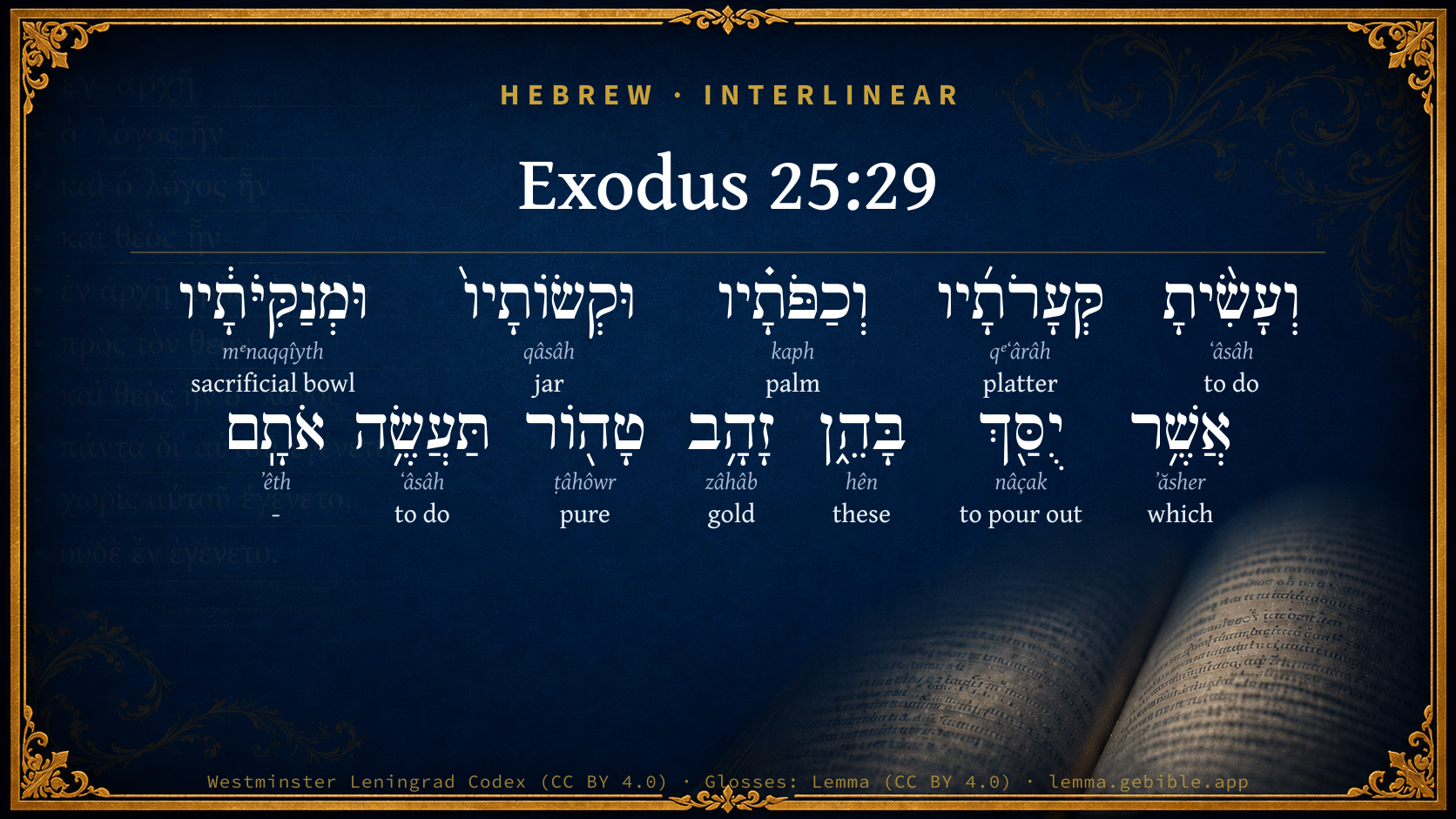
Hebrew (Westminster Leningrad Codex) Exodus 25:29 appears in the Hebrew Old Testament. The text above is from the Westminster Leningrad Codex. Each word links to its Strong’s number, a concise gloss, and parsing drawn from the Open Scriptures Hebrew Bible morphology. Click any word for its full Brown-Driver-Briggs (BDB) entry.
Download image
Cite this verse

Exodus 25:29 (World English Bible). Public Domain. Lemma interlinear Bible study tool, https://lemma.gebible.app/v/exodus/25/29.

Show BibTeX & RIS
BibTeX
RIS
English Translation
You shall make its dishes, its spoons, its ladles, and its bowls to pour out offerings with. Of pure gold shall you make them.
World English Bible · Public Domain
Highlights
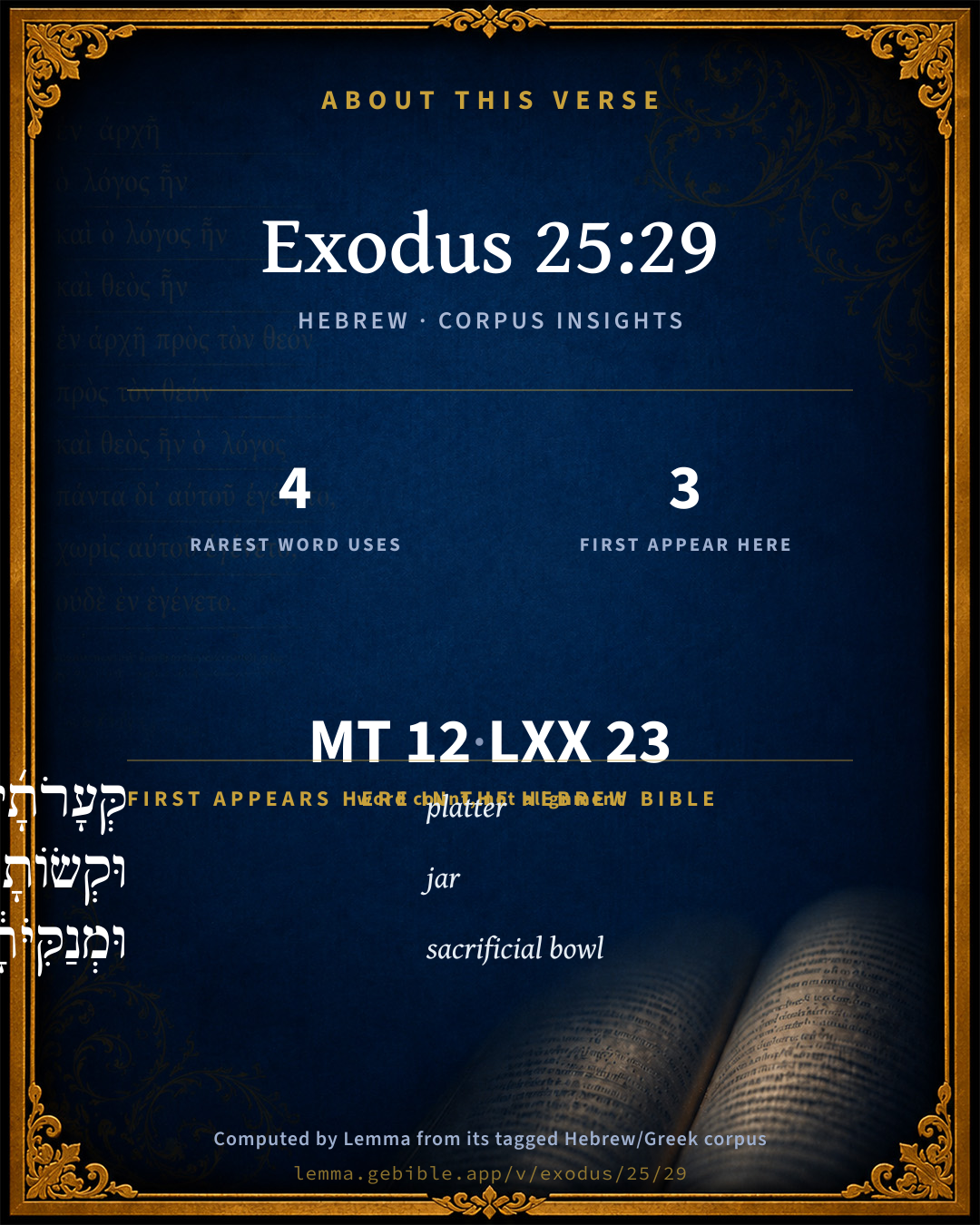
  • 3 first appearances in the Hebrew Bible
Full analysis ↓
Download a study sheet

One document with this verse’s original text, its word-by-word gloss line, the meaning frame, cross-references with their text, attributed commentary, and full source and license credits — printable, and it pastes into notes with its structure intact.

This verse Autodidact and up

Study sheet (.html) Plain text (.txt)

A passage Seminary Student

Up to 50 verses in one chapter. A passage sheet keeps up to 6 commentary sources and 12 cross-references per verse, in the order this page ranks them, and says so on the sheet whenever that leaves anything out. Ask for a single verse and you get the Autodidact verse sheet above.

Everything on this page stays free to read, with no account — the sheet is a download of what is already on screen, not access to it.

Want to remove ads? Support Godless Engineer
Compare translations 3

The same verse in 3 English versions, stacked beneath the original-language interlinear above. Click any original word for its lexicon entry.

Each is an independent rendering of the whole verse — the interlinear is not word-aligned to these translations.

Highlighted words mark where these versions differ — a whole-verse word diff, not a word-by-word alignment.

  • World English Bible Public Domain
    You shall make its dishes, its spoons, its ladles, and its bowls to pour out offerings with. Of pure gold shall you make them.
  • King James Version Public Domain
    And thou shalt make the dishes thereof, and spoons thereof, and covers thereof, and bowls thereof, to cover withal: of pure gold shalt thou make them.
  • unfoldingWord Literal Text CC BY-SA 4.0
    And you shall make its plates and its pans and its pitchers and its bowls with which it will be poured out. You shall make them pure gold.

unfoldingWord Literal Text — © unfoldingWord, licensed CC BY-SA 4.0. Word-aligned USFM3 via Door43 (git.door43.org/unfoldingWord/en_ult).

Versions to compare (up to 4)

3 of 4 selected

Show all 18 translations

Every available English version of this verse, each an independent rendering of the whole verse.

  • World English Bible Public Domain
    You shall make its dishes, its spoons, its ladles, and its bowls to pour out offerings with. Of pure gold shall you make them.
  • Berean Standard Bible Public Domain
    You are also to make the plates and dishes, as well as the pitchers and bowls for pouring drink offerings. Make them out of pure gold.
  • Majority Standard Bible Public Domain
    You are also to make the plates and dishes, as well as the pitchers and bowls for pouring drink offerings. Make them out of pure gold.
  • King James Version Public Domain
    And thou shalt make the dishes thereof, and spoons thereof, and covers thereof, and bowls thereof, to cover withal: of pure gold shalt thou make them.
  • American Standard Version (1901) Public Domain
    And thou shalt make the dishes thereof, and the spoons thereof, and the flagons thereof, and the bowls thereof, wherewith to pour out: of pure gold shalt thou make them.
  • Revised Version (1885) Public Domain
    And thou shalt make the dishes thereof, and the spoons thereof, and the flagons thereof, and the bowls thereof, to pour out withal: of pure gold shalt thou make them.
  • Geneva Bible (1599) Public Domain
    Thou shalt make also dishes for it, and incense cuppes for it, and couerings for it, and goblets, wherewith it shall be couered, euen of fine golde shalt thou make them.
  • Douay-Rheims (1899) Public Domain
    Thou shalt prepare also dishes, and bowls, censers, and cups, wherein the libations are to be offered of the purest gold.
  • Young's Literal Translation Public Domain
    and thou hast made its dishes, and its bowls, and its covers, and its cups, with which they pour out; of pure gold thou dost make them;
  • Literal Standard Version CC BY-SA 4.0
    and you have made its dishes, and its bowls, and its covers, and its cups, with which they pour out; you make them of pure gold;
  • Unlocked Literal Bible CC BY-SA 4.0
    You must make the dishes, spoons, pitchers, and bowls to be used to pour out drink offerings. You must make them of pure gold.
  • unfoldingWord Literal Text CC BY-SA 4.0
    And you shall make its plates and its pans and its pitchers and its bowls with which it will be poured out. You shall make them pure gold.
  • Darby Bible Public Domain
    And thou shalt make the dishes thereof, and cups thereof, and goblets thereof, and bowls thereof, with which to pour out: of pure gold shalt thou make them.
  • World Messianic Bible Public Domain
    You shall make its dishes, its spoons, its ladles, and its bowls with which to pour out offerings. You shall make them of pure gold.
  • Webster's Bible Public Domain
    And thou shalt make its dishes, and its spoons, and its covers, and its bowls, to cover it with: of pure gold shalt thou make them.
  • Free Bible Version CC BY-SA 4.0
    Make plates and dishes for the table, as well as pitchers and bowls for pouring out drink offerings. Make all of them out of pure gold.
  • Bible in Basic English Public Domain
    And make the table-vessels, the spoons and the cups and the basins for liquids, all of the best gold.
  • JPS Tanakh (1917) Public Domain
    And thou shalt make the dishes thereof, and the pans thereof, and the jars thereof, and the bowls thereof, wherewith to pour out; of pure gold shalt thou make them.

Literal Standard Version (2020), Covenant Press — licensed CC BY-SA 4.0. Text via the HelloAO Bible API (eBible.org). Unlocked Literal Bible (unfoldingWord) — licensed CC BY-SA 4.0. Text via the HelloAO Bible API (eBible.org). unfoldingWord Literal Text — © unfoldingWord, licensed CC BY-SA 4.0. Word-aligned USFM3 via Door43 (git.door43.org/unfoldingWord/en_ult). Free Bible Version, Dr. Jonathan Gallagher — licensed CC BY-SA 4.0. Text via the HelloAO Bible API (eBible.org).

Word by word

More ways to search: Search by grammar → Find every occurrence → Compare this word →

Practice this passage: Drill this verse → Learn its vocabulary →

וּקְשׂוֹתָיו֙
qâsâh
H7184
“and · jars · his”
Conjunction + Noun, Common, Feminine, Plural, Construct + Suffix, Personal, 3rd Person, Masculine, Singular
Part of Speech
Conjunction + Noun
Type
Common
Gender
Feminine
Number
Plural
State
Construct
Full BDB Definition

Origin: from an unused root meaning to be round

TWOT: 2080 , 2080a

a kind of jug, jar
  1. וְעָשִׂ֨יתָ ʻâsâh H6213 “and · to do” Conjunction + Verb, Qal, Sequential Perfect, 2nd Person, Masculine, Singular
  2. קְּעָרֹתָ֜יו qᵉʻârâh H7086 “platters · his” Noun, Common, Feminine, Plural, Construct + Suffix, Personal, 3rd Person, Masculine, Singular
  3. וְכַפֹּתָ֗יו kaph H3709 “and · palms · his” Conjunction + Noun, Common, Feminine, Plural, Construct + Suffix, Personal, 3rd Person, Masculine, Singular
  4. וּמְנַקִּיֹּתָ֔יו mᵉnaqqîyth H4518 “and · sacrificial bowls · his” Conjunction + Noun, Common, Feminine, Plural, Construct + Suffix, Personal, 3rd Person, Masculine, Singular
  5. אֲשֶׁ֥ר ʼăsher H834 “which” Particle, Relative
  6. יֻסַּ֖ךְ nâçak H5258 “to pour out” Verb, Hophal, Imperfect, 3rd Person, Masculine, Singular
  7. בָּהֵ֑ן hên H2004 “in/at · them” Preposition + Suffix, Personal, 3rd Person, Feminine, Plural
  8. זָהָ֥ב zâhâb H2091 “gold” Noun, Common, Masculine, Singular, Absolute
  9. טָה֖וֹר ṭâhôwr H2889 “pure” Adjective, Adjective, Masculine, Singular, Absolute
  10. תַּעֲשֶׂ֥ה ʻâsâh H6213 “to do” Verb, Qal, Imperfect, 2nd Person, Masculine, Singular
  11. אֹתָֽם ʼêth H853 “- · them” Particle, Direct Object + Suffix, Personal, 3rd Person, Masculine, Plural

About this verse

These counts appear in no published source. They are computed here, from the morphology-tagged text and Lemma’s own curated glosses. What Lemma adds →

12
words
11
distinct lemmas
Pentateuch
section

Notable vocabulary

The rarest word here is וּקְשׂוֹתָיו֙ jar H7184 — appearing just 4 times in the whole Hebrew Bible.

First appearance in Scripture

These words make their first canonical appearance in the Hebrew Bible here:

  • קְּעָרֹתָ֜יו platter H7086
  • וּקְשׂוֹתָיו֙ jar H7184
  • וּמְנַקִּיֹּתָ֔יו sacrificial bowl H4518

Shared distinctive vocabulary

וּקְשׂוֹתָיו֙ jar H7184 occurs in 4 verses of the Hebrew Bible. Also found in:

Grammatical profile

  • 3 verbs
  • 5 nouns
  • 1 adjective
  • 1 preposition
  • 2 particles

Verb forms

  • וְעָשִׂ֨יתָ Qal · Sequential Perfect
  • יֻסַּ֖ךְ Hophal · Imperfect
  • תַּעֲשֶׂ֥ה Qal · Imperfect

Repetition

A word recurs within this verse — often emphatic in Hebrew:

  • וְעָשִׂ֨יתָ to do H6213 ×2

Hebrew & Septuagint length

In English translation the verse runs 24 words from the Hebrew and 28 from the Septuagint (LXX English) — closely comparable.

A rough comparison of the two English renderings, which tokenize alike — not a word-level alignment.

Word counts can differ between the Hebrew and the Greek without any difference in meaning — e.g. the Hebrew direct-object marker אֵת has no separate Greek word, and Greek often adds the article ὁ.

In the original languages it is 12 Hebrew tokens and 23 Greek tokens — but the two are counted differently (Hebrew bundles its prefixes and suffixes into one token; the Greek is in lemma form), so that isn’t a like-for-like length.

Cross-references

12

Topical passages linked to Exodus 25:29 in the Treasury of Scripture Knowledge — connected by theme and wording, ordered by reader-vote popularity; previews shown in the World English Bible.

  • Numbers 4:7 On the table of show bread they shall spread a blue cloth, and put on it the dishes, the spoons, the bowls, and the cups with which to pour out; and the continual bread shall be on it.
  • Exodus 37:16 He made the vessels which were on the table, its dishes, its spoons, its bowls, and its pitchers with which to pour out, of pure gold.
  • Revelation 3:20 Behold, I stand at the door and knock. If anyone hears my voice and opens the door, then I will come in to him, and will dine with him, and he with me.
  • Leviticus 24:5–9 "You shall take fine flour, and bake twelve cakes of it: two tenth parts of an ephah shall be in one cake.
  • Numbers 7:13 and his offering was: one silver platter, the weight of which was one hundred thirty shekels, one silver bowl of seventy shekels, after the shekel of the sanctuary; both of them full of fine flour mixed with oil for a meal offering;
  • Numbers 7:19 He offered for his offering: one silver platter, the weight of which was one hundred thirty shekels, one silver bowl of seventy shekels, after the shekel of the sanctuary; both of them full of fine flour mixed with oil for a meal offering;
  • Numbers 7:31–33 gave his offering: one silver platter, the weight of which was one hundred thirty shekels, one silver bowl of seventy shekels, after the shekel of the sanctuary; both of them full of fine flour mixed with oil for a meal offering;
  • 1 Kings 7:50 and the cups, and the snuffers, and the basins, and the spoons, and the fire pans, of pure gold; and the hinges, both for the doors of the inner house, the most holy place, and for the doors of the house, [to wit], of the temple, of gold.
  • 2 Chronicles 4:22 and the snuffers, and the basins, and the spoons, and the fire pans, of pure gold: and as for the entry of the house, the inner doors of it for the most holy place, and the doors of the house, [to wit], of the temple, were of gold.
  • Ezra 1:9–11 This is the number of them: thirty platters of gold, one thousand platters of silver, twenty-nine knives,
  • Song of Solomon 5:1 I have come into my garden, my sister, my bride. I have gathered my myrrh with my spice; I have eaten my honeycomb with my honey; I have drunk my wine with my milk. Friends Eat, friends! Drink, yes, drink abundantly, beloved. Beloved
  • Jeremiah 52:18–19 The pots also, and the shovels, and the snuffers, and the basins, and the spoons, and all the vessels of brass with which they ministered, took they away.

Cross-references courtesy of OpenBible.info (CC BY 4.0).

Hebrew and Greek witnesses Masoretic Hebrew ↔ Greek Septuagint

The same verse in the two great witnesses to the Old Testament, shown verse-for-verse.

These are two independent witnesses, not word-aligned to each other, and the Septuagint is shown in lemma (dictionary) form.

Hebrew Exodus 25:29 Masoretic · Westminster Leningrad Codex

וְעָשִׂ֨יתָ קְּעָרֹתָ֜יו וְכַפֹּתָ֗יו וּקְשׂוֹתָיו֙ וּמְנַקִּיֹּתָ֔יו אֲשֶׁ֥ר יֻסַּ֖ךְ בָּהֵ֑ן זָהָ֥ב טָה֖וֹר תַּעֲשֶׂ֥ה אֹתָֽם

You shall make its dishes, its spoons, its ladles, and its bowls to pour out offerings with. Of pure gold shall you make them.

World English Bible · Public Domain

Greek LXX Exodus 25:29 Septuagint · lemma form

καί ποιέω ὁ τρυβλίον αὐτός καί ὁ θυΐσκη καί ὁ σπονδεῖον καί ὁ κύαθος ἐν ὅς σπένδω ἐν αὐτός χρυσίον καθαρός ποιέω αὐτός

And you shall make its dishes and its censers, and its bowls, and its cups, with which you shall offer drink-offerings: of pure gold shall you make them.

LXX2012 (modern English Septuagint) · Public Domain

On this verse, The Cambridge Bible for Schools and Colleges discusses the Septuagint’s reading. Read the note in Commentary ↓

Hebrew: Westminster Leningrad Codex (CC BY 4.0). Greek: Septuagint (public domain); English from LXX2012 (modern English Septuagint) (Public Domain). How the Septuagint differs from the Hebrew →

Targum (Aramaic paraphrase)

2

The Targum is the ancient Jewish Aramaic paraphrase of the Hebrew Scriptures — an interpretive translation, not the Hebrew text itself. Onkelos (literal) and Pseudo-Jonathan (expansive) render the Torah, and Jonathan the Prophets. Coverage is partial: where no permissively-licensed English translation exists for a verse, only the Aramaic is shown. This is verse-level text, not a word-by-word alignment to the Hebrew.

  1. Targum Onkelos Torah (Genesis–Deuteronomy)
    וְתַעְבֵּד מָגִיסוֹהִי וּבָזִכּוֹהִי וְקַסְוָתֵהּ וּמְכִילָתֵהּ דְיִתְנַסַךְ בְּהֵן דְהַב דְכֵי תַּעְבֵּד יָתְהוֹן:

    (no public-domain English translation for this verse)

    Targum Onkelos — Aramaic: “Onkelos Genesis” (public domain); “Onkelos Exodus” (public domain); “Onkelos Leviticus” (public domain); “Onkelos Numbers” (public domain); “Onkelos Deuteronomy” (public domain). English: “Sefaria Community Translation” (CC0 1.0 (public-domain dedication)); “J.W. Etheridge. The Targums of Onkelos and Jonathan Ben Uzziel on the Pentateuch. London: Longmans, Green, 1862” (public domain). Text via Sefaria.

  2. Targum Pseudo-Jonathan Torah (Genesis–Deuteronomy)
    וְתַעֲבֵיד פַּיַילְתּוֹי וּבָזִיכוֹי וְקַשְוָותוֹי וּמְכִילְתוֹי דִי יִשְׁתַּמֵּשׁ וְיִתְרוֹק בְּהוֹן דִּדְהַב דְּכֵי תַעֲבֵיד יַתְהוֹן

    And thou shalt make its dishes and its spoons, its tankards and its measures, which are for the service of libation; of pure gold shalt thou make them.

    Targum Pseudo-Jonathan — Aramaic: “Targum Jonathan on Genesis” (public domain); “Targum Jonathan on Exodus” (public domain); “Targum Jonathan on Leviticus” (public domain); “Targum Jonathan on Numbers” (public domain); “Targum Jonathan on Deuteronomy” (public domain). English: “The Targum of Jonathan ben Uzziel, trans. J. W. Etheridge, London, 1862” (public domain). Text via Sefaria.

Commentary

Notes on Exodus 25:29 from classic Christian and Jewish commentators (each source and its license shown beneath its notes). The classic Christian expositions comment on the surrounding passage and are grouped to its opening verse, so a note may address several verses; the Jewish commentaries on the Tanakh (Rashi and others) are per-verse, so they appear only where the commentator wrote on this verse.

Lemma curates 59 commentaries, every one of them public domain or Creative Commons licensed, each selected and text-cleaned for this edition rather than reprinted as found. About our sources →

Trapp's Complete Commentary

John Trapp

Exo 25:29 And thou shalt make the dishes thereof, and spoons thereof, and covers thereof, and bowls thereof, to cover withal: [of] pure gold shalt thou make them.

Ver. 29. The dishes thereof, &c.] Haply to hold the loaves and frankincense.

Spoons.] To put the frankincense into those dishes.

Covers and bowls to cover withal.] Or, To pour out with.

John Trapp, A Commentary or Exposition upon All the Books of the Old and New Testament (1647–1656) — public domain. Text from a community e-Sword module.

Tyndale Open Study Notes

Tyndale Open Resources

25:29 The liquid offerings included olive oil and wine (see 29:40).

Tyndale Open Study Notes — © Tyndale Open Resources, licensed CC BY-SA 4.0. Text via the HelloAO Bible API.

Geneva Bible (1599)

Geneva Bible translators

To set the bread upon.

Geneva Bible (1599) marginal notes — public domain. Text via Bolls.life.

Jamieson, Fausset & Brown

Robert Jamieson, A. R. Fausset & David Brown

dishes--broad platters.

spoons--cups or concave vessels, used for holding incense.

covers--both for bread and incense.

bowls--cups; for though no mention is made of wine, libations were undoubtedly made to God, according to JOSEPHUS and the rabbins, once a week, when the bread was changed.

to cover withal--rather, "to pour out withal."

Jamieson, Fausset & Brown — Commentary Critical and Explanatory on the Whole Bible (1871) — public domain (CC PDM 1.0). Text via the HelloAO Bible API.

Adam Clarke's Commentary

Verse 29. The dishes thereof] קערתיו kearothaiv, probably the deep bowls in which they kneaded the mass out of which they made the shew-bread.

And spoons thereof] כפתיו cappothaiu, probably censers, on which they put up the incense; as seems pretty evident from Nu 7:14, Nu 7:20, Nu 7:26, Nu 7:32, Nu 7:38, Nu 7:44, Nu 7:50, Nu 7:56, Nu 7:62, Nu 7:68, Nu 7:74, Nu 7:80, Nu 7:86, where the same word is used, and the instrument, whatever it was, is always represented as being filled with incense.

Covers thereof] קשותיו kesothaiv, supposed to be a large cup or tankard, in which pure wine was kept on the table along with the shewbread for libations, which were poured out before the Lord every Sabbath, when the old bread was removed, and the new bread laid on the table.

Bowls thereof] מנקיתיו menakkiyothaiv, from נקה nakah, to clear away, remove, empty, c. supposed by Calmet to mean, either the sieves by which the Levites cleansed the wheat they made into bread, (for it is asserted that the grain, out of which the shew-bread was made, was sowed, reaped, ground, sifted, kneaded, baked, &c., by the Levites themselves,) or the ovens in which the bread was baked. Others suppose they were vessels which they dipped into the kesoth, to take out the wine for libations.

Adam Clarke's Commentary on the Bible (1810–1826) — public domain. Text from a community e-Sword/MySword module.

Ellicott's Commentary for English Readers

(29) The dishes thereof . . . —The “dishes” of the shewbread table were probably large bowls in which the loaves or “cakes” were brought to the table. Such bowls are common in the Egyptian wall decorations. The so-called “spoons” were small pots in which the incense was put (Lev_24:7) and burnt. Two such appeared upon the table on the Arch of Titus. The “covers” and “bowls” are flagons and chalices to contain the drink offerings which were necessary accompaniments of every meat offering. To cover withal.—Rather (as in the margin), to pour out withal. Drink offerings were poured out in libation.

A Bible Commentary for English Readers, edited by Charles John Ellicott (1878–1897) — public domain. Text from a community e-Sword module.

The Cambridge Bible for Schools and Colleges

gen. ed. J. J. S. Perowne

29. dishes] also Exo_37:16, Num_4:7; Numbers , 14 times in Numbers 7 (‘charger,’ each weighing 130 shekels=c. 67 oz., and filled with fine flour mingled with oil). The root in Arab, signifies to be deep. A deep and large gold dish, or other similar vessel, must be thought of, in which the large oblong cakes were either brought to the Table, or laid out upon it.

spoons] cups for the frankincense, which was placed upon the loaves, and burnt (Lev_24:7) at the end of the week on the altar of burnt-offering: LXX. θυίσκαι (‘incense-cups’), as 1Ma_1:22. Also Exo_37:16, Num_4:7; Num_4:16 times in Numbers 7 (each 10 shekels=5 oz. in weight, and filled with incense); and of the incense-cups in the Temple, 1Ki_7:50 al. Cf. Jos. Ant. iii. 6. 6 ‘and above the loaves were placed two golden cups (φιάλαι) full of incense’; and the cups upon the Table on the Arch of Titus.

flagons … and chalices (Speaker’s Comm.; LXX. κύαθοι)] viz. for the wine, which, though this is not stated explicitly in the OT., apparently entered into the ritual of the Presence-bread. The flagons (also Exo_37:16, Num_4:7, 1Ch_28:17†) would be for keeping the wine in; the ‘chalices’ (Exo_37:16, Num_4:7, Jer_52:19†) for making the libations with,—we may suppose that, like other libations, they were poured out at the base of the Bronze altar (cf. Exo_29:40; Sir_50:15).

The Cambridge Bible for Schools and Colleges (gen. ed. J. J. S. Perowne; Cambridge University Press, 1878–1918) — public domain. Text from a community e-Sword module.

John Gill's Exposition

And thou shalt make a candlestick of pure gold,.... Another piece of household furniture, and an useful one, especially in a house where there are no windows, as there were none in the tabernacle, denoting the darkness of the legal dispensation, see Kg2 4:10. This candlestick was set in the holy place, on the south side of it, opposite the shewbread table, Exo 26:35 and was typical of the church of God; so the candlesticks John had a vision of signify seven churches, Rev 1:13, the general use of which is, to hold forth light put into it, for it has none of itself, but what is put there by Christ: and this is not the light of nature and reason, nor the law of Moses, but the Gospel of Christ; which where it is set, gives light and dispels darkness; is useful to walk and work by; does not always burn alike, and will shine the brightest in the end of the world: this light is put into the candlestick by Christ the fountain of all light, and from whom all light is communicated, particularly the Gospel; and being put there, lost sinners are looked up by it, strayed ones are brought back, hypocrites are detected, and saints are enlightened, comforted, and refreshed: and this candlestick being made of "pure gold", may denote the worth and value of the church of God, and the members of it, their splendour, glory, and purity they have from Christ, and their duration; and thus the seven churches of Asia are compared to seven golden candlesticks, Rev 1:12, and under the form of a golden candlestick is the Gospel church set forth in Zac 4:2. Josephus (b) is of opinion the candlestick has some mystical meaning in it, it being of seventy parts, as he says, refers to the twelve signs of the Zodiac, through which the seven planets take their course, whom Milton (c) follows:

of beaten work shall the candlestick be made; not of gold melted, and poured into a mould, from whence it might take its form; but it was beaten with an hammer out of an entire mass of gold, and not the following parts made separately, and then joined:

his shaft, and his branches, his bowls, his knops, and his flowers, shall be of the same; not only of the same metal, but beaten out of the same mass and lump of gold; these are the several parts of the candlestick: the "shaft" is the trunk and body of the candlestick, which stood in the middle of it, and in which the several parts united; and may either be typical of Christ, who is principal and head of the church, and stands in the middle of it, and is the cement of the several parts of it, and is but one, the one head, Mediator and Saviour; or else the church universal, of which particular ones are parts: its "branches" may either signify the several members of churches, who are in Christ as branches, and hold forth the word of light; or else minister, of the Gospel, who have their commission and gifts from him, and are held by him as stars in his right hand; or else particular churches, which are branches of the church universal: its "bowls", which were to hold oil for the lamps, may denote men of capacity in the churches, full of the gifts and graces of the Spirit, able to teach others also: and the "knops" and "flowers" were for decoration, and may signify the graces of the Spirit, with which private members and believers are adorned; or the gifts of the Spirit with which the ministers of the word are furnished, and appear beautiful, publishing the glad tidings of salvation by Christ.

(b) Antiq. l. 3. c. 7. sect. 7. (c) Paradise Lost. B. 12. ver. 254, 255, 256.

John Gill's Exposition of the Whole Bible (1746–1763) — public domain (CC PDM 1.0). Text via the HelloAO Bible API.

Haydock's Catholic Bible Commentary

Dishes. (acetabulum.) Properly, a vessel to hold vinegar, but used for various purposes. --- Bowls, or vials full of wine. (Tostat) --- Censers, to contain incense, &c., chap. xxxvii. 16. The first term, karuth, might also mean vessels to contain the flour and oil of which these loaves were made, Numbers vii. 13. The Levites made the bread themselves, (1 Paralipomenon xxii. 29,) and even sowed the corn, and did every thing about it. (St. Jerome in Malachias i. 7.) The second term, coputh, may denote vessels to keep incense; the third, monkiuth, instruments to clean either the floor or the table, &c. All these vessels seem mended to accompany the table of shew-bread. --- Cups, used for libations (chap. xxxvii. 16; Numbers iv. 7) of wine, on the sabbath. Kossuth signifies a porringer or dish, like the ancient patera. Whether wine was placed on this table, we cannot determine. But we read of salt, (Calmet) which was to accompany all God’s sacrifices, Leviticus ii. 13.

George Leo Haydock (1774–1849), Haydock's Catholic Family Bible and Commentary, 1859 edition — public domain. Excludes Psalms (Douay-Rheims chapter numbering differs from Protestant) and Deuterocanonical books (Catholic canon only).

Matthew Poole's English Annotations

The dishes, in which the bread and frankincense upon it were put, Lev 24:7. Of this sort there were twelve, one for every loaf.

Spoons, in which incense was put, as appears from Num 7:14, and by which incense was either put into the dishes or taken out of them, as occasion required.

Covers; so the Hebrew word is used, Exo 37:16; Num 4:7. Herewith either the bread, or incense, or both, were covered.

Bowls, to cover the same things. So this and the former were two several sorts of covers, the one deeper than the other, one to cover the bread, another the incense. Or, bowls thereof, to pour out withal, to wit, liquid things, as wine and oil, when they were offered. See Gen 35:14. Or these last words may relate not only to the bowls, but the other things, here mentioned, and may be thus rendered, wherewith it, to wit, the table, shall be covered, as indeed it was in a manner quite covered with these vessels.

Matthew Poole's English Annotations on the Holy Bible (1683–1685) — public domain. Text from a community e-Sword/MySword module.

Whedon's Commentary on the Bible

Daniel D. Whedon

29. The dishes — Probably large deep plates used for the purpose of carrying the showbread to and from the table.

Spoons — Or, perhaps, cups, small hollow vessels used sometimes, according to Num_7:14, for holding incense.

Covers… bowls — These were vessels for holding the drink offerings, as appears from the words which immediately follow, to pour out withal, (margin,) wrongly translated to cover withal. The Speaker’s Commentary renders this part of the verse thus: “And thou shalt make its bowls and its incense-cups and its flagons and its chalices for pouring out, (the drink offerings.)”

Daniel D. Whedon (gen. ed.), Commentary on the Old and New Testaments (1874–1909) — public domain. Text from a community e-Sword module.

The Pulpit Commentary

The dishes thereof. Literally" its dishes," or rather perhaps, "its bowls" (LXX trublia). They were probably the vessels in which the loaves were brought to the table. Loaves are often seen arranged in bowls in the Egyptian tomb decorations (Lepsius, Denkmaler, pt. 2, pls. 5, 19, 84, 129, etc.). Spoons thereof. Rather, "its incense cups small jars or pots in which the incense, offered with the loaves, (Lev_24:5) was to be burnt. Two such were represented in the bas-relief of the table on the Arch of Titus. Covers thereof and bowls thereof. Rather, "its flagons and its chalices" (LXX spondeia kaiaqoi) vessels required for the libations or "drink offerings" which accompanied every meat-offering. To cover withal Rather, as in the margin, "to pour out withal." So the Septuagint, Vulgate, Syriac, and most of the Targums.

The Pulpit Commentary (1880–1919), ed. H.D.M. Spence-Jones & Joseph S. Exell — public domain. Text from a community e-Sword module.

Keil & Delitzsch

C. F. Keil & F. Delitzsch

Vessels of pure gold were also to be made, to stand upon the table (cf. Exo 37:16). קערת, τὰ τευβλία (lxx), large deep plates, in which the shew-bread was not only brought to the table, but placed upon it. These plates cannot have been small, for the silver קערת, presented by Nahshon the tribe prince, weighed 130 shekels (Num 7:13). כּפּת, from כּף a hollow hand, small scoops, according to Num 7:14, only ten shekels in weight, used to put out the incense belonging to the shew-bread upon the table (cf. Lev 24:7 and Num 7:14): lxx θυΐ́σκη, i.e., according to the Etymol. Magn., σκάφη ἡ τὰ θύματα δεχομένη. There were also two vessels "to pour out," sc., the drink-offering, or libation of wine: viz., קשׂות, σπονδεῖα (lxx), sacrificial spoons to make the libation of wine with, and מנקּיּת, κύαθοι (lxx), goblets into which the wine was poured, and in which it was placed upon the table. (See Exo 37:16 and Num 4:7, where the goblets are mentioned before the sacrificial spoons.)

Keil & Delitzsch — Biblical Commentary on the Old Testament (1861–1891) — public domain (CC PDM 1.0). Text via the HelloAO Bible API. (Old Testament only.)

Rashi

Rabbi Shlomo Yitzchaki (Rashi)

ועשית קערתיו וכפתיו AND THOU SHALT MAKE THE DISHES THEREOF AND THE SPOONS THEREOF — קערתיו are the forms (moulds) that were made to fit the shape of the bread (Menachot 97a). The bread was shaped like a case broken open as regards two of its sides (two opposite sides of which have been removed; these are what we would call the front and the back). It had a bottom underneath, but no top, and this bottom was turned up on both ends to form, as it were, walls. On this account it was called לחם הפנים, “bread with faces” — because it had faces (surfaces) looking in both directions towards the sides of the House (the Sanctuary). The bread was placed lengthwise across the breadth of the table with its sides standing up exactly in a line with the edge of the table. There were made for it a golden mould and an iron mould: in the iron one it was baked, and when it was taken out from the oven it was put on the golden one until the next day, the Sabbath, when it was arranged on the table (the mould then being removed). This golden mould is here called קערה (Menachot 94a; cf. also Berliner’s Rashi 2nd ed. p. 426).

וכפתיו AND ITS SPOONS — ladles (or rather, cups with flat bottoms) in which the incense was put. There were two such vessels for the two handfuls of incense which was put upon the piles in which the loaves were arranged, as it is said, (Leviticus 24:7) “And thou shalt put pure frankincense upon each pile”.

וקשתיו — These had the form of halves of hollow canes which are split along their length (Menachot 96a). Articles similar to these were made of gold and three of them were set in a row above each loaf so that another loaf (that above it) should rest on top of the “canes”; thus they (these canes) separated one loaf from another so that air could enter between and they would not become mouldy (Menachot 97a). In the Arabic language anything hollow is called קסוא (and this corresponds to the root of this word, which therefore denotes something hollow).

מנקיותיו — It is translated in the Targum by ומכילתיה “and the trestles (supports) thereof” (cf. Menachot 96a). According to him these were attachments to the table like a kind of golden pegs (pillars) standing on the floor and reaching in height far above the table up to the height of the pile of bread. They were notched in five places, one above the other, and the ends of the canes which were between one loaf and another were supported on these notches so that the weight of the upper loaves should not press heavily upon the lower ones in which event these would be broken. The word מכילתיה used by Onkelos as a rendering of מנקיותיו denotes “bearers;” it is of the same root as the verb in (Jeremiah 6:11) “I am weary to bear (הכיל) it.” But as for the term מנקיות (which is a Piel of נקה and would denote “cleansers”) I do not know how it is applicable to these attachments the purpose of which was not to keep the bread clean but merely to serve as supports for the canes. But there are some of the Jewish Sages who hold that קשתיו (connected with קשה “hard”) are the pegs (or pillars) and they are so called because they served to keep it (the loaves) hard and firm, so that it should not break, whilst מנקיותיו are the “canes” which kept the bread clean so that it should not become mouldy. Onkelos, however, who translated מנקיותיו by מכילתיה understood it according to the opinion of him who holds that מנקיות were the supporting pillars (cf. Menachot 97a).

אשר יסך בהן means BY WHICH THEY SHALL BE COVERED. It is of the קשות, the “canes,” that the words אשר יסך are said, because these lay over it like a cover and a screen. Thus, too, in another passage (Numbers 4:7) it says, ואת קשות הנסך, “and the קשות for covering;” both words, יסך and הנסך, denote screening and covering.

Rashi on the Tanakh — English translations: “The Judaica Press complete Tanach with Rashi, translated by A. J. Rosenberg” (CC BY 4.0); “Pentateuch with Rashi's commentary by M. Rosenbaum and A.M. Silbermann, 1929-1934” (public domain); “The Metsudah Tanach series, Lakewood, N.J” (CC BY 4.0); and “The Book of Joshua, Metsudah Publications, 1997” (CC BY 4.0). Text via Sefaria.

Ramban (Nachmanides)

Rabbi Moshe ben Nachman (Ramban / Nachmanides)

AND THOU SHALT MAKE ‘KE’AROTHAV VEKHAPOTHAV UKSOTHAV UMENAKIYOTHAV.’ Rashi explained: “Ke’arothav are the forms [the moulds that were made to fit the shape of the bread]; vekhapothav are spoons in which the incense was put; uksothav are rods in the shape of halves of hollow canes [which were put between one loaf and another so that they would not become mouldy]; umenakiyothav are the trestles which were notched in [five places] to support the canes.” These vessels [that Rashi referred to] are indeed mentioned in the Gemara. And the Rabbi further said: “The word mechilathei [which Onkelos used for the Hebrew menakiyothav] means ‘bearers,’ similar to the expressions: and I weary myself ‘kalkeil’ (to bear it); I am weary ‘hachil’ (bearing it)., 6:11. The beginning of the verse reads: Therefore I am full of the fury of the Eternal. Now the Sages of Israel have differed on this. For some say that ksothav are the trestles, and menakiyothav are the hollow canes. But Onkelos who translated menakiyothav by [the Aramaic] mechilathei was of the same opinion as he who says that menakiyoth are the trestles [supporting pillars attached to the table].” These are Rashi’s words. But I do not find them to be correct, for the word mechilathei [of Onkelos] in the Aramaic language is but a term meaning measures, such as ephahs and the like. Thus Onkelos rendered, eiphath tzedek — mechilon dikshot (a true measure); Thou shalt not have in thy house ‘eiphah v’eiphah’ — thou shalt not have mechilta umechilta (diverse measures). In a similar sense it is found whenever mentioned in the Talmud and in the Sages’ words: kayal meikal (he was measuring);. bimchilta d’kayil inish ba mitkil (with the measure that one measures others, with that he is measured). Similarly, I am weary ‘hachil’, 6:11. The beginning of the verse reads: Therefore I am full of the fury of the Eternal. means “I am weary of being a holding measure” [of G-d’s fury], and it is associated with these expressions: alpayim bath yachil (it held two thousand baths); v’chol bashalish aphar ha’aretz (and He comprehended the dust of the earth in a measure); too little ‘meihachil’ (to receive) the burnt offering. Similarly, I am weary ‘hachil’, 6:11. The beginning of the verse reads: Therefore I am full of the fury of the Eternal. is in my opinion not an expression of “bearing” but is instead a form of that very same meaning of “holding,” thus saying, “I am weary of holding” [G-d’s fury], similar in usage to these expressions: the land is not able ‘l’hachil’ (to hold) all his words; the spirit of a man ‘y’chalkeil’ his infirmity, meaning that he will be able to hold the pain within himself and not become weary [and broken in spirit] because of it. Behold, heaven and the heaven of heavens cannot ‘y’chalkelucha’ — they cannot hold and contain the greatness of Your exaltedness, for there is no limit and measure to You — how much less this house that I have built! 'Y’chalkeil' his words rightfully means that he is not a fool who spendeth all his spirit, but holds his words within himself when necessary, and uses them as necessary. 'Vay’chalkeil Yoseiph' means that Joseph gave them as much food as they could hold; he gave neither too much nor too little, but bread according to the want of their little ones. (Genesis 47:12). And such is the explanation of all [other similar expressions].But Onkelos’ opinion [who translated umenakiyothav — umechilathei] is not clear. Perhaps menakiyothav is in the opinion of Onkelos a term for measures, since they had [in the Tabernacle and later in the Sanctuary] a measure holding two tenth parts [of an ephah] flour, with which to measure one cake, and they did not measure it twice with the one tenth measure of the meal-offering. We must then say that Onkelos differs from the Mishnah which teaches: “There were two dry-measures in the Sanctuary: the tenth, and the half-tenth” [of an ephah], and in his opinion there were three dry-measures: the tenth, the half-tenth, and the two tenths.The correct interpretation of Onkelos’ opinion appears to me to be that mechila is the form (mould) made for the dough, just as the Rabbis have said:, 94a. “There were in the Tabernacle three moulds [for the showbread]: he placed it in a mould whilst it was still dough; when baked in the oven it was put in another mould, and when he took it out he placed it in a [third] frame so that it should not spoil.” This [third] frame which was used so that it should not spoil did not have to be shaped to the form of the bread and its size; instead, it was made like a sort of dish to support the sides of the bread, this being the ke’arothav mentioned in the verse. But the first mould for the dough was shaped to the form of the bread and its size, namely, ten [handbreadths] long and five wide, and its horns seven fingerbreadths [high]. Into this mould the dough was put, measured and shaped to fit its form, and for this reason it was called mechila because it was made to “the measure.” The term menakiyoth then [according to Onkelos] is a name just like ephah and s’ah [a third of the ephah measure is a s’ah], similar, to ke’arothav and ksothav and other nouns which are not descriptive. Perhaps those just measures which are called a just ephah, and a just hin, and termed menakiyoth [of the root naki — clean] because they are clean of any falsehood, and thus they clear their owners of any cheating and sin. And ksavoth is a general term covering the canes [which were put between one loaf and another] and the trestles [notched in five places upon which the canes separating the loaves rested]. Perhaps because of their notches they were so called [ksavoth], with the letter tzade [ktzavoth — sides, corners] being used instead of the letter sin [ksavoth], this word [ksavoth] being similar to [the word ktzavoth found in the following verse]: so that they that dwell in ‘ktzavoth’ (the uttermost parts) stand in awe of Thy signs, by interchanging the letter tzade with the sin, just like in the word s’chok [“laughter,” which is the word tzchok].Rabbi Abraham ibn Ezra wrote: “There is an error in Chronicles,. — Ibn Ezra’s comment is to the effect that there are new vessels here mentioned for the table in the Sanctuary that are not found here in the Torah in connection with the table in the Tabernacle. — Ramban will point out mat Ibn Ezra erred in thinking that this Verse 17 refers back to the tables of showbread mentioned above in Verse 16, since it really refers back to Verse 13, as explained in the text. for in speaking of the vessels of the table in place of ke’aroth [mentioned here] it writes mizrakoth (basins); in place of kapoth [mentioned here] it writes kiporim (bowls); ksavoth is mentioned there as here; and in the place of menakiyoth it speaks of mizlagoth (forks). And all these were made of gold for the purpose of the table [and yet we do not find the mizrakoth, kiporim, and mizlagoth mentioned here in connection with the table in the Tabernacle]! Perhaps these were other vessels which David commanded to be placed on the tables which his son Solomon would make, but the table in the Tent of Meeting did not have these vessels.” The error, however, is in Rabbi Abraham’s words, [not in the Book of Chronicles], for that which Scripture states, and the forks, and the basins, and the jars of pure gold; and for the golden bowls by weight for every bowl,. — Ibn Ezra’s comment is to the effect that there are new vessels here mentioned for the table in the Sanctuary that are not found here in the Torah in connection with the table in the Tabernacle. — Ramban will point out mat Ibn Ezra erred in thinking that this Verse 17 refers back to the tables of showbread mentioned above in Verse 16, since it really refers back to Verse 13, as explained in the text. is not connected only with the tables of showbread [mentioned in the preceding verse], but it reverts back to that which Scripture stated [several verses above], and for all the work of the service of the house of the Eternal, and for all the vessels of service in the house of the Eternal., Verse 13. And then it continues, of gold, for all vessels of every kind of service, Verse 14. and then it mentioned, and the forks, and the basins. — Ibn Ezra’s comment is to the effect that there are new vessels here mentioned for the table in the Sanctuary that are not found here in the Torah in connection with the table in the Tabernacle. — Ramban will point out mat Ibn Ezra erred in thinking that this Verse 17 refers back to the tables of showbread mentioned above in Verse 16, since it really refers back to Verse 13, as explained in the text. which are vessels of the altar, and the jars for the table, and the bowls for the altar. And finally it stated, and for the altar of incense refined gold by weight, Verse 18. concluding: All this [do I give thee] in writing, as the Eternal hath made me wise by His hand upon me, even all the works of this pattern., Verse 19. Thus David [in speaking to his son Solomon] included all needs of the Sanctuary.

Ramban (Nachmanides) on the Tanakh — English translation: “Commentary on the Torah by Ramban (Nachmanides). Translated and annotated by Charles B. Chavel. New York, Shilo Pub. House, 1971-1976” (CC BY 4.0). Text via Sefaria.

Lesson kit

Teaching starters — assembled from the data on this page, not authored interpretation. Every prompt links to the verse data it draws on. Edit before teaching.

Exodus, in the Pentateuch, opens this verse with 12 words (11 distinct Hebrew lemmas). Its most distinctive word is qâsâh (“jar”). A historical commentator’s framing appears above. Read the whole chapter for the surrounding context.

Discussion questions

  1. The word qâsâh carries the sense “jar.” How does it shape the verse?
  2. 3 words here appear for the first time in Scripture. What is being introduced at this debut?
  3. Exodus 37:16 shares the word «jar» with this verse. How do the two illuminate each other?
  4. “to do” occurs 2× in this one verse. What is the effect of the repetition?
  5. These translations render this verse differently. What is at stake in choosing one wording over another?
  6. The verb «וְעָשִׂ֨יתָ» is Qal Sequential Perfect. How does its form color the action?
  7. Reading how Trapp's Complete Commentary and Tyndale Open Study Notes read this verse, where do the two commentators agree and where do they part?

Things to notice

Reading settings

Reading text

Shown beneath each verse's original-language words.

Old Testament
Old Testament edition

Read the OT as the Masoretic Hebrew (MT) or the Greek Septuagint (LXX).

English shown for the Greek Septuagint (in the Hebrew ↔ Greek comparison).

Comparing translations? Open the Compare panel on any verse page to stack up to four side by side.