
Psalms 44:20

Hebrew (Westminster Leningrad Codex) Psalms 44:20 appears in the Hebrew Old Testament. The text above is from the Westminster Leningrad Codex. Each word links to its Strong’s number, a concise gloss, and parsing drawn from the Open Scriptures Hebrew Bible morphology. Click any word for its full Brown-Driver-Briggs (BDB) entry.
Download image
Cite this verse

Psalms 44:20 (World English Bible). Public Domain. Lemma interlinear Bible study tool, https://lemma.gebible.app/v/psalms/44/20.

Show BibTeX & RIS
BibTeX
RIS
English Translation
If we have forgotten the name of our God, Or spread forth our hands to a strange god;
World English Bible · Public Domain
Download a study sheet

One document with this verse’s original text, its word-by-word gloss line, the meaning frame, cross-references with their text, attributed commentary, and full source and license credits — printable, and it pastes into notes with its structure intact.

This verse Autodidact and up

Study sheet (.html) Plain text (.txt)

A passage Seminary Student

Up to 50 verses in one chapter. A passage sheet keeps up to 6 commentary sources and 12 cross-references per verse, in the order this page ranks them, and says so on the sheet whenever that leaves anything out. Ask for a single verse and you get the Autodidact verse sheet above.

Everything on this page stays free to read, with no account — the sheet is a download of what is already on screen, not access to it.

Want to remove ads? Support Godless Engineer
Compare translations 3

The same verse in 3 English versions, stacked beneath the original-language interlinear above. Click any original word for its lexicon entry.

Each is an independent rendering of the whole verse — the interlinear is not word-aligned to these translations.

Highlighted words mark where these versions differ — a whole-verse word diff, not a word-by-word alignment.

  • World English Bible Public Domain
    If we have forgotten the name of our God, Or spread forth our hands to a strange god;
  • King James Version Public Domain
    If we have forgotten the name of our God, or stretched out our hands to a strange god;
  • unfoldingWord Literal Text CC BY-SA 4.0
    If we had forgotten the name of our God and spread out our palms to a foreign god,

unfoldingWord Literal Text — © unfoldingWord, licensed CC BY-SA 4.0. Word-aligned USFM3 via Door43 (git.door43.org/unfoldingWord/en_ult).

Versions to compare (up to 4)

3 of 4 selected

Show all 18 translations

Every available English version of this verse, each an independent rendering of the whole verse.

  • World English Bible Public Domain
    If we have forgotten the name of our God, Or spread forth our hands to a strange god;
  • Berean Standard Bible Public Domain
    If we had forgotten the name of our God or spread out our hands to a foreign god,
  • Majority Standard Bible Public Domain
    If we had forgotten the name of our God or spread out our hands to a foreign god,
  • King James Version Public Domain
    If we have forgotten the name of our God, or stretched out our hands to a strange god;
  • American Standard Version (1901) Public Domain
    If we have forgotten the name of our God, Or spread forth our hands to a strange god;
  • Revised Version (1885) Public Domain
    If we have forgotten the name of our God, or spread forth our hands to a strange god;
  • Geneva Bible (1599) Public Domain
    If wee haue forgotten the Name of our God, and holden vp our hands to a strange god,
  • Douay-Rheims (1899) Public Domain
    For thou hast humbled us in the place of affliction: and the shadow of death hath covered us.
  • Young's Literal Translation Public Domain
    If we have forgotten the name of our God, And spread our hands to a strange God,
  • Literal Standard Version CC BY-SA 4.0
    If we have forgotten the Name of our God, || And spread our hands to a strange God,
  • Unlocked Literal Bible CC BY-SA 4.0
    If we have forgotten the name of our God or spread out our hands to a strange god,
  • unfoldingWord Literal Text CC BY-SA 4.0
    If we had forgotten the name of our God and spread out our palms to a foreign god,
  • Darby Bible Public Domain
    If we had forgotten the name of our God, and stretched out our hands to a strange ùgod,
  • World Messianic Bible Public Domain
    If we have forgotten the name of our God, or spread out our hands to a strange god,
  • Webster's Bible Public Domain
    \\44:19\\Though thou hast severely broke us in the place of dragons, and covered us with the shades of death.
  • Free Bible Version CC BY-SA 4.0
    If we had forgotten the name of our God, or worshiped other gods,
  • Bible in Basic English Public Domain
    If the name of our God has gone out of our minds, or if our hands have been stretched out to a strange god,
  • JPS Tanakh (1917) Public Domain
    (44-21) If we had forgotten the name of our God, or spread forth our hands to a strange god;

Literal Standard Version (2020), Covenant Press — licensed CC BY-SA 4.0. Text via the HelloAO Bible API (eBible.org). Unlocked Literal Bible (unfoldingWord) — licensed CC BY-SA 4.0. Text via the HelloAO Bible API (eBible.org). unfoldingWord Literal Text — © unfoldingWord, licensed CC BY-SA 4.0. Word-aligned USFM3 via Door43 (git.door43.org/unfoldingWord/en_ult). Free Bible Version, Dr. Jonathan Gallagher — licensed CC BY-SA 4.0. Text via the HelloAO Bible API (eBible.org).

Word by word

More ways to search: Search by grammar → Find every occurrence → Compare this word →

Practice this passage: Drill this verse → Learn its vocabulary →

וַנִּפְרֹ֥שׂ
pâras
H6566
“and · to spread out”
Conjunction + Verb, Qal, Sequential Imperfect, 1st Person, Common, Plural
Part of Speech
Conjunction + Verb
Stem
Qal
Form
Sequential Imperfect
Person
1st Person
Gender
Common
Number
Plural
Full BDB Definition

Origin: a primitive root

TWOT: 1832

to spread, spread out, stretch, break in pieces - (Qal) - to spread out, display - to spread over - (Niphal) to be scattered, be spread out - (Piel) - to spread out - to scatter
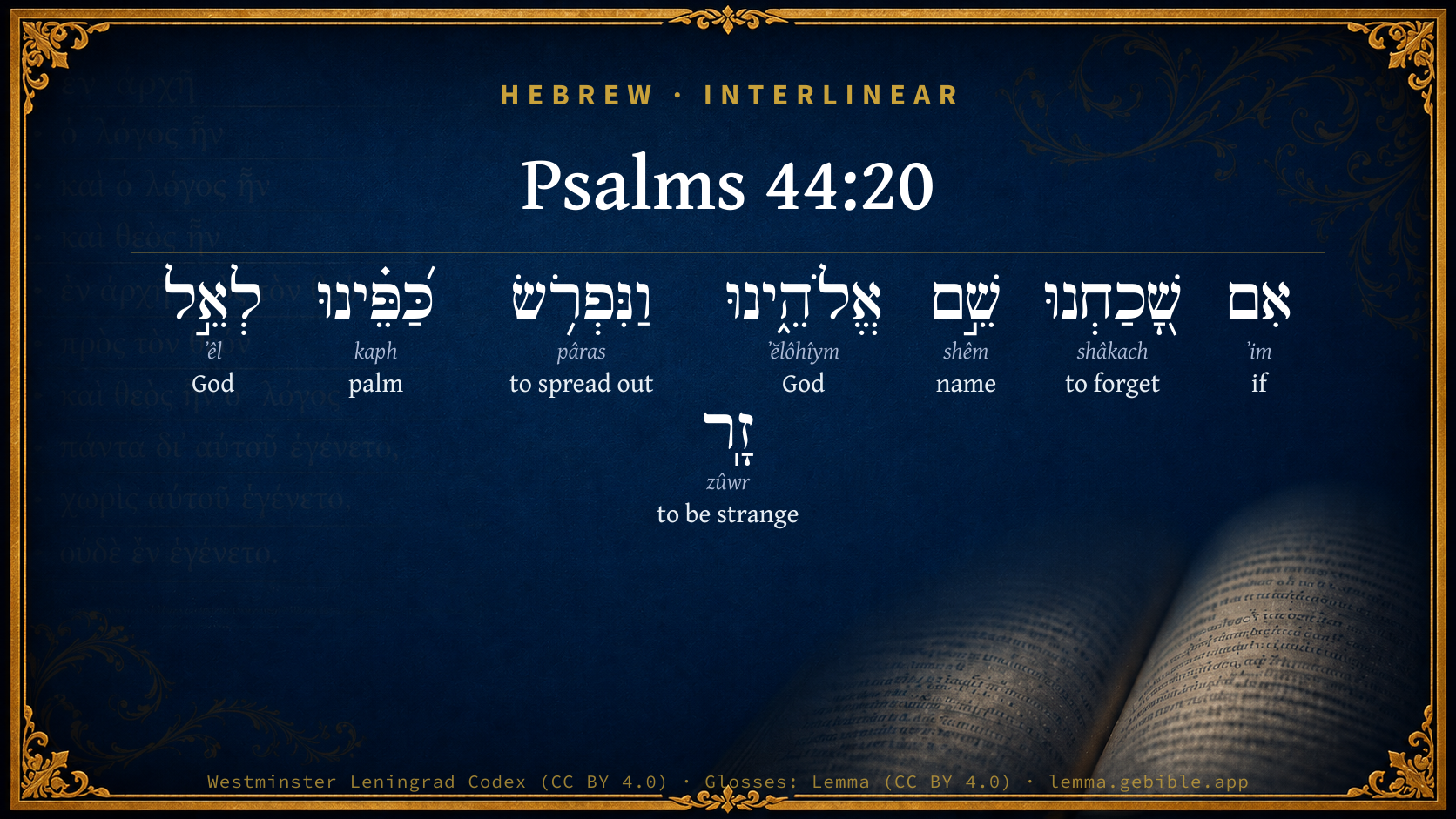
  1. אִם ʼim H518 “if” Conjunction
  2. שָׁ֭כַחְנוּ shâkach H7911 “to forget” Verb, Qal, Perfect, 1st Person, Common, Plural
  3. שֵׁ֣ם shêm H8034 “name of” Noun, Common, Masculine, Singular, Construct
  4. אֱלֹהֵ֑ינוּ ʼĕlôhîym H430 “God(s) · our” Noun, Common, Masculine, Plural, Construct + Suffix, Personal, 1st Person, Common, Plural
  5. כַּ֝פֵּ֗ינוּ kaph H3709 “palms · our” Noun, Common, Feminine, Dual, Construct + Suffix, Personal, 1st Person, Common, Plural
  6. לְאֵ֣ל ʼêl H410 “to/for · God” Preposition + Noun, Common, Masculine, Singular, Absolute
  7. זָֽר zûwr H2114 “strange” Adjective, Adjective, Masculine, Singular, Absolute

About this verse

These counts appear in no published source. They are computed here, from the morphology-tagged text and Lemma’s own curated glosses. What Lemma adds →

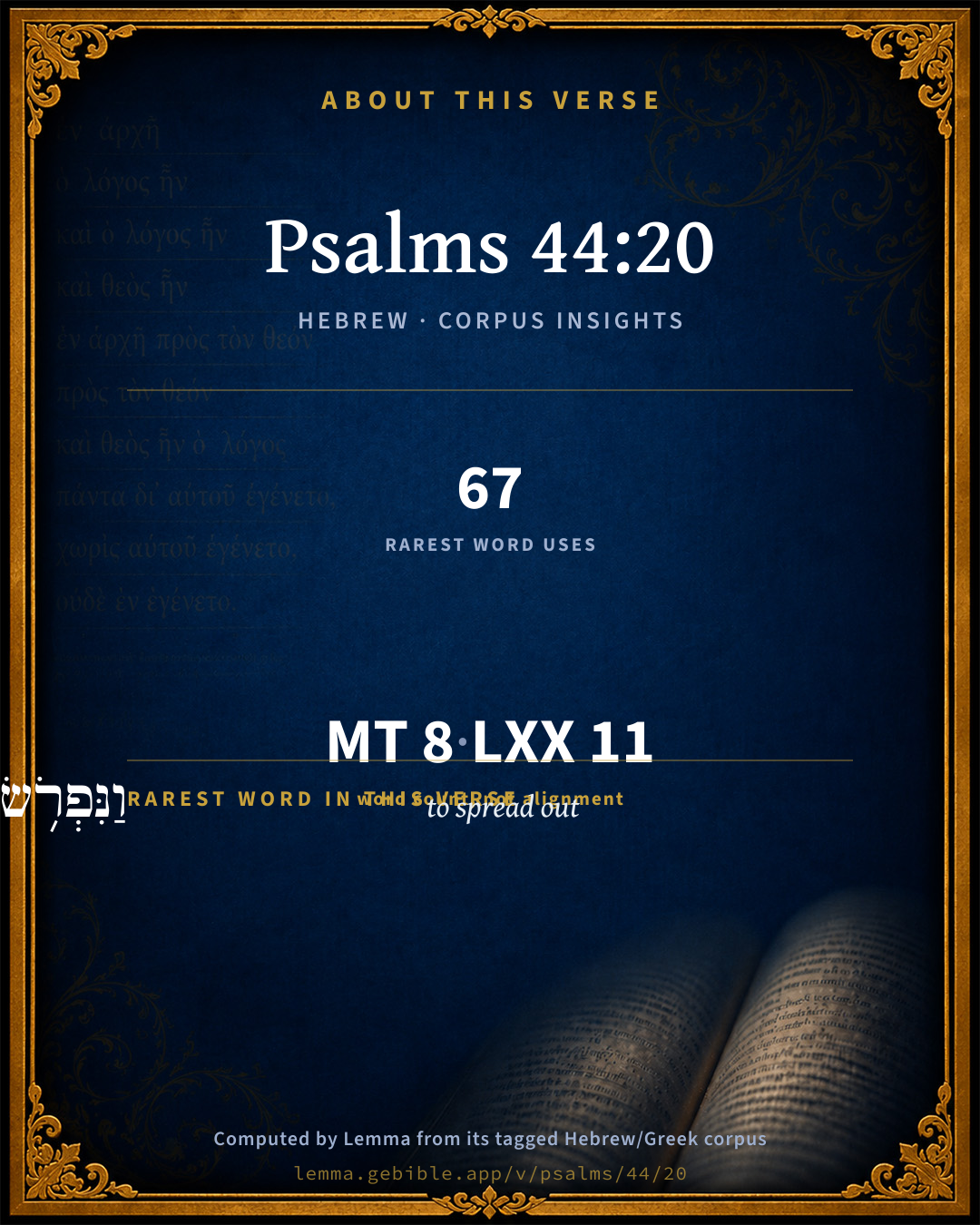
8
words
8
distinct lemmas
Wisdom
section

Grammatical profile

  • 2 verbs
  • 4 nouns
  • 1 adjective
  • 1 conjunction

Verb forms

  • שָׁ֭כַחְנוּ Qal · Perfect
  • וַנִּפְרֹ֥שׂ Qal · Sequential Imperfect

Hebrew & Septuagint length

In English translation the verse runs 18 words from the Hebrew and 28 from the Septuagint (LXX English) — closely comparable.

A rough comparison of the two English renderings, which tokenize alike — not a word-level alignment.

Word counts can differ between the Hebrew and the Greek without any difference in meaning — e.g. the Hebrew direct-object marker אֵת has no separate Greek word, and Greek often adds the article ὁ.

In the original languages it is 8 Hebrew tokens and 11 Greek tokens — but the two are counted differently (Hebrew bundles its prefixes and suffixes into one token; the Greek is in lemma form), so that isn’t a like-for-like length.

Cross-references

10

Topical passages linked to Psalms 44:20 in the Treasury of Scripture Knowledge — connected by theme and wording, ordered by reader-vote popularity; previews shown in the World English Bible.

  • Psalms 81:9 There shall be no strange god in you, Neither shall you worship any foreign god.
  • Job 11:13 "If you set your heart aright, Stretch out your hands toward him.
  • Deuteronomy 6:14 You shall not go after other gods, of the gods of the peoples who are round about you;
  • Job 31:5–40 "If I have walked with falsehood, And my foot has hurried to deceit
  • Psalms 7:3–5 Yahweh, my God, if I have done this, If there is iniquity in my hands,
  • Psalms 68:31 Princes shall come out of Egypt. Ethiopia shall hurry to stretch out her hands to God.
  • Exodus 9:29 Moses said to him, "As soon as I have gone out of the city, I will spread abroad my hands to Yahweh. The thunders shall cease, neither shall there be any more hail; that you may know that the earth is Yahweh's.
  • 1 Kings 8:22 Solomon stood before the altar of Yahweh in the presence of all the assembly of Israel, and spread forth his hands toward heaven;
  • Psalms 44:17 All this has come on us, Yet have we not forgotten you, Neither have we been false to your covenant.
  • Psalms 78:11 They forgot his doings, His wondrous works that he had shown them.

Cross-references courtesy of OpenBible.info (CC BY 4.0).

Hebrew and Greek witnesses Masoretic Hebrew ↔ Greek Septuagint

The same verse in the two great witnesses to the Old Testament, shown verse-for-verse.

You’re reading Greek Psalm 43 (Hebrew Psalm 44). The Septuagint counts the superscription, so verse numbers can differ from the Hebrew — chapter-level alignment, not verse-by-verse. Numbering follows Rahlfs.

These are two independent witnesses, not word-aligned to each other, and the Septuagint is shown in lemma (dictionary) form.

Hebrew Psalms 44:20 Masoretic · Westminster Leningrad Codex

אִם שָׁ֭כַחְנוּ שֵׁ֣ם אֱלֹהֵ֑ינוּ וַנִּפְרֹ֥שׂ כַּ֝פֵּ֗ינוּ לְאֵ֣ל זָֽר

If we have forgotten the name of our God, Or spread forth our hands to a strange god;

World English Bible · Public Domain

Greek LXX Greek Psalm 43:20 Septuagint · lemma form

ὅτι ταπεινόω ἐγώ ἐν τόπος κάκωσις καί ἐπικαλύπτω ἐγώ σκιά θάνατος

If we have forgotten the name of our God, and if we have spread out our hands to a strange god; shall not God search these things out?

LXX2012 (modern English Septuagint) · Public Domain

Hebrew: Westminster Leningrad Codex (CC BY 4.0). Greek: Septuagint (public domain); English from LXX2012 (modern English Septuagint) (Public Domain). How the Septuagint differs from the Hebrew →

Commentary

Notes on Psalms 44:20 from classic Christian and Jewish commentators (each source and its license shown beneath its notes). The classic Christian expositions comment on the surrounding passage and are grouped to its opening verse, so a note may address several verses; the Jewish commentaries on the Tanakh (Rashi and others) are per-verse, so they appear only where the commentator wrote on this verse.

Lemma curates 59 commentaries, every one of them public domain or Creative Commons licensed, each selected and text-cleaned for this edition rather than reprinted as found. About our sources →

Trapp's Complete Commentary

John Trapp

Psa 44:20 If we have forgotten the name of our God, or stretched out our hands to a strange god;

Ver. 20. If we have forgotten the name of our God] i.e. Foregone our religion, as renegadoes, denying the Lord that bought us. In the time of the Maccabees many defected to Paganism; Demas, forsaking Paul, became an idolatrous priest at Thessalonica, saith Dorotheus; Julian turned Pagan; Damascen, Mahometan, as some write; Harding, an obstinate Papist. In the Palatinate, when, not forty years since, taken by the Spaniard, scarce one man in twenty stood out, but fell to Popery, as fast as leaves fall in antumn.

Or stretched out our hands to a strange god] This Ignatius, Laurentius, and thousands of those primitive Christians would die, rather than be drawn to do. So the three children, the seven brethren, &c. Origen, for yielding a little, was excommunicated.

John Trapp, A Commentary or Exposition upon All the Books of the Old and New Testament (1647–1656) — public domain. Text from a community e-Sword module.

J. A. Alexander on Psalms

Joseph Addison Alexander

21. (Psa 44:20). If we have forgotten the name of our God, and spread our hands to a strange God. Some regard this as the common elliptical formula of swearing. "(God do so to us and more also) if we have forgotten," which is equivalent to saying, "we have not forgotten." Another method of supplying the ellipsis is exemplified in Jos 22:22. But since the verse, conditionally understood, yields a good sense in connection with the next verse, this, as being the more obvious construction, is entitled to the preference. The act of holding up or stretching out the hands is often mentioned as a natural gesture of entreaty. See Exo 9:29; Exo 9:33, 1Ki 8:38, Isa 1:15. The word God in the version represents two different divine names in Hebrew, Elohim and El. See above, on Psa 43:4. A strange God, or a God (who is) a stranger, i.e. to Jehovah and his people. The Hebrew word is applied by Moses both to men (Exo 30:33) and idols (Deu 32:16).

Joseph Addison Alexander, The Psalms Translated and Explained (1850) — public domain. Text from a community e-Sword module.

Geneva Bible (1599)

Geneva Bible translators

They show that they honored God aright, because they trusted in him alone.

Geneva Bible (1599) marginal notes — public domain. Text via Bolls.life.

Jamieson, Fausset & Brown

Robert Jamieson, A. R. Fausset & David Brown

A solemn appeal to God to witness their constancy.

stretched out . . . hands--gesture of worship (Exo 9:29; Psa 88:9).

Jamieson, Fausset & Brown — Commentary Critical and Explanatory on the Whole Bible (1871) — public domain (CC PDM 1.0). Text via the HelloAO Bible API.

Adam Clarke's Commentary

Verse 20. If we have forgotten the name of our God] That name, יהוה Jehovah, by which the true God was particularly distinguished, and which implied the exclusion of all other objects of adoration.

Or stretched out our hands] Made supplication; offered prayer or adoration to any strange god - a god that we had not known, nor had been acknowledged by our fathers. It has already been remarked, that from the time of the Babylonish captivity the Jews never relapsed into idolatry.

It was customary among the ancients, while praying, to stretch out their hands towards the heavens, or the image they were worshipping, as if they expected to receive the favour they were asking.

Adam Clarke's Commentary on the Bible (1810–1826) — public domain. Text from a community e-Sword/MySword module.

The Cambridge Bible for Schools and Colleges

gen. ed. J. J. S. Perowne

20. stretched out] R.V., spread forth: the gesture of prayer being not, as with us, folded hands, but the hands extended with open palms: the Lat. ‘manibus passis.’ Cp. Psa_143:6; 1Ki_8:22; 1Ki_8:38; 1Ki_8:54; Isa_1:15.

The Cambridge Bible for Schools and Colleges (gen. ed. J. J. S. Perowne; Cambridge University Press, 1878–1918) — public domain. Text from a community e-Sword module.

John Gill's Exposition

If we have forgotten the name of our God,.... As antichrist, and the antichristian party did in those times, Dan 11:36;

or stretched out our hands to a strange god; as not to any of the Heathen deities under the Pagan persecutions, so not to any images of gold, silver, brass, and wood, under the Papal tyranny; not to the Virgin Mary, nor to angels and saints departed; nor to the breaden God in the mass, never heard of before; see Dan 11:38.

John Gill's Exposition of the Whole Bible (1746–1763) — public domain (CC PDM 1.0). Text via the HelloAO Bible API.

Albert Barnes' Notes on the Bible

If we have forgotten the name of our God - That is, if we have apostatized from him.

Or stretched out our hands to a strange god - Or have been guilty of idolatry. The act of stretching out the hands, or spreading forth the hands, was significant of worship or prayer: 1Ki 8:22; 2Ch 6:12-13; see the notes at Isa 1:15. The idea here is, that this was not the cause or reason of their calamities; that if this had occurred, it would have been a sufficient reason for what had taken place; but that no such cause actually existed, and therefore the reason must be found in something else. It was the fact of such calamities having come upon the nation when no such cause existed, that perplexed the author of the psalm, and led to the conclusion in his own mind Psa 44:22 that these calamities were produced by the malignant designs of the enemies of the true religion, and that, instead of their suffering for their national sins, they were really martyrs in the cause of God, and were suffering for his sake.

Albert Barnes' Notes on the Bible (1834–1885) — public domain. Text from a community e-Sword/MySword module.

Matthew Poole's English Annotations

In the place: or rather into, as others render it; which seems much more emphatical. And so this verb may be rendered, thou hast humbled, or brought us down, as all the ancients rendered it. Or this is a pregnant verb, as they call them, or one verb put for two; of which there are many instances, as hath been showed. So it may be rendered, thou hast sore broken us, casting us into; or, thou hast by sore breaking brought us into. By inflicting upon us one breach after another, thou hast at last brought us to this pass. The place of dragons; which signifies a place extremely desolate, such as dragons love, Isa 13:21,22; 34:13; 35:7, and therefore full of horror, and danger, and mischief. Thou hast thrown us among people as fierce and: cruel as dragons. With the shadow of death, i.e. with deadly horrors and miseries. See Poole "Job 3:5"; See Poole "Psa 23:4".

The name of God, i.e. either God himself; or his worship and service; which we have denied that we have done, Psa 44:17.

Stretched out our hands, in way of prayer or adoration, whereof this is a gesture, Exo 9:29; 1Ki 8:22; Psa 143:6.

Matthew Poole's English Annotations on the Holy Bible (1683–1685) — public domain. Text from a community e-Sword/MySword module.

The Treasury of David

Charles H. Spurgeon

Ver. 20. An appeal is now made to the omniscience of God; he is himself called in to bear witness that Israel had not set up another God. If we have forgotten the name of our God. This would be the first step in apostasy; men first forget the true, and then adore the false. Or stretched out our hands to a strange god. Stretching out the hands was the symbol of adoration or of entreaty in prayer; this they had not offered to any of the idols of the heathens.

Ver. 20. Stretched out our hands to a strange god. The stretching out the hand towards an object of devotion, or an holy place, was an ancient usage among the Jews and heathens both, and it continues in the East at this time, which continuance I do not remember to have seen remarked. That this attitude in prayer has continued among the Eastern people, appears by the following passage from Pitts, in his account of the religion and manners of the Mohammedans. Speaking of the Algerians throwing wax candles and pots of oil overboard, as a present to some marabbot (or Mohammedan saint), Pitt goes on, and says, "When this is done, they all together hold up their hands, begging the marabbot's blessing, and a prosperous voyage." In the same page he tells us, "the marabbots have generally a little neat room built over their graves, resembling in figure their mosques or churches, which is very nicely cleaned, and well looked after." And in the succeeding page he tells us, "Many people there are who will scarce pass by any of them without lifting up their hand, and saying some short prayer." In like manner, he tells us, that at quitting the Beat, or holy house at Mecca, to which they make devout pilgrimages, "they hold up their hands towards the Beat, making earnest petitions." Harmer's "Observations."

None.

Psalms 44:21*

Charles H. Spurgeon's The Treasury of David (1869–1885) — public domain. Psalms only. Text from a community e-Sword/MySword module.

Whedon's Commentary on the Bible

Daniel D. Whedon

20. If we have forgotten—Compare Job 31

Daniel D. Whedon (gen. ed.), Commentary on the Old and New Testaments (1874–1909) — public domain. Text from a community e-Sword module.

The Pulpit Commentary

If we have forgotten the name of our God, or stretched out (rather, spread out) our hands to a strange god. If Israel had either forgotten the true God (see above, ver. 17) or fallen away to the worship of false or strange gods then her ill success against her foreign enemies would have been fully accounted for, since it would only have been in accordance with the threatenings of the Law; (Lev_26:14-17 Deu_28:15-23) but as she had done neither of these things, her defeats and depressed condition seemed to the psalmist wholly unaccountable. We trace here the same current belief, which comes out so strongly in the Book of Job the belief that calamities were, almost of necessity, punishments for sin; and that when they occurred, and there had been no known precedent misconduct, the case was abnormal and extraordinary.

The Pulpit Commentary (1880–1919), ed. H.D.M. Spence-Jones & Joseph S. Exell — public domain. Text from a community e-Sword module.

Rashi

Rabbi Shlomo Yitzchaki (Rashi)

when You crushed us in a place of serpents This כי serves as an expression of כאשר, when. Even when You humbled us in a land of plains and pits; [in] a desert, a place of serpents, and You covered us with the darkness of death - despite all this, if we forgot the name of our God, will God not search this out? For He knows the secrets of the heart.

Rashi on the Tanakh — English translations: “The Judaica Press complete Tanach with Rashi, translated by A. J. Rosenberg” (CC BY 4.0); “Pentateuch with Rashi's commentary by M. Rosenbaum and A.M. Silbermann, 1929-1934” (public domain); “The Metsudah Tanach series, Lakewood, N.J” (CC BY 4.0); and “The Book of Joshua, Metsudah Publications, 1997” (CC BY 4.0). Text via Sefaria.

Lesson kit

Teaching starters — assembled from the data on this page, not authored interpretation. Every prompt links to the verse data it draws on. Edit before teaching.

Psalms, in the Wisdom, opens this verse with 8 words (8 distinct Hebrew lemmas). Its most distinctive word is pâras (“to spread out”). A historical commentator’s framing appears above. Read the whole chapter for the surrounding context.

Discussion questions

  1. How does “to spread out” (pâras) shape what this verse is saying?
  2. Psalms 81:9 shares this passage’s theme. How do the two illuminate each other?
  3. These translations render this verse differently; the difference is in the English rendering, not the original. What questions does that raise?
  4. The verb «שָׁ֭כַחְנוּ» is Qal Perfect. How does its form color the action?
  5. Reading how Trapp's Complete Commentary and J. A. Alexander on Psalms read this verse, where do the two commentators agree and where do they part?

Things to notice

Reading settings

Reading text

Shown beneath each verse's original-language words.

Old Testament
Old Testament edition

Read the OT as the Masoretic Hebrew (MT) or the Greek Septuagint (LXX).

English shown for the Greek Septuagint (in the Hebrew ↔ Greek comparison).

Comparing translations? Open the Compare panel on any verse page to stack up to four side by side.