
Lamentations 2:15

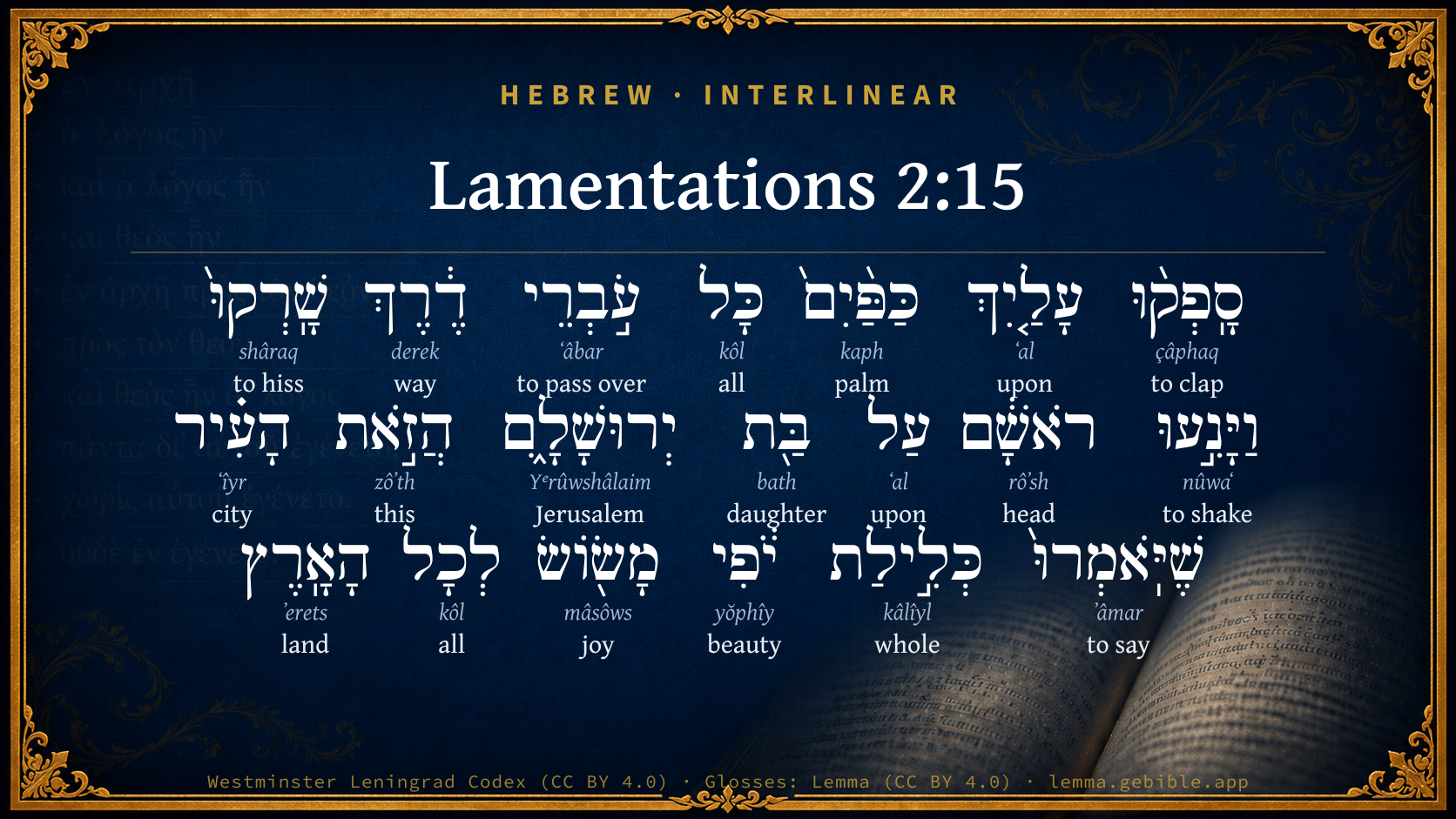
Hebrew (Westminster Leningrad Codex) Lamentations 2:15 appears in the Hebrew Old Testament. The text above is from the Westminster Leningrad Codex. Each word links to its Strong’s number, a concise gloss, and parsing drawn from the Open Scriptures Hebrew Bible morphology. Click any word for its full Brown-Driver-Briggs (BDB) entry.
Download image
Cite this verse

Lamentations 2:15 (World English Bible). Public Domain. Lemma interlinear Bible study tool, https://lemma.gebible.app/v/lamentations/2/15.

Show BibTeX & RIS
BibTeX
RIS
English Translation
All that pass by clap their hands at you; They hiss and wag their head at the daughter of Jerusalem, [saying], Is this the city that men called The perfection of beauty, The joy of the whole earth?
World English Bible · Public Domain
Download a study sheet

One document with this verse’s original text, its word-by-word gloss line, the meaning frame, cross-references with their text, attributed commentary, and full source and license credits — printable, and it pastes into notes with its structure intact.

This verse Autodidact and up

Study sheet (.html) Plain text (.txt)

A passage Seminary Student

Up to 50 verses in one chapter. A passage sheet keeps up to 6 commentary sources and 12 cross-references per verse, in the order this page ranks them, and says so on the sheet whenever that leaves anything out. Ask for a single verse and you get the Autodidact verse sheet above.

Everything on this page stays free to read, with no account — the sheet is a download of what is already on screen, not access to it.

Want to remove ads? Support Godless Engineer
Compare translations 3

The same verse in 3 English versions, stacked beneath the original-language interlinear above. Click any original word for its lexicon entry.

Each is an independent rendering of the whole verse — the interlinear is not word-aligned to these translations.

Highlighted words mark where these versions differ — a whole-verse word diff, not a word-by-word alignment.

  • World English Bible Public Domain
    All that pass by clap their hands at you; They hiss and wag their head at the daughter of Jerusalem, [saying], Is this the city that men called The perfection of beauty, The joy of the whole earth?
  • King James Version Public Domain
    All that pass by clap their hands at thee; they hiss and wag their head at the daughter of Jerusalem, saying, Is this the city that men call The perfection of beauty, The joy of the whole earth?
  • unfoldingWord Literal Text CC BY-SA 4.0
    All those passing along the road clap hands at you. They hiss and shake their heads at the daughter of Jerusalem: “Is this the city that they called ‘the perfection of beauty, the joy of all the earth’?” AYIN

unfoldingWord Literal Text — © unfoldingWord, licensed CC BY-SA 4.0. Word-aligned USFM3 via Door43 (git.door43.org/unfoldingWord/en_ult).

Versions to compare (up to 4)

3 of 4 selected

Show all 18 translations

Every available English version of this verse, each an independent rendering of the whole verse.

  • World English Bible Public Domain
    All that pass by clap their hands at you; They hiss and wag their head at the daughter of Jerusalem, [saying], Is this the city that men called The perfection of beauty, The joy of the whole earth?
  • Berean Standard Bible Public Domain
    All who pass by clap their hands at you in scorn. They hiss and shake their heads at the Daughter of Jerusalem: “Is this the city that was called the perfection of beauty, the joy of all the earth?”
  • Majority Standard Bible Public Domain
    All who pass by clap their hands at you in scorn. They hiss and shake their heads at the Daughter of Jerusalem: “Is this the city that was called the perfection of beauty, the joy of all the earth?”
  • King James Version Public Domain
    All that pass by clap their hands at thee; they hiss and wag their head at the daughter of Jerusalem, saying, Is this the city that men call The perfection of beauty, The joy of the whole earth?
  • American Standard Version (1901) Public Domain
    All that pass by clap their hands at thee; They hiss and wag their head at the daughter of Jerusalem, `saying', Is this the city that men called The perfection of beauty, The joy of the whole earth?
  • Revised Version (1885) Public Domain
    All that pass by clap their hands at thee; they hiss and wag their head at the daughter of Jerusalem, saying: Is this the city that men called The perfection of beauty, The joy of the whole earth?
  • Geneva Bible (1599) Public Domain
    All that passe by the way, clap their hands at thee: they hisse and wagge their head vpon the daughter Ierusalem, saying, Is this the citie that men call, The perfection of beautie, and the ioye of the whole earth?
  • Douay-Rheims (1899) Public Domain
    Samech. All they that passed by the way have clapped their hands at thee: they have hissed, and wagged their heads at the daughter of Jerusalem, saying: Is this the city of perfect beauty, the joy of all the earth?
  • Young's Literal Translation Public Domain
    Clapped hands at thee have all passing by the way, They have hissed -- and they shake the head At the daughter of Jerusalem: `Is this the city of which they said: The perfection of beauty, a joy to all the land?'
  • Literal Standard Version CC BY-SA 4.0
    Everyone passing by the way clapped hands at you, || They have hissed—and they shake the head || At the daughter of Jerusalem: “Is this the city of which they said: The perfection of beauty, a joy to all the land?”
  • Unlocked Literal Bible CC BY-SA 4.0
    All those who pass along the road clap their hands at you. They hiss and shake their heads against the daughter of Jerusalem and say, “Is this the city that they called 'The Perfection of Beauty,' 'The Joy for All of Earth'?”
  • unfoldingWord Literal Text CC BY-SA 4.0
    All those passing along the road clap hands at you. They hiss and shake their heads at the daughter of Jerusalem: “Is this the city that they called ‘the perfection of beauty, the joy of all the earth’?” AYIN
  • Darby Bible Public Domain
    All that pass by clap [their] hands at thee; they hiss and shake their head at the daughter of Jerusalem: Is this the city which they called, The perfection of beauty, The joy of the whole earth?
  • World Messianic Bible Public Domain
    All that pass by clap their hands at you. They hiss and wag their head at the daughter of Jerusalem, saying, “Is this the city that men called ‘The perfection of beauty, the joy of the whole earth’?”
  • Webster's Bible Public Domain
    All that pass by, clap their hands at thee; they hiss and wag their head at the daughter of Jerusalem, saying, Is this the city that men call the Perfection of beauty, the Joy of the whole earth?
  • Free Bible Version CC BY-SA 4.0
    Everyone who passes by mock you, clapping their hands, hissing and shaking their heads in scorn at the Daughter of Jerusalem. “Is this really the city that people called the perfection of beauty, the joy of all the earth?” they ask.
  • Bible in Basic English Public Domain
    All who go by make a noise with their hands at you; they make hisses, shaking their heads at the daughter of Jerusalem, and saying, Is this the town which was the crown of everything beautiful, the joy of all the earth?
  • JPS Tanakh (1917) Public Domain
    All that pass by clap their hands at thee; they hiss and wag their head at the daughter of Jerusalem: 'Is this the city that men called the perfection of beauty, the joy of the whole earth?'

Literal Standard Version (2020), Covenant Press — licensed CC BY-SA 4.0. Text via the HelloAO Bible API (eBible.org). Unlocked Literal Bible (unfoldingWord) — licensed CC BY-SA 4.0. Text via the HelloAO Bible API (eBible.org). unfoldingWord Literal Text — © unfoldingWord, licensed CC BY-SA 4.0. Word-aligned USFM3 via Door43 (git.door43.org/unfoldingWord/en_ult). Free Bible Version, Dr. Jonathan Gallagher — licensed CC BY-SA 4.0. Text via the HelloAO Bible API (eBible.org).

Word by word

More ways to search: Search by grammar → Find every occurrence → Compare this word →

Practice this passage: Drill this verse → Learn its vocabulary →

סָֽפְק֨וּ
çâphaq
H5606
“to clap”
Verb, Qal, Perfect, 3rd Person, Common, Plural
Part of Speech
Verb
Stem
Qal
Form
Perfect
Person
3rd Person
Gender
Common
Number
Plural
Full BDB Definition

Origin: a primitive root

TWOT: 1539

( 1Ki 20:10 , Job 27:23 , Is Job 2:6 ) - to clap, slap - (Qal) - to slap, clap - to slap, chastise - to splash, throw up - (Hiphil) to cause to clap
  1. עָלַ֤יִךְ ʻal H5921 “upon · you” Preposition + Suffix, Personal, 2nd Person, Feminine, Singular
  2. כַּפַּ֨יִם֙ kaph H3709 “palms” Noun, Common, Feminine, Dual, Absolute
  3. כָּל kôl H3605 “all of” Noun, Common, Masculine, Singular, Construct
  4. עֹ֣בְרֵי ʻâbar H5674 “passing over” Verb, Qal, Participle Active, Masculine, Plural, Construct
  5. דֶ֔רֶךְ derek H1870 “way” Noun, Common, Both, Singular, Absolute
  6. שָֽׁרְקוּ֙ shâraq H8319 “to hiss” Verb, Qal, Perfect, 3rd Person, Common, Plural
  7. וַיָּנִ֣עוּ nûwaʻ H5128 “and · to shake” Conjunction + Verb, Hiphil, Sequential Imperfect, 3rd Person, Masculine, Plural
  8. רֹאשָׁ֔ם rôʼsh H7218 “head · their” Noun, Common, Masculine, Singular, Construct + Suffix, Personal, 3rd Person, Masculine, Plural
  9. עַל ʻal H5921 “upon” Preposition
  10. בַּ֖ת bath H1323 “daughter of” Noun, Common, Feminine, Singular, Construct
  11. יְרוּשָׁלִָ֑ם Yᵉrûwshâlaim H3389 “Jerusalem” Noun, Proper
  12. הֲזֹ֣את zôʼth H2063 “this” Particle, Interrogative + Pronoun, Demonstrative, Feminine, Singular
  13. הָעִ֗יר ʻîyr H5892 “the · city” Particle, Definite Article + Noun, Common, Feminine, Singular, Absolute
  14. שֶׁיֹּֽאמְרוּ֙ ʼâmar H559 “who/which · to say” Particle, Relative + Verb, Qal, Imperfect, 3rd Person, Masculine, Plural
  15. כְּלִ֣ילַת kâlîyl H3632 “whole of” Adjective, Adjective, Feminine, Singular, Construct
  16. יֹ֔פִי yŏphîy H3308 “beauty” Noun, Common, Masculine, Singular, Absolute
  17. מָשׂ֖וֹשׂ mâsôws H4885 “joy” Noun, Common, Masculine, Singular, Absolute
  18. לְכָל kôl H3605 “to/for · all of” Preposition + Noun, Common, Masculine, Singular, Construct
  19. הָאָֽרֶץ ʼerets H776 “the · land” Particle, Definite Article + Noun, Common, Both, Singular, Absolute

About this verse

These counts appear in no published source. They are computed here, from the morphology-tagged text and Lemma’s own curated glosses. What Lemma adds →

20
words
18
distinct lemmas
Prophets
section

Notable vocabulary

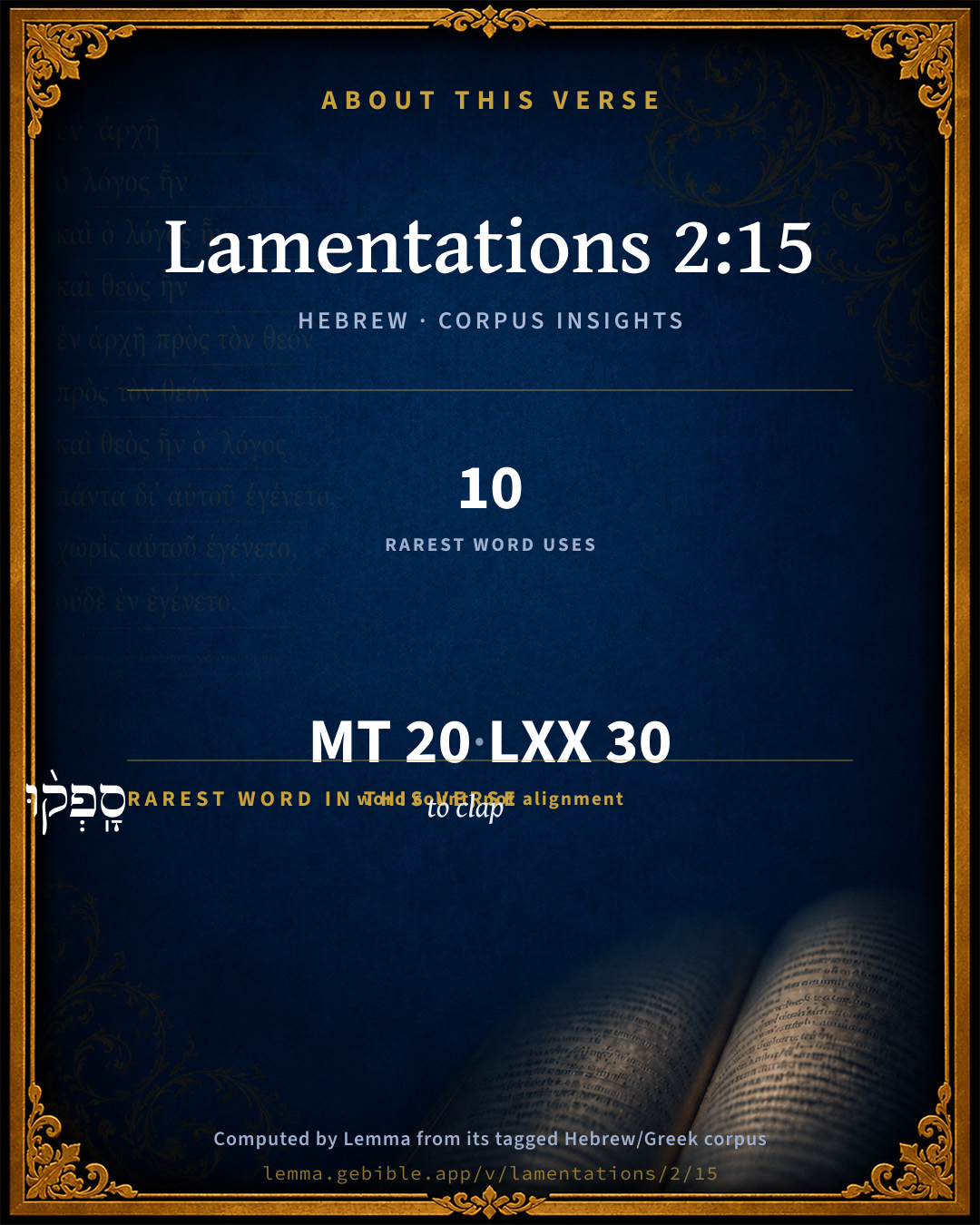
The rarest word here is סָֽפְק֨וּ to clap H5606 — appearing just 10 times in the whole Hebrew Bible.

Shared distinctive vocabulary

סָֽפְק֨וּ to clap H5606 occurs in 10 verses of the Hebrew Bible. Also found in:

Grammatical profile

  • 5 verbs
  • 11 nouns
  • 1 adjective
  • 1 pronoun
  • 2 prepositions

Verb forms

  • סָֽפְק֨וּ Qal · Perfect
  • עֹ֣בְרֵי Qal · Participle Active
  • שָֽׁרְקוּ֙ Qal · Perfect
  • וַיָּנִ֣עוּ Hiphil · Sequential Imperfect
  • שֶׁיֹּֽאמְרוּ֙ Qal · Imperfect

Repetition

Words recur within this verse — often emphatic in Hebrew:

  • עָלַ֤יִךְ upon H5921 ×2
  • כָּל all H3605 ×2

Hebrew & Septuagint length

In English translation the verse runs 38 words from the Hebrew and 39 from the Septuagint (LXX English) — closely comparable.

A rough comparison of the two English renderings, which tokenize alike — not a word-level alignment.

Word counts can differ between the Hebrew and the Greek without any difference in meaning — e.g. the Hebrew direct-object marker אֵת has no separate Greek word, and Greek often adds the article ὁ.

In the original languages it is 20 Hebrew tokens and 30 Greek tokens — but the two are counted differently (Hebrew bundles its prefixes and suffixes into one token; the Greek is in lemma form), so that isn’t a like-for-like length.

Cross-references

26

Topical passages linked to Lamentations 2:15 in the Treasury of Scripture Knowledge — connected by theme and wording, ordered by reader-vote popularity; previews shown in the World English Bible.

  • Psalms 48:2 Beautiful in elevation, the joy of the whole earth, Is Mount Zion, on the north sides, The city of the great King.
  • Jeremiah 18:16 to make their land an astonishment, and a perpetual hissing; everyone who passes thereby shall be astonished, and shake his head.
  • Psalms 50:2 Out of Zion, the perfection of beauty, God shines forth.
  • Jeremiah 19:8 I will make this city an astonishment, and a hissing; everyone who passes thereby shall be astonished and hiss because of all the plagues of it.
  • Ezekiel 25:6 For thus says the Lord Yahweh: Because you have clapped your hands, and stamped with the feet, and rejoiced with all the despite of your soul against the land of Israel;
  • Psalms 22:7 All those who see me mock me. They insult me with their lips. They shake their heads, saying,
  • Isaiah 37:22 this is the word which Yahweh has spoken concerning him: The virgin daughter of Zion has despised you and ridiculed you; the daughter of Jerusalem has shaken her head at you.
  • Isaiah 64:11 Our holy and our beautiful house, where our fathers praised you, is burned with fire; and all our pleasant places are laid waste.
  • Zephaniah 2:15 This is the joyous city that lived carelessly, that said in her heart, "I am, and there is none besides me." How she has become a desolation, a place for animals to lie down in! Everyone who passes by her will hiss, and shake their fists.
  • Matthew 27:39 Those who passed by blasphemed him, wagging their heads,
  • Deuteronomy 29:22–28 The generation to come, your children who shall rise up after you, and the foreigner who shall come from a far land, shall say, when they see the plagues of that land, and the sicknesses with which Yahweh has made it sick;
  • 1 Kings 9:7–9 then will I cut off Israel out of the land which I have given them; and this house, which I have made holy for my name, will I cast out of my sight; and Israel shall be a proverb and a byword among all peoples.
  • 2 Kings 19:21 This is the word that Yahweh has spoken concerning him: The virgin daughter of Zion has despised you and ridiculed you; the daughter of Jerusalem has shaken her head at you.
  • 2 Chronicles 7:21 This house, which is so high, everyone who passes by it shall be astonished, and shall say, Why has Yahweh done thus to this land, and to this house?
  • Job 27:22–23 For it hurls at him, and does not spare, As he flees away from his hand.
  • Psalms 44:14–15 You make us a byword among the nations, A shaking of the head among the peoples.
  • Jeremiah 25:9 behold, I will send and take all the families of the north, says Yahweh, and [I will send] to Nebuchadrezzar the king of Babylon, my servant, and will bring them against this land, and against the inhabitants of it, and against all these nations round about; and I will utterly destroy them, and make them an astonishment, and a hissing, and perpetual desolations.
  • Jeremiah 25:18 [to wit], Jerusalem, and the cities of Judah, and the kings of it, and the princes of it, to make them a desolation, an astonishment, a hissing, and a curse, as it is this day;
  • Jeremiah 29:18 I will pursue after them with the sword, with the famine, and with the pestilence, and will deliver them to be tossed back and forth among all the kingdoms of the earth, to be an object of horror, and an astonishment, and a hissing, and a reproach, among all the nations where I have driven them;
  • Jeremiah 51:37 Babylon shall become heaps, a dwelling-place for jackals, an astonishment, and a hissing, without inhabitant.
  • Lamentations 1:8 Jerusalem has grievously sinned; therefore she is become as an unclean thing; All who honored her despise her, because they have seen her nakedness: Yes, she sighs, and turns backward.
  • Lamentations 2:6 He has violently taken away his tent, as if it were of a garden; he has destroyed his place of assembly: Yahweh has caused solemn assembly and Sabbath to be forgotten in Zion, Has despised in the indignation of his anger the king and the priest.
  • Lamentations 2:16 All your enemies have opened their mouth wide against you; They hiss and gnash the teeth; they say, We have swallowed her up; Certainly this is the day that we looked for; we have found, we have seen it.
  • Micah 6:16 For the statutes of Omri are kept, And all the works of the house of Ahab. You walk in their counsels, That I may make you a ruin, And her inhabitants a hissing; And you will bear the reproach of my people."
  • Nahum 3:19 There is no healing your wound, for your injury is fatal. All who hear the report of you clap their hands over you; for who hasn't felt your endless cruelty?
  • Mark 15:29 Those who passed by blasphemed him, wagging their heads, and saying, "Ha! You who destroy the temple, and build it in three days,

Cross-references courtesy of OpenBible.info (CC BY 4.0).

Hebrew and Greek witnesses Masoretic Hebrew ↔ Greek Septuagint

The same verse in the two great witnesses to the Old Testament, shown verse-for-verse.

These are two independent witnesses, not word-aligned to each other, and the Septuagint is shown in lemma (dictionary) form.

Hebrew Lamentations 2:15 Masoretic · Westminster Leningrad Codex

סָֽפְק֨וּ עָלַ֤יִךְ כַּפַּ֨יִם֙ כָּל עֹ֣בְרֵי דֶ֔רֶךְ שָֽׁרְקוּ֙ וַיָּנִ֣עוּ רֹאשָׁ֔ם עַל בַּ֖ת יְרוּשָׁלִָ֑ם הֲזֹ֣את הָעִ֗יר שֶׁיֹּֽאמְרוּ֙ כְּלִ֣ילַת יֹ֔פִי מָשׂ֖וֹשׂ לְכָל הָאָֽרֶץ

All that pass by clap their hands at you; They hiss and wag their head at the daughter of Jerusalem, [saying], Is this the city that men called The perfection of beauty, The joy of the whole earth?

World English Bible · Public Domain

Greek LXX Lamentations 2:15 Septuagint · lemma form

κροτέω ἐπί σύ χείρ πᾶς ὁ παραπορεύομαι ὁδός συρίζω καί κινέω ὁ κεφαλή αὐτός ἐπί ὁ θυγάτηρ ἰερουσαλήμ ἦ οὗτος ὁ πόλις ὅς εἶπον στέφανος δόξα εὐφροσύνη πᾶς ὁ γῆ

SAMECH. All that go by the way have clapped their hands at you; they have hissed and shaken their head at the daughter of Jerusalem. Is this the city, they say, the crown of joy of all the earth?

LXX2012 (modern English Septuagint) · Public Domain

Hebrew: Westminster Leningrad Codex (CC BY 4.0). Greek: Septuagint (public domain); English from LXX2012 (modern English Septuagint) (Public Domain). How the Septuagint differs from the Hebrew →

Commentary

Notes on Lamentations 2:15 from classic Christian and Jewish commentators (each source and its license shown beneath its notes). The classic Christian expositions comment on the surrounding passage and are grouped to its opening verse, so a note may address several verses; the Jewish commentaries on the Tanakh (Rashi and others) are per-verse, so they appear only where the commentator wrote on this verse.

Lemma curates 59 commentaries, every one of them public domain or Creative Commons licensed, each selected and text-cleaned for this edition rather than reprinted as found. About our sources →

The Cambridge Bible for Schools and Colleges

gen. ed. J. J. S. Perowne

15. They hiss and wag their head] expressions denoting amazement mixed with contempt. Cp. Jer_18:16; 2Ki_19:21; Job_27:23; Psa_22:7; Zep_2:15.

that men called] These words (as Löhr, following J. D. Michaelis, points out) should for metrical reasons be omitted.

The perfection of beauty, the joy etc.] Cp. for both phrases Psa_48:2, and for the former one Psa_50:2 and (of Tyre) Eze_27:3; Eze_28:13. They were possibly current phrases used by Psalmists and this writer independently.

The Cambridge Bible for Schools and Colleges (gen. ed. J. J. S. Perowne; Cambridge University Press, 1878–1918) — public domain. Text from a community e-Sword module.

Trapp's Complete Commentary

John Trapp

Lam 2:15 All that pass by clap [their] hands at thee; they hiss and wag their head at the daughter of Jerusalem, [saying, Is] this the city that [men] call The perfection of beauty, The joy of the whole earth?

Ver. 15. All that pass by thee clap.] See Lam 1:17.

Is this the city?] God’s palace upon earth, the porch of paradise, &c., as they said of Jezebel when she lay torn with dogs, Is this that Jezebel?

“ O quantum haec Niobe, Niobe mutatur ab ills? ”

John Trapp, A Commentary or Exposition upon All the Books of the Old and New Testament (1647–1656) — public domain. Text from a community e-Sword module.

The Biblical Illustrator

Joseph S. Exell

Lam_2:15

An that pass by clap their hands at thee.

Deriding the distressed

1. God is wont to whip His children for their sins, by the multitude of unbelievers that hate the truth (Isa_10:5-6; Jer_25:9; Exo_1:13-14).

2. It is a property of a wicked heart, to insult over the distressed, whom we should pity and relieve (Psa_35:15; Psa_79:4; 2Sa_16:7-8; Mat_27:39).

3. The wicked seeing the godly afflicted, take occasion thereby to blaspheme God and His truth (Psa_74:10; Psa_74:18; 2Ki_18:30; 2Ki_18:35; 2Ki_19:12).

4. There only is true joy and excellency where Gods truth is rightly preached, and His name called upon (Psa_50:2; Eze_47:8-9; Eze_47:12). (J. Udall.)

Exultation over the fallen

Men are always ready to remind the fallen of the days of prosperity. It is hard to pass by a man who is thrown down without telling him what he might have been, what he once was, and how foolishly he has acted in forsaking the way in which he found prosperity and delight. We must expect this from all men. It is not in their nature to heal our diseases, to comfort our sorrows, to sympathise with us in the hour of desolation. The Psalmist complained, Thou makest us a by-word among the heathen, a shaking of the head among the people. Wonderful things had been spoken of Zion in the better days. In proportion to our exaltation is our down throwing. Beautiful for situation, the joy of the whole earth, is mount Zion, etc. Out of Zion, the perfection of beauty, God hath shined. How great is His goodness! and how great is His beauty! But all this will go for notching where there has been moral apostasy, spiritual disobedience, or spiritual idolatry. Decoration is vanity. All that men can do in the beautifying of their lives is as rottenness if the heart itself be not in a healthy condition. Add to the bitterness of self-remorse the triumphant exultation of enemies who pass by, and say whether any humiliation can be deeper or more intolerable. Where, then, is hope to be found? In heaven. The God whom we have offended must be the God who can forgive us. Do not let us seek to placate our enemies, or turn their triumphing into felicitation: we have no argument with them; not a word ought we to have to say to such mockers; we must acquaint ourselves with God, and make ourselves at peace with heaven, and if a mans ways please the Lord, the Lord will make that mans enemies to be at peace with him. (J. Parker, D. D.)

The call to prayer

This is not the first occasion on which the elegist has shown his faith in the efficacy of prayer. But hitherto he has only uttered brief exclamations in the middle of his descriptive passages. Now he gives a solemn call to prayer, and follows this with a deliberate full petition, addressed to God. This new and more elevated turn in the elegy is itself suggestive. The transition from lamentation to prayer is always good for the sufferer. The trouble that drives us to prayer is a blessing, because the state of a praying soul is a blessed state. Like the muezzin on his minaret, the elegist calls to prayer. But his exhortation is addressed to a strange object--to the wall of the daughter of Zion. This wall is to let its tears flow like a river. Browning has an exquisitely beautiful little poem apostrophising an old wall; but this is not done so as to leave out of account the actual form and nature of his subject. Walls can not only be beautiful and even sublime, as Mr. Ruskin has shewn in his Stones of Venice; they may also wreath their severe outlines in a multitude of thrilling associations. This is especially so when, as in the present instance, it is the wall of a city that we are contemplating. Such a wall is eloquent in its wealth of associations, and there is pathos in the thought of its mere age when this is considered in relation to the many men and women and children who have rested beneath its shadow at noon, or sheltered themselves behind its solid masonry amid the terrors of war. The walls that encircle the ancient English city of Chester and keep alive memories of medieval life, the bits of the old London wall that are left standing among the warehouses and offices of the busy mart of modern commerce, even the remote wall of China for quite different reasons, and many another famous wall, suggest to us multitudinous reflections. But the walls of Jerusalem surpass them all in the pathos of the memories that cling to their old grey stones. In personifying the wall of Zion, however, the Hebrew poet does not indulge in reflections such as these, which are more in harmony with the mild melancholy of Grays Elegy than with the sadder mood of the mourning patriot. He names the wall to give unity and concreteness to his appeal, and to clothe it in an atmosphere of poetic fancy. But his sober thought in the background is directed towards the citizens whom that historic wall once enclosed. Let us look at the appeal in detail. First the elegist encourages a free outflow of grief, that tears should run like a river, literally, like a torrent--the allusion being to one of those steep watercourses which, though dry in summer, become rushing floods in the rainy season. This introduction shews that the call to prayer is not intended in any sense as a rebuke for the natural expression of grief, nor as a denial of its existence. The sufferers cannot say that the poet does not sympathise with them. There may be a deeper reason for this encouragement of the expression of grief as a preliminary to a call to prayer. The helplessness which it so eloquently proclaims is just the condition in which the soul is most ready to cast itself on the mercy of God. The first step towards deliverance will be to melt the glacier. The soul must feel before it can pray. Therefore the tears are encouraged to run like torrents, and the sufferer to give himself no respite, nor let the apple of his eye cease from weeping. Next the poet exhorts the object of his sympathy--this strange personification of the wall of the daughter of Zion, under the image of which he is thinking of the Jews--to arise. The weeping is but a preliminary to more promising acts. The sufferer must be roused if he is to be saved from the disease of melancholia. He must be roused also if he would pray. True prayer is a strenuous effort of the soul, requiring the most wakeful attention and taxing the utmost energy of will. Therefore we must gird up our loins to pray just as we would to work, or run, or fight. Now the awakened soul is urged to cry out in the night, and in the beginning of the night watches--that is to say, not only at the commencement of the night, for this would require no rousing, but at the beginning of each of the three watches into which the Hebrews divided the hours of darkness--at sunset, at ten oclock, and at two in the morning. The sufferer is to keep watch with prayer--observing his vespers, his nocturns, and his matins, not of course to fulfil forms, but because, since his grief is continuous, his prayer also must not cease. Proceeding with our consideration of the details of this call to prayer, we come upon the exhortation to pour out the heart like water before the face of the Lord. The image here used is not without parallel in Scripture (see Psa_22:14). But the ideas are not just the same in the two cases. While the Psalmist thinks of himself as crushed and shattered, as though his very being were dissolved, the thought of the elegist has more action about it, with a deliberate intention and object in view. His image suggests complete openness before God. Nothing is to be withheld. The sufferer should tell the whole tale of his grief to God, quite freely, without any reserve, trusting absolutely to the Divine sympathy. The attitude of soul that is here recommended is in itself the very essence of prayer. The devotions that consist in a series of definite petitions are of secondary worth, and superficial in comparison with this outpouring of the heart before God. To enter into relations of sympathy and confidence with God is to pray in the truest, deepest way possible, or even conceivable. Even in the extremity of need, perhaps the best thing we can do is to spread out the whole case before God. It will certainly relieve our own minds to do so, and everything will appear changed when viewed in the light of the Divine presence. Perhaps we shall then cease to think ourselves aggrieved and wronged; for what are our deserts before the holiness of God? Passion is allayed in the stillness of the sanctuary, and the indignant protest dies upon our lips as we proceed to lay our case before the eyes of the All-Seeing. We cannot be impatient any longer; He is so patient with us, so fair, so kind, so good. Thus, when we cast our burden upon the Lord, we may be surprised with the discovery that it is not so heavy as we supposed. The secret of failure in prayer is not that we do not ask enough; it is that we do not pour out our hearts before God, the restraint of confidence rising from fear or doubt simply paralysing the energies of prayer. Jesus teaches us to pray not only because He gives us a model prayer, but much more because He is in Himself so true and full and winsome a revelation of God, that as we come to know and follow Him our lost confidence in God is restored. Then the heart that knows its own bitterness, and that shrinks from permitting the stranger even to meddle with its joy--how much more then with its sorrow?--can pour itself out quite freely before God, for the simple reason that He is no longer a stranger, but the one perfectly intimate and absolutely trusted Friend. (W. F. Adeney, M. A.)

The Biblical Illustrator, edited by Joseph S. Exell (c. 1880s–1900s) — public domain. Text from a community e-Sword module.

Joseph Benson's Commentary

Lam 2:15. All that pass by clap their hands at thee; they hiss, &c. — These were gestures of derision, whereby the enemies of the Jews expressed a satisfaction in their calamities; saying, Is this the city that men call The Perfection of beauty — Or, perfect in beauty, as Blaney renders כל לת יפי; The Joy of the whole earth — Such was the light in which the Jews had viewed Jerusalem, and such was the language in which they had been wont to speak of it. And it was at least a pardonable partiality in them, which led them to pass these encomiums upon it, and to suppose that all strangers would be equally delighted with its beauty as they themselves were. It was the metropolis of their nation, and the city their God had chosen to put his name there. There was his magnificent temple, and there the symbols of his divine presence, and the administration of the ordinances of his worship. Thither the whole nation resorted, according to his appointment, to celebrate their solemn feasts: and there those feasts were observed with all the magnificence of religious joy. It is no wonder, therefore, that they esteemed it the perfection of beauty, and a place in which the whole earth ought to delight.

Joseph Benson's Commentary on the Old and New Testaments (1811–1818) — public domain. Text from a community e-Sword module.

The Preacher's Complete Homiletical Commentary

Joseph S. Exell (gen. ed.)

HOMILETICS

EXEGETICAL NOTES.—

(ם) Lam_2:15. Casual strangers on their travels felt glad at sight of desolated Jerusalem. They clap their hands at thee, all who pass by the way, and add scorn to gladness; they hiss and wag their head. They use sarcasm, Is this the city which they called the perfection of beauty, a joy to the whole earth? So the glorying of the Jews is turned into a reproach and shame.

(פ) Lam_2:16. A similar but wider view is presented than in the preceding verse. Not strangers, but all thine enemies, filled with mockery and exultation, have opened their mouth against thee. There is testimony in the Psalms as to how Orientals can belch out with their mouth. Abrupt utterances follow, and intimate how excited and impassioned they were. We have swallowed up. Hah! this is the day which we have expected, have found, have seen. Now at length we see what we sought, get what we wanted.

(ע) Lam_2:17. Whatever are the calamities suffered, whatever the taunts to which the people are exposed in their ruined condition, they have not come from the onslaught of ruthless foes, but from God, their own God. That was the final fact of the catastrophe which had overwhelmed them. It is not the generalisations, called “laws,” which make history what it is, but the will of “the living Lord.” He controls all existences, and His methods with them are always definite and consistent. Not one faileth. Jehovah has done that which he purposed; he has fulfilled his word which he commanded from the days of old. Compare Lev_26:14 ff; Deu_28:15 ff. He keeps His word. His order has been faithfully carried out in the overthrow of Jerusalem, and, giving entire power to boasting destroyers, he has exalted the horn of thine adversaries.

THE HEARTLESS TRIUMPH OF THE SCORNER

(Lam_2:15-17)

I. Expressed in aggravated taunts (Lam_2:15). The conquerors heap insult upon insult on the fallen city. They employ all the familiar signs expressive of contempt and derision. They clap their hands, they hiss, they wag their heads, and with a scornful curl of the lip they ask, “Is this the city that men call the perfection of beauty, the joy of the whole earth?” Jerusalem had acquired a world-wide renown. It was the pride of the Jew, the dread of its subject tribes, the envy of surrounding nations. No city had been so signally honoured of Heaven; and now that it was prone in the dust, its foes united in a wild chorus of fiendish jubilation. How vividly does this verse remind us of the scene around the cross of the world’s Redeemer! (Mat_27:39-44; Mar_15:29-32; Luk_23:35-37). It is heartless and wicked to make sport of the miseries of others, and is a cruel aggravation of those miseries. The triumph of the wicked is short. Their hollow-ringing laughter is as “the crackling of thorns under a pot.” Their taunts and gibes fall back upon themselves. Our unkind words come home to roost.

II. Savagely exults in the havoc that has been ardently desired (Lam_2:16). The intensity of the enemy’s exultation is shown by the heaping up of unconnected words, with each of which its own proper object must be supplied. We have found what we sought, have seen what we looked for; our hopes and longings are all fulfilled.—Speaker’s Commentary. The enemies of Zion eagerly watched for her downfall, they earnestly desired it, they maliciously helped to bring it about; and now it had come, their maddened hilarity and scorn knew no bounds. The truly brave never exult over the defeat of their worst foes. They have often been known to weep over the devastation they have themselves created. It is inhuman to chuckle over the sufferings of others. It is a depth of demoralisation reached only by the cowardly and craven-hearted.

III. The fulfilment of Divine threatenings against national unfaithfulness (Lam_2:17). The ruin of Jerusalem, over which her adversaries so savagely rejoiced, was no accidental or unforeseen event. It was the fulfilment of the Divine purpose, of which Israel had been so often forewarned from the days of old. It was distinctly foretold that if Israel forsook Jehovah and lapsed into idolatry, they would be punished with all the miseries of a siege, ending in national overthrow (Lev_26:14-39; Deu_28:15-68). The contemptuous scorn of their enemies emphasised their punishment, and testified to the exactness with which the Divine threatenings against disobedience had been fulfilled. The Divine word, whether in threat or promise, never fails. God is unchangeably faithful both in mercy and in judgment.

LESSONS.—

1. The wicked ever gloat over the downfall of the good.

2. The gibes of the scorner are a bitter ingredient in the punishment of the unfaithful.

3. The taunts of the wicked have no power to injure the truly righteous.

GERM NOTES ON THE VERSES

Lam_2:15, 16. The world’s treatment of its suffering Redeemer:

1. A wild tempest of unreasoning scorn, hatred, and exultation.

2. A mournful evidence of the intense acrimony of sin.

3. Does not prevent the unselfish working out of its sublime redemption.

Lam_2:17. The Divine threatenings of judgment: I. Unaffected by the lapse of time. “He hath fulfilled His word that He had commanded in the days of old.” II. Are carried out with relentless certainty. “He hath thrown down and hath not pitied.” III. Always finds agents willing to execute them. “He hath caused thine enemy to rejoice over thee; He hath set up the horn of thine adversaries.”

ILLUSTRATIONS.—Triumph premature. During the reign of Henry VIII., the Pope, angry at the English monarch’s resistance, called a council in Rome, at which it was resolved that the Emperor of Germany should invade England, and that Henry should be deposed. So rejoiced was the Papal party, that they illuminated Rome; cannons were fired, bonfires lighted, and great bodies of men paraded the streets shouting, “The Empire and Spain.” Already, in their eager expectation, England was a second Netherlands, a captured province under the regency of Catherine or Mary. How bitterly these expectations were overthrown history too well declares.

Scorn, not to be dreaded.

“Ridicule is a weak weapon when levelled at a strong mind;

But common men are cowards, and dread an empty laugh.

Betray mean terror of ridicule, thou shalt find fools enough to mock thee;

But answer thou their laughter with contempt,

And the scoffers will lick thy feet.”

—Tupper.

A scoffer non-plussed. On a certain occasion, in the presence of a vast and brilliant assemblage, a person more noted for his self-esteem than for his learning was speaking against the Christian religion in terms of the severest scorn and derision. The celebrated Dr. Belknap, overhearing the orator, stepped up to him and asked, “Well, sir, have you found a religion that is better?” The scoffer, considerably abashed by this unlooked-for question, was forced to acknowledge that thus far he had not. “Well,” responded the Doctor, “when you have, let me know, and I will join you in adopting it.” The rebuke was as wise as it was just.

Sarcasm destroys friendship. Life is full of paradoxes. There are some slight causes which will destroy the strongest friendship. Great causes will not always impair it. A sarcastic and disparaging speech made by a friend concerning his friend in his absence, and repeated by some mischief-maker, will invariably disturb friendship; while an angry altercation, or some injury to person or to property, will often leave friendship unharmed. When alienation begins, it increases at a very rapid rate. The rust spot multiplies apace. The mildew spreads quickly. The rift in the lute becomes longer and longer.—S. Martin.

The Redeemer’s sufferings unique. Did Christ then merely suffer as any other man has done? Suffering is a question of nature. The educated man suffers more than the uneducated man; the poet probably suffers more than the mathematician; the commanding officer suffers more in a defeat than the common soldier. The more life the more suffering, the billows of sorrow being in proportion to the volume of our manhood. Now Jesus Christ was not merely a man. He was man, and by the very compass of His manhood He suffered more than any mortal can endure. The storm may pass as fiercely over the shallow lake as over the Atlantic, but by its very volume the latter is more terribly shaken. No other man had come with Christ’s ideas; in no other man was the element of self so entirely abnegated; no other man had offered such opposition to diabolical rule. All these circumstances combine to render Christ’s sufferings unique, yet not one of them puts Christ so far away as to prevent us finding in His suffering unfailing solace and strength.—Dr. Parker.

Divine punishment certain. Those who made light of the invitation to the supper mentioned in the Gospel were shut out. The sceptical Pilate ended a miserable, hopeless life by suicide. The rich man went on living splendidly, giving banquets, pampering his body, until one day he died and was buried, and awoke in torment to know its reality at last. The people in Noah’s days lived securely and indifferent, “until the flood came and took them all away.” On the inhabitants of Sodom the sun was shining when Lot went out of the city; but the same day it rained fire and brimstone, and destroyed them all.

The Preacher's Complete Homiletical Commentary (gen. ed. Joseph S. Exell; Funk & Wagnalls, c. 1892) — public domain (pre-1929). A full-Bible homiletical/sermon-outline anthology covering 65 of 66 books (2 John is absent from the source module). Text from a community e-Sword module.

Jamieson, Fausset & Brown

Robert Jamieson, A. R. Fausset & David Brown

clap . . . hands--in derision (Job 27:23; Job 34:37).

wag . . . head-- (Kg2 19:21; Psa 44:14).

perfection of beauty . . . joy of . . . earth-- (Psa 48:2; Psa 50:2). The Jews' enemies quote their very words in scorn.

Jamieson, Fausset & Brown — Commentary Critical and Explanatory on the Whole Bible (1871) — public domain (CC PDM 1.0). Text via the HelloAO Bible API.

Adam Clarke's Commentary

Verse 15. The perfection of beauty] This probably only applied to the temple. Jerusalem never was a fine or splendid city; but the temple was most assuredly the most splendid building in the world.

Adam Clarke's Commentary on the Bible (1810–1826) — public domain. Text from a community e-Sword/MySword module.

John Calvin's Commentaries

The Prophet here reminds the Jews of the miseries by which they had been already in an extreme measure afflicted, so that these words seem redundant and somewhat unkind; for unseasonable is reproof when one lies down, as it were, worn out with evils. As this was the condition of the people, the Prophet ought not to have made more bitter their grief. But we have already referred to the reason for this, even because the Jews, though they mourned and were extremely sorrowful in their calamities, did not yet consider whence their evils came. It was therefore necessary that they should be more and more awakened; for it is but of little profit for any one to suffer evils, except he has regard to God’s judgment. We hence perceive the design of the Prophet, why he so much at large speaks of the miseries which were seen by all, and could not escape the notice of the Jews, who were almost overwhelmed with them; for it was not enough for them to feel their miseries, except they also considered the cause of them.

He then says, All who have passed by clapped their hands and hissed and moved the head, either in token of mockery, or of abhorrence, which is more probable. He then says, that they moved or shook the head at the daughter of Jerusalem, Is this the city of which they said, It is perfect in beauty, and the joy of the whole earth? I know not why some render כלילת, calibat, a crown; it comes, as it is well known, from כלל calal, which means fullness, or anything solid. He then says, that Jerusalem had been perfect in beauty, because God had adorned it with singular gifts; he had especially favored it with the incomparable honor of being called by his name. Hence Jerusalem was in a manner the earthly palace of God, that is, on account of the Temple; and further, it was there that the doctrine of salvation was to be found; and remarkable was this promise,

“From Sion shall go forth the law, and rite word of God from Jerusalem.” (Isaiah 2:3.)

God had also promised to Ezekiel, that this city would be the fountain and origin of salvation to the whole world. (Ezekiel 47:1-12.) As, then, Jerusalem had been adorned with so remarkable gifts, the Prophet introduces here strangers, who ask, “Could it be that a city so celebrated for beauty had become a desolation?”

He calls it also the joy of the whole earth; for God had poured there his gifts so liberally, that it was a cause of joy to all. For we delight in beautiful things; and wherever God’s gifts appear, we ought to have our hearts filled with joy. Some give a more refined explanation — that Jerusalem had been the joy of the whole earth, because men have no peace except God be propitious to them; and there God had deposited the testimony and pledge of his favor: and thus Jerusalem made glad the whole world, because it invited all nations to God. This, at the first view, is plausible; but it seems to me more refined than solid. I am, therefore, content with this simple view, that Jerusalem was the joy of the whole earth, because God had designed that his favor should appear there, which might justly excite the whole world to rejoice. It afterwards follows, —

John Calvin's Commentaries (1540-1563) — public domain. Text from the Calvin Translation Society English edition (1840s-50s) via the Christian Classics Ethereal Library (ccel.org). Calvin's coverage is partial (roughly two-thirds of the Bible); uncommented books and verses are honest gaps, never fabricated. The 19th-century editor's footnotes and remarks are omitted so the notes are faithfully Calvin's own voice.

Ellicott's Commentary for English Readers

(15) All that pass by.—The triumphant exultation of the enemies of Zion came to add bitterness to her sorrows. They reminded her of what she had been in the past, and contrasted it with her present desolation.

The perfection of beauty . . .—Like phrases are used of Zion in Psa_48:2; Psa_50:2; of Tyre in Eze_27:3. Now that beauty was turned into squalor and desolation.

A Bible Commentary for English Readers, edited by Charles John Ellicott (1878–1897) — public domain. Text from a community e-Sword module.

John Gill's Exposition

All that pass by clap their hands at thee,.... Travellers that passed by, and saw Jerusalem in ruins, clapped their hands at it, by way of rejoicing, as well pleased at the sight. This must be understood, not of the inhabitants of the land, but of strangers, who had no good will to it; though they seem to be distinguished from their implacable enemies in Lam 2:16,

they hiss and wag their head at the daughter of Jerusalem; by way of scorn and derision; hereby expressing their contempt of her, and the pleasure and satisfaction they took in seeing her in this condition:

saying, is this the city that men call the perfection of beauty,

the joy of the whole earth? a complete city, a most beautiful one for its situation; for its fortifications by nature and art; for its spacious buildings, palaces, and towers; and especially for the magnificent temple in it, and the residence of the God of heaven there, and that pompous worship of him there performed; on account of all which, and the abundant blessings of goodness bestowed upon the inhabitants, they had reason to rejoice more than all the men of the world besides; as well as they contributed many ways to the good and happiness of all nations; this is what had been said by themselves, Psa 48:2; and had even been owned by others; by the forefathers of those very persons that now insult over it. So the Targum,

"is this the city which our fathers that were of old said? &c.''

nor do they by these words deny, but rather own, that it had been what was said of it; but now the case was otherwise; instead of being a perfect beauty, it was a perfect heap of rubbish; instead of being the joy of the whole earth, it was the offscouring of all things.

John Gill's Exposition of the Whole Bible (1746–1763) — public domain (CC PDM 1.0). Text via the HelloAO Bible API.

Albert Barnes' Notes on the Bible

Compare the scene round the cross of the Redeemer Mat 27:39.

Albert Barnes' Notes on the Bible (1834–1885) — public domain. Text from a community e-Sword/MySword module.

Matthew Poole's English Annotations

This was according to God’s threatenings, 1Ki 9:8; Jer 18:16; 19:8. God had poured out all his blessings upon this people, whatsoever might adorn them, or make them happy, so as all people blessed the Jewish nation; but now the case was so altered, that all people scoffed at them, and hissed, and admired at the change which God had made.

Matthew Poole's English Annotations on the Holy Bible (1683–1685) — public domain. Text from a community e-Sword/MySword module.

Whedon's Commentary on the Bible

Daniel D. Whedon

15. Clap their hands — An expression of delight at the calamity of the people. They wag their head as did the Jews in derision of the crucified Christ.

Daniel D. Whedon (gen. ed.), Commentary on the Old and New Testaments (1874–1909) — public domain. Text from a community e-Sword module.

The Pulpit Commentary

Clap... hiss... wag their heads. Gestures of malicious joy (Job_27:23) or contempt. (Jer_19:8 Psa_22:7) The perfection of beauty; literally, the perfect in beauty. The same phrase is used in Ezekiel (Eze_27:3 Eze_28:12) of Tyro, and a similar one in Psa_1:2 of Zion.

The glory and the shame of Jerusalem.

Contrast with misery escaped heightens the joy of the rescued and the happy; and, on the other hand, contrast with bygone prosperity adds to the wretchedness of those who are fallen from high estate.

I THE BEAUTY AND RENOWN OF JERUSALEM IN ITS PROSPERITY. Into these many elements entered.

1. Its situation was superb. Nature pointed out the heights of Zion for a metropolis. Especially when beheld from the brow of Olivet the city impresses every traveller with admiration.

2. Its history and memorable associations. Won by the valour of David, adorned by the magnificence of Solomon, the home of heroes and of saints, this city possessed a fascination with which few cities of the earth could compare.

3. Its sacred edifice ranked alone, far above all the temples of the ancient world. Not that its architecture was commanding or beautiful in the highest degree; but. that its erection, its dedication, the presence of the Eternal, all lent an interest and a sacredness to the peerless building.

4. Its sacrifices and festivals, which were attended by hundreds of thousands of worshippers, were altogether unique.

II THE DISGRACE OF JERUSALEM. This appears:

1. From its ruinous and almost uninhabitable condition,

2. From the slaughter or dispersion of its citizens.

3. From its degradation from its proud position as the metropolis of a nation.

4. From the hatred, scorn, and insults of its triumphant enemies.

APPLICATION. There is a day of visitation which it behoves every child of privilege and mercy to use aright. To neglect that day is surely to entail a bitter overtaking by the night of calamity and destruction. T.

The Pulpit Commentary (1880–1919), ed. H.D.M. Spence-Jones & Joseph S. Exell — public domain. Text from a community e-Sword module.

Keil & Delitzsch

C. F. Keil & F. Delitzsch

Strangers and enemies have, for the misfortune of Jerusalem, only expressions of scorn and delight over her loss. "Those who pass by the way" are strangers who travel past Jerusalem. To clap the hands together is not here a gesture betokening anger and disinclination (Num 24:10), but of delight over the injury of others, as in Job 27:23. שׂרק, to hiss, is an expression of scorn; see on Jer 19:8. The same is true as regards the shaking of the head; cf. Psa 22:8; Psa 109:25, etc.: the expression for this, in Jer 18:16, is הניד בּראשׁ. The exclamation, "Is this the city which they call 'perfect in beauty'?" is an expression of scornful astonishment. כּלילת יפי is substantially the same as מכלל יפי, Psa 50:2, where the expression is applied to Zion; in Eze 27:3 the same is said of Tyre. That Jeremiah had Psa 50:2 in his mind is shown by the apposition, "a joy of the whole earth," which is taken from Psa 48:3.

Keil & Delitzsch — Biblical Commentary on the Old Testament (1861–1891) — public domain (CC PDM 1.0). Text via the HelloAO Bible API. (Old Testament only.)

unfoldingWord translationNotes

Door43 World Missions Community

clap their hands ... hiss and shake their heads

These actions are used to mock and insult others. AT: "mock you by clapping their hands ... hiss and shake their heads" (See: Symbolic Action)

the daughter of Jerusalem

This is a poetic name for Jerusalem, which is spoken of here as if it were a woman. (See: Personification)

Is this the city that they called 'The Perfection of Beauty,' 'The Joy for All of Earth'?

This rhetorical question is used to express sarcasm. This question can be written as a statement. AT: "This city that they called 'The Perfection of Beauty,' 'The Joy for All of Earth,' is not so beautiful or joyful anymore!" (See: Rhetorical Question)

The Perfection of Beauty

"Perfectly Beautiful"

grind their teeth

This action shows a person's anger and that they are mocking others. (See: Symbolic Action)

We have swallowed her up

Here the people speak of destroying Jerusalem as if they were an animal swallowing its food. AT: "We have completely destroyed Jerusalem" (See: Metaphor)

We have lived to see it

This is an idiom. AT: "We have greatly desired to see it happen" (See: Idiom)

translationWords

Jerusalem

perfect

joy

adversary

mock

unfoldingWord translationNotes — © Distant Shores Media and the Door43 World Missions Community, licensed CC BY-SA 4.0. Source: git.door43.org/Door43/en_tn.

Rashi

Rabbi Shlomo Yitzchaki (Rashi)

they hissed To blow with the mouth, siblir in Old French, to hiss, whistle. It is customary for a person to do this when he sees an important thing that was ruined.

the perfection of beauty All beauty was hers.

Rashi on the Tanakh — English translations: “The Judaica Press complete Tanach with Rashi, translated by A. J. Rosenberg” (CC BY 4.0); “Pentateuch with Rashi's commentary by M. Rosenbaum and A.M. Silbermann, 1929-1934” (public domain); “The Metsudah Tanach series, Lakewood, N.J” (CC BY 4.0); and “The Book of Joshua, Metsudah Publications, 1997” (CC BY 4.0). Text via Sefaria.

Lesson kit

Teaching starters — assembled from the data on this page, not authored interpretation. Every prompt links to the verse data it draws on. Edit before teaching.

Lamentations, in the Prophets, opens this verse with 20 words (18 distinct Hebrew lemmas). Its most distinctive word is çâphaq (“to clap”). A historical commentator’s framing appears above. Read the whole chapter for the surrounding context.

Discussion questions

  1. The word çâphaq carries the sense “to clap.” How does it shape the verse?
  2. How does Numbers 24:10, which shares the word «to clap», read alongside this verse?
  3. What does the repetition of “upon” (2× in this one verse) do in this verse?
  4. These translations render this verse differently. What is at stake in choosing one wording over another?
  5. «סָֽפְק֨וּ» is a Qal Perfect verb. How does that grammatical form shape the action described?
  6. Compare how The Cambridge Bible for Schools and Colleges and Trapp's Complete Commentary read this verse. Where do they agree or differ?

Things to notice

Reading settings

Reading text

Shown beneath each verse's original-language words.

Old Testament
Old Testament edition

Read the OT as the Masoretic Hebrew (MT) or the Greek Septuagint (LXX).

English shown for the Greek Septuagint (in the Hebrew ↔ Greek comparison).

Comparing translations? Open the Compare panel on any verse page to stack up to four side by side.