
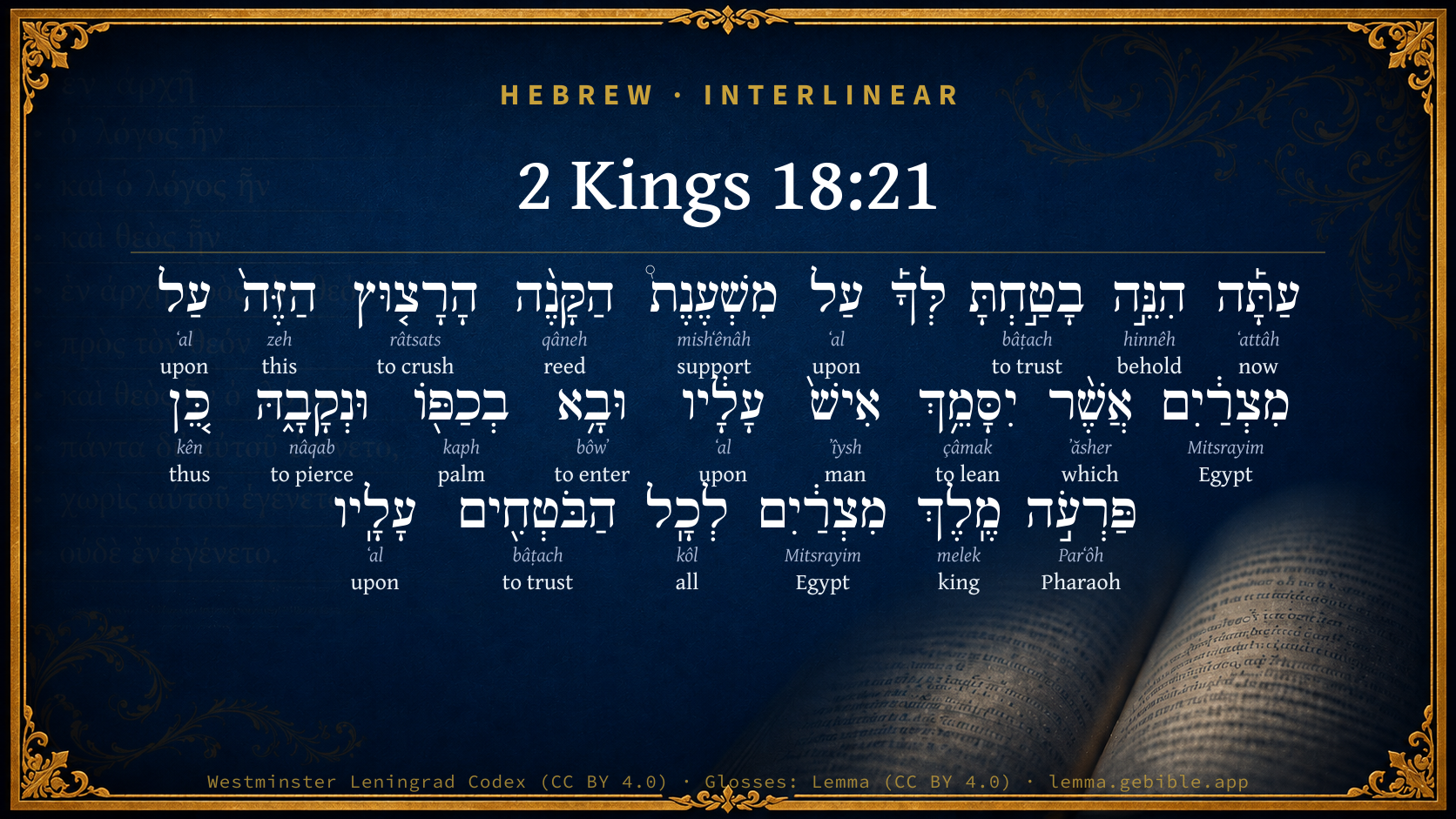
2 Kings 18:21

Hebrew (Westminster Leningrad Codex) 2 Kings 18:21 appears in the Hebrew Old Testament. The text above is from the Westminster Leningrad Codex. Each word links to its Strong’s number, a concise gloss, and parsing drawn from the Open Scriptures Hebrew Bible morphology. Click any word for its full Brown-Driver-Briggs (BDB) entry.
Download image
Cite this verse

2 Kings 18:21 (World English Bible). Public Domain. Lemma interlinear Bible study tool, https://lemma.gebible.app/v/2-kings/18/21.

Show BibTeX & RIS
BibTeX
RIS
English Translation
Now, behold, you trust on the staff of this bruised reed, even on Egypt; whereon if a man lean, it will go into his hand, and pierce it: so is Pharaoh king of Egypt to all who trust on him.
World English Bible · Public Domain
Download a study sheet

One document with this verse’s original text, its word-by-word gloss line, the meaning frame, cross-references with their text, attributed commentary, and full source and license credits — printable, and it pastes into notes with its structure intact.

This verse Autodidact and up

Study sheet (.html) Plain text (.txt)

A passage Seminary Student

Up to 50 verses in one chapter. A passage sheet keeps up to 6 commentary sources and 12 cross-references per verse, in the order this page ranks them, and says so on the sheet whenever that leaves anything out. Ask for a single verse and you get the Autodidact verse sheet above.

Everything on this page stays free to read, with no account — the sheet is a download of what is already on screen, not access to it.

Want to remove ads? Support Godless Engineer
Compare translations 3

The same verse in 3 English versions, stacked beneath the original-language interlinear above. Click any original word for its lexicon entry.

Each is an independent rendering of the whole verse — the interlinear is not word-aligned to these translations.

Highlighted words mark where these versions differ — a whole-verse word diff, not a word-by-word alignment.

  • World English Bible Public Domain
    Now, behold, you trust on the staff of this bruised reed, even on Egypt; whereon if a man lean, it will go into his hand, and pierce it: so is Pharaoh king of Egypt to all who trust on him.
  • King James Version Public Domain
    Now, behold, thou trustest upon the staff of this bruised reed, even upon Egypt, on which if a man lean, it will go into his hand, and pierce it: so is Pharaoh king of Egypt unto all that trust on him.
  • unfoldingWord Literal Text CC BY-SA 4.0
    Now behold, you trust for yourself in the staff of this broken reed, in Egypt, on which a man supports himself and it goes into his palm and pierces it. Thus Pharaoh, the king of Egypt, to all of the ones trusting in him.”’

unfoldingWord Literal Text — © unfoldingWord, licensed CC BY-SA 4.0. Word-aligned USFM3 via Door43 (git.door43.org/unfoldingWord/en_ult).

Versions to compare (up to 4)

3 of 4 selected

Show all 18 translations

Every available English version of this verse, each an independent rendering of the whole verse.

  • World English Bible Public Domain
    Now, behold, you trust on the staff of this bruised reed, even on Egypt; whereon if a man lean, it will go into his hand, and pierce it: so is Pharaoh king of Egypt to all who trust on him.
  • Berean Standard Bible Public Domain
    Look now, you are trusting in Egypt, that splintered reed of a staff that will pierce the hand of anyone who leans on it. Such is Pharaoh king of Egypt to all who trust in him.
  • Majority Standard Bible Public Domain
    Look now, you are trusting in Egypt, that splintered reed of a staff that will pierce the hand of anyone who leans on it. Such is Pharaoh king of Egypt to all who trust in him.
  • King James Version Public Domain
    Now, behold, thou trustest upon the staff of this bruised reed, even upon Egypt, on which if a man lean, it will go into his hand, and pierce it: so is Pharaoh king of Egypt unto all that trust on him.
  • American Standard Version (1901) Public Domain
    Now, behold, thou trustest upon the staff of this bruised reed, even upon Egypt; whereon if a man lean, it will go into his hand, and pierce it: so is Pharaoh king of Egypt unto all that trust on him.
  • Revised Version (1885) Public Domain
    Now, behold, thou trustest upon the staff of this bruised reed, even upon Egypt; whereon if a man lean, it will go into his hand, and pierce it: so is Pharaoh king of Egypt unto all that trust on him.
  • Geneva Bible (1599) Public Domain
    Lo, thou trustest now in this broken staffe of reede, to wit, on Egypt, on which if a man leane, it will goe into his hand, and pearce it: so is Pharaoh king of Egypt vnto all that trust on him.
  • Douay-Rheims (1899) Public Domain
    Dost thou trust in Egypt a staff of a broken reed, upon which if a man lean, it will break and go into his hand, and pierce it? so is Pharao king of Egypt, to all that trust in him.
  • Young's Literal Translation Public Domain
    `Now, lo, thou hast trusted for thee on the staff of this broken reed, on Egypt; which a man leaneth on, and it hath gone into his hand, and pierced it! -- so `is' Pharaoh king of Egypt to all those trusting on him.
  • Literal Standard Version CC BY-SA 4.0
    Now behold, you have trusted for yourself on the staff of this broken reed, on Egypt; which a man leans on, and it has gone into his hand and pierced it! So [is] Pharaoh king of Egypt to all those trusting on him.
  • Unlocked Literal Bible CC BY-SA 4.0
    Look, you trust in the walking stick of this bruised reed of Egypt, but if a man leans on it, it will stick into his hand and pierce it. That is what Pharaoh king of Egypt is to anyone who trusts in him.
  • unfoldingWord Literal Text CC BY-SA 4.0
    Now behold, you trust for yourself in the staff of this broken reed, in Egypt, on which a man supports himself and it goes into his palm and pierces it. Thus Pharaoh, the king of Egypt, to all of the ones trusting in him.”’
  • Darby Bible Public Domain
    Now behold, thou reliest upon the staff of that broken reed, upon Egypt, on which if a man lean, it goes into his hand and pierces it: so is Pharaoh king of Egypt to all that rely upon him.
  • World Messianic Bible Public Domain
    Now, behold, you trust in the staff of this bruised reed, even in Egypt. If a man leans on it, it will go into his hand and pierce it. So is Pharaoh king of Egypt to all who trust on him.
  • Webster's Bible Public Domain
    Now behold, thou trustest upon the staff of this bruised reed, even upon Egypt, on which if a man leaneth, it will go into his hand, and pierce it: so is Pharaoh king of Egypt to all that trust on him.
  • Free Bible Version CC BY-SA 4.0
    Now look! You're trusting in Egypt, a walking stick that's like a broken reed that will cut the hand of anyone leaning on it. That's what Pharaoh, king of Egypt, is like to everyone who trusts in him.
  • Bible in Basic English Public Domain
    See, now, you are basing your hope on that broken rod of Egypt, which will go through a man's hand if he makes use of it for a support; for so is Pharaoh, king of Egypt, to all who put their faith in him.
  • JPS Tanakh (1917) Public Domain
    Now, behold, thou trustest upon the staff of this bruised reed, even upon Egypt; whereon if a man lean, it will go into his hand, and pierce it; so is Pharaoh king of Egypt unto all that trust on him.

Literal Standard Version (2020), Covenant Press — licensed CC BY-SA 4.0. Text via the HelloAO Bible API (eBible.org). Unlocked Literal Bible (unfoldingWord) — licensed CC BY-SA 4.0. Text via the HelloAO Bible API (eBible.org). unfoldingWord Literal Text — © unfoldingWord, licensed CC BY-SA 4.0. Word-aligned USFM3 via Door43 (git.door43.org/unfoldingWord/en_ult). Free Bible Version, Dr. Jonathan Gallagher — licensed CC BY-SA 4.0. Text via the HelloAO Bible API (eBible.org).

Word by word

More ways to search: Search by grammar → Find every occurrence → Compare this word →

Practice this passage: Drill this verse → Learn its vocabulary →

מִשְׁעֶנֶת֩
mishʻênâh
H4938
“support of”
Noun, Common, Feminine, Singular, Construct
Part of Speech
Noun
Type
Common
Gender
Feminine
Number
Singular
State
Construct
Full BDB Definition

Origin: from H4937

TWOT: 2434c , 2434d

support (of every kind), staff
  1. עַתָּ֡ה ʻattâh H6258 “now” Adverb
  2. הִנֵּ֣ה hinnêh H2009 “behold” Particle, Demonstrative
  3. בָטַ֣חְתָּ bâṭach H982 “to trust” Verb, Qal, Perfect, 2nd Person, Masculine, Singular
  4. עַל ʻal H5921 “upon” Preposition
  5. הַקָּנֶ֨ה qâneh H7070 “the · reed” Particle, Definite Article + Noun, Common, Masculine, Singular, Absolute
  6. הָרָצ֤וּץ râtsats H7533 “the · crushed” Particle, Definite Article + Verb, Qal, Participle Passive, Masculine, Singular, Absolute
  7. הַזֶּה֙ zeh H2088 “the · this” Particle, Definite Article + Pronoun, Demonstrative, Masculine, Singular
  8. עַל ʻal H5921 “upon” Preposition
  9. מִצְרַ֔יִם Mitsrayim H4714 “Egypt” Noun, Proper
  10. אֲשֶׁ֨ר ʼăsher H834 “which” Particle, Relative
  11. יִסָּמֵ֥ךְ çâmak H5564 “to lean” Verb, Niphal, Imperfect, 3rd Person, Masculine, Singular
  12. אִישׁ֙ ʼîysh H376 “man” Noun, Common, Masculine, Singular, Absolute
  13. עָלָ֔יו ʻal H5921 “upon · him” Preposition + Suffix, Personal, 3rd Person, Masculine, Singular
  14. וּבָ֥א bôwʼ H935 “and · to enter” Conjunction + Verb, Qal, Sequential Perfect, 3rd Person, Masculine, Singular
  15. בְכַפּ֖וֹ kaph H3709 “in/at · palm · his” Preposition + Noun, Common, Feminine, Singular, Construct + Suffix, Personal, 3rd Person, Masculine, Singular
  16. וּנְקָבָ֑הּ nâqab H5344 “and · to pierce · her” Conjunction + Verb, Qal, Sequential Perfect, 3rd Person, Masculine, Singular + Suffix, Personal, 3rd Person, Feminine, Singular
  17. כֵּ֚ן kên H3651 “thus” Particle, Demonstrative
  18. פַּרְעֹ֣ה Parʻôh H6547 “Pharaoh” Noun, Proper
  19. מֶֽלֶךְ melek H4428 “king of” Noun, Common, Masculine, Singular, Construct
  20. מִצְרַ֔יִם Mitsrayim H4714 “Egypt” Noun, Proper
  21. לְכָֽל kôl H3605 “to/for · all of” Preposition + Noun, Common, Masculine, Singular, Construct
  22. הַבֹּטְחִ֖ים bâṭach H982 “the · trusting” Particle, Definite Article + Verb, Qal, Participle Active, Masculine, Plural, Absolute
  23. עָלָֽיו ʻal H5921 “upon · him” Preposition + Suffix, Personal, 3rd Person, Masculine, Singular

About this verse

These counts appear in no published source. They are computed here, from the morphology-tagged text and Lemma’s own curated glosses. What Lemma adds →

25
words
19
distinct lemmas
Historical
section

Notable vocabulary

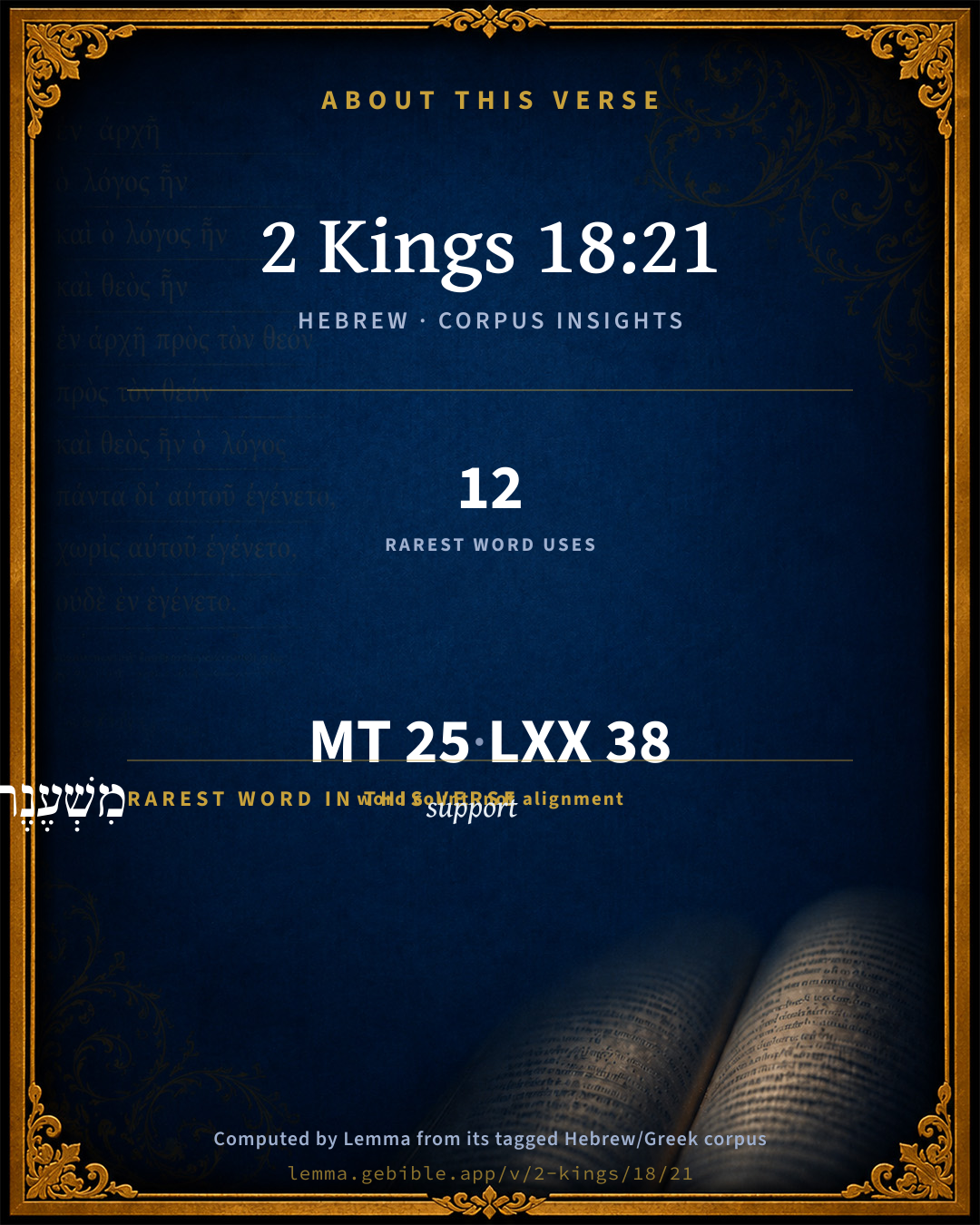
The rarest word here is מִשְׁעֶנֶת֩ support H4938 — appearing just 12 times in the whole Hebrew Bible.

Shared distinctive vocabulary

מִשְׁעֶנֶת֩ support H4938 occurs in 11 verses of the Hebrew Bible. Also found in:

Grammatical profile

  • 6 verbs
  • 9 nouns
  • 1 pronoun
  • 5 prepositions
  • 1 adverb
  • 3 particles

Verb forms

  • בָטַ֣חְתָּ Qal · Perfect
  • הָרָצ֤וּץ Qal · Participle Passive
  • יִסָּמֵ֥ךְ Niphal · Imperfect
  • וּבָ֥א Qal · Sequential Perfect
  • וּנְקָבָ֑הּ Qal · Sequential Perfect
  • הַבֹּטְחִ֖ים Qal · Participle Active

Repetition

Words recur within this verse — often emphatic in Hebrew:

  • עַל upon H5921 ×4
  • בָטַ֣חְתָּ to trust H982 ×2
  • מִצְרַ֔יִם Egypt H4714 ×2

Hebrew & Septuagint length

In English translation the verse runs 40 words from the Hebrew and 44 from the Septuagint (LXX English) — closely comparable.

A rough comparison of the two English renderings, which tokenize alike — not a word-level alignment.

Word counts can differ between the Hebrew and the Greek without any difference in meaning — e.g. the Hebrew direct-object marker אֵת has no separate Greek word, and Greek often adds the article ὁ.

In the original languages it is 25 Hebrew tokens and 38 Greek tokens — but the two are counted differently (Hebrew bundles its prefixes and suffixes into one token; the Greek is in lemma form), so that isn’t a like-for-like length.

Cross-references

7

Topical passages linked to 2 Kings 18:21 in the Treasury of Scripture Knowledge — connected by theme and wording, ordered by reader-vote popularity; previews shown in the World English Bible.

  • Isaiah 30:7 For Egypt helps in vain, and to no purpose: therefore have I called her Rahab who sits still.
  • Isaiah 30:2–3 that set out to go down into Egypt, and have not asked at my mouth; to strengthen themselves in the strength of Pharaoh, and to take refuge in the shadow of Egypt!
  • Ezekiel 29:6–7 All the inhabitants of Egypt shall know that I am Yahweh, because they have been a staff of reed to the house of Israel.
  • 2 Kings 17:4 The king of Assyria found conspiracy in Hoshea; for he had sent messengers to So king of Egypt, and offered no tribute to the king of Assyria, as he had done year by year: therefore the king of Assyria shut him up, and bound him in prison.
  • Isaiah 31:1–3 Woe to those who go down to Egypt for help, and rely on horses, and trust in chariots because they are many, and in horsemen because they are very strong, but they don't look to the Holy One of Israel, neither seek Yahweh!
  • Isaiah 36:6 Behold, you trust on the staff of this bruised reed, even on Egypt, whereon if a man lean, it will go into his hand, and pierce it: so is Pharaoh king of Egypt to all who trust on him.
  • Jeremiah 46:17 They cried there, Pharaoh king of Egypt is but a noise; he has let the appointed time pass by.

Cross-references courtesy of OpenBible.info (CC BY 4.0).

Hebrew and Greek witnesses Masoretic Hebrew ↔ Greek Septuagint

The same verse in the two great witnesses to the Old Testament, shown verse-for-verse.

These are two independent witnesses, not word-aligned to each other, and the Septuagint is shown in lemma (dictionary) form.

Hebrew 2 Kings 18:21 Masoretic · Westminster Leningrad Codex

עַתָּ֡ה הִנֵּ֣ה בָטַ֣חְתָּ לְּךָ֡ עַל מִשְׁעֶנֶת֩ הַקָּנֶ֨ה הָרָצ֤וּץ הַזֶּה֙ עַל מִצְרַ֔יִם אֲשֶׁ֨ר יִסָּמֵ֥ךְ אִישׁ֙ עָלָ֔יו וּבָ֥א בְכַפּ֖וֹ וּנְקָבָ֑הּ כֵּ֚ן פַּרְעֹ֣ה מֶֽלֶךְ מִצְרַ֔יִם לְכָֽל הַבֹּטְחִ֖ים עָלָֽיו

Now, behold, you trust on the staff of this bruised reed, even on Egypt; whereon if a man lean, it will go into his hand, and pierce it: so is Pharaoh king of Egypt to all who trust on him.

World English Bible · Public Domain

Greek LXX 2 Kings 18:21 Septuagint · lemma form

νῦν ἰδού πείθω σεαυτοῦ ἐπί ὁ ῥάβδος ὁ καλάμινος ὁ θλάω οὗτος ἐπί αἴγυπτος ὅς ἄν στηρίζω ἀνήρ ἐπί αὐτός καί εἰςἔρχομαι εἰς ὁ χείρ αὐτός καί τετραίνω αὐτός οὕτως φαραώ βασιλεύς αἴγυπτος πᾶς ὁ πείθω ἐπί αὐτός

See now, are you trusting for yourself on this broken staff of reed, even upon Egypt? whoever shall stay himself upon it, it shall even go into his hand, and pierce it: so is Pharao king of Egypt to all that trust on him.

LXX2012 (modern English Septuagint) · Public Domain

Hebrew: Westminster Leningrad Codex (CC BY 4.0). Greek: Septuagint (public domain); English from LXX2012 (modern English Septuagint) (Public Domain). How the Septuagint differs from the Hebrew →

Targum (Aramaic paraphrase)

1

The Targum is the ancient Jewish Aramaic paraphrase of the Hebrew Scriptures — an interpretive translation, not the Hebrew text itself. Onkelos (literal) and Pseudo-Jonathan (expansive) render the Torah, and Jonathan the Prophets. Coverage is partial: where no permissively-licensed English translation exists for a verse, only the Aramaic is shown. This is verse-level text, not a word-by-word alignment to the Hebrew.

  1. Targum Jonathan Prophets (Joshua–Malachi)
    כְּעַן הָא אִתְרְחֵיצְתָּא לָךְ עַל סְמַךְ קַנְיָא רְעִיעָא הָדֵין עַל מִצְרַיִם דְאִם יִסְתְּמִיךְ גַבְרָא עֲלוֹהִי וְיֵעוּל בִּידֵיהּ וִיבַזְעִינֵיהּ כֵּן פַּרְעֹה מַלְכָּא דְמִצְרַיִם לְכֹל דְמִתְרַחֲצִין עֲלוֹהִי:

    (no public-domain English translation for this verse)

    Targum Jonathan — Aramaic: “Mikraot Gedolot” (public domain). English: “Sefaria Community Translation” (CC0 1.0 (public-domain dedication)); “London "Chaldee Paraphrase," 1871” (public domain). Text via Sefaria.

Commentary

Notes on 2 Kings 18:21 from classic Christian and Jewish commentators (each source and its license shown beneath its notes). The classic Christian expositions comment on the surrounding passage and are grouped to its opening verse, so a note may address several verses; the Jewish commentaries on the Tanakh (Rashi and others) are per-verse, so they appear only where the commentator wrote on this verse.

Lemma curates 59 commentaries, every one of them public domain or Creative Commons licensed, each selected and text-cleaned for this edition rather than reprinted as found. About our sources →

Trapp's Complete Commentary

John Trapp

2Ki 18:21 Now, behold, thou trustest upon the staff of this bruised reed, [even] upon Egypt, on which if a man lean, it will go into his hand, and pierce it: so [is] Pharaoh king of Egypt unto all that trust on him.

Ver. 21. Now thou trustest upon the staff, &c.] This Hezekiah did not, that we read of: but Rabshakeh thought he would, as Hoshea had done before.

John Trapp, A Commentary or Exposition upon All the Books of the Old and New Testament (1647–1656) — public domain. Text from a community e-Sword module.

Joseph Benson's Commentary

2Ki 18:21. Thou trustest upon this bruised reed — Sennacherib probably thought that Hezekiah depended on Egypt for help, and therefore represents the power of that kingdom to be as weak as the canes or reeds that grew on the banks of the Nile, (to which he seems to allude,) on which, if a man leaned, they brake, and the splinters ran into his hand. Such is Pharaoh, says he; a man gets no help, but mischief, by relying on him. Whoever trusts in man, leans on a broken reed; but God is the Rock of ages.

Joseph Benson's Commentary on the Old and New Testaments (1811–1818) — public domain. Text from a community e-Sword module.

Geneva Bible (1599)

Geneva Bible translators

Egypt shall not only not be able to succor thee, but shall be an hurt unto thee.

Geneva Bible (1599) marginal notes — public domain. Text via Bolls.life.

Adam Clarke's Commentary

Verse 21. The staff of this bruised reed] Egypt had already been greatly bruised and broken, through the wars carried on against it by the Assyrians.

Adam Clarke's Commentary on the Bible (1810–1826) — public domain. Text from a community e-Sword/MySword module.

Ellicott's Commentary for English Readers

(21) The staff of this bruised reed.—Cracked or flawed would be better than bruised; because, as is clear from the following words, the idea is that of a reed splitting and piercing the hand that rests upon it. (Comp. Isa_42:3.) As to the Judæan expectations from Egypt, comp. Isa_20:1-5; Isa_30:1-8; Isa_31:1-4, passages in which such expectations are denounced as implying want of faith in Jehovah.

A Bible Commentary for English Readers, edited by Charles John Ellicott (1878–1897) — public domain. Text from a community e-Sword module.

The Cambridge Bible for Schools and Colleges

gen. ed. J. J. S. Perowne

21. Thou trustest upon the staff of this bruised reed] Rab-shakeh answers his own question. It may be that he also is correct in saying that Hezekiah had hopes of help from Egypt. But in this the king would find no support from the prophets of the time. The figure of a reed is perhaps used by Rab-shakeh because Egypt produced them in abundance. A bruised reed, one which will crack, and offer jagged points at the broken part is used as a figure by Ezekiel concerning Egypt (Eze_29:6), and the words exactly illustrate what Rab-shakeh would convey. ‘They (the Egyptians) have been a staff of reed to the house of Israel. When they took hold of thee by thy hand thou didst break, and rend all their shoulder: and when they leaned upon thee, thou brakest, and madest all their loins to be at a stand’. (Bp Hall.)

Pharaoh king of Egypt] Pharaoh is here used as the common title of the native kings of Egypt. Thus Rabshakeh disposes of external help.

The Cambridge Bible for Schools and Colleges (gen. ed. J. J. S. Perowne; Cambridge University Press, 1878–1918) — public domain. Text from a community e-Sword module.

Albert Barnes' Notes on the Bible

This bruised reed - The “tall reed of the Nile bulrush” fitly symbolized the land where it grew. Apparently strong and firm, it was quite unworthy of trust. Let a man lean upon it, and the rotten support instantly gave way, wounding the hand that stayed itself so insecurely. So it was with Egypt throughout the whole period of Jewish history (compare 2Ki 17:4-6). Her actual practice was to pretend friendship, to hold out hopes of support, and then to fail in time of need.

Albert Barnes' Notes on the Bible (1834–1885) — public domain. Text from a community e-Sword/MySword module.

Haydock's Catholic Bible Commentary

Pierce it. He alludes to the reeds which grow on the Nile. See Delrio, adag. 210. Egypt had been already greatly harassed in the expedition of Sennacherib, so that no succour could be expected thence. (Calmet)

George Leo Haydock (1774–1849), Haydock's Catholic Family Bible and Commentary, 1859 edition — public domain. Excludes Psalms (Douay-Rheims chapter numbering differs from Protestant) and Deuterocanonical books (Catholic canon only).

Matthew Poole's English Annotations

This bruised reed; he calls Egypt a reed, with allusion to the reeds wherewith the banks of Nilus were full; and bruised, to note their weakness and insufficiency to support him. Compare Eze 29:6,7.

It will go into his hand, and pierce it, by some of the fragments into which it will be broken.

Unto all that trust on him; doing them no good, but much hurt.

Matthew Poole's English Annotations on the Holy Bible (1683–1685) — public domain. Text from a community e-Sword/MySword module.

Whedon's Commentary on the Bible

Daniel D. Whedon

21. Staff of this bruised reed — A figure especially well chosen, since the banks of the Nile, the great river of Egypt, abounded with reeds. Compare also Eze_29:6. The slender reed is a poor thing to lean upon, and when bruised or broken is still more frail. “Sennacherib compares Egypt with a broken reed, not because he had already broken its power, but because he regarded it as good as already broken.” — Thenius.

Daniel D. Whedon (gen. ed.), Commentary on the Old and New Testaments (1874–1909) — public domain. Text from a community e-Sword module.

The Pulpit Commentary

Now, behold, thou trustest upon the staff of this bruised reed, even upon Egypt. Sennacherib had good information. Hezekiah"s embassy to Egypt (Isa_30:2-7) was known to him; and he rightly judged that Hezekiah was expecting aid from this quarter. This expectation he ridicules. What is Egypt but a "bruised reed"? The Nile bulrush (xr) has a goodly show; it rears itself aloft, and leeks strong and stately; but use it as a staff, lean upon it, and it snaps at once. Such is Pharaoh nay, he is worse; he is a bruised reed, which can give no support at all, even for a moment. The Assyrian monarch was justified in his contempt. Egypt had never yet given any effectual support to the states attacked by Assyria Shebek gave no manner of aid to Hoshea, but allowed Samaria to be conquered in B.C. 722 without making the slightest effort on her behalf. In B.C. 720 he came to the aid of Gaza ("Eponym Canon," p. 126), but Gazawas captured notwithstanding. In B.C. 711 either he or Sabatok undertook the protection of Ashdod, but with the same lack of success (ibid., pp. 130, 131). "Kings of Egypt" assisted the Ascalonites against Sennacherib himself in B.C. 701, and were again completely defeated (ibid., pp. 133, 134). Sargon calls the King of Egypt, whoso aid was invited by the Ashdedites (ibid., p. 130, line 37), "a monarch who could not save them." On which if a man lean, it will go into his hand, and pierce it; i.e. trust in Egypt will not only bring a country no advantage, but it will bring positive injury. The sharp siliceous casing of a reed might run into the hand and give an ugly wound. So is Pharaoh King of Egypt unto all that trust on him. Sargon in one place (ibid., p. 130, line 36) speaks of a King of Egypt under the title of "Pharaoh."

The Pulpit Commentary (1880–1919), ed. H.D.M. Spence-Jones & Joseph S. Exell — public domain. Text from a community e-Sword module.

John Wesley's Explanatory Notes

This broken reed - Whoever trusts in man, leans on a broken reed: but God is the rock of ages.

John Wesley, Explanatory Notes Upon the Whole Bible (1754–1765) — public domain. Text via the GEBible commentary corpus.

Rashi

Rabbi Shlomo Yitzchaki (Rashi)

It will go into his palm. When a person supports himself on a support of a splintered reed, which has broken in his hand, the splintered edges come and puncture his palm.

Rashi on the Tanakh — English translations: “The Judaica Press complete Tanach with Rashi, translated by A. J. Rosenberg” (CC BY 4.0); “Pentateuch with Rashi's commentary by M. Rosenbaum and A.M. Silbermann, 1929-1934” (public domain); “The Metsudah Tanach series, Lakewood, N.J” (CC BY 4.0); and “The Book of Joshua, Metsudah Publications, 1997” (CC BY 4.0). Text via Sefaria.

Lesson kit

Teaching starters — assembled from the data on this page, not authored interpretation. Every prompt links to the verse data it draws on. Edit before teaching.

2 Kings, in the Historical, opens this verse with 25 words (19 distinct Hebrew lemmas). Its most distinctive word is mishʻênâh (“support”). A historical commentator’s framing appears above. Read the whole chapter for the surrounding context.

Discussion questions

  1. The word mishʻênâh carries the sense “support.” How does it shape the verse?
  2. Exodus 21:19 shares the word «support» with this verse. How do the two illuminate each other?
  3. “upon” occurs 4× in this one verse. What is the effect of the repetition?
  4. The translations on this page render this verse differently — a whole-verse word diff, not a word-by-word alignment. What might account for the different wordings?
  5. The verb «בָטַ֣חְתָּ» is Qal Perfect. How does its form color the action?
  6. Reading how Trapp's Complete Commentary and Joseph Benson's Commentary read this verse, where do the two commentators agree and where do they part?

Things to notice

Reading settings

Reading text

Shown beneath each verse's original-language words.

Old Testament
Old Testament edition

Read the OT as the Masoretic Hebrew (MT) or the Greek Septuagint (LXX).

English shown for the Greek Septuagint (in the Hebrew ↔ Greek comparison).

Comparing translations? Open the Compare panel on any verse page to stack up to four side by side.