
2 Chronicles 30:6

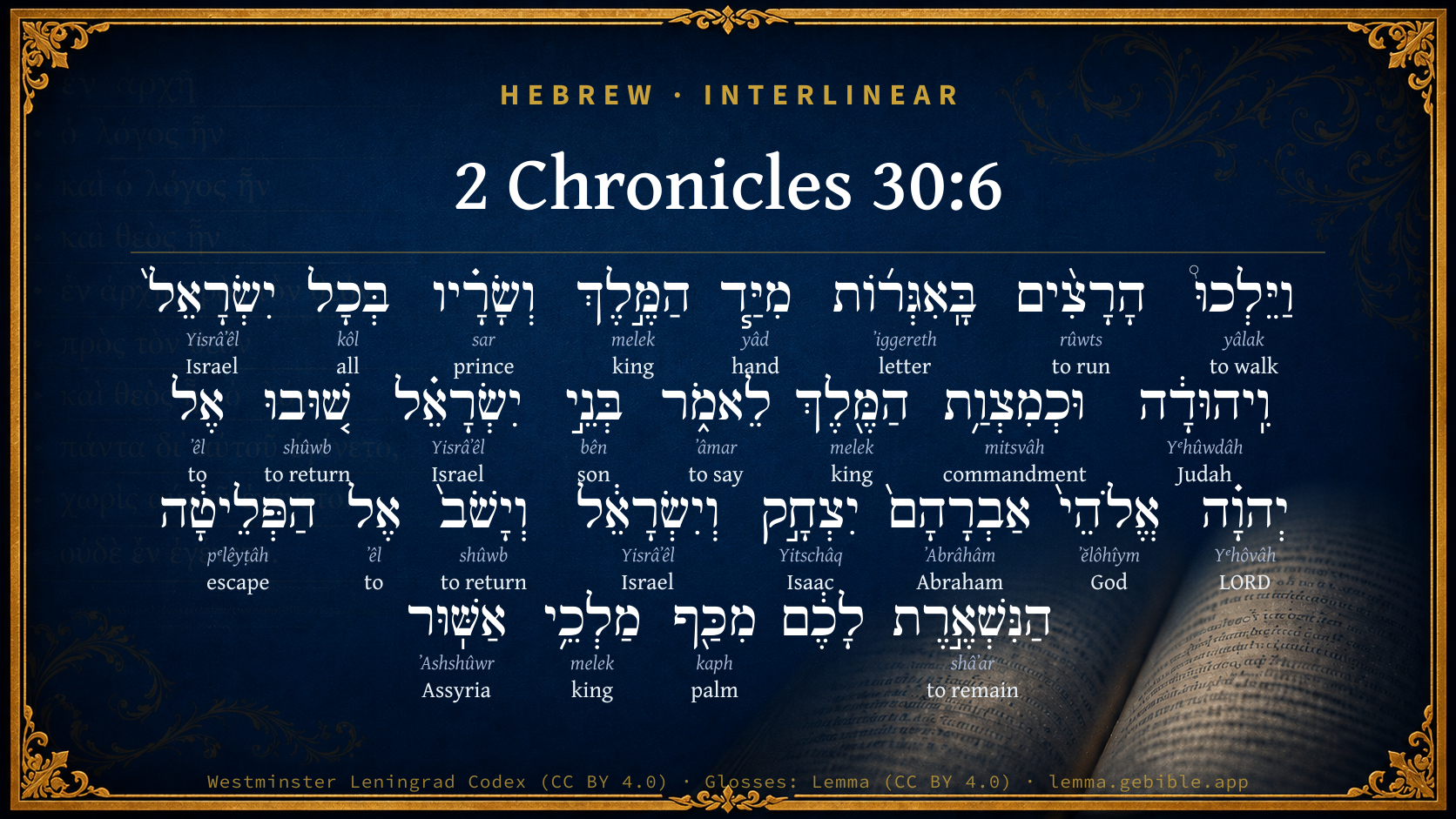
Hebrew (Westminster Leningrad Codex) 2 Chronicles 30:6 appears in the Hebrew Old Testament. The text above is from the Westminster Leningrad Codex. Each word links to its Strong’s number, a concise gloss, and parsing drawn from the Open Scriptures Hebrew Bible morphology. Click any word for its full Brown-Driver-Briggs (BDB) entry.
Download image
Cite this verse

2 Chronicles 30:6 (World English Bible). Public Domain. Lemma interlinear Bible study tool, https://lemma.gebible.app/v/2-chronicles/30/6.

Show BibTeX & RIS
BibTeX
RIS
English Translation
So the posts went with the letters from the king and his princes throughout all Israel and Judah, and according to the commandment of the king, saying, You children of Israel, turn again to Yahweh, the God of Abraham, Isaac, and Israel, that he may return to the remnant that have escaped of you out of the hand of the kings of Assyria.
World English Bible · Public Domain
Download a study sheet

One document with this verse’s original text, its word-by-word gloss line, the meaning frame, cross-references with their text, attributed commentary, and full source and license credits — printable, and it pastes into notes with its structure intact.

This verse Autodidact and up

Study sheet (.html) Plain text (.txt)

A passage Seminary Student

Up to 50 verses in one chapter. A passage sheet keeps up to 6 commentary sources and 12 cross-references per verse, in the order this page ranks them, and says so on the sheet whenever that leaves anything out. Ask for a single verse and you get the Autodidact verse sheet above.

Everything on this page stays free to read, with no account — the sheet is a download of what is already on screen, not access to it.

Want to remove ads? Support Godless Engineer
Compare translations 3

The same verse in 3 English versions, stacked beneath the original-language interlinear above. Click any original word for its lexicon entry.

Each is an independent rendering of the whole verse — the interlinear is not word-aligned to these translations.

Highlighted words mark where these versions differ — a whole-verse word diff, not a word-by-word alignment.

  • World English Bible Public Domain
    So the posts went with the letters from the king and his princes throughout all Israel and Judah, and according to the commandment of the king, saying, You children of Israel, turn again to Yahweh, the God of Abraham, Isaac, and Israel, that he may return to the remnant that have escaped of you out of the hand of the kings of Assyria.
  • King James Version Public Domain
    So the posts went with the letters from the king and his princes throughout all Israel and Judah, and according to the commandment of the king, saying, Ye children of Israel, turn again unto the LORD God of Abraham, Isaac, and Israel, and he will return to the remnant of you, that are escaped out of the hand of the kings of Assyria.
  • unfoldingWord Literal Text CC BY-SA 4.0
    And runners went with letters from the hand of the king and his chiefs among all Israel and Judah and according to the command of the king, saying, “Sons of Israel, return to Yahweh, the God of Abraham, Isaac, and Israel, and he will return to the escaped remaining of you all from the palm of the kings of Assyria.

unfoldingWord Literal Text — © unfoldingWord, licensed CC BY-SA 4.0. Word-aligned USFM3 via Door43 (git.door43.org/unfoldingWord/en_ult).

Versions to compare (up to 4)

3 of 4 selected

Show all 18 translations

Every available English version of this verse, each an independent rendering of the whole verse.

  • World English Bible Public Domain
    So the posts went with the letters from the king and his princes throughout all Israel and Judah, and according to the commandment of the king, saying, You children of Israel, turn again to Yahweh, the God of Abraham, Isaac, and Israel, that he may return to the remnant that have escaped of you out of the hand of the kings of Assyria.
  • Berean Standard Bible Public Domain
    So the couriers went throughout Israel and Judah with letters from the king and his officials, which read: “Children of Israel, return to the LORD, the God of Abraham, Isaac, and Israel, so that He may return to those of you who remain, who have escaped the grasp of the kings of Assyria.
  • Majority Standard Bible Public Domain
    At the command of the king, the couriers went throughout Israel and Judah with letters from the king and his officials, which read: “Children of Israel, return to the LORD, the God of Abraham, Isaac, and Israel, so that He may return to those of you who remain, who have escaped the grasp of the kings of Assyria.
  • King James Version Public Domain
    So the posts went with the letters from the king and his princes throughout all Israel and Judah, and according to the commandment of the king, saying, Ye children of Israel, turn again unto the LORD God of Abraham, Isaac, and Israel, and he will return to the remnant of you, that are escaped out of the hand of the kings of Assyria.
  • American Standard Version (1901) Public Domain
    So the posts went with the letters from the king and his princes throughout all Israel and Judah, and according to the commandment of the king, saying, Ye children of Israel, turn again unto Jehovah, the God of Abraham, Isaac, and Israel, that he may return to the remnant that are escaped of you out of the hand of the kings of Assyria.
  • Revised Version (1885) Public Domain
    So the posts went with the letters from the king and his princes throughout all Israel and Judah, and according to the commandment of the king, saying, Ye children of Israel, turn again unto the LORD, the God of Abraham, Isaac, and Israel, that he may return to the remnant that are escaped of you out of the hand of the kings of Assyria.
  • Geneva Bible (1599) Public Domain
    So the postes went with letters by the commission of the King, and his princes, thorowout all Israel and Iudah, and with the commandement of the King, saying, Ye children of Israel, turne againe vnto the Lord God of Abraham, Izhak, and Israel, and he will returne to the remnant that are escaped of you, out of ye hands of the Kings of Asshur.
  • Douay-Rheims (1899) Public Domain
    And they decreed to send messengers to all Israel from Bersabee even to Dan, that they should come, and keep the phase to the Lord the God of Israel in Jerusalem: for many had not kept it as it is prescribed by the law.
  • Young's Literal Translation Public Domain
    And the runners go with letters from the hand of the king and his heads, into all Israel and Judah, even according to the command of the king, saying, `O sons of Israel, turn back unto Jehovah, God of Abraham, Isaac, and Israel, and He doth turn back unto the escaped part that is left of you from the hand of the kings of Asshur;
  • Literal Standard Version CC BY-SA 4.0
    And the runners go with letters from the hand of the king and his heads into all Israel and Judah, even according to the command of the king, saying, “O sons of Israel, turn back to YHWH, God of Abraham, Isaac, and Israel, and He turns back to the escaped part that is left of you from the hand of the kings of Asshur;
  • Unlocked Literal Bible CC BY-SA 4.0
    So couriers went with the letters from the king and his leaders throughout all Israel and Judah, by the command of the king. They said, “You people of Israel, turn back to Yahweh, the God of Abraham, Isaac, and Israel, so that he may turn back to the remnant of you who have escaped from the hand of the kings of Assyria.
  • unfoldingWord Literal Text CC BY-SA 4.0
    And runners went with letters from the hand of the king and his chiefs among all Israel and Judah and according to the command of the king, saying, “Sons of Israel, return to Yahweh, the God of Abraham, Isaac, and Israel, and he will return to the escaped remaining of you all from the palm of the kings of Assyria.
  • Darby Bible Public Domain
    And the couriers went with the letters from the king and his princes throughout Israel and Judah, and according to the commandment of the king, saying, Ye children of Israel, return to Jehovah the God of Abraham, Isaac, and Israel, and he will return to the remnant of you that are escaped out of the hand of the kings of Assyria.
  • World Messianic Bible Public Domain
    So the couriers went with the letters from the king and his princes throughout all Israel and Judah, according to the commandment of the king, saying, “You children of Israel, turn again to the LORD, the God of Abraham, Isaac, and Israel, that he may return to the remnant of you that have escaped out of the hand of the kings of Assyria.
  • Webster's Bible Public Domain
    So the posts went with the letters from the king and his princes throughout all Israel and Judah, and according to the commandment of the king, saying, Ye children of Israel, turn again to the LORD God of Abraham, Isaac, and Israel, and he will return to the remnant of you that have escaped from the hand of the kings of Assyria.
  • Free Bible Version CC BY-SA 4.0
    So messengers went to all of Israel and Judah carrying letters from the king and his officials and with the king's authorization. They said, “Children of Israel, return to the Lord, the God of Abraham, Isaac, and Israel, so that he may return to you who are left, who have escaped the oppression of the kings of Assyria.
  • Bible in Basic English Public Domain
    So runners went with letters from the king and his chiefs through all Israel and Judah, by the order of the king, saying, O children of Israel, come back again to the Lord, the God of Abraham, Isaac, and Israel, so that he may come again to that small band of you which has been kept safe out of the hands of the kings of Assyria.
  • JPS Tanakh (1917) Public Domain
    So the posts went with the letters from the king and his princes throughout all Israel and Judah, and according to the commandment of the king, saying: 'Ye children of Israel, turn back unto the LORD, the God of Abraham, Isaac, and Israel, that He may return to the remnant that are escaped of you out of the hand of the kings of Assyria.

Literal Standard Version (2020), Covenant Press — licensed CC BY-SA 4.0. Text via the HelloAO Bible API (eBible.org). Unlocked Literal Bible (unfoldingWord) — licensed CC BY-SA 4.0. Text via the HelloAO Bible API (eBible.org). unfoldingWord Literal Text — © unfoldingWord, licensed CC BY-SA 4.0. Word-aligned USFM3 via Door43 (git.door43.org/unfoldingWord/en_ult). Free Bible Version, Dr. Jonathan Gallagher — licensed CC BY-SA 4.0. Text via the HelloAO Bible API (eBible.org).

Word by word

More ways to search: Search by grammar → Find every occurrence → Compare this word →

Practice this passage: Drill this verse → Learn its vocabulary →

בָּֽאִגְּר֜וֹת
ʼiggereth
H107
“in/at the · letters”
Preposition, Determined + Noun, Common, Feminine, Plural, Absolute
Part of Speech
Preposition + Noun
Type
Common
Gender
Feminine
Number
Plural
State
Absolute
Full BDB Definition

Origin: from H104

TWOT: 23b

letter, missive
  1. וַיֵּלְכוּ֩ yâlak H3212 “and · to walk” Conjunction + Verb, Qal, Sequential Imperfect, 3rd Person, Masculine, Plural
  2. הָרָצִ֨ים rûwts H7323 “the · running” Particle, Definite Article + Verb, Qal, Participle Active, Masculine, Plural, Absolute
  3. מִיַּ֧ד yâd H3027 “from · hand of” Preposition + Noun, Common, Both, Singular, Construct
  4. הַמֶּ֣לֶךְ melek H4428 “the · king” Particle, Definite Article + Noun, Common, Masculine, Singular, Absolute
  5. וְשָׂרָ֗יו sar H8269 “and · princes · his” Conjunction + Noun, Common, Masculine, Plural, Construct + Suffix, Personal, 3rd Person, Masculine, Singular
  6. בְּכָל kôl H3605 “in/at · all of” Preposition + Noun, Common, Masculine, Singular, Construct
  7. יִשְׂרָאֵל֙ Yisrâʼêl H3478 “Israel” Noun, Proper
  8. וִֽיהוּדָ֔ה Yᵉhûwdâh H3063 “and · Judah” Conjunction + Noun, Proper
  9. וּכְמִצְוַ֥ת mitsvâh H4687 “and · like/as · commandment of” Conjunction + Preposition + Noun, Common, Feminine, Singular, Construct
  10. הַמֶּ֖לֶךְ melek H4428 “the · king” Particle, Definite Article + Noun, Common, Masculine, Singular, Absolute
  11. לֵאמֹ֑ר ʼâmar H559 “to say” Preposition + Verb, Qal, Infinitive Construct
  12. בְּנֵ֣י bên H1121 “sons of” Noun, Common, Masculine, Plural, Construct
  13. יִשְׂרָאֵ֗ל Yisrâʼêl H3478 “Israel” Noun, Proper
  14. שׁ֚וּבוּ shûwb H7725 “return” Verb, Qal, Imperative, 2nd Person, Masculine, Plural
  15. אֶל ʼêl H413 “to” Preposition
  16. יְהוָ֗ה Yᵉhôvâh H3068 “LORD” Noun, Proper
  17. אֱלֹהֵי֙ ʼĕlôhîym H430 “God(s) of” Noun, Common, Masculine, Plural, Construct
  18. אַבְרָהָם֙ ʼAbrâhâm H85 “Abraham” Noun, Proper
  19. יִצְחָ֣ק Yitschâq H3327 “Isaac” Noun, Proper
  20. וְיִשְׂרָאֵ֔ל Yisrâʼêl H3478 “and · Israel” Conjunction + Noun, Proper
  21. וְיָשֹׁב֙ shûwb H7725 “and · to return” Conjunction + Verb, Qal, Jussive, 3rd Person, Masculine, Singular
  22. אֶל ʼêl H413 “to” Preposition
  23. הַפְּלֵיטָ֔ה pᵉlêyṭâh H6413 “the · escape” Particle, Definite Article + Noun, Common, Feminine, Singular, Absolute
  24. הַנִּשְׁאֶ֣רֶת shâʼar H7604 “the · remaining” Particle, Definite Article + Verb, Niphal, Participle Active, Feminine, Singular, Absolute
  25. מִכַּ֖ף kaph H3709 “from · palm of” Preposition + Noun, Common, Feminine, Singular, Construct
  26. מַלְכֵ֥י melek H4428 “kings of” Noun, Common, Masculine, Plural, Construct
  27. אַשּֽׁוּר ʼAshshûwr H804 “Assyria” Noun, Proper

About this verse

These counts appear in no published source. They are computed here, from the morphology-tagged text and Lemma’s own curated glosses. What Lemma adds →

29
words
22
distinct lemmas
Historical
section

Notable vocabulary

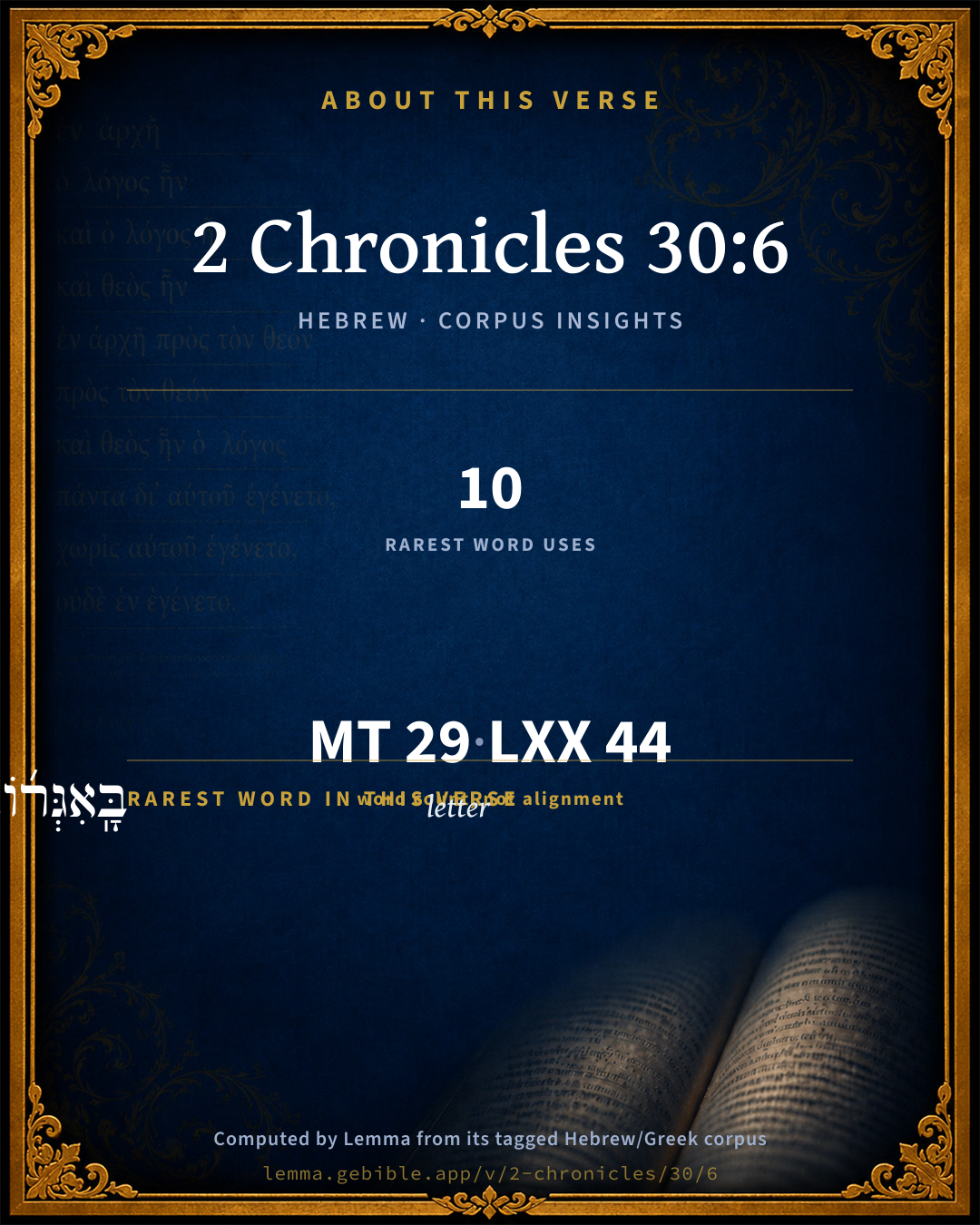
The rarest word here is בָּֽאִגְּר֜וֹת letter H107 — appearing just 10 times in the whole Hebrew Bible.

Shared distinctive vocabulary

בָּֽאִגְּר֜וֹת letter H107 occurs in 10 verses of the Hebrew Bible. Also found in:

Grammatical profile

  • 6 verbs
  • 20 nouns
  • 3 prepositions

Verb forms

  • וַיֵּלְכוּ֩ Qal · Sequential Imperfect
  • הָרָצִ֨ים Qal · Participle Active
  • לֵאמֹ֑ר Qal · Infinitive Construct
  • שׁ֚וּבוּ Qal · Imperative
  • וְיָשֹׁב֙ Qal · Jussive
  • הַנִּשְׁאֶ֣רֶת Niphal · Participle Active

Repetition

Words recur within this verse — often emphatic in Hebrew:

  • הַמֶּ֣לֶךְ king H4428 ×3
  • יִשְׂרָאֵל֙ Israel H3478 ×3
  • שׁ֚וּבוּ to return H7725 ×2
  • אֶל to H413 ×2

Hebrew & Septuagint length

In English translation the verse runs 63 words from the Hebrew and 60 from the Septuagint (LXX English) — closely comparable.

A rough comparison of the two English renderings, which tokenize alike — not a word-level alignment.

Word counts can differ between the Hebrew and the Greek without any difference in meaning — e.g. the Hebrew direct-object marker אֵת has no separate Greek word, and Greek often adds the article ὁ.

In the original languages it is 29 Hebrew tokens and 44 Greek tokens — but the two are counted differently (Hebrew bundles its prefixes and suffixes into one token; the Greek is in lemma form), so that isn’t a like-for-like length.

Cross-references

16

Topical passages linked to 2 Chronicles 30:6 in the Treasury of Scripture Knowledge — connected by theme and wording, ordered by reader-vote popularity; previews shown in the World English Bible.

  • Jeremiah 51:31 One post shall run to meet another, and one messenger to met another, to show the king of Babylon that his city is taken on every quarter:
  • 2 Kings 15:19 There came against the land Pul the king of Assyria; and Menahem gave Pul one thousand talents of silver, that his hand might be with him to confirm the kingdom in his hand.
  • 2 Kings 15:29 In the days of Pekah king of Israel came Tiglath Pileser king of Assyria, and took Ijon, and Abel Beth Maacah, and Janoah, and Kedesh, and Hazor, and Gilead, and Galilee, all the land of Naphtali; and he carried them captive to Assyria.
  • Esther 8:14 So the posts who rode on swift steeds that were used in the king's service went out, being hurried and pressed on by the king's commandment; and the decree was given out in Shushan the palace.
  • Jeremiah 4:1 If you will return, Israel, says Yahweh, if you will return to me, and if you will put away your abominations out of my sight; then you shall not be removed;
  • 1 Chronicles 5:26 The God of Israel stirred up the spirit of Pul king of Assyria, and the spirit of Tilgath Pilneser king of Assyria, and he carried them away, even the Reubenites, and the Gadites, and the half-tribe of Manasseh, and brought them to Halah, and Habor, and Hara, and to the river of Gozan, to this day.
  • 2 Chronicles 28:20 Tilgath Pilneser king of Assyria came to him, and distressed him, but didn't strengthen him.
  • Job 9:25 "Now my days are swifter than a runner. They flee away, they see no good,
  • Isaiah 55:6–7 Seek you Yahweh while he may be found; call you on him while he is near:
  • Isaiah 1:9 Unless Yahweh of hosts had left to us a very small remnant, We would have been as Sodom; We would have been like Gomorrah.
  • Isaiah 6:13 If there are yet a tenth in it, It also shall in turn be eaten up: As a terebinth, and as an oak, whose stock remains, when they are felled; So the holy seed is its stock."
  • Lamentations 5:21 Turn you us to you, Yahweh, and we shall be turned; Renew our days as of old.
  • Ezekiel 33:11 Tell them, As I live, says the Lord Yahweh, I have no pleasure in the death of the wicked; but that the wicked turn from his way and live: turn you, turn you from your evil ways; for why will you die, house of Israel?
  • Hosea 14:1 Israel, return to Yahweh your God; For you have fallen because of your sin.
  • Joel 2:12–14 "Yet even now," says Yahweh, "turn to me with all your heart, And with fasting, and with weeping, and with mourning."
  • James 4:8 Draw near to God, and he will draw near to you. Cleanse your hands, you sinners; and purify your hearts, you double-minded.

Cross-references courtesy of OpenBible.info (CC BY 4.0).

Hebrew and Greek witnesses Masoretic Hebrew ↔ Greek Septuagint

The same verse in the two great witnesses to the Old Testament, shown verse-for-verse.

These are two independent witnesses, not word-aligned to each other, and the Septuagint is shown in lemma (dictionary) form.

Hebrew 2 Chronicles 30:6 Masoretic · Westminster Leningrad Codex

וַיֵּלְכוּ֩ הָרָצִ֨ים בָּֽאִגְּר֜וֹת מִיַּ֧ד הַמֶּ֣לֶךְ וְשָׂרָ֗יו בְּכָל יִשְׂרָאֵל֙ וִֽיהוּדָ֔ה וּכְמִצְוַ֥ת הַמֶּ֖לֶךְ לֵאמֹ֑ר בְּנֵ֣י יִשְׂרָאֵ֗ל שׁ֚וּבוּ אֶל יְהוָ֗ה אֱלֹהֵי֙ אַבְרָהָם֙ יִצְחָ֣ק וְיִשְׂרָאֵ֔ל וְיָשֹׁב֙ אֶל הַפְּלֵיטָ֔ה הַנִּשְׁאֶ֣רֶת לָכֶ֔ם מִכַּ֖ף מַלְכֵ֥י אַשּֽׁוּר

So the posts went with the letters from the king and his princes throughout all Israel and Judah, and according to the commandment of the king, saying, You children of Israel, turn again to Yahweh, the God of Abraham, Isaac, and Israel, that he may return to the remnant that have escaped of you out of the hand of the kings of Assyria.

World English Bible · Public Domain

Greek LXX 2 Chronicles 30:6 Septuagint · lemma form

καί πορεύομαι ὁ τρέχω σύν ὁ ἐπιστολή παρά ὁ βασιλεύς καί ὁ ἄρχων εἰς πᾶς ἰσραήλ καί ἰούδας κατά ὁ πρόσταγμα ὁ βασιλεύς λέγω υἱός ἰσραήλ ἐπιστρέφω πρός θεός ἀβραάμ καί ισαακ καί ἰσραήλ καί ἐπιστρέφω ὁ ἀνασώζω ὁ καταλείπω ἀπό χείρ βασιλεύς ασσουρ

And the posts went with the letters from the king and the princes to all Israel and Juda, according to the command of the king, saying, Children of Israel, return to the Lord God of Abraam, and Isaac, and Israel, and bring back them that have escaped even those that were left of the hand of the king of Assyria.

LXX2012 (modern English Septuagint) · Public Domain

On this verse, Ellicott's Commentary for English Readers discusses the Septuagint’s reading. Read the note in Commentary ↓

Hebrew: Westminster Leningrad Codex (CC BY 4.0). Greek: Septuagint (public domain); English from LXX2012 (modern English Septuagint) (Public Domain). How the Septuagint differs from the Hebrew →

Commentary

Notes on 2 Chronicles 30:6 from classic Christian and Jewish commentators (each source and its license shown beneath its notes). The classic Christian expositions comment on the surrounding passage and are grouped to its opening verse, so a note may address several verses; the Jewish commentaries on the Tanakh (Rashi and others) are per-verse, so they appear only where the commentator wrote on this verse.

Lemma curates 59 commentaries, every one of them public domain or Creative Commons licensed, each selected and text-cleaned for this edition rather than reprinted as found. About our sources →

Trapp's Complete Commentary

John Trapp

2Ch 30:6 So the posts went with the letters from the king and his princes throughout all Israel and Judah, and according to the commandment of the king, saying, Ye children of Israel, turn again unto the LORD God of Abraham, Isaac, and Israel, and he will return to the remnant of you, that are escaped out of the hand of the kings of Assyria.

Ver. 6. Ye children of Israel, turn again to the Lord.] Hezekiah knew that the poor remnant of Israel were in great affliction: he therefore presseth them to repentance, whereby men return to God, as by sin they run from him. Afflictiones sunt lex practice {Psa 119:71} Hezekiah thought it was good striking while the iron was hot.

John Trapp, A Commentary or Exposition upon All the Books of the Old and New Testament (1647–1656) — public domain. Text from a community e-Sword module.

Joseph Benson's Commentary

2Ch 30:6. So the posts — Hebrew, הרצים, haratsim, the runners; went with the letters — Expresses were sent throughout all the tribes of Israel, with memorials, earnestly pressing the people to take this opportunity of returning to God, from whom they had revolted. Saying, Ye children of Israel, turn again unto the Lord, &c. — In these letters Hezekiah discovers great concern both for the honour of God and for the welfare of the neighbouring kingdom, the prosperity of which he seems earnestly to have desired, though he not only received no toll, tribute, or custom from it, but it had often, and not long since, been vexatious to his kingdom. This was indeed rendering good for evil. And he will return to the remnant of you — You are but a remnant, narrowly escaped out of the hand of the kings of Assyria, (namely, Pul and Tiglath-pileser,) who have carried your brethren away captive. And therefore it concerns you to put yourselves under the protection of the God of your fathers, that you may not be quite swallowed up: and if you turn to him in the way of duty, he will turn to you in a way of mercy.

Joseph Benson's Commentary on the Old and New Testaments (1811–1818) — public domain. Text from a community e-Sword module.

Geneva Bible (1599)

Geneva Bible translators

He will have compassion on them, and preserve them.

Geneva Bible (1599) marginal notes — public domain. Text via Bolls.life.

Jamieson, Fausset & Brown

Robert Jamieson, A. R. Fausset & David Brown

the posts--that is, runners, or royal messengers, who were taken from the king's bodyguard (Ch2 23:1-2). Each, well mounted, had a certain number of miles to traverse. Having performed his course, he was relieved by another, who had to scour an equal extent of ground; so that, as the government messengers were despatched in all directions, public edicts were speedily diffused throughout the country. The proclamation of Hezekiah was followed by a verbal address from himself, piously urging the duty, and setting forth the advantages, of a return to the pure faith and institutions which God had delivered to their ancestors through Moses.

the remnant of you, that are escaped out of the hand of the kings of Assyria--This implies that several expeditions against Israel had already been made by Assyrian invaders--by Pul (Kg2 15:19), but none of the people were then removed; at a later period by Tiglath-pileser, when it appears that numbers among the tribes east of Jordan (Ch1 5:26), and afterwards in the northern parts of Israel (Kg2 15:20), were carried into foreign exile. The invasion of Shalmaneser cannot be alluded to, as it did not take place till the sixth year of Hezekiah's reign (Kg2 17:6; Kg2 18:9-12).

Jamieson, Fausset & Brown — Commentary Critical and Explanatory on the Whole Bible (1871) — public domain (CC PDM 1.0). Text via the HelloAO Bible API.

Adam Clarke's Commentary

Verse 6. So the posts went] רצים ratsim, the runners or couriers; persons who were usually employed to carry messages; men who were light of foot, and confidential.

Adam Clarke's Commentary on the Bible (1810–1826) — public domain. Text from a community e-Sword/MySword module.

Ellicott's Commentary for English Readers

(6) The posts.—The runners— i.e., couriers (ᾰγγαροι). The Syriac uses the Latin word Tabellarii, “letter- carriers,” which the Arabic mistakes for “folk of Tiberias”! The soldiers of the body-guard seem to have acted as royal messengers.

From the king.—From the hand of the king.

And according to the commandment.—The construction appears to be: they went with the letters . . . and according to the king’s order. The LXX. and Vulg. omit and, but the Syriac has it.

And he will return.—That he may return unto the survivors that are left unto you from the hand of the hings of Assyria.

Remnant.—Pĕlêtâh.—That the word really means survivors appears from comparison of the Assyrian balâtu, “to be alive;” bullŭtu, “life.”

The kings of Assyria.—See 2Ch_28:16; 2Ch_28:20. The words are a rhetorical reference to Tiglath-pileser’s invasion of the northern kingdom, and the depopulation of Galilee and Gilead. The chronicler’s language may have been influenced also by recollection of the last fatal inroad of Shalmaneser II., in the fourth year of Hezekiah (2Ki_18:9). (See 2Ki_15:29.)

A Bible Commentary for English Readers, edited by Charles John Ellicott (1878–1897) — public domain. Text from a community e-Sword module.

The Cambridge Bible for Schools and Colleges

gen. ed. J. J. S. Perowne

6. the posts] Lit. “the runners.”

The Cambridge Bible for Schools and Colleges (gen. ed. J. J. S. Perowne; Cambridge University Press, 1878–1918) — public domain. Text from a community e-Sword module.

John Gill's Exposition

And be not ye like your fathers, and like your brethren, which trespassed against the Lord God of their fathers,.... By worshipping the calves, and neglecting the service of God in the temple at Jerusalem; the Targum is,"which acted deceitfully with the Word of the Lord their God:"

who therefore gave them up to desolation, as ye see; some part of the land of Israel being already made desolate by the kings of Assyria, which was very visible.

John Gill's Exposition of the Whole Bible (1746–1763) — public domain (CC PDM 1.0). Text via the HelloAO Bible API.

Albert Barnes' Notes on the Bible

The posts went - The bearers of the letters were probably the “runners” who formed a portion of the king’s body-guard (2Ki 10:25 note).

The kings of Assyria - Pul, Tiglath-pileser, and Shalmaneser may all be referred to in this passage (compare the marginal reference and 2Ki 17:3). The passage by no means implies that the fall of Samaria and final captivity of the Israelites had as yet taken place.

Albert Barnes' Notes on the Bible (1834–1885) — public domain. Text from a community e-Sword/MySword module.

Haydock's Catholic Bible Commentary

Posts. Literally, "runners or couriers." H. --- King. Heb. "kings." Phul and Thelgathphalnasar. The latter had taken away some tribes, 4 K. xv. 20, 29. C.

George Leo Haydock (1774–1849), Haydock's Catholic Family Bible and Commentary, 1859 edition — public domain. Excludes Psalms (Douay-Rheims chapter numbering differs from Protestant) and Deuterocanonical books (Catholic canon only).

Matthew Poole's English Annotations

To wit, Pul and Tilgath-pilneser, who had carried their brethren away captives, 2Ki 15:19,29; 1Ch 5:26; 2Ch 28:20.

Matthew Poole's English Annotations on the Holy Bible (1683–1685) — public domain. Text from a community e-Sword/MySword module.

Whedon's Commentary on the Bible

Daniel D. Whedon

6. The posts — Hebrew, the runners; probably officers of the royal bodyguard.

The remnant of you, that are escaped out of the hand of the kings of Assyria — This passage by no means necessarily implies the downfall of the northern kingdom, nor does any thing in the history of this passover necessitate or require the conclusion of Keil, that it was held subsequent to the final captivity of the ten tribes; for Pul, and Tiglath-pileser, (1Ch_5:26,) and Shalmaneser, (2Ki_17:3,) had carried many Israelites into exile before the first year of Hezekiah’s reign.

Daniel D. Whedon (gen. ed.), Commentary on the Old and New Testaments (1874–1909) — public domain. Text from a community e-Sword module.

The Pulpit Commentary

So the posts (see note on ver. 1). The remnant of you escaped of Assyria. Hezekiah had, no doubt, already made his account with the fact that the injured and crushed state of the northern kingdom might be of salutary omen for the attempt on his part to bring them to a sense of their past sins, specially perhaps of omission. Of the calamities of Israel, and their captivity in large part, and in the rest subjection by tribute to Assyria, there is clear testimony in 2Ki_15:29 2Ki_17:1-6.

Vers. 6-9.

Four reasons for repentance.

The letters which Hezekiah sent throughout the cities and villages of Israel contained an earnest exhortation to repentance; they urged upon the inhabitants of that distressed land that, for the strongest reasons, they should return from their idolatrous ways, and worship the true and living God in his own temple. These considerations are fourfold.

I IT IS TO THE GOD OF THEIR FATHERS THEY WERE EXHORTED TO RETURN. "Children of Israel, turn again unto the Lord God of Israel" (ver. 6). It was not to the house of a strange deity they were now invited; it was to the God of Israel to him to whom their own ancestors bowed the knee; it was to him who ever called himself by the very name they bore, in whom their illustrious father put his trust and found his heritage. Whom should they serve but that One whom Israel himself acknowledged as the Lord his God? (Gen_28:16-22) To those who have gone astray to vanities, to the pursuits of earth, to human attachments, to perishable treasures, and who have forsaken the Divine Source of all good and joy, we have to say, "Return unto the Lord God of your fathers. He to whom and to whose service we invite your return is no strange God in your house. It is he whom your father, whom your mother, has loved and served these many years; whom (it may be) they are worshipping and serving now in the upper sanctuary. It is their tones that may be recognized in our voice, if you have an ear to hear, saying, "Return unto our God, unto our Saviour, unto our heritage, unto our home.

II REBELLION MEANS NOTHING BUT RUIN. "Who trespassed against the Lord God of their fathers, who therefore gave them up to desolation" (ver. 7). Assuming the (more probable) theory that the country was now in the hands of the Assyrians, there was "desolation" indeed; to most of their families (and to the best of them) captivity or bereavement; to the nation, as such, utter subjection, humiliation, ruin. This was the penalty of their rebellion against Jehovah, its natural and inevitable end. (Deu_29:22-28) To those who are estranged from God we have to say," Return unto God, for distance from him is spiritual ruin.

1. It is the forfeiture of the true heritage of the human soul, the heritage ithas in the favour and the friendship of God.

2. It is the endurance of his most serious displeasure.

3. It is a spiritual bondage, the bondage of sin.

4. It is the beginning of death eternal.

III THERE IS NO DANGER OF REPULSE. "The Lord your God is gracious and merciful, and will not turn away his face from you, if ye return unto him" (ver. 9). The people of this idolatrous realm might well ask whether they had not hopelessly separated themselves from Jehovah, whether their rebelliousness had not gone such lengths that mercy was not to be looked for. But Hezekiah charged them to dismiss all such fears from their minds; their repentance would meet with a gracious response from the forgiving God of their fathers. It is one of the strongest inducements we have to offer to those now spiritually estranged, that their genuine repentance, the turning of their heart toward the God of their fathers, and their seeking his mercy in Jesus Christ the Divine Saviour, is certain to be attended with his abundant mercy, and to he followed by their restitution to the favour they have lost, to the home they have left, to the blessedness they have thrown away. There is absolutely no fear of a repulse that is a moral impossibility; the unchangeable Word of the faithful God is the immovable pledge that return means reconciliation.

IV RECONCILIATION FOR THEMSELVES MEANS MERCY FOR THEIR RELATIONS. "Your brethren and your children shall find compassion," etc. (ver. 9). This was their one and only hope. If God had mercy upon Israel that was in Israel, he might, he would, recall their brethren and children from the land of their captivity; otherwise these must perish in "a strange land," in the land of the enemy. Our message to men is not unlike this; we have to say to them, "If you will consult the well-being of those in whom you are most interested and for whom you are most responsible; if you will care for the salvation of those nearest and dearest to you, of your brethren and your children; then do you live the life of the holy, do you give the best and strongest evidence that you believe in the excellency of the service of Christ, do you turn from the transient and the unsatisfying treasures of earth, and seek your heritage in the favour of the heavenly Father, in the love and the friendship of the Saviour of mankind. Therefore "yield yourselves unto God" (ver. 8); enter his sanctuary; accept the overtures of his Son; sit down at his table; take on you his Name and his vows. C.

The Pulpit Commentary (1880–1919), ed. H.D.M. Spence-Jones & Joseph S. Exell — public domain. Text from a community e-Sword module.

unfoldingWord translationNotes

Door43 World Missions Community

couriers

people who carry messages

all Israel and Judah

The tribe of Judah was the largest of the tribes of Israel and was in the southern part of Israel. Here the phrase "Israel and Judah" refers to the people who belonged to the southern tribes of Israel. See how you translated this in 2 Chronicles 30:1. AT: "the southern tribes of Israel" (See: Hendiadys)

turn back to Yahweh

Here "turn back to Yahweh" represents submitting to him again. AT: "submit again to Yahweh" (See: Metaphor)

so that he may turn back to the remnant of you

Here "turn back to the remnant" represents protecting the remnant again. AT: "so that he may again protect the remnant of you" (See: Metaphor)

who have escaped from the hand of the kings of Assyria

The word "hand" often represents power or authority. Here it represents the kings' cruel authority to force people to go to other countries. AT: "who have escaped from the power of the kings of Assyria" (See: Metonymy)

translationWords

turn

Abraham

Isaac

Jacob

remnant

hand

Assyria

unfoldingWord translationNotes — © Distant Shores Media and the Door43 World Missions Community, licensed CC BY-SA 4.0. Source: git.door43.org/Door43/en_tn.

Rashi

Rabbi Shlomo Yitzchaki (Rashi)

so that He may return to the remnant that has escaped from the clutches of the kings of Assyria Although they had not yet been exiled, he calls them a remnant that has escaped because they considered themselves as if they had already been exiled, and moreover, the kings of Assyria had seized everything in the days of Ahaz, and the reason they saw themselves as if they had already been exiled was that for six years the Israelites were tribute-paying serfs to the king of Assyria, and he ruled over them and led them away into exile and did with them as he wished. This occurred within those six years, and they had already been exiled many times in the days of the kings of Israel and Ahaz, and they knew that as soon as Israel would rebel against the king of Assyria, he would lead them away in exile. He calls them ‘those who escaped from Assyria’ because he ruled neither over them, nor over the entire land of Judah.

Rashi on the Tanakh — English translations: “The Judaica Press complete Tanach with Rashi, translated by A. J. Rosenberg” (CC BY 4.0); “Pentateuch with Rashi's commentary by M. Rosenbaum and A.M. Silbermann, 1929-1934” (public domain); “The Metsudah Tanach series, Lakewood, N.J” (CC BY 4.0); and “The Book of Joshua, Metsudah Publications, 1997” (CC BY 4.0). Text via Sefaria.

Lesson kit

Teaching starters — assembled from the data on this page, not authored interpretation. Every prompt links to the verse data it draws on. Edit before teaching.

2 Chronicles, in the Historical, opens this verse with 29 words (22 distinct Hebrew lemmas). Its most distinctive word is ʼiggereth (“letter”). A historical commentator’s framing appears above. Read the whole chapter for the surrounding context.

Discussion questions

  1. How does “letter” (ʼiggereth) shape what this verse is saying?
  2. How does 2 Chronicles 30:1, which shares the word «letter», read alongside this verse?
  3. What does the repetition of “king” (3× in this one verse) do in this verse?
  4. These translations render this verse differently. What is at stake in choosing one wording over another?
  5. «וַיֵּלְכוּ֩» is a Qal Sequential Imperfect verb. How does that grammatical form shape the action described?
  6. Compare how Trapp's Complete Commentary and Joseph Benson's Commentary read this verse. Where do they agree or differ?

Things to notice

Reading settings

Reading text

Shown beneath each verse's original-language words.

Old Testament
Old Testament edition

Read the OT as the Masoretic Hebrew (MT) or the Greek Septuagint (LXX).

English shown for the Greek Septuagint (in the Hebrew ↔ Greek comparison).

Comparing translations? Open the Compare panel on any verse page to stack up to four side by side.