

Proverbs 10:4

Hebrew (Westminster Leningrad Codex) Proverbs 10:4 appears in the Hebrew Old Testament. The text above is from the Westminster Leningrad Codex. Each word links to its Strong’s number, a concise gloss, and parsing drawn from the Open Scriptures Hebrew Bible morphology. Click any word for its full Brown-Driver-Briggs (BDB) entry.
Download image
Cite this verse

Proverbs 10:4 (World English Bible). Public Domain. Lemma interlinear Bible study tool, https://lemma.gebible.app/v/proverbs/10/4.

Show BibTeX & RIS
BibTeX
RIS
English Translation
He becomes poor who works with a lazy hand, But the hand of the diligent brings wealth.
World English Bible · Public Domain
Download a study sheet

One document with this verse’s original text, its word-by-word gloss line, the meaning frame, cross-references with their text, attributed commentary, and full source and license credits — printable, and it pastes into notes with its structure intact.

This verse Autodidact and up

Study sheet (.html) Plain text (.txt)

A passage Seminary Student

Up to 50 verses in one chapter. A passage sheet keeps up to 6 commentary sources and 12 cross-references per verse, in the order this page ranks them, and says so on the sheet whenever that leaves anything out. Ask for a single verse and you get the Autodidact verse sheet above.

Everything on this page stays free to read, with no account — the sheet is a download of what is already on screen, not access to it.

Want to remove ads? Support Godless Engineer
Compare translations 3

The same verse in 3 English versions, stacked beneath the original-language interlinear above. Click any original word for its lexicon entry.

Each is an independent rendering of the whole verse — the interlinear is not word-aligned to these translations.

Highlighted words mark where these versions differ — a whole-verse word diff, not a word-by-word alignment.

  • World English Bible Public Domain
    He becomes poor who works with a lazy hand, But the hand of the diligent brings wealth.
  • King James Version Public Domain
    He becometh poor that dealeth with a slack hand: but the hand of the diligent maketh rich.
  • unfoldingWord Literal Text CC BY-SA 4.0
    A palm of idleness makes poverty, but the hand of the diligent ones makes rich.

unfoldingWord Literal Text — © unfoldingWord, licensed CC BY-SA 4.0. Word-aligned USFM3 via Door43 (git.door43.org/unfoldingWord/en_ult).

Versions to compare (up to 4)

3 of 4 selected

Show all 18 translations

Every available English version of this verse, each an independent rendering of the whole verse.

  • World English Bible Public Domain
    He becomes poor who works with a lazy hand, But the hand of the diligent brings wealth.
  • Berean Standard Bible Public Domain
    Idle hands make one poor, but diligent hands bring wealth.
  • Majority Standard Bible Public Domain
    Idle hands make one poor, but diligent hands bring wealth.
  • King James Version Public Domain
    He becometh poor that dealeth with a slack hand: but the hand of the diligent maketh rich.
  • American Standard Version (1901) Public Domain
    He becometh poor that worketh with a slack hand; But the hand of the diligent maketh rich.
  • Revised Version (1885) Public Domain
    He becometh poor that dealeth with a slack hand: but the hand of the diligent maketh rich.
  • Geneva Bible (1599) Public Domain
    A slouthfull hand maketh poore: but the hand of the diligent maketh riche.
  • Douay-Rheims (1899) Public Domain
    The slothful hand hath wrought poverty: but the hand of the industrious getteth riches. He that trusteth to lies feedeth the winds: and the same runneth after birds that fly away.
  • Young's Literal Translation Public Domain
    Poor `is' he who is working -- a slothful hand, And the hand of the diligent maketh rich.
  • Literal Standard Version CC BY-SA 4.0
    Poor [is] he who is working [with] a slothful hand, || And the hand of the diligent makes rich.
  • Unlocked Literal Bible CC BY-SA 4.0
    A lazy hand causes a person to be poor, but the hand of the diligent person gains riches.
  • unfoldingWord Literal Text CC BY-SA 4.0
    A palm of idleness makes poverty, but the hand of the diligent ones makes rich.
  • Darby Bible Public Domain
    He cometh to want that dealeth with a slack hand; but the hand of the diligent maketh rich.
  • World Messianic Bible Public Domain
    He becomes poor who works with a lazy hand, but the hand of the diligent brings wealth.
  • Webster's Bible Public Domain
    He becometh poor that dealeth with a slack hand: but the hand of the diligent maketh rich.
  • Free Bible Version CC BY-SA 4.0
    Lazy hands make you poor, but hard-working hands make you rich.
  • Bible in Basic English Public Domain
    He who is slow in his work becomes poor, but the hand of the ready worker gets in wealth.
  • JPS Tanakh (1917) Public Domain
    He becometh poor that dealeth with a slack hand; but the hand of the diligent maketh rich.

Literal Standard Version (2020), Covenant Press — licensed CC BY-SA 4.0. Text via the HelloAO Bible API (eBible.org). Unlocked Literal Bible (unfoldingWord) — licensed CC BY-SA 4.0. Text via the HelloAO Bible API (eBible.org). unfoldingWord Literal Text — © unfoldingWord, licensed CC BY-SA 4.0. Word-aligned USFM3 via Door43 (git.door43.org/unfoldingWord/en_ult). Free Bible Version, Dr. Jonathan Gallagher — licensed CC BY-SA 4.0. Text via the HelloAO Bible API (eBible.org).

Word by word

More ways to search: Search by grammar → Find every occurrence → Compare this word →

Practice this passage: Drill this verse → Learn its vocabulary →

About this verse

These counts appear in no published source. They are computed here, from the morphology-tagged text and Lemma’s own curated glosses. What Lemma adds →

7
words
7
distinct lemmas
Wisdom
section

Notable vocabulary

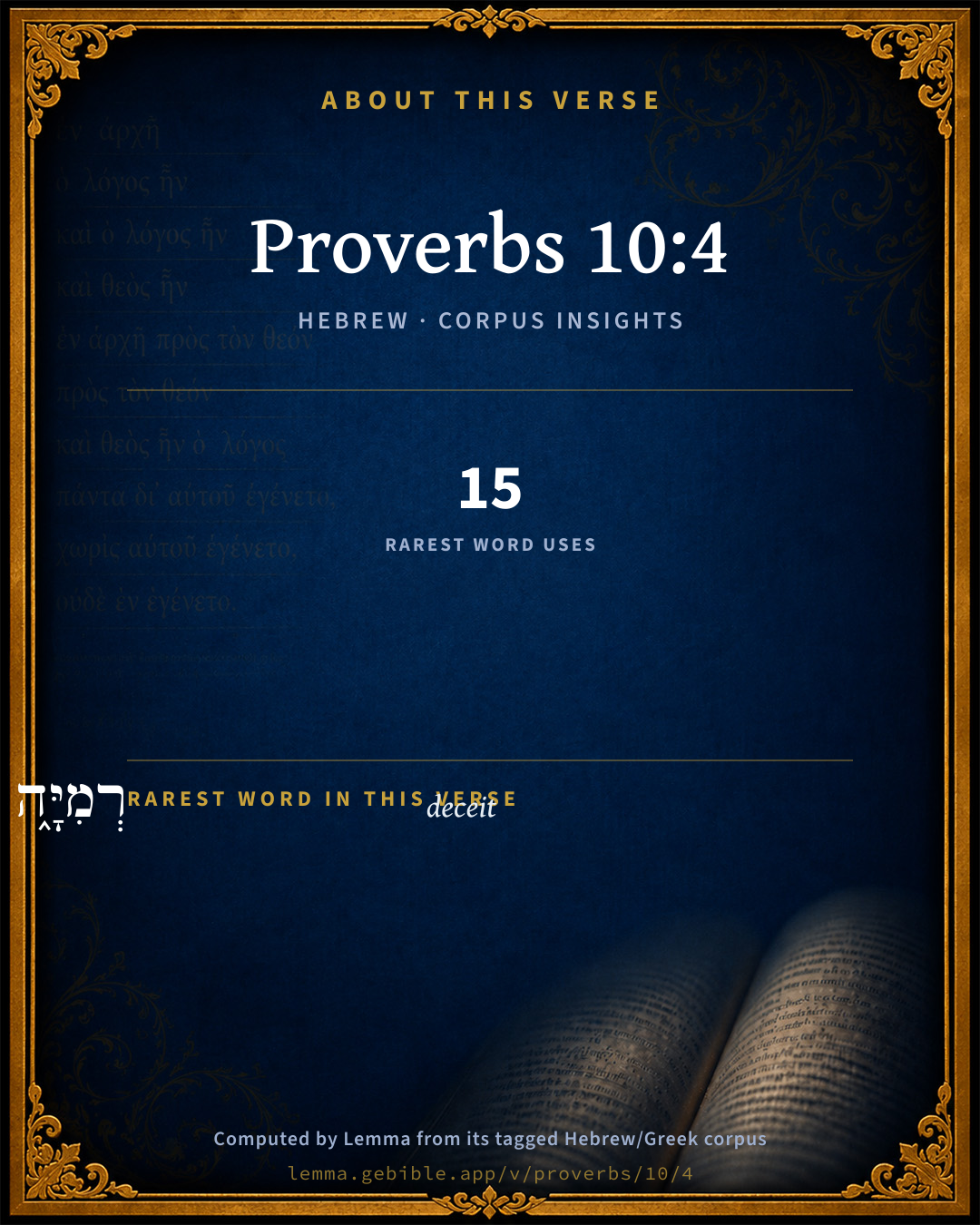
The rarest word here is רְמִיָּ֑ה deceit H7423 — appearing just 15 times in the whole Hebrew Bible.

Shared distinctive vocabulary

רְמִיָּ֑ה deceit H7423 occurs in 15 verses of the Hebrew Bible. Also found in:

Grammatical profile

  • 2 verbs
  • 4 nouns
  • 1 adjective

Verb forms

  • עֹשֶׂ֥ה Qal · Participle Active
  • תַּעֲשִֽׁיר Hiphil · Imperfect

Hebrew & Septuagint length

In English translation the verse runs 17 words from the Hebrew and 29 from the Septuagint (LXX English) — the Septuagint runs noticeably longer here. See the side-by-side →

A rough comparison of the two English renderings, which tokenize alike — not a word-level alignment.

Word counts can differ between the Hebrew and the Greek without any difference in meaning — e.g. the Hebrew direct-object marker אֵת has no separate Greek word, and Greek often adds the article ὁ.

Cross-references

15

Topical passages linked to Proverbs 10:4 in the Treasury of Scripture Knowledge — connected by theme and wording, ordered by reader-vote popularity; previews shown in the World English Bible.

  • Proverbs 20:4 The sluggard will not plow by reason of the winter; Therefore he shall beg in harvest, and have nothing.
  • Proverbs 13:4 The soul of the sluggard desires, and has nothing, But the desire of the diligent shall be fully satisfied.
  • Proverbs 19:15 Slothfulness casts into a deep sleep. The idle soul shall suffer hunger.
  • Proverbs 21:5 The plans of the diligent surely lead to profit; And everyone who is hasty surely rushes to poverty.
  • Proverbs 6:6–11 Go to the ant, you sluggard. Consider her ways, and be wise;
  • Proverbs 12:24 The hands of the diligent ones shall rule, But laziness ends in slave labor.
  • Proverbs 19:24 The sluggard buries his hand in the dish; He will not so much as bring it to his mouth again.
  • Proverbs 20:13 Don't love sleep, lest you come to poverty; Open your eyes, and you shall be satisfied with bread.
  • 1 Corinthians 15:58 Therefore, my beloved brothers, be steadfast, immovable, always abounding in the Lord's work, because you know that your labor is not in vain in the Lord.
  • Proverbs 11:24 There is one who scatters, and increases yet more. There is one who withholds more than is appropriate, but gains poverty.
  • Proverbs 24:30–34 I went by the field of the sluggard, By the vineyard of the man void of understanding;
  • John 6:27 Don't work for the food which perishes, but for the food which remains to eternal life, which the Son of Man will give to you. For God the Father has sealed him."
  • 2 Peter 1:5–10 Yes, and for this very cause adding on your part all diligence, in your faith supply moral excellence; and in moral excellence, knowledge;
  • Ecclesiastes 10:18 By slothfulness the roof sinks in; And through idleness of the hands the house leaks.
  • Hebrews 6:11–12 We desire that each one of you may show the same diligence to the fullness of hope even to the end,

Cross-references courtesy of OpenBible.info (CC BY 4.0).

Hebrew and Greek witnesses Masoretic Hebrew ↔ Greek Septuagint

The same verse in the two great witnesses to the Old Testament, shown verse-for-verse.

Here the Septuagint runs noticeably longer than the Hebrew — LXX2012 (modern English Septuagint) 29 words vs World English Bible 17. A rough length comparison of the two English translations, not a word-level alignment — read both below.

These are two independent witnesses, not word-aligned to each other, and the Septuagint is shown in lemma (dictionary) form.

Hebrew Proverbs 10:4 Masoretic · Westminster Leningrad Codex

רָ֗אשׁ עֹשֶׂ֥ה כַף רְמִיָּ֑ה וְיַ֖ד חָרוּצִ֣ים תַּעֲשִֽׁיר

He becomes poor who works with a lazy hand, But the hand of the diligent brings wealth.

World English Bible · Public Domain

Greek LXX Proverbs 10:4 Septuagint · lemma form

πενία ἀνήρ ταπεινόω χείρ δέ ἀνδρεῖος πλουτίζω υἱός παιδεύω σοφός εἰμί ὁ δέ ἄφρων διάκονος χράω

Poverty brings a man low: but the hands of the vigorous make rich. A son who is instructed shall be wise, and shall use the fool for a servant.

LXX2012 (modern English Septuagint) · Public Domain

On this verse, Haydock's Catholic Bible Commentary discusses the Septuagint’s reading. Read the note in Commentary ↓

Hebrew: Westminster Leningrad Codex (CC BY 4.0). Greek: Septuagint (public domain); English from LXX2012 (modern English Septuagint) (Public Domain). How the Septuagint differs from the Hebrew →

Commentary

Notes on Proverbs 10:4 from classic Christian and Jewish commentators (each source and its license shown beneath its notes). The classic Christian expositions comment on the surrounding passage and are grouped to its opening verse, so a note may address several verses; the Jewish commentaries on the Tanakh (Rashi and others) are per-verse, so they appear only where the commentator wrote on this verse.

Lemma curates 59 commentaries, every one of them public domain or Creative Commons licensed, each selected and text-cleaned for this edition rather than reprinted as found. About our sources →

Trapp's Complete Commentary

John Trapp

Pro 10:4 He becometh poor that dealeth [with] a slack hand: but the hand of the diligent maketh rich.

Ver. 4. He becometh poor.] Lest any should say, If God do all, we need do the less. Doing you must be, saith the wise man, or else the beggar will catch you by the back. Labour also you must with your hands, "working the thing that is good, that ye may have to give to him that needeth." {Eph 4:28}

But the hand of the diligent.] Or, Of the nimble; that do motitare, saith Kimchi, are active and agile; that will lose nothing for looking after, but take care of smallest matters that all go right, being frugal and parsimonious of time, husbanding the opportunity of thriving and plenty. How did Boaz follow the business himself. How were his eyes in every corner, on the servants, and on the reapers, yea, on the gleaners too. He doth even lodge in the midst of his husbandry, {Rth 2:4-14; Rth 3:7; Rth 3:14} as knowing well the truth of that proverbial sentence, Procul a villa sua dissitus iactura vicinus, {a} - He that is far from his business, is not far from loss.

{a} Columel.

John Trapp, A Commentary or Exposition upon All the Books of the Old and New Testament (1647–1656) — public domain. Text from a community e-Sword module.

The Biblical Illustrator

Joseph S. Exell

Pro_10:4

The hand of the diligent maketh rich.

Diligent

Our life is dependent on our industry. It is good for man that he should have to labour. Were God to do all, We should truly leave Him to do it, not caring to co-operate with the Divine Husbandman in the culture of the field of life. By the diligent we are to understand the nimble-handed--those who are active and agile, who will lose nothing for want of rising early and peering about in the darkness if they may but catch a glimpse even of an outline of things. The persons referred to in the text are those who take account of microscopic matters--they are particular about the smallest coins, about moments and minutes, about so-called secondary engagements and plans. The true business man lives in the midst of his business. We are not far from the sanctuary of God when we are listening to such proverbs as these. (J. Parker, D.D.)

Idleness and industry

I. The hand of the one is diligent, the other is slack.

II. The soul of the one seizes opportunities, the other neglects them. The industrious man makes opportunities. He does the work of the season. The other lets opportunities pass. He sleepeth in harvest.

III. The destiny of the one is prosperity, that of the other ruin. The man in the gospel who employed his talents got the Well done! of his Master and the ruler-ship over many things. Laziness everywhere brings ruin. Drowsiness clothes man in rags. (D. Thomas, D.D.)

Diligent in business

This rule applies alike to the business of life and the concerns of the soul. The law holds good in common things. The earth brings forth thorns instead of grapes unless it be cultivated by the labour of man. A world bringing forth food spontaneously might have suited a sinless race, but it would be unsuitable for mankind as they now are. The fallen cannot be left idle with safety to themselves. The necessity of labour has become a blessing to man. The maxim has passed into a proverb, If you do not wait on your business, your business will not wait on you. That diligence in necessary to progress in holiness is witnessed by all the Word of God and all the experience of His people. It would be a libel on the Divine economy to imagine that the tender plant of grace would thrive in a sluggards garden. The work is difficult, the times are bad. He who would gain in godliness must put his soul into the business. But he who puts his soul into the business will grow rich. When all counts are closed he who is rich in faith is the richest man. (W. Arnot, D. D.)

Slack hand

Lazy hand. Sloth is the mother of poverty. Or the words may be rendered the hand of deceit. Without diligence honesty can scarcely be expected. Next unto virtue let children be trained up to industry, for both poverty and fraud are commonly the effect of sloth. (B. E. Nicholls, M.A.)

Diligence and prosperity

A connection exists between the bounty of God and the duty of man. All things are of God, and our dependence upon Him is absolute and imperative. There is a perfect accordance between the established law of nature and the law of grace. The former of these combines a dependence upon God for daily subsistence with the necessity of effort to procure it. The latter tells us, and insists upon it, that while by grace we are saved through faith which is the gift of God, we are nevertheless to work out our own salvation with fear and trembling.

I. Apply sentiment of text to the ordinary affairs of life. With respect to temporal blessings. The purposes of God are never carried into effect without the use of those means by which they are intended to be accomplished. The application of these means is indispensable to the attainment of the end. If we neglect these, it will be worse than folly to hope for any blessing. What are the appointed means by which a beneficent providence supplies the temporal wants of man?

1. Diligence or industry. An unoccupied and idle man countervails all the laws both of his animal and intellectual frame and wages war upon every organ of his material structure. The law of industry is a benevolent law. If you would make a man miserable, let him have nothing to do. Idleness is the nursery of crime.

2. Economy. He who wastes what providence gives him may not complain of it being with-held or withdrawn. Nature and observation are constantly reading us this lesson. In all that God does there is nothing lost, nothing thrown away, nothing but what is designed for some useful purpose. Every natural substance that does not retain its original form passes into some other that is equally important in its way. There is no example of the entire destruction of anything in the universe. The Lord Jesus did not deem it mean to be frugal. Meanness is more justly chargeable to waste and prodigality. He that is regardless of little things will be very apt to be careless of those that are greater.

3. A sacred regard to the Lords day. If a man would make the most of human life, to say nothing of the life to come, he must be a conscientious observer of this consecrated day. Other collateral means are, a sacred regard to truth, honesty in every transaction, rectitude and integrity of character.

II. Apply sentiment of the text to the interests of the soul. Many events may transpire which will frustrate the most diligent in their enterprise. Sickness, infirmity, calamity, treachery. But it is never so in the case of the soul. There is an opulence in the Divine benignity which satisfies the desire of every praying spirit. Note there is a certainty in the promise. Labour for the meat which endureth unto everlasting life shall be rewarded in the issue to the extent of our largest expectations. And at the last his joy will be full. He has gained the true riches and is rich indeed. (J. Everitt.)

Advantages of virtuous industry

I. The industrious man accomplishes very many things which are profitable to himself and others in numberless respects. How many of his own wants and those of others does he not thus relieve! How many sources of welfare does he not open to himself and others!

II. If the industrious man executes many useful matters, he executes them with far more ease and dexterity than if he were not industrious. He has no need of any long previous contest with himself. He understands, he loves the work; has a certain confidence in himself, and is more or less sure of success.

III. The industrious man unfolds, exercises, perfects his powers; not only his mechanical, but also his nobler, his mental powers.

IV. The industrious man lives in the true, intimate, entire consciousness of himself, and of that which he is and does. He actually rejoices in his life, his faculties, his endowments, his time.

V. The industrious man, who is so from principle and inclination, experiences neither languor nor irksomeness. Never are his faculties, never is his time, a burden to him.

VI. The industrious man has a far greater relish for every innocent pleasure, for every relaxation, that he enjoys. He alone properly knows the pleasure of rest.

VII. The industrious man alone fulfils the design for which he is placed on earth, and may say so to himself, and may in the consciousness of it be contented and cheerful. (G. J. Zollikofer.)

The Biblical Illustrator, edited by Joseph S. Exell (c. 1880s–1900s) — public domain. Text from a community e-Sword module.

Joseph Benson's Commentary

Pro 10:4. He becometh poor — Probably by slow degrees; that dealeth with a slack hand — Who is negligent and slothful in his business. Hebrew, כŠ רמיה, with a deceitful hand, so called, partly because it seems, or pretends to do something, when, in truth, it doth nothing; and partly because such persons usually endeavour to maintain themselves by deceit and wickedness, instead of doing it by honest labour and diligence. But the hand of the diligent maketh rich — Not by itself, nor necessarily, as is manifest from experience, and is observed Ecc 9:11, but through God’s blessing, which is commonly given to the diligent and industrious.

Joseph Benson's Commentary on the Old and New Testaments (1811–1818) — public domain. Text from a community e-Sword module.

Bridges on Proverbs

Charles Bridges

He becometh poor that dealeth with a slack (deceitful, marg.) hand: but the hand of the diligent maketh rich.

Every day’s observation confirms the fact, that a slack hand impoverishes (Pro 19:15 ; Pro 20:4 ; Pro 23:21 ; Pro 24:30-34 . Ecc 10:18 ), and the hand of the diligent enriches (Pro 13:4 ; Pro 21:5 ), the harvest’s lord. Justly is the slothful condemned as deceitful; because he pretends to serve his Master, when in truth he has been doing nothing. (Mat 25:26 . Jer 48:10 - marginal reading: {deceitfully: or, negligently}) He becometh poor by wasting his trust. (Pro 18:9 . Compare Mat 25:28-29 .) His life, which might have been a continued feast, is a continual vexation. Industry was the law of Paradise (Gen 2:15 ); and though now it bears the stamp of the fall (Gen 3:19 ), it is overruled as a blessing; and in the ordinary course of Providence maketh rich. (Pro 12:24, Pro 12:27 ; Pro 22:29 .) The Lord’s visits of favor were never given to loiterers. Moses and the Shepherds of Bethlehem were keeping their flocks. (Exo 3:1-2 . Luk 2:8-9 .) Gideon was at the threshing-floor. (Jdg 6:11 .) ’Our idle days’ — as Bishop Hall observes — ’are Satan’s busy days.’ Active employment gives us a ready answer to his present temptation — "I am doing a great work, and I cannot come down." (Neh 6:3 .)

Is then the man of God waxing low in his store? Has there not been a slack hand in drawing upon the sacred treasury? Has not he gazed upon the heavenly treasures, with "his hand in his bosom"? (Pro 19:24 .) Has he not become poor by slighting his rich consolations? The Lord gives his blessing, as he gives the fruits of the earth, not to those that wish (Pro 13:4 ; Pro 20:4 ), but to those that "labour" (Pro 10:3 with Pro 10:4 . Joh 6:27 ); not to sentimental indolence, but to Christian energy and perseverance. The trade of the world is uncertain. The trade of godliness is sure. There are no bankrupts here. The diligent servant is honoured with an increase of his grace (Mat 25:29 ), and the enlargement of his confidence.†1

Footnotes:

†1 2Pe 1:5-11 . Bp. Sanderson’s Sermon on 1Co 7:24 .

Charles Bridges, An Exposition of the Book of Proverbs (1846) — public domain. Text from a community e-Sword module.

Tyndale Open Study Notes

Tyndale Open Resources

10:4-5 Lazy people are foolish, while hard workers are wise (see also 10:26; 26:13-16).

Tyndale Open Study Notes — © Tyndale Open Resources, licensed CC BY-SA 4.0. Text via the HelloAO Bible API.

Geneva Bible (1599)

Geneva Bible translators

Or, deceitful.

Geneva Bible (1599) marginal notes — public domain. Text via Bolls.life.

Matthew Henry's Commentary

We are here told, 1. Who those are who, though rich, are in a fair way to become poor - those who deal with a slack hand, who are careless and remiss in their business, and never mind which end goes foremost, nor ever set their hands vigorously to their work or stick to it; those who deal with a deceitful hand (so it may be read); those who think to enrich themselves by fraud and tricking will, in the end, impoverish themselves, not only by bringing the curse of God on what they have, but by forfeiting their reputation with men; none will care to deal with those who deal with sleight of hand and are honest only with good looking to. 2. Who those are who, though poor, are in a fair way to become rich - those who are diligent and honest, who are careful about their affairs, and, what their hands find to do, do it with all their might, in a fair and honourable way, those are likely to increase what they have. The hand of the acute (so some), of those who are sharp, but not sharpers; the hand of the active (so others); the stirring hand gets a penny. This is true in the affairs of our souls as well as in our worldly affairs; slothfulness and hypocrisy lead to spiritual poverty, but those who are fervent in spirit, serving the Lord, are likely to be rich in faith and rich in good works.

Matthew Henry's Commentary on the Whole Bible (1708–1710) — public domain (CC PDM 1.0). Text via the HelloAO Bible API.

Jamieson, Fausset & Brown

Robert Jamieson, A. R. Fausset & David Brown

slack--literally, "deceitful," failing of its purpose (compare Hos 7:16).

maketh rich--(compare Pro 10:22).

Jamieson, Fausset & Brown — Commentary Critical and Explanatory on the Whole Bible (1871) — public domain (CC PDM 1.0). Text via the HelloAO Bible API.

Adam Clarke's Commentary

Verse 4. He becometh poor] God has ordered, in the course of his providence, that he who will not work shall not eat. And he always blesses the work of the industrious man.

Adam Clarke's Commentary on the Bible (1810–1826) — public domain. Text from a community e-Sword/MySword module.

The Cambridge Bible for Schools and Colleges

gen. ed. J. J. S. Perowne

4. He becometh poor] It has been thought that the change of a single vowel point would give A slack hand maketh poor, which is an exact parallel to the second clause of the verse, and is adopted by the Vulg., egestatem operata est manus remissa.

The Cambridge Bible for Schools and Colleges (gen. ed. J. J. S. Perowne; Cambridge University Press, 1878–1918) — public domain. Text from a community e-Sword module.

John Gill's Exposition

He becometh poor that dealeth with a slack hand,.... That is either remiss in giving to the necessities of others, according to his abilities, and as cases require; or that is negligent and slothful in his business. Or, "that worketh with a deceitful hand"; or, "with a hand of deceit" (u), as it may be rendered; who pretends to work, but does not; makes a show as if he did, but acts deceitfully; or who uses many tricking and deceitful ways and methods to live, as usually slothful persons do. Aben Ezra observes, it may be rendered and interpreted, "he becomes poor that makes a deceitful balance"; thinking to enrich himself by such fraudulent practices: or, as others, "a deceitful balance maketh poor" (w); such seldom or ever thrive, or it does not long prosper with them who use such unlawful methods;

but the hand of the diligent maketh rich; that is, with the blessing of God along with it, as in Pro 10:22; such who are "sharp" (x) and acute, as the word signifies; who are careful and industrious, mind their business, and do the honest part; these, with a divine blessing, frequently grow rich: or rather who are like those that dig in the earth for gold, who search for it with great eagerness and diligence; for from this root is a word often used for gold, Pro 3:14. All this is true in a spiritual sense; such who are slothful in attendance on the means of grace, the word and ordinances, are slack and negligent in duty, bring a spiritual poverty upon them; and like the Laodicean church, who, through her lukewarmness and carnal security, became poor and wretched, blind and naked: on the other hand, such who are diligent in the use of means are frequent at the throne of grace, forsake not the assembly of the saints, constantly wait at Wisdom's gates; these grow rich in grace and in all good works.

(u) "vola doli", Montanus; "fraudulenta manu", Tigurine version, Cocceius, Schultens; so Junius & Tremellius, Michaelis. (w) So Mercerus. (x) "acuti", Bochart. Hierizoic. par. 1. l. 2. c. 55. col. 668.

John Gill's Exposition of the Whole Bible (1746–1763) — public domain (CC PDM 1.0). Text via the HelloAO Bible API.

Albert Barnes' Notes on the Bible

Slack - The word is elsewhere translated as “deceitful” Job 13:7; Psa 120:2-3; Hos 7:16; Jer 48:10. The two thoughts run easily into each other.

Albert Barnes' Notes on the Bible (1834–1885) — public domain. Text from a community e-Sword/MySword module.

Haydock's Catholic Bible Commentary

Poverty. Even of those who had plenty. This is true in a spiritual sense likewise. (Calmet) --- The kingdom of heaven suffereth violence. (Haydock) --- Otiositas mater nugarum, noverca virtutum. (St. Bernard, consid. ii.) --- He, &c. This is not in Hebrew, Greek, St. Jerome, or in several Latin copies. (Calmet) --- We find it in the Septuagint, chap. ix. 13. --- Away. He derives no benefits from lies. (Menochius)

George Leo Haydock (1774–1849), Haydock's Catholic Family Bible and Commentary, 1859 edition — public domain. Excludes Psalms (Douay-Rheims chapter numbering differs from Protestant) and Deuterocanonical books (Catholic canon only).

Matthew Poole's English Annotations

With a slack hand; negligently and slothfully, as appears from the diligence opposed to it in the next branch, and from the use of this word in this sense, Pro 12:24,27; 19:15; Jer 48:10. Heb. with a deceitful hand; so called, partly because it seems and pretends to do something, when in truth it doth nothing; and partly because such persons usually endeavour to maintain themselves by deceit and wickedness, which they cannot or will not do by honest labour and diligence.

Maketh rich; not by itself, nor necessarily, as is manifest from experience, and is noted, Ecc 9:11, but through God’s blessing, which commonly is given to such, by comparing this verse with Pro 10:22, here following.

Matthew Poole's English Annotations on the Holy Bible (1683–1685) — public domain. Text from a community e-Sword/MySword module.

Whedon's Commentary on the Bible

Daniel D. Whedon

4. Slack hand — Idle, languid, or loose, in opposition to expert; the word is rendered “deceitful” in Job_13:9; Psalm 122:23; Hos_9:16; Jer_48:10, where, however, “negligently” appears in the margin as an alternate. The two ideas of negligence and trickiness are “nearly” allied, as negligence tempts to trickery and deceit. Comp. Pro_12:24; Pro_12:27; Pro_19:15.

Daniel D. Whedon (gen. ed.), Commentary on the Old and New Testaments (1874–1909) — public domain. Text from a community e-Sword module.

The Pulpit Commentary

That dealeth with a stack hand; that is lazy and indolent. (comp. Pro_6:10, Pro_6:11; see on Pro_19:15) The Septuagint, with a different pointing, reads, "Poverty humbleth a man." The hand of the diligent (Pro_12:24) maketh rich. The words for "hand" are different in the two clauses as Wordsworth remarks. The first word is caph, the open, ineffective, hand or palm; the second term is yad, the hand tense and braced for vigorous work. The LXX introduces a clause here which seems to interfere with the connection: Uiov pepaioeumenov sofo afroni diakonw, crhsetai , "A well instructed son will be wise. and he will use a fool as his minister;" i.e. he is aide to make even the foolish subserve his ends. The sentence is quoted by St. Augustine, "De Civil Dei," 16:2. The Vulgate inserts another paragraph, which is also found in some manuscripts of the Septuagint at Pro_9:12: Qui nititur mendaciis, hic pascit ventos; idem autem ipse sequitur aves volantes, "He who relieth on lies feedeth on the winds, and pursueth flying birds.

Diligence.

Of late it has become fashionable to claim a cheap reputation for loftiness of moral aims by sneering at what are called the "smug virtues." There is a great deal about these despised virtues in the Book of Proverbs, and consequently a very low estimate is formed of that portion of Scripture. But is there not something hollow about this assumption of ethical elevation? It cannot be denied that the "smug virtues" have a real obligation. No one would venture to say that they can be dispensed with. They are simply of a comparatively inferior value. But till they are complied with it is often difficult to rise to more ethereal heights of goodness. Meanwhile that man is little short of a hypocrite who neglects the plain duties that lie at his door for the pursuit of some other more recondite graces. Diligence is one of the first of these duties, and it is requisite for various reasons. Note some of them.

I WEALTH DEPENDS ON WORK. This is a primary law of providence. God might have fed us as he fed the ravens. But instead of putting food ready for our mouths, he gives us hands with which to work for it. Social arrangements only disguise this law. The son inherits the fruits of his father"s industry. The idle man sucks the honey of other men"s toil. But it remains truth that work makes wealth. Every man"s wealth depends largely on the work of some one his own or somebody else"s. It is the duty of everybody to see that he is not dependent upon other people"s labours if he can help himself. The man who squanders his money in prosperous times, and throws himself on public charity directly he is ill or out of work, is guilty of gross selfishness amounting to dishonesty. It is plainly every man"s duty not only to keep himself and his family, but, where it is possible, to make fit provision for the future, or he will be robbing others of their maintenance. Hence one obligation to be industrious and thrifty.

II WORK IS FOR OUR OWN GOOD. People talk of the curse of toil, little knowing that it is one of the greatest blessings we have. Better talk of the curse of idleness. It is a happy thing that man has to earn his bread with the sweat of his brow. Work develops strength strength of mind as well as strength of limb. The self-made man is not invariably a model of grace; but he is usually a specimen of sturdy vigor of character, as different from the limp conventionality of indolence as granite rock from drifting seaweed.

III WE ARE ALL STEWARDS. The servant is required to be industrious for his master"s sake. His time is not his own. He is not at liberty, therefore, to lounge about in dreamy idleness. We are stewards of the things lent us by God. He has sent us to work in his vineyard. In duo time he will call us to account. "To be blameless as a steward of God" a man must be faithful, honest, industrious.

IV CHRISTIANITY INCULCATES DILIGENCE. No greater mistake can be made than to suppose that the New Testament favours indolence. The ideal of Oriental monasticism is derived from other sources. Even the remake in the West knew better. In its palmy days European monasticism was the centre of honest toil. The monks cleared forests, reclaimed bogs, built cathedrals, cultivated farms, studied, laboriously copied and preserved for us the invaluable treasures of the literature of antiquity. Amongst other fruits of grace in the Christian"s heart will be increased diligence in business. Christian principle, however, is necessary to consecrate industry. Without it wealth. will be a god, business an absorbing worldly influence, and success a source of low selfish pleasure. But he who is diligent on Christian principle will make his business holy by working in it as the servant of Christ, and his wealth holy by dedicating it to the use of God.

The Pulpit Commentary (1880–1919), ed. H.D.M. Spence-Jones & Joseph S. Exell — public domain. Text from a community e-Sword module.

Keil & Delitzsch

C. F. Keil & F. Delitzsch

There follow two proverbs which say how one man fails and another succeeds:

He becomes poor who bears a sluggish hand;

But the hand of the diligent maketh rich.

These three proverbs, Pro 19:15; Pro 12:24, Pro 12:27, are similar. From the last two it is seen that רמיּה is a subst., as also from Psa 120:2. (לשׁון רמיּה, from a crafty tongue) that it is an adject., and from Lev 14:15. (where כּף is fem.) that it may be at the same time an adject. here also. The masc. is רמי, like טרי to טריּה ot , but neither of these occur; "the fundamental idea is that of throwing oneself down lazily, when one with unbent muscles holds himself no longer erect and stretched, Arab. taramy" (Fl.). The translation: deceitful balances (Lwenstein after Rashi), is contrary to biblical usage, which knows nothing of כף in this Mishnic meaning. But if כף is here regarded as fem., then it cannot be the subject (Jerome, egestatem operata est manus remissa), since we read עשׂה, not עשׂה. But ראשׁ also is not suitable as the subject (lxx, Syr., Targ.), for poverty is called רישׁ, רישׁ, ראשׁ; on the contrary, רשׁ, plur. רשׁים or ראשׁים, is used adjectively. Since now the adject. רשׁ, Sa1 12:14, is also written ראשׁ, it may be translated: Poor is he who... (Bertheau); but we much rather expect the statement of that which happens to such an one, thus: Poor will he be... ראשׁ, 3 praet. = רשׁ, Psa 34:11, with the same (grammatically incorrect) full writing as קאם, Hos 10:14. In the conception of the subject, כף־רמיה, after Jer 48:10, is interpreted as the accus. of the manner (Berth.: whoever works with sluggish hand); but since עשׂה רמיה (in another sense indeed: to practise cunning) is a common phrase, Psa 52:4; Psa 101:7, so also will כף־רמיה be regarded as the object: qui agit manum remissam, whoever carries or moves such a hand (Hitzig). In 4b working is placed opposite to bearing: the diligent hand makes rich, ditat or divitias parit; but not for itself (Gesen. and others: becomes rich), but for him who bears it. The diligent man is called חרוּץ, from חרץ, to sharpen, for, as in ὀξύς, acer, sharpness is transferred to energy; the form is the same as הלּוּק, smooth (for the ā is unchangeable, because recompensative), a kindred form to קטול like חמוץ, and Arab. fâ'ûl as fashawsh, a boaster, wind-bag, either of active (as חנּוּן) or (as חלוק, חרוץ, עמּוּד, שׁכּוּל) of passive signification.

Keil & Delitzsch — Biblical Commentary on the Old Testament (1861–1891) — public domain (CC PDM 1.0). Text via the HelloAO Bible API. (Old Testament only.)

Kretzmann's Popular Commentary

Paul E. Kretzmann

v. 4. He becometh poor that dealeth with a slack hand, doing his work with an idle hand, too lazy to exert himself; but the hand of the diligent maketh rich, under the blessing of God prosperity and even wealth will be given to him who works with industry and energy.

Paul E. Kretzmann, Popular Commentary of the Bible (1921–1924) — public domain. Text from a community e-Sword module.

unfoldingWord translationNotes

Door43 World Missions Community

A lazy hand

"Hand" represents the strength and ability of a person. AT: "A person unwilling to work" (See: Metonymy)

hand of the diligent

"Hand" represents the strength and ability of a person. AT: "person who works hard" (See: Metonymy)

translationWords

hand

wise

son

harvest

unfoldingWord translationNotes — © Distant Shores Media and the Door43 World Missions Community, licensed CC BY-SA 4.0. Source: git.door43.org/Door43/en_tn.

Rashi

Rabbi Shlomo Yitzchaki (Rashi)

A poor man makes a deceitful scale Whoever is impoverished in [his knowledge of] Torah promulgates false decisions.

deceitful scales Scales of deceit. According to its simple meaning, it refers to merchants.

and the hand of those who make true decisions The upright, who decide a matter truly and justly without injustice.

Rashi on the Tanakh — English translations: “The Judaica Press complete Tanach with Rashi, translated by A. J. Rosenberg” (CC BY 4.0); “Pentateuch with Rashi's commentary by M. Rosenbaum and A.M. Silbermann, 1929-1934” (public domain); “The Metsudah Tanach series, Lakewood, N.J” (CC BY 4.0); and “The Book of Joshua, Metsudah Publications, 1997” (CC BY 4.0). Text via Sefaria.

Lesson kit

Teaching starters — assembled from the data on this page, not authored interpretation. Every prompt links to the verse data it draws on. Edit before teaching.

Proverbs, in the Wisdom, opens this verse with 7 words (7 distinct Hebrew lemmas). Its most distinctive word is rᵉmîyâh (“deceit”). The Greek Septuagint runs longer here. A historical commentator’s framing appears above. Read the whole chapter for the surrounding context.

Discussion questions

  1. How does “deceit” (rᵉmîyâh) shape what this verse is saying?
  2. Job 13:7 shares the word «deceit» with this verse. How do the two illuminate each other?
  3. Compared with the Hebrew, the Septuagint runs longer here. What questions does that raise?
  4. The translations on this page render this verse differently — a whole-verse word diff, not a word-by-word alignment. What might account for the different wordings?
  5. The verb «עֹשֶׂ֥ה» is Qal Participle Active. How does its form color the action?
  6. Reading how Trapp's Complete Commentary and The Biblical Illustrator read this verse, where do the two commentators agree and where do they part?

Things to notice

Reading settings

Reading text

Shown beneath each verse's original-language words.

Old Testament
Old Testament edition

Read the OT as the Masoretic Hebrew (MT) or the Greek Septuagint (LXX).

English shown for the Greek Septuagint (in the Hebrew ↔ Greek comparison).

Comparing translations? Open the Compare panel on any verse page to stack up to four side by side.