

Proverbs 31:13

Hebrew (Westminster Leningrad Codex) Proverbs 31:13 appears in the Hebrew Old Testament. The text above is from the Westminster Leningrad Codex. Each word links to its Strong’s number, a concise gloss, and parsing drawn from the Open Scriptures Hebrew Bible morphology. Click any word for its full Brown-Driver-Briggs (BDB) entry.
Download image
Cite this verse

Proverbs 31:13 (World English Bible). Public Domain. Lemma interlinear Bible study tool, https://lemma.gebible.app/v/proverbs/31/13.

Show BibTeX & RIS
BibTeX
RIS
English Translation
She seeks wool and flax, And works eagerly with her hands.
World English Bible · Public Domain
Download a study sheet

One document with this verse’s original text, its word-by-word gloss line, the meaning frame, cross-references with their text, attributed commentary, and full source and license credits — printable, and it pastes into notes with its structure intact.

This verse Autodidact and up

Study sheet (.html) Plain text (.txt)

A passage Seminary Student

Up to 50 verses in one chapter. A passage sheet keeps up to 6 commentary sources and 12 cross-references per verse, in the order this page ranks them, and says so on the sheet whenever that leaves anything out. Ask for a single verse and you get the Autodidact verse sheet above.

Everything on this page stays free to read, with no account — the sheet is a download of what is already on screen, not access to it.

Want to remove ads? Support Godless Engineer
Compare translations 3

The same verse in 3 English versions, stacked beneath the original-language interlinear above. Click any original word for its lexicon entry.

Each is an independent rendering of the whole verse — the interlinear is not word-aligned to these translations.

Highlighted words mark where these versions differ — a whole-verse word diff, not a word-by-word alignment.

  • World English Bible Public Domain
    She seeks wool and flax, And works eagerly with her hands.
  • King James Version Public Domain
    She seeketh wool, and flax, and worketh willingly with her hands.
  • unfoldingWord Literal Text CC BY-SA 4.0
    She searches wool and linens and works with the delight of her palms.

unfoldingWord Literal Text — © unfoldingWord, licensed CC BY-SA 4.0. Word-aligned USFM3 via Door43 (git.door43.org/unfoldingWord/en_ult).

Versions to compare (up to 4)

3 of 4 selected

Show all 18 translations

Every available English version of this verse, each an independent rendering of the whole verse.

  • World English Bible Public Domain
    She seeks wool and flax, And works eagerly with her hands.
  • Berean Standard Bible Public Domain
    She selects wool and flax and works with eager hands.
  • Majority Standard Bible Public Domain
    She selects wool and flax and works with eager hands.
  • King James Version Public Domain
    She seeketh wool, and flax, and worketh willingly with her hands.
  • American Standard Version (1901) Public Domain
    She seeketh wool and flax, And worketh willingly with her hands.
  • Revised Version (1885) Public Domain
    She seeketh wool and flax, and worketh willingly with her hands.
  • Geneva Bible (1599) Public Domain
    She seeketh wooll and flaxe, and laboureth cheerefully with her handes.
  • Douay-Rheims (1899) Public Domain
    She hath sought wool and flax, and hath wrought by the counsel of her hands.
  • Young's Literal Translation Public Domain
    She hath sought wool and flax, And with delight she worketh `with' her hands.
  • Literal Standard Version CC BY-SA 4.0
    She has sought wool and flax, || And with delight she works [with] her hands.
  • Unlocked Literal Bible CC BY-SA 4.0
    She selects wool and flax, and works with the delight of her hands.
  • unfoldingWord Literal Text CC BY-SA 4.0
    She searches wool and linens and works with the delight of her palms.
  • Darby Bible Public Domain
    She seeketh wool and flax, and worketh willingly with her hands.
  • World Messianic Bible Public Domain
    She seeks wool and flax, and works eagerly with her hands.
  • Webster's Bible Public Domain
    She seeketh wool, and flax, and worketh willingly with her hands.
  • Free Bible Version CC BY-SA 4.0
    She gets wool and flax, and with her eager hands turns them into clothes.
  • Bible in Basic English Public Domain
    She gets wool and linen, working at the business of her hands.
  • JPS Tanakh (1917) Public Domain
    She seeketh wool and flax, and worketh willingly with her hands.

Literal Standard Version (2020), Covenant Press — licensed CC BY-SA 4.0. Text via the HelloAO Bible API (eBible.org). Unlocked Literal Bible (unfoldingWord) — licensed CC BY-SA 4.0. Text via the HelloAO Bible API (eBible.org). unfoldingWord Literal Text — © unfoldingWord, licensed CC BY-SA 4.0. Word-aligned USFM3 via Door43 (git.door43.org/unfoldingWord/en_ult). Free Bible Version, Dr. Jonathan Gallagher — licensed CC BY-SA 4.0. Text via the HelloAO Bible API (eBible.org).

Word by word

More ways to search: Search by grammar → Find every occurrence → Compare this word →

Practice this passage: Drill this verse → Learn its vocabulary →

About this verse

These counts appear in no published source. They are computed here, from the morphology-tagged text and Lemma’s own curated glosses. What Lemma adds →

6
words
6
distinct lemmas
Wisdom
section

Notable vocabulary

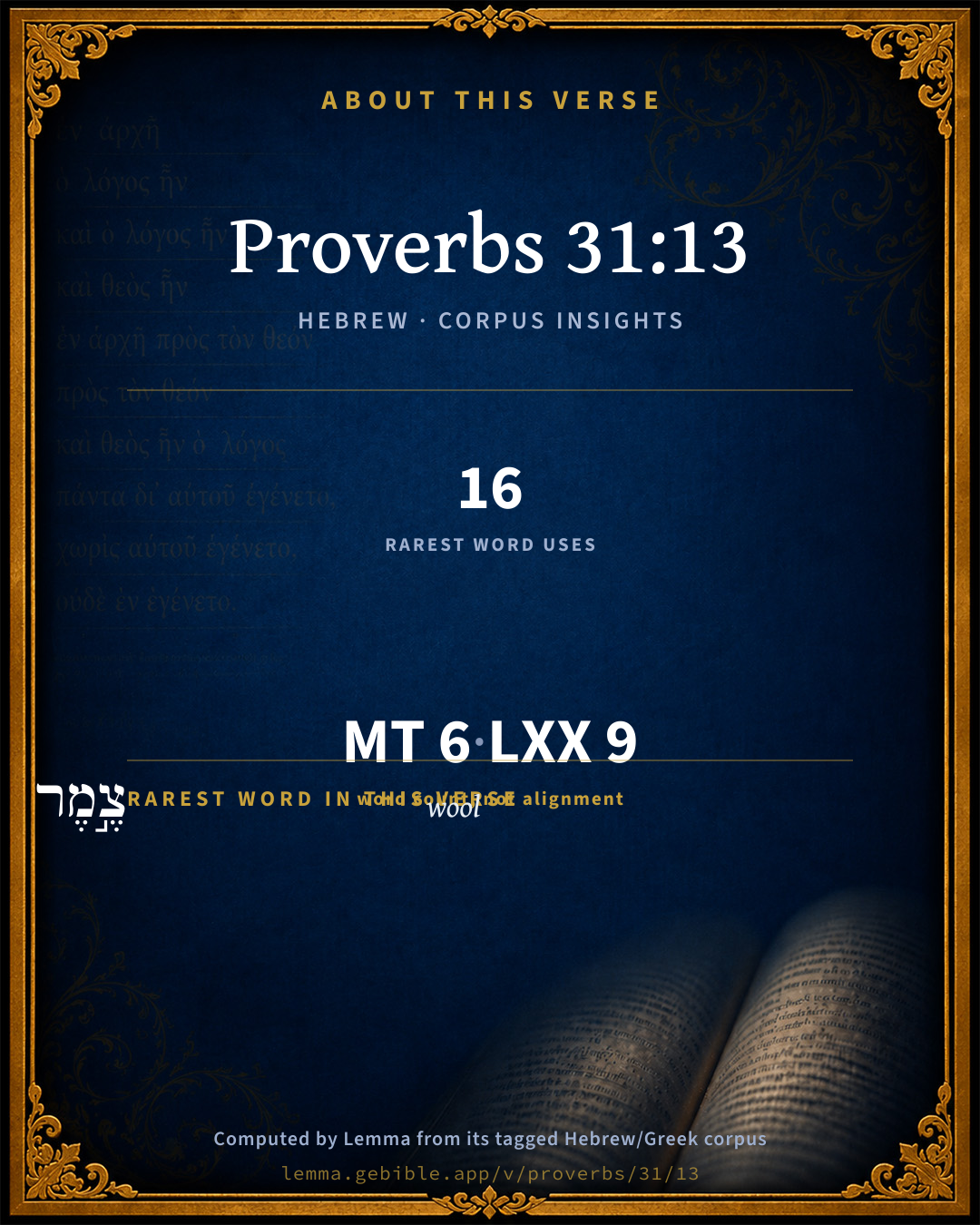
The rarest word here is צֶ֣מֶר wool H6785 — appearing just 16 times in the whole Hebrew Bible.

Shared distinctive vocabulary

צֶ֣מֶר wool H6785 occurs in 16 verses of the Hebrew Bible. Also found in:

Grammatical profile

  • 2 verbs
  • 4 nouns

Verb forms

  • דָּ֭רְשָׁה Qal · Perfect
  • וַ֝תַּ֗עַשׂ Qal · Sequential Imperfect

Hebrew & Septuagint length

In English translation the verse runs 11 words from the Hebrew and 11 from the Septuagint (LXX English) — the same length.

A rough comparison of the two English renderings, which tokenize alike — not a word-level alignment.

Word counts can differ between the Hebrew and the Greek without any difference in meaning — e.g. the Hebrew direct-object marker אֵת has no separate Greek word, and Greek often adds the article ὁ.

In the original languages it is 6 Hebrew tokens and 9 Greek tokens — but the two are counted differently (Hebrew bundles its prefixes and suffixes into one token; the Greek is in lemma form), so that isn’t a like-for-like length.

Cross-references

15

Topical passages linked to Proverbs 31:13 in the Treasury of Scripture Knowledge — connected by theme and wording, ordered by reader-vote popularity; previews shown in the World English Bible.

  • 1 Timothy 5:10 being approved by good works, if she has brought up children, if she has been hospitable to strangers, if she has washed the saints' feet, if she has relieved the afflicted, and if she has diligently followed every good work.
  • Titus 2:5 to be sober-minded, chaste, workers at home, kind, being in subjection to their own husbands, that God's word may not be blasphemed.
  • 2 Thessalonians 3:10–12 For even when we were with you, we commanded you this: "If anyone will not work, neither let him eat."
  • Acts 9:39–40 Peter got up and went with them. When he had come, they brought him into the upper chamber. All the widows stood by him weeping, and showing the coats and garments which Dorcas had made while she was with them.
  • Genesis 18:6–8 Abraham hurried into the tent to Sarah, and said, "Quickly make ready three measures of fine meal, knead it, and make cakes."
  • Genesis 24:13–14 Behold, I am standing by the spring of water. The daughters of the men of the city are coming out to draw water.
  • Genesis 24:18–20 She said, "Drink, my lord." She hurried, and let down her pitcher on her hand, and gave him drink.
  • Genesis 29:9–10 While he was yet speaking with them, Rachel came with her father's sheep, for she kept them.
  • Ruth 2:2–3 Ruth the Moabitess said to Naomi, Let me now go to the field, and glean among the ears of grain after him in whose sight I shall find favor. She said to her, Go, my daughter.
  • Ruth 2:23 So she kept fast by the maidens of Boaz, to glean to the end of barley harvest and of wheat harvest; and she lived with her mother-in-law.
  • Isaiah 3:16–24 Moreover Yahweh said, "Because the daughters of Zion are haughty, And walk with outstretched necks and flirting eyes, Walking to trip as they go, Jingling ornaments on their feet;
  • Isaiah 32:9–11 Rise up, you women who are at ease, [and] hear my voice; you careless daughters, give ear to my speech.
  • Exodus 2:16 Now the priest of Midian had seven daughters. They came and drew water, and filled the troughs to water their father's flock.
  • 1 Thessalonians 4:11 and that you make it your ambition to lead a quiet life, and to do your own business, and to work with your own hands, even as we charged you;
  • 1 Timothy 5:14 I desire therefore that the younger widows marry, bear children, rule the household, and give no occasion to the adversary for reviling.

Cross-references courtesy of OpenBible.info (CC BY 4.0).

Hebrew and Greek witnesses Masoretic Hebrew ↔ Greek Septuagint

The same verse in the two great witnesses to the Old Testament, shown verse-for-verse.

These are two independent witnesses, not word-aligned to each other, and the Septuagint is shown in lemma (dictionary) form.

Hebrew Proverbs 31:13 Masoretic · Westminster Leningrad Codex

דָּ֭רְשָׁה צֶ֣מֶר וּפִשְׁתִּ֑ים וַ֝תַּ֗עַשׂ בְּחֵ֣פֶץ כַּפֶּֽיהָ

She seeks wool and flax, And works eagerly with her hands.

World English Bible · Public Domain

Greek LXX Proverbs 31:13 Septuagint · lemma form

μηρύομαι ἔριον καί λίνον ποιέω εὔχρηστος ὁ χείρ αὐτός

Gathering wool and flax, she makes it serviceable with her hands.

LXX2012 (modern English Septuagint) · Public Domain

On this verse, The Cambridge Bible for Schools and Colleges discusses the Septuagint’s reading. Read the note in Commentary ↓

Hebrew: Westminster Leningrad Codex (CC BY 4.0). Greek: Septuagint (public domain); English from LXX2012 (modern English Septuagint) (Public Domain). How the Septuagint differs from the Hebrew →

Commentary

Notes on Proverbs 31:13 from classic Christian and Jewish commentators (each source and its license shown beneath its notes). The classic Christian expositions comment on the surrounding passage and are grouped to its opening verse, so a note may address several verses; the Jewish commentaries on the Tanakh (Rashi and others) are per-verse, so they appear only where the commentator wrote on this verse.

Lemma curates 59 commentaries, every one of them public domain or Creative Commons licensed, each selected and text-cleaned for this edition rather than reprinted as found. About our sources →

Trapp's Complete Commentary

John Trapp

Pro 31:13 She seeketh wool, and flax, and worketh willingly with her hands.

Ver. 13. She seeketh wool and flax.] This was held no shame for Solomon’s wife. Augustus Caesar taught his daughters to spin and card; he wore no garments but what his wife and daughters made him. The like is reported of Charles the Great. Spinster, they say, is a term given the greatest women in our law. Rebecca was a dainty cook; so was Tamar, David’s daughter. {2Sa 13:7-10} By Mohammed’s law, the grand Turk himself must be of some trade.

And worketh willingly with her hands.] As if her hands did desire to do what she put them to do, for so the original soundeth: "She worketh with the will of her hands." The Vulgate render it, "with the counsel of her hands," as if her hands were oculatae. She discreetly and cheerfully rids her work - with fervour and forecast.

John Trapp, A Commentary or Exposition upon All the Books of the Old and New Testament (1647–1656) — public domain. Text from a community e-Sword module.

Joseph Benson's Commentary

Pro 31:13-14. She seeketh wool and flax — That she may find employment for her servants, and not suffer them to spend their time unprofitably. And worketh willingly with her hands — She encourages them to work by her example; which was a common practice among princesses in those first ages. Not that it is the duty of kings and queens to use manual operations, but it is the duty of all persons, the greatest not excepted, to improve all their talents, and particularly their time, which is one of the noblest of them, to the service of that God to whom they must give an account, and to the good of that community to which they are related. She bringeth her food from afar — By the sale of her home-spun commodities she purchases the choicest goods which come from far countries.

Joseph Benson's Commentary on the Old and New Testaments (1811–1818) — public domain. Text from a community e-Sword module.

Tyndale Open Study Notes

Tyndale Open Resources

31:13-15 This wife works to provide food and clothing for her family.

Tyndale Open Study Notes — © Tyndale Open Resources, licensed CC BY-SA 4.0. Text via the HelloAO Bible API.

Jamieson, Fausset & Brown

Robert Jamieson, A. R. Fausset & David Brown

Ancient women of rank thus wrought with their hands; and such, indeed, were the customs of Western women a few centuries since. In the East also, the fabrics were articles of merchandise.

Jamieson, Fausset & Brown — Commentary Critical and Explanatory on the Whole Bible (1871) — public domain (CC PDM 1.0). Text via the HelloAO Bible API.

Adam Clarke's Commentary

Verse 13. She seeketh wood and flax, and worketh willingly, c.]

II. This is the second part of her character, giving the particulars of which it is composed.

1. She did not buy ready woven cloth: she procured the raw material, if wool, most probably from her own flocks if flax, most probably from her own fields.

2. Here she manufactured; for she worketh willingly with her hands. And all her labour is a cheerful service; her will, her heart, is in it.

It needs no arguments to prove that women, even of the highest ranks, among the Greeks, Romans, and Israelites, worked with their hands at every kind of occupation necessary for the support of the family. This kind of employment was not peculiar to the virtuous woman in the text.

Adam Clarke's Commentary on the Bible (1810–1826) — public domain. Text from a community e-Sword/MySword module.

Ellicott's Commentary for English Readers

(13) And worketh willingly with her hands.—Literally, with the pleasure or willingness of her hands; they, as it were, catch her willing spirit.

A Bible Commentary for English Readers, edited by Charles John Ellicott (1878–1897) — public domain. Text from a community e-Sword module.

The Cambridge Bible for Schools and Colleges

gen. ed. J. J. S. Perowne

13. seeketh] Some would render, applies herself to, busies herself about. The LXX. have draws out; μηρυομένη.

The Cambridge Bible for Schools and Colleges (gen. ed. J. J. S. Perowne; Cambridge University Press, 1878–1918) — public domain. Text from a community e-Sword module.

John Gill's Exposition

She seeketh wool and flax,.... To get them, in order to spin them, and work them up into garments; she stays not till they are brought to her, and she is pressed to take them; but she seeks after them, which shows her willingness to work, as is after more fully expressed. It was usual in ancient times for great personages to do such works as these, both among the Grecians (z) and Romans: Lucretia with her maids were found spinning, when her husband Collatinus paid a visit to her from the camp (a): Tanaquills, or Caia Caecilia, the wife of King Tarquin, was an excellent spinster of wool (b); her wool, with a distaff and spindle, long remained in the temple of Sangus, or Sancus, as Varro (c) relates: and a garment made by her, wore by Servius Tullius, was reserved in the temple of Fortune; hence it became a custom for maidens to accompany newly married women with a distaff and spindle, with wool upon them (d), signifying what they were principally to attend unto; and maidens are advised to follow the example of Minerva, said to be the first that made a web (e); and, if they would have her favour, to learn to use the distaff, and to card and spin (f): so did the daughters of Minyas, in Ovid (g); and the nymphs, in Virgil (h). When Alexander the great advised the mother of Darius to use her nieces to such employments, the Persian ladies were in great concern, it being reckoned reproachful with them for such to move their hands to wool; on hearing which, Alexander himself went to her, and told her the clothes he wore were wrought by his sisters (i): and the daughters and granddaughters of Augustus Caesar employed themselves in the woollen manufacture by his order (k); and he himself usually wore no other garment than what was made at home, by his wife, sister, daughter, and granddaughter (l). The Jews have a saying (m), that there is no wisdom in a woman but in the distaff; suggesting, that it is her wisdom to mind her spinning, and the affairs of her household: at the Roman marriages, the word "thalassio" was often repeated (n), which signified a vessel in which spinning work was put; and this was done to put the bride in mind what her work was to be. Now as to the mystical sense of these words; as of wool outward garments, and of flax linen and inward garments, are made; by the one may be meant external, and by the other internal, acts of religion; both are to be done, and not the one without the other: outward acts of religion are, such as hearing the word, attendance on ordinances, and all good works, which make up a conversation garment that should be kept; and they should be done so as to be seen of men, but not for that reason: and internal acts of religion are, the fear of God, humility, faith, hope, love, and other graces, and the exercises of them, which make up the new man, to be put on as a garment; and these should go together; bodily exercise, without powerful godliness, profiteth little; and pretensions to spirituality and internal religion, without regard to the outward duties of religion, are all vain. Hence Ambrose, on the text, observes that one may say,

"It is enough to worship and serve God in my mind; what need have I to go to church, and visibly mingle with Christians? Such a man would have a linen, without a woollen garment, this woman knew not; she does not commend such works.''

She sought all opportunities of doing good works externally, as believers do; and sought after the kingdom of God, inward godliness, which lies in peace, righteousness, and joy in the Holy Ghost. Not that such garments are to be joined with Christs robe of righteousness, to make up a justifying one; a garment mingled with linen and woollen, in this sense, is not to come upon the saints, Lev 19:19;

and worketh willingly with her hands; or, "with the pleasure of her hands" (o); as if her hands took delight in working, as the church and all true believers do; who are made willing in the day of the Lord's power upon them, to serve him, as well as to be saved by him; in whose hearts he works, both to will and to do; and these do what they do cheerfully: these do the work of the Lord, not by the force of the law, nor through fear of punishment, but in love; not by constraint, but willingly, having no other constraint but the love of God and Christ; and not with mercenary selfish views, but with a view to his glory; and they find a pleasure and delight in all they do; Christ's ways are ways of pleasantness; his commandments are not grievous, his yoke is easy.

(z) Vid. Homer. Iliad 3. v. 125. & 6. v. 490, 491. & 22. v. 440. Odyss. l. v. 357. & 5. v. 62. (a) "Cujus, ante torumn calathi, lanaque mollis erat", Ovid. Fasti, l. 2. prope finem. (b) Valerius Maximus, l. 10. p. 348. (c) Apud Plin. Nat. Hist. l. 8. c. 48. (d) Plin. ibid. (e) Pomponius Subinus in Virgil. Cyrin, p. 1939. (f) "Pallade placata, lanam mollire puellae discant, et plenas exonerare colos", Ovid. Fast. l. 3. prope finem. (g) Metamorph. l. 4. Fab. 1. v. 34, 35. (h) Georgic. l. 4. (i) Curt. Hist. l. 5. c. 2. (k) Sueton. in Vit. August. c. 64. (l) lbid. c. 73. (m) Vid. Buxtorf. Lex. Rabbin. col. 1742. (n) Varro apud Chartar. de Imag. Deorum, p. 88. (o) "cum voluptate altro neis manibus", so some in Vatablus, Tigurine version; so Cocceius, Michaelis, Piscator, Gejerus, Schultens.

John Gill's Exposition of the Whole Bible (1746–1763) — public domain (CC PDM 1.0). Text via the HelloAO Bible API.

Albert Barnes' Notes on the Bible

Worketh willingly with her hands - Or, worketh with willing hands. The stress laid upon the industrial habits of Israelite matrons may perhaps belong to a time when, as under the monarchy of Judah, those habits were passing away.

Albert Barnes' Notes on the Bible (1834–1885) — public domain. Text from a community e-Sword/MySword module.

Haydock's Catholic Bible Commentary

Hands, with skill and industry, (Calmet) or "willingness." (Hebrew) (Menochius) --- Ladies of the highest quality formerly employed themselves in this manner, like Penelope. Alexander, Augustus, and Charlemagne wore garments, which their sisters or wives had wrought. (Curtius 5.) (Suetonius 64.) (Eginhard.)

George Leo Haydock (1774–1849), Haydock's Catholic Family Bible and Commentary, 1859 edition — public domain. Excludes Psalms (Douay-Rheims chapter numbering differs from Protestant) and Deuterocanonical books (Catholic canon only).

Matthew Poole's English Annotations

She seeketh wool and flax, that she may find employment for her servants, and not suffer them to spend all their time unprofitably in ease and idleness.

Worketh willingly with her hands; she encourageth them to work by her example; which was a common practice among princesses in those first and purest ages of the world. Not that it is the duty of kings and queens to use manual or mechanical operations, but that it is the duty of all persons, the greatest not excepted, to improve all their talents, and particularly their time, which is one of the noblest of them, one way or other to the service of that God to whom they must give an account, and to the good of that community to which they are related and obliged.

Matthew Poole's English Annotations on the Holy Bible (1683–1685) — public domain. Text from a community e-Sword/MySword module.

The Pulpit Commentary

DALETH. She seeketh wool, and flax. She pays attention to these things, as materials for clothing and domestic uses. Wool has been used for clothing from the earliest times, (see Lev_13:47 Job_31:20, etc.) and flax was largely cultivated for the manufacture of linen, the processes of drying, peeling, hackling, and spinning being well understood. (see Jos_2:6 Isa_19:9 Jer_13:1, etc.) The prohibition about mixing wool and flax in a garment (Deu_22:11) was probably based on the idea that all mixtures made by the art of man are polluted, and that what is pure and simple, such as it is in its natural state, is alone proper for the use of the people of God. And worketh willingly with her hands; or, she worketh with her hands" pleasure; i.e. with willing hands. The rendering of the Revised Version margin, after Hitzig, "She worketh at the business of her hands," is feeble, and does not say much. What is meant is that she not only labours diligently herself, but finds pleasure in doing so, and this, not because she has none to help her, and is forced to do her own work (on the contrary, she is represented as rich, and at the head of a large household), but because she considers that labour is a duty for all, and that idleness is a transgression of a universal law. Septuagint, "Weaving (mhruomenh ) wool and flax; she makes it useful with her hands."

The Pulpit Commentary (1880–1919), ed. H.D.M. Spence-Jones & Joseph S. Exell — public domain. Text from a community e-Sword module.

John Wesley's Explanatory Notes

Flax - That she may find employment for her servants. Worketh - She encourages them to work by her example; which was a common practice among princesses in those first ages. Not that it is the duty of kings and queens to use manual operations, but it is the duty of all persons, the greatest not excepted, to improve all their talents, and particularly their time, which is one of the noblest of them, to the service of that God to whom they must give an account, and to the good of that community to which they are related.

John Wesley, Explanatory Notes Upon the Whole Bible (1754–1765) — public domain. Text via the GEBible commentary corpus.

Keil & Delitzsch

C. F. Keil & F. Delitzsch

The poet now describes how she disposes of things:

13 ד She careth for wool and flax,

And worketh these with her hands' pleasure.

The verb דּרשׁ proceeds, as the Arab. shows,

(Note: The inquirer is there called (Arab.) daras, as libros terens.)

from the primary meaning terere; but to translate with reference thereto: tractat lanam et linum (lxx, Schultens, Dathe, Rosemller, Fleischer), is inadmissible. The Heb. דרשׁ does not mean the external working at or manufacturing of a thing; but it means, even when it refers to this, the intention of the mind purposely directed thereto. Thus wool and flax come into view as the material of work which she cares to bring in; and ותּעשׂ signifies the work itself, following the creation of the need of work. Hitzig translates the second line: she works at the business of her hands. Certainly ב after עשׂה may denote the sphere of activity, Exo 31:4; 1 Kings 5:30, etc.; but if חפץ had here the weakened signification business, πρᾶγμα, - which it gains in the same way as we say business, affair, of any object of care - the scarcely established meaning presents itself, that she shows herself active in that which she has made the business of her hands. How much more beautiful, on the contrary, is the thought: she is active with her hands' pleasure! חפץ is, as Schultens rightly explains, inclinatio flexa et propensa in aliquid, and pulchre manibus diligentissimis attribuitur lubentia cum oblectatione et per oblectationem sese animans. עשׂה, without obj. accus., signifies often: to accomplish, e.g., Ps. 22:32; here it stands, in a sense, complete in itself, and without object. accus., as when it means "handeln" [agere], Pro 13:16, and particularly to act in the service of God = to offer sacrifice, Exo 10:25; it means here, and at Rut 2:19; Hab 2:4, to be active, as at Isa 19:15, to be effective; ותּעשׂ is equivalent to ותעשׂ בּמּלאכה or ותעשׂ מלאכתּהּ (cf. under Pro 10:4). And pleasure and love for the work, חפץ, can be attributed to the hands with the same right as at Psa 78:72, discretion. The disposition which animates a man, especially his inner relation to the work devolving upon him, communicates itself to his hands, which, according as he has joy or aversion in regard to his work, will be nimble or clumsy. The Syr. translates: "and her hands are active after the pleasure of her heart;" but בחפץ is not equivalent to כּחפצהּ; also בּחפץ, in the sense of con amore (Bttcher), is not used.

Keil & Delitzsch — Biblical Commentary on the Old Testament (1861–1891) — public domain (CC PDM 1.0). Text via the HelloAO Bible API. (Old Testament only.)

Bridges on Proverbs

Charles Bridges

This lovely character is drawn according to the usage of ancient times; though the general principles are of universal application. It describes not only the wife of a man of rank, but a wise, useful, and godly matron in her domestic responsibilities. It is "a woman professing godliness," adorned "with good works" (1Ti 2:10 ); a Mary no less than a Martha. ’It may be necessary to retouch the lines of the picture, that have been obscured by length of years; in plain terms — to explain some parts of the description, which relate to ancient manners and customs, and to shew how they may be usefully applied to those of our own age and country.’†1

One thing however is most remarkable. The standard of godliness here exhibited is not that of a religious recluse, shut up from active obligations, under the pretense of greater sanctity and consecration to God. Here are none of those habits of monastic asceticism, that are now extolled as the highest point of Christian perfection. One half at least of the picture of the virtuous woman is occupied with her personal and domestic industry. What a rebuke also does this convey to a self-indulgent inactivity! Her several employments admirably illustrate genuine simplicity of manners, and practical, yet liberal economy. This is indeed a difficult and rare attainment, economy without a niggardly spirit; seen and felt as little as possible, and conducted with all care and consideration of the comfort of the family.

But let us look more minutely into the features of the portrait drawn before us. Her personal habits are full of energy. Manual labor, even menial service, in olden times was the employment of females in the highest ranks.†2 Self-denial is here a main principle. — The virtuous woman goes before her servants in diligence, no less than in dignity; imposing nothing upon them, which she had not first bound upon herself, ruling her household most efficiently by the government of herself. Thus she seeks out her materials for work. Her needle is at the service of her family. Instead of a suppressed murmur at some inconvenient demand, she sets the pattern of working willingly with her hands. Instead of loitering herself, while they were laboring, she counts it no shame to be employed at the spindle and distaff.†3 She is early and late at her work, rising in the night.†4 The fruit of her work she turns to good account. She exchanges it in commerce for food brought from far. Her merchandise is good in quality — tapestry, fine linen, and girdles delivered to the merchant.†5 Her whole soul is in her work — girding her loins with strength, and strengthening her arms — ready to do any work befitting her sex and station. The land has also her due share of attention. Ever careful for her husband’s interests, she considers the value of a field; and, if it be a good purchase, she buys it, and plants the vineyard for the best produce.

One more particular connectd with her character as a wife is mentioned — her dress. This in a woman of superior rank, fit for a king, is of course according to her station. Her clothing is silk†6 and purple. Nor does this contravene the New Testament rule of sobriety.†7 It only commends her station in consistency with the purest simplicity of godliness. In a more general application, the dress should be suitable, so as to maintain the rank of presidency in the house. It is possible to pay too little, as well as too much, attention to this point; and it is not always that Christian women pay to it the regard precisely due, separate from both extremes. No increase of active exercise can excuse the neglect of those graces, which, trifling as they seem, when set out on right principles, form a component part of an attractive profession. The primary respect inculcated to the inward "adorning"†8 in no way renders the exterior grace a nullity. Even in isolated seclusion some regard would be due; much more, as suited to the gradation which Providence has assigned; and as commanding an husband’s respect, who justly claims, that his wife’s exterior, so far as she is concerned, should continue to be not less pleasing, than when at first his heart was drawn to her.

We now again observe her conduct as a mistress. And here also her praise is not, that she spends her time in devotional exercises (though these, as "a woman that feareth the LORD" (Pro 31:30 ), she duly prizes); but that, according to the Scriptural canon, "she guides her house" (1Ti 5:14 ), watching carefully over her charge, distributing both her meat and her work in due proportion, and "in due season." This is her responsibility. If "man goeth forth to his work, and to his labor till the evening" (Psa 104:23 ), the woman finds her work as "a keeper at home." (Tit 2:5 .) And beautiful indeed is it to see, how by her industry, self-denial, and heartiness she "buildeth her house." (Pro 14:1 .) She rises while it is yet night, not for the sake of being admired and talked of, but to give meat to her household. The delicacy also, with which she preserves her own sphere, is remarkable. For while she provides food for the whole household, she giveth the portion — that is — of work — not to the man-servants (these with great propriety she leaves to her husband), but to her maidens.†9 Their clothing is also provided with every regard to their comfort. She is not afraid of snow for them. They are clothed with scarlet, or rather with double garments,†10 well clad for a severe winter. So well does she look to the ways of her household, such untiring energy does she shew in every department, that none can accuse her of eating the bread of idleness. In her household, order is the principle of her rule. Timely orders are given, and they must be obeyed. Nothing is neglected, that belongs to order, sobriety, economy, or general management. Well does she understand the exact work of each under her care, and their different abilities; when they need to be directed, and when they may be left to their own responsibility; what belongs to, and what is beyond, her own province of superintendence.

But never let the mistress contract her inspection within the sphere of a mere housekeeper, with her whole time and mind employed in the external routine of her household. While she exercises sound discipline and maternal anxiety, her primary principle is a Christian conscience for their highest interests; looking well to their moral habits, their religious instruction, and attendance on the means of grace; giving them time for secret prayer, and reading the word of God,†11 bringing them to the daily ordinance of family worship; inculcating the careful observance of the Sabbath; anxiously watching over their manners, habits, and connections. While we would be careful not to over-work them, yet never let them eat the bread of idleness. If they have nothing to do for us, let them work for God. In short — let us consider them, not as beasts of burden, not as mere mercenaries; but as a solemn and responsible trust for God and for eternity. Who can have the claim to a virtuous woman, who does not feel this weight of family responsibility?

Nor is her provident care limited to her own dependents. Her spindle and distaff are worked, not for herself only, or for her household, but for the poor and needy. And, having first "drawn out her soul" (Isa 58:10 ), she stretcheth out her hands (Deu 15:7-8 ), to embrace those at a distance from her with the flow of her love; and thus "the blessing of those that were ready to perish cometh upon her." (Job 29:13 . Act 9:39 .) Her spirit and manner also are of the same character; all in full accordance with her professions. Clever, brisk, and managing minds are often deficient in the softer graces. Their tongues are unrestrained, and lawless under provocation. Children, servants, and neighbors, suffer from this revolting hardness, and find "it better to dwell in a corner of the house-top, than with a brawling woman in a wide house" (Pro 21:9 .) But the godly matron has not only the law of love in her heart, but wisdom in her mouth, and in her tongue the law of kindness. The same love that binds her heart, governs her tongue, not with the caprice, but with the law, of kindness — a law, which she receives from wisdom, and which gives the mold to her whole spirit, so that ’she says nothing that is foolish, nothing that is ill-natured.’†12 Richly endued with "the wisdom that is from above," she is "gentle, and easy to be entreated; pitiful, courteous." (Jas 3:17 . 1Pe 3:8 .)

Thus indeed "a virtuous woman is a crown to her husband." (Pro 12:4 .) He is known in the gates, when he sitteth among the elders of the land; as blessed with no common treasures of happiness; ’as indebted perhaps for his promotion to the wealth acquired by her management at home, and, it may be, for the preservation and establishment of his virtue, to the encouragement furnished by her example and conversation.’†13

For herself — manifest and manifold blessings rest upon her. Strength is the clothing of her inner man. Christian courage and resolution lift her up above appalling difficulties. The clothing of honor stamps her with the Lord’s acceptance, as his faithful servant, the child of his grace, and the heir of his glory. She rejoices, not only in her present happiness, but in time to come. Having been so wisely provident for the morrow, she is not overburdened with its cares. Having lived in the fear of God, and honored her God with the fruits of righteousness, there is sunshine in her hour of trial, "in the valley of the shadow of death," in the unclouded day of eternity. She shall rejoice in time to come, when the ministering angels, and with them the blessed recipients of her bounty (Luk 16:9 ), shall welcome this daughter of Jerusalem "into the joy of the Lord."

Footnotes:

†1 Bp. Horne, ut supra.

†2 Sarah, Gen 18:6-8 ; Rebekah, Gen 24:18-20, with Gen 24:12-14 ; Rachel, Gen 29:9-10 ; the daughters of the Prince of Midian, Exo 2:16 ; the daughter of a king, 2Sa 13:5-9 .

†3 Compare Paxton’s Illustrations, ii. 418-420. Hom. Il. I. 128. Z. 490, 491. XI. 440. Odyss, A. 357. E. 62. Ovid advises maidens, if they would have the favor of Minerva, to learn to use the distaff, to card, and spin (Fasti, Lib. iii.) Compare Met. L. iv. v. 34. Virg. Georg. iv. 348. Classic writers mention Lucretia found spinning with her maids, when her husband paid her a visit from the camp. The wool spun by Tarquin’s wife long remained with a distaff and spindle in the temple. Alexander the Great is said to have shewn to the Persian princesses his garments made by his mother. Augustus - it is said - would wear no clothes, but such as were made by the members of his own family. (Burder’s Oriental Customs.) Our English records of female royalty furnish similar proofs of hand-industry. The magnificent far-famed tapestry of Bayeux was the work of William I.’s Queen. The messengers of Henry to Katherine of Arragon, announcing her divorce, found her with a skein of red silk round her neck, being at work with her maids. Beautiful memorials are still preserved of Queen Katherine Parr’s manual skill. See Miss Strickland’s Queens of England - a work however, not to be read without caution from the unsound principles pervading it.

†4 See Parkhurst - Virgil’s beautiful picture of the industrious wife. Æn. viii. 407.

†5 See Paxton’s Illustrations, ii. 420. - Girdles, a rich article of dress both of men (2Sa 18:11 ), and women. Isa 3:24 . The Merchant - ’The Canaanite.’ Heb. LXX.

†6 Parkhurst translates it, ’Fine white linen.’ Holden doubts whether the article of silk was known to the Jews at this early age. Gibbon mentions it as not known beyond the Chinese territories, whence it originally came, till the reign of Justinian. Chapter xl.

†7 1Ti 2:9 . 1Pe 3:3 .

†8 1Pe 3:4 . 1Ti 2:10 .

†9 See Foxe’s beautiful picture of Anne Boleyn as the mistress of her household, v. 63.

†10 ’Duplicibus penulis’ - such as the wife of Hector made. Hom. Il. XI. 441. ’All her household folks are double clothed.’ Bp. Coverdale.

†11 Esther must surely have been in the habit of instructing her maidens; else they could not have been girded for the extraordinary services of the fast, Est 4:16. Thus it is recorded of one, who shone as a sparkling jewel in the licentious court of Charles II., that ’she provided her servants books to read, prayers to use by themselves, and constantly instructed them herself in the principles of religion.’ - Life of Mrs. Godolphin, p. 195.

†12 Bp. Horn. Compare Sir 36:23 . Hooker probably had the portrait before his eyes, when in his exquisite funeral sermon for his ’virtuous gentlewoman’ he enumerates ’among so many virtues hearty devotion towards God, towards poverty tender compassion; motherly affection towards servants; towards friends even serviceable kindness; mild behavior and harmless meaning towards all.’ - Remedy against Sorrow and Fear. Bp. Taylor’s finely-drawn portrait of Lady Carbery is after the same pattern of completeness. ’If we look on her as a wife, she was chaste and loving, discreet and humble. If we remember her as a mother, she was kind and severe, careful and prudent, very tender, and not at all fond; a greater lover of her children’s souls than of their bodies, and one that would value them more by the strict rules of honor and proper worth, than by their relation to herself. Her servants found her prudent and fit to govern, and yet open-handed and apt to reward; a just exalter of their duty, and a great rewarder of their diligence.’ - Funeral Sermon. Mrs. Godolphin’s Biographer mentions her ’employing herself (especially in Lent) in working for poor people, cutting out and making waistcoats, and other necessary coverings, which she constantly distributed among them, like another Dorcas, spending much of her time, and no little of her money, in relieving, visiting and inquiring of them out.’ - Life, pp. 176, 177, 182.

†13 Bp. Horne.

Charles Bridges, An Exposition of the Book of Proverbs (1846) — public domain. Text from a community e-Sword module.

unfoldingWord translationNotes

Door43 World Missions Community

wool

sheep's hair that is used to make cloth

flax

a plant whose fiber is used to make linen

with the delight of her hands

Possible meanings are that the word "delight" describes 1) how she feels as she works, "gladly with her hands," or 2) how she feels about the wool and flax, "with her hands on things that she enjoys working with"

merchant

someone who buys and sells

distributes the work for her female servants

"tells her female servants what work each of them is to do that day"

translationWords

household

servant

unfoldingWord translationNotes — © Distant Shores Media and the Door43 World Missions Community, licensed CC BY-SA 4.0. Source: git.door43.org/Door43/en_tn.

Lesson kit

Teaching starters — assembled from the data on this page, not authored interpretation. Every prompt links to the verse data it draws on. Edit before teaching.

Proverbs, in the Wisdom, opens this verse with 6 words (6 distinct Hebrew lemmas). Its most distinctive word is tsemer (“wool”). A historical commentator’s framing appears above. Read the whole chapter for the surrounding context.

Discussion questions

  1. What does “wool” (tsemer) contribute to the verse as a whole?
  2. How does Leviticus 13:47, which shares the word «wool», read alongside this verse?
  3. The translations on this page render this verse differently — a whole-verse word diff, not a word-by-word alignment. What might account for the different wordings?
  4. «דָּ֭רְשָׁה» is a Qal Perfect verb. How does that grammatical form shape the action described?
  5. Compare how Trapp's Complete Commentary and Joseph Benson's Commentary read this verse. Where do they agree or differ?

Things to notice

Reading settings

Reading text

Shown beneath each verse's original-language words.

Old Testament
Old Testament edition

Read the OT as the Masoretic Hebrew (MT) or the Greek Septuagint (LXX).

English shown for the Greek Septuagint (in the Hebrew ↔ Greek comparison).

Comparing translations? Open the Compare panel on any verse page to stack up to four side by side.