
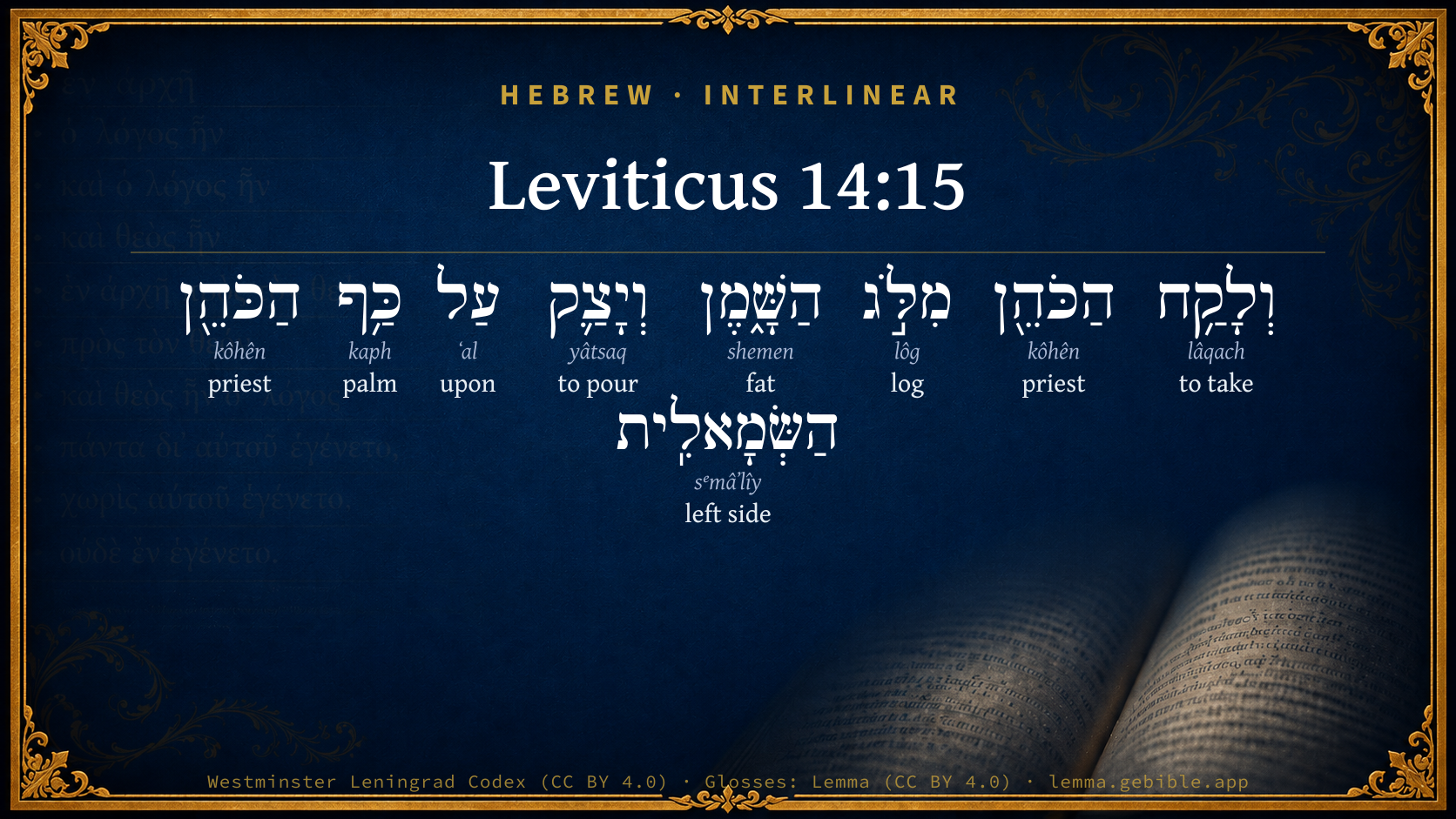
Leviticus 14:15

Hebrew (Westminster Leningrad Codex) Leviticus 14:15 appears in the Hebrew Old Testament. The text above is from the Westminster Leningrad Codex. Each word links to its Strong’s number, a concise gloss, and parsing drawn from the Open Scriptures Hebrew Bible morphology. Click any word for its full Brown-Driver-Briggs (BDB) entry.
Download image
Cite this verse

Leviticus 14:15 (World English Bible). Public Domain. Lemma interlinear Bible study tool, https://lemma.gebible.app/v/leviticus/14/15.

Show BibTeX & RIS
BibTeX
RIS
English Translation
The priest shall take some of the log of oil, and pour it into the palm of his own left hand.
World English Bible · Public Domain
Highlights
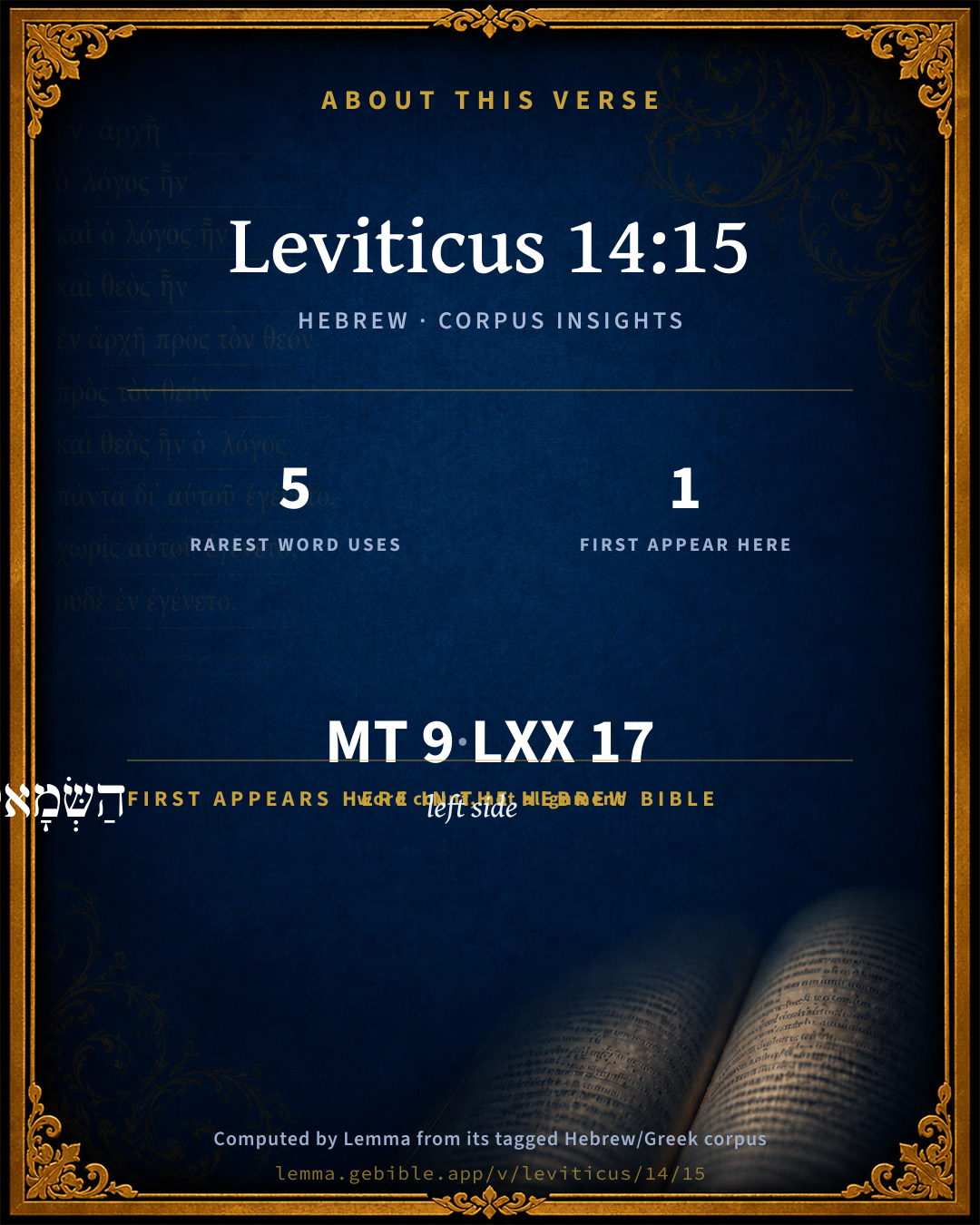
  • 1 first appearance in the Hebrew Bible
Full analysis ↓
Download a study sheet

One document with this verse’s original text, its word-by-word gloss line, the meaning frame, cross-references with their text, attributed commentary, and full source and license credits — printable, and it pastes into notes with its structure intact.

This verse Autodidact and up

Study sheet (.html) Plain text (.txt)

A passage Seminary Student

Up to 50 verses in one chapter. A passage sheet keeps up to 6 commentary sources and 12 cross-references per verse, in the order this page ranks them, and says so on the sheet whenever that leaves anything out. Ask for a single verse and you get the Autodidact verse sheet above.

Everything on this page stays free to read, with no account — the sheet is a download of what is already on screen, not access to it.

Want to remove ads? Support Godless Engineer
Compare translations 3

The same verse in 3 English versions, stacked beneath the original-language interlinear above. Click any original word for its lexicon entry.

Each is an independent rendering of the whole verse — the interlinear is not word-aligned to these translations.

Highlighted words mark where these versions differ — a whole-verse word diff, not a word-by-word alignment.

  • World English Bible Public Domain
    The priest shall take some of the log of oil, and pour it into the palm of his own left hand.
  • King James Version Public Domain
    And the priest shall take some of the log of oil, and pour it into the palm of his own left hand:
  • unfoldingWord Literal Text CC BY-SA 4.0
    And the priest shall take some of the measure of oil, and he shall pour on the left palm of the priest.

unfoldingWord Literal Text — © unfoldingWord, licensed CC BY-SA 4.0. Word-aligned USFM3 via Door43 (git.door43.org/unfoldingWord/en_ult).

Versions to compare (up to 4)

3 of 4 selected

Show all 18 translations

Every available English version of this verse, each an independent rendering of the whole verse.

  • World English Bible Public Domain
    The priest shall take some of the log of oil, and pour it into the palm of his own left hand.
  • Berean Standard Bible Public Domain
    Then the priest shall take some of the log of olive oil, pour it into his left palm,
  • Majority Standard Bible Public Domain
    Then the priest shall take some of the log of olive oil, pour it into his left palm,
  • King James Version Public Domain
    And the priest shall take some of the log of oil, and pour it into the palm of his own left hand:
  • American Standard Version (1901) Public Domain
    And the priest shall take of the log of oil, and pour it into the palm of his own left hand;
  • Revised Version (1885) Public Domain
    and the priest shall take of the log of oil, and pour it into the palm of his own left hand:
  • Geneva Bible (1599) Public Domain
    The Priest shall also take of ye pint of oyle, and powre it into the palme of his left hand,
  • Douay-Rheims (1899) Public Domain
    And he shall pour of the sextary of oil into his own left. hand,
  • Young's Literal Translation Public Domain
    and the priest hath taken of the log of oil, and hath poured on the left palm of the priest,
  • Literal Standard Version CC BY-SA 4.0
    and the priest has taken of the log of oil, and has poured [it] on the left palm of the priest,
  • Unlocked Literal Bible CC BY-SA 4.0
    Then the priest will take oil from the log and pour it into the palm of his own left hand,
  • unfoldingWord Literal Text CC BY-SA 4.0
    And the priest shall take some of the measure of oil, and he shall pour on the left palm of the priest.
  • Darby Bible Public Domain
    And the priest shall take of the log of oil, and pour it into his, the priest's, left hand;
  • World Messianic Bible Public Domain
    The priest shall take some of the log of oil, and pour it into the palm of his own left hand.
  • Webster's Bible Public Domain
    And the priest shall take some of the log of oil, and pour it into the palm of his own left hand:
  • Free Bible Version CC BY-SA 4.0
    The priest will pour some of the log of olive oil into his left palm,
  • Bible in Basic English Public Domain
    And take some of the oil and put it in the hollow of his left hand;
  • JPS Tanakh (1917) Public Domain
    And the priest shall take of the log of oil, and pour it into the palm of his own left hand.

Literal Standard Version (2020), Covenant Press — licensed CC BY-SA 4.0. Text via the HelloAO Bible API (eBible.org). Unlocked Literal Bible (unfoldingWord) — licensed CC BY-SA 4.0. Text via the HelloAO Bible API (eBible.org). unfoldingWord Literal Text — © unfoldingWord, licensed CC BY-SA 4.0. Word-aligned USFM3 via Door43 (git.door43.org/unfoldingWord/en_ult). Free Bible Version, Dr. Jonathan Gallagher — licensed CC BY-SA 4.0. Text via the HelloAO Bible API (eBible.org).

Word by word

More ways to search: Search by grammar → Find every occurrence → Compare this word →

Practice this passage: Drill this verse → Learn its vocabulary →

מִלֹּ֣ג
lôg
H3849
“from · log of”
Preposition + Noun, Common, Masculine, Singular, Construct
Part of Speech
Preposition + Noun
Type
Common
Gender
Masculine
Number
Singular
State
Construct
Full BDB Definition

Origin: from an unused root apparently meaning to deepen or hollow [like H3537 ]

TWOT: 1076

log - a liquid measure equal to about one half litre
  1. וְלָקַ֥ח lâqach H3947 “and · to take” Conjunction + Verb, Qal, Sequential Perfect, 3rd Person, Masculine, Singular
  2. הַכֹּהֵ֖ן kôhên H3548 “the · priest” Particle, Definite Article + Noun, Common, Masculine, Singular, Absolute
  3. הַשָּׁ֑מֶן shemen H8081 “the · fat” Particle, Definite Article + Noun, Common, Masculine, Singular, Absolute
  4. וְיָצַ֛ק yâtsaq H3332 “and · to pour” Conjunction + Verb, Qal, Sequential Perfect, 3rd Person, Masculine, Singular
  5. עַל ʻal H5921 “upon” Preposition
  6. כַּ֥ף kaph H3709 “palm of” Noun, Common, Feminine, Singular, Construct
  7. הַכֹּהֵ֖ן kôhên H3548 “the · priest” Particle, Definite Article + Noun, Common, Masculine, Singular, Absolute
  8. הַשְּׂמָאלִֽית sᵉmâʼlîy H8042 “the · left side” Particle, Definite Article + Adjective, Adjective, Feminine, Singular, Absolute

About this verse

These counts appear in no published source. They are computed here, from the morphology-tagged text and Lemma’s own curated glosses. What Lemma adds →

9
words
8
distinct lemmas
Pentateuch
section

Notable vocabulary

The rarest word here is מִלֹּ֣ג log H3849 — appearing just 5 times in the whole Hebrew Bible.

First appearance in Scripture

This word makes its first canonical appearance in the Hebrew Bible here:

  • הַשְּׂמָאלִֽית left side H8042

Shared distinctive vocabulary

מִלֹּ֣ג log H3849 occurs in 5 verses of the Hebrew Bible. Also found in:

Grammatical profile

  • 2 verbs
  • 5 nouns
  • 1 adjective
  • 1 preposition

Verb forms

  • וְלָקַ֥ח Qal · Sequential Perfect
  • וְיָצַ֛ק Qal · Sequential Perfect

Repetition

A word recurs within this verse — often emphatic in Hebrew:

  • הַכֹּהֵ֖ן priest H3548 ×2

Hebrew & Septuagint length

In English translation the verse runs 21 words from the Hebrew and 19 from the Septuagint (LXX English) — closely comparable.

A rough comparison of the two English renderings, which tokenize alike — not a word-level alignment.

Word counts can differ between the Hebrew and the Greek without any difference in meaning — e.g. the Hebrew direct-object marker אֵת has no separate Greek word, and Greek often adds the article ὁ.

In the original languages it is 9 Hebrew tokens and 17 Greek tokens — but the two are counted differently (Hebrew bundles its prefixes and suffixes into one token; the Greek is in lemma form), so that isn’t a like-for-like length.

Cross-references

3

Topical passages linked to Leviticus 14:15 in the Treasury of Scripture Knowledge — connected by theme and wording, ordered by reader-vote popularity; previews shown in the World English Bible.

  • Psalms 45:7 You have loved righteousness, and hated wickedness. Therefore God, your God, has anointed you with the oil of gladness above your fellows.
  • John 3:34 For he whom God has sent speaks the words of God; for God gives the Spirit without measure.
  • 1 John 2:20 You have an anointing from the Holy One, and you know the truth.

Cross-references courtesy of OpenBible.info (CC BY 4.0).

Hebrew and Greek witnesses Masoretic Hebrew ↔ Greek Septuagint

The same verse in the two great witnesses to the Old Testament, shown verse-for-verse.

These are two independent witnesses, not word-aligned to each other, and the Septuagint is shown in lemma (dictionary) form.

Hebrew Leviticus 14:15 Masoretic · Westminster Leningrad Codex

וְלָקַ֥ח הַכֹּהֵ֖ן מִלֹּ֣ג הַשָּׁ֑מֶן וְיָצַ֛ק עַל כַּ֥ף הַכֹּהֵ֖ן הַשְּׂמָאלִֽית

The priest shall take some of the log of oil, and pour it into the palm of his own left hand.

World English Bible · Public Domain

Greek LXX Leviticus 14:15 Septuagint · lemma form

καί λαμβάνω ὁ ἱερεύς ἀπό ὁ κοτύλη ὁ ἔλαιον ἐπιχέω ἐπί ὁ χείρ ὁ ἱερεύς ὁ ἀριστερός

And the priest shall take of the cup of oil, and shall pour it upon his own left hand.

LXX2012 (modern English Septuagint) · Public Domain

Hebrew: Westminster Leningrad Codex (CC BY 4.0). Greek: Septuagint (public domain); English from LXX2012 (modern English Septuagint) (Public Domain). How the Septuagint differs from the Hebrew →

Targum (Aramaic paraphrase)

2

The Targum is the ancient Jewish Aramaic paraphrase of the Hebrew Scriptures — an interpretive translation, not the Hebrew text itself. Onkelos (literal) and Pseudo-Jonathan (expansive) render the Torah, and Jonathan the Prophets. Coverage is partial: where no permissively-licensed English translation exists for a verse, only the Aramaic is shown. This is verse-level text, not a word-by-word alignment to the Hebrew.

  1. Targum Onkelos Torah (Genesis–Deuteronomy)
    וְיִסַב כַּהֲנָא מִלֻגָא דְמִשְׁחָא וִירִיק עַל יְדָא דְכַהֲנָא דִשְׁמָאלָא

    (no public-domain English translation for this verse)

    Targum Onkelos — Aramaic: “Onkelos Genesis” (public domain); “Onkelos Exodus” (public domain); “Onkelos Leviticus” (public domain); “Onkelos Numbers” (public domain); “Onkelos Deuteronomy” (public domain). English: “Sefaria Community Translation” (CC0 1.0 (public-domain dedication)); “J.W. Etheridge. The Targums of Onkelos and Jonathan Ben Uzziel on the Pentateuch. London: Longmans, Green, 1862” (public domain). Text via Sefaria.

  2. Targum Pseudo-Jonathan Torah (Genesis–Deuteronomy)
    וְיִסַב כַּהֲנָא בִּידֵיהּ יְמִינָא מִלוּגָא דְמִשְׁחָא וְיָרִיק עַל יְדָא דְכַהֲנָא דִשְמָלָא

    And the priest, with his right hand, shall take (some) from the log of oil, and pour it upon the priest's left hand;

    Targum Pseudo-Jonathan — Aramaic: “Targum Jonathan on Genesis” (public domain); “Targum Jonathan on Exodus” (public domain); “Targum Jonathan on Leviticus” (public domain); “Targum Jonathan on Numbers” (public domain); “Targum Jonathan on Deuteronomy” (public domain). English: “The Targum of Jonathan ben Uzziel, trans. J. W. Etheridge, London, 1862” (public domain). Text via Sefaria.

Commentary

Notes on Leviticus 14:15 from classic Christian and Jewish commentators (each source and its license shown beneath its notes). The classic Christian expositions comment on the surrounding passage and are grouped to its opening verse, so a note may address several verses; the Jewish commentaries on the Tanakh (Rashi and others) are per-verse, so they appear only where the commentator wrote on this verse.

Lemma curates 59 commentaries, every one of them public domain or Creative Commons licensed, each selected and text-cleaned for this edition rather than reprinted as found. About our sources →

Trapp's Complete Commentary

John Trapp

Lev 14:15 And the priest shall take [some] of the log of oil, and pour [it] into the palm of his own left hand:

Ver. 15. Some of the log of oil.] Christ’s comforts must be warily propounded to men, and with good discretion.

John Trapp, A Commentary or Exposition upon All the Books of the Old and New Testament (1647–1656) — public domain. Text from a community e-Sword module.

Joseph Benson's Commentary

Lev 14:15-17. The oil — As the blood signified Christ’s blood, by which men obtain remission of sins, so the oil denoted the graces of the Spirit, by which they are renewed. Before the Lord — Before the second veil which covered the holy of holies. Upon the blood — Upon the place where that blood was put.

Joseph Benson's Commentary on the Old and New Testaments (1811–1818) — public domain. Text from a community e-Sword module.

Tyndale Open Study Notes

Tyndale Open Resources

14:15-17 In the ancient world, olive oil was commonly used to aid healing (see Isa 1:6; Luke 10:34). Its use here might symbolize the healing and cleansing of the infection, which allowed the person to return to the community. Perhaps it also represented restored union between God, the priest, and the worshiper.

Tyndale Open Study Notes — © Tyndale Open Resources, licensed CC BY-SA 4.0. Text via the HelloAO Bible API.

Ellicott's Commentary for English Readers

(15) Shall take some of the log of oil.—This he had to do with his right hand, which is actually expressed in the ancient Chaldee paraphrase.

And pour it into the palm of his own left hand.—Better, and he shall pour it into the palm of the priest’s left hand, that is, the priest who has hitherto performed the ceremony of cleansing the leper now takes some of the log of oil, and puts it into the left hand of his fellow priest. This is not only distinctly declared in the canons which obtained during the second Temple, but is expressed in the text, which is seen from the literal translation we have given of the clause in question. The same priest, however, was allowed to pour it into the palm of his own hands. To express this view, which the translators of the Authorised Version espoused, they omitted the word priest, which is to be found in the original, and substituted his own, which is not in the original.

A Bible Commentary for English Readers, edited by Charles John Ellicott (1878–1897) — public domain. Text from a community e-Sword module.

The Cambridge Bible for Schools and Colleges

gen. ed. J. J. S. Perowne

15. and the priest shall take of the log of oil, and pour it into the palm of his own left hand] Heb. and pour it into the left hand of the priest. The traditional interpretation is that the one priest poured the oil into the palm of the other priest (see note on Lev_14:14), but the Mishna adds ‘if he pours it into his own palm, it is allowed.’ The procedure, as described in EVV is supported by authority.

The Cambridge Bible for Schools and Colleges (gen. ed. J. J. S. Perowne; Cambridge University Press, 1878–1918) — public domain. Text from a community e-Sword module.

John Gill's Exposition

And the priest shall take some of the log of oil,.... With his right hand, as the Targum of Jonathan adds:

and pour it into the palm of his own left hand: but in the original text it is, "pour it into the palm of the priest's left hand": and it is a question, whether he or another priest is meant; according to Aben Ezra, the oil was to be poured into the hand of the priest that was cleansing the leper, and which, he thinks, is plain from what follows; but Gersom thinks it is better to understand it of another priest, since it is not said into his own hand, but into the hand of the priest; and the Misnah (u) is clear for it, he (the priest) takes of the log of oil and pours it into the palm of his fellow (priest), but if he pours it into his own palm it is sufficient.

(u) Ib. sect. 10. so Maimon. Mechosre Capharah, ut supra, (c. 4. sect. 2.) & Bartenora, in Misn. Negaim, ib.

John Gill's Exposition of the Whole Bible (1746–1763) — public domain (CC PDM 1.0). Text via the HelloAO Bible API.

Matthew Poole's English Annotations

As the blood signified Christ’s blood, by which men obtain remission of sins; so the oil noted the graces of the Spirit, by which they are regenerated and renewed.

Matthew Poole's English Annotations on the Holy Bible (1683–1685) — public domain. Text from a community e-Sword/MySword module.

Whedon's Commentary on the Bible

Daniel D. Whedon

15. The priest shall take… oil — The administration of the oil to various parts of the person, ending with pouring it upon the head, is the last act in the process of cleansing. Its spiritual significance is no enigma. Oil symbolizes the Holy Spirit. Jesus, as the Messiah, or the Christ, was anointed of the Holy Spirit. Zec_4:2-12; Act_10:38; Heb_1:9. Believers endowed with the fulness of the Spirit are said to be anointed. 1Jn_2:20; 1Jn_2:27. All genuine Christians are etymologically the oiled ones. The restoration of the leper involved two parts — the negative, the removal of the impurity by the blood sprinkled; and the positive, the reinvestment with all lost privileges, especially communion with God’s people, and favour with him and the right of access to him. The positive work is typified by the anointing. Entire sanctification consists not only of a death unto sin, but of life unto God. There must be a destructive and a constructive process. The old man must be slain and the new man must be created in righteousness and true holiness.

Daniel D. Whedon (gen. ed.), Commentary on the Old and New Testaments (1874–1909) — public domain. Text from a community e-Sword module.

The Pulpit Commentary

Vers. 15-18. And the priest shall take some of the log of oil, and pour it into the palm of his own left hand. This ceremony is altogether peculiar to this purification. The joint use of blood and oil is not singular, (see Lev_8:30) but elsewhere there is no sprinkling of the oil... seven times before the Lord, and in the consecration of priests there was no anointing of the different members with oil as well as with blood. The Mishua (as before cited) continues the description of the ceremony as follows: priest now takes from the log of oil and pours it into the palm of his colleague, though if he poured it into his own it were valid. He dips his finger and sprinkles seven times towards the holy of holies, dipping each time he sprinkles. He goes before the leper, and on the spot where he had put the blood he puts the oil, as it is written, "Upon the blood of the trespass offering." And the remnant of the oil that is in the priest"s hand, he pours on the head of him that is cleansed, for an atonement; if he so puts it, he is atoned for, but if not, he is not atoned for. So Rabbi Akiba. Rabbi Jochanan, the son of Nuri, saith, This is only the remnant of the ordinance, whether it be done or not, the atonement is made; but they impute it to him (the priest), as if he had not made atonement." The double sprinkling with blood and oil betokened dedication as in the case of the priests, the blood specially denoting reconciliation, and the oil the strengthening power of God by which the new life was to be led.

The Pulpit Commentary (1880–1919), ed. H.D.M. Spence-Jones & Joseph S. Exell — public domain. Text from a community e-Sword module.

John Wesley's Explanatory Notes

The oil - As the blood signified Christ's blood by which men obtained remission of sins, so the oil noted the graces of the spirit by which they are renewed.

John Wesley, Explanatory Notes Upon the Whole Bible (1754–1765) — public domain. Text via the GEBible commentary corpus.

Lesson kit

Teaching starters — assembled from the data on this page, not authored interpretation. Every prompt links to the verse data it draws on. Edit before teaching.

Leviticus, in the Pentateuch, opens this verse with 9 words (8 distinct Hebrew lemmas). Its most distinctive word is lôg (“log”). A historical commentator’s framing appears above. Read the whole chapter for the surrounding context.

Discussion questions

  1. How does “log” (lôg) shape what this verse is saying?
  2. This is the first place “left side” appears in Scripture (first appears here). What does its debut here establish?
  3. How does Leviticus 14:10, which shares the word «log», read alongside this verse?
  4. What does the repetition of “priest” (2× in this one verse) do in this verse?
  5. These translations render this verse differently. What is at stake in choosing one wording over another?
  6. «וְלָקַ֥ח» is a Qal Sequential Perfect verb. How does that grammatical form shape the action described?
  7. Compare how Trapp's Complete Commentary and Joseph Benson's Commentary read this verse. Where do they agree or differ?

Things to notice

Reading settings

Reading text

Shown beneath each verse's original-language words.

Old Testament
Old Testament edition

Read the OT as the Masoretic Hebrew (MT) or the Greek Septuagint (LXX).

English shown for the Greek Septuagint (in the Hebrew ↔ Greek comparison).

Comparing translations? Open the Compare panel on any verse page to stack up to four side by side.