
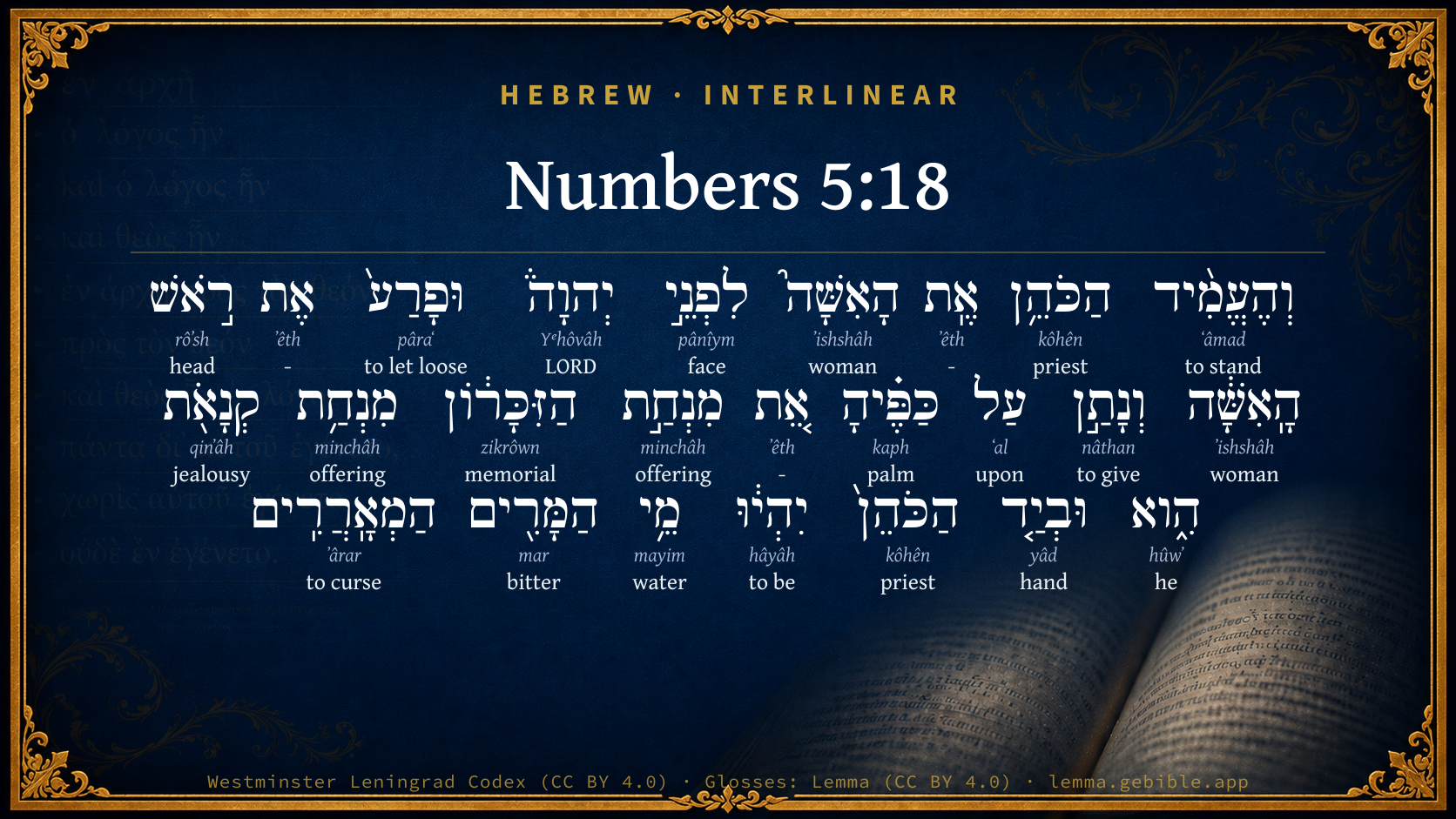
Numbers 5:18

Hebrew (Westminster Leningrad Codex) Numbers 5:18 appears in the Hebrew Old Testament. The text above is from the Westminster Leningrad Codex. Each word links to its Strong’s number, a concise gloss, and parsing drawn from the Open Scriptures Hebrew Bible morphology. Click any word for its full Brown-Driver-Briggs (BDB) entry.
Download image
Cite this verse

Numbers 5:18 (World English Bible). Public Domain. Lemma interlinear Bible study tool, https://lemma.gebible.app/v/numbers/5/18.

Show BibTeX & RIS
BibTeX
RIS
English Translation
The priest shall set the woman before Yahweh, and let the hair of the woman's head go loose, and put the meal offering of memorial in her hands, which is the meal offering of jealousy. The priest shall have in his hand the water of bitterness that brings a curse.
World English Bible · Public Domain
Download a study sheet

One document with this verse’s original text, its word-by-word gloss line, the meaning frame, cross-references with their text, attributed commentary, and full source and license credits — printable, and it pastes into notes with its structure intact.

This verse Autodidact and up

Study sheet (.html) Plain text (.txt)

A passage Seminary Student

Up to 50 verses in one chapter. A passage sheet keeps up to 6 commentary sources and 12 cross-references per verse, in the order this page ranks them, and says so on the sheet whenever that leaves anything out. Ask for a single verse and you get the Autodidact verse sheet above.

Everything on this page stays free to read, with no account — the sheet is a download of what is already on screen, not access to it.

Want to remove ads? Support Godless Engineer
Compare translations 3

The same verse in 3 English versions, stacked beneath the original-language interlinear above. Click any original word for its lexicon entry.

Each is an independent rendering of the whole verse — the interlinear is not word-aligned to these translations.

Highlighted words mark where these versions differ — a whole-verse word diff, not a word-by-word alignment.

  • World English Bible Public Domain
    The priest shall set the woman before Yahweh, and let the hair of the woman's head go loose, and put the meal offering of memorial in her hands, which is the meal offering of jealousy. The priest shall have in his hand the water of bitterness that brings a curse.
  • King James Version Public Domain
    And the priest shall set the woman before the LORD, and uncover the woman's head, and put the offering of memorial in her hands, which is the jealousy offering: and the priest shall have in his hand the bitter water that causeth the curse:
  • unfoldingWord Literal Text CC BY-SA 4.0
    And the priest shall stand the woman to the face of Yahweh, and he shall loose the head of the woman, and he shall put on her palm the grain offering of memorial. It a grain offering of jealousy. And in the hand of the priest shall be the water of bitterness that brings a curse.

unfoldingWord Literal Text — © unfoldingWord, licensed CC BY-SA 4.0. Word-aligned USFM3 via Door43 (git.door43.org/unfoldingWord/en_ult).

Versions to compare (up to 4)

3 of 4 selected

Show all 18 translations

Every available English version of this verse, each an independent rendering of the whole verse.

  • World English Bible Public Domain
    The priest shall set the woman before Yahweh, and let the hair of the woman's head go loose, and put the meal offering of memorial in her hands, which is the meal offering of jealousy. The priest shall have in his hand the water of bitterness that brings a curse.
  • Berean Standard Bible Public Domain
    After the priest has the woman stand before the LORD, he is to let down her hair and place in her hands the grain offering of memorial, which is the grain offering for jealousy. The priest is to hold the bitter water that brings a curse.
  • Majority Standard Bible Public Domain
    After the priest has the woman stand before the LORD, he is to let down her hair and place in her hands the grain offering of memorial, which is the grain offering for jealousy. The priest is to hold the bitter water that brings a curse.
  • King James Version Public Domain
    And the priest shall set the woman before the LORD, and uncover the woman's head, and put the offering of memorial in her hands, which is the jealousy offering: and the priest shall have in his hand the bitter water that causeth the curse:
  • American Standard Version (1901) Public Domain
    And the priest shall set the woman before Jehovah, and let the hair of the woman's head go loose, and put the meal-offering of memorial in her hands, which is the meal-offering of jealousy: and the priest shall have in his hand the water of bitterness that causeth the curse.
  • Revised Version (1885) Public Domain
    and the priest shall set the woman before the LORD, and let the hair of the woman’s head go loose, and put the meal offering of memorial in her hands, which is the meal offering of jealousy: and the priest shall have in his hand the water of bitterness that causeth the curse:
  • Geneva Bible (1599) Public Domain
    After, the Priest shall set the woman before the Lord, and vncouer the womans head, and put the offring of the memorial in her hands: it is the ielousie offering, and the Priest shall haue bitter and cursed water in his hand,
  • Douay-Rheims (1899) Public Domain
    And when the woman shall stand before the Lord, he shall uncover her head, and shall, put on her hands the sacrifice of remembrance, and the oblation of jealousy: and he himself shall hold the most bitter waters, whereon he hath heaped curses with execration.
  • Young's Literal Translation Public Domain
    and the priest hath caused the woman to stand before Jehovah, and hath uncovered the woman's head, and hath given into her hands the present of the memorial, it `is' a present of jealousy, and in the hand of the priest are the bitter waters which cause the curse.
  • Literal Standard Version CC BY-SA 4.0
    and the priest has caused the woman to stand before YHWH, and has uncovered the woman’s head, and has given the present of the memorial into her hands (it [is] a present of jealousy), and the bitter waters which cause the curse are in the hand of the priest.
  • Unlocked Literal Bible CC BY-SA 4.0
    The priest will set the woman before Yahweh and he will untie the hair on the woman's head. He will put into her hands the grain offering of remembrance, which is the grain offering of suspicion. The priest will hold in his hand the bitter water that can bring a curse.
  • unfoldingWord Literal Text CC BY-SA 4.0
    And the priest shall stand the woman to the face of Yahweh, and he shall loose the head of the woman, and he shall put on her palm the grain offering of memorial. It a grain offering of jealousy. And in the hand of the priest shall be the water of bitterness that brings a curse.
  • Darby Bible Public Domain
    And the priest shall set the woman before Jehovah, and uncover the woman's head, and put the memorial oblation in her hands, which is the jealousy offering; and in the hand of the priest shall be the bitter water that bringeth the curse.
  • World Messianic Bible Public Domain
    The priest shall set the woman before the LORD, and let the hair of the woman’s head go loose, and put the meal offering of memorial in her hands, which is the meal offering of jealousy. The priest shall have in his hand the water of bitterness that brings a curse.
  • Webster's Bible Public Domain
    And the priest shall set the woman before the LORD, and uncover the woman's head, and put the offering of memorial in her hands, which is the jealousy-offering: and the priest shall have in his hand the bitter water that causeth the curse:
  • Free Bible Version CC BY-SA 4.0
    Once the priest has had the woman stand before the Lord, he shall let her hair loose and have her hold the reminder grain offering—the grain offering used in cases of jealousy. The priest shall hold the bitter water that curses.
  • Bible in Basic English Public Domain
    And he will make the woman come before the Lord with her hair loose, and will put the meal offering, the offering of a bitter spirit, in her hands; and the priest will take in his hand the bitter water causing the curse;
  • JPS Tanakh (1917) Public Domain
    And the priest shall set the woman before the LORD, and let the hair of the woman's head go loose, and put the meal-offering of memorial in her hands, which is the meal-offering of jealousy; and the priest shall have in his hand the water of bitterness that causeth the curse.

Literal Standard Version (2020), Covenant Press — licensed CC BY-SA 4.0. Text via the HelloAO Bible API (eBible.org). Unlocked Literal Bible (unfoldingWord) — licensed CC BY-SA 4.0. Text via the HelloAO Bible API (eBible.org). unfoldingWord Literal Text — © unfoldingWord, licensed CC BY-SA 4.0. Word-aligned USFM3 via Door43 (git.door43.org/unfoldingWord/en_ult). Free Bible Version, Dr. Jonathan Gallagher — licensed CC BY-SA 4.0. Text via the HelloAO Bible API (eBible.org).

Word by word

More ways to search: Search by grammar → Find every occurrence → Compare this word →

Practice this passage: Drill this verse → Learn its vocabulary →

וּפָרַע֙
pâraʻ
H6544
“and · to let loose”
Conjunction + Verb, Qal, Sequential Perfect, 3rd Person, Masculine, Singular
Part of Speech
Conjunction + Verb
Stem
Qal
Form
Sequential Perfect
Person
3rd Person
Gender
Masculine
Number
Singular
Full BDB Definition

Origin: a primitive root

TWOT: 1822 , 1823 , 1824

to lead, act as leader - to let go, let loose, ignore, let alone - (Qal) - to let go, let loose - to let alone, avoid, neglect - to loosen - (Niphal) to be let loose, be loosened of restraint - (Hiphil) - to cause to refrain - to show lack of restraint - to let loose restraints
  1. וְהֶעֱמִ֨יד ʻâmad H5975 “and · to stand” Conjunction + Verb, Hiphil, Sequential Perfect, 3rd Person, Masculine, Singular
  2. הַכֹּהֵ֥ן kôhên H3548 “the · priest” Particle, Definite Article + Noun, Common, Masculine, Singular, Absolute
  3. אֶֽת ʼêth H853 “-” Particle, Direct Object
  4. הָאִשָּׁה֮ ʼishshâh H802 “the · woman” Particle, Definite Article + Noun, Common, Feminine, Singular, Absolute
  5. לִפְנֵ֣י pânîym H6440 “to/for · face(s) of” Preposition + Noun, Common, Both, Plural, Construct
  6. יְהוָה֒ Yᵉhôvâh H3068 “LORD” Noun, Proper
  7. אֶת ʼêth H853 “-” Particle, Direct Object
  8. רֹ֣אשׁ rôʼsh H7218 “head of” Noun, Common, Masculine, Singular, Construct
  9. הָֽאִשָּׁ֔ה ʼishshâh H802 “the · woman” Particle, Definite Article + Noun, Common, Feminine, Singular, Absolute
  10. וְנָתַ֣ן nâthan H5414 “and · to give” Conjunction + Verb, Qal, Sequential Perfect, 3rd Person, Masculine, Singular
  11. עַל ʻal H5921 “upon” Preposition
  12. כַּפֶּ֗יהָ kaph H3709 “palms · her” Noun, Common, Feminine, Dual, Construct + Suffix, Personal, 3rd Person, Feminine, Singular
  13. אֵ֚ת ʼêth H853 “-” Particle, Direct Object
  14. מִנְחַ֣ת minchâh H4503 “offering of” Noun, Common, Feminine, Singular, Construct
  15. הַזִּכָּר֔וֹן zikrôwn H2146 “the · memorial” Particle, Definite Article + Noun, Common, Masculine, Singular, Absolute
  16. מִנְחַ֥ת minchâh H4503 “offering of” Noun, Common, Feminine, Singular, Construct
  17. קְנָאֹ֖ת qinʼâh H7068 “jealousy” Noun, Common, Feminine, Plural, Absolute
  18. הִ֑וא hûwʼ H1931 “he” Pronoun, Personal, 3rd Person, Feminine, Singular
  19. וּבְיַ֤ד yâd H3027 “and · in/at · hand of” Conjunction + Preposition + Noun, Common, Both, Singular, Construct
  20. הַכֹּהֵן֙ kôhên H3548 “the · priest” Particle, Definite Article + Noun, Common, Masculine, Singular, Absolute
  21. יִהְי֔וּ hâyâh H1961 “to be” Verb, Qal, Imperfect, 3rd Person, Masculine, Plural
  22. מֵ֥י mayim H4325 “water(s) of” Noun, Common, Masculine, Plural, Construct
  23. הַמָּרִ֖ים mar H4751 “the · bitter” Particle, Definite Article + Adjective, Adjective, Masculine, Plural, Absolute
  24. הַמְאָֽרֲרִֽים ʼârar H779 “the · cursing” Particle, Definite Article + Verb, Piel, Participle Active, Masculine, Plural, Absolute

About this verse

These counts appear in no published source. They are computed here, from the morphology-tagged text and Lemma’s own curated glosses. What Lemma adds →

25
words
20
distinct lemmas
Pentateuch
section

Notable vocabulary

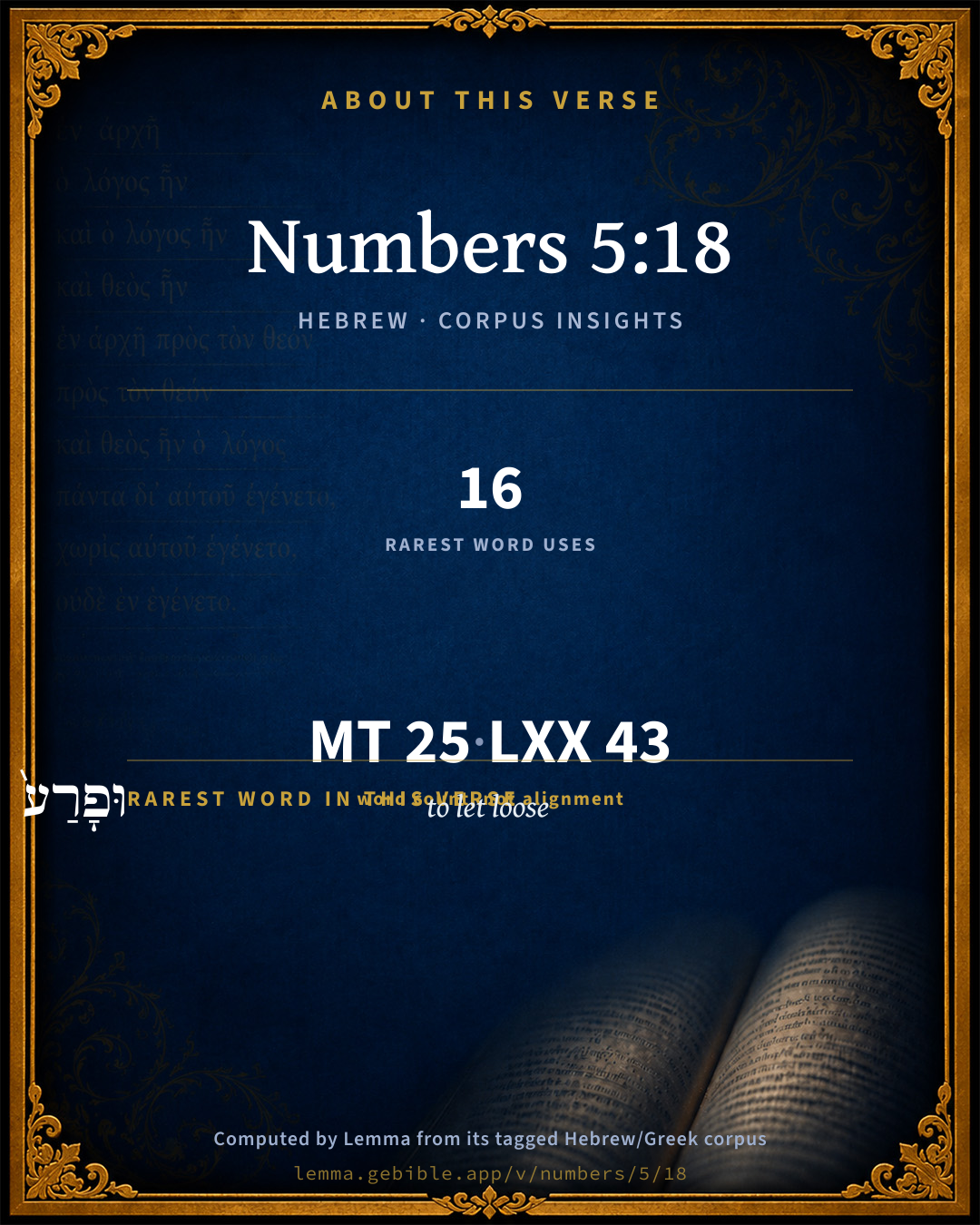
The rarest word here is וּפָרַע֙ to let loose H6544 — appearing just 16 times in the whole Hebrew Bible.

Shared distinctive vocabulary

וּפָרַע֙ to let loose H6544 occurs in 15 verses of the Hebrew Bible. Also found in:

Grammatical profile

  • 5 verbs
  • 14 nouns
  • 1 adjective
  • 1 pronoun
  • 1 preposition
  • 3 particles

Verb forms

  • וְהֶעֱמִ֨יד Hiphil · Sequential Perfect
  • וּפָרַע֙ Qal · Sequential Perfect
  • וְנָתַ֣ן Qal · Sequential Perfect
  • יִהְי֔וּ Qal · Imperfect
  • הַמְאָֽרֲרִֽים Piel · Participle Active

Repetition

Words recur within this verse — often emphatic in Hebrew:

  • הַכֹּהֵ֥ן priest H3548 ×2
  • הָאִשָּׁה֮ woman H802 ×2
  • מִנְחַ֣ת offering H4503 ×2

Hebrew & Septuagint length

In English translation the verse runs 50 words from the Hebrew and 52 from the Septuagint (LXX English) — closely comparable.

A rough comparison of the two English renderings, which tokenize alike — not a word-level alignment.

Word counts can differ between the Hebrew and the Greek without any difference in meaning — e.g. the Hebrew direct-object marker אֵת has no separate Greek word, and Greek often adds the article ὁ.

In the original languages it is 25 Hebrew tokens and 43 Greek tokens — but the two are counted differently (Hebrew bundles its prefixes and suffixes into one token; the Greek is in lemma form), so that isn’t a like-for-like length.

Cross-references

17

Topical passages linked to Numbers 5:18 in the Treasury of Scripture Knowledge — connected by theme and wording, ordered by reader-vote popularity; previews shown in the World English Bible.

  • Leviticus 13:45 "The leper in whom the plague is shall wear torn clothes, and the hair of his head shall hang loose. He shall cover his upper lip, and shall cry, 'Unclean! Unclean!'
  • Numbers 5:15 then the man shall bring his wife to the priest, and shall bring her offering for her: the tenth part of an ephah of barley meal. He shall pour no oil on it, nor put frankincense on it, for it is a meal offering of jealousy, a meal offering of memorial, bringing iniquity to memory.
  • Numbers 5:17 and the priest shall take holy water in an earthen vessel; and of the dust that is on the floor of the tabernacle the priest shall take, and put it into the water.
  • Numbers 5:22 and this water that brings a curse will go into your bowels, and make your body swell, and your thigh fall away.' The woman shall say, 'Amen, Amen.'
  • Numbers 5:24–26 He shall make the woman drink the water of bitterness that causes the curse; and the water that causes the curse shall enter into her and become bitter.
  • Deuteronomy 29:18 lest there should be among you man, or woman, or family, or tribe, whose heart turns away this day from Yahweh our God, to go to serve the gods of those nations; lest there should be among you a root that bears gall and wormwood;
  • 1 Samuel 15:32 Then said Samuel, Bring you here to me Agag the king of the Amalekites. Agag came to him cheerfully. Agag said, Surely the bitterness of death is past.
  • Proverbs 5:4 But in the end she is as bitter as wormwood, And as sharp as a two-edged sword.
  • Ecclesiastes 7:26 I find more bitter than death the woman whose heart is snares and traps, whose hands are chains. Whoever pleases God shall escape from her; but the sinner will be ensnared by her.
  • Isaiah 38:17 Behold, [it was] for [my] peace [that] I had great bitterness: But you have in love to my soul delivered it from the pit of corruption; For you have cast all my sins behind your back.
  • Jeremiah 2:19 Your own wickedness shall correct you, and your backsliding shall reprove you: know therefore and see that it is an evil thing and a bitter, that you have forsaken Yahweh your God, and that my fear is not in you, says the Lord, Yahweh of Hosts.
  • 1 Corinthians 11:6 For if a woman is not covered, let her also be shorn. But if it is shameful for a woman to be shorn or shaved, let her be covered.
  • Hebrews 4:12–13 For the word of God is living, and active, and sharper than any two-edged sword, and piercing even to the dividing of soul and spirit, of both joints and marrow, and is able to discern the thoughts and intentions of the heart.
  • Hebrews 13:4 Let marriage be held in honor among all, and let the bed be undefiled: but God will judge the sexually immoral and adulterers.
  • Revelation 2:19–23 I know your works, your love, faith, service, patient endurance, and that your last works are more than the first.
  • Revelation 10:9–10 I went to the angel, telling him to give me the little book. He said to me, "Take it, and eat it up. It will make your stomach bitter, but in your mouth it will be as sweet as honey."
  • 1 Corinthians 11:15 But if a woman has long hair, it is a glory to her, for her hair is given to her for a covering.

Cross-references courtesy of OpenBible.info (CC BY 4.0).

Hebrew and Greek witnesses Masoretic Hebrew ↔ Greek Septuagint

The same verse in the two great witnesses to the Old Testament, shown verse-for-verse.

These are two independent witnesses, not word-aligned to each other, and the Septuagint is shown in lemma (dictionary) form.

Hebrew Numbers 5:18 Masoretic · Westminster Leningrad Codex

וְהֶעֱמִ֨יד הַכֹּהֵ֥ן אֶֽת הָאִשָּׁה֮ לִפְנֵ֣י יְהוָה֒ וּפָרַע֙ אֶת רֹ֣אשׁ הָֽאִשָּׁ֔ה וְנָתַ֣ן עַל כַּפֶּ֗יהָ אֵ֚ת מִנְחַ֣ת הַזִּכָּר֔וֹן מִנְחַ֥ת קְנָאֹ֖ת הִ֑וא וּבְיַ֤ד הַכֹּהֵן֙ יִהְי֔וּ מֵ֥י הַמָּרִ֖ים הַמְאָֽרֲרִֽים

The priest shall set the woman before Yahweh, and let the hair of the woman's head go loose, and put the meal offering of memorial in her hands, which is the meal offering of jealousy. The priest shall have in his hand the water of bitterness that brings a curse.

World English Bible · Public Domain

Greek LXX Numbers 5:18 Septuagint · lemma form

καί ἵστημι ὁ ἱερεύς ὁ γυνή ἔναντι κύριος καί ἀποκαλύπτω ὁ κεφαλή ὁ γυνή καί δίδωμι ἐπί ὁ χείρ αὐτός ὁ θυσία ὁ μνημόσυνον ὁ θυσία ὁ ζηλοτυπία ἐν δέ ὁ χείρ ὁ ἱερεύς εἰμί ὁ ὕδωρ ὁ ἐλεγμός ὁ ἐπι καταἀράομαι οὗτος

And the priest shall cause the woman to stand before the Lord, and shall uncover the head of the woman, and shall put into her hands the sacrifice of memorial, the sacrifice of jealousy; and in the hand of the priest shall be the water of this conviction that brings the curse.

LXX2012 (modern English Septuagint) · Public Domain

On this verse, Whedon's Commentary on the Bible discusses the Septuagint’s reading. Read the note in Commentary ↓

Hebrew: Westminster Leningrad Codex (CC BY 4.0). Greek: Septuagint (public domain); English from LXX2012 (modern English Septuagint) (Public Domain). How the Septuagint differs from the Hebrew →

Targum (Aramaic paraphrase)

2

The Targum is the ancient Jewish Aramaic paraphrase of the Hebrew Scriptures — an interpretive translation, not the Hebrew text itself. Onkelos (literal) and Pseudo-Jonathan (expansive) render the Torah, and Jonathan the Prophets. Coverage is partial: where no permissively-licensed English translation exists for a verse, only the Aramaic is shown. This is verse-level text, not a word-by-word alignment to the Hebrew.

  1. Targum Onkelos Torah (Genesis–Deuteronomy)
    וִיקֵים כַּהֲנָא יָת אִתְּתָא קֳדָם יְיָ וְיִפְרַע יָת רֵישָׁא דְאִתְּתָא וְיתֵּן עַל יְדָהָא יָת מִנְחַת דוּכְרָנָא מִנְחַת קִנְאָתָא הִיא וּבִידָא דְכַהֲנָא יְהוֹן מַיָא מְרִירַיָא מְלַטְטַיָא

    (no public-domain English translation for this verse)

    Targum Onkelos — Aramaic: “Onkelos Genesis” (public domain); “Onkelos Exodus” (public domain); “Onkelos Leviticus” (public domain); “Onkelos Numbers” (public domain); “Onkelos Deuteronomy” (public domain). English: “Sefaria Community Translation” (CC0 1.0 (public-domain dedication)); “J.W. Etheridge. The Targums of Onkelos and Jonathan Ben Uzziel on the Pentateuch. London: Longmans, Green, 1862” (public domain). Text via Sefaria.

  2. Targum Pseudo-Jonathan Torah (Genesis–Deuteronomy)
    וְיוֹקִים כַּהֲנָא יַת אִיתְּתָא קֳדָם יְיָ וְיֶאֱסוֹר עַל חַרְצָא אַשְׁלָא מֵעִילוֹי חַדְיָיהָא מְטוֹל דְאִיהִי אַסְרַת חַרְצָהָא בְּצִילְצוֹלִין וְיִפְרַע יַת רֵישָׁא דְאִיתְּתָא מְטוֹל דְאִיהִי קַלְעַת שְעַר רֵישָׁא וְיִתֵּן עַל יְדָהָא יַת מִנְחַת דוּכְרָנָא מִנְחַת קִנְאֵיתָא הִיא וּבִידָא דְכַהֲנָא יְהוֹן מַיָא מְרִירַיָא בְּדוּקַיָא

    And the priest shall cause the woman to stand before the Lord, and bind a cord over her loins and upon her breast,- because she should have bound her loins with a girdle; and he shall uncover the woman's head, because she had tied a fillet upon her hair. And he shall put the mincha of memorial, the mincha of jealousy, into her hand; while in the hand of the priest shall be the bitter water of the trial.

    Targum Pseudo-Jonathan — Aramaic: “Targum Jonathan on Genesis” (public domain); “Targum Jonathan on Exodus” (public domain); “Targum Jonathan on Leviticus” (public domain); “Targum Jonathan on Numbers” (public domain); “Targum Jonathan on Deuteronomy” (public domain). English: “The Targum of Jonathan ben Uzziel, trans. J. W. Etheridge, London, 1862” (public domain). Text via Sefaria.

Commentary

Notes on Numbers 5:18 from classic Christian and Jewish commentators (each source and its license shown beneath its notes). The classic Christian expositions comment on the surrounding passage and are grouped to its opening verse, so a note may address several verses; the Jewish commentaries on the Tanakh (Rashi and others) are per-verse, so they appear only where the commentator wrote on this verse.

Lemma curates 59 commentaries, every one of them public domain or Creative Commons licensed, each selected and text-cleaned for this edition rather than reprinted as found. About our sources →

Trapp's Complete Commentary

John Trapp

Num 5:18 And the priest shall set the woman before the LORD, and uncover the woman’s head, and put the offering of memorial in her hands, which [is] the jealousy offering: and the priest shall have in his hand the bitter water that causeth the curse:

Ver. 18. Uncover the woman’s head.] Because she stood now upon her justification, and thereupon laid aside, for present, this sign of subjection to the man. {1Co 11:7}

The offering of memorial.] Brought by her husband, {Num 5:15} who was now sick of one of those three diseases, that they say are hardly cured, jealousy, frenzy, and heresy.

John Trapp, A Commentary or Exposition upon All the Books of the Old and New Testament (1647–1656) — public domain. Text from a community e-Sword module.

Geneva Bible (1599)

Geneva Bible translators

It was so called by the effect, because it declared the woman to be accursed, and turned to her destruction.

Geneva Bible (1599) marginal notes — public domain. Text via Bolls.life.

Adam Clarke's Commentary

Verse 18. Uncover the woman's head] To take off a woman's veil, and expose her to the sight of men, would be considered a very great degradation in the East. To this St. Paul appears to allude, 1Co 11:5-6; 1Co 11:10.

Adam Clarke's Commentary on the Bible (1810–1826) — public domain. Text from a community e-Sword/MySword module.

The Cambridge Bible for Schools and Colleges

gen. ed. J. J. S. Perowne

18. The hair is let loose as a sign of mourning for her shame.

the water of bitterness] the water which causes physical pain.

The Cambridge Bible for Schools and Colleges (gen. ed. J. J. S. Perowne; Cambridge University Press, 1878–1918) — public domain. Text from a community e-Sword module.

John Gill's Exposition

And the priest shall set the woman before the Lord,.... In the east of the tabernacle, with her face to the west, where was the holy of holies, so Ben Gersom; but not immediately for they had her from place to place, as Jarchi says, till she was weary, and her mind disturbed, that she might confess; and if she said, I am defiled, she rent the writing of her dowry, and went out; but if she said, I am pure, they brought her to the eastern gate, the gate of Nicanor, for there they made women suspected of adultery to drink the waters (t):

and uncover the woman's head; as a token of her immodesty and non-subjection to her husband, and that she might be seen by all, to cause shame in her: according to the Misnah (u), the priest took off her clothes, and loosed her hair--if she was clothed with white garments, he clothed her with black; if she had on her ornaments of gold, chains, earrings, or rings, he took them away from her, that she might be unseemly, and whoever would might come and look at her:

and put the offering of memorial into her hands, which is the jealousy offering; to weary her, as Jarchi says, that if perhaps her mind was disturbed she would confess; and so in the Misnah (w) it is said, that her husband put this offering into her hands to weary her; but the true reason here seems to be, that it might appear to be her own offering:

and the priest shall have in his hand the bitter water that causeth the curse; not that the water was bitter of itself, for it was the water out of the laver, and had nothing in it but the dust of the floor of the tabernacle; though some think some bitter thing was put into it, so Ben Gersom, as wormwood; but it is so called from the effects of it on those that were guilty; it produced sad effects in them, bitter and distressing, and made them appear to be accursed ones, for it was not bitter till it entered, Num 5:24; whereas it was not so to the innocent, nor attended with any such consequence to them; so that there was nothing in the water itself, but its efficacy was divine and supernatural.

(t) Sotah, c. 1. sect. 5. (u) Sotah, c. 1. sect. 5, 6. (w) Sotah, c. 2. sect. 1.

John Gill's Exposition of the Whole Bible (1746–1763) — public domain (CC PDM 1.0). Text via the HelloAO Bible API.

Matthew Poole's English Annotations

Before the Lord; before the tabernacle, with her face towards the ark.

Uncover the woman’s head; partly, that she might be made sensible how manifest she and all her ways were to God, and that she might be more visible to the congregation, that her shame might be greater if she were guilty; partly, in token of her sorrow either for her sin, or at least for any cause of suspicion which she had given; partly, as a sign that she was after a sort deprived of the help and protection of her husband, which the covering of the woman’s head signified, 1Co 11:5-7,10, and that she was neither virgin nor loyal with, for the heads of both these used to be covered.

In her hands, that she herself might offer it, and therefore call God to be witness of her innocency. Bitter; so called either from the bitter taste which the dust gave it, or from the bitter effects of it upon her if she were guilty. Compare Exo 32:20.

That causeth the curse; not by any natural power, but by a supernatural efficacy ordained and wrought by God for her punishment, and for the terror and caution of others.

Matthew Poole's English Annotations on the Holy Bible (1683–1685) — public domain. Text from a community e-Sword/MySword module.

Whedon's Commentary on the Bible

Daniel D. Whedon

18. The woman before the Lord — In Num_5:16 the offering was “before the Lord” when brought to the altar. The woman was “before the Lord” when, with her face toward the ark, where dwelt the Shekinah, she stood before the door of the tabernacle.

And uncover the woman’s head — The Mishna prescribes that she be clothed in black, with a rope girded around her waist. It would seem from the text that her head was vailed, probably also in black. This uncovering seems to typify her removal from the protection of her husband, and her exposure to the wrath of God. It was necessary, also, that the vail be removed in order that the people might mark the woman, and note the Divine stroke upon her in the future if she were guilty. We cannot accept the statement that dishevelling the hair is all that is here meant. In the same Hebrew words Aaron is forbidden to uncover his head in mourning for his sons, Nadab and Abihu. Lev_10:6. The jealousy offering was to be in her hands until her oath had entitled her to have it burned upon the altar. The woman, holding her offering — the priest, with the curse-water in his hand — and the jealous husband, the priests, and people looking on, constitute a tableau vivant of deep and solemn interest.

The bitter water — It was not bitter in its taste, but in its effects upon the guilty. The Septuagint reads, water of conviction.

Daniel D. Whedon (gen. ed.), Commentary on the Old and New Testaments (1874–1909) — public domain. Text from a community e-Sword module.

The Pulpit Commentary

Uncover the woman"s head. In token that she had forfeited her glory by breaking, or seeming to have broken, her allegiance to her husband; (1Co_11:5-10) perhaps also with some reference to the truth that "all things are naked and open to the eyes of him" with whom she had to do. (Heb_4:13) Put the offering of memorial in her hands. That she herself might present, as it were, the fruits of her life before God, and challenge investigation of them. Bitter water. It was not literally bitter, but it was so fraught with conviction and judgment as to bring bitter suffering on the guilty.

The Pulpit Commentary (1880–1919), ed. H.D.M. Spence-Jones & Joseph S. Exell — public domain. Text from a community e-Sword module.

John Wesley's Explanatory Notes

Before the Lord - Before the tabernacle with her face towards the ark. Uncover her head - Partly that she might be made sensible how manifest she and all her ways were to God; partly in token of her sorrow for her sin, or at least for any cause of suspicion which she had given. In her hands - That she herself might offer it, and thereby call God to be witness of her innocency. Bitter - So called either from the bitter taste which the dust gave it, or from the bitter effects of it upon her, if she were guilty. That causeth the curse - Not by any natural power, but by a supernatural efficacy.

John Wesley, Explanatory Notes Upon the Whole Bible (1754–1765) — public domain. Text via the GEBible commentary corpus.

unfoldingWord translationNotes

Door43 World Missions Community

before Yahweh

"in the presence of Yahweh"

grain offering of suspicion

See how you translated this phrase in Numbers 5:15.

if you have not gone astray

The words "gone astray" is an idiom that means "to be unfaithful." AT: "if you have not been unfaithful to your husband" (See: Idiom)

and committed impurity

"by committing impurity." This phrase refers to "committing adultery."

you will be free from this bitter water

The phrase to "be free" from something means to not be harmed by it. AT: "this bitter water will not harm you, though it is able to" (See: Idiom)

this bitter water that can bring a curse

Here the bitter water is described as being able to bring a curse. This means that when the woman drinks the water it cause her to be unable to bear children, if she is guilty. AT: "this bitter water can be a curse to you" (See: Personification)

translationWords

curse

oath

had relations with

astray

unfoldingWord translationNotes — © Distant Shores Media and the Door43 World Missions Community, licensed CC BY-SA 4.0. Source: git.door43.org/Door43/en_tn.

Rashi

Rabbi Shlomo Yitzchaki (Rashi)

והעמיד הכהן וגו׳ AND THE PRIEST SHALL PRESENT [THE WOMAN BEFORE THE LORD] — But has it not already been stated, (v. 16) “and he shall present her before the Lord”? But they used to move her about from place to place (and thus, as it were, present her many times) in order to wear her out so that her thoughts should become confused and she be unable to invent explanations of her conduct and so she would confess her guilt (Sotah 8a).

ופרע AND HE SHALL PUT IN DISORDER [THE WOMAN’S HAIR] — i.e. he pulls away her hair-plaits in order to make her look despicable. — We may learn from this that as regards married Jewish women an uncovered head is a disgrace to them (Sifrei Bamidbar 11).

לפני ה׳ [AND THE PRIEST SHALL PRESENT THE WOMAN] BEFORE THE LORD — i.e. in the gateway of Nicanor (cf. Rashi on Leviticus 14:11 and Note thereon) which was the eastern gate of the court, the passage for all who entered the court [and where she was therefore most exposed to public view] (Sotah 7a).

ונתן על כפיה AND HE SHALL PUT [THE MEAL-OFFERING OF MEMORIAL] IN HER HANDS — to wear her out even more (cf. Rashi on the beginning of the verse); — perhaps her thoughts would become confused now, so that she would confess her guilt and it would become unnecessary to blot out from the parchment the Divine Proper Name by the water (cf. Sifrei Bamidbar 11; Sotah 14a).

המרים THE BITTER [WATERS] — They were called bitter waters because of their final effect, viz., that they proved bitter for her (Sifrei Bamidbar 11; Sotah 20a).

המאררים means, the waters that make her disappear (pine away) from the world. It has the same meaning as, (Ezekiel. 28:24): “a removing (ממאיר) brier” (one that removed some of the flesh). It would not be correct to explain מים המאררים as מים ארורים, “cursed waters” for actually they are holy (cf. v. 17). Besides, even if the meaning has anything to do with “cursing”, Scripture does not write ארורים, “waters that are cursed”, but מאררים — “that bring a curse to others”; and Onkelos, too, does not render it by ליטיא — “cursed waters” but by מלטטיא — “waters that show a curse on the body of this woman”.

Rashi on the Tanakh — English translations: “The Judaica Press complete Tanach with Rashi, translated by A. J. Rosenberg” (CC BY 4.0); “Pentateuch with Rashi's commentary by M. Rosenbaum and A.M. Silbermann, 1929-1934” (public domain); “The Metsudah Tanach series, Lakewood, N.J” (CC BY 4.0); and “The Book of Joshua, Metsudah Publications, 1997” (CC BY 4.0). Text via Sefaria.

Ramban (Nachmanides)

Rabbi Moshe ben Nachman (Ramban / Nachmanides)

AND THE PRIEST SHALL HAVE IN HIS HAND ‘MEI HAMARIM’ (THE WATER OF BITTERNESS) THAT CAUSETH THE CURSE. The commentators have written that Scripture describes it [i.e., the water of bitterness] in terms of its final effect, for there will be a bitterness in it, and G-d will deal very bitterly with her, and it will effect a curse upon her. So also have our Rabbis said in the Sifre: 11. “the water is called water of bitterness because of its final effect, for it effects a curse on the body and brings to light the sin.” But in the Gemara [of Tractate Sotah] the Sages have said that the priest put a bitter substance in the water, in order to arouse her. If so, the verse stating, and the water that causeth the curse shall enter into her and become bitter should rather have said: “and the bitter water shall enter into her to cause the curse,” [since the bitter substance was already present in the water before she drank it]. And in the Sifre it is further stated: 16. “And he shall blot them out into the water of bitterness. The verse teaches you that it is the writing [on the scroll of the sotah which was blotted out into the water] which makes the water bitter.”The correct interpretation appears to me to be in accordance with its plain meaning, for when the woman drinks the water, it will taste to her just like any other water, and only afterwards when it enters into her, will it arouse her if she had become defiled [i.e., committed adultery], and then she will immediately feel the bitterness in her mouth and inside her. Therefore Scripture states, And when he hath made her drink the water, then it shall come to pass, if she be defiled, and have acted unfaithfully against her husband, that the water that causeth the curse shall enter into her and become bitter, in our verse because of its final effect, for if she is guilty, the curses that have been erased into the water will cause a bitter taste and the fatal effects described further on. for it is after drinking, when the water enters her belly, that it immediately becomes bitter in her mouth and inside her, as happens with all substances which make one nauseous and cause vomiting, that they seem very bitter to those that drink them. After that her belly shall swell, and her thigh shall fall away. in our verse because of its final effect, for if she is guilty, the curses that have been erased into the water will cause a bitter taste and the fatal effects described further on. The water is called [in the verse before us] m’orerim [from the root arur — “cursed”] because of the curses [written on the scroll] which have been erased into the water, and which cause her to suffer their effects.Now the commentators is a reference to the final effect of the water, the word mei cannot be in construct [‘the water of’ bitterness — for it is not yet bitter]; thus the word mei here merely means “water” — “the bitter water,” and is so called because of its final effect. However, as Ramban continues, according to the Rabbis who said that the bitter substance was mixed with the water, the word mei may indeed be understood as being in construct — “the water ‘of’ bitterness,” since the water was already bitter. have said that the word mei [‘mei’ hamarim] is like mayim hamarim [“the bitter water”], the word mei [literally: “the water of”] being stated here in a construct form in place of the absolute form, just as we find [an opposite verse]: mayim birkayim [literally: “the water the ankles,” where the word mayim occurs in the absolute form, but is really to be understood in the construct: mei birkayim — “the water ‘of’ the ankles,” i.e., water which reached as high as the ankles]. But Rabbi Abraham ibn Ezra wrote that “the word mei is [indeed] construct [meaning: the water ‘of’], but the word hamarim is an adjectival noun [meaning: ‘the bitter substances’ — thus mei hamarim means ‘the water of bitter substances’], and if so, the secret thereof is known.” — “the water of bitter substances.” But [Ibn Ezra’s interpretation] does not appear to me to be correct, because the verse states, and the water that causeth the curse shall enter into her and become bitter.

Ramban (Nachmanides) on the Tanakh — English translation: “Commentary on the Torah by Ramban (Nachmanides). Translated and annotated by Charles B. Chavel. New York, Shilo Pub. House, 1971-1976” (CC BY 4.0). Text via Sefaria.

Lesson kit

Teaching starters — assembled from the data on this page, not authored interpretation. Every prompt links to the verse data it draws on. Edit before teaching.

Numbers, in the Pentateuch, opens this verse with 25 words (20 distinct Hebrew lemmas). Its most distinctive word is pâraʻ (“to let loose”). A historical commentator’s framing appears above. Read the whole chapter for the surrounding context.

Discussion questions

  1. How does “to let loose” (pâraʻ) shape what this verse is saying?
  2. Exodus 5:4 shares the word «to let loose» with this verse. How do the two illuminate each other?
  3. “priest” occurs 2× in this one verse. What is the effect of the repetition?
  4. The translations on this page render this verse differently — a whole-verse word diff, not a word-by-word alignment. What might account for the different wordings?
  5. The verb «וְהֶעֱמִ֨יד» is Hiphil Sequential Perfect. How does its form color the action?
  6. Reading how Trapp's Complete Commentary and Geneva Bible (1599) read this verse, where do the two commentators agree and where do they part?

Things to notice

Reading settings

Reading text

Shown beneath each verse's original-language words.

Old Testament
Old Testament edition

Read the OT as the Masoretic Hebrew (MT) or the Greek Septuagint (LXX).

English shown for the Greek Septuagint (in the Hebrew ↔ Greek comparison).

Comparing translations? Open the Compare panel on any verse page to stack up to four side by side.