
Numbers 6:19

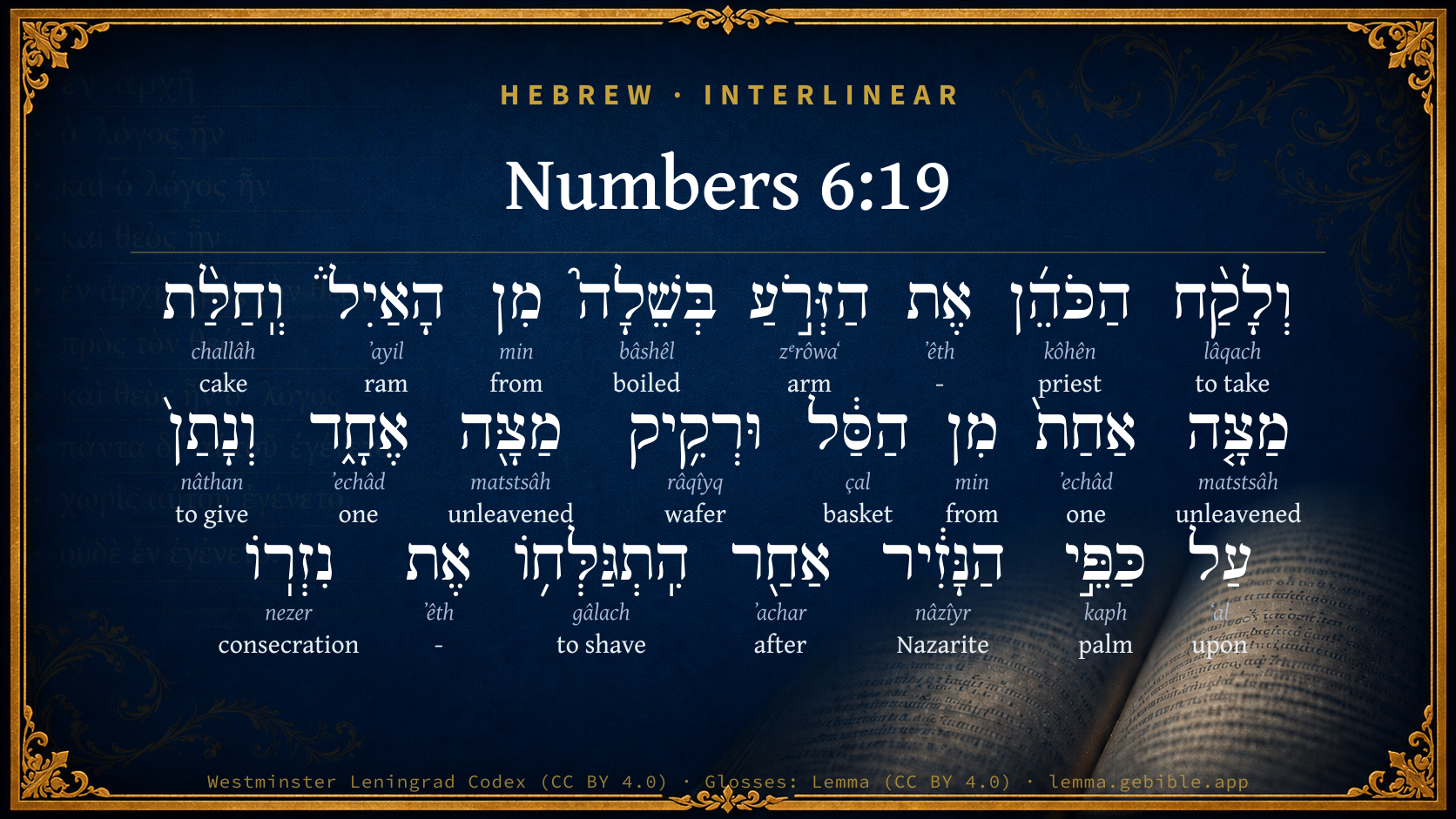
Hebrew (Westminster Leningrad Codex) Numbers 6:19 appears in the Hebrew Old Testament. The text above is from the Westminster Leningrad Codex. Each word links to its Strong’s number, a concise gloss, and parsing drawn from the Open Scriptures Hebrew Bible morphology. Click any word for its full Brown-Driver-Briggs (BDB) entry.
Download image
Cite this verse

Numbers 6:19 (World English Bible). Public Domain. Lemma interlinear Bible study tool, https://lemma.gebible.app/v/numbers/6/19.

Show BibTeX & RIS
BibTeX
RIS
English Translation
The priest shall take the boiled shoulder of the ram, and one unleavened cake out of the basket, and one unleavened wafer, and shall put them on the hands of the Nazirite, after he has shaved the head of his separation;
World English Bible · Public Domain
Download a study sheet

One document with this verse’s original text, its word-by-word gloss line, the meaning frame, cross-references with their text, attributed commentary, and full source and license credits — printable, and it pastes into notes with its structure intact.

This verse Autodidact and up

Study sheet (.html) Plain text (.txt)

A passage Seminary Student

Up to 50 verses in one chapter. A passage sheet keeps up to 6 commentary sources and 12 cross-references per verse, in the order this page ranks them, and says so on the sheet whenever that leaves anything out. Ask for a single verse and you get the Autodidact verse sheet above.

Everything on this page stays free to read, with no account — the sheet is a download of what is already on screen, not access to it.

Want to remove ads? Support Godless Engineer
Compare translations 3

The same verse in 3 English versions, stacked beneath the original-language interlinear above. Click any original word for its lexicon entry.

Each is an independent rendering of the whole verse — the interlinear is not word-aligned to these translations.

Highlighted words mark where these versions differ — a whole-verse word diff, not a word-by-word alignment.

  • World English Bible Public Domain
    The priest shall take the boiled shoulder of the ram, and one unleavened cake out of the basket, and one unleavened wafer, and shall put them on the hands of the Nazirite, after he has shaved the head of his separation;
  • King James Version Public Domain
    And the priest shall take the sodden shoulder of the ram, and one unleavened cake out of the basket, and one unleavened wafer, and shall put them upon the hands of the Nazarite, after the hair of his separation is shaven:
  • unfoldingWord Literal Text CC BY-SA 4.0
    And the priest shall take the boiled shoulder from the ram and one loaf of unleavened bread from the basket and one wafer of unleavened bread, and he shall put on the palms of the Nazirite after his shaving his separation.

unfoldingWord Literal Text — © unfoldingWord, licensed CC BY-SA 4.0. Word-aligned USFM3 via Door43 (git.door43.org/unfoldingWord/en_ult).

Versions to compare (up to 4)

3 of 4 selected

Show all 18 translations

Every available English version of this verse, each an independent rendering of the whole verse.

  • World English Bible Public Domain
    The priest shall take the boiled shoulder of the ram, and one unleavened cake out of the basket, and one unleavened wafer, and shall put them on the hands of the Nazirite, after he has shaved the head of his separation;
  • Berean Standard Bible Public Domain
    And the priest is to take the boiled shoulder from the ram, one unleavened cake from the basket, and one unleavened wafer, and put them into the hands of the Nazirite who has just shaved the hair of his consecration.
  • Majority Standard Bible Public Domain
    And the priest is to take the boiled shoulder from the ram, one unleavened cake from the basket, and one unleavened wafer, and put them into the hands of the Nazirite who has just shaved the hair of his consecration.
  • King James Version Public Domain
    And the priest shall take the sodden shoulder of the ram, and one unleavened cake out of the basket, and one unleavened wafer, and shall put them upon the hands of the Nazarite, after the hair of his separation is shaven:
  • American Standard Version (1901) Public Domain
    And the priest shall take the boiled shoulder of the ram, and one unleavened cake out of the basket, and one unleavened wafer, and shall put them upon the hands of the Nazirite, after he hath shaven `the head of' his separation;
  • Revised Version (1885) Public Domain
    And the priest shall take the sodden shoulder of the ram, and one unleavened cake out of the basket, and one unleavened wafer, and shall put them upon the hands of the Nazirite, after he hath shaven the head of his separation:
  • Geneva Bible (1599) Public Domain
    Then the Priest shall take ye sodden shoulder of the ramme, and an vnleauened cake out of the basket, and a wafer vnleauened, and put them vpon the hands of the Nazarite, after he hath shauen his consecration.
  • Douay-Rheims (1899) Public Domain
    And shall take the boiled shoulder of the ram, and one unleavened cake out of the basket, and one unleavened wafer, and he shall deliver them into the hands of the Nazarite, after his head is shaven.
  • Young's Literal Translation Public Domain
    `And the priest hath taken the boiled shoulder from the ram, and one unleavened cake out of the basket, and one thin unleavened cake, and hath put on the palms of the Nazarite after his shaving his separation;
  • Literal Standard Version CC BY-SA 4.0
    And the priest has taken the boiled shoulder from the ram, and one unleavened cake out of the basket, and one thin unleavened cake, and has put [them] on the palms of the Nazarite after his shaving [the hair of] his separation;
  • Unlocked Literal Bible CC BY-SA 4.0
    The priest must take the boiled shoulder of the ram, one loaf of bread without yeast out of the basket, and one wafer without yeast. He must place them into the hands of the Nazirite after he has shaved his head indicating separation.
  • unfoldingWord Literal Text CC BY-SA 4.0
    And the priest shall take the boiled shoulder from the ram and one loaf of unleavened bread from the basket and one wafer of unleavened bread, and he shall put on the palms of the Nazirite after his shaving his separation.
  • Darby Bible Public Domain
    And the priest shall take the boiled shoulder of the ram, and one unleavened cake out of the basket, and one unleavened wafer, and shall put them upon the hands of the Nazarite, after he hath shaven [the hair of] his consecration.
  • World Messianic Bible Public Domain
    The priest shall take the boiled shoulder of the ram, one unleavened cake out of the basket, and one unleavened wafer, and shall put them on the hands of the Nazirite after he has shaved the head of his separation;
  • Webster's Bible Public Domain
    And the priest shall take the boiled shoulder of the ram, and one unleavened cake out of the basket, and one unleavened wafer, and shall put them upon the hands of the Nazarite, after the hair of his separation is shaven:
  • Free Bible Version CC BY-SA 4.0
    Once the Nazirites have shaved, the priest will take the boiled shoulder from the ram, one bread without yeast from the basket, and one wafer without yeast, and place them in their hands.
  • Bible in Basic English Public Domain
    And the priest will take the cooked leg of the sheep and one unleavened cake and one thin cake out of the basket, and put them on the hands of the separate one after his hair has been cut,
  • JPS Tanakh (1917) Public Domain
    And the priest shall take the shoulder of the ram when it is sodden, and one unleavened cake out of the basket, and one unleavened wafer, and shall put them upon the hands of the Nazirite, after he hath shaven his consecrated head.

Literal Standard Version (2020), Covenant Press — licensed CC BY-SA 4.0. Text via the HelloAO Bible API (eBible.org). Unlocked Literal Bible (unfoldingWord) — licensed CC BY-SA 4.0. Text via the HelloAO Bible API (eBible.org). unfoldingWord Literal Text — © unfoldingWord, licensed CC BY-SA 4.0. Word-aligned USFM3 via Door43 (git.door43.org/unfoldingWord/en_ult). Free Bible Version, Dr. Jonathan Gallagher — licensed CC BY-SA 4.0. Text via the HelloAO Bible API (eBible.org).

Word by word

More ways to search: Search by grammar → Find every occurrence → Compare this word →

Practice this passage: Drill this verse → Learn its vocabulary →

בְּשֵׁלָה֮
bâshêl
H1311
“boiled”
Adjective, Adjective, Feminine, Singular, Absolute
Part of Speech
Adjective
Type
Adjective
Gender
Feminine
Number
Singular
State
Absolute
Full BDB Definition

Origin: from H1310

TWOT: 292a

cooked, boiled
  1. וְלָקַ֨ח lâqach H3947 “and · to take” Conjunction + Verb, Qal, Sequential Perfect, 3rd Person, Masculine, Singular
  2. הַכֹּהֵ֜ן kôhên H3548 “the · priest” Particle, Definite Article + Noun, Common, Masculine, Singular, Absolute
  3. אֶת ʼêth H853 “-” Particle, Direct Object
  4. הַזְּרֹ֣עַ zᵉrôwaʻ H2220 “the · arm” Particle, Definite Article + Noun, Common, Both, Singular, Absolute
  5. מִן min H4480 “from” Preposition
  6. הָאַיִל֒ ʼayil H352 “the · ram” Particle, Definite Article + Noun, Common, Masculine, Singular, Absolute
  7. וְֽחַלַּ֨ת challâh H2471 “and · cake of” Conjunction + Noun, Common, Feminine, Singular, Construct
  8. מַצָּ֤ה matstsâh H4682 “unleavened” Noun, Common, Feminine, Singular, Absolute
  9. אַחַת֙ ʼechâd H259 “one” Adjective, Cardinal number, Feminine, Singular, Absolute
  10. מִן min H4480 “from” Preposition
  11. הַסַּ֔ל çal H5536 “the · basket” Particle, Definite Article + Noun, Common, Masculine, Singular, Absolute
  12. וּרְקִ֥יק râqîyq H7550 “and · wafer of” Conjunction + Noun, Common, Masculine, Singular, Construct
  13. מַצָּ֖ה matstsâh H4682 “unleavened” Noun, Common, Feminine, Singular, Absolute
  14. אֶחָ֑ד ʼechâd H259 “one” Adjective, Cardinal number, Masculine, Singular, Absolute
  15. וְנָתַן֙ nâthan H5414 “and · to give” Conjunction + Verb, Qal, Sequential Perfect, 3rd Person, Masculine, Singular
  16. עַל ʻal H5921 “upon” Preposition
  17. כַּפֵּ֣י kaph H3709 “palms of” Noun, Common, Feminine, Dual, Construct
  18. הַנָּזִ֔יר nâzîyr H5139 “the · Nazarite” Particle, Definite Article + Noun, Common, Masculine, Singular, Absolute
  19. אַחַ֖ר ʼachar H310 “after” Preposition
  20. הִֽתְגַּלְּח֥וֹ gâlach H1548 “to shave · him” Verb, Hithpael, Infinitive Construct + Suffix, Personal, 3rd Person, Masculine, Singular
  21. אֶת ʼêth H853 “-” Particle, Direct Object
  22. נִזְרֽוֹ nezer H5145 “consecration · his” Noun, Common, Masculine, Singular, Construct + Suffix, Personal, 3rd Person, Masculine, Singular

About this verse

These counts appear in no published source. They are computed here, from the morphology-tagged text and Lemma’s own curated glosses. What Lemma adds →

23
words
19
distinct lemmas
Pentateuch
section

Notable vocabulary

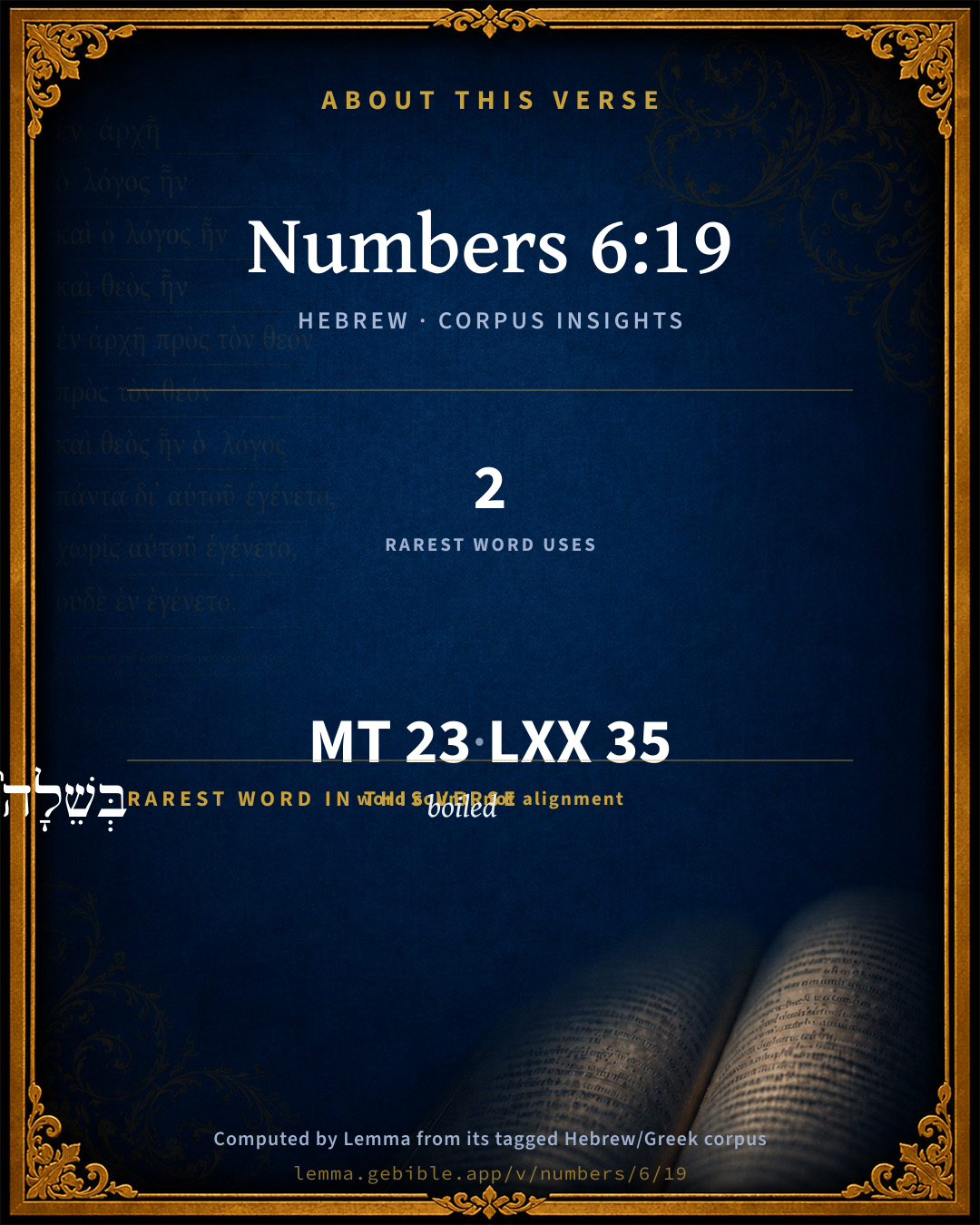
The rarest word here is בְּשֵׁלָה֮ boiled H1311 — appearing just 2 times in the whole Hebrew Bible.

Shared distinctive vocabulary

בְּשֵׁלָה֮ boiled H1311 occurs in 2 verses of the Hebrew Bible. Also found in:

Grammatical profile

  • 3 verbs
  • 11 nouns
  • 3 adjectives
  • 4 prepositions
  • 2 particles

Verb forms

  • וְלָקַ֨ח Qal · Sequential Perfect
  • וְנָתַן֙ Qal · Sequential Perfect
  • הִֽתְגַּלְּח֥וֹ Hithpael · Infinitive Construct

Repetition

Words recur within this verse — often emphatic in Hebrew:

  • מַצָּ֤ה unleavened H4682 ×2
  • אַחַת֙ one H259 ×2
  • מִן from H4480 ×2

Hebrew & Septuagint length

In English translation the verse runs 41 words from the Hebrew and 38 from the Septuagint (LXX English) — closely comparable.

A rough comparison of the two English renderings, which tokenize alike — not a word-level alignment.

Word counts can differ between the Hebrew and the Greek without any difference in meaning — e.g. the Hebrew direct-object marker אֵת has no separate Greek word, and Greek often adds the article ὁ.

In the original languages it is 23 Hebrew tokens and 35 Greek tokens — but the two are counted differently (Hebrew bundles its prefixes and suffixes into one token; the Greek is in lemma form), so that isn’t a like-for-like length.

Cross-references

5

Topical passages linked to Numbers 6:19 in the Treasury of Scripture Knowledge — connected by theme and wording, ordered by reader-vote popularity; previews shown in the World English Bible.

  • Leviticus 7:30 With his own hands he shall bring the offerings of Yahweh made by fire. He shall bring the fat with the breast, that the breast may be waved for a wave offering before Yahweh.
  • 1 Samuel 2:15 Yes, before they burnt the fat, the priest's servant came, and said to the man who sacrificed, Give flesh to roast for the priest; for he will not have boiled flesh of you, but raw.
  • Exodus 29:23–28 and one loaf of bread, one cake of oiled bread, and one wafer out of the basket of unleavened bread that is before Yahweh.
  • Leviticus 8:27 He put all these in Aaron's hands and in his sons' hands, and waved them for a wave offering before Yahweh.
  • Leviticus 8:31 Moses said to Aaron and to his sons, "Boil the flesh at the door of the Tent of Meeting, and there eat it and the bread that is in the basket of consecration, as I commanded, saying, 'Aaron and his sons shall eat it.'

Cross-references courtesy of OpenBible.info (CC BY 4.0).

Hebrew and Greek witnesses Masoretic Hebrew ↔ Greek Septuagint

The same verse in the two great witnesses to the Old Testament, shown verse-for-verse.

These are two independent witnesses, not word-aligned to each other, and the Septuagint is shown in lemma (dictionary) form.

Hebrew Numbers 6:19 Masoretic · Westminster Leningrad Codex

וְלָקַ֨ח הַכֹּהֵ֜ן אֶת הַזְּרֹ֣עַ בְּשֵׁלָה֮ מִן הָאַיִל֒ וְֽחַלַּ֨ת מַצָּ֤ה אַחַת֙ מִן הַסַּ֔ל וּרְקִ֥יק מַצָּ֖ה אֶחָ֑ד וְנָתַן֙ עַל כַּפֵּ֣י הַנָּזִ֔יר אַחַ֖ר הִֽתְגַּלְּח֥וֹ אֶת נִזְרֽוֹ

The priest shall take the boiled shoulder of the ram, and one unleavened cake out of the basket, and one unleavened wafer, and shall put them on the hands of the Nazirite, after he has shaved the head of his separation;

World English Bible · Public Domain

Greek LXX Numbers 6:19 Septuagint · lemma form

καί λαμβάνω ὁ ἱερεύς ὁ βραχίων ἑφθός ἀπό ὁ κριός καί ἄρτος εἷς ἄζυμος ἀπό ὁ κανοῦν καί λάγανον ἄζυμος εἷς καί ἐπιτίθημι ἐπί ὁ χείρ ὁ εὔχομαι μετά ὁ ξυράω αὐτός ὁ εὐχή αὐτός

And the priest shall take the sodden shoulder of the ram, and one unleavened loaf from the basket, and one unleavened cake, and shall put them on the hands of the votary after he has shaved off his

LXX2012 (modern English Septuagint) · Public Domain

Hebrew: Westminster Leningrad Codex (CC BY 4.0). Greek: Septuagint (public domain); English from LXX2012 (modern English Septuagint) (Public Domain). How the Septuagint differs from the Hebrew →

Targum (Aramaic paraphrase)

2

The Targum is the ancient Jewish Aramaic paraphrase of the Hebrew Scriptures — an interpretive translation, not the Hebrew text itself. Onkelos (literal) and Pseudo-Jonathan (expansive) render the Torah, and Jonathan the Prophets. Coverage is partial: where no permissively-licensed English translation exists for a verse, only the Aramaic is shown. This is verse-level text, not a word-by-word alignment to the Hebrew.

  1. Targum Onkelos Torah (Genesis–Deuteronomy)
    וְיִסַב כַּהֲנָא יָת דְרָעָא בְּשֵׁלָא מִן דִכְרָא וּגְרִצְתָּא פַטִּירְתָּא חֲדָא מִן סַלָא וְאִסְפּוֹג פַּטִיר חָד וְיִתֵּן עַל יְדֵי נְזִירָא בָּתַר דְגַלַח יָת נִזְרֵהּ

    (no public-domain English translation for this verse)

    Targum Onkelos — Aramaic: “Onkelos Genesis” (public domain); “Onkelos Exodus” (public domain); “Onkelos Leviticus” (public domain); “Onkelos Numbers” (public domain); “Onkelos Deuteronomy” (public domain). English: “Sefaria Community Translation” (CC0 1.0 (public-domain dedication)); “J.W. Etheridge. The Targums of Onkelos and Jonathan Ben Uzziel on the Pentateuch. London: Longmans, Green, 1862” (public domain). Text via Sefaria.

  2. Targum Pseudo-Jonathan Torah (Genesis–Deuteronomy)
    וְיִסַב כַּהֲנָא יַת אֶדְרוֹעָא דְמִיבַשְׁלָא שְׁלֵימָא מִן דִיכְרָא וּגְרִיצְתָּא פַּטִירְתָּא חֲדָא מִן סַלָא וְעָרוּךְ פַּטִיר חָד וְיִתֵּן עַל יְדֵי נְזִירָא בָּתַר דְיִגְלַח יַת נִזְרֵיהּ

    And the priest shall take the shoulder that is boiled, entire from the ram, and one unleavened cake from the basket, and one unleavened wafer, and put upon the hands of the Nazirite, after he hath shaved his head of the consecration.

    Targum Pseudo-Jonathan — Aramaic: “Targum Jonathan on Genesis” (public domain); “Targum Jonathan on Exodus” (public domain); “Targum Jonathan on Leviticus” (public domain); “Targum Jonathan on Numbers” (public domain); “Targum Jonathan on Deuteronomy” (public domain). English: “The Targum of Jonathan ben Uzziel, trans. J. W. Etheridge, London, 1862” (public domain). Text via Sefaria.

Commentary

Notes on Numbers 6:19 from classic Christian and Jewish commentators (each source and its license shown beneath its notes). The classic Christian expositions comment on the surrounding passage and are grouped to its opening verse, so a note may address several verses; the Jewish commentaries on the Tanakh (Rashi and others) are per-verse, so they appear only where the commentator wrote on this verse.

Lemma curates 59 commentaries, every one of them public domain or Creative Commons licensed, each selected and text-cleaned for this edition rather than reprinted as found. About our sources →

Trapp's Complete Commentary

John Trapp

Num 6:19 And the priest shall take the sodden shoulder of the ram, and one unleavened cake out of the basket, and one unleavened wafer, and shall put [them] upon the hands of the Nazarite, after [the hair of] his separation is shaven:

Ver. 19. The sodden shoulder,] i.e., The left shoulder; for the right was due unto him raw. {Lev 7:32} This taught the Nazarite special thankfulness: dignity requires duty.

John Trapp, A Commentary or Exposition upon All the Books of the Old and New Testament (1647–1656) — public domain. Text from a community e-Sword module.

Joseph Benson's Commentary

Num 6:19. The shoulder — The left shoulder, as it appears from Num 6:20, where this is joined with the heave-shoulder, which was the right shoulder, and which was the priests’ due in all sacrifices, (Lev 7:32,) and in this also. But here the other shoulder was added to it, as a special token of thankfulness from the Nazarites for God’s singular favours vouchsafed unto them. The hands — That he may give them to the priest, as his peculiar gift.

Joseph Benson's Commentary on the Old and New Testaments (1811–1818) — public domain. Text from a community e-Sword module.

The Cambridge Bible for Schools and Colleges

gen. ed. J. J. S. Perowne

19. the sodden shoulder] It had been previously sodden, i.e. boiled, elsewhere in readiness.

The Cambridge Bible for Schools and Colleges (gen. ed. J. J. S. Perowne; Cambridge University Press, 1878–1918) — public domain. Text from a community e-Sword module.

John Gill's Exposition

And the priest shall wave them for a wave offering before the Lord,.... Putting his hands under the Nazarite's, as in other cases where this ceremony was used; and so moving them to and fro, backwards and forwards, upwards and downwards, testifying hereby the goodness of God unto him, his sovereign dominion over him, that all he had depended on him, and was received from him; and that all he did, particularly in keeping his vow of Nazariteship, was through his assistance, and for which he made this grateful acknowledgment by delivering the above, together with what follows, to his priest:

this is holy for the priest, with the wave breast and heave shoulder; besides these which were given him by another law, the wave shoulder of the Nazarite's ram was given him to eat; it was holy, and set apart for his use, and his only, and it belonged not in common to the course of the priests then on duty, but to him only that officiated in this peculiar service; and so it is observed by the Jewish writers (c), that the Nazarite's ram and some other things were not given to every priest, but to him that offered the sacrifice, as it is said, "he shall wave this is holy to the priest"; upon which it is observed, that it follows from hence, that the priest that waves is he that eats the sacrifice:

and after that the Nazarite may drink wine; and cut his hair, and shave his head, and be defiled for the dead as other persons, the vow of his Nazariteship being fulfilled.

(c) Maimon. in Misn. Challah, c. 4. sect. 9.

John Gill's Exposition of the Whole Bible (1746–1763) — public domain (CC PDM 1.0). Text via the HelloAO Bible API.

Matthew Poole's English Annotations

The sodden shoulder; the left shoulder, as it appears from Num 6:20, where this is joined with the heave-shoulder, which was the right shoulder, and which was the priest’s due in all sacrifices, Lev 7:32, and in this also. But here the other shoulder was added to it, as a special token of thankfulness from the Nazarites for God’s singular favours vouchsafed into them.

Upon the hands of the Nazarite, that he may give them to the priest, as his peculiar gift.

Matthew Poole's English Annotations on the Holy Bible (1683–1685) — public domain. Text from a community e-Sword/MySword module.

Whedon's Commentary on the Bible

Daniel D. Whedon

19. Sodden — Cooked, usually boiled.

Unleavened — See Lev_2:11, note.

Wafer — A thin cake. For the mode of baking it see Lev_2:4, wood-cut.

Daniel D. Whedon (gen. ed.), Commentary on the Old and New Testaments (1874–1909) — public domain. Text from a community e-Sword module.

The Pulpit Commentary

The sodden shoulder, or boiled shoulder; the left. The right, or heave shoulder, was already the priest"s, according to the general rule. (Lev_7:32) That the other shoulder was also "waved" and accepted by God as his portion, to be consumed in his name by the priest, was a further token of the gracious acceptance of the self-dedication of the Nazirite, and of the fullness of eucharistic communion into which he had entered with his God.

The Pulpit Commentary (1880–1919), ed. H.D.M. Spence-Jones & Joseph S. Exell — public domain. Text from a community e-Sword module.

John Wesley's Explanatory Notes

The shoulder - The left-shoulder, as it appears from ver. 20, where this is joined with the heave-shoulder, which was the right- shoulder, and which was the priests due in all sacrifices, Lev. vii, 32, and in this also. But here the other shoulder was added to it, as a special token of thankfulness from the Nazarites for God's singular favours vouchsafed unto them. The hands - That he may give them to the priest, as his peculiar gift.

John Wesley, Explanatory Notes Upon the Whole Bible (1754–1765) — public domain. Text via the GEBible commentary corpus.

unfoldingWord translationNotes

Door43 World Missions Community

the boiled shoulder of the ram

This means that he had boiled the ram's shoulder. This can be stated in active form. AT: "the shoulder of the ram that he boiled" (See: Active or Passive)

indicating separation

Here "separation" means "dedication." Also, this abstract noun can be expressed with the verb "separated." AT: "indicating dedication" or "indicating that he has dedicated himself to Yahweh" (See: Idiom and Abstract Nouns)

The priest must wave them

After handing the items to the Nazirite, the priest takes them back to offer them to Yahweh. The full meaning of this statement can be made clear. AT: "Then the priest must take them back and wave them" (See: Assumed Knowledge and Implicit Information)

together with

"as well as"

that was waved

This can be stated in active form. AT: "that the priest waved" (See: Active or Passive)

that was presented

This can be stated in active form. AT: "that he presented" (See: Active or Passive)

translationWords

ewe

bread

yeast

Nazirite

raise

Yahweh

holy

wine

unfoldingWord translationNotes — © Distant Shores Media and the Door43 World Missions Community, licensed CC BY-SA 4.0. Source: git.door43.org/Door43/en_tn.

Rashi

Rabbi Shlomo Yitzchaki (Rashi)

הזרע בשלה [AND THE PRIEST SHALL TAKE] THE SHOULDER בשלה — i.e. after it has been boiled.

Rashi on the Tanakh — English translations: “The Judaica Press complete Tanach with Rashi, translated by A. J. Rosenberg” (CC BY 4.0); “Pentateuch with Rashi's commentary by M. Rosenbaum and A.M. Silbermann, 1929-1934” (public domain); “The Metsudah Tanach series, Lakewood, N.J” (CC BY 4.0); and “The Book of Joshua, Metsudah Publications, 1997” (CC BY 4.0). Text via Sefaria.

Lesson kit

Teaching starters — assembled from the data on this page, not authored interpretation. Every prompt links to the verse data it draws on. Edit before teaching.

Numbers, in the Pentateuch, opens this verse with 23 words (19 distinct Hebrew lemmas). Its most distinctive word is bâshêl (“boiled”). A historical commentator’s framing appears above. Read the whole chapter for the surrounding context.

Discussion questions

  1. The word bâshêl carries the sense “boiled.” How does it shape the verse?
  2. Exodus 12:9 shares the word «boiled» with this verse. How do the two illuminate each other?
  3. “unleavened” occurs 2× in this one verse. What is the effect of the repetition?
  4. These translations render this verse differently. What is at stake in choosing one wording over another?
  5. The verb «וְלָקַ֨ח» is Qal Sequential Perfect. How does its form color the action?
  6. Reading how Trapp's Complete Commentary and Joseph Benson's Commentary read this verse, where do the two commentators agree and where do they part?

Things to notice

Reading settings

Reading text

Shown beneath each verse's original-language words.

Old Testament
Old Testament edition

Read the OT as the Masoretic Hebrew (MT) or the Greek Septuagint (LXX).

English shown for the Greek Septuagint (in the Hebrew ↔ Greek comparison).

Comparing translations? Open the Compare panel on any verse page to stack up to four side by side.