
Lamentations 3:41

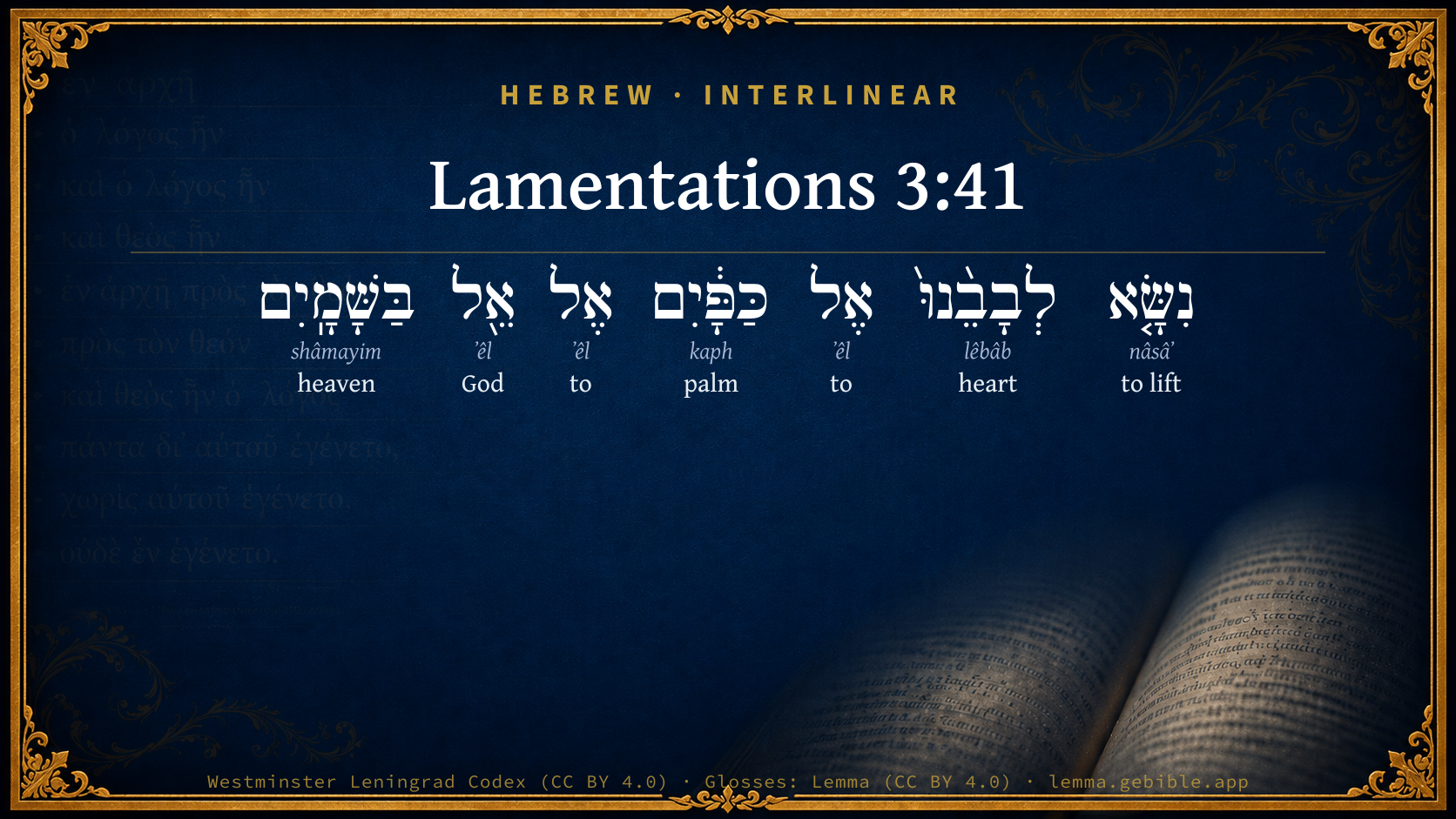
Hebrew (Westminster Leningrad Codex) Lamentations 3:41 appears in the Hebrew Old Testament. The text above is from the Westminster Leningrad Codex. Each word links to its Strong’s number, a concise gloss, and parsing drawn from the Open Scriptures Hebrew Bible morphology. Click any word for its full Brown-Driver-Briggs (BDB) entry.
Download image
Cite this verse

Lamentations 3:41 (World English Bible). Public Domain. Lemma interlinear Bible study tool, https://lemma.gebible.app/v/lamentations/3/41.

Show BibTeX & RIS
BibTeX
RIS
English Translation
Let us lift up our heart with our hands to God in the heavens.
World English Bible · Public Domain
Download a study sheet

One document with this verse’s original text, its word-by-word gloss line, the meaning frame, cross-references with their text, attributed commentary, and full source and license credits — printable, and it pastes into notes with its structure intact.

This verse Autodidact and up

Study sheet (.html) Plain text (.txt)

A passage Seminary Student

Up to 50 verses in one chapter. A passage sheet keeps up to 6 commentary sources and 12 cross-references per verse, in the order this page ranks them, and says so on the sheet whenever that leaves anything out. Ask for a single verse and you get the Autodidact verse sheet above.

Everything on this page stays free to read, with no account — the sheet is a download of what is already on screen, not access to it.

Want to remove ads? Support Godless Engineer
Compare translations 3

The same verse in 3 English versions, stacked beneath the original-language interlinear above. Click any original word for its lexicon entry.

Each is an independent rendering of the whole verse — the interlinear is not word-aligned to these translations.

Highlighted words mark where these versions differ — a whole-verse word diff, not a word-by-word alignment.

  • World English Bible Public Domain
    Let us lift up our heart with our hands to God in the heavens.
  • King James Version Public Domain
    Let us lift up our heart with our hands unto God in the heavens.
  • unfoldingWord Literal Text CC BY-SA 4.0
    Let us lift up our hearts with hands to God in the heavens.

unfoldingWord Literal Text — © unfoldingWord, licensed CC BY-SA 4.0. Word-aligned USFM3 via Door43 (git.door43.org/unfoldingWord/en_ult).

Versions to compare (up to 4)

3 of 4 selected

Show all 18 translations

Every available English version of this verse, each an independent rendering of the whole verse.

  • World English Bible Public Domain
    Let us lift up our heart with our hands to God in the heavens.
  • Berean Standard Bible Public Domain
    Let us lift up our hearts and hands to God in heaven:
  • Majority Standard Bible Public Domain
    Let us lift up our hearts and hands to God in heaven:
  • King James Version Public Domain
    Let us lift up our heart with our hands unto God in the heavens.
  • American Standard Version (1901) Public Domain
    Let us lift up our heart with our hands unto God in the heavens.
  • Revised Version (1885) Public Domain
    Let us lift up our heart with our hands unto God in the heavens.
  • Geneva Bible (1599) Public Domain
    Let vs lift vp our hearts with our handes vnto God in the heauens.
  • Douay-Rheims (1899) Public Domain
    Nun. Let us lift up our hearts with our hands to the Lord in the heavens.
  • Young's Literal Translation Public Domain
    We lift up our heart on the hands unto God in the heavens.
  • Literal Standard Version CC BY-SA 4.0
    We lift up our heart on the hands to God in the heavens.
  • Unlocked Literal Bible CC BY-SA 4.0
    Let us lift up our hearts and our hands to God in the heavens:
  • unfoldingWord Literal Text CC BY-SA 4.0
    Let us lift up our hearts with hands to God in the heavens.
  • Darby Bible Public Domain
    Let us lift up our heart with [our] hands unto ùGod in the heavens.
  • World Messianic Bible Public Domain
    Let’s lift up our heart with our hands to God in the heavens.
  • Webster's Bible Public Domain
    Let us lift up our heart with our hands to God in the heavens.
  • Free Bible Version CC BY-SA 4.0
    Let's not just hold up our hands to God in heaven, but our minds as well, saying,
  • Bible in Basic English Public Domain
    Lifting up our hearts with our hands to God in the heavens.
  • JPS Tanakh (1917) Public Domain
    Let us lift up our heart with our hands unto God in the heavens.

Literal Standard Version (2020), Covenant Press — licensed CC BY-SA 4.0. Text via the HelloAO Bible API (eBible.org). Unlocked Literal Bible (unfoldingWord) — licensed CC BY-SA 4.0. Text via the HelloAO Bible API (eBible.org). unfoldingWord Literal Text — © unfoldingWord, licensed CC BY-SA 4.0. Word-aligned USFM3 via Door43 (git.door43.org/unfoldingWord/en_ult). Free Bible Version, Dr. Jonathan Gallagher — licensed CC BY-SA 4.0. Text via the HelloAO Bible API (eBible.org).

Word by word

More ways to search: Search by grammar → Find every occurrence → Compare this word →

Practice this passage: Drill this verse → Learn its vocabulary →

About this verse

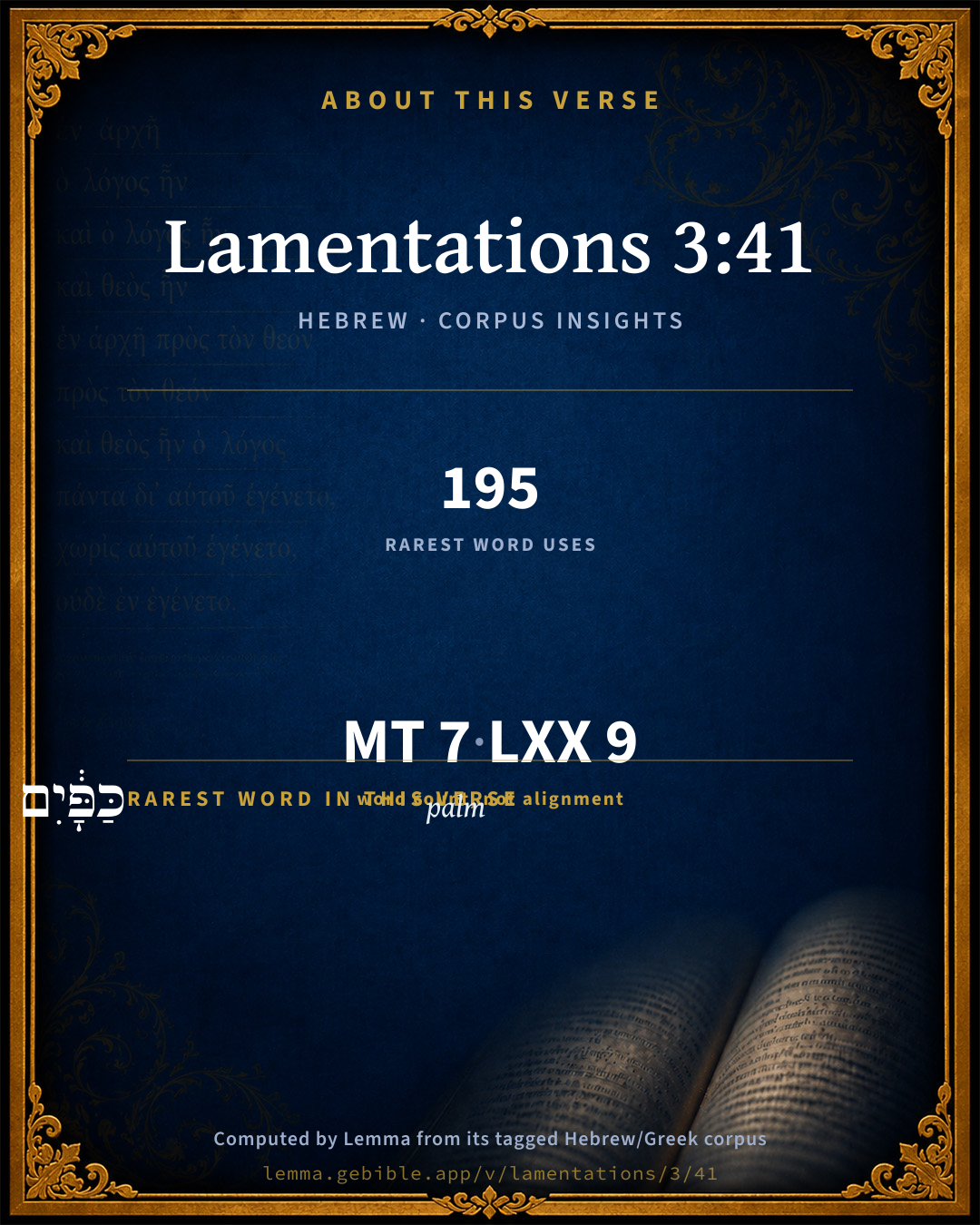
These counts appear in no published source. They are computed here, from the morphology-tagged text and Lemma’s own curated glosses. What Lemma adds →

7
words
6
distinct lemmas
Prophets
section

Grammatical profile

  • 1 verb
  • 4 nouns
  • 2 prepositions

Verb forms

  • נִשָּׂ֤א Qal · Cohortative

Repetition

A word recurs within this verse — often emphatic in Hebrew:

  • אֶל to H413 ×2

Hebrew & Septuagint length

In English translation the verse runs 14 words from the Hebrew and 15 from the Septuagint (LXX English) — closely comparable.

A rough comparison of the two English renderings, which tokenize alike — not a word-level alignment.

Word counts can differ between the Hebrew and the Greek without any difference in meaning — e.g. the Hebrew direct-object marker אֵת has no separate Greek word, and Greek often adds the article ὁ.

In the original languages it is 7 Hebrew tokens and 9 Greek tokens — but the two are counted differently (Hebrew bundles its prefixes and suffixes into one token; the Greek is in lemma form), so that isn’t a like-for-like length.

Cross-references

7

Topical passages linked to Lamentations 3:41 in the Treasury of Scripture Knowledge — connected by theme and wording, ordered by reader-vote popularity; previews shown in the World English Bible.

  • Psalms 25:1 To you, Yahweh, do I lift up my soul.
  • Psalms 28:2 Hear the voice of my petitions, when I cry to you, When I lift up my hands toward your Most Holy Place.
  • Psalms 86:4 Bring joy to the soul of your servant, For to you, Lord, do I lift up my soul.
  • Psalms 143:6–8 I spread forth my hands to you. My soul thirsts for you, like a parched land. Selah.
  • Psalms 63:4 So I will bless you while I live. I will lift up my hands in your name.
  • Psalms 141:2 Let my prayer be set before you like incense; The lifting up of my hands like the evening sacrifice.
  • 1 Thessalonians 2:8 Even so, affectionately longing for you, we were well pleased to impart to you, not the Gospel of God only, but also our own souls, because you had become very dear to us.

Cross-references courtesy of OpenBible.info (CC BY 4.0).

Hebrew and Greek witnesses Masoretic Hebrew ↔ Greek Septuagint

The same verse in the two great witnesses to the Old Testament, shown verse-for-verse.

These are two independent witnesses, not word-aligned to each other, and the Septuagint is shown in lemma (dictionary) form.

Hebrew Lamentations 3:41 Masoretic · Westminster Leningrad Codex

נִשָּׂ֤א לְבָבֵ֨נוּ֙ אֶל כַּפָּ֔יִם אֶל אֵ֖ל בַּשָּׁמָֽיִם

Let us lift up our heart with our hands to God in the heavens.

World English Bible · Public Domain

Greek LXX Lamentations 3:41 Septuagint · lemma form

ἀναλαμβάνω καρδία ἐγώ ἐπί χείρ πρός ὑψηλός ἐν οὐρανός

Let us lift up our hearts with our hand to the lofty One in heaven.

LXX2012 (modern English Septuagint) · Public Domain

Hebrew: Westminster Leningrad Codex (CC BY 4.0). Greek: Septuagint (public domain); English from LXX2012 (modern English Septuagint) (Public Domain). How the Septuagint differs from the Hebrew →

Commentary

Notes on Lamentations 3:41 from classic Christian and Jewish commentators (each source and its license shown beneath its notes). The classic Christian expositions comment on the surrounding passage and are grouped to its opening verse, so a note may address several verses; the Jewish commentaries on the Tanakh (Rashi and others) are per-verse, so they appear only where the commentator wrote on this verse.

Lemma curates 59 commentaries, every one of them public domain or Creative Commons licensed, each selected and text-cleaned for this edition rather than reprinted as found. About our sources →

Trapp's Complete Commentary

John Trapp

Lam 3:41 Let us lift up our heart with [our] hands unto God in the heavens.

Ver. 41. Let us llft up our hearts with our hands.] Holy hearts, pure hands. Instead of wrangling with God, {as Lam 3:39} let us wrestle with him in prayer; this is the only way to get off with comfort. Nazianzen saith, that the best work we can put our hands unto is, in coelos eas extendere, ad precesque expandere, to lift them up to God in prayer. But then it must be with a true heart. {Heb 10:22} See Job 11:13. {See Trapp on "Job 11:13"}

John Trapp, A Commentary or Exposition upon All the Books of the Old and New Testament (1647–1656) — public domain. Text from a community e-Sword module.

Geneva Bible (1599)

Geneva Bible translators

That is, both hearts and hands: for else to lift up the hands, is but hypocrisy.

Geneva Bible (1599) marginal notes — public domain. Text via Bolls.life.

Jamieson, Fausset & Brown

Robert Jamieson, A. R. Fausset & David Brown

heart with . . . hands--the antidote to hypocrisy (Psa 86:4; Ti1 2:8).

Jamieson, Fausset & Brown — Commentary Critical and Explanatory on the Whole Bible (1871) — public domain (CC PDM 1.0). Text via the HelloAO Bible API.

John Calvin's Commentaries

To conversion he joins prayer; for we cannot be reconciled to God except he buries our sins; nor can repentance and faith be separated. Moreover, to taste of God’s mercy opens to us the door of prayer. And this ought to be carefully noticed, because the unbelieving seem at times to be very busy in seeking to return to God’s favor, but they only attend to the outward change of life; and at the same time they are not anxious about pardon, but go boldly before God, as though they were not exposed to his judgment.

And we see under the Papacy that while they make long sermons on repentance, they hardly ever make any account of faith, as though repentance without faith were a restoration from death to life.

Hence I said that we ought to notice the mode of teaching which our Prophet adopts: he begins with self-examination, then he requires conversion; but he does not separate it from faith. For when he exhorts us to pray, it is the same thing as though he had set before us the judgment of God, and had also taught us that we cannot escape death except God be propitious to us. How then is pardon to be obtained? by prayer: and prayer, as it is well known, must be always founded on faith.

By telling us to raise up our hearts to God together with our hands, he bids us to banish all hypocrisy from our prayers. For all without a difference raise up their hands to God; and nature itself, when we are pressed down with evils, leads us to seek God. But the greater part stifle this feeling of nature. When affliction comes, it is a common thing with all to raise up their hands to heaven, though no one should bid them to do so; but still their hearts remain fixed on the earth, and they come not to God. And the greater part of men are included in that class mentioned by Isaiah,

“This people come to me with their tongue, but their heart is far away.” (Isaiah 29:13.)

As, then, men deal thus formally with God, and present a naked ceremony, as though God had changed and suffered his eyes to be covered, the Prophet bids all dissimulation to cease from prayer; Let us raise up hands, he says, to God, and also hearts. Joel speaks somewhat differently, when he says,

“Rend your hearts and not your garments,” (Joel 2:13;)

for he seems to exclude the outward rite, because men, wishing to shew that they were guilty before God, rent their garments. Joel says that this was superfluous and useless; and doubtless the rite itself was not so very necessary. But as prayers, when they are earnest, move the hands, our Prophet refers to that practice as useful. At the same time he teaches us that the chief thing ought not to be omitted, even to raise up the hearts to God: Let us, then, he says, raise up our hearts together with our hands to God; and he adds, to God who is in heaven: for it is necessary that men should rise up above the world, and to go out of themselves, so to speak, in order to come to God.

We now then understand the meaning of the Prophet, — that those who repent from the heart ought not to go before God, as though they were not guilty before his tribunal, but that on the contrary they ought to be penitent and humble, so that they may obtain pardon. He afterwards shews that the right way of praying is, when we not only perform the outward ceremonies, but when we open our hearts and raise them up as it were to heaven itself. It is, then, the right way of praying, when the inward feeling corresponds with the external posture. It follows, —

John Calvin's Commentaries (1540-1563) — public domain. Text from the Calvin Translation Society English edition (1840s-50s) via the Christian Classics Ethereal Library (ccel.org). Calvin's coverage is partial (roughly two-thirds of the Bible); uncommented books and verses are honest gaps, never fabricated. The 19th-century editor's footnotes and remarks are omitted so the notes are faithfully Calvin's own voice.

Ellicott's Commentary for English Readers

(41) With our hands.—Literally, to our hands. There is, as it were, a psychological analysis of prayer. Men can by an act of will, lift up the heart as the centre of affection: this, in its turn, prompts the outward act of the uplifted hands of supplication; God is the final object to whom the prayer is addressed.

A Bible Commentary for English Readers, edited by Charles John Ellicott (1878–1897) — public domain. Text from a community e-Sword module.

The Cambridge Bible for Schools and Colleges

gen. ed. J. J. S. Perowne

41. with our hands] Cp. Exo_9:33; 1Ki_8:22.

The Cambridge Bible for Schools and Colleges (gen. ed. J. J. S. Perowne; Cambridge University Press, 1878–1918) — public domain. Text from a community e-Sword module.

John Gill's Exposition

Thou hast made us as the offscouring and refuse in the midst of the people. Had given them up into the hands of the Gentiles, the Chaldeans, to be treated as the dirt of the streets, as the sweepings of a house; or the dross of metal; or anything that is vile, mean, and contemptible. The apostle seems to have some reference to this passage; and his words may be an illustration of it, Co1 4:13.

.

Lamentations 3:46

lam 3:46

lam 3:46

lam 3:46All our enemies have opened their mouths against us. Like lions and other beasts of prey, to devour us; or in way of scorn and derision; pouring out their reproaches upon us, and scoffs at us, for our religion, and the worship of God, and on account of present miseries and distresses; see Lam 2:16. The Targum adds,

"to decree against us evil decrees.''

John Gill's Exposition of the Whole Bible (1746–1763) — public domain (CC PDM 1.0). Text via the HelloAO Bible API.

Haydock's Catholic Bible Commentary

Up. This posture "is the testimony of a soul naturally Christian." (Tertullian, Apol.) --- Our heart must accompany our hands, 1 Timothy ii. 8. (Calmet)

George Leo Haydock (1774–1849), Haydock's Catholic Family Bible and Commentary, 1859 edition — public domain. Excludes Psalms (Douay-Rheims chapter numbering differs from Protestant) and Deuterocanonical books (Catholic canon only).

Matthew Poole's English Annotations

Let us apply ourselves unto God by prayer, often expressed under this notion in Scripture from that gesture ordinarily used in prayer; and let us not do it in hypocrisy, but joining our hearts with our hands, praying seriously and fervently.

Matthew Poole's English Annotations on the Holy Bible (1683–1685) — public domain. Text from a community e-Sword/MySword module.

Whedon's Commentary on the Bible

Daniel D. Whedon

41. Lift up our heart… hands — As if the lifting up of the hands — outward, ceremonial prayer — were a matter of course. The real thing which is contingent, and which requires our watchful attention, is the lifting up of the “heart” also. The modifying clause, God in the heavens, is not merely for fulness, but also emphasis. The throne of his almightiness is “in the heavens,” and out of the resources of his infinite power help may come.

Daniel D. Whedon (gen. ed.), Commentary on the Old and New Testaments (1874–1909) — public domain. Text from a community e-Sword module.

The Pulpit Commentary

Our heart with our hands. It is to be sincere prayer; "spreading out the hands" is not enough by itself. (Isa_1:25)

"Sursum corda!

Religion takes possession of the whole of our nature. A service professedly of the heart, and of the heart alone, is a hypocritical service, which because of its insincerity God cannot accept, inasmuch as it is contradicted by the life. On the other hand, how can the Searcher of all hearts be pleased with a service which is of the hands, the outward posture and actions only, in which the heart has no share? The true worship and homage consists in the combination of the spirit and the body.

I HEART AND HANDS ARE LIFTED IN PENITENCE AND CONFESSION. It seems to this exercise that the prophet here admonishes and invites. The heart has been engrossed by earthly pursuits and pleasures; and these it now quits, directing its contrite sighs to heaven, and lifting with it the clasped hands of penitence.

II HEART AND HANDS ARE LIFTED IN EARNEST ENTREATY. In its anguish, in its conscious helplessness, the heart seeks mercy and acceptance with God; the hands are raised as in supplication, to give expression to the imploring petitions.

III HEART AND HANDS ARE LIFTED IN BELIEVING CONFIDENCE. There is encouragement to trust in the Lord. The repenting and confiding Church of the Redeemer is ever lifting holy hands to heaven, in expression of that sentiment which is the condition of all blessing. It is the attitude of hope. "I will lift up mine eyes unto the hills whence cometh my help." And as the eyes of faith behold the God of grace upon the throne of power, they draw the heart upwards; the hands follow, and the posture of the spiritual nature is becoming to man and honouring to God. T.

The Pulpit Commentary (1880–1919), ed. H.D.M. Spence-Jones & Joseph S. Exell — public domain. Text from a community e-Sword module.

Rashi

Rabbi Shlomo Yitzchaki (Rashi)

Let us lift up our hearts to our hands When we lift up our hands to heaven, let us also lift up our hearts with them, to return, to bring back our hearts before the Omnipresent, blessed be He. (Lam. Rabbah ms.). Another explanation: to our hands to the clouds, to the heavens, as Scripture states (I Kings 18:44): “There is a cloud as small as a man’s palm, rising.” And similarly, (Job 36:32): “Over the clouds (כַּפַּיִם) He covers the rain.” And [according to] the Midrash of our Sages: Let us lift up our hands sincerely to the Holy One, blessed be He, like one who washes his hands with cleanliness, who casts from his hands all contamination, for “he who confesses [his sins] and abandons [them] will obtain mercy, but he who confesses [his sins] but does not abandon [them] is like one who immerses himself while holding a [dead] reptile in his hand.”

Rashi on the Tanakh — English translations: “The Judaica Press complete Tanach with Rashi, translated by A. J. Rosenberg” (CC BY 4.0); “Pentateuch with Rashi's commentary by M. Rosenbaum and A.M. Silbermann, 1929-1934” (public domain); “The Metsudah Tanach series, Lakewood, N.J” (CC BY 4.0); and “The Book of Joshua, Metsudah Publications, 1997” (CC BY 4.0). Text via Sefaria.

Lesson kit

Teaching starters — assembled from the data on this page, not authored interpretation. Every prompt links to the verse data it draws on. Edit before teaching.

Lamentations, in the Prophets, opens this verse with 7 words (6 distinct Hebrew lemmas). Its most distinctive word is kaph (“palm”). A historical commentator’s framing appears above. Read the whole chapter for the surrounding context.

Discussion questions

  1. What does “palm” (kaph) contribute to the verse as a whole?
  2. How does Psalms 25:1, which shares this passage’s theme, read alongside this verse?
  3. What does the repetition of “to” (2× in this one verse) do in this verse?
  4. The translations on this page render this verse differently — a whole-verse word diff, not a word-by-word alignment. What might account for the different wordings?
  5. «נִשָּׂ֤א» is a Qal Cohortative verb. How does that grammatical form shape the action described?
  6. Compare how Trapp's Complete Commentary and Geneva Bible (1599) read this verse. Where do they agree or differ?

Things to notice

Reading settings

Reading text

Shown beneath each verse's original-language words.

Old Testament
Old Testament edition

Read the OT as the Masoretic Hebrew (MT) or the Greek Septuagint (LXX).

English shown for the Greek Septuagint (in the Hebrew ↔ Greek comparison).

Comparing translations? Open the Compare panel on any verse page to stack up to four side by side.