Ezekiel 1:7

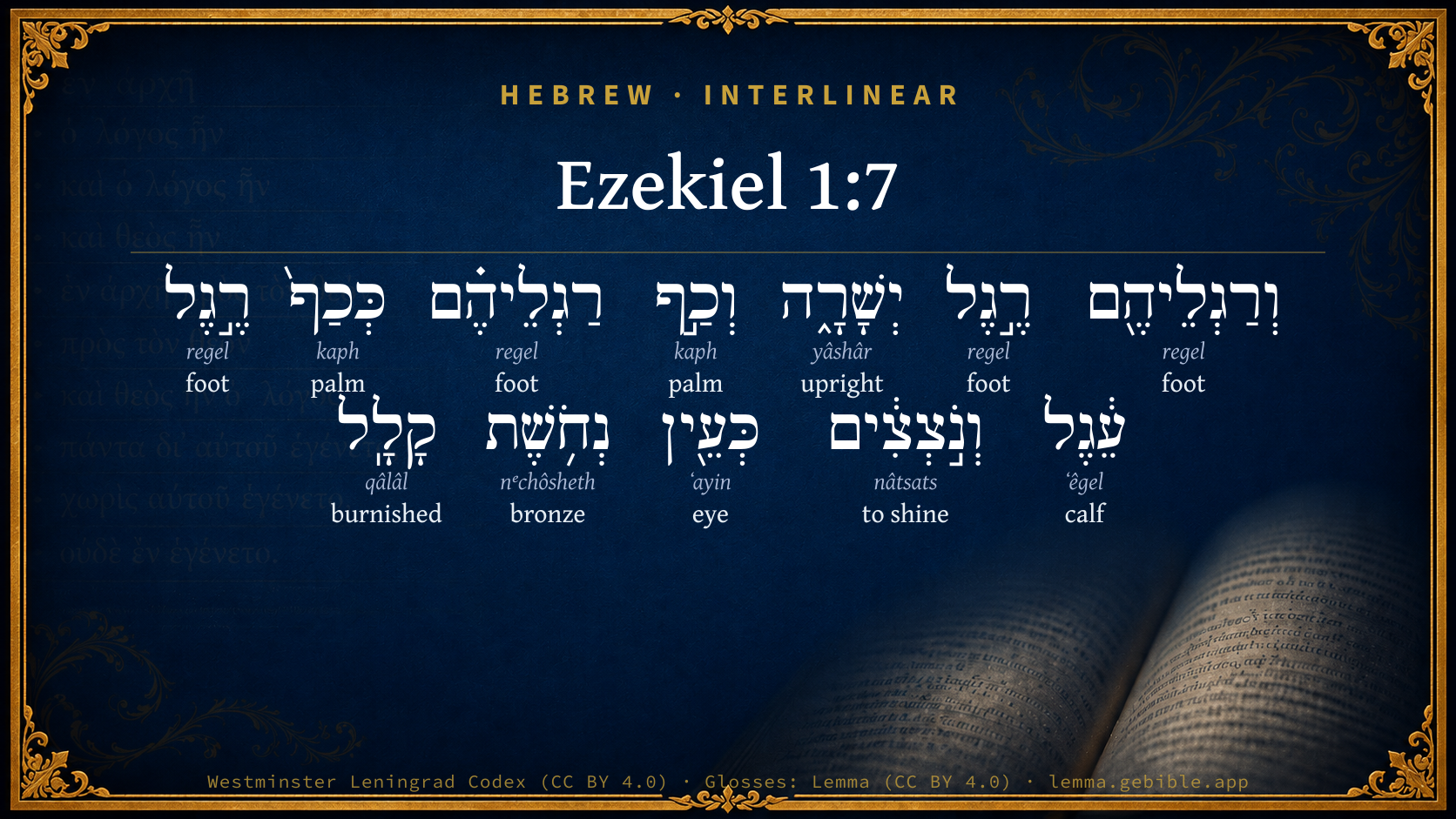
Hebrew (Westminster Leningrad Codex) Ezekiel 1:7 appears in the Hebrew Old Testament. The text above is from the Westminster Leningrad Codex. Each word links to its Strong’s number, a concise gloss, and parsing drawn from the Open Scriptures Hebrew Bible morphology. Click any word for its full Brown-Driver-Briggs (BDB) entry.
Download image
Cite this verse

Ezekiel 1:7 (World English Bible). Public Domain. Lemma interlinear Bible study tool, https://lemma.gebible.app/v/ezekiel/1/7.

Show BibTeX & RIS
BibTeX
RIS
English Translation
Their feet were straight feet; and the sole of their feet was like the sole of a calf's foot; and they sparkled like burnished brass.
World English Bible · Public Domain
Highlights
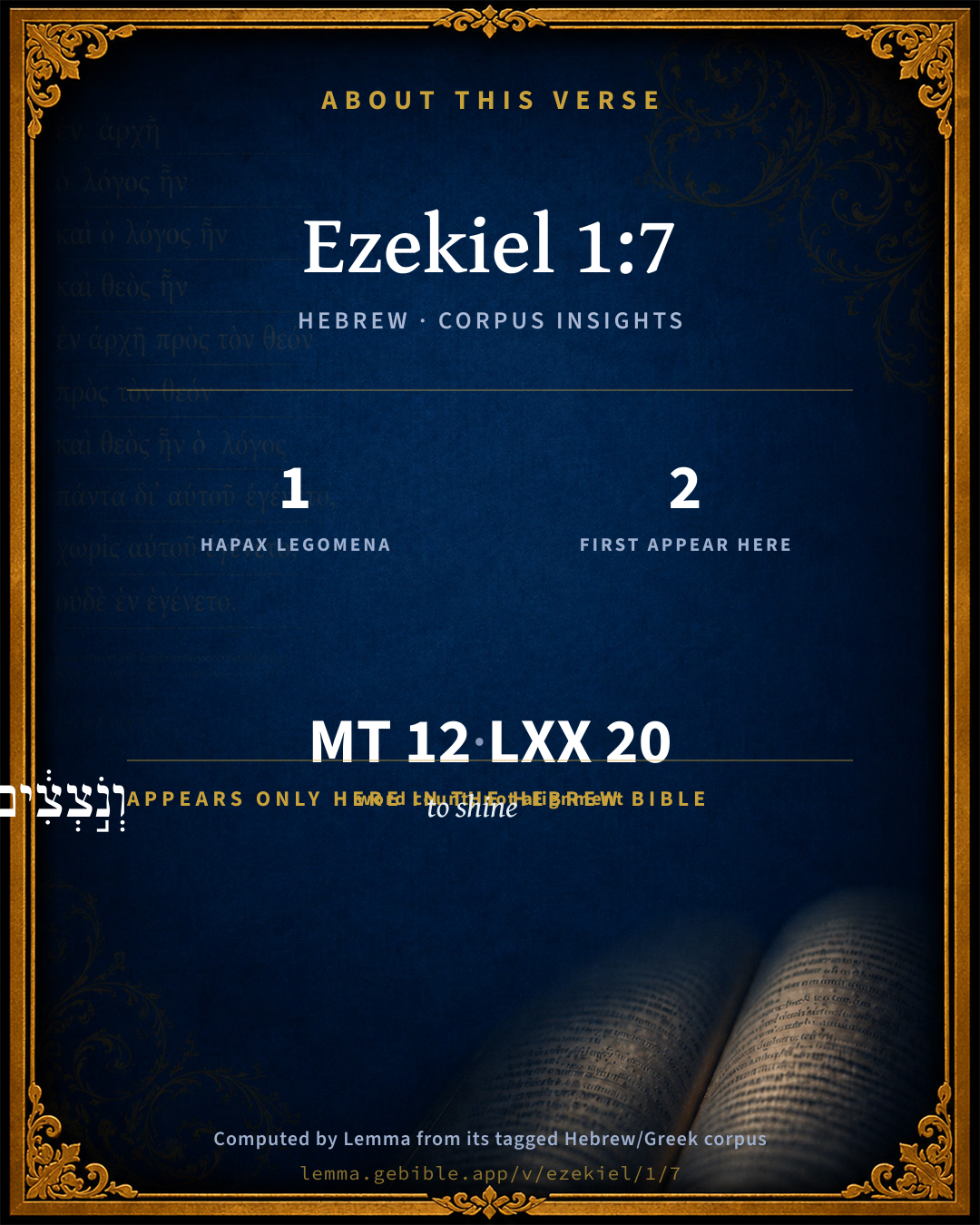
  • 1 hapax legomenon — only here in the Hebrew Bible
  • 2 first appearances in the Hebrew Bible
Full analysis ↓
Download a study sheet

One document with this verse’s original text, its word-by-word gloss line, the meaning frame, cross-references with their text, attributed commentary, and full source and license credits — printable, and it pastes into notes with its structure intact.

This verse Autodidact and up

Study sheet (.html) Plain text (.txt)

A passage Seminary Student

Up to 50 verses in one chapter. A passage sheet keeps up to 6 commentary sources and 12 cross-references per verse, in the order this page ranks them, and says so on the sheet whenever that leaves anything out. Ask for a single verse and you get the Autodidact verse sheet above.

Everything on this page stays free to read, with no account — the sheet is a download of what is already on screen, not access to it.

Want to remove ads? Support Godless Engineer
Compare translations 3

The same verse in 3 English versions, stacked beneath the original-language interlinear above. Click any original word for its lexicon entry.

Each is an independent rendering of the whole verse — the interlinear is not word-aligned to these translations.

Highlighted words mark where these versions differ — a whole-verse word diff, not a word-by-word alignment.

  • World English Bible Public Domain
    Their feet were straight feet; and the sole of their feet was like the sole of a calf's foot; and they sparkled like burnished brass.
  • King James Version Public Domain
    And their feet were straight feet; and the sole of their feet was like the sole of a calf's foot: and they sparkled like the colour of burnished brass.
  • unfoldingWord Literal Text CC BY-SA 4.0
    Their legs were straight, but the soles of their feet were like the hooves of a calf that shone like polished bronze.

unfoldingWord Literal Text — © unfoldingWord, licensed CC BY-SA 4.0. Word-aligned USFM3 via Door43 (git.door43.org/unfoldingWord/en_ult).

Versions to compare (up to 4)

3 of 4 selected

Show all 18 translations

Every available English version of this verse, each an independent rendering of the whole verse.

  • World English Bible Public Domain
    Their feet were straight feet; and the sole of their feet was like the sole of a calf's foot; and they sparkled like burnished brass.
  • Berean Standard Bible Public Domain
    Their legs were straight, and the soles of their feet were like the hooves of a calf, gleaming like polished bronze.
  • Majority Standard Bible Public Domain
    Their legs were straight, and the soles of their feet were like the hooves of a calf, gleaming like polished bronze.
  • King James Version Public Domain
    And their feet were straight feet; and the sole of their feet was like the sole of a calf's foot: and they sparkled like the colour of burnished brass.
  • American Standard Version (1901) Public Domain
    And their feet were straight feet; and the sole of their feet was like the sole of a calf's foot; and they sparkled like burnished brass.
  • Revised Version (1885) Public Domain
    And their feet were straight feet; and the sole of their feet was like the sole of a calf’s foot: and they sparkled like the colour of burnished brass.
  • Geneva Bible (1599) Public Domain
    And their feete were streight feete, and the sole of their feete was like the sole of a calues foote, and they sparkled like the appearance of bright brasse.
  • Douay-Rheims (1899) Public Domain
    Their feet were straight feet, and the sole of their foot was like the sole of a calf's foot, and they sparkled like the appearance of glowing brass.
  • Young's Literal Translation Public Domain
    and their feet `are' straight feet, and the sole of their feet `is' as a sole of a calf's foot, and they are sparkling as the colour of bright brass;
  • Literal Standard Version CC BY-SA 4.0
    and their feet [are] straight feet, and the sole of their feet [is] as a sole of a calf’s foot, and they are sparkling as the color of bright bronze;
  • Unlocked Literal Bible CC BY-SA 4.0
    Their legs were straight, but the soles of their feet were like the hooves of a calf that shone like polished bronze.
  • unfoldingWord Literal Text CC BY-SA 4.0
    Their legs were straight, but the soles of their feet were like the hooves of a calf that shone like polished bronze.
  • Darby Bible Public Domain
    And their feet were straight feet; and the sole of their feet was like the sole of a calf's foot; and they sparkled as the look of burnished brass.
  • World Messianic Bible Public Domain
    Their feet were straight feet. The sole of their feet was like the sole of a calf’s foot; and they sparkled like burnished bronze.
  • Webster's Bible Public Domain
    And their feet were straight feet; and the sole of their feet was like the sole of a calf's foot: and they sparkled like the color of burnished brass.
  • Free Bible Version CC BY-SA 4.0
    They had straight legs, and the soles of their feet looked like the hooves of calves, and shone like polished bronze.
  • Bible in Basic English Public Domain
    And their feet were straight feet; and the under sides of their feet were like the feet of oxen; and they were shining like polished brass.
  • JPS Tanakh (1917) Public Domain
    And their feet were straight feet; and the sole of their feet was like the sole of a calf's foot; and they sparkled like the colour of burnished brass.

Literal Standard Version (2020), Covenant Press — licensed CC BY-SA 4.0. Text via the HelloAO Bible API (eBible.org). Unlocked Literal Bible (unfoldingWord) — licensed CC BY-SA 4.0. Text via the HelloAO Bible API (eBible.org). unfoldingWord Literal Text — © unfoldingWord, licensed CC BY-SA 4.0. Word-aligned USFM3 via Door43 (git.door43.org/unfoldingWord/en_ult). Free Bible Version, Dr. Jonathan Gallagher — licensed CC BY-SA 4.0. Text via the HelloAO Bible API (eBible.org).

Word by word

More ways to search: Search by grammar → Find every occurrence → Compare this word →

Practice this passage: Drill this verse → Learn its vocabulary →

וְנֹ֣צְצִ֔ים
nâtsats
H5340
“and · shining”
Conjunction + Verb, Qal, Participle Active, Masculine, Plural, Absolute
Part of Speech
Conjunction + Verb
Stem
Qal
Form
Participle Active
Gender
Masculine
Number
Plural
State
Absolute
Full BDB Definition

Origin: a primitive root

TWOT: 1405

(Qal) to shine, sparkle
  1. וְרַגְלֵיהֶ֖ם regel H7272 “and · feet · their” Conjunction + Noun, Common, Feminine, Dual, Construct + Suffix, Personal, 3rd Person, Masculine, Plural
  2. רֶ֣גֶל regel H7272 “foot” Noun, Common, Feminine, Singular, Absolute
  3. יְשָׁרָ֑ה yâshâr H3477 “upright” Adjective, Adjective, Feminine, Singular, Absolute
  4. וְכַ֣ף kaph H3709 “and · palm of” Conjunction + Noun, Common, Feminine, Singular, Construct
  5. רַגְלֵיהֶ֗ם regel H7272 “feet · their” Noun, Common, Feminine, Dual, Construct + Suffix, Personal, 3rd Person, Masculine, Plural
  6. כְּכַף֙ kaph H3709 “like/as · palm of” Preposition + Noun, Common, Feminine, Singular, Construct
  7. רֶ֣גֶל regel H7272 “foot of” Noun, Common, Feminine, Singular, Construct
  8. עֵ֔גֶל ʻêgel H5695 “calf” Noun, Common, Masculine, Singular, Absolute
  9. כְּעֵ֖ין ʻayin H5869 “like/as · eye of” Preposition + Noun, Common, Both, Singular, Construct
  10. נְחֹ֥שֶׁת nᵉchôsheth H5178 “bronze” Noun, Common, Feminine, Singular, Absolute
  11. קָלָֽל qâlâl H7044 “burnished” Adjective, Adjective, Masculine, Singular, Absolute

About this verse

These counts appear in no published source. They are computed here, from the morphology-tagged text and Lemma’s own curated glosses. What Lemma adds →

12
words
8
distinct lemmas
Prophets
section

Notable vocabulary

1 hapax legomenon — a word that appears only here in the entire Hebrew Bible:

  • וְנֹ֣צְצִ֔ים to shine H5340

First appearance in Scripture

These words make their first canonical appearance in the Hebrew Bible here:

  • וְנֹ֣צְצִ֔ים to shine H5340
  • קָלָֽל burnished H7044

Shared distinctive vocabulary

קָלָֽל burnished H7044 occurs in 2 verses of the Hebrew Bible. Also found in:

Grammatical profile

  • 1 verb
  • 9 nouns
  • 2 adjectives

Verb forms

  • וְנֹ֣צְצִ֔ים Qal · Participle Active

Repetition

Words recur within this verse — often emphatic in Hebrew:

  • וְרַגְלֵיהֶ֖ם foot H7272 ×4
  • וְכַ֣ף palm H3709 ×2

Hebrew & Septuagint length

In English translation the verse runs 25 words from the Hebrew and 22 from the Septuagint (LXX English) — closely comparable.

A rough comparison of the two English renderings, which tokenize alike — not a word-level alignment.

Word counts can differ between the Hebrew and the Greek without any difference in meaning — e.g. the Hebrew direct-object marker אֵת has no separate Greek word, and Greek often adds the article ὁ.

In the original languages it is 12 Hebrew tokens and 20 Greek tokens — but the two are counted differently (Hebrew bundles its prefixes and suffixes into one token; the Greek is in lemma form), so that isn’t a like-for-like length.

Cross-references

6

Topical passages linked to Ezekiel 1:7 in the Treasury of Scripture Knowledge — connected by theme and wording, ordered by reader-vote popularity; previews shown in the World English Bible.

  • Revelation 1:15 His feet were like burnished brass, as if it had been refined in a furnace. His voice was like the voice of many waters.
  • Daniel 10:6 his body also was like the beryl, and his face as the appearance of lightning, and his eyes as flaming torches, and his arms and his feet like burnished brass, and the voice of his words like the voice of a multitude.
  • Psalms 104:4 He makes his messengers winds; His servants flames of fire.
  • Ezekiel 1:13 As for the likeness of the living creatures, their appearance was like burning coals of fire, like the appearance of torches: [the fire] went up and down among the living creatures; and the fire was bright, and out of the fire went forth lightning.
  • Leviticus 11:3 Whatever parts the hoof, and is cloven-footed, and chews the cud among the animals, that you may eat.
  • Leviticus 11:47 to make a distinction between the unclean and the clean, and between the living thing that may be eaten and the living thing that may not be eaten.'"

Cross-references courtesy of OpenBible.info (CC BY 4.0).

Hebrew and Greek witnesses Masoretic Hebrew ↔ Greek Septuagint

The same verse in the two great witnesses to the Old Testament, shown verse-for-verse.

These are two independent witnesses, not word-aligned to each other, and the Septuagint is shown in lemma (dictionary) form.

Hebrew Ezekiel 1:7 Masoretic · Westminster Leningrad Codex

וְרַגְלֵיהֶ֖ם רֶ֣גֶל יְשָׁרָ֑ה וְכַ֣ף רַגְלֵיהֶ֗ם כְּכַף֙ רֶ֣גֶל עֵ֔גֶל וְנֹ֣צְצִ֔ים כְּעֵ֖ין נְחֹ֥שֶׁת קָלָֽל

Their feet were straight feet; and the sole of their feet was like the sole of a calf's foot; and they sparkled like burnished brass.

World English Bible · Public Domain

Greek LXX Ezekiel 1:7 Septuagint · lemma form

καί ὁ σκέλος αὐτός ὀρθός καί πτερωτός ὁ πούς αὐτός καί σπινθήρ ὡς ἐκἀστράπτω χαλκός καί ἐλαφρός ὁ πτέρυξ αὐτός

And their legs were straight; and their feet were winged, and there were sparks, like gleaming brass, and their wings were light.

LXX2012 (modern English Septuagint) · Public Domain

On this verse, John Gill's Exposition discusses the Septuagint’s reading. Read the note in Commentary ↓

Hebrew: Westminster Leningrad Codex (CC BY 4.0). Greek: Septuagint (public domain); English from LXX2012 (modern English Septuagint) (Public Domain). How the Septuagint differs from the Hebrew →

Targum (Aramaic paraphrase)

1

The Targum is the ancient Jewish Aramaic paraphrase of the Hebrew Scriptures — an interpretive translation, not the Hebrew text itself. Onkelos (literal) and Pseudo-Jonathan (expansive) render the Torah, and Jonathan the Prophets. Coverage is partial: where no permissively-licensed English translation exists for a verse, only the Aramaic is shown. This is verse-level text, not a word-by-word alignment to the Hebrew.

  1. Targum Jonathan Prophets (Joshua–Malachi)
    וְרִגְלֵיהוֹן רִגְלִין כֵּיוָנָן וּפַרְסַת רִגְלֵיהוֹן כְּפַרְסַת רִגְלִית סְגַלְגְלָן וּמְזִיעָן עַלְמָא בִּמְהָכְהֵן וּמְנַצְנְצָן כְּעֵין נְחָשׁ מְצַלְהַב:

    (no public-domain English translation for this verse)

    Targum Jonathan — Aramaic: “Mikraot Gedolot” (public domain). English: “Sefaria Community Translation” (CC0 1.0 (public-domain dedication)); “London "Chaldee Paraphrase," 1871” (public domain). Text via Sefaria.

Commentary

Notes on Ezekiel 1:7 from classic Christian and Jewish commentators (each source and its license shown beneath its notes). The classic Christian expositions comment on the surrounding passage and are grouped to its opening verse, so a note may address several verses; the Jewish commentaries on the Tanakh (Rashi and others) are per-verse, so they appear only where the commentator wrote on this verse.

Lemma curates 59 commentaries, every one of them public domain or Creative Commons licensed, each selected and text-cleaned for this edition rather than reprinted as found. About our sources →

Trapp's Complete Commentary

John Trapp

Eze 1:7 And their feet [were] straight feet; and the sole of their feet [was] like the sole of a calf’s foot: and they sparkled like the colour of burnished brass.

Ver. 7. And their feet were straight feet.] Importing their right progress in executing God’s will. We must also "make straight or even paths for our feet, lest that which is lame be turned out of the way." {Heb 12:13} See Eze 1:9.

And the sole of their feet was like the sole of a calf’s foot] Round, and therefore easily turned. Hoc ad agilitatem et varietatem cursus spectat. The angels, because they see every way, so they are apt to go every way, and this with the greatest facility that can be.

And they sparkled.] So swiftly they went, that their feet seemed to sparkle or strike fire.

Like the colour of burnished brass.] Burnished, not blemished; polished, not polluted.

John Trapp, A Commentary or Exposition upon All the Books of the Old and New Testament (1647–1656) — public domain. Text from a community e-Sword module.

Joseph Benson's Commentary

Eze 1:7-10. And their feet were straight feet — Emblematical probably of simplicity and uprightness, or of the steadiness of their obedience. And the sole of their feet like the sole of a calf’s foot — To signify their firmness and constancy in performing the divine will. Or, as some think, the soles of their feet, being divided, like those of calves and other clean animals, might be emblematical of their perfect purity and holiness. And they sparkled like the colour of burnished brass — To signify their zeal in God’s service, or that the glory of God should shine forth, or be made manifest in their actions. And they had the hands of a man — To show their power and ability to perform with speed what was enjoined them; or, that they did all things orderly, distinctly, and quickly; the hands of a man being most aptly made, of any thing we know, for performing any artificial operations. And by these hands being under their wings might be signified that their works were invisible and unknown to man, and done without any ostentation. They four had their faces and their wings — This is a repetition of what had been said before, in order that it might be more noticed. Their wings were joined one to another — To signify their perfect agreement in the speedy execution of God’s will; and that all the acts which God performs by the ministry of his angels are admirably consistent, and agreeing with each other, and adapted to the purpose intended to be brought to pass. They turned not when they went — They were immediately ready to do the work assigned them without any delay or hinderance, and they proceeded directly on in one and the same undeviating course; were constant and persevering in performing the divine will, without being turned aside therefrom by any obstacle whatever. They four had the face of a man, &c. — See note on Eze 1:6.

Joseph Benson's Commentary on the Old and New Testaments (1811–1818) — public domain. Text from a community e-Sword module.

Jamieson, Fausset & Brown

Robert Jamieson, A. R. Fausset & David Brown

straight feet--that is, straight legs. Not protruding in any part as the legs of an ox, but straight like a man's [GROTIUS]. Or, like solid pillars; not bending, as man's, at the knee. They glided along, rather than walked. Their movements were all sure, right, and without effort [KITTO, Cyclopedia].

sole . . . calf's foot--HENDERSON hence supposes that "straight feet" implies that they did not project horizontally like men's feet, but vertically as calves' feet. The solid firmness of the round foot of a calf seems to be the point of comparison.

colour--the glittering appearance, indicating God's purity.

Jamieson, Fausset & Brown — Commentary Critical and Explanatory on the Whole Bible (1871) — public domain (CC PDM 1.0). Text via the HelloAO Bible API.

Adam Clarke's Commentary

Verse 7. Their feet were straight feet] There did not seem to be any flexure at the knee, nor were the legs separated in that way as to indicate progression by walking. I have before me several ancient Egyptian images of Isis, Osiris. Anubis, c., where the legs are not separated, nor is there any bend at the knees so that if there was any motion at all, it must have been by gliding, not progressive walking. It is a remark of AElian, that the gods are never represented as walking, but always gliding; and he gives this as a criterion to discern common angelic appearances from those of the gods: all other spiritual beings walked progressively, rising on one foot, while they stretched out the other; but the deities always glided without gradual progressive motions. And Heliodorus in his Romance of Theogines and Charicha, gives the same reason for the united feet of the gods, c., and describes the same appearances.

Like the sole of a calf's foot] Before it is stated to be a straight foot one that did not lay down a flat horizontal sole, like that of the human foot.

And they sparkled like the colour of burnished brass.] I suppose this refers rather to the hoof of the calf's foot, than to the whole appearance of the leg. There is scarcely any thing that gives a higher lustre than highly polished or burnished brass. Our blessed Lord is represented with legs like burnished brass, Re 1:15.

Adam Clarke's Commentary on the Bible (1810–1826) — public domain. Text from a community e-Sword/MySword module.

John Calvin's Commentaries

This seems added by way of explanation. Since Ezekiel has spoken of their human form, he adds that their feet were straight, although he calls them round or like those of a calf. I refer the straightness not to the feet only but also to the legs. It is therefore just as if he had said that these animals stood as men do. For we differ from the brutes, who look down towards the ground. As the poet appositely remarks, when he commends the singular favor which God has conferred upon man,

Man looks aloft, and with erected eyes Beholds his own hereditary skies.

The Prophet now signifies the same thing, when he says that the animals had straight feet. He asserts that they had not anything akin to brutes, but rather to the appearance or likeness of man. He says that their feet were round, and this seems to indicate their agility or the variety of their movements, as if he had said that their feet were not confined, to any one direction, but wherever God impels them they move easily, since their feet are round. If any of us wishes to turn either to the right or the left, he will feel himself to be contending with nature, if he attempt at the same time to walk backwards; if however his feet were round, or of the form of calves’ feet, he could easily move in any direction. Agility of this kind then seems pointed at in the animals. As to the sparks which shone like polished brass or steel, we know that this similitude often occurs in Scripture, for whenever God wishes to render his servants attentive, he proposes new figures which may excite their admiration. This very thing happened to our Prophet, because if the usual fleshy color had appeared in these animals, this perhaps would have been neglected: even the Prophet had not considered the meaning of the vision with sufficient attention. But when he saw the glistening thighs and sparks shining in every direction, as if from polished steel, then he was compelled to apply his mind more attentively to this vision, Now, therefore, we see why he says that the appearance of the legs was like polished steel, and that sparks glittered on them

John Calvin's Commentaries (1540-1563) — public domain. Text from the Calvin Translation Society English edition (1840s-50s) via the Christian Classics Ethereal Library (ccel.org). Calvin's coverage is partial (roughly two-thirds of the Bible); uncommented books and verses are honest gaps, never fabricated. The 19th-century editor's footnotes and remarks are omitted so the notes are faithfully Calvin's own voice.

Ellicott's Commentary for English Readers

(7) Their feet were straight feet.—Rather, each of their legs was a straight leg, i.e., without any bend in it, as at the knee, but was equally fitted for motion in any direction. So also “the sole of their feet,” the part which rested on the ground, was not, like the human foot, formed to move forward only, but was round and solid, something “like the sole of a calf’s foot.”

They sparkled.—This refers only to “the sole of the feet,” the hoof. The “burnished brass” is a different word from that used in Eze_1:4, and gives another feature to the general brilliancy and magnificence of the vision.

A Bible Commentary for English Readers, edited by Charles John Ellicott (1878–1897) — public domain. Text from a community e-Sword module.

The Cambridge Bible for Schools and Colleges

gen. ed. J. J. S. Perowne

7. straight feet] “Feet” here means limbs. These appear to have been two in number, though this is not expressly stated. The foot itself was round, or as much so as that of a calf. The word “straight” applied to the limbs means strictly “even,” i.e. probably without protuberance or knot such as a knee-joint would be. The living creature did not need to turn, and its leg was without joints.

they sparkled … burnished brass] that is, the limbs of the creature, not the living creature itself, Dan_10:6, “his arms and his feet like in colour to burnished brass” (Rev_1:15). “Colour” (lit. eye) is probably “glance” (Eze_1:4).

The Cambridge Bible for Schools and Colleges (gen. ed. J. J. S. Perowne; Cambridge University Press, 1878–1918) — public domain. Text from a community e-Sword module.

John Gill's Exposition

And their feet were straight feet,.... And they went straight forward, as in Eze 1:12; they made straight paths for their feet, and walked uprightly, according to the truth of the Gospel; did not go into crooked paths, or turn to the right hand, or the left; and having put their hand to the plough of the Gospel neither looked back, nor turned back.

And or "for"

the sole of their feet was like the sole of a calf's foot; round, and the hoof divided, and fit for treading out the corn, in which oxen were employed; denoting the firmness and constancy of ministers in their work, treading out the corn of the word for the nourishment of souls, to whom they minister. The Septuagint render it, "their feet were winged"; or "flying", as the Arabic version; in like manner as Mercury, the Heathen god, is painted: this may denote the readiness and swiftness of Gospel ministers to do their master's work; their feet being shod with the preparation of the Gospel, and so very beautiful, Eph 6:15. The Targum is,

"the sole of their feet as the sole of feet that are round (l), and they moved the world where they went;''

and they sparkled like the colour of burnished brass; that is, their feet; being burning and shining lights in their conversation, as well as in their doctrine; see Rev 1:15.

(l) So R. Sol. Urbin, Ohel Moed, fol. 60. 2.

John Gill's Exposition of the Whole Bible (1746–1763) — public domain (CC PDM 1.0). Text via the HelloAO Bible API.

Albert Barnes' Notes on the Bible

The “foot” seems here to mean the lower part of the leg, including the knee, and this was “straight,” i. e. upright like a man’s. The “sole” is the “foot” as distinguished from the “leg,” the leg terminated in a solid calf’s hoof. This was suitable for a being which was to present a front on each of its four sides. Ezekiel was living in a country on the walls of whose temples and palaces were those strange mixed figures, human heads with the bodies of lions and the feet of calves, and the like, which we see in the Babylonian and Assyrian monuments. These combinations were of course symbolic, and the symbolism must have been familiar to Ezekiel. But the prophet is not constructing his cherubim in imitation of these figures, the Spirit of God is revealing forms corresponding to the general rules of eastern symbolism.

Albert Barnes' Notes on the Bible (1834–1885) — public domain. Text from a community e-Sword/MySword module.

Haydock's Catholic Bible Commentary

Straight. Hebrew, "a straight foot." Protestants prefer "feet." (Haydock) --- Of a calf. Aquila reads to the same import hagol, "round," instead of hegel, (Haydock) "a calf." Symmachus has "winged feet," like Mercury. (Calmet) --- Septuagint omit this, says St. Jerome, though we have his version of Symmachus as if it belonged to the Septuagint; and it occurs in Grabe as genuine. --- Brass. Septuagint add, "and their feathers were very light." (Haydock)

George Leo Haydock (1774–1849), Haydock's Catholic Family Bible and Commentary, 1859 edition — public domain. Excludes Psalms (Douay-Rheims chapter numbering differs from Protestant) and Deuterocanonical books (Catholic canon only).

Matthew Poole's English Annotations

Their feet; the Hebrew expresseth the parts below the belly by foot, their thighs, legs, and feet (as by hand is meant the whole arm) were of human shape.

Were straight feet; not bowed to this or that part, which argues weakness: here is most elegantly described the unconquered firmness wherewith angels do the commands of God; their readiness and their wisdom also in doing it, nothing low or brutish in their actions.

The sole of their feet, that which is properly the foot,

was like the sole of a calf’s foot: divided hoof spike the cleanness of the creature. The ox, patient of labour, a beast for sacrifice to God, in these things angels, servants of God, well resembled: what if we should add a slowness in pace; blessed angels are not over-forward to executions, yet ever go when bid.

They sparkled; it may refer either to the living creatures or to their feet; it speaks either their anger against an obstinate, sinful people, or the terror of executing God’s judgments, or the self-discovering light of his justice, or the zeal of angels in a speedy performing the will of God, in which their swiftness enkindles these sparks.

Matthew Poole's English Annotations on the Holy Bible (1683–1685) — public domain. Text from a community e-Sword/MySword module.

Whedon's Commentary on the Bible

Daniel D. Whedon

7. Straight feet — Dr. Davidson thinks this to mean that the limbs were smooth and unjointed; perhaps the idea was that their limbs were not bound in any way, and not drawn up in the effort of flying. They moved without effort. These limbs and feet shone like burnished brass. (Compare Dan_10:6; Rev_1:15.)

Daniel D. Whedon (gen. ed.), Commentary on the Old and New Testaments (1874–1909) — public domain. Text from a community e-Sword module.

The Pulpit Commentary

Their feet were straight feet, etc. The noun is probably used as including the lower part of the leg, and what is meant is that the legs were not bent, or kneeling. What we may call the bovine symbolism appears at the extremity, and the actual foot is round like a calf"s. The LXX curiously enough gives "their feet were winged (pterwtoi)." Burnished brass. Probably a shade less brilliant, or more ruddy, than the electrum of ver. 4 (see note there).

The Pulpit Commentary (1880–1919), ed. H.D.M. Spence-Jones & Joseph S. Exell — public domain. Text from a community e-Sword module.

John Wesley's Explanatory Notes

Feet - Their thighs, legs and feet, were of a human shape. Straight - Not bowed to this or that part, which argues weakness. The sole - That which is properly the foot. A calf's - A divided hoof spake the cleanness of the creature. They - Their feet.

John Wesley, Explanatory Notes Upon the Whole Bible (1754–1765) — public domain. Text via the GEBible commentary corpus.

unfoldingWord translationNotes

Door43 World Missions Community

Connecting Statement:

Ezekiel continues to describe his vision.

but the soles of their feet were like the hooves of a calf

"but their feet looked like calf hooves" or "but their feet looked like the feet of calves"

hooves of a calf

the hard part of a calf's foot

that shone like polished bronze

"that were shiny like bronze that has been polished." This describes the feet of the creatures. AT: "and they shone like polished bronze" (See: Simile)

on all four sides

"on all four sides of their bodies"

For all four, their faces and wings were like this

"For all four of the creatures, their wings and their faces were like this"

they did not turn as they went

"the creatures did not turn as they moved"

translationWords

cow

bronze

creature

unfoldingWord translationNotes — © Distant Shores Media and the Door43 World Missions Community, licensed CC BY-SA 4.0. Source: git.door43.org/Door43/en_tn.

Rashi

Rabbi Shlomo Yitzchaki (Rashi)

were straight legs [Jonathan renders]: רִגְלִין כֵּיוָנָן parallel legs, this one opposite this one. Another explanation: “straight,” meaning they had no knee joints by which to bend their legs because they do no sitting or lying. Therefore they do not require joints like those of animalsthe upper joint and the lower joint by which it bends its legs to lie down.

a round foot Heb. עֵגֶל, a round foot, and so did Jonathan render it: round feet.

and they sparkled Because of their brilliance, sparks seemed to emanate from them, as we say in tractate Yoma (37b): She too [Queen Helene] made a golden candelabrum, etc. When the sun shone, sparks would [seemingly] emanate from it, etc. וְנוֹצְצִים is etincelants in French, gleaming.

like the color Heb. כְּעֵין, like מַרְאֶה, the appearance.

burnished copper Heb. קָלָל, clarified and gleaming. Menachem (Machbereth p. 155) associated it with (Lev. 2: 14): “roasted (קָלוּי) in fire.”

Rashi on the Tanakh — English translations: “The Judaica Press complete Tanach with Rashi, translated by A. J. Rosenberg” (CC BY 4.0); “Pentateuch with Rashi's commentary by M. Rosenbaum and A.M. Silbermann, 1929-1934” (public domain); “The Metsudah Tanach series, Lakewood, N.J” (CC BY 4.0); and “The Book of Joshua, Metsudah Publications, 1997” (CC BY 4.0). Text via Sefaria.

Lesson kit

Teaching starters — assembled from the data on this page, not authored interpretation. Every prompt links to the verse data it draws on. Edit before teaching.

Ezekiel, in the Prophets, opens this verse with 12 words (8 distinct Hebrew lemmas). Its most distinctive word is nâtsats (“to shine”). A historical commentator’s framing appears above. Read the whole chapter for the surrounding context.

Discussion questions

  1. How does “to shine” (nâtsats) shape what this verse is saying?
  2. 1 word here appears nowhere else in the Hebrew Bible. Why might the author reach for such rare wording?
  3. 2 words make their first appearance in Scripture here. What does this debut establish?
  4. How does Daniel 10:6, which shares the word «burnished», read alongside this verse?
  5. What does the repetition of “foot” (4× in this one verse) do in this verse?
  6. These translations render this verse differently; the difference is in the English rendering, not the original. What questions does that raise?
  7. «וְנֹ֣צְצִ֔ים» is a Qal Participle Active verb. How does that grammatical form shape the action described?
  8. Compare how Trapp's Complete Commentary and Joseph Benson's Commentary read this verse. Where do they agree or differ?

Things to notice

  • 1 word in this verse appears nowhere else in the Hebrew Bible.
  • 2 words make their first canonical appearance in Scripture here.
  • This verse counts 12 Hebrew ↔ 20 Greek words.
  • These translations choose different wording for 14 words in this verse.
  • “foot” occurs 4× in this single verse.

Reading settings

Reading text

Shown beneath each verse's original-language words.

Old Testament
Old Testament edition

Read the OT as the Masoretic Hebrew (MT) or the Greek Septuagint (LXX).

English shown for the Greek Septuagint (in the Hebrew ↔ Greek comparison).

Comparing translations? Open the Compare panel on any verse page to stack up to four side by side.