
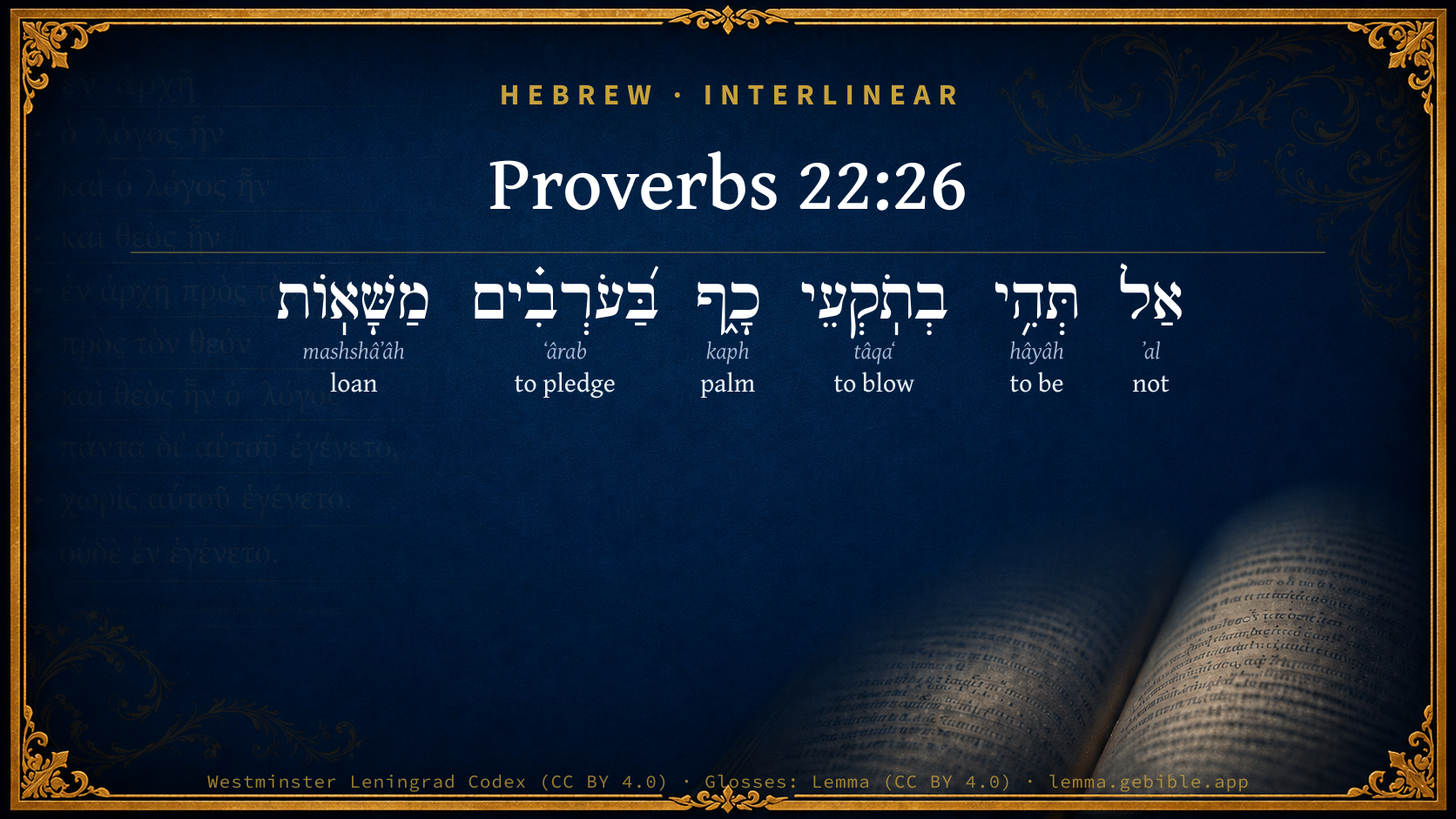
Proverbs 22:26

Hebrew (Westminster Leningrad Codex) Proverbs 22:26 appears in the Hebrew Old Testament. The text above is from the Westminster Leningrad Codex. Each word links to its Strong’s number, a concise gloss, and parsing drawn from the Open Scriptures Hebrew Bible morphology. Click any word for its full Brown-Driver-Briggs (BDB) entry.
Download image
Cite this verse

Proverbs 22:26 (World English Bible). Public Domain. Lemma interlinear Bible study tool, https://lemma.gebible.app/v/proverbs/22/26.

Show BibTeX & RIS
BibTeX
RIS
English Translation
Don't you be one of those who strike hands, Of those who are collateral for debts.
World English Bible · Public Domain
Download a study sheet

One document with this verse’s original text, its word-by-word gloss line, the meaning frame, cross-references with their text, attributed commentary, and full source and license credits — printable, and it pastes into notes with its structure intact.

This verse Autodidact and up

Study sheet (.html) Plain text (.txt)

A passage Seminary Student

Up to 50 verses in one chapter. A passage sheet keeps up to 6 commentary sources and 12 cross-references per verse, in the order this page ranks them, and says so on the sheet whenever that leaves anything out. Ask for a single verse and you get the Autodidact verse sheet above.

Everything on this page stays free to read, with no account — the sheet is a download of what is already on screen, not access to it.

Want to remove ads? Support Godless Engineer
Compare translations 3

The same verse in 3 English versions, stacked beneath the original-language interlinear above. Click any original word for its lexicon entry.

Each is an independent rendering of the whole verse — the interlinear is not word-aligned to these translations.

Highlighted words mark where these versions differ — a whole-verse word diff, not a word-by-word alignment.

  • World English Bible Public Domain
    Don't you be one of those who strike hands, Of those who are collateral for debts.
  • King James Version Public Domain
    Be not thou one of them that strike hands, or of them that are sureties for debts.
  • unfoldingWord Literal Text CC BY-SA 4.0
    Do not be among those who clasp a palm, among those who pledge for loans.

unfoldingWord Literal Text — © unfoldingWord, licensed CC BY-SA 4.0. Word-aligned USFM3 via Door43 (git.door43.org/unfoldingWord/en_ult).

Versions to compare (up to 4)

3 of 4 selected

Show all 18 translations

Every available English version of this verse, each an independent rendering of the whole verse.

  • World English Bible Public Domain
    Don't you be one of those who strike hands, Of those who are collateral for debts.
  • Berean Standard Bible Public Domain
    Do not be one who gives pledges, who puts up security for debts.
  • Majority Standard Bible Public Domain
    Do not be one who gives pledges, who puts up security for debts.
  • King James Version Public Domain
    Be not thou one of them that strike hands, or of them that are sureties for debts.
  • American Standard Version (1901) Public Domain
    Be thou not one of them that strike hands, `Or' of them that are sureties for debts.
  • Revised Version (1885) Public Domain
    Be thou not one of them that strike hands, or of them that are sureties for debts:
  • Geneva Bible (1599) Public Domain
    Be not thou of them that touch the hand, nor among them that are suretie for debts.
  • Douay-Rheims (1899) Public Domain
    Be not with them that fasten down their hands, and that offer themselves sureties for debts:
  • Young's Literal Translation Public Domain
    Be not thou among those striking hands, Among sureties `for' burdens.
  • Literal Standard Version CC BY-SA 4.0
    Do not be among those striking hands, || Among sureties [for] burdens.
  • Unlocked Literal Bible CC BY-SA 4.0
    Do not be one who strikes hands in making a pledge, or who puts up security for debts.
  • unfoldingWord Literal Text CC BY-SA 4.0
    Do not be among those who clasp a palm, among those who pledge for loans.
  • Darby Bible Public Domain
    Be not of them that strike hands, of them that are sureties for debts:
  • World Messianic Bible Public Domain
    Don’t you be one of those who strike hands, of those who are collateral for debts.
  • Webster's Bible Public Domain
    Be not thou one of them that strike hands, or of them that are sureties for debts.
  • Free Bible Version CC BY-SA 4.0
    Don't shake hands and guarantee someone's debt,
  • Bible in Basic English Public Domain
    Be not one of those who give their hands in an agreement, or of those who make themselves responsible for debts:
  • JPS Tanakh (1917) Public Domain
    Be thou not of them that strike hands, or of them that are sureties for debts;

Literal Standard Version (2020), Covenant Press — licensed CC BY-SA 4.0. Text via the HelloAO Bible API (eBible.org). Unlocked Literal Bible (unfoldingWord) — licensed CC BY-SA 4.0. Text via the HelloAO Bible API (eBible.org). unfoldingWord Literal Text — © unfoldingWord, licensed CC BY-SA 4.0. Word-aligned USFM3 via Door43 (git.door43.org/unfoldingWord/en_ult). Free Bible Version, Dr. Jonathan Gallagher — licensed CC BY-SA 4.0. Text via the HelloAO Bible API (eBible.org).

Word by word

More ways to search: Search by grammar → Find every occurrence → Compare this word →

Practice this passage: Drill this verse → Learn its vocabulary →

About this verse

These counts appear in no published source. They are computed here, from the morphology-tagged text and Lemma’s own curated glosses. What Lemma adds →

6
words
6
distinct lemmas
Wisdom
section

Notable vocabulary

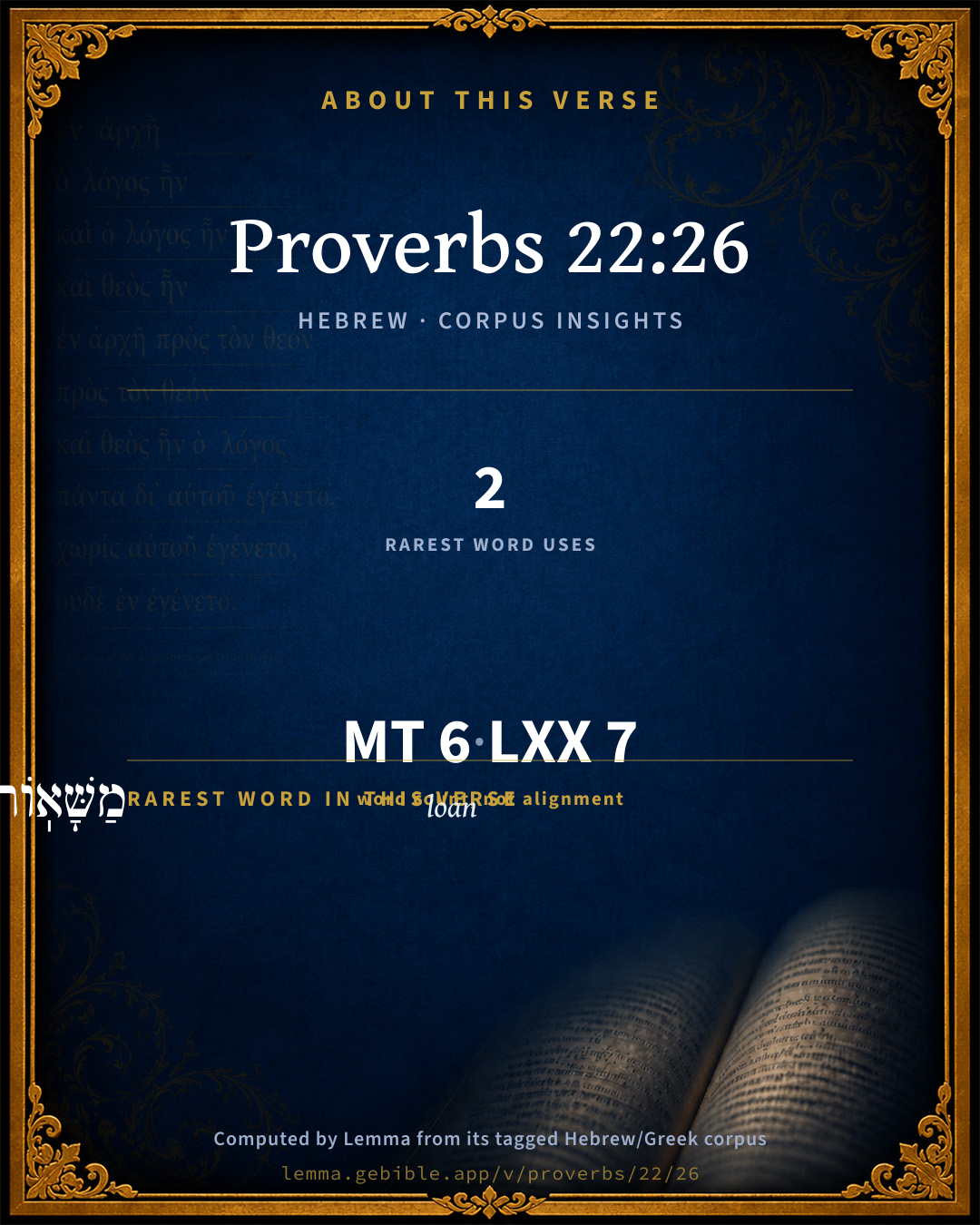
The rarest word here is מַשָּׁאֽוֹת loan H4859 — appearing just 2 times in the whole Hebrew Bible.

Shared distinctive vocabulary

מַשָּׁאֽוֹת loan H4859 occurs in 2 verses of the Hebrew Bible. Also found in:

Grammatical profile

  • 3 verbs
  • 2 nouns
  • 1 particle

Verb forms

  • תְּהִ֥י Qal · Jussive
  • בְתֹֽקְעֵי Qal · Participle Active
  • בַּ֝עֹרְבִ֗ים Qal · Participle Active

Hebrew & Septuagint length

In English translation the verse runs 16 words from the Hebrew and 9 from the Septuagint (LXX English) — the Septuagint runs noticeably shorter here. See the side-by-side →

A rough comparison of the two English renderings, which tokenize alike — not a word-level alignment.

Word counts can differ between the Hebrew and the Greek without any difference in meaning — e.g. the Hebrew direct-object marker אֵת has no separate Greek word, and Greek often adds the article ὁ.

In the original languages it is 6 Hebrew tokens and 7 Greek tokens — but the two are counted differently (Hebrew bundles its prefixes and suffixes into one token; the Greek is in lemma form), so that isn’t a like-for-like length.

Cross-references

4

Topical passages linked to Proverbs 22:26 in the Treasury of Scripture Knowledge — connected by theme and wording, ordered by reader-vote popularity; previews shown in the World English Bible.

  • Proverbs 11:15 He who is collateral for a stranger will suffer for it, But he who refuses pledges of collateral is secure.
  • Proverbs 6:1–5 My son, if you have become collateral for your neighbor, If you have struck your hands in pledge for a stranger;
  • Proverbs 17:18 A man void of understanding strikes hands, And becomes collateral in the presence of his neighbor.
  • Proverbs 27:13 Take his garment when he puts up collateral for a stranger; Hold it for a wayward woman!

Cross-references courtesy of OpenBible.info (CC BY 4.0).

Hebrew and Greek witnesses Masoretic Hebrew ↔ Greek Septuagint

The same verse in the two great witnesses to the Old Testament, shown verse-for-verse.

Here the Septuagint runs noticeably shorter than the Hebrew — LXX2012 (modern English Septuagint) 9 words vs World English Bible 16. A rough length comparison of the two English translations, not a word-level alignment — read both below.

These are two independent witnesses, not word-aligned to each other, and the Septuagint is shown in lemma (dictionary) form.

Hebrew Proverbs 22:26 Masoretic · Westminster Leningrad Codex

אַל תְּהִ֥י בְתֹֽקְעֵי כָ֑ף בַּ֝עֹרְבִ֗ים מַשָּׁאֽוֹת

Don't you be one of those who strike hands, Of those who are collateral for debts.

World English Bible · Public Domain

Greek LXX Proverbs 22:26 Septuagint · lemma form

μή δίδωμι σεαυτοῦ εἰς ἐγγύη αἰσχύνω πρόσωπον

Become not surety from respect of a man's person.

LXX2012 (modern English Septuagint) · Public Domain

On this verse, The Pulpit Commentary discusses the Septuagint’s reading. Read the note in Commentary ↓

Hebrew: Westminster Leningrad Codex (CC BY 4.0). Greek: Septuagint (public domain); English from LXX2012 (modern English Septuagint) (Public Domain). How the Septuagint differs from the Hebrew →

Commentary

Notes on Proverbs 22:26 from classic Christian and Jewish commentators (each source and its license shown beneath its notes). The classic Christian expositions comment on the surrounding passage and are grouped to its opening verse, so a note may address several verses; the Jewish commentaries on the Tanakh (Rashi and others) are per-verse, so they appear only where the commentator wrote on this verse.

Lemma curates 59 commentaries, every one of them public domain or Creative Commons licensed, each selected and text-cleaned for this edition rather than reprinted as found. About our sources →

Matthew Henry's Commentary

We have here, as often before, a caution against suretiship, as a thing both imprudent and unjust. 1. We must not associate ourselves, nor contract an intimacy, with men of broken fortunes, and reputations, who need and will urge their friends to be bound for them, that they may cheat their neighbours to feed their lusts, and by keeping up a little longer may do the more damage at last to those that give them credit. Have nothing to do with such; be not thou among them. 2. We must not cheat people of their money, by striking hands ourselves, or becoming surety for others, when we have not to pay. If a man by the divine providence is disabled to pay his debts, he ought to be pitied and helped; but he that takes up money or goods himself, or is bound for another, when he knows that he has not wherewithal to pay, or that what he has is so settled that the creditors cannot come at it, does in effect pick his neighbour's pocket, and though, in all cases, compassion is to be used, yet he may thank himself if the law have its course and his bed be taken from under him, which might be taken for a pledge to secure a debt, Exo 22:26, Exo 22:27. For, if a man appeared to be so poor that he had nothing else to give for security, he ought to be relieved, and it was honestly done to own it; but, for the recovery of a debt, it seems it might be taken by the summum jus - the strict operation of law. 3. We must not ruin our own estates and families. Every man ought to be just to himself and to his wife and children; those are not so who live above what they have, who by the mismanagement of their own affairs, or by encumbering themselves with debts of others, waste what they have and bring themselves to poverty. We may take joyfully the spoiling of our goods if it be for the testimony of a good conscience; but, if be for our own rashness and folly, we cannot but take it heavily.

Matthew Henry's Commentary on the Whole Bible (1708–1710) — public domain (CC PDM 1.0). Text via the HelloAO Bible API.

Trapp's Complete Commentary

John Trapp

Pro 22:26 Be not thou [one] of them that strike hands, [or] of them that are sureties for debts.

Ver. 26. Be not thou of them.] {See Trapp on "Pro 6:1"} {See Trapp on "Pro 6:2"} {See Trapp on "Pro 6:3"}

John Trapp, A Commentary or Exposition upon All the Books of the Old and New Testament (1647–1656) — public domain. Text from a community e-Sword module.

Joseph Benson's Commentary

Pro 22:26-27. Be not of them that are sureties for debts — Namely, rashly or unnecessarily. Why should he take away thy bed, &c. — Why wilt thou put thyself into the hands of such a man, who will exact the debt from thee without compassion? For though God did not allow the practice of taking and keeping a poor person’s bed, or necessary clothing, (see Exo 22:26-27,) yet covetous creditors would frequently do it.

Joseph Benson's Commentary on the Old and New Testaments (1811–1818) — public domain. Text from a community e-Sword module.

The Pulpit Commentary

Vers 26, 27. A warning against suretyship, often repeated. Be not thou one of them that strike hands; i.e. that become guarantees for others. (see Pro_17:18 Pro_20:16; and comp. Pro_6:1 Pro_11:15) Sureties for debts. The writer explains what kind of guarantee he means. Why should he (the creditor) take away thy bed from under thee? Why should you ("from respect of person." Septuagint) act so weakly as to give a creditor power to seize your very bed as a pledge? The Law endeavoured to mitigate this penalty. (Exo_22:26, 27 Deu_24:12, Deu_24:13) But doubtless its merciful provisions were evaded by the moneylenders (see on Neh_5:11 Eze_18:12, "hath not restored the pledge").

Vers. 26, 27. See homily on Pro_26:1-5. C.

The Pulpit Commentary (1880–1919), ed. H.D.M. Spence-Jones & Joseph S. Exell — public domain. Text from a community e-Sword module.

The Preacher's Complete Homiletical Commentary

Joseph S. Exell (gen. ed.)

MAIN HOMILETICS OF Pro_22:26-27

SURETYSHIP AND ITS DANGERS

I. A command to avoid a perilous habit. We cannot, in the light of the spirit of Bible teaching—especially that of the New Testament—regard this proverb as forbidding all suretyship. It cannot mean that one honest man when he has ample means at his command is never to become security for another man of honesty. We know that there are cases in which it is the greatest kindness that one friend can do another, and that it is often the means of giving a poor or unfortunate brother a fair start in life. We are commanded to “bear one another’s burdens” (Gal_6:2), and “to do good unto all men, especially unto them who are of the household of faith” (Gal_6:10), and this is sometimes the most effectual way of carrying out these precepts. But Solomon here warns men against the unwisdom of choosing for companions those men whose habit it is lightly to become a surety for another—who lend their name and credit without considering the responsibility they undertake or asking themselves whether they are doing any real good to the person they oblige. Although it may be a man’s duty sometimes to become a surety for another it is perilous and wrong to make it a habit of life, and thereby encourage thriftlessness and perhaps dishonesty.

II. A warning as to the probable consequences of such a habit. Solomon regards it as certain that a man who habitually becomes a “surety for debt” will come to ruin. This is obvious if we reflect that for one honest man who asks such a favour there are twenty who have little or no moral sense in such a matter; that although a good and true man is often found in circumstances of such need, the great majority who are so found are rogues.

For an illustration and comments on this subject see on Chap. Pro_6:1, page 76, and page 216. Also Homiletics on Chap. Pro_20:16, page 589.

OUTLINES AND SUGGESTIVE COMMENTS

We are commanded to “love our neighbour as ourselves;” but to do for him what might expose us to having our very bed sold from under us, is to love him better than ourselves, which is a step beyond the Divine injunction. Wardlaw.

Seeing by taking suretyship upon him, he put himself under the creditor, and made himself to be, as it were, the bed on which the trust of others did rest, and seeing by not paying he hath taken away the creditor from the bed of his rest, it is but like for like if the creditor take away his bed from under him. And yet the wise man asking the question seemeth to me to imply in some sort that he should not do it. For though the other doth justly deserve it, yet in so much need let mercy spare.—Jermin.

For Homiletics on Pro_22:28 see on chap. Pro_23:10, page 666.

The Preacher's Complete Homiletical Commentary (gen. ed. Joseph S. Exell; Funk & Wagnalls, c. 1892) — public domain (pre-1929). A full-Bible homiletical/sermon-outline anthology covering 65 of 66 books (2 John is absent from the source module). Text from a community e-Sword module.

Bridges on Proverbs

Charles Bridges

Avoid contention, not only with angry, but with imprudent, perhaps unprincipled associates. Strike not your hands†1 as a surety, without forethought, perhaps without upright principle. Repeated warnings have been given of this danger.†2 Striking hands for a friend is often striking, and even wounding, our own hearts. The putting your hand to a bill may be almost signing a warrant for your own execution. At all events it is a fraud to give security for more than you are worth; promising what you are unable to perform. The creditor may fairly in this case proceed to extremities†3 — not with the debtor (whom he knows to be worth nothing, and whom indeed the law of God protected†4) — but with the surety. And why — the wise man asks — shouldest thou rashly incur beggary and ruin, so as to have the bed taken from under thee?

There is, however, so much danger of erring in over-caution, and of indulging selfishness under the cover of prudence, that these wholesome cautions must be considerately applied. Yet, in "devising liberal things" (Isa 32:8 ), we must combine scrupulous regard to justice and truth (Php 4:8 ); else our very charity will prove the scandal, instead of the glory, of our profession.†5 ’We may "take joyfully the spoiling of our goods," for the testimony of a good conscience. But as the fruit of our own rashness and folly, we cannot but take it heavily.’†6 Oh! let our Divine Master be honored in our profession; by well-doing "putting to silence the ignorance of foolish men."†7

Footnotes:

†1 Pro 6:1.

†2 Pro 22:1-2; Pro 11:15 ; Pro 17:18 .

†3 Pro 20:16.

†4 Exo 22:26-27. Deu 24:12-13 .

†5 Rom 14:16. 1Ti 5:22 . Heb 12:13 .

†6 Heb 10:34. Henry in loco.

†7 1Pe 2:12, 1Pe 2:15 ; 1Pe 3:16 .

Charles Bridges, An Exposition of the Book of Proverbs (1846) — public domain. Text from a community e-Sword module.

Tyndale Open Study Notes

Tyndale Open Resources

22:26-27 Saying 3: The message of this proverb is repeated in 6:1-5; 11:15; 17:18; 20:16; 27:13.

Tyndale Open Study Notes — © Tyndale Open Resources, licensed CC BY-SA 4.0. Text via the HelloAO Bible API.

Geneva Bible (1599)

Geneva Bible translators

Which rashly put themselves in danger for others, as Prov. 6:2.

Geneva Bible (1599) marginal notes — public domain. Text via Bolls.life.

Jamieson, Fausset & Brown

Robert Jamieson, A. R. Fausset & David Brown

(Compare Pro 6:1; Pro 17:18).

Jamieson, Fausset & Brown — Commentary Critical and Explanatory on the Whole Bible (1871) — public domain (CC PDM 1.0). Text via the HelloAO Bible API.

Adam Clarke's Commentary

Verse 26. That strike hands] See on the parallel texts in the margin.

Adam Clarke's Commentary on the Bible (1810–1826) — public domain. Text from a community e-Sword/MySword module.

Ellicott's Commentary for English Readers

(26) Be not thou one of them that strike hands.—Another warning against suretiship. (See above, on Pro_6:1.)

A Bible Commentary for English Readers, edited by Charles John Ellicott (1878–1897) — public domain. Text from a community e-Sword module.

The Cambridge Bible for Schools and Colleges

gen. ed. J. J. S. Perowne

26. strike hands] i.e. as a surety. See Pro_6:1 note.

The Cambridge Bible for Schools and Colleges (gen. ed. J. J. S. Perowne; Cambridge University Press, 1878–1918) — public domain. Text from a community e-Sword module.

John Gill's Exposition

Be not thou one of them that strike hands,.... Or "among them" (m), of the number of them, that do as they do, give their hand or their bond for others; he surety for them, as it is explained in the following clause; see Pro 6:1;

or of them that are sureties for debts; contracted by others; that engage for the payment of them, in case the principal fails: and it is much if persons that keep indifferent company, angry and furious men, who are often in broils and quarrels, and spend their time and substance in strife and contention, are not drawn into engagements of this kind.

(m) "inter", Pagninus, Tigurine version, Mercerus, Gejerus, Michaelis.

John Gill's Exposition of the Whole Bible (1746–1763) — public domain (CC PDM 1.0). Text via the HelloAO Bible API.

Albert Barnes' Notes on the Bible

Strike hands - i. e., Bind themselves as surety for what another owes (compare the margin reference).

Albert Barnes' Notes on the Bible (1834–1885) — public domain. Text from a community e-Sword/MySword module.

Haydock's Catholic Bible Commentary

Hands. Engaging to stand bond. (Haydock) (Chap. vi. 1.) --- Such a one might be required to pay the debt, chap. xx. 16.

George Leo Haydock (1774–1849), Haydock's Catholic Family Bible and Commentary, 1859 edition — public domain. Excludes Psalms (Douay-Rheims chapter numbering differs from Protestant) and Deuterocanonical books (Catholic canon only).

Matthew Poole's English Annotations

To wit, rashly, or unnecessarily.

Matthew Poole's English Annotations on the Holy Bible (1683–1685) — public domain. Text from a community e-Sword/MySword module.

Whedon's Commentary on the Bible

Daniel D. Whedon

26, 27. If thou hast nothing — The subject of suretyship has been treated before. (See Pro_6:1; Pro_11:15.) The case here presented seems to be that of a man becoming security for another who has little or nothing for himself. Such a man practices a fraud upon the creditor party.

Take… bed — Among the Hebrews, notwithstanding the old law seemed to be otherwise, (Exo_22:27,) even the bed, which was often only a coverlet, or a piece of coarse cloth, and not indispensable, could be taken for debt. But it is probable that this rigour was seldom practised. In this case the creditor, being imposed upon, is represented as possibly taking even the bed. Why should a man be so careless of his own and his family’s welfare as thus to expose himself? The question implies that it is sinful folly. Compare Pro_20:16; Pro_6:1-4; Pro_11:15; Pro_17:18.

Daniel D. Whedon (gen. ed.), Commentary on the Old and New Testaments (1874–1909) — public domain. Text from a community e-Sword module.

Keil & Delitzsch

C. F. Keil & F. Delitzsch

A third distich follows:

26 Be not among those who strike hands,

Among those who become surety for loans.

27 If thou hast nothing to pay,

Why shall he take away thy bed from under thee?

To strike hands is equivalent to, to be responsible to any one for another, to stake one's goods and honour for him, Pro 6:1; Pro 11:15; Pro 17:18 - in a word, ערב, seq. acc., to pledge oneself for him (Gen 43:9), or for the loan received by him, משּׁאה, Deu 24:10 (from השּׁה, with ב, of the person and accus. of the thing: to lend something to one on interest). The proverb warns against being one of such sureties (write בּערבים with Cod. 1294, and old impressions such as the Venice, 1521), against acting as they do; for why wouldest thou come to this, that when thou cast not pay (שׁלּם, to render a full equivalent reckoning, and, generally, to pay, Pro 6:31),

(Note: After Ben-Asher, the pointing is אם־אין־לך; while, on the contrary, Ben-Naphtali prefers אם־אין לך; vid., my Genesis (1869), pp. 74 (under Gen 1:3) and 81. So, without any bearing on the sense, Ben-Asher points למּה with Tarcha, Ben-Naphtali with Mercha.)

he (the creditor) take away thy bed from under thee? - for, as Pro 20:16 says, thus improvident suretyships are wont to be punished.

Keil & Delitzsch — Biblical Commentary on the Old Testament (1861–1891) — public domain (CC PDM 1.0). Text via the HelloAO Bible API. (Old Testament only.)

Kretzmann's Popular Commentary

Paul E. Kretzmann

v. 26. Be not thou one of them that strike hands, by hastily pledging himself for the debts of another, or of them that, in a frivolous manner, are sureties for debts.

Paul E. Kretzmann, Popular Commentary of the Bible (1921–1924) — public domain. Text from a community e-Sword module.

unfoldingWord translationNotes

Door43 World Missions Community

General Information:

These verses continue the "thirty sayings" (Proverbs 22:20).

strikes hands

A person would strike his hand against another person's hand to bind himself to do what he had agreed to do. Here the speaker warns the hearer not to strike hands as a way to promise to pay off someone's debts.

in making a pledge

"and agree to pay what someone owes to another person"

translationWords

pledge

unfoldingWord translationNotes — © Distant Shores Media and the Door43 World Missions Community, licensed CC BY-SA 4.0. Source: git.door43.org/Door43/en_tn.

Rashi

Rabbi Shlomo Yitzchaki (Rashi)

Do not be one of those who give their hands, who stand surety for debts Loans, as in (Deut. 24: 10), “When you lend you fellow [Jew] any item.”

Rashi on the Tanakh — English translations: “The Judaica Press complete Tanach with Rashi, translated by A. J. Rosenberg” (CC BY 4.0); “Pentateuch with Rashi's commentary by M. Rosenbaum and A.M. Silbermann, 1929-1934” (public domain); “The Metsudah Tanach series, Lakewood, N.J” (CC BY 4.0); and “The Book of Joshua, Metsudah Publications, 1997” (CC BY 4.0). Text via Sefaria.

Lesson kit

Teaching starters — assembled from the data on this page, not authored interpretation. Every prompt links to the verse data it draws on. Edit before teaching.

Proverbs, in the Wisdom, opens this verse with 6 words (6 distinct Hebrew lemmas). Its most distinctive word is mashshâʼâh (“loan”). The Greek Septuagint runs shorter here. A historical commentator’s framing appears above. Read the whole chapter for the surrounding context.

Discussion questions

  1. The word mashshâʼâh carries the sense “loan.” How does it shape the verse?
  2. How does Deuteronomy 24:10, which shares the word «loan», read alongside this verse?
  3. The Septuagint runs shorter here than the Hebrew. What might account for the difference?
  4. These translations render this verse differently. What is at stake in choosing one wording over another?
  5. «תְּהִ֥י» is a Qal Jussive verb. How does that grammatical form shape the action described?
  6. Compare how Matthew Henry's Commentary and Trapp's Complete Commentary read this verse. Where do they agree or differ?

Things to notice

Reading settings

Reading text

Shown beneath each verse's original-language words.

Old Testament
Old Testament edition

Read the OT as the Masoretic Hebrew (MT) or the Greek Septuagint (LXX).

English shown for the Greek Septuagint (in the Hebrew ↔ Greek comparison).

Comparing translations? Open the Compare panel on any verse page to stack up to four side by side.