
Isaiah 59:6

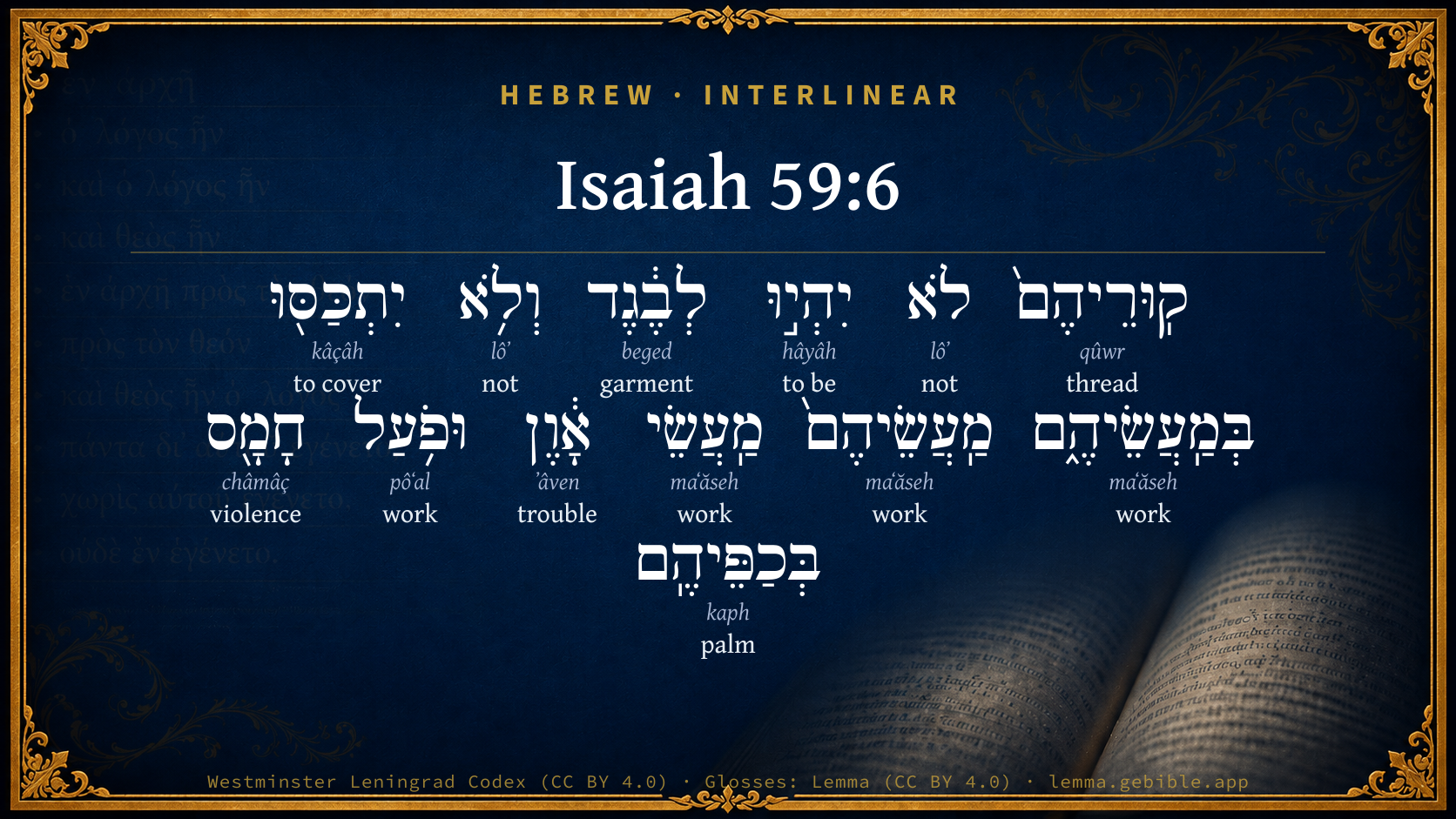
Hebrew (Westminster Leningrad Codex) Isaiah 59:6 appears in the Hebrew Old Testament. The text above is from the Westminster Leningrad Codex. Each word links to its Strong’s number, a concise gloss, and parsing drawn from the Open Scriptures Hebrew Bible morphology. Click any word for its full Brown-Driver-Briggs (BDB) entry.
Download image
Cite this verse

Isaiah 59:6 (World English Bible). Public Domain. Lemma interlinear Bible study tool, https://lemma.gebible.app/v/isaiah/59/6.

Show BibTeX & RIS
BibTeX
RIS
English Translation
Their webs shall not become garments, neither shall they cover themselves with their works: their works are works of iniquity, and the act of violence is in their hands.
World English Bible · Public Domain
Download a study sheet

One document with this verse’s original text, its word-by-word gloss line, the meaning frame, cross-references with their text, attributed commentary, and full source and license credits — printable, and it pastes into notes with its structure intact.

This verse Autodidact and up

Study sheet (.html) Plain text (.txt)

A passage Seminary Student

Up to 50 verses in one chapter. A passage sheet keeps up to 6 commentary sources and 12 cross-references per verse, in the order this page ranks them, and says so on the sheet whenever that leaves anything out. Ask for a single verse and you get the Autodidact verse sheet above.

Everything on this page stays free to read, with no account — the sheet is a download of what is already on screen, not access to it.

Want to remove ads? Support Godless Engineer
Compare translations 3

The same verse in 3 English versions, stacked beneath the original-language interlinear above. Click any original word for its lexicon entry.

Each is an independent rendering of the whole verse — the interlinear is not word-aligned to these translations.

Highlighted words mark where these versions differ — a whole-verse word diff, not a word-by-word alignment.

  • World English Bible Public Domain
    Their webs shall not become garments, neither shall they cover themselves with their works: their works are works of iniquity, and the act of violence is in their hands.
  • King James Version Public Domain
    Their webs shall not become garments, neither shall they cover themselves with their works: their works are works of iniquity, and the act of violence is in their hands.
  • unfoldingWord Literal Text CC BY-SA 4.0
    Their webs will not become clothing, and they will not cover themselves with their works. Their works works of iniquity, and a deed of violence in their palms.

unfoldingWord Literal Text — © unfoldingWord, licensed CC BY-SA 4.0. Word-aligned USFM3 via Door43 (git.door43.org/unfoldingWord/en_ult).

Versions to compare (up to 4)

3 of 4 selected

Show all 18 translations

Every available English version of this verse, each an independent rendering of the whole verse.

  • World English Bible Public Domain
    Their webs shall not become garments, neither shall they cover themselves with their works: their works are works of iniquity, and the act of violence is in their hands.
  • Berean Standard Bible Public Domain
    Their cobwebs cannot be made into clothing, and they cannot cover themselves with their works. Their deeds are sinful deeds, and acts of violence are in their hands.
  • Majority Standard Bible Public Domain
    Their cobwebs cannot be made into clothing, and they cannot cover themselves with their works. Their deeds are sinful deeds, and acts of violence are in their hands.
  • King James Version Public Domain
    Their webs shall not become garments, neither shall they cover themselves with their works: their works are works of iniquity, and the act of violence is in their hands.
  • American Standard Version (1901) Public Domain
    Their webs shall not become garments, neither shall they cover themselves with their works: their works are works of iniquity, and the act of violence is in their hands.
  • Revised Version (1885) Public Domain
    Their webs shall not become garments, neither shall they cover themselves with their works: their works are works of iniquity, and the act of violence is in their hands.
  • Geneva Bible (1599) Public Domain
    Their webbes shall be no garment, neither shall they couer themselues with their labours: for their workes are workes of iniquitie, and the worke of crueltie is in their handes.
  • Douay-Rheims (1899) Public Domain
    Their webs shall not be for clothing, neither shall they cover themselves with their works: their works are unprofitable works, and the work of iniquity is in their hands.
  • Young's Literal Translation Public Domain
    Their webs become not a garment, Nor do they cover themselves with their works, Their works `are' works of iniquity, And a deed of violence `is' in their hands.
  • Literal Standard Version CC BY-SA 4.0
    Their webs do not become a garment, || Nor do they cover themselves with their works, || Their works [are] works of iniquity, || And a deed of violence [is] in their hands.
  • Unlocked Literal Bible CC BY-SA 4.0
    Their webs cannot be used for garments, nor can they cover themselves with their works. Their works are works of sin, and deeds of violence are in their hands.
  • unfoldingWord Literal Text CC BY-SA 4.0
    Their webs will not become clothing, and they will not cover themselves with their works. Their works works of iniquity, and a deed of violence in their palms.
  • Darby Bible Public Domain
    Their webs shall not become garments, neither shall they cover themselves with their works; their works are works of iniquity, and the act of violence is in their hands.
  • World Messianic Bible Public Domain
    Their webs won’t become garments. They won’t cover themselves with their works. Their works are works of iniquity, and acts of violence are in their hands.
  • Webster's Bible Public Domain
    Their webs shall not become garments, neither shall they cover themselves with their works: their works are works of iniquity, and the act of violence is in their hands.
  • Free Bible Version CC BY-SA 4.0
    Their webs can't be made into clothes; they can't cover themselves by what they produce. What they do is wicked; they use their hands to commit violence.
  • Bible in Basic English Public Domain
    Their twisted threads will not make clothing, and their works will give them nothing for covering themselves: their works are works of sin, and violent acts are in their hands.
  • JPS Tanakh (1917) Public Domain
    Their webs shall not become garments, neither shall men cover themselves with their works; their works are works of iniquity, and the act of violence is in their hands.

Literal Standard Version (2020), Covenant Press — licensed CC BY-SA 4.0. Text via the HelloAO Bible API (eBible.org). Unlocked Literal Bible (unfoldingWord) — licensed CC BY-SA 4.0. Text via the HelloAO Bible API (eBible.org). unfoldingWord Literal Text — © unfoldingWord, licensed CC BY-SA 4.0. Word-aligned USFM3 via Door43 (git.door43.org/unfoldingWord/en_ult). Free Bible Version, Dr. Jonathan Gallagher — licensed CC BY-SA 4.0. Text via the HelloAO Bible API (eBible.org).

Word by word

More ways to search: Search by grammar → Find every occurrence → Compare this word →

Practice this passage: Drill this verse → Learn its vocabulary →

קֽוּרֵיהֶם֙
qûwr
H6980
“threads · their”
Noun, Common, Masculine, Plural, Construct + Suffix, Personal, 3rd Person, Masculine, Plural
Part of Speech
Noun
Type
Common
Gender
Masculine
Number
Plural
State
Construct
Full BDB Definition

Origin: from H6979

TWOT: 2005a

thread, film, web
  1. לֹא lôʼ H3808 “not” Particle, Negative
  2. יִהְי֣וּ hâyâh H1961 “to be” Verb, Qal, Imperfect, 3rd Person, Masculine, Plural
  3. לְבֶ֔גֶד beged H899 “to/for · garment” Preposition + Noun, Common, Masculine, Singular, Absolute
  4. וְלֹ֥א lôʼ H3808 “and · not” Conjunction + Particle, Negative
  5. יִתְכַּסּ֖וּ kâçâh H3680 “to cover” Verb, Hithpael, Imperfect, 3rd Person, Masculine, Plural
  6. בְּמַֽעֲשֵׂיהֶ֑ם maʻăseh H4639 “in/at · works · their” Preposition + Noun, Common, Masculine, Plural, Construct + Suffix, Personal, 3rd Person, Masculine, Plural
  7. מַֽעֲשֵׂיהֶם֙ maʻăseh H4639 “works · their” Noun, Common, Masculine, Plural, Construct + Suffix, Personal, 3rd Person, Masculine, Plural
  8. מַֽעֲשֵׂי maʻăseh H4639 “works of” Noun, Common, Masculine, Plural, Construct
  9. אָ֔וֶן ʼâven H205 “trouble” Noun, Common, Masculine, Singular, Absolute
  10. וּפֹ֥עַל pôʻal H6467 “and · work of” Conjunction + Noun, Common, Masculine, Singular, Construct
  11. חָמָ֖ס châmâç H2555 “violence” Noun, Common, Masculine, Singular, Absolute
  12. בְּכַפֵּיהֶֽם kaph H3709 “in/at · palms · their” Preposition + Noun, Common, Feminine, Dual, Construct + Suffix, Personal, 3rd Person, Masculine, Plural

About this verse

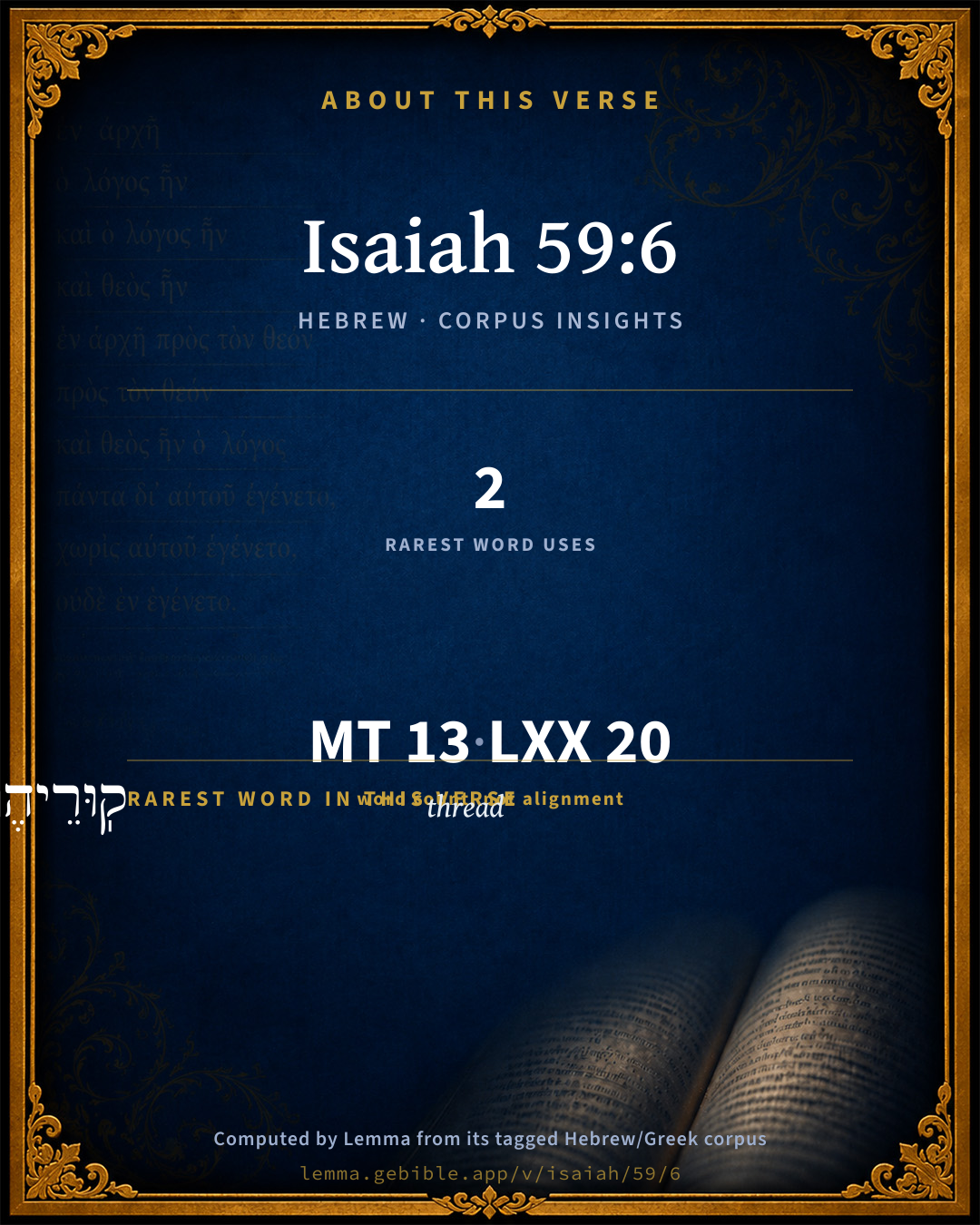
These counts appear in no published source. They are computed here, from the morphology-tagged text and Lemma’s own curated glosses. What Lemma adds →

13
words
10
distinct lemmas
Prophets
section

Notable vocabulary

The rarest word here is קֽוּרֵיהֶם֙ thread H6980 — appearing just 2 times in the whole Hebrew Bible.

Shared distinctive vocabulary

קֽוּרֵיהֶם֙ thread H6980 occurs in 2 verses of the Hebrew Bible. Also found in:

Grammatical profile

  • 2 verbs
  • 9 nouns
  • 2 particles

Verb forms

  • יִהְי֣וּ Qal · Imperfect
  • יִתְכַּסּ֖וּ Hithpael · Imperfect

Repetition

Words recur within this verse — often emphatic in Hebrew:

  • בְּמַֽעֲשֵׂיהֶ֑ם work H4639 ×3
  • לֹא not H3808 ×2

Hebrew & Septuagint length

In English translation the verse runs 29 words from the Hebrew and 24 from the Septuagint (LXX English) — closely comparable.

A rough comparison of the two English renderings, which tokenize alike — not a word-level alignment.

Word counts can differ between the Hebrew and the Greek without any difference in meaning — e.g. the Hebrew direct-object marker אֵת has no separate Greek word, and Greek often adds the article ὁ.

In the original languages it is 13 Hebrew tokens and 20 Greek tokens — but the two are counted differently (Hebrew bundles its prefixes and suffixes into one token; the Greek is in lemma form), so that isn’t a like-for-like length.

Cross-references

25

Topical passages linked to Isaiah 59:6 in the Treasury of Scripture Knowledge — connected by theme and wording, ordered by reader-vote popularity; previews shown in the World English Bible.

  • Isaiah 57:12 I will declare your righteousness; and as for your works, they shall not profit you.
  • Jeremiah 6:7 As a well casts forth its waters, so she casts forth her wickedness: violence and destruction is heard in her; before me continually is sickness and wounds.
  • Revelation 3:17–18 Because you say, 'I am rich, and have gotten riches, and have need of nothing;' and don't know that you are the wretched one, miserable, poor, blind, and naked;
  • Genesis 6:11 The earth was corrupt before God, and the earth was filled with violence.
  • Job 8:14–15 Whose confidence shall break apart, Whose trust is a spider's web.
  • Psalms 58:2 No, in your heart you plot injustice. You measure out the violence of your hands in the earth.
  • Isaiah 5:7 For the vineyard of Yahweh of Hosts is the house of Israel, And the men of Judah his pleasant plant: And he looked for justice, but, behold, oppression; For righteousness, but, behold, a cry of distress.
  • Isaiah 28:18–20 Your covenant with death shall be annulled, and your agreement with Sheol shall not stand; when the overflowing scourge shall pass through, then you shall be trodden down by it.
  • Isaiah 30:1 Woe to the rebellious children, says Yahweh, who take counsel, but not of me; and who make a league, but not of my Spirit, that they may add sin to sin,
  • Isaiah 30:12–14 Therefore thus says the Holy One of Israel, "Because you despise this word, and trust in oppression and perverseness, and rely thereon;
  • Isaiah 58:4 Behold, you fast for strife and contention, and to strike with the fist of wickedness: you don't fast this day so as to make your voice to be heard on high.
  • Isaiah 64:6 For we are all become as one who is unclean, and all our righteousness are as a polluted garment: and we all do fade as a leaf; and our iniquities, like the wind, take us away.
  • Ezekiel 7:11 Violence is risen up into a rod of wickedness; none of them [shall remain], nor of their multitude, nor of their wealth: neither shall there be eminency among them.
  • Ezekiel 7:23 Make the chain; for the land is full of bloody crimes, and the city is full of violence.
  • Amos 3:10 "Indeed they don't know to do right," says Yahweh, "Who hoard plunder and loot in their palaces."
  • Amos 6:3 Those who put far away the evil day, And cause the seat of violence to come near;
  • Micah 2:1–3 Woe to those who devise iniquity And work evil on their beds! When the morning is light, they practice it, Because it is in the power of their hand.
  • Micah 2:8 But lately my people have risen up as an enemy. You strip the robe and clothing from those who pass by without a care, returning from battle.
  • Micah 3:1–11 I said, "Please listen, you heads of Jacob, And rulers of the house of Israel: Isn't it for you to know justice?
  • Micah 6:12 Her rich men are full of violence, Her inhabitants speak lies, And their tongue is deceitful in their speech.
  • Habakkuk 1:2–4 Yahweh, how long will I cry, and you will not hear? I cry out to you "Violence!" and will you not save?
  • Zephaniah 1:9 In that day, I will punish all those who leap over the threshold, who fill their master's house with violence and deceit.
  • Zephaniah 3:3–4 Her princes in the midst of her are roaring lions. Her judges are evening wolves. They leave nothing until the next day.
  • Romans 3:20–22 Because by the works of the law, no flesh will be justified in his sight. For through the law comes the knowledge of sin.
  • Romans 4:6–8 Even as David also pronounces blessing on the man to whom God counts righteousness apart from works,

Cross-references courtesy of OpenBible.info (CC BY 4.0).

Hebrew and Greek witnesses Masoretic Hebrew ↔ Greek Septuagint

The same verse in the two great witnesses to the Old Testament, shown verse-for-verse.

These are two independent witnesses, not word-aligned to each other, and the Septuagint is shown in lemma (dictionary) form.

Hebrew Isaiah 59:6 Masoretic · Westminster Leningrad Codex

קֽוּרֵיהֶם֙ לֹא יִהְי֣וּ לְבֶ֔גֶד וְלֹ֥א יִתְכַּסּ֖וּ בְּמַֽעֲשֵׂיהֶ֑ם מַֽעֲשֵׂיהֶם֙ מַֽעֲשֵׂי אָ֔וֶן וּפֹ֥עַל חָמָ֖ס בְּכַפֵּיהֶֽם

Their webs shall not become garments, neither shall they cover themselves with their works: their works are works of iniquity, and the act of violence is in their hands.

World English Bible · Public Domain

Greek LXX Isaiah 59:6 Septuagint · lemma form

ὁ ἱστός αὐτός οὐ εἰμί εἰς ἱμάτιον οὐδέ μή περιβάλλω ἀπό ὁ ἔργον αὐτός ὁ γάρ ἔργον αὐτός ἔργον ἀνομία

Their web shall not become a garment, nor shall they at all clothe themselves with their works; for their works are works of iniquity.

LXX2012 (modern English Septuagint) · Public Domain

Hebrew: Westminster Leningrad Codex (CC BY 4.0). Greek: Septuagint (public domain); English from LXX2012 (modern English Septuagint) (Public Domain). How the Septuagint differs from the Hebrew →

Targum (Aramaic paraphrase)

1

The Targum is the ancient Jewish Aramaic paraphrase of the Hebrew Scriptures — an interpretive translation, not the Hebrew text itself. Onkelos (literal) and Pseudo-Jonathan (expansive) render the Torah, and Jonathan the Prophets. Coverage is partial: where no permissively-licensed English translation exists for a verse, only the Aramaic is shown. This is verse-level text, not a word-by-word alignment to the Hebrew.

  1. Targum Jonathan Prophets (Joshua–Malachi)
    הָא כְקַוִין דְעַכּוֹבִיתָא דְלָא כַשְׁרִין לְאִתְכַּסָאָה כֵּן לֵית הֲנָאָה בְּעוֹבָדֵיהוֹן דְרַשִׁיעַיָא עוֹבָדֵיהוֹן עוֹבָדֵי אוֹנֶס וְלֵיאוּת שְׁקַר בִּידֵהוֹן:

    Behold, like a spider's web, with which no one can be covered, thus there is no profit from the works of the wicked; their works are the works of violence, and the work of a lie is in their hands.

    Targum Jonathan — Aramaic: “Mikraot Gedolot” (public domain). English: “Sefaria Community Translation” (CC0 1.0 (public-domain dedication)); “London "Chaldee Paraphrase," 1871” (public domain). Text via Sefaria.

Commentary

Notes on Isaiah 59:6 from classic Christian and Jewish commentators (each source and its license shown beneath its notes). The classic Christian expositions comment on the surrounding passage and are grouped to its opening verse, so a note may address several verses; the Jewish commentaries on the Tanakh (Rashi and others) are per-verse, so they appear only where the commentator wrote on this verse.

Lemma curates 59 commentaries, every one of them public domain or Creative Commons licensed, each selected and text-cleaned for this edition rather than reprinted as found. About our sources →

Trapp's Complete Commentary

John Trapp

Isa 59:6 Their webs shall not become garments, neither shall they cover themselves with their works: their works [are] works of iniquity, and the act of violence [is] in their hands.

Ver. 6. Their webs shall not become garments.] "Garments" quasi gardments; one use of them being to guard our bodies from the injury of wind and weather. Wicked devices and false doctrines profit not those that are therein occupied. {as Heb 13:9} In the day of God’s wrath, they will prove but as a coat of cobweb.

Their works are works of iniquity.] Here ministers may learn roundly to reprove the sins of the people.

John Trapp, A Commentary or Exposition upon All the Books of the Old and New Testament (1647–1656) — public domain. Text from a community e-Sword module.

The Biblical Illustrator

Joseph S. Exell

Isa_59:6

Their webs shall not become garments

The art of weaving

The art of weaving is older than human history; figures drawn from it are found in the earliest literature of all nations.

It is frequently employed in the Word of God to set forth the sublimest truths of life, and in the classical mythologies it occupies an even more important place. The three fates preside over the lives of men, and they practise the weavers art. Clothe holds the threads, Lachesis introduces the warp, and the grim goddess Atropos cuts the web when the fabric of human destiny is complete. In later times we find the figure with a still wider import. The spirit of Goethes Faust labours in the workshop of the spring-time to weave the garment for Nature by which God Himself may be seen by mortals. Thus in all the ages of the world the figure of the loom has commended itself as one most aptly setting forth the deepest truths of human experience. (J. Wallace, M. A.)

Character as a web

The prophet Isaiah has laid hold on the idea, now a commonplace of our thought, that all character is a web. In the case of all the web is variegated; in the case of some the piece is spoiled by rotten threads. As our days fly past they dart across the warp of the Divine purposes the woof of human action and human thought, and the marvel is that multitudes live on in brutish carelessness while the loom of life spins on. We look back on a misspent day with the wretched consolation that it will be all the same a hundred years hence. Will it? If threads missing in the web do not spoil its market value, then it may; but if one false thread ruins the whole, then life with one day misspent is by so much of less value in the sight of God. (J. Wallace, M. A.)

Hopeless weaving

From our text we wish to look at one or two methods of character-weaving which are doomed to miserable failure when the web of life is spun.

I. There are HALF-DONE DUTIES. Multitudes perform their duty in such a way that it is but half done. In the ordinary routine of life they are always a little late, and consequently have to work with haste. Or take the higher duty of man to love God and keep His commandments. There are moments of Pisgah vision, but what weary leagues of plain are there unredeemed by any thought of God! This half-done duty is lifes shuttle plied with a palsied hand, and the fabric of character is such as in the end will put the weaver to the blush.

II. There are HALF-CONQUERED TEMPTATIONS. Many a man is conquered who does not fall.

III. What is the secret of duties half done, of temptation half conquered? The secret is HALF-CONSECRATED LIVES. If all the provinces of the soul do not obey the Divine mandate, we need not be astonished if rebellion sometimes shows its head. When we have done our best to weave, we are not to go to heaven in our own garments. Christ has provided raiment for His people, woven on the Cross and dyed there in colours more enduring than Tyrian purple. We have to weave as those who have to prove their calling, not win it. (J. Wallace, M. A.)

Projects injurious to others are hurtful to self

They may do hurt to others with their projects, but can never do any real service or kindness to themselves, by them. There is nothing to be got by sin. (M. Henry.)

Unprofitable Weaving

Our text speaks of works which are inadequate to the purpose for which they are performed. An unprofitable and useless manufacture is denounced. What should we think of a manufacturer who persisted in making a kind of cloth so flimsy and rotten that it would hardly hold together--so weak and threadbare that either it could not be made up into garments, or, if it were, they would be useless for either adornment or comfort. And how great would be our astonishment if this imprudent man actually proceeded to clothe himself with the flimsy stuff he had made! Yet such, in a moral sense, is the conduct of those who are condemned in our text. They weave a web with which they try in vain to effectually clothe themselves. The web is the fabric of their own righteousness, or works. The persons spoken of are they who are self-sufficient in their wickedness and pride of heart. They are unrighteous people, who think themselves righteous, or who desire to be thought so by others. But the material they produce is as flimsy as a spiders web; and it will serve for neither decency nor comfort, for neither ornament nor use. Let us think of the purposes a garment is intended to serve, and we shall be supplied with various illustrations of the utter inadequacy of self-righteousness.

I. A GARMENT IS DESIGNED FOR PERSONAL COMFORT. A garment is useless, and even intolerable, unless it affords warmth and ease. We are quite unable to produce a fabric which will afford either substantial comfort or permanent peace.

1. However genuine our present righteousness might be, it would not absolve us from the guilt of past sin.

2. Our own righteousness is insufficient for comfort because, it leaves, untouched the passions of the unregenerate- heart.

3. Our own righteousness is inadequate for comfort because it affords no effectual protection against temptation.

II. THE SECOND PURPOSE--A GARMENT IS INTENDED TO SERVE IS DECENCY. A garment which is ill-fitting, or of unseemly pattern, or formed of coarse and worthless material, is unpleasing to others no less, and possibly more, than to the wearer himself. And ones own righteousness--that is the righteousness which is not produced under the influence of the Holy Spirit--will no more bear the scrutiny of ones fellow-men, than would a ragged coat or a draggled and threadbare dress. Like an inferior garment, it may pass muster in the crowd, or escape criticism on a casual view, but it will not bear close inspection. A man cannot so cover himself with his own righteousness as to appear at all times decently and respectably clothed.

1. The garment is so thin that it does not hide the natural ugliness of the soul.

2. It is likewise so limited in its dimensions as to cause serious disfigurement of the life.

3. The garment of self-righteousness is undurable.

III. THE GARMENT OF SELF-RIGHTEOUSNESS IS INTENDED TO SECURE FOR ITS WEARER ACCEPTANCE WITH GOD. There are garments which are necessary for certain occasions, or for admission to particular places. Such was the wedding garment in the East, and such is the modern court dress. The garment of outward works is designed by the wearer to serve a similar purpose. It is intended as a recommendation to the favour of God and a passport to heaven. But it will answer neither of these ends. If we would sustain the scrutiny of God, we must be clothed in something of finer texture, of stronger substance, and of richer hue, than the flimsy and bedraggled garment of our own righteousness.

1. It will not cover us to the satisfaction of God because of its insufficient dimensions and its many flaws.

2. Nor is it in fact any real covering in the sight of God. Let us learn the worthlessness of merely outward righteousness, and the absolute necessity of repentance, regeneration, and holiness of heart. (J. W. Keyworth.)

Webs and garments

A mere web of cloth might be said to be of no practical use. It may lie on the shelves in the drapers shop for a time, but it is intended for something beyond that. The ultimate purpose in connection with it is the garments that may be made from it. It has possibilities--the possibility of garments in it--and that was intended from the first. It has not realized the intention regarding it until it is ultimately turned into garments. So when the prophet says, Their webs shall not become garments, he is referring to the wicked plans of wicked men among the Israelites, and means that their plans would not reach the final, the complete and practical stage. Their purposes would be frustrated by a higher Hand. The words may be applied to ourselves, and in various ways.

I. SOME PURPOSES ARE FRUSTRATED BECAUSE OF SOMETHING LACKING IN OURSELVES--indolence, want of energy, or want of ability to complete our purposes.

II. SOME PURPOSES ARE FRUSTRATED BECAUSE OF POSITIVE HINDRANCES IN THE WAY THAT WE CANNOT SURMOUNT, AND THAT PERSONALLY WE MAY HAVE NOTHING TO DO WITH. It is to us one of the most inexplicable things in Providential dealing, how men who devote themselves to a great and good object, and who seem to us essential for its success, are often cut down in the mid-time of their days, just when to our eyes their presence seemed most needed. Why should it be so? No doubt we should see things differently, however, if with wider vision we could look before and after; and find that, higher ways than we can dream of, men whose plans seem to be frustrated are more than satisfied with the Divine mode of dealing. In the text it is wicked purposes that are referred to, and though often a good purpose seems to be checked as well, yet there will be no real failure in lifes plans if we live according to our light. Working in line with God there is a deeper sense in which, instead of our webs not becoming garments, it might be said that the very stars in their courses will fight for us. The great purpose of our life will be fulfilled if we keep near to God. Conclusion:

1. This true success is, above all and first of all, an inward thing. It refers pre-eminently to the inward condition. It must begin there.

2. We see not yet all things put under Him, but we see Jesus. Whether as to humanity as a whole, or as to individuals, that is true; all things are not yet put under, but there is ever one source of help and hope, and only one. Looking unto Jesus, if that be the attitude of our life, then it cannot be said, whatever befall, that lifes purpose has failed, and in higher ways than we can tell our webs shall become garments, the beautiful and durable garments of the soul. (J. S. Mayer, M. A.)

The Biblical Illustrator, edited by Joseph S. Exell (c. 1880s–1900s) — public domain. Text from a community e-Sword module.

The Preacher's Complete Homiletical Commentary

Joseph S. Exell (gen. ed.)

WEBS BUT NOT GARMENTS

Isa_59:6. Their webs shall not become garments

What a telling blow the prophet deals at the corruptions of his age! His illustration is homely, but, on that account, all the more forcible. The whole passage presents an appalling picture of the state of society,—powers perverted, &c. The two things always go together—the practice of wickedness, and recourse to vain excuses to palliate it. An evil course cannot long be pursued without some plea which justifies it to the sinner’s mind. These fictions are the very food on which his sin lives. Tear them away, and you strip him of those defences behind which he fortifies himself in the practice of iniquity. This is what God’s prophet is trying to do; not only denouncing sin, but exposing the worthlessness of the pleas by which it is encouraged. These fancies he characterises as “spiders’ webs” (Isa_59:5); and, continuing the metaphor (Isa_59:6), he declares—“Their webs shall not become garments.” It is a kindness to undeceive one who labours under a fatal mistake, however unpleasant the task. Some of you are the victims of soul-destroying delusions; but soon you will pass into a world of reality, where every dark subterfuge in which you try to hide yourselves, will be illumined in all its corners by the fierce and searching light of eternity. You are weaving your subtle webs of fancy and practice now, bestowing pains upon them, thinking well of them, and gaining the approval of others; but they are mere shoddy, which, though it pass from the loom, is worthless for wear. Let us visit some of the looms in the great factory of human life, and see what sort of fabrics the weavers are turning out.

I. There is one who is weaving the web of a respectable life. Living for appearances, squaring his opinions and behaviour by the maxims of the world; pleasant and accommodating whatever company he may enter, and putting up even with Christian society, if they are not too decided. No strong principles has he to bring him into collision with other people. His principle is to have no principles, but to fall in with those of others. If ever he offered a real prayer it would be—“O God, keep me on good terms with the world; save me from anything that would incur its censure, or draw down upon me its frown.” He worships the goddess of respectability. It would never do for him to be anything but sober, honest, and industrious. He cannot throw into his web the dark threads which they use who have sunk so low as to have no regard even for public opinion. It has attractive colours and a glossy surface. Such goods are in demand in the world’s market; but with no higher purpose, his web shall not become a garment. He has lived without the thought of God, and tried to do as others do, not what conscience and Scripture command.

II. At another loom sits a busy worker weaving the web of formalism. The formalist sees something good in religion, but is mistaken as to the way in which its blessedness is secured. His trust is in the outward observance of religious ceremonies, forgetting that the Kingdom of God is a thing of the heart. Precise and regular in his church attendance and Sabbath observance, he is yet cold and heartless. No warm, loving impulse stirs his soul. He has made a god of religious routine (Job_8:13-14). It is hard to undeceive such a man, just because of his familiarity with sacred things (Mat_21:31). He who weaves such a web, is only preparing a winding-sheet for his dead soul.

III. There is another weaving the web of self-righteousness. Not blindly trusting in ceremonies, but relying on an upright life. Without a change of heart he tries to obey the law (Rom_10:3), but his view of sin is defective. So long as the Divine law is regarded as an outward rule, you may think you render a tolerably perfect obedience, but let its light shine into the heart and it reveals the sinner’s guilt (Rom_7:7-9). Self-righteousness may be a web, but it never shall become a garment (Isa_57:12; Isa_64:6). We are to work not for but from acceptance and pardon. Never can we fulfil the law until the heart has been changed by the experience of God’s mercy (Php_3:9).

IV. Further on we encounter another who is weaving the web of reliance on the future. A young man who promises himself long life and abundant opportunity. He is bent on trying some experiments in weaving before he settles down to serious work. He means to attend to religious matters, but not just now. Can he count upon the uncertain future? can he promise himself inclination and opportunity? That is the web which the young are prone to weave. How is it with those more advanced in life?

V. Here is an old man busily weaving the web of amendment, thinking thus to atone for the vices and follies of an ill-spent youth. But can any resolution for the future wipe out the guilt of the erring past? If he wishes to begin life anew he must go to the cross, and make that his starting-point, but he blindly imagines that reformation of life will supply the garment which he needs.

VI. Have I exhausted the various classes of weavers? Alas for our race if I have! Many find the requisite garment provided for them in the righteousness of Christ (Rom_3:21-26; Rom_4:5). It fits us, becomes us, protects us, will never grow old, and will never be out of fashion. How can you appear before God in the flimsy dress of your own manufacture? (Mat_22:11-13). But do we cease to be weavers when we “put on the Lord Jesus Christ?” The weaving of the right sort can only then begin; for, the righteousness wrought out for us and imputed becomes a righteousness wrought in us and imparted. Christ takes the web of our life into his own hands (1Co_1:30; Gal_2:20). Instead of leading to licentiousness a free justification alone can sanctify the life (Rom_6:1-4).

To which class of weavers do you belong? Look at your life—how profitless, purposeless, and polluted! Can that web clothe you for standing before God, when it is finished and removed from the beam? Throw it away, tear it to shreds, abandon alike your good and bad works, and listen to the Redeemer’s voice (Rev_3:18). You pity the poorly-clad amid the biting frosts and snows of winter, but more to be pitied are they who advance into the winter of declining years, the chill region of death, and the storms of judgment, with no sufficient clothing for their defenceless souls!—William Guthrie, M.A.

Isa_59:7. Depravity. I. Has its seat in the heart. II. Its expression in the conduct. III. Its issue in misery and ruin.—J. Lyth, D.D.

Isa_59:8. I. The characters described. Those who make crooked paths—

1. From the line of duty prescribed by the law.

2. By the Gospel.

3. By conscience. II. Their awful condition. Cannot know peace. In life—death—eternal world.—C. Simeon, M.A.

The path of transgressors is one—I. Of contention. II. Of injustice. III. Of perverseness. IV. Of misery.

Isa_59:9-15. I. The misery of sinners. No light, comfort, certainty, security, relief, salvation. II. The cause. Transgression multiplied, acknowledged, aggravated, open, wilful, exciting justly the displeasure of God.—Dr. Lyth.

The Preacher's Complete Homiletical Commentary (gen. ed. Joseph S. Exell; Funk & Wagnalls, c. 1892) — public domain (pre-1929). A full-Bible homiletical/sermon-outline anthology covering 65 of 66 books (2 John is absent from the source module). Text from a community e-Sword module.

MacLaren's Expositions of Holy Scripture

Alexander MacLaren

Isaiah

FLIMSY GARMENTS

Isa 59:6. - Rev 3:18.

The force of these words of the prophet is very obvious. He has been pouring out swift, indignant denunciation on the evil-doers in Israel; and, says he, ‘they hatch cockatrice’s eggs and spin spiders’ webs,’ pointing, as I suppose, to the patient perseverance, worthy of a better cause, which bad men will exercise in working out their plans. Then with a flash of bitter irony, led on by his imagination to say more than he had meant, he adds this scathing parenthesis, as if he said, ‘Yes, they spin spiders’ webs, elaborate toil and creeping contrivance, and what comes of it all! The flimsy foul thing is swept away by God’s besom sooner or later. A web indeed! but they will never make a garment out of it. It looks like cloth, but it is useless.’ That is the old lesson that all sin is profitless and comes to nothing.

I venture to connect with that strongly figurative declaration of the essential futility of godless living, our second text, in which Jesus uses a similar figure to express one aspect of His gifts to the believing soul. He is ready to clothe it, so that ‘being clothed, it will not be found naked.’

I. Sin clothes no man even here.

Notice in passing what a hint there is of the toil and trouble that men are so willing to take in a wrong course. Hatching and spinning both suggest protracted, sedulous labour. And then the issue of it all is- nothing.

Take the plainest illustrations of this truth first-the breach of common laws of morality, the indulgence, for instance, in dissipation. A man gets a certain coarse delight out of it, but what does he get besides? A weakened body, a tyrannous craving, ruined prospects, oftenest poverty and shame, the loss of self-respect and love; of moral excellences, of tastes for what is better. He is not a beast, and he cannot live for pure animalism without injuring himself.

Then take actual breaches of human laws. How seldom these ‘pay,’ even in the lowest sense. Thieves are always poor. The same experience of futility dogs all coarse and palpable breaches of morality. It is always true that ‘He that breaketh a hedge, a serpent shall bite him.’

The reasons are not far to seek. This is, on the whole, God’s world, a world of retribution. Things are, on the whole, on the side of goodness. God is in the world, and that is an element not to be left out in the calculation. Society is on the side of goodness to a large extent. The constitution of a man’s own soul, which God made, works in the same direction. Young men who are trembling on the verge of youthful yieldings to passion, are tempted to fancy that they can sow sin and not reap suffering or harm. Would that they settled it in their thoughts that he who fires a fuse must expect an explosion!

But the same rule applies to every godless form of life. Take our Manchester temptation, money or success in business. Take ambition. Take culture, literary fame. Take love and friendship. What do they all come to, if godless? I do not point to the many failures, but suppose success: would that make you a happy man? If you won what you wanted, would it be enough? What ‘garments’ for your conscience, for your sense of sin, for your infinite longings would success in any godless course provide? You would have what you wanted, and what would it bring with it? Cares and troubles and swift satiety, and not seldom incapacity to enjoy what you had won with so much toil. If you gained the prize, you would find clinging to it something that you did not bargain for, and that took most of the dazzle away from it.

II. The rags are all stripped off some day.

Death is a becoming naked as to the body, and as to all the occupations that terminate with bodily life. It necessarily involves the loss of possessions, the cessation of activities, the stripping off of self-deceptions, and exposure to the gaze of the Judge, without defence. The godless soul will ‘be found naked’ and ashamed. All ‘works of darkness,’ laden with rich blossom or juicy fruit though they have seemed to be, will then be seen to be in tragic truth ‘fruitless.’ A life’s spinning and weaving, and not a rag to cover the toiler after all! Is that ‘productive labour’?

III. Christ will clothe you.

‘White raiment.’ Pure character. Covering before the Judge. Festal robe of Victory.

‘Buy’-how? By giving up self.

Alexander MacLaren, Expositions of Holy Scripture (1904–1910) — public domain. Text from a community e-Sword module.

Jamieson, Fausset & Brown

Robert Jamieson, A. R. Fausset & David Brown

not . . . garments--like the "fig leaves" wherewith Adam and Eve vainly tried to cover their shame, as contrasted with "the coats of skins" which the Lord God made to clothe them with (Isa 64:6; Rom 13:14; Gal 3:27; Phi 3:9). The artificial self-deceiving sophisms of human philosophy (Ti1 6:5; Ti2 2:16, Ti2 2:23).

Jamieson, Fausset & Brown — Commentary Critical and Explanatory on the Whole Bible (1871) — public domain (CC PDM 1.0). Text via the HelloAO Bible API.

Ellicott's Commentary for English Readers

(6) Their webs shall not become garments.—See the same figure in Isa_30:1. The point of the comparison lies chiefly in the uselessness of the spider’s webs, but the second clause emphasises also the fact that the only purpose which the webs serve is one of mischief. They may catch flies, they cannot clothe men.

A Bible Commentary for English Readers, edited by Charles John Ellicott (1878–1897) — public domain. Text from a community e-Sword module.

The Cambridge Bible for Schools and Colleges

gen. ed. J. J. S. Perowne

6. Development of the second image of Isa_59:5, the point of comparison being the uselessness for any good social end of the schemes devised by the ungodly.

shall not become garments] i.e. “shall not serve for a garment.”

neither shall they cover themselves &c.] Better, neither shall men cover themselves &c. (indefinite subj.).

The Cambridge Bible for Schools and Colleges (gen. ed. J. J. S. Perowne; Cambridge University Press, 1878–1918) — public domain. Text from a community e-Sword module.

John Gill's Exposition

Their webs shall not become garments, neither shall they cover themselves with their works,.... As spiders' webs are not fit to make garments of, are too thin to cover naked bodies, or shelter from bad weather, or injuries from different causes; so neither the false doctrines of men will be of any use to themselves, or to others that receive them; particularly the doctrine of justification by works: these are not proper garments to cover the nakedness of a sinner from the sight of God, or screen him from avenging justice; but his hope which is placed on them will be cut off, and his trust in them will be a spider's web, of no avail to him, Job 8:14,

their works are works of iniquity: both of preacher and hearer; even their best works are sinful; not only as being imperfect, and having a mixture of sin in them, and so filthy rags, and insufficient to justify them before God; but because done from wrong principles, and with wrong views, and tending to set aside the justifying righteousness of Christ, and God's way of justifying sinners by it, which is abominable to him:

and the act of violence is in their hands; they persecuting such that preach and profess the contrary doctrine.

John Gill's Exposition of the Whole Bible (1746–1763) — public domain (CC PDM 1.0). Text via the HelloAO Bible API.

Albert Barnes' Notes on the Bible

Their webs shall not become garments - The spider’s web is unfit for clothing; and the idea here is, that their works are as unfit to secure salvation as the attenuated web of a spider is for raiment. The sense is, says Vitringa, that their artificial sophisms avail nothing in producing true wisdom, piety, virtue, and religion, or the true righteousness and salvation of people, but are airy speculations. The works of the self-righteous and the wicked; their vain formality, their false opinions, their subtle reasonings, and their traditions, are like the web of the spider. They bide nothing, they answer none of the purposes of a garment of salvation. The doctrine is, that people must have some better righteousness than the thin and gossamer covering which their own empty forms and ceremonies produce (compare Isa 64:6).

Albert Barnes' Notes on the Bible (1834–1885) — public domain. Text from a community e-Sword/MySword module.

Matthew Poole's English Annotations

Their webs shall not become garments, i.e. their contrivances and deep designs shall not advantage them, they being like a thin and raw garment, either through which all their wretchedness and malice will appear, as the next words intimate; or, for want of solidity and substance, shall not be able to defend them from their impending evils.

Works of iniquity, i.e. works of injustice, whereby their grieve and vex their brethren, which the next words do clear. The act of violence is in their hands, i.e. they exercise themselves in all acts of violence and oppression.

Matthew Poole's English Annotations on the Holy Bible (1683–1685) — public domain. Text from a community e-Sword/MySword module.

The Pulpit Commentary

Their webs shall not become garments. The unsubstantial fabrics which they weave shall not serve them in any way as garments, or be of any real value or utility. Their devices shall not take objective shape in such sort as to afford them "cover" or protection. Their works are works of iniquity; rather, works of nothingness, works that make a mere pretence of being works at all, and are in reality mere shams, impotent and delusive. And the act of violence is in their hands; rather, and it is an act of violence that is in their hands. Violence creates nothing. At the best, it destroys.

Webs that will not make garments.

It is the virtue of a garment that it covers. The ideas of covering and of atoning were very closely allied in Hebrew thought. The prophet intimates that there were webs of their own spinning which would never hide their sin from the sight of God. Such are there now. We look at

I THE SOUL"S SUPREME NECESSITY. The presence of sin is the sternest of all facts; the mark which it has made on our manhood is by far the deepest and darkest of any; all others are mere touches, mere scratches in comparison. This is true of the individual as well as of the community. The thing that we have done, more serious and of greater consequence than any other, is that we have sinned against the Lord and come beneath his condemnation. What we most urgently want is a covering for our soul. Our naked and guilty soul imperatively and sorely needs that under which it may appear before God without shame and shrinking, and take its place, in this world or in any other, among the pure, the holy, the righteous. The question is What is that garment which will cover the sinful human soul?

II THE INSUFFICIENCY OF THE PROVISION WHICH SOME MEN ARE MAKING. Many are providing for themselves that which is utterly inadequate; they are spinning webs poor, thin, gossamer productions which "will not become garments" available for this purpose. There is:

1. The web of Christian profession. Some find comfort and complacency of soul in the fact that they are acknowledged members of a Church, ancient, or catholic, or established, or scriptural. Desirable, in many ways, as is an avowal of attachment to Christ, it is not a thing in which to put any trust; a man may be a member of the most scriptural Church, and yet be destitute of that which is vital and essential. "He is not a Jew who is one outwardly," etc. Christian profession is a poor thing for a soul to hide in; it is no true refuge for the human heart; it is a "web that will not make a garment.

2. The web of ceremony and ordinance. Many have an undefined but strong confidence in having passed through Christian ceremonies (Baptism and the Lord"s Supper), or in having been constant in attendance on Divine worship, or in having taken on their lips apostolic and evangelical language; but to trust in these things as garments of salvation is to put "confidence in the flesh": (Php_3:1) they may exist without any faith or love prompting and vitalizing them.

3. The web of correct behaviour abstinence from impurity, inebriety, untruthfulness, trickery, profanity. This is altogether and in every way desirable, and it may be eminently praiseworthy from a human standpoint; but it will not atone for the supreme omission the failure to respond to a heavenly Father"s love, to subject the will to the will of the Creator, to dedicate the life to the service of God. It, too, is a web that will not make a garment with which to cover a sinful soul.

III THE ONE GARMENT TEAT SUFFICES. What did Christ mean by that "wedding garment" without which the guest might not sit down to the marriage-feast? (Mat_22:11) May it not have been the abounding mercy of God unto eternal life, received through faith in a Divine Saviour? (Rom_5:1 Rom_8:1 Php_3:7-9) Men will be just with God, their sins wilt be covered and hidden for evermore, when, in the spirit of penitence and faith, they accept the Saviour of mankind as the Lord in whom they hide and to whom they yield themselves in glad surrender. C.

The Pulpit Commentary (1880–1919), ed. H.D.M. Spence-Jones & Joseph S. Exell — public domain. Text from a community e-Sword module.

John Wesley's Explanatory Notes

Webs - Their contrivances shall not be able to cover or defend them.

John Wesley, Explanatory Notes Upon the Whole Bible (1754–1765) — public domain. Text via the GEBible commentary corpus.

J. A. Alexander on Isaiah

Joseph Addison Alexander

“Their webs shall not become (or be for) clothing, and they shall not cover themselves with their works; their works are works of mischief (or iniquity), and the doing of violence is in their hands.” The first clause does not seem to form a part of what the writer meant at first to say, but is a kind of after-thought, by which he gives a new turn to the sentence, and expresses an additional idea without a change of metaphor. Having introduced the spider’s web, in connection with the serpent’s egg, as an emblem of malignant and treacherous designs, he here repeats the first but for another purpose, namely, to suggest the idea of futility and worthlessness. This application may have been suggested by the frequent reference to webs and weaving as conducive to the comfort and emolument of men; but spiders’ webs can answer no such purpose. The idea that it is not fit or cannot be applied to this end, although not exclusively expressed, is really included in the general declaration that they shall not be so used. Works in the first clause simply means what they have made; but in the second, where the metaphor is dropped, this version would be inadmissible.

Joseph Addison Alexander, The Prophecies of Isaiah (1846–1847; New York: Scribner, 1870–1878) — public domain. Text from a community e-Sword module.

Ibn Ezra

Rabbi Abraham ibn Ezra

Their webs shall not become garments. Their deeds are compared with the spider’s web, that is to say, they are not durable.

Ibn Ezra on the Tanakh — English translations: “Sefaria Community Translation” (CC0 1.0 (public-domain dedication)); “Yalkut, Sifsei Chachomim Chumash, Metsudah Publications, 2009” (CC BY 4.0); and “Commentary of Ibn Ezra on Isaiah - trans. by M. Friedlander, 1873” (public domain). Text via Sefaria.

Lesson kit

Teaching starters — assembled from the data on this page, not authored interpretation. Every prompt links to the verse data it draws on. Edit before teaching.

Isaiah, in the Prophets, opens this verse with 13 words (10 distinct Hebrew lemmas). Its most distinctive word is qûwr (“thread”). A historical commentator’s framing appears above. Read the whole chapter for the surrounding context.

Discussion questions

  1. How does “thread” (qûwr) shape what this verse is saying?
  2. How does Isaiah 59:5, which shares the word «thread», read alongside this verse?
  3. What does the repetition of “work” (3× in this one verse) do in this verse?
  4. These translations render this verse differently. What is at stake in choosing one wording over another?
  5. «יִהְי֣וּ» is a Qal Imperfect verb. How does that grammatical form shape the action described?
  6. Compare how Trapp's Complete Commentary and The Biblical Illustrator read this verse. Where do they agree or differ?

Things to notice

Reading settings

Reading text

Shown beneath each verse's original-language words.

Old Testament
Old Testament edition

Read the OT as the Masoretic Hebrew (MT) or the Greek Septuagint (LXX).

English shown for the Greek Septuagint (in the Hebrew ↔ Greek comparison).

Comparing translations? Open the Compare panel on any verse page to stack up to four side by side.