
Proverbs 31:19

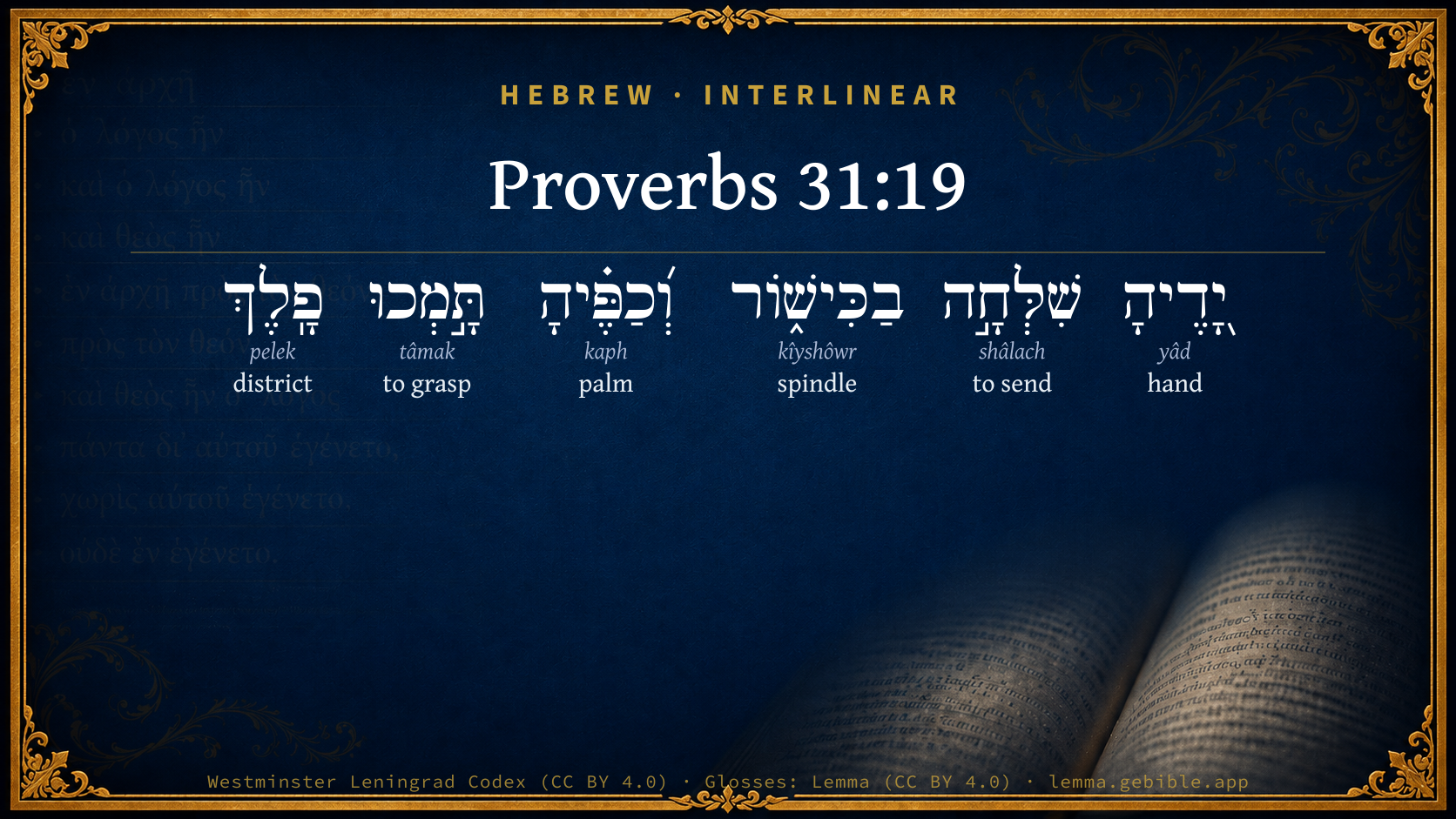
Hebrew (Westminster Leningrad Codex) Proverbs 31:19 appears in the Hebrew Old Testament. The text above is from the Westminster Leningrad Codex. Each word links to its Strong’s number, a concise gloss, and parsing drawn from the Open Scriptures Hebrew Bible morphology. Click any word for its full Brown-Driver-Briggs (BDB) entry.
Download image
Cite this verse

Proverbs 31:19 (World English Bible). Public Domain. Lemma interlinear Bible study tool, https://lemma.gebible.app/v/proverbs/31/19.

Show BibTeX & RIS
BibTeX
RIS
English Translation
She lays her hands to the distaff, And her hands hold the spindle.
World English Bible · Public Domain
Highlights
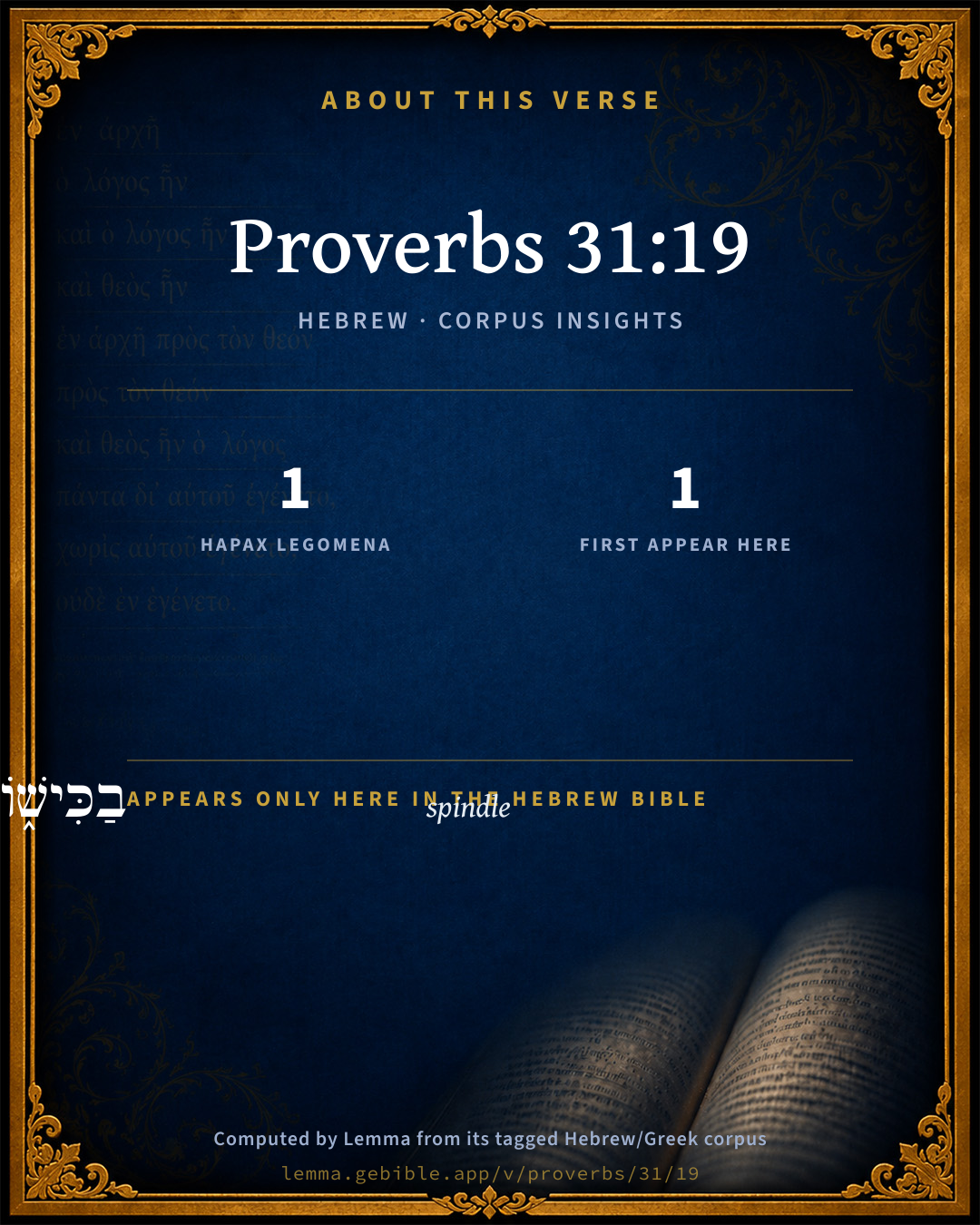
  • 1 hapax legomenon — only here in the Hebrew Bible
  • 1 first appearance in the Hebrew Bible
Full analysis ↓
Download a study sheet

One document with this verse’s original text, its word-by-word gloss line, the meaning frame, cross-references with their text, attributed commentary, and full source and license credits — printable, and it pastes into notes with its structure intact.

This verse Autodidact and up

Study sheet (.html) Plain text (.txt)

A passage Seminary Student

Up to 50 verses in one chapter. A passage sheet keeps up to 6 commentary sources and 12 cross-references per verse, in the order this page ranks them, and says so on the sheet whenever that leaves anything out. Ask for a single verse and you get the Autodidact verse sheet above.

Everything on this page stays free to read, with no account — the sheet is a download of what is already on screen, not access to it.

Want to remove ads? Support Godless Engineer
Compare translations 3

The same verse in 3 English versions, stacked beneath the original-language interlinear above. Click any original word for its lexicon entry.

Each is an independent rendering of the whole verse — the interlinear is not word-aligned to these translations.

Highlighted words mark where these versions differ — a whole-verse word diff, not a word-by-word alignment.

  • World English Bible Public Domain
    She lays her hands to the distaff, And her hands hold the spindle.
  • King James Version Public Domain
    She layeth her hands to the spindle, and her hands hold the distaff.
  • unfoldingWord Literal Text CC BY-SA 4.0
    She stretches out her hands at the distaff, and her palms grasp the spindle.

unfoldingWord Literal Text — © unfoldingWord, licensed CC BY-SA 4.0. Word-aligned USFM3 via Door43 (git.door43.org/unfoldingWord/en_ult).

Versions to compare (up to 4)

3 of 4 selected

Show all 18 translations

Every available English version of this verse, each an independent rendering of the whole verse.

  • World English Bible Public Domain
    She lays her hands to the distaff, And her hands hold the spindle.
  • Berean Standard Bible Public Domain
    She stretches out her hands to the distaff and grasps the spindle with her fingers.
  • Majority Standard Bible Public Domain
    She stretches out her hands to the distaff and grasps the spindle with her fingers.
  • King James Version Public Domain
    She layeth her hands to the spindle, and her hands hold the distaff.
  • American Standard Version (1901) Public Domain
    She layeth her hands to the distaff, And her hands hold the spindle.
  • Revised Version (1885) Public Domain
    She layeth her hands to the distaff, and her hands hold the spindle.
  • Geneva Bible (1599) Public Domain
    She putteth her handes to the wherue, and her handes handle the spindle.
  • Douay-Rheims (1899) Public Domain
    She hath put out her hand to strong things, and her fingers have taken hold of the spindle.
  • Young's Literal Translation Public Domain
    Her hands she hath sent forth on a spindle, And her hands have held a distaff.
  • Literal Standard Version CC BY-SA 4.0
    She has sent forth her hands on a spindle, || And her hands have held a distaff.
  • Unlocked Literal Bible CC BY-SA 4.0
    She puts her hands on the spindle, and she holds the twisting thread.
  • unfoldingWord Literal Text CC BY-SA 4.0
    She stretches out her hands at the distaff, and her palms grasp the spindle.
  • Darby Bible Public Domain
    She putteth her hands to the distaff, and her hands hold the spindle.
  • World Messianic Bible Public Domain
    She lays her hands to the distaff, and her hands hold the spindle.
  • Webster's Bible Public Domain
    She layeth her hands to the spindle, and her hands hold the distaff.
  • Free Bible Version CC BY-SA 4.0
    She spins the thread and weaves the cloth.
  • Bible in Basic English Public Domain
    She puts her hands to the cloth-working rod, and her fingers take the wheel.
  • JPS Tanakh (1917) Public Domain
    She layeth her hands to the distaff, and her hands hold the spindle.

Literal Standard Version (2020), Covenant Press — licensed CC BY-SA 4.0. Text via the HelloAO Bible API (eBible.org). Unlocked Literal Bible (unfoldingWord) — licensed CC BY-SA 4.0. Text via the HelloAO Bible API (eBible.org). unfoldingWord Literal Text — © unfoldingWord, licensed CC BY-SA 4.0. Word-aligned USFM3 via Door43 (git.door43.org/unfoldingWord/en_ult). Free Bible Version, Dr. Jonathan Gallagher — licensed CC BY-SA 4.0. Text via the HelloAO Bible API (eBible.org).

Word by word

More ways to search: Search by grammar → Find every occurrence → Compare this word →

Practice this passage: Drill this verse → Learn its vocabulary →

About this verse

These counts appear in no published source. They are computed here, from the morphology-tagged text and Lemma’s own curated glosses. What Lemma adds →

6
words
6
distinct lemmas
Wisdom
section

Notable vocabulary

1 hapax legomenon — a word that appears only here in the entire Hebrew Bible:

  • בַכִּישׁ֑וֹר spindle H3601

First appearance in Scripture

This word makes its first canonical appearance in the Hebrew Bible here:

  • בַכִּישׁ֑וֹר spindle H3601

Shared distinctive vocabulary

פָֽלֶךְ district H6418 occurs in 9 verses of the Hebrew Bible. Also found in:

Grammatical profile

  • 2 verbs
  • 4 nouns

Verb forms

  • שִׁלְּחָ֣ה Piel · Perfect
  • תָּ֣מְכוּ Qal · Perfect

Hebrew & Septuagint length

In English translation the verse runs 13 words from the Hebrew and 15 from the Septuagint (LXX English) — closely comparable.

A rough comparison of the two English renderings, which tokenize alike — not a word-level alignment.

Word counts can differ between the Hebrew and the Greek without any difference in meaning — e.g. the Hebrew direct-object marker אֵת has no separate Greek word, and Greek often adds the article ὁ.

Cross-references

1

Topical passages linked to Proverbs 31:19 in the Treasury of Scripture Knowledge — connected by theme and wording, ordered by reader-vote popularity; previews shown in the World English Bible.

  • Exodus 35:25–26 All the women who were wise-hearted spun with their hands, and brought that which they had spun, the blue, the purple, the scarlet, and the fine linen.

Cross-references courtesy of OpenBible.info (CC BY 4.0).

Hebrew and Greek witnesses Masoretic Hebrew ↔ Greek Septuagint

The same verse in the two great witnesses to the Old Testament, shown verse-for-verse.

These are two independent witnesses, not word-aligned to each other, and the Septuagint is shown in lemma (dictionary) form.

Hebrew Proverbs 31:19 Masoretic · Westminster Leningrad Codex

יָ֭דֶיהָ שִׁלְּחָ֣ה בַכִּישׁ֑וֹר וְ֝כַפֶּ֗יהָ תָּ֣מְכוּ פָֽלֶךְ

She lays her hands to the distaff, And her hands hold the spindle.

World English Bible · Public Domain

Greek LXX Proverbs 31:19 Septuagint · lemma form

ὁ πῆχυς αὐτός ἐκτείνω ἐπί ὁ συνφέρω ὁ δέ χείρ αὐτός ἐρείδω εἰς ἄτρακτος

She reaches forth her arms to needful works, and applies her hands to the spindle.

LXX2012 (modern English Septuagint) · Public Domain

On this verse, Haydock's Catholic Bible Commentary discusses the Septuagint’s reading. Read the note in Commentary ↓

Hebrew: Westminster Leningrad Codex (CC BY 4.0). Greek: Septuagint (public domain); English from LXX2012 (modern English Septuagint) (Public Domain). How the Septuagint differs from the Hebrew →

Commentary

Notes on Proverbs 31:19 from classic Christian and Jewish commentators (each source and its license shown beneath its notes). The classic Christian expositions comment on the surrounding passage and are grouped to its opening verse, so a note may address several verses; the Jewish commentaries on the Tanakh (Rashi and others) are per-verse, so they appear only where the commentator wrote on this verse.

Lemma curates 59 commentaries, every one of them public domain or Creative Commons licensed, each selected and text-cleaned for this edition rather than reprinted as found. About our sources →

Trapp's Complete Commentary

John Trapp

Pro 31:19 She layeth her hands to the spindle, and her hands hold the distaff.

Ver. 19. She layeth her hands to the spindle.] {a} Notwithstanding her late purchase, and planting a vineyard {Pro 31:16} and other out businesses. {See Trapp on "Pro 31:13"} The two cardinals, Wolsey and Campeius, coming from King Henry VIII on a message to Queen Catherine of Spain, a little before the divorce, found her with a skein of red silk about her neck, being at work with her maiden. {b} And Queen Anne Boleyn kept her maids, and all that were about her, so busied in sewing and working, that neither was there seen any idleness among them, nor any leisure to follow such pastimes as are usually in princes’ courts. {c}

{a} Lucretia inter ancillas ad Lucernam fila ducebat.

{b} Life and Death of Cardinal Wolsey, p. 69.

{c} Acts and Mon., fol. 957.

John Trapp, A Commentary or Exposition upon All the Books of the Old and New Testament (1647–1656) — public domain. Text from a community e-Sword module.

Joseph Benson's Commentary

Pro 31:19. She layeth her hands to the spindle — By her own example she provokes her servants to labour. And although in these latter and more delicate times such mean employments are grown out of fashion among great persons, yet they were not so in former ages, neither in other countries, nor in this land; whence all women unmarried, unto this day, are called, in the language of our law, spinsters.

Joseph Benson's Commentary on the Old and New Testaments (1811–1818) — public domain. Text from a community e-Sword module.

Tyndale Open Study Notes

Tyndale Open Resources

31:19-21 A virtuous wife is generous to the poor, another characteristic of wise people (11:24-26; 21:13; 22:9, 16, 22-23; 28:27).

Tyndale Open Study Notes — © Tyndale Open Resources, licensed CC BY-SA 4.0. Text via the HelloAO Bible API.

Jamieson, Fausset & Brown

Robert Jamieson, A. R. Fausset & David Brown

No work, however mean, if honest, is disdained.

Jamieson, Fausset & Brown — Commentary Critical and Explanatory on the Whole Bible (1871) — public domain (CC PDM 1.0). Text via the HelloAO Bible API.

Adam Clarke's Commentary

Verse 19. She layeth her hands to the spindle]

10. She gives an example of skill and industry to her household. She takes the distaff, that on which the wool or flax was rolled; and the spindle, that by twisting of which she twisted the thread with the right hand, while she held the distaff in the guard of the left arm, and drew down the thread with the fingers of the left hand. Allowing that spindle and distaff are proper translations of כישור kishor, and פלך pelech, this was their use, and the way in which they were used. The spindle and distaff are the most ancient of all the instruments used for spinning, or making thread. The spinning-wheel superseded them in these countries; but still they were in considerable use till spinning machinery superseded both them and the spinning-wheels in general.

Adam Clarke's Commentary on the Bible (1810–1826) — public domain. Text from a community e-Sword/MySword module.

The Cambridge Bible for Schools and Colleges

gen. ed. J. J. S. Perowne

19. spindle … distaff] Rather, distaff … spindle, with R.V. Of the two Heb. words here used the first occurs nowhere else, but it is derived from a root which means to be straight, and therefore may properly denote the distaff, or straight rod. Of the second word, the root-meaning is to be round. It is used of the circuit or circle round, the environs of, Jerusalem (Neh_3:12; Neh. 14:15).

“Till comparatively recent times the sole spinning implements were the spindle and distaff. The spindle, which is the fundamental apparatus in all spinning, was nothing more nor less than a round stick or rod of wood, about 12 inches in length, tapering towards each extremity, and having at its upper end a notch or slit, into which the yarn might be caught or fixed. In general, a ring or whorl of stone or clay was passed round the upper part of the spindle to give it momentum and steadiness when in rotation. The distaff or rod was a rather longer and stronger bar or stick, around one end of which, in a loose coil or ball, the fibrous material to be spun was wound. The other extremity of the distaff was carried under the left arm, or fixed in the girdle at the left side, so as to have the coil of flax in a convenient position for drawing out to yarn.” Encyclop. Britann. Art. Linen, vol. xiv. p. 664. 9th edition.

An illustration of the use of these implements is found in Catullus, Epithal. de nupt. Pel. et Thet. 312 sqq.:

“Læva colum molli lana retinebat amictum:

Dextera turn leviter deducens fila supinis

Formabat digitis; turn prono in pollice torquens

Libratum tereti versabat turbine fusum.”

The Cambridge Bible for Schools and Colleges (gen. ed. J. J. S. Perowne; Cambridge University Press, 1878–1918) — public domain. Text from a community e-Sword module.

John Gill's Exposition

She layeth her hands to the spindle,.... As Penelope and her maidens did (t). Or spinning wheel, more properly, the wheel itself, which is laid hold on by the right hand, and turned round;

and her hands hold the distaff; the rock, stick, or staff, about which the wool is wrapped, which is spun, and is held in the left hand; for though hands are mentioned in both clauses, yet it is only with one hand the wheel is turned, and the distaff held with the other. Not only wool and flax were sought by her, Pro 31:13; but she spins them, and works them up into garments her web is not like the spider's, spun out of its own bowels, on which it hangs; to which the hope and trust of a hypocrite are compared, and whose webs do not become garments to cover them, Job 8:14; but the church's web is both for ornament, to the adorning of her profession, and for defence and protection from the calumnies of the world; for by these are meant good works, as Ambrose interprets them.

(t) Homer, Odyss. 1. v. 357. & 21. v. 351.

John Gill's Exposition of the Whole Bible (1746–1763) — public domain (CC PDM 1.0). Text via the HelloAO Bible API.

Haydock's Catholic Bible Commentary

Strong things, "becoming" (Septuagint) her station. (Calmet) --- Spindle. She purposes and begins well, trusting in God for perfection and a reward. (Worthington)

George Leo Haydock (1774–1849), Haydock's Catholic Family Bible and Commentary, 1859 edition — public domain. Excludes Psalms (Douay-Rheims chapter numbering differs from Protestant) and Deuterocanonical books (Catholic canon only).

Matthew Poole's English Annotations

By her own example she provoketh her servants to labour. And although in these later and more delicate and luxurious times, such mean employments are grown out of fashion among great persons, yet they were not so in former ages, neither in other countries, nor in this land; whence all women unmarried are to this day called in the language of our law spinsters.

Matthew Poole's English Annotations on the Holy Bible (1683–1685) — public domain. Text from a community e-Sword/MySword module.

Whedon's Commentary on the Bible

Daniel D. Whedon

19. The spindle… the distaff — It is not entirely certain to which parts of the Eastern spinning apparatus these terms were applied. Stuart renders the first word by distaff, and the second by spindle. “In the East the spindle is held in the hand, often perpendicularly, and is twirled in one, while the other draws out the thread.” — Gesenius. The distaff is the staff for holding the bunch of flax or wool from which the thread is drawn when spinning. “I saw a woman sitting at the door of her hut on Zion spinning woollen yarn with a spindle, while another near her was twirling nimbly the ancient distaff.” — Land and Book, vol. ii, p. 572.

Daniel D. Whedon (gen. ed.), Commentary on the Old and New Testaments (1874–1909) — public domain. Text from a community e-Sword module.

The Pulpit Commentary

YODH. She layeth her hands to the spindle. rwOvyKi. (kishor, a word not occurring elsewhere) is probably not the spindle, but the distaff, i.e. the staff to which is tied the bunch of flax from which the spinning wheel draws the thread. To this she applies her hand; she deftly performs the work of spinning her flax into thread. Her hands hold the distsaff. (pelek) is the spindle, the cylindrical wood (afterwards the wheel) on which the thread winds itself as it is spun. The hands could not be spared to hold the distaff as well as the spindle, so the first clause should run, "She stretches her hand towards the distaff." In the former clause kishor occasioned some difficulty to the early translators, who did not view the word as connected with the process of spinning. The Septuagint translates, "She stretches out her arms to useful works (epi ta sumferonta );" Vulgate, Manum suam misit ad fortia. So Aquila and Symmachus, andreia . This rather impedes the parallelism of the two clauses. There was nothing derogatory in women of high rank spinning among their maidens, just as in the Middle Ages noble ladies worked at tapestry with their attendants. We remember how Lucretia, the wife of Collatinus, was found sitting in the midst of her handmaids, carding wool and spinning (Livy, 1:57). Catullus, in his "Epithal. Pel. et Thet.," 312, describes the process of spinning"Laeva colum molli lana retinebat amictum; Dextera tum leviter deducens fila supinis Formabat digitis; tum prono in pollice torquens Libratum tereti versabat turbine fusum. ("Carm.," 64.)

The Pulpit Commentary (1880–1919), ed. H.D.M. Spence-Jones & Joseph S. Exell — public domain. Text from a community e-Sword module.

John Wesley's Explanatory Notes

She layeth - By her own example she provokes her servants to labour. And although in these latter and more delicate times, such mean employments are grown out of fashion among great persons, yet they were not so in former ages, neither in other countries, nor in this land; whence all women unmarried unto this day are called in the language of our law, Spinsters.

John Wesley, Explanatory Notes Upon the Whole Bible (1754–1765) — public domain. Text via the GEBible commentary corpus.

Keil & Delitzsch

C. F. Keil & F. Delitzsch

19 י She putteth her hand to the rock Spinnrocken;

And her fingers lay hold on the spindle.

She applies herself to the work of spinning, and performs it with skill. The phrase שׁלּח יד בּ (שׁלח, Job 28:9) signifies to take up an object of work, and תּמך, with obj. accus. (cf. Amo 1:5), the handling of the instrument of work necessary thereto. כּפּים denotes the hands when the subject is skilful, successful work; we accordingly say יגיע כפים, not יגיע ידים; cf. Pro 31:13 and Pro 31:16, Psa 78:72. What פּלך means is shown by the Arab. falakat, which, as distinguished from mighzal, i.e., fuseau (Lat. fusus), is explained by bout arrondi et conique au bas du fuseau, thus: the whorl, i.e., the ring or knob fastened on the spindle below, which gives it its necessary weight and regulates its movement, Lat. verticellus, post-bibl. פּיקה (which Bartenora glosses by the Ital. fusajuolo) or צנּורה, e.g., Kelim ix. 6, כושׁ שׁבלע את הצנורה, a spindle which holds the whorl hidden (vid., Aruch under כש, iii.). But the word then also signifies per synecdochen partis pro toto, the spindle, i.e., the cylindrical wood on which the thread winds itself when spinning (cf. Sa2 3:29, where it means the staff on which the infirm leans); Homer gives to Helen and the goddesses golden spindles (χρυσηλάκατοι). Accordingly it is not probable that כּישׁור also denotes the whorl, as Kimchi explains the word: "כישור is that which one calls by the name verteil, viz., that which one fixes on the spindle (פלך) above to regulate the spinning (מטוה)," according to which the Venet. renders כישׁור by σφόνδυλος, whorl, and פלך by ἄτρακτος, spindle. The old interpreters have not recognised that כישׁור denotes a thing belonging to the spinning apparatus; the lxx, Aquila, Symmachus, Theodotion, Syr., and Jerome see therein an ethical idea (from כּשׁר, to be capable, able); but Luther, not misled thereby, translates with unusual excellence:

She stretches her hand to the rock,

And her fingers grasp the spindle.

He has in this no predecessors, except only the Targumists, whose כוּנשׁרא (vid., Levy) appears also to denote the spinning-rock. The Syriac and Talmudic כּוּשׁ, which is compared by Gesenius-Dietrich, is another word, and denotes, not the rock, but the spindle. Immanuel also, who explains פלך as the מעזל, i.e., the spindle, understands (as perhaps also Parchon) by כישׁור the rock. And why should not the rock (wocken = distaff), i.e., the stock to which the tuft of flax, hemp, or wool is fixed for the purpose of being spun, Lat. colus, not be named כּישׁור, from כשׁר, to be upright as a stick, upright in height, or perhaps more correctly as מכשׁיר, i.e., as that which prepares or makes fit the flax for spinning? Also in צינק, Jer 29:26, there are united the meanings of the close and the confining dungeon, and שׁלה = שׁילון signifies

(Note: Otherwise, but improbably, Schultens: colus a כשׁר = katr kathr, necti in orbem, circumnecti in globum. In פּלך, whence פּלך, he rightly finds the primary meaning of circumvolutio sive gyratio.)

the place which yields rest. The spinning-wheel is a German invention of the 16th century, but the rock standing on the ground, or held also in the hands, the spindle and the whorl, are more ancient.

(Note: A view of the ancient art of spinning is afforded by the figures of the 12th Dynasty (according to Lepsius, 2380-2167 b.c.) in the burial chamber of Beni Hassan (270 kilometres above Bulak, on the right bank of the Nile). M. J. Henry, in his work L'Egypte Pharaonique (Paris 1846), Bd. 2, p. 431, mentions that there are figures there which represent "toutes les oprations de la fabrication des tissus depuis le filage jusqu au tissage." Then he continues: Lex fuseaux dont se servent les fileuses sont excatement semblables aux ntres, et on voit mme ces fileuses imprimer le mouvement de rotation ces fuseaux, en en froissant le bout inferieur entre leur main et leur cuisse.)

With the spindle תמך stands in fit relation, for it is twirled between the fingers, as Catullus says of Fate:

Libratum tereti versabat pollice fusum.

(Note: In the "marriage of Peleus and Thetis," Catullus describes the work of the Fates: "Their hands are ceaselessly active at their never-ending work; while the left holds the rock, surrounded with a soft fleece, the right assiduously draws the thread and forms it with raised fingers; then it swiftly turns the spindle, with the thumb stretched down, and swings it away in whirling circles." Then follows the refrain of the song of the Fates: Currite ducentes subtegmina, currite, fusi. - (After Hertzberg's Translation.))

Keil & Delitzsch — Biblical Commentary on the Old Testament (1861–1891) — public domain (CC PDM 1.0). Text via the HelloAO Bible API. (Old Testament only.)

Rashi

Rabbi Shlomo Yitzchaki (Rashi)

onto the distaff Heb. כישור that is called vertel, verteil, vertay in Provencal, which prepares (מכשיר) the spindle to spin. the spindle Heb. פלך, fusele in French.

Rashi on the Tanakh — English translations: “The Judaica Press complete Tanach with Rashi, translated by A. J. Rosenberg” (CC BY 4.0); “Pentateuch with Rashi's commentary by M. Rosenbaum and A.M. Silbermann, 1929-1934” (public domain); “The Metsudah Tanach series, Lakewood, N.J” (CC BY 4.0); and “The Book of Joshua, Metsudah Publications, 1997” (CC BY 4.0). Text via Sefaria.

Lesson kit

Teaching starters — assembled from the data on this page, not authored interpretation. Every prompt links to the verse data it draws on. Edit before teaching.

Proverbs, in the Wisdom, opens this verse with 6 words (6 distinct Hebrew lemmas). Its most distinctive word is kîyshôwr (“spindle”). A historical commentator’s framing appears above. Read the whole chapter for the surrounding context.

Discussion questions

  1. What does “spindle” (kîyshôwr) contribute to the verse as a whole?
  2. 1 word here appears nowhere else in the Hebrew Bible. Why might the author reach for such rare wording?
  3. This is the first place “spindle” appears in Scripture (first appears here). What does its debut here establish?
  4. How does 2 Samuel 3:29, which shares the word «district», read alongside this verse?
  5. These translations render this verse differently; the difference is in the English rendering, not the original. What questions does that raise?
  6. «שִׁלְּחָ֣ה» is a Piel Perfect verb. How does that grammatical form shape the action described?
  7. Compare how Trapp's Complete Commentary and Joseph Benson's Commentary read this verse. Where do they agree or differ?

Things to notice

  • 1 word in this verse appears nowhere else in the Hebrew Bible.
  • 1 word makes its first canonical appearance in Scripture here.
  • These translations choose different wording for 7 words in this verse.
  • 6 distinct Hebrew lemmas span 6 words in this verse.

Reading settings

Reading text

Shown beneath each verse's original-language words.

Old Testament
Old Testament edition

Read the OT as the Masoretic Hebrew (MT) or the Greek Septuagint (LXX).

English shown for the Greek Septuagint (in the Hebrew ↔ Greek comparison).

Comparing translations? Open the Compare panel on any verse page to stack up to four side by side.