
Psalms 7:3

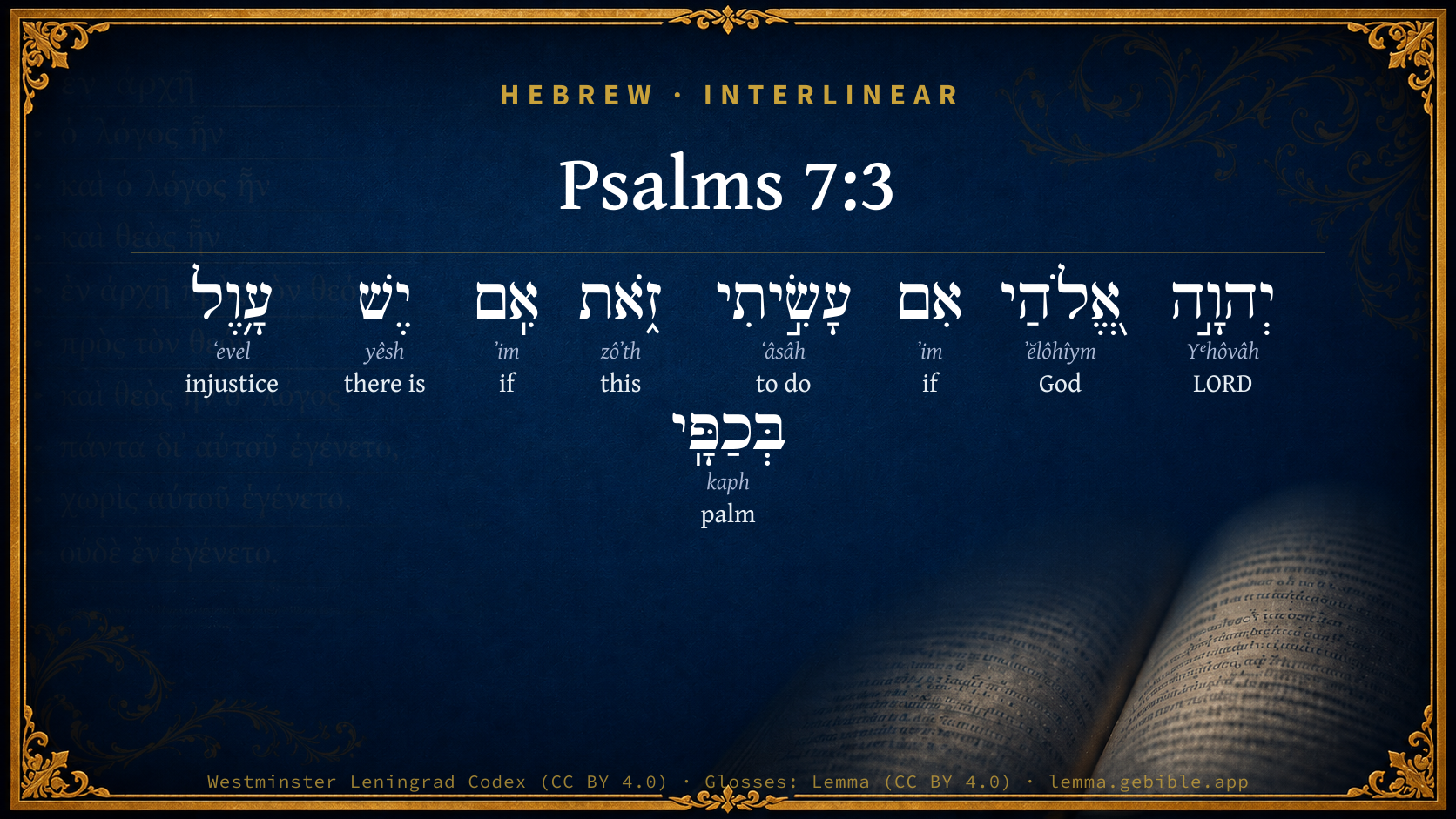
Hebrew (Westminster Leningrad Codex) Psalms 7:3 appears in the Hebrew Old Testament. The text above is from the Westminster Leningrad Codex. Each word links to its Strong’s number, a concise gloss, and parsing drawn from the Open Scriptures Hebrew Bible morphology. Click any word for its full Brown-Driver-Briggs (BDB) entry.
Download image
Cite this verse

Psalms 7:3 (World English Bible). Public Domain. Lemma interlinear Bible study tool, https://lemma.gebible.app/v/psalms/7/3.

Show BibTeX & RIS
BibTeX
RIS
English Translation
Yahweh, my God, if I have done this, If there is iniquity in my hands,
World English Bible · Public Domain
Download a study sheet

One document with this verse’s original text, its word-by-word gloss line, the meaning frame, cross-references with their text, attributed commentary, and full source and license credits — printable, and it pastes into notes with its structure intact.

This verse Autodidact and up

Study sheet (.html) Plain text (.txt)

A passage Seminary Student

Up to 50 verses in one chapter. A passage sheet keeps up to 6 commentary sources and 12 cross-references per verse, in the order this page ranks them, and says so on the sheet whenever that leaves anything out. Ask for a single verse and you get the Autodidact verse sheet above.

Everything on this page stays free to read, with no account — the sheet is a download of what is already on screen, not access to it.

Want to remove ads? Support Godless Engineer
Compare translations 3

The same verse in 3 English versions, stacked beneath the original-language interlinear above. Click any original word for its lexicon entry.

Each is an independent rendering of the whole verse — the interlinear is not word-aligned to these translations.

Highlighted words mark where these versions differ — a whole-verse word diff, not a word-by-word alignment.

  • World English Bible Public Domain
    Yahweh, my God, if I have done this, If there is iniquity in my hands,
  • King James Version Public Domain
    O LORD my God, If I have done this; if there be iniquity in my hands;
  • unfoldingWord Literal Text CC BY-SA 4.0
    Yahweh my God, if I have done this, if there is wrong on my hands,

unfoldingWord Literal Text — © unfoldingWord, licensed CC BY-SA 4.0. Word-aligned USFM3 via Door43 (git.door43.org/unfoldingWord/en_ult).

Versions to compare (up to 4)

3 of 4 selected

Show all 18 translations

Every available English version of this verse, each an independent rendering of the whole verse.

  • World English Bible Public Domain
    Yahweh, my God, if I have done this, If there is iniquity in my hands,
  • Berean Standard Bible Public Domain
    O LORD my God, if I have done this, if injustice is on my hands,
  • Majority Standard Bible Public Domain
    O LORD my God, if I have done this, if injustice is on my hands,
  • King James Version Public Domain
    O LORD my God, If I have done this; if there be iniquity in my hands;
  • American Standard Version (1901) Public Domain
    O Jehovah my God, if I have done this; If there be iniquity in my hands;
  • Revised Version (1885) Public Domain
    O LORD my God, if I have done this; if there be iniquity in my hands;
  • Geneva Bible (1599) Public Domain
    O Lord my God, if I haue done this thing, if there be any wickednes in mine handes,
  • Douay-Rheims (1899) Public Domain
    Lest at any time he seize upon my soul like a lion, while there is no one to redeem me, nor to save.
  • Young's Literal Translation Public Domain
    O Jehovah, my God, if I have done this, If there is iniquity in my hands,
  • Literal Standard Version CC BY-SA 4.0
    O YHWH, my God, if I have done this, || If there is iniquity in my hands,
  • Unlocked Literal Bible CC BY-SA 4.0
    Yahweh my God, if I have done this, and there is guilt on my hands—
  • unfoldingWord Literal Text CC BY-SA 4.0
    Yahweh my God, if I have done this, if there is wrong on my hands,
  • Darby Bible Public Domain
    Jehovah my God, if I have done this, if there be iniquity in my hands;
  • World Messianic Bible Public Domain
    LORD, my God, if I have done this, if there is iniquity in my hands,
  • Webster's Bible Public Domain
    \\7:2\\Lest he tear my soul like a lion, rending it in pieces, while there is none to deliver.
  • Free Bible Version CC BY-SA 4.0
    If I have done what I'm accused of, if my hands are guilty,
  • Bible in Basic English Public Domain
    O Lord my God, if I have done this; if my hands have done any wrong;
  • JPS Tanakh (1917) Public Domain
    (7-4) O LORD my God, if I have done this; if there be iniquity in my hands;

Literal Standard Version (2020), Covenant Press — licensed CC BY-SA 4.0. Text via the HelloAO Bible API (eBible.org). Unlocked Literal Bible (unfoldingWord) — licensed CC BY-SA 4.0. Text via the HelloAO Bible API (eBible.org). unfoldingWord Literal Text — © unfoldingWord, licensed CC BY-SA 4.0. Word-aligned USFM3 via Door43 (git.door43.org/unfoldingWord/en_ult). Free Bible Version, Dr. Jonathan Gallagher — licensed CC BY-SA 4.0. Text via the HelloAO Bible API (eBible.org).

Word by word

More ways to search: Search by grammar → Find every occurrence → Compare this word →

Practice this passage: Drill this verse → Learn its vocabulary →

About this verse

These counts appear in no published source. They are computed here, from the morphology-tagged text and Lemma’s own curated glosses. What Lemma adds →

9
words
8
distinct lemmas
Wisdom
section

Shared distinctive vocabulary

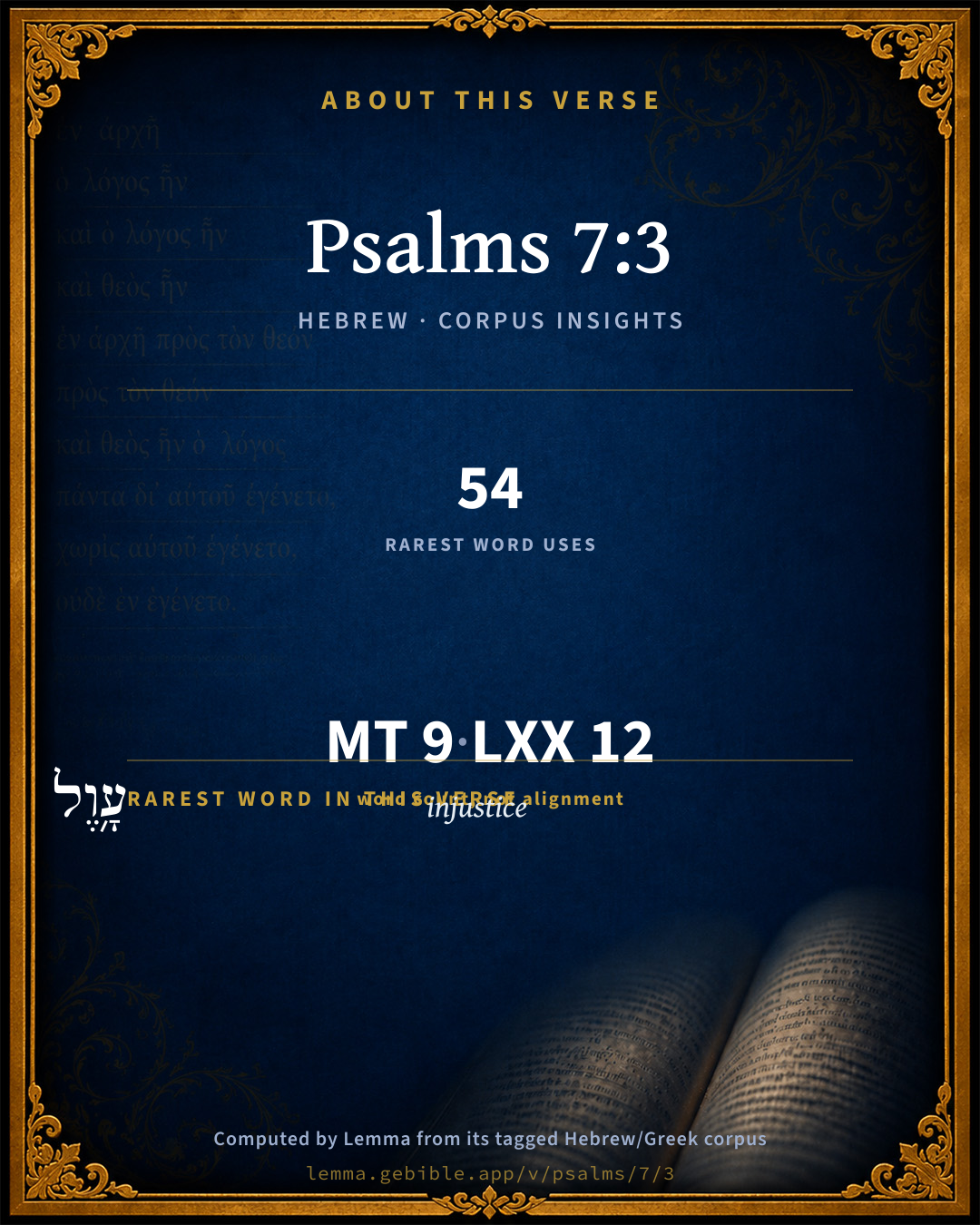
עָ֥וֶל injustice H5766 occurs in 51 verses of the Hebrew Bible. Also found in:

Grammatical profile

  • 1 verb
  • 4 nouns
  • 1 pronoun
  • 2 conjunctions
  • 1 particle

Verb forms

  • עָשִׂ֣יתִי Qal · Perfect

Repetition

A word recurs within this verse — often emphatic in Hebrew:

  • אִם if H518 ×2

Hebrew & Septuagint length

In English translation the verse runs 15 words from the Hebrew and 16 from the Septuagint (LXX English) — closely comparable.

A rough comparison of the two English renderings, which tokenize alike — not a word-level alignment.

Word counts can differ between the Hebrew and the Greek without any difference in meaning — e.g. the Hebrew direct-object marker אֵת has no separate Greek word, and Greek often adds the article ὁ.

In the original languages it is 9 Hebrew tokens and 12 Greek tokens — but the two are counted differently (Hebrew bundles its prefixes and suffixes into one token; the Greek is in lemma form), so that isn’t a like-for-like length.

Cross-references

12

Topical passages linked to Psalms 7:3 in the Treasury of Scripture Knowledge — connected by theme and wording, ordered by reader-vote popularity; previews shown in the World English Bible.

  • 1 Samuel 24:11 Moreover, my father, behold, yes, see the skirt of your robe in my hand; for in that I cut off the skirt of your robe, and didn't kill you, know you and see that there is neither evil nor disobedience in my hand, and I have not sinned against you, though you hunt after my life to take it.
  • 1 Samuel 26:18–19 He said, Why does my lord pursue after his servant? for what have I done? or what evil is in my hand?
  • Psalms 59:3 For, behold, they lie in wait for my soul. The mighty gather themselves together against me, Not for my disobedience, nor for my sin, Yahweh.
  • Joshua 22:22 The Mighty One, God, Yahweh, the Mighty One, God, Yahweh, he knows; and Israel he shall know: if it be in rebellion, or if in trespass against Yahweh (don't save us this day),
  • 2 Samuel 16:7–8 Thus said Shimei when he cursed, Be gone, be gone, you man of blood, and base fellow:
  • Job 11:14 If iniquity is in your hand, put it far away, Don't let unrighteousness dwell in your tents.
  • 1 Samuel 20:8 Therefore deal kindly with your servant; for you have brought your servant into a covenant of Yahweh with you: but if there be in me iniquity, kill me yourself; for why should you bring me to your father?
  • 1 Samuel 22:13 Saul said to him, Why have you conspired against me, you and the son of Jesse, in that you have given him bread, and a sword, and have inquired of God for him, that he should rise against me, to lie in wait, as at this day?
  • 1 Samuel 24:9 David said to Saul, Why listen you to men's words, saying, Behold, David seeks your hurt?
  • Job 16:17–19 Although there is no violence in my hands, And my prayer is pure.
  • Psalms 66:18 If I cherished sin in my heart, The Lord wouldn't have listened.
  • 1 Samuel 22:8 that all of you have conspired against me, and there is none who discloses to me when my son makes a league with the son of Jesse, and there is none of you who is sorry for me, or discloses to me that my son has stirred up my servant against me, to lie in wait, as at this day?

Cross-references courtesy of OpenBible.info (CC BY 4.0).

Hebrew and Greek witnesses Masoretic Hebrew ↔ Greek Septuagint

The same verse in the two great witnesses to the Old Testament, shown verse-for-verse.

You’re reading Greek Psalm 7 (Hebrew Psalm 7). The Septuagint counts the superscription, so verse numbers can differ from the Hebrew — chapter-level alignment, not verse-by-verse. Numbering follows Rahlfs.

These are two independent witnesses, not word-aligned to each other, and the Septuagint is shown in lemma (dictionary) form.

Hebrew Psalms 7:3 Masoretic · Westminster Leningrad Codex

יְהוָ֣ה אֱ֭לֹהַי אִם עָשִׂ֣יתִי זֹ֑את אִֽם יֶשׁ עָ֥וֶל בְּכַפָּֽי

Yahweh, my God, if I have done this, If there is iniquity in my hands,

World English Bible · Public Domain

Greek LXX Greek Psalm 7:3 Septuagint · lemma form

μήποτε ἁρπάζω ὡς λέων ὁ ψυχή ἐγώ μή εἰμί λυτρόω μηδέ σώζω

O Lord my God, if I have done this; (if there is unrighteousness in my hands;)

LXX2012 (modern English Septuagint) · Public Domain

Hebrew: Westminster Leningrad Codex (CC BY 4.0). Greek: Septuagint (public domain); English from LXX2012 (modern English Septuagint) (Public Domain). How the Septuagint differs from the Hebrew →

Commentary

Notes on Psalms 7:3 from classic Christian and Jewish commentators (each source and its license shown beneath its notes). The classic Christian expositions comment on the surrounding passage and are grouped to its opening verse, so a note may address several verses; the Jewish commentaries on the Tanakh (Rashi and others) are per-verse, so they appear only where the commentator wrote on this verse.

Lemma curates 59 commentaries, every one of them public domain or Creative Commons licensed, each selected and text-cleaned for this edition rather than reprinted as found. About our sources →

Trapp's Complete Commentary

John Trapp

Psa 7:3 O LORD my God, if I have done this; if there be iniquity in my hands;

Ver. 3. O Lord my God] {See Trapp on "Psa 7:1"}

If I have done this] i.e. This treachery and treason, whereof Saul doth causelessly suspect me, and wherewith his pick thank partisans unjustly charge me. As for sedition, saith Latimer, for aught that I know, methinks I should not need Christ, if I might so say. But where malice beareth mastery the doing of anything or of nothing is alike dangerous (Serm. 3, before K. Ed. VI).

If there be iniquity in my hands] Heb. in the palms of my hands, where it may be concealed. If I have secretly acted against my sovereign.

John Trapp, A Commentary or Exposition upon All the Books of the Old and New Testament (1647–1656) — public domain. Text from a community e-Sword module.

The Biblical Illustrator

Joseph S. Exell

Psa_7:3-5

O Lord my God, if I have done this; if there be iniquity in my hands.

The appeal of conscious integrity

When near his end Mahomet made an effort to obtain himself the peace and pardon of the living before presenting himself before his Judge. Sustained beneath the arms by his two cherished disciples, Abubeker and All, he trailed himself along to the pulpit of the mosque, and said, with a feeble voice, Mussulmans! if I have ever maltreated any among you, let him now come and strike me in turn. If I have offended any of you by word, let him return insult for insult. If I have taken from any his property, let him take all I possess upon the earth. And these are not vain words; let no one, in doing himself justice, apprehend my resentment. Resentment and anger are not in my character. A man dared to step from the crowd and claim of him a concealed debt. Help thyself, said the prophet; it is better to blush in this life before men, for ones injustice, than to blush in the other world before God. (Lamartines Turkey.)

The Biblical Illustrator, edited by Joseph S. Exell (c. 1880s–1900s) — public domain. Text from a community e-Sword module.

Joseph Benson's Commentary

Psa 7:3. O Lord, if I have done this — Which Cush and others falsely lay to my charge; if there be iniquity in my hands — In my actions, the hand being often put for actions whereof it is a great instrument: “David here makes a solemn appeal to God, the searcher of hearts, as judge of his innocence, with regard to the particular crime laid to his charge. Any person, when slandered, may do the same. But Christ only could call upon Heaven to attest his universal uprightness.” — Horne.

Joseph Benson's Commentary on the Old and New Testaments (1811–1818) — public domain. Text from a community e-Sword module.

J. A. Alexander on Psalms

Joseph Addison Alexander

4. (Psa 7:3.) He proceeds upon the principle that God will not hear the prayer of the wicked, and that he must hear that of the righteous. He proceeds, therefore, to assert his innocence, not his freedom from all sin, but from that particular offence with which he had been charged. O Lord, Jehovah, my God, as in Psa 7:2 (1), if I have done this, which follows, or this of which I am accused, referring to "the words of Cush," the calumnies, which gave occasion to the psalm itself. If there is, with emphasis on the verb, which might have been omitted in Hebrew, and is therefore emphatic, if there is indeed, as my accusers say, perverseness, iniquity, in my palms, in the palms of my hands, here mentioned as instruments of evil. The apodosis of the sentence is contained in Psa 7:6 (5) below.

Joseph Addison Alexander, The Psalms Translated and Explained (1850) — public domain. Text from a community e-Sword module.

Tyndale Open Study Notes

Tyndale Open Resources

7:3-5 The psalmist swears to his innocence, making himself vulnerable to scrutiny (7:9.

7:3 The psalmist does not claim to be without sin, but he knows that he does not deserve the brutal attacks of his opponents (see 35:7).

Tyndale Open Study Notes — © Tyndale Open Resources, licensed CC BY-SA 4.0. Text via the HelloAO Bible API.

Geneva Bible (1599)

Geneva Bible translators

Wherewith Cush chargeth me.

Geneva Bible (1599) marginal notes — public domain. Text via Bolls.life.

Jamieson, Fausset & Brown

Robert Jamieson, A. R. Fausset & David Brown

if I have done this--that is, the crime charged in the "words of Cush" (compare Sa1 24:9).

Jamieson, Fausset & Brown — Commentary Critical and Explanatory on the Whole Bible (1871) — public domain (CC PDM 1.0). Text via the HelloAO Bible API.

Adam Clarke's Commentary

Verse 3. If I have done this] David was accused by Saul of affecting the kingdom; and of waiting for an opportunity to take away the life of his king, his patron, and his friend. In his application to God he refers to these charges; meets them with indignation; and clears himself of them by a strong appeal to his Judge; and an imprecation that, if he had meditated or designed any such thing, he might meet with nothing but curse and calamity either from God or man.

Adam Clarke's Commentary on the Bible (1810–1826) — public domain. Text from a community e-Sword/MySword module.

John Calvin's Commentaries

3 O Jehovah my God Here David, to induce God to show him favour, protests that he is molested unjustly, and without being guilty of any crime. To give his protestation the greater weight, he uses an imprecation. If he has done any wrong, he declares his readiness to bear the blame; yea, he offers to endure the severest punishment, if he is not altogether innocent of the crime of which all men thought him almost convicted. And by entreating God to succour him upon no other condition than this, that his integrity should upon trial be found to be untarnished, he teaches us, by his example, that as often as we have recourse to God, we must make it our first care to be well assured in our own consciences with respect to the righteousness of our cause; for we do him great wrong if we wish to engage him as the advocate and defender of a bad cause. The pronoun this shows that he speaks of a thing which was generally known; whence we may conclude, that the slander which had been raised by Cush was spread far and wide. And as David was condemned, by the false reports and unrighteous judgments which men advanced against him, and saw no remedy on earth, he betakes himself to the judgment-seat of God, and contents himself with maintaining his innocence before the heavenly Judge; an example which all the godly should imitate, in order that, in opposition to the slanderous reports which are spread against them, they may rest satisfied with the judgment of God alone. He next declares more distinctly, that he had committed no crime. And in the fourth verse, he mentions two particulars in self-vindication; first, That he had done no wrong to any one; and, secondly, That he had rather endeavoured to do good to his enemies, by whom notwithstanding he had been injured without any just cause. I, therefore, explain the fourth verse thus: If I have wronged any man that was at peace with me, and have not rather succoured the unworthy, who persecuted me without a cause, etc. Since David was hated of almost all men, as if ambition to reign had impelled him perfidiously to rise up in rebellion against Saul, and to lay snares for the monarch to whom he was bound by the oath of allegiances “Apres luy avoir fait le serment.”—Fr. “After having sworn the oath of allegiance to him.”

“Pource que le nom et titre royal luy devoit estre une sauvegarde et le tenir en seurete.”—Fr. “Because the royal name and title ought to be to him a safeguard, and secure the safety of his person.”

John Calvin's Commentaries (1540-1563) — public domain. Text from the Calvin Translation Society English edition (1840s-50s) via the Christian Classics Ethereal Library (ccel.org). Calvin's coverage is partial (roughly two-thirds of the Bible); uncommented books and verses are honest gaps, never fabricated. The 19th-century editor's footnotes and remarks are omitted so the notes are faithfully Calvin's own voice.

Ellicott's Commentary for English Readers

(3) This—i.e., this with which I am charged—the Benjamite’s slander.

If there be iniquity.—A comparison with 1Sa_24:12-13, and still more 1Sa_26:18, shows how closely this psalm is connected with the two notorious instances of David’s magnanimous and generous conduct towards Saul.

A Bible Commentary for English Readers, edited by Charles John Ellicott (1878–1897) — public domain. Text from a community e-Sword module.

The Cambridge Bible for Schools and Colleges

gen. ed. J. J. S. Perowne

3. if I have done this] ‘This’ refers to the crimes of which he was falsely accused by Cush, and is further explained in the two following lines.

if there be iniquity in my hands] Wrong as the opposite of right: what is crooked and distorted: a different word from that used in Psa_7:14 and in Psa_5:5. Compare the closely similar language of David’s protest in 1Sa_24:11, “Know thou and see that there is neither evil nor transgression in mine hand:” and 1Sa_26:18, “What have I done? or what evil is in mine hand?”

3–5. The appeal for help is supported by a solemn protestation of innocence. If he is guilty of the crimes laid to his charge, may he be surrendered to the utmost fury of his enemies.

The Cambridge Bible for Schools and Colleges (gen. ed. J. J. S. Perowne; Cambridge University Press, 1878–1918) — public domain. Text from a community e-Sword module.

John Gill's Exposition

O Lord my God, if I have done this. The crime which Saul and his courtiers charged him with, and which was made so public that every body knew it; and therefore it was needless particularly to mention it; namely, that he lay in wait for Saul, and sought his life to take it away, Sa1 24:9. The Targum interprets it of this psalm, paraphrasing it, "if I have made this song with an evil intention"; to give an ill character of any, and lead them with false charges;

if there be iniquity in my hands; not that he was without sin, he had it in his heart; nor that he lived without the actual commission of sin: but his sense is, that there was no iniquity, as not in his heart, purpose, and design, so not in his hand, nor attempted by him, of the kind he was accused of, Sa1 24:11. Otherwise, we often hear him complaining of the depravity of his nature, and acknowledging his sins and transgressions, Psa 32:5.

John Gill's Exposition of the Whole Bible (1746–1763) — public domain (CC PDM 1.0). Text via the HelloAO Bible API.

Albert Barnes' Notes on the Bible

O Lord my God - A solemn appeal to God as to the sincerity and truth of what he was about to say.

If I have done this - This thing charged upon me, for it is evident that “Cush,” whoever he was, had accused him of some wrong thing - some wicked action. What that was can only be learned from what follows, and even this is not very specific. So far as appears, however, it would seem to be that he accused David of bringing evil, in some way, upon one who was at peace with him; that is, of wantonly and without provocation doing him wrong, and of so doing wrong that he had the avails of it in his own possession - some spoil, or plunder, or property, that he had taken from him. The charge would seem to be, that he had made a wanton and unprovoked attack on one who had not injured him, and that he had taken, and had still in his possession, something of value that properly belonged to another. Whether the accuser (Cush) in this referred to himself or to some other person, does not appear clear from the psalm; but as he was filled with rage, and as the life of David was endangered by him, it would seem most probable that the reference was to himself, and that he felt he had been personally wronged. The design of David, in the passage now before us, is to deny this charge altogether. This he does in the most explicit manner, by saying that this was so far from being true, that he had, on the contrary, delivered the life of him that was his enemy, and by adding that, if this were so, he would be willing that the injured man should persecute and oppose him, and even trample his life down to the earth.

If there be iniquity in my hands - That is, if there is the iniquity referred to; or, in other words, if he had in his possession what had been wrongfully taken from another, to wit, as appears, from this “Cush” who now accused him. The word “iniquity” here denotes an “unjust possession” - a property that had been unjustly taken from another; and, as remarked above, the slanderous charge would seem to have been, that he had taken that property from some one who was at peace with him, and that he retained it contrary to justice. This charge David means peremptorily to deny.

Albert Barnes' Notes on the Bible (1834–1885) — public domain. Text from a community e-Sword/MySword module.

Matthew Poole's English Annotations

If I have done this, i.e. that which Cush and others falsely lay to my charge. If I design or have endeavoured to take away Saul’s crown and life by violence, as Saul’s courtiers maliciously reported, 1Sa 24:9,10; 26:19.

In my hands, i.e. in my actions or carriage towards Saul. The hand is oft put for actions, whereof the hand is a great and common instrument, as Psa 78:42; 109:27; Jon 3:8. If I design or have attempted to lay violent hands upon Saul.

Matthew Poole's English Annotations on the Holy Bible (1683–1685) — public domain. Text from a community e-Sword/MySword module.

The Treasury of David

Charles H. Spurgeon

Ver. 3. O Lord, my God, if I have done this, if there be iniquity in my hands. In the primitive times the people of God were then a people under great reproach. What strange things does Tertullian tell us they reproached them withal; as that in their meetings they made Thyestes suppers, who invited his brother to a supper, and presented him with a dish of his own flesh. They charged them with uncleanness because they met in the night (for they durst not meet in the day,) and said, they blew out the candles when they were together, and committed filthiness. They reproached them for ignorance, saying, they were all unlearned; and therefore the heathens in Tertullian's time used to paint the God of the Christians with an ass's head, and a book in his hand to signify that though they pretended learning, yet they were an unlearned, silly people, rude and ignorant. Bishop Jewel in his sermon upon Lu 11:5, cites this out of Tertullian, and applies it to his time:"Do not our adversaries do the like," saith he, "at this day, against all those that profess the gospel of Christ? Oh, say they, who are they that favour this way? they are none but shoemakers, tailors, weavers, and such as were never at the university;" they are the bishop's own words. He cites likewise Tertullian a little after, saying, that the Christians were accounted the public enemies of the State. And Josephus tells us of Apollinaris, speaking concerning the Jews and Christians, that they were more foolish than any barbarian. And Paulus Fagius reports a story of an Egyptian, concerning the Christians, who said, "They were a gathering together of a most filthy, lecherous people;" and for the keeping of the Sabbath, he says, "they had a disease that was upon them, and they were fain to rest the seventh day because of that disease." And so in Augustine's time, he hath this expression, "Any one that begins to be godly, presently he must prepare to suffer reproach from the tongues of adversaries;" and this was their usual manner of reproach, "What shall we have of you, an Elias? a Jeremy?" And Nazianzen, in one of his orations says, "It is ordinary to reproach, that I cannot think to go free myself." And so Athanasius, they called him Sathanasius, because he was a special instrument against the Arians. And Cyprian, they called him Coprian, one that gathers up dung, as if all the excellent things that he had gathered in his works was but dung. Jeremiah Burroughs.

Ver. 3. If I have done this; if there be iniquity in my hands. I deny not but you may, and ought to be sensible of the wrong done to your name, for as "a good name is a precious ointment" (So 1:3), so to have an evil name is a great judgment; and therefore you ought not to be insensible of the wrong done to your name by slanders and reproaches, saying, "Let men speak of me what they please, I care not, so long as I know mine own innocency," for though the testimony of your own innocency be a ground of comfort unto you, yet your care must be not only to approve yourselves unto God, but also unto men, to be as careful of your good names as possibly ye can; but yet you are not to manifest any distemper or passion upon the reproachful speeches of others against you. Thomas Gouge, 1660.

Ver. 3. It is a sign that there is some good in thee if a wicked world abuse thee. "Quid mali feci?" said Socrates, what evil have I done that this bad man commends me? The applause of the wicked usually denotes some evil, and their censure imports some good. Thomas Watson.

Ver. 3. If there be iniquity in my hands. Injustice is ascribed to the hand, not because injustice as always, though usually it be, done by the hand. With the hand men take away, and with that men detain the right of others. David speaks thus (1Ch 12:17), "Seeing there is no wrong in mine hands;" that is, I have done no wrong. Joseph Caryl.

Ver. 3-4. A good conscience is a flowing spring of assurance. "For our rejoicing is this, the testimony of our conscience, that in simplicity and godly sincerity, not with fleshly wisdom, but by the grace of God, we have had our conversation in the world, and more abundantly to you-ward." 2Co 1:12. "Beloved, if our heart condemn us not, then have we confidence towards God." 1Jo 3:21. A good conscience has sure confidence. He who has it sits in the midst of all combustions and distractions, Noah-like, all sincerity and serenity, uprightness and boldness. What the probationer disciple said to our Saviour, "Master, I will follow thee whithersoever thou goest," that a good conscience says to the believing soul; I will stand by thee; I will strengthen thee; I will uphold thee; I will be a comfort to thee in life, and a friend to thee in death. "Though all should leave thee, yet will I never forsake thee," Thomas Brooks.

Ver. 3. Self-vindication before men. When possible, judicious, or serviceable. With remarks upon the spirit in which it should be attempted.

Ver. 3-5. The second part of this wandering hymn contains a protestation of innocence, and an invocation of wrath upon his own head, if he were not clear from the evil imputed to him. So far from hiding treasonable intentions in his hands, or ungratefully requiting the peaceful deeds of a friend, he had even suffered his enemy to escape when he had him completely in his power. Twice had he spared Saul's life; once in the cave of Adullam, and again when he found him sleeping in the midst of his slumbering camp: he could, therefore, with a clear conscience, make his appeal to heaven. He needs not fear the curse whose soul is clear of guilt. Yet is the imprecation a most solemn one, and only justifiable through the extremity of the occasion, and the nature of the dispensation under which the Psalmist lived. We are commanded by our Lord Jesus to let our yea be yea, and our nay, nay: "for whatsoever is more than this cometh of evil." If we cannot be believed on our word, we are surely not to be trusted on our oath; for to a true Christian his simple word is as binding as another man's oath. Especially beware, O unconverted men! of trifling with solemn imprecations. Remember the woman at Devizes, who wished she might die if she had not paid her share in a joint purchase, and who fell dead there and then with the money in her hand.

Selah. David enhances the solemnity of this appeal to the dread tribunal of God by the use of the usual pause.

From these verses we may learn that no innocence can shield a man from the calumnies of the wicked. David had been scrupulously careful to avoid any appearance of rebellion against Saul, whom he constantly styled "the Lord's anointed;" but all this could not protect him from lying tongues. As the shadow follows the substance, so envy pursues goodness. It is only at the tree laden with fruit that men throw stones. If we would live without being slandered we must wait till we get to heaven. Let us be very heedful not to believe the flying rumors which are always harassing gracious men. If there are no believers in lies there will be but a dull market in falsehood, and good men's characters will be safe. Ill-will never spoke well. Sinners have an ill-will to saints, and therefore, be sure they will not speak well of them.

Ver. 3-4. A good conscience is a flowing spring of assurance. "For our rejoicing is this, the testimony of our conscience, that in simplicity and godly sincerity, not with fleshly wisdom, but by the grace of God, we have had our conversation in the world, and more abundantly to you-ward." 2Co 1:12. "Beloved, if our heart condemn us not, then have we confidence towards God." 1Jo 3:21. A good conscience has sure confidence. He who has it sits in the midst of all combustions and distractions, Noah-like, all sincerity and serenity, uprightness and boldness. What the probationer disciple said to our Saviour, "Master, I will follow thee whithersoever thou goest," that a good conscience says to the believing soul; I will stand by thee; I will strengthen thee; I will uphold thee; I will be a comfort to thee in life, and a friend to thee in death. "Though all should leave thee, yet will I never forsake thee," Thomas Brooks.

Charles H. Spurgeon's The Treasury of David (1869–1885) — public domain. Psalms only. Text from a community e-Sword/MySword module.

Whedon's Commentary on the Bible

Daniel D. Whedon

3. O Lord my God—A solemn appeal for the truth of what he is about to utter.

If I have done this—The shedding of blood in revenge, or to open my way to the throne, of which his enemies accused him. See 2Sa_16:5-8

Daniel D. Whedon (gen. ed.), Commentary on the Old and New Testaments (1874–1909) — public domain. Text from a community e-Sword module.

The Pulpit Commentary

O Lord my God, if I have done this; i.e. "this which is laid to my charge." The general charge against David in Saul"s lifetime was that he "sought the king"s hurt". (1Sa_24:9) Afterwards he was accused of being "a bloody man" (2Sa_16:8) the death of Ishbosheth, and perhaps of others, being regarded as his work. If there be iniquity in my hands. If, i.e. , I have committed any criminal act, if any definite offence can be charged against me. Human weakness and imperfection David does not mean to deny, but, like Job, he maintains in a certain qualified sense his righteousness.

HOMILIES BY W. FORSYTH Ver. 3. Purity of heart.

"If I have done this.

I TRUE INNOCENCE IS MARKED BY HUMILITY. David is bold before men, but humble before God. Why? There is the sense that innocence is limited and imperfect. We may be free from particular sins, and yet be guilty in others. Besides, innocence is but comparative. Measured by the standard of men, we may be without offence, but tried by the holy, spiritual Law of God, we are convicted of innumerable sins, and behind all is a sinful heart.

II ASSOCIATED WITH MERCY. "Yea, I have delivered him" (ver. 4). So David dealt gently with Saul. His magnanimous sparing of him when he was in his power was no mere impulse, but the free outcome of his loving and generous heart. The merciful, whom our Lord has blessed, are placed between those who "hunger and thirst after righteousness" and "the pure in heart," who see God.

III APPEALS WITH CONFIDENCE TO THE JUDGMENT OF GOD. The sense of right prophesies of the triumph of right. Having faith in the justice of God, we can leave all in his hands; and, loving him and assured of his love toward us, we can patiently await the end, knowing that all things shall work together for our good. W.F.

The Pulpit Commentary (1880–1919), ed. H.D.M. Spence-Jones & Joseph S. Exell — public domain. Text from a community e-Sword module.

John Wesley's Explanatory Notes

Hands - Which Cush and others falsely lay to my charge. Iniquity - In my actions.

John Wesley, Explanatory Notes Upon the Whole Bible (1754–1765) — public domain. Text via the GEBible commentary corpus.

Keil & Delitzsch

C. F. Keil & F. Delitzsch

(Heb.: 7:4-6) According to the inscription זאת points to the substance of those slanderous sayings of the Benjamite. With בּכפּי אם־ישׁ־עול one may compare David's words to Saul אין בּידי רעה Sa1 24:12; Sa1 26:18; and from this comparison one will at once see in a small compass the difference between poetical and prose expression. שׁלמי (Targ. לבעל שׁלמי) is the name he gives (with reference to Saul) to him who stands on a peaceful, friendly footing with him, cf. the adject. שׁלום, Psa 55:21, and אישׁ שׁלום, Psa 41:10. The verb גּמל, cogn. גּמר, signifies originally to finish, complete, (root גם, כם ,גם t, cf. כּימה to be or to make full, to gather into a heap). One says טּוב גּמל and גּמל רע, and also without a material object גּמל עלי or גּמלני benefecit or malefecit mihi. But we join גּמלתּי with רע according to the Targum and contrary to the accentuation, and not with שׁלמי (Olsh., Bttch., Hitz.), although שׁלם beside משׁלּם, as e.g., דּבר beside מדבּר might mean "requiting." The poet would then have written: אם שׁלּמתּי גּמלי רע i.e., if I have retaliated upon him that hath done evil to me. In Psa 7:5 we do not render it according the meaning to הלּץ which is usual elsewhere: but rather I rescued... (Louis de Dieu, Ewald 345, a, and Hupfeld). Why cannot הלּץ in accordance with its primary signification expedire, exuere (according to which even the signification of rescuing, taken exactly, does not proceed from the idea of drawing out, but of making loose, exuere vinclis) signify here exuere = spoliare, as it does in Aramaic? And how extremely appropriate it is as an allusion to the incident in the cave, when David did not rescue Saul, but, without indeed designing to take חליצה, exuviae, cut off the hem of his garment! As Hengstenberg observes, "He affirms his innocence in the most general terms, thereby showing that his conduct towards Saul was not anything exceptional, but sprang from his whole disposition and mode of action." On the 1 pers. fut. conv. and ah, vid., on Psa 3:6. ריקם belongs to צוררי, like Psa 25:3; Psa 69:5.

In the apodosis, Psa 7:6, the fut. Kal of רדף is made into three syllables, in a way altogether without example, since, by first making the Sheb audible, from ירדּף it is become ירדף (like יצחק Gen 21:6, תּהלך Psa 73:9; Exo 9:23, שׁמעה Psa 39:13), and this is then sharpened by an euphonic Dag. forte.

(Note: The Dag. is of the same kind as the Dag. in גּמלּים among nouns; Arabic popular dialect farassı̂ (my horse), vid., Wetzstein's Inshriften S. 366.)

Other ways of explaining it, as that by Cahjg = יתרדף, or by Kimchi as a mixed form from Kal and Piel,

(Note: Pinsker's view, that the pointing ירדף is designed to leave the reader at liberty to choose between the reading ירדּף and ירדּף, cannot be supported. There are no safe examples for the supposition that the variations of tradition found expression in this way.)

have been already refuted by Baer, Thorath Emeth, p. 33. This dactylic jussive form of Kal is followed by the regular jussives of Hiph. ישּׂג and ישׁכּן. The rhythm is similar so that in the primary passage Exo 15:9, which also finds its echo in Psa 18:38, - viz. iambic with anapaests inspersed. By its parallelism with נפשׁי and חיּי, כּבודי acquires the signification "my soul," as Saadia, Gecatilia and Aben-Ezra have rendered it - a signification which is secured to it by Psa 16:9; 30:13; Psa 57:9; Psa 108:2, Gen 49:6. Man's soul is his doxa, and this it is as being the copy of the divine doxa (Bibl. Psychol. S. 98, [tr. p. 119], and frequently). Moreover, "let him lay in the dust" is at least quite as favourable to this sense of כבודי as to the sense of personal and official dignity (Psa 3:4; Psa 4:3). To lay down in the dust is equivalent to: to lay in the dust of death, Psa 22:16. שׁכני עפר, Isa 26:19, are the dead. According to the biblical conception the soul is capable of being killed (Num 35:11), and mortal (Num 23:10). It binds spirit and body together and this bond is cut asunder by death. David will submit willingly to death in case he has ever acted dishonourably.

Here the music is to strike up, in order to give intensity to the expression of this courageous confession. In the next strophe is affirmation of innocence rises to a challenging appeal to the judgment-seat of God and a prophetic certainty that that judgment is near at hand.

Keil & Delitzsch — Biblical Commentary on the Old Testament (1861–1891) — public domain (CC PDM 1.0). Text via the HelloAO Bible API. (Old Testament only.)

unfoldingWord translationNotes

Door43 World Missions Community

there is guilt on my hands

The hands represent what a person does. Having guilt on them represents having done something wrong. AT: "I am guilty of doing something wrong" or "I have sinned" (See: Metonymy)

translationWords

just

hand

wrong

peace

unfoldingWord translationNotes — © Distant Shores Media and the Door43 World Missions Community, licensed CC BY-SA 4.0. Source: git.door43.org/Door43/en_tn.

Rashi

Rabbi Shlomo Yitzchaki (Rashi)

rending it to pieces Heb. פרק, an expression of (Exod. 32:2): “Break off (פרקו) the golden rings.”

Rashi on the Tanakh — English translations: “The Judaica Press complete Tanach with Rashi, translated by A. J. Rosenberg” (CC BY 4.0); “Pentateuch with Rashi's commentary by M. Rosenbaum and A.M. Silbermann, 1929-1934” (public domain); “The Metsudah Tanach series, Lakewood, N.J” (CC BY 4.0); and “The Book of Joshua, Metsudah Publications, 1997” (CC BY 4.0). Text via Sefaria.

Radak

Rabbi David Kimhi (Radak)

Lest he tear my soul like a lion, Rending in pieces while there is none to deliver. – This could not be said of any other enemy of David except Saul, who was king; and of him it is said, Rending in pieces while there is none to deliver. And he says as a lion, because he is the mightiest among the beasts, and is called king over them, and if he rends there is none to deliver. And (the sense of) פרק (rending in pieces) is to be gathered from the sense (of the expression) in “and thou shall break in pieces (ופרקת) his yoke” (Gen. 27:41).

Radak on the Tanakh — English translations: “Sefaria Community Translation” (CC0 1.0 (public-domain dedication)); “Eliyahu Munk, HaChut Hameshulash” (CC BY 4.0); “Rabbi Mike Feuer, Jerusalem Anthology” (CC BY 4.0); and “R. David Kimhi on the first book of Psalms, Translated by R.G. Finch, London, 1919” (public domain). Text via Sefaria.

Lesson kit

Teaching starters — assembled from the data on this page, not authored interpretation. Every prompt links to the verse data it draws on. Edit before teaching.

Psalms, in the Wisdom, opens this verse with 9 words (8 distinct Hebrew lemmas). Its most distinctive word is ʻevel (“injustice”). A historical commentator’s framing appears above. Read the whole chapter for the surrounding context.

Discussion questions

  1. The word ʻevel carries the sense “injustice.” How does it shape the verse?
  2. Leviticus 19:15 shares the word «injustice» with this verse. How do the two illuminate each other?
  3. “if” occurs 2× in this one verse. What is the effect of the repetition?
  4. The translations on this page render this verse differently — a whole-verse word diff, not a word-by-word alignment. What might account for the different wordings?
  5. The verb «עָשִׂ֣יתִי» is Qal Perfect. How does its form color the action?
  6. Reading how Trapp's Complete Commentary and The Biblical Illustrator read this verse, where do the two commentators agree and where do they part?

Things to notice

Reading settings

Reading text

Shown beneath each verse's original-language words.

Old Testament
Old Testament edition

Read the OT as the Masoretic Hebrew (MT) or the Greek Septuagint (LXX).

English shown for the Greek Septuagint (in the Hebrew ↔ Greek comparison).

Comparing translations? Open the Compare panel on any verse page to stack up to four side by side.