
Ezekiel 43:7

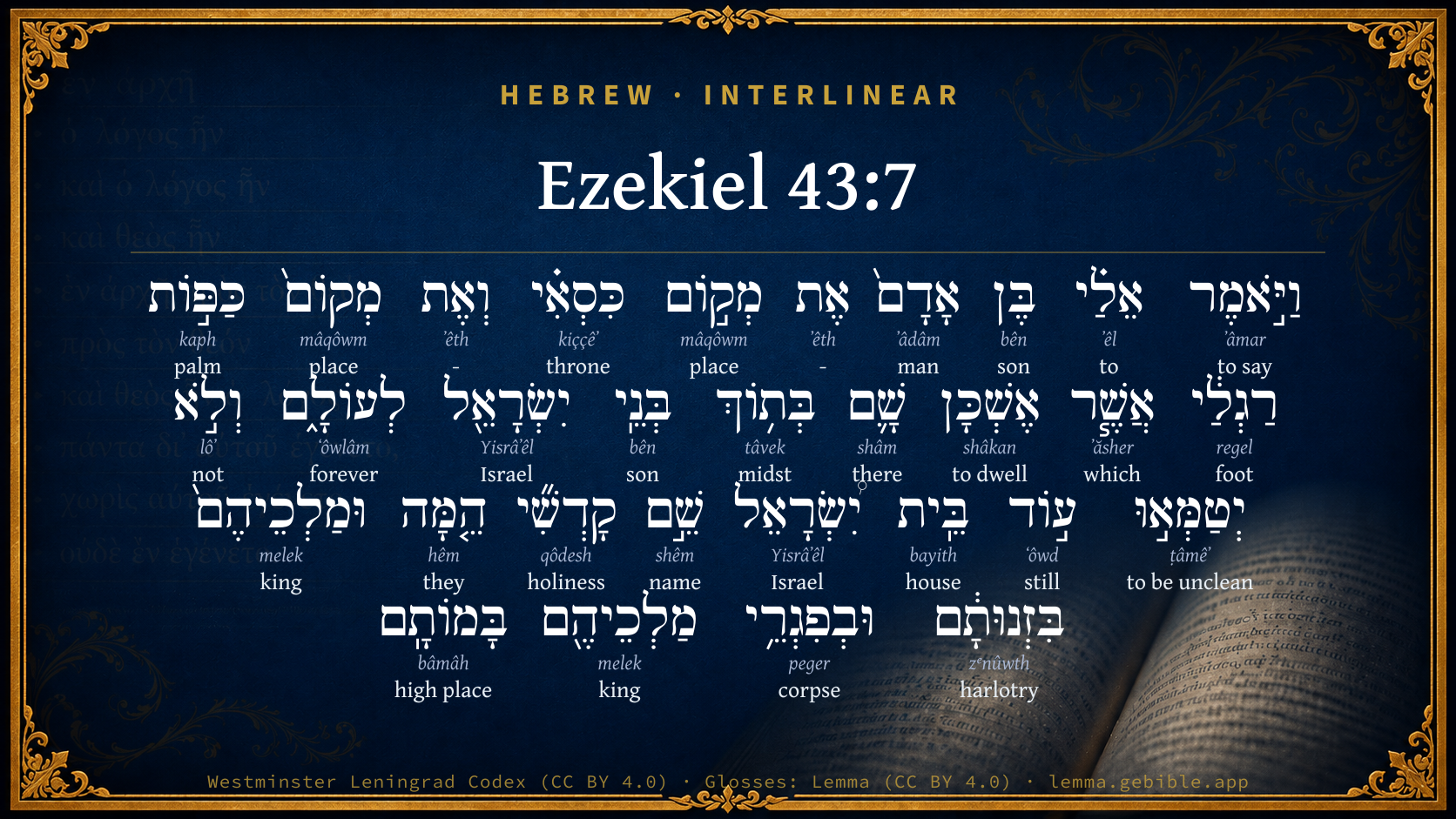
Hebrew (Westminster Leningrad Codex) Ezekiel 43:7 appears in the Hebrew Old Testament. The text above is from the Westminster Leningrad Codex. Each word links to its Strong’s number, a concise gloss, and parsing drawn from the Open Scriptures Hebrew Bible morphology. Click any word for its full Brown-Driver-Briggs (BDB) entry.
Download image
Cite this verse

Ezekiel 43:7 (World English Bible). Public Domain. Lemma interlinear Bible study tool, https://lemma.gebible.app/v/ezekiel/43/7.

Show BibTeX & RIS
BibTeX
RIS
English Translation
He said to me, Son of man, [this is] the place of my throne, and the place of the soles of my feet, where I will dwell in the midst of the children of Israel forever. The house of Israel shall no more defile my holy name, neither they, nor their kings, by their prostitution, and by the dead bodies of their kings [in] their high places;
World English Bible · Public Domain
Download a study sheet

One document with this verse’s original text, its word-by-word gloss line, the meaning frame, cross-references with their text, attributed commentary, and full source and license credits — printable, and it pastes into notes with its structure intact.

This verse Autodidact and up

Study sheet (.html) Plain text (.txt)

A passage Seminary Student

Up to 50 verses in one chapter. A passage sheet keeps up to 6 commentary sources and 12 cross-references per verse, in the order this page ranks them, and says so on the sheet whenever that leaves anything out. Ask for a single verse and you get the Autodidact verse sheet above.

Everything on this page stays free to read, with no account — the sheet is a download of what is already on screen, not access to it.

Want to remove ads? Support Godless Engineer
Compare translations 3

The same verse in 3 English versions, stacked beneath the original-language interlinear above. Click any original word for its lexicon entry.

Each is an independent rendering of the whole verse — the interlinear is not word-aligned to these translations.

Highlighted words mark where these versions differ — a whole-verse word diff, not a word-by-word alignment.

  • World English Bible Public Domain
    He said to me, Son of man, [this is] the place of my throne, and the place of the soles of my feet, where I will dwell in the midst of the children of Israel forever. The house of Israel shall no more defile my holy name, neither they, nor their kings, by their prostitution, and by the dead bodies of their kings [in] their high places;
  • King James Version Public Domain
    And he said unto me, Son of man, the place of my throne, and the place of the soles of my feet, where I will dwell in the midst of the children of Israel for ever, and my holy name, shall the house of Israel no more defile, neither they, nor their kings, by their whoredom, nor by the carcases of their kings in their high places.
  • unfoldingWord Literal Text CC BY-SA 4.0
    He said to me, “Son of man, this is the place of my throne and the place for the soles of my feet, where I will live in the midst of the people of Israel forever. The house of Israel will no longer profane my holy name—they or their kings—with their faithlessness or with the corpses of their kings at their high places.

unfoldingWord Literal Text — © unfoldingWord, licensed CC BY-SA 4.0. Word-aligned USFM3 via Door43 (git.door43.org/unfoldingWord/en_ult).

Versions to compare (up to 4)

3 of 4 selected

Show all 18 translations

Every available English version of this verse, each an independent rendering of the whole verse.

  • World English Bible Public Domain
    He said to me, Son of man, [this is] the place of my throne, and the place of the soles of my feet, where I will dwell in the midst of the children of Israel forever. The house of Israel shall no more defile my holy name, neither they, nor their kings, by their prostitution, and by the dead bodies of their kings [in] their high places;
  • Berean Standard Bible Public Domain
    and He said to me, “Son of man, this is the place of My throne and the place for the soles of My feet, where I will dwell among the Israelites forever. The house of Israel will never again defile My holy name—neither they nor their kings—by their prostitution and by the funeral offerings for their kings at their deaths.
  • Majority Standard Bible Public Domain
    and He said to me, “Son of man, this is the place of My throne and the place for the soles of My feet, where I will dwell among the Israelites forever. The house of Israel will never again defile My holy name—neither they nor their kings—by their prostitution and by the funeral offerings for their kings at their deaths.
  • King James Version Public Domain
    And he said unto me, Son of man, the place of my throne, and the place of the soles of my feet, where I will dwell in the midst of the children of Israel for ever, and my holy name, shall the house of Israel no more defile, neither they, nor their kings, by their whoredom, nor by the carcases of their kings in their high places.
  • American Standard Version (1901) Public Domain
    And he said unto me, Son of man, `this is' the place of my throne, and the place of the soles of my feet, where I will dwell in the midst of the children of Israel for ever. And the house of Israel shall no more defile my holy name, neither they, nor their kings, by their whoredom, and by the dead bodies of their kings `in' their high places;
  • Revised Version (1885) Public Domain
    And he said unto me, Son of man, this is the place of my throne, and the place of the soles of my feet, where I will dwell in the midst of the children of Israel for ever: and the house of Israel shall no more defile my holy name, neither they, nor their kings, by their whoredom, and by the carcases of their kings in their high places;
  • Geneva Bible (1599) Public Domain
    Which saide vnto me, Sonne of man, this place is my throne, and the place of the soles of my feete, whereas I will dwell among the children of Israel for euer, and the house of Israel shall no more defile mine holy Name, neither they, nor their Kings by their fornication, nor by the carkeises of their Kings in their high places.
  • Douay-Rheims (1899) Public Domain
    Said to me: Son of man, the place of my throne, and the place of the soles of my feet, where I dwell in the midst of the children of Israel for ever: and the house of Israel shall no more profane my holy name, they and their kings by their fornications, and by the carcasses of their kings, and by the high places.
  • Young's Literal Translation Public Domain
    and He saith unto me: `Son of man, the place of My throne, And the place of the soles of My feet, Where I dwell in the midst of the sons of Israel to the age, Defile no more do the house of Israel My holy name, They, and their kings, by their whoredom, And by the carcases of their kings -- their high places.
  • Literal Standard Version CC BY-SA 4.0
    and He says to me: “Son of man, the place of My throne, || And the place of the soles of My feet, || Where I dwell in the midst of the sons of Israel for all time, || The house of Israel defiles My holy Name no longer, || They, and their kings, by their whoredom, || And by the carcasses of their kings—their high places.
  • Unlocked Literal Bible CC BY-SA 4.0
    He said to me, “Son of man, this is the place of my throne and the place for the soles of my feet, where I will live in the midst of the people of Israel forever. The house of Israel will no longer profane my holy name—they or their kings—with their faithlessness or with the corpses of their kings at their high places.
  • unfoldingWord Literal Text CC BY-SA 4.0
    He said to me, “Son of man, this is the place of my throne and the place for the soles of my feet, where I will live in the midst of the people of Israel forever. The house of Israel will no longer profane my holy name—they or their kings—with their faithlessness or with the corpses of their kings at their high places.
  • Darby Bible Public Domain
    And he said unto me, Son of man, [this is] the place of my throne, and the place of the soles of my feet, where I will dwell in the midst of the children of Israel for ever; and the house of Israel shall no more defile my holy name, they nor their kings, with their fornication, and with the carcases of their kings [in] their high places,
  • World Messianic Bible Public Domain
    He said to me, “Son of man, this is the place of my throne and the place of the soles of my feet, where I will dwell among the children of Israel forever. The house of Israel will no more defile my holy name, neither they nor their kings, by their prostitution and by the dead bodies of their kings in their high places;
  • Webster's Bible Public Domain
    And he said to me, Son of man, the place of my throne, and the place of the soles of my feet, where I will dwell in the midst of the children of Israel for ever, and my holy name, shall the house of Israel no more defile, neither they, nor their kings, by their lewd deeds, nor by the carcasses of their kings in their high places.
  • Free Bible Version CC BY-SA 4.0
    He told me, “Son of man, this is where I have my throne. It's my home where I will live among the Israelites forever. The people of Israel and their kings won't ever again disgrace me and my holiness by their acts of prostitution and by their honoring their dead kings in their pagan high places.
  • Bible in Basic English Public Domain
    And he said to me, Son of man, this is the place where the seat of my power is and the resting-place of my feet, where I will be among the children of Israel for ever: and no longer will the people of Israel make my holy name unclean, they or their kings, by their loose ways and by the dead bodies of their kings;
  • JPS Tanakh (1917) Public Domain
    And He said unto me: 'Son of man, this is the place of My throne, and the place of the soles of My feet, where I will dwell in the midst of the children of Israel for ever; and the house of Israel shall no more defile My holy name, neither they, nor their kings, by their harlotry, and by the carcasses of their kings in their high places;

Literal Standard Version (2020), Covenant Press — licensed CC BY-SA 4.0. Text via the HelloAO Bible API (eBible.org). Unlocked Literal Bible (unfoldingWord) — licensed CC BY-SA 4.0. Text via the HelloAO Bible API (eBible.org). unfoldingWord Literal Text — © unfoldingWord, licensed CC BY-SA 4.0. Word-aligned USFM3 via Door43 (git.door43.org/unfoldingWord/en_ult). Free Bible Version, Dr. Jonathan Gallagher — licensed CC BY-SA 4.0. Text via the HelloAO Bible API (eBible.org).

Word by word

More ways to search: Search by grammar → Find every occurrence → Compare this word →

Practice this passage: Drill this verse → Learn its vocabulary →

בִּזְנוּתָ֔ם
zᵉnûwth
H2184
“in/at · harlotry · their”
Preposition + Noun, Common, Feminine, Singular, Construct + Suffix, Personal, 3rd Person, Masculine, Plural
Part of Speech
Preposition + Noun
Type
Common
Gender
Feminine
Number
Singular
State
Construct
Full BDB Definition

Origin: from H2181

TWOT: 563b

fornication, harlotry
  1. וַיֹּ֣אמֶר ʼâmar H559 “and · to say” Conjunction + Verb, Qal, Sequential Imperfect, 3rd Person, Masculine, Singular
  2. אֵלַ֗י ʼêl H413 “to · me” Preposition + Suffix, Personal, 1st Person, Common, Singular
  3. בֶּן bên H1121 “son of” Noun, Common, Masculine, Singular, Construct
  4. אָדָם֙ ʼâdâm H120 “man” Noun, Common, Masculine, Singular, Absolute
  5. אֶת ʼêth H853 “-” Particle, Direct Object
  6. מְק֣וֹם mâqôwm H4725 “place of” Noun, Common, Masculine, Singular, Construct
  7. כִּסְאִ֗י kiççêʼ H3678 “throne · my” Noun, Common, Masculine, Singular, Construct + Suffix, Personal, 1st Person, Common, Singular
  8. וְאֶת ʼêth H853 “and · -” Conjunction + Particle, Direct Object
  9. מְקוֹם֙ mâqôwm H4725 “place of” Noun, Common, Masculine, Singular, Construct
  10. כַּפּ֣וֹת kaph H3709 “palms of” Noun, Common, Feminine, Plural, Construct
  11. רַגְלַ֔י regel H7272 “feet · my” Noun, Common, Feminine, Dual, Construct + Suffix, Personal, 1st Person, Common, Singular
  12. אֲשֶׁ֧ר ʼăsher H834 “which” Particle, Relative
  13. אֶשְׁכָּן shâkan H7931 “to dwell” Verb, Qal, Imperfect, 1st Person, Common, Singular
  14. שָׁ֛ם shâm H8033 “there” Adverb
  15. בְּת֥וֹךְ tâvek H8432 “in/at · midst of” Preposition + Noun, Common, Masculine, Singular, Construct
  16. בְּנֵֽי bên H1121 “sons of” Noun, Common, Masculine, Plural, Construct
  17. יִשְׂרָאֵ֖ל Yisrâʼêl H3478 “Israel” Noun, Proper
  18. לְעוֹלָ֑ם ʻôwlâm H5769 “to/for · forever” Preposition + Noun, Common, Masculine, Singular, Absolute
  19. וְלֹ֣א lôʼ H3808 “and · not” Conjunction + Particle, Negative
  20. יְטַמְּא֣וּ ṭâmêʼ H2930 “to be unclean” Verb, Piel, Imperfect, 3rd Person, Masculine, Plural
  21. ע֣וֹד ʻôwd H5750 “still” Adverb
  22. בֵּֽית bayith H1004 “house of” Noun, Common, Masculine, Singular, Construct
  23. יִ֠שְׂרָאֵל Yisrâʼêl H3478 “Israel” Noun, Proper
  24. שֵׁ֣ם shêm H8034 “name of” Noun, Common, Masculine, Singular, Construct
  25. קָדְשִׁ֞י qôdesh H6944 “holiness · my” Noun, Common, Masculine, Singular, Construct + Suffix, Personal, 1st Person, Common, Singular
  26. הֵ֤מָּה hêm H1992 “they” Pronoun, Personal, 3rd Person, Masculine, Plural
  27. וּמַלְכֵיהֶם֙ melek H4428 “and · kings · their” Conjunction + Noun, Common, Masculine, Plural, Construct + Suffix, Personal, 3rd Person, Masculine, Plural
  28. וּבְפִגְרֵ֥י peger H6297 “and · in/at · corpses of” Conjunction + Preposition + Noun, Common, Masculine, Plural, Construct
  29. מַלְכֵיהֶ֖ם melek H4428 “kings · their” Noun, Common, Masculine, Plural, Construct + Suffix, Personal, 3rd Person, Masculine, Plural
  30. בָּמוֹתָֽם bâmâh H1116 “high places · their” Noun, Common, Feminine, Plural, Construct + Suffix, Personal, 3rd Person, Masculine, Plural

About this verse

These counts appear in no published source. They are computed here, from the morphology-tagged text and Lemma’s own curated glosses. What Lemma adds →

31
words
26
distinct lemmas
Prophets
section

Notable vocabulary

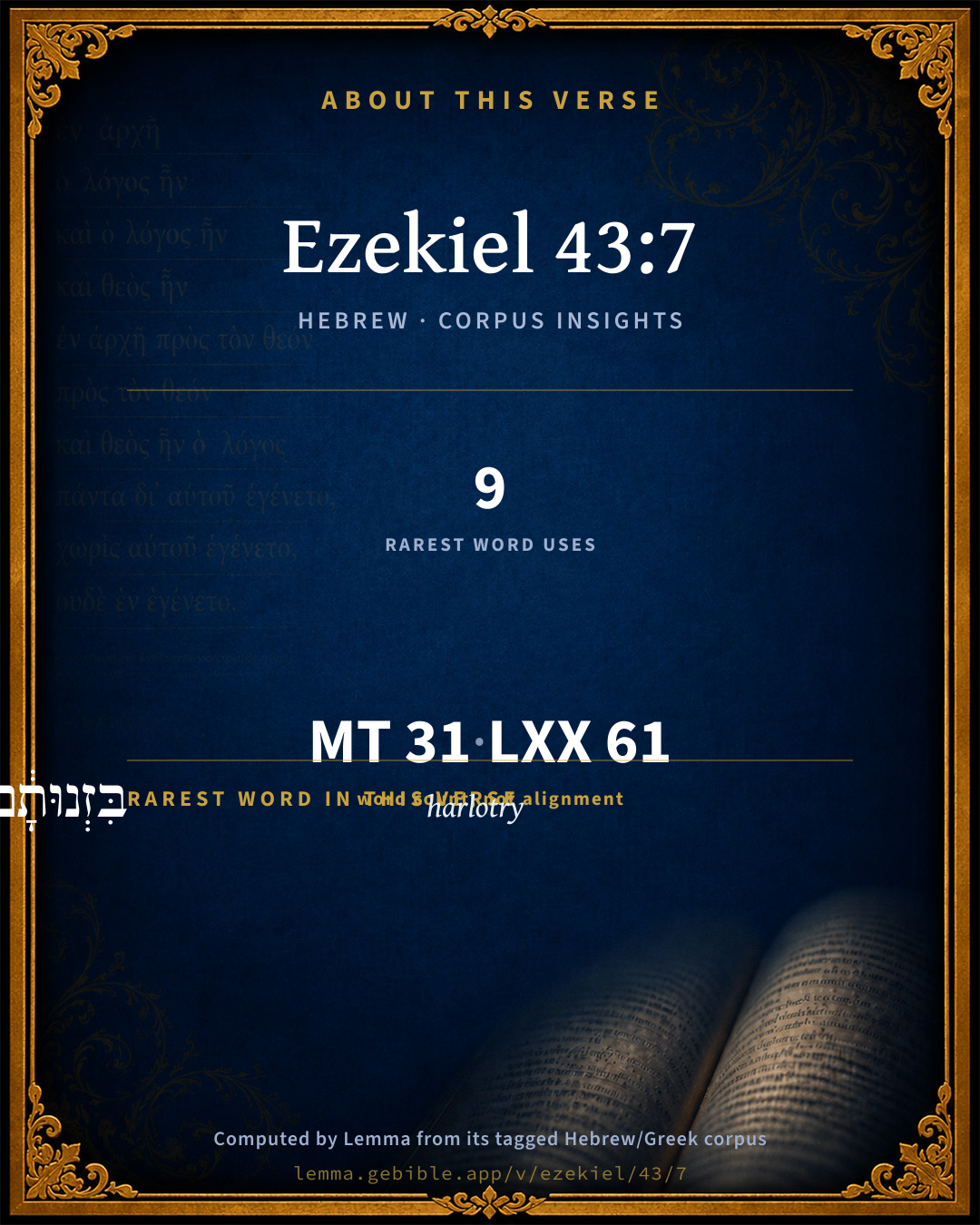
The rarest word here is בִּזְנוּתָ֔ם harlotry H2184 — appearing just 9 times in the whole Hebrew Bible.

Shared distinctive vocabulary

בִּזְנוּתָ֔ם harlotry H2184 occurs in 9 verses of the Hebrew Bible. Also found in:

Grammatical profile

  • 3 verbs
  • 20 nouns
  • 1 pronoun
  • 1 preposition
  • 2 adverbs
  • 4 particles

Verb forms

  • וַיֹּ֣אמֶר Qal · Sequential Imperfect
  • אֶשְׁכָּן Qal · Imperfect
  • יְטַמְּא֣וּ Piel · Imperfect

Repetition

Words recur within this verse — often emphatic in Hebrew:

  • בֶּן son H1121 ×2
  • מְק֣וֹם place H4725 ×2
  • יִשְׂרָאֵ֖ל Israel H3478 ×2
  • וּמַלְכֵיהֶם֙ king H4428 ×2

Hebrew & Septuagint length

In English translation the verse runs 67 words from the Hebrew and 72 from the Septuagint (LXX English) — closely comparable.

A rough comparison of the two English renderings, which tokenize alike — not a word-level alignment.

Word counts can differ between the Hebrew and the Greek without any difference in meaning — e.g. the Hebrew direct-object marker אֵת has no separate Greek word, and Greek often adds the article ὁ.

In the original languages it is 31 Hebrew tokens and 61 Greek tokens — but the two are counted differently (Hebrew bundles its prefixes and suffixes into one token; the Greek is in lemma form), so that isn’t a like-for-like length.

Cross-references

34

Topical passages linked to Ezekiel 43:7 in the Treasury of Scripture Knowledge — connected by theme and wording, ordered by reader-vote popularity; previews shown in the World English Bible.

  • Ezekiel 43:9 Now let them put away their prostitution, and the dead bodies of their kings, far from me; and I will dwell in the midst of them forever.
  • Psalms 47:8 God reigns over the nations. God sits on his holy throne.
  • Leviticus 26:30 I will destroy your high places, and cut down your incense altars, and cast your dead bodies upon the bodies of your idols; and my soul will abhor you.
  • 1 Chronicles 28:2 Then David the king stood up on his feet, and said, Hear me, my brothers, and my people: as for me, it was in my heart to build a house of rest for the ark of the covenant of Yahweh, and for the footstool of our God; and I had made ready for the building.
  • Psalms 99:1 Yahweh reigns! Let the peoples tremble. He sits enthroned among the cherubim. Let the earth be moved.
  • Ezekiel 1:26 Above the expanse that was over their heads was the likeness of a throne, as the appearance of a sapphire stone; and on the likeness of the throne was a likeness as the appearance of a man on it above.
  • Ezekiel 20:39 As for you, house of Israel, thus says the Lord Yahweh: Go you, serve everyone his idols, and hereafter also, if you will not listen to me; but my holy name shall you no more profane with your gifts, and with your idols.
  • Revelation 22:3 There will be no curse any more. The throne of God and of the Lamb will be in it, and his servants serve him.
  • Exodus 29:45 I will dwell among the children of Israel, and will be their God.
  • Psalms 68:18 You have ascended on high. You have led away captives. You have received gifts among men, Yes, among the rebellious also, that Yah God might dwell there.
  • Psalms 99:5 Exalt Yahweh our God. Worship at his footstool. He is Holy!
  • Psalms 132:14 "This is my resting place forever. Here I will live, for I have desired it.
  • Isaiah 6:1 In the year that king Uzziah died, I saw the Lord sitting on a throne, high and lifted up; and his train filled the temple.
  • Isaiah 66:1 Thus says Yahweh, heaven is my throne, and the earth is my footstool: what manner of house will you build to me? and what place shall be my rest?
  • Jeremiah 3:17 At that time they shall call Jerusalem the throne of Yahweh; and all the nations shall be gathered to it, to the name of Yahweh, to Jerusalem: neither shall they walk any more after the stubbornness of their evil heart.
  • Jeremiah 14:21 Do not abhor [us], for your name's sake; do not disgrace the throne of your glory: remember, don't break your covenant with us.
  • Jeremiah 16:18 First I will recompense their iniquity and their sin double, because they have polluted my land with the carcasses of their detestable things, and have filled my inheritance with their abominations.
  • Jeremiah 17:12 A glorious throne, [set] on high from the beginning, is the place of our sanctuary.
  • Ezekiel 10:1 Then I looked, and see, in the expanse that was over the head of the cherubim there appeared above them as it were a sapphire stone, as the appearance of the likeness of a throne.
  • Ezekiel 23:38–39 Moreover this they have done to me: they have defiled my sanctuary in the same day, and have profaned my Sabbaths.
  • Ezekiel 37:26–28 Moreover I will make a covenant of peace with them; it shall be an everlasting covenant with them; and I will place them, and multiply them, and will set my sanctuary in the midst of them forevermore.
  • Ezekiel 39:7 My holy name will I make known in the midst of my people Israel; neither will I allow my holy name to be profaned any more: and the nations shall know that I am Yahweh, the Holy One in Israel.
  • Ezekiel 48:35 It shall be eighteen thousand [reeds] round about: and the name of the city from that day shall be, Yahweh is there.
  • Hosea 14:8 Ephraim, what have I to do any more with idols? I answer, and will take care of him. I am like a green fir tree; From me your fruit is found."
  • Joel 3:17 "So you will know that I am Yahweh, your God, Dwelling in Zion, my holy mountain. Then Jerusalem will be holy, And no strangers will pass through her any more.
  • Zechariah 13:2 It will come to pass in that day, says Yahweh of Hosts, that I will cut off the names of the idols out of the land, and they will no more be remembered; and also I will cause the prophets and the spirit of impurity to pass out of the land.
  • Zechariah 14:20–21 In that day there will be on the bells of the horses, "HOLY TO YAHWEH;" and the pots in Yahweh's house will be like the bowls before the altar.
  • Matthew 5:34–35 but I tell you, don't swear at all: neither by heaven, for it is the throne of God;
  • Matthew 28:20 teaching them to observe all things that I commanded you. Behold, I am with you always, even to the end of the age." Amen.
  • John 1:14 The Word became flesh, and lived among us. We saw his glory, such glory as of the one and only Son of the Father, full of grace and truth.
  • John 14:23 Jesus answered him, "If a man loves me, he will keep my word. My Father will love him, and we will come to him, and make our home with him.
  • Acts 7:48–49 However, the Most High doesn't dwell in temples made with hands, as the prophet says,
  • 2 Corinthians 6:16 What agreement has a temple of God with idols? For you are a temple of the living God. Even as God said, "I will dwell in them, and walk in them; and I will be their God, and they will be my people."
  • Revelation 21:2–3 I saw the holy city, New Jerusalem, coming down out of heaven from God, made ready like a bride adorned for her husband.

Cross-references courtesy of OpenBible.info (CC BY 4.0).

Hebrew and Greek witnesses Masoretic Hebrew ↔ Greek Septuagint

The same verse in the two great witnesses to the Old Testament, shown verse-for-verse.

These are two independent witnesses, not word-aligned to each other, and the Septuagint is shown in lemma (dictionary) form.

Hebrew Ezekiel 43:7 Masoretic · Westminster Leningrad Codex

וַיֹּ֣אמֶר אֵלַ֗י בֶּן אָדָם֙ אֶת מְק֣וֹם כִּסְאִ֗י וְאֶת מְקוֹם֙ כַּפּ֣וֹת רַגְלַ֔י אֲשֶׁ֧ר אֶשְׁכָּן שָׁ֛ם בְּת֥וֹךְ בְּנֵֽי יִשְׂרָאֵ֖ל לְעוֹלָ֑ם וְלֹ֣א יְטַמְּא֣וּ ע֣וֹד בֵּֽית יִ֠שְׂרָאֵל שֵׁ֣ם קָדְשִׁ֞י הֵ֤מָּה וּמַלְכֵיהֶם֙ בִּזְנוּתָ֔ם וּבְפִגְרֵ֥י מַלְכֵיהֶ֖ם בָּמוֹתָֽם

He said to me, Son of man, [this is] the place of my throne, and the place of the soles of my feet, where I will dwell in the midst of the children of Israel forever. The house of Israel shall no more defile my holy name, neither they, nor their kings, by their prostitution, and by the dead bodies of their kings [in] their high places;

World English Bible · Public Domain

Greek LXX Ezekiel 43:7 Septuagint · lemma form

καί εἶπον πρός ἐγώ ὁράω υἱός ἄνθρωπος ὁ τόπος ὁ θρόνος ἐγώ καί ὁ τόπος ὁ ἴχνος ὁ πούς ἐγώ ἐν ὅς κατασκηνόω ὁ ὄνομα ἐγώ ἐν μέσος οἶκος ἰσραήλ ὁ αἰών καί οὐ βεβηλόω οὐκέτι οἶκος ἰσραήλ ὁ ὄνομα ὁ ἅγιος ἐγώ αὐτός καί ὁ ἡγέομαι αὐτός ἐν ὁ πορνεία αὐτός καί ἐν ὁ φόνος ὁ ἡγέομαι ἐν μέσος αὐτός

and he said to me, Son of man, you have seen the place of my throne, and the place of the soles of my feet, in which my name shall dwell in the midst of the house of Israel for ever; and the house of Israel shall no more profane my holy name, they and their princes, by their fornication, or by the murders of their princes in the midst of them;

LXX2012 (modern English Septuagint) · Public Domain

On this verse, Albert Barnes' Notes on the Bible discusses the Septuagint’s reading. Read the note in Commentary ↓

Hebrew: Westminster Leningrad Codex (CC BY 4.0). Greek: Septuagint (public domain); English from LXX2012 (modern English Septuagint) (Public Domain). How the Septuagint differs from the Hebrew →

Targum (Aramaic paraphrase)

1

The Targum is the ancient Jewish Aramaic paraphrase of the Hebrew Scriptures — an interpretive translation, not the Hebrew text itself. Onkelos (literal) and Pseudo-Jonathan (expansive) render the Torah, and Jonathan the Prophets. Coverage is partial: where no permissively-licensed English translation exists for a verse, only the Aramaic is shown. This is verse-level text, not a word-by-word alignment to the Hebrew.

  1. Targum Jonathan Prophets (Joshua–Malachi)
    וַאֲמַר לִי בַּר אָדָם דֵין אֲתַר בֵּית כּוּרְסֵי יְקָרִי וְדֵין אֲתַר בֵּית אַשְׁרָיוּת שְׁכִנְתִּי דְאַשְׁרֵי שְׁכִנְתִּי תַמָן בְּגוֹ בְּנֵי יִשְׂרָאֵל לַעֲלָם וְלָא יִסְאֲבוּן עוֹד בֵּית יִשְׂרָאֵל שְׁמָא דְקוּדְשִׁי אִינוּן וּמַלְכֵיהוֹן בְּטַעֲוַתְהוֹן וּבְפִגְרֵי מַלְכֵיהוֹן בָּמוֹתֵיהוֹן:

    (no public-domain English translation for this verse)

    Targum Jonathan — Aramaic: “Mikraot Gedolot” (public domain). English: “Sefaria Community Translation” (CC0 1.0 (public-domain dedication)); “London "Chaldee Paraphrase," 1871” (public domain). Text via Sefaria.

Commentary

Notes on Ezekiel 43:7 from classic Christian and Jewish commentators (each source and its license shown beneath its notes). The classic Christian expositions comment on the surrounding passage and are grouped to its opening verse, so a note may address several verses; the Jewish commentaries on the Tanakh (Rashi and others) are per-verse, so they appear only where the commentator wrote on this verse.

Lemma curates 59 commentaries, every one of them public domain or Creative Commons licensed, each selected and text-cleaned for this edition rather than reprinted as found. About our sources →

Matthew Henry's Commentary

God does here, in effect, renew his covenant with his people Israel, upon his retaking possession of the house, and Ezekiel negotiates the matter, as Moses formerly. This would be of great use to the captives at their return both for direction and encouragement; but it looks further, to those that are blessed with the privileges of the gospel-temple, that they may understand how they are before him on their good behaviour.

I. God, by the prophet, puts them in mind of their former provocations, for which they had long lain under the tokens of his displeasure. This conviction is spoken to them to make way for the comforts designed them. Though God gives and upbraids not, it becomes us, when he forgives, to upbraid ourselves with our unworthy conduct towards him. Let them now remember therefore, 1. That they had formerly defiled God's holy name, had profaned and abused all those sacred things by which he had made himself known among them, Eze 43:7. They and their kings had brought contempt on the religion they professed, and their relation to God, by their spiritual whoredom, their idolatry, and by worshipping images, which they called their kings (for so Moloch signifies) or lords (for so Baal signifies), but which were really the carcases of kings, not only lifeless and useless, but loathsome and abominable as dead carcases, in their high places, set up in honour of them. They had defiled God's name by their abominations. And what were they? It was in setting their threshold by my thresholds, and their post by my posts, that is, adding their own inventions to God's institutions, and urging all to a compliance with them, as if they had been of equal authority and efficacy, teaching for doctrines the commandments of men (Isa 29:13); or, rather, setting up altars to their idols even in the courts of the temple, than which a more impudent affront could not be put upon the divine Majesty. Thus they set up a separation wall between him and them, which stopped the current of his favours to them and spoiled the acceptableness of their services to him. See what an indignity sinners do to God, setting up their walls in opposition to his, and thrusting him out from what is his right; and see what injury they do to themselves, for the nearer any come to God with their sins the further they set him at a distance from them. Some give this sense of it: Though their houses joined close to God's house, their posts and thresholds to hi, so that they were in a manner his next neighbours, there was but a wall between me and them (so it is in the margin), so that it might have been expected they would acquaint themselves with him and be in care to please him, yet they were not so much as neighbourly. Note, It often proves too true, The nearer the church the further from God. They were, by profession, in covenant with God, and yet they had defiled the place of his throne and of the soles of his feet, his temple, where he did both reside and reign. Jerusalem is called the city of the great king (Psa 48:2) and his footstool, Psa 99:5; Psa 132:7. Note, When God's ordinances are profaned his holy name is polluted. 2. That for this God had had a controversy with them in their late troubles. They could not condemn him, for he had but brought upon them the desert of their sins: Wherefore I have consumed them in my anger. Note, Those that pollute God's holy name fall under his just displeasure.

II. He calls upon them to repent and reform, and, in order to that, to be ashamed of their iniquities (Eze 43:9): "Now let them put away their whoredom; now that they have smarted so severely for it, and now that God is returning in mercy to them and setting up his sanctuary again in the midst of them, now let them cast away their idols and have no more to do with them, that they may not again forfeit the privileges which they have been taught to know the worth of by the want of them. Let them put away their idols, those loathsome carcases of their kings, far from me, from being a provocation to me." This was seasonable counsel now that the prophet had the model or pattern of the temple to set before them; for, 1. If they see that pattern, they will surely be ashamed of their sins (Eze 43:10): when they see what mercy God has in store for them, notwithstanding their utter unworthiness of it, they will be ashamed to think of their disingenuous conduct towards him. Note, The goodness of God to us should lead us to repentance, especially to a penitential shame. Let them measure the pattern themselves, and see how much it exceeds the former pattern, and guess by that what great things God has in store for them; and surely it will put them out of countenance to think what the desert of their sins was. And then, 2. If they be ashamed of their sins, they shall surely see more of the pattern, Eze 43:11. If they be ashamed of all that they have done, upon a general view of the goodness of God, let them have a more distinct particular account of the temple. Note, Those that improve what they see and know of the goodness of God shall see and know more of it. And then, and not till then, we are qualified for God's favours, when we are truly humbled for our own follies. "Show them the form of the house; let them see what a stately structure it will be; and withal show them the ordinances and laws of it." Note, With the foresights of our comforts it is fit that we should get the knowledge of our duty; with the privileges of God's house we must acquaint ourselves with the rules of it. Show them these ordinances, that they may keep them and do them. Note, Therefore we are made to know our duty, that we may do it, and be blessed in our deed.

III. He promises that they shall be such as they should be, and then he will be to them such as they would have him to be, Eze 43:7. 1. The house of Israel shall no more defile my holy name. This is pure gospel. The precept of the law says, You must not defile my name: the grace of the gospel says, You shall not. Thus what is required in the covenant is promised in the covenant, Jer 32:40. 2. Then I will dwell in the midst of them for ever; and the same again Eze 43:9. God secures to us his good-will be confirming in us his good work. If we do not defile his name, we may be sure that he will not depart from us.

IV. The general law of God's house is laid down (Eze 43:12), That, whereas formerly only the chancel, or sanctuary, was most holy, now the whole mountain of the house shall be so; the whole limit thereof, including all the courts and all the chambers, shall be as the most holy place, signifying that in gospel-times, 1. The whole church shall have the privilege of the holy of holies, that of a near access to God. All believers have now, under the gospel, boldness to enter into the holiest (Heb 10:19), with this advantage, that whereas the high priest entered in the virtue of the blood of bulls and goats, we enter in the virtue of the blood of Jesus, and, wherever we are, we have through him access to the Father. 2. The whole church shall be under a mighty obligation to press towards the perfection of holiness, as he who has called us is holy. All must now be most holy. Holiness becomes God's house for ever, and in gospel-times more than ever. Behold this is the law of the house; let none expect the protection of it that will not submit to this law.

Matthew Henry's Commentary on the Whole Bible (1708–1710) — public domain (CC PDM 1.0). Text via the HelloAO Bible API.

Trapp's Complete Commentary

John Trapp

Eze 43:7 And he said unto me, Son of man, the place of my throne, and the place of the soles of my feet, where I will dwell in the midst of the children of Israel for ever, and my holy name, shall the house of Israel no more defile, [neither] they, nor their kings, by their whoredom, nor by the carcases of their kings in their high places.

Ver. 7. The place of my throne, and the place of the soles of my feet,] i.e., My Church, which is unto me instead of heaven and earth. Behold the place of my throne, &c., {Isa 60:1} so some read it; others, As for the place of my throne, &c.

No more defile.] But hallow; for negative holiness alone is little worth.

Nor by the carcases of their kings,] i.e., Their idols; {a} not unfitly called "carcases": - (1.) Because void of life; (2.) Stinking stuff. See Lev 26:30 Jer 16:18. These were oft brought in, and countenanced by their kings.

{a} Piscat.

John Trapp, A Commentary or Exposition upon All the Books of the Old and New Testament (1647–1656) — public domain. Text from a community e-Sword module.

Joseph Benson's Commentary

Eze 43:7-9. And he said unto me, Son of man, &c. — God here, in retaking possession of his house, in effect renews his covenant with his people Israel; and Ezekiel negotiates the matter, as Moses formerly did. This would be of great use to the captives at their return, both for direction and for encouragement; but it more especially concerns those that are blessed with the privileges of the gospel temple, and shows that they hold their blessings under the condition of their obedience. The place of my throne — The sense would be plainer if the beginning of the verse were rendered, This is the place of my throne, &c. — The cherubim are described as God’s throne, and he is said to dwell, or sit, between the cherubim, and the ark was as his footstool. Observe, reader, his temple, the church, is the place where the throne of his grace is erected; and in the dispensations of grace he has a throne, and manifests himself as a king, to whom we must be subject. Where I will dwell in the midst of the children of Israel for ever — He alludes to the promise formerly made with relation to the tabernacle and temple, (see Psa 68:16; Psa 132:14,) which promise is to be understood, like all God’s other promises made of old, as conditional, (see Eze 43:9,) and intended to be eminently fulfilled in and by Christ, in whom all the promises of the Old Testament are to have their final accomplishment. Zechariah prophesied, Zec 6:13, that the Messiah should build the temple of the Lord, and bear the glory; that is, as such prophecies are explained in the New Testament, he shall build the Christian Church, and in him shall all the fulness of the Godhead dwell bodily and really, not in types and figures. To the same sense we may explain the prophecy of Hag 2:7, The glory of the latter house shall be greater than that of the former; for no visible glory appeared in the second temple, till the Lord whom they expected came to his temple, Mal 3:1; that is till the Messiah, who was the brightness of his Father’s glory, appeared there, and made it an illustrious figure of that true temple, or church of believers, where he would continue his presence for ever; see 2Co 6:16. And my holy name shall Israel no more defile by their whoredom — By idolatry, often described in Scripture under the metaphor of fornication. The captivity had that good effect upon the Jews, that they scarce ever after relapsed into idolatry. And the entire destruction of idolatry is often mentioned as a blessing reserved for the latter days, when the Jews shall be converted, and the fulness of the Gentiles come into the church. Nor by the carcasses of their kings in their high places — Idols are called carcasses, because they are without life and motion, and likewise upon the account of their being hateful and loathsome in the sight of God: see the margin. They are called carcasses of kings because they were set up, and the worship of them encouraged, by the idolatrous kings of Judah, who erected high places for that purpose near Jerusalem, in the very view of the temple, 2Ki 23:13. By this means the temple itself was profaned by those that came directly from the worship of idols to attend upon God’s service in the temple. Nay, they even advanced to such high degrees of idolatry, as to set up their threshold by God’s threshold, that is, to erect the altars and images of their idols in the temple itself, and the courts before it. And the wall — For there was but a wall between me and them: see the margin.

Joseph Benson's Commentary on the Old and New Testaments (1811–1818) — public domain. Text from a community e-Sword module.

Tyndale Open Study Notes

Tyndale Open Resources

43:7b-9 If God were to remain with his people, standards would have to be raised and regulations enforced that would guard against the repetition of past abuses. Israel and their kings would not defile God’s holy name by their spiritual adultery with other gods or with relics of their kings who had died—memorial markers to dead kings—within the grounds of the Temple of the living God. There was no place for honoring human kings in the palace of the divine King. In the future, the proper hierarchy would be reestablished by removing the residence of the earthly ruler to a greater distance from the spiritual center of the land (see 45:7). Putting the earthly ruler in his proper place was a necessary precondition for God’s dwelling perpetually in his rightful place.

Tyndale Open Study Notes — © Tyndale Open Resources, licensed CC BY-SA 4.0. Text via the HelloAO Bible API.

Geneva Bible (1599)

Geneva Bible translators

By their idolatries.

He alludeth to Amnon and Manasseh, who were buried in their gardens near the Temple, and there had erected up monuments to their idols.

Geneva Bible (1599) marginal notes — public domain. Text via Bolls.life.

Jamieson, Fausset & Brown

Robert Jamieson, A. R. Fausset & David Brown

the place--that is, "behold the place of My throne"--the place on which your thoughts have so much dwelt (Isa 2:1-3; Jer 3:17; Zac 14:16-20; Mal 3:1). God from the first claimed to be their King politically as well as religiously: and He had resisted their wish to have a human king, as implying a rejection of Him as the proper Head of the state. Even when He yielded to their wish, it was with a protest against their king ruling except as His vicegerent. When Messiah shall reign at Jerusalem, He shall then first realize the original idea of the theocracy, with its at once divine and human king reigning in righteousness over a people all righteous (Eze 43:12; Isa 52:1; Isa 54:13; Isa 60:21).

Jamieson, Fausset & Brown — Commentary Critical and Explanatory on the Whole Bible (1871) — public domain (CC PDM 1.0). Text via the HelloAO Bible API.

Adam Clarke's Commentary

Verse 7. Son of man, the place of my throne] The throne refers to his majesty; the soles of his feet, to his condescension in dwelling among men.

Where I will dwell in the midst of the children of Israel] The tabernacle and temple were types of the incarnation of Jesus Christ: "Destroy THIS TEMPLE, and after three days I will raise it up; - but this he spake of the temple of his body;" Joh 2:19; Joh 2:21. And in THAT TEMPLE "dwelt all the fulness of the Godhead bodily." Into this immaculate humanity did the glory of the Supreme God enter; and thus, "God was in Christ reconciling the world unto himself." And this Jesus is Immanuel, GOD with US. In him we find united the ineffable majesty of God, with the abjectness of man. He humbled himself in human nature, not only to bear the form of a servant, but to suffer death upon the cross as a malefactor slave! But by these means he has purchased eternal redemption for us; and the spiritual Israel, who find redemption in his blood, shall be raised up wherever his holy name shall be proclaimed; and shall not, like the old apostate Israel, defile that great name by idolatry or a life of wickedness, but they shall show forth the virtues of Him who has called them from darkness into his marvellous light.

Adam Clarke's Commentary on the Bible (1810–1826) — public domain. Text from a community e-Sword/MySword module.

Ellicott's Commentary for English Readers

(7) The place of the soles of my feet.—Comp. 1Ch_28:2; Psa_132:7.

I will dwell . . . for ever.—This should be the peculiar distinction of the Temple seen in the vision. The Tabernacle and Solomon’s Temple had both been accepted as the peculiar dwelling-place of God, but both had passed away. So also it would be with the material Temple of the restoration. But in this Temple of the vision God promises that He would dwell for ever.

By the carcases of their kings.—The “shall defile” with which the later clauses of this verse are connected is not an imperative, but a simple future, and is in accordance with the generally ideal character of the vision. The word “carcases” is here a difficult one. Some commentators understand it literally of the burial of some of the kings in the Temple area; but there is no historical proof that any were so buried, the gardens of the royal palace being quite too distant for the language here used, nor is there anywhere any allusion to such defilement. The simplest explanation is that the language is founded upon Lev_26:30, and means idols. Manasseh and others had introduced their idols into the very courts of the Temple (2Ki_21:4-7; sec also 2Ki_16:11).

A Bible Commentary for English Readers, edited by Charles John Ellicott (1878–1897) — public domain. Text from a community e-Sword module.

The Cambridge Bible for Schools and Colleges

gen. ed. J. J. S. Perowne

7. the place of my throne] this is the place of my throne … for ever: and the house of Israel shall no more defile. No change of reading is implied but the emphatic position of “the place” &c. requires to be expressed by some such word as “this is,” or, “Behold.” On “soles of my feet” cf. Isa_60:13; Isa_66:1; Lam_2:1; Psa_132:7; 1Ch_28:2.

by their whoredom] Their idolatries, cf. ch. 8.

in their high places] Probably: in their death, i.e. when dead, Lev_11:31-32. So some mss., Targ., by change of one vowel. The ref. is to the burial of the kings in the vicinity of the temple. The passages Lev_26:30; Jer_16:18, to which appeal is made, do not sustain the idea that “carcase” could be used as a mere name of opprobrium for idols (Psa_106:28 is of doubtful meaning). In the former passage the hewn down idol is a carcase just as the slain man is; and in Jer_16:18 the use of the word “dead body” is not figurative. It is true that there is no record of kings being buried close to the temple, but their sepulchres were in such vicinity that in comparison with the new ideal of holiness they could not but be held to bring defilement to the dwelling-place of Jehovah, the living God. Eze_43:9 seems conclusive for this rendering.

The Cambridge Bible for Schools and Colleges (gen. ed. J. J. S. Perowne; Cambridge University Press, 1878–1918) — public domain. Text from a community e-Sword module.

John Gill's Exposition

And he said unto me, son of man,.... A kind, usual, and singular appellation, given to this prophet: these are the words either of the man that stood by him, so the Arabic version; or of Jehovah, speaking out of the house to him:

the place of my throne, and the place of the soles of my feet: that is, this house, the church of God, is the place where the throne of the Lord is set; where he rules and reigns; where he sets his feet, and is his resting place; even his, whose throne is the heaven, and the earth his footstool; here Christ, as King of saints, dwells, and here he walks and shows the glory of his majesty:

where I will dwell in the midst of the children of Israel for ever; not Carnal, but spiritual Israel; such as are Israelites indeed, or which the church will be full in the latter day, both Jews and Gentiles; and in the midst of these will Jehovah dwell, and grant his gracious presence, and never more depart from them: this shows that this house or building can not be understood of the second temple; since the Lord did not dwell in that for ever, but has left that house desolate hundreds of years ago: some Jewish writers (p) have owned that it belongs to the times of the Messiah:

and my name shall the house of Israel no more defile, or "profane"; or cause to be blasphemed by immoralities, or false doctrines, or superstition and will worship; denoting the holiness of life, purity of doctrine and worship, in the churches of Christ in the latter day; see Isa 4:3,

neither they, nor their kings, by their whoredom: that is, idolatry, which is spiritual fornication; such as the kings of Israel, and their subjects, were often guilty of, before their captivity in Babylon, though not after; nor will they ever return to it in the latter day, when converted; for they will never espouse the idolatries of Rome; and those kings and people that bear the name of Christians, and yet commit fornication with the whore of Babylon, shall do so no more after these times, Rev 17:2,

nor by the carcasses of their kings in their high places; or, and "their high places" (q); that is, by both; by the carcasses of their kings being buried in or near the house of God; so the Targum adds, at their death (r); or by human carcasses being sacrificed to Molech or Milcom, which signifies their king: or else the idols themselves are so called, because lifeless and abominable; see Jer 16:18, and the worship of which the kings of Israel encouraged by precept and practice, order and example, and therefore called theirs; and also by their high places, which they made for idolatrous worship, and which were made where the carcasses of their kings were laid, as Ben Melech observes; and all which were done, especially in the reigns of Manasseh and Ammon: but now nothing of this kind shall be hereafter, or any thing now similar to it, in the antichristian state.

(p) Vid. R. Isaac Chizzuk Emunah, par. 1. p. 51. (q) "et excelsis suis", Junius & Tremellius, Piscator. (r) So Abendana takes this word to signify "in their death"; their carcasses being buried in their gardens, as Manasseh, 2 Kings xxi. 18.

John Gill's Exposition of the Whole Bible (1746–1763) — public domain (CC PDM 1.0). Text via the HelloAO Bible API.

Albert Barnes' Notes on the Bible

He said - i. e., God “said.” Both the Septuagint and the Vulgate break this verse into two, so as to make the first half the solemn words of dedication. place a full stop after “forever;” the words mark the distinction between the new and the former sanctuary.

The palace of Solomon abutted upon the southern side of the embankment of the temple-platform; there was but “a wall between Yahweh and them.” When the kings gave themselves up to idolatry, this vicinity was to the temple a pollution and defilement. Thus it has been conjectured that “the garden of Uzza” in which Manasseh and Amon were buried 2Ki 21:18, 2Ki 21:26, and on which now stands the mosque of Omar, was on the temple area itself; if so, this would explain the mention of “high places” in connection with the defilement by the “carcases of kings,” since the platform of the mosque of Omar at the time of Ezekiel rose to a considerable height above the temple.

Besides this, idolatrous kings of Judah did actually introduce their idolatries into the temple courts themselves (compare 2Ki 16:11; 2Ki 21:4).

Albert Barnes' Notes on the Bible (1834–1885) — public domain. Text from a community e-Sword/MySword module.

Haydock's Catholic Bible Commentary

Said. The Lord spoke, (Chaldean; Theodoret) or the angel, (St. Jerome) in human shape. (Haydock) --- He addresses the prophet, ver. 12 to chap. xliv. 5., though what follows immediately seems to belong to the Lord, (Calmet) in whose name he speaks. --- Name. God hath abandoned the synagogue, but will remain with his Church unto the end, Matthew xxiii. 38., and xxviii. 20. Yet the perfect Church, without spot, is the [Church] triumphant [in heaven]; (Ephesians v. 27.; Worthington) though the Catholic Church, on earth, is every holy and "the communion of saints." (Haydock) --- Carcasses. Idols, according to some; or rather by the kings being buried on Sion. This is nowhere else reprehended; neither is their building too near the temple, which the prophet here condemns, ver. 8. (Calmet) --- It seems, however, that if these things had been blameable, such a number of pious and wise kings would not have acted thus, nor the prophets have neglected to admonish them of their duty. The carcasses and houses here specified may have been vestiges of idolatry; or, in future, the tombs and palaces were to be at a more respectful distance. (Haydock)

George Leo Haydock (1774–1849), Haydock's Catholic Family Bible and Commentary, 1859 edition — public domain. Excludes Psalms (Douay-Rheims chapter numbering differs from Protestant) and Deuterocanonical books (Catholic canon only).

Matthew Poole's English Annotations

And he; the glorious God of Israel.

The place of my throne: his throne, i.e. of glory and majesty, is in heaven, but the throne of his grace is in his temple; in the dispensations of grace, God manifests himself a King.

The place of the soles of my feet: after the manner of man God speaks, and expresseth his abode and rest, where it is in his temple, as type, in his church, as the antitype.

I will dwell; not only shall my ordinances be there administered, but I myself will dwell there.

For ever; for a very long time, till the age of infancy with the Jewish church be over; and to eternity with my church, signified by this temple and city.

My holy name: see Eze 22:26; 36:20. No more defile; dishonour, and bring into contempt, as they have done. Neither they; the priests, the false prophets, and the common people, nor their governors and kings.

By their whoredom; by idolatries, and worshipping of strange gods, which, after the captivity, they did very punctually abstain from, as history assures us.

By the carcasses of their kings; either the dead bodies of their deceased kings, buried too near the temple, less likely; or by the sacrificing of men to their idols, to Moloch; or idols are here called carcasses, as dead, stinking, loathsome things in the sight of God. Or, if I had instances of any kings buried in the temples Of the idols, I should incline to interpret this passage of the profane and wicked burying idolatrous kings near the idols they worshipped.

In their high places; where idol temples and idol worship were celebrated.

Matthew Poole's English Annotations on the Holy Bible (1683–1685) — public domain. Text from a community e-Sword/MySword module.

The Pulpit Commentary

Vers. 7-12 Debate exists as to who the speaker in the seventh verse was, whether Jehovah or the man some holding with Kliefoth, Ewald, Smend, and Currey, that he was Jehovah; others, with Havernick, Keil, Hengstenberg, and Schroder, that he was "the man;" and still others, with Plumptre, that it cannot be decided which he was. One thing is clear, that if "the man" was the speaker, his words and message were not his own, but Jehovah"s. Yet unless the man had been the angel of the Lord the view of Hengstenberg and Schroder it will always seem incongruous that he should have addressed Ezekiel without a "Thus saith the Lord." Hence the notion that the speaker was Jehovah is, perhaps, the one freest from difficulty. The message announced or communication made to the prophet related first to Jehovah"s purpose in entering the temple (vers. 7-9), and secondly to his object in showing the house to the prophet, viz. that he might show it to the house of Israel (vers. 10-12).

The LXX and the Vulgate divide the present verse into two parts, and take the first as equivalent to a solemn word of consecration, the former supplying eJwrakav the latter vidisti, "thou hast seen." The Chaldee Targum inserts, hic est locus, "this is the place," and in so doing is followed by Luther and the Revised Version. Some word, it is obvious, either a "see!" or a "behold!" must be interpolated, in thought at least, unless one adopts the construction of the Authorized Version, with which Smend agrees, and makes "the place of my throne," etc., to be governed By the verb "defile," or, with Ewald, places it under the regimen of "show" in ver. 10, throwing the whole intervening clause into a long parenthesis a device which does not contribute to lucidity. Of the two expressions here employed to designate the sanctuary not the temple proper, but the whole house with its surroundings the former, the place of my throne, though peculiar to Ezekiel, receives explanation from the conception, familiar to earlier writers, of Jehovah as dwelling between the cherubim (Exo_25:22; 1Sa_4:4; 2Ki_19:15; Psa_80:1; Isa_37:16) the latter, the place of the soles of my feet, was of frequent occurrence to denote the ark of the covenant (Psa_99:5 Psa_132:7) and the temple. (Isa_60:13; Lam_2:1) The word of consecration was expressed in the promise, I will dwell (in the temple) in the midst of the children of Israel forever, etc., which went beyond anything that had been spoken concerning either the tabernacle of Moses or the temple of Solomon. (Exo_25:8 Exo_29:45; 1Ki_6:13) The second part of the verse announces what would be the result of Jehovah"s perpetual inhabitation of the temple the house of Israel would no more defile his holy Name either by their whoredom or by the carcasses of their kings in their high places, or, according to another reading, in their death. That the whoredom signified idolatry (comp. Eze 16) commentators are agreed. What divides them is whether this also is alluded to in the alternative clause. Rosenm Havernick, Keil, Fairbairn, and Plumptre believe it is, contending that the "carcasses of their kings" (comp. Lev_26:30; and Jer_16:18) was a contemptuous and satirical designation of the idols they had formerly served, that the word "kings " is frequently employed in this sense in Scripture. (see Isa_8:21; Amo_5:26; Zep_1:5) and that the special sin complained of, that of building altars for dead idols in the very temple court, had been practiced by more kings than one in Judah; (comp. 2Ki_16:11 2Ki_21:4, 2Ki_21:5-7) and in support of this view may be urged first that it is favored by the use of the term bamotk, or high places," in ver. 7, and secondly by the exposition offered in ver. 8 of the nature of the sin. Ewald, Hitzig, Kliefoth, and Smend, on the other hand, regard the sin spoken of in the second clause as different from that indicated in the first, maintaining that while this was the practice of defiling Jehovah"s sanctuary by idolatry that was the desecration of the same by the interment in its courts of their dead kings. Against this, however, stands the fact that no authentic instance can be produced of a Judaean sovereign"s corpse having been interred in the temple area. David, Solomon, Jehoshaphat, and others were buried in the city of David, (1Ki_2:10 1Ki_11:43 1Ki_22:50) and a place of sepulchers existed on the south-west comer of Zion in the days of Nehemiah; (Neh_3:16) but these prove nothing unless the temple hill be taken, as no doubt it sometimes was, in an extended sense as inclusive of Mount Zion. Similarly, the statement that Manasseh had a burial-place in the garden of Uzzah (2Ki_21:18, 2Ki_21:26) cannot be adduced in support of this view, unless it can be shown that the garden of Uzzah was situated on the temple hill. On the whole, therefore, the balance of argument inclines in favor of the first view, though it does involve the introduction of a figurative sense into the words.

The Divine indwelling.

There peculiar solemnity in this utterance. The prophet has beheld the return of the Lord"s glory to his house, and has seen its courts filled with the mystic luster. He stands in the ironer court, the attendant angel being by his side. And the voice of the Lord, mighty as the sound of many waters, addresses him as the son of man, and assures him that the Eternal. Spirit has now takes up a perpetual abode within his consecrated temple, and that those courts shall henceforth be pure from every defilement, and shall be holy unto the Lord.

I THE FACT OF THE DIVINE INDWELLING. It appears that this is set forth under two metaphors, both just and impressive, yet, even when taken together, inadequate to set forth the great reality.

1. The Church is God"s dwelling, his home, where he reveals himself in his compassion and kindness, and where he admits men to his sacred fellowship, upon terms of delightful, though reverent, intercourse and familiarity.

2. The Church is God"s throne, whence he rules by the publication of his Divine and righteous laws, and the exercise of his just, irresistible, and yet benign authority. It is as though he were at once the Father of the spiritual family and the King of the spiritual dominion. He is, indeed, all this, and more than this, to the Church he loves and has redeemed.

II THE ACCOMPANIMENTS OF THE DIVINE INDWELLING. These, as represented in this passage, are:

1. Deliverance from past idolatries, by which humanity has been defiled, degraded, and disgraced.

2. By implication, reverence for God"s holy Name, displaying itself in holiness, in obedience, in praise. It was the expulsion of evil abominations which made the return of the Lord a possibility; it is the prevalence of holy worship and affectionate service which secures the lasting residence and reign of the great and glorious Inhabitant. T.

Vers. 7-9God"s unapproachable sovereignty.

God now appears among his people as their Divine Sovereign; the house to which he comes in glorious manifestation is "the place of his throne" (ver. 7). There he is resolved to rule. Other kings, human potentates, had been reigning there, but their rule should now be over. They had been usurpers in that they had set up their will against his, "their threshold by his thresholds, their post by his posts" (ver. 8); but all such pretensions would be henceforth peremptorily disallowed; they would be unsparingly swept away. I consumed them in mine anger." The Lord alone was to reign, without any rival, the unchallenged, unapproachable Authority. The sanctuary of the Lord was the throne of the great King.

I THE CHURCH OF CHRIST THE SPHERE OF DIVINE SOVEREIGNTY. AS God declared, through his prophet, that he would reign in the temple, so Jesus Christ claims to be the one and only Head and Ruler of his Church. "One is your Master, even Christ." We must not invade his "crown rights" in any way or under any consideration whatever.

1. To him we must pay our worship, not placing any created being by his side upon his throne.

2. By his revealed will we must determine the constitution of his Church. Whether we gather that from his own words, or from the spirit of his life, or from the words and action of his apostles, we must make the will of Christ absolutely supreme in all our collective action, And his will not only affects us in deciding on the forms and the rules of our ecclesiastical association, but also as to the spirit in which we hold our post and do our work in his kingdom; we are essentially disloyal to him when our attitude or bearing toward any of our brethren is other than that which illustrates the spirit of Christ.

II THE CHURCH OF CHRIST THE SOURCE OF DYING SOVEREIGNTY. The source in the sense of being instrumental in its promotion. For it is to the Church that God has committed that truth which alone will establish it; and it is of the Church he expects that life which will contribute so largely to its extension. The Church every Christian Church has:

1. To proclaim the sovereign rights of him who is the God of our life; to present God to men as the Divine Author of their being, Fountain of their joy, Source of all their comforts and their blessings, Father of their spirit, Preserver and Guardian of their life; as that Divine One in whom they "live and move and have their being, "with whom they have to do" in a deeper sense and to a far higher degree than they have with any human being.

2. To present the regal claims of the Lord of our salvation; to hold up before the eyes of men that Son of man who came down from heaven to be our Teacher, Leader, Friend, and Savior; who lived, taught, wrought, sorrowed, and died for our redemption; that Son of God who rose in triumph from the grave and ascended to the right hand of God; who has a supreme right to the trust, the love, the obedience, the full and entire devotion of all who have received the story of his dying love and living power.

3. To show the Way of a true, thorough, happy subjection to the Divine rule. Thus will the Church of Christ become "the place of his throne. C.

The Pulpit Commentary (1880–1919), ed. H.D.M. Spence-Jones & Joseph S. Exell — public domain. Text from a community e-Sword module.

John Wesley's Explanatory Notes

He - The glorious God of Israel. My throne - The throne of his grace is in his temple; in the dispensations of grace, God manifests himself a king. My feet - Speaking after the manner of men, and expressing his abode and rest, in his temple, as the type, in his church, as the antitype. In their high places - Perhaps some kings were buried in the temples of their idols, near the idols they worshipped.

John Wesley, Explanatory Notes Upon the Whole Bible (1754–1765) — public domain. Text via the GEBible commentary corpus.

Rashi

Rabbi Shlomo Yitzchaki (Rashi)

and with the corpses of their kings whose houses were near the Temple, as we find with Solomon and with Athaliah. Sometimes they would bury them in the gardens of their houses, as He explains and says, “... by placing their threshold with My threshold.”

Rashi on the Tanakh — English translations: “The Judaica Press complete Tanach with Rashi, translated by A. J. Rosenberg” (CC BY 4.0); “Pentateuch with Rashi's commentary by M. Rosenbaum and A.M. Silbermann, 1929-1934” (public domain); “The Metsudah Tanach series, Lakewood, N.J” (CC BY 4.0); and “The Book of Joshua, Metsudah Publications, 1997” (CC BY 4.0). Text via Sefaria.

Lesson kit

Teaching starters — assembled from the data on this page, not authored interpretation. Every prompt links to the verse data it draws on. Edit before teaching.

Ezekiel, in the Prophets, opens this verse with 31 words (26 distinct Hebrew lemmas). Its most distinctive word is zᵉnûwth (“harlotry”). A historical commentator’s framing appears above. Read the whole chapter for the surrounding context.

Discussion questions

  1. What does “harlotry” (zᵉnûwth) contribute to the verse as a whole?
  2. How does Numbers 14:33, which shares the word «harlotry», read alongside this verse?
  3. What does the repetition of “son” (2× in this one verse) do in this verse?
  4. These translations render this verse differently; the difference is in the English rendering, not the original. What questions does that raise?
  5. «וַיֹּ֣אמֶר» is a Qal Sequential Imperfect verb. How does that grammatical form shape the action described?
  6. Compare how Matthew Henry's Commentary and Trapp's Complete Commentary read this verse. Where do they agree or differ?

Things to notice

Reading settings

Reading text

Shown beneath each verse's original-language words.

Old Testament
Old Testament edition

Read the OT as the Masoretic Hebrew (MT) or the Greek Septuagint (LXX).

English shown for the Greek Septuagint (in the Hebrew ↔ Greek comparison).

Comparing translations? Open the Compare panel on any verse page to stack up to four side by side.