
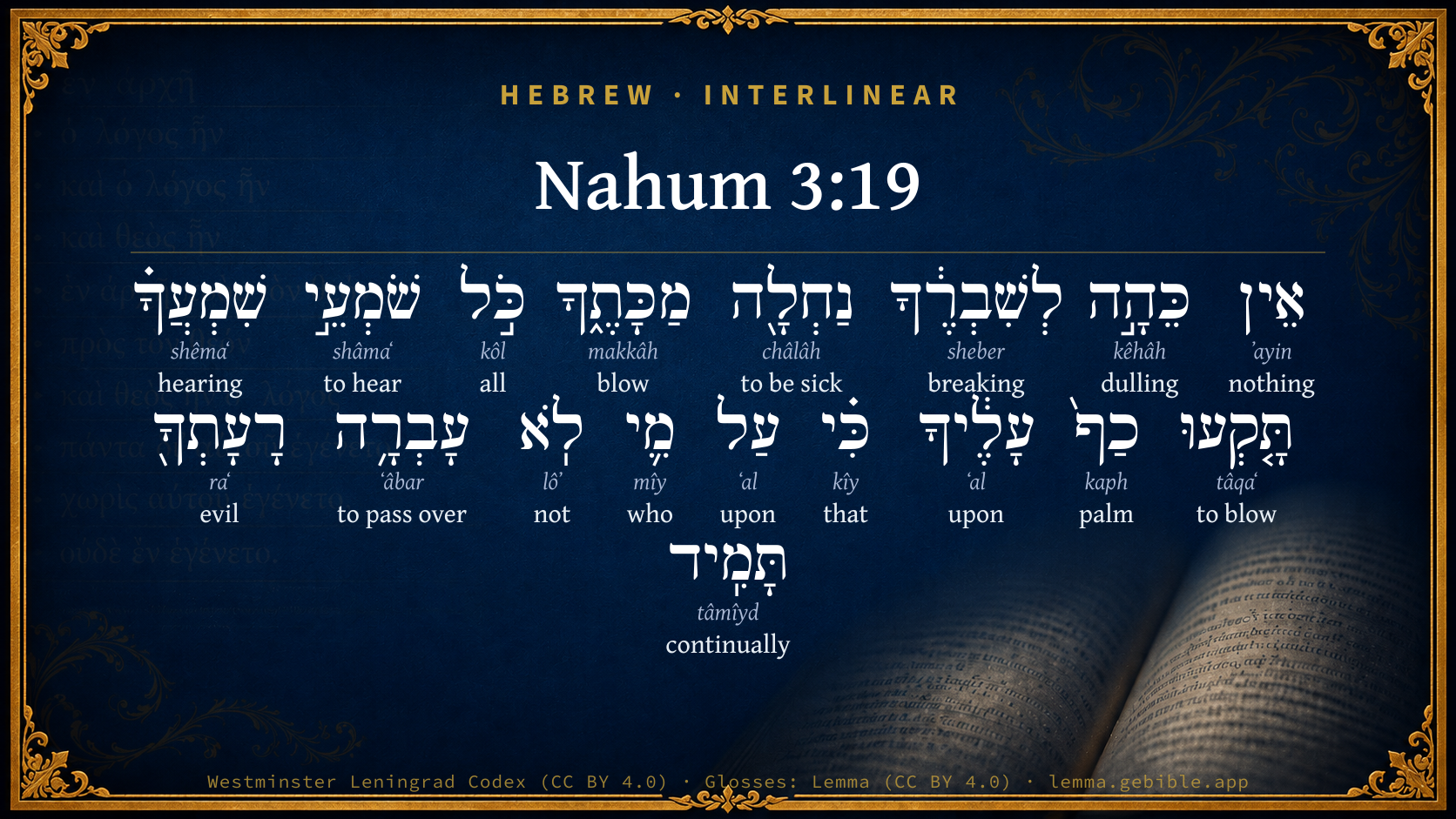
Nahum 3:19

Hebrew (Westminster Leningrad Codex) Nahum 3:19 appears in the Hebrew Old Testament. The text above is from the Westminster Leningrad Codex. Each word links to its Strong’s number, a concise gloss, and parsing drawn from the Open Scriptures Hebrew Bible morphology. Click any word for its full Brown-Driver-Briggs (BDB) entry.
Download image
Cite this verse

Nahum 3:19 (World English Bible). Public Domain. Lemma interlinear Bible study tool, https://lemma.gebible.app/v/nahum/3/19.

Show BibTeX & RIS
BibTeX
RIS
English Translation
There is no healing your wound, for your injury is fatal. All who hear the report of you clap their hands over you; for who hasn't felt your endless cruelty?
World English Bible · Public Domain
Highlights
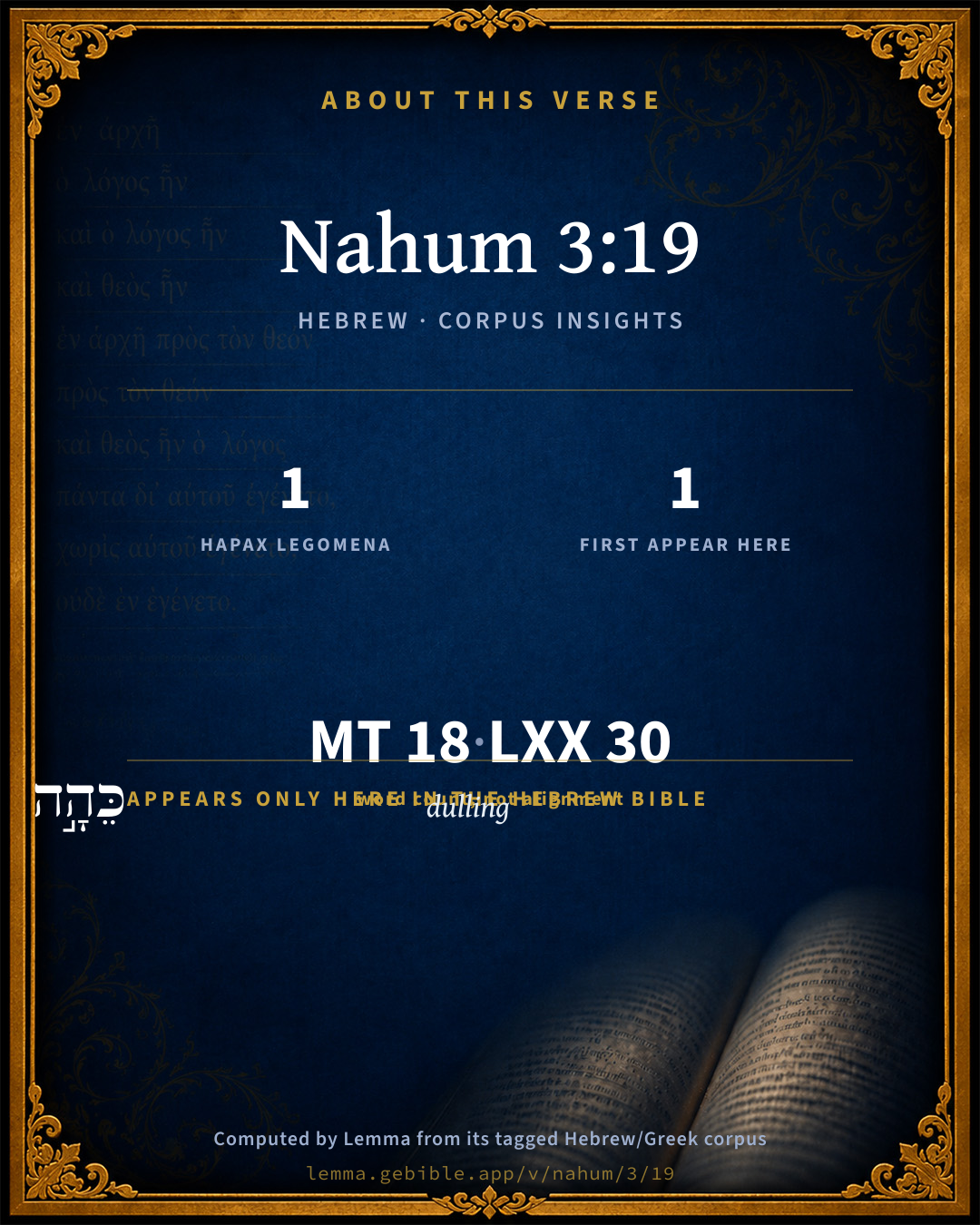
  • 1 hapax legomenon — only here in the Hebrew Bible
  • 1 first appearance in the Hebrew Bible
Full analysis ↓
Download a study sheet

One document with this verse’s original text, its word-by-word gloss line, the meaning frame, cross-references with their text, attributed commentary, and full source and license credits — printable, and it pastes into notes with its structure intact.

This verse Autodidact and up

Study sheet (.html) Plain text (.txt)

A passage Seminary Student

Up to 50 verses in one chapter. A passage sheet keeps up to 6 commentary sources and 12 cross-references per verse, in the order this page ranks them, and says so on the sheet whenever that leaves anything out. Ask for a single verse and you get the Autodidact verse sheet above.

Everything on this page stays free to read, with no account — the sheet is a download of what is already on screen, not access to it.

Want to remove ads? Support Godless Engineer
Compare translations 3

The same verse in 3 English versions, stacked beneath the original-language interlinear above. Click any original word for its lexicon entry.

Each is an independent rendering of the whole verse — the interlinear is not word-aligned to these translations.

Highlighted words mark where these versions differ — a whole-verse word diff, not a word-by-word alignment.

  • World English Bible Public Domain
    There is no healing your wound, for your injury is fatal. All who hear the report of you clap their hands over you; for who hasn't felt your endless cruelty?
  • King James Version Public Domain
    There is no healing of thy bruise; thy wound is grievous: all that hear the bruit of thee shall clap the hands over thee: for upon whom hath not thy wickedness passed continually?
  • unfoldingWord Literal Text CC BY-SA 4.0
    There is no relief for your destruction. Your wound is severe. Everyone hearing the news of you will clap hands over you. For upon whom has not come your endless evil?

unfoldingWord Literal Text — © unfoldingWord, licensed CC BY-SA 4.0. Word-aligned USFM3 via Door43 (git.door43.org/unfoldingWord/en_ult).

Versions to compare (up to 4)

3 of 4 selected

Show all 18 translations

Every available English version of this verse, each an independent rendering of the whole verse.

  • World English Bible Public Domain
    There is no healing your wound, for your injury is fatal. All who hear the report of you clap their hands over you; for who hasn't felt your endless cruelty?
  • Berean Standard Bible Public Domain
    There is no healing for your injury; your wound is severe. All who hear the news of you applaud your downfall, for who has not experienced your constant cruelty?
  • Majority Standard Bible Public Domain
    There is no healing for your injury; your wound is severe. All who hear the news of you applaud your downfall, for who has not experienced your constant cruelty?
  • King James Version Public Domain
    There is no healing of thy bruise; thy wound is grievous: all that hear the bruit of thee shall clap the hands over thee: for upon whom hath not thy wickedness passed continually?
  • American Standard Version (1901) Public Domain
    There is no assuaging of thy hurt: thy wound is grievous: all that hear the report of thee clap their hands over thee; for upon whom hath not thy wickedness passed continually?
  • Revised Version (1885) Public Domain
    There is no assuaging of thy hurt; thy wound is grievous: all that hear the bruit of thee clap the hands over thee; for upon whom hath not thy wickedness passed continually?
  • Geneva Bible (1599) Public Domain
    There is no healing of thy wounde: thy plague is grieuous: all that heare the brute of thee, shall clap the handes ouer thee: for vpon whome hath not thy malice passed continually?
  • Douay-Rheims (1899) Public Domain
    Thy destruction is not hidden, thy wound is grievous: all that have heard the fame of thee, have clapped their hands over thee: for upon whom hath not thy wickedness passed continually?
  • Young's Literal Translation Public Domain
    There is no weakening of thy destruction, Grievous `is' thy smiting, All hearing thy fame have clapped the hand at thee, For over whom did not thy wickedness pass continually?
  • Literal Standard Version CC BY-SA 4.0
    There is no weakening of your destruction, || Your striking [is] grievous, || All hearing your fame have clapped the hand at you, || For over whom did your wickedness not pass continually?
  • Unlocked Literal Bible CC BY-SA 4.0
    No healing is possible for your wounds. Your wounds are severe. Everyone who hears the news about you will clap their hands in joy over you. Who has escaped your constant wickedness?
  • unfoldingWord Literal Text CC BY-SA 4.0
    There is no relief for your destruction. Your wound is severe. Everyone hearing the news of you will clap hands over you. For upon whom has not come your endless evil?
  • Darby Bible Public Domain
    There is no healing of thy breach; thy wound is grievous; all that hear the report of thee clap the hands over thee; for upon whom hath not thy wickedness passed continually?
  • World Messianic Bible Public Domain
    There is no healing your wound, for your injury is fatal. All who hear the report of you clap their hands over you, for who hasn’t felt your endless cruelty?
  • Webster's Bible Public Domain
    There is no healing of thy bruise; thy wound is grievous: all that hear the fame of thee shall clap the hands over thee: for upon whom hath not thy wickedness passed continually?
  • Free Bible Version CC BY-SA 4.0
    There is no way to heal your injuries, you are too badly wounded. Everyone who hears this news will applaud what has happened to you, for was there anyone who escaped your continuous cruelty?
  • Bible in Basic English Public Domain
    Your pain may not be made better; you are wounded to death: all those hearing the news about you will be waving their hands in joy over you: for who has not undergone the weight of your evil-doing again and again?
  • JPS Tanakh (1917) Public Domain
    There is no assuaging of thy hurt, thy wound is grievous; all that hear the report of thee clap the hands over thee; for upon whom hath not thy wickedness passed continually?

Literal Standard Version (2020), Covenant Press — licensed CC BY-SA 4.0. Text via the HelloAO Bible API (eBible.org). Unlocked Literal Bible (unfoldingWord) — licensed CC BY-SA 4.0. Text via the HelloAO Bible API (eBible.org). unfoldingWord Literal Text — © unfoldingWord, licensed CC BY-SA 4.0. Word-aligned USFM3 via Door43 (git.door43.org/unfoldingWord/en_ult). Free Bible Version, Dr. Jonathan Gallagher — licensed CC BY-SA 4.0. Text via the HelloAO Bible API (eBible.org).

Word by word

More ways to search: Search by grammar → Find every occurrence → Compare this word →

Practice this passage: Drill this verse → Learn its vocabulary →

כֵּהָ֣ה
kêhâh
H3545
“dulling”
Noun, Common, Feminine, Singular, Absolute
Part of Speech
Noun
Type
Common
Gender
Feminine
Number
Singular
State
Absolute
Full BDB Definition

Origin: from H3544

TWOT: 957b

a quenching, dulling, lessening, healing, alleviation
  1. אֵין ʼayin H369 “nothing” Particle, Negative
  2. לְשִׁבְרֶ֔ךָ sheber H7667 “to/for · breaking · your” Preposition + Noun, Common, Masculine, Singular, Construct + Suffix, Personal, 2nd Person, Masculine, Singular
  3. נַחְלָ֖ה châlâh H2470 “sick” Verb, Niphal, Participle Passive, Feminine, Singular, Absolute
  4. מַכָּתֶ֑ךָ makkâh H4347 “blow · your” Noun, Common, Feminine, Singular, Construct + Suffix, Personal, 2nd Person, Masculine, Singular
  5. כֹּ֣ל kôl H3605 “all of” Noun, Common, Masculine, Singular, Construct
  6. שֹׁמְעֵ֣י shâmaʻ H8085 “hearing” Verb, Qal, Participle Active, Masculine, Plural, Construct
  7. שִׁמְעֲךָ֗ shêmaʻ H8088 “hearing · your” Noun, Common, Masculine, Singular, Construct + Suffix, Personal, 2nd Person, Masculine, Singular
  8. תָּ֤קְעוּ tâqaʻ H8628 “to blow” Verb, Qal, Perfect, 3rd Person, Common, Plural
  9. כַף֙ kaph H3709 “palm” Noun, Common, Feminine, Singular, Absolute
  10. עָלֶ֔יךָ ʻal H5921 “upon · you” Preposition + Suffix, Personal, 2nd Person, Masculine, Singular
  11. כִּ֗י kîy H3588 “that” Conjunction
  12. עַל ʻal H5921 “upon” Preposition
  13. מִ֛י mîy H4310 “who” Particle, Interrogative
  14. לֹֽא lôʼ H3808 “not” Particle, Negative
  15. עָבְרָ֥ה ʻâbar H5674 “to pass over” Verb, Qal, Perfect, 3rd Person, Feminine, Singular
  16. רָעָתְךָ֖ raʻ H7451 “evil · your” Noun, Common, Feminine, Singular, Construct + Suffix, Personal, 2nd Person, Masculine, Singular
  17. תָּמִֽיד tâmîyd H8548 “continually” Noun, Common, Masculine, Singular, Absolute

About this verse

These counts appear in no published source. They are computed here, from the morphology-tagged text and Lemma’s own curated glosses. What Lemma adds →

18
words
17
distinct lemmas
Prophets
section

Notable vocabulary

1 hapax legomenon — a word that appears only here in the entire Hebrew Bible:

  • כֵּהָ֣ה dulling H3545

First appearance in Scripture

This word makes its first canonical appearance in the Hebrew Bible here:

  • כֵּהָ֣ה dulling H3545

Shared distinctive vocabulary

שִׁמְעֲךָ֗ hearing H8088 occurs in 17 verses of the Hebrew Bible. Also found in:

Grammatical profile

  • 4 verbs
  • 8 nouns
  • 2 prepositions
  • 1 conjunction
  • 3 particles

Verb forms

  • נַחְלָ֖ה Niphal · Participle Passive
  • שֹׁמְעֵ֣י Qal · Participle Active
  • תָּ֤קְעוּ Qal · Perfect
  • עָבְרָ֥ה Qal · Perfect

Repetition

A word recurs within this verse — often emphatic in Hebrew:

  • עָלֶ֔יךָ upon H5921 ×2

Hebrew & Septuagint length

In English translation the verse runs 30 words from the Hebrew and 33 from the Septuagint (LXX English) — closely comparable.

A rough comparison of the two English renderings, which tokenize alike — not a word-level alignment.

Word counts can differ between the Hebrew and the Greek without any difference in meaning — e.g. the Hebrew direct-object marker אֵת has no separate Greek word, and Greek often adds the article ὁ.

In the original languages it is 18 Hebrew tokens and 30 Greek tokens — but the two are counted differently (Hebrew bundles its prefixes and suffixes into one token; the Greek is in lemma form), so that isn’t a like-for-like length.

Cross-references

17

Topical passages linked to Nahum 3:19 in the Treasury of Scripture Knowledge — connected by theme and wording, ordered by reader-vote popularity; previews shown in the World English Bible.

  • Micah 1:9 For her wounds are incurable; For it has come even to Judah. It reaches to the gate of my people, Even to Jerusalem.
  • Lamentations 2:15 All that pass by clap their hands at you; They hiss and wag their head at the daughter of Jerusalem, [saying], Is this the city that men called The perfection of beauty, The joy of the whole earth?
  • Job 27:23 Men shall clap their hands at him, And shall hiss him out of his place.
  • Isaiah 37:18 Of a truth, Yahweh, the kings of Assyria have laid waste all the countries, and their land,
  • Jeremiah 46:11 Go up into Gilead, and take balm, virgin daughter of Egypt: in vain do you use many medicines; there is no healing for you.
  • Isaiah 10:6–14 I will send him against a profane nation, and against the people of my wrath will I give him a charge, to take the spoil, and to take the prey, and to tread them down like the mire of the streets.
  • Isaiah 14:8–21 Yes, the fir trees rejoice at you, [and] the cedars of Lebanon, [saying], Since you are laid low, no lumberjack is come up against us.
  • Jeremiah 10:22 The voice of news, behold, it comes, and a great commotion out of the north country, to make the cities of Judah a desolation, a dwelling-place of jackals.
  • Jeremiah 30:13–15 There is none to plead your cause, that you may be bound up: you have no healing medicines.
  • Ezekiel 25:6 For thus says the Lord Yahweh: Because you have clapped your hands, and stamped with the feet, and rejoiced with all the despite of your soul against the land of Israel;
  • Ezekiel 30:21–22 Son of man, I have broken the arm of Pharaoh king of Egypt; and, behold, it has not been bound up, to apply [healing] medicines, to put a bandage to bind it, that it be strong to hold the sword.
  • Nahum 2:11–12 Where is the den of the lions, and the feeding-place of the young lions, where the lion and the lioness walked, the lion's cubs, and no one made them afraid?
  • Zephaniah 2:13–15 He will stretch out his hand against the north, destroy Assyria, and will make Nineveh a desolation, and dry like the wilderness.
  • Revelation 13:7 It was given to him to make war with the saints, and to overcome them. Authority over every tribe, people, language, and nation was given to him.
  • Revelation 17:2 with whom the kings of the earth committed sexual immorality, and those who dwell in the earth were made drunken with the wine of her sexual immorality."
  • Revelation 18:2–3 He cried with a mighty voice, saying, "Fallen, fallen is Babylon the great, and she has become a habitation of demons, a prison of every unclean spirit, and a prison of every unclean and hateful bird!
  • Revelation 18:20 Rejoice over her, O heaven, you saints, apostles, and prophets; for God has judged your judgment on her."

Cross-references courtesy of OpenBible.info (CC BY 4.0).

Hebrew and Greek witnesses Masoretic Hebrew ↔ Greek Septuagint

The same verse in the two great witnesses to the Old Testament, shown verse-for-verse.

These are two independent witnesses, not word-aligned to each other, and the Septuagint is shown in lemma (dictionary) form.

Hebrew Nahum 3:19 Masoretic · Westminster Leningrad Codex

אֵין כֵּהָ֣ה לְשִׁבְרֶ֔ךָ נַחְלָ֖ה מַכָּתֶ֑ךָ כֹּ֣ל שֹׁמְעֵ֣י שִׁמְעֲךָ֗ תָּ֤קְעוּ כַף֙ עָלֶ֔יךָ כִּ֗י עַל מִ֛י לֹֽא עָבְרָ֥ה רָעָתְךָ֖ תָּמִֽיד

There is no healing your wound, for your injury is fatal. All who hear the report of you clap their hands over you; for who hasn't felt your endless cruelty?

World English Bible · Public Domain

Greek LXX Nahum 3:19 Septuagint · lemma form

οὐ εἰμί ἴασις ὁ συντριβή σύ φλεγμαίνω ὁ πληγή σύ πᾶς ὁ ἀκούω ὁ ἀγγελία σύ κροτέω χείρ ἐπί σύ διότι ἐπί τίς οὐ ἐπιἔρχομαι ὁ κακία σύ διά πᾶς

There is no healing for your bruise; your wound has rankled: all that hear the report of you shall clap their hands against you; for upon whom has not your wickedness passed continually?

LXX2012 (modern English Septuagint) · Public Domain

On this verse, Haydock's Catholic Bible Commentary discusses the Septuagint’s reading. Read the note in Commentary ↓

Hebrew: Westminster Leningrad Codex (CC BY 4.0). Greek: Septuagint (public domain); English from LXX2012 (modern English Septuagint) (Public Domain). How the Septuagint differs from the Hebrew →

Targum (Aramaic paraphrase)

1

The Targum is the ancient Jewish Aramaic paraphrase of the Hebrew Scriptures — an interpretive translation, not the Hebrew text itself. Onkelos (literal) and Pseudo-Jonathan (expansive) render the Torah, and Jonathan the Prophets. Coverage is partial: where no permissively-licensed English translation exists for a verse, only the Aramaic is shown. This is verse-level text, not a word-by-word alignment to the Hebrew.

  1. Targum Jonathan Prophets (Joshua–Malachi)
    לֵית דְכָאֵיב לֵיהּ עַל תַּבְרֵיךְ מִמְרָעָא מְחָתָךְ כָּל דִי שְׁמָעוּ שִׁמְעֲתָךְ טְפָחוּ יְדֵיהוֹן עֲלָךְ חַדִיאוּ אֲרֵי עַל מַן לָא עֲדַת מְחַת בִּישְׁתֵּיךְ תְּדִירָא:

    (no public-domain English translation for this verse)

    Targum Jonathan — Aramaic: “Mikraot Gedolot” (public domain). English: “Sefaria Community Translation” (CC0 1.0 (public-domain dedication)); “London "Chaldee Paraphrase," 1871” (public domain). Text via Sefaria.

Commentary

Notes on Nahum 3:19 from classic Christian and Jewish commentators (each source and its license shown beneath its notes). The classic Christian expositions comment on the surrounding passage and are grouped to its opening verse, so a note may address several verses; the Jewish commentaries on the Tanakh (Rashi and others) are per-verse, so they appear only where the commentator wrote on this verse.

Lemma curates 59 commentaries, every one of them public domain or Creative Commons licensed, each selected and text-cleaned for this edition rather than reprinted as found. About our sources →

Trapp's Complete Commentary

John Trapp

Nah 3:19 [There is] no healing of thy bruise; thy wound is grievous: all that hear the bruit of thee shall clap the hands over thee: for upon whom hath not thy wickedness passed continually?

Ver. 19. There is no healing of thy bruise] Clades et strages tua irreparabilis est. Thy disease is desperate, thy condition comfortless; thou art utterly to be destroyed. When God smiteth his own people it may well be asked, as Isa 27:7, "Hath he smitten him as he smote those that smote him? or is he slain according to the slaughter of them that are slain by him?" Surely no; there is a manifest difference. "He hath torn," saith the Church, "and he will heal us; he hath smitten, and he will bind us up," Hos 6:1. Hence that distinction of punishment, or pain, in condemnantem, et corrigentem, in poenam vindictae, et poenam medelae. Afflictions and temporal evils are in the nature, to the wicked of a curse, to the godly of a cure; to the former mortal, to the latter medicinal. "When the wicked spring as grass, and when all the workers of iniquity do flourish," it is not for any goodwill that God beareth to them; but "it is that they shall be destroyed for ever," Psa 92:7.{see Trapp on "Nah 1:9"}

Thy wound is grievous] Not only incurable, but full of anguish intolerable. Thus, "many sorrows shall be to the wicked," Psa 32:10, and yet all that they suffer here is but as drops of wrath, forerunning the great storm in hell; or as a crack, preceding the fall of the whole house upon them: the leaves only fall on them here; there, the whole tree.

All that hear the bruit of thee shall clap the hands, &c.] As rejoicing at thy ruin, and subscribing to God’s just judgment upon thee; they shall take up this taunting speech against thee, and say, "How hath the oppressor ceased! the golden city ceased! The Lord hath broken the staff of the wicked, and the sceptre of the rulers," &c. Isa 14:4-7.

For upon whom hath not thy wickedness passed continually?] "Thy wickedness," that is, thy wicked counsels, edicts, enterprises, have they not extended far and near for mischief to many nations? and this not for a little while, but jugiter, continually? It hath been thy constant trade from thy youth up ( neque enim nova est aut nupera haec tua crudelitas) to waste and weary out other nations with thine inroads and hostilities. The destruction therefore is of thyself, O Nineveh; the insultations, and complosions of others at thy misery, is no more than thou hast merited. Os quod in sorte tua ceciderit, illud rodas, as the Arabian proverb hath it. Bear the reward of thy wickedness, which is now come home to thee; thy wickedness is the root of thy wretchedness: this the prophet here repeateth and inculcateth in the perclose; that he may leave it as a sting in the minds of his hearers, as Gualther well observeth.

John Trapp, A Commentary or Exposition upon All the Books of the Old and New Testament (1647–1656) — public domain. Text from a community e-Sword module.

The Preacher's Complete Homiletical Commentary

Joseph S. Exell (gen. ed.)

CRITICAL NOTES.]

Nah_3:19. Healing] Softening, or anointing, no cure. Bruise] Fracture or ruin (Pro_16:18; Lam_2:11).

IRRETRIEVABLE RUIN.—Nah_3:19

Deliverance is utterly hopeless. The prophet declares the end of a nation which ruled with a rod of iron, and oppressed with unmitigated cruelty.

I. Nineveh cruel will be repaid for her cruelty. “For upon whom hath not thy wickedness passed continually?” Monuments and inscriptions prove the pitiless cruelty of Assyria. In sculptures are rows of impaled prisoners, whose eyes were put out, and whose lips were fastened by rings. God had long borne this oppression, but now guilt must be punished. Judgment must fall, and there is not the least hope of recovery. Cruelty and oppression will be rewarded in their own coin.

II. Nineveh ruined will be a joy to others. “All that hear the bruit of thee shall clap their hands over thee.”

1. This joy is great. It is exultation, clapping of hands.

2. This joy is universal. All, for cruelty was extensive, and none can grieve at its termination. The fall of the oppressor is the triumph of the oppressed.

III. Nineveh destroyed will never be restored. There is neither comfort in the affliction nor recovery from it. The wound is incurable. “There is no healing of thy bruise.” There is none to help. She had made no friends in her policy, displayed no signs of repentance in her guilt. Now she must perish without pity and without help. The ruin is total and irretrievable. “How hath the oppressor ceased! the golden city ceased! The Lord hath broken the staff of the wicked, and the sceptre of the rulers,” &c. (Isa_14:4-7).

The Preacher's Complete Homiletical Commentary (gen. ed. Joseph S. Exell; Funk & Wagnalls, c. 1892) — public domain (pre-1929). A full-Bible homiletical/sermon-outline anthology covering 65 of 66 books (2 John is absent from the source module). Text from a community e-Sword module.

Tyndale Open Study Notes

Tyndale Open Resources

3:19 Nineveh deserved destruction rather than healing. Although God had been patient with Nineveh in Jonah’s day (Jon 3:10), the Assyrians had returned to cruelty and would reap the harvest of their own evil (see Prov 11:16-19; Isa 66:5-6; Hos 8:7). Those who had suffered under Assyria’s cruelty would welcome this message with joy.

Tyndale Open Study Notes — © Tyndale Open Resources, licensed CC BY-SA 4.0. Text via the HelloAO Bible API.

Geneva Bible (1599)

Geneva Bible translators

Meaning, that there was no people to whom the Assyrians had not done hurt.

Geneva Bible (1599) marginal notes — public domain. Text via Bolls.life.

Jamieson, Fausset & Brown

Robert Jamieson, A. R. Fausset & David Brown

bruit--the report.

clap the hands--with joy at thy fall. The sole descendants of the ancient Assyrians and Babylonians in the whole country are the Nestorian Christians, who speak a Chaldean language [LAYARD].

upon whom hath not thy wickedness passed continually?--implying God's long forbearance, and the consequent enormity of Assyria's guilt, rendering her case one that admitted no hope of restoration.

Next: Habakkuk Introduction

Jamieson, Fausset & Brown — Commentary Critical and Explanatory on the Whole Bible (1871) — public domain (CC PDM 1.0). Text via the HelloAO Bible API.

Adam Clarke's Commentary

Verse 19. There is no healing of thy bruise] Thou shalt never be rebuilt.

All that hear the bruit of thee] The report or account.

Shall clap the hands] Shall exult in thy downfall.

For upon whom hath not thy wickedness passed] Thou hast been a universal oppressor, and therefore all nations rejoice at thy fall and utter desolation.

Bp. Newton makes some good remarks on the fall and total ruin of Nineveh.

"What probability was there that the capital city of a great kingdom, a city which was sixty miles in compass, a city which contained so many thousand inhabitants, a city which had walls a hundred feet high, and so thick that three chariots could go abreast upon them, and which had one thousand five hundred towers, of two hundred feet in height; what probability was there that such a city should ever be totally destroyed? And yet so totally was it destroyed that the place is hardly known where it was situated. What we may suppose helped to complete its ruin and devastation, was Nebuchadnezzar's enlarging and beautifying Babylon, soon after Nineveh was taken. From that time no mention is made of Nineveh by any of the sacred writers; and the most ancient of the heathen authors, who have occasion to say any thing about it, speak of it as a city that was once great and flourishing, but now destroyed and desolate. Great as it was formerly, so little of it is remaining, that authors are not agreed even about its situation. From the general suffrage of ancient historians and geographers, it appears to have been situated upon the Tigris, though others represent it as placed upon the Euphrates. Bochart has shown that Herodotus, Diodorus Siculus, and Ammianus Marcellinus, all three speak differently of it; sometimes as if situated on the Euphrates, sometimes as if on the Tigris; to reconcile whom he supposes that there were two Ninevehs; and Sir John Marsham, that there were three; the Syrian upon the Euphrates, the Assyrian on the Tigris, and a third built afterwards upon the Tigris by the Persians, who succeeded the Parthians in the empire of the East, in the third century, and were subdued by the Saracens in the seventh century after Christ. But whether this latter was built in the same place as the old Nineveh, is a question that cannot be decided.

"There is a city at this time called Mosul, situate upon the western side of the Tigris; and on the opposite eastern shore are ruins of great extent, which are said to be those of Nineveh.

"Dr. Prideaux, following Thevenot, observes that Mosul is situated on the west side of the Tigris, where was anciently only a suburb of the old Nineveh; for the city itself stood on the east side of the river, where are to be seen some of its ruins of great extent even to this day. Even the ruins of old Nineveh, as we may say, have been long ago ruined and destroyed; such an utter end hath been made of it, and such is the truth of the Divine predictions!

"These extraordinary circumstances may strike the reader more strongly by supposing only a parallel instance. Let us then suppose that a person should come in the name of a prophet, preaching repentance to the people of this kingdom, or otherwise denouncing the destruction of the capital city within a few years. 'With an overflowing flood will God make an utter end of the place thereof; he will make an utter end: its place may be sought, but it shall never be found.' I presume we should look upon such a prophet as a madman, and show no farther attention to his message than to deride and despise it. And yet such an event would not be more strange and incredible than the destruction and devastation of Nineveh; for Nineveh was much the larger, stronger, and older city of the two. And the Assyrian empire had subsisted and flourished more ages than any form of government in this country; so there is no objecting the instability of Eastern monarchies in this case. Let us then, since this event would not be more improbable and extraordinary than the other, suppose again, that things should succeed according to the prediction; that the floods should arise, and the enemies should come; the city should be overthrown and broken down, be taken and pillaged, and destroyed so totally that even the learned could not agree about the place where it was situated. What would be said or thought in such a case? Whoever of posterity should read and compare the prophecy and event together, must they not, by such an illustrious instance, be thoroughly convinced of the providence of God, and of the truth of his prophet, and be ready to acknowledge, 'Verily, this IS the word which the Lord hath spoken; verily, there IS a God who judgeth the earth?"' - See Bp. Newton, vol. i., dissert. 9.

Adam Clarke's Commentary on the Bible (1810–1826) — public domain. Text from a community e-Sword/MySword module.

John Calvin's Commentaries

The Prophet shows here more clearly, that when the empire of Nineveh should be scattered, it would be an incurable evil, that every hope of a remedy would be taken away. Though the wicked cannot escape calamity, yet they harbor false expectations, and think that they can in a short time gather new strength. Hence, in order to take from them this hope, the Prophet says, that there would be no contraction of the fracture And this is a striking similitude; for he compares the ruin of Nineveh to a wound which cannot be seamed and healed. There is then no contraction; some render it, a wrinkle, but improperly. There is then no contraction: and he adds, Thy stroke is full of pain; that is, the pain of thy stroke cannot be allayed. This is one thing, — that the ruin of Nineveh would be irreparable.

Then he says, Whosoever shall hear the report, shall strike the hand on thy account Many give this rendering, They shall clap the hand over thee, or with the hands; and they think that the singular is put for the plural number. But as in Hebrew to strike the hand is a token of consent, it would not be unsuitable to say, that the Prophet means, that wherever the report of this calamity would be heard, all would express their approbation, “See, God has at length proved himself to be the just avenger of so much wickedness.” To strike the hand is said to be done by those who make an agreements or when any one pledges himself for another. As then in giving pledges, and in other compacts, men are said to strike the hand; so also all shall thus give their assent to God’s judgment in this case, “O how rightly is this done! O how justly has God punished these tyrants, these plunderers.” They will then strike the hand on thy account; that is, “This thy ruin will be approved;” as though he said, “Not only before God art thou, Nineveh, accursed, but also according to the consent of all nations.” And thus he intimates, that Nineveh would perish in the greatest dishonor and disgrace. It sometimes happens that an empire falls, and all bewail the event: but God here declares, that he would not be satisfied with the simple destruction of the city Nineveh without adding to it a public infamy, so that all might acknowledge that it happened through his righteous judgment.

He afterwards adds, For upon whom has not thy wickedness passed continually? This is a confirmation of the last clause; and this reason will suit both the views which have been given. If we take the striking of the hand for approbation, this reason will be suitable. — How? For all nations will rejoice at thy destruction, because there is no nation which thou hast not in many ways injured. So also, in token of their joy, all will congratulate themselves, as though they were made free; or they will clap their hands, that is, acknowledge that thou hast been destroyed by the judgment of God, because all had experienced how unjustly and tyrannically thou hast ruled. As then thy wickedness has been like a deluge, and hast nearly consumed all the earth, all will clap or shake their hands at thy ruin.

And he says, continually, to show that God’s forbearance had been long exercised. Hence, also, it appears, that the Assyrians were inexcusable, because, when God indulgently spared them, they did not repent, but pursued their wicked ways for a long course of time. As then to their sinful licentiousness they added perverseness, every excuse was removed. But the Prophet does, at the same time, remind the Israelites, that there was no reason for them to be cast down in their minds, because God did not immediately execute punishment; for by the word תמיד, tamid, he insinuates, that God would so suspend for a time his judgment as to Nineveh, that his forbearance and delay might be an evidence of his goodness and mercy. We hence see that the Prophet here opposes the ardor of men, for they immediately grow angry or complain when God delays to execute vengeance on their enemies.

He shows that God has a just reason for not visiting the wicked with immediate punishment; but yet the time will come when it shall appear that they are altogether past recovery, — the time, I say, will come, when the Lord shall at length put forth his hand and execute his judgment.

John Calvin's Commentaries (1540-1563) — public domain. Text from the Calvin Translation Society English edition (1840s-50s) via the Christian Classics Ethereal Library (ccel.org). Calvin's coverage is partial (roughly two-thirds of the Bible); uncommented books and verses are honest gaps, never fabricated. The 19th-century editor's footnotes and remarks are omitted so the notes are faithfully Calvin's own voice.

Ellicott's Commentary for English Readers

(19) Clap the hands over thee.—All that hear the “bruit” or report of the fall of Nineveh clap their hands with joy (Psa_47:1), for where has not her oppressive rule been felt? The verse is addressed to the king (second person masculine) as the representative of the empire, perhaps also in view of his terrible end. The cruelty of the Ninevite régime is illustrated, as Kleinert remarks, in the sculptures, “by the rows of the impaled, the prisoners through whose lips rings were fastened, whose eyes were put out, who were flayed alive. Consequently it would be a joy to all nations to hear the voice of the messengers of the tyrant no more (Nah_2:13), but to hear that of the messengers of his destruction.”

A Bible Commentary for English Readers, edited by Charles John Ellicott (1878–1897) — public domain. Text from a community e-Sword module.

The Cambridge Bible for Schools and Colleges

gen. ed. J. J. S. Perowne

19. no healing of thy bruise] Lit. thy breach, a favourite word of Jeremiah, e.g. Jer_6:14, Jer_8:11; Jer_8:21, “the hurt of the daughter of my people.” The hurt of Nineveh is incurable (Jer_30:12), her ruin shall be eternal.

the bruit of thee] i.e. the report of thy downfall.

clap the hands] A gesture of illwill and malevolent gladness.

upon whom hath not thy wickedness passed] Assyria has been the foe and the scourge of the human race.

The Cambridge Bible for Schools and Colleges (gen. ed. J. J. S. Perowne; Cambridge University Press, 1878–1918) — public domain. Text from a community e-Sword module.

John Gill's Exposition

There is no healing of thy bruise,.... Made by the fatal blow given to the empire by the taking of Nineveh; the ruin of it was irreparable and irrecoverable; the city of Nineveh was no more, and the Assyrian empire sunk, and never rose again: or, "there is no contraction of thy bruise" (r); as when a wound is healed, or near it, the skin round about is wrinkled and contracted. The Targum is,

"there is none that grieves at thy breach;''

so the Syriac version; so far from it, that they rejoiced at it, as in a following clause:

thy wound is grievous; to be borne; the pain of it intolerable; an old obstinate one, inveterate and incurable: or, is "weak", or "sickly" (s); which had brought a sickness and weakness on the state, out of which it would never be recovered:

all that hear the bruit of thee; the fame, the report of the destruction of Nineveh, and of the ruin of the Assyrian empire, and the king of it:

shall clap the hands over thee; for joy; so far were they from lending a helping hand in the time of distress, that they clapped both hands together, to express the gladness of their hearts at hearing such news:

for upon whom hath not thy wickedness passed continually? to which of thy neighbours hast thou not been troublesome and injurious? which of them hast thou not oppressed, and used with violence and cruelty? what province or city but have felt the weight of thine hand, have been harassed with wars, and distressed with tributes and exactions? and therefore it is no wonder they rejoice at thy fall. The destruction of this city, and so of the whole empire, is placed by Dr. Prideaux in the twenty ninth year of Josiah's reign, and in the year 612 B.C.; and by what Josephus says (t) it appears to have been but a little while before Josiah was slain by Pharaohnecho, who came out with an army to Euphrates, to make war upon the Medes and Babylonians; who, he says, had overturned the Assyrian empire; being jealous, as it seems, of their growing power. Learned men justly regret the loss of the Assyriaca of Abydenus, and of the history of the Assyrians by Herodotus, who promised (u) it; but whether he finished it or no is not certain; however, it is not extant; and in one place, speaking of the Medes attacking Nineveh, and taking it, he says (w), but how they took it I shall show in another history; all which, had they come to light, and been continued, might have been of singular use in explaining this prophecy.

(r) "nulla est contractio", Junius & Tremellius, Burkius. (s) "infirmata", Pagninus, Montanus; "aegritudine plena", Vatablus; "aegra", Junius & Tremellius, Piscator, Drusius, Burkius. (t) Antiqu. l. 10. c. 5. sect. 1. (u) L. 1. sive Clio, c. 184. (w) Ibid. c. 106.

Next: Habakkuk Introduction

John Gill's Exposition of the Whole Bible (1746–1763) — public domain (CC PDM 1.0). Text via the HelloAO Bible API.

Albert Barnes' Notes on the Bible

There is no healing - (literally, “dulling”) of thy bruise It cannot be softened or mitigated; and so thy wound is grievous (literally, sick), incurable, for when the wound ever anew inflames, it cannot be healed. The word, bruise, is the more expressive, because it denotes alike the abiding wound in the body Lev 21:19, and the shattering of a state, which God can heal Psa 60:4; Isa 30:26, or which may be great, incurable Jer 30:12. When the passions are ever anew aroused, they are at last without remedy; when the soul is ever swollen with pride, it cannot be healed; since only by submitting itself to Christ, “broken and contrite” by humility, can it be healed. Nineveh sank, and never rose; nothing soothed its fall. In the end there shall be nothing to mitigate the destruction of the world, or to soften the sufferings of the damned. The “rich man, being in torments,” asked in vain that Lazarus might “dip the tip of his finger in water and cool my tongue.”

All that hear the bruit of thee shall clap the hands over thee - For none can grieve at thy fall.

Nineveh sinks out of sight amid one universal, exulting, exceeding joy of all who heard the report of her. “For upon whom hath not thy wickedness passed continually?” “In that he asketh, upon whom hath not thy wickedness passed continually? He affirms most strongly that his evil did pass upon all continually.” His wickedness, like one continual flood. which knew no ebb or bound, had passed upon the whole world and each one in it; now at length it had passed away, and “the whole earth is at rest, is quiet; they break forth into singing” Isa 14:7.

It is not without meaning, that having throughout the prophecy addressed Nineveh (in the feminine), now, in the close Nah 3:18-19, the prophet turns to him in whom all its wickedness is, as it were, gathered into one, the soul of all its evil, and the director of it, its king. As Nineveh is the image of the world, its pomps, wealth, luxury, vanity, wickedness, oppression, destruction, so its king is the image of a worse king, the Prince of this world. : “And this is the song of triumph of those, over whom ‘his wickedness has passed,’ not rested, but they have escaped out of his hands. Nahum, ‘the comforter,’ had ‘rebuked the world of sin;’ now he pronounces that ‘the prince of this world is judged.’ ‘His shepherds’ are they who serve him, who ‘feed the flock of the slaughter,’ who guide them to evil, not to good. These, when they sleep, as all mankind, dwell there; it is their abiding-place; their sheep are ‘scattered on the mountains,’ in the heights of their pride, because they are not of the sheep of Christ; and since they would not be gathered of Him, they are ‘scattered, where none gathereth.’” “The king of Assyria (Satan) knows that he cannot deceive the sheep, unless he have first laid the shepherds asleep. It is always the aim of the devil to lay asleep souls that watch. In the Passion of the Lord, he weighed down the eves of the Apostles with heavy sleep, whom Christ arouseth, ‘Watch and pray, lest ye enter into temptation’ Mat 26:41; and again, ‘What I say unto you, I say unto all, watch!’ ‘And no man gathers them,’ for their shepherds themselves cannot protect themselves. In the Day of God’s anger, ‘the kings of the earth and the great men, and the rich men and the chief captains, and the mighty men, and every bondman, and every free man, hid themselves in the dens and in the rocks of the mountains’ Rev 6:15. Such are his shepherds, and his sheep; but what of himself?

Truly his bruise or breaking can not he healed; his wound or smiting is incurable; that namely whereby, when he came to Him in whom he found nothing Joh 14:30, yet bruised His heel, and exacted of Him a sinner’s death, his own head was bruised.” And hence, “all who have ears to hear,” who hear not with the outward only, but with the inner ears of the heart, “clap the hands over thee,” that is, give to God all their souls’ thanks and praise, raise up their eyes and hands to God in heaven, praising Him who had “bruised Satan under their feet.” Ever since, through the serpent, the evil and malicious one has lied, saying, “ye shall not surely die, eat and ye shall be as gods,” hath his evil, continually and unceasingly, from one and through one, passed upon all men. As the apostle saith, “As by one man, sin entered into the world, and death by sin, and so death passed upon all men, for that all have sinned” Rom 5:12.

Upon whom then hath not his sin paased? Who hath not been shapen in iniquity? and whom did not his mother conceive in sin? Yet, it passes only, for “the world itself also passeth away,” and we pass away from it, and all the evil it can do us, unless we share in its evil, is not abiding, but passing. This then is the cause, and a great cause, why “all that hear the bruit of thee” should “clap the hands over thee;” because thee, whose wickedness passed through one upon all, One Man, who alone was without sin, contemned and bruised, while He riced and justified from wickedness them who “hearing” rejoiced, and rejoicing and believing, “clapped the hands over thee.” Yet they only shall be glad, upon whom his “wickedness,” although it passed, yet abode not, but in prayer and good deeds, by the grace of God, they lifted up their hands to Him Who overcame, and Who, in His own, overcomes still, to whom be praise and thanksgiving forever and ever. Amen.

Albert Barnes' Notes on the Bible (1834–1885) — public domain. Text from a community e-Sword/MySword module.

Haydock's Catholic Bible Commentary

Hidden. Hebrew and Septuagint, "irremediable," (Haydock) --- No one pities thy wound, Chaldean. (Calmet)

George Leo Haydock (1774–1849), Haydock's Catholic Family Bible and Commentary, 1859 edition — public domain. Excludes Psalms (Douay-Rheims chapter numbering differs from Protestant) and Deuterocanonical books (Catholic canon only).

Matthew Poole's English Annotations

There is no healing of thy bruise; in a word, thou, Nineveh, must die, thy bruise he will not heal. who gave it, and others cannot. God by the Chaldeans hath wounded thee, and thy friends cannot bind up the wound.

Thy bruise; shivered and broken state.

Thy wound is grievous; hath brought a weakness on thee, thou art sick with thy wound, and faintest, not able to bear a cure.

All that hear the bruit of thee, of thy former carriage and present calamities,

shall clap the hands; insulting and rejoicing over thee.

Upon whom hath not; no kingdom, state, city, or family almost round about thee; not one can be named.

Thy wickedness; thy sins, thy idolatry, luxury, &c.; thy tyranny, pride, oppression, and cruelty; thy illegal, unprecedented violence.

Passed, without any bounds, and in most vehement and fierce manner.

Continually; either always treading down and trampling upon those whom thou hadst subdued, or else having conquered and spoiled one state, didst forthwith fall upon some other. Thus all suffered by thee, and all rejoice at thy utter downfall; and as none have cause to befriend thee, so none will find hearts to pity thee, or hands to help thee, but every one is ready to wish, that all who are, as thou wert, enemy to mankind and justice, may, as thou, perish without help or pity.

Matthew Poole's English Annotations on the Holy Bible (1683–1685) — public domain. Text from a community e-Sword/MySword module.

The Pulpit Commentary

There is no healing of thy bruise; there is no assuaging of thy hurt (Revised Version; Jer_10:19) The ruin is irretrievable; no one shall restore the destroyed kingdom. (see Zep_2:13, Zep_2:14) Thy wound is grievous; Pessima est plaga tua (Vulgate); Eflegmanen h plhgh sou , "Thy wound is inflamed." The "wound" is the stroke or plague inflicted by God. (Lev_26:21) Shall clap the hands over thee. All who hear of thy destruction will rejoice over it. (Psa_47:1 Lam_2:15) Thy wickedness. The cruelty and oppression of Nineveh have been universally felt. If Edom is the type of insidious foes of the Church"s own household, Nineveh is the emblem of open, blaspheming infidelity, arrayed in powerful opposition against God"s people. In the overthrow of this kingdom there is a prophecy of the destruction of all anti-Christian powers, which shall be utterly crushed in the latter days.

Hopelessness.

"There is no healing of thy bruise; thy wound is grievous." Nothing can be more distressing than the consciousness of powerlessness in the presence of the deepest human need; to witness from the seashore the wreck, and to be utterly unable to save the shipwrecked mariners; to be sure that some one is in the burning edifice, and yet for it to be impossible to reach him and to bring him out; to stand before an audience alarmed by some needless cry, and to see the rush towards the doors, and to be unequal to checking it; or even to be by the bedside of one in life"s youth or manhood"s prime, and to hear that disease has, humanly speaking, prematurely seized its victim, and that medical help cannot cure, but only, and that for a time, alleviate. This position is occupied by many an earnest hearted worker for God and the good of souls, in relation to the moral salvation of men. Nahum sustained it in reference to the Ninevites. He saw in them a people wrecked through the adverse winds and tempests of evil, consumed by the fires of unholy passion, on the mad rush to ruin and death, diseased through and through so that recovery was impossible; and hence, unable to heal, he cried in the sadness of his heart, "There is no healing of thy bruise; thy wound is grievous" (ver. 19). So Isaiah said, "Ye will revolt more and more: the whole head is sick," etc. (Isa_50:5, Isa_50:6) So still. Note

I THIS STATE OF MORAL HOPELESSNESS IS NOT REACHED ALL AT ONCE, BUT IS BROUGHT ABOUT BY DEGREES.

II IT IS NOT BROUGHT TO PASS THROUGH DIVINE HELP AND STRENGTH BEING UNAVAILABLE.

III IT CANNOT BE EXCUSED ON THE GROUND OF THERE BEING A LACK OF WARNINGS AND EXPOSTULATIONS.

IV IT IS ENTIRELY SELF-CAUSED; THE TRANSGRESSOR BRINGS HIMSELF INTO THIS STATE OF HOPELESSNESS; THE SINNER IS HIS OWN DESTROYER. "Take heed lest ye be hardened through the deceitfulness of sin". S.D.H. (Heb_3:12, Heb_3:13)

The overthrow of evil doers a source of thankful joy.

"All that hear the bruit of thee shall clap the hands over thee: for upon whom hath not thy wickedness passed continually?" These last words in the Book of Nahum are truly impressive. The messenger closes his brief prophecy in the same tone in which he commenced it, the vengeance of God being still his theme. At the outset he declared the solemn fact; at the end he applies the truth thus announced to the particular case in hand. "The magnificent dirge" forming this third chapter "is one sustained shout of wild exultation that the oppressor has fallen at last. The naked discrowned corpse of the glorious city is cast out to the scorn and disgust of the World. No spark of pity mingles with the prophet"s delight. In this storm of indignation and vengeance the spirit of prophecy in the northern kingdom Breathes its last. Under this doom Nineveh vanishes from view, to be no more seen till in our day the discovery of her buried remains has given new life to the whole of this portion of sacred history" (Stanley"s "Jewish Church," 2:315, 316). The theme suggested by this final utterance of Nahum is the overthrow of evil doers a source of thankful joy. Wherever the report of the fall of Nineveh should reach it should occasion a sense of relief and should excite rapturous delight. "All that hear the bruit of thee shall clap the hands," etc. (ver. 19). This satisfaction, providing it does not arise from revenge, may be amply justified. See this in that

I THE FALL OF WRONG DOERS MEANS A DIMINUTION OF SUFFERING. It is to this that the prophet specially alludes when he says, "For upon whom hath not thy wickedness passed continually?" meaning that through her guilt she had proved a bitter scourge to all who had come under her influence, and that hence there would be general thanksgiving at her fall in that the tyranny would cease.

II THE FALL OF WRONG DOERS MEANS THE TRIUMPH OF RIGHTEOUSNESS. The true hearted, as they witness the prevalence of iniquity, and as they see on every hand hollowness and insincerity, treachery and malice, envy and jealousy, slander and calumny, tyranny and oppression, are led ardently to long for the time when sin shall be completely vanquished, and when right shall be victorious; and since the discomfiture of wrong doers brings on the final triumph, they rejoice in this, though with a chastened joy, thankfulness for the victory of the right being blended with pity for transgressors.

III THE FALL OF WRONG DOERS VINDICATES THE DIVINE RECTITUDE. The honour of their God is very precious to the hearts of the faithful and true. This is often impugned when manifest injustice and wrong seems to pass unpunished. The sceptical appeal to such inequalities, and ask tauntingly, "Where is now thy God?" "Is there a God that judges in the earth?" And when, in the history of men and of nations, God interposes in judgments and vindicates his rectitude, his servants cannot but praise and give thanks.

Note:

1. From the discomfiture and defeat which must eventually be the outcome of evil doing, God would save men. "He willeth not the death of the sinner.

2. How benevolent the ministry of those who seek men"s deliverance from evil!

3. How great the folly of not heeding the call to righteousness given through them!

4. How intense will be the joy of the redeemed Church of God when our poor sin-stricken humanity shall be completely healed, and the full conquest over sin be gained by "the Lord and his Christ"! S.D.H.

The Pulpit Commentary (1880–1919), ed. H.D.M. Spence-Jones & Joseph S. Exell — public domain. Text from a community e-Sword module.

John Wesley's Explanatory Notes

Shall clap the hands - Insulting and rejoicing. Thy wickedness - Thy tyranny, pride, oppression and cruelty; treading down and trampling upon them.

John Wesley, Explanatory Notes Upon the Whole Bible (1754–1765) — public domain. Text via the GEBible commentary corpus.

Rashi

Rabbi Shlomo Yitzchaki (Rashi)

No one is pained over your destruction—No one is troubled over your destruction, for everyone rejoices. כֵּהָה is an expression of a darkened thing.

clap hands—to rejoice.

Rashi on the Tanakh — English translations: “The Judaica Press complete Tanach with Rashi, translated by A. J. Rosenberg” (CC BY 4.0); “Pentateuch with Rashi's commentary by M. Rosenbaum and A.M. Silbermann, 1929-1934” (public domain); “The Metsudah Tanach series, Lakewood, N.J” (CC BY 4.0); and “The Book of Joshua, Metsudah Publications, 1997” (CC BY 4.0). Text via Sefaria.

Lesson kit

Teaching starters — assembled from the data on this page, not authored interpretation. Every prompt links to the verse data it draws on. Edit before teaching.

Nahum, in the Prophets, opens this verse with 18 words (17 distinct Hebrew lemmas). Its most distinctive word is kêhâh (“dulling”). A historical commentator’s framing appears above. Read the whole chapter for the surrounding context.

Discussion questions

  1. What does “dulling” (kêhâh) contribute to the verse as a whole?
  2. This verse holds 1 word here found nowhere else in the Hebrew Bible. What might the rare word draw attention to?
  3. The word “dulling” first appears here in Scripture. What is being introduced at this debut?
  4. Genesis 29:13 shares the word «hearing» with this verse. How do the two illuminate each other?
  5. “upon” occurs 2× in this one verse. What is the effect of the repetition?
  6. These translations render this verse differently. What is at stake in choosing one wording over another?
  7. The verb «נַחְלָ֖ה» is Niphal Participle Passive. How does its form color the action?
  8. Reading how Trapp's Complete Commentary and The Preacher's Complete Homiletical Commentary read this verse, where do the two commentators agree and where do they part?

Things to notice

  • 1 word in this verse appears nowhere else in the Hebrew Bible.
  • 1 word makes its first canonical appearance in Scripture here.
  • This verse counts 18 Hebrew ↔ 30 Greek words.
  • These translations choose different wording for 31 words in this verse.
  • “upon” occurs 2× in this single verse.

Reading settings

Reading text

Shown beneath each verse's original-language words.

Old Testament
Old Testament edition

Read the OT as the Masoretic Hebrew (MT) or the Greek Septuagint (LXX).

English shown for the Greek Septuagint (in the Hebrew ↔ Greek comparison).

Comparing translations? Open the Compare panel on any verse page to stack up to four side by side.