
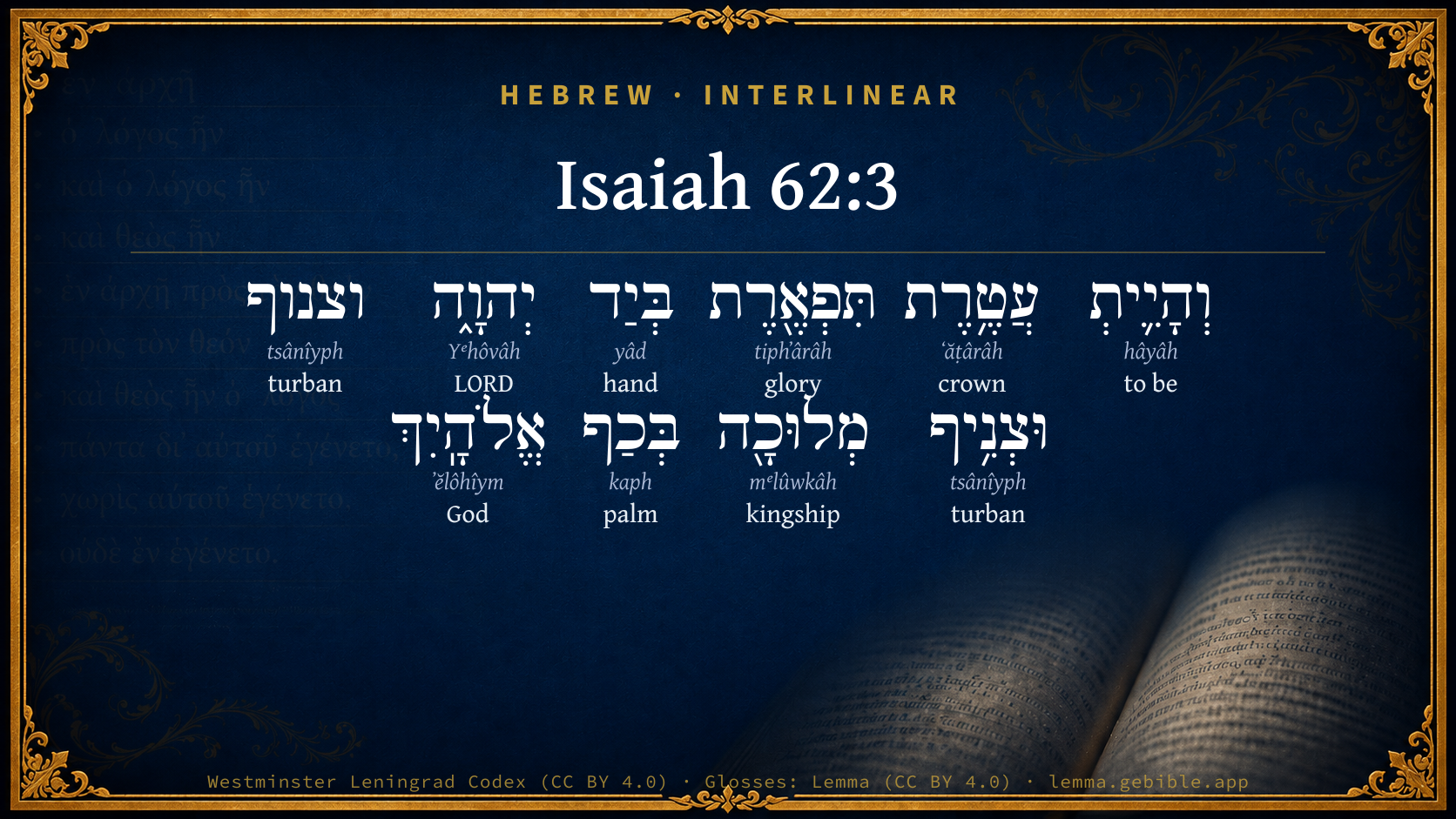
Isaiah 62:3

Hebrew (Westminster Leningrad Codex) Isaiah 62:3 appears in the Hebrew Old Testament. The text above is from the Westminster Leningrad Codex. Each word links to its Strong’s number, a concise gloss, and parsing drawn from the Open Scriptures Hebrew Bible morphology. Click any word for its full Brown-Driver-Briggs (BDB) entry.
Download image
Cite this verse

Isaiah 62:3 (World English Bible). Public Domain. Lemma interlinear Bible study tool, https://lemma.gebible.app/v/isaiah/62/3.

Show BibTeX & RIS
BibTeX
RIS
English Translation
You shall also be a crown of beauty in the hand of Yahweh, and a royal diadem in the hand of your God.
World English Bible · Public Domain
Download a study sheet

One document with this verse’s original text, its word-by-word gloss line, the meaning frame, cross-references with their text, attributed commentary, and full source and license credits — printable, and it pastes into notes with its structure intact.

This verse Autodidact and up

Study sheet (.html) Plain text (.txt)

A passage Seminary Student

Up to 50 verses in one chapter. A passage sheet keeps up to 6 commentary sources and 12 cross-references per verse, in the order this page ranks them, and says so on the sheet whenever that leaves anything out. Ask for a single verse and you get the Autodidact verse sheet above.

Everything on this page stays free to read, with no account — the sheet is a download of what is already on screen, not access to it.

Want to remove ads? Support Godless Engineer
Compare translations 3

The same verse in 3 English versions, stacked beneath the original-language interlinear above. Click any original word for its lexicon entry.

Each is an independent rendering of the whole verse — the interlinear is not word-aligned to these translations.

Highlighted words mark where these versions differ — a whole-verse word diff, not a word-by-word alignment.

  • World English Bible Public Domain
    You shall also be a crown of beauty in the hand of Yahweh, and a royal diadem in the hand of your God.
  • King James Version Public Domain
    Thou shalt also be a crown of glory in the hand of the LORD, and a royal diadem in the hand of thy God.
  • unfoldingWord Literal Text CC BY-SA 4.0
    And you will be a crown of beauty in the hand of Yahweh, and a turban of kingship in the palm of your God.

unfoldingWord Literal Text — © unfoldingWord, licensed CC BY-SA 4.0. Word-aligned USFM3 via Door43 (git.door43.org/unfoldingWord/en_ult).

Versions to compare (up to 4)

3 of 4 selected

Show all 18 translations

Every available English version of this verse, each an independent rendering of the whole verse.

  • World English Bible Public Domain
    You shall also be a crown of beauty in the hand of Yahweh, and a royal diadem in the hand of your God.
  • Berean Standard Bible Public Domain
    You will be a crown of glory in the hand of the LORD, a royal diadem in the palm of your God.
  • Majority Standard Bible Public Domain
    You will be a crown of glory in the hand of the LORD, a royal diadem in the palm of your God.
  • King James Version Public Domain
    Thou shalt also be a crown of glory in the hand of the LORD, and a royal diadem in the hand of thy God.
  • American Standard Version (1901) Public Domain
    Thou shalt also be a crown of beauty in the hand of Jehovah, and a royal diadem in the hand of thy God.
  • Revised Version (1885) Public Domain
    Thou shalt also be a crown of beauty in the hand of the LORD, and a royal diadem in the hand of thy God.
  • Geneva Bible (1599) Public Domain
    Thou shalt also be a crowne of glory in the hand of the Lord, and a royall diademe in the hand of thy God.
  • Douay-Rheims (1899) Public Domain
    And thou shalt be a crown of glory in the hand of the Lord, and a royal diadem in the hand of thy God.
  • Young's Literal Translation Public Domain
    And thou hast been a crown of beauty in the hand of Jehovah, And a diadem of royalty in the hand of thy God,
  • Literal Standard Version CC BY-SA 4.0
    And you have been a crown of beauty in the hand of YHWH, || And a turban of royalty in the hand of your God,
  • Unlocked Literal Bible CC BY-SA 4.0
    You will also be a crown of beauty in the hand of Yahweh, and a turban of kingship in the hand of your God.
  • unfoldingWord Literal Text CC BY-SA 4.0
    And you will be a crown of beauty in the hand of Yahweh, and a turban of kingship in the palm of your God.
  • Darby Bible Public Domain
    And thou shalt be a crown of beauty in the hand of Jehovah, and a royal diadem in the hand of thy God.
  • World Messianic Bible Public Domain
    You will also be a crown of beauty in the LORD’s hand, and a royal diadem in your God’s hand.
  • Webster's Bible Public Domain
    Thou shalt also be a crown of glory in the hand of the LORD, and a royal diadem in the hand of thy God.
  • Free Bible Version CC BY-SA 4.0
    You will be a crown of beauty in the Lord's hand; a royal head-dress in the hand of your God.
  • Bible in Basic English Public Domain
    And you will be a fair crown in the hand of the Lord, and a king's head-dress in the hand of your God.
  • JPS Tanakh (1917) Public Domain
    Thou shalt also be a crown of beauty in the hand of the LORD, and a royal diadem in the open hand of thy God.

Literal Standard Version (2020), Covenant Press — licensed CC BY-SA 4.0. Text via the HelloAO Bible API (eBible.org). Unlocked Literal Bible (unfoldingWord) — licensed CC BY-SA 4.0. Text via the HelloAO Bible API (eBible.org). unfoldingWord Literal Text — © unfoldingWord, licensed CC BY-SA 4.0. Word-aligned USFM3 via Door43 (git.door43.org/unfoldingWord/en_ult). Free Bible Version, Dr. Jonathan Gallagher — licensed CC BY-SA 4.0. Text via the HelloAO Bible API (eBible.org).

Word by word

More ways to search: Search by grammar → Find every occurrence → Compare this word →

Practice this passage: Drill this verse → Learn its vocabulary →

וצנוף
tsânîyph
H6797
“and · turban”
Conjunction + Verb, Qal, Infinitive Absolute
Part of Speech
Conjunction + Verb
Stem
Qal
Form
Infinitive Absolute
Full BDB Definition

Origin: from H6801

TWOT: 1940a

turban, headdress
  1. וְהָיִ֛יתְ hâyâh H1961 “and · to be” Conjunction + Verb, Qal, Sequential Perfect, 2nd Person, Feminine, Singular
  2. עֲטֶ֥רֶת ʻăṭârâh H5850 “crown of” Noun, Common, Feminine, Singular, Construct
  3. תִּפְאֶ֖רֶת tiphʼârâh H8597 “glory” Noun, Common, Feminine, Singular, Absolute
  4. בְּיַד yâd H3027 “in/at · hand of” Preposition + Noun, Common, Both, Singular, Construct
  5. יְהוָ֑ה Yᵉhôvâh H3068 “LORD” Noun, Proper
  6. וּצְנִ֥יף tsânîyph H6797 “and · turban of” Conjunction + Noun, Common, Both, Singular, Construct
  7. מְלוּכָ֖ה mᵉlûwkâh H4410 “kingship” Noun, Common, Feminine, Singular, Absolute
  8. בְּכַף kaph H3709 “in/at · palm of” Preposition + Noun, Common, Feminine, Singular, Construct
  9. אֱלֹהָֽיִךְ ʼĕlôhîym H430 “God(s) · your” Noun, Common, Masculine, Plural, Construct + Suffix, Personal, 2nd Person, Feminine, Singular

About this verse

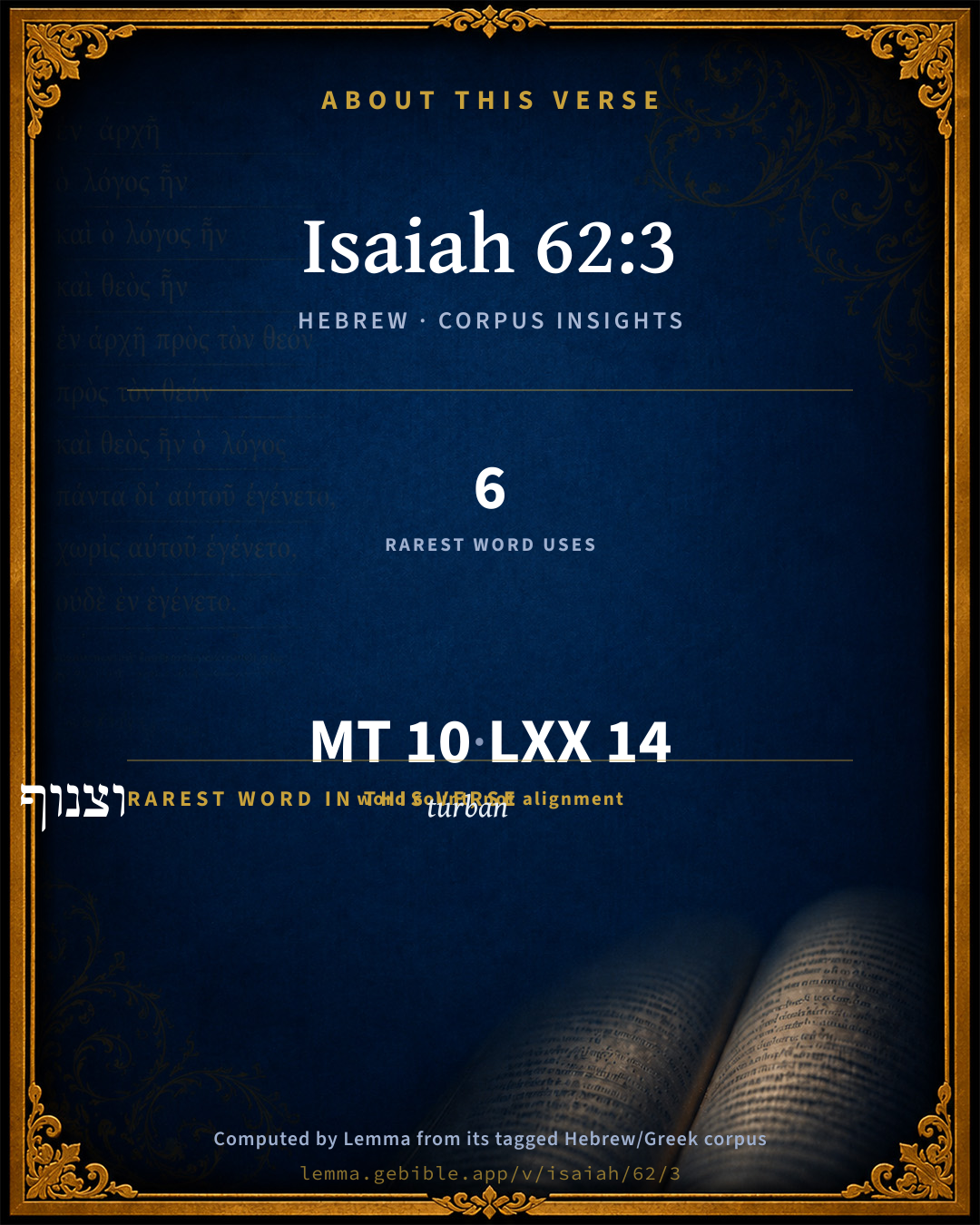
These counts appear in no published source. They are computed here, from the morphology-tagged text and Lemma’s own curated glosses. What Lemma adds →

10
words
9
distinct lemmas
Prophets
section

Notable vocabulary

The rarest word here is וצנוף turban H6797 — appearing just 6 times in the whole Hebrew Bible.

Shared distinctive vocabulary

וצנוף turban H6797 occurs in 4 verses of the Hebrew Bible. Also found in:

Grammatical profile

  • 2 verbs
  • 8 nouns

Verb forms

  • וְהָיִ֛יתְ Qal · Sequential Perfect
  • וצנוף Qal · Infinitive Absolute

Repetition

A word recurs within this verse — often emphatic in Hebrew:

  • וצנוף turban H6797 ×2

Hebrew & Septuagint length

In English translation the verse runs 23 words from the Hebrew and 24 from the Septuagint (LXX English) — closely comparable.

A rough comparison of the two English renderings, which tokenize alike — not a word-level alignment.

Word counts can differ between the Hebrew and the Greek without any difference in meaning — e.g. the Hebrew direct-object marker אֵת has no separate Greek word, and Greek often adds the article ὁ.

In the original languages it is 10 Hebrew tokens and 14 Greek tokens — but the two are counted differently (Hebrew bundles its prefixes and suffixes into one token; the Greek is in lemma form), so that isn’t a like-for-like length.

Cross-references

4

Topical passages linked to Isaiah 62:3 in the Treasury of Scripture Knowledge — connected by theme and wording, ordered by reader-vote popularity; previews shown in the World English Bible.

  • Isaiah 28:5 In that day will Yahweh of Hosts become a crown of glory, and a diadem of beauty, to the residue of his people;
  • Zechariah 9:16 Yahweh their God will save them in that day as the flock of his people; For they are like the jewels of a crown, Lifted on high over his land.
  • 1 Thessalonians 2:19 For what is our hope, or joy, or crown of rejoicing? Isn't it even you, before our Lord Jesus at his coming?
  • Luke 2:14 "Glory to God in the highest, On earth peace, good will toward men."

Cross-references courtesy of OpenBible.info (CC BY 4.0).

Hebrew and Greek witnesses Masoretic Hebrew ↔ Greek Septuagint

The same verse in the two great witnesses to the Old Testament, shown verse-for-verse.

These are two independent witnesses, not word-aligned to each other, and the Septuagint is shown in lemma (dictionary) form.

Hebrew Isaiah 62:3 Masoretic · Westminster Leningrad Codex

וְהָיִ֛יתְ עֲטֶ֥רֶת תִּפְאֶ֖רֶת בְּיַד יְהוָ֑ה וצנוף וּצְנִ֥יף מְלוּכָ֖ה בְּכַף אֱלֹהָֽיִךְ

You shall also be a crown of beauty in the hand of Yahweh, and a royal diadem in the hand of your God.

World English Bible · Public Domain

Greek LXX Isaiah 62:3 Septuagint · lemma form

καί εἰμί στέφανος κάλλος ἐν χείρ κύριος καί διάδημα βασιλεία ἐν χείρ θεός σύ

And you shall be a crown of beauty in the hand of the Lord, and a royal diadem in the hand of your God.

LXX2012 (modern English Septuagint) · Public Domain

Hebrew: Westminster Leningrad Codex (CC BY 4.0). Greek: Septuagint (public domain); English from LXX2012 (modern English Septuagint) (Public Domain). How the Septuagint differs from the Hebrew →

Targum (Aramaic paraphrase)

1

The Targum is the ancient Jewish Aramaic paraphrase of the Hebrew Scriptures — an interpretive translation, not the Hebrew text itself. Onkelos (literal) and Pseudo-Jonathan (expansive) render the Torah, and Jonathan the Prophets. Coverage is partial: where no permissively-licensed English translation exists for a verse, only the Aramaic is shown. This is verse-level text, not a word-by-word alignment to the Hebrew.

  1. Targum Jonathan Prophets (Joshua–Malachi)
    וּתְהוֹן כְּלִיל דְחֶדְוָא קֳדָם יְיָ וּכְתַר דְתוּשְׁבְּחָא קֳדָם אֱלָהָיִךְ:

    Ye shall be a crown of joy before the Lord, and a diadem of glory before thy God.

    Targum Jonathan — Aramaic: “Mikraot Gedolot” (public domain). English: “Sefaria Community Translation” (CC0 1.0 (public-domain dedication)); “London "Chaldee Paraphrase," 1871” (public domain). Text via Sefaria.

Commentary

Notes on Isaiah 62:3 from classic Christian and Jewish commentators (each source and its license shown beneath its notes). The classic Christian expositions comment on the surrounding passage and are grouped to its opening verse, so a note may address several verses; the Jewish commentaries on the Tanakh (Rashi and others) are per-verse, so they appear only where the commentator wrote on this verse.

Lemma curates 59 commentaries, every one of them public domain or Creative Commons licensed, each selected and text-cleaned for this edition rather than reprinted as found. About our sources →

Trapp's Complete Commentary

John Trapp

Isa 62:3 Thou shalt also be a crown of glory in the hand of the LORD, and a royal diadem in the hand of thy God.

Ver. 3. And thou shalt be a crown of glory in the hand of the Lord.] Or, A glorious crown by the hand, the good hand, of the Lord upon thee. The saints are God’s glory.; {Isa 46:13} the house of his glory; {Isa 60:7} a crown of glory and a royal diadem here: the throne of glory; {Jer 14:21} the ornament of God; {Eze 7:20} the beauty of his ornament, and that also set in majesty (ib.) Oh learn and labour to live up to such high preferment.

John Trapp, A Commentary or Exposition upon All the Books of the Old and New Testament (1647–1656) — public domain. Text from a community e-Sword module.

The Biblical Illustrator

Joseph S. Exell

Isa_62:3-5

Thou shalt also be a crown of glory

Zion a crown of glory Gods hand

It is only through figurative representations that prophecy here sees what Zion will be in the future; she becomes a crown of adornment, a tiara (the head-dress of the high priest, Exo_33:4; Zec_3:5; and of the King, Eze_21:26) of royal dignity in the hand of Jehovah her God.

It is a leading feature in the picture that Jehovah holds the crown in His hand. Zion is not the ancient crown which the Eternal bears on His head, but she is the crown which He holds in His hand, because in Zion He is recognized by all creation; the whole history of redemption is the history of Jehovahs taking the kingdom and bringing it to perfection, in other words, the history of the working out of this crown. (F. Delitzsch, D. D.)

The Biblical Illustrator, edited by Joseph S. Exell (c. 1880s–1900s) — public domain. Text from a community e-Sword module.

Joseph Benson's Commentary

Isa 62:3. Thou shalt be a crown of glory — Or, a beautiful crown, as Bishop Lowth renders עשׂרה תפארה. The expression is meant to set forth the dignity of her state. In the hand of the Lord — Preserved and defended by God’s hand. And a royal diadem — The same thing with the former for substance. Or the royal priesthood, whereof the apostle speaks, 1Pe 2:9. In the hand of thy God — Or palm, or grasp, as בכŠought rather to be rendered. The meaning is, that the Christian Church should become glorious in the hand of the Lord, that is, under his protection and blessing, and that God would hold it fast in his hand, figuratively speaking, and in the very palm of it, as what was extremely dear and precious in his sight, so that none should take it from him.

Joseph Benson's Commentary on the Old and New Testaments (1811–1818) — public domain. Text from a community e-Sword module.

The Preacher's Complete Homiletical Commentary

Joseph S. Exell (gen. ed.)

THE CHURCH A CROWN OF GLORY

Isa_62:3. Thou shalt also be a crown of glory, &c.

A very interesting promise made to the Church of God. God will not rest until Zion is as perfect as His hand can make her. Notice three things:—

I. The Church of God is highly prized. She is dearer to Him than all created beings. What makes her precious in His sight? No finite being can tell. Why He prized her before He visited her, is known only to Himself. Infinite wisdom can do nothing without reason: He says that He loved her, and in this truth we rest. She has no worth in herself, and is rendered precious by free, unmerited, unchangeable love.

II. As she is so prized, she is eminently honoured. Having paid such a price for her (1Jn_4:10), He will beautify her by all that infinite wisdom, love, and power can do.

III. As she is so precious and 30 highly honoured, she shall be safely preserved. Secure in His hands. Can any overcome Omnipotence? Then may they snatch the crown out of the hands of Jehovah (Joh_10:28-29). Attempts are indeed made to destroy her. Satan tries to do so,

1. By error.

2. By persecution.

3. By snares and temptations. But she is safe (Mat_16:18. See pp. 357, 558; H.E.I., 1246–1251, 2449).—William Howels: Sermons, vol. i. pp. 235–241.

Isa_62:3. I. The estimate God puts upon His people. II. The honour He confers, upon them. III. The care He exercises over them (p. 341).

Isa_62:4. I. Zion’s reproach. II. Exaltation. III. The occasion of the change.

Isa_62:5. I. The joy of Israel at their return. II. The joy of God over them (Isa_65:19).

I. The rapid increase of Zion (see pp. 348, 546). II. The joy it occasions (see p. 546). On earth. In heaven.—J. Lyth, D.D.

Isa_62:6-7. The text is the Divine summons to prayer Tor the prosperity of the Church. It points out—

I. The persons by whom it should be presented.

1. The ministers of the Gospel.

2. The members of the Church. II. The blessings for which it should be presented. Pray—

1. That the Church may be built on sure foundations.

2. That it may be distinguished by spiritual characteristics.

3. That it may be extended. III. The manner in which it should be presented.

1. It must be sincere.

2. Believing.

3. Persevering. Qualify yourselves to be the Lord’s remembrancers, in the retirement of the closet, and in the assembly of the brethren.—J. Rawlinson.

Isa_62:6-7. I. There is always need of watchmen. II. God has never left the Church without watchmen. III. Christ’s call is to all the members of His Church. How are you responding to the call?—The Homiletical Library, vol. ii. p. 275.

Isa_62:8-9. God’s oath. I. The matter of it.

1. The protection.

2. The happiness of His people. II. The certainty and solemnity of it. He has sworn. Who is true. By His right hand—has power to effect it (see on Isa_1:2-3; Isa_59:1).—J. Lyth, D.D.

Isa_62:10-12. I. The preparation. II. The proclamation. III. The felicitous result.—Dr. Lyth.

Isa_62:10. The work of God’s people. I. Gates to enter. Of righteousness. II. A way to prepare (Isa_57:14). III. Stones of stumbling to be removed (Isa_57:14). IV. A standard to uplift (vol. i. p. 219).—J. Lyth, D.D.

The Preacher's Complete Homiletical Commentary (gen. ed. Joseph S. Exell; Funk & Wagnalls, c. 1892) — public domain (pre-1929). A full-Bible homiletical/sermon-outline anthology covering 65 of 66 books (2 John is absent from the source module). Text from a community e-Sword module.

MacLaren's Expositions of Holy Scripture

Alexander MacLaren

Isaiah

MAN’S CROWN AND GOD’S

Isa 28:5. - Isa 62:3.

Connection of first prophecy-destruction of Samaria. Its situation, crowning the hill with its walls and towers, its fertile ‘fat valley,’ the flagrant immorality and drunkenness of its inhabitants, and its final ruin, are all presented in the highly imaginative picture of its fall as being like the trampling under foot of a garland on a reveller’s head, the roses of which fade and droop amid the fumes of the banqueting hall, and are then flung out on the highway. The contrast presented is very striking and beautiful. When all that gross and tumultuous beauty has faded and died, then God Himself will be a crown of beauty to His people.

The second text comes into remarkable line with this. The verbal resemblance is not quite so strong in the original. The words for diadem and crown are not the same; the word rendered glory in the second text is rendered beauty in the first, but the two texts are entirely one in meaning. The same metaphor, then, is used with reference to what God is to the Church and what the Church is to God. He is its crown, it is His.

I. The Possession of God is the Coronation of Man.

{a} Crowns were worn by guests at feasts. They who possess God sit at a table perpetually spread with all which the soul can wish or want. Contrast the perishable delights of sense and godless life with the calm and immortal joys of communion with God; ‘a crown that fadeth not away’ beside withered garlands.

{b} Crowns were worn by kings. They who serve God are thereby invested with rule over selves, over circumstances, over all externals. He alone gives completeness to self-control.

{c} Crowns were worn by priests. The highest honour and dignity of man’s nature is thereby reached. To have God is like a beam of sunshine on a garden, which brings out the colours of all the flowers; contrast with the same garden in the grey monotony of a cloudy twilight.

II. The Coronation of Man in God is the Coronation of God in Man.

That includes the following thoughts.

The true glory of God is in the communication of Himself. What a wonderful light that throws on divine character! It is equivalent to ‘God is Love.’

He who is glorified by God glorifies God, as showing the most wonderful working of His power in making such a man out of such material, by an alchemy that can convert base metal into fine gold; as showing the most wonderful condescension of His love in taking to His heart man, into whose flesh the rotting leprosy of sin has eaten.

Such a man will glorify God by becoming a conscious herald of His praise. He who has God in his heart will magnify Him by lip and life. Redeemed men are ‘secretaries of His praise’ to men, and ‘to principalities and powers in heavenly places is made known by the Church the manifold wisdom of God.’

He who thus glorifies God is held in God’s hand.

‘None shall pluck them out of My Father’s hand.’

All this will be perfected in heaven. Redeemed men lead the universal chorus that thunders forth ‘glory to Him that sitteth on the throne.’

‘He shall come to be glorified in His saints.’

‘Glorify Thy Son, that Thy Son also may glorify Thee.’

Alexander MacLaren, Expositions of Holy Scripture (1904–1910) — public domain. Text from a community e-Sword module.

Geneva Bible (1599)

Geneva Bible translators

He shall esteem thee as dear and precious as a king doth his crown.

Geneva Bible (1599) marginal notes — public domain. Text via Bolls.life.

Jamieson, Fausset & Brown

Robert Jamieson, A. R. Fausset & David Brown

(Zac 9:16)

in . . . hand of . . . Lord--As a crown is worn on the head, not "in the hand," hand must here be figurative for "under the Lord's protection" (compare Deu 33:3). "All His saints are in thy hand." His people are in His hand at the same time that they are "a crown of glory" to Him (Rev 6:2; Rev 19:12); reciprocally, He is "a crown of glory and a diadem of beauty" to them (Isa 28:5; compare Mal 3:17).

Jamieson, Fausset & Brown — Commentary Critical and Explanatory on the Whole Bible (1871) — public domain (CC PDM 1.0). Text via the HelloAO Bible API.

Ellicott's Commentary for English Readers

(3) A crown of glory . . .—The “crown” as distinctively kingly; the “diadem” implies a “tiara,” like the mitre of the High Priest (Exo_28:4; Zec_3:5). The two “hands” are expressed by different words in the Hebrew, the second having the sense of the open palm of the hand. The “new crown,” i.e., the new glory accruing to Jehovah from the restoration of Jerusalem, is not worn on the head (thought of, we may believe, as already crowned from eternity), but held forth in the hand for the gaze of the adoring nations.

A Bible Commentary for English Readers, edited by Charles John Ellicott (1878–1897) — public domain. Text from a community e-Sword module.

The Cambridge Bible for Schools and Colleges

gen. ed. J. J. S. Perowne

3. a crown of glory] R.V. of beauty. There is probably an allusion to the mural crown which tutelary deities of cities are sometimes represented as wearing, on ancient coins &c. The prophet for some reason hesitates to adopt the heathen image in its completeness; and pictures Jehovah as holding the crown in His hand.

The Cambridge Bible for Schools and Colleges (gen. ed. J. J. S. Perowne; Cambridge University Press, 1878–1918) — public domain. Text from a community e-Sword module.

John Gill's Exposition

Thou shalt also be a crown of glory in the hand of the Lord,.... The church and her members are glorious in themselves, through the righteousness of Christ put upon them; through the grace of Christ wrought in them; and through the honour they are raised unto, being made kings and priests unto God, all which will be more manifest in the latter day: and they are a glory to the Lord; there is a glory arises to him from their election, redemption, sanctification, and glorification, and from the ascriptions of glory made unto him; and they are regarded by him as a crown is by a prince; as a crown of massy gold, stuck with jewels, is rich and valuable, so are they in the eyes of Christ; they are dear and precious to him; high in his esteem; which he will not suffer to be trampled upon, or to be taken away from him, no more than a prince will suffer his crown to be so used or lost: and these are "in" his "hand" as such, which he holds in his hand, and looks at with pleasure and delight, and which he preserves and keeps safe and secure: or, "by the hand of the Lord" (f); and then the sense is, that the church and its members should become so glorious, through his hand communicating grace and glory to them, through the operations of his hand, and the wonderful effects of his power on them:

and a royal diadem in the hand of thy God; the same thing expressed in different words, for the further confirmation and illustration of it.

(f) "per manum Jovae", Gataker.

John Gill's Exposition of the Whole Bible (1746–1763) — public domain (CC PDM 1.0). Text via the HelloAO Bible API.

Albert Barnes' Notes on the Bible

Thou shalt also be a crown of glory - On the application of the word ‘crown’ to a place, see the notes at Isa 28:1, where it is applied to Samaria. Some difficulty has been felt by expositors in explaining this, from the fact that a crown or diadem was worn on the head and not held in the hand, and some have supposed that the word ‘crown’ here is equivalent to any ornament which might be either horne in the hand or worn on the head; others have supposed that the reference is to the custom of carrying a chaplet or garland in the hand on festival occasions. But probably the sense is this, ‘Thou shalt I be so beautiful and prosperous as to be appropriately regarded as a splendid crown or diadem. God shall keep thee as a beautiful diadem - the crown of beauty among the cities of the earth, and as that which is most comely and valuable in his sight.’ This is the sense expressed by Gataker and Rosenmuller.

And a royal diadem - Hebrew, ‘A diadem of a kingdom.’ The diadem is the wreath or chaplet, usually set with diamonds, which is “encircled” (צניף tsânı̂yph from צנף tsânaph) to roll or wind around, to encircle) around the head. It here means such as was usually worn by monarchs; and the sense is, that Jerusalem would become exceedingly beautiful in the sight of God.

Albert Barnes' Notes on the Bible (1834–1885) — public domain. Text from a community e-Sword/MySword module.

Haydock's Catholic Bible Commentary

Hand. Chaldean, "before." Hebrew, "by the protection."

George Leo Haydock (1774–1849), Haydock's Catholic Family Bible and Commentary, 1859 edition — public domain. Excludes Psalms (Douay-Rheims chapter numbering differs from Protestant) and Deuterocanonical books (Catholic canon only).

Matthew Poole's English Annotations

A crown of glory; an expression to set forth the dignity of her state.

In the hand of the Lord, i.e. either as placed upon thee by God’s hand, that he will dispose of or dispense to thee; a usual form of speech in Scripture, as Hag 1:1, by the hand of Haggai: so Mal 1:1. Or, in the hand of God; he shall so manage thine honourable estate, that thou shalt be a crown, a credit, and honour to him; and so the word crown may be used for any kind of ornament, or matter of honour. Or, preserved and defended by God’s hand; a phrase that expresseth it to be out of all danger, as to put a man’s life in his hands is to expose it to dangers, Jdg 12:3; 1Sa 19:5; 28:21.

A royal diadem; the same thing with the former for substance. Or, the royal priesthood, whereof the apostle speaks, 1Pe 2:9.

Matthew Poole's English Annotations on the Holy Bible (1683–1685) — public domain. Text from a community e-Sword/MySword module.

The Pulpit Commentary

Thou shalt also be a crown of glory, etc. God will exhibit Israel to an admiring world, as a man might exhibit a "crown" or "diadem" which he held in his hand. They will look on with admiration and reverence they shall perceive that it is his work". (Psa_64:9)

The Pulpit Commentary (1880–1919), ed. H.D.M. Spence-Jones & Joseph S. Exell — public domain. Text from a community e-Sword module.

John Wesley's Explanatory Notes

Crown of glory - An expression to set forth the dignity of her state. In the hand - Preserved and defended by God's hand. Royal diadem - The same thing with the former for substance. Or, the royal priesthood, whereof the apostle speaks, 1 Pet. ii, 9.

John Wesley, Explanatory Notes Upon the Whole Bible (1754–1765) — public domain. Text via the GEBible commentary corpus.

J. A. Alexander on Isaiah

Joseph Addison Alexander

“And thou shalt be a crown of beauty in Jehovah’s hand, and a diadem of royalty in the palm of thy God” The only difficulty in this verse has respect to the crown’s being twice emphatically placed in the hand and not upon the head. Some suppose that Jehovah is here represented as holding the crown in His hand to admire it; or for the purpose of exhibiting it to others; or for that of crowning Himself. Others take in the hand of God to mean at His disposal, or bestowed by Him. This is a good sense in itself; but upon whom could Zion or Jerusalem be thus bestowed? Others again think it obvious that as it would be incongruous to place the crown upon Jehovah’s head; the only place remaining was the hand.

Joseph Addison Alexander, The Prophecies of Isaiah (1846–1847; New York: Scribner, 1870–1878) — public domain. Text from a community e-Sword module.

unfoldingWord translationNotes

Door43 World Missions Community

You will also be a crown of beauty in the hand of Yahweh, and a turban of kingship in the hand of your God

These mean the same thing and are combined for emphasis. They say that Jerusalem will become a royal city under the power and authority of God. Yahweh's hand is a metonym for his power and authority. (See: Parallelism and Metonymy)

It will no more ... will it be said, "Desolate."

These mean the same thing are combined for emphasis. (See: Parallelism)

It will no more be said of you

This can be stated in active form. AT: "People will no longer say about you" (See: Active or Passive)

nor of your land any longer will it be said

This can be stated in active form. AT: "nor will people any longer say about your land" (See: Active or Passive)

your land will be married

This means Yahweh will love the people of Israel and will always be with them as is a husband. (See: Metaphor)

translationWords

crown

hand

Yahweh

God

desolate

unfoldingWord translationNotes — © Distant Shores Media and the Door43 World Missions Community, licensed CC BY-SA 4.0. Source: git.door43.org/Door43/en_tn.

Ibn Ezra

Rabbi Abraham ibn Ezra

In the hand of the Lord. In some countries people wear crowns on their hands., here, of the hand. But it is, in fact, not necessary to join ביד with עטרת; we may join it with והיית and explain the phrase thus: Thou shalt be a crown of glory in the hand of the Lord—that is, well protected and guarded by the Lord. Comp. Kimchi ad locum.

Ibn Ezra on the Tanakh — English translations: “Sefaria Community Translation” (CC0 1.0 (public-domain dedication)); “Yalkut, Sifsei Chachomim Chumash, Metsudah Publications, 2009” (CC BY 4.0); and “Commentary of Ibn Ezra on Isaiah - trans. by M. Friedlander, 1873” (public domain). Text via Sefaria.

Lesson kit

Teaching starters — assembled from the data on this page, not authored interpretation. Every prompt links to the verse data it draws on. Edit before teaching.

Isaiah, in the Prophets, opens this verse with 10 words (9 distinct Hebrew lemmas). Its most distinctive word is tsânîyph (“turban”). A historical commentator’s framing appears above. Read the whole chapter for the surrounding context.

Discussion questions

  1. How does “turban” (tsânîyph) shape what this verse is saying?
  2. Job 29:14 shares the word «turban» with this verse. How do the two illuminate each other?
  3. “turban” occurs 2× in this one verse. What is the effect of the repetition?
  4. The translations on this page render this verse differently — a whole-verse word diff, not a word-by-word alignment. What might account for the different wordings?
  5. The verb «וְהָיִ֛יתְ» is Qal Sequential Perfect. How does its form color the action?
  6. Reading how Trapp's Complete Commentary and The Biblical Illustrator read this verse, where do the two commentators agree and where do they part?

Things to notice

Reading settings

Reading text

Shown beneath each verse's original-language words.

Old Testament
Old Testament edition

Read the OT as the Masoretic Hebrew (MT) or the Greek Septuagint (LXX).

English shown for the Greek Septuagint (in the Hebrew ↔ Greek comparison).

Comparing translations? Open the Compare panel on any verse page to stack up to four side by side.