
Haggai 1:11

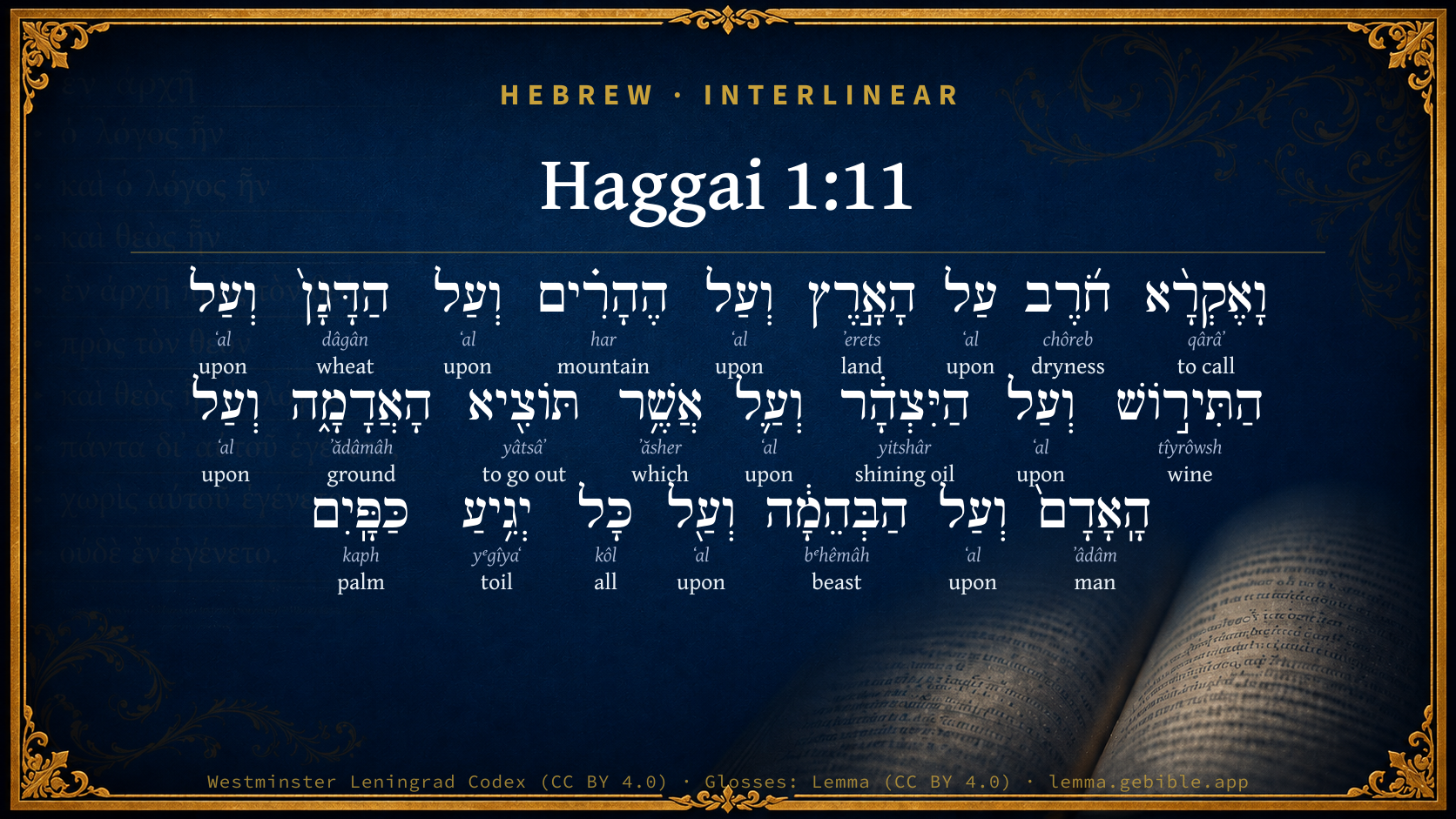
Hebrew (Westminster Leningrad Codex) Haggai 1:11 appears in the Hebrew Old Testament. The text above is from the Westminster Leningrad Codex. Each word links to its Strong’s number, a concise gloss, and parsing drawn from the Open Scriptures Hebrew Bible morphology. Click any word for its full Brown-Driver-Briggs (BDB) entry.
Download image
Cite this verse

Haggai 1:11 (World English Bible). Public Domain. Lemma interlinear Bible study tool, https://lemma.gebible.app/v/haggai/1/11.

Show BibTeX & RIS
BibTeX
RIS
English Translation
I called for a drought on the land, on the mountains, on the grain, on the new wine, on the oil, on that which the ground brings forth, on men, on cattle, and on all the labor of the hands."
World English Bible · Public Domain
Download a study sheet

One document with this verse’s original text, its word-by-word gloss line, the meaning frame, cross-references with their text, attributed commentary, and full source and license credits — printable, and it pastes into notes with its structure intact.

This verse Autodidact and up

Study sheet (.html) Plain text (.txt)

A passage Seminary Student

Up to 50 verses in one chapter. A passage sheet keeps up to 6 commentary sources and 12 cross-references per verse, in the order this page ranks them, and says so on the sheet whenever that leaves anything out. Ask for a single verse and you get the Autodidact verse sheet above.

Everything on this page stays free to read, with no account — the sheet is a download of what is already on screen, not access to it.

Want to remove ads? Support Godless Engineer
Compare translations 3

The same verse in 3 English versions, stacked beneath the original-language interlinear above. Click any original word for its lexicon entry.

Each is an independent rendering of the whole verse — the interlinear is not word-aligned to these translations.

Highlighted words mark where these versions differ — a whole-verse word diff, not a word-by-word alignment.

  • World English Bible Public Domain
    I called for a drought on the land, on the mountains, on the grain, on the new wine, on the oil, on that which the ground brings forth, on men, on cattle, and on all the labor of the hands."
  • King James Version Public Domain
    And I called for a drought upon the land, and upon the mountains, and upon the corn, and upon the new wine, and upon the oil, and upon that which the ground bringeth forth, and upon men, and upon cattle, and upon all the labour of the hands.
  • unfoldingWord Literal Text CC BY-SA 4.0
    And I have called for desolation upon the land and upon the mountains and upon the grain and upon the new wine and upon the oil and upon what the ground produces and upon the man and upon the beast and upon all the labor of hands!’”

unfoldingWord Literal Text — © unfoldingWord, licensed CC BY-SA 4.0. Word-aligned USFM3 via Door43 (git.door43.org/unfoldingWord/en_ult).

Versions to compare (up to 4)

3 of 4 selected

Show all 18 translations

Every available English version of this verse, each an independent rendering of the whole verse.

  • World English Bible Public Domain
    I called for a drought on the land, on the mountains, on the grain, on the new wine, on the oil, on that which the ground brings forth, on men, on cattle, and on all the labor of the hands."
  • Berean Standard Bible Public Domain
    I have summoned a drought on the fields and on the mountains, on the grain, new wine, and oil, and on whatever the ground yields, on man and beast, and on all the labor of your hands.”
  • Majority Standard Bible Public Domain
    I have summoned a drought on the fields and on the mountains, on the grain, new wine, and oil, and on whatever the ground yields, on man and beast, and on all the labor of your hands.”
  • King James Version Public Domain
    And I called for a drought upon the land, and upon the mountains, and upon the corn, and upon the new wine, and upon the oil, and upon that which the ground bringeth forth, and upon men, and upon cattle, and upon all the labour of the hands.
  • American Standard Version (1901) Public Domain
    And I called for a drought upon the land, and upon the mountains, and upon the grain, and upon the new wine, and upon the oil, and upon that which the ground bringeth forth, and upon men, and upon cattle, and upon all the labor of the hands.
  • Revised Version (1885) Public Domain
    And I called for a drought upon the land, and upon the mountains, and upon the corn, and upon the wine, and upon the oil, and upon that which the ground bringeth forth, and upon men, and upon cattle, and upon all the labour of the hands.
  • Geneva Bible (1599) Public Domain
    And I called for a drought vpon the land, and vpon the mountaines, and vpon the corne, and vpon the wine, and vpon the oyle, vpon all that the ground bringeth foorth: both vpon men and vpon cattell, and vpon all the labour of the hands.
  • Douay-Rheims (1899) Public Domain
    And I called for a drought upon the land, and upon the mountains, and upon the corn, and upon the wine, and upon the oil, and upon all that the ground bringeth forth, and upon men, and upon beasts, and upon all the labour of the hands.
  • Young's Literal Translation Public Domain
    And I proclaim draught on the land, And on the mountains, and on the corn, And on the new wine, and on the oil, And on what the ground doth bring forth, And on man, and on beast, And on all labour of the hands.'
  • Literal Standard Version CC BY-SA 4.0
    And I proclaim drought on the land, || And on the mountains, and on the grain, || And on the new wine, and on the oil, || And on what the ground brings forth, || And on man, and on beast, || And on all labor of the hands.”
  • Unlocked Literal Bible CC BY-SA 4.0
    I have summoned a drought upon the land and upon the mountains, upon the grain and upon the new wine, upon the oil and upon the harvest of the earth, upon men and upon beasts, and upon all the labor of your hands!”
  • unfoldingWord Literal Text CC BY-SA 4.0
    And I have called for desolation upon the land and upon the mountains and upon the grain and upon the new wine and upon the oil and upon what the ground produces and upon the man and upon the beast and upon all the labor of hands!’”
  • Darby Bible Public Domain
    And I called for a drought upon the land, and upon the mountains, and upon the corn, and upon the new wine, and upon the oil, and upon that which the ground bringeth forth, and upon man, and upon cattle, and upon all the labour of the hands.
  • World Messianic Bible Public Domain
    I called for a drought on the land, on the mountains, on the grain, on the new wine, on the oil, on that which the ground produces, on men, on livestock, and on all the labor of the hands.”
  • Webster's Bible Public Domain
    And I called for a drouth upon the land, and upon the mountains, and upon the corn, and upon the new wine, and upon the oil, and upon that which the ground bringeth forth, and upon men, and upon cattle, and upon all the labor of the hands.
  • Free Bible Version CC BY-SA 4.0
    I called for a drought on the land, on the hills, on the grain fields, on the vineyards, and on the olive groves—on whatever the earth produces—and on people and livestock, on everything you do!
  • Bible in Basic English Public Domain
    And by my order no rain came on the land or on the mountains or the grain or the wine or the oil or the produce of the earth or on men or cattle or on any work of man's hands.
  • JPS Tanakh (1917) Public Domain
    And I called for a drought upon the land, and upon the mountains, and upon the corn, and upon the wine, and upon the oil, and upon that which the ground bringeth forth, and upon men, and upon cattle, and upon all the labour of the hands.'

Literal Standard Version (2020), Covenant Press — licensed CC BY-SA 4.0. Text via the HelloAO Bible API (eBible.org). Unlocked Literal Bible (unfoldingWord) — licensed CC BY-SA 4.0. Text via the HelloAO Bible API (eBible.org). unfoldingWord Literal Text — © unfoldingWord, licensed CC BY-SA 4.0. Word-aligned USFM3 via Door43 (git.door43.org/unfoldingWord/en_ult). Free Bible Version, Dr. Jonathan Gallagher — licensed CC BY-SA 4.0. Text via the HelloAO Bible API (eBible.org).

Word by word

More ways to search: Search by grammar → Find every occurrence → Compare this word →

Practice this passage: Drill this verse → Learn its vocabulary →

חֹ֜רֶב
chôreb
H2721
“dryness”
Noun, Common, Masculine, Singular, Absolute
Part of Speech
Noun
Type
Common
Gender
Masculine
Number
Singular
State
Absolute
Full BDB Definition

Origin: a collaterally form of H2719

TWOT: 731b

dryness, desolation, drought, heat - dryness - drought - parching heat
  1. וָאֶקְרָ֨א qârâʼ H7121 “and · to call” Conjunction + Verb, Qal, Sequential Imperfect, 1st Person, Common, Singular
  2. עַל ʻal H5921 “upon” Preposition
  3. הָאָ֣רֶץ ʼerets H776 “the · land” Particle, Definite Article + Noun, Common, Both, Singular, Absolute
  4. וְעַל ʻal H5921 “and · upon” Conjunction + Preposition
  5. הֶהָרִ֗ים har H2022 “the · mountains” Particle, Definite Article + Noun, Common, Masculine, Plural, Absolute
  6. וְעַל ʻal H5921 “and · upon” Conjunction + Preposition
  7. הַדָּגָן֙ dâgân H1715 “the · wheat” Particle, Definite Article + Noun, Common, Masculine, Singular, Absolute
  8. וְעַל ʻal H5921 “and · upon” Conjunction + Preposition
  9. הַתִּיר֣וֹשׁ tîyrôwsh H8492 “the · wine” Particle, Definite Article + Noun, Common, Masculine, Singular, Absolute
  10. וְעַל ʻal H5921 “and · upon” Conjunction + Preposition
  11. הַיִּצְהָ֔ר yitshâr H3323 “the · shining oil” Particle, Definite Article + Noun, Common, Masculine, Singular, Absolute
  12. וְעַ֛ל ʻal H5921 “and · upon” Conjunction + Preposition
  13. אֲשֶׁ֥ר ʼăsher H834 “which” Particle, Relative
  14. תּוֹצִ֖יא yâtsâʼ H3318 “to go out” Verb, Hiphil, Imperfect, 3rd Person, Feminine, Singular
  15. הָאֲדָמָ֑ה ʼădâmâh H127 “the · ground” Particle, Definite Article + Noun, Common, Feminine, Singular, Absolute
  16. וְעַל ʻal H5921 “and · upon” Conjunction + Preposition
  17. הָֽאָדָם֙ ʼâdâm H120 “the · man” Particle, Definite Article + Noun, Common, Masculine, Singular, Absolute
  18. וְעַל ʻal H5921 “and · upon” Conjunction + Preposition
  19. הַבְּהֵמָ֔ה bᵉhêmâh H929 “the · beast” Particle, Definite Article + Noun, Common, Feminine, Singular, Absolute
  20. וְעַ֖ל ʻal H5921 “and · upon” Conjunction + Preposition
  21. כָּל kôl H3605 “all of” Noun, Common, Masculine, Singular, Construct
  22. יְגִ֥יעַ yᵉgîyaʻ H3018 “toil of” Noun, Common, Masculine, Singular, Construct
  23. כַּפָּֽיִם kaph H3709 “palms” Noun, Common, Feminine, Dual, Absolute

About this verse

These counts appear in no published source. They are computed here, from the morphology-tagged text and Lemma’s own curated glosses. What Lemma adds →

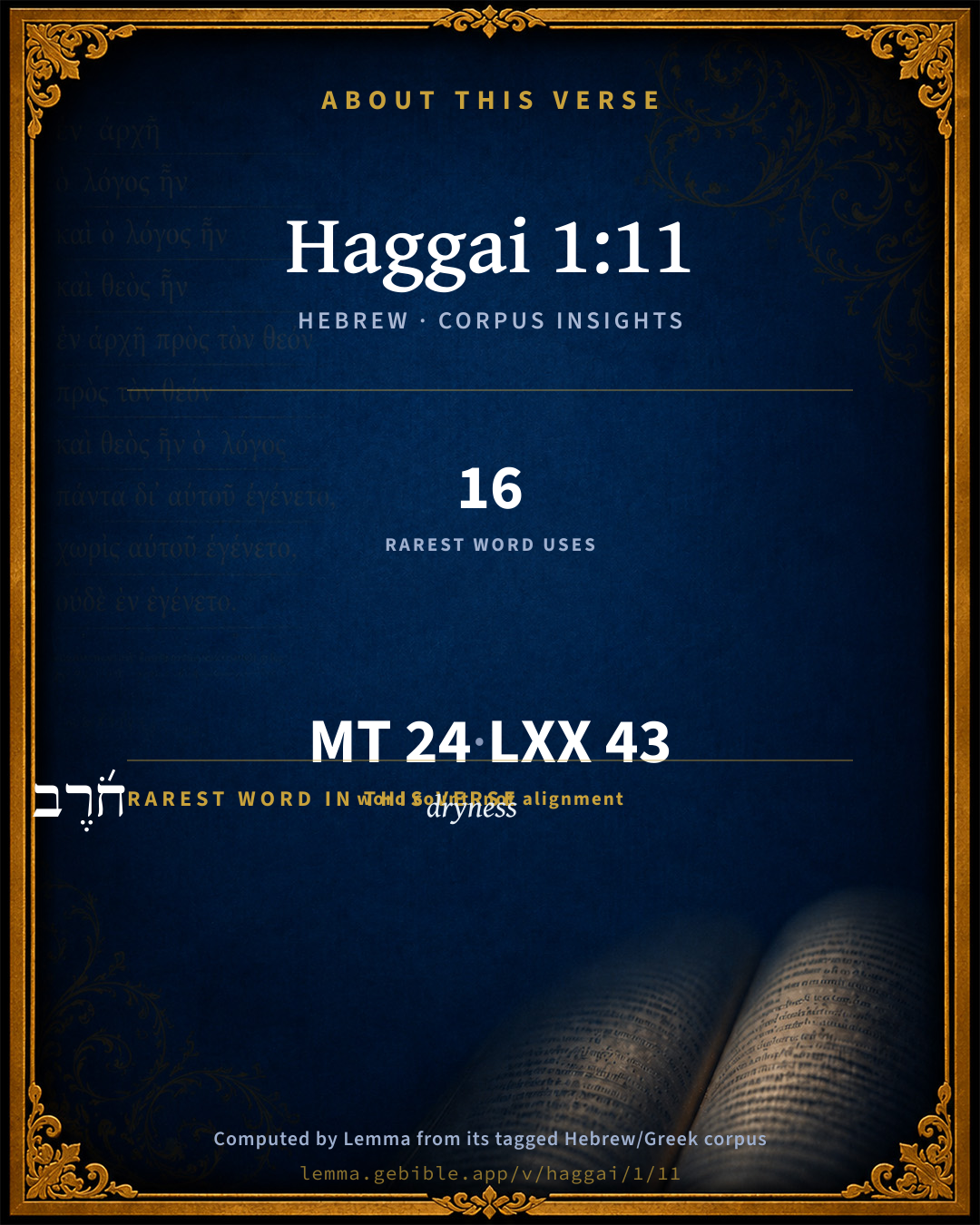
24
words
16
distinct lemmas
Prophets
section

Notable vocabulary

The rarest word here is חֹ֜רֶב dryness H2721 — appearing just 16 times in the whole Hebrew Bible.

Shared distinctive vocabulary

חֹ֜רֶב dryness H2721 occurs in 15 verses of the Hebrew Bible. Also found in:

Grammatical profile

  • 2 verbs
  • 12 nouns
  • 9 prepositions
  • 1 particle

Verb forms

  • וָאֶקְרָ֨א Qal · Sequential Imperfect
  • תּוֹצִ֖יא Hiphil · Imperfect

Repetition

A word recurs within this verse — often emphatic in Hebrew:

Hebrew & Septuagint length

In English translation the verse runs 40 words from the Hebrew and 47 from the Septuagint (LXX English) — closely comparable.

A rough comparison of the two English renderings, which tokenize alike — not a word-level alignment.

Word counts can differ between the Hebrew and the Greek without any difference in meaning — e.g. the Hebrew direct-object marker אֵת has no separate Greek word, and Greek often adds the article ὁ.

In the original languages it is 24 Hebrew tokens and 43 Greek tokens — but the two are counted differently (Hebrew bundles its prefixes and suffixes into one token; the Greek is in lemma form), so that isn’t a like-for-like length.

Cross-references

9

Topical passages linked to Haggai 1:11 in the Treasury of Scripture Knowledge — connected by theme and wording, ordered by reader-vote popularity; previews shown in the World English Bible.

  • Haggai 2:17 I struck you with blight, mildew, and hail in all the work of your hands; yet you didn't turn to me,' says Yahweh.
  • Deuteronomy 28:22 Yahweh will strike you with consumption, and with fever, and with inflammation, and with fiery heat, and with the sword, and with blasting, and with mildew; and they shall pursue you until you perish.
  • 1 Kings 17:1 Elijah the Tishbite, who was of the foreigners of Gilead, said to Ahab, As Yahweh, the God of Israel, lives, before whom I stand, there shall not be dew nor rain these years, but according to my word.
  • 2 Kings 8:1 Now Elisha had spoken to the woman, whose son he had restored to life, saying, Arise, and go you and your household, and sojourn wherever you can sojourn: for Yahweh has called for a famine; and it shall also come on the land seven years.
  • Job 34:29 When he gives quietness, who then can condemn? When he hides his face, who then can see him? Alike whether to a nation, or to a man:
  • Lamentations 1:21 They have heard that I sigh; there is none to comfort me; All my enemies have heard of my trouble; they are glad that you have done it: You will bring the day that you have proclaimed, and they shall be like me.
  • Amos 5:8 Seek him who made the Pleiades and Orion, And turns the shadow of death into the morning, And makes the day dark with night; Who calls for the waters of the sea, And pours them out on the surface of the earth, Yahweh is his name,
  • Amos 7:4 Thus the Lord Yahweh showed me and, behold, the Lord Yahweh called for judgment by fire; and it dried up the great deep, and would have devoured the land.
  • Amos 9:6 It is he who builds his chambers in the heavens, and has founded his vault on the earth; he who calls for the waters of the sea, and pours them out on the surface of the earth; Yahweh is his name.

Cross-references courtesy of OpenBible.info (CC BY 4.0).

Hebrew and Greek witnesses Masoretic Hebrew ↔ Greek Septuagint

The same verse in the two great witnesses to the Old Testament, shown verse-for-verse.

These are two independent witnesses, not word-aligned to each other, and the Septuagint is shown in lemma (dictionary) form.

Hebrew Haggai 1:11 Masoretic · Westminster Leningrad Codex

וָאֶקְרָ֨א חֹ֜רֶב עַל הָאָ֣רֶץ וְעַל הֶהָרִ֗ים וְעַל הַדָּגָן֙ וְעַל הַתִּיר֣וֹשׁ וְעַל הַיִּצְהָ֔ר וְעַ֛ל אֲשֶׁ֥ר תּוֹצִ֖יא הָאֲדָמָ֑ה וְעַל הָֽאָדָם֙ וְעַל הַבְּהֵמָ֔ה וְעַ֖ל כָּל יְגִ֥יעַ כַּפָּֽיִם

I called for a drought on the land, on the mountains, on the grain, on the new wine, on the oil, on that which the ground brings forth, on men, on cattle, and on all the labor of the hands."

World English Bible · Public Domain

Greek LXX Haggai 1:11 Septuagint · lemma form

καί ἐπιἄγω ῥομφαία ἐπί ὁ γῆ καί ἐπί ὁ ὄρος καί ἐπί ὁ σῖτος καί ἐπί ὁ οἶνος καί ἐπί ὁ ἔλαιον καί ὅσος ἐκφέρω ὁ γῆ καί ἐπί ὁ ἄνθρωπος καί ἐπί ὁ κτῆνος καί ἐπί πᾶς ὁ πόνος ὁ χείρ αὐτός

And I will bring a sword upon the land, and upon the mountains, and upon the corn, and upon the wine, and upon the oil, and all that the earth produces, and upon the men, and upon the cattle, and upon all the labors of their hands.

LXX2012 (modern English Septuagint) · Public Domain

On this verse, Trapp's Complete Commentary discusses the Septuagint’s reading. Read the note in Commentary ↓

Hebrew: Westminster Leningrad Codex (CC BY 4.0). Greek: Septuagint (public domain); English from LXX2012 (modern English Septuagint) (Public Domain). How the Septuagint differs from the Hebrew →

Targum (Aramaic paraphrase)

1

The Targum is the ancient Jewish Aramaic paraphrase of the Hebrew Scriptures — an interpretive translation, not the Hebrew text itself. Onkelos (literal) and Pseudo-Jonathan (expansive) render the Torah, and Jonathan the Prophets. Coverage is partial: where no permissively-licensed English translation exists for a verse, only the Aramaic is shown. This is verse-level text, not a word-by-word alignment to the Hebrew.

  1. Targum Jonathan Prophets (Joshua–Malachi)
    וּקְרֵית חוּרְבָא עַל אַרְעָא וְעַל טוּרַיָא וְעַל עִבּוּרָא וְעַל חַמְרָא וְעַל מִשְׁחָא וְעַל כָּל דִי מַפְקָא אַרְעָא וְעַל אֱנָשָׁא וְעַל בְּעִירָא וְעַל כָּל לֵיאוּת יְדִין:

    (no public-domain English translation for this verse)

    Targum Jonathan — Aramaic: “Mikraot Gedolot” (public domain). English: “Sefaria Community Translation” (CC0 1.0 (public-domain dedication)); “London "Chaldee Paraphrase," 1871” (public domain). Text via Sefaria.

Commentary

Notes on Haggai 1:11 from classic Christian and Jewish commentators (each source and its license shown beneath its notes). The classic Christian expositions comment on the surrounding passage and are grouped to its opening verse, so a note may address several verses; the Jewish commentaries on the Tanakh (Rashi and others) are per-verse, so they appear only where the commentator wrote on this verse.

Lemma curates 59 commentaries, every one of them public domain or Creative Commons licensed, each selected and text-cleaned for this edition rather than reprinted as found. About our sources →

Trapp's Complete Commentary

John Trapp

Hag 1:11 And I called for a drought upon the land, and upon the mountains, and upon the corn, and upon the new wine, and upon the oil, and upon [that] which the ground bringeth forth, and upon men, and upon cattle, and upon all the labour of the hands.

Ver. 11. than call for a drought &c.] and so for a dearth (which inevitably followed in those hot countries), and consequently for pestilence and sword, the usual concomitants? The Septuagint for drought here (by a mistake of points) translate a sword Pro chorebb legunt cherib. And in the original there is an elegance alliteration past the ability to translate. Because my house is chareb, that is, waste, therefore I have called for a choreb, drought, or for a chereb, a sword, which shall in like sort lay your land waste and make your houses desolate; according to that which is threatened, Deu 28:15-68 Mat 23:38. And in the very next chapter Mat 24:7, Christ telleth his apostles that those refractory Jews, and others, that rejected him, the true temple, in "whom the Godhead dwelt bodily," Col 2:9, that is, essentially (and not in clouds and ceremonies, as once between the cherubims, which they used to call Shechinah), because they loathed the heavenly manna, therefore they should be pined with famine. They that would have none of the gospel of peace should taste deeply of the miseries of war. They that despised the only medicine of their souls should be visited with pestilence. The black horse is ever at the heels of the red; and the pale of the black Rev 6:4. As there hath been a conjuncture of offences, so there will be of miseries; a conflux of them abideth the neglecters of God’s house, the contemners of his gospel. Ursine tells us, that those that fled from England for religion in Queen Mary’s days, acknowledged that that great inundation of misery came justly upon them, for their unprofitableness under the means of grace, which they had enjoyed in King Edward’s days. Zanchy likewise tells us, that when he first came to be pastor at Clavenna there happened a grievous pestilence in that town, so that in seven months’ time there died twelve hundred persons. Their former pastor, Mainardus, that man of God, as he calleth him, had often foretold such a calamity, for their profaneness and Popery; but he could never be believed till the plague had proved him a true prophet; and then they remembered his words, and wished they had been warned by him (Zanch. Miscel. ep. ad Lantgrav.). Let us also fear, lest for our many and bony sins (as the prophet’s expression is, Amo 5:12, Peccata ossea, bony sins i.e. fortia) strong, but especially for our hateful and horrible contempt of his servants and services (never the, like known), we pull upon our land Amos’s famine, not of bread, but (which is a thousandfold worse) of hearing the words of the Lord, Amo 8:11; a famine long since foretold and feared by our martyrs and confessors; and now, if ever (if God forefend not), in procinctu, in readiness of battle to fall upon us, as the most unworthy and unthankful people that ever the sun of heaven beheld or the sun of Christ’s gospel shone upon so fair and so long together. The best way of prevention is prevision and reformation; beginning at our own, as Gideon did at his father’s household, Jdg 6:27. And the best almanack we can rely upon for seasonable weather and the lengthening of our tranquillity is our obedience to God, love to our neighbours, care of ourselves.

John Trapp, A Commentary or Exposition upon All the Books of the Old and New Testament (1647–1656) — public domain. Text from a community e-Sword module.

Tyndale Open Study Notes

Tyndale Open Resources

1:11 I have called for a drought: The people failed to recognize their plight as a divine judgment on their misplaced priorities, so Haggai interpreted the situation in light of the curses attached to the covenant (Deut 28:15-68, especially vv 22-24, 38-40). • Drought (Hebrew khoreb) is a wordplay on “ruins” (Hag 1:4, 9; Hebrew khareb)—Judah’s experiences corresponded with the condition in which they had left the Lord’s Temple.

Tyndale Open Study Notes — © Tyndale Open Resources, licensed CC BY-SA 4.0. Text via the HelloAO Bible API.

Jamieson, Fausset & Brown

Robert Jamieson, A. R. Fausset & David Brown

I called--what the "heaven" and "earth," the second causes, were said to do (Hag 1:10), being the visible instruments, Jehovah, in this verse, the invisible first cause, declares to be His doing. He "calls for" famine, &c., as instruments of His wrath (Kg2 8:1; Psa 105:16). The contrast is striking between the prompt obedience of these material agencies, and the slothful disobedience of living men, His people.

drought--Hebrew, Choreb, like in sound to Chareeb, "waste" (Hag 1:4, Hag 1:9), said of God's house; implying the correspondence between the sin and its punishment. Ye have let My house be waste, and I will send on all that is yours a wasting drought. This would affect not merely the "corn," &c., but also "men" and "cattle," who must perish in the absence of the "corn," &c., lost by the drought.

labour of the hands--all the fruits of lands, gardens, and vineyards, obtained by labor of the hands (Deu 28:33; Psa 78:46).

Jamieson, Fausset & Brown — Commentary Critical and Explanatory on the Whole Bible (1871) — public domain (CC PDM 1.0). Text via the HelloAO Bible API.

Ellicott's Commentary for English Readers

(11) And I called for a drought upon.—Better, And I invoked a desolation upon. Similarly in 2Ki_8:1, Elisha announces to the Shunammite. “The Lord hath called a famine, and it shall also come upon the land seven years.”

A Bible Commentary for English Readers, edited by Charles John Ellicott (1878–1897) — public domain. Text from a community e-Sword module.

The Cambridge Bible for Schools and Colleges

gen. ed. J. J. S. Perowne

11. a drought] The Jewish commentators have observed a paronomasia or play on words, as between the fault and the punishment. My house is “waste” (charçb, ver. 4, 9), through your neglect, and your punishment shall be a “drought” (choreb). “Quasi dicat; quia aedem meam vastam relinquitis, ego quoque in omnia vestra vastitatem immittam.” Rosenm.

labour] The word here used means properly wearisome labour, toil (Gen_31:42). It is κόπος rather than ἔργον. Here of course it means the product of labour.

The Cambridge Bible for Schools and Colleges (gen. ed. J. J. S. Perowne; Cambridge University Press, 1878–1918) — public domain. Text from a community e-Sword module.

John Gill's Exposition

And I called for a drought upon the land,.... Upon the whole land of Judea; as he withheld the dew and rain from falling on it to moisten it, refresh it, and make it fruitful; so he ordered a vehement heat to dry and parch it; and directed the rays of the sun to strike with great force upon it, and cause the fruits of it to wither; and which is done by a word of his; when he calls, every creature obeys. There is an elegant play on words, which shows the justness of such a proceeding, that it was according to the law of retaliation; they suffered the house of God to lie "waste", and therefore he calls for a "wasting" drought, to come upon their land:

and upon the mountains; where herbage grew, and herds of cattle and flocks of sheep were fed; but now the grass through the drought was withered away, and so no pasturage for them, and in course must perish:

and upon the corn, and upon the new wine, and upon the oil; that is, upon the grain fields, and upon the vines and olive trees; so that they produced but very little grain, wine, and oil, and that not very good, and which was not satisfying and refreshing; at least there were not enough for their support and comfort: now these three things were the principal necessaries of life in the country of Judea, and therefore a scarcity of them was very distressing:

and upon that which the ground bringeth forth; whatever else not mentioned the earth produced, as figs, pomegranates, and other fruit:

and upon men, and upon cattle; who not only suffered in this drought, by the above said things it came upon; but by diseases it produced upon them, as the pestilence and fever among men, and murrain upon the cattle:

and upon all the labour of the hands: of men; whatsoever fields and gardens, trees and plants of every kind, that were set and cultivated by them. Of this drought, and the famine that came upon it, we nowhere else read; but there is no doubt to be made of it.

John Gill's Exposition of the Whole Bible (1746–1763) — public domain (CC PDM 1.0). Text via the HelloAO Bible API.

Albert Barnes' Notes on the Bible

And I called for a drought upon the land - God called to the people and they would not hear. It is His ever-repeated complaint to them. “I called unto you, and ye would not hear.” He called to His inanimate creatures to punish them, and “they” obeyed. So Elisha tells the woman, whose son he had restored to life, 2Ki 8:1. “The Lord hath called to the famine, and it shall also come to the land seven years.”

And upon men, - in that the drought was oppressive to man. The prophet may also allude to the other meaning of the word, “waste,” “desolation.” They had left the house of the Lord “waste,” therefore God called for waste, desolation, upon them.

Albert Barnes' Notes on the Bible (1834–1885) — public domain. Text from a community e-Sword/MySword module.

Haydock's Catholic Bible Commentary

Drought. Hebrew choreb, (Haydock) is rendered the sword, by the Septuagint and may best signify "a burning wind," according to the different pronunciation. (St. Jerome) --- This was not then determined by the vowel points (Calmet) of the Masora, Sophonias ii. 14. (Haydock)

George Leo Haydock (1774–1849), Haydock's Catholic Family Bible and Commentary, 1859 edition — public domain. Excludes Psalms (Douay-Rheims chapter numbering differs from Protestant) and Deuterocanonical books (Catholic canon only).

Matthew Poole's English Annotations

This verse is a particular narrative of what was more generally expressed in the former verse, and all things mentioned herein are very plain.

I, your God whom you neglected, called for; commanded or willed, which is call powerful enough to bring together any of his armed soldiers, to punish rebellious and contumacious sinners.

Upon the land; either the whole land, or, in distinction to mountains. the lower grounds and valleys.

Upon the mountains; which in Canaan were fruitful in pasturage, and rich in vines, and olives, and corn; all which, for want of rain, dried up and withered, languished and came to nothing; so the condition of these people was very desolate, a just punishment for a temple desolate by their negligence.

Upon men; the very blood, humours, and constitutions of men were strangely changed hereby, and many diseases afflicted them.

Upon cattle; murrain, leanness, and death among the brute beasts.

Upon all the labour of the hands; whatever man’s industry planted, as trees and plants, were under this curse, and languished, died, and were burnt up.

Matthew Poole's English Annotations on the Holy Bible (1683–1685) — public domain. Text from a community e-Sword/MySword module.

The Pulpit Commentary

I called for a drought. So Elisha says (2Ki_8:1) that "the Lord hath called for a famine." There is a play of words in the Hebrew: as they had let the Lord"s house lie" waste" (thatch) (vers. 4, 9), so the Lord punished them with "drought" (choreb). The Septuagint and Syriac, pointing differently, translate this last word "sword," but this is not suitable for the context, which speaks of the sterility of the land only. The land, in contradistinction to the mountains, is the plain country. Nothing anywhere was spared. All the labour of the hands. (Psa_128:2, etc.) All that they had effected by long and wearisome toil in the cornfield, the vineyard, etc.. (comp. Hos_2:9; Joe_1:10)

The Pulpit Commentary (1880–1919), ed. H.D.M. Spence-Jones & Joseph S. Exell — public domain. Text from a community e-Sword module.

John Wesley's Explanatory Notes

Upon men - The very blood, and constitutions of men were changed, and many diseases afflicted them.

John Wesley, Explanatory Notes Upon the Whole Bible (1754–1765) — public domain. Text via the GEBible commentary corpus.

Lesson kit

Teaching starters — assembled from the data on this page, not authored interpretation. Every prompt links to the verse data it draws on. Edit before teaching.

Haggai, in the Prophets, opens this verse with 24 words (16 distinct Hebrew lemmas). Its most distinctive word is chôreb (“dryness”). A historical commentator’s framing appears above. Read the whole chapter for the surrounding context.

Discussion questions

  1. How does “dryness” (chôreb) shape what this verse is saying?
  2. Genesis 31:40 shares the word «dryness» with this verse. How do the two illuminate each other?
  3. “upon” occurs 9× in this one verse. What is the effect of the repetition?
  4. These translations render this verse differently; the difference is in the English rendering, not the original. What questions does that raise?
  5. The verb «וָאֶקְרָ֨א» is Qal Sequential Imperfect. How does its form color the action?
  6. Reading how Trapp's Complete Commentary and Tyndale Open Study Notes read this verse, where do the two commentators agree and where do they part?

Things to notice

Reading settings

Reading text

Shown beneath each verse's original-language words.

Old Testament
Old Testament edition

Read the OT as the Masoretic Hebrew (MT) or the Greek Septuagint (LXX).

English shown for the Greek Septuagint (in the Hebrew ↔ Greek comparison).

Comparing translations? Open the Compare panel on any verse page to stack up to four side by side.