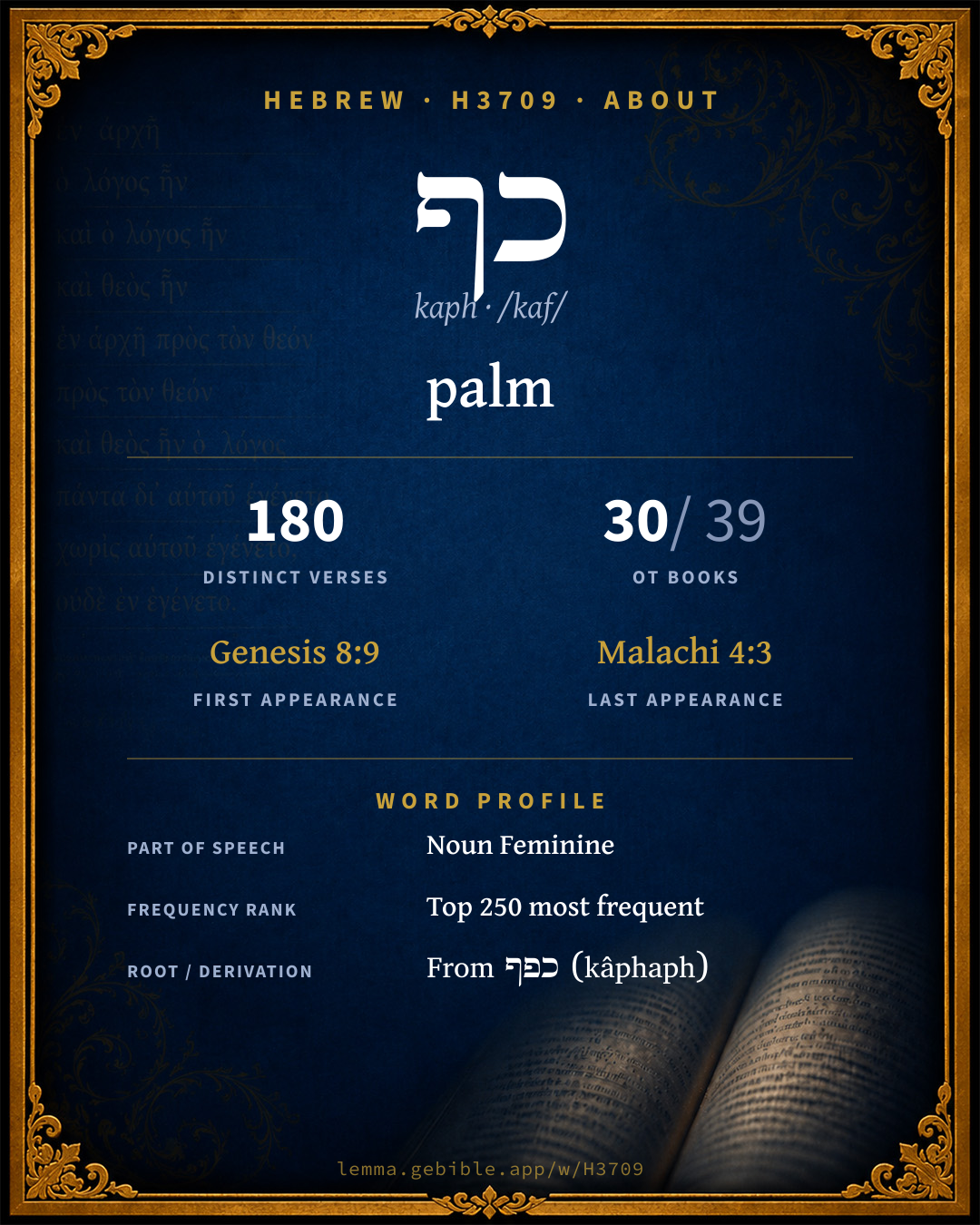
כַּף
palm
also: hand, sole fuller range ↓
Full lexicon entry — Brown-Driver-Briggs (BDB)
From Brown-Driver-Briggs (BDB)
Where this word appears
Grammar key — what these labels mean
Part of speech
- Noun
- A naming word — a person, place, thing, or idea.
Noun type
- Common
- A common noun — a general class of person, place, or thing (“king,” “city,” “water”), not a specific name.
State
- Construct
- A noun bound to a following noun in a possessive / “of” relationship (the construct chain).
- Absolute
- The independent form of a noun, not bound to a following word.
Gender
- Feminine
- Grammatically feminine.
Number
- Singular
- One.
- Dual
- Exactly two — for natural pairs and some measures of time.
- Plural
- More than one (in Hebrew, generally three or more).
Every verse where H3709 appears in the Book of 1 Samuel — 5 distinct verses. Click any verse to open its interlinear word-by-word view. Verse text shown in the World English Bible for context — . Each verse’s Hebrew form is shown with its reference; the English is not keyword-highlighted, since the data carries no word-level English alignment. Use “Compare translations” on any verse to read it across multiple English versions. This concordance covers the Hebrew Bible; Septuagint (Greek Old Testament) occurrences are not indexed here.
1 Samuel
- 1 Samuel 4:3 מִ/כַּ֥ף prep + n c fs cs When the people were come into the camp, the elders of Israel said, Why has Yahweh struck us today before the Philistines? Let us get the ark of the covenant of Yahweh out of Shiloh to us, that it may come among us, and save us out of the hand of our enemies.
- 1 Samuel 5:4 כַּפּ֣וֹת n c fp cs When they arose early on the next day morning, behold, Dagon was fallen on his face to the ground before the ark of Yahweh; and the head of Dagon and both the palms of his hands [lay] cut off on the threshold; only [the stump of] Dagon was left to him.
- 1 Samuel 19:5 בְ/כַפּ֜/וֹ prep + n c fs cs + sfx pers 3ms for he put his life in his hand, and struck the Philistine, and Yahweh worked a great victory for all Israel: you saw it, and did rejoice; why then will you sin against innocent blood, to kill David without a cause?
- 1 Samuel 25:29 כַּ֥ף n c fs cs Though men be risen up to pursue you, and to seek your soul, yet the soul of my lord shall be bound in the bundle of life with Yahweh your God; and the souls of your enemies, them shall he sling out, as from the hollow of a sling.
- 1 Samuel 28:21 בְּ/כַפִּ֔/י prep + n c fs cs + sfx pers 1cs The woman came to Saul, and saw that he was sore troubled, and said to him, Behold, your handmaid has listened to your voice, and I have put my life in my hand, and have listened to your words which you spoke to me.
About this entry
At a glance — auto-summarized from this page’s data, not written by a person. Every figure links to its source below. This summary describes the numbers; it doesn’t interpret them.
כף (kaph) is a Hebrew noun most often rendered “palm.” Its English rendering has broadened — “hands” classically, “palms” (unfoldingWord Literal Text) in modern versions; see the renderings breakdown. Spanning 180 verses in 30 books, it ranks among the common words of the Hebrew Bible. It first appears in Genesis 8:9. It also covers “hand” and “sole”, alongside “palm” — see its full sense range. For the data behind this summary, explore the sense tree and the renderings breakdown below.
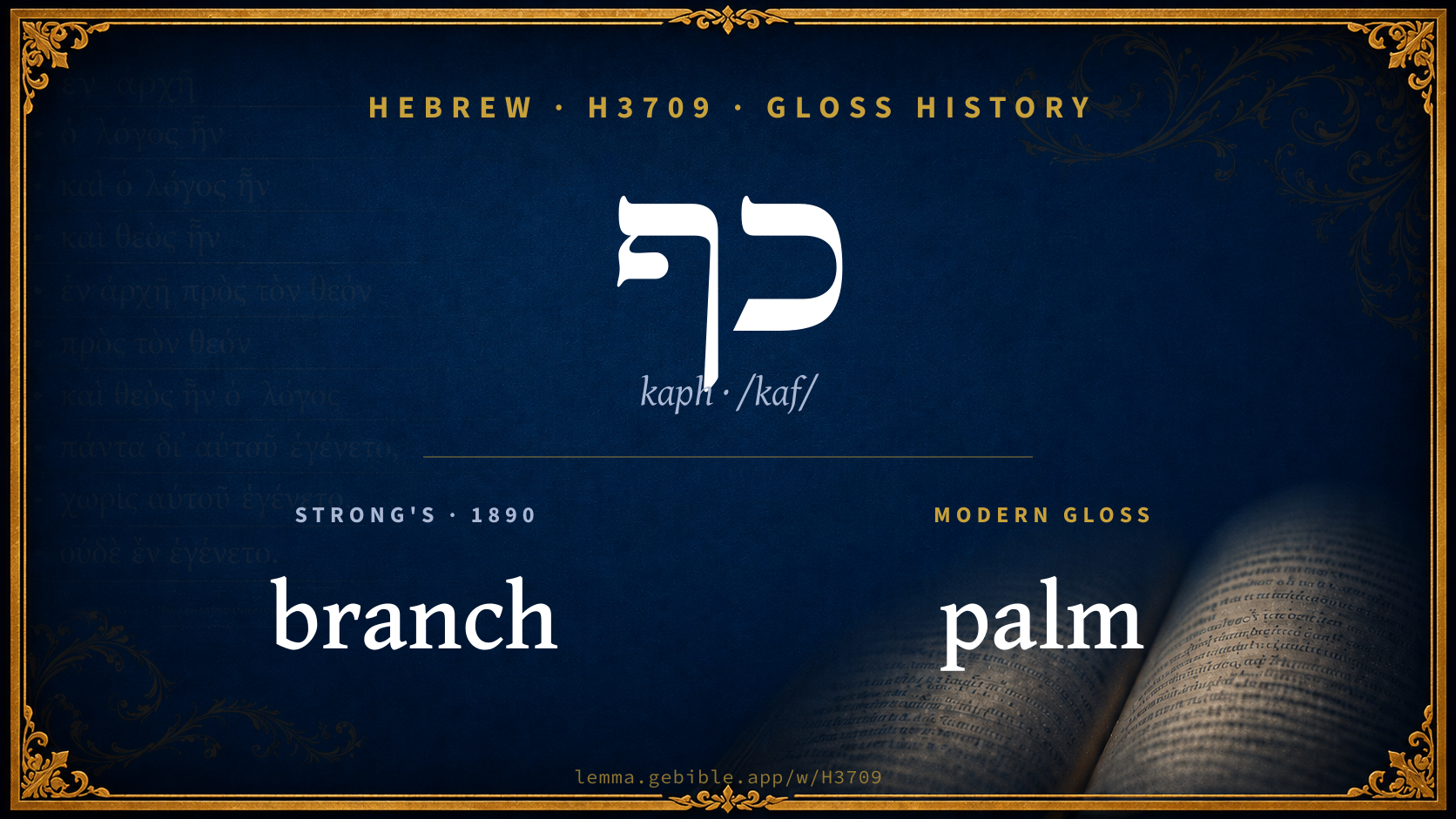
Gloss history
Strong's 1890 vs modern scholarship
About this word
Strong's H3709 catalogs a Hebrew word from the Hebrew Old Testament.
These counts are not copied from any lexicon or concordance. They are computed here, from the morphology-tagged Hebrew Old Testament. What Lemma adds →
- 180
- distinct verses
- The word appears in 180 distinct verses.
- 30 / 39
- OT books
- The word appears in 30 of 39 Old Testament books.
- #241
- by frequency
- Top 250 most frequent Hebrew words (rank 241 of 8,640 Hebrew words by occurrence).
View all 180 occurrences in the concordance →
By section of the Old Testament
By traditional corpus
Conventional, traditional groupings — biblical authorship is debated, so this is a traditional corpus grouping, not an authorship claim. Each share is this word’s portion of its verses in that division of the Hebrew canon. Each figure is a share of the word’s 180 distinct verses.
- Prophets (Nevi'im) 69 verses · 38%
- Writings (Ketuvim) 59 verses · 33%
- Torah (Pentateuch) 52 verses · 29%
How translations render this word
Counts come from each version’s own published word-to-Strong’s tagging or interlinear alignment — an approximate guide to how each version renders this word, not a word-level alignment the data otherwise carries. Because each total is that version’s own tagged count, the per-version totals vary from one another and need not match the appearance or distinct-verse counts above. These counts may also differ from a printed concordance because Lemma counts each distinctly tagged rendering and does not collapse phrase taggings into a single head-word total. This is a fixed set of word-tagged versions (KJV, ASV, BSB, ULT) and does not change with the reading translation you choose elsewhere. Each version’s license is shown beside its name below (and on Sources).
BDB lists this Strong’s number as 2 distinct words (homographs). Each count above pools all of them and is not split by sense — see the Senses section below. A low-frequency rendering may belong to a different one of those words, not the primary meaning.
- King James Version†: Hands 61×, Hand 47×, Spoon 12×
- American Standard Version†: Hands 54×, Hand 36×, Spoon 12×
- Berean Standard Bible†: Hands 68×, Hand 32×, Dish 12×
- unfoldingWord Literal Text†: Palms 31×, Hands 28×, Palm 25×
King James Version Public Domain
Renders H3709 across 188† tagged occurrences — most commonly:
Plus other, less common renderings. Plus 30 renderings that appear only once — usually multi-word phrases or single function words the recovered tagging swept in, not distinct renderings. Not rendered by a distinct English word in 4 further occurrences.
American Standard Version Public Domain
Renders H3709 across 185† tagged occurrences — most commonly:
Plus other, less common renderings. Plus 39 renderings that appear only once — usually multi-word phrases or single function words the recovered tagging swept in, not distinct renderings.
Berean Standard Bible Public Domain
Renders H3709 across 176† tagged occurrences — most commonly:
Plus 20 renderings that appear only once — usually multi-word phrases or single function words the recovered tagging swept in, not distinct renderings. Not rendered by a distinct English word in 17 further occurrences.
unfoldingWord Literal Text CC BY-SA 4.0
Renders H3709 across 204† tagged occurrences — most commonly:
Plus other, less common renderings. Plus 16 renderings that appear only once — usually multi-word phrases or single function words the recovered tagging swept in, not distinct renderings.
12 senses and sub-senses in the full BDB
What do BDB’s symbols mean?
BDB uses these scholarly abbreviations:
| Symbol | Meaning |
|---|---|
| 𝔊 | the Septuagint (the ancient Greek translation, LXX) |
| 𝔙 | the Vulgate (the Latin translation) |
| 𝔖 | the Syriac version (the Peshitta) |
| 𝔗 | the Targum (the Aramaic translation) |
| ψ | the Psalms |
| √ | root (the underlying root or stem) |
| ‖ | parallel passage (a synonymous or contrasted parallel) |
| † | the dagger: every passage where the word occurs is cited |
The 12 senses and sub-senses the full Brown-Driver-Briggs lexicon distinguishes for this word, in lexicon order (not ranked by frequency), with BDB’s own verbatim wording and sub-sense lettering. Shown in Hebrew script with BDB’s own scholarly abbreviations. The condensed entry is in the Lexicon Entry tab. See also the Forms in the corpus table below.
- 1.
- a. of human beings, hollow or flat of hand, palm, (c. 116 times) 2 K 4:34(×2); נָתַן אֵת הַכּום עַל־כַּף פ׳ Gn 40:11, 21 (E), set the cup upon the palm of Pharaoh (cf. v 11a וְכוֹס פַּרְעֹה בְּיָדִי), similarly Lv 8:27(×2) (P) +; הַשֶּׁמֶן אֲשֶׁר עַל־כַּפּוֹ Lv 14:16, 17, 18, 27, 28; as disting. from wrist and arm, Dt 25:12; rarely c. ידים (always כַּכּוֹת), שְׁתֵּי כַּפּוֹת ידיו 1 S 5:4 (of Dagon), כ׳ הַיָּדַיִם 2 K 9:35, cf. Dn 10:10; כַּף הַשְּׂמָאלִית Lv 14:15, 26; note especially מְלֹא כ׳ קֶמַח 1 K 17:12 a handful of meal (lit. palmful), cf. Ec 4:6 (where disting. from מלא חָפְנַיִם a double fistful; in both these passages of a very small quantity); cf. וַיְמַלֵּא כַּפּוֹ מִן Lv 9:17 (ref. to מְלֹא קֻמְצוֹ 2:2; 5:12 cf. 6:8). In Ex 4:4 (JE), Pr 31:19 Ez 21:16 ψ 129:7, etc., the thought is that of grasping. e.g. 2 Kings 4:34
- b. anthropomorph. of י׳, covering Moses over with his palm, וְשַׂכֹּתִי כַפִּי עָלֶיךָ Ex 33:22 (J), and so fig. (c. שׁית) ψ 139:5; withdrawing (הֵסִיר) his hand Ex 33:23 (J); removing (הִרְחִיק) his afflicting hand Jb 13:21; עַל־כַּפַּיִם כִּסָּה אוֹר Jb 36:22, i.e. he (God) hath filled his palms with light. e.g. Exodus 33:22
- c. once of animals, הוֹלֵךְ עַל־כַּפָּיו Lv 11:27 going upon their palms, i.e. paws (cats, dogs, etc.). e.g. Leviticus 11:27
- d. phrases are:—†(1) הִכָּה כַּף = clap the hands, in applause 2 K 11:12 so תָּקַע כ׳ ψ 47:2, מָחָא כ׳ Is 55:12 (fig. of trees), ψ 98:8 (fig. of rivers); but especially in scorn, contempt, etc., סָפַק אֶת־כַּפָּיו Nu 24:10 (J), יִשְׂפֹּק עָלֵימוֹ כַפֵּ֑ימוֹ Jb 27:23; so תָּקַע כַּף על־ Na 3:19, הִכָּה כַפִּי אֶל־ Ez 22:13 (of י׳); abs., הִכָּה בְכַפְּךָ Ez 6:11 (as מחא יד 25:6), הִכָּה כַּף אֶל־כַּף 21:19, אַכֶּה כַפִּי אֶל־כַּפִּי v 22 (of י׳). †(2) תָּפַשׂ בַּכַּף grasp, seize with the hand Ez 29:7 cf. v 7 (on text v. supr.) †(3) of hand-grasp as pledge, תָּקַעְתָּ לַזָּר כַּפֶּיךָ Pr 6:1 (if) thou hast smitten thy palms (given a double hand-grassp), for another (so De; ‖ עָרַבְתָּ לְרֵעֶ֑ךָ); so abs. תקע כף 17:18; 22:26 (cf. תקע ליד Jb 17:3). (4) often of hand spread out in prayer, as sign of longing to receive, c. פָּרַשׂ אֶל־ Ex 9:29, 33 (J), 1 K 8:38 = 2 Ch 6:29, etc. (v. יר ψ 143:6 La 1:17 and יָר 1 d, supr. p. 389; also פרשׂ, נשׂא, שׁטח). †(5) שׂים כַּף לְפֶה, in respectful silence, Jb 29:9. †(6) fig. וָאָשִׂימָה נַפְשִׁי בְכַפִּי Ju 12:3 = I have taken my life in my hand (i.e. hazard ed it), so 1 S 19:5; 28:21; Jb 13:14 and (without vb.) ψ 119:109. †(7) נִקְיֹן כ׳ Gn 20:5 cleanness of palms is fig. for purity of act, cf. ψ 26:6, also Jb 9:30; 22:30; ψ 24:4; 73:13; conversely, (לֹא)חָמָם בְּכַפָּ֑י Jb 16:17; 1 Ch 12:18; Is 59:6; Jon 3:8, cf. Is 59:3 (so ידים 1:15), Jb 31:7 ψ 7:4.—In many cases כַּף is not to be distinguished from יָד; so in phr. †יְגִיעַ כ׳ toil of the hands Gn 31:42; Hg 1:11; Jb 10:3; ψ 128:2; פֹּעַל כ׳ ψ 9:17, חֵפֶץ כ׳ Pr 31:13; תְּבוּנוֹת כ׳ ψ 78:72, פְּרִי כ׳ Pr 31:16 †; cf. Mi 7:3. e.g. 2 Kings 11:12
- 2. = power (i.e. grasp) of any one, נתן בכף Ju 6:13 = deliver into the power of, so Je 12:7, cf. בּוֹא בכף Pr 6:3; usually הוֹשִׁיעַ, פָּדָה, הִצִּיל etc., c. מִכַּף = out of the power of Ju 6:14 1 S 4:3 2 S 14:16; 19:10(×2); 22:1(×2) = 18:1 (title), 2 K 16:7(×2); 20:6 = Is 38:6, Mi 4:10 Je 15:21 2 Ch 30:6; 32:11 Ezr 8:31 ψ 71:4 (cf. יָד 5 g, p. 391 supr.) e.g. Judges 6:13
- 3. כַּף רַגְלָהּ, etc., = sole of foot, Gn 8:9 (J), Jos 3:13; 4:18 (both JE), 1 K 5:17 2 K 19:24 = Is 37:25, Dt 11:24; 28:56, 65 Jos 1:3 (D), Ez 43:7 Mal 3:21; מִכַּף רַגְלוֹ וְעַד קָדְקֳדוֹ 2 S 14:25 Jb 2:7, cf. Is 1:6 (fig.); מִדְרַךְ כ׳ ר׳ Dt 2:5 treading-place for the sole of a foot; of the cherubim Ez 1:7, of a calf, (in sim.) v 7, (according to MT; cf. however Co). e.g. Genesis 8:9
- 4. of various hollow, bending or bend objects:—
- a. hollow (i.e. socket), of the thigh-joint, כ׳ יָרֵךְ Gn 32:26(×2), 33(×2) (J). e.g. Genesis 32:26
- b. pan, vessel (as hollow), used in ritual, Ex 25:29; 37:16 Nu 4:7; 7:14 + 15 times Nu 7; 1 K 7:50 = 2 Ch 4:22, 2 K 25:14 = Je 52:18, Je 52:19, 2 Ch 24:14. e.g. Exodus 25:29
- c. hollow of sling, 1 S 25:29. e.g. 1 Samuel 25:29
- d. כַּפּוֹת תְּמָרִים Lv 23:40 = of huge hand-shaped branches (or fronds) of palm-trees. e.g. Leviticus 23:40
- e. כַּפּוֹת הַמַּנְעוּל Ct 5:5 the (bent) handles of the bolt. e.g. Song of Solomon 5:5
Senses from the full Brown-Driver-Briggs lexicon (Brown, Driver, Briggs; Oxford 1906 — public domain), digitized via Sefaria, supplemented by the OpenScriptures HebrewLexicon (CC BY 4.0). Full attribution on Sources.
Word origin
n.f. 1 K 8:54 hollow, or flat of the hand, palm, sole of foot, pan (NH id.; Aramaic id., ܟܰܦܳܐ; Assyrian kappu, hand, pan, kippatu, hollow; Arabic كَفٌّ palm, hand)—abs. כ׳ Jb 29:9 +, so read prob. also Ez 29:7b for MT כָּתֵף (𝔊 𝔖 Sm Co, cf. v a); כָּ֑ף 2 K 11:12 +; more often cstr. כַּף Gn 40:11 +; sf. כַּפִּי Ju 12:3, כַּפְּךָ Jb 13:21, etc.; in Ez 29:7 read כַּף Qr for כפך Kt (so Ew Hi Sm Co Da); du. כַּפַּיִם Is 49:16 +; cstr. כַּפֵּי Ex 29:24(×2) + 3 times; sf. כַּפַּי Gn 20:5 +, כַּפָּיו Nu 24:10 +, כַּפֵּיהֶם Is 59:6 + 2 times, כַּפֵּימוֹ Jb 27:23, etc.; pl. כַּפּוֹת (especially of soles, and in metaph. senses) abs. Nu 4:7 +; cstr. 2 K 9:35 +, sf. כַּפֹתָיו Ex 25:29; 37:16;—
— Brown-Driver-Briggs (Oxford 1906, public domain), digitized via Sefaria, supplemented by the OpenScriptures HebrewLexicon (CC BY 4.0). See Sources.
Derived from כפף (kâphaph) (H3721) — to bow down.
Jastrow Dictionary
A second Hebrew/Aramaic lexicon for comparison, covering Aramaic and post-biblical (Talmudic, Targumic, Midrashic) usage that the biblical-Hebrew BDB does not. Matched by lemma rather than by Strong’s number, so a lemma may carry more than one Jastrow headword (shown separately below), and the entries cover usage well beyond the Bible.
כָּף
- , v. כָּפַף, כְּפַף.
כֵּף
- , v. כֵּיף
כַּף
- c. (b. h.; [something arched, hollow,]
- 1. palm of the hand, hand.—Du. כַּפַּיִם. Y. Ber. I, 3ᶜ bot., v. חָטַף. Naz. 46ᵇ, v. כָּנָף; a. fr.—נשא כ׳ to raise the hands, to pronounce the priestly benediction. Ber. V, 4 לא ישא את כַּפָּיו must not pronounce &c.; a. fr.
- 2. sole of the foot. Du. as ab. Ḥull. 70ᵇ מהלכי כ׳ animals walking on soles (having no split hoofs, Lev. XI, 27).—Trnsf. glove; sole of the shoe. Kel. XXVI, 3 כף לוקטי(ם) קוצים (R. S. כפלוקטי) the thorn-pickers’ glove. Tosef. Kel. B. Bath. IV, 5 רוב כף אחת, the larger portion of one sole; כל כף אחת the whole of &c. e.g. Leviticus 11:27
- 3. the crest (fleshy elevation) over the genitals. Tosef. Nidd. VI, 4, sq. עד שתפשט את הכף (Var. משתתפשט) when the crest (of the girl) begins to flatten; Y. Yeb. I, 2ᵈ bot. עד שתתפשט הכף; Y. Snh. VIII, beg. 26ᵃ משתתפשט הכ׳ (of a male); Nidd. 47ᵃ, sq. נתמעך הכ׳ the crest grows lower. Ib. 52ᵇ אחת על הכ׳ one hair on the crest; a. e.
- 4. pan, censer. Tam. V, 4 (containing the בָּזָךְ). Ib. VII, 2 כף וכסויה the censer and its lid; a. fr.—Pl. כַּפּוֹת. Num. R. s. 14; a. e.
- 5. spoon, mason’s trowel &c. Kel. XIII, 2; 4; a. fr. Sabb. VIII, 5 כ׳ סיד, expl. ib. 80ᵇ כ׳ של סיידין the plasterers’ trowel.—Pl. כַּפִּים, כַּפִּין. Midd. III, 4 כפין של ברזל Ar. (ed. כפיס, Var. כפים) iron trowels.
- 6. (with, or without מאזנים) scale of the balance. Ab. II, 8. Pesik. Aḥăré, p. 167ᵃ כ׳ עוונות וכ׳ the scale of sins on the one side, and that of merits on the other; והקב"ה מטה לכ׳ זכות and the Lord bends (the balance) towards the scale of merits. Ab. I, 6, v. זְכוּת; a. fr.—Du. כַּפַּיִים, כַּפַּיִין. Tosef. Kel. B. Mets. II, 5 (ed. Zuck. כיפין, read: כפיין).
- 7. shore, banks (v. כֵּיפָא). Num. R. s. 13, v. חָף.—Pl. כַּפִּים, constr. כַּפֵּי. Lam. R. introd. (R. Ḥăn. 3) (transl. גיא המלח, II Chr. XXV, 11) כ׳ המלח the salt shores. e.g. 2 Chronicles 25:11
כַּף ²
- 1. palm, hand. Targ. Y. Gen. III, 19.—Pl. כַּפַּיָּא. Targ. Ps. XCVIII, 8 (v., however, Num. R. s. 13, s. v. חָף).
- 2. border, shore, v. כֵּיפָא.
- 3. bundle, sheaf. Snh. 26ᵇ bot. חד גנב כ׳ Ar. (v. Rabb. D. S. a. l. note 6, Var. in Ar. הזמת כ׳, v. הזמת; ed. קבא דשערי) one stole a sheaf.—Pl. (כֵּיפֵי) כַּפִּין. Y. Sabb. III, 5ᵈ bot. מיתן תלתא כ׳ וכ׳ to bring three bunches (of twigs) and put dishes upon them. Gitt. 86ᵇ דביני כיפי, v. דִּידְבָא. Pes. 40ᵃ, v. הֲפַךְ. Ned. 48ᵇ top כי׳ דכיתנא flax bunches, v. שְׁמַט; a. e.—Ib. bot. דשדיא בכיפי, v. כְּפֵילָא.
- 4. top branch of palm trees (v. כִּיפָּה).—Pl. כַּפֵּי. Succ. 32ᵃ ואימא תרתי כ׳ דתמרי perhaps kappoth (Lev. XXIII, 40) means two tops of palm trees? e.g. Leviticus 23:40
- 5. pan, spoon &c. Pes. 28ᵃ, v. חֲטַט I. Sabb. 142ᵇ מנח כ׳ אכיפי (Ms. M. כיפא) placed a ladle on a pile of sheaves. Ḥull. 54ᵃ מאי כ׳ what kappa do yon mean?—כ׳ דידא pan of the fore foot (shoulder), כ׳ דמוחא scull
- 6. shoulder(also of human beings). B. Bath. 96ᵇ top אכ׳ Ms. M. a. Ar. (ed. אכתפא); Sot. 34ᵃ bot. בכ׳ Ar. (ed. לכתפיה); Taan. 23ᵇ אחד כַּפֵּיה Ar. (ed. כתפיה), v. כַּתְּפָא.—Sot. 6ᵇ … אטו בכַפָּהּ תלי לה Ar. (ed. בכיפה) do the young priests (that guard the woman) suspend her by her shoulder (Rashi: by her cap), i.e. can they watch all her movements?
A Dictionary of the Targumim, the Talmud Babli and Yerushalmi, and the Midrashic Literature (Marcus Jastrow; London, Luzac, 1903) — Public Domain. Digitized via Sefaria. Digitized via Sefaria. Full attribution on Sources.
Forms in the corpus
The 118 distinct written forms H3709 takes in the Hebrew Bible, most frequent first — each parse links to that state’s occurrences in the concordance. Hebrew forms include their vowel points and cantillation, so a single lemma takes many written forms.
The 60 most common forms are shown; 58 rarer forms follow in the full concordance.
Same root — word family
Other BDB entries built from the same root as H3709, grouped by Strong’s listed origin. These share a root / origin per the lexicon — not necessarily a shared meaning. Each links to that word’s own entry.
Derives from
Shares the same root
Derived from this word
Compare all same-root words → They share a root, not necessarily a meaning.
Septuagint verse parallels
This word appears in 175 verses that also exist in the Greek Old Testament (Septuagint), out of the 180 Hebrew verses it occurs in. You can read those verses in Greek by switching the Old Testament edition to the Septuagint.
Read these verses in the Septuagint
- Genesis 8:9
- Exodus 4:4
- Leviticus 8:27
- Numbers 4:7
- Deuteronomy 2:5
- Joshua 1:3
- Judges 6:13
- 1 Samuel 4:3
- 2 Samuel 14:16
- 1 Kings 5:3
- 2 Kings 4:34
- 1 Chronicles 12:17
This is a verse-level parallel only — the same verses exist in both the Hebrew and Greek Old Testaments. No word-level Hebrew↔Greek correspondence is claimed: the data carries no such alignment, so no Greek word is shown as this Hebrew word’s translation. Coverage is not total — the Septuagint omits the deuterocanon and renumbers the Psalms, so some Hebrew verses have no direct Greek parallel.