
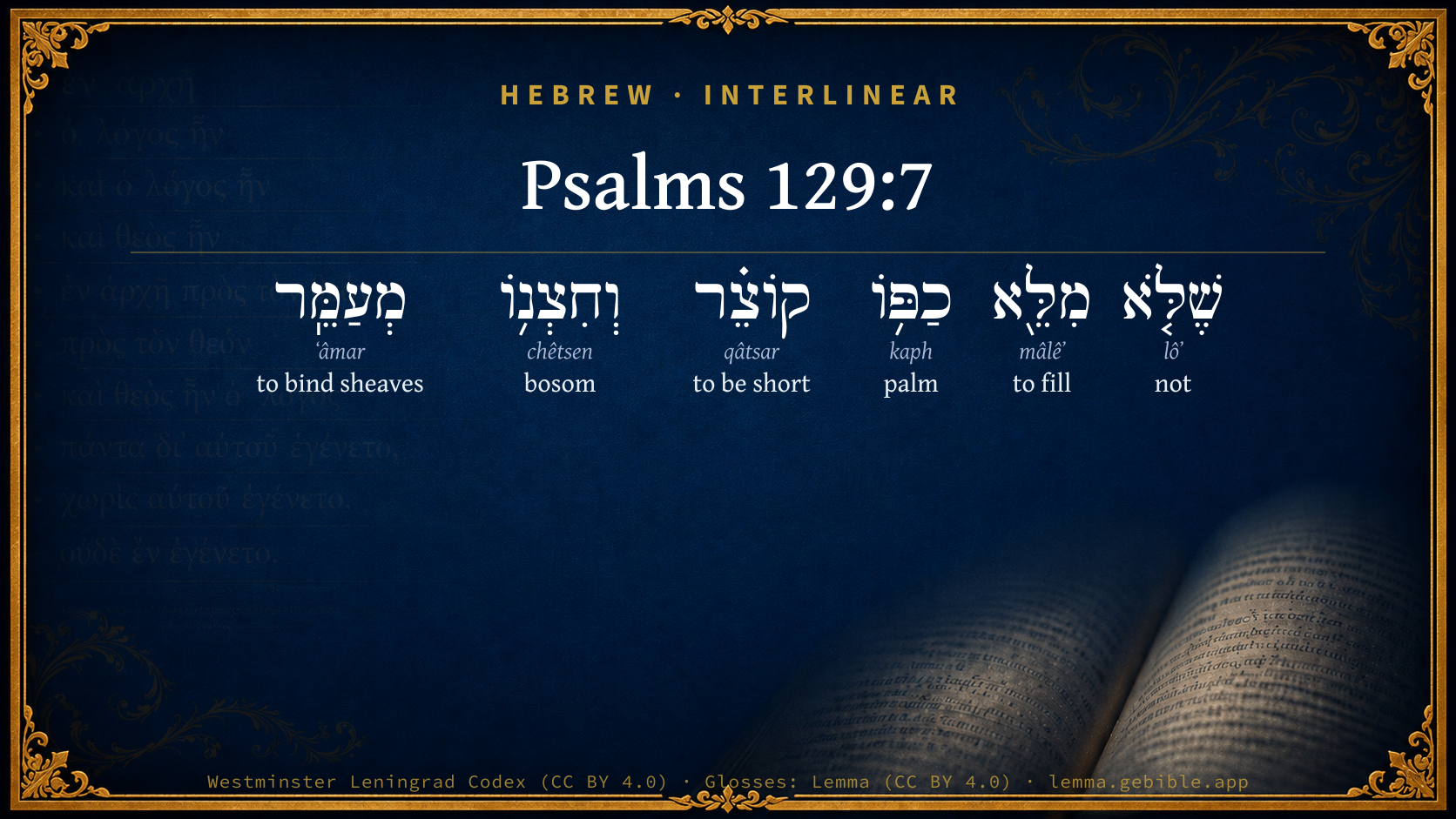
Psalms 129:7

Hebrew (Westminster Leningrad Codex) Psalms 129:7 appears in the Hebrew Old Testament. The text above is from the Westminster Leningrad Codex. Each word links to its Strong’s number, a concise gloss, and parsing drawn from the Open Scriptures Hebrew Bible morphology. Click any word for its full Brown-Driver-Briggs (BDB) entry.
Download image
Cite this verse

Psalms 129:7 (World English Bible). Public Domain. Lemma interlinear Bible study tool, https://lemma.gebible.app/v/psalms/129/7.

Show BibTeX & RIS
BibTeX
RIS
English Translation
With which the reaper doesn't fill his hand, Nor he who binds sheaves, his bosom.
World English Bible · Public Domain
Highlights
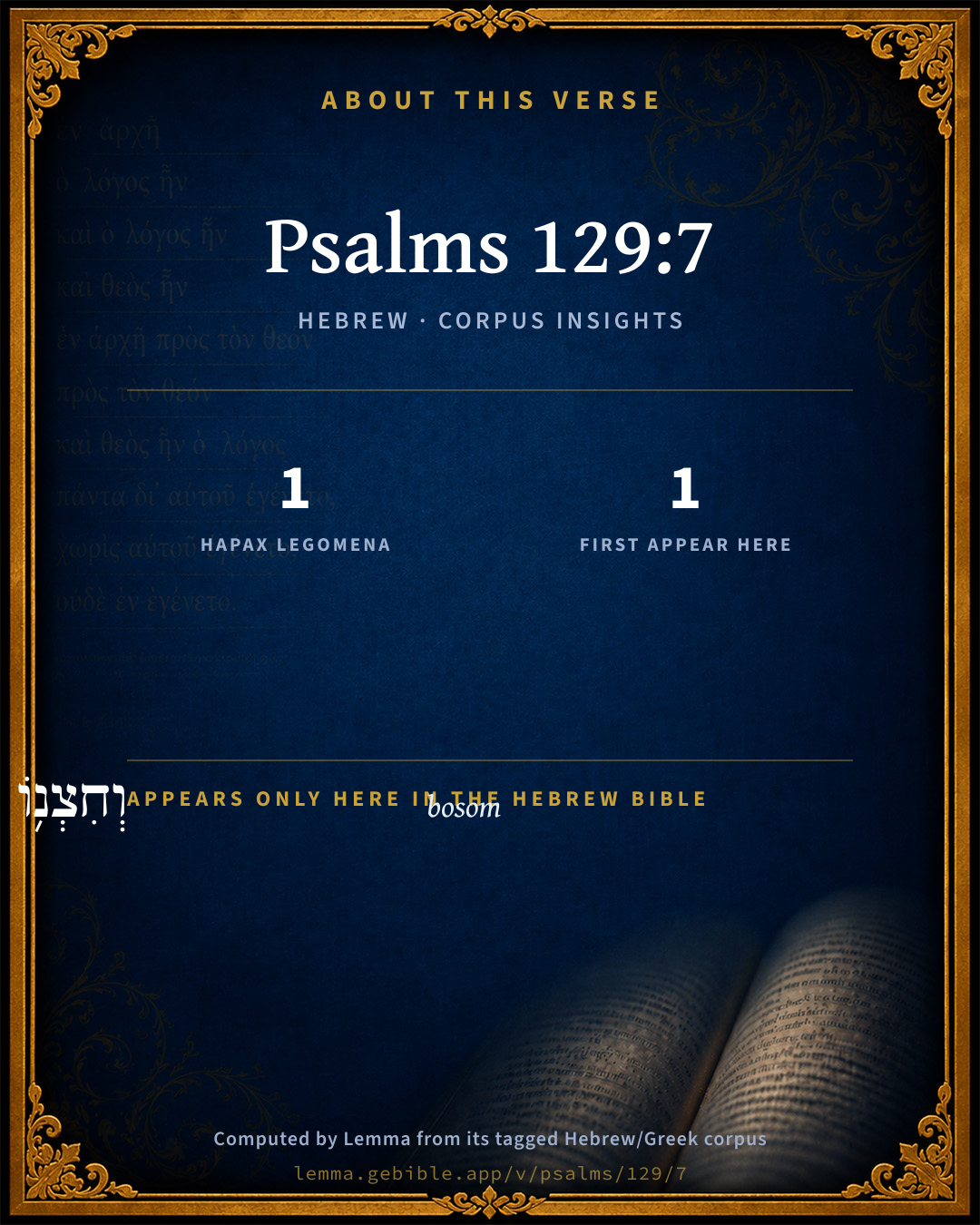
  • 1 hapax legomenon — only here in the Hebrew Bible
  • 1 first appearance in the Hebrew Bible
Full analysis ↓
Download a study sheet

One document with this verse’s original text, its word-by-word gloss line, the meaning frame, cross-references with their text, attributed commentary, and full source and license credits — printable, and it pastes into notes with its structure intact.

This verse Autodidact and up

Study sheet (.html) Plain text (.txt)

A passage Seminary Student

Up to 50 verses in one chapter. A passage sheet keeps up to 6 commentary sources and 12 cross-references per verse, in the order this page ranks them, and says so on the sheet whenever that leaves anything out. Ask for a single verse and you get the Autodidact verse sheet above.

Everything on this page stays free to read, with no account — the sheet is a download of what is already on screen, not access to it.

Want to remove ads? Support Godless Engineer
Compare translations 3

The same verse in 3 English versions, stacked beneath the original-language interlinear above. Click any original word for its lexicon entry.

Each is an independent rendering of the whole verse — the interlinear is not word-aligned to these translations.

Highlighted words mark where these versions differ — a whole-verse word diff, not a word-by-word alignment.

  • World English Bible Public Domain
    With which the reaper doesn't fill his hand, Nor he who binds sheaves, his bosom.
  • King James Version Public Domain
    Wherewith the mower filleth not his hand; nor he that bindeth sheaves his bosom.
  • unfoldingWord Literal Text CC BY-SA 4.0
    that the reaper does not fill his palm, and the one binding sheaves, not fill his bosom,

unfoldingWord Literal Text — © unfoldingWord, licensed CC BY-SA 4.0. Word-aligned USFM3 via Door43 (git.door43.org/unfoldingWord/en_ult).

Versions to compare (up to 4)

3 of 4 selected

Show all 17 translations

Every available English version of this verse, each an independent rendering of the whole verse.

  • World English Bible Public Domain
    With which the reaper doesn't fill his hand, Nor he who binds sheaves, his bosom.
  • Berean Standard Bible Public Domain
    unable to fill the hands of the reaper, or the arms of the binder of sheaves.
  • Majority Standard Bible Public Domain
    unable to fill the hands of the reaper, or the arms of the binder of sheaves.
  • King James Version Public Domain
    Wherewith the mower filleth not his hand; nor he that bindeth sheaves his bosom.
  • American Standard Version (1901) Public Domain
    Wherewith the reaper filleth not his hand, Nor he that bindeth sheaves his bosom.
  • Revised Version (1885) Public Domain
    Wherewith the reaper filleth not his hand, nor he that bindeth sheaves his bosom.
  • Geneva Bible (1599) Public Domain
    Whereof the mower filleth not his hand, neither the glainer his lap:
  • Young's Literal Translation Public Domain
    That hath not filled the hand of a reaper, And the bosom of a binder of sheaves.
  • Literal Standard Version CC BY-SA 4.0
    That has not filled the hand of a reaper, || And the bosom of a binder of sheaves.
  • Unlocked Literal Bible CC BY-SA 4.0
    that cannot fill the reaper's hand or the chest of the one who binds bundles of grain together.
  • unfoldingWord Literal Text CC BY-SA 4.0
    that the reaper does not fill his palm, and the one binding sheaves, not fill his bosom,
  • Darby Bible Public Domain
    Wherewith the mower filleth not his hand, nor he that bindeth sheaves his bosom;
  • World Messianic Bible Public Domain
    with which the reaper doesn’t fill his hand, nor he who binds sheaves, his bosom.
  • Webster's Bible Public Domain
    With which the mower filleth not his hand; nor he that bindeth sheaves, his bosom.
  • Free Bible Version CC BY-SA 4.0
    There's not enough even for a reaper to hold, not enough even for the binder to bind.
  • Bible in Basic English Public Domain
    He who gets in the grain has no use for it; and they do not make bands of it for the grain-stems.
  • JPS Tanakh (1917) Public Domain
    Wherewith the reaper filleth not his hand, nor he that bindeth sheaves his bosom.

Literal Standard Version (2020), Covenant Press — licensed CC BY-SA 4.0. Text via the HelloAO Bible API (eBible.org). Unlocked Literal Bible (unfoldingWord) — licensed CC BY-SA 4.0. Text via the HelloAO Bible API (eBible.org). unfoldingWord Literal Text — © unfoldingWord, licensed CC BY-SA 4.0. Word-aligned USFM3 via Door43 (git.door43.org/unfoldingWord/en_ult). Free Bible Version, Dr. Jonathan Gallagher — licensed CC BY-SA 4.0. Text via the HelloAO Bible API (eBible.org).

Word by word

More ways to search: Search by grammar → Find every occurrence → Compare this word →

Practice this passage: Drill this verse → Learn its vocabulary →

About this verse

These counts appear in no published source. They are computed here, from the morphology-tagged text and Lemma’s own curated glosses. What Lemma adds →

6
words
6
distinct lemmas
Wisdom
section

Notable vocabulary

1 hapax legomenon — a word that appears only here in the entire Hebrew Bible:

  • וְחִצְנ֥וֹ bosom H2683

First appearance in Scripture

This word makes its first canonical appearance in the Hebrew Bible here:

  • וְחִצְנ֥וֹ bosom H2683

Shared distinctive vocabulary

מְעַמֵּֽר to bind sheaves H6014 occurs in 3 verses of the Hebrew Bible. Also found in:

Grammatical profile

  • 3 verbs
  • 2 nouns
  • 1 particle

Verb forms

  • מִלֵּ֖א Piel · Perfect
  • קוֹצֵ֗ר Qal · Participle Active
  • מְעַמֵּֽר Piel · Participle Active

Hebrew & Septuagint length

In English translation the verse runs 15 words from the Hebrew and 16 from the Septuagint (LXX English) — closely comparable.

A rough comparison of the two English renderings, which tokenize alike — not a word-level alignment.

Word counts can differ between the Hebrew and the Greek without any difference in meaning — e.g. the Hebrew direct-object marker אֵת has no separate Greek word, and Greek often adds the article ὁ.

Cross-references

4

Topical passages linked to Psalms 129:7 in the Treasury of Scripture Knowledge — connected by theme and wording, ordered by reader-vote popularity; previews shown in the World English Bible.

  • Galatians 6:8 For he who sows to his own flesh will from the flesh reap corruption. But he who sows to the Spirit will from the Spirit reap eternal life.
  • Isaiah 17:10–11 For you have forgotten the God of your salvation, and have not been mindful of the rock of your strength; therefore you plant pleasant plants, and set it with strange slips.
  • Psalms 126:6 He who goes out weeping, carrying seed for sowing, Will assuredly come again with joy, carrying his sheaves.
  • Hosea 8:7 For they sow the wind, And they will reap the whirlwind. He has no standing grain. The stalk will yield no head. If it does yield, strangers will swallow it up.

Cross-references courtesy of OpenBible.info (CC BY 4.0).

Hebrew and Greek witnesses Masoretic Hebrew ↔ Greek Septuagint

The same verse in the two great witnesses to the Old Testament, shown verse-for-verse.

You’re reading Greek Psalm 128 (Hebrew Psalm 129). The Septuagint counts the superscription, so verse numbers can differ from the Hebrew — chapter-level alignment, not verse-by-verse. Numbering follows Rahlfs.

These are two independent witnesses, not word-aligned to each other, and the Septuagint is shown in lemma (dictionary) form.

Hebrew Psalms 129:7 Masoretic · Westminster Leningrad Codex

שֶׁלֹּ֤א מִלֵּ֖א כַפּ֥וֹ קוֹצֵ֗ר וְחִצְנ֥וֹ מְעַמֵּֽר

With which the reaper doesn't fill his hand, Nor he who binds sheaves, his bosom.

World English Bible · Public Domain

Greek LXX Greek Psalm 128:7 Septuagint · lemma form

ὅς οὐ πληρόω ὁ χείρ αὐτός ὁ θερίζω καί ὁ κόλπος αὐτός ὁ ὁ δράγμα συνλέγω

Wherewith the reaper fills not his hand, nor he that makes up the sheaves, his bosom.

LXX2012 (modern English Septuagint) · Public Domain

Hebrew: Westminster Leningrad Codex (CC BY 4.0). Greek: Septuagint (public domain); English from LXX2012 (modern English Septuagint) (Public Domain). How the Septuagint differs from the Hebrew →

Commentary

Notes on Psalms 129:7 from classic Christian and Jewish commentators (each source and its license shown beneath its notes). The classic Christian expositions comment on the surrounding passage and are grouped to its opening verse, so a note may address several verses; the Jewish commentaries on the Tanakh (Rashi and others) are per-verse, so they appear only where the commentator wrote on this verse.

Lemma curates 59 commentaries, every one of them public domain or Creative Commons licensed, each selected and text-cleaned for this edition rather than reprinted as found. About our sources →

Trapp's Complete Commentary

John Trapp

Psa 129:7 Wherewith the mower filleth not his hand; nor he that bindeth sheaves his bosom.

Ver. 7. Wherewith the mower filleth not his hand] As holding it not worth gathering in. Wicked men are useless creatures; as Stratonicus, in Athenaeus, saith, that the hill Haemus was for eight months in the year very cold, and for the other four it was winter.

John Trapp, A Commentary or Exposition upon All the Books of the Old and New Testament (1647–1656) — public domain. Text from a community e-Sword module.

J. A. Alexander on Psalms

Joseph Addison Alexander

7. (Psa 129:7) (With) which the reaper fills not his hand and his bosom, (when) binding sheaves. The ephemeral and worthless vegetation of the house-top is contrasted still further with the useful products of the earth, in order to contrast still more strongly the end of the righteous and the wicked. The last Hebrew word is translated above strictly as a participle of the verb to bind or gather sheaves, and may agree with reaper in the first clause. Since the latter, however, is itself a participle used as a noun, most interpreters put the same construction on the other word, and suppose it to denote a different person from the reaper. With which the reaper fills not his hand nor his bosom the sheaf-binder. The word translated bosom is explained by lexicographers to mean the front fold of the oriental robe, in which things are carried. It might also be translated lap. Hengstenberg's version is his arm. Compare my note on Isa 49:22.

Joseph Addison Alexander, The Psalms Translated and Explained (1850) — public domain. Text from a community e-Sword module.

John Calvin's Commentaries

7 With which the mower hath not filled his hand. “Whereof the mower hath not filled his hand, etc. — i.e., It is too scanty to afford employment for a labourer to gather it by the hand, or for a reaper, who uses a sickle, depositing what he cuts in the fold of his garment, or as Le Clerc understands it, under his left arm. The Psalmist in effect prays, that the enemies of Israel may be reduced to such poverty, that none could become richer by despoiling them: in a word, that they might be altogether despicable. For binding up the sheaves, Hammond suggests, gathereth the handfuls, with reference to the gleaner, Ruth 2:2 ” — Cresswell.

“Au lieu que chacun communement en passant par les bleds les benit, et prie pour la moisson.” — Fr.

John Calvin's Commentaries (1540-1563) — public domain. Text from the Calvin Translation Society English edition (1840s-50s) via the Christian Classics Ethereal Library (ccel.org). Calvin's coverage is partial (roughly two-thirds of the Bible); uncommented books and verses are honest gaps, never fabricated. The 19th-century editor's footnotes and remarks are omitted so the notes are faithfully Calvin's own voice.

The Cambridge Bible for Schools and Colleges

gen. ed. J. J. S. Perowne

7. mower] Reaper (R.V.). The ‘grass’ includes corn springing from grains accidentally dropped on the roof.

bosom] The ‘lap’ or loose fold of the garment, which could be used for collecting the ears of corn. Cp. Neh_5:13. Children were carried in it (Isa_49:22).

7, 8. An expansion of the simile (cp. Psa_127:4-5).

The Cambridge Bible for Schools and Colleges (gen. ed. J. J. S. Perowne; Cambridge University Press, 1878–1918) — public domain. Text from a community e-Sword module.

John Gill's Exposition

Wherewith the mower filleth not his hand,.... Such grass never rises high enough to be mowed, nor is of that account to have such pains taken with it; nor the quantity so large as to fill a mower's hand, and carry it away in his arms;

nor he that bindeth sheaves his bosom; when corn is mowed or reaped, the binders come and gather it up in their arms, and bind it in sheaves, and then bring it into the barn; but nothing of this kind is done with grass on the housetops. This represents the insignificancy and worthlessness of wicked men; who, when the harvest comes, the end of the world, will not be gathered in by the reapers, the angels, into Christ's garner into heaven as the wheat, the righteous will; but like the tares and chaff will be cast into unquenchable fire, Mat 3:12.

John Gill's Exposition of the Whole Bible (1746–1763) — public domain (CC PDM 1.0). Text via the HelloAO Bible API.

Albert Barnes' Notes on the Bible

Wherewith the mower filleth not his hand - It cannot be gathered and laid up for the use of cattle, as grass can that grows in the field. It is valueless for any such purpose; or, is utterly worthless. The phrase “filleth not his hand” seems to be derived from the idea of reaping, where the reaper with one hand takes hold of the grain which he reaps, and cuts it off with the sickle in the other.

Nor he that bindeth sheaves - The man who gathers in the harvest. This was commonly performed by a different person from the reaper.

His bosom - This word would commonly refer to the bosom of the garment, in which tilings were carried; or that part above the girdle. It may be used here, however, in a larger sense - since it is incongruous to suppose that sheaves of grain would be carried thus - as meaning simply that one who gathered the sheaves would usually convey them in his arms, folding them to his bosom.

Albert Barnes' Notes on the Bible (1834–1885) — public domain. Text from a community e-Sword/MySword module.

The Treasury of David

Charles H. Spurgeon

Ver. 7. Wherewith the mower filleth not his hand; nor he that bindeth sheaves his bosom. When with his sickle the husbandman would cut down the tufts, he found nothing to lay hold upon: the grass promised fairly enough, but there was no fulfilment, there was nothing to cut or to carry, nothing for the hand to grasp, nothing for the lap to gather. Easterners carry their corn in their bosoms, but in this case there was nothing to bear home. Thus do the wicked come to nothing. By God's just appointment they prove a disappointment. Their fire ends in smoke; their verdure turns to vanity; their flourishing is but a form of withering. No one profits by them, least of all are they profitable to themselves. Their aim is bad, their work is worse, their end is worst of all.

Ver. 7. The mower filleth not his hand, etc. The grain was rather pulled than cut, and as each handful was taken the reaper gave it a flourishing swing up into his bosom. Mrs. Finn, in "Home in the Holy Land", 1866.

Ver. 7. He that bindeth sheaves his bosom. A practice prevails in hot climates of sending out persons into the woods and other wild places to collect the grass, which would otherwise be wasted; and it is no uncommon tiling in the evening to see groups of grass cutters in the market, waiting to dispose of their bundles or sheaves, which are often so large that one is disposed to wonder how they could have been conveyed from the woods upon one man's shoulders. Maria Calcott, in "A Scripture Herbal", 1842.

Psalms 129:8*

Charles H. Spurgeon's The Treasury of David (1869–1885) — public domain. Psalms only. Text from a community e-Sword/MySword module.

The Pulpit Commentary

Wherewith the mower filleth not his hand. Which is so worthless that no one takes the trouble to mow it. Nor he that bindeth sheaves his bosom. Much less does any one bind it into sheaves and store it away.

The Pulpit Commentary (1880–1919), ed. H.D.M. Spence-Jones & Joseph S. Exell — public domain. Text from a community e-Sword module.

Rashi

Rabbi Shlomo Yitzchaki (Rashi)

his arm Like (Isa. 49:22): “and they will bring your sons in [their] arms (בחצן),” aisselle in French, and so (Neh. 5:13): “Also I shook out my arm (חצני).”

Rashi on the Tanakh — English translations: “The Judaica Press complete Tanach with Rashi, translated by A. J. Rosenberg” (CC BY 4.0); “Pentateuch with Rashi's commentary by M. Rosenbaum and A.M. Silbermann, 1929-1934” (public domain); “The Metsudah Tanach series, Lakewood, N.J” (CC BY 4.0); and “The Book of Joshua, Metsudah Publications, 1997” (CC BY 4.0). Text via Sefaria.

Lesson kit

Teaching starters — assembled from the data on this page, not authored interpretation. Every prompt links to the verse data it draws on. Edit before teaching.

Psalms, in the Wisdom, opens this verse with 6 words (6 distinct Hebrew lemmas). Its most distinctive word is chêtsen (“bosom”). A historical commentator’s framing appears above. Read the whole chapter for the surrounding context.

Discussion questions

  1. What does “bosom” (chêtsen) contribute to the verse as a whole?
  2. 1 word here appears nowhere else in the Hebrew Bible. Why might the author reach for such rare wording?
  3. This is the first place “bosom” appears in Scripture (first appears here). What does its debut here establish?
  4. How does Deuteronomy 21:14, which shares the word «to bind sheaves», read alongside this verse?
  5. These translations render this verse differently; the difference is in the English rendering, not the original. What questions does that raise?
  6. «מִלֵּ֖א» is a Piel Perfect verb. How does that grammatical form shape the action described?
  7. Compare how Trapp's Complete Commentary and J. A. Alexander on Psalms read this verse. Where do they agree or differ?

Things to notice

  • 1 word in this verse appears nowhere else in the Hebrew Bible.
  • 1 word makes its first canonical appearance in Scripture here.
  • These translations choose different wording for 15 words in this verse.
  • 6 distinct Hebrew lemmas span 6 words in this verse.

Reading settings

Reading text

Shown beneath each verse's original-language words.

Old Testament
Old Testament edition

Read the OT as the Masoretic Hebrew (MT) or the Greek Septuagint (LXX).

English shown for the Greek Septuagint (in the Hebrew ↔ Greek comparison).

Comparing translations? Open the Compare panel on any verse page to stack up to four side by side.