
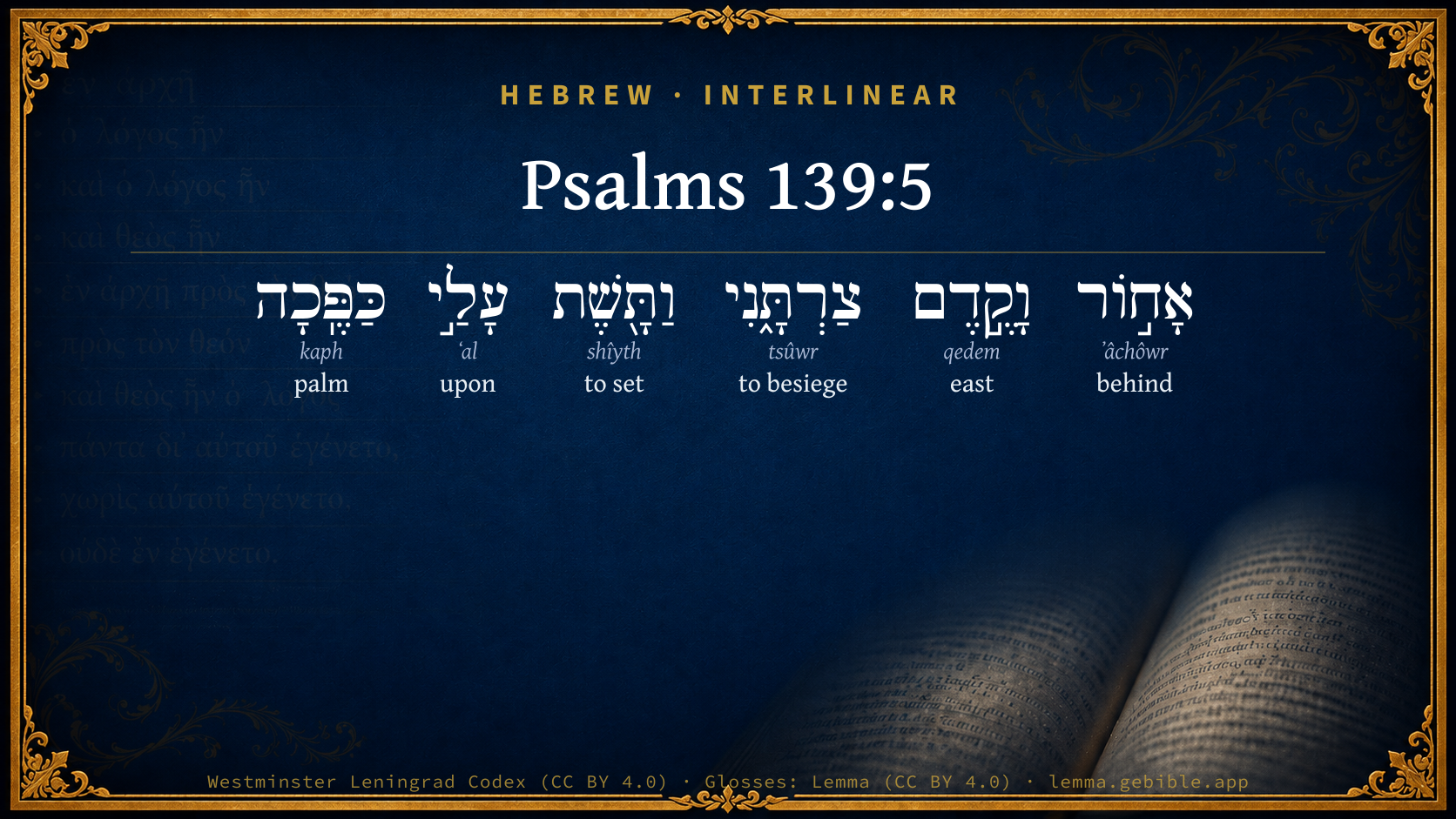
Psalms 139:5

Hebrew (Westminster Leningrad Codex) Psalms 139:5 appears in the Hebrew Old Testament. The text above is from the Westminster Leningrad Codex. Each word links to its Strong’s number, a concise gloss, and parsing drawn from the Open Scriptures Hebrew Bible morphology. Click any word for its full Brown-Driver-Briggs (BDB) entry.
Download image
Cite this verse

Psalms 139:5 (World English Bible). Public Domain. Lemma interlinear Bible study tool, https://lemma.gebible.app/v/psalms/139/5.

Show BibTeX & RIS
BibTeX
RIS
English Translation
You hem me in behind and before. You laid your hand on me.
World English Bible · Public Domain
Download a study sheet

One document with this verse’s original text, its word-by-word gloss line, the meaning frame, cross-references with their text, attributed commentary, and full source and license credits — printable, and it pastes into notes with its structure intact.

This verse Autodidact and up

Study sheet (.html) Plain text (.txt)

A passage Seminary Student

Up to 50 verses in one chapter. A passage sheet keeps up to 6 commentary sources and 12 cross-references per verse, in the order this page ranks them, and says so on the sheet whenever that leaves anything out. Ask for a single verse and you get the Autodidact verse sheet above.

Everything on this page stays free to read, with no account — the sheet is a download of what is already on screen, not access to it.

Want to remove ads? Support Godless Engineer
Compare translations 3

The same verse in 3 English versions, stacked beneath the original-language interlinear above. Click any original word for its lexicon entry.

Each is an independent rendering of the whole verse — the interlinear is not word-aligned to these translations.

Highlighted words mark where these versions differ — a whole-verse word diff, not a word-by-word alignment.

  • World English Bible Public Domain
    You hem me in behind and before. You laid your hand on me.
  • King James Version Public Domain
    Thou hast beset me behind and before, and laid thine hand upon me.
  • unfoldingWord Literal Text CC BY-SA 4.0
    Behind and before you have enclosed me, and you have set your palm upon me.

unfoldingWord Literal Text — © unfoldingWord, licensed CC BY-SA 4.0. Word-aligned USFM3 via Door43 (git.door43.org/unfoldingWord/en_ult).

Versions to compare (up to 4)

3 of 4 selected

Show all 18 translations

Every available English version of this verse, each an independent rendering of the whole verse.

  • World English Bible Public Domain
    You hem me in behind and before. You laid your hand on me.
  • Berean Standard Bible Public Domain
    You hem me in behind and before; You have laid Your hand upon me.
  • Majority Standard Bible Public Domain
    You hem me in behind and before; You have laid Your hand upon me.
  • King James Version Public Domain
    Thou hast beset me behind and before, and laid thine hand upon me.
  • American Standard Version (1901) Public Domain
    Thou hast beset me behind and before, And laid thy hand upon me.
  • Revised Version (1885) Public Domain
    Thou hast beset me behind and before, and laid thine hand upon me.
  • Geneva Bible (1599) Public Domain
    Thou holdest mee straite behinde and before, and layest thine hand vpon me.
  • Douay-Rheims (1899) Public Domain
    And let them sing in the ways of the Lord: for great is the glory of the Lord.
  • Young's Literal Translation Public Domain
    Behind and before Thou hast besieged me, And Thou dost place on me Thy hand.
  • Literal Standard Version CC BY-SA 4.0
    You have besieged me behind and before, || And You place Your hand on me.
  • Unlocked Literal Bible CC BY-SA 4.0
    Behind me and before me you surround me and place your hand upon me.
  • unfoldingWord Literal Text CC BY-SA 4.0
    Behind and before you have enclosed me, and you have set your palm upon me.
  • Darby Bible Public Domain
    Thou hast beset me behind and before, and laid thy hand upon me.
  • World Messianic Bible Public Domain
    You hem me in behind and before. You laid your hand on me.
  • Webster's Bible Public Domain
    Thou hast beset me behind and before, and laid thy hand upon me.
  • Free Bible Version CC BY-SA 4.0
    You're always there—behind me, in front of me, and all around me. You place your caring hand on me.
  • Bible in Basic English Public Domain
    I am shut in by you on every side, and you have put your hand on me.
  • JPS Tanakh (1917) Public Domain
    Thou hast hemmed me in behind and before, and laid Thy hand upon me.

Literal Standard Version (2020), Covenant Press — licensed CC BY-SA 4.0. Text via the HelloAO Bible API (eBible.org). Unlocked Literal Bible (unfoldingWord) — licensed CC BY-SA 4.0. Text via the HelloAO Bible API (eBible.org). unfoldingWord Literal Text — © unfoldingWord, licensed CC BY-SA 4.0. Word-aligned USFM3 via Door43 (git.door43.org/unfoldingWord/en_ult). Free Bible Version, Dr. Jonathan Gallagher — licensed CC BY-SA 4.0. Text via the HelloAO Bible API (eBible.org).

Word by word

More ways to search: Search by grammar → Find every occurrence → Compare this word →

Practice this passage: Drill this verse → Learn its vocabulary →

About this verse

These counts appear in no published source. They are computed here, from the morphology-tagged text and Lemma’s own curated glosses. What Lemma adds →

6
words
6
distinct lemmas
Wisdom
section

Shared distinctive vocabulary

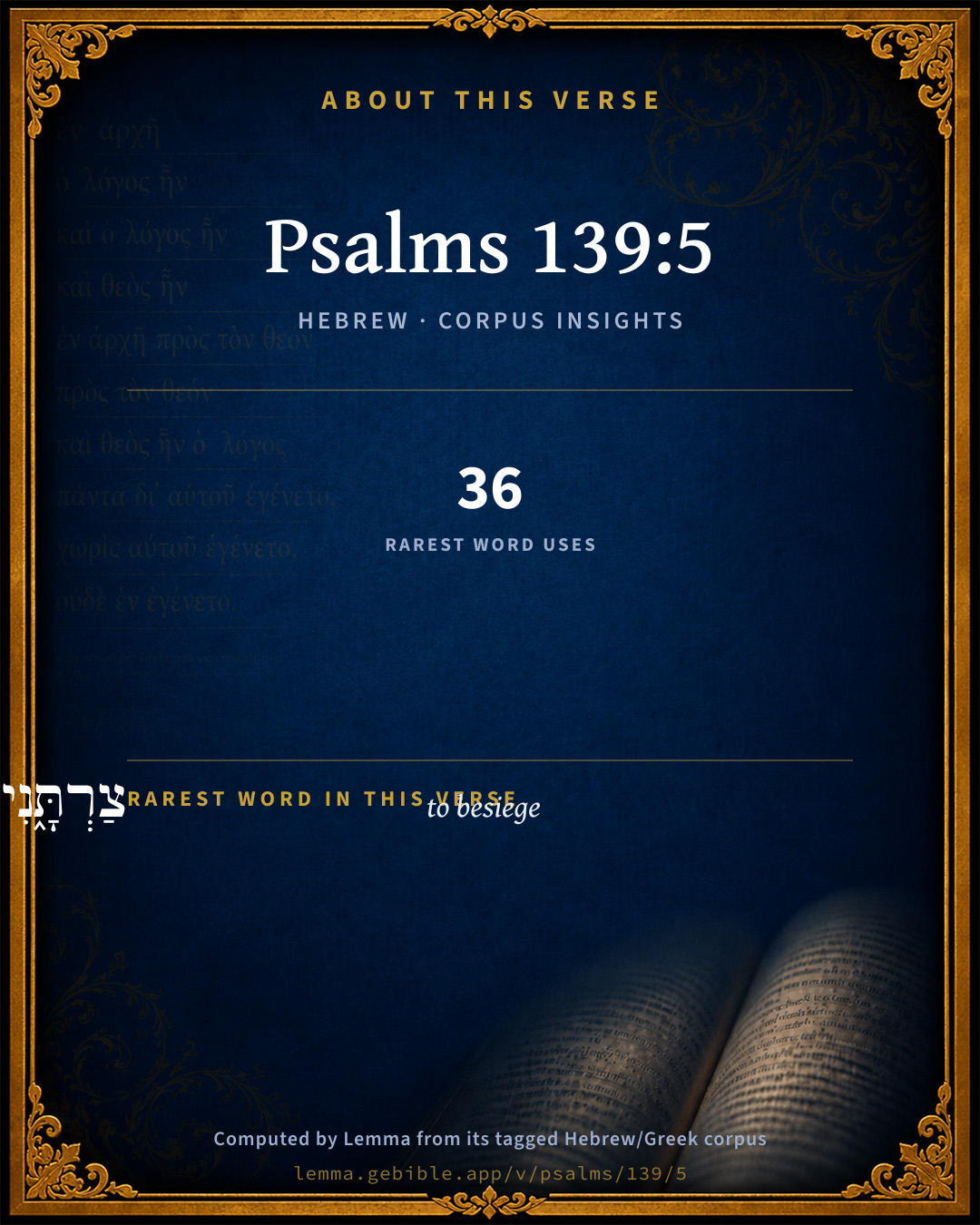
צַרְתָּ֑נִי to besiege H6696 occurs in 36 verses of the Hebrew Bible. Also found in:

Grammatical profile

  • 2 verbs
  • 3 nouns
  • 1 preposition

Verb forms

  • צַרְתָּ֑נִי Qal · Perfect
  • וַתָּ֖שֶׁת Qal · Sequential Imperfect

Hebrew & Septuagint length

In English translation the verse runs 13 words from the Hebrew and 15 from the Septuagint (LXX English) — closely comparable.

A rough comparison of the two English renderings, which tokenize alike — not a word-level alignment.

Word counts can differ between the Hebrew and the Greek without any difference in meaning — e.g. the Hebrew direct-object marker אֵת has no separate Greek word, and Greek often adds the article ὁ.

Cross-references

6

Topical passages linked to Psalms 139:5 in the Treasury of Scripture Knowledge — connected by theme and wording, ordered by reader-vote popularity; previews shown in the World English Bible.

  • Psalms 34:7 The angel of Yahweh encamps round about those who fear him, And delivers them.
  • Deuteronomy 33:27 The eternal God is [your] dwelling-place, Underneath are the everlasting arms. He thrust out the enemy from before you, Said, Destroy.
  • Revelation 1:17 When I saw him, I fell at his feet like a dead man. He laid his right hand on me, saying, "Don't be afraid. I am the first and the last,
  • Job 23:8–9 "If I go east, he is not there; If west, I can't find him;
  • Exodus 24:11 He didn't lay his hand on the nobles of the children of Israel. They saw God, and ate and drank.
  • Job 9:33 There is no umpire between us, That might lay his hand on us both.

Cross-references courtesy of OpenBible.info (CC BY 4.0).

Hebrew and Greek witnesses Masoretic Hebrew ↔ Greek Septuagint

The same verse in the two great witnesses to the Old Testament, shown verse-for-verse.

You’re reading Greek Psalm 138 (Hebrew Psalm 139). The Septuagint counts the superscription, so verse numbers can differ from the Hebrew — chapter-level alignment, not verse-by-verse. Numbering follows Rahlfs.

These are two independent witnesses, not word-aligned to each other, and the Septuagint is shown in lemma (dictionary) form.

Hebrew Psalms 139:5 Masoretic · Westminster Leningrad Codex

אָח֣וֹר וָקֶ֣דֶם צַרְתָּ֑נִי וַתָּ֖שֶׁת עָלַ֣י כַּפֶּֽכָה

You hem me in behind and before. You laid your hand on me.

World English Bible · Public Domain

Greek LXX Greek Psalm 138:5 Septuagint · lemma form

ἰδού κύριος σύ γιγνώσκω πᾶς ὁ ἔσχατος καί ὁ ἀρχαῖος σύ πλάσσω ἐγώ καί τίθημι ἐπί ἐγώ ὁ χείρ σύ

the last and the first: you have fashioned me, and laid your hand upon me.

LXX2012 (modern English Septuagint) · Public Domain

On this verse, John Calvin's Commentaries discusses the Septuagint’s reading. Read the note in Commentary ↓

Hebrew: Westminster Leningrad Codex (CC BY 4.0). Greek: Septuagint (public domain); English from LXX2012 (modern English Septuagint) (Public Domain). How the Septuagint differs from the Hebrew →

Commentary

Notes on Psalms 139:5 from classic Christian and Jewish commentators (each source and its license shown beneath its notes). The classic Christian expositions comment on the surrounding passage and are grouped to its opening verse, so a note may address several verses; the Jewish commentaries on the Tanakh (Rashi and others) are per-verse, so they appear only where the commentator wrote on this verse.

Lemma curates 59 commentaries, every one of them public domain or Creative Commons licensed, each selected and text-cleaned for this edition rather than reprinted as found. About our sources →

Trapp's Complete Commentary

John Trapp

Psa 139:5 Thou hast beset me behind and before, and laid thine hand upon me.

Ver. 5. Thou hast beset me behind and before] As a beast that is pursued, as an enemy that is begirt and environed; and lest I should think by some means to make escape (as David did from Saul and his host, by a providence, 1Sa 23:27; as Hannibal did from the Romans, by a stratagem).

Thou hast laid thine hand upon me] As by an arrest; so that I am thy prisoner, and cannot stir a foot from thee.

John Trapp, A Commentary or Exposition upon All the Books of the Old and New Testament (1647–1656) — public domain. Text from a community e-Sword module.

J. A. Alexander on Psalms

Joseph Addison Alexander

5. (Psa 139:5) Behind and before thou dost beset me, and layest upon me thy hand. There is here an insensible transition from God's omniscience to his omni-presence, out of which the Scriptures represent it as arising. Behind and before, i.e. on all sides. The idea of above and below is suggested by the last clause. Beset, besiege, hem in, or closely surround. Thy hand, or the palm of thy hand, as the Hebrew word strictly denotes.

Joseph Addison Alexander, The Psalms Translated and Explained (1850) — public domain. Text from a community e-Sword module.

Geneva Bible (1599)

Geneva Bible translators

Thou so guidest me with thine hand, that I can turn no way, but where thou appointest me.

Geneva Bible (1599) marginal notes — public domain. Text via Bolls.life.

Adam Clarke's Commentary

Verse 5. Thou hast beset me behind and before] אחור וקדם צרתני achor vekodam tsartani, "The hereafter and the past, thou hast formed me." I think Bishop Horsley's emendation here is just, uniting the two verses together. "Behold thou, O Jehovah, knowest the whole, the hereafter and the past. Thou hast formed me, and laid thy hand upon me."

Adam Clarke's Commentary on the Bible (1810–1826) — public domain. Text from a community e-Sword/MySword module.

John Calvin's Commentaries

In verse fifth some read — behind and before thou hast fashioned me; Thus the Septuagint have ἔπλασάς με, Thou hast formed me. Similar is the rendering of the Syriac. Those who embrace this view take the verb, as if the root were יצר, yatsar. “But,” says Phillips, “it is certain that the root of צרתני must be צור, to afflict, press, besiege. Hence the meaning of the verse is, ‘Thou hast so pressed upon, or besieged me, both behind and before, that I find there is no escaping from thee; Thou hast placed thy hand upon me, so that I am quite in thy power.’ The whole passage is a figure, representing God’s thorough knowledge of man.” — Phillips. “Thou besettest me behind and before, i.e. thou knowest all my doings as perfectly as if I were begirt by thee on every side.” — Cresswell.

“Comme mettant la main sur eux pour los arrester par le collet, ainsi qu’on dit, tellement qu’ils ne peuvent bouger le moins du monde qu’il ne le scache.” — Fr.

John Calvin's Commentaries (1540-1563) — public domain. Text from the Calvin Translation Society English edition (1840s-50s) via the Christian Classics Ethereal Library (ccel.org). Calvin's coverage is partial (roughly two-thirds of the Bible); uncommented books and verses are honest gaps, never fabricated. The 19th-century editor's footnotes and remarks are omitted so the notes are faithfully Calvin's own voice.

Ellicott's Commentary for English Readers

(5) Beset—as a beleagured city from which there is no escape.

A Bible Commentary for English Readers, edited by Charles John Ellicott (1878–1897) — public domain. Text from a community e-Sword module.

The Cambridge Bible for Schools and Colleges

gen. ed. J. J. S. Perowne

5. beset me] The word is used of besieging a town. God hems him in on all sides so that he cannot escape. The P.B.V. thou hast fashioned me follows the LXX and other Ancient Versions in a less probable rendering.

laid thine hand upon me] God holds him fast in His grasp, exercises His authority over him. Cp. Job_9:33.

The Cambridge Bible for Schools and Colleges (gen. ed. J. J. S. Perowne; Cambridge University Press, 1878–1918) — public domain. Text from a community e-Sword module.

John Gill's Exposition

Such knowledge is too wonderful for me,.... Meaning either the knowledge of himself, such as God had of him, which was vastly superior to what he had of himself; and especially the knowledge of other persons and things, whether visible or invisible, in heaven, earth, or hell; things past, present, and to come; or else the manner in which God knew all this was amazing to him, and quite impenetrable by him; that he did know him, his thoughts, his words and actions, and so those of all others, was easy of belief; but how he should know all this was past his conception, and struck him with the profoundest admiration;

it is high; sublime, out of his reach, beyond his comprehension;

I cannot attain unto it; neither to such knowledge, nor to comprehend what it is in God; and how he should have it, and in what manner he exercises it. Kimchi, Jarchi, and Aben Ezra, connect the words with the following, as if the matter of his wonder and astonishment was the omnipresence of God, or where he should find a place to flee from him.

John Gill's Exposition of the Whole Bible (1746–1763) — public domain (CC PDM 1.0). Text via the HelloAO Bible API.

Albert Barnes' Notes on the Bible

Thou hast beset me behind and before - The word rendered “beset” - צור tsûr - means properly to press; to press upon; to compress. It has reference commonly to the siege of a city, or to the pressing on of troops in war; and then it comes to mean to besiege, hem in, closely surround, so that there is no way of escape. This is the idea here - that God was on every side of him; that he could not escape in any direction. He was like a garrison besieged in a city so that there was no means of escape. There is a transition here (not an unnatural one), from the idea of the Omniscience of God to that of His Omnipresence, and the remarks which follow have a main reference to the latter.

And laid thine hand upon me - That is, If I try to escape in any direction I find thine band laid upon me there. Escape is impossible.

Albert Barnes' Notes on the Bible (1834–1885) — public domain. Text from a community e-Sword/MySword module.

Matthew Poole's English Annotations

Thou hast beset me behind and before, with thine all-seeing and all-disposing providence.

And laid thine hand upon me; thou keepest me, as it were, with a strong hand, in thy sight and under thy power.

Matthew Poole's English Annotations on the Holy Bible (1683–1685) — public domain. Text from a community e-Sword/MySword module.

The Treasury of David

Charles H. Spurgeon

Ver. 5. Thou hast beset me behind and before. As though we were caught in an ambush, or besieged by an army which has wholly beleaguered the city walls, we are surrounded by the Lord. God has set us where we be, and beset us wherever we be. Behind us there is God recording our sins, or in grace blotting out the remembrance of them; and before us there is God foreknowing all our deeds, and providing for all our wants. We cannot turn back and so escape him, for he is behind; we cannot go forward and outmarch him, for he is before. He not only beholds us, but he besets us; and lest there should seem any chance of escape, or lest we should imagine that the surrounding presence is yet a distant one, it is added,

And laid thine hand upon me. The prisoner marches along surrounded by a guard, and gripped by an officer. God is very near; we are wholly in his power; from that power there is no escape. It is not said that God will thus beset us and arrest us, but it is done "Thou hast beset me." Shall we not alter the figure, and say that our heavenly Father has folded his arms around us, and caressed us with his hand It is even so with those who are by faith the children of the Most High.

Ver. 5. Thou hast beset me behind and before, etc. There is here an insensible transition from God's omniscience to his omnipresence, out of which the Scriptures represent it as arising. "Behind and before", i.e., on all sides. The idea of above and below is suggested by the last clause. "Beset", besiege, hem in, or closely surround. "Thy hand", or the palm of thy hand, as the Hebrew word strictly denotes. Joseph Addison Alexander.

Ver. 5. Thou hast beset me behind and before. What would you say if, wherever you turned, whatever you were doing, whatever thinking, whether in public or private, with a confidential friend telling your secrets, or alone planning themif, I say, you saw an eye constantly fixed on you, from whose watching, though you strove ever so much, you could never escape...that could perceive your every thought? The supposition is awful enough. There is such an Eye. De Vere.

Ver. 5. Thou hast beset me behind and before. One who finds the way blocked up turns back; but David found himself hedged in behind as well as before. John Calvin.

Ver. 5. Thou hast...laid thine hand upon me. As by an arrest; so that I am thy prisoner, and cannot stir a foot from thee. John Trapp.

Ver. 5. And laid thine hand upon me. To make of me one acceptable to thyself. To rule me, to lead me, to uphold me, to protect me; to restore me; in my growth, in my walk, in my failures, in my affliction, in my despair. Thomas Le Blanc.

Ver. 5. A soul captured. Stopped, overtaken, arrested. What has it done? What shall it do?

Psalms 139:6*

Charles H. Spurgeon's The Treasury of David (1869–1885) — public domain. Psalms only. Text from a community e-Sword/MySword module.

Whedon's Commentary on the Bible

Daniel D. Whedon

5. Beset—Surrounded, like a besieging army, for my protection if good, to render my escape impossible if wicked.

Laid thine hand upon me—I am already in thy grasp, wholly in thy power.

Daniel D. Whedon (gen. ed.), Commentary on the Old and New Testaments (1874–1909) — public domain. Text from a community e-Sword module.

The Pulpit Commentary

Thou hast beset me behind and before; i.e. "thou art ever close to me, and therefore hast complete knowledge of me. Thine omniscience arises out of thy omnipresence." And laid thine hand upon me. To uphold me, and at the same time to restrain me (comp. ver. 10).

HOMILIES BY C. SHORT Ver. 5. Wonderful knowledge.

"Thou hast laid thine hand upon me." Aben Ezra called this "the crown of all the psalms." Man is completely in God"s power physically, intellectually, and morally.

I Look AT THE PROOFS.

1. Man"s spiritual nature. Sense of sin and responsibility; conscience; instinct of prayer; sense of Divine omniscience.

2. The Divine providence. God"s omnipresence; our lot appointed and mysteriously controlled.

3. In the provisions of the gospel. Cannot wholly throw off the power of the Divine love or Divine Law. God"s hold of us through Christ much greater that our hold of him.

II FOR WHAT PURPOSE DOES GOD EXERCISE HIS POWER OVER MAN? Not to destroy his freedom of will and action.

1. To assert his property in us.

2. To make man conscious of his calamity and his hope. By the remedy in the gospel.

3. To draw man to himself as the exclusive Redeemer. S.

The Pulpit Commentary (1880–1919), ed. H.D.M. Spence-Jones & Joseph S. Exell — public domain. Text from a community e-Sword module.

John Wesley's Explanatory Notes

Beset me - With thy all-seeing providence. And laid - Thou keepest me, as it were with a strong hand, in thy sight and under thy power.

John Wesley, Explanatory Notes Upon the Whole Bible (1754–1765) — public domain. Text via the GEBible commentary corpus.

Rashi

Rabbi Shlomo Yitzchaki (Rashi)

From the rear and the front My face and my back.

Your pressure your coercion and your ruling, destroit in Old French.

Rashi on the Tanakh — English translations: “The Judaica Press complete Tanach with Rashi, translated by A. J. Rosenberg” (CC BY 4.0); “Pentateuch with Rashi's commentary by M. Rosenbaum and A.M. Silbermann, 1929-1934” (public domain); “The Metsudah Tanach series, Lakewood, N.J” (CC BY 4.0); and “The Book of Joshua, Metsudah Publications, 1997” (CC BY 4.0). Text via Sefaria.

Lesson kit

Teaching starters — assembled from the data on this page, not authored interpretation. Every prompt links to the verse data it draws on. Edit before teaching.

Psalms, in the Wisdom, opens this verse with 6 words (6 distinct Hebrew lemmas). Its most distinctive word is tsûwr (“to besiege”). A historical commentator’s framing appears above. Read the whole chapter for the surrounding context.

Discussion questions

  1. How does “to besiege” (tsûwr) shape what this verse is saying?
  2. Exodus 23:22 shares the word «to besiege» with this verse. How do the two illuminate each other?
  3. These translations render this verse differently. What is at stake in choosing one wording over another?
  4. The verb «צַרְתָּ֑נִי» is Qal Perfect. How does its form color the action?
  5. Reading how Trapp's Complete Commentary and J. A. Alexander on Psalms read this verse, where do the two commentators agree and where do they part?

Things to notice

Reading settings

Reading text

Shown beneath each verse's original-language words.

Old Testament
Old Testament edition

Read the OT as the Masoretic Hebrew (MT) or the Greek Septuagint (LXX).

English shown for the Greek Septuagint (in the Hebrew ↔ Greek comparison).

Comparing translations? Open the Compare panel on any verse page to stack up to four side by side.