

Isaiah 1:6

Hebrew (Westminster Leningrad Codex) Isaiah 1:6 appears in the Hebrew Old Testament. The text above is from the Westminster Leningrad Codex. Each word links to its Strong’s number, a concise gloss, and parsing drawn from the Open Scriptures Hebrew Bible morphology. Click any word for its full Brown-Driver-Briggs (BDB) entry.
Download image
Cite this verse

Isaiah 1:6 (World English Bible). Public Domain. Lemma interlinear Bible study tool, https://lemma.gebible.app/v/isaiah/1/6.

Show BibTeX & RIS
BibTeX
RIS
English Translation
From the sole of the foot even to the head there is no soundness in it: Wounds, welts, and open sores. They haven't been closed, neither bandaged, neither soothed with oil.
World English Bible · Public Domain
Download a study sheet

One document with this verse’s original text, its word-by-word gloss line, the meaning frame, cross-references with their text, attributed commentary, and full source and license credits — printable, and it pastes into notes with its structure intact.

This verse Autodidact and up

Study sheet (.html) Plain text (.txt)

A passage Seminary Student

Up to 50 verses in one chapter. A passage sheet keeps up to 6 commentary sources and 12 cross-references per verse, in the order this page ranks them, and says so on the sheet whenever that leaves anything out. Ask for a single verse and you get the Autodidact verse sheet above.

Everything on this page stays free to read, with no account — the sheet is a download of what is already on screen, not access to it.

Want to remove ads? Support Godless Engineer
Compare translations 3

The same verse in 3 English versions, stacked beneath the original-language interlinear above. Click any original word for its lexicon entry.

Each is an independent rendering of the whole verse — the interlinear is not word-aligned to these translations.

Highlighted words mark where these versions differ — a whole-verse word diff, not a word-by-word alignment.

  • World English Bible Public Domain
    From the sole of the foot even to the head there is no soundness in it: Wounds, welts, and open sores. They haven't been closed, neither bandaged, neither soothed with oil.
  • King James Version Public Domain
    From the sole of the foot even unto the head there is no soundness in it; but wounds, and bruises, and putrifying sores: they have not been closed, neither bound up, neither mollified with ointment.
  • unfoldingWord Literal Text CC BY-SA 4.0
    From the sole of the foot and up to the head, there is no soundness in it. Wound and bruise and raw sore, they have not been pressed out, and they have not been bound up, and they have not been softened with oil.

unfoldingWord Literal Text — © unfoldingWord, licensed CC BY-SA 4.0. Word-aligned USFM3 via Door43 (git.door43.org/unfoldingWord/en_ult).

Versions to compare (up to 4)

3 of 4 selected

Show all 18 translations

Every available English version of this verse, each an independent rendering of the whole verse.

  • World English Bible Public Domain
    From the sole of the foot even to the head there is no soundness in it: Wounds, welts, and open sores. They haven't been closed, neither bandaged, neither soothed with oil.
  • Berean Standard Bible Public Domain
    From the sole of your foot to the top of your head, there is no soundness—only wounds and welts and festering sores neither cleansed nor bandaged nor soothed with oil.
  • Majority Standard Bible Public Domain
    From the sole of your foot to the top of your head, there is no soundness—only wounds and welts and festering sores neither cleansed nor bandaged nor soothed with oil.
  • King James Version Public Domain
    From the sole of the foot even unto the head there is no soundness in it; but wounds, and bruises, and putrifying sores: they have not been closed, neither bound up, neither mollified with ointment.
  • American Standard Version (1901) Public Domain
    From the sole of the foot even unto the head there is no soundness in it; `but' wounds, and bruises, and fresh stripes: they have not been closed, neither bound up, neither mollified with oil.
  • Revised Version (1885) Public Domain
    From the sole of the foot even unto the head there is no soundness in it; but wounds, and bruises, and festering sores: they have not been closed, neither bound up, neither mollified with oil.
  • Geneva Bible (1599) Public Domain
    From the sole of the foote vnto the head, there is nothing whole therein, but wounds, and swelling, and sores full of corruption: they haue not bene wrapped, nor bound vp, nor mollified with oyle.
  • Douay-Rheims (1899) Public Domain
    From the sole of the foot unto the top of the head, there is no soundness therein: wounds and bruises and swelling sores: they are not bound up, nor dressed, nor fomented with oil.
  • Young's Literal Translation Public Domain
    From the sole of the foot -- unto the head, There is no soundness in it, Wound, and bruise, and fresh smiting! They have not been closed nor bound, Nor have they softened with ointment.
  • Literal Standard Version CC BY-SA 4.0
    From the sole of the foot—to the head, || There is no soundness in it, || Wound, and bruise, and fresh striking! They have not been closed nor bound, || Nor have they softened with ointment.
  • Unlocked Literal Bible CC BY-SA 4.0
    From the sole of the foot to the head there is no part unharmed; only wounds, and bruises, and fresh open wounds; they have not been closed, cleansed, bandaged, nor treated with oil.
  • unfoldingWord Literal Text CC BY-SA 4.0
    From the sole of the foot and up to the head, there is no soundness in it. Wound and bruise and raw sore, they have not been pressed out, and they have not been bound up, and they have not been softened with oil.
  • Darby Bible Public Domain
    From the sole of the foot even unto the head there is no soundness in him; wounds, and weals, and open sores: they have not been dressed, nor bound up, nor mollified with oil.
  • World Messianic Bible Public Domain
    From the sole of the foot even to the head there is no soundness in it, but wounds, welts, and open sores. They haven’t been closed, bandaged, or soothed with oil.
  • Webster's Bible Public Domain
    From the sole of the foot even to the head there is no soundness in it; but wounds, and bruises, and putrifying sores: they have not been closed, neither bound up, neither mollified with ointment.
  • Free Bible Version CC BY-SA 4.0
    You're injured from head to toe, bruised and sore, with open wounds that haven't been cleaned or bandaged or treated with olive oil.
  • Bible in Basic English Public Domain
    The body, from head to foot, is all diseased; it is a mass of open wounds, marks of blows, and broken flesh: the flow of blood has not been stopped, and no oil has been put on the wounds.
  • JPS Tanakh (1917) Public Domain
    From the sole of the foot even unto the head there is no soundness in it; but wounds, and bruises, and festering sores: they have not been pressed, neither bound up, neither mollified with oil.

Literal Standard Version (2020), Covenant Press — licensed CC BY-SA 4.0. Text via the HelloAO Bible API (eBible.org). Unlocked Literal Bible (unfoldingWord) — licensed CC BY-SA 4.0. Text via the HelloAO Bible API (eBible.org). unfoldingWord Literal Text — © unfoldingWord, licensed CC BY-SA 4.0. Word-aligned USFM3 via Door43 (git.door43.org/unfoldingWord/en_ult). Free Bible Version, Dr. Jonathan Gallagher — licensed CC BY-SA 4.0. Text via the HelloAO Bible API (eBible.org).

Word by word

More ways to search: Search by grammar → Find every occurrence → Compare this word →

Practice this passage: Drill this verse → Learn its vocabulary →

טְרִיָּ֑ה
ṭârîy
H2961
“fresh”
Adjective, Adjective, Feminine, Singular, Absolute
Part of Speech
Adjective
Type
Adjective
Gender
Feminine
Number
Singular
State
Absolute
Full BDB Definition

Origin: from an unused root apparently meaning to be moist

TWOT: 824a

fresh, new
  1. מִכַּף kaph H3709 “from · palm of” Preposition + Noun, Common, Feminine, Singular, Construct
  2. רֶ֤גֶל regel H7272 “foot” Noun, Common, Feminine, Singular, Absolute
  3. וְעַד ʻad H5704 “and · until” Conjunction + Preposition
  4. רֹאשׁ֙ rôʼsh H7218 “head” Noun, Common, Masculine, Singular, Absolute
  5. אֵֽין ʼayin H369 “nothing” Particle, Negative
  6. מְתֹ֔ם mᵉthôm H4974 “soundness” Noun, Common, Masculine, Singular, Absolute
  7. פֶּ֥צַע petsaʻ H6482 “bruise” Noun, Common, Masculine, Singular, Absolute
  8. וְחַבּוּרָ֖ה chabbûwrâh H2250 “and · wound” Conjunction + Noun, Common, Feminine, Singular, Absolute
  9. וּמַכָּ֣ה makkâh H4347 “and · blow” Conjunction + Noun, Common, Feminine, Singular, Absolute
  10. לֹא lôʼ H3808 “not” Particle, Negative
  11. זֹ֨רוּ֙ zûwr H2115 “to crush” Verb, Qal Passive, Perfect, 3rd Person, Common, Plural
  12. וְלֹ֣א lôʼ H3808 “and · not” Conjunction + Particle, Negative
  13. חֻבָּ֔שׁוּ châbash H2280 “to bind” Verb, Pual, Perfect, 3rd Person, Common, Plural
  14. וְלֹ֥א lôʼ H3808 “and · not” Conjunction + Particle, Negative
  15. רֻכְּכָ֖ה râkak H7401 “to be weak” Verb, Pual, Perfect, 3rd Person, Feminine, Singular
  16. בַּשָּֽׁמֶן shemen H8081 “in/at the · fat” Preposition, Determined + Noun, Common, Masculine, Singular, Absolute

About this verse

These counts appear in no published source. They are computed here, from the morphology-tagged text and Lemma’s own curated glosses. What Lemma adds →

18
words
15
distinct lemmas
Prophets
section

Notable vocabulary

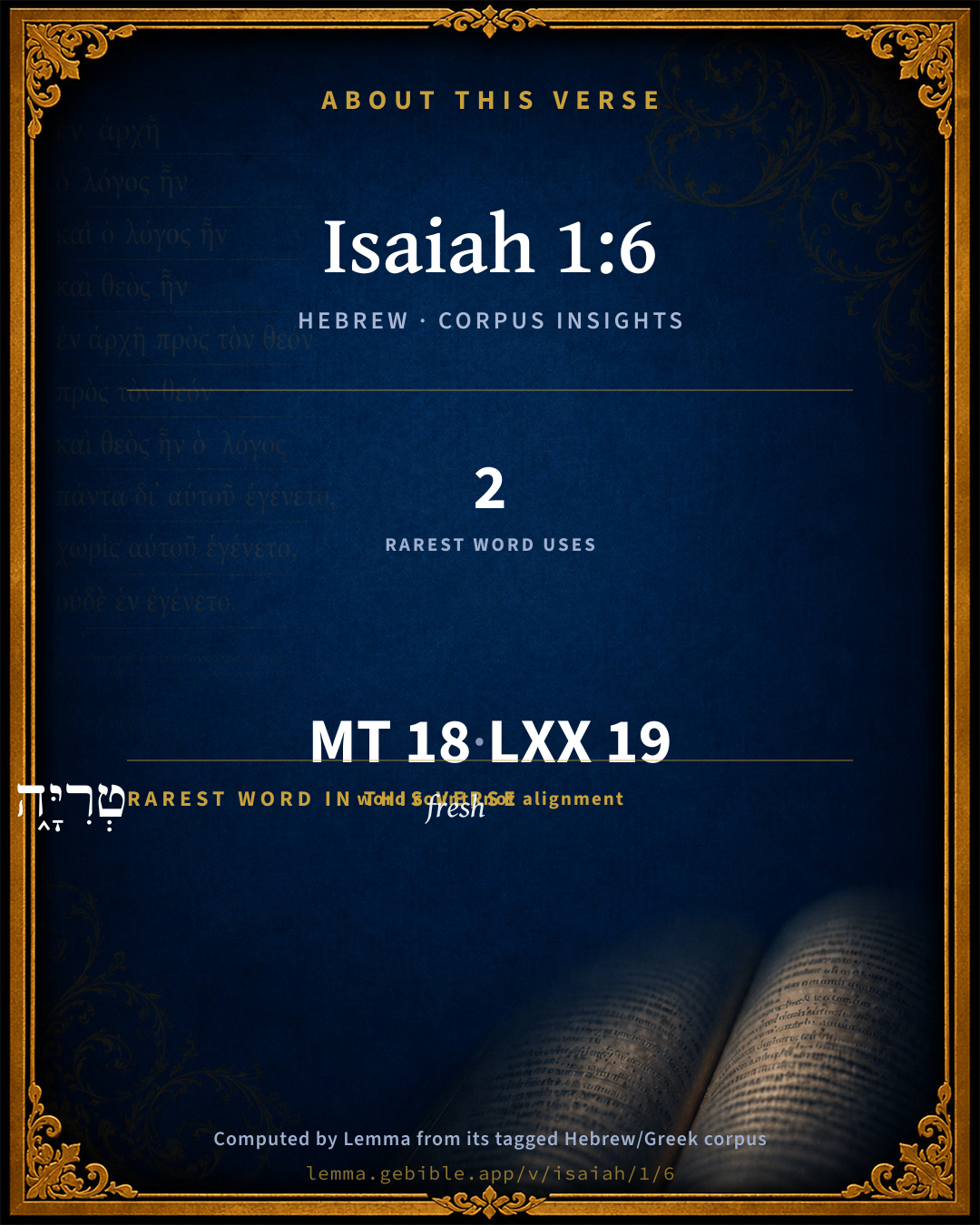
The rarest word here is טְרִיָּ֑ה fresh H2961 — appearing just 2 times in the whole Hebrew Bible.

Shared distinctive vocabulary

טְרִיָּ֑ה fresh H2961 occurs in 2 verses of the Hebrew Bible. Also found in:

Grammatical profile

  • 3 verbs
  • 8 nouns
  • 1 adjective
  • 2 prepositions
  • 4 particles

Verb forms

  • זֹ֨רוּ֙ Qal Passive · Perfect
  • חֻבָּ֔שׁוּ Pual · Perfect
  • רֻכְּכָ֖ה Pual · Perfect

Repetition

A word recurs within this verse — often emphatic in Hebrew:

Hebrew & Septuagint length

In English translation the verse runs 31 words from the Hebrew and 33 from the Septuagint (LXX English) — closely comparable.

A rough comparison of the two English renderings, which tokenize alike — not a word-level alignment.

Word counts can differ between the Hebrew and the Greek without any difference in meaning — e.g. the Hebrew direct-object marker אֵת has no separate Greek word, and Greek often adds the article ὁ.

In the original languages it is 18 Hebrew tokens and 19 Greek tokens — but the two are counted differently (Hebrew bundles its prefixes and suffixes into one token; the Greek is in lemma form), so that isn’t a like-for-like length.

Cross-references

15

Topical passages linked to Isaiah 1:6 in the Treasury of Scripture Knowledge — connected by theme and wording, ordered by reader-vote popularity; previews shown in the World English Bible.

  • Jeremiah 6:14 They have healed also the hurt of my people slightly, saying, Peace, peace; when there is no peace.
  • Jeremiah 33:6 Behold, I will bring it health and cure, and I will cure them; and I will reveal to them abundance of peace and truth.
  • Matthew 9:12 When Jesus heard it, he said to them, "Those who are healthy have no need for a physician, but those who are sick do.
  • Job 5:18 For he wounds, and binds up; He injures, and his hands make whole.
  • Psalms 38:3–5 There is no soundness in my flesh because of your indignation, Neither is there any health in my bones because of my sin.
  • Psalms 77:2 In the day of my trouble I sought the Lord. My hand was stretched out in the night, and didn't get tired. My soul refused to be comforted.
  • Jeremiah 8:21–22 For the hurt of the daughter of my people am I hurt: I mourn; dismay has taken hold on me.
  • Malachi 4:2 But to you who fear my name shall the sun of righteousness arise with healing in its wings. You will go out, and leap like calves of the stall.
  • Luke 10:34 came to him, and bound up his wounds, pouring on oil and wine. He set him on his own animal, and brought him to an inn, and took care of him.
  • 2 Chronicles 6:28–29 If there be in the land famine, if there be pestilence, if there be blasting or mildew, locust or caterpillar; if their enemies besiege them in the land of their cities; whatever plague or whatever sickness there be;
  • Job 2:7–8 So Satan went forth from the presence of Yahweh, and struck Job with painful sores from the sole of his foot to his head.
  • Jeremiah 30:12 For thus says Yahweh, Your hurt is incurable, and your wound grievous.
  • Hosea 5:12–13 Therefore I am to Ephraim like a moth, And to the house of Judah like rottenness.
  • Nahum 3:19 There is no healing your wound, for your injury is fatal. All who hear the report of you clap their hands over you; for who hasn't felt your endless cruelty?
  • Luke 16:20–21 A certain beggar, named Lazarus, was laid at his gate, full of sores,

Cross-references courtesy of OpenBible.info (CC BY 4.0).

Hebrew and Greek witnesses Masoretic Hebrew ↔ Greek Septuagint

The same verse in the two great witnesses to the Old Testament, shown verse-for-verse.

These are two independent witnesses, not word-aligned to each other, and the Septuagint is shown in lemma (dictionary) form.

Hebrew Isaiah 1:6 Masoretic · Westminster Leningrad Codex

מִכַּף רֶ֤גֶל וְעַד רֹאשׁ֙ אֵֽין בּ֣וֹ מְתֹ֔ם פֶּ֥צַע וְחַבּוּרָ֖ה וּמַכָּ֣ה טְרִיָּ֑ה לֹא זֹ֨רוּ֙ וְלֹ֣א חֻבָּ֔שׁוּ וְלֹ֥א רֻכְּכָ֖ה בַּשָּֽׁמֶן

From the sole of the foot even to the head there is no soundness in it: Wounds, welts, and open sores. They haven't been closed, neither bandaged, neither soothed with oil.

World English Bible · Public Domain

Greek LXX Isaiah 1:6 Septuagint · lemma form

ἀπό πούς ἕως κεφαλή οὔτε τραῦμα οὔτε μώλωψ οὔτε πληγή φλεγμαίνω οὐ εἰμί μάλαγμα ἐπιτίθημι οὔτε ἔλαιον οὔτε καταδέσμους

From the feet to the head, there is no soundness in them; neither wound, nor bruise, nor festering ulcer are healed: it is not possible to apply a plaister, nor oil, nor bandages.

LXX2012 (modern English Septuagint) · Public Domain

On this verse, Trapp's Complete Commentary discusses the Septuagint’s reading. Read the note in Commentary ↓

Hebrew: Westminster Leningrad Codex (CC BY 4.0). Greek: Septuagint (public domain); English from LXX2012 (modern English Septuagint) (Public Domain). How the Septuagint differs from the Hebrew →

Targum (Aramaic paraphrase)

1

The Targum is the ancient Jewish Aramaic paraphrase of the Hebrew Scriptures — an interpretive translation, not the Hebrew text itself. Onkelos (literal) and Pseudo-Jonathan (expansive) render the Torah, and Jonathan the Prophets. Coverage is partial: where no permissively-licensed English translation exists for a verse, only the Aramaic is shown. This is verse-level text, not a word-by-word alignment to the Hebrew.

  1. Targum Jonathan Prophets (Joshua–Malachi)
    מִשְׁאָר עַמָא וְעַד רֵישָׁא לֵית בְּהוֹן דִשְׁלִים בִּדְחַלְתִּי כּוּלְהוֹן סָרְבִין וּמָרְדִין אִתְגַעֲלוּ בְחוֹבִין כְּמָחָא מְרַסְסָא לָא שָׁבְקִין מִזְדוֹנֵיהוֹן וְלָא מְחַמְדִין לִתְיוּבְתָּא אַף לָא זַכְוָן לְהוֹן לְאַגָנָא עֲלֵיהוֹן:

    From the lowest of my people even unto the chief of them, there is not one amongst them who is perfect in my fear: all of them are disobedient and rebellious; they are polluted with sins, they are like an ulcerous wound; they have not forsaken their pride, neither long for repentance; they have also no righteousness to protect them.

    Targum Jonathan — Aramaic: “Mikraot Gedolot” (public domain). English: “Sefaria Community Translation” (CC0 1.0 (public-domain dedication)); “London "Chaldee Paraphrase," 1871” (public domain). Text via Sefaria.

Commentary

Notes on Isaiah 1:6 from classic Christian and Jewish commentators (each source and its license shown beneath its notes). The classic Christian expositions comment on the surrounding passage and are grouped to its opening verse, so a note may address several verses; the Jewish commentaries on the Tanakh (Rashi and others) are per-verse, so they appear only where the commentator wrote on this verse.

Lemma curates 59 commentaries, every one of them public domain or Creative Commons licensed, each selected and text-cleaned for this edition rather than reprinted as found. About our sources →

Jamieson, Fausset & Brown

Robert Jamieson, A. R. Fausset & David Brown

From the lowest to the highest of the people; "the ancient and honorable, the head, the prophet that teacheth lies, the tail." See Isa 9:13-16. He first states their wretched condition, obvious to all (Isa 1:6-9); and then, not previously, their irreligious state, the cause of it.

wounds--judicially inflicted (Hos 5:13).

mollified with ointment--The art of medicine in the East consists chiefly in external applications (Luk 10:34; Jam 5:14).

Jamieson, Fausset & Brown — Commentary Critical and Explanatory on the Whole Bible (1871) — public domain (CC PDM 1.0). Text via the HelloAO Bible API.

Trapp's Complete Commentary

John Trapp

Isa 1:6 From the sole of the foot even unto the head [there is] no soundness in it; [but] wounds, and bruises, and putrifying sores: they have not been closed, neither bound up, neither mollified with ointment.

Ver. 6. From the sole of the foot.] Totum est pro vulnere corpus, The whole body politic was deadly diseased, and it was our prophet’s unhappiness to be the physician to a dying state; Tunc etenim docta plus valet arte malum.

There is no soundness.] Nec sanitas in corpore, nec sanctitas in corde. Heu, heu, Domine Deus. Neither soundness in body nor soundness in heart, Alas, alas oh God, God.

But wounds, and bruises, and putrifying sores.] And those also such as would not be cured, but called for cutting off. Immedicabile vulnus ense recidendum est.

They have not been closed.] Neither will be. Non est malagma imponere, say the Septuagint here. You will not endure to have them searched or suppled: what hope therefore of healing? If the Sun of righteousness shall shine upon us with healing under his wings, we must repent and believe the gospel. {Mar 1:15}

John Trapp, A Commentary or Exposition upon All the Books of the Old and New Testament (1647–1656) — public domain. Text from a community e-Sword module.

Tyndale Open Study Notes

Tyndale Open Resources

1:6 without any soothing ointments or bandages: Judah’s national condition was like the body of an injured person who had not received medical care.

Tyndale Open Study Notes — © Tyndale Open Resources, licensed CC BY-SA 4.0. Text via the HelloAO Bible API.

Geneva Bible (1599)

Geneva Bible translators

Every part of the body as well the least as the chiefest, was plagued.

Their plagues were so grievous, that they were incurable, and yet they would not repent.

Geneva Bible (1599) marginal notes — public domain. Text via Bolls.life.

Adam Clarke's Commentary

Verse 6. They have not been closed, c. - "It hath not been pressed," c.] The pharmaceutical art in the East consists chiefly in external applications: accordingly the prophet's images in this place are all taken from surgery. Sir John Chardin, in his note on Pr 3:8, "It shall be health to thy navel, and marrow to thy bones," observes that "the comparison is taken from the plasters, ointments, oils, and frictions, which are made use of in the East upon the belly and stomach in most maladies. Being ignorant in the villages of the art of making decoctions and potions, and of the proper doses of such things, they generally make use of external medicines." - Harmer's Observations on Scripture, vol. ii. p. 488. And in surgery their materia medica is extremely simple, oil making the principal part of it. "In India," says Tavernier, "they have a certain preparation of oil and melted grease, which they commonly use for the healing of wounds." Voyage Ind. So the good Samaritan poured oil and wine on the wounds of the distressed Jew: wine, cleansing and somewhat astringent, proper for a fresh wound oil, mollifying and healing, Lu 10:34. Kimchi has a judicious remark here: "When various medicines are applied, and no healing takes place, that disorder is considered as coming immediately from God."

Of the three verbs in this sentence, one is in the singular number in the text another is singular in two MSS., (one of them ancient,) חבשה chubbeshah; and the Syriac and Vulgate render all of them in the singular number.

Adam Clarke's Commentary on the Bible (1810–1826) — public domain. Text from a community e-Sword/MySword module.

The Cambridge Bible for Schools and Colleges

gen. ed. J. J. S. Perowne

6. The state of the nation is indeed desperate; no remedial measures have yet been applied. In the simple surgery of Isaiah’s time a wound was first pressed (to extrude suppurating matter), then bandaged and softened with oil (cf. Luk_10:34).

The Cambridge Bible for Schools and Colleges (gen. ed. J. J. S. Perowne; Cambridge University Press, 1878–1918) — public domain. Text from a community e-Sword module.

John Gill's Exposition

From the sole of the foot even unto the head there is no soundness in it,.... Every member of the body politic was afflicted in one way or another, or sadly infected with the disease of sin; see Psa 28:3. So the Targum,

"from the rest of the people, even unto the princes, there is none among them who is perfect in my fear;''

see Dan 9:8.

but wounds, and bruises, and putrefying sores; to which either public calamities on a city or nation may be compared, Hos 5:13 or the sins and transgressions both of single persons, and of whole bodies of men, Psa 38:5. The Targum is,

"they are all stubborn and rebellious, they are defiled with sins as an ulcerous plaster.''

They have not been closed; that is, the wounds and sores have not been healed; or "they have not been pressed" or "squeezed" (c), in order to get the purulent matter out of them:

neither bound up; with bands, after the matter is squeezed out, and a plaster laid on:

neither mollified with ointment; which is used for the supplying and healing of wounds; see Luk 10:34. The sense either is, that they were not reformed by their afflictions; or that they did not repent of their sins, nor seek to God for healing and pardon, nor make use of any means for their more healthful state and condition. The Targum paraphrases the words thus,

"they do not leave their haughtinesses, nor are they desirous of repentance, nor have they any righteousness to protect them.''

(c) "non expessa fuere a" "exprimere humorem, hoc significari clarum est ex" Jud. vi. 38. Gusset. Comment. Ling. Ebr. p. 227. So Vatablus, Junius & Tremellius.

John Gill's Exposition of the Whole Bible (1746–1763) — public domain (CC PDM 1.0). Text via the HelloAO Bible API.

Albert Barnes' Notes on the Bible

From the sole of the foot ... - Or is we say, ‘from head to foot,’ that is, in every part of the body. There may be included also the idea that this extended from the lowest to the highest among the people. The Chaldee paraphrase is, ‘from the lowest of the people even to the princes - all are contumacious and rebellious.’

No soundness - מתם methôm, from תמם tâmam, to be perfect, sound, uninjured. There is no part unaffected; no part that is sound. It is all smitten and sore.

But wounds - The precise shade of difference between this and the two following words may not be apparent. Together, they mean Such wounds and contusions as are inflicted upon man by scourging, or beating him. This mode of punishment was common among the Jews; as it is at the East at this time. Abarbanel and Kimchi say that the word rendered here “wounds” (פצע petsa‛, a verbal from פצע pâtsa‛ to wound, to mutilate), means an open wound, or a cut from which blood flows.

Bruises - חבורה chabbûrâh. This word means a contusion, or the effect of a blow where the skin is not broken; such a contusion as to produce a swelling, and livid appearance; or to make it, as we say, black and blue.

Putrifying sores - The Hebrew rather means recent, or fresh wounds; or rather, perhaps, a running wound, which continues fresh and open; which cannot be cicatrized, or dried up. The Septuagint renders it elegantly πληγή φλγμαίνουσα plēgē flegmainous, a swelling, or tumefying wound. The expression is applied usually to inflammations, as of boils, or to the swelling of the tonsils, etc.

They have not been closed - That is, the lips had not been pressed together, to remove the blood from the wound. The meaning is, that nothing had been done toward healing the wound. It was an unhealed, undressed, all-pervading sore. The art of medicine, in the East, consists chiefly in external applications; accordingly the prophet’s images in this place are all taken from surgery. Sir John Chardin, in his note on Pro 3:8, ‘It shall be health to thy navel, and marrow to thy bones,’ observes, that the comparison is taken from the plasters, ointments, oils, and frictions, which are made use of in the East in most maladies. ‘In Judea,’ says Tavernier, ‘they have a certain preparation of oil, and melted grease, which they commonly use for the healing of wounds.’ Lowth. Compare the note at Isa 38:21.

Neither mollified with ointment - Neither made soft, or tender, with ointment. Great use was made, in Eastern nations, of oil, and various kinds of unguents, in medicine. Hence, the good Samaritan is represented as pouring in oil and wine into the wounds of the man that fell among thieves Luk 10:34; and the apostles were directed to anoint with oil those who were sick; Jam 5:14; compare Rev 3:18.

Ointment - Hebrew oil. שׁמן shemen. The oil of olives was used commonly for this purpose. The whole figure in these two verses relates to their being punished for their sins. It is taken from the appearance of a man who is severely, beaten, or scourged for crime; whose wounds had not been dressed, and who was thus a continued bruise, or sore, from his head to his feet. The cause of this the prophet states afterward, Isa 1:10 ff. With great skill he first reminds them of what they saw and knew, that they were severely punished; and then states to them the cause of it. Of the calamities to which the prophet refers, they could have no doubt. They were every where visible in all their cities and towns. On these far-spreading desolations, he fixes the eye distinctly first. Had he begun with the statement of their depravity, they would probably have revolted at it. But being presented with a statement of their sufferings, which they all saw and felt, they were prepared for the statement of the cause. To find access to the consciences of sinners, and to convince them of their guilt, it is often necessary to remind them first of the calamities in which they are actually involved; and then to search for the cause. This passage, therefore, has no reference to their moral character. It relates solely to their punishment. It is often indeed adduced to prove the doctrine of depravity; but it has no direct reference to it, and it should not be adduced to prove that people are depraved, or applied as referring to the moral condition of man. The account of their moral character, as the cause of their calamities, is given in Isa 1:10-14. That statement will fully account for the many woes which had come on the nation.

Albert Barnes' Notes on the Bible (1834–1885) — public domain. Text from a community e-Sword/MySword module.

Matthew Poole's English Annotations

From the sole of the foot even unto the head there is no soundness in it; you have been all of you punished, from the highest to the lowest, from the worst to the best.

They have not been closed, neither bound up, neither mollified with ointment; I have suffered you to lie under your maladies for a time, without applying any remedies, to try whether the length and continuance of your affliction might not work that cure which the strength of it could not do, but all in vain.

Matthew Poole's English Annotations on the Holy Bible (1683–1685) — public domain. Text from a community e-Sword/MySword module.

The Pulpit Commentary

From the sole of the foot even unto the head. (comp. Job_2:7) From top to bottom, the body corporate is diseased throughout there is no soundness in it (cf. Psa_38:3, Psa_38:7) all is one wound, one livid bruise, one festering sore. Note the use of the singular number in the original. They have not been closed; literally, they have not been pressed; which is explained to mean (Aben Ezra, Kay) that they have not had the matter formed by suppuration pressed out of them. Neither bound up; i.e. not bandaged, Neither mollified with ointment; rather, with oil. On the treatment of wounds and ulcers with oil m ancient times, see "Hippocrat., De Ulceri. bus," Galen., "De Compos. Medic.," and comp. Luk_10:34. Recent medical science has revived the practice, and wounds of all kinds are now frequently treated with nothing but carbolic oil. The general sentiment of the entire passage is that there has been no medical treatment of the wounds of any kind; they have been left to themselves, to spread corruption over the whole body no attempt has been made to cure them.

The Pulpit Commentary (1880–1919), ed. H.D.M. Spence-Jones & Joseph S. Exell — public domain. Text from a community e-Sword module.

Keil & Delitzsch

C. F. Keil & F. Delitzsch

This description of the total misery of every individual in the nation is followed by a representation of the whole nation as one miserably diseased body. "From the some of the foot even to the head there is nothing sound in it: cuts, and stripes, and festering wounds; they have not been pressed out, nor bound up, nor has there been any soothing with oil." The body of the nation, to which the expression "in it" applies (i.e., the nation as a whole), was covered with wounds of different kinds; and no means whatever had been applied to heal these many, various wounds, which lay all together, close to one another, and one upon the other, covering the whole body. Cuts (from פּצע to cut) are wounds that have cut into the flesh - sword-cuts, for example. These need binding up, in order that the gaping wound may close again. Stripes (Chabburâh, from Châbar, to stripe), swollen stripes, or weals, as if from a cut with a whip, or a blow with a fist: these require softening with oil, that the coagulated blood of swelling may disperse. Festering wounds, maccâh teriyâh, from târâh, to be fresh (a different word from the talmudic word t're, Chullin 45b, to thrust violently, so as to shake): these need pressing, for the purpose of cleansing them, so as to facilitate their healing. Thus the three predicates manifest an approximation to a chiasm (the crossing of the members); but this retrospective relation is not thoroughly carried out. The predicates are written in the plural, on account of the collective subject. The clause ולא רּכּכה בּשּׁמן, which refers to חבורה (stripes), so far as the sense is concerned (olive-oil, like all oleosa, being a dispersing medium), is to be taken as neuter, since this is the only way of explaining the change in the number: "And no softening has been effected with oil." Zoru we might suppose to be a pual, especially on account of the other puals near: it is not so, however, for the simple reason that, according to the accentuation (viz., with two pashtahs, the first of which gives the tone, as in tohu, Gen 1:2, so that it must be pronounced zóru), it has the tone upon the penultimate, for which it would be impossible to discover any reason, if it were derived from zârâh. For the assumption that the tone is drawn back to prepare the way for the strong tone of the next verb (Chubbâshu) is arbitrary, as the influence of the pause, though it sometimes reaches the last word but one, never extends to the last but two. Moreover, according to the usage of speech, zorâh signifies to be dispersed, not to be pressed out; whereas zur and zârar are commonly used in the sense of pressing together and squeezing out. Consequently zoru is either the kal of an intransitive zor in the middle voice (like boshu), or, what is more probable - as zoru, the middle voice in Psa 58:4, has a different meaning (abalienati sunt: cf., Isa 1:4) - the kal of zârar (= Arab. Constringere), which is here conjugated as an intransitive (cf., Job 24:24, rommu, and Gen 49:23, where robbu is used in an active sense). The surgical treatment so needed by the nation was a figurative representation of the pastoral addresses of the prophets, which had been delivered indeed, but, inasmuch as their salutary effects were dependent upon the penitential sorrow of the people, might as well have never been delivered at all. The people had despised the merciful, compassionate kindness of their God. They had no liking for the radical cure which the prophets had offered to effect. All the more pitiable, therefore, was the condition of the body, which was sick within, and diseased from head to foot. The prophet is speaking here of the existing state of things. He affirms that it is all over with the nation; and this is the ground and object of his reproachful lamentations. Consequently, when he passes in the next v. from figurative language to literal, we may presume that he is still speaking of his own times. It is Isaiah's custom to act in this manner as his own expositor (compare Isa 1:22 with Isa 1:23). The body thus inwardly and outwardly diseased, was, strictly speaking, the people and the land in their fearful condition at that time.

Keil & Delitzsch — Biblical Commentary on the Old Testament (1861–1891) — public domain (CC PDM 1.0). Text via the HelloAO Bible API. (Old Testament only.)

J. A. Alexander on Isaiah

Joseph Addison Alexander

The idea suggested at the beginning of v. 5, that there was no more room for further strokes, is now carried out with great particularity. “From the sole of the foot and (i.e., even) to the head” (a common scriptural expression for the body in its whole extent) “there is not in it” (the people, or in him, (i.e., Judah, considered as a body) “a sound place; (it is) wound and bruise” (vibex, the tumor produced by stripes) “and fresh stroke”. The wounds are then described as not only grievous but neglected. “They have not been pressed, and they have not been bound or bandaged, and it has not been mollified with ointment”, all familiar processes of ancient surgery.

Joseph Addison Alexander, The Prophecies of Isaiah (1846–1847; New York: Scribner, 1870–1878) — public domain. Text from a community e-Sword module.

Rashi

Rabbi Shlomo Yitzchaki (Rashi)

soundness An expression of perfection, sound without pain.

wounds Heb. פֶּצַע, i.e., a wound of a sword.

contusions Heb. חַבּוּרָה, an expression of a bruise. [Some editions read:] Other bruises.

and lacerated sores Jonathan renders: מְרַסְסָא, lacerated and crushed.

and lacerated sores demarcejjre, in O.F., and in the language of the Talmud, we find, “he bumped (טַרְיֵה) his head” (Chullin 45b). Menahem explained it as an expression of moisture, i.e., moist and wet, always oozing [muyte in O.F.].

they have not been sprinkled These lesions were not sprinkled with medicinal powders by physicians. This is an expression of: (Job 18:15) “Sulphur shall be sprinkled (יְזֹרֶה) on his dwelling.” Menahem explained it as an expression of healing, as in (Jeremiah 30:13): “No one pronounced your judgment for healing (לְמָזוֹר).”

neither was it softened with oil Their wound was not softened with oil, as is customary with other wounds. It would be inappropriate to say here, “They were not softened with oil,” for they soften only the place of the sore, not the wound and the contusion but the sprinkling and the bandaging applies to all three, [i.e., the wound, the contusion, and the lacerated sore.] Therefore, the plural number applies to them; the lesions were not sprinkled and not bandaged. Jonathan interprets the entire verse figuratively, referring to the fact that they were soiled and afflicted with iniquity. Accordingly, he rendered, “From the sole of the foot until the head,” from the smallest to the greatest, there is no soundness. There is none good among them, wounds and contusions, rebellious deeds, iniquities, and inadvertent sins. they have not been sprinkled... i.e., they have not been healed by repenting wholeheartedly, nor has it been softened with oil, not even a trace of repentant thought has entered their heart.

Rashi on the Tanakh — English translations: “The Judaica Press complete Tanach with Rashi, translated by A. J. Rosenberg” (CC BY 4.0); “Pentateuch with Rashi's commentary by M. Rosenbaum and A.M. Silbermann, 1929-1934” (public domain); “The Metsudah Tanach series, Lakewood, N.J” (CC BY 4.0); and “The Book of Joshua, Metsudah Publications, 1997” (CC BY 4.0). Text via Sefaria.

Ibn Ezra

Rabbi Abraham ibn Ezra

מְתוֹם A place containing soundness (תּוֹם ‘ soundness or integrity’). The form of the word is irregular, for it should be מָתוֹם like מָעוֹז (25:4). The same form is used Ps. 38:4. R. Moses Hakkohen says that מְתוֹם is the same as מְתִים ‘ people;’ he quotes a parallel, Judges 20:48, and explains our verse, there is nothing in them that is good for man; but this explanation is rather far-fetched.

פצע Wounds. Supply the word רק ‘only,’ ‘but,’ before פצע. There is no soundness in him; there are but wounds and bruises; comp. שיאכל ושתה אין טוב באדם There is nothing good for man but that he should eat and drink. (Eccles. 2:24).

פצע A wound caused by the breaking of the bone.

חבורת A sore attended with suppuration.

טריה Fresh, not yet dry (comp. Judges 15:15); in Arabic the word طرا has the same meaning...

זׂרוּ They have been squeezed. Root זׁרד ‘ to squeeze ’ (comp. Judges 6:38). The wound cannot be healed unless the matter is removed from it.

חבשו They have been bound up. Root חבש ‘ to compress,’ ‘to bind up ’ (comp. חובש ‘ruler,’ 3:7).

בַּשָּׁמֶן With the oil. With the oil, which the cure of the wound requires.

Ibn Ezra on the Tanakh — English translations: “Sefaria Community Translation” (CC0 1.0 (public-domain dedication)); “Yalkut, Sifsei Chachomim Chumash, Metsudah Publications, 2009” (CC BY 4.0); and “Commentary of Ibn Ezra on Isaiah - trans. by M. Friedlander, 1873” (public domain). Text via Sefaria.

Lesson kit

Teaching starters — assembled from the data on this page, not authored interpretation. Every prompt links to the verse data it draws on. Edit before teaching.

Isaiah, in the Prophets, opens this verse with 18 words (15 distinct Hebrew lemmas). Its most distinctive word is ṭârîy (“fresh”). A historical commentator’s framing appears above. Read the whole chapter for the surrounding context.

Discussion questions

  1. What does “fresh” (ṭârîy) contribute to the verse as a whole?
  2. Judges 15:15 shares the word «fresh» with this verse. How do the two illuminate each other?
  3. “not” occurs 3× in this one verse. What is the effect of the repetition?
  4. These translations render this verse differently. What is at stake in choosing one wording over another?
  5. The verb «זֹ֨רוּ֙» is Qal Passive Perfect. How does its form color the action?
  6. Reading how Jamieson, Fausset & Brown and Trapp's Complete Commentary read this verse, where do the two commentators agree and where do they part?

Things to notice

Reading settings

Reading text

Shown beneath each verse's original-language words.

Old Testament
Old Testament edition

Read the OT as the Masoretic Hebrew (MT) or the Greek Septuagint (LXX).

English shown for the Greek Septuagint (in the Hebrew ↔ Greek comparison).

Comparing translations? Open the Compare panel on any verse page to stack up to four side by side.