
1 Kings 8:38

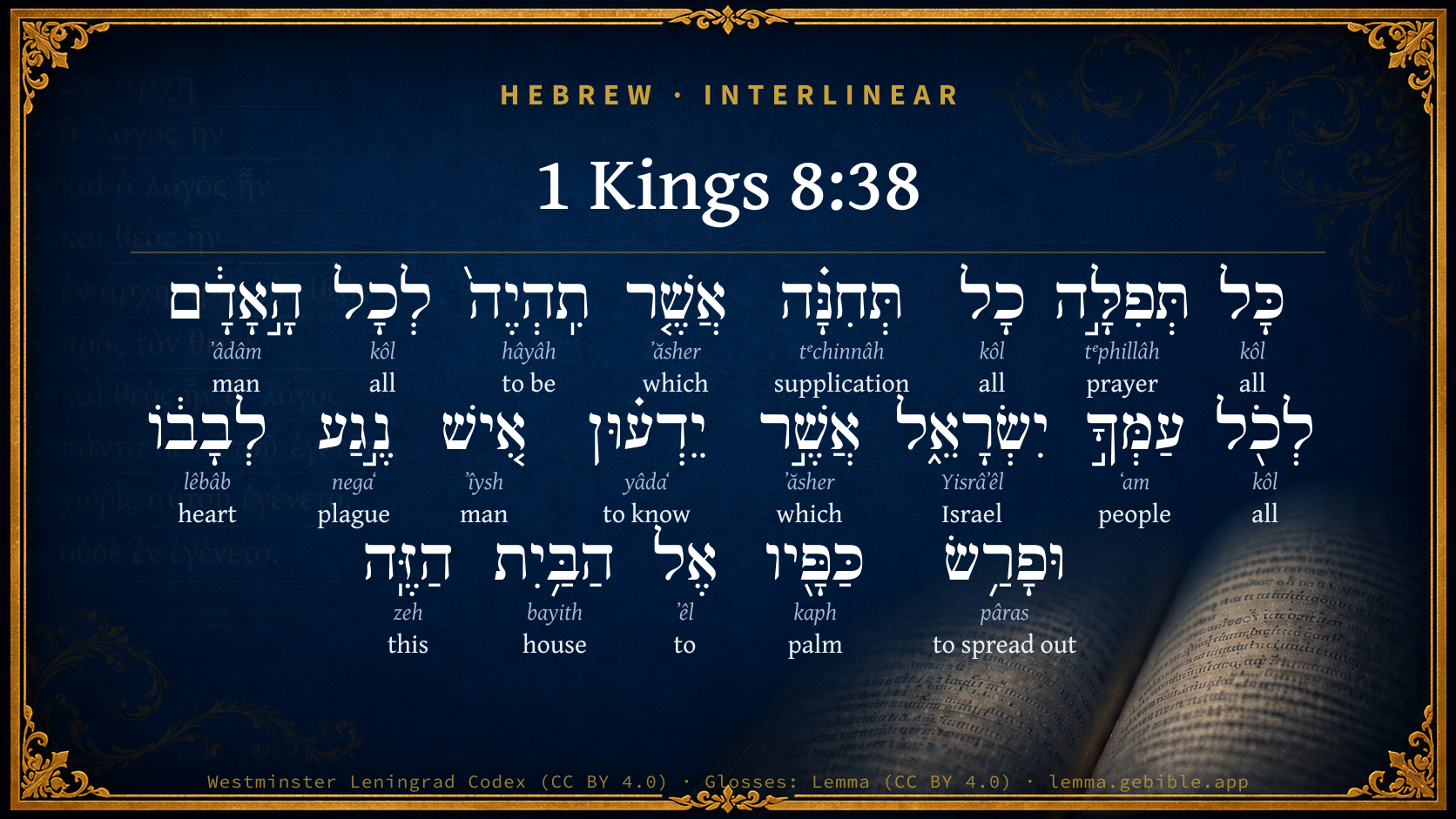
Hebrew (Westminster Leningrad Codex) 1 Kings 8:38 appears in the Hebrew Old Testament. The text above is from the Westminster Leningrad Codex. Each word links to its Strong’s number, a concise gloss, and parsing drawn from the Open Scriptures Hebrew Bible morphology. Click any word for its full Brown-Driver-Briggs (BDB) entry.
Download image
Cite this verse

1 Kings 8:38 (World English Bible). Public Domain. Lemma interlinear Bible study tool, https://lemma.gebible.app/v/1-kings/8/38.

Show BibTeX & RIS
BibTeX
RIS
English Translation
whatever prayer and supplication be made by any man, [or] by all your people Israel, who shall know every man the plague of his own heart, and spread forth his hands toward this house:
World English Bible · Public Domain
Download a study sheet

One document with this verse’s original text, its word-by-word gloss line, the meaning frame, cross-references with their text, attributed commentary, and full source and license credits — printable, and it pastes into notes with its structure intact.

This verse Autodidact and up

Study sheet (.html) Plain text (.txt)

A passage Seminary Student

Up to 50 verses in one chapter. A passage sheet keeps up to 6 commentary sources and 12 cross-references per verse, in the order this page ranks them, and says so on the sheet whenever that leaves anything out. Ask for a single verse and you get the Autodidact verse sheet above.

Everything on this page stays free to read, with no account — the sheet is a download of what is already on screen, not access to it.

Want to remove ads? Support Godless Engineer
Compare translations 3

The same verse in 3 English versions, stacked beneath the original-language interlinear above. Click any original word for its lexicon entry.

Each is an independent rendering of the whole verse — the interlinear is not word-aligned to these translations.

Highlighted words mark where these versions differ — a whole-verse word diff, not a word-by-word alignment.

  • World English Bible Public Domain
    whatever prayer and supplication be made by any man, [or] by all your people Israel, who shall know every man the plague of his own heart, and spread forth his hands toward this house:
  • King James Version Public Domain
    What prayer and supplication soever be made by any man, or by all thy people Israel, which shall know every man the plague of his own heart, and spread forth his hands toward this house:
  • unfoldingWord Literal Text CC BY-SA 4.0
    any prayer, any supplication that is to any man, to any of your people Israel who know, a man the plague of his heart, and he spreads out his palms toward this house,

unfoldingWord Literal Text — © unfoldingWord, licensed CC BY-SA 4.0. Word-aligned USFM3 via Door43 (git.door43.org/unfoldingWord/en_ult).

Versions to compare (up to 4)

3 of 4 selected

Show all 18 translations

Every available English version of this verse, each an independent rendering of the whole verse.

  • World English Bible Public Domain
    whatever prayer and supplication be made by any man, [or] by all your people Israel, who shall know every man the plague of his own heart, and spread forth his hands toward this house:
  • Berean Standard Bible Public Domain
    then may whatever prayer or petition Your people Israel make—each knowing his own afflictions and spreading out his hands toward this temple—
  • Majority Standard Bible Public Domain
    then may whatever prayer or petition Your people Israel make—each knowing his own afflictions and spreading out his hands toward this temple—
  • King James Version Public Domain
    What prayer and supplication soever be made by any man, or by all thy people Israel, which shall know every man the plague of his own heart, and spread forth his hands toward this house:
  • American Standard Version (1901) Public Domain
    what prayer and supplication soever be made by any man, `or' by all thy people Israel, who shall know every man the plague of his own heart, and spread forth his hands toward this house:
  • Revised Version (1885) Public Domain
    what prayer and supplication soever be made by any man, or by all thy people Israel, which shall know every man the plague of his own heart, and spread forth his hands toward this house:
  • Geneva Bible (1599) Public Domain
    Then what prayer, and supplication so euer shalbe made of any man or of all thy people Israel, when euery one shall knowe the plague in his owne heart, and stretch foorth his handes in this house,
  • Douay-Rheims (1899) Public Domain
    Whatsoever curse or imprecation shall happen to any man of thy people Israel: when a man shall know the wound of his own heart, and shall spread forth his hands in this house,
  • Young's Literal Translation Public Domain
    any prayer, any supplication that `is' of any man of all Thy people Israel, who know each the plague of his own heart, and hath spread his hands towards this house,
  • Literal Standard Version CC BY-SA 4.0
    any prayer, any supplication that [is] of any man of all Your people Israel, each who knows the plague of his own heart, and has spread his hands toward this house,
  • Unlocked Literal Bible CC BY-SA 4.0
    and suppose then that prayers and requests are made by a person or by all your people Israel—each knowing the plague in his own heart as he spreads out his hands toward this temple.
  • unfoldingWord Literal Text CC BY-SA 4.0
    any prayer, any supplication that is to any man, to any of your people Israel who know, a man the plague of his heart, and he spreads out his palms toward this house,
  • Darby Bible Public Domain
    what prayer, what supplication soever be made by any man, of all thy people Israel, when they shall know every man the plague of his own heart, and shall spread forth his hands toward this house;
  • World Messianic Bible Public Domain
    whatever prayer and supplication is made by any man, or by all your people Israel, who shall each know the plague of his own heart, and spread out his hands toward this house,
  • Webster's Bible Public Domain
    Whatever prayer and supplication shall be made by any man, or by all thy people Israel, who shall know every man the plague of his own heart, and spread forth his hands towards this house:
  • Free Bible Version CC BY-SA 4.0
    then whatever kind of prayer or whatever kind of appeal is made by anyone or all your people Israel, (in fact anyone who, knowing their problems and pains, prays toward this Temple),
  • Bible in Basic English Public Domain
    Whatever prayer or request for your grace is made by any man, or by all your people Israel, whatever his trouble may be, whose hands are stretched out to this house:
  • JPS Tanakh (1917) Public Domain
    what prayer and supplication soever be made by any man of all Thy people Israel, who shall know every man the plague of his own heart, and spread forth his hands toward this house;

Literal Standard Version (2020), Covenant Press — licensed CC BY-SA 4.0. Text via the HelloAO Bible API (eBible.org). Unlocked Literal Bible (unfoldingWord) — licensed CC BY-SA 4.0. Text via the HelloAO Bible API (eBible.org). unfoldingWord Literal Text — © unfoldingWord, licensed CC BY-SA 4.0. Word-aligned USFM3 via Door43 (git.door43.org/unfoldingWord/en_ult). Free Bible Version, Dr. Jonathan Gallagher — licensed CC BY-SA 4.0. Text via the HelloAO Bible API (eBible.org).

Word by word

More ways to search: Search by grammar → Find every occurrence → Compare this word →

Practice this passage: Drill this verse → Learn its vocabulary →

תְּחִנָּ֗ה
tᵉchinnâh
H8467
“supplication”
Noun, Common, Feminine, Singular, Absolute
Part of Speech
Noun
Type
Common
Gender
Feminine
Number
Singular
State
Absolute
Full BDB Definition

Origin: from H2603

TWOT: 694f

favour, supplication, supplication for favour - favour - supplication for favour
  1. כָּל kôl H3605 “all of” Noun, Common, Masculine, Singular, Construct
  2. תְּפִלָּ֣ה tᵉphillâh H8605 “prayer” Noun, Common, Feminine, Singular, Absolute
  3. כָל kôl H3605 “all of” Noun, Common, Masculine, Singular, Construct
  4. אֲשֶׁ֤ר ʼăsher H834 “which” Particle, Relative
  5. תִֽהְיֶה֙ hâyâh H1961 “to be” Verb, Qal, Imperfect, 3rd Person, Feminine, Singular
  6. לְכָל kôl H3605 “to/for · all of” Preposition + Noun, Common, Masculine, Singular, Construct
  7. הָ֣אָדָ֔ם ʼâdâm H120 “the · man” Particle, Definite Article + Noun, Common, Masculine, Singular, Absolute
  8. לְכֹ֖ל kôl H3605 “to/for · all of” Preposition + Noun, Common, Masculine, Singular, Construct
  9. עַמְּךָ֣ ʻam H5971 “people · your” Noun, Common, Masculine, Singular, Construct + Suffix, Personal, 2nd Person, Masculine, Singular
  10. יִשְׂרָאֵ֑ל Yisrâʼêl H3478 “Israel” Noun, Proper
  11. אֲשֶׁ֣ר ʼăsher H834 “which” Particle, Relative
  12. יֵדְע֗וּן yâdaʻ H3045 “to know” Verb, Qal, Imperfect, 3rd Person, Masculine, Plural + Suffix, n
  13. אִ֚ישׁ ʼîysh H376 “man” Noun, Common, Masculine, Singular, Absolute
  14. נֶ֣גַע negaʻ H5061 “plague of” Noun, Common, Masculine, Singular, Construct
  15. לְבָב֔וֹ lêbâb H3824 “heart · his” Noun, Common, Masculine, Singular, Construct + Suffix, Personal, 3rd Person, Masculine, Singular
  16. וּפָרַ֥שׂ pâras H6566 “and · to spread out” Conjunction + Verb, Qal, Sequential Perfect, 3rd Person, Masculine, Singular
  17. כַּפָּ֖יו kaph H3709 “palms · his” Noun, Common, Feminine, Dual, Construct + Suffix, Personal, 3rd Person, Masculine, Singular
  18. אֶל ʼêl H413 “to” Preposition
  19. הַבַּ֥יִת bayith H1004 “the · house” Particle, Definite Article + Noun, Common, Masculine, Singular, Absolute
  20. הַזֶּֽה zeh H2088 “the · this” Particle, Definite Article + Pronoun, Demonstrative, Masculine, Singular

About this verse

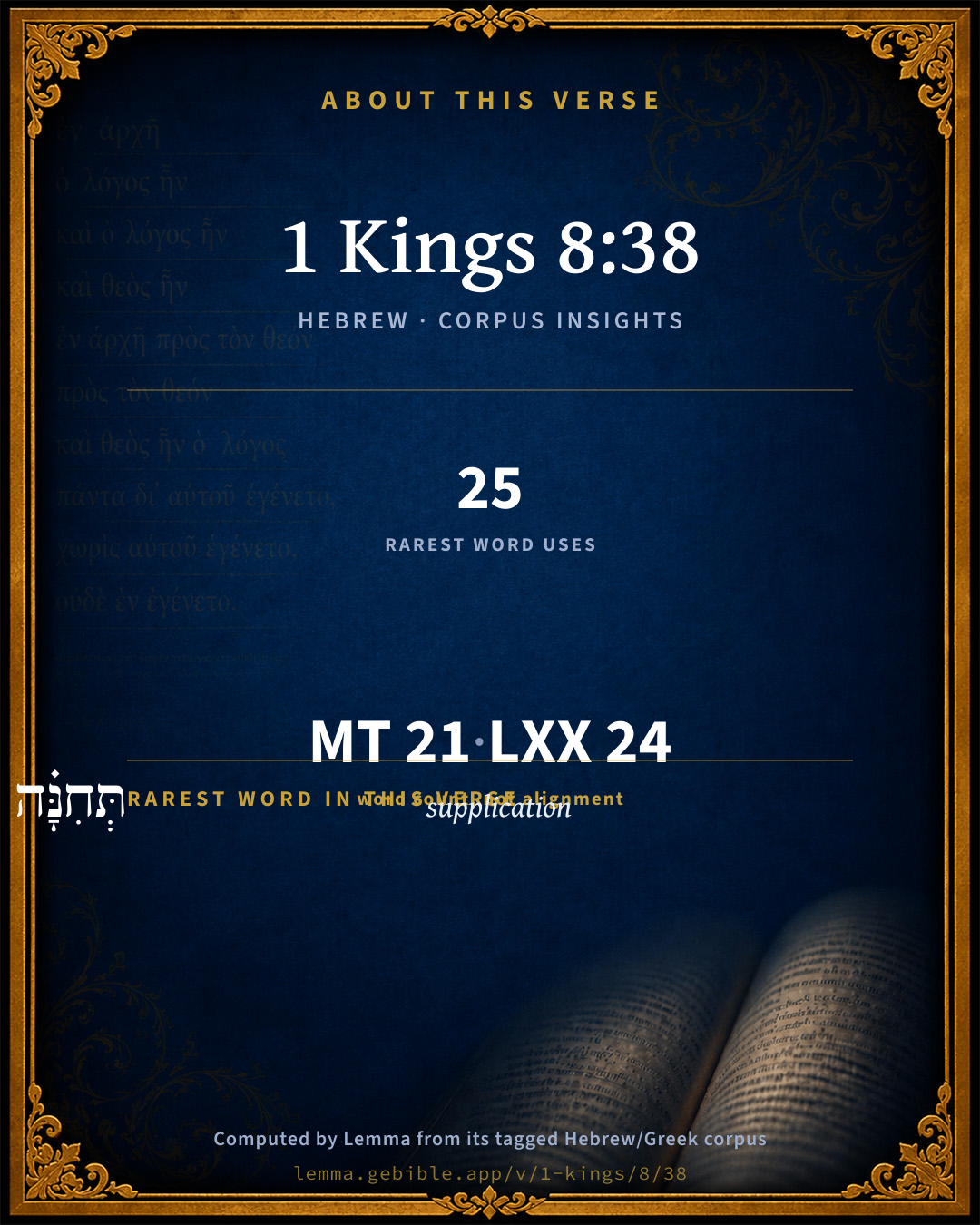
These counts appear in no published source. They are computed here, from the morphology-tagged text and Lemma’s own curated glosses. What Lemma adds →

21
words
17
distinct lemmas
Historical
section

Notable vocabulary

The rarest word here is תְּחִנָּ֗ה supplication H8467 — appearing just 25 times in the whole Hebrew Bible.

Shared distinctive vocabulary

תְּחִנָּ֗ה supplication H8467 occurs in 24 verses of the Hebrew Bible. Also found in:

Grammatical profile

  • 3 verbs
  • 14 nouns
  • 1 pronoun
  • 1 preposition
  • 2 particles

Verb forms

  • תִֽהְיֶה֙ Qal · Imperfect
  • יֵדְע֗וּן Qal · Imperfect
  • וּפָרַ֥שׂ Qal · Sequential Perfect

Repetition

Words recur within this verse — often emphatic in Hebrew:

  • כָּל all H3605 ×4
  • אֲשֶׁ֤ר which H834 ×2

Hebrew & Septuagint length

In English translation the verse runs 34 words from the Hebrew and 30 from the Septuagint (LXX English) — closely comparable.

A rough comparison of the two English renderings, which tokenize alike — not a word-level alignment.

Word counts can differ between the Hebrew and the Greek without any difference in meaning — e.g. the Hebrew direct-object marker אֵת has no separate Greek word, and Greek often adds the article ὁ.

In the original languages it is 21 Hebrew tokens and 24 Greek tokens — but the two are counted differently (Hebrew bundles its prefixes and suffixes into one token; the Greek is in lemma form), so that isn’t a like-for-like length.

Cross-references

20

Topical passages linked to 1 Kings 8:38 in the Treasury of Scripture Knowledge — connected by theme and wording, ordered by reader-vote popularity; previews shown in the World English Bible.

  • 1 Kings 8:22 Solomon stood before the altar of Yahweh in the presence of all the assembly of Israel, and spread forth his hands toward heaven;
  • Psalms 73:21–22 For my soul was grieved. I was embittered in my heart.
  • Amos 7:1–6 Thus the Lord Yahweh showed me: and, behold, he formed locusts in the beginning of the shooting up of the latter growth; and, behold, it was the latter growth after the king's harvest.
  • Philippians 4:6 In nothing be anxious, but in everything, by prayer and petition with thanksgiving, let your requests be made known to God.
  • 2 Chronicles 20:5–13 Jehoshaphat stood in the assembly of Judah and Jerusalem, in the house of Yahweh, before the new court;
  • Psalms 42:6 My God, my soul is in despair within me. Therefore I remember you from the land of the Jordan, The heights of Hermon, from the hill Mizar.
  • Psalms 42:9 I will ask God, my rock, "Why have you forgotten me? Why do I go mourning because of the oppression of the enemy?"
  • Psalms 42:11 Why are you in despair, my soul? Why are you disturbed within me? Hope in God! For I shall still praise him, The saving help of my countenance, and my God.
  • Psalms 50:15 Call on me in the day of trouble. I will deliver you, and you will honor me."
  • Psalms 91:15 He will call on me, and I will answer him. I will be with him in trouble. I will deliver him, and honor him.
  • Psalms 142:3–5 When my spirit was overwhelmed within me, You knew my path. In the way in which I walk, They have hidden a snare for me.
  • Proverbs 14:10 The heart knows its own bitterness and joy; He will not share these with a stranger.
  • Isaiah 1:15 When you spread forth your hands, I will hide my eyes from you; Yes, when you make many prayers, I will not hear. Your hands are full of blood.
  • Isaiah 37:4 It may be Yahweh your God will hear the words of Rabshakeh, whom the king of Assyria his master has sent to defy the living God, and will rebuke the words which Yahweh your God has heard. Therefore lift up your prayer for the remnant that is left.
  • Isaiah 37:15–21 Hezekiah prayed to Yahweh, saying,
  • Joel 2:17 Let the priests, the ministers of Yahweh, weep between the porch and the altar, And let them say, "Spare your people, Yahweh, And don't give your heritage to reproach, That the nations should rule over them. Why should they say among the peoples, 'Where is their God?'"
  • 2 Chronicles 6:29 whatever prayer and supplication be made by any man, or by all your people Israel, who shall know every man his own plague and his own sorrow, and shall spread forth his hands toward this house:
  • Job 7:11 "Therefore I will not keep silent. I will speak in the anguish of my spirit. I will complain in the bitterness of my soul.
  • Psalms 32:3–4 When I kept silence, my bones wasted away through my groaning all day long.
  • Romans 7:24 What a wretched man I am! Who will deliver me out of the body of this death?

Cross-references courtesy of OpenBible.info (CC BY 4.0).

Hebrew and Greek witnesses Masoretic Hebrew ↔ Greek Septuagint

The same verse in the two great witnesses to the Old Testament, shown verse-for-verse.

These are two independent witnesses, not word-aligned to each other, and the Septuagint is shown in lemma (dictionary) form.

Hebrew 1 Kings 8:38 Masoretic · Westminster Leningrad Codex

כָּל תְּפִלָּ֣ה כָל תְּחִנָּ֗ה אֲשֶׁ֤ר תִֽהְיֶה֙ לְכָל הָ֣אָדָ֔ם לְכֹ֖ל עַמְּךָ֣ יִשְׂרָאֵ֑ל אֲשֶׁ֣ר יֵדְע֗וּן אִ֚ישׁ נֶ֣גַע לְבָב֔וֹ וּפָרַ֥שׂ כַּפָּ֖יו אֶל הַבַּ֥יִת הַזֶּֽה

whatever prayer and supplication be made by any man, [or] by all your people Israel, who shall know every man the plague of his own heart, and spread forth his hands toward this house:

World English Bible · Public Domain

Greek LXX 1 Kings 8:38 Septuagint · lemma form

πᾶς προσευχή πᾶς δέησις ἐάν γίγνομαι πᾶς ἄνθρωπος ὡς ἄν γιγνώσκω ἕκαστος ἁφή καρδία αὐτός καί διαπετάζω ὁ χείρ αὐτός εἰς ὁ οἶκος οὗτος

every prayer, every supplication whatever shall be made by any man, as they shall know each the plague of his heart, and shall spread abroad his hands to this house,

LXX2012 (modern English Septuagint) · Public Domain

On this verse, Haydock's Catholic Bible Commentary discusses the Septuagint’s reading. Read the note in Commentary ↓

Hebrew: Westminster Leningrad Codex (CC BY 4.0). Greek: Septuagint (public domain); English from LXX2012 (modern English Septuagint) (Public Domain). How the Septuagint differs from the Hebrew →

Targum (Aramaic paraphrase)

1

The Targum is the ancient Jewish Aramaic paraphrase of the Hebrew Scriptures — an interpretive translation, not the Hebrew text itself. Onkelos (literal) and Pseudo-Jonathan (expansive) render the Torah, and Jonathan the Prophets. Coverage is partial: where no permissively-licensed English translation exists for a verse, only the Aramaic is shown. This is verse-level text, not a word-by-word alignment to the Hebrew.

  1. Targum Jonathan Prophets (Joshua–Malachi)
    כָּל צְלוֹתָא כָּל בָּעוּתָא דִתְהֵי לְכָל אֱנָשָׁא לְכָל עַמָךְ יִשְׂרָאֵל דִי יֵדְעוּן גְבַר מַכְתַּשׁ לִבֵּיהּ וְיִפְרוֹס יְדוֹהִי בִּצְלוֹ לְאַפֵּי בֵיתָא הָדֵין:

    (no public-domain English translation for this verse)

    Targum Jonathan — Aramaic: “Mikraot Gedolot” (public domain). English: “Sefaria Community Translation” (CC0 1.0 (public-domain dedication)); “London "Chaldee Paraphrase," 1871” (public domain). Text via Sefaria.

Commentary

Notes on 1 Kings 8:38 from classic Christian and Jewish commentators (each source and its license shown beneath its notes). The classic Christian expositions comment on the surrounding passage and are grouped to its opening verse, so a note may address several verses; the Jewish commentaries on the Tanakh (Rashi and others) are per-verse, so they appear only where the commentator wrote on this verse.

Lemma curates 59 commentaries, every one of them public domain or Creative Commons licensed, each selected and text-cleaned for this edition rather than reprinted as found. About our sources →

Trapp's Complete Commentary

John Trapp

1Ki 8:38 What prayer and supplication soever be [made] by any man, [or] by all thy people Israel, which shall know every man the plague of his own heart, and spread forth his hands toward this house:

Ver. 38. Which shall know every man the plague of his own heart.] His own iniquity; {Psa 18:23} the cause of his calamity; as he well understandeth, when sin and wrath meet in the soul, and make a wound in it: the cure whereof he seeketh of God by prayer, which hath a pacifying property, and fetcheth out the stain and sting of sin.

John Trapp, A Commentary or Exposition upon All the Books of the Old and New Testament (1647–1656) — public domain. Text from a community e-Sword module.

Joseph Benson's Commentary

1Ki 8:38. What prayer and supplication soever be made by any man — Distressed through national calamities, or private and personal troubles. He now comes to speak of the case of individual Israelites. If any man of Israel has an errand to thee, here let him find thee, here let him find favour with thee. He does not instance in particulars; so numerous, so various are the grievances of the children of men. Which shall know every man the plague of his own heart — His sinfulness, the corruption of his nature, which may be called the plague of his own heart, in opposition to the other plagues here mentioned: and so the sense is, Who by their afflictions are brought to a true and serious sense of the inward plague of their sins, which are most fitly called the plague of the heart, because the heart is both the principal seat of sin, and the fountain from whence all sinful thoughts, words, and actions flow. Now every true Israelite labours to know his heart, and the sinfulness and depravity of it, that he may resist and mortify the lusts, passions, and corrupt inclinations thereof, and may watch against the first risings of evil within him. Of these things he complains: these drive him to his knees and to the sanctuary, and, lamenting and seeking deliverance from these, he spreads forth his hands in prayer, as Hezekiah spread his letter before the Lord. Reader, is this thy practice?

Joseph Benson's Commentary on the Old and New Testaments (1811–1818) — public domain. Text from a community e-Sword module.

Geneva Bible (1599)

Geneva Bible translators

For such are most meet to receive God’s mercies.

Geneva Bible (1599) marginal notes — public domain. Text via Bolls.life.

The Cambridge Bible for Schools and Colleges

gen. ed. J. J. S. Perowne

38. which shall know every man the plague of his own heart] i.e. The special infliction which is sent to him for his own correction, and for the relief of which he only can fitly pray.

The Cambridge Bible for Schools and Colleges (gen. ed. J. J. S. Perowne; Cambridge University Press, 1878–1918) — public domain. Text from a community e-Sword module.

John Gill's Exposition

What prayer and supplication soever,.... On account of any of the above things, or any other:

be made by any man, or by all the people Israel; by a private man, for such an one might go to the temple and pray by himself; see Luk 18:10 or by the public congregation:

which shall know every man the plague of his own heart; be sensible of his sin as the cause of his distress, and own it, though ever so privately committed, which none knows but God and his own heart; and which may be only an heart sin, not actually committed; as all sin is originally in the heart, and springs from it, that is the source of all wickedness; it may respect the corruption of nature, indwelling sin, which truly deserves this name, and which every good man is led to observe, confess, and bewail, Psa 51:4. In Ch2 6:29 it is,

shall know his own sore and his own grief; what particularly affects him, and gives him pain and sorrow, as every man best knows his own affliction and trouble, and so can best represent his own case to the Lord:

and spread forth his hands towards this house; pray with his face towards it, and his hands spread out, a prayer gesture, and what was now used by Solomon, Kg1 8:22.

John Gill's Exposition of the Whole Bible (1746–1763) — public domain (CC PDM 1.0). Text via the HelloAO Bible API.

Albert Barnes' Notes on the Bible

Know every man the plague of his own heart - i. e. perceive one’s sinfulness, or recognize one’s sufferings as divine chastisements, and sin as their cause.

Albert Barnes' Notes on the Bible (1834–1885) — public domain. Text from a community e-Sword/MySword module.

Haydock's Catholic Bible Commentary

Heart: his offence. Septuagint Greek: aphen, "touching, or compunction." (Haydock) --- Let a man go to the source of the evil, and be sorry for his sins. (Calmet)

George Leo Haydock (1774–1849), Haydock's Catholic Family Bible and Commentary, 1859 edition — public domain. Excludes Psalms (Douay-Rheims chapter numbering differs from Protestant) and Deuterocanonical books (Catholic canon only).

Matthew Poole's English Annotations

The plague of his own heart, i.e. either,

1. His sin, which may be called the plague of his heart, in opposition to the other plagues here mentioned, which afflict only the body, or outward man; so the sense is, Who by their afflictions are brought to a true and serious sense of their worse and inward plague of their sins, which are most fitly called the plague of the heart, because that is both the principal seat of sin, and the fountain from whence all actual sins flow, Mat 15:19. Or rather,

2. His affliction; for so this is explained in the parallel place, 2Ch 6:29, (which is the more considerable, because that book was written after this, to explain what was dark or doubtful, and to supply what was lacking in this,) when every one shall know his own sore, and his own grief; which is not unfitly called the plague of his heart, because it was that plague which his heart was most afflicted with, which pained him at the very heart, as the phrase is, Jer 4:19; compare Psa 55:4; which caused him most vexation or grief, which is a passion of the heart: and so the sense is, Who shall know, i.e. be duly and deeply sensible of his affliction, and the hand of God in it; and his sin as the cause of it; for words of knowledge in Scripture do very frequently note such a kind of knowledge as affects and changeth the heart, and reforms the whole course of a man’s life; for which cause, men of ungodly lives are frequently said in Scripture not to know God, or Christ, or his word, &c. And therefore no man knows his sore in a Scripture sense but he who bears the rod, who turneth unto him that smiteth him, and sincerely seeketh to the Lord for relief.

Matthew Poole's English Annotations on the Holy Bible (1683–1685) — public domain. Text from a community e-Sword/MySword module.

Whedon's Commentary on the Bible

Daniel D. Whedon

38. The plague of his own heart — That particular form of misfortune, pain, moral darkness, and confusion of spirit, which each man may recognise for himself as a Divine judgment upon him for his sins. Happy he who is able to discern the plague of his own heart, and by timely repentance escapes a hopeless ruin!

Daniel D. Whedon (gen. ed.), Commentary on the Old and New Testaments (1874–1909) — public domain. Text from a community e-Sword module.

The Pulpit Commentary

What prayer and supplication soever There is here a studied reference to the preceding words. Lit., every prayer, etc. We might render in ver. 37, "Whatsoever the plague," etc., and here, "Whatsoever the prayer," etc. be made by any man, or by all thy people Israel, which shall know every man the plague of his own heart Here again there is an unmistakeable reference to the "plague" (same word) of ver. 37. The plague of the heart is the inner smart of the conscience corresponding with and perhaps more painful than the smiting of the person. The meaning obviously is that the prayers will vary. according to the various mental and physical sufferings of men, and spread forth his hands see on ver. 22 toward this house.

HOMILIES BY J. WAITE Vers. 38, 39.

The Praying King.

One of the most remarkable features of this scene of the dedication of the temple is the place occupied, the part performed, in it by Solomon himself. He is the central figure, the chief actor. Both priest and prophet give place to him. The dedicatory prayer is a spontaneous effusion of his own devout feeling, and it is he who pronounces afterwards the benediction on the people. He stands before us here as a true type of that greater "Son of David," who is our Prophet, Priest, and King. There is a great deal in the tone of this prayer that betokens a soul fully alive to the solemn and momentous meaning of what was taking place in Jerusalem that day. It is not, indeed, to the service of the ancient Jewish temple that we should look for the most perfect models of devotion. New Testament revelations multiply and strengthen immeasurably our motives to prayer, enlarge its scope, open to us new grounds of assurance in it. "One greater than Solomon" has taught us how to pray, and revealed to us the path to acceptance in the merit of His own mediation. But as the life of religion in the soul of man is essentially the same in all ages, so the principles involved in prayer as the expression of it are the same. Two such rudimentary principles appear in this passage, viz., the sense of need prompting the suppliant to look heavenwards, and the recognition of something out of himself as the ground of hope for acceptance.

I THE SENSE OF NEED, etc. It is the "plague of the heart the burden resting heavy there, the haunting sense of want or sadness in the secret soul, coupled with some kind of faith in Divine power that moves men to pray. All true prayer is the utterance of these inward impressions. If much of our so called praying were subjected to this test, it is to be feared that it would be found very hollow and unreal, mere "words," a mere formal homage to custom no deep, earnest, irrepressible longing of the soul inspiring it. Solomon begins to enumerate different calamities that may impel the people to pray, and then, as if overpowered by the mere vague, distant imagination of these possibilities, he says, "Whatsoever plague, whatsoever sickness," etc. How soon are we lost in the attempt to realize the manifold troubles of human life. We can understand and sympathize with individual griefs, but who can comprehend at all adequately the general sum of human woe, and take the weight of it sympathetically upon himself? Every man, however, knows where the universal evil specially touches himself. "Every heart knows its own bitterness." And with God there is both an infinite acquaintance with the whole and a special sympathy with each. There are some griefs that you lock up in your own bosom as secrets that none else must look upon.

"Not e"en the dearest heart, and next our own, Knows half the reasons why we smile or sigh.

But there is no grief you can conceal from Him. He became in the person of His Son "the man of sorrows and acquainted with grief," that we might feel how He follows us, or rather, goes before us, in every path of suffering. There is room in the great fatherly heart of God for us all, with all our burdens, and we can never measure the uplifting and sustaining power that comes to us by casting ourselves and them upon it everything by prayer and supplication," etc.; (Php_4:6, 7) "Cast thy burden upon the Lord," etc. (Psa_55:22) But this expression, "to plague of his own heart," has a deeper meaning. It opens to us all the dark sad mystery of personal sinfulness, the moral disease that lurks within. There are times when the most careless, reckless spirit has glimpses of the unwelcome truth that this, after all, is the deepest cause of its disquietude. The multiform, mysterious evil of the world has its central root in the world"s heart. Something of that "root of all bitterness" is in every human heart. Here lies the fatal mischief. It is not the tribulations of outward life, it is yourself you have most reason to mourn over. Not so much from them, but from something in yourself you have need to pray to be delivered. Christ always taught, By word and deed, the vital connection between the external calamities and the internal "plague." He took upon Him our sicknesses and sorrows, not only to show us how they may be nobly borne, but that He might bring His power as the Great Physician of souls to Bear upon the seat of our deadly disease, and by the efficacy of His blood might heal and save us all. Go penitently in His name to the mercy seat with the "plague of your heart," and you shall be redeemed from it.

II THE RECOGNITION OF SOMETHING OUT OF ONE"S SELF AS THE GROUND OF HOPE. This essential element in true prayer is suggested by the words, "And shall stretch forth his hands towards this place." An interesting view is here given us of the relation of the temple to the individual religious life of the people. It was intended to be a witness to the unseen, a help to faith, an incentive to all holy thought and feeling. It stood through all the changes of time, the shifting lights and shadows of the world around it, as an impressive symbol of the "everlasting covenant." It enshrined the "sure mercies of David." Within its hallowed enclosure were gathered the sacred historic records and relies, and the types and shadows of "better things to come." It told both of what God had done and what He had promised the monument of the glorious past, the prophecy of the brighter future. There was deep meaning, then, in the suppliant "stretching forth his hands towards that house," as expressive of the attitude of his soul towards that which it symbolized. When some lonely worshipper in a distant corner of the land, some patient sufferer, some soldier in his agony on the field of battle, some captive, like Daniel, in a strange country, directed his eyes towards the holy place, it was a sort of pathetic appeal to God s own faithfulness, a silent but eloquent plea that He would not forget His covenant, would fulfil the hopes that He Himself had awakened, and not for their sakes alone, but for His own truth and mercy"s sake, would hear and save. In all this the temple was a type of something nobler, diviner than itself. The temple was the shadow, the substance is in Christ. "In him are hid all the treasures," etc. The cross of Christ, in which all the promises are confirmed and sealed; the cross, which is both the altar of the Redeemer"s sacrifice and the throne of His sovereignty, is the shrine of "truth and grace" to men. The glory alike of the past and of the future is centred, focussed there.

"All the light of sacred story Gathers round its head sublime," and from it there streams forth an ever-brightening radiance into the otherwise dark futurity. It stands the connecting link between heaven and earth, the meeting place of God and man, the key to all human history, the basis of our immortal hope. Here, then, on this central object alike of Divine and human interest, must the eye of the suppliant be fixed. It is that pledge of Divine love and faithfulness, external to ourselves, embodied in the cross of Christ, that we must plead if we would find acceptance in our prayer. When God has thoroughly taught us what the "plague of our own heart" means, and has unveiled to us the blessed mystery of His mode of curing it, it will be the sustained habit of our life to stand as suppliants before Him "in the name of Jesus." Thus alone can we so link ourselves with the sanctities of a higher world as to make our common life Divine. W.

HOMILIES BY E. DE PRESSENSE Ver. 38.

The consecration of the temple was the grandest religious ceremony of the old covenant. It is important

I BECAUSE IT CENTRALIZES THE WORSHIP OF THE THEOCRACY.

II BECAUSE IT SUPPLIES A TYPE OF THE SPIRITUAL TEMPLE which is to be reared in the Church and in every Christian soul. Solomon, as the king chosen of God, represents in this service of consecration the entire theocracy. The temple is essentially a house of prayer, as is manifest from the words of the consecration. "What prayer and supplication soever be made by any man, or by all thy people Israel, which shall know every man the plague of his own heart hear thou in heaven." It is the sanctuary of the invisible God, and its gates stand open to the multitude, who come to worship and to offer sacrifice. Instead of a statue, such as was found in the idol temples, the priests of the true God place in their sanctuary the ark of the covenant, containing the law, the Divine expression of the holy will of God. The altar of sacrifice, placed in front of the sanctuary, reminds the people of their transgressions, while at the same time the sacrifice of the victims is prophetic of the future redemption. The consecrating prayer opens and closes with adoration. It spreads before God all the wants of the people, and asks from Him deliverance in every time of need. (1Ki_9:8) It enumerates first temporal distresses, but the whole petition culminates in the ever-recurring pleading for forgiveness. This is the burden of the whole temple service, and this character is reproduced in Christian worship. In the time of its highest spirituality there were no properly consecrated Christian temples. Aras non habemus said Minutius Felix. A temple is nevertheless a necessity of worship; and we are free to recognize this apart from any superstitious notion, and remembering that while the heaven of heavens cannot contain the Most High, He yet condescends to dwell in the humble and contrite heart. There has been no longer a sanctuary in the old exclusive sense, since the blood was shed which has redeemed the whole earth to God. Our houses of prayer are not now more holy in themselves than our homes. Let us consecrate them by consecrating ourselves to God, and rendering to Him the worship which is His due the sacrifice of our whole being. Let our prayers, like that of Solomon, begin and end with adoration, and let the burden of them be the expression of our repentance for sin. Let them have, like the prayer of the theocratic king, s breadth of intercession for the whole people of God, and let them lay at the foot of the cross the burden of the woes of humanity and the needs of the Church. E. de P.

The Pulpit Commentary (1880–1919), ed. H.D.M. Spence-Jones & Joseph S. Exell — public domain. Text from a community e-Sword module.

John Wesley's Explanatory Notes

The plague - His sin, which may be called the plague of his heart, in opposition to the other plagues here mentioned; so the sense is, who, by their afflictions are brought to a true and serious sense of their worse and inward plague of their sins, which are most fitly called the plague of the heart, because that is both the principal seat of sin, and the fountain from whence all actual sins flow.

John Wesley, Explanatory Notes Upon the Whole Bible (1754–1765) — public domain. Text via the GEBible commentary corpus.

Lesson kit

Teaching starters — assembled from the data on this page, not authored interpretation. Every prompt links to the verse data it draws on. Edit before teaching.

1 Kings, in the Historical, opens this verse with 21 words (17 distinct Hebrew lemmas). Its most distinctive word is tᵉchinnâh (“supplication”). A historical commentator’s framing appears above. Read the whole chapter for the surrounding context.

Discussion questions

  1. How does “supplication” (tᵉchinnâh) shape what this verse is saying?
  2. Joshua 11:20 shares the word «supplication» with this verse. How do the two illuminate each other?
  3. “all” occurs 4× in this one verse. What is the effect of the repetition?
  4. The translations on this page render this verse differently — a whole-verse word diff, not a word-by-word alignment. What might account for the different wordings?
  5. The verb «תִֽהְיֶה֙» is Qal Imperfect. How does its form color the action?
  6. Reading how Trapp's Complete Commentary and Joseph Benson's Commentary read this verse, where do the two commentators agree and where do they part?

Things to notice

Reading settings

Reading text

Shown beneath each verse's original-language words.

Old Testament
Old Testament edition

Read the OT as the Masoretic Hebrew (MT) or the Greek Septuagint (LXX).

English shown for the Greek Septuagint (in the Hebrew ↔ Greek comparison).

Comparing translations? Open the Compare panel on any verse page to stack up to four side by side.