
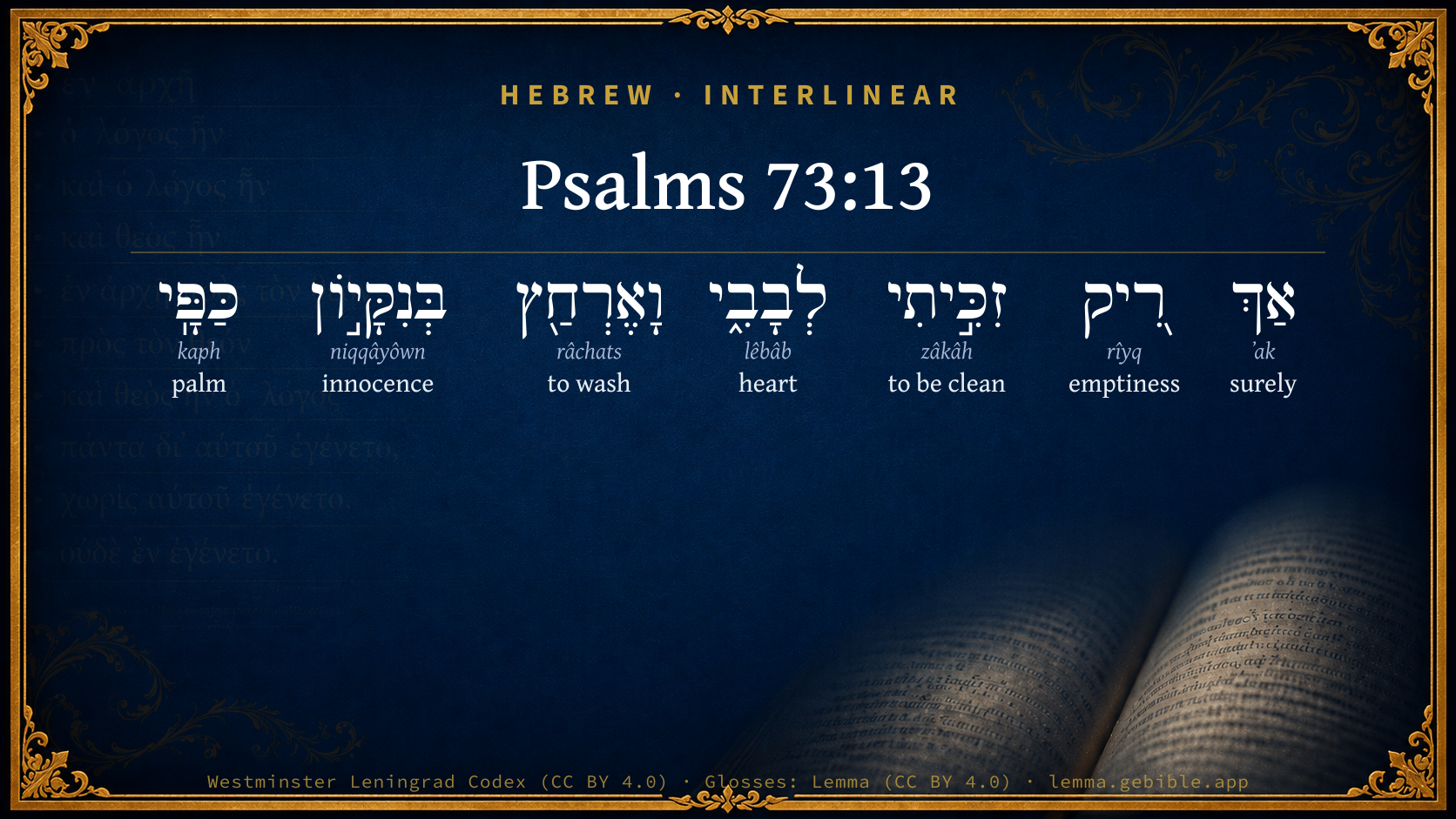
Psalms 73:13

Hebrew (Westminster Leningrad Codex) Psalms 73:13 appears in the Hebrew Old Testament. The text above is from the Westminster Leningrad Codex. Each word links to its Strong’s number, a concise gloss, and parsing drawn from the Open Scriptures Hebrew Bible morphology. Click any word for its full Brown-Driver-Briggs (BDB) entry.
Download image
Cite this verse

Psalms 73:13 (World English Bible). Public Domain. Lemma interlinear Bible study tool, https://lemma.gebible.app/v/psalms/73/13.

Show BibTeX & RIS
BibTeX
RIS
English Translation
Surely in vain I have cleansed my heart, And washed my hands in innocence,
World English Bible · Public Domain
Download a study sheet

One document with this verse’s original text, its word-by-word gloss line, the meaning frame, cross-references with their text, attributed commentary, and full source and license credits — printable, and it pastes into notes with its structure intact.

This verse Autodidact and up

Study sheet (.html) Plain text (.txt)

A passage Seminary Student

Up to 50 verses in one chapter. A passage sheet keeps up to 6 commentary sources and 12 cross-references per verse, in the order this page ranks them, and says so on the sheet whenever that leaves anything out. Ask for a single verse and you get the Autodidact verse sheet above.

Everything on this page stays free to read, with no account — the sheet is a download of what is already on screen, not access to it.

Want to remove ads? Support Godless Engineer
Compare translations 3

The same verse in 3 English versions, stacked beneath the original-language interlinear above. Click any original word for its lexicon entry.

Each is an independent rendering of the whole verse — the interlinear is not word-aligned to these translations.

Highlighted words mark where these versions differ — a whole-verse word diff, not a word-by-word alignment.

  • World English Bible Public Domain
    Surely in vain I have cleansed my heart, And washed my hands in innocence,
  • King James Version Public Domain
    Verily I have cleansed my heart in vain, and washed my hands in innocency.
  • unfoldingWord Literal Text CC BY-SA 4.0
    Surely in vain I have kept my heart clean and washed my hands in innocence.

unfoldingWord Literal Text — © unfoldingWord, licensed CC BY-SA 4.0. Word-aligned USFM3 via Door43 (git.door43.org/unfoldingWord/en_ult).

Versions to compare (up to 4)

3 of 4 selected

Show all 18 translations

Every available English version of this verse, each an independent rendering of the whole verse.

  • World English Bible Public Domain
    Surely in vain I have cleansed my heart, And washed my hands in innocence,
  • Berean Standard Bible Public Domain
    Surely in vain I have kept my heart pure; in innocence I have washed my hands.
  • Majority Standard Bible Public Domain
    Surely in vain I have kept my heart pure; in innocence I have washed my hands.
  • King James Version Public Domain
    Verily I have cleansed my heart in vain, and washed my hands in innocency.
  • American Standard Version (1901) Public Domain
    Surely in vain have I cleansed my heart, And washed my hands in innocency;
  • Revised Version (1885) Public Domain
    Surely in vain have I cleansed my heart, and washed my hands in innocency;
  • Geneva Bible (1599) Public Domain
    Certainely I haue clensed mine heart in vaine, and washed mine hands in innocencie.
  • Douay-Rheims (1899) Public Domain
    And I said: Then have I in vain justified my heart, and washed my hands among the innocent.
  • Young's Literal Translation Public Domain
    Only -- a vain thing! I have purified my heart, And I wash in innocency my hands,
  • Literal Standard Version CC BY-SA 4.0
    Only—a vain thing! I have purified my heart, || And I wash my hands in innocence,
  • Unlocked Literal Bible CC BY-SA 4.0
    Surely it is in vain that I have guarded my heart and washed my hands in innocence.
  • unfoldingWord Literal Text CC BY-SA 4.0
    Surely in vain I have kept my heart clean and washed my hands in innocence.
  • Darby Bible Public Domain
    Truly have I purified my heart in vain, and washed my hands in innocency:
  • World Messianic Bible Public Domain
    Surely I have cleansed my heart in vain, and washed my hands in innocence,
  • Webster's Bible Public Domain
    Verily I have cleansed my heart in vain, and washed my hands in innocence.
  • Free Bible Version CC BY-SA 4.0
    It's been pointless to keep my mind pure and my hands clean.
  • Bible in Basic English Public Domain
    As for me, I have made my heart clean to no purpose, washing my hands in righteousness;
  • JPS Tanakh (1917) Public Domain
    Surely in vain have I cleansed my heart, and washed my hands in innocency;

Literal Standard Version (2020), Covenant Press — licensed CC BY-SA 4.0. Text via the HelloAO Bible API (eBible.org). Unlocked Literal Bible (unfoldingWord) — licensed CC BY-SA 4.0. Text via the HelloAO Bible API (eBible.org). unfoldingWord Literal Text — © unfoldingWord, licensed CC BY-SA 4.0. Word-aligned USFM3 via Door43 (git.door43.org/unfoldingWord/en_ult). Free Bible Version, Dr. Jonathan Gallagher — licensed CC BY-SA 4.0. Text via the HelloAO Bible API (eBible.org).

Word by word

More ways to search: Search by grammar → Find every occurrence → Compare this word →

Practice this passage: Drill this verse → Learn its vocabulary →

About this verse

These counts appear in no published source. They are computed here, from the morphology-tagged text and Lemma’s own curated glosses. What Lemma adds →

7
words
7
distinct lemmas
Wisdom
section

Notable vocabulary

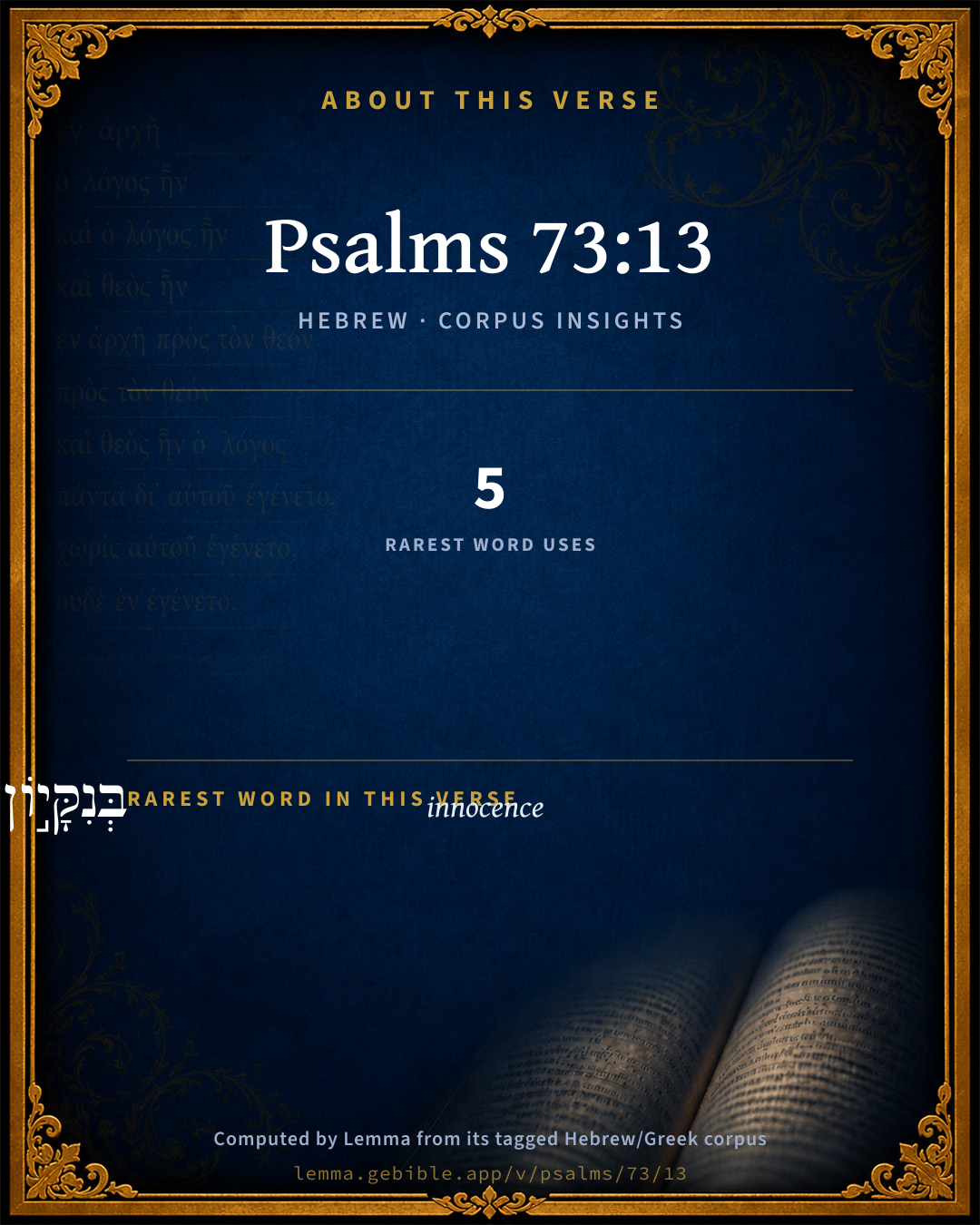
The rarest word here is בְּנִקָּי֣וֹן innocence H5356 — appearing just 5 times in the whole Hebrew Bible.

Shared distinctive vocabulary

בְּנִקָּי֣וֹן innocence H5356 occurs in 5 verses of the Hebrew Bible. Also found in:

Grammatical profile

  • 2 verbs
  • 4 nouns
  • 1 particle

Verb forms

  • זִכִּ֣יתִי Piel · Perfect
  • וָאֶרְחַ֖ץ Qal · Sequential Imperfect

Hebrew & Septuagint length

In English translation the verse runs 14 words from the Hebrew and 17 from the Septuagint (LXX English) — closely comparable.

A rough comparison of the two English renderings, which tokenize alike — not a word-level alignment.

Word counts can differ between the Hebrew and the Greek without any difference in meaning — e.g. the Hebrew direct-object marker אֵת has no separate Greek word, and Greek often adds the article ὁ.

Cross-references

11

Topical passages linked to Psalms 73:13 in the Treasury of Scripture Knowledge — connected by theme and wording, ordered by reader-vote popularity; previews shown in the World English Bible.

  • Job 21:15 What is the Almighty, that we should serve him? What profit should we have, if we pray to him?'
  • Psalms 26:6 I will wash my hands in innocence, So I will go about your altar, Yahweh;
  • Job 34:9 For he has said, 'It profits a man nothing That he should delight himself with God.'
  • Job 35:3 That you ask, 'What advantage will it be to you? What profit shall I have, more than if I had sinned?'
  • Psalms 51:10 Create in me a clean heart, O God. Renew a right spirit within me.
  • Malachi 3:14 You have said, 'It is vain to serve God;' and 'What profit is it that we have kept his charge, and that we have walked mournfully before Yahweh of Hosts?
  • Hebrews 10:19–22 Having therefore, brothers, boldness to enter into the holy place by the blood of Jesus,
  • James 4:8 Draw near to God, and he will draw near to you. Cleanse your hands, you sinners; and purify your hearts, you double-minded.
  • Job 9:27 If I say, 'I will forget my complaint, I will put off my sad face, and cheer up;'
  • Job 9:31 Yet you will plunge me in the ditch. My own clothes shall abhor me.
  • Psalms 24:4 He who has clean hands and a pure heart; Who has not lifted up his soul to falsehood, And has not sworn deceitfully.

Cross-references courtesy of OpenBible.info (CC BY 4.0).

Hebrew and Greek witnesses Masoretic Hebrew ↔ Greek Septuagint

The same verse in the two great witnesses to the Old Testament, shown verse-for-verse.

You’re reading Greek Psalm 72 (Hebrew Psalm 73). The Septuagint counts the superscription, so verse numbers can differ from the Hebrew — chapter-level alignment, not verse-by-verse. Numbering follows Rahlfs.

These are two independent witnesses, not word-aligned to each other, and the Septuagint is shown in lemma (dictionary) form.

Hebrew Psalms 73:13 Masoretic · Westminster Leningrad Codex

אַךְ רִ֭יק זִכִּ֣יתִי לְבָבִ֑י וָאֶרְחַ֖ץ בְּנִקָּי֣וֹן כַּפָּֽי

Surely in vain I have cleansed my heart, And washed my hands in innocence,

World English Bible · Public Domain

Greek LXX Greek Psalm 72:13 Septuagint · lemma form

καί εἶπον ἄρα ματαίως δικαιόω ὁ καρδία ἐγώ καί νίπτω ἐν ἀθῷος ὁ χείρ ἐγώ

And I said, Verily in vain have I justified my heart, and washed my hands in innocency.

LXX2012 (modern English Septuagint) · Public Domain

On this verse, Whedon's Commentary on the Bible discusses the Septuagint’s reading. Read the note in Commentary ↓

Hebrew: Westminster Leningrad Codex (CC BY 4.0). Greek: Septuagint (public domain); English from LXX2012 (modern English Septuagint) (Public Domain). How the Septuagint differs from the Hebrew →

Commentary

Notes on Psalms 73:13 from classic Christian and Jewish commentators (each source and its license shown beneath its notes). The classic Christian expositions comment on the surrounding passage and are grouped to its opening verse, so a note may address several verses; the Jewish commentaries on the Tanakh (Rashi and others) are per-verse, so they appear only where the commentator wrote on this verse.

Lemma curates 59 commentaries, every one of them public domain or Creative Commons licensed, each selected and text-cleaned for this edition rather than reprinted as found. About our sources →

Trapp's Complete Commentary

John Trapp

Psa 73:13 Verily I have cleansed my heart [in] vain, and washed my hands in innocency.

Ver. 13. Verily I have cleansed my heart in vain] For all is to little purpose, if the cards play on this fashion, if the good must be thus extremely under, and the bad on top of the wheel. Surely I have troubled myself to no purpose or profit; if it be so, why am I thus? as she said. I read of a profane soldier, who at the siege of a town, passing a place of danger, was heard swearing, and when one that stood by warned him, saying, Fellow soldier, do not swear, the bullets fly, he answered, They that swear come off as well as those that pray; but soon after this a shot hit him, and down he fell. It is not safe for saints to symbolize with sinners in such desperate speeches; lest the Lord hear it and be displeased.

Omne trahit secum numinis ira malum (Ovid).

John Trapp, A Commentary or Exposition upon All the Books of the Old and New Testament (1647–1656) — public domain. Text from a community e-Sword module.

The Biblical Illustrator

Joseph S. Exell

Psa_73:13

Verily I have cleansed my heart in vain, and washed my hands in innocency.

Trust and trouble

The innocent suffer with the guilty, often suffer for them, that so the guilty, spared, may be led by Gods goodness to repentance; to be helpful in such a ministry is an abundant recompense for all its pain. This the Gospel teaches us; it tells us that we have not cleansed our hearts in vain, and washed our hands in innocency; for that the fellowship of the righteous Saviour is the fellowship of the Man of Sorrows. But it brings us face to face with deeper mysteries than those which it solves. If we ask the reason of this--why God has so constituted the world as that all this is true; if we are not content with seeing how God acts, but want to know the reason, then there is no answer for us. We can do nothing but wait and trust. God is doing for us in the Gospel what He did for Asaph in the sanctuary; He is bringing us to trust in Him. He is confirming our faith, enlarging our conceptions of His righteousness, calling us to a broader view of His counsel, deepening our confidence that He is good. There is no mystery in life so dark but we can bear it, if only we are persuaded that God is pursuing His purpose in it. Let us consider, then--

I. How forgetfulness of God leads us to chafe under the painful dispensations of human life (Psa_73:8). No doubt Asaph was perfectly familiar with the pious sayings in which the experience of the godly is gathered up and afterwards repeated by others. Doubtless he could have talked as sagely as we about the prosperity of the wicked being transient, of the Lords loving whom He chastens, and scourging every son whom He receives. But the feebleness of his hold upon these truths is seen in that he cannot bear their actual sight. When he sees the prosperity of the foolish; when he marks their pride and self-complacency, that seem to laugh his lowly trust in God to scorn; then he finds that his maxims do not serve him much, he gives way to envy of them. He needs more than maxims, however sage. It is the actual stress of life, contact with all its hard and trying realities, that tests our faith. We can talk well about Gods favour being our chief joy. But can we bear to see the prosperity of the wicked while we ourselves are in adversity? That is the real test and strain. Notice, too, how envy grows into self-righteousness. Verily I have cleansed my heart in vain. Such words suggest that the man is pretty well satisfied with himself, because he is free front blame. And Psa_73:10-14 show deep distrust in God, as well as flippant self-satisfaction. It suggests, We good men ought not to be treated thus, we are not being dealt with righteously. They even venture to ask, Is there knowledge in the Most High? Does God Almighty know what He is doing? This is what is meant. Asaph is startled when he sees where the speculation he has begun is leading him. Hence he says, If I say, I will speak thus, behold I should offend against, etc.

II. Notice some considerations which may help us to trust that God is good in ordaining for us the painful dispensations of human life. Perhaps we could not have borne prosperity. When Asaph went into the sanctuary of God and saw the end of the wicked, he learned that they had been set in slippery places, that the pride which compassed them about as a chain, that their having more than heart could wish, had but sealed them up against the day of desolation, and the terrors that should utterly consume them. Because they were prosperous, they were self-confident, and their self-confidence was their destruction. And then there opens upon him an awful vision of what prosperity might have done for him. With the memory of his sinful murmuring upon him, he feared that he might have grown sinfully proud. The heart which tribulation had grieved would have been hardened by prosperity. So foolish was he, and ignorant in his adversity, as a beast before God; what would he have been if he had known no trouble? Then think, how hopeless would be the restoration of the wicked, which the Gospel bids us hope for, and not for their destruction, if all the sufferings of life were apportioned to them, and the righteous were never troubled. They would be consciously and irrevocably doomed, and they would sink into worse despair. It is to save them from this end that God does them good: He would spare them, that so His goodness may lead them to repentance; He would save them from the hopeless agony of seeing themselves already condemned. It is the grace of God that restores the ungodly, not His punishments. And then let us look on Christ--what a life was His! Trouble, anguish, and at the end the Cross. And yet He was Gods well-beloved Son. Would we not be with Him? God has better things for His children than prosperity. (A. Mackennal, D. D.)

A right act but a wrong opinion

I. Here is a right act. Cleansing the heart and washing the hands mean the cultivation of personal holiness; and this is certainly a right work for man. It implies three things:--

1. The consciousness of personal defilement.

2. The possession of a cleansing element.

3. The effort of personal application. Moral evil is the defilements--Christianity is the cleansing element--and practical faith is the personal application.

II. Here is a wrong opinion. The writer thought that it was in vain. Three facts show that this is a great mistake:--

1. That moral holiness involves its own reward.

2. That moral holiness is pro-meted by temporal adversity.

3. That moral holiness will meet with its perfect recompense hereafter.

No; this cleansing the heart is no vain work. No engagement is so real and profitable. Every fresh practical idea of God is a rising in the scale of being and of bliss; every conquest over sense, appetite, and sin, is a widening and strengthening of our spiritual sovereignty; every devout sentiment, earnest resolve, and generous sacrifice attunes our natures to higher music. (Homilist.)

The Biblical Illustrator, edited by Joseph S. Exell (c. 1880s–1900s) — public domain. Text from a community e-Sword module.

Joseph Benson's Commentary

Psa 73:13-14. Verily I have cleansed my heart in vain, &c. — Hence I have been tempted to think, that religion is a vain and unprofitable thing; that “all my faith, my charity, and my devotion; all my watching and fastings, in short, all the labour and pains I have taken in the way of goodness, have been altogether vain and fruitless; since, while the rebellious enemies of God enjoy the world and themselves at pleasure, I, who continue his servant, am in perpetual tribulation and affliction.” — Horne. True religion is properly and fully described in this verse, by its two principal parts and works, the cleansing of the heart from sinful lusts and passions, and of the hands, or outward man, from a course of sinful actions. And although it be God’s work to cleanse the heart, yet he says, I have cleansed it, because every pious man co-operates with God’s grace in cleansing his heart. Compare 2Co 6:1; 2Co 7:1. And washed my hands in innocency — That is, kept my hands (the chief instruments of action, and, consequently, the rest of the members of my body) innocent and pure from evil practices. I have washed my hands, not only ceremonially with water, wherewith hypocrites satisfy themselves, but also morally, with the waters of God’s grace and Spirit, in innocency or purity. For all the day long I have been plagued, &c. — While their ungodliness hath been attended with constant prosperity, my piety hath been exercised with continual afflictions.

Joseph Benson's Commentary on the Old and New Testaments (1811–1818) — public domain. Text from a community e-Sword module.

J. A. Alexander on Psalms

Joseph Addison Alexander

Psa 73:13. Only (in) vain have I cleansed my heart, and in innocence have washed my hands. These may be taken either indefinitely as the words of any person in the painful situation just described, or more specifically as the words of the Psalmist, by whom the whole class was, in fact, represented. They contain the inference which would be naturally drawn in such a situation, even by a true believer, but one tempted to repine and doubt by the sight of providential enigmas. "Since, then, it is the wicked who enjoy God's favour, all my efforts to avoid sin and to do his will have been gratuitous and fruitless." With the first words of the verse compare Psa 39:5; Psa 39:11.

Joseph Addison Alexander, The Psalms Translated and Explained (1850) — public domain. Text from a community e-Sword module.

Tyndale Open Study Notes

Tyndale Open Resources

73:13-17 Recognizing the ramifications of his discouragement and doubt, the psalmist turns to the Lord and receives special insight.

73:13-14 These rhetorical questions expect a discouraging “yes” for an answer. The psalmist wonders if godliness has become a meaningless ritual (see Mal 3:14-15). • My heart refers to his whole being. • The psalmist’s pain comes from discipline and rebuke (Ps 39:11; Prov 1:23, 25; 12:1).

Tyndale Open Study Notes — © Tyndale Open Resources, licensed CC BY-SA 4.0. Text via the HelloAO Bible API.

Adam Clarke's Commentary

Verse 13. I have cleansed my heart in vain] It is no advantage to us to worship the true God, to walk according to the law of righteousness, and keep the ordinances of the Most High.

Adam Clarke's Commentary on the Bible (1810–1826) — public domain. Text from a community e-Sword/MySword module.

The Cambridge Bible for Schools and Colleges

gen. ed. J. J. S. Perowne

13. Verily] The same word ak as in Psa_73:1. R.V. Surely in vain have I cleansed my heart. If the wicked prosper thus, his endeavours after holiness have been wasted. There is no reward for the righteous: nay (Psa_73:14) his own reward has been chastisement. He would not have claimed to be sinless any more than Job (cp. Job_20:9), but he has a good conscience. For the second line cp. Psa_26:6. The metaphor is derived from the ceremonies of the Levitical ritual. See Exo_30:17 ff.; cp. Deu_31:6.

The Cambridge Bible for Schools and Colleges (gen. ed. J. J. S. Perowne; Cambridge University Press, 1878–1918) — public domain. Text from a community e-Sword module.

John Gill's Exposition

Verily, I have cleansed my heart in vain,.... Which supposes that his heart had been unclean, as every man's is, and which appears by what is in it, and by what comes out of it; that it was now cleansed, not in an absolute and legal sense, as if it was wholly free from sin, for this no man can say; but in an evangelical sense, being purified by faith in the blood of Christ; that he had himself some concern in the cleansing of his heart, which seems to be contrary to Pro 20:9 and besides, this is the Lord's own work, Psa 51:10 wherefore this may be considered as a wrong and rash expression of his; for as he was wrong in one part of it, its being cleansed in vain, so he might be in the other, in ascribing it to himself; though it may be allowed, consistent with what is before observed, that a believer has a concern in the cleansing of his heart; for, being convinced of the impurity of it, he owns and laments it before the Lord; and, seeing the fountain of the Redeemer's blood opened, he applies to it, and to him for cleansing; and expresses a love unto, a great and studious concern for purity of heart as well as life; and, under the influence of divine grace, is enabled to keep a watch over it, whereby, through the same grace, it is preserved from much pollution; and by fresh application to the blood of Christ, is cleansed from what it daily contracts:

and washed my hands in innocency: that is, "in vain", as before; which denotes the performance of good works, a course of holy life and conversation, which when right springs from purity of heart; See Gill on Psa 26:6, now the psalmist under temptation concluded that all his religion and devotion were in vain, all his hearing, and reading, and attending on ordinances, all his concern for purity of heart and life; since those who showed no regard to these things prospered in the world, and increased in riches, abounded in ease and plenty, and seemed to be rather the favourites of heaven than religious men; and this temptation was strengthened by the following observation.

John Gill's Exposition of the Whole Bible (1746–1763) — public domain (CC PDM 1.0). Text via the HelloAO Bible API.

Albert Barnes' Notes on the Bible

Verily I have cleansed my heart in vain - That is, There is no advantage in all my efforts to become pure and holy. It does not assist me in obtaining the favor of God; and it would be just as well to live a sinful life - to indulge in the pleasures of sense - to make the world my portion. Nothing is to be gained by all my painful efforts at self-discipline; by all my endeavors to become righteous. It would have been as well for me - or better - if I had lived a life of sin like other people. The righteous obtain from God fewer blessings than the wicked; they have less happiness and less prosperity in this world; they are subjected to more trouble and sorrow; and to all else there must be added the struggles, the conflict, the warfare, the painful effort “to be” pure, and to lead a holy life, all of which is now seen to be of no advantage whatever. Such thoughts as these were not confined to the psalmist. They are thoughts which will start up in the mind, and which it is not easy to calm down.

And washed my hands in innocency - That is, It has been of no use that I have washed my hands in innocency. The word “innocency” here means “purity.” He had washed his hands in that which was pure; as, pure water. To wash the hands is emblematic of innocence or purity. See the notes at Psa 26:6.

Albert Barnes' Notes on the Bible (1834–1885) — public domain. Text from a community e-Sword/MySword module.

Matthew Poole's English Annotations

Hence I was sometimes tempted to think that religion was a vain and unprofitable thing, at least as to the happiness of this life, which yet God had promised as a reward to piety. True religion is here fitly and fully described by its two principal parts and works, the cleansing of the heart from sinful lusts and passions, and of the hands, or outward man, from a course of sinful actions, And although it be God’s work to cleanse the heart, yet he saith,

I have cleansed it, because every good man doth co-operate with God’s grace in cleansing it. Compare 2Co 6:1; 7:1.

Washed my hands in innocency, i.e. kept my hands (the great instruments of action, and consequently the rest of the members of my body) innocent and pure from evil practices. I have washed my hands, not only ceremonially with water, wherewith hypocrites satisfy themselves, but also morally, or with the waters of God’s grace and Spirit, innocency or purity.

Matthew Poole's English Annotations on the Holy Bible (1683–1685) — public domain. Text from a community e-Sword/MySword module.

The Treasury of David

Charles H. Spurgeon

Ver. 13. Verily I have cleansed my heart in vain. Poor Asaph! he questions the value of holiness when its wages are paid in the coin of affliction. With no effect has he been sincere; no advantage has come to him through his purity, for the filthy hearted are exalted and fed on the fat of the land. Thus foolishly will the wisest of men argue, when faith is napping. Asaph was a seer, but he could not see when reason left him in the dark; even seers must have the sunlight of revealed truth to see by, or they grope like the blind. In the presence of temporal circumstances, the pure in heart may seem to have cleansed themselves altogether in vain, but we must not judge after the sight of the eyes.

And washed my hands in innocency. Asaph had been as careful of his hands as of his heart; he had guarded his outer as well as his inner life, and it was a bitter thought that all of this was useless, and left him in even a worse condition than foul handed, black hearted worldlings. Surely the horrible character of the conclusion must have helped to render it untenable; it could not be so while God was God. It smelt too strong of a lie to be tolerated long in the good man's soul; hence, in a verse or two, we see his mind turning in another direction.

Charles H. Spurgeon's The Treasury of David (1869–1885) — public domain. Psalms only. Text from a community e-Sword/MySword module.

Whedon's Commentary on the Bible

Daniel D. Whedon

13. Verily I have cleansed my heart in vain— “Verily” has the force of wholly. Wholly in vain have I cleansed my heart. So it appeared, but this was his temptation: in Psa_73:1; Psa_73:22, after the temptation, he asserts the contrary.

Washed my hands in innocency—In protestation of innocency. The allusion is to Deu_21:6-7. Compare Mat_27:24; Psa_26:6. The Septuagint understands this as the language of personal experience, not as that of a representative man, and introduces “And I said, Verily I have washed,” etc.

Daniel D. Whedon (gen. ed.), Commentary on the Old and New Testaments (1874–1909) — public domain. Text from a community e-Sword module.

The Pulpit Commentary

Verily, I have cleansed my heart in vain, and washed my hands in innocency. Such was the psalmist"s first instinctive feeling, when he noticed the prosperity of the wicked. The Prayer book Version inserts, between this verse and the last, the words, "and I said;" which is correct, though somewhat free, exegesis. Compare with the expression, "I have washed my hands in innocency," Job"s remarkable words, "If I wash myself with snow, and make my hands never so clean". (Job_9:30)

The Pulpit Commentary (1880–1919), ed. H.D.M. Spence-Jones & Joseph S. Exell — public domain. Text from a community e-Sword module.

John Wesley's Explanatory Notes

In vain - Hence I was sometimes tempted, to think that religion was a vain, unprofitable thing. True religion is here described by its two principal parts, the cleansing of the heart, and the hands.

John Wesley, Explanatory Notes Upon the Whole Bible (1754–1765) — public domain. Text via the GEBible commentary corpus.

Kretzmann's Popular Commentary

Paul E. Kretzmann

The Believer’s Trust at the Realization of the Truth

v. 13. Verily, I have cleansed my heart in vain, in view of the offense given by the prosperity of the ungodly, and washed my hands in innocency, making diligent efforts to live a holy life before the Lord.

v. 14. For all the day long have I been plagued, buffeted with troubles on every hand, and chastened every morning, some new visitation of the Lord striking him with every new day. The psalmist, however, guards against such blasphemous utterances; he does not want to become guilty of speeches against the Lord.

v. 15. If I say, I will speak thus, his thoughts being on the point of being uttered, behold, I should offend against the generation of Thy children, giving offense to the Lord’s people by an act of perfidy against Jehovah, that is, he found himself in the position of Paul, Romans 7, when he speaks of the quarrel in his members.

v. 16. When I thought to know this, to get a satisfactory explanation of the riddle presented in the situation, it was too painful for me, his pondering remained a toil, did not offer him a satisfactory solution,

v. 17. until I went into the Sanctuary of God, to the Tabernacle, or Temple, where the Word of the Lord was kept, which reveals also the mysteries of God’s government of the world, so far as God wants the believers to know them; then understood I their end, then he found out what would be the final disposition of the ungodly, what fate God had in store for them.

v. 18. Surely Thou didst set them in slippery places, they who believed themselves so safe and secure against misfortune were in reality in danger of slipping every moment; Thou castedst them down into destruction, bringing sudden ruin upon them.

v. 19. How are they brought into desolation, as in a moment! They are utterly consumed with terrors, wasted away, reduced to nothing, by the horror of the fate which overtook them.

v. 20. As a dream when one awaketh, from the moment when a person arouses himself from his sleep, so, O Lord, when Thou awakest, Thou shalt despise their image. A dream may seem real enough while it lasts. but upon awaking a person shakes it off with its effects, as lacking in material substance. Thus the ungodly, with all their show of prosperity, are nothing but a dream-picture in the eyes of God; there is no place for them in the eternal city of God, their fate is decided.

v. 21. Thus my heart was grieved, and I was pricked in my reins, that is, if his heart should become embittered, if it should hurt him inside, in his inward parts, in his feelings;

v. 22. so foolish was I and ignorant; I was as a beast before Thee, he would have been foolish and like an irrational animal before God if he had yielded to dissatisfaction and bitterness. But he shakes off the attack and states what his true comfort consists in.

v. 23. Nevertheless I am continually with Thee, in spite of all the offense given by the unbelievers and their apparent good fortune; Thou hast holden me by my right hand, keeping the believer from falling, holding him secure with His almighty power.

v. 24. Thou shalt guide me with Thy counsel for God shows each of His children on which paths they should go forward, and afterward receive me to glory, when he has reached the goal, his soul’s salvation, receiving the reward of mercy. Therefore every believer is constrained to call out with Asaph:

v. 25. Whom have I in heaven but Thee? God is his highest Good; in Him there is complete satisfaction. And there is none upon earth that I desire beside Thee, he no longer finds true pleasure in this world and all its goods.

v. 26. My flesh and my heart faileth, they faint, pine, dwindle away under the attacks of misery and tribulation; but God is the Strength of: my heart, the dependable Rock of his faith, and my Portion forever, the inheritance which will give the believer eternal satisfaction and enjoyment. The psalmist therefore, in conclusion, offers a summary of his meditations.

v. 27. For, lo, they that are far from Thee shall perish, they who have left God, have become estranged to Him by means of their pride and arrogance, will become victims of eternal destruction; Thou hast destroyed all them that go a-whoring from Thee, in spiritual adultery, in idolatry, by their disobedience and faithlessness.

v. 28. But it is good for me, it is his greatest pleasure and happiness, to draw near to God, to be united with Him in the fellowship of faith; I have put my trust in the Lord God that I may declare all Thy works, that he may have reason to praise the works of God for his own salvation. In heaven we shall have the full revelation of the fact that it was the mercy and kindness of God which directed Him in His entire relation toward us, even during periods which seemed dark to us, which we could not explain at the time, and that the end and goal was the salvation of our souls and the glory of heaven.

Paul E. Kretzmann, Popular Commentary of the Bible (1921–1924) — public domain. Text from a community e-Sword module.

unfoldingWord translationNotes

Door43 World Missions Community

General Information:

In verses 13 and 14, Asaph continues to describe how he sometimes wants to complain to God about those who are "arrogant" and "wicked" (Psalms 73:3). In verse 15 he begins to talk about what he is really thinking.

I have

The word "I" refers to Asaph.

guarded my heart

Asaph speaks of guarding his heart as if he were guarding a city or building against enemies. AT: "I have kept my thoughts pure" (See: Metaphor)

washed my hands in innocence

The writer speaks of his purity as if he had washed his hands with innocence instead of with water. See how you translated this in Psalms 26:6. AT: "my actions have remained pure" or "I have washed my hands to show that I am innocent" (See: Metaphor)

all the day long

"always" or "every day"

I have been afflicted

"You have made me suffer." See how "they are not afflicted" is translated in Psalms 73:5.

I have been ... disciplined

"I have been ... punished"

If I had said, "I will say these things," then I would have betrayed this generation of your children

This hypothetical situation did not happen. AT: "I never said, 'I will say these things,' so I did not betray this generation of your children" (See: Hypothetical Situations)

translationWords

vain

hand

innocent

afflicted

discipline

betray

generation

children

unfoldingWord translationNotes — © Distant Shores Media and the Door43 World Missions Community, licensed CC BY-SA 4.0. Source: git.door43.org/Door43/en_tn.

Rashi

Rabbi Shlomo Yitzchaki (Rashi)

But for nought I cleansed my heart All this refers back to: “And they say, ‘How does God know?’” They also say, “But for nothing and in vain we keep the commandments of the Holy One, blessed be He, for behold, we are plagued all the days.”

Rashi on the Tanakh — English translations: “The Judaica Press complete Tanach with Rashi, translated by A. J. Rosenberg” (CC BY 4.0); “Pentateuch with Rashi's commentary by M. Rosenbaum and A.M. Silbermann, 1929-1934” (public domain); “The Metsudah Tanach series, Lakewood, N.J” (CC BY 4.0); and “The Book of Joshua, Metsudah Publications, 1997” (CC BY 4.0). Text via Sefaria.

Lesson kit

Teaching starters — assembled from the data on this page, not authored interpretation. Every prompt links to the verse data it draws on. Edit before teaching.

Psalms, in the Wisdom, opens this verse with 7 words (7 distinct Hebrew lemmas). Its most distinctive word is niqqâyôwn (“innocence”). A historical commentator’s framing appears above. Read the whole chapter for the surrounding context.

Discussion questions

  1. The word niqqâyôwn carries the sense “innocence.” How does it shape the verse?
  2. Genesis 20:5 shares the word «innocence» with this verse. How do the two illuminate each other?
  3. These translations render this verse differently. What is at stake in choosing one wording over another?
  4. The verb «זִכִּ֣יתִי» is Piel Perfect. How does its form color the action?
  5. Reading how Trapp's Complete Commentary and The Biblical Illustrator read this verse, where do the two commentators agree and where do they part?

Things to notice

Reading settings

Reading text

Shown beneath each verse's original-language words.

Old Testament
Old Testament edition

Read the OT as the Masoretic Hebrew (MT) or the Greek Septuagint (LXX).

English shown for the Greek Septuagint (in the Hebrew ↔ Greek comparison).

Comparing translations? Open the Compare panel on any verse page to stack up to four side by side.