
Proverbs 31:20

Hebrew (Westminster Leningrad Codex) Proverbs 31:20 appears in the Hebrew Old Testament. The text above is from the Westminster Leningrad Codex. Each word links to its Strong’s number, a concise gloss, and parsing drawn from the Open Scriptures Hebrew Bible morphology. Click any word for its full Brown-Driver-Briggs (BDB) entry.
Download image
Cite this verse

Proverbs 31:20 (World English Bible). Public Domain. Lemma interlinear Bible study tool, https://lemma.gebible.app/v/proverbs/31/20.

Show BibTeX & RIS
BibTeX
RIS
English Translation
She opens her arms to the poor; Yes, she extends her hands to the needy.
World English Bible · Public Domain
Download a study sheet

One document with this verse’s original text, its word-by-word gloss line, the meaning frame, cross-references with their text, attributed commentary, and full source and license credits — printable, and it pastes into notes with its structure intact.

This verse Autodidact and up

Study sheet (.html) Plain text (.txt)

A passage Seminary Student

Up to 50 verses in one chapter. A passage sheet keeps up to 6 commentary sources and 12 cross-references per verse, in the order this page ranks them, and says so on the sheet whenever that leaves anything out. Ask for a single verse and you get the Autodidact verse sheet above.

Everything on this page stays free to read, with no account — the sheet is a download of what is already on screen, not access to it.

Want to remove ads? Support Godless Engineer
Compare translations 3

The same verse in 3 English versions, stacked beneath the original-language interlinear above. Click any original word for its lexicon entry.

Each is an independent rendering of the whole verse — the interlinear is not word-aligned to these translations.

Highlighted words mark where these versions differ — a whole-verse word diff, not a word-by-word alignment.

  • World English Bible Public Domain
    She opens her arms to the poor; Yes, she extends her hands to the needy.
  • King James Version Public Domain
    She stretcheth out her hand to the poor; yea, she reacheth forth her hands to the needy.
  • unfoldingWord Literal Text CC BY-SA 4.0
    She spreads out her palm to the afflicted one, and she stretches out her hands to the poor one.

unfoldingWord Literal Text — © unfoldingWord, licensed CC BY-SA 4.0. Word-aligned USFM3 via Door43 (git.door43.org/unfoldingWord/en_ult).

Versions to compare (up to 4)

3 of 4 selected

Show all 18 translations

Every available English version of this verse, each an independent rendering of the whole verse.

  • World English Bible Public Domain
    She opens her arms to the poor; Yes, she extends her hands to the needy.
  • Berean Standard Bible Public Domain
    She opens her arms to the poor and reaches out her hands to the needy.
  • Majority Standard Bible Public Domain
    She opens her arms to the poor and reaches out her hands to the needy.
  • King James Version Public Domain
    She stretcheth out her hand to the poor; yea, she reacheth forth her hands to the needy.
  • American Standard Version (1901) Public Domain
    She stretcheth out her hand to the poor; Yea, she reacheth forth her hands to the needy.
  • Revised Version (1885) Public Domain
    She spreadeth out her hand to the poor; yea, she reacheth forth her hands to the needy.
  • Geneva Bible (1599) Public Domain
    She stretcheth out her hand to the poore, and putteth foorth her hands to the needie.
  • Douay-Rheims (1899) Public Domain
    She hath opened her hand to the needy, and stretched out her hands to the poor.
  • Young's Literal Translation Public Domain
    Her hand she hath spread forth to the poor, Yea, her hands she sent forth to the needy.
  • Literal Standard Version CC BY-SA 4.0
    She has spread forth her hand to the poor, || Indeed, she sent forth her hands to the needy.
  • Unlocked Literal Bible CC BY-SA 4.0
    She reaches out with her hand to poor people; she reaches out with her hands to needy people.
  • unfoldingWord Literal Text CC BY-SA 4.0
    She spreads out her palm to the afflicted one, and she stretches out her hands to the poor one.
  • Darby Bible Public Domain
    She stretcheth out her hand to the afflicted, and she reacheth forth her hands to the needy.
  • World Messianic Bible Public Domain
    She opens her arms to the poor; yes, she extends her hands to the needy.
  • Webster's Bible Public Domain
    She stretcheth out her hand to the poor; yes, she reacheth forth her hands to the needy.
  • Free Bible Version CC BY-SA 4.0
    She's generous to the poor, and gives help to the needy.
  • Bible in Basic English Public Domain
    Her hands are stretched out to the poor; yes, she is open-handed to those who are in need.
  • JPS Tanakh (1917) Public Domain
    She stretcheth out her hand to the poor; yea, she reacheth forth her hands to the needy.

Literal Standard Version (2020), Covenant Press — licensed CC BY-SA 4.0. Text via the HelloAO Bible API (eBible.org). Unlocked Literal Bible (unfoldingWord) — licensed CC BY-SA 4.0. Text via the HelloAO Bible API (eBible.org). unfoldingWord Literal Text — © unfoldingWord, licensed CC BY-SA 4.0. Word-aligned USFM3 via Door43 (git.door43.org/unfoldingWord/en_ult). Free Bible Version, Dr. Jonathan Gallagher — licensed CC BY-SA 4.0. Text via the HelloAO Bible API (eBible.org).

Word by word

More ways to search: Search by grammar → Find every occurrence → Compare this word →

Practice this passage: Drill this verse → Learn its vocabulary →

לָֽאֶבְיֽוֹן
ʼebyôwn
H34
“to/for the · needy”
Preposition, Determined + Adjective, Adjective, Masculine, Singular, Absolute
Part of Speech
Preposition + Adjective
Type
Adjective
Gender
Masculine
Number
Singular
State
Absolute
Full BDB Definition

Origin: from H14 , in the sense of want (especially in feeling)

TWOT: 3a

in want, needy, chiefly poor, needy person - subject to oppression and abuse - needing help, deliverance from trouble, especially as delivered by God - general reference to lowest class
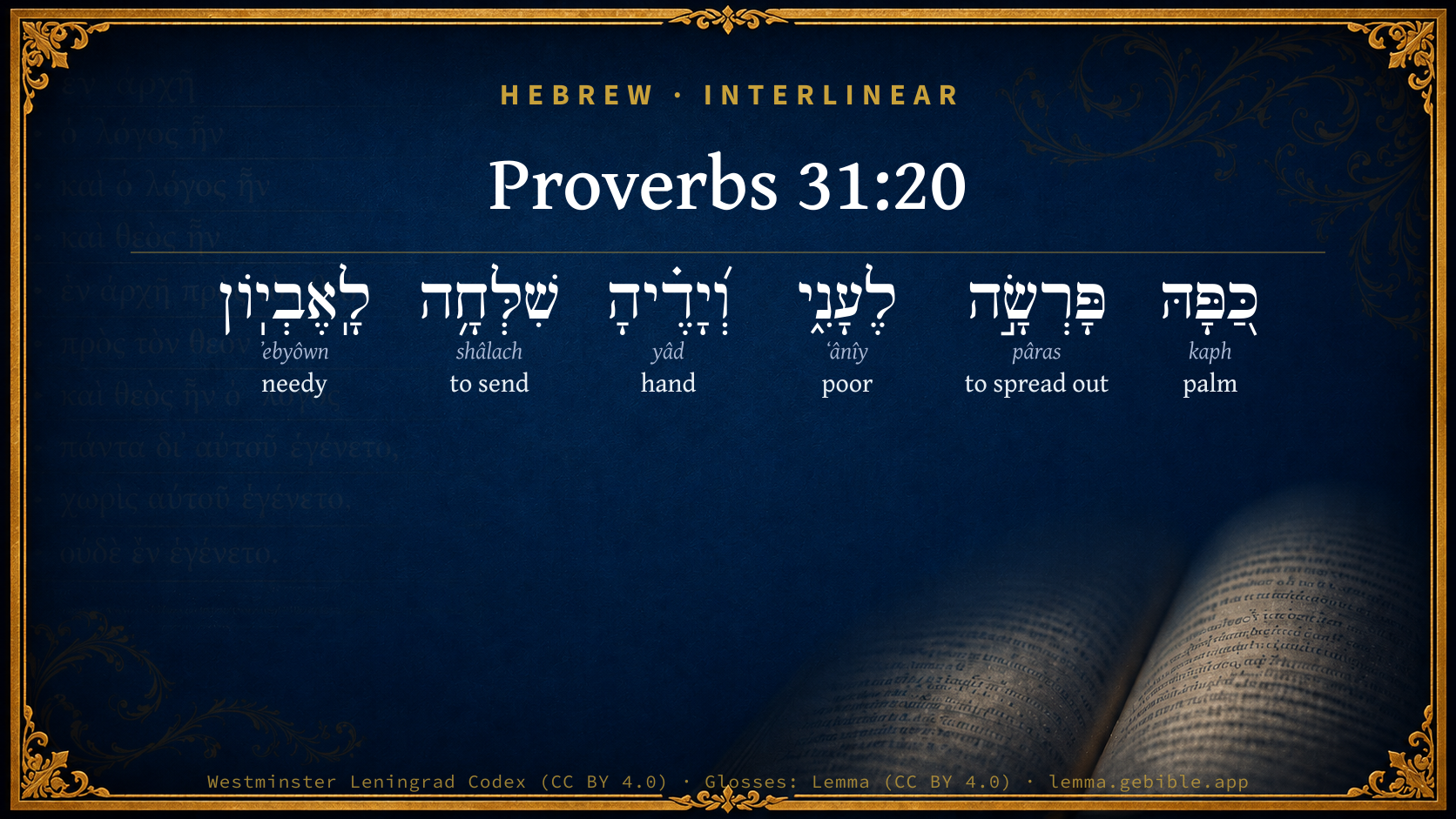
  1. כַּ֭פָּהּ kaph H3709 “palm · her” Noun, Common, Feminine, Singular, Construct + Suffix, Personal, 3rd Person, Feminine, Singular
  2. פָּרְשָׂ֣ה pâras H6566 “to spread out” Verb, Qal, Perfect, 3rd Person, Feminine, Singular
  3. לֶעָנִ֑י ʻânîy H6041 “to/for the · poor” Preposition, Determined + Adjective, Adjective, Masculine, Singular, Absolute
  4. וְ֝יָדֶ֗יהָ yâd H3027 “and · hands · her” Conjunction + Noun, Common, Both, Dual, Construct + Suffix, Personal, 3rd Person, Feminine, Singular
  5. שִׁלְּחָ֥ה shâlach H7971 “to send” Verb, Piel, Perfect, 3rd Person, Feminine, Singular

About this verse

These counts appear in no published source. They are computed here, from the morphology-tagged text and Lemma’s own curated glosses. What Lemma adds →

6
words
6
distinct lemmas
Wisdom
section

Grammatical profile

  • 2 verbs
  • 2 nouns
  • 2 adjectives

Verb forms

  • פָּרְשָׂ֣ה Qal · Perfect
  • שִׁלְּחָ֥ה Piel · Perfect

Hebrew & Septuagint length

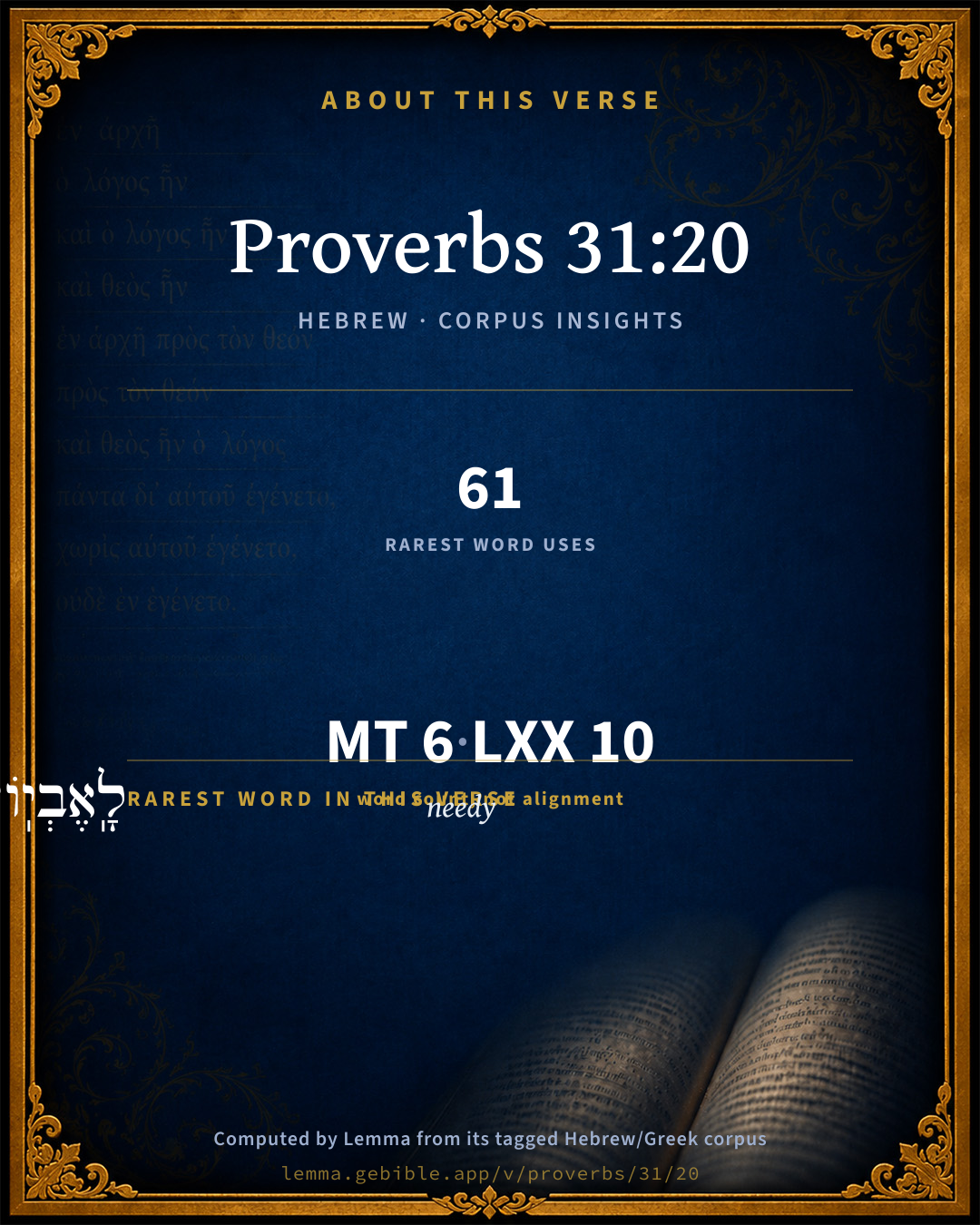
In English translation the verse runs 15 words from the Hebrew and 15 from the Septuagint (LXX English) — the same length.

A rough comparison of the two English renderings, which tokenize alike — not a word-level alignment.

Word counts can differ between the Hebrew and the Greek without any difference in meaning — e.g. the Hebrew direct-object marker אֵת has no separate Greek word, and Greek often adds the article ὁ.

In the original languages it is 6 Hebrew tokens and 10 Greek tokens — but the two are counted differently (Hebrew bundles its prefixes and suffixes into one token; the Greek is in lemma form), so that isn’t a like-for-like length.

Cross-references

15

Topical passages linked to Proverbs 31:20 in the Treasury of Scripture Knowledge — connected by theme and wording, ordered by reader-vote popularity; previews shown in the World English Bible.

  • Ephesians 4:28 Let him who stole steal no more; but rather let him labor, working with his hands the thing that is good, that he may have something to give to him who has need.
  • Hebrews 13:16 But don't forget to be doing good and sharing, for with such sacrifices God is well pleased.
  • Proverbs 19:17 He who has pity on the poor lends to Yahweh; He will reward him.
  • Proverbs 22:9 He who has a generous eye will be blessed; For he shares his food with the poor.
  • Deuteronomy 15:11 For the poor will never cease out of the land: therefore I command you, saying, You shall surely open your hand to your brother, to your needy, and to your poor, in your land.
  • Psalms 41:1 Blessed is he who considers the poor: Yahweh will deliver him in the day of evil.
  • Acts 20:34–35 You yourselves know that these hands ministered to my necessities, and to those who were with me.
  • Romans 12:13 contributing to the needs of the saints; given to hospitality.
  • Job 31:16–20 "If I have withheld the poor from their desire, Or have caused the eyes of the widow to fail,
  • Psalms 112:9 He has dispersed, he has given to the poor. His righteousness endures forever. His horn will be exalted with honor.
  • Ecclesiastes 11:1–2 Cast your bread on the waters; For you shall find it after many days.
  • Mark 14:7 For you always have the poor with you, and whenever you want to, you can do them good; but you will not always have me.
  • Acts 9:39–41 Peter got up and went with them. When he had come, they brought him into the upper chamber. All the widows stood by him weeping, and showing the coats and garments which Dorcas had made while she was with them.
  • Romans 10:21 But as to Israel he says, "All day long I stretched out my hands to a disobedient and contrary people."
  • Proverbs 1:24 Because I have called, and you have refused; I have stretched out my hand, and no one has paid attention;

Cross-references courtesy of OpenBible.info (CC BY 4.0).

Hebrew and Greek witnesses Masoretic Hebrew ↔ Greek Septuagint

The same verse in the two great witnesses to the Old Testament, shown verse-for-verse.

These are two independent witnesses, not word-aligned to each other, and the Septuagint is shown in lemma (dictionary) form.

Hebrew Proverbs 31:20 Masoretic · Westminster Leningrad Codex

כַּ֭פָּהּ פָּרְשָׂ֣ה לֶעָנִ֑י וְ֝יָדֶ֗יהָ שִׁלְּחָ֥ה לָֽאֶבְיֽוֹן

She opens her arms to the poor; Yes, she extends her hands to the needy.

World English Bible · Public Domain

Greek LXX Proverbs 31:20 Septuagint · lemma form

χείρ δέ αὐτός δια ἀναοἴγω πένης καρπός δέ ἐκτείνω πτωχός

And she opens her hands to the needy, and reaches out fruit to the poor.

LXX2012 (modern English Septuagint) · Public Domain

On this verse, The Pulpit Commentary discusses the Septuagint’s reading. Read the note in Commentary ↓

Hebrew: Westminster Leningrad Codex (CC BY 4.0). Greek: Septuagint (public domain); English from LXX2012 (modern English Septuagint) (Public Domain). How the Septuagint differs from the Hebrew →

Commentary

Notes on Proverbs 31:20 from classic Christian and Jewish commentators (each source and its license shown beneath its notes). The classic Christian expositions comment on the surrounding passage and are grouped to its opening verse, so a note may address several verses; the Jewish commentaries on the Tanakh (Rashi and others) are per-verse, so they appear only where the commentator wrote on this verse.

Lemma curates 59 commentaries, every one of them public domain or Creative Commons licensed, each selected and text-cleaned for this edition rather than reprinted as found. About our sources →

Trapp's Complete Commentary

John Trapp

Pro 31:20 She stretcheth out her hand to the poor; yea, she reacheth forth her hands to the needy.

Ver. 20. She stretcheth out her hand to the poor.] She laboureth with her hands to that purpose, {Eph 4:28} and findeth by experience that not getting but giving is the way to thrive. See my Common Place of Alms.

Yea, she reacheth forth her hands to the needy.] ‘Nittily needy,’ as one phraseth it. To those that are extremely poor she not only stretcheth but reacheth, not her hand only, but both hands; yea, she hath her almoners to give to those that she cannot go to, as Queen Anne Boleyn had. {a} For, besides what she dealt and distributed by the hands of others, she carried ever about her a certain little purse; out of which she was wont to scatter about daily some alms to the needy, thinking no day well spent wherein some man had not fared the better by some benefit at her hands. The like is told of Placilla, wife to the Emperor Theodosius, that for her courtesy and bounty to the poor she was called φιλοπτωχως, The poor man’s friend.

{a} Acts and Mon., fol. 957.

John Trapp, A Commentary or Exposition upon All the Books of the Old and New Testament (1647–1656) — public domain. Text from a community e-Sword module.

Joseph Benson's Commentary

Pro 31:20. She stretcheth out her hand to the poor — To relieve their necessities. Her designs are generous and noble; for she labours not only to supply her own and her household’s necessities, or to support her own state, much less to feed her pride and luxury; but that she may have wherewith to supply the wants of others, who crave or need her assistance. Which also procures God’s blessing upon her husband and children, and whole family, to whom, by this means, she brings both honour and advantage.

Joseph Benson's Commentary on the Old and New Testaments (1811–1818) — public domain. Text from a community e-Sword module.

Jamieson, Fausset & Brown

Robert Jamieson, A. R. Fausset & David Brown

Industry enables her to be charitable.

Jamieson, Fausset & Brown — Commentary Critical and Explanatory on the Whole Bible (1871) — public domain (CC PDM 1.0). Text via the HelloAO Bible API.

Adam Clarke's Commentary

Verse 20. She stretcheth out her hand to the poor]

11. She is truly charitable. She knows that in every portion of a man's gain God requires a lot for the poor; and if this is not given, God's blessing is not in the rest. And she is not contented to give common alms. While with one hand (יד yad) she relieves the general poor, with both hands (ידיה yadeyha) she gives to the needy, לעני leaney, to the afflicted poor.

Adam Clarke's Commentary on the Bible (1810–1826) — public domain. Text from a community e-Sword/MySword module.

Ellicott's Commentary for English Readers

(20) She streteheth out her hand to the poor.—Either in sympathy or with alms; “yea, she reacheth forth (both) her hands to the needy;” she is keenly alive to their sorrows, and pities them and aids them with all her power.

A Bible Commentary for English Readers, edited by Charles John Ellicott (1878–1897) — public domain. Text from a community e-Sword module.

The Cambridge Bible for Schools and Colleges

gen. ed. J. J. S. Perowne

20. stretcheth out] Rather, spreadeth out.

her hand] Lit. her palm. The whole expression, spreadeth out her palm (holding out the gift for acceptance) denotes the open-handed liberality with which she disperses abroad and gives to the poor (Psa_112:9; 2Co_9:9).

“The hand which is thus held out to the poor is precisely the hand which has been laid on the distaff and the spindle; not the lazy hand or the useless hand, but the hand which is supple with toil, dexterous with acquired skill.” Horton.

The Cambridge Bible for Schools and Colleges (gen. ed. J. J. S. Perowne; Cambridge University Press, 1878–1918) — public domain. Text from a community e-Sword module.

John Gill's Exposition

She stretcheth out her hand to the poor,.... Her liberality is very extensive, reaches to many, and at a distance; it is done with great cheerfulness and readiness; to do good and communicate, she forgets not, it being acceptable to her Lord and husband, Heb 13:16;

yea, she reacheth forth her hands to the needy; she gives with both hands, liberally and largely. It may be applied to the church, giving spiritual food by her ministers to those who are poor in spirit, spiritually poor and needy, and who hunger and thirst after righteousness.

John Gill's Exposition of the Whole Bible (1746–1763) — public domain (CC PDM 1.0). Text via the HelloAO Bible API.

Albert Barnes' Notes on the Bible

The industry is not selfish, but bears the fruit of an open-handed charity.

Albert Barnes' Notes on the Bible (1834–1885) — public domain. Text from a community e-Sword/MySword module.

Matthew Poole's English Annotations

To relieve their necessities. Her designs are generous and noble; for she labours not only to supply her own and her household necessities, or to support her own state, much less to feed her pride and luxury, but that she may have wherewith to supply the wants of others who crave or need her assistance; which also procures God’s blessing upon her husband, and children, and whole family, to whom, by this means, she brings both honour and advantage.

Matthew Poole's English Annotations on the Holy Bible (1683–1685) — public domain. Text from a community e-Sword/MySword module.

Whedon's Commentary on the Bible

Daniel D. Whedon

20. Stretcheth out… to the poor — She spreads out or opens her palm. While exceedingly thrifty and industrious, she is not “close-fisted;” but generously opens her hand to every case of distress and need: an example of good economy and liberality — two virtues but rarely blended, unhappily, in the same person, either man or woman.

Daniel D. Whedon (gen. ed.), Commentary on the Old and New Testaments (1874–1909) — public domain. Text from a community e-Sword module.

The Pulpit Commentary

CAPH. She is not impelled by selfish greed to improve her means and enlarge her revenues. She is sympathizing and charitable, and loves to extend to others the blessings which have rewarded her efforts. She stretcheth out her hand to the poor. "Hand" is here caph, "the palm," evidently containing alms. She knows the maxim, (Pro_19:17) "He that hath pity upon the poor lendeth unto the Lord," etc.; and she has no fear of poverty. Yea, she reacheth forth her hands to the needy. "Hand," is here yod, with its nerves and sinews ready for exertion; (see on Pro_10:4) and the idea is that she puts forth her hand to raise and soothe the poor man, not being satisfied with dealing alms to him, but exercising the gentle ministries of a tender love. Septuagint, "She opens her hands to the needy, and reaches forth her wrist (karpon ) to the poor." Like Dorcas, she is full of good works and alms deeds. (Act_9:36) It is doubtless implied that the prosperity which she experiences is the reward of this benevolence. (Pro_22:9)

The Pulpit Commentary (1880–1919), ed. H.D.M. Spence-Jones & Joseph S. Exell — public domain. Text from a community e-Sword module.

Keil & Delitzsch

C. F. Keil & F. Delitzsch

That which impels the housewife to this labour is not selfishness, not a narrow-hearted limitation of her care to the circle of what is her own, but love, which reaches out far beyond this circle:

20 כ She holdeth out her hand to the unfortunate,

And stretcheth forth her hands to the needy.

With כּפּיה, 19b, is connected the idea of artistic skilfulness; with כּפּהּ, here that of offering for counsel (vid., at Isa 2:6); with sympathy and readiness to help, she presents herself to those who are oppressed by the misfortunes of life as if for an alliance, as if saying: place confidence in me, I shall do whatever I can - there thou hast my hand! Hitzig erroneously thinks of the open hand with a gift lying in it: this ought to be named, for כף in itself is nothing else than the half-opened hand. Also in 20b we are not to think of alms. Here Hitzig rightly: she stretches out to him both of her hands, that he might grasp them, both of them, or whichever he may. She does not throw to him merely a gift from a distance, but above all she gives to him to experience her warm sympathy (cf. Eze 16:49). Here, as at 19a, שׁלחה is punctuated (with Dagesh) as Piel. The punctuation supposes that the author both times not unintentionally made use of the intensive form. This one verse (20) is complete in itself as a description of character; and the author has done well in choosing such strong expressions, for, without this sympathy with misery and poverty, she, so good and trustworthy and industrious, might indeed be pleasing to her husband, but not to God. One could almost wish that greater expansion had been given to this one feature in the picture.

Keil & Delitzsch — Biblical Commentary on the Old Testament (1861–1891) — public domain (CC PDM 1.0). Text via the HelloAO Bible API. (Old Testament only.)

unfoldingWord translationNotes

Door43 World Missions Community

reaches out with her hand to poor

The hand is a metonym for the help the woman uses her hand to give. AT: "helps poor" (See: Metonymy)

reaches out with her hands to

These words translate the same words translated "puts her hands on" in Proverbs 31:19.

are clothed in scarlet

Here "scarlet" does not refer to the color of the cloth, but that the clothing is expensive and warm. AT: "have expensive, warm clothing" (See: Metonymy)

scarlet

The color red, but with a hint of orange.

translationWords

snow

household

clothe

unfoldingWord translationNotes — © Distant Shores Media and the Door43 World Missions Community, licensed CC BY-SA 4.0. Source: git.door43.org/Door43/en_tn.

Lesson kit

Teaching starters — assembled from the data on this page, not authored interpretation. Every prompt links to the verse data it draws on. Edit before teaching.

Proverbs, in the Wisdom, opens this verse with 6 words (6 distinct Hebrew lemmas). Its most distinctive word is ʼebyôwn (“needy”). A historical commentator’s framing appears above. Read the whole chapter for the surrounding context.

Discussion questions

  1. How does “needy” (ʼebyôwn) shape what this verse is saying?
  2. How does Ephesians 4:28, which shares this passage’s theme, read alongside this verse?
  3. The translations on this page render this verse differently — a whole-verse word diff, not a word-by-word alignment. What might account for the different wordings?
  4. «פָּרְשָׂ֣ה» is a Qal Perfect verb. How does that grammatical form shape the action described?
  5. Compare how Trapp's Complete Commentary and Joseph Benson's Commentary read this verse. Where do they agree or differ?

Things to notice

Reading settings

Reading text

Shown beneath each verse's original-language words.

Old Testament
Old Testament edition

Read the OT as the Masoretic Hebrew (MT) or the Greek Septuagint (LXX).

English shown for the Greek Septuagint (in the Hebrew ↔ Greek comparison).

Comparing translations? Open the Compare panel on any verse page to stack up to four side by side.