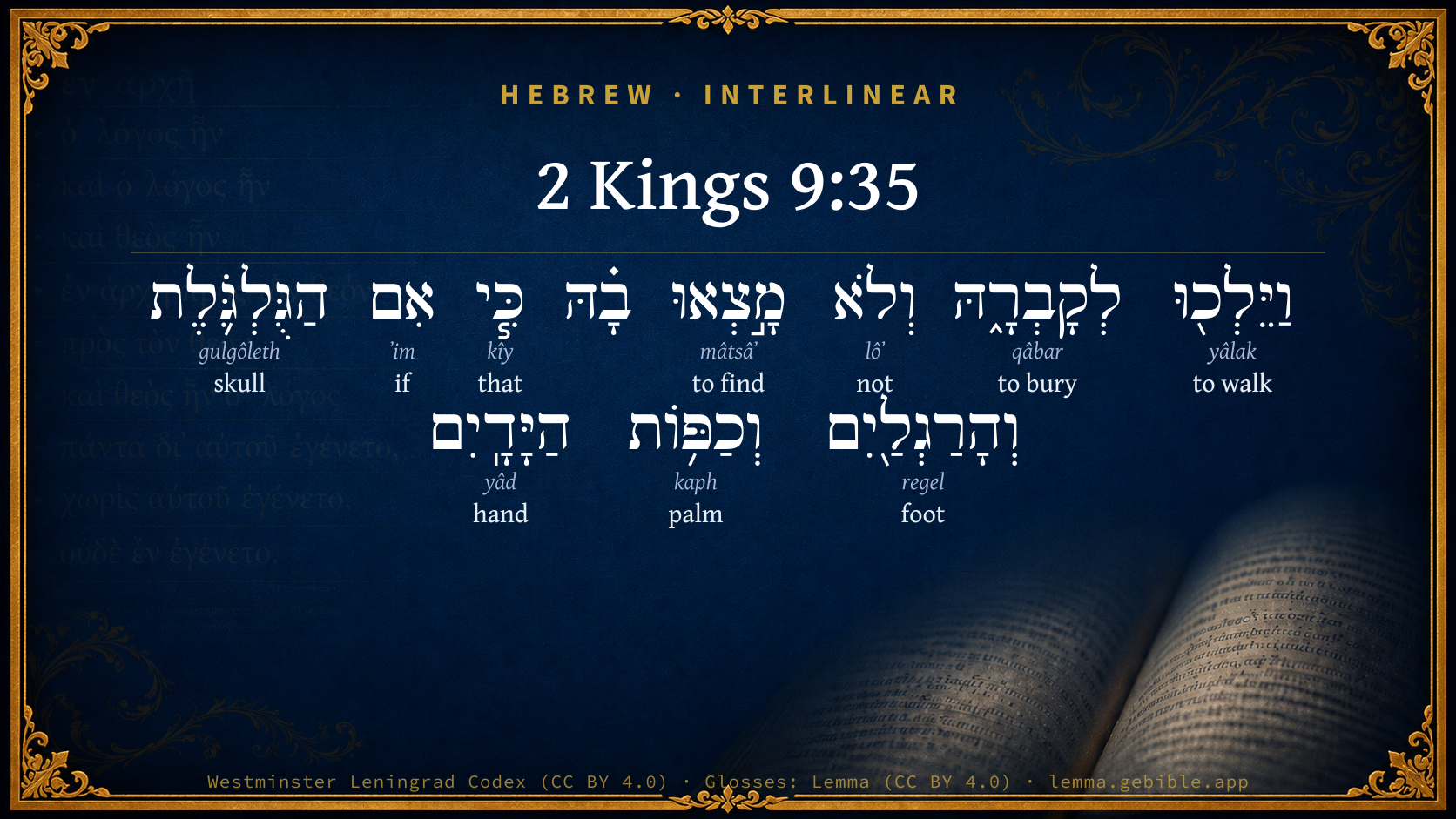
2 Kings 9:35

Hebrew (Westminster Leningrad Codex) 2 Kings 9:35 appears in the Hebrew Old Testament. The text above is from the Westminster Leningrad Codex. Each word links to its Strong’s number, a concise gloss, and parsing drawn from the Open Scriptures Hebrew Bible morphology. Click any word for its full Brown-Driver-Briggs (BDB) entry.
Download image
Cite this verse

2 Kings 9:35 (World English Bible). Public Domain. Lemma interlinear Bible study tool, https://lemma.gebible.app/v/2-kings/9/35.

Show BibTeX & RIS
BibTeX
RIS
English Translation
They went to bury her; but they found no more of her than the skull, and the feet, and the palms of her hands.
World English Bible · Public Domain
Download a study sheet

One document with this verse’s original text, its word-by-word gloss line, the meaning frame, cross-references with their text, attributed commentary, and full source and license credits — printable, and it pastes into notes with its structure intact.

This verse Autodidact and up

Study sheet (.html) Plain text (.txt)

A passage Seminary Student

Up to 50 verses in one chapter. A passage sheet keeps up to 6 commentary sources and 12 cross-references per verse, in the order this page ranks them, and says so on the sheet whenever that leaves anything out. Ask for a single verse and you get the Autodidact verse sheet above.

Everything on this page stays free to read, with no account — the sheet is a download of what is already on screen, not access to it.

Want to remove ads? Support Godless Engineer
Compare translations 3

The same verse in 3 English versions, stacked beneath the original-language interlinear above. Click any original word for its lexicon entry.

Each is an independent rendering of the whole verse — the interlinear is not word-aligned to these translations.

Highlighted words mark where these versions differ — a whole-verse word diff, not a word-by-word alignment.

  • World English Bible Public Domain
    They went to bury her; but they found no more of her than the skull, and the feet, and the palms of her hands.
  • King James Version Public Domain
    And they went to bury her: but they found no more of her than the skull, and the feet, and the palms of her hands.
  • unfoldingWord Literal Text CC BY-SA 4.0
    So they went to bury her, but they did not find of her except the skull and the feet and the palms of the hands.

unfoldingWord Literal Text — © unfoldingWord, licensed CC BY-SA 4.0. Word-aligned USFM3 via Door43 (git.door43.org/unfoldingWord/en_ult).

Versions to compare (up to 4)

3 of 4 selected

Show all 18 translations

Every available English version of this verse, each an independent rendering of the whole verse.

  • World English Bible Public Domain
    They went to bury her; but they found no more of her than the skull, and the feet, and the palms of her hands.
  • Berean Standard Bible Public Domain
    But when they went out to bury her, they found nothing but her skull, her feet, and the palms of her hands.
  • Majority Standard Bible Public Domain
    But when they went out to bury her, they found nothing but her skull, her feet, and the palms of her hands.
  • King James Version Public Domain
    And they went to bury her: but they found no more of her than the skull, and the feet, and the palms of her hands.
  • American Standard Version (1901) Public Domain
    And they went to bury her; but they found no more of her than the skull, and the feet, and the palms of her hands.
  • Revised Version (1885) Public Domain
    And they went to bury her: but they found no more of her than the skull, and the feet, and the palms of her hands.
  • Geneva Bible (1599) Public Domain
    And they went to burie her, but they foud no more of her, then the skull and the feete, and the palmes of her handes.
  • Douay-Rheims (1899) Public Domain
    And when they went to bury her, they found nothing but the skull, and the feet, and the extremities of her hands.
  • Young's Literal Translation Public Domain
    And they go to bury her, and have not found of her except the skull, and the feet, and the palms of the hands.
  • Literal Standard Version CC BY-SA 4.0
    And they go to bury her, and have not found [anything] of her except the skull, and the feet, and the palms of the hands.
  • Unlocked Literal Bible CC BY-SA 4.0
    They went to bury her, but they found no more of her than the skull, the feet, and the palms of her hands.
  • unfoldingWord Literal Text CC BY-SA 4.0
    So they went to bury her, but they did not find of her except the skull and the feet and the palms of the hands.
  • Darby Bible Public Domain
    And they went to bury her; but they found no more of her than the skull, and the feet, and the palms of the hands.
  • World Messianic Bible Public Domain
    They went to bury her, but they found no more of her than the skull, the feet, and the palms of her hands.
  • Webster's Bible Public Domain
    And they went to bury her: but they found no more of her than the skull, and the feet, and the palms of her hands.
  • Free Bible Version CC BY-SA 4.0
    They went out to bury her but all they found were her skull, her feet, and her hands.
  • Bible in Basic English Public Domain
    And they went out to put her body into the earth, but nothing of her was to be seen, only the bones of her head, and her feet, and parts of her hands.
  • JPS Tanakh (1917) Public Domain
    And they went to bury her; but they found no more of her than the skull, and the feet, and the palms of her hands.

Literal Standard Version (2020), Covenant Press — licensed CC BY-SA 4.0. Text via the HelloAO Bible API (eBible.org). Unlocked Literal Bible (unfoldingWord) — licensed CC BY-SA 4.0. Text via the HelloAO Bible API (eBible.org). unfoldingWord Literal Text — © unfoldingWord, licensed CC BY-SA 4.0. Word-aligned USFM3 via Door43 (git.door43.org/unfoldingWord/en_ult). Free Bible Version, Dr. Jonathan Gallagher — licensed CC BY-SA 4.0. Text via the HelloAO Bible API (eBible.org).

Word by word

More ways to search: Search by grammar → Find every occurrence → Compare this word →

Practice this passage: Drill this verse → Learn its vocabulary →

הַגֻּלְגֹּ֛לֶת
gulgôleth
H1538
“the · skull”
Particle, Definite Article + Noun, Common, Feminine, Singular, Absolute
Part of Speech
Particle + Noun
Type
Common
Gender
Feminine
Number
Singular
State
Absolute
Full BDB Definition

Origin: by reduplication from H1556

TWOT: 353l

head, poll, skull - skull - head, poll (of census)
  1. וַיֵּלְכ֖וּ yâlak H3212 “and · to walk” Conjunction + Verb, Qal, Sequential Imperfect, 3rd Person, Masculine, Plural
  2. לְקָבְרָ֑הּ qâbar H6912 “to bury · her” Preposition + Verb, Qal, Infinitive Construct + Suffix, Personal, 3rd Person, Feminine, Singular
  3. וְלֹא lôʼ H3808 “and · not” Conjunction + Particle, Negative
  4. מָ֣צְאוּ mâtsâʼ H4672 “to find” Verb, Qal, Perfect, 3rd Person, Common, Plural
  5. כִּ֧י kîy H3588 “that” Conjunction
  6. אִם ʼim H518 “if” Conjunction
  7. וְהָרַגְלַ֖יִם regel H7272 “and · the · feet” Conjunction + Particle, Definite Article + Noun, Common, Feminine, Dual, Absolute
  8. וְכַפּ֥וֹת kaph H3709 “and · palms of” Conjunction + Noun, Common, Feminine, Plural, Construct
  9. הַיָּדָֽיִם yâd H3027 “the · hands” Particle, Definite Article + Noun, Common, Both, Dual, Absolute

About this verse

These counts appear in no published source. They are computed here, from the morphology-tagged text and Lemma’s own curated glosses. What Lemma adds →

11
words
10
distinct lemmas
Historical
section

Notable vocabulary

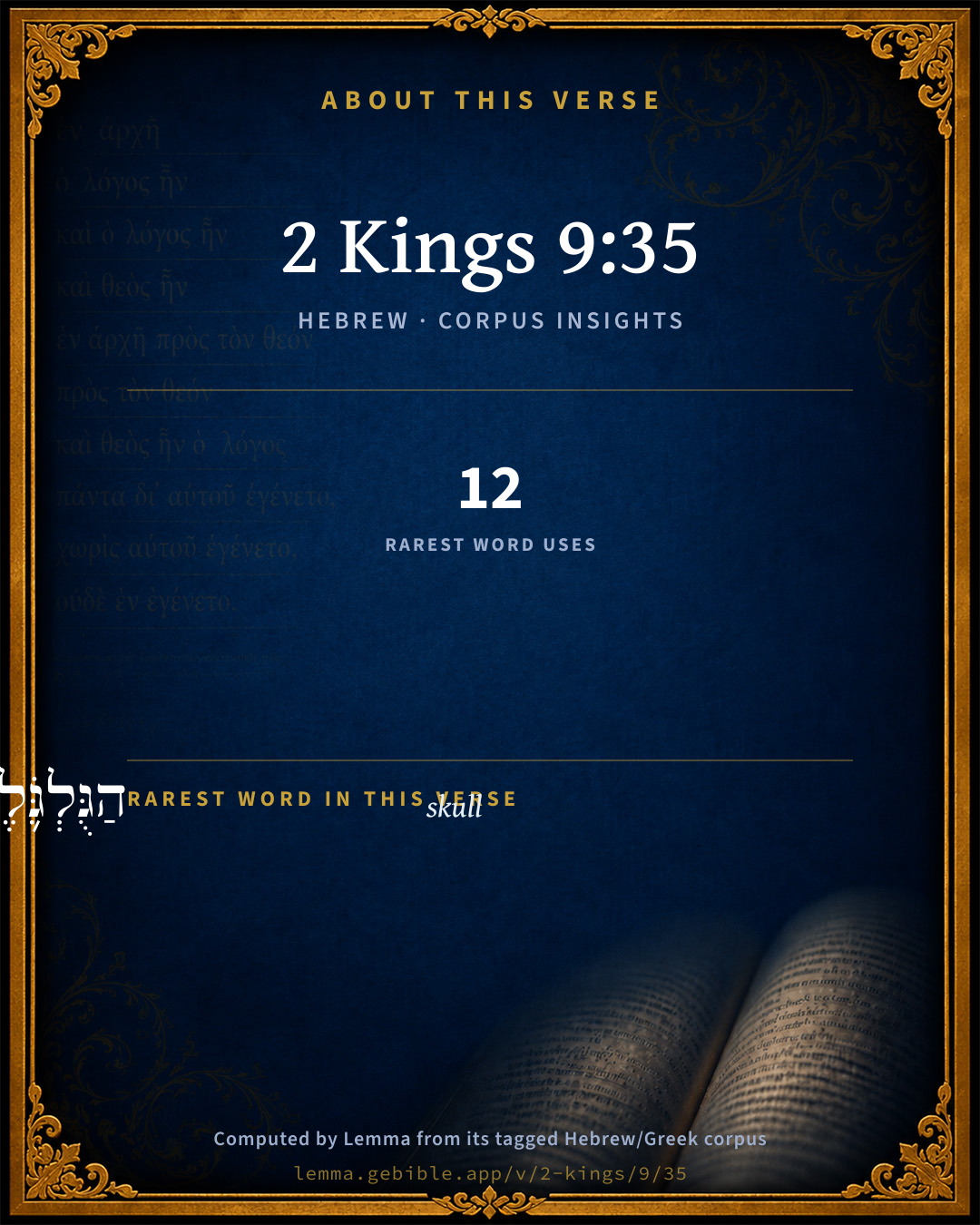
The rarest word here is הַגֻּלְגֹּ֛לֶת skull H1538 — appearing just 12 times in the whole Hebrew Bible.

Shared distinctive vocabulary

הַגֻּלְגֹּ֛לֶת skull H1538 occurs in 12 verses of the Hebrew Bible. Also found in:

Grammatical profile

  • 3 verbs
  • 4 nouns
  • 1 preposition
  • 2 conjunctions
  • 1 particle

Verb forms

  • וַיֵּלְכ֖וּ Qal · Sequential Imperfect
  • לְקָבְרָ֑הּ Qal · Infinitive Construct
  • מָ֣צְאוּ Qal · Perfect

Hebrew & Septuagint length

In English translation the verse runs 24 words from the Hebrew and 24 from the Septuagint (LXX English) — the same length.

A rough comparison of the two English renderings, which tokenize alike — not a word-level alignment.

Word counts can differ between the Hebrew and the Greek without any difference in meaning — e.g. the Hebrew direct-object marker אֵת has no separate Greek word, and Greek often adds the article ὁ.

Cross-references

6

Topical passages linked to 2 Kings 9:35 in the Treasury of Scripture Knowledge — connected by theme and wording, ordered by reader-vote popularity; previews shown in the World English Bible.

  • Job 31:3 Is it not calamity to the unrighteous, And disaster to the workers of iniquity?
  • Ecclesiastes 6:3 If a man fathers a hundred children, and lives many years, so that the days of his years are many, but his soul is not filled with good, and moreover he has no burial; I say, that an untimely birth is better than he:
  • Isaiah 14:18–20 All the kings of the nations, all of them, sleep in glory, everyone in his own house.
  • Jeremiah 22:19 He shall be buried with the burial of a donkey, drawn and cast forth beyond the gates of Jerusalem.
  • Jeremiah 36:30 Therefore thus says Yahweh concerning Jehoiakim king of Judah: He shall have none to sit on the throne of David; and his dead body shall be cast out in the day to the heat, and in the night to the frost.
  • Acts 12:23 Immediately an angel of the Lord struck him, because he didn't give God the glory, and he was eaten by worms and died.

Cross-references courtesy of OpenBible.info (CC BY 4.0).

Hebrew and Greek witnesses Masoretic Hebrew ↔ Greek Septuagint

The same verse in the two great witnesses to the Old Testament, shown verse-for-verse.

These are two independent witnesses, not word-aligned to each other, and the Septuagint is shown in lemma (dictionary) form.

Hebrew 2 Kings 9:35 Masoretic · Westminster Leningrad Codex

וַיֵּלְכ֖וּ לְקָבְרָ֑הּ וְלֹא מָ֣צְאוּ בָ֗הּ כִּ֧י אִם הַגֻּלְגֹּ֛לֶת וְהָרַגְלַ֖יִם וְכַפּ֥וֹת הַיָּדָֽיִם

They went to bury her; but they found no more of her than the skull, and the feet, and the palms of her hands.

World English Bible · Public Domain

Greek LXX 2 Kings 9:35 Septuagint · lemma form

καί πορεύομαι θάπτω αὐτός καί οὐ εὑρίσκω ἐν αὐτός ἄλλος τις ἤ ὁ κρανίον καί ὁ πούς καί ὁ ἴχνος ὁ χείρ

And they went to bury her; but they found nothing of her but the skull, and the feet, and the palms of her hands.

LXX2012 (modern English Septuagint) · Public Domain

Hebrew: Westminster Leningrad Codex (CC BY 4.0). Greek: Septuagint (public domain); English from LXX2012 (modern English Septuagint) (Public Domain). How the Septuagint differs from the Hebrew →

Targum (Aramaic paraphrase)

1

The Targum is the ancient Jewish Aramaic paraphrase of the Hebrew Scriptures — an interpretive translation, not the Hebrew text itself. Onkelos (literal) and Pseudo-Jonathan (expansive) render the Torah, and Jonathan the Prophets. Coverage is partial: where no permissively-licensed English translation exists for a verse, only the Aramaic is shown. This is verse-level text, not a word-by-word alignment to the Hebrew.

  1. Targum Jonathan Prophets (Joshua–Malachi)
    וַאֲזַלוּ לְמִקְבְּרָהּ וְלָא אַשְׁכָּחוּ בָה אֱלָהֵין גוּלְגַלְתָּא וְרַגְלַיָא וּפִסַת יְדָא:

    (no public-domain English translation for this verse)

    Targum Jonathan — Aramaic: “Mikraot Gedolot” (public domain). English: “Sefaria Community Translation” (CC0 1.0 (public-domain dedication)); “London "Chaldee Paraphrase," 1871” (public domain). Text via Sefaria.

Commentary

Notes on 2 Kings 9:35 from classic Christian and Jewish commentators (each source and its license shown beneath its notes). The classic Christian expositions comment on the surrounding passage and are grouped to its opening verse, so a note may address several verses; the Jewish commentaries on the Tanakh (Rashi and others) are per-verse, so they appear only where the commentator wrote on this verse.

Lemma curates 59 commentaries, every one of them public domain or Creative Commons licensed, each selected and text-cleaned for this edition rather than reprinted as found. About our sources →

Trapp's Complete Commentary

John Trapp

2Ki 9:35 And they went to bury her: but they found no more of her than the skull, and the feet, and the palms of [her] hands.

Ver. 35. Than the skull, and the feet.] All her flesh was devoured by dogs. And the like befell those Donatists that cast the sacramental bread to dogs, as is before noted. Let all dogged persecutors look to it: Qualis vita, finis ita; those that fall foul upon the saints, shall come to an ill end, as were easy to exemplify.

John Trapp, A Commentary or Exposition upon All the Books of the Old and New Testament (1647–1656) — public domain. Text from a community e-Sword module.

Jamieson, Fausset & Brown

Robert Jamieson, A. R. Fausset & David Brown

found no more of her than the skull, and the palms of her hands, &c.--The dog has a rooted aversion to prey on the human hands and feet.

Jamieson, Fausset & Brown — Commentary Critical and Explanatory on the Whole Bible (1871) — public domain (CC PDM 1.0). Text via the HelloAO Bible API.

Adam Clarke's Commentary

Verse 35. The skull - the feet, and the palms of her hands.] The dogs did not eat those parts, say Jarchi and Kimchi, because in her festal dances she danced like a dog, on her hands and feet, wantonly moving her head. What other meaning these rabbins had, I do not inquire. She was, no doubt, guilty of the foulest actions, and was almost too bad to be belied.

How literally was the prediction delivered in the preceding book, (1Kg 21:23, The dogs shall eat Jezebel, by the wall of Jezreel,) fulfilled! And how dearly did she and her husband Ahab pay for the murder of innocent Naboth!

Adam Clarke's Commentary on the Bible (1810–1826) — public domain. Text from a community e-Sword/MySword module.

Ellicott's Commentary for English Readers

(35) Her hands.—Heb., the hands.

A Bible Commentary for English Readers, edited by Charles John Ellicott (1878–1897) — public domain. Text from a community e-Sword module.

The Cambridge Bible for Schools and Colleges

gen. ed. J. J. S. Perowne

35. they went to bury her] While Jehu was refreshing himself in the palace, the dogs gathered about the dead body of Jezebel and devoured it. So completely had the tide of popular favour turned towards Jehu, that there was not found one to protect the corpse of Jezebel.

The Cambridge Bible for Schools and Colleges (gen. ed. J. J. S. Perowne; Cambridge University Press, 1878–1918) — public domain. Text from a community e-Sword module.

Haydock's Catholic Bible Commentary

Hands. All the rest had been presently devoured, or carried off by dogs. (Haydock) --- Her precious jewels had been plundered by the soldiers. (Menochius)

George Leo Haydock (1774–1849), Haydock's Catholic Family Bible and Commentary, 1859 edition — public domain. Excludes Psalms (Douay-Rheims chapter numbering differs from Protestant) and Deuterocanonical books (Catholic canon only).

Whedon's Commentary on the Bible

Daniel D. Whedon

35. Skull… feet… hands — An eastern traveller, describing the remains of some human bodies that had been devoured by dogs, says: “The only portion of the several corpses I noticed that remained entire and untouched, were the bottoms of the feet, and the insides of the hands — a proof of the rooted antipathy the dog has to prey upon the human hands and feet.” Dr. Thomson supposes that the dogs under Jezebel’s palace “may have been taught to devour the wretched victims of her cruelty, in which case the retribution would be remarkably striking.”

Daniel D. Whedon (gen. ed.), Commentary on the Old and New Testaments (1874–1909) — public domain. Text from a community e-Sword module.

The Pulpit Commentary

And they went to bury her: hut they found no more of her than the skull, and the feet, and the palms of her hands. "The harder parts of the human frame" (Stanley); perhaps also the less palatable, since cannibals say that the palm of the human hand is excessively bitter. Dogs in Oriental countries are ever prowling about, especially in the vicinity of towns, on the lookout for food, and will eat flesh or offal of any kind. They have been called "the scavengers of the East," and the phrase well describes them. Dean Stanley saw "the wild dogs of Jezreel prowling about the mounds where the offal is cast outside the gates of the town by the inhabitants."

The Pulpit Commentary (1880–1919), ed. H.D.M. Spence-Jones & Joseph S. Exell — public domain. Text from a community e-Sword module.

Keil & Delitzsch

C. F. Keil & F. Delitzsch

But when they went to bury her, they found nothing but her skull, the two feet, and the two hollow hands. The rest had been eaten by the dogs and dragged away. When this was reported to Jehu, he said: "This is the word of the Lord, which He spake by His servant Elijah," etc. (Kg1 21:23), i.e., this has been done in fulfilment of the word of the Lord. Kg2 9:37 is also to be regarded as a continuation of the prophecy of Elijah quoted by Jehu (and not as a closing remark of the historian, as Luther supposes), although what Jehu says here does not occur verbatim in Kg1 21:23, but Jehu has simply expanded rather freely the meaning of that prophecy. והית (Chethb) is the older form of the 3rd pers. fem. Kal, which is only retained here and there (vid., Ewald, 194, a.). אשׁר is a conjunction (see Ewald, 337, a.): "that men may not be able to say, This is Jezebel," i.e., that they may no more be able to recognise Jezebel.

Keil & Delitzsch — Biblical Commentary on the Old Testament (1861–1891) — public domain (CC PDM 1.0). Text via the HelloAO Bible API. (Old Testament only.)

unfoldingWord translationNotes

Door43 World Missions Community

they found no more of her than

"they found no more of her body than" This can be stated in positive form. AT: "all they found that was left of her body were"

the palms of her hands

The palm is the inner part of the hand.

the Tishbite

This refers to someone from the city of Tishbe. See how you translated this in 2 Kings 1:3. (See: How to Translate Names)

the body of Jezebel will be like dung on the surface of the fields ... so that no one will be able to say

This speaks of the pieces of Jezebel's body being scattered in the field as if they were dung spread in the field. Since the pieces of her body were so small and spread out there was nothing that could be collected and buried. AT: "the pieces of Jezebel's body will be scattered like dung in the fields ... so that no one will be able to recognize them and say" (See: Simile)

dung

manure, specifically dung used as a fertilizer

so that no one will be able to say, "This is Jezebel."

"so that no one will be able to recognize her body." or "so no one will be able to tell this was Jezebel."

translationWords

skull

Elijah

flesh

dung

unfoldingWord translationNotes — © Distant Shores Media and the Door43 World Missions Community, licensed CC BY-SA 4.0. Source: git.door43.org/Door43/en_tn.

Rashi

Rabbi Shlomo Yitzchaki (Rashi)

The skull [and] the feet. Our Rabbis said, that she would dance before bridegrooms with her hands and feet, and shake her head.

Rashi on the Tanakh — English translations: “The Judaica Press complete Tanach with Rashi, translated by A. J. Rosenberg” (CC BY 4.0); “Pentateuch with Rashi's commentary by M. Rosenbaum and A.M. Silbermann, 1929-1934” (public domain); “The Metsudah Tanach series, Lakewood, N.J” (CC BY 4.0); and “The Book of Joshua, Metsudah Publications, 1997” (CC BY 4.0). Text via Sefaria.

Lesson kit

Teaching starters — assembled from the data on this page, not authored interpretation. Every prompt links to the verse data it draws on. Edit before teaching.

2 Kings, in the Historical, opens this verse with 11 words (10 distinct Hebrew lemmas). Its most distinctive word is gulgôleth (“skull”). A historical commentator’s framing appears above. Read the whole chapter for the surrounding context.

Discussion questions

  1. How does “skull” (gulgôleth) shape what this verse is saying?
  2. How does Exodus 16:16, which shares the word «skull», read alongside this verse?
  3. The translations on this page render this verse differently — a whole-verse word diff, not a word-by-word alignment. What might account for the different wordings?
  4. «וַיֵּלְכ֖וּ» is a Qal Sequential Imperfect verb. How does that grammatical form shape the action described?
  5. Compare how Trapp's Complete Commentary and Jamieson, Fausset & Brown read this verse. Where do they agree or differ?

Things to notice

Reading settings

Reading text

Shown beneath each verse's original-language words.

Old Testament
Old Testament edition

Read the OT as the Masoretic Hebrew (MT) or the Greek Septuagint (LXX).

English shown for the Greek Septuagint (in the Hebrew ↔ Greek comparison).

Comparing translations? Open the Compare panel on any verse page to stack up to four side by side.