
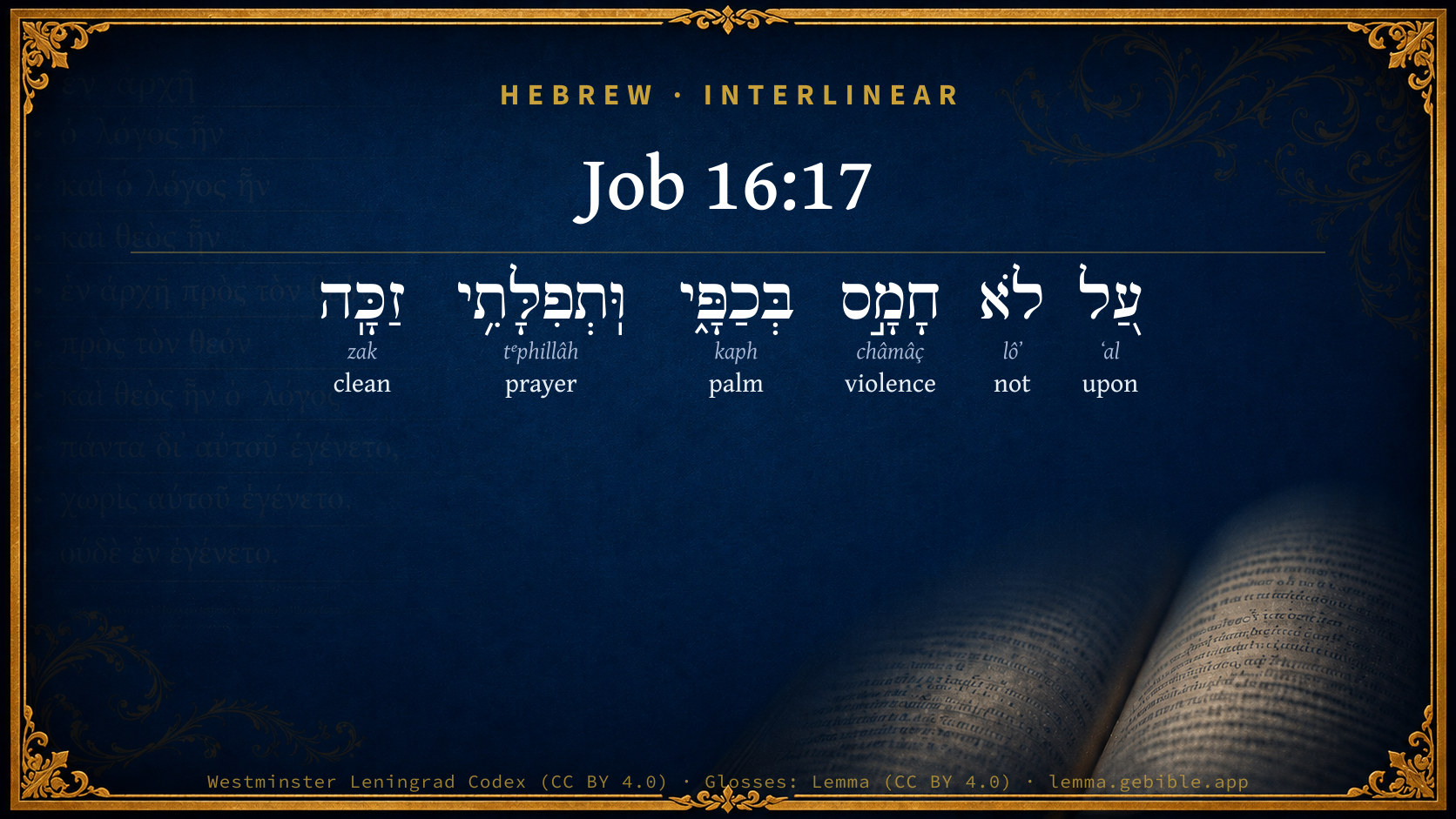
Job 16:17

Hebrew (Westminster Leningrad Codex) Job 16:17 appears in the Hebrew Old Testament. The text above is from the Westminster Leningrad Codex. Each word links to its Strong’s number, a concise gloss, and parsing drawn from the Open Scriptures Hebrew Bible morphology. Click any word for its full Brown-Driver-Briggs (BDB) entry.
Download image
Cite this verse

Job 16:17 (World English Bible). Public Domain. Lemma interlinear Bible study tool, https://lemma.gebible.app/v/job/16/17.

Show BibTeX & RIS
BibTeX
RIS
English Translation
Although there is no violence in my hands, And my prayer is pure.
World English Bible · Public Domain
Download a study sheet

One document with this verse’s original text, its word-by-word gloss line, the meaning frame, cross-references with their text, attributed commentary, and full source and license credits — printable, and it pastes into notes with its structure intact.

This verse Autodidact and up

Study sheet (.html) Plain text (.txt)

A passage Seminary Student

Up to 50 verses in one chapter. A passage sheet keeps up to 6 commentary sources and 12 cross-references per verse, in the order this page ranks them, and says so on the sheet whenever that leaves anything out. Ask for a single verse and you get the Autodidact verse sheet above.

Everything on this page stays free to read, with no account — the sheet is a download of what is already on screen, not access to it.

Want to remove ads? Support Godless Engineer
Compare translations 3

The same verse in 3 English versions, stacked beneath the original-language interlinear above. Click any original word for its lexicon entry.

Each is an independent rendering of the whole verse — the interlinear is not word-aligned to these translations.

Highlighted words mark where these versions differ — a whole-verse word diff, not a word-by-word alignment.

  • World English Bible Public Domain
    Although there is no violence in my hands, And my prayer is pure.
  • King James Version Public Domain
    Not for any injustice in mine hands: also my prayer is pure.
  • unfoldingWord Literal Text CC BY-SA 4.0
    although violence not in my hands and my prayer pure.

unfoldingWord Literal Text — © unfoldingWord, licensed CC BY-SA 4.0. Word-aligned USFM3 via Door43 (git.door43.org/unfoldingWord/en_ult).

Versions to compare (up to 4)

3 of 4 selected

Show all 18 translations

Every available English version of this verse, each an independent rendering of the whole verse.

  • World English Bible Public Domain
    Although there is no violence in my hands, And my prayer is pure.
  • Berean Standard Bible Public Domain
    yet my hands are free of violence and my prayer is pure.
  • Majority Standard Bible Public Domain
    yet my hands are free of violence and my prayer is pure.
  • King James Version Public Domain
    Not for any injustice in mine hands: also my prayer is pure.
  • American Standard Version (1901) Public Domain
    Although there is no violence in my hands, And my prayer is pure.
  • Revised Version (1885) Public Domain
    Although there is no violence in mine hands, and my prayer is pure.
  • Geneva Bible (1599) Public Domain
    Though there be no wickednesse in mine hands, and my prayer be pure.
  • Douay-Rheims (1899) Public Domain
    My face is swollen with weeping, and my eyelids are dim.
  • Young's Literal Translation Public Domain
    Not for violence in my hands, And my prayer `is' pure.
  • Literal Standard Version CC BY-SA 4.0
    Not for violence in my hands, || And my prayer [is] pure.
  • Unlocked Literal Bible CC BY-SA 4.0
    although there is no violence in my hands, and my prayer is pure.
  • unfoldingWord Literal Text CC BY-SA 4.0
    although violence not in my hands and my prayer pure.
  • Darby Bible Public Domain
    Although there is no violence in my hands, and my prayer is pure.
  • World Messianic Bible Public Domain
    although there is no violence in my hands, and my prayer is pure.
  • Webster's Bible Public Domain
    Not for any injustice in my hands: also my prayer is pure.
  • Free Bible Version CC BY-SA 4.0
    although I have done nothing wrong and my prayer is pure.
  • Bible in Basic English Public Domain
    Though my hands have done no violent acts, and my prayer is clean.
  • JPS Tanakh (1917) Public Domain
    Although there is no violence in my hands, and my prayer is pure.

Literal Standard Version (2020), Covenant Press — licensed CC BY-SA 4.0. Text via the HelloAO Bible API (eBible.org). Unlocked Literal Bible (unfoldingWord) — licensed CC BY-SA 4.0. Text via the HelloAO Bible API (eBible.org). unfoldingWord Literal Text — © unfoldingWord, licensed CC BY-SA 4.0. Word-aligned USFM3 via Door43 (git.door43.org/unfoldingWord/en_ult). Free Bible Version, Dr. Jonathan Gallagher — licensed CC BY-SA 4.0. Text via the HelloAO Bible API (eBible.org).

Word by word

More ways to search: Search by grammar → Find every occurrence → Compare this word →

Practice this passage: Drill this verse → Learn its vocabulary →

About this verse

These counts appear in no published source. They are computed here, from the morphology-tagged text and Lemma’s own curated glosses. What Lemma adds →

6
words
6
distinct lemmas
Wisdom
section

Notable vocabulary

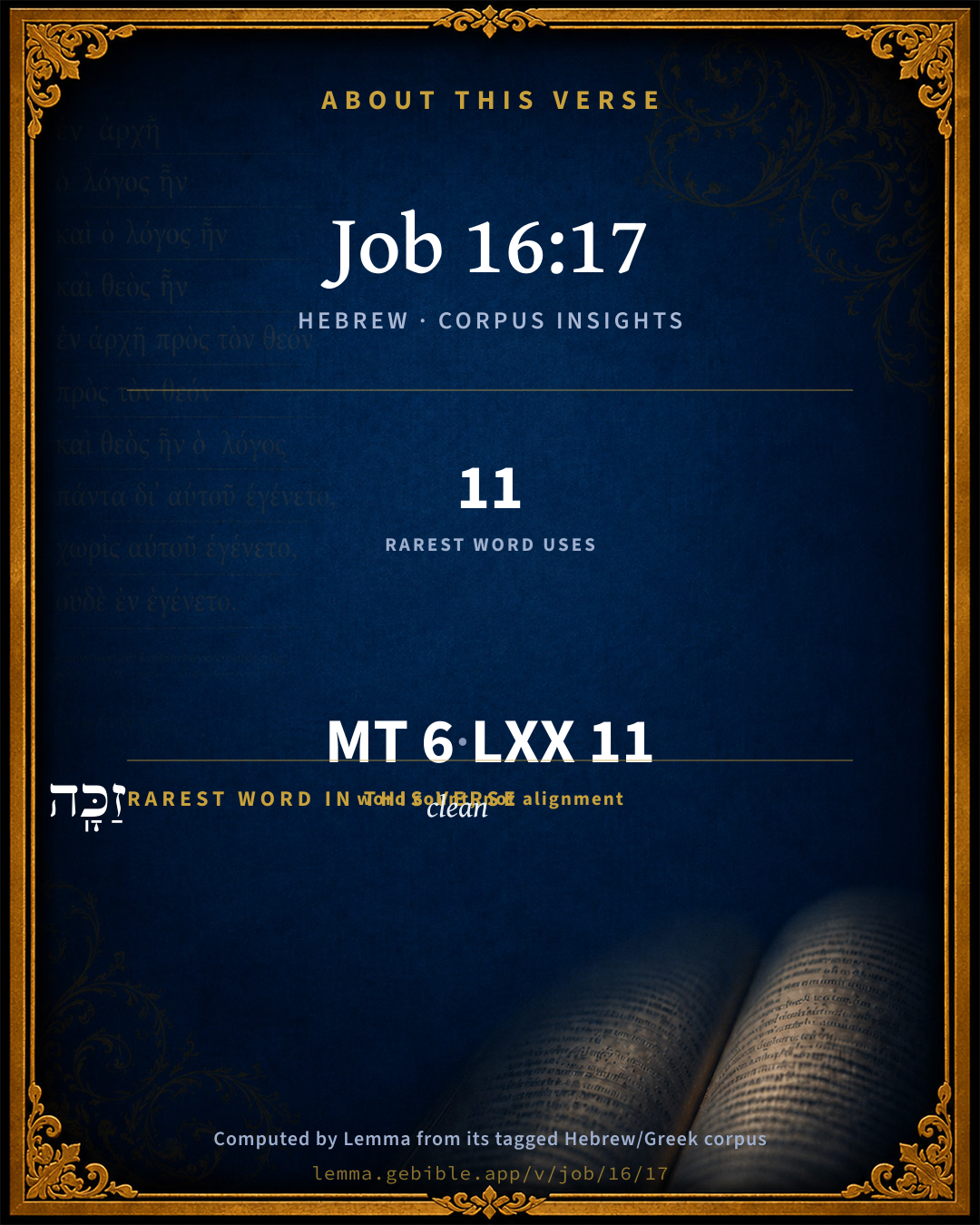
The rarest word here is זַכָּֽה clean H2134 — appearing just 11 times in the whole Hebrew Bible.

Shared distinctive vocabulary

זַכָּֽה clean H2134 occurs in 11 verses of the Hebrew Bible. Also found in:

Grammatical profile

  • 3 nouns
  • 1 adjective
  • 1 preposition
  • 1 particle

Hebrew & Septuagint length

In English translation the verse runs 13 words from the Hebrew and 13 from the Septuagint (LXX English) — the same length.

A rough comparison of the two English renderings, which tokenize alike — not a word-level alignment.

Word counts can differ between the Hebrew and the Greek without any difference in meaning — e.g. the Hebrew direct-object marker אֵת has no separate Greek word, and Greek often adds the article ὁ.

In the original languages it is 6 Hebrew tokens and 11 Greek tokens — but the two are counted differently (Hebrew bundles its prefixes and suffixes into one token; the Greek is in lemma form), so that isn’t a like-for-like length.

Cross-references

16

Topical passages linked to Job 16:17 in the Treasury of Scripture Knowledge — connected by theme and wording, ordered by reader-vote popularity; previews shown in the World English Bible.

  • Proverbs 15:8 The sacrifice made by the wicked is an abomination to Yahweh, But the prayer of the upright is his delight.
  • Psalms 66:18–19 If I cherished sin in my heart, The Lord wouldn't have listened.
  • Job 8:5–6 If you want to seek God diligently, Make your supplication to the Almighty.
  • Job 27:6–7 I hold fast to my righteousness, and will not let it go. My heart shall not reproach me so long as I live.
  • Job 11:14 If iniquity is in your hand, put it far away, Don't let unrighteousness dwell in your tents.
  • Job 15:20 The wicked man travails with pain all his days, Even the number of years that are laid up for the oppressor.
  • Job 15:34 For the company of the godless shall be barren, And fire shall consume the tents of bribery.
  • Job 21:27–28 "Behold, I know your thoughts, The devices with which you would wrong me.
  • Job 22:5–9 Isn't your wickedness great? Neither is there any end to your iniquities.
  • Job 29:12–17 Because I delivered the poor who cried, And the fatherless also, who had none to help him.
  • Job 31:1–40 "I made a covenant with my eyes, How then should I look lustfully at a young woman?
  • Psalms 7:3–5 Yahweh, my God, if I have done this, If there is iniquity in my hands,
  • Psalms 44:17–21 All this has come on us, Yet have we not forgotten you, Neither have we been false to your covenant.
  • Isaiah 59:6 Their webs shall not become garments, neither shall they cover themselves with their works: their works are works of iniquity, and the act of violence is in their hands.
  • Jonah 3:8 but let them be covered with sackcloth, both man and animal, and let them cry mightily to God. Yes, let them turn everyone from his evil way, and from the violence that is in his hands.
  • 1 Timothy 2:8 I desire therefore that the men in every place pray, lifting up holy hands without wrath and doubting.

Cross-references courtesy of OpenBible.info (CC BY 4.0).

Hebrew and Greek witnesses Masoretic Hebrew ↔ Greek Septuagint

The same verse in the two great witnesses to the Old Testament, shown verse-for-verse.

These are two independent witnesses, not word-aligned to each other, and the Septuagint is shown in lemma (dictionary) form.

Hebrew Job 16:17 Masoretic · Westminster Leningrad Codex

עַ֭ל לֹא חָמָ֣ס בְּכַפָּ֑י וּֽתְפִלָּתִ֥י זַכָּֽה

Although there is no violence in my hands, And my prayer is pure.

World English Bible · Public Domain

Greek LXX Job 16:17 Septuagint · lemma form

ἄδικος δέ οὐδείς εἰμί ἐν χείρ ἐγώ εὐχή δέ ἐγώ καθαρός

My belly has been parched with wailing, and darkness is on my eyelids.

LXX2012 (modern English Septuagint) · Public Domain

On this verse, Haydock's Catholic Bible Commentary discusses the Septuagint’s reading. Read the note in Commentary ↓

Hebrew: Westminster Leningrad Codex (CC BY 4.0). Greek: Septuagint (public domain); English from LXX2012 (modern English Septuagint) (Public Domain). How the Septuagint differs from the Hebrew →

Commentary

Notes on Job 16:17 from classic Christian and Jewish commentators (each source and its license shown beneath its notes). The classic Christian expositions comment on the surrounding passage and are grouped to its opening verse, so a note may address several verses; the Jewish commentaries on the Tanakh (Rashi and others) are per-verse, so they appear only where the commentator wrote on this verse.

Lemma curates 59 commentaries, every one of them public domain or Creative Commons licensed, each selected and text-cleaned for this edition rather than reprinted as found. About our sources →

Matthew Henry's Commentary

Job's condition was very deplorable; but had he nothing to support him, nothing to comfort him? Yes, and he here tells us what it was.

I. He had the testimony of his conscience for him that he had walked uprightly, and had never allowed himself in any gross sin. None was ever more ready than he to acknowledge his sins of infirmity; but, upon search, he could not charge himself with any enormous crime, for which he should be made more miserable than other men, Job 16:17.

1. He had kept a conscience void of offence, (1.) Towards men: "Not for any injustice in my hands, any wealth that I have unjustly got or kept." Eliphaz had represented him as a tyrant and an oppressor. "No," says he, "I never did any wrong to any man, but always despised the gain of oppression." (2.) Towards God: Also my prayer is pure; but prayer cannot be pure as long as there is injustice in our hands, Isa 1:15. Eliphaz had charged him with hypocrisy in religion, but he specifies prayer, the great act of religion, and professes that in that he was pure, though not from all infirmity, yet from reigning and allowed guile: it was not like the prayers of the Pharisees, who looked no further than to be seen of men, and to serve a turn.

2. This assertion of his own integrity he backs with a solemn imprecation of shame and confusion to himself if it were not true, Job 16:18. (1.) If there were any injustice in his hands, he wished it might not be concealed: O earth! cover thou not my blood, that is, "the innocent blood of others, which I am suspected to have shed." Murder will out; and "let it," says Job, "if I have ever been guilty if it," Gen 4:10, Gen 4:11. The day is coming when the earth shall disclose her blood (Isa 26:21), and a good man as far from dreading that day. (2.) If there were any impurity in his prayers, he wished they might not be accepted: Let my cry have no place. He was willing to be judged by that rule, If I regard iniquity in my heart, the Lord will not hear me, Psa 66:18. There is another probable sense of these words, that he does hereby, as it were, lay his death upon his friends, who broke his heart with their harsh censures, and charges the guilt of his blood upon them, begging of God to avenge it and that the cry of his blood might have no place in which to lie hid, but might come up to heaven and be heard by him that makes inquisition for blood.

II. He could appeal to God's omniscience concerning his integrity, Job 16:19. The witness in our own bosoms for us will stand us in little stead if we have not a witness in heaven for us too; for God is greater than our hearts, and we are not to he our own judges. This therefore is Job's triumph, My witness is in heaven. Note, It is an unspeakable comfort to a good man, when he lies under the censure of his brethren, that there is a God in heaven who knows his integrity and will clear it up sooner or later. See Joh 5:31, Joh 5:37. This one witness is instead of a thousand.

III. He had a God to go to before whom he might unbosom himself, Job 16:20, Job 16:21. See here, 1. How the case stood between him and his friends. He knew not how to be free with them, nor could he expect either a fair hearing with them or fair dealing from them. "My friends (so they call themselves) scorn me; they set themselves not only to resist me, but to expose me; they are of counsel against me, and use all their art and eloquence" (so the word signifies) "to run me down." The scorns of friends are more cutting than those of enemies; but we must expect them, and provide accordingly. 2. How it stood between him and God. He doubted not but that, (1.) God did now take cognizance of his sorrows: My eye pours out tears to God. He had said (Job 16:16) that he wept much; here he tells us in what channel his tears ran, and which way they were directed. His sorrow was not that of the world, but he sorrowed after a godly sort, wept before the Lord, and offered to him the sacrifice of a broken heart. Note, Even tears, when sanctified to God, give ease to troubled spirits; and, if men slight our grief, this may comfort us, that God regards them. (2.) That he would in due time clear up his innocency (Job 16:21): O that one might plead for a man with God! If he could but now have the same freedom at God's bar that men commonly have at the bar of the civil magistrate, he doubted not but to carry his cause, for the Judge himself was a witness to his integrity. The language of this wish is like that in Isa 50:7, Isa 50:8, I know that I shall not be ashamed, for he is near that justifies me. Some give a gospel sense of this verse, and the original will very well bear it; and he will plead (that is, there is one that will plead) for man with God, even the Son of man for his friend, or neighbour. Those who pour out tears before God, though they cannot plead for themselves, by reason of their distance and defects, have a friend to plead for them, even the Son of man, and on this we must bottom all our hopes of acceptance with God.

IV. He had a prospect of death which would put a period to all his troubles. Such confidence had he towards God that he could take pleasure in thinking of the approach of death, when he should be determined to his everlasting state, as one that doubted not but it would be well with him then: When a few years have come (the years of number which are determined and appointed to me) then I shall go the way whence I shall not return. Note, 1. To die is to go the way whence we shall not return. It is to go a journey, a long journey, a journey for good and all, to remove from this to another country, from the world of sense to the world of spirits. It is a journey to our long home; there will be no coming back to out state in this world nor any change of our state in the other world. 2. We must all of us very certainly, and very shortly, go this journey; and it is comfortable to those who keep a good conscience to think of it, for it is the crown of their integrity.

Matthew Henry's Commentary on the Whole Bible (1708–1710) — public domain (CC PDM 1.0). Text via the HelloAO Bible API.

Trapp's Complete Commentary

John Trapp

Job 16:17 Not for [any] injustice in mine hands: also my prayer [is] pure.

Ver. 17. Not for any injustice (Heb. Violence or wrong doing) in my hands] Job could wash his hands of that rapine and bribery wherewith they had injuriously charged him, Job 15:34, and safely say of it, as afterwards Father Latimer did of sedition (3 Serm. before K. Edw.), As for that sin, for aught that I know, methinks I should not need Christ, if I might so say. Some failings there might be in him in doing justice, but no intentions of doing injustice.

Also my prayer is pure] As proceeding from a heart washed from wickedness, Jer 4:14, and presented with holy hands, lifted up without wrath or doubting, 1Ti 2:8. That he regarded not iniquity in his heart he was well assured, Psa 66:17. Prayer is the pouring out of the heart; if iniquity be harboured there, prayer will have the scent and savour, and that incense will strike off the hand which offereth it. God requireth that in every place incense be offered unto his name, and a pure offering, Mal 1:11. It standeth a man in hand to see that though his work be but mean, yet it be clean; though not fine, yet not foul, soiled, and slubbered with the slur of a rotten heart. An upright man in afflictions is not without his cordial, as is to be seen in Job here, and St Paul, 2Co 1:12.

John Trapp, A Commentary or Exposition upon All the Books of the Old and New Testament (1647–1656) — public domain. Text from a community e-Sword module.

The Biblical Illustrator

Joseph S. Exell

Job_16:17-19

Not for any injustice in mine hands.

A good mans confidence

In these words Job delivers us--

1. The confidence of a godly man.

2. That kind of infirm anguish and indignation, that half-distemper, that expostulation with God, which sometimes comes to an excess even in good and godly men.

3. The foundation of his confidence, and his deliverance from this his infirmity. (John Donne.)

My witness is in heaven and my record is on high.

The trite witness of life

I. In reference to Job.

1. A declaration of his belief.

2. An avowal of his sincerity.

3. A proof of his devotion.

II. In reference to ourselves.

1. In seasons of self-suspicion.

2. Under the assaults of calumny.

3. In the prospect of death. (G. Brooks.)

The Biblical Illustrator, edited by Joseph S. Exell (c. 1880s–1900s) — public domain. Text from a community e-Sword module.

Joseph Benson's Commentary

Job 16:17-18. Not for any justice in my hands — And all this is not come upon me for any injurious dealing, but for other reasons, known to God only; also my prayer is pure — I do not cast off God’s fear and service, Job 15:4. I do still pray and worship God, and my prayer is accompanied with a sincere heart. O earth, cover not thou my blood — The earth is said to cover that blood which lies undiscovered and unrevenged: of which see on Gen 4:10-11; and Isa 26:21. But, says Job, if I be guilty of destroying any one man by murder, or oppression, as I am traduced, O Lord, let the earth disclose it; let it be brought to light, that I may suffer condign punishment for it. And let my cry have no place — That is, either, 1st, Let the cries and groans which I have forced from others by my oppressions, have no place to hide them. Or, rather, 2d, Let the cry of my complaints to men, or prayers to God, find no place in the ears or hearts of God or men, if this be true.

Joseph Benson's Commentary on the Old and New Testaments (1811–1818) — public domain. Text from a community e-Sword module.

Tyndale Open Study Notes

Tyndale Open Resources

16:17 done no wrong (or done no violence; Hebrew lo’-khamas): If violence is the meaning, Job was possibly denying that he was a formidable warrior who should be attacked (16:12-14; see also Isa 59:6; Jon 3:8). • Contrary to Eliphaz’s charge (Job 15:4-5) and Bildad’s assumption (8:6), Job’s prayer was pure because he was innocent (Gen 20:5; Isa 59:3).

Tyndale Open Study Notes — © Tyndale Open Resources, licensed CC BY-SA 4.0. Text via the HelloAO Bible API.

Geneva Bible (1599)

Geneva Bible translators

That is, unfeigned, and without hypocrisy.

Signifying, that he is not able to comprehend the cause of this his grievous punishment.

Geneva Bible (1599) marginal notes — public domain. Text via Bolls.life.

Adam Clarke's Commentary

Verse 17. Not for any injustice] I must assert, even with my last breath, that the charges of my friends against me are groundless. I am afflicted unto death, but not on account of my iniquities.

Also my prayer is pure.] I am no hypocrite, God knoweth.

Adam Clarke's Commentary on the Bible (1810–1826) — public domain. Text from a community e-Sword/MySword module.

Ellicott's Commentary for English Readers

(17) Not for any injustice.—Literally, for no injustice, just as in Isa_53:9 : “because he had done no violence,” should be “not because he had done any violence, or because deceit was in his mouth.”

A Bible Commentary for English Readers, edited by Charles John Ellicott (1878–1897) — public domain. Text from a community e-Sword module.

The Cambridge Bible for Schools and Colleges

gen. ed. J. J. S. Perowne

17. Not for any injustice] i. e. though there is no wrong in my hands, cf. Isa_53:9. The first clause denies that he had done anything amiss in action; and the second affirms that his “prayer,” i. e. his whole religious walk with God, was pure. The last words give a reply to the insinuations of Eliphaz, ch. Job_15:4, and the former to his allusion ch. Job_15:34.

The Cambridge Bible for Schools and Colleges (gen. ed. J. J. S. Perowne; Cambridge University Press, 1878–1918) — public domain. Text from a community e-Sword module.

John Gill's Exposition

O earth, cover not thou my blood,.... This is an imprecation, wishing that if; he had been guilty of any capital crime, of such acts of injustice that he ought to be punished by the judge, and even to die for them, that his blood when spilt might not be received into the earth, but be licked up by dogs, or that he might have no burial or interment in the earth; and if he had committed such sins as might come under the name of blood, either the shedding of innocent blood, though that is so gross a crime that it can hardly be thought that Job's friends even suspected this of him; or rather other foul sins, as injustice and oppression of the poor; the Tigurine version is, "my capital sins", see Isa 1:15; then he wishes they might never be covered and concealed, but disclosed and spread abroad everywhere, that all might know them, and he suffer shame for them; even as the earth discloses the blood of the slain, when inquisition is made for it, Isa 26:21;

and let my cry have no place; meaning if he was the wicked man and the hypocrite he was said to be, or if his prayer was not pure, sincere, and upright, as he said it was, then he desired that when he cried to God, or to man, in his distress, he might be regarded by neither; that his cry might not enter into the ears of the Lord of hosts, but that it might be shut out, and he cover himself with a cloud, that it might not pass through, and have any place with him; land that he might not meet with any pity and compassion from the heart, nor help and relief from the hand of any man.

John Gill's Exposition of the Whole Bible (1746–1763) — public domain (CC PDM 1.0). Text via the HelloAO Bible API.

Albert Barnes' Notes on the Bible

Not for any injustice ... - Still claiming that he does not deserve his sorrows, and that these calamities had not come upon him on account of any enormous sins, as his friends believed.

My prayer is pure - My devotion; my worship of God is not hypocritical - as my friends maintain.

Albert Barnes' Notes on the Bible (1834–1885) — public domain. Text from a community e-Sword/MySword module.

Haydock's Catholic Bible Commentary

Dim. Hebrew and Septuagint, "covered with the shadow of death," (Haydock) greatly impaired. Some have almost lost their sight by weeping; and death seemed ready to close Job’s eyes. (Calmet)

George Leo Haydock (1774–1849), Haydock's Catholic Family Bible and Commentary, 1859 edition — public domain. Excludes Psalms (Douay-Rheims chapter numbering differs from Protestant) and Deuterocanonical books (Catholic canon only).

Matthew Poole's English Annotations

And all this is not come upon me for any injurious dealing with others by oppression, or deceit, or bribery, wherewith I am implicitly charged, Job 15:16,20,34; but for other reasons known to God only, for I cannot discover them.

Also my prayer is pure; I do not cast off God’s fear and service, as I am accused to do, Job 15:4. I do still pray and worship God, and my prayer is accompanied with a sincere heart and undefiled conscience: see Psa 109:7; Pro 28:9; 1Ti 2:8. So that I have lived inoffensively towards God and towards men; and therefore your assertion is both uncharitable and false, that eminent afflictions are peculiar to ungodly men.

Matthew Poole's English Annotations on the Holy Bible (1683–1685) — public domain. Text from a community e-Sword/MySword module.

Whedon's Commentary on the Bible

Daniel D. Whedon

17. Not for injustice — The Hebrew is the same as in Isa_53:9. where the words are spoken of Christ. Read, Though there be no violence in my hands.

Second division — JOB’S HOPE IS IN THE GODHEAD — THE GOD WHO SEES HIS GRIEFS SHALL TREAT WITH GOD IN HIS BEHALF, Job_16:18 - Job_17:9.

Daniel D. Whedon (gen. ed.), Commentary on the Old and New Testaments (1874–1909) — public domain. Text from a community e-Sword module.

The Pulpit Commentary

Not for any injustice in mine hands; or, not that there is any violence in my hands. (Isa_53:9, where the expression used of the Messiah is nearly the same) Job repudiates the charge of rapine and robbery which Eliphaz has brought against him. (Job_15:28, Job_15:34) His hands have not done violence to any. Also my prayer is pure. Neither has he been guilty of the hypocrisy which Eliphaz has also charged him with. (Job_15:34) His prayers have been sincere and genuine.

Acceptable prayer.

I WHEN ADDRESSED TO THE RIGHT OBJECT. God. (Psa_65:2) Not, however, the God of our imaginations, or the God of nature simply; but the God of revelation and the God of grace, the God who hath manifested forth his glory in the Person of Jesus Christ.

II WHEN PRESENTED THROUGH THE RIGHT MEDIUM Jesus Christ, the one Mediator between God and man, (1Ti_2:5) the one Advocate for sinful men, (1Jn_2:1) the one High Priest over the house of God, (Heb_7:25) the Daysman for whom Job longed, (Job_9:33) the Redeemer to whom he looked forward. (Job_19:25)

III WHEN OFFERED IN THE RIGHT SPIRIT.

1. Sincerely. (Isa_29:13 Mat_15:8)

2. Humbly. (Gen_32:10 Isa_66:2 Luk_18:13)

3. Believingly. (Mat_21:22 Heb_11:6 Jam_1:6)

4. Holily; (1Ti_2:8) i.e. with renunciation of sin, (Pro_15:8 Pro_21:27 Pro_28:9 Psa_66:18) and with kind and forgiving dispositions. (Mar_11:25)

IV WHEN ASKING FOR THE RIGHT THINGS. Things contained within the promises. These give to prayer a scope at once ample and sufficient.

1. Ample; since the promises are exceeding great and precious in their variety. (2Pe_1:4)

2. Sufficient; since they contain all things pertaining to life and godliness.

Purity of prayer.

The impure prayer cannot be heard by God. It may be earnest, passionate, vehement, yet it must fall back rejected and confounded. Let us, then, consider in what purity of prayer consists.

I REALITY. The prayer that is not felt and meant in the heart is an impure offering of hypocrisy. Though it be uttered in the becoming phrases of devotion, it is to God as the howling of blasphemous demons. If there be no other sin in our prayer, insincerity is fatal. But it is not easy to be always true and real, especially in public acts of devotion, when a multitude of people are expected to be joining in the same prayer at the same moment. If, however, the heart is set on truly seeking God, he will not count the wandering thought of casual distractions as a mark of insincerity. The spirit may be willing while the flesh is weak, (Mat_26:41) and God looks to the heart. What is essential is a true purpose and effort to worship God, who is a Spirit, in spirit and in truth. (Joh_4:24)

II PENITENCE. We are all sinners, and therefore can only come to God as suppliants confessing our sin. Any other method of approach is false to our character and deeds. In the parable of the publican and the Pharisee it is just the contrition of the publican that meets with God"s approval. If we hold to our sin we cannot be received m our prayer. Though we may forget the ugly thing, or suppose that we have left it behind us, it is with us in the very house of God; it is even standing between us and God, a black and impenetrable barrier.

III FAITH. We cannot pray purely till we trust God. The prayer of unbelief is a wild cry in the darkness wrung from a soul by its utter distress. Surely God will pity such a cry, and in his infinite compassion he will do what is possible to save his benighted child. But the strength of communion with God that comes in prayer is only possible when we can trust God as our Father and completely confide in him. It is by believing, by trusting God, that we win great blessings in prayer.

IV SUBMISSION. If Our prayer is a self-willed mandate claiming certain things from God which must be just according to our mind, it is defiled by impurity. We have not to dictate to God what he is to do for us. Our duty is to lay our case before God and then to leave it with him. He must do what he thinks best, not what we demand. The pure prayer will be submissive, saying, "Not as I will, but as thou wilt.

V UNSELFLSHNESS. Even in our submission we may still be selfish, for we may be convinced that it is best for ourselves that God should do with us what he thinks best, and may think of nothing else. Such prayers as "Bless me; save me; comfort me; fill me with good things," are narrow, and when they stand alone they are selfish. Christ"s model prayer is in the plural number," Our Father give us," etc. We need to enlarge our petitions with intercession for our brethren, and to include the wants of the world in our prayers. The purest prayer is one that chiefly seeks the glory of God Christ"s prayer, "Father, glorify thy Name. W.F.A.

The Pulpit Commentary (1880–1919), ed. H.D.M. Spence-Jones & Joseph S. Exell — public domain. Text from a community e-Sword module.

John Wesley's Explanatory Notes

Not - And all this is not come upon me for any injurious dealing, but for other reasons known to God only. Pure - I do not cast off God's fear and service, chap. xv, 4. I do still pray and worship God, and my prayer is accompanied with a sincere heart.

John Wesley, Explanatory Notes Upon the Whole Bible (1754–1765) — public domain. Text via the GEBible commentary corpus.

Rashi

Rabbi Shlomo Yitzchaki (Rashi)

and my prayer is pure I did not curse my friend nor did I think any evil against him.

Rashi on the Tanakh — English translations: “The Judaica Press complete Tanach with Rashi, translated by A. J. Rosenberg” (CC BY 4.0); “Pentateuch with Rashi's commentary by M. Rosenbaum and A.M. Silbermann, 1929-1934” (public domain); “The Metsudah Tanach series, Lakewood, N.J” (CC BY 4.0); and “The Book of Joshua, Metsudah Publications, 1997” (CC BY 4.0). Text via Sefaria.

Lesson kit

Teaching starters — assembled from the data on this page, not authored interpretation. Every prompt links to the verse data it draws on. Edit before teaching.

Job, in the Wisdom, opens this verse with 6 words (6 distinct Hebrew lemmas). Its most distinctive word is zak (“clean”). A historical commentator’s framing appears above. Read the whole chapter for the surrounding context.

Discussion questions

  1. How does “clean” (zak) shape what this verse is saying?
  2. Exodus 27:20 shares the word «clean» with this verse. How do the two illuminate each other?
  3. These translations render this verse differently; the difference is in the English rendering, not the original. What questions does that raise?
  4. Reading how Matthew Henry's Commentary and Trapp's Complete Commentary read this verse, where do the two commentators agree and where do they part?

Things to notice

Reading settings

Reading text

Shown beneath each verse's original-language words.

Old Testament
Old Testament edition

Read the OT as the Masoretic Hebrew (MT) or the Greek Septuagint (LXX).

English shown for the Greek Septuagint (in the Hebrew ↔ Greek comparison).

Comparing translations? Open the Compare panel on any verse page to stack up to four side by side.