
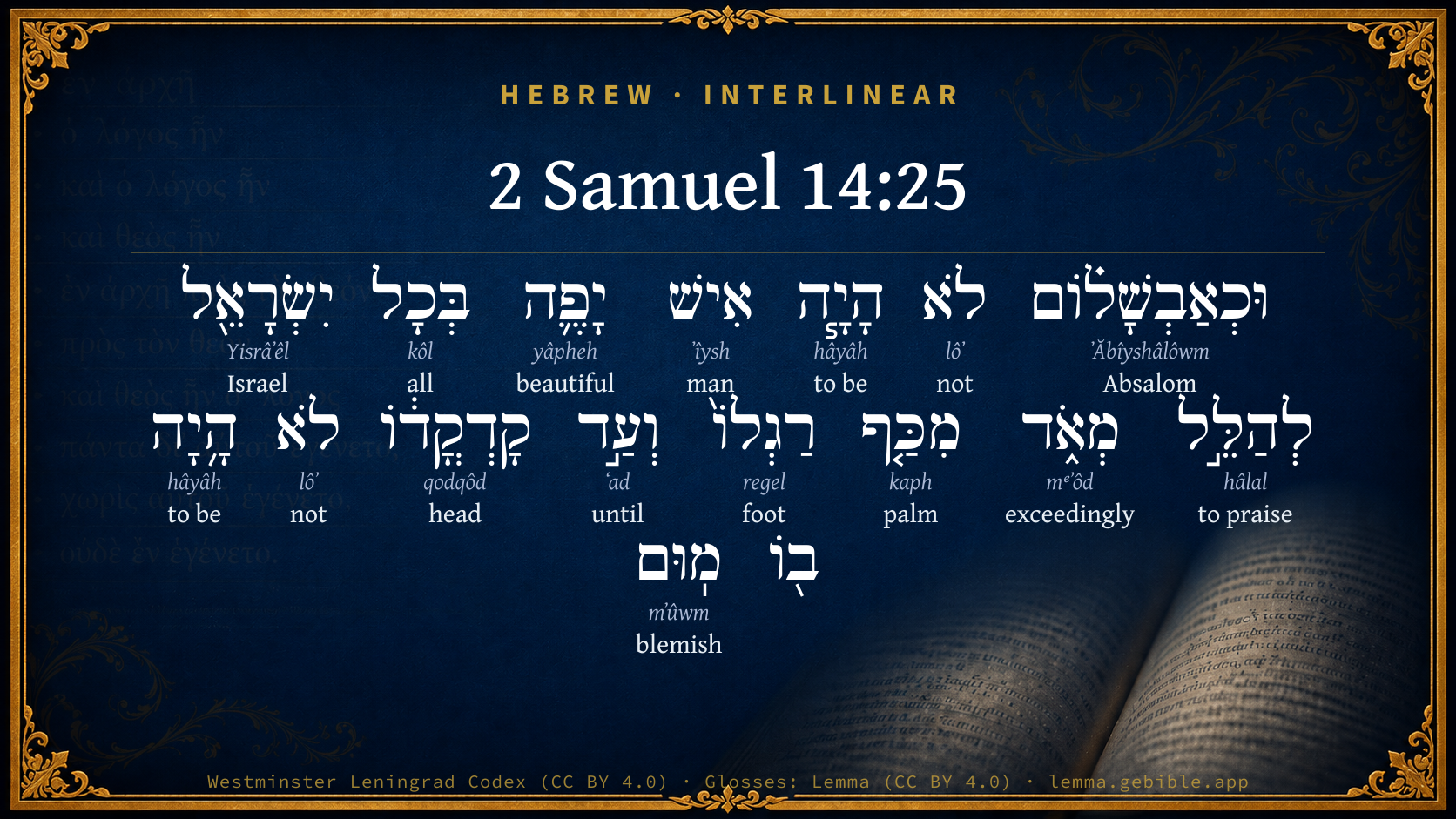
2 Samuel 14:25

Hebrew (Westminster Leningrad Codex) 2 Samuel 14:25 appears in the Hebrew Old Testament. The text above is from the Westminster Leningrad Codex. Each word links to its Strong’s number, a concise gloss, and parsing drawn from the Open Scriptures Hebrew Bible morphology. Click any word for its full Brown-Driver-Briggs (BDB) entry.
Download image
Cite this verse

2 Samuel 14:25 (World English Bible). Public Domain. Lemma interlinear Bible study tool, https://lemma.gebible.app/v/2-samuel/14/25.

Show BibTeX & RIS
BibTeX
RIS
English Translation
Now in all Israel there was none to be so much praised as Absalom for his beauty: from the sole of his foot even to the crown of his head there was no blemish in him.
World English Bible · Public Domain
Download a study sheet

One document with this verse’s original text, its word-by-word gloss line, the meaning frame, cross-references with their text, attributed commentary, and full source and license credits — printable, and it pastes into notes with its structure intact.

This verse Autodidact and up

Study sheet (.html) Plain text (.txt)

A passage Seminary Student

Up to 50 verses in one chapter. A passage sheet keeps up to 6 commentary sources and 12 cross-references per verse, in the order this page ranks them, and says so on the sheet whenever that leaves anything out. Ask for a single verse and you get the Autodidact verse sheet above.

Everything on this page stays free to read, with no account — the sheet is a download of what is already on screen, not access to it.

Want to remove ads? Support Godless Engineer
Compare translations 3

The same verse in 3 English versions, stacked beneath the original-language interlinear above. Click any original word for its lexicon entry.

Each is an independent rendering of the whole verse — the interlinear is not word-aligned to these translations.

Highlighted words mark where these versions differ — a whole-verse word diff, not a word-by-word alignment.

  • World English Bible Public Domain
    Now in all Israel there was none to be so much praised as Absalom for his beauty: from the sole of his foot even to the crown of his head there was no blemish in him.
  • King James Version Public Domain
    But in all Israel there was none to be so much praised as Absalom for his beauty: from the sole of his foot even to the crown of his head there was no blemish in him.
  • unfoldingWord Literal Text CC BY-SA 4.0
    Now was not a handsome man like Absalom in all of Israel to praise greatly. From the sole of his foot and to his pate, no blemish was on him.

unfoldingWord Literal Text — © unfoldingWord, licensed CC BY-SA 4.0. Word-aligned USFM3 via Door43 (git.door43.org/unfoldingWord/en_ult).

Versions to compare (up to 4)

3 of 4 selected

Show all 18 translations

Every available English version of this verse, each an independent rendering of the whole verse.

  • World English Bible Public Domain
    Now in all Israel there was none to be so much praised as Absalom for his beauty: from the sole of his foot even to the crown of his head there was no blemish in him.
  • Berean Standard Bible Public Domain
    Now there was not a man in all Israel as handsome and highly praised as Absalom. From the sole of his foot to the top of his head, he did not have a single flaw.
  • Majority Standard Bible Public Domain
    Now there was not a man in all Israel as handsome and highly praised as Absalom. From the sole of his foot to the top of his head, he did not have a single flaw.
  • King James Version Public Domain
    But in all Israel there was none to be so much praised as Absalom for his beauty: from the sole of his foot even to the crown of his head there was no blemish in him.
  • American Standard Version (1901) Public Domain
    Now in all Israel there was none to be so much praised as Absalom for his beauty: from the sole of his foot even to the crown of his head there was no blemish in him.
  • Revised Version (1885) Public Domain
    Now in all Israel there was none to be so much praised as Absalom for his beauty: from the sole of his foot even to the crown of his head there was no blemish in him.
  • Geneva Bible (1599) Public Domain
    Nowe in all Israel there was none to be so much praysed for beautie as Absalom: from the sole of his foote euen to the toppe of his head there was no blemish in him.
  • Douay-Rheims (1899) Public Domain
    But in all Israel there was not a man so comely, and so exceedingly beautiful as Absalom: from the sole of the foot to the crown of his head there was no blemish in him.
  • Young's Literal Translation Public Domain
    And like Absalom there was no man `so' fair in all Israel, to praise greatly; from the sole of his foot even unto his crown there was no blemish in him;
  • Literal Standard Version CC BY-SA 4.0
    And there was no man [so] beautiful in all Israel like Absalom, to praise greatly; from the sole of his foot even to his crown there was no blemish in him;
  • Unlocked Literal Bible CC BY-SA 4.0
    Now in all Israel there was no one praised for his handsomeness more than Absalom. From the sole of his foot to the top of his head there was no blemish in him.
  • unfoldingWord Literal Text CC BY-SA 4.0
    Now was not a handsome man like Absalom in all of Israel to praise greatly. From the sole of his foot and to his pate, no blemish was on him.
  • Darby Bible Public Domain
    But in all Israel there was none to be so much praised as Absalom for his beauty: from the sole of his foot even to the crown of his head there was no blemish in him.
  • World Messianic Bible Public Domain
    Now in all Israel there was no one to be so much praised as Absalom for his beauty. From the sole of his foot even to the crown of his head there was no defect in him.
  • Webster's Bible Public Domain
    But in all Israel there was none to be so much praised as Absalom for his beauty: from the sole of his foot even to the crown of his head there was no blemish in him.
  • Free Bible Version CC BY-SA 4.0
    Absalom was admired as the most handsome man in the whole of Israel. He didn't have a single blemish from head to toe.
  • Bible in Basic English Public Domain
    Now in all Israel there was no one so greatly to be praised for his beautiful form as Absalom: from his feet to the crown of his head he was completely beautiful.
  • JPS Tanakh (1917) Public Domain
    Now in all Israel there was none to be so much praised as Absalom for his beauty; from the sole of his foot even to the crown of his head there was no blemish in him.

Literal Standard Version (2020), Covenant Press — licensed CC BY-SA 4.0. Text via the HelloAO Bible API (eBible.org). Unlocked Literal Bible (unfoldingWord) — licensed CC BY-SA 4.0. Text via the HelloAO Bible API (eBible.org). unfoldingWord Literal Text — © unfoldingWord, licensed CC BY-SA 4.0. Word-aligned USFM3 via Door43 (git.door43.org/unfoldingWord/en_ult). Free Bible Version, Dr. Jonathan Gallagher — licensed CC BY-SA 4.0. Text via the HelloAO Bible API (eBible.org).

Word by word

More ways to search: Search by grammar → Find every occurrence → Compare this word →

Practice this passage: Drill this verse → Learn its vocabulary →

קָדְקֳד֔וֹ
qodqôd
H6936
“head · his”
Noun, Common, Masculine, Singular, Construct + Suffix, Personal, 3rd Person, Masculine, Singular
Part of Speech
Noun
Type
Common
Gender
Masculine
Number
Singular
State
Construct
Full BDB Definition

Origin: from H6915

TWOT: 1986a

head, crown of head, top of head, hairy crown, scalp
  1. וּכְאַבְשָׁל֗וֹם ʼĂbîyshâlôwm H53 “and · like/as · Absalom” Conjunction + Preposition + Noun, Proper
  2. לֹא lôʼ H3808 “not” Particle, Negative
  3. הָיָ֧ה hâyâh H1961 “to be” Verb, Qal, Perfect, 3rd Person, Masculine, Singular
  4. אִישׁ ʼîysh H376 “man” Noun, Common, Masculine, Singular, Absolute
  5. יָפֶ֛ה yâpheh H3303 “beautiful” Adjective, Adjective, Masculine, Singular, Absolute
  6. בְּכָל kôl H3605 “in/at · all of” Preposition + Noun, Common, Masculine, Singular, Construct
  7. יִשְׂרָאֵ֖ל Yisrâʼêl H3478 “Israel” Noun, Proper
  8. לְהַלֵּ֣ל hâlal H1984 “to praise” Preposition + Verb, Piel, Infinitive Construct
  9. מְאֹ֑ד mᵉʼôd H3966 “exceedingly” Adverb
  10. מִכַּ֤ף kaph H3709 “from · palm of” Preposition + Noun, Common, Feminine, Singular, Construct
  11. רַגְלוֹ֙ regel H7272 “foot · his” Noun, Common, Feminine, Singular, Construct + Suffix, Personal, 3rd Person, Masculine, Singular
  12. וְעַ֣ד ʻad H5704 “and · until” Conjunction + Preposition
  13. לֹא lôʼ H3808 “not” Particle, Negative
  14. הָ֥יָה hâyâh H1961 “to be” Verb, Qal, Perfect, 3rd Person, Masculine, Singular
  15. מֽוּם mʼûwm H3971 “blemish” Noun, Common, Masculine, Singular, Absolute

About this verse

These counts appear in no published source. They are computed here, from the morphology-tagged text and Lemma’s own curated glosses. What Lemma adds →

17
words
14
distinct lemmas
Historical
section

Notable vocabulary

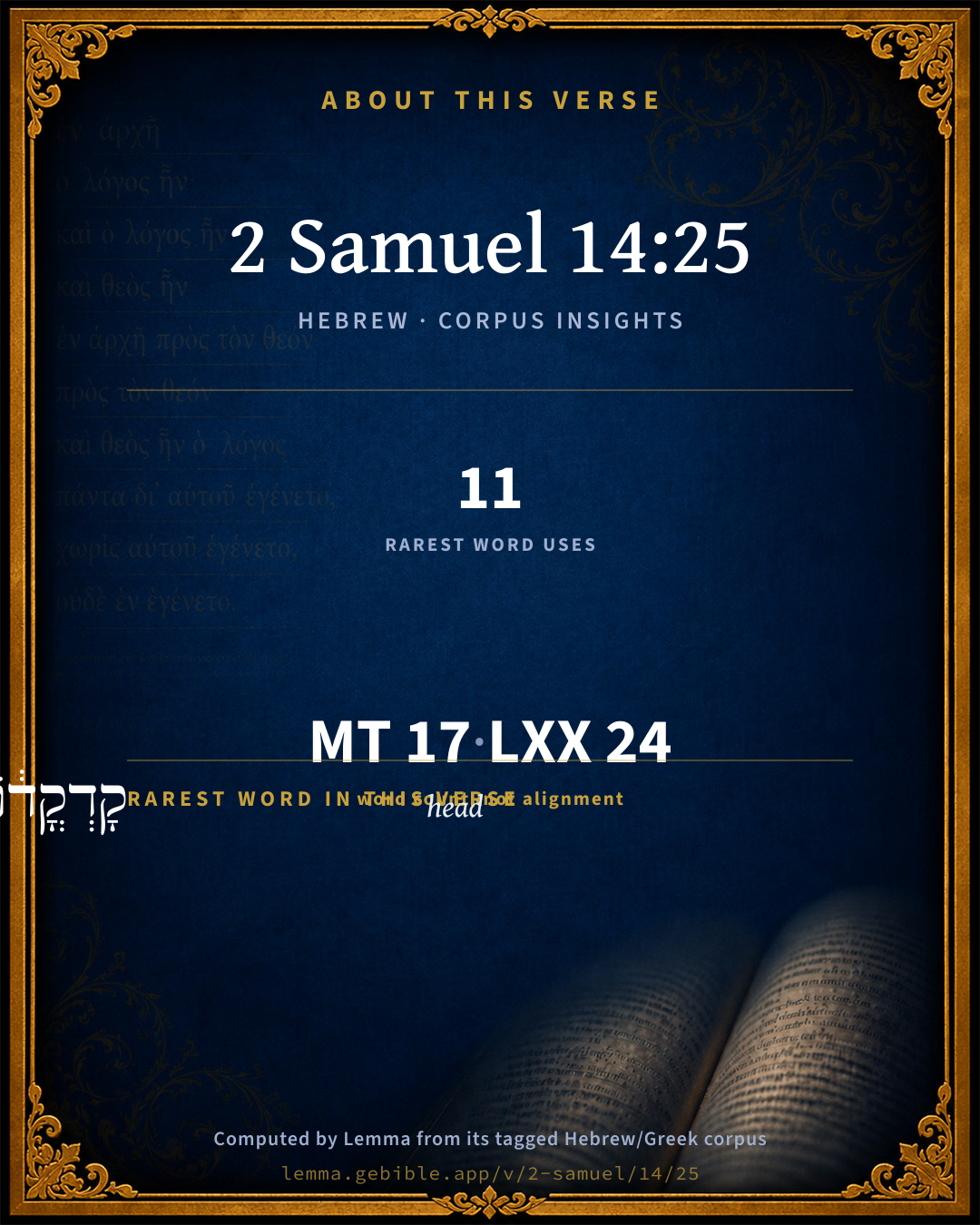
The rarest word here is קָדְקֳד֔וֹ head H6936 — appearing just 11 times in the whole Hebrew Bible.

Shared distinctive vocabulary

קָדְקֳד֔וֹ head H6936 occurs in 11 verses of the Hebrew Bible. Also found in:

Grammatical profile

  • 3 verbs
  • 8 nouns
  • 1 adjective
  • 2 prepositions
  • 1 adverb
  • 2 particles

Verb forms

  • הָיָ֧ה Qal · Perfect
  • לְהַלֵּ֣ל Piel · Infinitive Construct
  • הָ֥יָה Qal · Perfect

Repetition

Words recur within this verse — often emphatic in Hebrew:

  • הָיָ֧ה to be H1961 ×2
  • לֹא not H3808 ×2

Hebrew & Septuagint length

In English translation the verse runs 36 words from the Hebrew and 32 from the Septuagint (LXX English) — closely comparable.

A rough comparison of the two English renderings, which tokenize alike — not a word-level alignment.

Word counts can differ between the Hebrew and the Greek without any difference in meaning — e.g. the Hebrew direct-object marker אֵת has no separate Greek word, and Greek often adds the article ὁ.

In the original languages it is 17 Hebrew tokens and 24 Greek tokens — but the two are counted differently (Hebrew bundles its prefixes and suffixes into one token; the Greek is in lemma form), so that isn’t a like-for-like length.

Cross-references

8

Topical passages linked to 2 Samuel 14:25 in the Treasury of Scripture Knowledge — connected by theme and wording, ordered by reader-vote popularity; previews shown in the World English Bible.

  • Isaiah 1:6 From the sole of the foot even to the head there is no soundness in it: Wounds, welts, and open sores. They haven't been closed, neither bandaged, neither soothed with oil.
  • Deuteronomy 28:35 Yahweh will strike you in the knees, and in the legs, with a sore boil, of which you can not be healed, from the sole of your foot to the crown of your head.
  • Job 2:7 So Satan went forth from the presence of Yahweh, and struck Job with painful sores from the sole of his foot to his head.
  • 1 Samuel 9:2 He had a son, whose name was Saul, an impressive young man; and there was not among the children of Israel a better person than he. From his shoulders and upward he was higher than any of the people.
  • 1 Samuel 16:7 But Yahweh said to Samuel, "Don't look on his face, or on the height of his stature; because I have rejected him: for [Yahweh sees] not as man sees; for man looks at the outward appearance, but Yahweh looks at the heart."
  • Proverbs 31:30 Charm is deceitful, and beauty is vain; But a woman who fears Yahweh, she shall be praised.
  • Matthew 23:27 "Woe to you, scribes and Pharisees, hypocrites! For you are like whitened tombs, which outwardly appear beautiful, but inwardly are full of dead men's bones, and of all uncleanness.
  • Ephesians 5:27 that he might present the assembly to himself gloriously, not having spot or wrinkle or any such thing; but that it should be holy and without blemish.

Cross-references courtesy of OpenBible.info (CC BY 4.0).

Hebrew and Greek witnesses Masoretic Hebrew ↔ Greek Septuagint

The same verse in the two great witnesses to the Old Testament, shown verse-for-verse.

These are two independent witnesses, not word-aligned to each other, and the Septuagint is shown in lemma (dictionary) form.

Hebrew 2 Samuel 14:25 Masoretic · Westminster Leningrad Codex

וּכְאַבְשָׁל֗וֹם לֹא הָיָ֧ה אִישׁ יָפֶ֛ה בְּכָל יִשְׂרָאֵ֖ל לְהַלֵּ֣ל מְאֹ֑ד מִכַּ֤ף רַגְלוֹ֙ וְעַ֣ד קָדְקֳד֔וֹ לֹא הָ֥יָה ב֖וֹ מֽוּם

Now in all Israel there was none to be so much praised as Absalom for his beauty: from the sole of his foot even to the crown of his head there was no blemish in him.

World English Bible · Public Domain

Greek LXX 2 Samuel 14:25 Septuagint · lemma form

καί ὡς αβεσσαλωμ οὐ εἰμί ἀνήρ ἐν πᾶς ἰσραήλ αἰνετός σφόδρα ἀπό ἴχνος πούς αὐτός καί ἕως κορυφή αὐτός οὐ εἰμί ἐν αὐτός μῶμος

And there was not a man in Israel so very comely as Abessalom: from the sole of his foot even to the crown of his head there was no blemish in him.

LXX2012 (modern English Septuagint) · Public Domain

Hebrew: Westminster Leningrad Codex (CC BY 4.0). Greek: Septuagint (public domain); English from LXX2012 (modern English Septuagint) (Public Domain). How the Septuagint differs from the Hebrew →

Targum (Aramaic paraphrase)

1

The Targum is the ancient Jewish Aramaic paraphrase of the Hebrew Scriptures — an interpretive translation, not the Hebrew text itself. Onkelos (literal) and Pseudo-Jonathan (expansive) render the Torah, and Jonathan the Prophets. Coverage is partial: where no permissively-licensed English translation exists for a verse, only the Aramaic is shown. This is verse-level text, not a word-by-word alignment to the Hebrew.

  1. Targum Jonathan Prophets (Joshua–Malachi)
    וּכְאַבְשָׁלוֹם לָא הֲוָה גְבַר שַׁפִּיר בְּכָל יִשְׂרָאֵל לְשָׁבָּחָא לַחֲדָא מִפַּרְסַת רִגְלוֹהִי וְעַד מוֹחֵיהּ לָא הֲוָה בֵיהּ מוּמָא:

    (no public-domain English translation for this verse)

    Targum Jonathan — Aramaic: “Mikraot Gedolot” (public domain). English: “Sefaria Community Translation” (CC0 1.0 (public-domain dedication)); “London "Chaldee Paraphrase," 1871” (public domain). Text via Sefaria.

Commentary

Notes on 2 Samuel 14:25 from classic Christian and Jewish commentators (each source and its license shown beneath its notes). The classic Christian expositions comment on the surrounding passage and are grouped to its opening verse, so a note may address several verses; the Jewish commentaries on the Tanakh (Rashi and others) are per-verse, so they appear only where the commentator wrote on this verse.

Lemma curates 59 commentaries, every one of them public domain or Creative Commons licensed, each selected and text-cleaned for this edition rather than reprinted as found. About our sources →

Trapp's Complete Commentary

John Trapp

2Sa 14:25 But in all Israel there was none to be so much praised as Absalom for his beauty: from the sole of his foot even to the crown of his head there was no blemish in him.

Ver. 25. There was none to be so much praised as Absalom for his beauty.] This was no great commendation, that he was pulcherrimus corpore, aterrimus mente, fair without, and foul within; like an Egyptian temple: or as Alcibiades, comely but turbulent: or as Aurelia Orestilla, cuius praeter formam nihil unquam bonus laudavit, {a} commendable only for her beauty; which is only then praise worthy, when it is the flower of virtue. Otherwise it is but as the goodly oak, which beareth no fruit but for swine; whereas the weak and deformed vine yieldeth sweet grapes: or, as the peacock, which hath gay feathers, but maketh the ground barren whereon it sitteth; whenas the poor homely bee yieldeth honey, &c. In Saul and Absalom, saith an interpreter {b} here, two men of goodly stature, but of bad conditions, we have the right description of hypocrites, who bear a fair show outwardly, but within are corrupt. The more to blame were this people for doting so much upon these two whited sepulchres; as therefore worthy to reign, because comely and sightly.

There was no blemish in him.] But nature had spent all her strength, saith one, {c} in trimming his body; his soul she had left altogether untrimmed, as appeareth by his ambition.

{a} Sallust.

{b} Borrh.

{c} A Lap.

John Trapp, A Commentary or Exposition upon All the Books of the Old and New Testament (1647–1656) — public domain. Text from a community e-Sword module.

The Biblical Illustrator

Joseph S. Exell

2Sa_14:25

But in all Israel there was none to be so much praised as Absalom for his beauty.

Absalom a contradiction

The ancients, and in particular the Orientals, were very fond of remarking upon a mans height. Their notion was that the greater the stature the more fit the man was for the society of the gods. The Old Testament is to a large extent a book which takes notice of outward features, and praises physical excellence, and estimates at high price all material blessings. But what an irony there is in such a case as Absaloms! Given, a grand physique and a little soul, and say if any irony can be more ghastly and humiliating. Such contradictions we are to ourselves sometimes, and to one another. Our circumstances may be the best part of us: the house may be greater than the tenant; the furniture may be more worthy than its owner. What, then, is to be done? A blot like this ought not to be tolerated. Wherein a man is conscious that he represents this irony, he should look about him, and say that to-day shall end the intolerable disharmony, and at least seek to introduce a reconciliation as between the outward and the inward, so that the soul may prosper and be in health as the body, or the body may prosper and be in health as the soul, according to the special circumstances of each individual case. (J. Parker, D. D.)

The Biblical Illustrator, edited by Joseph S. Exell (c. 1880s–1900s) — public domain. Text from a community e-Sword module.

Joseph Benson's Commentary

2Sa 14:25. There was none to be so much praised as Absalom for his beauty — Which proved one occasion of his ruin; for he became proud because he was so much admired; and, forgetting his cruel murder of his brother, he began to rely on the people’s favour, and to proceed to the commission of a greater crime, even to seek the life of his father.

Joseph Benson's Commentary on the Old and New Testaments (1811–1818) — public domain. Text from a community e-Sword module.

The Preacher's Complete Homiletical Commentary

Joseph S. Exell (gen. ed.)

CRITICAL AND EXPOSITORY NOTES.—

2Sa_14:26. “He polled his head,” i.e., cut his hair. “Two hundred shekels after the king’s weight.” The king’s shekel is probably a different weight from the sacred shekel, and probably less than that. Kitto mentions reading of a lady’s hair that weighed more than four pounds; and, if two hundred shekels is not more than this, it is a possible weight. The ancients were accustomed to bestow much care on the hair.” (Erdmann.)

2Sa_14:27. “Three sons.” From the fact that, contrary to custom, the names of these sons are not given, and from chap, 2Sa_18:1 it is concluded that they died in infancy.

2Sa_14:30. “Set the field on fire.” Some commentators regard this act of Absalom as an expedient to bring him face to face with Joab; and others look upon it merely as an act of angry revenge.

2Sa_14:32. “Let me see the king’s face.” Rather, “I will see,” etc. “Being sure that if he could do that all would be gained; such was his confidence in the tender-heartedness of David.” (Wordsworth.) “The message sent by Absalom through Joab to his father contain—

1. A reproach. ‘Why am I come from Geshur?’ Why didst thou send for me if I am not permitted to appear before thee?

2. A repudiation of the indulgence shown him in the permission granted him to return home: ‘It were better for me that I were still there.’

3. A self-willed demand, ‘and now I will see the king’s face.’

4. A defiant challenge. ‘If there be iniquity in me, let him kill me.’ From the tone of his speech he does not allow that he has done wrong, but relies on the right he thinks he has against his father, who had been too indulgent to Amnon.” (Erdmann.)

MAIN HOMILETICS OF THE PARAGRAPH.—2Sa_14:25-33

DAVID’S RECONCILIATION TO HIS SON

I. The difference between the godly and the ungodly is manifested by the different light in which they regard their sins. This truth becomes very apparent if we compare the behaviour of Absalom at this time with that of his father after his great fall. We cannot say that the sin of the ungodly son was greater than that of his godly parent—indeed we are compelled to admit that the opposite was the case. Although no rightful excuse can be found for any wrong deed, Absalom could plead some extenuations of his crime and might even have invested it with a show of justice. But nothing can be said which can in any degree make David’s guilt look less. And it must be confessed that in later days the godly man sometimes falls into more gross sin than his ungodly brother. But the grand line of demarcation is found in the difference in their conduct in relation to it. The one acknowledges and mourns over his fault, and perhaps, like David, goes with broken bones all the rest of his days, while the other either fails to see that he has done anything wrong or else excuses it on the plea of necessity or expediency. While all the acts of David, after his great sin, are pervaded more or less by a consciousness of his own unworthiness, we find in Absalom no trace of any regret that he was guilty of his brother’s blood. On the contrary, all his subsequent actions are marked by the same unscrupulousness. The same regard for his own supposed interest and entire disregard of what he owed to other men or to God are displayed in every deed that is recorded of him, and make him a striking example of the radical difference which exists between the natural and the spiritual man even when the latter falls sadly below the moral standard we might reasonably expect him to maintain.

II. To restore a wrong-doer to favour unconditionally, is a sin against the person forgiven. The prodigal whom the father welcomed back returned with a confession upon his lips and such contrition in his heart as showed that his restoration to his old place in the home would be a blessing to himself and others. But if he had been re-instated without any acknowledgment that he had sinned, it would have been not only useless but injurious to him. If he had not felt the sinfulness of the past, he would have wandered again into the far country if a tempting prospect had been held out to him, and his last state would have doubtless been worse than the first. The elder brother might have justly complained at such an unconditional blotting out of the past, and would have rightly urged that it did harm both to the sinner and to the innocent man. This is not God’s method. With Him it is—“If we confess our sins, He is faithful and just to forgive” (1Jn_1:9). “Repent and be converted (turn to God) that your sins may be blotted out” (Act_3:19). For it is only the repentant to whom God’s forgiveness can be of any use. In Absalom’s case we see the consequence of his restoration to favour without any acknowledgment of his guilt—it gave him ample opportunity to organise and complete those rebellious designs which resulted in his downfall and ruin, and was therefore not only unjust but unkind.

The Preacher's Complete Homiletical Commentary (gen. ed. Joseph S. Exell; Funk & Wagnalls, c. 1892) — public domain (pre-1929). A full-Bible homiletical/sermon-outline anthology covering 65 of 66 books (2 John is absent from the source module). Text from a community e-Sword module.

Jamieson, Fausset & Brown

Robert Jamieson, A. R. Fausset & David Brown

But in all Israel there was none to be so much praised as Absalom for his beauty--This extraordinary popularity arose not only from his high spirit and courtly manners, but from his uncommonly handsome appearance. One distinguishing feature, seemingly an object of great admiration, was a profusion of beautiful hair. Its extraordinary luxuriance compelled him to cut it "at every year's end;" lit., "at times," "from time to time," when it was found to weigh two hundred shekels--equal to one hundred twelve ounces troy; but as "the weight was after the king's shekel," which was less than the common shekel, the rate has been reduced as low as three pounds, two ounces [BOCHART], and even less by others.

Jamieson, Fausset & Brown — Commentary Critical and Explanatory on the Whole Bible (1871) — public domain (CC PDM 1.0). Text via the HelloAO Bible API.

Adam Clarke's Commentary

Verse 25. None to be so much praised as Absalom] It was probably his personal beauty that caused the people to interest themselves so much in his behalf; for the great mass of the public is ever caught and led by outward appearances.

There was no blemish in him.] He was perfect and regular in all his features, and in all his proportions.

Adam Clarke's Commentary on the Bible (1810–1826) — public domain. Text from a community e-Sword/MySword module.

John Gill's Exposition

But in all Israel there was none to be so much praised as Absalom for his beauty,.... Which is observed to account in some measure for the interest he had in the affections of the people, both now and hereafter:

from the sole of his foot to the crown of his head there was no blemish in him; not any spot, freckle, wart, scurf, or scab; nothing deficient or superfluous in him; no disproportion of parts, nor any disagreeable feature; but an entire symmetry, and perfect comeliness, which made him very respectable. The Talmudists (u) make him to be of a gigantic stature.

(u) T. Bab. Niddah, fol. 24. 2.

John Gill's Exposition of the Whole Bible (1746–1763) — public domain (CC PDM 1.0). Text via the HelloAO Bible API.

Matthew Poole's English Annotations

This is here noted as the occasion of his pride and insolency, and of the people’s affections to him, and consequently of the following rebellion.

Matthew Poole's English Annotations on the Holy Bible (1683–1685) — public domain. Text from a community e-Sword/MySword module.

The Pulpit Commentary

Physical beauty. "And in all Israel there was none to be so much praised as Absalom for his beauty," etc.. (see 1Sa_16:7, 1Sa_16:12; 2Sa_11:2 2Sa_13:1; ver. 27)

Of all God"s works, which do this world adorn, There is no one more fair and excellent Than is man"s body, both for power and form, Whilst it is kept in sober government; But none than it more foul and indecent,

Distempered through misrule anti passions base; It grows a monster, and incontinent Doth lose its dignity and native grace: Behold, who list, both one and other in this place (Spenser, "The Faerie Queens," canto IX)

It is

I AN ADMIRED ENDOWMENT; involuntarily conferred, without personal effort and beyond human control; (Mat_5:36 Mat_6:27) yet one of the most personal and enviable of human possessions. "Beauty is a thing of great recommendation in the correspondence amongst men; it is the principal means of acquiring the favour and good liking of one another, and no man is so barbarous and morose that does not perceive himself in some sort struck with its attraction" (Montaigne). "Beauty is, indeed, a good gift of God; but that the good may not think it a great good, God dispenses it even to the wicked" (Augustine).

A beautiful and fair young man is he; In all his body is no blemish seen; His hair is like the wire of David"s harp, That twines about his bright and ivory neck; In Israel is not such a goodly man. (Geo. Peele, "The Tragedy of Absolom:" 1599.)

II A SUPERFICIAL DISTINCTION; shadowing forth, indeed, beauty of mind and character; and heightened by the latter, when present; but often, in fact, disassociated from it; and covering, "skin deep," dreadful moral deformity. (Pro_11:22) Absalom was beautiful externally, but not "beautiful within," Wisdom, truth, humility, modesty, purity, patience, meekness, piety, mercy; charity, these constitute inward, substantial, spiritual beauty, "the beauty of holiness," the product of the grace and the reflection of the beauty and glory of the Lord; (Psa_90:17 Psa_149:4) in which he delights, and which all persons may acquire (Eph_4:24; Gal_5:22; Php_2:5) "Whatsoever things are lovely, etc. (Php_4:8) "The graces of the Spirit are the richest ornaments of the reasonable creature.

III A DANGEROUS INFLUENCE; on its possessors, making them vain and presumptuous, and exposing them to many temptations; on its beholders, directing undue attention to "the outward appearance," disposing to excuses for mental and moral defects, alluring to evil. (2Sa_15:1-6) The beauty of Absalom was a snare to the people. "His hair was his halter". (2Sa_18:9)

Where is the virtue of thy beauty, Absolon? Will any of us here now fear thy locks, Or be in love with that thy golden hair, Wherein was wrapt rebellion "gainst thy sire, And words prepared to stop thy father"s breath? (Geo. Peele.)

IV A TRANSIENT POSSESSION. Precarious, short lived, inevitably turning to dust (ver. 14); "a fading flower" (Isa_28:4 Isa_40:8; Psa_39:11) whose "root is ever in its grave.

A doubtful good, a gloss, a glass, a flower, Lost, faded, broken, dead, within an hour.

"So have I seen a rose newly springing from the clefts of its hood, and at first it was fair as the morning, and full with the dew of heaven as a lamb"s fleece; but when a ruder breath had forced open its virgin modesty, and dismantled its too youthful and unripe retirements, it began to put on darkness, and to decline to softness and the symptoms of a sickly age; it bowed the head, and broke its stalk, and at night, having lost some of its leaves and all its beauty, it fell into the portion of weeds and outworn faces. The same is the portion of every man and every woman" (Jeremy Taylor, "Holy Dying"). But goodness is immortal; it "fadeth not away". (1Pe_1:4) "Beauty belongs to youth and dies with it, but the odours of piety survive death and perfume the tomb.

Only the actions of the just Smell sweet and blossom in the dust.

D.

Absalom"s beauty.

This remark, thrown in by the way, has more to do with the main course of the narrative than at first appears. The personal beauty of Absalom accounts in part for the excessive fondness of David for him, for his vanity and ambition, and for his powerful influence over others; and, so far as it consisted in abundance of fine hair, appears to have been the immediate occasion of his miserable end. It may serve us as the starting point of some remarks on beauty of person.

I ITS WORTH.

1. It is in itself good as a fair work and gift off God. A sober divine (Manton) calls it "a beam of the majesty of God.

2. It is pleasant to look upon.. Beautiful people are so many pictures moving about in society for the innocent gratification of beholders, with this superiority to other pictures, that they are alive and present continual variety.

3. It may be off great advantage to its possessor. It attracts others; makes it easier to secure friends. A comely face and form are an introduction to notice and favour.

4. It may be a power for good to others. In a ruler, a preacher, any leader in society, it is an element of influence. Is not, therefore, to be despised either by its possessor or by others;

II ITS PERILS.

1. It is apt to excite vanity and pride themselves the parapets of many sins.

2. When overvalued, it leads to the neglect of higher things the culture of mind, heart, and character.

3. In children it may awaken in their parents a foolish fondness whichhinders parental discipline. . (comp. 1Ki_1:6)

4. It attracts flatterers and seducers, and thus often occasions moral ruin.

It was Tamar"s beauty that kindled Amnon"s lust. (2Sa_13:1) It is a very perilous endowment to young women, especially among the poor.

5. It may lead its possessor to become a tempter of others; and renders his (or her) temptations all the more seductive. Lord Bacon (in his essay "On Beauty") says, "For the most part it makes a dissolute youth, and an age a little out of countenance; but yet certainly again, if it light well, it maketh virtues shine and vices blush.

III ITS INFERIORITY. In comparison with mental, moral, and spiritual beauty.

1. In essential nature. The latter belong to a far higher region, are a far more valuable product of the Divine hand. The beauties of holiness are the features of the Divine Father appearing in his children, and manifesting their parentage.

2. In appearance. Moral loveliness is far more beautiful than physical in the sight of God and the good, (comp. 1Sa_16:7) and it has the power of rendering very plain faces interesting and attractive, if not beautiful.

3. In value to its possessor and to others. Beauty of character is a priceless treasure, (1Pe_3:4) indicating one still more precious the character itself; it excites the deepest and best kind of admiration and commendation; (Pro_31:30) and it gives those in whom it appears a power over others for their good which incalculably surpasses the influence of mere beauty of person; and which "adorning the doctrine of God our Saviour" (Tit_2:10) the chief instrument of good to men wins for it a readier acceptance.

4. In facility of attainment. Beauty of person, if not a gift of nature, cannot be acquired; but that of the soul can. The Lord Jesus came to earth to make it possible for the ugly and deformed to become lovely; he lives to effect this great transformation. Those who are in him become the subjects of a new creation: "Old things are passed away; all things are become new". (2Co_5:17) The Holy Ghost adorns the soul with heavenly grace and attractiveness. (Gal_5:22, Gal_5:23) And when the process is complete on the whole Church of Christ, he will "present it to himself" as his beauteous bride, "a glorious Church, not having spot, or wrinkle, or any such thing, but holy and without blemish". (Eph_5:27) Faith in, and habitual converse with, him who is "altogether lovely," is the way to experience for ourselves this wondrous change. "Beholding as in a mirror the glory of the Lord, we are changed into the same image from glory to glory, even as by the Spirit of the Lord". (2Co_3:18) Even the body will at length be beautified. (Php_3:21)

5. In duration. The beauty which is of earth fades and passes away, but that which is of heaven abides evermore. The former may vanish even in youth through the ravages of disease; will almost certainly in afterlife, unless heightened and ripened by sense and goodness; and certainly will turn to corruption after death. But the latter will survive the decay and destruction of all things, and adorn the "Father"s house" forever.

In conclusion, this subject appeals especially to the young. Let them seek with all their heart the beauty which is spiritual and everlasting; and regard as of small account that which is in itself of little value, and at best of short duration; and which, if separate from moral excellence, is like the beauty of a sepulchre, covering death and corruption. G.W.

The Pulpit Commentary (1880–1919), ed. H.D.M. Spence-Jones & Joseph S. Exell — public domain. Text from a community e-Sword module.

John Wesley's Explanatory Notes

Beauty - This is noted as the occasion of his pride, and of the people's affection to him.

John Wesley, Explanatory Notes Upon the Whole Bible (1754–1765) — public domain. Text via the GEBible commentary corpus.

unfoldingWord translationNotes

Door43 World Missions Community

Now

This word marks a break in the main story line. This new section gives background information for the part of the story that follows. (See: Background Information)

there was no one praised for his handsomeness more than Absalom

This can be stated in active form. AT: "people praised Absalom for his handsomeness more than they praised anyone else" (See: Active or Passive)

handsomeness

good and pleasing appearance, especially of the face

From the sole of his foot to the top of his head there was no blemish in him

This means the whole person was without blemish. AT: "There were no blemishes on any part of his body" (See: Merism)

two hundred shekels

This can be written in modern units. AT: "two and a half kilograms" (See: Biblical Weight)

the weight of the king's standard

The king had weights that determined the standard weight of the shekel and other weights and measurements.

To Absalom were born three sons and one daughter

This can be stated in active form. AT: "Absalom had three sons and one daughter"

translationWords

Israel

praise

blemish

Tamar

unfoldingWord translationNotes — © Distant Shores Media and the Door43 World Missions Community, licensed CC BY-SA 4.0. Source: git.door43.org/Door43/en_tn.

Lesson kit

Teaching starters — assembled from the data on this page, not authored interpretation. Every prompt links to the verse data it draws on. Edit before teaching.

2 Samuel, in the Historical, opens this verse with 17 words (14 distinct Hebrew lemmas). Its most distinctive word is qodqôd (“head”). A historical commentator’s framing appears above. Read the whole chapter for the surrounding context.

Discussion questions

  1. How does “head” (qodqôd) shape what this verse is saying?
  2. How does Genesis 49:26, which shares the word «head», read alongside this verse?
  3. What does the repetition of “to be” (2× in this one verse) do in this verse?
  4. The translations on this page render this verse differently — a whole-verse word diff, not a word-by-word alignment. What might account for the different wordings?
  5. «הָיָ֧ה» is a Qal Perfect verb. How does that grammatical form shape the action described?
  6. Compare how Trapp's Complete Commentary and The Biblical Illustrator read this verse. Where do they agree or differ?

Things to notice

Reading settings

Reading text

Shown beneath each verse's original-language words.

Old Testament
Old Testament edition

Read the OT as the Masoretic Hebrew (MT) or the Greek Septuagint (LXX).

English shown for the Greek Septuagint (in the Hebrew ↔ Greek comparison).

Comparing translations? Open the Compare panel on any verse page to stack up to four side by side.