2 Chronicles 6:12

Hebrew (Westminster Leningrad Codex) 2 Chronicles 6:12 appears in the Hebrew Old Testament. The text above is from the Westminster Leningrad Codex. Each word links to its Strong’s number, a concise gloss, and parsing drawn from the Open Scriptures Hebrew Bible morphology. Click any word for its full Brown-Driver-Briggs (BDB) entry.
Download image
Cite this verse

2 Chronicles 6:12 (World English Bible). Public Domain. Lemma interlinear Bible study tool, https://lemma.gebible.app/v/2-chronicles/6/12.

Show BibTeX & RIS
BibTeX
RIS
English Translation
He stood before the altar of Yahweh in the presence of all the assembly of Israel, and spread forth his hands
World English Bible · Public Domain
Download a study sheet

One document with this verse’s original text, its word-by-word gloss line, the meaning frame, cross-references with their text, attributed commentary, and full source and license credits — printable, and it pastes into notes with its structure intact.

This verse Autodidact and up

Study sheet (.html) Plain text (.txt)

A passage Seminary Student

Up to 50 verses in one chapter. A passage sheet keeps up to 6 commentary sources and 12 cross-references per verse, in the order this page ranks them, and says so on the sheet whenever that leaves anything out. Ask for a single verse and you get the Autodidact verse sheet above.

Everything on this page stays free to read, with no account — the sheet is a download of what is already on screen, not access to it.

Want to remove ads? Support Godless Engineer
Compare translations 3

The same verse in 3 English versions, stacked beneath the original-language interlinear above. Click any original word for its lexicon entry.

Each is an independent rendering of the whole verse — the interlinear is not word-aligned to these translations.

Highlighted words mark where these versions differ — a whole-verse word diff, not a word-by-word alignment.

  • World English Bible Public Domain
    He stood before the altar of Yahweh in the presence of all the assembly of Israel, and spread forth his hands
  • King James Version Public Domain
    And he stood before the altar of the LORD in the presence of all the congregation of Israel, and spread forth his hands:
  • unfoldingWord Literal Text CC BY-SA 4.0
    And he stood before the altar of Yahweh in front of all the assembly of Israel. And he spread out his hands,

unfoldingWord Literal Text — © unfoldingWord, licensed CC BY-SA 4.0. Word-aligned USFM3 via Door43 (git.door43.org/unfoldingWord/en_ult).

Versions to compare (up to 4)

3 of 4 selected

Show all 18 translations

Every available English version of this verse, each an independent rendering of the whole verse.

  • World English Bible Public Domain
    He stood before the altar of Yahweh in the presence of all the assembly of Israel, and spread forth his hands
  • Berean Standard Bible Public Domain
    Then Solomon stood before the altar of the LORD in front of the whole assembly of Israel and spread out his hands.
  • Majority Standard Bible Public Domain
    Then Solomon stood before the altar of the LORD in front of the whole assembly of Israel and spread out his hands.
  • King James Version Public Domain
    And he stood before the altar of the LORD in the presence of all the congregation of Israel, and spread forth his hands:
  • American Standard Version (1901) Public Domain
    And he stood before the altar of Jehovah in the presence of all the assembly of Israel, and spread forth his hands;
  • Revised Version (1885) Public Domain
    And he stood before the altar of the LORD in the presence of all the congregation of Israel, and spread forth his hands:
  • Geneva Bible (1599) Public Domain
    And the King stoode before the altar of the Lord, in the presence of all the Congregation of Israel, and stretched out his hands,
  • Douay-Rheims (1899) Public Domain
    And he stood before the altar of the I Lord, in presence of all the multitude of Israel, and stretched forth his hands.
  • Young's Literal Translation Public Domain
    And he standeth before the altar of Jehovah, over-against all the assembly of Israel, and spreadeth out his hand, --
  • Literal Standard Version CC BY-SA 4.0
    And he stands before the altar of YHWH, in front of all the assembly of Israel, and spreads out his hand—
  • Unlocked Literal Bible CC BY-SA 4.0
    Solomon stood before the altar of Yahweh in the presence of all the assembly of Israel, and spread out his hands.
  • unfoldingWord Literal Text CC BY-SA 4.0
    And he stood before the altar of Yahweh in front of all the assembly of Israel. And he spread out his hands,
  • Darby Bible Public Domain
    And he stood before the altar of Jehovah in the presence of the whole congregation of Israel, and spread forth his hands.
  • World Messianic Bible Public Domain
    He stood before the LORD’s altar in the presence of all the assembly of Israel, and spread out his hands
  • Webster's Bible Public Domain
    And he stood before the altar of the LORD in the presence of all the congregation of Israel, and spread forth his hands:
  • Free Bible Version CC BY-SA 4.0
    Then Solomon stood in front of the altar of the Lord before the whole assembly of Israel and spread out his hands in prayer.
  • Bible in Basic English Public Domain
    Then he took his place in front of the altar of the Lord, all the men of Israel being present,
  • JPS Tanakh (1917) Public Domain
    And he stood before the altar of the LORD in the presence of all the congregation of Israel, and spread forth his hands —

Literal Standard Version (2020), Covenant Press — licensed CC BY-SA 4.0. Text via the HelloAO Bible API (eBible.org). Unlocked Literal Bible (unfoldingWord) — licensed CC BY-SA 4.0. Text via the HelloAO Bible API (eBible.org). unfoldingWord Literal Text — © unfoldingWord, licensed CC BY-SA 4.0. Word-aligned USFM3 via Door43 (git.door43.org/unfoldingWord/en_ult). Free Bible Version, Dr. Jonathan Gallagher — licensed CC BY-SA 4.0. Text via the HelloAO Bible API (eBible.org).

Word by word

More ways to search: Search by grammar → Find every occurrence → Compare this word →

Practice this passage: Drill this verse → Learn its vocabulary →

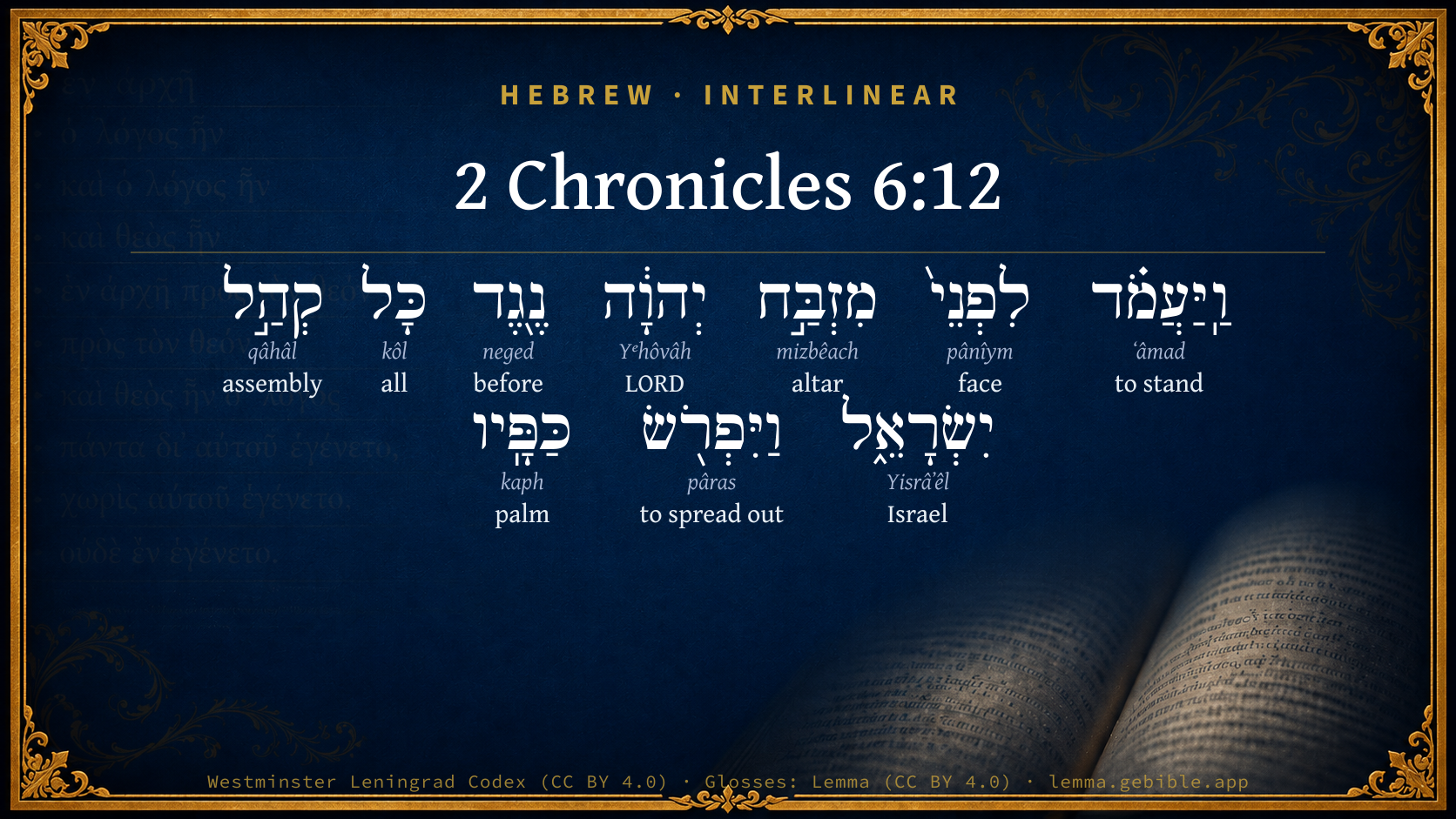
וַיִּפְרֹ֖שׂ
pâras
H6566
“and · to spread out”
Conjunction + Verb, Qal, Sequential Imperfect, 3rd Person, Masculine, Singular
Part of Speech
Conjunction + Verb
Stem
Qal
Form
Sequential Imperfect
Person
3rd Person
Gender
Masculine
Number
Singular
Full BDB Definition

Origin: a primitive root

TWOT: 1832

to spread, spread out, stretch, break in pieces - (Qal) - to spread out, display - to spread over - (Niphal) to be scattered, be spread out - (Piel) - to spread out - to scatter
  1. וַֽיַּעֲמֹ֗ד ʻâmad H5975 “and · to stand” Conjunction + Verb, Qal, Sequential Imperfect, 3rd Person, Masculine, Singular
  2. לִפְנֵי֙ pânîym H6440 “to/for · face(s) of” Preposition + Noun, Common, Both, Plural, Construct
  3. מִזְבַּ֣ח mizbêach H4196 “altar of” Noun, Common, Masculine, Singular, Construct
  4. יְהוָ֔ה Yᵉhôvâh H3068 “LORD” Noun, Proper
  5. נֶ֖גֶד neged H5048 “before” Preposition
  6. כָּל kôl H3605 “all of” Noun, Common, Masculine, Singular, Construct
  7. קְהַ֣ל qâhâl H6951 “assembly of” Noun, Common, Masculine, Singular, Construct
  8. יִשְׂרָאֵ֑ל Yisrâʼêl H3478 “Israel” Noun, Proper
  9. כַּפָּֽיו kaph H3709 “palms · his” Noun, Common, Feminine, Dual, Construct + Suffix, Personal, 3rd Person, Masculine, Singular

About this verse

These counts appear in no published source. They are computed here, from the morphology-tagged text and Lemma’s own curated glosses. What Lemma adds →

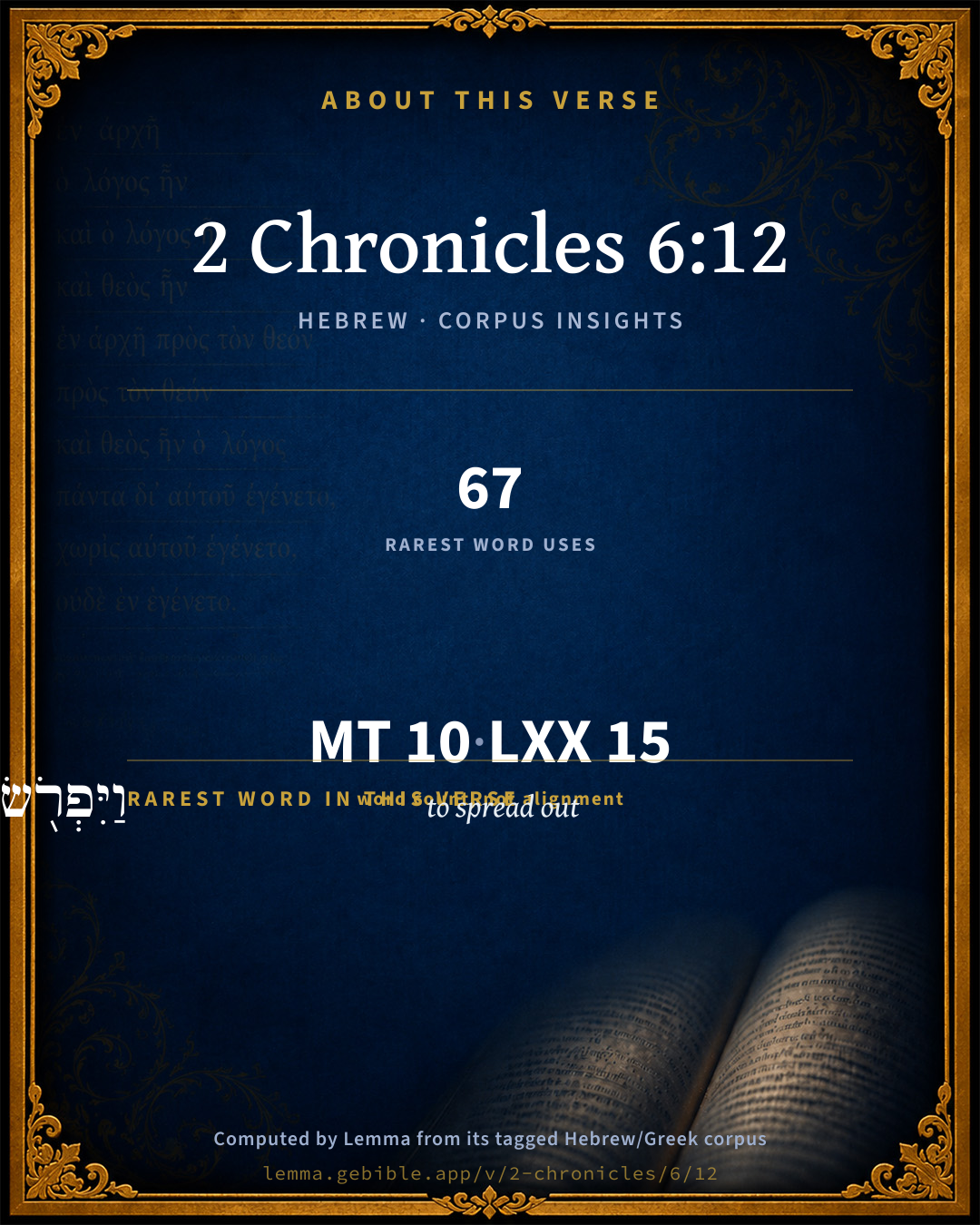
10
words
10
distinct lemmas
Historical
section

Grammatical profile

  • 2 verbs
  • 7 nouns
  • 1 preposition

Verb forms

  • וַֽיַּעֲמֹ֗ד Qal · Sequential Imperfect
  • וַיִּפְרֹ֖שׂ Qal · Sequential Imperfect

Hebrew & Septuagint length

In English translation the verse runs 21 words from the Hebrew and 23 from the Septuagint (LXX English) — closely comparable.

A rough comparison of the two English renderings, which tokenize alike — not a word-level alignment.

Word counts can differ between the Hebrew and the Greek without any difference in meaning — e.g. the Hebrew direct-object marker אֵת has no separate Greek word, and Greek often adds the article ὁ.

In the original languages it is 10 Hebrew tokens and 15 Greek tokens — but the two are counted differently (Hebrew bundles its prefixes and suffixes into one token; the Greek is in lemma form), so that isn’t a like-for-like length.

Cross-references

13

Topical passages linked to 2 Chronicles 6:12 in the Treasury of Scripture Knowledge — connected by theme and wording, ordered by reader-vote popularity; previews shown in the World English Bible.

  • Exodus 9:33 Moses went out of the city from Pharaoh, and spread abroad his hands to Yahweh; and the thunders and hail ceased, and the rain was not poured on the earth.
  • Job 11:13 "If you set your heart aright, Stretch out your hands toward him.
  • Psalms 63:4 So I will bless you while I live. I will lift up my hands in your name.
  • Psalms 143:6 I spread forth my hands to you. My soul thirsts for you, like a parched land. Selah.
  • Isaiah 50:10 Who is among you who fears Yahweh, who obeys the voice of his servant? He who walks in darkness, and has no light, let him trust in the name of Yahweh, and rely on his God.
  • 1 Kings 8:22–53 Solomon stood before the altar of Yahweh in the presence of all the assembly of Israel, and spread forth his hands toward heaven;
  • 2 Kings 11:14 and she looked, and, behold, the king stood by the pillar, as the manner was, and the captains and the trumpets by the king; and all the people of the land rejoiced, and blew trumpets. Then Athaliah tore her clothes, and cried, Treason! treason!
  • 2 Kings 23:3 The king stood by the pillar, and made a covenant before Yahweh, to walk after Yahweh, and to keep his commandments, and his testimonies, and his statutes, with all [his] heart, and all [his] soul, to confirm the words of this covenant that were written in this book: and all the people stood to the covenant.
  • Psalms 28:2 Hear the voice of my petitions, when I cry to you, When I lift up my hands toward your Most Holy Place.
  • Psalms 29:1–2 Ascribe to Yahweh, you sons of the mighty, Ascribe to Yahweh glory and strength.
  • Psalms 68:31 Princes shall come out of Egypt. Ethiopia shall hurry to stretch out her hands to God.
  • Psalms 141:2 Let my prayer be set before you like incense; The lifting up of my hands like the evening sacrifice.
  • 1 Timothy 2:8 I desire therefore that the men in every place pray, lifting up holy hands without wrath and doubting.

Cross-references courtesy of OpenBible.info (CC BY 4.0).

Hebrew and Greek witnesses Masoretic Hebrew ↔ Greek Septuagint

The same verse in the two great witnesses to the Old Testament, shown verse-for-verse.

These are two independent witnesses, not word-aligned to each other, and the Septuagint is shown in lemma (dictionary) form.

Hebrew 2 Chronicles 6:12 Masoretic · Westminster Leningrad Codex

וַֽיַּעֲמֹ֗ד לִפְנֵי֙ מִזְבַּ֣ח יְהוָ֔ה נֶ֖גֶד כָּל קְהַ֣ל יִשְׂרָאֵ֑ל וַיִּפְרֹ֖שׂ כַּפָּֽיו

He stood before the altar of Yahweh in the presence of all the assembly of Israel, and spread forth his hands

World English Bible · Public Domain

Greek LXX 2 Chronicles 6:12 Septuagint · lemma form

καί ἵστημι κατέναντι ὁ θυσιαστήριον κύριος ἔναντι πᾶς ἐκκλησία ἰσραήλ καί διαπετάζω ὁ χείρ αὐτός

And he stood before the altar of the Lord in the presence of all the congregation of Israel, and spread out his hands.

LXX2012 (modern English Septuagint) · Public Domain

On this verse, Matthew Henry's Commentary discusses the Septuagint’s reading. Read the note in Commentary ↓

Hebrew: Westminster Leningrad Codex (CC BY 4.0). Greek: Septuagint (public domain); English from LXX2012 (modern English Septuagint) (Public Domain). How the Septuagint differs from the Hebrew →

Commentary

Notes on 2 Chronicles 6:12 from classic Christian and Jewish commentators (each source and its license shown beneath its notes). The classic Christian expositions comment on the surrounding passage and are grouped to its opening verse, so a note may address several verses; the Jewish commentaries on the Tanakh (Rashi and others) are per-verse, so they appear only where the commentator wrote on this verse.

Lemma curates 59 commentaries, every one of them public domain or Creative Commons licensed, each selected and text-cleaned for this edition rather than reprinted as found. About our sources →

Ellicott's Commentary for English Readers

3. THE KING UTTERS THE PRAYER OF CONSECRATION (2Ch_6:12-42).

(Comp. 1Ki_8:22-53.)

The whole is given as in Kings, save that one verse (2Ch_6:13) is added, and the peroration (2Ch_6:40-42) is quite different.

(12) Stood.—Took his place. It is not implied that he remained standing. (Comp. 1Sa_17:51; 2Ch_6:3, supr.)

Spread forth his hands.—Towards heaven (Kings). Syriac and Arabic have both.

A Bible Commentary for English Readers, edited by Charles John Ellicott (1878–1897) — public domain. Text from a community e-Sword module.

The Biblical Illustrator

Joseph S. Exell

2Ch_6:12-15

And he stood before the altar of the Lord.

Davids charge to Solomon fulfilled

I. Solomons affectionate remembrance of his earthly father.

II. His reverence of his heavenly Father. What sublimity and yet what humility is there evinced in this prayer of the king! Had he been an outcast like Manasseh, praying to God for restoration to his lost throne, he could not have humbled himself deeper in the dust. Listen to his lowly words: But will God in very deed dwell with men on the earth? Behold, heaven and the heaven of heavens cannot contain Thee; how much less this house which I have built! etc. Who is this on bended knees and with bended heart that offers up these lowly petitions? A king? Yea, I say unto you, and more than a king. Tis Solomon in all his glory. True greatness is ever founded on humility. As it is in the natural world, so is it in the moral world--the higher the structure, the deeper the foundation. The lofty Alps, upon whose snowy head the stars of heaven seem to rest, have their foundations deep in the heart of the earth. Never was Solomon so exalted, never was he nearer heaven, than when on bended knees we behold him a suppliant at the footstool of Gods throne. The highest rank, the loftiest genius, the most splendid crown, receive a double splendour from the grace of humility. (H. Cay.)

Solomons prayer

The great proof of the blessing given to Solomon is to be found in the prayer which he prayed at the dedication of the temple. No man could have prayed that prayer without help. This we should have said about it in all honesty if we had found it in Sanscrit; if we had exhumed it out of Indian libraries, it would have been due to the author to have said, You never dreamed that dream; it was a vision of God. Probably there is no such prayer in all literary records. If ever that prayer be excelled, it will be by the Son of God alone, and His excelling of it will be by contrast rather than by comparison. There is not a selfish word in it. It is not a Jews prayer; it is a mans prayer. (J. Parker, D. D.)

The Biblical Illustrator, edited by Joseph S. Exell (c. 1880s–1900s) — public domain. Text from a community e-Sword module.

Geneva Bible (1599)

Geneva Bible translators

On a scaffold that was made for that purpose, that he praying for the whole people might be heard of all, as 1 Kings 8:22.

Geneva Bible (1599) marginal notes — public domain. Text via Bolls.life.

Matthew Henry's Commentary

Solomon had, in the foregoing verses, signed and sealed, as it were, the deed of dedication, by which the temple was appropriated to the honour and service of God. Now here he prays the consecration-prayer, by which it was made a figure of Christ, the great Mediator, through whom we are to offer all our prayers, and to expect all God's favours, and to whom we are to have an eye in every thing where we have to do with God. We have opened the particulars of this prayer (1 Kings 8) and therefore shall now only glean up some few passages in it which may be the proper subjects of our meditation.

I. Here are some doctrinal truths occasionally laid down. As, 1. That the God of Israel is a being of incomparable perfection. We cannot describe him; but this we know, there is none like him in heaven or in earth, Ch2 6:14. All the creatures have their fellow-creatures, but the Creator has not his peer. He is infinitely above all, and over all, God blessed for ever. 2. That he is, and will be, true to every word that he has spoken; and all that serve him in sincerity shall certainly find him both faithful and kind. Those that set God always before them, and walk before him with all their hearts, shall find him as good as his word and better; he will both keep covenant with them and show mercy to them, Ch2 6:14. 3. That he is a being infinite and immense, whom the heaven, and heaven of heavens, cannot contain, and to whose felicity nothing is added by the utmost we can do in his service, Ch2 6:18. He is infinitely beyond the bounds of the creation and infinitely above the praises of all intelligent creatures. 4. That he, and he only, knows the hearts of the children of men, Ch2 6:30. All men's thoughts, aims, and affections, are naked and open before him; and, however the imaginations and intents of our hearts may be concealed from men, angels, and devils, they cannot be hidden from God, who knows not only what is in the heart, but the heart itself and all the beatings of it. 5. That there is no such thing as a sinless perfection to be found in this life (Ch2 6:36): There is no man who sinneth not; nay, who doeth good and sinneth not; so he writes, agreeable to what he here says, Ecc 7:20.

II. Here are some suppositions or cases put which are to be taken notice of. 1. He supposed that if doubts and controversies arose between man and man both sides would agree to appeal to God, and lay an oath upon the person whose testimony must decide the matter, Ch2 6:22. The religious reverence of an oath, as it was ancient, so, it may be presumed, it will continue as long as there are any remains of conscience and right reason among men. 2. He supposed that, though Israel enjoyed a profound peace and tranquillity, yet troublesome times would come. He did not think the mountain of their prosperity stood so strong but that it might be moved; nay, he expected sin would move it. 3. He supposed that those who had not called upon God at other times, yet, in their affliction, would seek him early and earnestly. "When they are in distress they will confess their sins, and confess thy name, and make supplication to thee." Trouble will drive those to God who have said to him, Depart, Ch2 6:24, Ch2 6:26, Ch2 6:28. 4. He supposed that strangers would come from afar to worship the God of Israel and to pay homage to him; and this also might reasonably be expected, considering what worthless things the gods of the nations were, and what proofs the God of Israel had given of his being Lord of the whole earth.

III. Here are petitions very pertinent. 1. That God would own this house, and have an eye to it, as the place of which he had said that he would put his name there, Ch2 6:20. He could not, in faith, have asked God to show such peculiar favour to this house above any other if he himself had not said that it should be his rest for ever. The prayer that will speed must be warranted by the word. We may with humble confidence pray to God to be well pleased with us in Jesus Christ, because he had declared himself well pleased in him - This is my beloved Son; but he says not now of any house, "This is my beloved place." 2. That God would hear and accept the prayers which should be made in or towards that place, Ch2 6:21. He asked not that God should help them whether they prayed for themselves or no, but that God would help them in answer to their prayers. Even Christ's intercessions do not supersede but encourage our supplications. He prayed that God would hear from his dwelling-place, even from heaven. Heaven in his dwelling-place still, not this temple; and thence help must come. When thou hearest forgive. Note, The forgiveness of our sins is that which makes way for all the other answers to our prayers, Removendo prohibens - The evil which it drives away it keeps away. 3. That God would give judgment according to equity upon all the appeals that should be made to him, Ch2 6:23, Ch2 6:30. This we may, in faith, pray for, for we are sure it shall be done. God sitteth on the throne judging right. 4. That God would return in mercy to his people when they repented, and reformed, and sought unto him, Ch2 6:25, Ch2 6:27, Ch2 6:38, Ch2 6:39. This we also may, in faith, pray for, building upon the repeated declarations God has made of his readiness to accepts penitents. 5. That God would bid the strangers welcome to this house, and answer their prayers (Ch2 6:33); for, if there be in duty, why should there not be in privilege one law for the stranger and for one born in the land? Lev 24:22. 6. That God would, upon all occasions, own and plead the cause of his people Israel, against all the opposers of it (Ch2 6:35): Maintain their cause; and again, Ch2 6:39. If they be the Israel of God, their cause is the cause of God, and he would espouse it. 7. He concludes this prayer with some expressions which he had learned of his good father, and borrowed from one of his psalms. We had then not in the Kings, but here we have them, Ch2 6:41, Ch2 6:42. The whole word of God is of use to direct us in prayer; and how can we express ourselves in better language to God than that of his own Spirit? But these words were of use, in a special manner, to direct Solomon, because they had reference to this very work that he was now doing. We have them, Psa 132:8-10. He prayer (Ch2 6:41), (1.) That God would take possession of the temple, and keep possession, that he would make it his resting-place: Thou and the ark; what will the ark do without the God of the ark-ordinances without the God of the ordinances? (2.) That he would make the ministers of the temple public blessings: Clothe them with salvation, that is, not only save them, but make them instrumental to save others, by offering the sacrifices of righteousness. (3.) That the service of the temple might turn abundantly to the joy and satisfaction of all the Lord's people: Let thy saints rejoice in goodness, that is, in the goodness of thy house, Psa 65:4. "Let all that come hither to worship, like the eunuch, go away rejoicing." He pleads two things, Ch2 6:42. [1.] His own relation to God: "Turn not away the face of thy anointed. Lord, thou hast appointed me to be king, and wilt not thou own me?" [2.] God's covenant with his father: Remember thy mercies of David thy servant - the piety of David towards God (so some understand it and so the word sometimes signifies), his pious care of the ark, and concern for it (see Psa 132:1, Psa 132:2, etc.), or the promises of God to David, which were mercies to him, his great support and comforts in all his troubles. We may plead, as Solomon does here, with an eye to Christ: - "We deserve that God should turn away our face, that he should reject us and our prayers; but we come in the name of the Lord Jesus, thy anointed, thy Messiah (so the word is), thy Christ, so the lxx. Him thou hearest always, and wilt never turn away his face. We have no righteousness of our own to plead, but, Lord, remember the mercies of David thy servant." Christ is God's servant (Isa 42:1), and is called David, Hos 3:5. "Lord, remember his mercies, and accept us on the account of them. Remember his tender concern for his Father's honour and man's salvation, and what he did and suffered from that principle. Remember the promises of the everlasting covenant, which free grace has made to us in Christ, and which are called the sure mercies of David," Isa 55:3 and Act 13:34. This must be all our desire and all our hope, all our prayer and all our plea; for it is all our salvation.

Matthew Henry's Commentary on the Whole Bible (1708–1710) — public domain (CC PDM 1.0). Text via the HelloAO Bible API.

The Cambridge Bible for Schools and Colleges

gen. ed. J. J. S. Perowne

12–39 (= 1Ki_8:22-50). Solomon’s Prayer

The prayer is reproduced from 1 Kings with a few verbal changes and with the omission of v. 50–53. it is chiefly to the effect that future prayers made “in” or “towards this house” may be heard. The subjects of the different parts of the prayer are as follows:—

2Ch_6:14-17.

The promise made to David.

2Ch_6:18-21.

Prayer made towards this place.

2Ch_6:22-23.

The oath of ordeal taken in this place.

2Ch_6:24-25.

Prayer under defeat.

2Ch_6:26-27.

Prayer for rain.

2Ch_6:28-31.

Prayer under diverse afflictions.

2Ch_6:32-33.

The stranger’s prayer.

2Ch_6:34-35.

The prayer of the army at war abroad.

2Ch_6:36-39.

The prayer of Israel in captivity.

13. Solomon had made a brasen scaffold] This “scaffold” is not mentioned in 1 Kings. The word used (kiyyôr) properly means a “laver” (Son_4:6).

The Cambridge Bible for Schools and Colleges (gen. ed. J. J. S. Perowne; Cambridge University Press, 1878–1918) — public domain. Text from a community e-Sword module.

Haydock's Catholic Bible Commentary

Hands. Such external gestures promote attention in prayer; and hence were much used by holy people, at all times. (Worthington)

George Leo Haydock (1774–1849), Haydock's Catholic Family Bible and Commentary, 1859 edition — public domain. Excludes Psalms (Douay-Rheims chapter numbering differs from Protestant) and Deuterocanonical books (Catholic canon only).

The Pulpit Commentary

Before the altar. This means to say that Solomon stood (and afterwards knelt down) eastward of the altar indeed, but with his face to the temple and congregation. Although the voice of Solomon was raised in prayer to God, yet the prayer was to be that of the whole congregation and not of priestly proxy, and therefore of the whole congregation it must be heard.

Vers. 12-14.

Spiritual attitude.

We have in these three verses four references to attitude. Solomon "stood before the altar;" he "spread forth his hands;" he "kneeled down upon his knees;" he spoke of those who "walk before God." Now, it is worth while to observe that

I BODILY ATTITUDE IS NOT WITHOUT ITS VALUE. In the gospel of Christ, with all its precious and glorious spiritual freedom, there are no regulations as to posture in prayer; it is in no particular position of body that we must draw nigh to God and nave fellowship with him. The sufferer on his couch, the workman at his post, is as free to converse with God as the minister in the church. We glory in this divinely bestowed liberty. But it is wise to remember that one bodily attitude may be more closely associated with prayer than all others are, and, being thus associated in our minds, we in that attitude more readily fall into, and more successfully maintain ourselves in, the spirit of devotion than we can in any other. The body is the servant of the mind, and we may compel it to serve us thus; by constantly suggesting to us and thus favouring in us the idea and the spirit of worship. Here, as everywhere, is action and reaction. Our heart prompts us to worship, and this devout desire leads us to assume the attitude of devotion; then the bodily attitude helps, in its way and measure, to sustain the spirit in its reverential mood.

II OVERT ACTS ARE IMPORTANT.

1. Attendance at the place of worship: "standing before the altar.

2. Recognizing sacred obligations publicly; doing the right thing "in thepresence of all the congregation.

3. Using right and true words, not only concerning God (as in ver. 14), butconcerning man.

4. Acting, "walking," in honesty, in purity, in sobriety, in rectitude, in allrelations. But, most important of all, because at the root of all

III SPIRITUAL ATTITUDE IS OF THE FIRST CONSIDERATION. What is the attitude of our soul toward God, toward the Lord Jesus Christ?

We cannot propose to ourselves a more radical, a more vital question. The answer decides our position in (or towards) the kingdom of God. If our spiritual attitude is that of enmity, aversion, indifference, then, whatever our overt actions may be, or whatever our professions may be, we stand outside that kingdom, and are in danger of hearing the words, "I never knew you." But if our attitude is not this, but rather one of hope and trust, if it be one of desire to understand and please God, if it be one of honest and earnest inquiry, then, though there be many imperfections in our behaviour, and though there be much to be learned and acquired, we are right in the sight of God, and are counted among his servants and his friends. It was the spiritual attitude of Mary when she came with her precious spikenard which drew the Saviour"s commendation; it was the attitude of penitence and faith which called forth his gracious assurance to the poor malefactor by his side. As Christian men, it concerns us much that our spiritual attitude is one of

(1) reverence;

(2) of prayerfulness;

(3) of loving service;

(4) of concern for the coming of his kingdom. C.

Vers. 12-21.

The dedication of the temple: 3. The consecration prayer.

I THE PERSON OF THE SUPPLIANT. Solomon.

1. Royal. That Solomon should have prayed was not surprising, considering the example and training he must have received from his father, and remembering the solemn and impressive spectacle he had witnessed. It is difficult to shake off habits formed within the soul by ancestral piety and early training; while, if a sense of God"s nearness and a realization of God"s goodness will not stimulate to prayer, it is doubtful if anything on earth will. Yet praying kings are not so numerous as they might and should, or indeed would be, did they consider their own or their people"s good, not to speak of the allegiance they owe to the King of kings, by whose permission alone it is they reign (Pro_8:15; Dan_2:21)

2. Representative. Though Solomon prayed for himself and in his own name, he nevertheless acted as the official mouthpiece of his people, who in this whole work were associated with him. Though from this it cannot be inferred that earthly sovereigns in general (or even Christian sovereigns in particular) have a right to prescribe creeds or forms of worship to, or serve vicariously for, their subjects in the duties of the sanctuary, it is still true that they occupy a sort of representative position as the nation"s head, and just on that account should interest themselves in the advancement of religion amongst those who own their sway, and should frequently bear these upon their hearts before God in prayer.

II THE DEITY ADDRESSED. The Lord God of Israel.

1. The only God. The language employed here by Solomon (ver. 14), and elsewhere by David, (Psa_86:8) was not intended to concede the existence of other divinities either in heaven or on earth, but designed, like the statements of Moses, (Deu_4:39) Rahab, (Jos_2:11) David, (2Sa_7:22) and Jehovah himself, (Isa_45:22 Isa_46:5) to emphasize in the strongest way the unity and soleity of God (Exo_9:14; Deu_6:4; 1Ki_8:23; (Jeremiah. (1Co_8:4)

2. A covenant-keeping God. Solomon, like all pious Israelites, like Moses, (Deu_7:9) David (Psa_25:10 Psa_89:34; 1Ch_16:15) Nehemiah, (Neh_1:5) and Daniel, (Dan_9:4) delighted to acknowledge Jehovah"s faithfulness to his promised word. It was solely on the ground of that covenant by which God had chosen Israel for his possession, (Exo_19:5, Exo_19:8) and made himself over to be their, (Exo_20:2) that Israel existed as a nation and enjoyed the privilege of drawing near to God. Had it been possible for God to violate his deliberately and graciously formed engagements, or go back in the smallest measure from his promised word, Solomon knew that Israel"s continuance as a people would instantly have become imperilled. That Jehovah had fulfilled the promise made to David with reference to the temple, was a proof that this contingency could not occur. The same covenant faithfulness is the believer"s warrant for drawing near to God in prayer, and the suppliant"s encouragement in expecting an answer (2Co_1:20; 1Th_5:24; Tit_1:2; Heb_6:18)

3. A mercy-showing God. This also indispensable as a characteristic of such a Divinity as man can hopefully address in prayer. For unless God can be merciful towards the undeserving and hell-deserving, it is useless to think of asking anything at his hands. The notion that man may treat with God on grounds of pure personal justice must be discarded, as neither warranted by Scripture nor supported by experience.

"Tis from the mercy of our God That all our hopes begin.

And that God is pre-eminently a God of mercy is the clear teaching of revelation (Exo_34:7; Psa_103:8; Mic_7:18; Eph_2:4; Jam_5:11)

III THE MODE OF SUPPLICATION.

1. Publicly. The king prayed from a brazen scaffold, or basin-like elevation, perhaps resembling a modern pulpit, five cubits long, five broad, and three high, erected in the middle of the court and congregation. Prayers for one"s self should not be made in public, (Mat_6:5) the place for such being, not the synagogue, street corners, or market squares, but the inner chamber of the house, the secret room, or retiring-hall of the. (Mat_6:6)

2. Humbly. Indicated by the attitude assumed during prayer. Hitherto, while speaking to the people, the king had stood; now, in addressing God, he kneels. David sat before the Lord; (2Sa_7:18) Abraham stood. (Gen_18:22) In Nehemiah"s time the people stood and confessed their sins. (Neh_9:2) Daniel kneeled three times a day on his knees and prayed. (Dan_11:10) In the New Testament Scripture the Pharisee stood and prayed; (Luk_18:11) Jesus kneeled; (Luk_22:41) so did Stephen, (Act_7:60) Peter, (Act_9:40) and Paul. (Act_20:36 Act_21:5)

1. Fervently. Outstretched hands were a sign of prayer generally, their heavenward direction symbolizing a solemn and earnest appeal to him who sat enthroned on high (Exo_9:29, Exo_9:33; Psa_88:9 Psa_143:6; Isa_1:15) The same thing now signified by the folding or clasping ofthe hands and the upward turning of the face. Both classes of actions betoken inward emotion, and fervency of spirit on the part of him who prays.

2. Believingly. The scaffold stood before the brazen altar. The king" prayed from the neighbourhood of sacrificial blood a recognition on his part that only through atoning blood could either himself or his supplications gain admission into Jehovah"s audience-chamber, or acceptance with him. (Heb_9:7) It is now true that only through the blood of Jesus can one draw near to God. (Heb_10:19)

IV THE CONTENTS OF THE PRAYER. A fourfold petition.

1. For Davids house that it should never want a man to sit upon the throne (ver. 16). Jehovah had promised this conditionally on David"s children proving faithful to their covenant obligations, and walking in the ways of righteousness and truth. (2Sa_7:12-16) Solomon requests that this promise may be fulfilled, not provisionally merely, but absolutely, by God dealing with David"s children so that they shall take heed to their way, and walk in God"s Law as David had done before them. To suppose Solomon only meant that Jehovah should stand to his word and maintain the Davidic dynasty, should it eventually prove worth maintaining, he, Jehovah, all the while severely leaving it alone, is as incorrect as to imagine that Solomon desired God to establish David"s throne for ever, irrespective of the character of its occupants. What Solomon craved was the two things together the perpetuity of David"s house through the never-failing moral and spiritual worth of David"s successors.

2. For the temple that it might continue to be a dwelling-place for God on earth, and in the midst of men (ver. 18). Solomon saw that, without this, his magnificent edifice would turn out a comparatively worthless structure, as modern cathedrals and churches, however imposing their appearance, elaborate their ornamentation, or gigantic their dimensions, are nothing more than piles of masonry if God is absent from their aisles. Yet, so overpowered was his imagination with the bare idea of God"s immensity heaven and the heaven of heavens cannot contain thee thatit seemed to him doubtful if it were not the merest vanity to dream that an infinite and omnipresent Deity could inhabit even a palace such as he had erected much less this house which I have built?" And in any case the condescension of it appeared so strange as to fill him with wonder and doubtful joy. "But will God in very deed dwell with men on the earth?" The feelings here expressed have their counterparts in those kindled in believing hearts by the contemplation of that mystery of mysteries, the incarnation of the Eternal Son, and of that almost equally amazing fact, the inhabitation of the human heart by the Holy Ghost. (1Co_3:16) (See next homily on ver. 18.)

1. For himself that his present supplication might be answered (ver. 19). The special burden of his supplication was that Jehovah"s eyes might be

2. open upon the temple day and night, not so much for protection though that idea must not be excluded (Psa_121:3) as for observation; to note when any worshipper should be directing thitherward his prayer (ver. 20), lest for want of being observed such petitioner should go without an answer. The earnestness with which Solomon "cried" unto Jehovah concerning this thing was an attestation of the importance he attached to it. So far from doubting whether God could answer prayer, it seemed to him that, if God could not, his entire reputation and character as a God would be gone.

3. For all future suppliants that their prayers might be heard (ver. 21). Solomon believed that his people would in after-years retain such a faith in Jehovah as to lead them to direct their supplications towards his earthly dwelling-place. Yet Solomon confounded not Jehovah"s earthly habitation with his true dwelling-place in heaven, or expected responses from the lower shrine after the manner of a heathen oracle, instead of from the upper temple where Jehovah sat enthroned in unveiled glory. Jehovah"s symbolic presence might be behind the screen that concealed the holy of holies; his real presence was beyond the curtain of the sky. Thence accordingly should all answers come, as thither would all petitions go. The coming of such answers would be a fruit and a sign of forgiveness.

Learn:

1. The duty of intercessory prayer. (1Ti_2:1)

2. The propriety of public devotion. (Heb_10:25)

3. The reverential spirit of prayer. (Heb_12:28)

4. The reasonableness of expecting answers to prayer. W. (Psa_5:3)

The Pulpit Commentary (1880–1919), ed. H.D.M. Spence-Jones & Joseph S. Exell — public domain. Text from a community e-Sword module.

Keil & Delitzsch

C. F. Keil & F. Delitzsch

Solomon's dedicatory prayer likewise corresponds exactly with the account of it given in 1 Kings 8:22-53 till near the end (Ch2 6:40-42), where it takes quite a different turn. Besides this, in the introduction (Ch2 6:13) Solomon's position during the prayer is more accurately described, it being there stated that Solomon had caused a high stage (כּיּור, a basin-like elevation) to be erected, which he ascended, and kneeling, spoke the prayer which follows. This fact is not stated in Kg1 8:22, and Then. and Berth. conjecture that it has been dropped out of our text only by mistake. Perhaps so, but it may have been passed over by the author of the books of Kings as a point of subordinate importance. On the contents of the prayer, which begins with the joyful confession that the Lord had fulfilled His promise to David in reference to the building of the temple, and proceeds with a request for a further bestowment of the blessing promised to His people, and a supplication that all prayers made to the Lord in the temple may be heard, see the Com. on Kg1 8:22. The conclusion of the prayer in the Chronicle is different from that in 1 Kings 8. There the last supplication, that the prayers might be heard, is followed by the thought: for they (the Israelites) are Thy people and inheritance; and in the further amplification of this thought the prayer returns to the idea with which it commenced. In the narrative of the Chronicle, on the other hand, the supplications conclude with the general thought (Ch2 6:40): "Now, my God, let, I beseech Thee, Thine eyes be open, and Thine ears attend unto the prayer of this place" (i.e., unto the prayer spoken in this place). There follows, then, the conclusion of the whole prayer - a summons to the Lord (Ch2 6:41.): "And now, Lord God, arise into Thy rest, Thou and the ark of Thy strength; let Thy priests, Lord God, clothe themselves in salvation, and Thy saints rejoice in good! Lord God, turn not away the face of Thine anointed: remember the pious deeds of Thy servant David." הסדים as in Ch2 32:32; Ch2 35:26, and Neh 13:14. On this Thenius remarks, to Kg1 8:53 : "This conclusion is probably authentic, for there is in the text of the prayer, 1 Kings 8, no special expression of dedication, and this the summons to enter into possession of the temple very fittingly supplies. The whole contents of the conclusion are in perfect correspondence with the situation, and, as to form, nothing better could be desired. It can scarcely be thought an arbitrary addition made by the chronicler for no other reason than that the summons spoken of, if taken literally, is irreconcilable with the entrance of the cloud into the temple, of which he has already given us an account." Berth. indeed thinks that it does not thence follow that our conclusion is authentic, and considers it more probable that it was introduced because it appeared more suitable, in place of the somewhat obscure words in Kg1 8:51-53, though not by the author of the Chronicle, and scarcely at an earlier time. The decision on this question can only be arrived at in connection with the question as to the origin of the statements peculiar to the Chronicle contained in Ch2 7:1-3.

If we consider, in the first place, our verses in themselves, they contain no thought which Solomon might not have spoken, and consequently nothing which would tend to show that they are not authentic. It is true that the phrase קשּׁבות אזניך occurs only here and in Ch2 7:15, and again in Psa 130:2, and the noun נוּח instead of מנוּחה is found only in Est 9:16-18 in the form נוח; but even if these two expressions be peculiar to the later time, no further conclusion can be drawn from that, than that the author of the Chronicle has here, as often elsewhere, given the thoughts of his authority in the language of his own time. Nor is the relation in which Ch2 6:41, Ch2 6:42 stand to Psa 132:8-10 a valid proof of the later composition of the conclusion of our prayer. For (a) it is still a question whether our verses have been borrowed from Ps 132, or the verses of the psalm from our passage; and (b) the period when Psa 138:1-8 was written is so doubtful, that some regard it as a Solomonic psalm, while others place it in the post-exilic period. Neither the one nor the other of these questions can be determined on convincing grounds. The appeal to the fact that the chronicler has compounded the hymn in 1 Chron 15 also out of post-exilic psalms proves nothing, for even in that case it is at least doubtful if that be a correct account of the matter. But the further assertion, that the conclusion (Ch2 6:42) resembles Isa 55:3, and that recollections of this passage may have had some effect also on the conclusion (Ch2 6:41), is undoubtedly erroneous, for דויד חסדי in Ch2 6:42 has quite a different meaning from that which it has in Isa 55:3. There דּוד חסדי are the favours granted to David by the Lord; in Ch2 6:42, on the contrary, they are the pious deeds of David, - all that he had done for the raising and advancement of the public worship (see above). The phrase וגו קוּמה, "Arise, O Lord God, into Thy rest," is modelled on the formula which was spoken when the ark was lifted and when it was set down on the journey through the wilderness, which explains both קוּמה and the use of לנוּחך, which is formed after בּנוּחה, Num 10:36. The call to arise into rest is not inconsistent with the fact that the ark had already been brought into the most holy place, for קוּמה has merely the general signification, "to set oneself to anything." The idea is, that God would now take the rest to which the throne of His glory had attained, show Himself to His people from this His throne to be the God of salvation, endue His priests, the guardians of His sanctuary, with salvation, and cause the pious to rejoice in His goodness. בטּוב ישׂמחוּ is generalized in Psa 132:9 into ירנּנוּ. פּני פ השׁב, to turn away the face of any one, i.e., to deny the request, cf. Kg1 2:16.

Keil & Delitzsch — Biblical Commentary on the Old Testament (1861–1891) — public domain (CC PDM 1.0). Text via the HelloAO Bible API. (Old Testament only.)

Kretzmann's Popular Commentary

Paul E. Kretzmann

Solomon’s Dedicatory Prayer

v. 12. And he stood before the altar of the Lord, facing the altar of burnt offerings, in the presence of all the congregation of Israel, and spread forth his hands, in a gesture of entreaty;

v. 13. for Solomon had made a brazen scaffold, a pulpitlike platform, of five cubits long and five cubits broad and three cubits high (approximately nine by nine by five feet), and had set it in the midst of the court; and upon it he stood, visible to the entire multitude, and kneeled down upon his knees before all the congregation of Israel, and spread forth his hands toward heaven,

v. 14. and said, O Lord God of Israel, there is no God like Thee in the heaven nor in the earth, Jehovah being the only true God; which keepest covenant and showest mercy unto Thy servants that walk before Thee with all their hearts, ordering their entire lives in conformity with God’s holy will;

v. 15. Thou which hast kept with Thy servant David, my father, that which Thou hast promised him, and spakest with Thy mouth and hast fulfilled it with Thine hand, as it is this day, the finished Temple being a proof of the faithfulness of the Lord’s promises.

v. 16. Now, therefore, O Lord God of Israel, keep with Thy servant David, my father, continuing to fulfill His promises also in the future, that which Thou hast promised him, saying, There shall not fail thee a man in My sight to sit upon the throne of Israel, 2Sa 7:12-16, yet so that thy children take heed to their way to walk in My Law, as thou hast walked before Me.

v. 17. Now, then, O Lord God of Israel, let Thy word be verified which Thou hast spoken unto Thy servant David. Mark that this is the proper and effective way of approaching the Lord, reminding Him of His promises and urging His own faithfulness.

v. 18. But will God in very deed dwell with men on the earth? Behold, heaven and the heaven of heavens cannot contain Thee, how much less this house which I have built! The object of Solomon’s magnificent Temple was not to confine God to this one building, as the heathen did by erecting shrines for their idols, but to provide a place where His people might worship Him; the Temple was erected not for the Lord, but for the people.

v. 19. Have respect, therefore, to the prayer of Thy servant, literally, "turn Thou to the appeal of Thy servant," and to his supplication, O Lord, my God, to hearken unto the cry and the prayer which Thy servant prayeth before Thee, concerning the mode and the effectiveness of the public worship which was to be instituted in this Temple,

v. 20. that Thine eyes may be open upon this house day and night, upon the place whereof Thou hast said that Thou wouldest put Thy name there, in the Word proclaimed and in the prayers offered, to hearken unto the prayer which Thy servant prayeth toward this place, this building being at that time the one Temple in the entire world where the worship of Jehovah was publicly held.

v. 21. Hearken therefore unto the supplications of Thy servant and of Thy people Israel which they shall make toward this place; hear Thou from Thy dwelling-place, even from heaven; and when Thou hearest, forgive, this phase of God’s work, the forgiveness of sins, being prominent even at that time, just as all the sacrifices were but types of the great and only true Sacrifice, Jesus Christ. Special types of sins and special occasions of distress are now discussed.

v. 22. If a man sin against his neighbor, and an oath be laid upon him to make him swear, and the oath come before Thine altar in this house. the reference being to the practise of having men swear by or before the altar, where witnesses were not available, Mat 23:20, the oath in that case being equal to an imprecation calling down the curse of God in the event of a false oath,

v. 23. then hear Thou from heaven, and do, and judge Thy servants, by requiting the wicked, by recompensing his way upon his own head, letting the curse implied in his oath strike him, and by justifying the righteous, by giving him according to his righteousness.

v. 24. And if Thy people Israel be put to the worse before the enemy, utterly defeated and put to flight in battle, because they have sinned against Thee, and shall return and confess Thy name, and pray and make supplication before Thee in this house, making their prayer toward this Sanctuary, where the ark of God’s presence was stationed,

v. 25. then hear Thou from the heavens, and forgive the sin of Thy people Israel, and bring them again unto the land which Thou gavest to them and to their fathers.

v. 26. When the heaven is shut up, and there is no rain, droughts of this kind being expressly named as punishments of the Lord upon a disobedient people, because they have sinned against Thee, yet, if they pray toward this place, as was the custom of the Jews in all foreign countries, and confess Thy name and turn from their sin when Thou dost afflict them,

v. 27. then hear Thou from heaven, and forgive the sin of Thy servants and of Thy people Israel when Thou hast taught them the good way wherein they should walk, if they have learned the lesson intended to be conveyed to them by the Lord’s punishment, and send rain upon Thy land which Thou hast given unto Thy people for an inheritance.

v. 28. If there be dearth in the land, if there be pestilence, if there be blasting, or mildew, locusts, or caterpillars; if their enemies besiege them in the cities of their land; whatsoever sore or whatsoever sickness there be, only a few of the curses being named here which are threatened Leviticus 26 and Deuteronomy 28 upon a stubborn and rebellious people,

v. 29. then, what prayer or what supplication soever shall be made of any man or of all thy people Israel, when everyone shall know his own sore and his own grief, coming to the knowledge of his sins and grieving over them in true repentance, and shall spread forth his hands in this house,

v. 30. then hear Thou from heaven, Thy dwelling place, and forgive, and render unto every man according unto all his ways, whose heart Thou knowest, He would be able to judge the sincerity of a man’s repentance, (for Thou only knowest the hearts of the children of men, since He, the Omniscient One, reads all the thoughts of the heart,)

v. 31. that they may fear Thee, to walk in Thy ways, so long as they live in the land, sustained by the fruit on the face of the land, which Thou gavest unto our fathers.

v. 32. Moreover, concerning the stranger, which is not of Thy people Israel, but Is come from a far country for Thy great name’s sake, becoming a proselyte to the Jewish faith, as, for instance, the eunuch of Queen Candace, Act 8:27, and Thy mighty hand, and Thy stretched-out arm; If they come and pray in this house,

v. 33. then hear Thou from the heavens, even from Thy dwelling place, and do according to all that the stranger calleth to Thee for, that all people of the earth may know Thy name, becoming acquainted with it through such missionaries, and fear Thee as doth Thy people Israel, and may know that this house which I have built Is called by Thy name, literally, Thy name is called upon this house, for it was consecrated by the fact that the Word of God was observed and proclaimed there.

v. 34. If Thy people go out to war against their enemies by the way that Thou shalt send them, and they pray unto Thee, from the country where their expedition might lead them, toward this city which Thou hast chosen, and the house which I have built for Thy name,

v. 35. then hear Thou from the heavens their prayer and their supplication and maintain their cause, giving them the victory over their enemies.

v. 36. If they sin against Thee, (for there is no man which sinneth not, that is a principle which has been held in the Church at all times,) and Thou be angry with them and deliver them over before their enemies, and they carry them away captives unto a land far off or near, as happened afterward with both divisions of the nation;

v. 37. yet if they bethink themselves in the land whither they are carried captive, and turn and pray unto Thee in the land of their captivity, in true repentance over their sins, saying, We have sinned, we have done amiss, and have dealt wickedly, the formula which was afterward constantly used by the Jews in their public confessions of sins;

v. 38. if they return to Thee with all their heart and with all their soul in the land of their captivity whither they have carried them captives, and pray toward their land which Thou gavest unto their fathers, and toward the city which Thou hast chosen, and toward the house which I have built for Thy name, as it is related of Daniel, Dan 6:10,

v. 39. then hear Thou from the heavens, even from Thy dwelling-place, their prayer and their supplications, and maintain their cause, siding with them in the issue presented, and forgive Thy people which have sinned against Thee. In this way the Temple would become the central Sanctuary of the Jews, the one place where Jehovah’s presence would be revealed.

v. 40. Now, my God, let, I beseech Thee, Thine eyes be open, and let Thine ears be attent unto the prayer that is made in this place, both the present appeal and all prayers that would be made there in the future. For the entire prayer Cf 1Ki 8:23-53.

v. 41. Now, therefore, arise, O Lord God, into Thy resting-place, the fixed and permanent man a ion of the Temple, Thou and the ark of Thy strength, from which He would manifest His power in behalf of His people, a solemn summons to the Lord to take formal possession of His Sanctuary. Let Thy priests, O Lord God, be clothed with salvation, their white linen garments being expressive of the righteousness and moral beauty which the sacrifices they offered brought to the worshipers, and let Thy saints rejoice in goodness, being glad in the possession of the good and shouting for joy.

v. 42. O Lord God, turn not away the face of Thine anointed, namely, from Solomon, who was making this fervent appeal; remember the mercies of David, Thy servant, those promised to him, for whose fulfillment the king pleaded in faithful confidence. We believers of the New Testament have an even safer assurance that God will hear our prayers, if we but call to Him in the name of Jesus; for whosoever shall call upon the name of the Lord Jesus Christ shall be saved.

Paul E. Kretzmann, Popular Commentary of the Bible (1921–1924) — public domain. Text from a community e-Sword module.

unfoldingWord translationNotes

Door43 World Missions Community

in the presence of all the assembly of Israel

"in front of the people of Israel who had gathered there"

spread out his hands

"raised his hands." This was to show that he was praying. (See: Symbolic Action)

five cubits long, five cubits wide, and three cubits high

You may convert these to modern measures. AT: "two and one-third meters long, two and one-third meters wide, and one and one-half meters high" (See: Biblical Distance)

he spread out his hands toward the heavens

Solomon lifted up his hands and held them high as he knelt on the platform to pray. Spreading out his hands toward the heavens was a way of showing that he was praying to Yahweh. (See: Symbolic Action)

translationWords

altar

assembly

bronze

court

heaven

unfoldingWord translationNotes — © Distant Shores Media and the Door43 World Missions Community, licensed CC BY-SA 4.0. Source: git.door43.org/Door43/en_tn.

Rashi

Rabbi Shlomo Yitzchaki (Rashi)

and he spread forth his hands Scripture should have said the following: “and he spread forth his hands toward heaven, and he said, etc.,” but it interrupted in between to inform [us] on what he stood, and so in I Kings (8:22f.): “and he spread forth his hands towards heaven, and he said.”

Rashi on the Tanakh — English translations: “The Judaica Press complete Tanach with Rashi, translated by A. J. Rosenberg” (CC BY 4.0); “Pentateuch with Rashi's commentary by M. Rosenbaum and A.M. Silbermann, 1929-1934” (public domain); “The Metsudah Tanach series, Lakewood, N.J” (CC BY 4.0); and “The Book of Joshua, Metsudah Publications, 1997” (CC BY 4.0). Text via Sefaria.

Lesson kit

Teaching starters — assembled from the data on this page, not authored interpretation. Every prompt links to the verse data it draws on. Edit before teaching.

2 Chronicles, in the Historical, opens this verse with 10 words (10 distinct Hebrew lemmas). Its most distinctive word is pâras (“to spread out”). A historical commentator’s framing appears above. Read the whole chapter for the surrounding context.

Discussion questions

  1. The word pâras carries the sense “to spread out.” How does it shape the verse?
  2. How does Exodus 9:33, which shares this passage’s theme, read alongside this verse?
  3. These translations render this verse differently; the difference is in the English rendering, not the original. What questions does that raise?
  4. «וַֽיַּעֲמֹ֗ד» is a Qal Sequential Imperfect verb. How does that grammatical form shape the action described?
  5. Compare how Ellicott's Commentary for English Readers and The Biblical Illustrator read this verse. Where do they agree or differ?

Things to notice

Reading settings

Reading text

Shown beneath each verse's original-language words.

Old Testament
Old Testament edition

Read the OT as the Masoretic Hebrew (MT) or the Greek Septuagint (LXX).

English shown for the Greek Septuagint (in the Hebrew ↔ Greek comparison).

Comparing translations? Open the Compare panel on any verse page to stack up to four side by side.