
Deuteronomy 28:56

Hebrew (Westminster Leningrad Codex) Deuteronomy 28:56 appears in the Hebrew Old Testament. The text above is from the Westminster Leningrad Codex. Each word links to its Strong’s number, a concise gloss, and parsing drawn from the Open Scriptures Hebrew Bible morphology. Click any word for its full Brown-Driver-Briggs (BDB) entry.
Download image
Cite this verse

Deuteronomy 28:56 (World English Bible). Public Domain. Lemma interlinear Bible study tool, https://lemma.gebible.app/v/deuteronomy/28/56.

Show BibTeX & RIS
BibTeX
RIS
English Translation
The tender and delicate woman among you, who would not adventure to set the sole of her foot on the ground for delicateness and tenderness, her eye shall be evil toward the husband of her bosom, and toward her son, and toward her daughter,
World English Bible · Public Domain
Highlights
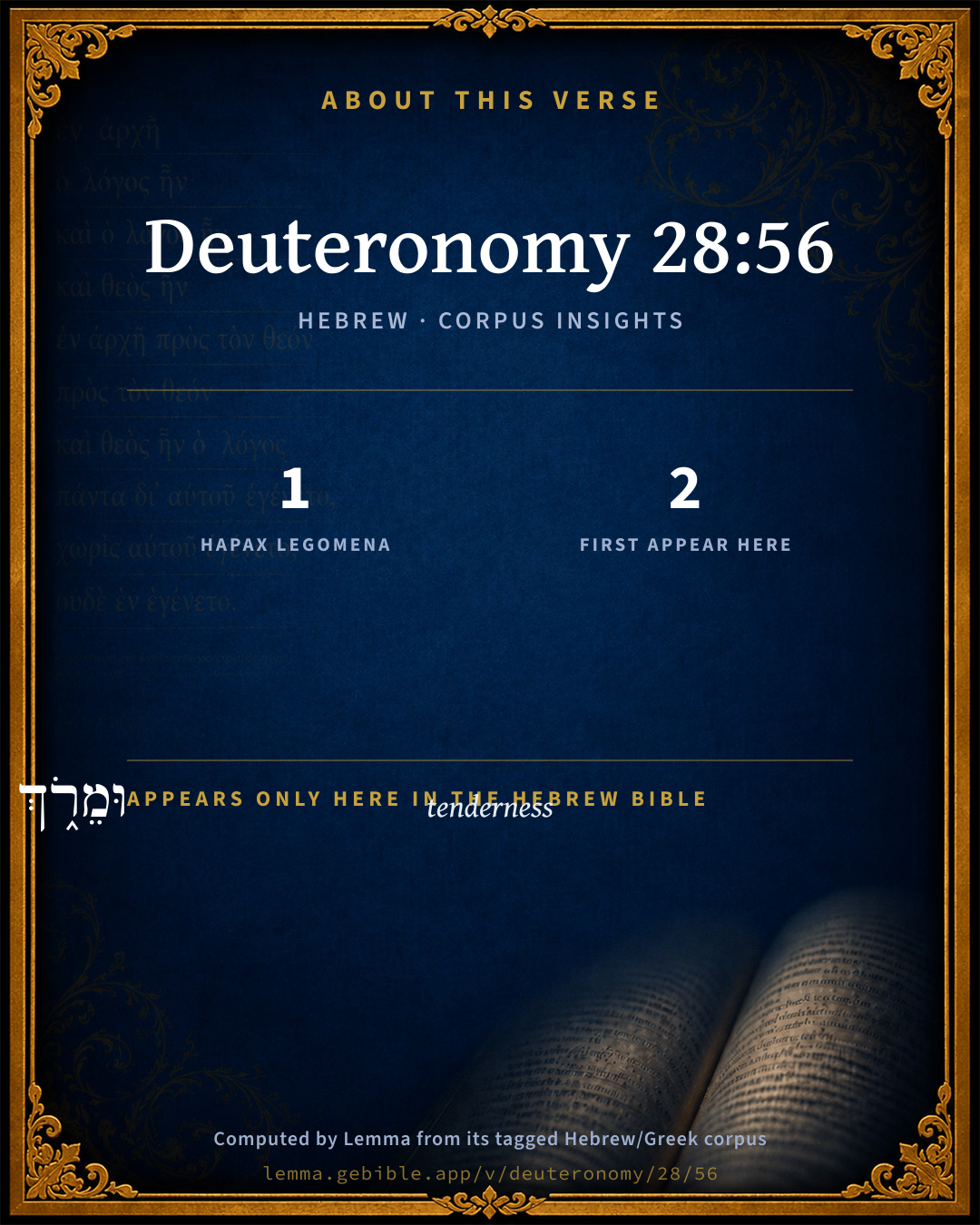
  • 1 hapax legomenon — only here in the Hebrew Bible
  • 2 first appearances in the Hebrew Bible
Full analysis ↓
Download a study sheet

One document with this verse’s original text, its word-by-word gloss line, the meaning frame, cross-references with their text, attributed commentary, and full source and license credits — printable, and it pastes into notes with its structure intact.

This verse Autodidact and up

Study sheet (.html) Plain text (.txt)

A passage Seminary Student

Up to 50 verses in one chapter. A passage sheet keeps up to 6 commentary sources and 12 cross-references per verse, in the order this page ranks them, and says so on the sheet whenever that leaves anything out. Ask for a single verse and you get the Autodidact verse sheet above.

Everything on this page stays free to read, with no account — the sheet is a download of what is already on screen, not access to it.

Want to remove ads? Support Godless Engineer
Compare translations 3

The same verse in 3 English versions, stacked beneath the original-language interlinear above. Click any original word for its lexicon entry.

Each is an independent rendering of the whole verse — the interlinear is not word-aligned to these translations.

Highlighted words mark where these versions differ — a whole-verse word diff, not a word-by-word alignment.

  • World English Bible Public Domain
    The tender and delicate woman among you, who would not adventure to set the sole of her foot on the ground for delicateness and tenderness, her eye shall be evil toward the husband of her bosom, and toward her son, and toward her daughter,
  • King James Version Public Domain
    The tender and delicate woman among you, which would not adventure to set the sole of her foot upon the ground for delicateness and tenderness, her eye shall be evil toward the husband of her bosom, and toward her son, and toward her daughter,
  • unfoldingWord Literal Text CC BY-SA 4.0
    The tender and delicate woman among you, who would not attempt to set the bottom of her foot on the ground because of delicateness and tenderness, her eye will do wrong against the husband of her bosom and against her son and against her daughter

unfoldingWord Literal Text — © unfoldingWord, licensed CC BY-SA 4.0. Word-aligned USFM3 via Door43 (git.door43.org/unfoldingWord/en_ult).

Versions to compare (up to 4)

3 of 4 selected

Show all 18 translations

Every available English version of this verse, each an independent rendering of the whole verse.

  • World English Bible Public Domain
    The tender and delicate woman among you, who would not adventure to set the sole of her foot on the ground for delicateness and tenderness, her eye shall be evil toward the husband of her bosom, and toward her son, and toward her daughter,
  • Berean Standard Bible Public Domain
    The most gentle and refined woman among you, so gentle and refined she would not venture to set the sole of her foot on the ground, will begrudge the husband she embraces and her son and daughter
  • Majority Standard Bible Public Domain
    The most gentle and refined woman among you, so gentle and refined she would not venture to set the sole of her foot on the ground, will begrudge the husband she embraces and her son and daughter
  • King James Version Public Domain
    The tender and delicate woman among you, which would not adventure to set the sole of her foot upon the ground for delicateness and tenderness, her eye shall be evil toward the husband of her bosom, and toward her son, and toward her daughter,
  • American Standard Version (1901) Public Domain
    The tender and delicate woman among you, who would not adventure to set the sole of her foot upon the ground for delicateness and tenderness, her eye shall be evil toward the husband of her bosom, and toward her son, and toward her daughter,
  • Revised Version (1885) Public Domain
    The tender and delicate woman among you, which would not adventure to set the sole of her foot upon the ground for delicateness and tenderness, her eye shall be evil toward the husband of her bosom, and toward her son, and toward her daughter;
  • Geneva Bible (1599) Public Domain
    The tender and deintie woman among you, which neuer woulde venture to set the sole of her foote vpon the grounde (for her softnesse and tendernesse) shalbe grieued at her husband that lieth in her bosome, and at her sonne, and at her daughter,
  • Douay-Rheims (1899) Public Domain
    The tender and delicate woman, that could not go upon the ground, nor set down her foot for over much niceness and tenderness, will envy her husband who lieth in her bosom, the flesh of her son, and of her daughter,
  • Young's Literal Translation Public Domain
    `The tender woman in thee, and the delicate, who hath not tried the sole of her foot to place on the ground because of delicateness and because of tenderness -- her eye is evil against the husband of her bosom, and against her son, and against her daughter,
  • Literal Standard Version CC BY-SA 4.0
    The tender woman in you, and the delicate, who has not tried the sole of her foot to place on the ground because of delicateness and because of tenderness—her eye is evil against the husband of her bosom, and against her son, and against her daughter,
  • Unlocked Literal Bible CC BY-SA 4.0
    The tender and delicate woman among you, who would not venture to put the bottom of her foot on the ground for delicateness and tenderness—she will be envious of her own dear husband, of her son, and of her daughter,
  • unfoldingWord Literal Text CC BY-SA 4.0
    The tender and delicate woman among you, who would not attempt to set the bottom of her foot on the ground because of delicateness and tenderness, her eye will do wrong against the husband of her bosom and against her son and against her daughter
  • Darby Bible Public Domain
    The eye of the tender and luxurious woman in thy midst who would not attempt to set the sole of her foot upon the ground from luxuriousness and from tenderness, shall be evil toward the husband of her bosom, and her son, and her daughter,
  • World Messianic Bible Public Domain
    The tender and delicate woman among you, who would not venture to set the sole of her foot on the ground for delicateness and tenderness, her eye will be evil toward the husband that she loves, toward her son, toward her daughter,
  • Webster's Bible Public Domain
    The tender and delicate woman among you, who would not venture to set the sole of her foot upon the ground for delicateness and tenderness, her eye shall be evil towards the husband of her bosom, and towards her son, and towards her daughter,
  • Free Bible Version CC BY-SA 4.0
    The kindest and most sensitive woman among you, so kind and sensitive she wouldn't ever go barefoot on the ground, will refuse to share her food, a baby and its afterbirth, with the husband she loves and her own son and daughter.
  • Bible in Basic English Public Domain
    The most soft and delicate of your women, who would not so much as put her foot on the earth, so delicate is she, will be hard-hearted to her husband and to her son and to her daughter;
  • JPS Tanakh (1917) Public Domain
    The tender and delicate woman among you, who would not adventure to set the sole of her foot upon the ground for delicateness and tenderness, her eye shall be evil against the husband of her bosom, and against her son, and against her daughter;

Literal Standard Version (2020), Covenant Press — licensed CC BY-SA 4.0. Text via the HelloAO Bible API (eBible.org). Unlocked Literal Bible (unfoldingWord) — licensed CC BY-SA 4.0. Text via the HelloAO Bible API (eBible.org). unfoldingWord Literal Text — © unfoldingWord, licensed CC BY-SA 4.0. Word-aligned USFM3 via Door43 (git.door43.org/unfoldingWord/en_ult). Free Bible Version, Dr. Jonathan Gallagher — licensed CC BY-SA 4.0. Text via the HelloAO Bible API (eBible.org).

Word by word

More ways to search: Search by grammar → Find every occurrence → Compare this word →

Practice this passage: Drill this verse → Learn its vocabulary →

וּמֵרֹ֑ךְ
rôk
H7391
“and · from · tenderness”
Conjunction + Preposition + Noun, Common, Masculine, Singular, Absolute
Part of Speech
Conjunction + Preposition + Noun
Type
Common
Gender
Masculine
Number
Singular
State
Absolute
Full BDB Definition

Origin: from H7401

TWOT: 2164b

tenderness, delicacy - of woman
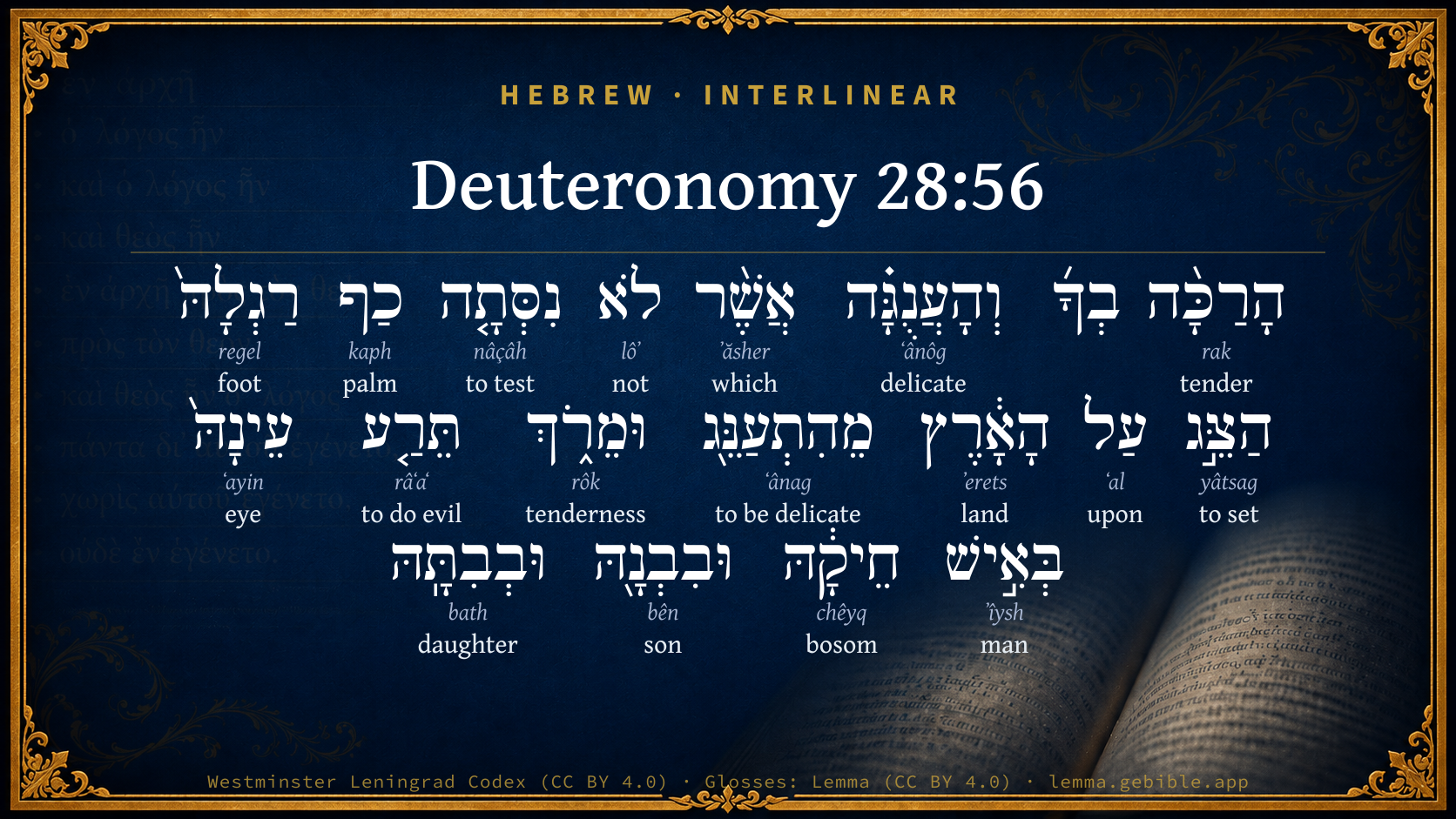
  1. הָרַכָּ֨ה rak H7390 “the · tender” Particle, Definite Article + Adjective, Adjective, Feminine, Singular, Absolute
  2. וְהָעֲנֻגָּ֗ה ʻânôg H6028 “and · the · delicate” Conjunction + Particle, Definite Article + Adjective, Adjective, Feminine, Singular, Absolute
  3. אֲשֶׁ֨ר ʼăsher H834 “which” Particle, Relative
  4. לֹא lôʼ H3808 “not” Particle, Negative
  5. נִסְּתָ֤ה nâçâh H5254 “to test” Verb, Piel, Perfect, 3rd Person, Feminine, Singular
  6. כַף kaph H3709 “palm of” Noun, Common, Feminine, Singular, Construct
  7. רַגְלָהּ֙ regel H7272 “foot · her” Noun, Common, Feminine, Singular, Construct + Suffix, Personal, 3rd Person, Feminine, Singular
  8. הַצֵּ֣ג yâtsag H3322 “to set” Verb, Hiphil, Infinitive Construct
  9. עַל ʻal H5921 “upon” Preposition
  10. הָאָ֔רֶץ ʼerets H776 “the · land” Particle, Definite Article + Noun, Common, Both, Singular, Absolute
  11. מֵהִתְעַנֵּ֖ג ʻânag H6026 “from · to be delicate” Preposition + Verb, Hithpael, Infinitive Construct
  12. תֵּרַ֤ע râʻaʻ H7489 “to do evil” Verb, Qal, Imperfect, 3rd Person, Feminine, Singular
  13. עֵינָהּ֙ ʻayin H5869 “eye · her” Noun, Common, Both, Singular, Construct + Suffix, Personal, 3rd Person, Feminine, Singular
  14. בְּאִ֣ישׁ ʼîysh H376 “in/at · man of” Preposition + Noun, Common, Masculine, Singular, Construct
  15. חֵיקָ֔הּ chêyq H2436 “bosom · her” Noun, Common, Masculine, Singular, Construct + Suffix, Personal, 3rd Person, Feminine, Singular
  16. וּבִבְנָ֖הּ bên H1121 “and · in/at · son · her” Conjunction + Preposition + Noun, Common, Masculine, Singular, Construct + Suffix, Personal, 3rd Person, Feminine, Singular
  17. וּבְבִתָּֽהּ bath H1323 “and · in/at · daughter · her” Conjunction + Preposition + Noun, Common, Feminine, Singular, Construct + Suffix, Personal, 3rd Person, Feminine, Singular

About this verse

These counts appear in no published source. They are computed here, from the morphology-tagged text and Lemma’s own curated glosses. What Lemma adds →

19
words
18
distinct lemmas
Pentateuch
section

Notable vocabulary

1 hapax legomenon — a word that appears only here in the entire Hebrew Bible:

  • וּמֵרֹ֑ךְ tenderness H7391

First appearance in Scripture

These words make their first canonical appearance in the Hebrew Bible here:

  • מֵהִתְעַנֵּ֖ג to be delicate H6026
  • וּמֵרֹ֑ךְ tenderness H7391

Shared distinctive vocabulary

וְהָעֲנֻגָּ֗ה delicate H6028 occurs in 3 verses of the Hebrew Bible. Also found in:

Grammatical profile

  • 4 verbs
  • 9 nouns
  • 2 adjectives
  • 2 prepositions
  • 2 particles

Verb forms

  • נִסְּתָ֤ה Piel · Perfect
  • הַצֵּ֣ג Hiphil · Infinitive Construct
  • מֵהִתְעַנֵּ֖ג Hithpael · Infinitive Construct
  • תֵּרַ֤ע Qal · Imperfect

Hebrew & Septuagint length

In English translation the verse runs 44 words from the Hebrew and 41 from the Septuagint (LXX English) — closely comparable.

A rough comparison of the two English renderings, which tokenize alike — not a word-level alignment.

Word counts can differ between the Hebrew and the Greek without any difference in meaning — e.g. the Hebrew direct-object marker אֵת has no separate Greek word, and Greek often adds the article ὁ.

Cross-references

3

Topical passages linked to Deuteronomy 28:56 in the Treasury of Scripture Knowledge — connected by theme and wording, ordered by reader-vote popularity; previews shown in the World English Bible.

  • Deuteronomy 28:54 The man who is tender among you, and very delicate, his eye shall be evil toward his brother, and toward the wife of his bosom, and toward the remnant of his children whom he has remaining;
  • Isaiah 3:16 Moreover Yahweh said, "Because the daughters of Zion are haughty, And walk with outstretched necks and flirting eyes, Walking to trip as they go, Jingling ornaments on their feet;
  • Lamentations 4:3–6 Even the jackals draw out the breast, they give suck to their young ones: The daughter of my people is become cruel, like the ostriches in the wilderness.

Cross-references courtesy of OpenBible.info (CC BY 4.0).

Hebrew and Greek witnesses Masoretic Hebrew ↔ Greek Septuagint

The same verse in the two great witnesses to the Old Testament, shown verse-for-verse.

These are two independent witnesses, not word-aligned to each other, and the Septuagint is shown in lemma (dictionary) form.

Hebrew Deuteronomy 28:56 Masoretic · Westminster Leningrad Codex

הָרַכָּ֨ה בְךָ֜ וְהָעֲנֻגָּ֗ה אֲשֶׁ֨ר לֹא נִסְּתָ֤ה כַף רַגְלָהּ֙ הַצֵּ֣ג עַל הָאָ֔רֶץ מֵהִתְעַנֵּ֖ג וּמֵרֹ֑ךְ תֵּרַ֤ע עֵינָהּ֙ בְּאִ֣ישׁ חֵיקָ֔הּ וּבִבְנָ֖הּ וּבְבִתָּֽהּ

The tender and delicate woman among you, who would not adventure to set the sole of her foot on the ground for delicateness and tenderness, her eye shall be evil toward the husband of her bosom, and toward her son, and toward her daughter,

World English Bible · Public Domain

Greek LXX Deuteronomy 28:56 Septuagint · lemma form

καί ὁ ἁπαλός ἐν σύ καί ὁ τρυφερός σφόδρα ὅς οὐ πεῖρα λαμβάνω ὁ πούς αὐτός βαίνω ἐπί ὁ γῆ διά ὁ τρυφερότης καί διά ὁ ἁπαλότης βασκαίνω ὁ ὀφθαλμός αὐτός ὁ ἀνήρ αὐτός ὁ ἐν ὁ κόλπος αὐτός καί ὁ υἱός καί ὁ θυγάτηρ αὐτός

And she that is tender and delicate among you, whose foot has not assayed to go upon the earth for delicacy and tenderness, shall look with an evil eye on her husband in her bosom, and her son and her daughter,

LXX2012 (modern English Septuagint) · Public Domain

Hebrew: Westminster Leningrad Codex (CC BY 4.0). Greek: Septuagint (public domain); English from LXX2012 (modern English Septuagint) (Public Domain). How the Septuagint differs from the Hebrew →

Targum (Aramaic paraphrase)

2

The Targum is the ancient Jewish Aramaic paraphrase of the Hebrew Scriptures — an interpretive translation, not the Hebrew text itself. Onkelos (literal) and Pseudo-Jonathan (expansive) render the Torah, and Jonathan the Prophets. Coverage is partial: where no permissively-licensed English translation exists for a verse, only the Aramaic is shown. This is verse-level text, not a word-by-word alignment to the Hebrew.

  1. Targum Onkelos Torah (Genesis–Deuteronomy)
    דְרַכִּיכָא בָךְ וְדִמְפַנְקָא דִי לָא נַסִיאַת פַּרְסַת רַגְלַהּ לַאֲחָתָא עַל אַרְעָא מִמְפַנְקוּ וּמֵרַכִּיכוּ תַּבְאֵשׁ עֵינַהּ בִּגְבַר קְיָמַהּ וּבִבְרַהּ וּבִבְרַתַּהּ

    (no public-domain English translation for this verse)

    Targum Onkelos — Aramaic: “Onkelos Genesis” (public domain); “Onkelos Exodus” (public domain); “Onkelos Leviticus” (public domain); “Onkelos Numbers” (public domain); “Onkelos Deuteronomy” (public domain). English: “Sefaria Community Translation” (CC0 1.0 (public-domain dedication)); “J.W. Etheridge. The Targums of Onkelos and Jonathan Ben Uzziel on the Pentateuch. London: Longmans, Green, 1862” (public domain). Text via Sefaria.

  2. Targum Pseudo-Jonathan Torah (Genesis–Deuteronomy)
    דִמְחַטַיְיתָא בְכוֹן וּדְמִפְרַנְקָא דְלָא נַסְיַית פַּרְסַת רִיגְלָהּ לְמִדְרַס עַל אַרְעָא מִן פַּרִינְקָא וּמִן חִיטוֹיָא תִּבְאַשׁ עֵינָהּ בִּבְעֵיל דְדָמִיךְ בְּעוֹבָהּ וּבִבְרָהּ וּבִבְרַתָּהּ

    She who is delicate and luxurious among you, who hath not ventured to put the sole of her foot upon the ground from tenderness and delicacy, will look with evil eyes upon the husband of her bosom, upon her son and her daughter,

    Targum Pseudo-Jonathan — Aramaic: “Targum Jonathan on Genesis” (public domain); “Targum Jonathan on Exodus” (public domain); “Targum Jonathan on Leviticus” (public domain); “Targum Jonathan on Numbers” (public domain); “Targum Jonathan on Deuteronomy” (public domain). English: “The Targum of Jonathan ben Uzziel, trans. J. W. Etheridge, London, 1862” (public domain). Text via Sefaria.

Commentary

Notes on Deuteronomy 28:56 from classic Christian and Jewish commentators (each source and its license shown beneath its notes). The classic Christian expositions comment on the surrounding passage and are grouped to its opening verse, so a note may address several verses; the Jewish commentaries on the Tanakh (Rashi and others) are per-verse, so they appear only where the commentator wrote on this verse.

Lemma curates 59 commentaries, every one of them public domain or Creative Commons licensed, each selected and text-cleaned for this edition rather than reprinted as found. About our sources →

Trapp's Complete Commentary

John Trapp

Deu 28:56 The tender and delicate woman among you, which would not adventure to set the sole of her foot upon the ground for delicateness and tenderness, her eye shall be evil toward the husband of her bosom, and toward her son, and toward her daughter,

Ver. 56. The tender and delicate.] These threatenings were tanquam in speculo conspicuae, literally and punctually fulfilled upon the Jews at the last destruction of Jerusalem, at which time wrath came upon them to the utmost. {2Th 2:6-13}

John Trapp, A Commentary or Exposition upon All the Books of the Old and New Testament (1647–1656) — public domain. Text from a community e-Sword module.

Joseph Benson's Commentary

Deu 28:56-57. The tender and delicate woman — shall eat her children — secretly — Not in order to escape the infamy of the action, but lest others should have a share with her. In the siege and straitness — This was fulfilled about six hundred years after the time of Moses, among the Israelites, when Samaria was besieged by the king of Syria, and two women agreed together, the one to give up her son to be boiled and eaten that day, and the other to deliver up her son to be dressed and eaten the next, and one of them was eaten accordingly, 2Ki 6:28. It was fulfilled again about nine hundred years after Moses, in the siege of Jerusalem, before the Babylonish captivity, Bar 2:1-3; Lam 4:10. And again it was fulfilled above one thousand five hundred years after Moses, in the last siege of Jerusalem by Titus; Josephus informing us particularly of a noble woman’s killing and eating her own sucking child; and she did it, as Moses says she should do it, secretly; for, according to Josephus, when she had boiled and eaten half, she covered up the rest, and kept it for another time. At so many different times, and distant periods, hath this prophecy been fulfilled, to the perpetual reproach of the Jewish nation; for never was the like done, either by Greek or barbarian. See the fruit of being abandoned of God! Nothing is too barbarous for such to do.

Joseph Benson's Commentary on the Old and New Testaments (1811–1818) — public domain. Text from a community e-Sword module.

Tyndale Open Study Notes

Tyndale Open Resources

28:56 not . . . touch the ground: This woman was so fastidious that she avoided walking barefoot on the soil.

Tyndale Open Study Notes — © Tyndale Open Resources, licensed CC BY-SA 4.0. Text via the HelloAO Bible API.

Geneva Bible (1599)

Geneva Bible translators

As came to pass in the days of Joram king of Israel, 2 Kings 6:20, and when the Romans besieged Jerusalem.

Geneva Bible (1599) marginal notes — public domain. Text via Bolls.life.

Adam Clarke's Commentary

Verse 56. The tender and delicate woman] This was literally fulfilled when Jerusalem was besieged by the Romans; a woman named Mary, of a noble family, driven to distraction by famine, boiled and ate her own child! See a similar case 2Kg 6:29; and See Clarke on Le 26:29.

Adam Clarke's Commentary on the Bible (1810–1826) — public domain. Text from a community e-Sword/MySword module.

Ellicott's Commentary for English Readers

(56) The tender and delicate woman.—This was fulfilled to the very letter in the case of Mary of Beth-ezob in the siege of Jerusalem by Titus. The story is told with horrible minuteness by Josephus, and again by Eusebius in his Church History. The secrecy of the deed was one of its horrors.

A Bible Commentary for English Readers, edited by Charles John Ellicott (1878–1897) — public domain. Text from a community e-Sword module.

The Cambridge Bible for Schools and Colleges

gen. ed. J. J. S. Perowne

56. The most tender and most delicate woman among you] Almost as in Deu_28:54.

which would not adventure] Rather, who had never ventured or tried (for the vb. see on Deu_4:34), having been accustomed to be carried.

The Cambridge Bible for Schools and Colleges (gen. ed. J. J. S. Perowne; Cambridge University Press, 1878–1918) — public domain. Text from a community e-Sword module.

John Gill's Exposition

Moreover, he will bring upon thee all the diseases of Egypt,.... All that in a way of judgment were brought upon the Egyptians for refusing to let Israel go; or all such diseases as were peculiar to them, and common among them, as the leprosy, the itch, ulcers, &c.

which thou wast afraid of; when living among them, lest they should catch them of them, or they should be inflicted on them by the hand of God:

and they shall cleave unto thee; not only should come upon them, but continue with them; they should not easily get rid of them, or be cured of them.

John Gill's Exposition of the Whole Bible (1746–1763) — public domain (CC PDM 1.0). Text via the HelloAO Bible API.

Haydock's Catholic Bible Commentary

Envy. Hebrew, "her eye shall be evil towards the husband of her bosom," &c. (Haydock)

George Leo Haydock (1774–1849), Haydock's Catholic Family Bible and Commentary, 1859 edition — public domain. Excludes Psalms (Douay-Rheims chapter numbering differs from Protestant) and Deuterocanonical books (Catholic canon only).

Matthew Poole's English Annotations

Evil, i.e. unmerciful: she will desire or design their destruction for her food.

Matthew Poole's English Annotations on the Holy Bible (1683–1685) — public domain. Text from a community e-Sword/MySword module.

The Pulpit Commentary

So intense should be the hunger, that the delicate and sensitive woman, brought up in luxury, and who would not set her foot on the ground lest she should be fatigued by the exertion or offended by coming in contact with the base soil, but when she went abroad must be carried in a litter or borne by a camel or an ass, even she should break through all restraints of delicacy and affection, and would secretly devour the very infant she had borne during the siege.

Vers. 56, 57. The delicate lady.

Isa_3:16-26 The queens of select society have little reason to be vain of their excessive and artificial delicacy. They need not pride themselves in it, or think that it entitles them to look haughtily on others. For

I DELICACY IS NOT CHARACTER. It is consistent with a vain, light, scornful, wicked disposition. The tender and delicate lady in this verse is one of the enemies of God. The purest types of female character avoid those extravagances of delicacy which, indulged in, become second nature. Character alone entities to respect. To be vain of beauty or breeding, when the heart is false and the life untrue to God, is to be vain of an ornamented husk within which lies rottenness. only noble to be good.

II DELICACY IS AN ACCIDENT OF FORTUNE. It is adventitious an accident of position. Born in another sphere, she who boasts of it would not have had it. It is the product of artificial conditions, of which she reaps the benefit, but which she had no part in creating. It is not gained by her own exertions, or attributable to her worth or merit. If she values it, let her at least not despise others. She might have been the cottager, the cottager the lady.

III DELICACY IS VALUELESS WHEN FORTUNE CEASES TO SMILE ON ITS POSSESSOR. No change of circumstances can rob of its value the possession of knowledge, talents, virtue, good breeding, or refinement. These will grace the humblest home, will prove a passport to respect in any society. It is different with the fastidious and excessive delicacy of the belle. So entirely is this an appendage of a certain social position that, when that is gone, it perishes like a crushed flower. The admirers of the delicate lady have deserted her. She is treated with coldness, even rudeness. No one so helpless, so dependent, as she. She shone, like the moon, in a reflected brightness, and, foolishly inconsiderate, gloried in it as something of her own.

IV DELICACY MAY BE COMPELLED TO STOOP TO THE BITTEREST DEGRADATIONS. This is the lesson of the verses before us, and we need not dwell upon it. But the thought of such possibilities should quell pride and awaken awe. The depths of want and woe to which the most delicately nurtured may sink, are only paralleled by the possibilities of joy that lie hidden in the most wretched souls, if they will but forsake sin and give themselves up to Jesus and the guidance of his Spirit. J.O.

The Pulpit Commentary (1880–1919), ed. H.D.M. Spence-Jones & Joseph S. Exell — public domain. Text from a community e-Sword module.

John Wesley's Explanatory Notes

Evil - Unmerciful: she will desire or design their destruction for her food.

John Wesley, Explanatory Notes Upon the Whole Bible (1754–1765) — public domain. Text via the GEBible commentary corpus.

unfoldingWord translationNotes

Door43 World Missions Community

General Information:

Moses speaks to the Israelites as if they were one man, so the words "you" and "your" here are singular. (See: Forms of You)

The tender and delicate woman among you ... tenderness—she

"The tender and delicate woman among you ... tenderness—even she." Moses is saying that not only those one would expect to eat their children, but even women of noble birth and normally very gentle, whom one would never expect to eat their children, will eat their children. The word "you" here is singular. (See: Forms of You)

who would not venture to put the bottom of her foot on the ground for delicateness and tenderness

Moses is exaggerating. He is emphasizing that this noble woman is so rich and lives in such luxury that she would not allow herself to get dirty. (See: Hyperbole and Generalization)

for delicateness and tenderness

The abstract nouns "delicateness" and "tenderness" can be stated as adjectives. AT: "because she is so delicate and tender" (See: Abstract Nouns)

within your city gates

Here "city gates" represents the cities themselves. AT: "within your cities" (See: Synecdoche)

translationWords

envy

son

children

siege

adversary

gate

unfoldingWord translationNotes — © Distant Shores Media and the Door43 World Missions Community, licensed CC BY-SA 4.0. Source: git.door43.org/Door43/en_tn.

Rashi

Rabbi Shlomo Yitzchaki (Rashi)

תרע עינה באיש חיקה ובבנה ובבתה HER EYE SHALL BE EVIL TOWARDS THE HUSBAND OF HER BOSOM, AND TOWARDS HER SON, AND TOWARDS HER DAUGHTER — i.e. the adult sons and daughters,

Rashi on the Tanakh — English translations: “The Judaica Press complete Tanach with Rashi, translated by A. J. Rosenberg” (CC BY 4.0); “Pentateuch with Rashi's commentary by M. Rosenbaum and A.M. Silbermann, 1929-1934” (public domain); “The Metsudah Tanach series, Lakewood, N.J” (CC BY 4.0); and “The Book of Joshua, Metsudah Publications, 1997” (CC BY 4.0). Text via Sefaria.

Lesson kit

Teaching starters — assembled from the data on this page, not authored interpretation. Every prompt links to the verse data it draws on. Edit before teaching.

Deuteronomy, in the Pentateuch, opens this verse with 19 words (18 distinct Hebrew lemmas). Its most distinctive word is rôk (“tenderness”). A historical commentator’s framing appears above. Read the whole chapter for the surrounding context.

Discussion questions

  1. The word rôk carries the sense “tenderness.” How does it shape the verse?
  2. This verse holds 1 word here found nowhere else in the Hebrew Bible. What might the rare word draw attention to?
  3. 2 words here appear for the first time in Scripture. What is being introduced at this debut?
  4. Deuteronomy 28:54 shares the word «delicate» with this verse. How do the two illuminate each other?
  5. These translations render this verse differently; the difference is in the English rendering, not the original. What questions does that raise?
  6. The verb «נִסְּתָ֤ה» is Piel Perfect. How does its form color the action?
  7. Reading how Trapp's Complete Commentary and Joseph Benson's Commentary read this verse, where do the two commentators agree and where do they part?

Things to notice

  • 1 word in this verse appears nowhere else in the Hebrew Bible.
  • 2 words make their first canonical appearance in Scripture here.
  • These translations choose different wording for 15 words in this verse.
  • 18 distinct Hebrew lemmas span 19 words in this verse.

Reading settings

Reading text

Shown beneath each verse's original-language words.

Old Testament
Old Testament edition

Read the OT as the Masoretic Hebrew (MT) or the Greek Septuagint (LXX).

English shown for the Greek Septuagint (in the Hebrew ↔ Greek comparison).

Comparing translations? Open the Compare panel on any verse page to stack up to four side by side.