
Judges 14:9

Hebrew (Westminster Leningrad Codex) Judges 14:9 appears in the Hebrew Old Testament. The text above is from the Westminster Leningrad Codex. Each word links to its Strong’s number, a concise gloss, and parsing drawn from the Open Scriptures Hebrew Bible morphology. Click any word for its full Brown-Driver-Briggs (BDB) entry.
Download image
Cite this verse

Judges 14:9 (World English Bible). Public Domain. Lemma interlinear Bible study tool, https://lemma.gebible.app/v/judges/14/9.

Show BibTeX & RIS
BibTeX
RIS
English Translation
He took it into his hands, and went on, eating as he went; and he came to his father and mother, and gave to them, and they ate: but he didn't tell them that he had taken the honey out of the body of the lion.
World English Bible · Public Domain
Download a study sheet

One document with this verse’s original text, its word-by-word gloss line, the meaning frame, cross-references with their text, attributed commentary, and full source and license credits — printable, and it pastes into notes with its structure intact.

This verse Autodidact and up

Study sheet (.html) Plain text (.txt)

A passage Seminary Student

Up to 50 verses in one chapter. A passage sheet keeps up to 6 commentary sources and 12 cross-references per verse, in the order this page ranks them, and says so on the sheet whenever that leaves anything out. Ask for a single verse and you get the Autodidact verse sheet above.

Everything on this page stays free to read, with no account — the sheet is a download of what is already on screen, not access to it.

Want to remove ads? Support Godless Engineer
Compare translations 3

The same verse in 3 English versions, stacked beneath the original-language interlinear above. Click any original word for its lexicon entry.

Each is an independent rendering of the whole verse — the interlinear is not word-aligned to these translations.

Highlighted words mark where these versions differ — a whole-verse word diff, not a word-by-word alignment.

  • World English Bible Public Domain
    He took it into his hands, and went on, eating as he went; and he came to his father and mother, and gave to them, and they ate: but he didn't tell them that he had taken the honey out of the body of the lion.
  • King James Version Public Domain
    And he took thereof in his hands, and went on eating, and came to his father and mother, and he gave them, and they did eat: but he told not them that he had taken the honey out of the carcass of the lion.
  • unfoldingWord Literal Text CC BY-SA 4.0
    And he scraped it into his palms, and going, he walked, and eating, he walked, to his father and to his mother. And he gave to them, and they ate, but he did not declare to them that he had scraped the honey from the body of the lion.

unfoldingWord Literal Text — © unfoldingWord, licensed CC BY-SA 4.0. Word-aligned USFM3 via Door43 (git.door43.org/unfoldingWord/en_ult).

Versions to compare (up to 4)

3 of 4 selected

Show all 18 translations

Every available English version of this verse, each an independent rendering of the whole verse.

  • World English Bible Public Domain
    He took it into his hands, and went on, eating as he went; and he came to his father and mother, and gave to them, and they ate: but he didn't tell them that he had taken the honey out of the body of the lion.
  • Berean Standard Bible Public Domain
    So he scooped some honey into his hands and ate it as he went along. And when he returned to his father and mother, he gave some to them and they ate it. But he did not tell them that he had taken the honey from the lion’s carcass.
  • Majority Standard Bible Public Domain
    So he scooped some honey into his hands and ate it as he went along. And when he returned to his father and mother, he gave some to them and they ate it. But he did not tell them that he had taken the honey from the lion’s carcass.
  • King James Version Public Domain
    And he took thereof in his hands, and went on eating, and came to his father and mother, and he gave them, and they did eat: but he told not them that he had taken the honey out of the carcass of the lion.
  • American Standard Version (1901) Public Domain
    And he took it into his hands, and went on, eating as he went; and he came to his father and mother, and gave unto them, and they did eat: but he told them not that he had taken the honey out of the body of the lion.
  • Revised Version (1885) Public Domain
    And he took it into his hands, and went on, eating as he went, and he came to his father and mother, and gave unto them, and they did eat: but he told them not that he had taken the honey out of the body of the lion.
  • Geneva Bible (1599) Public Domain
    And he tooke therof in his handes, and went eating, and came to his father and to his mother, and gaue vnto them, and they did eate: but hee told not them, that he had taken the hony out of the body of the lyon.
  • Douay-Rheims (1899) Public Domain
    And when be had taken it in his hands, he went on eating: and coming to his father and mother, he gave them of it, and they ate: but he would not tell them, that he had taken the honey from the body of the lion.
  • Young's Literal Translation Public Domain
    And he taketh it down on to his hands, and goeth on, going and eating; and he goeth unto his father, and unto his mother, and giveth to them, and they eat, and he hath not declared to them that from the body of the lion he took down the honey.
  • Literal Standard Version CC BY-SA 4.0
    And he takes it down on to his hands, and goes on, going and eating; and he goes to his father, and to his mother, and gives to them, and they eat, and he has not declared to them that he took down the honey from the body of the lion.
  • Unlocked Literal Bible CC BY-SA 4.0
    He scraped up the honey in his hands and went on, eating as he went. When he came to his father and his mother, he gave some to them, and they ate. But he did not tell them he had taken the honey out of what was left of the lion's body.
  • unfoldingWord Literal Text CC BY-SA 4.0
    And he scraped it into his palms, and going, he walked, and eating, he walked, to his father and to his mother. And he gave to them, and they ate, but he did not declare to them that he had scraped the honey from the body of the lion.
  • Darby Bible Public Domain
    He scraped it out into his hands, and went on, eating as he went; and he came to his father and mother, and gave some to them, and they ate. But he did not tell them that he had taken the honey from the carcass of the lion.
  • World Messianic Bible Public Domain
    He took it into his hands, and went on, eating as he went. He came to his father and mother and gave to them, and they ate, but he didn’t tell them that he had taken the honey out of the lion’s body.
  • Webster's Bible Public Domain
    And he took of it in his hands, and went on eating, and came to his father and mother, and he gave them, and they ate: but he told them not that he had taken the honey out of the carcass of the lion.
  • Free Bible Version CC BY-SA 4.0
    He scraped out some of the honey into his hands and ate it as he walked. When he got back to his father and mother, he gave some to them and they ate it. But he didn't tell them he'd taken the honey from a lion's carcass.
  • Bible in Basic English Public Domain
    And he took the honey in his hand, and went on, tasting it on the way; and when he came to his father and mother he gave some to them; but did not say that he had taken the honey from the body of the lion.
  • JPS Tanakh (1917) Public Domain
    And he scraped it out into his hands, and went on, eating as he went, and he came to his father and mother, and gave unto them, and they did eat; but he told them not that he had scraped the honey out of the body of the lion.

Literal Standard Version (2020), Covenant Press — licensed CC BY-SA 4.0. Text via the HelloAO Bible API (eBible.org). Unlocked Literal Bible (unfoldingWord) — licensed CC BY-SA 4.0. Text via the HelloAO Bible API (eBible.org). unfoldingWord Literal Text — © unfoldingWord, licensed CC BY-SA 4.0. Word-aligned USFM3 via Door43 (git.door43.org/unfoldingWord/en_ult). Free Bible Version, Dr. Jonathan Gallagher — licensed CC BY-SA 4.0. Text via the HelloAO Bible API (eBible.org).

Word by word

More ways to search: Search by grammar → Find every occurrence → Compare this word →

Practice this passage: Drill this verse → Learn its vocabulary →

מִגְּוִיַּ֥ת
gᵉvîyâh
H1472
“from · corpse of”
Preposition + Noun, Common, Feminine, Singular, Construct
Part of Speech
Preposition + Noun
Type
Common
Gender
Feminine
Number
Singular
State
Construct
Full BDB Definition

Origin: prolonged for H1465

TWOT: 326d

a body (of living creatures) - a corpse, carcass, dead body
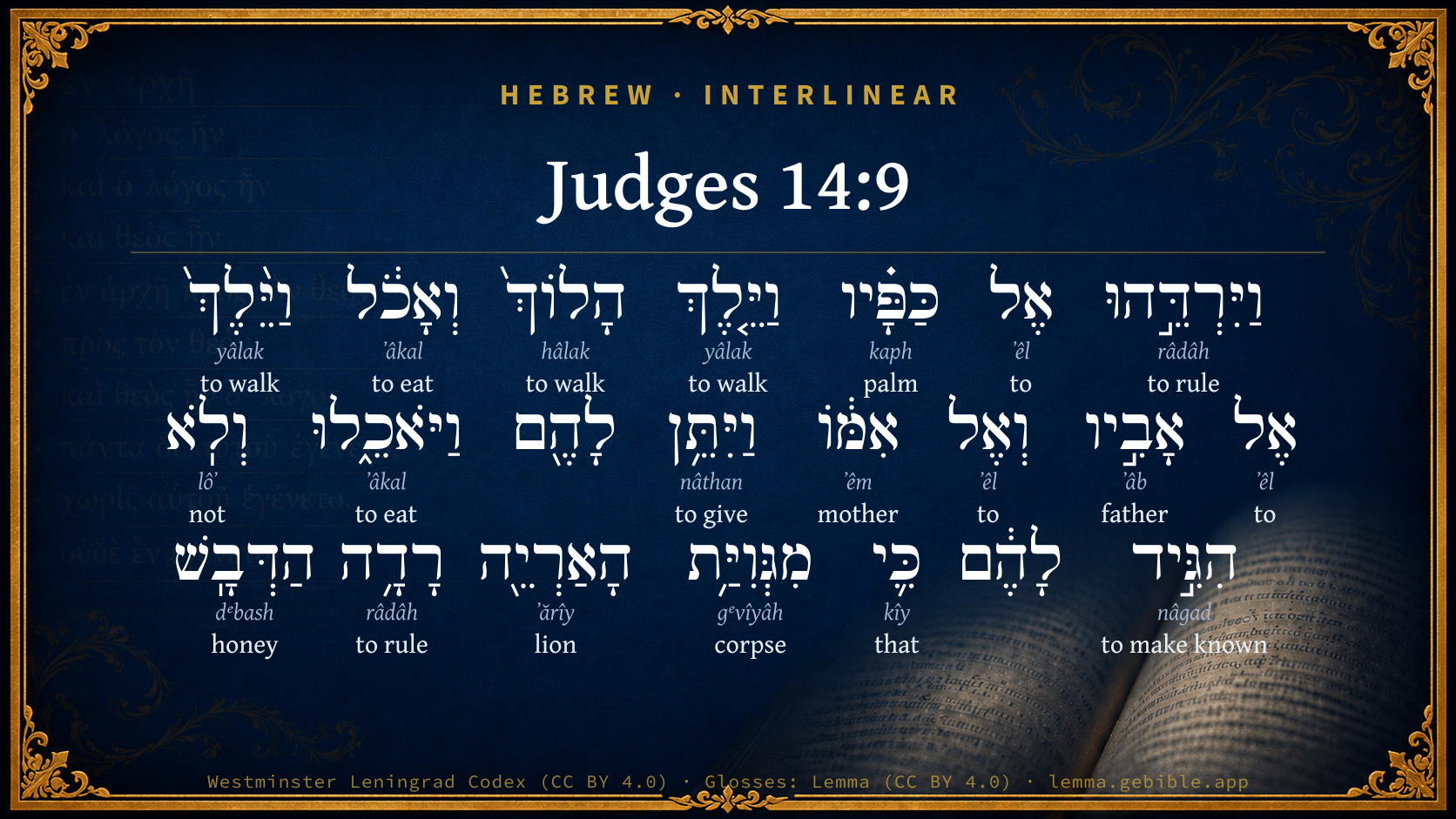
  1. וַיִּרְדֵּ֣הוּ râdâh H7287 “and · to rule · him” Conjunction + Verb, Qal, Sequential Imperfect, 3rd Person, Masculine, Singular + Suffix, Personal, 3rd Person, Masculine, Singular
  2. אֶל ʼêl H413 “to” Preposition
  3. כַּפָּ֗יו kaph H3709 “palms · his” Noun, Common, Feminine, Dual, Construct + Suffix, Personal, 3rd Person, Masculine, Singular
  4. וַיֵּ֤לֶךְ yâlak H3212 “and · to walk” Conjunction + Verb, Qal, Sequential Imperfect, 3rd Person, Masculine, Singular
  5. הָלוֹךְ֙ hâlak H1980 “to walk” Verb, Qal, Infinitive Absolute
  6. וְאָכֹ֔ל ʼâkal H398 “and · to eat” Conjunction + Verb, Qal, Infinitive Absolute
  7. וַיֵּ֨לֶךְ֙ yâlak H3212 “and · to walk” Conjunction + Verb, Qal, Sequential Imperfect, 3rd Person, Masculine, Singular
  8. אֶל ʼêl H413 “to” Preposition
  9. אָבִ֣יו ʼâb H1 “father · his” Noun, Common, Masculine, Singular, Construct + Suffix, Personal, 3rd Person, Masculine, Singular
  10. וְאֶל ʼêl H413 “and · to” Conjunction + Preposition
  11. אִמּ֔וֹ ʼêm H517 “mother · his” Noun, Common, Feminine, Singular, Construct + Suffix, Personal, 3rd Person, Masculine, Singular
  12. וַיִּתֵּ֥ן nâthan H5414 “and · to give” Conjunction + Verb, Qal, Sequential Imperfect, 3rd Person, Masculine, Singular
  13. וַיֹּאכֵ֑לוּ ʼâkal H398 “and · to eat” Conjunction + Verb, Qal, Sequential Imperfect, 3rd Person, Masculine, Plural
  14. וְלֹֽא lôʼ H3808 “and · not” Conjunction + Particle, Negative
  15. הִגִּ֣יד nâgad H5046 “to make known” Verb, Hiphil, Perfect, 3rd Person, Masculine, Singular
  16. כִּ֛י kîy H3588 “that” Conjunction
  17. הָאַרְיֵ֖ה ʼărîy H738 “the · lion” Particle, Definite Article + Noun, Common, Masculine, Singular, Absolute
  18. רָדָ֥ה râdâh H7287 “to rule” Verb, Qal, Perfect, 3rd Person, Masculine, Singular
  19. הַדְּבָֽשׁ dᵉbash H1706 “the · honey” Particle, Definite Article + Noun, Common, Masculine, Singular, Absolute

About this verse

These counts appear in no published source. They are computed here, from the morphology-tagged text and Lemma’s own curated glosses. What Lemma adds →

22
words
15
distinct lemmas
Historical
section

Notable vocabulary

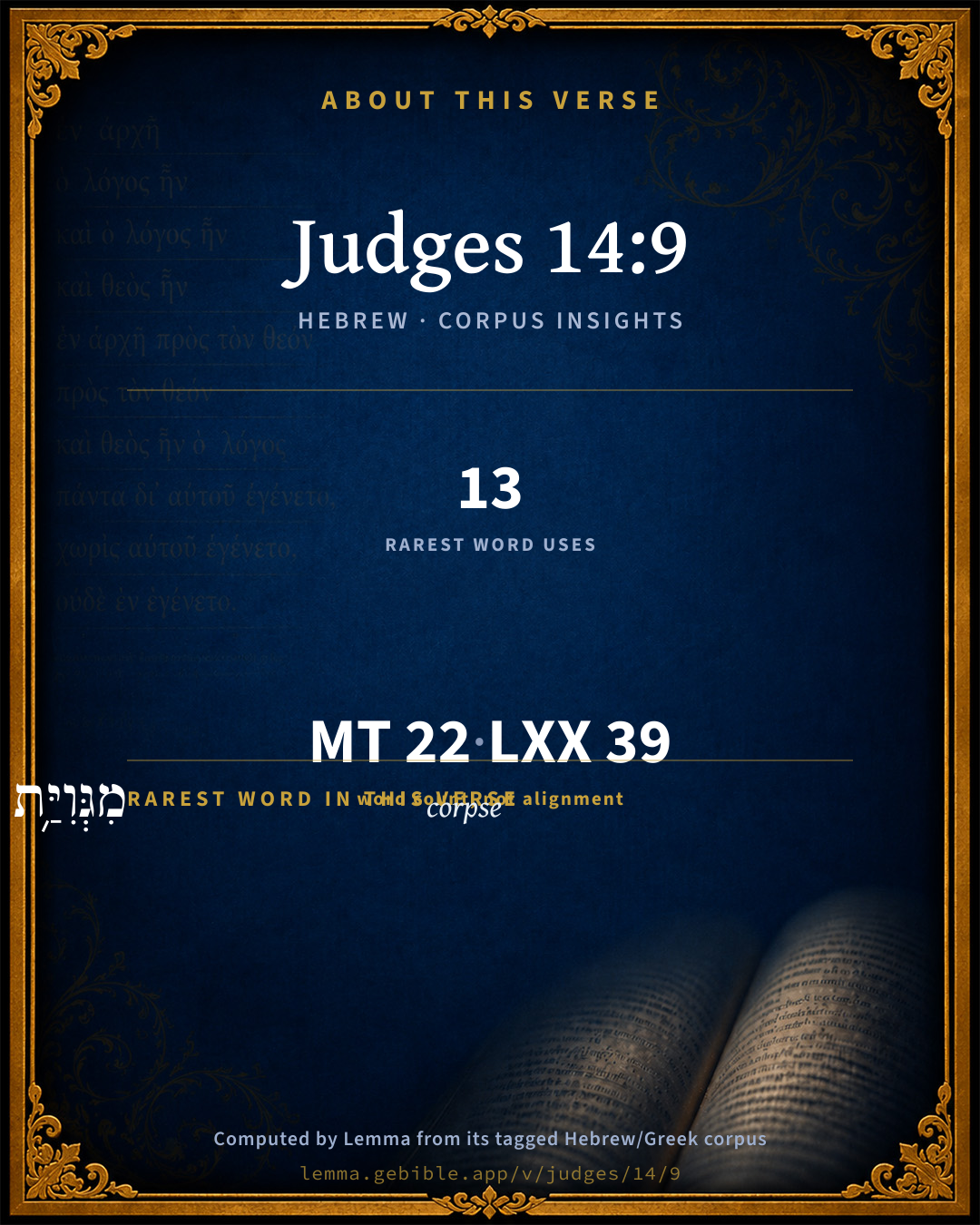
The rarest word here is מִגְּוִיַּ֥ת corpse H1472 — appearing just 13 times in the whole Hebrew Bible.

Shared distinctive vocabulary

מִגְּוִיַּ֥ת corpse H1472 occurs in 11 verses of the Hebrew Bible. Also found in:

Grammatical profile

  • 9 verbs
  • 6 nouns
  • 5 prepositions
  • 1 conjunction
  • 1 particle

Verb forms

  • וַיִּרְדֵּ֣הוּ Qal · Sequential Imperfect
  • וַיֵּ֤לֶךְ Qal · Sequential Imperfect
  • הָלוֹךְ֙ Qal · Infinitive Absolute
  • וְאָכֹ֔ל Qal · Infinitive Absolute
  • וַיֵּ֨לֶךְ֙ Qal · Sequential Imperfect
  • וַיִּתֵּ֥ן Qal · Sequential Imperfect
  • וַיֹּאכֵ֑לוּ Qal · Sequential Imperfect
  • הִגִּ֣יד Hiphil · Perfect
  • רָדָ֥ה Qal · Perfect

Repetition

Words recur within this verse — often emphatic in Hebrew:

  • וַיִּרְדֵּ֣הוּ to rule H7287 ×2
  • וַיֵּ֤לֶךְ to walk H3212 ×2
  • וְאָכֹ֔ל to eat H398 ×2
  • אֶל to H413 ×3

Hebrew & Septuagint length

In English translation the verse runs 46 words from the Hebrew and 45 from the Septuagint (LXX English) — closely comparable.

A rough comparison of the two English renderings, which tokenize alike — not a word-level alignment.

Word counts can differ between the Hebrew and the Greek without any difference in meaning — e.g. the Hebrew direct-object marker אֵת has no separate Greek word, and Greek often adds the article ὁ.

In the original languages it is 22 Hebrew tokens and 39 Greek tokens — but the two are counted differently (Hebrew bundles its prefixes and suffixes into one token; the Greek is in lemma form), so that isn’t a like-for-like length.

Cross-references

2

Topical passages linked to Judges 14:9 in the Treasury of Scripture Knowledge — connected by theme and wording, ordered by reader-vote popularity; previews shown in the World English Bible.

  • 1 Samuel 14:25–30 All the people came into the forest; and there was honey on the ground.
  • Proverbs 25:15 By patience a ruler is persuaded. A soft tongue breaks the bone.

Cross-references courtesy of OpenBible.info (CC BY 4.0).

Hebrew and Greek witnesses Masoretic Hebrew ↔ Greek Septuagint

The same verse in the two great witnesses to the Old Testament, shown verse-for-verse.

These are two independent witnesses, not word-aligned to each other, and the Septuagint is shown in lemma (dictionary) form.

Hebrew Judges 14:9 Masoretic · Westminster Leningrad Codex

וַיִּרְדֵּ֣הוּ אֶל כַּפָּ֗יו וַיֵּ֤לֶךְ הָלוֹךְ֙ וְאָכֹ֔ל וַיֵּ֨לֶךְ֙ אֶל אָבִ֣יו וְאֶל אִמּ֔וֹ וַיִּתֵּ֥ן לָהֶ֖ם וַיֹּאכֵ֑לוּ וְלֹֽא הִגִּ֣יד לָהֶ֔ם כִּ֛י מִגְּוִיַּ֥ת הָאַרְיֵ֖ה רָדָ֥ה הַדְּבָֽשׁ

He took it into his hands, and went on, eating as he went; and he came to his father and mother, and gave to them, and they ate: but he didn't tell them that he had taken the honey out of the body of the lion.

World English Bible · Public Domain

Greek LXX Judges 14:9 Septuagint · lemma form

καί ἐκαἱρέω αὐτός εἰς χείρ αὐτός καί πορεύομαι πορεύομαι καί ἐσθίω καί πορεύομαι πρός ὁ πατήρ αὐτός καί ὁ μήτηρ αὐτός καί δίδωμι αὐτός καί ἐσθίω καί οὐ ἀποἀγγέλλω αὐτός ὅτι ἀπό ὁ στόμα ὁ λέων ἐκαἱρέω ὁ μέλι

And he took it into his hands, and went on eating, and he went to his father and his mother, and gave to them, and they did eat; but he told them not that he took the honey out of the mouth of the lion.

LXX2012 (modern English Septuagint) · Public Domain

Hebrew: Westminster Leningrad Codex (CC BY 4.0). Greek: Septuagint (public domain); English from LXX2012 (modern English Septuagint) (Public Domain). How the Septuagint differs from the Hebrew →

Targum (Aramaic paraphrase)

1

The Targum is the ancient Jewish Aramaic paraphrase of the Hebrew Scriptures — an interpretive translation, not the Hebrew text itself. Onkelos (literal) and Pseudo-Jonathan (expansive) render the Torah, and Jonathan the Prophets. Coverage is partial: where no permissively-licensed English translation exists for a verse, only the Aramaic is shown. This is verse-level text, not a word-by-word alignment to the Hebrew.

  1. Targum Jonathan Prophets (Joshua–Malachi)
    וְנַסְחֵיהּ בִּידֵיהּ וַאֲזַל מֵיזַל וְאָכִיל וַאֲזַל לְוָת אָבוּהִי וּלְוַת אִמֵיהּ וִיהַב לְהוֹן וַאֲכַלוּ וְלָא חֲוִי לְהוֹן אֲרֵי מִפִּגְרָא דְאַרְיָא נְסִיחַ דוּבְשָׁא:

    (no public-domain English translation for this verse)

    Targum Jonathan — Aramaic: “Mikraot Gedolot” (public domain). English: “Sefaria Community Translation” (CC0 1.0 (public-domain dedication)); “London "Chaldee Paraphrase," 1871” (public domain). Text via Sefaria.

Commentary

Notes on Judges 14:9 from classic Christian and Jewish commentators (each source and its license shown beneath its notes). The classic Christian expositions comment on the surrounding passage and are grouped to its opening verse, so a note may address several verses; the Jewish commentaries on the Tanakh (Rashi and others) are per-verse, so they appear only where the commentator wrote on this verse.

Lemma curates 59 commentaries, every one of them public domain or Creative Commons licensed, each selected and text-cleaned for this edition rather than reprinted as found. About our sources →

Trapp's Complete Commentary

John Trapp

Jdg 14:9 And he took thereof in his hands, and went on eating, and came to his father and mother, and he gave them, and they did eat: but he told not them that he had taken the honey out of the carcase of the lion.

Ver. 9. And went on eating.] So must we pass on toward our heavenly Father’s house, feeding on the heavenly manna, sucking sweetness out of the precious promises, {Isa 66:11} which are pabulum fidei, the food of faith.

But he told not them.] Taciturnity is sometimes a virtue; and Tacitus is Primus in Historia. If this had come abroad, where had been the matter of his riddle?

John Trapp, A Commentary or Exposition upon All the Books of the Old and New Testament (1647–1656) — public domain. Text from a community e-Sword module.

Ellicott's Commentary for English Readers

(9) He took thereof in his hands.—Unless he considered that a skeleton could not be regarded as a dead body, he could not have done this without breaking the express conditions of his Nazarite vow (Num_5:6).

He told not them.—Perhaps from the general reticence of his character, but more probably because they might have been more scrupulous than he was about the ceremonial defilement involved in eating anything which had touched a carcase. Possibly, too, he may have already made the riddle in his head, and did not wish to give any clue to its solution.

A Bible Commentary for English Readers, edited by Charles John Ellicott (1878–1897) — public domain. Text from a community e-Sword module.

The Cambridge Bible for Schools and Colleges

gen. ed. J. J. S. Perowne

9. And he took it … had taken] The word, which occurs only here (? in Jer_5:31), is used in the Talmud for taking honey out of the hive, detaching bread from the sides of the oven; so we may render he scraped off the honey into his palms. It is one of the household words of old Hebrew which rarely find their way into literature (Moore). For wild honey as food cf. 1Sa_14:25 ff., St Mar_1:6.

The Cambridge Bible for Schools and Colleges (gen. ed. J. J. S. Perowne; Cambridge University Press, 1878–1918) — public domain. Text from a community e-Sword module.

John Gill's Exposition

And he took thereof in his hands, and went on eating,.... Josephus (k) says he took three honeycombs, he means three pieces of the honeycomb, and ate the honey as he went along to Timnath; which he might do without touching the carcass of the lion, and defiling himself thereby, which, as a Nazarite, he was more especially to be careful of:

and came to his father and mother, and he gave them, and they did eat; who went down with him to the consummation of the marriage, and from whom he had turned a little aside; and now overtook them, and to whom he gave some of his honey to eat, which, having travelled some way, might be grateful to them. The above writer takes no notice of this, but says he gave of it to the young woman whom he betrothed, when he came to her; but of that the text makes no mention:

but he told not them that he had taken the honey out of the carcass of the lion; either lest they should scruple eating it, being taken out of such a carcass; or that the riddle, which perhaps he meditated as he came along eating the honey, might not be found out, which might more easily have been done, had this fact been known by any.

(k) Ut supra. (Antiqu. l. 5. c. 8. sect. 6.)

John Gill's Exposition of the Whole Bible (1746–1763) — public domain (CC PDM 1.0). Text via the HelloAO Bible API.

Matthew Poole's English Annotations

He took thereof in his hands, out of the lion’s carcass.

Quest. Did not Samson transgress in touching a carcass?

Answ. It was in itself a legal pollution; but some such pollutions were involuntary and unavoidable, as in one that hath an issue running in his sleep; and some were necessary duties, as in those who were to attend upon a woman in her month, or upon the burial of a dead body. And such was this pollution, being contracted by Divine instinct and direction, and in order to God’s honour, and therefore dispensed with by the author of that law, and required by him for his service.

Came to his father and mother; from whom he had turned aside for a season, Jdg 14:8, upon some pretence or other.

Matthew Poole's English Annotations on the Holy Bible (1683–1685) — public domain. Text from a community e-Sword/MySword module.

Whedon's Commentary on the Bible

Daniel D. Whedon

9. Came to his father and mother — His parents seem to have accompanied him down to Timnath this second time in order to be present at the wedding feast.

He told them not — He perhaps at once conceived the riddle he would propound, and for that reason kept it secret from his parents. But also he might have thought that his approach to the dead carcass was a violation of his Nazarite purity, and he might better keep it to himself; or he may have thought that his parents would regard the honey as unclean if they knew whence he had taken it.

Daniel D. Whedon (gen. ed.), Commentary on the Old and New Testaments (1874–1909) — public domain. Text from a community e-Sword module.

The Pulpit Commentary

And... he went on eating, etc. Compare the account of Jonathan finding and eating the wild honey. (1Sa_14:25, and following verses)

The Pulpit Commentary (1880–1919), ed. H.D.M. Spence-Jones & Joseph S. Exell — public domain. Text from a community e-Sword module.

John Wesley's Explanatory Notes

Came to, &c. - From whom he had turned aside for a season, ver. 8.

John Wesley, Explanatory Notes Upon the Whole Bible (1754–1765) — public domain. Text via the GEBible commentary corpus.

Keil & Delitzsch

C. F. Keil & F. Delitzsch

Samson took it (the honey) in his hands, ate some of it as he went, and also gave some to his father and mother to eat, but did not tell them that he had got the honey out of the dead body of the lion; for in that case they would not only have refused to eat it as being unclean, but would have been aware of the fact, which Samson afterwards took as the subject of the riddle that he proposed to the Philistines. רדה, to tread, to tread down; hence to get forcible possession of, not to break or to take out, neither of which meanings can be established. The combination of רדה and אל־כּפּיו is a pregnant construction, signifying to obtain possession of and take into the hands.

Keil & Delitzsch — Biblical Commentary on the Old Testament (1861–1891) — public domain (CC PDM 1.0). Text via the HelloAO Bible API. (Old Testament only.)

Rashi

Rabbi Shlomo Yitzchaki (Rashi)

He dislodged it. This connotes the separation of an attached object. Similarly, with regard to a loaf attached to an oven, separation is described as "dislodging"— "If one dislodges a loaf from the oven," "If one dislodges his hive," as the honey is produced in wax combs attached to the walls of the hive in every area, extending from wall to wall along its circumference. Similarly, Targum Yonasan translates "He removed it."

Rashi on the Tanakh — English translations: “The Judaica Press complete Tanach with Rashi, translated by A. J. Rosenberg” (CC BY 4.0); “Pentateuch with Rashi's commentary by M. Rosenbaum and A.M. Silbermann, 1929-1934” (public domain); “The Metsudah Tanach series, Lakewood, N.J” (CC BY 4.0); and “The Book of Joshua, Metsudah Publications, 1997” (CC BY 4.0). Text via Sefaria.

Lesson kit

Teaching starters — assembled from the data on this page, not authored interpretation. Every prompt links to the verse data it draws on. Edit before teaching.

Judges, in the Historical, opens this verse with 22 words (15 distinct Hebrew lemmas). Its most distinctive word is gᵉvîyâh (“corpse”). A historical commentator’s framing appears above. Read the whole chapter for the surrounding context.

Discussion questions

  1. How does “corpse” (gᵉvîyâh) shape what this verse is saying?
  2. Genesis 47:18 shares the word «corpse» with this verse. How do the two illuminate each other?
  3. “to rule” occurs 2× in this one verse. What is the effect of the repetition?
  4. The translations on this page render this verse differently — a whole-verse word diff, not a word-by-word alignment. What might account for the different wordings?
  5. The verb «וַיִּרְדֵּ֣הוּ» is Qal Sequential Imperfect. How does its form color the action?
  6. Reading how Trapp's Complete Commentary and Ellicott's Commentary for English Readers read this verse, where do the two commentators agree and where do they part?

Things to notice

Reading settings

Reading text

Shown beneath each verse's original-language words.

Old Testament
Old Testament edition

Read the OT as the Masoretic Hebrew (MT) or the Greek Septuagint (LXX).

English shown for the Greek Septuagint (in the Hebrew ↔ Greek comparison).

Comparing translations? Open the Compare panel on any verse page to stack up to four side by side.