
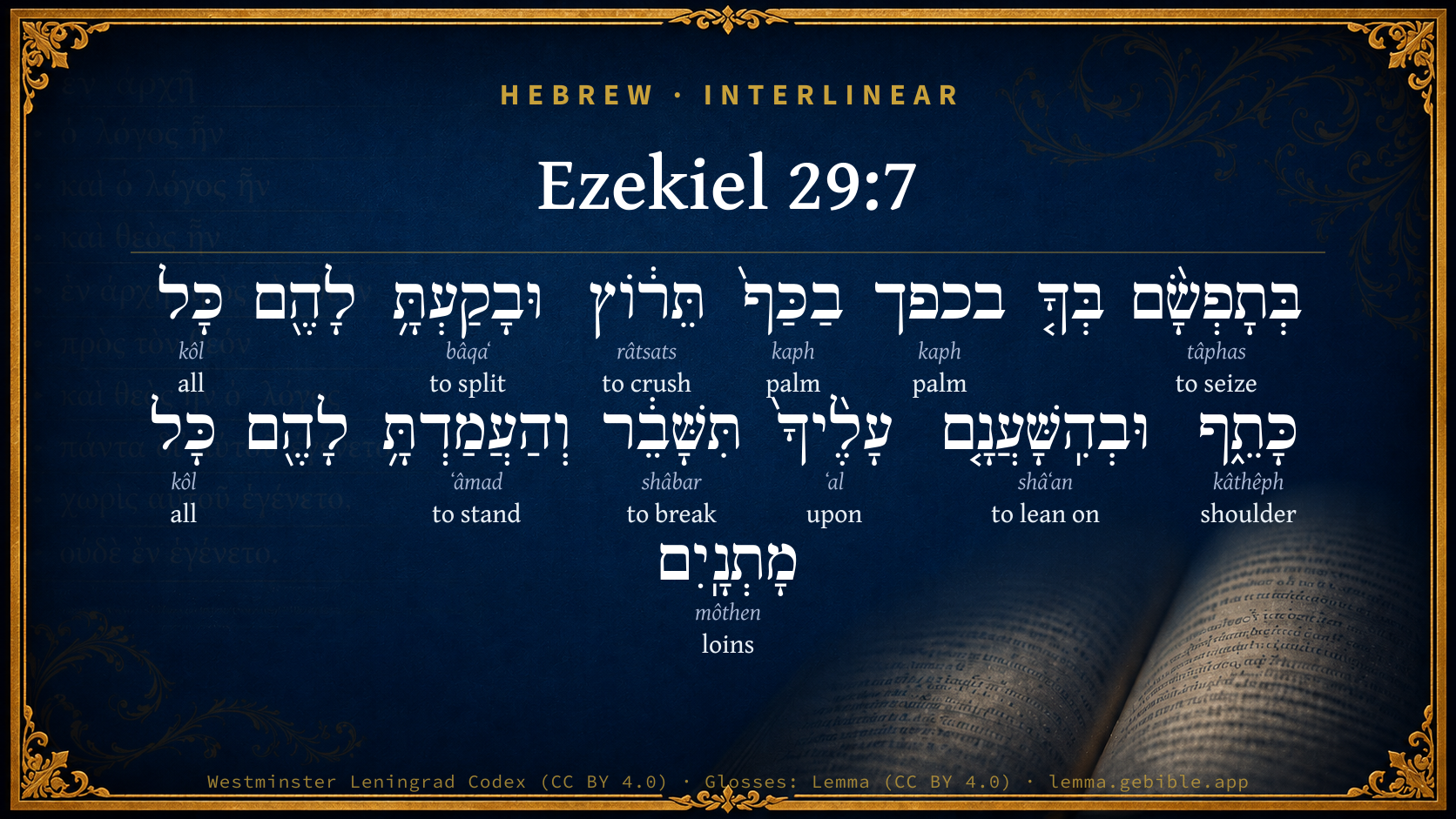
Ezekiel 29:7

Hebrew (Westminster Leningrad Codex) Ezekiel 29:7 appears in the Hebrew Old Testament. The text above is from the Westminster Leningrad Codex. Each word links to its Strong’s number, a concise gloss, and parsing drawn from the Open Scriptures Hebrew Bible morphology. Click any word for its full Brown-Driver-Briggs (BDB) entry.
Download image
Cite this verse

Ezekiel 29:7 (World English Bible). Public Domain. Lemma interlinear Bible study tool, https://lemma.gebible.app/v/ezekiel/29/7.

Show BibTeX & RIS
BibTeX
RIS
English Translation
When they took hold of you by your hand, you did break, and did tear all their shoulders; and when they leaned on you, you broke, and mad all their loins to be at a stand.
World English Bible · Public Domain
Highlights
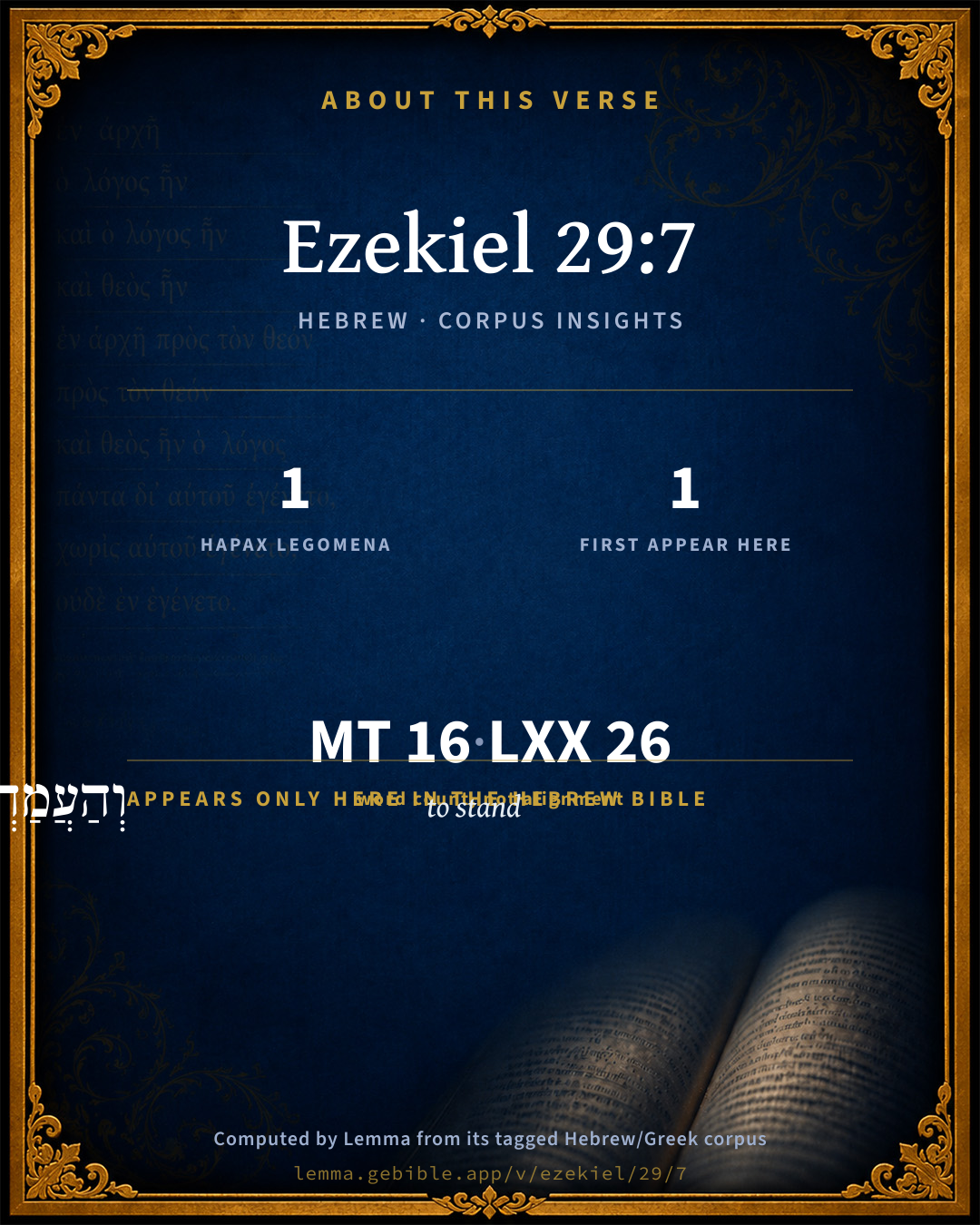
  • 1 hapax legomenon — only here in the Hebrew Bible
  • 1 first appearance in the Hebrew Bible
Full analysis ↓
Download a study sheet

One document with this verse’s original text, its word-by-word gloss line, the meaning frame, cross-references with their text, attributed commentary, and full source and license credits — printable, and it pastes into notes with its structure intact.

This verse Autodidact and up

Study sheet (.html) Plain text (.txt)

A passage Seminary Student

Up to 50 verses in one chapter. A passage sheet keeps up to 6 commentary sources and 12 cross-references per verse, in the order this page ranks them, and says so on the sheet whenever that leaves anything out. Ask for a single verse and you get the Autodidact verse sheet above.

Everything on this page stays free to read, with no account — the sheet is a download of what is already on screen, not access to it.

Want to remove ads? Support Godless Engineer
Compare translations 3

The same verse in 3 English versions, stacked beneath the original-language interlinear above. Click any original word for its lexicon entry.

Each is an independent rendering of the whole verse — the interlinear is not word-aligned to these translations.

Highlighted words mark where these versions differ — a whole-verse word diff, not a word-by-word alignment.

  • World English Bible Public Domain
    When they took hold of you by your hand, you did break, and did tear all their shoulders; and when they leaned on you, you broke, and mad all their loins to be at a stand.
  • King James Version Public Domain
    When they took hold of thee by thy hand, thou didst break, and rend all their shoulder: and when they leaned upon thee, thou brakest, and madest all their loins to be at a stand.
  • unfoldingWord Literal Text CC BY-SA 4.0
    When they took hold of you in their hand, you broke and tore open their shoulder; and when they leaned on you, you were broken, and you caused their legs to be unsteady.

unfoldingWord Literal Text — © unfoldingWord, licensed CC BY-SA 4.0. Word-aligned USFM3 via Door43 (git.door43.org/unfoldingWord/en_ult).

Versions to compare (up to 4)

3 of 4 selected

Show all 18 translations

Every available English version of this verse, each an independent rendering of the whole verse.

  • World English Bible Public Domain
    When they took hold of you by your hand, you did break, and did tear all their shoulders; and when they leaned on you, you broke, and mad all their loins to be at a stand.
  • Berean Standard Bible Public Domain
    When Israel took hold of you with their hands, you splintered, tearing all their shoulders; when they leaned on you, you broke, and their backs were wrenched.
  • Majority Standard Bible Public Domain
    When Israel took hold of you with their hands, you splintered, tearing all their shoulders; when they leaned on you, you broke, and their backs were wrenched.
  • King James Version Public Domain
    When they took hold of thee by thy hand, thou didst break, and rend all their shoulder: and when they leaned upon thee, thou brakest, and madest all their loins to be at a stand.
  • American Standard Version (1901) Public Domain
    When they took hold of thee by thy hand, thou didst break, and didst rend all their shoulders; and when they leaned upon thee, thou brakest, and madest all their loins to be at a stand.
  • Revised Version (1885) Public Domain
    When they took hold of thee by thy hand, thou didst break, and didst rend all their shoulders: and when they leaned upon thee, thou brakest, and madest all their loins to be at a stand.
  • Geneva Bible (1599) Public Domain
    When they tooke holde of thee with their hand, thou diddest breake, and rent all their shoulder: and when they leaned vpon thee, thou brakest and madest all their loynes to stand vpright.
  • Douay-Rheims (1899) Public Domain
    When they took hold of thee with the hand thou didst break, and rent all their shoulder: and when they leaned upon thee, thou brokest, and weakenest all their loins.
  • Young's Literal Translation Public Domain
    In their taking hold of thee by thy hand, -- thou art crushed, And hast rent to them all the shoulder, And in their leaning on thee thou art broken, And hast caused all their thighs to stand.
  • Literal Standard Version CC BY-SA 4.0
    In their taking hold of you by your hand, || You crush and have torn every shoulder of theirs, || And in their leaning on you you are broken, || And have caused all their thighs to stand.
  • Unlocked Literal Bible CC BY-SA 4.0
    When they took hold of you in their hand, you broke and tore open their shoulder; and when they leaned on you, you were broken, and you caused their legs to be unsteady.
  • unfoldingWord Literal Text CC BY-SA 4.0
    When they took hold of you in their hand, you broke and tore open their shoulder; and when they leaned on you, you were broken, and you caused their legs to be unsteady.
  • Darby Bible Public Domain
    When they took hold of thee by thy hand, thou didst give way and rend all their shoulder; and when they leaned upon thee, thou didst break, and didst make all their loins to tremble.
  • World Messianic Bible Public Domain
    When they took hold of you by your hand, you broke and tore all their shoulders. When they leaned on you, you broke and paralyzed all of their thighs.”
  • Webster's Bible Public Domain
    When they took hold of thee by thy hand, thou didst break, and rend all their shoulder: and when they leaned upon thee, thou didst break, and make all their loins to be at a stand.
  • Free Bible Version CC BY-SA 4.0
    When Israel grabbed hold of you, you split apart, damaging their shoulder. When they leaned on you, you broke, putting their backs out.
  • Bible in Basic English Public Domain
    When they took a grip of you in their hands, you were crushed so that their arms were broken: and when they put their weight on you for support, you were broken and all their muscles gave way.
  • JPS Tanakh (1917) Public Domain
    When they take hold of thee with the hand, thou dost break, and rend all their shoulders; and when they lean upon thee, thou breakest, and makest all their loins to be at a stand.

Literal Standard Version (2020), Covenant Press — licensed CC BY-SA 4.0. Text via the HelloAO Bible API (eBible.org). Unlocked Literal Bible (unfoldingWord) — licensed CC BY-SA 4.0. Text via the HelloAO Bible API (eBible.org). unfoldingWord Literal Text — © unfoldingWord, licensed CC BY-SA 4.0. Word-aligned USFM3 via Door43 (git.door43.org/unfoldingWord/en_ult). Free Bible Version, Dr. Jonathan Gallagher — licensed CC BY-SA 4.0. Text via the HelloAO Bible API (eBible.org).

Word by word

More ways to search: Search by grammar → Find every occurrence → Compare this word →

Practice this passage: Drill this verse → Learn its vocabulary →

וְהַעֲמַדְתָּ֥
ʻâmad
H5976
“and · to stand”
Conjunction + Verb, Hiphil, Sequential Perfect, 2nd Person, Masculine, Singular
Part of Speech
Conjunction + Verb
Stem
Hiphil
Form
Sequential Perfect
Person
2nd Person
Gender
Masculine
Number
Singular
Full BDB Definition

Origin: for H4571

TWOT: 1637

to be at a stand, stand, remain, endure
  1. בְּתָפְשָׂ֨ם tâphas H8610 “in/at · to seize · them” Preposition + Verb, Qal, Infinitive Construct + Suffix, Personal, 3rd Person, Masculine, Plural
  2. בכפך kaph H3709 “in/at · palm · your” Preposition + Noun, Common, Feminine, Singular, Construct + Suffix, Personal, 2nd Person, Masculine, Singular
  3. בַכַּף֙ kaph H3709 “in/at the · palm” Preposition, Determined + Noun, Common, Feminine, Singular, Absolute
  4. תֵּר֔וֹץ râtsats H7533 “to crush” Verb, Niphal, Imperfect, 2nd Person, Masculine, Singular
  5. וּבָקַעְתָּ֥ bâqaʻ H1234 “and · to split” Conjunction + Verb, Qal, Sequential Perfect, 2nd Person, Masculine, Singular
  6. כָּל kôl H3605 “all of” Noun, Common, Masculine, Singular, Construct
  7. כָּתֵ֑ף kâthêph H3802 “shoulder” Noun, Common, Feminine, Singular, Absolute
  8. וּבְהִֽשָּׁעֲנָ֤ם shâʻan H8172 “and · in/at · to lean on · them” Conjunction + Preposition + Verb, Niphal, Infinitive Construct + Suffix, Personal, 3rd Person, Masculine, Plural
  9. עָלֶ֨יךָ֙ ʻal H5921 “upon · you” Preposition + Suffix, Personal, 2nd Person, Masculine, Singular
  10. תִּשָּׁבֵ֔ר shâbar H7665 “to break” Verb, Niphal, Imperfect, 2nd Person, Masculine, Singular
  11. כָּל kôl H3605 “all of” Noun, Common, Masculine, Singular, Construct
  12. מָתְנָֽיִם môthen H4975 “loins” Noun, Common, Masculine, Dual, Absolute

About this verse

These counts appear in no published source. They are computed here, from the morphology-tagged text and Lemma’s own curated glosses. What Lemma adds →

16
words
11
distinct lemmas
Prophets
section

Notable vocabulary

1 hapax legomenon — a word that appears only here in the entire Hebrew Bible:

  • וְהַעֲמַדְתָּ֥ to stand H5976

First appearance in Scripture

This word makes its first canonical appearance in the Hebrew Bible here:

  • וְהַעֲמַדְתָּ֥ to stand H5976

Shared distinctive vocabulary

תֵּר֔וֹץ to crush H7533 occurs in 18 verses of the Hebrew Bible. Also found in:

Grammatical profile

  • 6 verbs
  • 6 nouns
  • 4 prepositions

Verb forms

  • בְּתָפְשָׂ֨ם Qal · Infinitive Construct
  • תֵּר֔וֹץ Niphal · Imperfect
  • וּבָקַעְתָּ֥ Qal · Sequential Perfect
  • וּבְהִֽשָּׁעֲנָ֤ם Niphal · Infinitive Construct
  • תִּשָּׁבֵ֔ר Niphal · Imperfect
  • וְהַעֲמַדְתָּ֥ Hiphil · Sequential Perfect

Repetition

Words recur within this verse — often emphatic in Hebrew:

Hebrew & Septuagint length

In English translation the verse runs 36 words from the Hebrew and 38 from the Septuagint (LXX English) — closely comparable.

A rough comparison of the two English renderings, which tokenize alike — not a word-level alignment.

Word counts can differ between the Hebrew and the Greek without any difference in meaning — e.g. the Hebrew direct-object marker אֵת has no separate Greek word, and Greek often adds the article ὁ.

In the original languages it is 16 Hebrew tokens and 26 Greek tokens — but the two are counted differently (Hebrew bundles its prefixes and suffixes into one token; the Greek is in lemma form), so that isn’t a like-for-like length.

Cross-references

7

Topical passages linked to Ezekiel 29:7 in the Treasury of Scripture Knowledge — connected by theme and wording, ordered by reader-vote popularity; previews shown in the World English Bible.

  • Isaiah 36:6 Behold, you trust on the staff of this bruised reed, even on Egypt, whereon if a man lean, it will go into his hand, and pierce it: so is Pharaoh king of Egypt to all who trust on him.
  • Ezekiel 17:15–17 But he rebelled against him in sending his ambassadors into Egypt, that they might give him horses and much people. Shall he prosper? shall he escape who does such things? shall he break the covenant, and yet escape?
  • Jeremiah 17:5–6 Thus says Yahweh: Cursed is the man who trusts in man, and makes flesh his arm, and whose heart departs from Yahweh.
  • Psalms 118:8–9 It is better to take refuge in Yahweh, Than to put confidence in man.
  • Psalms 146:3–4 Don't put your trust in princes, Each a son of man in whom there is no help.
  • Proverbs 25:19 Confidence in someone unfaithful in time of trouble Is like a bad tooth, or a lame foot.
  • Jeremiah 37:5–11 Pharaoh's army was come forth out of Egypt; and when the Chaldeans who were besieging Jerusalem heard news of them, they broke up from Jerusalem.

Cross-references courtesy of OpenBible.info (CC BY 4.0).

Hebrew and Greek witnesses Masoretic Hebrew ↔ Greek Septuagint

The same verse in the two great witnesses to the Old Testament, shown verse-for-verse.

These are two independent witnesses, not word-aligned to each other, and the Septuagint is shown in lemma (dictionary) form.

Hebrew Ezekiel 29:7 Masoretic · Westminster Leningrad Codex

בְּתָפְשָׂ֨ם בְּךָ֤ בכפך בַכַּף֙ תֵּר֔וֹץ וּבָקַעְתָּ֥ לָהֶ֖ם כָּל כָּתֵ֑ף וּבְהִֽשָּׁעֲנָ֤ם עָלֶ֨יךָ֙ תִּשָּׁבֵ֔ר וְהַעֲמַדְתָּ֥ לָהֶ֖ם כָּל מָתְנָֽיִם

When they took hold of you by your hand, you did break, and did tear all their shoulders; and when they leaned on you, you broke, and mad all their loins to be at a stand.

World English Bible · Public Domain

Greek LXX Ezekiel 29:7 Septuagint · lemma form

ὅτε ἐπιλαμβάνω σύ ὁ χείρ αὐτός θλάω καί ὅτε ἐπικρατέω ἐπί αὐτός πᾶς χείρ καί ὅτε ἐπι ἀναπαύω ἐπί σύ συντρίβω καί συνκλάζω αὐτός πᾶς ὀσφύς

When they took hold of you with their hand, you did break: and when every hand was clapped against them, and when they leaned on you, you were utterly broken, and did crush the loins of them all.

LXX2012 (modern English Septuagint) · Public Domain

On this verse, Whedon's Commentary on the Bible discusses the Septuagint’s reading. Read the note in Commentary ↓

Hebrew: Westminster Leningrad Codex (CC BY 4.0). Greek: Septuagint (public domain); English from LXX2012 (modern English Septuagint) (Public Domain). How the Septuagint differs from the Hebrew →

Targum (Aramaic paraphrase)

1

The Targum is the ancient Jewish Aramaic paraphrase of the Hebrew Scriptures — an interpretive translation, not the Hebrew text itself. Onkelos (literal) and Pseudo-Jonathan (expansive) render the Torah, and Jonathan the Prophets. Coverage is partial: where no permissively-licensed English translation exists for a verse, only the Aramaic is shown. This is verse-level text, not a word-by-word alignment to the Hebrew.

  1. Targum Jonathan Prophets (Joshua–Malachi)
    בְּאִתְכְּנָיוּתְהוֹן בָּךְ בְּיַד מְלַךְ תַּקִיף תִּתְמְסַר וְיֵיבַד בֵּית רוֹחֲצָנֵיהוֹן וּבְאִיסְתְּמָכוּתְהוֹן עֲלָךְ תִּתְּבַר וְלָא תְהֵי לְהוֹן לְבֵית סוּמְכְוָן:

    (no public-domain English translation for this verse)

    Targum Jonathan — Aramaic: “Mikraot Gedolot” (public domain). English: “Sefaria Community Translation” (CC0 1.0 (public-domain dedication)); “London "Chaldee Paraphrase," 1871” (public domain). Text via Sefaria.

Commentary

Notes on Ezekiel 29:7 from classic Christian and Jewish commentators (each source and its license shown beneath its notes). The classic Christian expositions comment on the surrounding passage and are grouped to its opening verse, so a note may address several verses; the Jewish commentaries on the Tanakh (Rashi and others) are per-verse, so they appear only where the commentator wrote on this verse.

Lemma curates 59 commentaries, every one of them public domain or Creative Commons licensed, each selected and text-cleaned for this edition rather than reprinted as found. About our sources →

Trapp's Complete Commentary

John Trapp

Eze 29:7 When they took hold of thee by thy hand, thou didst break, and rend all their shoulder: and when they leaned upon thee, thou brakest, and madest all their loins to be at a stand.

Ver. 7. When they took hold of thee by thy hand,] i.e., Made a covenant with thee, and hoped for help from thee. See Job 8:20. The Holy Scripture is its own best interpreter.

Thou didst break.] So unfaithful are many friends, so uncertain are all human helps.

And madest all their loins to be at a stand.] Thou leftest them in the lurch, as we say, to shift for themselves as they could.

John Trapp, A Commentary or Exposition upon All the Books of the Old and New Testament (1647–1656) — public domain. Text from a community e-Sword module.

Geneva Bible (1599)

Geneva Bible translators

When they felt their hurt, they would stay no more upon thee, but stood upon their feet, and put their trust in others.

Or, shake.

Geneva Bible (1599) marginal notes — public domain. Text via Bolls.life.

Jamieson, Fausset & Brown

Robert Jamieson, A. R. Fausset & David Brown

hand--or handle of the reed.

rend . . . shoulder--by the splinters on which the shoulder or arm would fall, on the support failing the hand.

madest . . . loins . . . at a stand--that is, made them to be disabled. MAURER somewhat similarly (referring to a kindred Arabic form), "Thou hast stricken both their loins." FAIRBAIRN, not so well, "Thou lettest all their loins stand," that is, by themselves, bereft of the support which they looked for from thee.

Jamieson, Fausset & Brown — Commentary Critical and Explanatory on the Whole Bible (1871) — public domain (CC PDM 1.0). Text via the HelloAO Bible API.

Ellicott's Commentary for English Readers

(7) All their loins to be at a stand.—The expression is a difficult one, but the more probable sense is, all their loins to shake. The reed breaks under the weight of the man who leans upon it, and pierces his shoulder as he falls, while in his consternation his loins tremble.

A Bible Commentary for English Readers, edited by Charles John Ellicott (1878–1897) — public domain. Text from a community e-Sword module.

The Cambridge Bible for Schools and Colleges

gen. ed. J. J. S. Perowne

7. took hold … by thy hand] Rather: take hold of thee with the hand, as Heb. marg. All the verbs are better put in the present: take hold … dost break … dost rend, &c.

madest … to be at a stand] Rather: makest all loins to shake (reading him ‘adta for ha‘amadta, Psa_69:24).

The Cambridge Bible for Schools and Colleges (gen. ed. J. J. S. Perowne; Cambridge University Press, 1878–1918) — public domain. Text from a community e-Sword module.

John Gill's Exposition

When they took hold of thee by thy hand,.... When the Israelites entered into an alliance and confederacy with the Egyptians, called for their assistance according to treaty, and put their confidence in them:

thou didst break and rend all their shoulder; as a reed which a man puts under his armhole, and leans upon, and it breaks under him, the splinters run into the flesh up to the very shoulder, and tear the flesh to pieces; so, through Zedekiah's trusting to the king of Egypt, he rebelled against the king of Babylon, which brought on his ruin, and the destruction of his kingdom:

and when they leaned upon thee thou brakest, and madest all their loins to be at a stand; when they put their confidence in the king of Egypt, and sent to him for help when besieged by the king of Babylon, and he failed them, they were obliged to raise up themselves, as a man is forced to do when his staff breaks under him, whose loins before were bowed, but now erects himself, and stands and walks as well as he can without it; so the Jews were forced to stand upon their own legs, and exert all the force they had, and make all the efforts they could against the king of Babylon, being left in the lurch by the king of Egypt; in which, though they were rightly served for their vain confidence and not trusting in the Lord, yet the treachery of the Egyptians was resented by him, as follows:

John Gill's Exposition of the Whole Bible (1746–1763) — public domain (CC PDM 1.0). Text via the HelloAO Bible API.

Albert Barnes' Notes on the Bible

So Egypt was continually proving to Israel, to Jehoiakim and to Zedekiah. The tenses are present not past.

To be at a stand - Others, “to totter.”

Albert Barnes' Notes on the Bible (1834–1885) — public domain. Text from a community e-Sword/MySword module.

Haydock's Catholic Bible Commentary

Loins. They fell upon thee, and thou didst wound (Calmet) or "dissolve" their loins. (Haydock)

George Leo Haydock (1774–1849), Haydock's Catholic Family Bible and Commentary, 1859 edition — public domain. Excludes Psalms (Douay-Rheims chapter numbering differs from Protestant) and Deuterocanonical books (Catholic canon only).

Matthew Poole's English Annotations

When they, the Jews, unable to stand on their own legs, as men ready to fall, took hold of thee by thy hand; caught thine hand to lean on, as when besieged by the Chaldeans.

Thou didst break: it includes a designed and voluntary failure; Egypt would not support.

And rend all their shoulder; didst tear, and pierce, and wound arm and shoulder, didst them much mischief instead of benefiting them, as thou hadst promised, Jer 37:7; 42:17.

When they leaned, & c.; the same thing in words little different.

The loins are the strength of a man: thou hast put them to use all their strength to repel the enemy, thou hast been chief occasion of their engaging against.

Matthew Poole's English Annotations on the Holy Bible (1683–1685) — public domain. Text from a community e-Sword/MySword module.

Whedon's Commentary on the Bible

Daniel D. Whedon

7. Took, etc. — All verbs in present tense.

By thy — Rather, with thee.

Shoulder — LXX., hand (Isa_26:6).

To be at a stand — Rather, R.V., margin, “to shake.” (Compare Eze_21:6.) The thing which they grasp for help, tears the hand which clasps it, and when they try to lean upon it it breaks and makes their hips to totter (Kautzsch).

Daniel D. Whedon (gen. ed.), Commentary on the Old and New Testaments (1874–1909) — public domain. Text from a community e-Sword module.

John Wesley's Explanatory Notes

Rent - Didst them much mischief instead of benefiting them, as thou hast promised, Jer. xxxvii, 7.

John Wesley, Explanatory Notes Upon the Whole Bible (1754–1765) — public domain. Text via the GEBible commentary corpus.

Rashi

Rabbi Shlomo Yitzchaki (Rashi)

When they took hold of you with the hand [Heb. בְּכַפְּךָ, lit. with your hand,] to be read בַּכַּף, with the hand, like a man who walks and supports himself on his staff.

you splintered [Heb. תֵּרוֹף] [like] תֵּרָצֵף.

and pierced the whole of their shoulders [lit. the whole of a shoulder,] i.e., their shoulders, like a man who leans on a reed, which breaks, and the man falls on it, and the shreds enter his shoulders.

and you made their loins stand upright [Heb. וְהַעֲמַדְתָּ.] Since you will break, they will be required to strengthen their loins and stand on them. You are like a man upon whom his friend was leaning, but he is weak and he says to him, “Strengthen yourself on your loins, for you can no longer lean on me.” So did Jonathan render: “and you will no longer be a support for them.” Some transpose וְהַעֲמַדְתָּ to וְהַמְעַדְתָּ, and you make all loins totter, but I do not care for their words. Moreover, Menachem (p. 134) associated it with the standing of the feet, just as I do.

Rashi on the Tanakh — English translations: “The Judaica Press complete Tanach with Rashi, translated by A. J. Rosenberg” (CC BY 4.0); “Pentateuch with Rashi's commentary by M. Rosenbaum and A.M. Silbermann, 1929-1934” (public domain); “The Metsudah Tanach series, Lakewood, N.J” (CC BY 4.0); and “The Book of Joshua, Metsudah Publications, 1997” (CC BY 4.0). Text via Sefaria.

Lesson kit

Teaching starters — assembled from the data on this page, not authored interpretation. Every prompt links to the verse data it draws on. Edit before teaching.

Ezekiel, in the Prophets, opens this verse with 16 words (11 distinct Hebrew lemmas). Its most distinctive word is ʻâmad (“to stand”). A historical commentator’s framing appears above. Read the whole chapter for the surrounding context.

Discussion questions

  1. What does “to stand” (ʻâmad) contribute to the verse as a whole?
  2. 1 word here appears nowhere else in the Hebrew Bible. Why might the author reach for such rare wording?
  3. This is the first place “to stand” appears in Scripture (first appears here). What does its debut here establish?
  4. How does Genesis 25:22, which shares the word «to crush», read alongside this verse?
  5. What does the repetition of “palm” (2× in this one verse) do in this verse?
  6. The translations on this page render this verse differently — a whole-verse word diff, not a word-by-word alignment. What might account for the different wordings?
  7. «בְּתָפְשָׂ֨ם» is a Qal Infinitive Construct verb. How does that grammatical form shape the action described?
  8. Compare how Trapp's Complete Commentary and Geneva Bible (1599) read this verse. Where do they agree or differ?

Things to notice

  • 1 word in this verse appears nowhere else in the Hebrew Bible.
  • 1 word makes its first canonical appearance in Scripture here.
  • This verse counts 16 Hebrew ↔ 26 Greek words.
  • These translations choose different wording for 22 words in this verse.
  • “palm” occurs 2× in this single verse.

Reading settings

Reading text

Shown beneath each verse's original-language words.

Old Testament
Old Testament edition

Read the OT as the Masoretic Hebrew (MT) or the Greek Septuagint (LXX).

English shown for the Greek Septuagint (in the Hebrew ↔ Greek comparison).

Comparing translations? Open the Compare panel on any verse page to stack up to four side by side.