
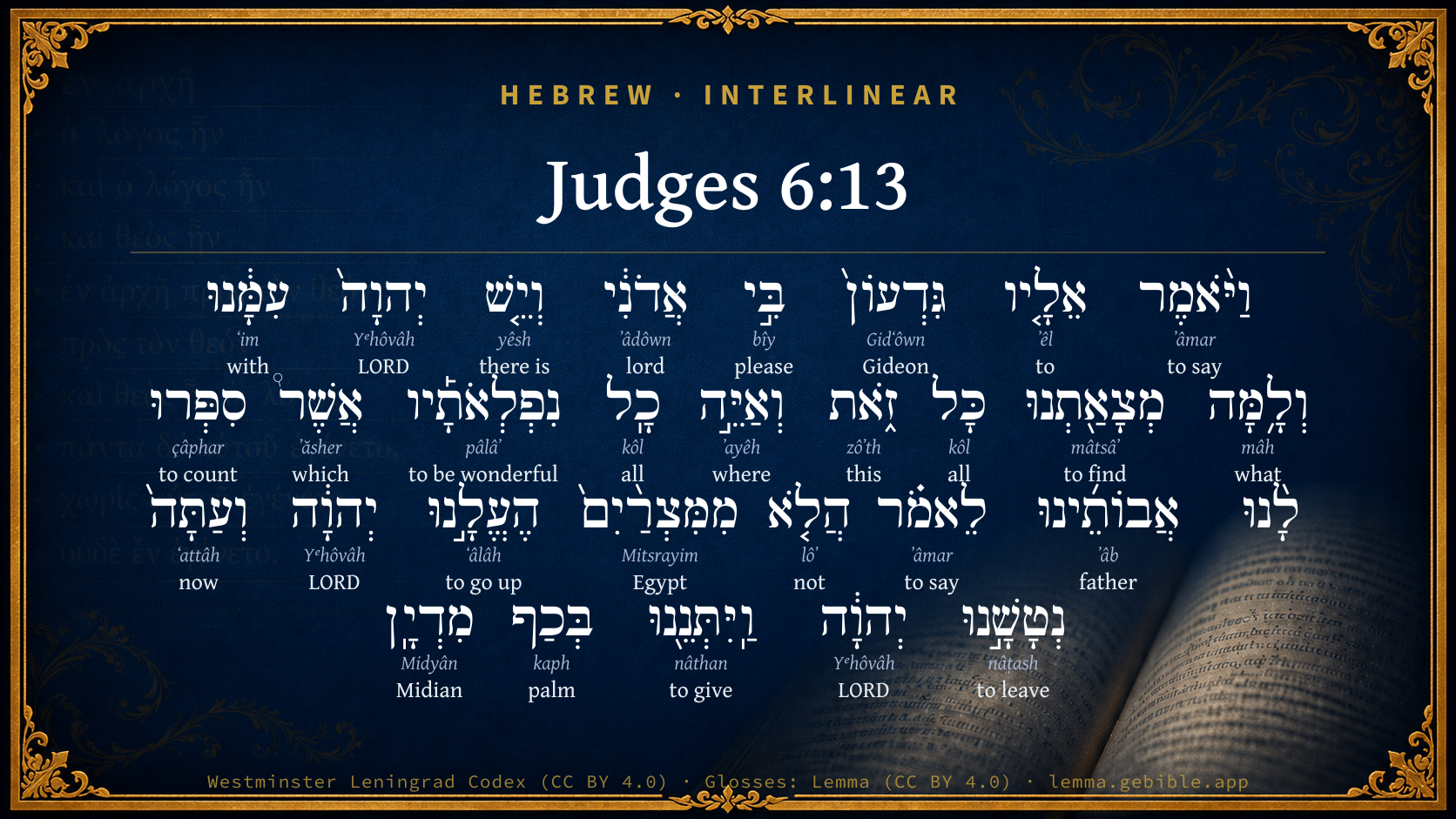
Judges 6:13

Hebrew (Westminster Leningrad Codex) Judges 6:13 appears in the Hebrew Old Testament. The text above is from the Westminster Leningrad Codex. Each word links to its Strong’s number, a concise gloss, and parsing drawn from the Open Scriptures Hebrew Bible morphology. Click any word for its full Brown-Driver-Briggs (BDB) entry.
Download image
Cite this verse

Judges 6:13 (World English Bible). Public Domain. Lemma interlinear Bible study tool, https://lemma.gebible.app/v/judges/6/13.

Show BibTeX & RIS
BibTeX
RIS
English Translation
Gideon said to him, Oh, my lord, if Yahweh is with us, why then has all this happened to us? and where are all his wondrous works which our fathers told us of, saying, Did not Yahweh bring us up from Egypt? but now Yahweh has cast us off, and delivered us into the hand of Midian.
World English Bible · Public Domain
Download a study sheet

One document with this verse’s original text, its word-by-word gloss line, the meaning frame, cross-references with their text, attributed commentary, and full source and license credits — printable, and it pastes into notes with its structure intact.

This verse Autodidact and up

Study sheet (.html) Plain text (.txt)

A passage Seminary Student

Up to 50 verses in one chapter. A passage sheet keeps up to 6 commentary sources and 12 cross-references per verse, in the order this page ranks them, and says so on the sheet whenever that leaves anything out. Ask for a single verse and you get the Autodidact verse sheet above.

Everything on this page stays free to read, with no account — the sheet is a download of what is already on screen, not access to it.

Want to remove ads? Support Godless Engineer
Compare translations 3

The same verse in 3 English versions, stacked beneath the original-language interlinear above. Click any original word for its lexicon entry.

Each is an independent rendering of the whole verse — the interlinear is not word-aligned to these translations.

Highlighted words mark where these versions differ — a whole-verse word diff, not a word-by-word alignment.

  • World English Bible Public Domain
    Gideon said to him, Oh, my lord, if Yahweh is with us, why then has all this happened to us? and where are all his wondrous works which our fathers told us of, saying, Did not Yahweh bring us up from Egypt? but now Yahweh has cast us off, and delivered us into the hand of Midian.
  • King James Version Public Domain
    And Gideon said unto him, Oh my Lord, if the LORD be with us, why then is all this befallen us? and where be all his miracles which our fathers told us of, saying, Did not the LORD bring us up from Egypt? but now the LORD hath forsaken us, and delivered us into the hands of the Midianites.
  • unfoldingWord Literal Text CC BY-SA 4.0
    And Gideon said to him, “Excuse me, my lord, but Yahweh is with us, then why has all of this happened to us? And where all of his wonders that our fathers recounted to us, saying, ‘Did not Yahweh bring us up from Egypt?’ But now Yahweh has forsaken us and given us into the palm of Midian.”

unfoldingWord Literal Text — © unfoldingWord, licensed CC BY-SA 4.0. Word-aligned USFM3 via Door43 (git.door43.org/unfoldingWord/en_ult).

Versions to compare (up to 4)

3 of 4 selected

Show all 18 translations

Every available English version of this verse, each an independent rendering of the whole verse.

  • World English Bible Public Domain
    Gideon said to him, Oh, my lord, if Yahweh is with us, why then has all this happened to us? and where are all his wondrous works which our fathers told us of, saying, Did not Yahweh bring us up from Egypt? but now Yahweh has cast us off, and delivered us into the hand of Midian.
  • Berean Standard Bible Public Domain
    “Please, my Lord,” Gideon replied, “if the LORD is with us, why has all this happened to us? And where are all His wonders of which our fathers told us, saying, ‘Has not the LORD brought us up out of Egypt?’ But now the LORD has forsaken us and delivered us into the hand of Midian.”
  • Majority Standard Bible Public Domain
    “Please, my Lord,” Gideon replied, “if the LORD is with us, why has all this happened to us? And where are all His wonders of which our fathers told us, saying, ‘Has not the LORD brought us up out of Egypt?’ But now the LORD has forsaken us and delivered us into the hand of Midian.”
  • King James Version Public Domain
    And Gideon said unto him, Oh my Lord, if the LORD be with us, why then is all this befallen us? and where be all his miracles which our fathers told us of, saying, Did not the LORD bring us up from Egypt? but now the LORD hath forsaken us, and delivered us into the hands of the Midianites.
  • American Standard Version (1901) Public Domain
    And Gideon said unto him, Oh, my lord, if Jehovah is with us, why then is all this befallen us? and where are all his wondrous works which our fathers told us of, saying, Did not Jehovah bring us up from Egypt? but now Jehovah hath cast us off, and delivered us into the hand of Midian.
  • Revised Version (1885) Public Domain
    And Gideon said unto him, Oh my lord, if the LORD be with us, why then is all this befallen us? and where be all his wondrous works which our fathers told us of, saying, Did not the LORD bring us up from Egypt? but now the LORD hath cast us off, and delivered us into the hand of Midian.
  • Geneva Bible (1599) Public Domain
    To whome Gideon answered, Ah my Lord, if the Lord be with vs, why then is all this come vpon vs? and where be all his miracles which our fathers tolde vs of, and sayd, Did not the Lord bring vs out of Egypt? but now the Lord hath forsaken vs, and deliuered vs into the hand of the Midianites.
  • Douay-Rheims (1899) Public Domain
    The angel of the Lord appeared to him, and said: The Lord is with thee, O most valiant of men.
  • Young's Literal Translation Public Domain
    And Gideon saith unto him, `O, my lord -- and Jehovah is with us! -- and why hath all this found us? and where `are' all His wonders which our fathers recounted to us, saying, Hath not Jehovah brought us up out of Egypt? and now Jehovah hath left us, and doth give us into the hand of Midian.'
  • Literal Standard Version CC BY-SA 4.0
    And Gideon says to Him, “O my Lord, [if] YHWH is indeed with us, then why has all this found us? And where [are] all His wonders which our fathers recounted to us, saying, Has YHWH not brought us up out of Egypt? And now YHWH has left us, and gives us into the hand of Midian.”
  • Unlocked Literal Bible CC BY-SA 4.0
    Gideon said to him, “Oh, my master, if Yahweh is with us, why then has all this happened to us? Where are all his wonderful deeds that our fathers told us about, when they said, 'Did not Yahweh bring us up from Egypt?' But now Yahweh has abandoned us and gave us into the hand of Midian.”
  • unfoldingWord Literal Text CC BY-SA 4.0
    And Gideon said to him, “Excuse me, my lord, but Yahweh is with us, then why has all of this happened to us? And where all of his wonders that our fathers recounted to us, saying, ‘Did not Yahweh bring us up from Egypt?’ But now Yahweh has forsaken us and given us into the palm of Midian.”
  • Darby Bible Public Domain
    And Gideon said to him, "Pray, sir, if the LORD is with us, why then has all this befallen us? And where are all his wonderful deeds which our fathers recounted to us, saying, 'Did not the LORD bring us up from Egypt?' But now the LORD has cast us off, and given us into the hand of Mid'ian."
  • World Messianic Bible Public Domain
    Gideon said to him, “Oh, my lord, if the LORD is with us, why then has all this happened to us? Where are all his wondrous works which our fathers told us of, saying, ‘Didn’t the LORD bring us up from Egypt?’ But now the LORD has cast us off, and delivered us into the hand of Midian.”
  • Webster's Bible Public Domain
    And Gideon said to him, O my Lord, if the LORD is with us, why then hath all this befallen us? and where are all his miracles which our fathers told us of, saying, Did not the LORD bring us up from Egypt? but now the LORD hath forsaken us, and delivered us into the hands of the Midianites.
  • Free Bible Version CC BY-SA 4.0
    “Excuse me, my lord, but if the Lord is with us, why has all this happened to us?” Gideon replied. “Where are all his wonderful miracles that our forefathers reminded us about when they said, ‘Wasn't it the Lord who led us out of Egypt?’ But now the Lord has given up on us and has handed us over to the Midianites.”
  • Bible in Basic English Public Domain
    Then Gideon said to him, O my lord, if the Lord is with us why has all this come on us? And where are all his works of power, of which our fathers have given us word, saying, Did not the Lord take us out of Egypt? But now he has given us up, handing us over to the power of Midian.
  • JPS Tanakh (1917) Public Domain
    And Gideon said unto him: 'Oh, my lord, if the LORD be with us, why then is all this befallen us? and where are all His wondrous works which our fathers told us of, saying: Did not the LORD bring us up from Egypt? but now the LORD hath cast us off, and delivered us into the hand of Midian.'

Literal Standard Version (2020), Covenant Press — licensed CC BY-SA 4.0. Text via the HelloAO Bible API (eBible.org). Unlocked Literal Bible (unfoldingWord) — licensed CC BY-SA 4.0. Text via the HelloAO Bible API (eBible.org). unfoldingWord Literal Text — © unfoldingWord, licensed CC BY-SA 4.0. Word-aligned USFM3 via Door43 (git.door43.org/unfoldingWord/en_ult). Free Bible Version, Dr. Jonathan Gallagher — licensed CC BY-SA 4.0. Text via the HelloAO Bible API (eBible.org).

Word by word

More ways to search: Search by grammar → Find every occurrence → Compare this word →

Practice this passage: Drill this verse → Learn its vocabulary →

בִּ֣י
bîy
H994
“please”
Particle, Exhortation
Part of Speech
Particle
Type
Exhortation
Full BDB Definition

Origin: perhaps from H1158 (sense of asking)

TWOT: 238a

if it please, pray excuse me, excuse me please - used to introduce an entreaty or request
  1. וַיֹּ֨אמֶר ʼâmar H559 “and · to say” Conjunction + Verb, Qal, Sequential Imperfect, 3rd Person, Masculine, Singular
  2. אֵלָ֤יו ʼêl H413 “to · him” Preposition + Suffix, Personal, 3rd Person, Masculine, Singular
  3. גִּדְעוֹן֙ Gidʻôwn H1439 “Gideon” Noun, Proper
  4. אֲדֹנִ֔י ʼâdôwn H113 “lord · my” Noun, Common, Masculine, Singular, Construct + Suffix, Personal, 1st Person, Common, Singular
  5. וְיֵ֤שׁ yêsh H3426 “and · there is” Conjunction + Particle, Demonstrative
  6. יְהוָה֙ Yᵉhôvâh H3068 “LORD” Noun, Proper
  7. עִמָּ֔נוּ ʻim H5973 “with · us” Preposition + Suffix, Personal, 1st Person, Common, Plural
  8. וְלָ֥מָּה mâh H4100 “and · to/for · what” Conjunction + Preposition + Particle, Interrogative
  9. מְצָאַ֖תְנוּ mâtsâʼ H4672 “to find · us” Verb, Qal, Perfect, 3rd Person, Feminine, Singular + Suffix, Personal, 1st Person, Common, Plural
  10. כָּל kôl H3605 “all of” Noun, Common, Masculine, Singular, Construct
  11. זֹ֑את zôʼth H2063 “this” Pronoun, Demonstrative, Feminine, Singular
  12. וְאַיֵּ֣ה ʼayêh H346 “and · where” Conjunction + Particle, Interrogative
  13. כָֽל kôl H3605 “all of” Noun, Common, Masculine, Singular, Construct
  14. נִפְלְאֹתָ֡יו pâlâʼ H6381 “being wonderful · him” Verb, Niphal, Participle Active, Feminine, Plural, Construct + Suffix, Personal, 3rd Person, Masculine, Singular
  15. אֲשֶׁר֩ ʼăsher H834 “which” Particle, Relative
  16. סִפְּרוּ çâphar H5608 “to count” Verb, Piel, Perfect, 3rd Person, Common, Plural
  17. אֲבוֹתֵ֜ינוּ ʼâb H1 “fathers · our” Noun, Common, Masculine, Plural, Construct + Suffix, Personal, 1st Person, Common, Plural
  18. לֵאמֹ֗ר ʼâmar H559 “to say” Preposition + Verb, Qal, Infinitive Construct
  19. הֲלֹ֤א lôʼ H3808 “not” Particle, Interrogative + Particle, Negative
  20. מִמִּצְרַ֨יִם֙ Mitsrayim H4714 “from · Egypt” Preposition + Noun, Proper
  21. הֶעֱלָ֣נוּ ʻâlâh H5927 “to go up · us” Verb, Hiphil, Perfect, 3rd Person, Masculine, Singular + Suffix, Personal, 1st Person, Common, Plural
  22. יְהוָ֔ה Yᵉhôvâh H3068 “LORD” Noun, Proper
  23. וְעַתָּה֙ ʻattâh H6258 “and · now” Conjunction + Adverb
  24. נְטָשָׁ֣נוּ nâṭash H5203 “to leave · us” Verb, Qal, Perfect, 3rd Person, Masculine, Singular + Suffix, Personal, 1st Person, Common, Plural
  25. יְהוָ֔ה Yᵉhôvâh H3068 “LORD” Noun, Proper
  26. וַֽיִּתְּנֵ֖נוּ nâthan H5414 “and · to give · us” Conjunction + Verb, Qal, Sequential Imperfect, 3rd Person, Masculine, Singular + Suffix, Personal, 1st Person, Common, Plural
  27. בְּכַף kaph H3709 “in/at · palm of” Preposition + Noun, Common, Feminine, Singular, Construct
  28. מִדְיָֽן Midyân H4080 “Midian” Noun, Proper

About this verse

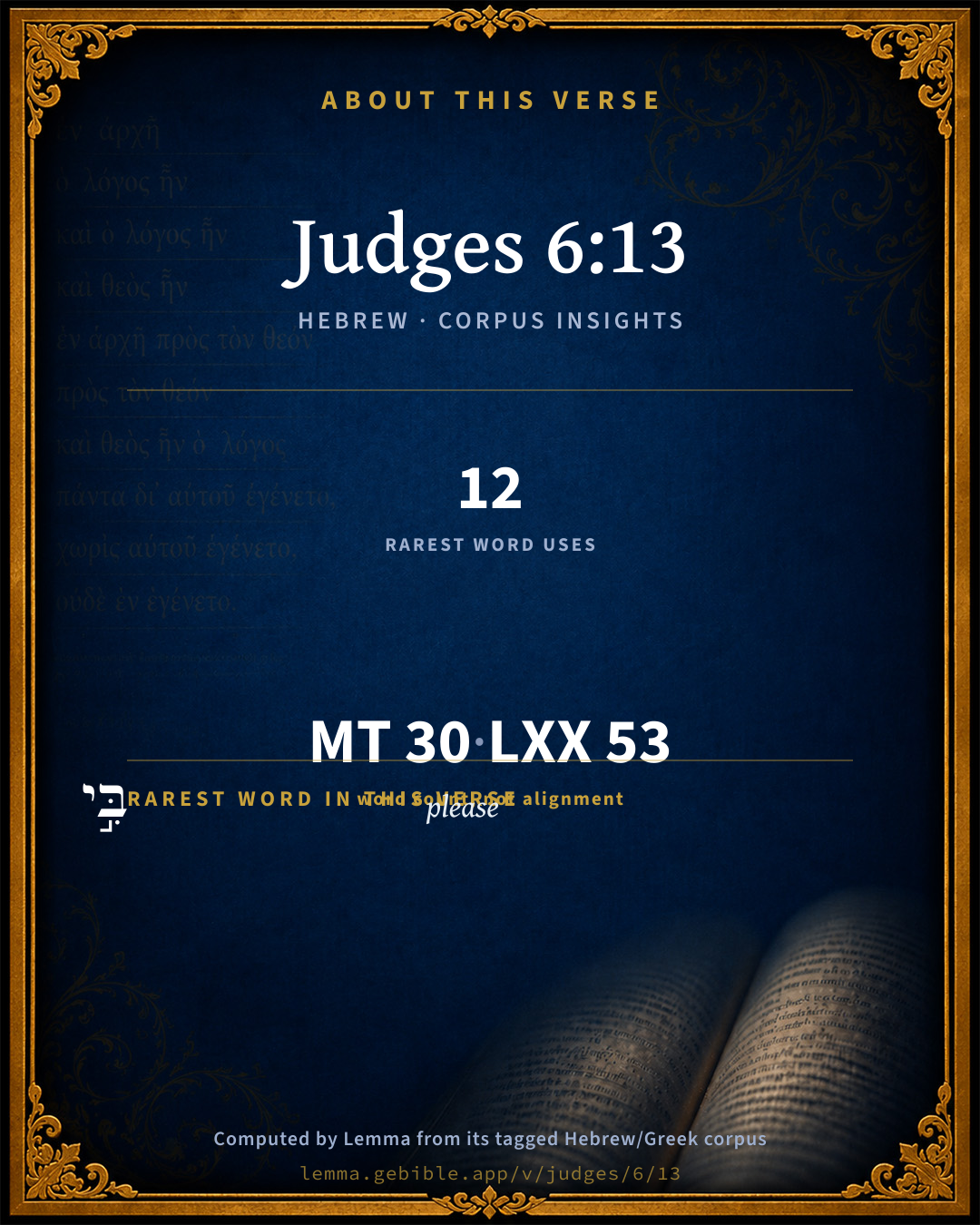
These counts appear in no published source. They are computed here, from the morphology-tagged text and Lemma’s own curated glosses. What Lemma adds →

30
words
25
distinct lemmas
Historical
section

Notable vocabulary

The rarest word here is בִּ֣י please H994 — appearing just 12 times in the whole Hebrew Bible.

Shared distinctive vocabulary

בִּ֣י please H994 occurs in 12 verses of the Hebrew Bible. Also found in:

Grammatical profile

  • 8 verbs
  • 11 nouns
  • 1 pronoun
  • 3 prepositions
  • 1 adverb
  • 6 particles

Verb forms

  • וַיֹּ֨אמֶר Qal · Sequential Imperfect
  • מְצָאַ֖תְנוּ Qal · Perfect
  • נִפְלְאֹתָ֡יו Niphal · Participle Active
  • סִפְּרוּ Piel · Perfect
  • לֵאמֹ֗ר Qal · Infinitive Construct
  • הֶעֱלָ֣נוּ Hiphil · Perfect
  • נְטָשָׁ֣נוּ Qal · Perfect
  • וַֽיִּתְּנֵ֖נוּ Qal · Sequential Imperfect

Repetition

Words recur within this verse — often emphatic in Hebrew:

  • יְהוָה֙ LORD H3068 ×3
  • וַיֹּ֨אמֶר to say H559 ×2
  • כָּל all H3605 ×2

Hebrew & Septuagint length

In English translation the verse runs 57 words from the Hebrew and 63 from the Septuagint (LXX English) — closely comparable.

A rough comparison of the two English renderings, which tokenize alike — not a word-level alignment.

Word counts can differ between the Hebrew and the Greek without any difference in meaning — e.g. the Hebrew direct-object marker אֵת has no separate Greek word, and Greek often adds the article ὁ.

In the original languages it is 30 Hebrew tokens and 53 Greek tokens — but the two are counted differently (Hebrew bundles its prefixes and suffixes into one token; the Greek is in lemma form), so that isn’t a like-for-like length.

Cross-references

17

Topical passages linked to Judges 6:13 in the Treasury of Scripture Knowledge — connected by theme and wording, ordered by reader-vote popularity; previews shown in the World English Bible.

  • Psalms 77:7–9 "Will the Lord reject us forever? Will he be favorable no more?
  • 2 Chronicles 15:2 and he went out to meet Asa, and said to him, Hear you me, Asa, and all Judah and Benjamin: Yahweh is with you, while you are with him; and if you seek him, he will be found of you; but if you forsake him, he will forsake you.
  • Isaiah 59:1–2 Behold, Yahweh's hand is not shortened, that it can't save; neither his ear heavy, that it can't hear:
  • Psalms 44:1 We have heard with our ears, God; Our fathers have told us, What work you did in their days, In the days of old.
  • Genesis 25:22 The children struggled together within her. She said, "If it be so, why do I live?" She went to inquire of Yahweh.
  • Deuteronomy 30:17–18 But if your heart turn away, and you will not hear, but shall be drawn away, and worship other gods, and serve them;
  • Deuteronomy 31:17 Then my anger shall be kindled against them in that day, and I will forsake them, and I will hide my face from them, and they shall be devoured, and many evils and troubles shall come on them; so that they will say in that day, Haven't these evils come on us because our God is not among us?
  • Psalms 78:3–4 Which we have heard and known, And our fathers have told us.
  • Psalms 89:49 Lord, where are your former loving kindnesses, Which you swore to David in your faithfulness?
  • Isaiah 41:17 The poor and needy seek water, and there is none, and their tongue fails for thirst; I, Yahweh, will answer them, I, the God of Israel, will not forsake them.
  • Isaiah 63:15 Look down from heaven, and see from the habitation of your holiness and of your glory: where are your zeal and your mighty acts? the yearning of your heart and your compassion is restrained toward me.
  • Exodus 33:14–16 He said, "My presence will go with you, and I will give you rest."
  • Romans 8:31 What then shall we say about these things? If God is for us, who can be against us?
  • Numbers 14:14–15 and they will tell it to the inhabitants of this land. They have heard that you Yahweh are in the midst of this people; for you Yahweh are seen face to face, and your cloud stands over them, and you go before them, in a pillar of cloud by day, and in a pillar of fire by night.
  • Deuteronomy 29:24 even all the nations shall say, Why has Yahweh done thus to this land? what means the heat of this great anger?
  • Psalms 27:9 Don't hide your face from me. Don't put your servant away in anger. You have been my help. Don't abandon me, Neither forsake me, God of my salvation.
  • Jeremiah 23:33 When this people, or the prophet, or a priest, shall ask you, saying, What is the burden of Yahweh? then shall you tell them, What burden! I will cast you off, says Yahweh.

Cross-references courtesy of OpenBible.info (CC BY 4.0).

Hebrew and Greek witnesses Masoretic Hebrew ↔ Greek Septuagint

The same verse in the two great witnesses to the Old Testament, shown verse-for-verse.

These are two independent witnesses, not word-aligned to each other, and the Septuagint is shown in lemma (dictionary) form.

Hebrew Judges 6:13 Masoretic · Westminster Leningrad Codex

וַיֹּ֨אמֶר אֵלָ֤יו גִּדְעוֹן֙ בִּ֣י אֲדֹנִ֔י וְיֵ֤שׁ יְהוָה֙ עִמָּ֔נוּ וְלָ֥מָּה מְצָאַ֖תְנוּ כָּל זֹ֑את וְאַיֵּ֣ה כָֽל נִפְלְאֹתָ֡יו אֲשֶׁר֩ סִפְּרוּ לָ֨נוּ אֲבוֹתֵ֜ינוּ לֵאמֹ֗ר הֲלֹ֤א מִמִּצְרַ֨יִם֙ הֶעֱלָ֣נוּ יְהוָ֔ה וְעַתָּה֙ נְטָשָׁ֣נוּ יְהוָ֔ה וַֽיִּתְּנֵ֖נוּ בְּכַף מִדְיָֽן

Gideon said to him, Oh, my lord, if Yahweh is with us, why then has all this happened to us? and where are all his wondrous works which our fathers told us of, saying, Did not Yahweh bring us up from Egypt? but now Yahweh has cast us off, and delivered us into the hand of Midian.

World English Bible · Public Domain

Greek LXX Judges 6:13 Septuagint · lemma form

καί εἶπον πρός αὐτός γεδεων ἐν ἐγώ κύριος ἐγώ καί εἰ εἰμί κύριος μετά ἐγώ εἰς τίς εὑρίσκω ἐγώ ὁ κακός οὗτος καί ποῦ εἰμί πᾶς ὁ θαυμάσιος αὐτός ὅς διαἡγέομαι ἐγώ ὁ πατήρ ἐγώ λέγω μή οὐ ἐκ αἴγυπτος ἀναἄγω ἐγώ κύριος καί νῦν ἐκῥίπτω ἐγώ καί δίδωμι ἐγώ ἐν χείρ μαδιαμ

And Gedeon said to him, Be gracious with me, my Lord: but if the Lord is with us, why have these evils found us? and where are all his miracles, which our fathers have related to us, saying, Did not the Lord bring us up out of Egypt? and now he has cast us out, and given us into the hand of Madiam.

LXX2012 (modern English Septuagint) · Public Domain

Hebrew: Westminster Leningrad Codex (CC BY 4.0). Greek: Septuagint (public domain); English from LXX2012 (modern English Septuagint) (Public Domain). How the Septuagint differs from the Hebrew →

Targum (Aramaic paraphrase)

1

The Targum is the ancient Jewish Aramaic paraphrase of the Hebrew Scriptures — an interpretive translation, not the Hebrew text itself. Onkelos (literal) and Pseudo-Jonathan (expansive) render the Torah, and Jonathan the Prophets. Coverage is partial: where no permissively-licensed English translation exists for a verse, only the Aramaic is shown. This is verse-level text, not a word-by-word alignment to the Hebrew.

  1. Targum Jonathan Prophets (Joshua–Malachi)
    וַאֲמַר לֵיהּ גִדְעוֹן בְּבָעוּ רִבּוֹנִי וְאִית שְׁכִנְתָּא דַיְיָ בְּסַעְדָנָא וּלְמָא עַרְעָנָא כָּל דָא וְאָן כָּל פְּרִשְׁוָתֵיהּ דְאִשְׁתְּעִיאוּ לָנָא אַבְהָתָנָא לְמֵימַר הֲלָא מִמִצְרַיִם אַסְקָנָא יְיָ וּכְעַן רַטְשָׁנָא יְיָ וּמַסְרָנָא בִּידָא דְמִדְיָנָאֵי:

    (no public-domain English translation for this verse)

    Targum Jonathan — Aramaic: “Mikraot Gedolot” (public domain). English: “Sefaria Community Translation” (CC0 1.0 (public-domain dedication)); “London "Chaldee Paraphrase," 1871” (public domain). Text via Sefaria.

Commentary

Notes on Judges 6:13 from classic Christian and Jewish commentators (each source and its license shown beneath its notes). The classic Christian expositions comment on the surrounding passage and are grouped to its opening verse, so a note may address several verses; the Jewish commentaries on the Tanakh (Rashi and others) are per-verse, so they appear only where the commentator wrote on this verse.

Lemma curates 59 commentaries, every one of them public domain or Creative Commons licensed, each selected and text-cleaned for this edition rather than reprinted as found. About our sources →

Trapp's Complete Commentary

John Trapp

Jdg 6:13 And Gideon said unto him, Oh my Lord, if the LORD be with us, why then is all this befallen us? and where [be] all his miracles which our fathers told us of, saying, Did not the LORD bring us up from Egypt? but now the LORD hath forsaken us, and delivered us into the hands of the Midianites.

Ver. 13. Why then is all this befallen us?] As if that could not be, and they in durance. But we must frame a new Bible, saith one, ere we can find any colour out of God’s afflicting us, to prove that he doth not love us, and hath forsaken us. Non deserit etiamsi deserat, saith a father.

John Trapp, A Commentary or Exposition upon All the Books of the Old and New Testament (1647–1656) — public domain. Text from a community e-Sword module.

Joseph Benson's Commentary

Jdg 6:13. If the Lord be with us, why then is all this befallen us? — All this trouble and distress from the incursions of the Midianites? All this loss, and grief, and dismay? Where be all his miracles which our fathers told us of? — We are too apt to conclude, that those instances of God’s power which have not been exerted for a long time will never be renewed. Gideon seems here to have given way to this common weakness of our nature and tendency to unbelief and distrust of God’s power, and love, and faithfulness. And we frequently find the prophets expostulating with the people for thinking that the hand of the Lord was shortened, or that he could not exert the same wonderful power, producing the same glorious effects for them which he had formerly exerted and produced for their fathers. The angel had spoken to him in particular, The Lord is with THEE: but he pleads and expostulates for all, If the Lord be with US — Associating himself with the thousands of Israel, and admitting no comfort but what they might be sharers in. Gideon does not seem yet to have had any idea that the person that spoke to him was an angel or heavenly being; but appears to have taken him only for some respectable person, or at most a prophet, for the expression, my Lord, with which he addresses him, was no more than was generally used toward persons of respectability.

Joseph Benson's Commentary on the Old and New Testaments (1811–1818) — public domain. Text from a community e-Sword module.

Geneva Bible (1599)

Geneva Bible translators

This came not of distrust, but of weakness of faith, which is in the most perfect: for no man in this life can have a perfect faith: yet the children of God have a true faith, whereby they be justified.

Geneva Bible (1599) marginal notes — public domain. Text via Bolls.life.

Jamieson, Fausset & Brown

Robert Jamieson, A. R. Fausset & David Brown

if the Lord be with us, why then is all this befallen us?--Gideon's language betrays want of reflection, for the very chastisements God had brought on His people showed His presence with, and His interest in, them.

Jamieson, Fausset & Brown — Commentary Critical and Explanatory on the Whole Bible (1871) — public domain (CC PDM 1.0). Text via the HelloAO Bible API.

Adam Clarke's Commentary

Verse 13. And Gideon said unto him] This speech is remarkable for its energy and simplicity; it shows indeed a measure of despondency, but not more than the circumstances of the case justified.

Adam Clarke's Commentary on the Bible (1810–1826) — public domain. Text from a community e-Sword/MySword module.

Ellicott's Commentary for English Readers

(13) Oh my Lord.—The title is here only one of courtesy (adoni, like kurie; “sir” in Joh_20:19, &c.),for Gideon only saw in the angel a stranger seated beneath the terebinth which overshadowed the rock-hewn wine-vat in which he was working.

Why then is all this befallen us?—See Deu_31:17 : “Are not these evils come upon us, because our God is not among us?” The words “all this” sound like an echo of Gideon’s gloomy thoughts—the thoughts of his country and his brothers, which had been darkening his soul amid his hard toil. “A mighty indication of God’s favour to me that I am forced to use this wine-press instead of a threshing-floor” (Jos.).

Where be all his miracles?—See Psa_78:12; Psa_89:49.

The Lord hath forsaken us.—See Psa_13:1; 2Ch_15:2 : “If ye forsake him, he will forsake you.”

A Bible Commentary for English Readers, edited by Charles John Ellicott (1878–1897) — public domain. Text from a community e-Sword module.

The Cambridge Bible for Schools and Colleges

gen. ed. J. J. S. Perowne

13. his wondrous works … from Egypt] Cf. Exo_3:20; Exo_34:10, Jos_3:5 J. Tradition, handed down from father to son (Psa_44:1; Psa_78:3), regarded the deliverance from Egypt and the divine interventions during the wanderings as the starting-point and evidence of Jehovah’s special relation to Israel. These words have the appearance of a later insertion.

The Cambridge Bible for Schools and Colleges (gen. ed. J. J. S. Perowne; Cambridge University Press, 1878–1918) — public domain. Text from a community e-Sword module.

John Gill's Exposition

And the Lord looked upon him,.... The same before called the angel of the Lord, and who was no other than Jehovah himself; who looked upon him with great earnestness, and with great delight and pleasure smiled upon him, and thereby showing he had a kindness for him, and meant well to him: and

said unto him, go in this thy might; both of body and mind, which had been before given unto him, and was now increased, and which no doubt Gideon was sensible of:

and thou shalt save Israel from the hand of the Midianites; as he did, and therefore justly reckoned among the saviours and judges of Israel:

have not I sent thee? to do this great work, save the people of Israel, from whence Gideon might perceive who it was that talked with him, and having a command and commission from God, had authority enough to go about this service.

John Gill's Exposition of the Whole Bible (1746–1763) — public domain (CC PDM 1.0). Text via the HelloAO Bible API.

Albert Barnes' Notes on the Bible

The extreme bitterness of the national sufferings under the Midianite occupation breaks out in Gideon’s language. The Angel’s words, suitable to times of prosperity, seemed to be a mockery, when it was evident the Lord was not with them. (Compare Deu 31:17.)

Albert Barnes' Notes on the Bible (1834–1885) — public domain. Text from a community e-Sword/MySword module.

Haydock's Catholic Bible Commentary

My lord. This he says out of respect, supposing that he was addressing a prophet, (Haydock) or some virtuous person, of whom he desires to know what reasons could be given for the assurance of divine favour, which he held out. He speaks not out of distrust. (Menochius)

George Leo Haydock (1774–1849), Haydock's Catholic Family Bible and Commentary, 1859 edition — public domain. Excludes Psalms (Douay-Rheims chapter numbering differs from Protestant) and Deuterocanonical books (Catholic canon only).

The Pulpit Commentary

If the Lord be with us, etc. The utter dejection caused by the Midianite oppression breathes in every word spoken by Gideon. But how reassuring the angel"s words were. Which our fathers told us of. This is a distinct reference to the national traditions. (which are elsewhere alluded to Exo_12:26, 27 Psa_44:1 Psa_78:3-5 Jer_16:14)

The Pulpit Commentary (1880–1919), ed. H.D.M. Spence-Jones & Joseph S. Exell — public domain. Text from a community e-Sword module.

John Wesley's Explanatory Notes

With us - The angel had said, Peace be with Thee: but he expostulates for All: herding himself with all Israel, and admitting no comfort, but what they might be sharers in.

John Wesley, Explanatory Notes Upon the Whole Bible (1754–1765) — public domain. Text via the GEBible commentary corpus.

unfoldingWord translationNotes

Door43 World Missions Community

my master

Gideon uses the word "master" as a polite way to greet a stranger. He does not realize he is speaking to Yahweh in the form of an angel or a man.

Where are all his wonderful deeds that our fathers told us about, when they said, 'Did not Yahweh bring us up from Egypt?'

Gideon uses a question to challenge the stranger's statement that Yahweh was with him. Also, the direct quotation can be stated as an indirect quotation. AT: "We have not seen any wonderful deeds like the ones our fathers told us about when Yahweh brought them up from Egypt." (See: Rhetorical Question and Direct and Indirect Quotations)

gave us into the hand of Midian

The phrase "gave us into" means Yahweh allowed the Israelites to be defeated. AT: "allowed the Midianites to defeat us" (See: Idiom)

gave us into the hand

Here "hand" represents power or control. (See: Metonymy)

of Midian

Here "Midian" represents the people of Midian. AT: "of the Midianites" (See: Metonymy)

translationWords

Gideon

lord

Yahweh

works

ancestor

Egypt

hand

Midian

unfoldingWord translationNotes — © Distant Shores Media and the Door43 World Missions Community, licensed CC BY-SA 4.0. Source: git.door43.org/Door43/en_tn.

Rashi

Rabbi Shlomo Yitzchaki (Rashi)

If [lit. and] Adonoy is with us. If Adonoy is with us, why has [all this] occurred, etc.

Which our forefathers recounted to us. It was Pesach, and he told him, "Last night father recited the Hallel for me, and I heard him read, "When Yisroel departed from Egypt" —but now He has abandoned us. If our forefathers were saintly, let Him act in our behalf in their merit; and if they were wicked, then, just as He worked His wonders for them gratuitously, so, let Him act in our behalf. Where are all His marvels?"

Rashi on the Tanakh — English translations: “The Judaica Press complete Tanach with Rashi, translated by A. J. Rosenberg” (CC BY 4.0); “Pentateuch with Rashi's commentary by M. Rosenbaum and A.M. Silbermann, 1929-1934” (public domain); “The Metsudah Tanach series, Lakewood, N.J” (CC BY 4.0); and “The Book of Joshua, Metsudah Publications, 1997” (CC BY 4.0). Text via Sefaria.

Lesson kit

Teaching starters — assembled from the data on this page, not authored interpretation. Every prompt links to the verse data it draws on. Edit before teaching.

Judges, in the Historical, opens this verse with 30 words (25 distinct Hebrew lemmas). Its most distinctive word is bîy (“please”). A historical commentator’s framing appears above. Read the whole chapter for the surrounding context.

Discussion questions

  1. The word bîy carries the sense “please.” How does it shape the verse?
  2. Genesis 43:20 shares the word «please» with this verse. How do the two illuminate each other?
  3. “LORD” occurs 3× in this one verse. What is the effect of the repetition?
  4. The translations on this page render this verse differently — a whole-verse word diff, not a word-by-word alignment. What might account for the different wordings?
  5. The verb «וַיֹּ֨אמֶר» is Qal Sequential Imperfect. How does its form color the action?
  6. Reading how Trapp's Complete Commentary and Joseph Benson's Commentary read this verse, where do the two commentators agree and where do they part?

Things to notice

Reading settings

Reading text

Shown beneath each verse's original-language words.

Old Testament
Old Testament edition

Read the OT as the Masoretic Hebrew (MT) or the Greek Septuagint (LXX).

English shown for the Greek Septuagint (in the Hebrew ↔ Greek comparison).

Comparing translations? Open the Compare panel on any verse page to stack up to four side by side.