
Proverbs 31:16

Hebrew (Westminster Leningrad Codex) Proverbs 31:16 appears in the Hebrew Old Testament. The text above is from the Westminster Leningrad Codex. Each word links to its Strong’s number, a concise gloss, and parsing drawn from the Open Scriptures Hebrew Bible morphology. Click any word for its full Brown-Driver-Briggs (BDB) entry.
Download image
Cite this verse

Proverbs 31:16 (World English Bible). Public Domain. Lemma interlinear Bible study tool, https://lemma.gebible.app/v/proverbs/31/16.

Show BibTeX & RIS
BibTeX
RIS
English Translation
She considers a field, and buys it. With the fruit of her hands, she plants a vineyard.
World English Bible · Public Domain
Download a study sheet

One document with this verse’s original text, its word-by-word gloss line, the meaning frame, cross-references with their text, attributed commentary, and full source and license credits — printable, and it pastes into notes with its structure intact.

This verse Autodidact and up

Study sheet (.html) Plain text (.txt)

A passage Seminary Student

Up to 50 verses in one chapter. A passage sheet keeps up to 6 commentary sources and 12 cross-references per verse, in the order this page ranks them, and says so on the sheet whenever that leaves anything out. Ask for a single verse and you get the Autodidact verse sheet above.

Everything on this page stays free to read, with no account — the sheet is a download of what is already on screen, not access to it.

Want to remove ads? Support Godless Engineer
Compare translations 3

The same verse in 3 English versions, stacked beneath the original-language interlinear above. Click any original word for its lexicon entry.

Each is an independent rendering of the whole verse — the interlinear is not word-aligned to these translations.

Highlighted words mark where these versions differ — a whole-verse word diff, not a word-by-word alignment.

  • World English Bible Public Domain
    She considers a field, and buys it. With the fruit of her hands, she plants a vineyard.
  • King James Version Public Domain
    She considereth a field, and buyeth it: with the fruit of her hands she planteth a vineyard.
  • unfoldingWord Literal Text CC BY-SA 4.0
    She considers a field and gets it; from the fruit of her palms she plants a vineyard.

unfoldingWord Literal Text — © unfoldingWord, licensed CC BY-SA 4.0. Word-aligned USFM3 via Door43 (git.door43.org/unfoldingWord/en_ult).

Versions to compare (up to 4)

3 of 4 selected

Show all 18 translations

Every available English version of this verse, each an independent rendering of the whole verse.

  • World English Bible Public Domain
    She considers a field, and buys it. With the fruit of her hands, she plants a vineyard.
  • Berean Standard Bible Public Domain
    She appraises a field and buys it; from her earnings she plants a vineyard.
  • Majority Standard Bible Public Domain
    She appraises a field and buys it; from her earnings she plants a vineyard.
  • King James Version Public Domain
    She considereth a field, and buyeth it: with the fruit of her hands she planteth a vineyard.
  • American Standard Version (1901) Public Domain
    She considereth a field, and buyeth it; With the fruit of her hands she planteth a vineyard.
  • Revised Version (1885) Public Domain
    She considereth a field, and buyeth it: with the fruit of her hands she planteth a vineyard.
  • Geneva Bible (1599) Public Domain
    She considereth a field, and getteth it: and with the fruite of her handes she planteth a vineyarde.
  • Douay-Rheims (1899) Public Domain
    She hath considered a field, and bought it: with the fruit of her hands she hath planted a vineyard.
  • Young's Literal Translation Public Domain
    She hath considered a field, and taketh it, From the fruit of her hands she hath planted a vineyard.
  • Literal Standard Version CC BY-SA 4.0
    She has considered a field, and takes it, || She has planted a vineyard from the fruit of her hands.
  • Unlocked Literal Bible CC BY-SA 4.0
    She considers a field and buys it, with the fruit of her hands she plants a vineyard.
  • unfoldingWord Literal Text CC BY-SA 4.0
    She considers a field and gets it; from the fruit of her palms she plants a vineyard.
  • Darby Bible Public Domain
    She considereth a field, and acquireth it; of the fruit of her hands she planteth a vineyard.
  • World Messianic Bible Public Domain
    She considers a field, and buys it. With the fruit of her hands, she plants a vineyard.
  • Webster's Bible Public Domain
    She considereth a field, and buyeth it: with the fruit of her hands she planteth a vineyard.
  • Free Bible Version CC BY-SA 4.0
    She looks at a field, and decides to buy it; from the money she's earned she buys a vineyard.
  • Bible in Basic English Public Domain
    After looking at a field with care, she gets it for a price, planting a vine-garden with the profit of her work.
  • JPS Tanakh (1917) Public Domain
    She considereth a field, and buyeth it; with the fruit of her hands she planteth a vineyard.

Literal Standard Version (2020), Covenant Press — licensed CC BY-SA 4.0. Text via the HelloAO Bible API (eBible.org). Unlocked Literal Bible (unfoldingWord) — licensed CC BY-SA 4.0. Text via the HelloAO Bible API (eBible.org). unfoldingWord Literal Text — © unfoldingWord, licensed CC BY-SA 4.0. Word-aligned USFM3 via Door43 (git.door43.org/unfoldingWord/en_ult). Free Bible Version, Dr. Jonathan Gallagher — licensed CC BY-SA 4.0. Text via the HelloAO Bible API (eBible.org).

Word by word

More ways to search: Search by grammar → Find every occurrence → Compare this word →

Practice this passage: Drill this verse → Learn its vocabulary →

זָמְמָ֣ה
zâmam
H2161
“to devise”
Verb, Qal, Perfect, 3rd Person, Feminine, Singular
Part of Speech
Verb
Stem
Qal
Form
Perfect
Person
3rd Person
Gender
Feminine
Number
Singular
Full BDB Definition

Origin: a primitive root

TWOT: 556

to have a thought, devise, plan, consider, purpose - (Qal) - to consider, fix thought upon - to purpose, devise - to plot (of evil intent)
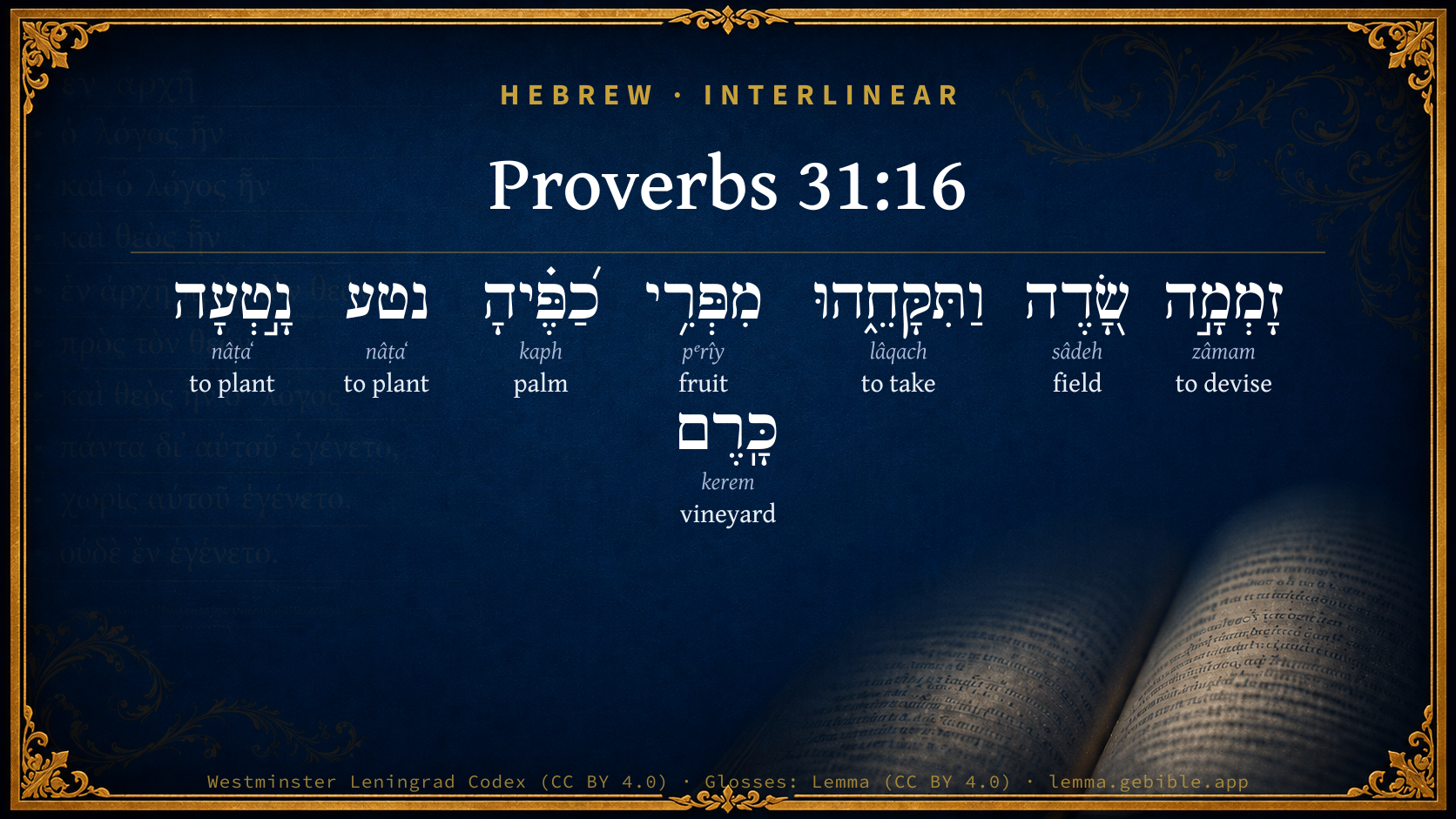
  1. שָׂ֭דֶה sâdeh H7704 “field” Noun, Common, Masculine, Singular, Absolute
  2. וַתִּקָּחֵ֑הוּ lâqach H3947 “and · to take · him” Conjunction + Verb, Qal, Sequential Imperfect, 3rd Person, Feminine, Singular + Suffix, Personal, 3rd Person, Masculine, Singular
  3. מִפְּרִ֥י pᵉrîy H6529 “from · fruit of” Preposition + Noun, Common, Masculine, Singular, Construct
  4. כַ֝פֶּ֗יהָ kaph H3709 “palms · her” Noun, Common, Feminine, Dual, Construct + Suffix, Personal, 3rd Person, Feminine, Singular
  5. נטע nâṭaʻ H5193 “to plant” Verb, Qal, Perfect, 3rd Person, Masculine, Singular
  6. נָ֣טְעָה nâṭaʻ H5193 “to plant” Verb, Qal, Perfect, 3rd Person, Feminine, Singular
  7. כָּֽרֶם kerem H3754 “vineyard” Noun, Common, Both, Singular, Absolute

About this verse

These counts appear in no published source. They are computed here, from the morphology-tagged text and Lemma’s own curated glosses. What Lemma adds →

8
words
7
distinct lemmas
Wisdom
section

Notable vocabulary

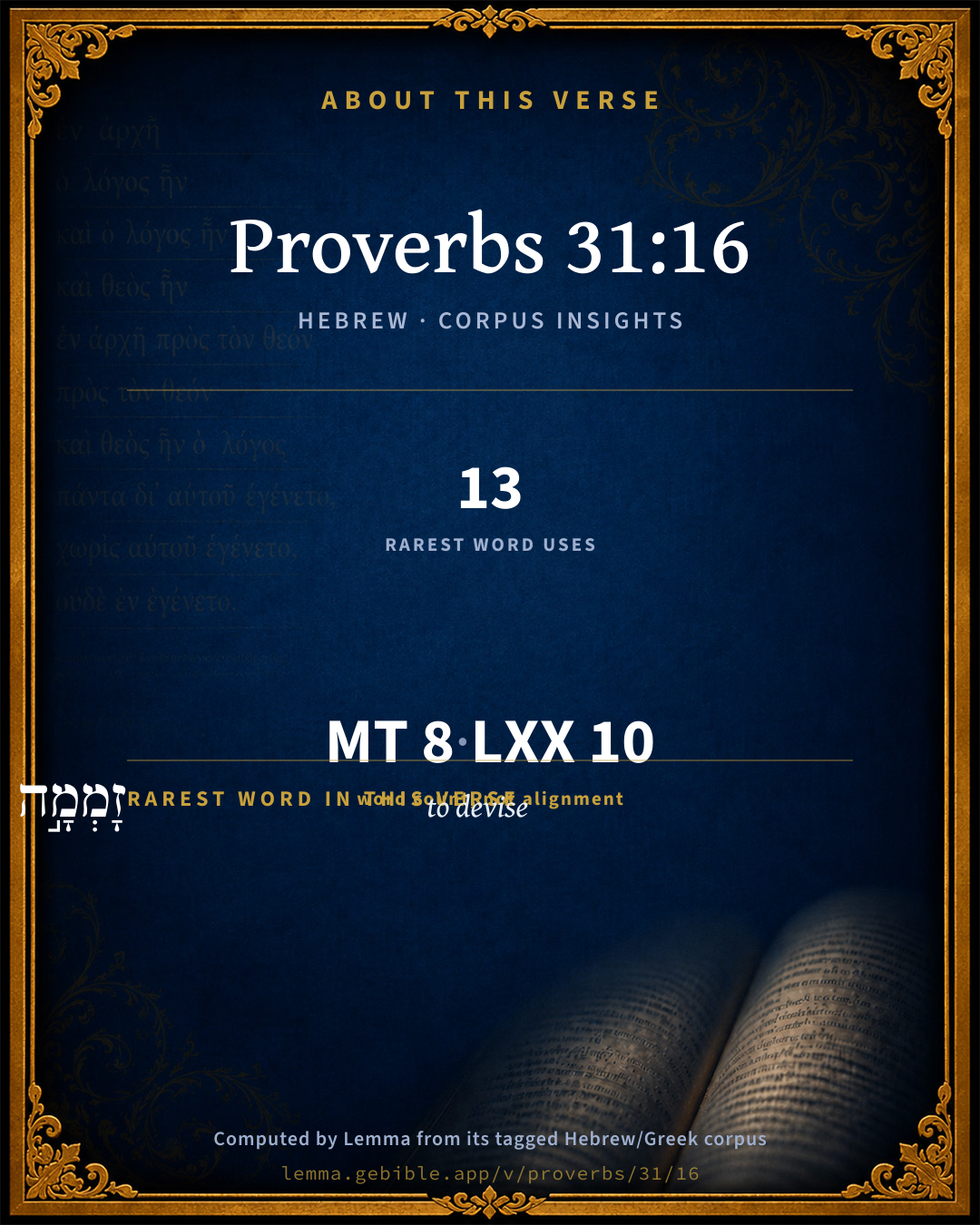
The rarest word here is זָמְמָ֣ה to devise H2161 — appearing just 13 times in the whole Hebrew Bible.

Shared distinctive vocabulary

זָמְמָ֣ה to devise H2161 occurs in 13 verses of the Hebrew Bible. Also found in:

Grammatical profile

  • 4 verbs
  • 4 nouns

Verb forms

  • זָמְמָ֣ה Qal · Perfect
  • וַתִּקָּחֵ֑הוּ Qal · Sequential Imperfect
  • נטע Qal · Perfect
  • נָ֣טְעָה Qal · Perfect

Repetition

A word recurs within this verse — often emphatic in Hebrew:

  • נטע to plant H5193 ×2

Hebrew & Septuagint length

In English translation the verse runs 17 words from the Hebrew and 18 from the Septuagint (LXX English) — closely comparable.

A rough comparison of the two English renderings, which tokenize alike — not a word-level alignment.

Word counts can differ between the Hebrew and the Greek without any difference in meaning — e.g. the Hebrew direct-object marker אֵת has no separate Greek word, and Greek often adds the article ὁ.

In the original languages it is 8 Hebrew tokens and 10 Greek tokens — but the two are counted differently (Hebrew bundles its prefixes and suffixes into one token; the Greek is in lemma form), so that isn’t a like-for-like length.

Cross-references

3

Topical passages linked to Proverbs 31:16 in the Treasury of Scripture Knowledge — connected by theme and wording, ordered by reader-vote popularity; previews shown in the World English Bible.

  • Matthew 13:44 "Again, the Kingdom of Heaven is like a treasure hidden in the field, which a man found, and hid. In his joy, he goes and sells all that he has, and buys that field.
  • Song of Solomon 8:12 My own vineyard is before me. The thousand are for you, Solomon; Two hundred for those who tend its fruit. Lover
  • Joshua 15:18 It happened, when she came [to him], that she moved him to ask of her father a field: and she alighted from off her donkey; and Caleb said, What would you?

Cross-references courtesy of OpenBible.info (CC BY 4.0).

Hebrew and Greek witnesses Masoretic Hebrew ↔ Greek Septuagint

The same verse in the two great witnesses to the Old Testament, shown verse-for-verse.

These are two independent witnesses, not word-aligned to each other, and the Septuagint is shown in lemma (dictionary) form.

Hebrew Proverbs 31:16 Masoretic · Westminster Leningrad Codex

זָמְמָ֣ה שָׂ֭דֶה וַתִּקָּחֵ֑הוּ מִפְּרִ֥י כַ֝פֶּ֗יהָ נטע נָ֣טְעָה כָּֽרֶם

She considers a field, and buys it. With the fruit of her hands, she plants a vineyard.

World English Bible · Public Domain

Greek LXX Proverbs 31:16 Septuagint · lemma form

θεωρέω γεώργιον πρίαμαι ἀπό δέ καρπός χείρ αὐτός καταφυτεύω κτῆμα

She views a farm, and buys it: and with the fruit of her hands she plants a possession.

LXX2012 (modern English Septuagint) · Public Domain

Hebrew: Westminster Leningrad Codex (CC BY 4.0). Greek: Septuagint (public domain); English from LXX2012 (modern English Septuagint) (Public Domain). How the Septuagint differs from the Hebrew →

Commentary

Notes on Proverbs 31:16 from classic Christian and Jewish commentators (each source and its license shown beneath its notes). The classic Christian expositions comment on the surrounding passage and are grouped to its opening verse, so a note may address several verses; the Jewish commentaries on the Tanakh (Rashi and others) are per-verse, so they appear only where the commentator wrote on this verse.

Lemma curates 59 commentaries, every one of them public domain or Creative Commons licensed, each selected and text-cleaned for this edition rather than reprinted as found. About our sources →

Trapp's Complete Commentary

John Trapp

Pro 31:16 She considereth a field, and buyeth it: with the fruit of her hands she planteth a vineyard.

Ver. 16. She considereth a field and buyeth it.] Here is the fruit of her pains and providence. The manus motitans, the "stirring hand maketh rich," {Pro 10:4} and "a wise woman buildeth her house." {Pro 14:1} {See Trapp on "Pro 14:1"} She considers the convenience of this field, and then casts about how she may compass it.

John Trapp, A Commentary or Exposition upon All the Books of the Old and New Testament (1647–1656) — public domain. Text from a community e-Sword module.

Joseph Benson's Commentary

Pro 31:16. She considereth a field — Whether it be fit for use and of a reasonable price, and how she may purchase it. This excludes the rashness, as the proceeding to buy it excludes the inconstancy, which is often incident to that sex; with the fruit of her hands — With the effects of her diligence; she planteth a vineyard — She improveth the land to the best advantage.

Joseph Benson's Commentary on the Old and New Testaments (1811–1818) — public domain. Text from a community e-Sword module.

Tyndale Open Study Notes

Tyndale Open Resources

31:16-18 An excellent wife is engaged in commercial enterprises outside her home.

Tyndale Open Study Notes — © Tyndale Open Resources, licensed CC BY-SA 4.0. Text via the HelloAO Bible API.

Geneva Bible (1599)

Geneva Bible translators

She purchaseth it with the gains of her travail.

Geneva Bible (1599) marginal notes — public domain. Text via Bolls.life.

Jamieson, Fausset & Brown

Robert Jamieson, A. R. Fausset & David Brown

and hence has means to purchase property.

Jamieson, Fausset & Brown — Commentary Critical and Explanatory on the Whole Bible (1871) — public domain (CC PDM 1.0). Text via the HelloAO Bible API.

Adam Clarke's Commentary

Verse 16. She considereth a field and buyeth it]

5. She provides for the growing wants of her family. More land will shortly be needed, for the family is growing up; and having seen a field contiguous to her own, which was on sale, she estimates its worth, and purchases it a good bargain; and she pays for it by the fruit of her own industry.

6. She does not restrict herself to the bare necessaries of life; she is able to procure some of its comforts. She plants a vineyard, that she may have wine for a beverage, for medicine, and for sacrifice. This also is procured of her own labour. Whatever goes out brings its worth in; and barter, not buying, is her chief mode of traffic.

Adam Clarke's Commentary on the Bible (1810–1826) — public domain. Text from a community e-Sword/MySword module.

Ellicott's Commentary for English Readers

(16) She considereth a field.—Fixes upon a suitable one for purchase.

With the fruit of her hands.—With her savings she buys a vineyard and stocks it.

A Bible Commentary for English Readers, edited by Charles John Ellicott (1878–1897) — public domain. Text from a community e-Sword module.

John Gill's Exposition

She considereth a field, and buyeth it,.... The field are the Scriptures, in which are hid the rich treasures of Gospel doctrines and promises; and the church, and all truly enlightened persons, consider to what use this field may be put, to what account it will turn; how profitable the Scriptures are, for doctrine, reproof, correction, and instruction in righteousness; what a rich mine and valuable treasure is in them; things more desirable, and of greater worth, than thousands of gold and silver; and therefore will buy this field at any rate, and not sell it; will part with all they have before they will part with that; even life itself, which in an improper sense is called buying of it, though it is without money and without price; see Mat 13:44;

with the fruit of her hand she planteth a vineyard; her own vineyard, whose plants are an orchard of pomegranates, Sol 1:6; who through the ministry of the word, are planted in the house of the Lord, and flourish there; this the church is said to do by her ministers, who plant and water, as Paul and Apollos did, Co1 3:6. And it is observable, that in the Hebrew text there is a double reading; the "Keri", or marginal reading, is feminine; but the "Cetib", or writing, is masculine; to show that she did it by means of men, she made use of in her vineyard for that service; it being, as Aben Ezra observes, not the custom and business of women to plant vineyards, but men. It may be rendered, "he planted", and be applied to her husband, Christ; who, through the ministry of the word in his church, plants souls in it; and happy are they who are the planting of the Lord! trees of righteousness, that he may be glorified, Isa 61:3.

John Gill's Exposition of the Whole Bible (1746–1763) — public domain (CC PDM 1.0). Text via the HelloAO Bible API.

Albert Barnes' Notes on the Bible

The verse points to a large sphere of feminine activity, strikingly in contrast with the degradation to which woman in the East has now fallen.

Albert Barnes' Notes on the Bible (1834–1885) — public domain. Text from a community e-Sword/MySword module.

Haydock's Catholic Bible Commentary

Considered. This conduct is suggested by prudence. (Calmet) --- Cato (Rust. 2.) says, "Do not go only once round the field," &c.

George Leo Haydock (1774–1849), Haydock's Catholic Family Bible and Commentary, 1859 edition — public domain. Excludes Psalms (Douay-Rheims chapter numbering differs from Protestant) and Deuterocanonical books (Catholic canon only).

Matthew Poole's English Annotations

She considereth a field; whether it be fit for her use, and of a reasonable price, and how she may purchase it. This excludes the rashness, as her proceeding to

buy it excludes the inconstancy, which is oft incident to that sex.

With the fruit of her hands, with the effects of her diligence,

she planteth a vineyard; she improveth the land to the best advantage.

Matthew Poole's English Annotations on the Holy Bible (1683–1685) — public domain. Text from a community e-Sword/MySword module.

Whedon's Commentary on the Bible

Daniel D. Whedon

16. She considereth a field — Sets her mind upon it, estimates its worth, and plans the means of purchasing it. Literally, she takes it.

With the fruit of her hands — The product of her labour.

She planteth a vineyard — Or, as some read, the fruit of her hands is the planting of a vineyard. These various items mark the industry, economy, and thrift of the energetic and capable woman. They are strongly “in contrast with the degradation to which woman has fallen under the later polygamy of the East.” — Speaker’s Com.

Daniel D. Whedon (gen. ed.), Commentary on the Old and New Testaments (1874–1909) — public domain. Text from a community e-Sword module.

The Pulpit Commentary

ZAYIN. She considereth a field, and buyeth it. She turns her attention to a certain field, the possession of which is for some cause desirable; and, after due examination and consideration, she buys it. One is reminded of Christ"s parable of the treasure hidden in a field, which the finder sold all that he had to purchase. (Mat_13:44) With the fruit of her hands she planteth a vineyard. Her prudent management and economy give her means to buy vines and plant a vineyard, and thus to increase her produce. Possibly it is meant that she sees the field she has gotten is more fitted for grapes than corn, and she cultivates it accordingly. Virgil "Georg.," 2:229"Altera frumentis quoniam favet, altera Baccho, Densa magis Cereri, rarissima quaeque Lyaeo.

The Pulpit Commentary (1880–1919), ed. H.D.M. Spence-Jones & Joseph S. Exell — public domain. Text from a community e-Sword module.

John Wesley's Explanatory Notes

Considereth - Whether it be fit for her use. The fruit - With the effects of her diligence. Planteth - She improves the land to the best advantage.

John Wesley, Explanatory Notes Upon the Whole Bible (1754–1765) — public domain. Text via the GEBible commentary corpus.

Keil & Delitzsch

C. F. Keil & F. Delitzsch

This industry - a pattern for the whole house - this punctuality in the management of household matters, secures to her success in the extension of her household wealth:

16 ז She seeketh a field and getteth possession of it;

Of the fruit of her hands she planteth a vineyard.

The field which she considereth, towards which her wish and her effort are directed, is perhaps not one beyond those which she already possesses, but one which has hitherto been wanting to her family; for the poet has, after Pro 31:23, an inhabitant of a town in his eye, - a woman whose husband is not a landlord, but has a business in the city. The perf. זממה precedes and gives circumstantiality to the chief factum expressed by ותּקּחה. Regarding זמם, vid., Pro 21:27. "לקח is the general expression for purchasing, as נתן, 24b, for selling. Thus the Aram. and Arab. אחד, while, (Arab.) akhadh w'ṭa, Turk. alisch werisch (from elmeḳ, to take, and wirmek, to give - viz. ṣâtun, in the way of selling; Lat. venum), post-bibl. משּׂא וּמתּן or מקּח וּממכּר, denotes giving and taking = business in general" (Fleischer). In 16b the Chethı̂b is, with Ewald and Bertheau, to be read נטע, and, with Hitzig, to be made dependent on ותקחה, as parallel obj.: "of her hands' fruit (she gaineth) a planting of vines." But a planting of vines would be expressed by מטּע כרם (Mic 1:6); and the Kerı̂ נטעה is more acceptable. The perf., as a fundamental verbal form, is here the expression of the abstract present: she plants a vineyard, for she purchases vines from the profit of her industry (Isa 7:23, cf. Pro 5:2).

Keil & Delitzsch — Biblical Commentary on the Old Testament (1861–1891) — public domain (CC PDM 1.0). Text via the HelloAO Bible API. (Old Testament only.)

unfoldingWord translationNotes

Door43 World Missions Community

the fruit of her hands

The money she has earned from the work she did with wool and flax (Proverbs 31:13) is spoken of as if it were fruit growing off a tree. The hands are a synecdoche for the person. AT: "the money she has earned" (See: Metaphor and Synecdoche)

She dresses herself with strength

Putting on clothes is a metonym for preparing for work. AT: "She prepares herself for hard physical work" (See: Idiom)

makes her arms strong

"she strengthens her arms by doing her work"

translationWords

fruit

vineyard

unfoldingWord translationNotes — © Distant Shores Media and the Door43 World Missions Community, licensed CC BY-SA 4.0. Source: git.door43.org/Door43/en_tn.

Lesson kit

Teaching starters — assembled from the data on this page, not authored interpretation. Every prompt links to the verse data it draws on. Edit before teaching.

Proverbs, in the Wisdom, opens this verse with 8 words (7 distinct Hebrew lemmas). Its most distinctive word is zâmam (“to devise”). A historical commentator’s framing appears above. Read the whole chapter for the surrounding context.

Discussion questions

  1. What does “to devise” (zâmam) contribute to the verse as a whole?
  2. Genesis 11:6 shares the word «to devise» with this verse. How do the two illuminate each other?
  3. “to plant” occurs 2× in this one verse. What is the effect of the repetition?
  4. These translations render this verse differently. What is at stake in choosing one wording over another?
  5. The verb «זָמְמָ֣ה» is Qal Perfect. How does its form color the action?
  6. Reading how Trapp's Complete Commentary and Joseph Benson's Commentary read this verse, where do the two commentators agree and where do they part?

Things to notice

Reading settings

Reading text

Shown beneath each verse's original-language words.

Old Testament
Old Testament edition

Read the OT as the Masoretic Hebrew (MT) or the Greek Septuagint (LXX).

English shown for the Greek Septuagint (in the Hebrew ↔ Greek comparison).

Comparing translations? Open the Compare panel on any verse page to stack up to four side by side.