
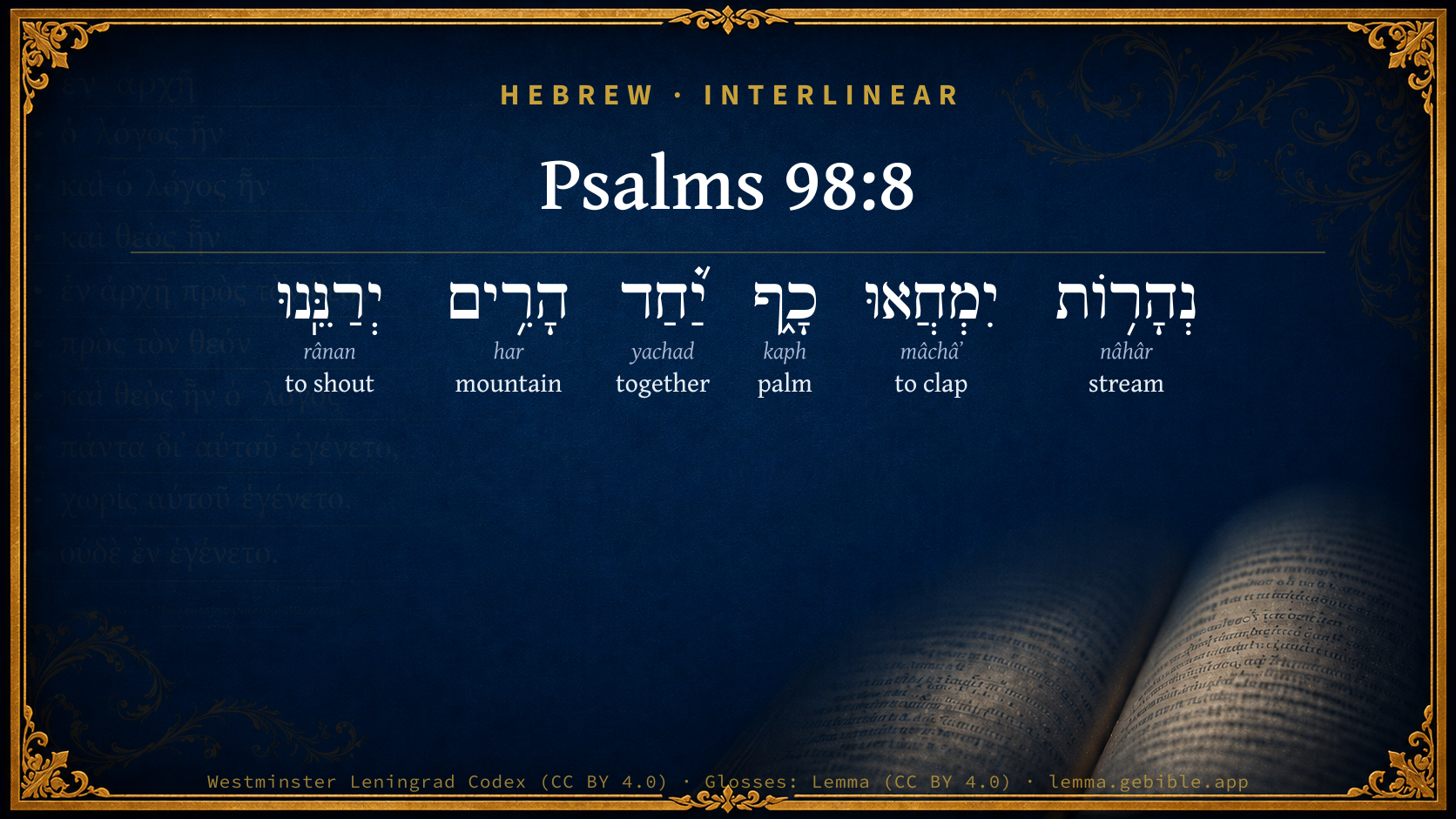
Psalms 98:8

Hebrew (Westminster Leningrad Codex) Psalms 98:8 appears in the Hebrew Old Testament. The text above is from the Westminster Leningrad Codex. Each word links to its Strong’s number, a concise gloss, and parsing drawn from the Open Scriptures Hebrew Bible morphology. Click any word for its full Brown-Driver-Briggs (BDB) entry.
Download image
Cite this verse

Psalms 98:8 (World English Bible). Public Domain. Lemma interlinear Bible study tool, https://lemma.gebible.app/v/psalms/98/8.

Show BibTeX & RIS
BibTeX
RIS
English Translation
Let the rivers clap their hands. Let the mountains sing for joy together.
World English Bible · Public Domain
Highlights
  • 1 first appearance in the Hebrew Bible
Full analysis ↓
Download a study sheet

One document with this verse’s original text, its word-by-word gloss line, the meaning frame, cross-references with their text, attributed commentary, and full source and license credits — printable, and it pastes into notes with its structure intact.

This verse Autodidact and up

Study sheet (.html) Plain text (.txt)

A passage Seminary Student

Up to 50 verses in one chapter. A passage sheet keeps up to 6 commentary sources and 12 cross-references per verse, in the order this page ranks them, and says so on the sheet whenever that leaves anything out. Ask for a single verse and you get the Autodidact verse sheet above.

Everything on this page stays free to read, with no account — the sheet is a download of what is already on screen, not access to it.

Want to remove ads? Support Godless Engineer
Compare translations 3

The same verse in 3 English versions, stacked beneath the original-language interlinear above. Click any original word for its lexicon entry.

Each is an independent rendering of the whole verse — the interlinear is not word-aligned to these translations.

Highlighted words mark where these versions differ — a whole-verse word diff, not a word-by-word alignment.

  • World English Bible Public Domain
    Let the rivers clap their hands. Let the mountains sing for joy together.
  • King James Version Public Domain
    Let the floods clap their hands: let the hills be joyful together
  • unfoldingWord Literal Text CC BY-SA 4.0
    Let the rivers clap palm; let the mountains rejoice together

unfoldingWord Literal Text — © unfoldingWord, licensed CC BY-SA 4.0. Word-aligned USFM3 via Door43 (git.door43.org/unfoldingWord/en_ult).

Versions to compare (up to 4)

3 of 4 selected

Show all 18 translations

Every available English version of this verse, each an independent rendering of the whole verse.

  • World English Bible Public Domain
    Let the rivers clap their hands. Let the mountains sing for joy together.
  • Berean Standard Bible Public Domain
    Let the rivers clap their hands, let the mountains sing together for joy
  • Majority Standard Bible Public Domain
    Let the rivers clap their hands, let the mountains sing together for joy
  • King James Version Public Domain
    Let the floods clap their hands: let the hills be joyful together
  • American Standard Version (1901) Public Domain
    Let the floods clap their hands; Let the hills sing for joy together
  • Revised Version (1885) Public Domain
    Let the floods clap their hands; let the hills sing for joy together;
  • Geneva Bible (1599) Public Domain
    Let the floods clap their hands, and let the mountaines reioyce together
  • Douay-Rheims (1899) Public Domain
    The rivers shall clap their hands, the mountains shall rejoice together
  • Young's Literal Translation Public Domain
    Floods clap hand, together hills cry aloud,
  • Literal Standard Version CC BY-SA 4.0
    Floods clap hand, together hills cry aloud,
  • Unlocked Literal Bible CC BY-SA 4.0
    Let the rivers clap their hands, and let the mountains shout for joy.
  • unfoldingWord Literal Text CC BY-SA 4.0
    Let the rivers clap palm; let the mountains rejoice together
  • Darby Bible Public Domain
    Let the floods clap [their] hands; let the mountains sing for joy together,
  • World Messianic Bible Public Domain
    Let the rivers clap their hands. Let the mountains sing for joy together.
  • Webster's Bible Public Domain
    Let the floods clap their hands: let the hills be joyful together
  • Free Bible Version CC BY-SA 4.0
    Let the rivers celebrate, let the hills join in the celebration
  • Bible in Basic English Public Domain
    Let the streams make sounds of joy with their hands; let the mountains be glad together,
  • JPS Tanakh (1917) Public Domain
    Let the floods clap their hands; let the mountains sing for joy together;

Literal Standard Version (2020), Covenant Press — licensed CC BY-SA 4.0. Text via the HelloAO Bible API (eBible.org). Unlocked Literal Bible (unfoldingWord) — licensed CC BY-SA 4.0. Text via the HelloAO Bible API (eBible.org). unfoldingWord Literal Text — © unfoldingWord, licensed CC BY-SA 4.0. Word-aligned USFM3 via Door43 (git.door43.org/unfoldingWord/en_ult). Free Bible Version, Dr. Jonathan Gallagher — licensed CC BY-SA 4.0. Text via the HelloAO Bible API (eBible.org).

Word by word

More ways to search: Search by grammar → Find every occurrence → Compare this word →

Practice this passage: Drill this verse → Learn its vocabulary →

About this verse

These counts appear in no published source. They are computed here, from the morphology-tagged text and Lemma’s own curated glosses. What Lemma adds →

6
words
6
distinct lemmas
Wisdom
section

Notable vocabulary

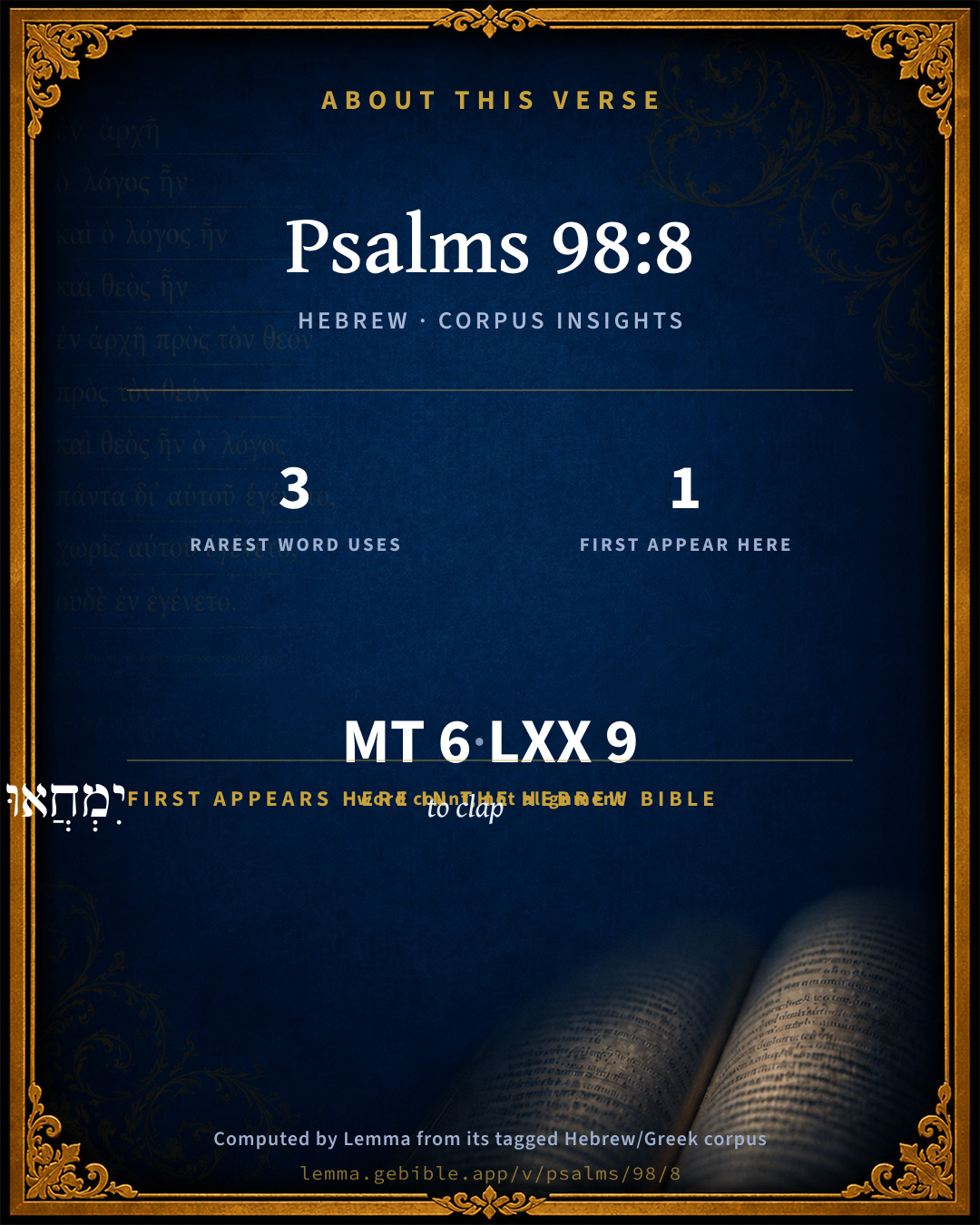
The rarest word here is יִמְחֲאוּ to clap H4222 — appearing just 3 times in the whole Hebrew Bible.

First appearance in Scripture

This word makes its first canonical appearance in the Hebrew Bible here:

  • יִמְחֲאוּ to clap H4222

Shared distinctive vocabulary

יִמְחֲאוּ to clap H4222 occurs in 3 verses of the Hebrew Bible. Also found in:

Grammatical profile

  • 2 verbs
  • 3 nouns
  • 1 adverb

Verb forms

  • יִמְחֲאוּ Qal · Imperfect
  • יְרַנֵּֽנוּ Piel · Imperfect

Hebrew & Septuagint length

In English translation the verse runs 13 words from the Hebrew and 11 from the Septuagint (LXX English) — closely comparable.

A rough comparison of the two English renderings, which tokenize alike — not a word-level alignment.

Word counts can differ between the Hebrew and the Greek without any difference in meaning — e.g. the Hebrew direct-object marker אֵת has no separate Greek word, and Greek often adds the article ὁ.

In the original languages it is 6 Hebrew tokens and 9 Greek tokens — but the two are counted differently (Hebrew bundles its prefixes and suffixes into one token; the Greek is in lemma form), so that isn’t a like-for-like length.

Cross-references

6

Topical passages linked to Psalms 98:8 in the Treasury of Scripture Knowledge — connected by theme and wording, ordered by reader-vote popularity; previews shown in the World English Bible.

  • Isaiah 55:12 For you shall go out with joy, and be led forth with peace: the mountains and the hills shall break forth before you into singing; and all the trees of the fields shall clap their hands.
  • Psalms 65:12–13 The wilderness grasslands overflow. The hills are clothed with gladness.
  • Psalms 89:12 The north and the south, you have created them. Tabor and Hermon rejoice in your name.
  • Psalms 47:1 Oh clap your hands, all you nations. Shout to God with the voice of triumph!
  • Psalms 93:3 The floods have lifted up, Yahweh, The floods have lifted up their voice. The floods lift up their waves.
  • 2 Kings 11:12 Then he brought out the king's son, and put the crown on him, and [gave him] the testimony; and they made him king, and anointed him; and they clapped their hands, and said, [Long] live the king.

Cross-references courtesy of OpenBible.info (CC BY 4.0).

Hebrew and Greek witnesses Masoretic Hebrew ↔ Greek Septuagint

The same verse in the two great witnesses to the Old Testament, shown verse-for-verse.

You’re reading Greek Psalm 97 (Hebrew Psalm 98). The Septuagint counts the superscription, so verse numbers can differ from the Hebrew — chapter-level alignment, not verse-by-verse. Numbering follows Rahlfs.

These are two independent witnesses, not word-aligned to each other, and the Septuagint is shown in lemma (dictionary) form.

Hebrew Psalms 98:8 Masoretic · Westminster Leningrad Codex

נְהָר֥וֹת יִמְחֲאוּ כָ֑ף יַ֝֗חַד הָרִ֥ים יְרַנֵּֽנוּ

Let the rivers clap their hands. Let the mountains sing for joy together.

World English Bible · Public Domain

Greek LXX Greek Psalm 97:8 Septuagint · lemma form

ποταμός κροτέω χείρ ἐπί ὁ αὐτός ὁ ὄρος ἀγαλλιάομαι

The rivers shall clap their hands together; the mountains shall exult.

LXX2012 (modern English Septuagint) · Public Domain

Hebrew: Westminster Leningrad Codex (CC BY 4.0). Greek: Septuagint (public domain); English from LXX2012 (modern English Septuagint) (Public Domain). How the Septuagint differs from the Hebrew →

Commentary

Notes on Psalms 98:8 from classic Christian and Jewish commentators (each source and its license shown beneath its notes). The classic Christian expositions comment on the surrounding passage and are grouped to its opening verse, so a note may address several verses; the Jewish commentaries on the Tanakh (Rashi and others) are per-verse, so they appear only where the commentator wrote on this verse.

Lemma curates 59 commentaries, every one of them public domain or Creative Commons licensed, each selected and text-cleaned for this edition rather than reprinted as found. About our sources →

Trapp's Complete Commentary

John Trapp

Psa 98:8 Let the floods clap [their] hands: let the hills be joyful together

Ver. 8. {See Trapp on "Psa 96:12"}

John Trapp, A Commentary or Exposition upon All the Books of the Old and New Testament (1647–1656) — public domain. Text from a community e-Sword module.

J. A. Alexander on Psalms

Joseph Addison Alexander

5. (Psa 98:8) Make music to Jehovah with a harp, with a harp and a musical voice! The first verb is the one translated play in the preceding verse. Its repetition is like that in Psa 47:1. It is strictly applied to instrumental music, but often extended to any musical expression, especially of praise to God. A musical voice, or a voice of singing, as distinguished from the voice of speech. The phrase occurs in Isa 51:3. The repeated introduction of the Hebrew verb or its derivatives is supposed by some to be the reason of the title. See above, on Psa 98:1.

8. (Psa 98:8) Let rivers clap the hand; together let mountains sing (or shout for joy)! This bold but beautiful personification is also found in Isa 55:12, the only other place where the clapping of the hands is ascribed to lifeless objects. This was a customary sign of joy, especially when joined with acclamation in honour of a sovereign, as it is not only here, and in Psa 47:1, in highly figurative poetry, but also in historical prose, e.g. the account of the coronation of Joash, 2Ki 11:12. Together, not merely with each other, but at the same time and in concert with the applauses of the floods or rivers.

Joseph Addison Alexander, The Psalms Translated and Explained (1850) — public domain. Text from a community e-Sword module.

Adam Clarke's Commentary

Verse 8. Let the floods clap their hands] נהרות neharoth, properly the rivers-possibly meaning immense continents, where only large rivers are found; thus including inland people, as well as maritime nations, and those on the sea-coasts generally; as in those early times little more than the coasts of the sea were known. The Gospel shall be preached in the most secluded nations of the world.

Let the hills be joyful] All the inhabitants of rocky and mountainous countries.

Adam Clarke's Commentary on the Bible (1810–1826) — public domain. Text from a community e-Sword/MySword module.

Ellicott's Commentary for English Readers

(8) Clap their hands.—This expression, descriptive of the lapping sound of waves, occurs also in Isa_55:12.

Let the hills be joyful together.—

“Far along,

From peak to peak, the rattling crags among,

Leaps the live thunder! Not from one long cloud,

But every mountain now hath found a tongue,

And Jura answers through her misty shroud

Back to the joyous Alps who call to her aloud.”

BYRON: Childe Harold, canto iii.

A Bible Commentary for English Readers, edited by Charles John Ellicott (1878–1897) — public domain. Text from a community e-Sword module.

The Cambridge Bible for Schools and Colleges

gen. ed. J. J. S. Perowne

8. Let the rivers clap their hands;

Let the mountains sing for Joy together.

Cp. Isa_55:12; and for the prosopopoeia, Hab_3:10.

The Cambridge Bible for Schools and Colleges (gen. ed. J. J. S. Perowne; Cambridge University Press, 1878–1918) — public domain. Text from a community e-Sword module.

John Gill's Exposition

Let the floods clap their hands,.... Or "rivers" (e), dashing against their banks, as they pass along; a prosopopoeia, as the preceding and following, expressing great joy on account of the Messiah, the reigning King. Aben Ezra interprets this of men that are in rivers, as the sea; in the preceding verse of such that are in ships at sea; and the hills in the next clause of such that dwell on them;

let the hills be joyful together; see Isa 55:12.

(e) "fluvii", Cocceius, Gejerus, so Ainsworth.

John Gill's Exposition of the Whole Bible (1746–1763) — public domain (CC PDM 1.0). Text via the HelloAO Bible API.

Albert Barnes' Notes on the Bible

Let the floods clap their hands - The rivers. Let them join in the universal praise. As if conscious of their beauty, their grandeur, their usefulness; as if sensible that all this was conferred by God; as if rejoicing in the goodness of God manifested to them, and through them, let them unite in the universal praise. Compare the notes at Isa 55:12.

Let the hills be joyful together - The mountains - in view of the goodness of God toward them - crowning them with beauty - clothing them with sublimity and grandeur - let them also rejoice in God as “their” God. Let all nature thus join in praise.

Albert Barnes' Notes on the Bible (1834–1885) — public domain. Text from a community e-Sword/MySword module.

The Treasury of David

Charles H. Spurgeon

Ver. 8. Let the floods clap their hands. The rolling rivers, the tidal estuaries, the roaring cataracts, are here summoned to pay their homage, and to clap their hands, as men do when they greet their sovereigns with acclamation.

Let the hills be joyful together, or in concert with the floods. Silent as are the mighty mountains, let them forget themselves, and burst forth into a sublime uproariousness of mirth, such as the poet described when he wrote those vivid lines

"Far along,

From peak to peak, the rattling crags among,

Leaps the live thunder! Not from one lone cloud,

But every mountain now hath found a tongue,

And Jura answers, through her misty shroud,

Back to the joyous Alps, who call to her aloud."

Ver. 8. Let the floods clap their hands. The clapping of the hands being a token of delight and approbation, and the striking or dashing of the water in a river being, for the noise of it, a resemblance of that, the rivers are here said to clap their hands. Henry Hammond.

Ver. 8. Though the language be figurative, so far as it gives a voice to the inanimate creation in its various departments, yet, like all the figurative language of Scripture, it expresses a truththat which the Apostle has stated without a metaphor in the express revelation that the "creation shall be delivered from the bondage of corruption into the glorious liberty of the children of God." And this because the reason of that bondage will no more exist. It is the consequence of sin: but when the world shall be subjected to the righteous rule of its coming King (as predicted in the last verse of this psalm), then earth and all creation shall own its present Lord, and join its tribute of praise to that of Israel and the nations, and the redeemed and glorified chinch. William De Burgh.

Ver. 8. The song of the sea, and the hallelujah of the hills.

Psalms 98:9*

Charles H. Spurgeon's The Treasury of David (1869–1885) — public domain. Psalms only. Text from a community e-Sword/MySword module.

Whedon's Commentary on the Bible

Daniel D. Whedon

8. The floods—Hebrew, the rivers. See on Psa_93:3.

Clap their hands—The clapping of the rivers is a figure which differs from Isa_55:12, and occurs nowhere else, but finds its origin in the playful dashings of the river rapids, or floods, as the common version has it. On clapping of hands, as an expression of exultation, see 2Ki_11:12; Psa_47:1; Eze_25:6. The whole imagery is exceedingly animated. See Psa_96:11-13. The correspondence of much of this psalm with the later prophecies of Isaiah is no proof that it is borrowed from, and hence later than, the latter, (better might the prophet be supposed to have copied from the psalm,) but is an example of coincidences in the poetic style where the subjects were similar, not unfrequent in Scripture, and not confined to Scripture.

Hills be joyful—Hills are “joyful” when clothed with greenness and covered with flocks. See on Psa_65:13. In the last of May and June the hills of Palestine already put on a brown and parched appearance for want of moisture; but if the rains, which end in April, have been copious, the harvest is plenteous and joyous. The imagery is specially suited to a pastoral and agricultural people in such a climate. Wherever Christ reigns men are at peace with each other, and through honest industry and sobriety the external signs of righteousness and prosperity soon appear in nature and in society.

Daniel D. Whedon (gen. ed.), Commentary on the Old and New Testaments (1874–1909) — public domain. Text from a community e-Sword module.

The Pulpit Commentary

Let the floods clap their hands. This bold metaphor occurs only here and in Isa_55:12, where the "trees" are asked to "clap their hands." Let the hills be joyful together before the Lord; or, sing for joy together; i.e. join with the rest of nature in expressing gladness.

The Pulpit Commentary (1880–1919), ed. H.D.M. Spence-Jones & Joseph S. Exell — public domain. Text from a community e-Sword module.

Rashi

Rabbi Shlomo Yitzchaki (Rashi)

Rivers will clap hands The prophets spoke in a language that the ear can hear; not that the rivers have a hand, but it is an expression of joy and gladness.

Rashi on the Tanakh — English translations: “The Judaica Press complete Tanach with Rashi, translated by A. J. Rosenberg” (CC BY 4.0); “Pentateuch with Rashi's commentary by M. Rosenbaum and A.M. Silbermann, 1929-1934” (public domain); “The Metsudah Tanach series, Lakewood, N.J” (CC BY 4.0); and “The Book of Joshua, Metsudah Publications, 1997” (CC BY 4.0). Text via Sefaria.

Lesson kit

Teaching starters — assembled from the data on this page, not authored interpretation. Every prompt links to the verse data it draws on. Edit before teaching.

Psalms, in the Wisdom, opens this verse with 6 words (6 distinct Hebrew lemmas). Its most distinctive word is mâchâʼ (“to clap”). A historical commentator’s framing appears above. Read the whole chapter for the surrounding context.

Discussion questions

  1. How does “to clap” (mâchâʼ) shape what this verse is saying?
  2. This is the first place “to clap” appears in Scripture (first appears here). What does its debut here establish?
  3. How does Isaiah 55:12, which shares the word «to clap», read alongside this verse?
  4. These translations render this verse differently. What is at stake in choosing one wording over another?
  5. «יִמְחֲאוּ» is a Qal Imperfect verb. How does that grammatical form shape the action described?
  6. Compare how Trapp's Complete Commentary and J. A. Alexander on Psalms read this verse. Where do they agree or differ?

Things to notice

Reading settings

Reading text

Shown beneath each verse's original-language words.

Old Testament
Old Testament edition

Read the OT as the Masoretic Hebrew (MT) or the Greek Septuagint (LXX).

English shown for the Greek Septuagint (in the Hebrew ↔ Greek comparison).

Comparing translations? Open the Compare panel on any verse page to stack up to four side by side.