

Psalms 128:2

Hebrew (Westminster Leningrad Codex) Psalms 128:2 appears in the Hebrew Old Testament. The text above is from the Westminster Leningrad Codex. Each word links to its Strong’s number, a concise gloss, and parsing drawn from the Open Scriptures Hebrew Bible morphology. Click any word for its full Brown-Driver-Briggs (BDB) entry.
Download image
Cite this verse

Psalms 128:2 (World English Bible). Public Domain. Lemma interlinear Bible study tool, https://lemma.gebible.app/v/psalms/128/2.

Show BibTeX & RIS
BibTeX
RIS
English Translation
For you will eat the labor of your hands. You will be happy, and it will be well with you.
World English Bible · Public Domain
Download a study sheet

One document with this verse’s original text, its word-by-word gloss line, the meaning frame, cross-references with their text, attributed commentary, and full source and license credits — printable, and it pastes into notes with its structure intact.

This verse Autodidact and up

Study sheet (.html) Plain text (.txt)

A passage Seminary Student

Up to 50 verses in one chapter. A passage sheet keeps up to 6 commentary sources and 12 cross-references per verse, in the order this page ranks them, and says so on the sheet whenever that leaves anything out. Ask for a single verse and you get the Autodidact verse sheet above.

Everything on this page stays free to read, with no account — the sheet is a download of what is already on screen, not access to it.

Want to remove ads? Support Godless Engineer
Compare translations 3

The same verse in 3 English versions, stacked beneath the original-language interlinear above. Click any original word for its lexicon entry.

Each is an independent rendering of the whole verse — the interlinear is not word-aligned to these translations.

Highlighted words mark where these versions differ — a whole-verse word diff, not a word-by-word alignment.

  • World English Bible Public Domain
    For you will eat the labor of your hands. You will be happy, and it will be well with you.
  • King James Version Public Domain
    For thou shalt eat the labour of thine hands: happy shalt thou be, and it shall be well with thee.
  • unfoldingWord Literal Text CC BY-SA 4.0
    The labor of your palms, when you eat, your happiness, and good for you.

unfoldingWord Literal Text — © unfoldingWord, licensed CC BY-SA 4.0. Word-aligned USFM3 via Door43 (git.door43.org/unfoldingWord/en_ult).

Versions to compare (up to 4)

3 of 4 selected

Show all 18 translations

Every available English version of this verse, each an independent rendering of the whole verse.

  • World English Bible Public Domain
    For you will eat the labor of your hands. You will be happy, and it will be well with you.
  • Berean Standard Bible Public Domain
    For when you eat the fruit of your labor, blessings and prosperity will be yours.
  • Majority Standard Bible Public Domain
    For when you eat the fruit of your labor, blessings and prosperity will be yours.
  • King James Version Public Domain
    For thou shalt eat the labour of thine hands: happy shalt thou be, and it shall be well with thee.
  • American Standard Version (1901) Public Domain
    For thou shalt eat the labor of thy hands: Happy shalt thou be, and it shall be well with thee.
  • Revised Version (1885) Public Domain
    For thou shalt eat the labour of thine hands: happy shalt thou be, and it shall be well with thee.
  • Geneva Bible (1599) Public Domain
    When thou eatest the labours of thine hands, thou shalt be blessed, and it shall be well with thee.
  • Douay-Rheims (1899) Public Domain
    It is vain for you to rise before light, rise ye after you have sitten, you that eat the bread of sorrow. When he shall give sleep to his beloved,
  • Young's Literal Translation Public Domain
    The labour of thy hands thou surely eatest, Happy `art' thou, and good `is' to thee.
  • Literal Standard Version CC BY-SA 4.0
    You surely eat the labor of your hands, || You [are] blessed, and good [is] to you.
  • Unlocked Literal Bible CC BY-SA 4.0
    What your hands provide, you will enjoy; you will be blessed and prosper.
  • unfoldingWord Literal Text CC BY-SA 4.0
    The labor of your palms, when you eat, your happiness, and good for you.
  • Darby Bible Public Domain
    For thou shalt eat the labour of thy hands; happy shalt thou be, and it shall be well with thee.
  • World Messianic Bible Public Domain
    For you will eat the labor of your hands. You will be happy, and it will be well with you.
  • Webster's Bible Public Domain
    For thou shalt eat the labor of thy hands: happy shalt thou be, and it shall be well with thee.
  • Free Bible Version CC BY-SA 4.0
    You will eat what your own hands have produced. You will be happy and do well.
  • Bible in Basic English Public Domain
    You will have the fruit of the work of your hands: happy will you be, and all will be well for you.
  • JPS Tanakh (1917) Public Domain
    When thou eatest the labour of thy hands, happy shalt thou be, and it shall be well with thee.

Literal Standard Version (2020), Covenant Press — licensed CC BY-SA 4.0. Text via the HelloAO Bible API (eBible.org). Unlocked Literal Bible (unfoldingWord) — licensed CC BY-SA 4.0. Text via the HelloAO Bible API (eBible.org). unfoldingWord Literal Text — © unfoldingWord, licensed CC BY-SA 4.0. Word-aligned USFM3 via Door43 (git.door43.org/unfoldingWord/en_ult). Free Bible Version, Dr. Jonathan Gallagher — licensed CC BY-SA 4.0. Text via the HelloAO Bible API (eBible.org).

Word by word

More ways to search: Search by grammar → Find every occurrence → Compare this word →

Practice this passage: Drill this verse → Learn its vocabulary →

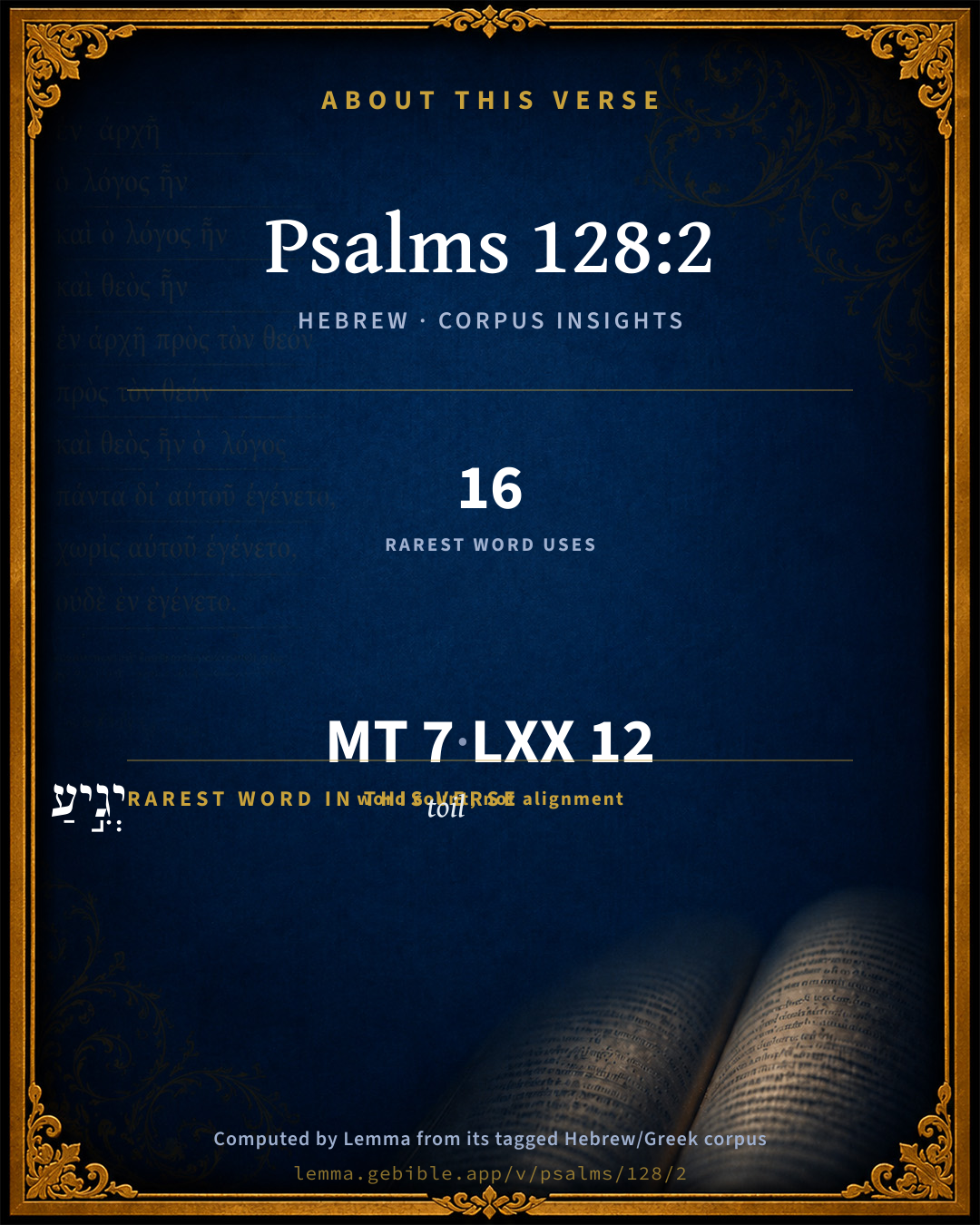
About this verse

These counts appear in no published source. They are computed here, from the morphology-tagged text and Lemma’s own curated glosses. What Lemma adds →

7
words
6
distinct lemmas
Wisdom
section

Notable vocabulary

The rarest word here is יְגִ֣יעַ toil H3018 — appearing just 16 times in the whole Hebrew Bible.

Shared distinctive vocabulary

יְגִ֣יעַ toil H3018 occurs in 16 verses of the Hebrew Bible. Also found in:

Grammatical profile

  • 2 verbs
  • 3 nouns
  • 1 preposition
  • 1 conjunction

Verb forms

  • תֹאכֵ֑ל Qal · Imperfect
  • וְט֣וֹב Qal · Sequential Perfect

Hebrew & Septuagint length

In English translation the verse runs 20 words from the Hebrew and 18 from the Septuagint (LXX English) — closely comparable.

A rough comparison of the two English renderings, which tokenize alike — not a word-level alignment.

Word counts can differ between the Hebrew and the Greek without any difference in meaning — e.g. the Hebrew direct-object marker אֵת has no separate Greek word, and Greek often adds the article ὁ.

In the original languages it is 7 Hebrew tokens and 12 Greek tokens — but the two are counted differently (Hebrew bundles its prefixes and suffixes into one token; the Greek is in lemma form), so that isn’t a like-for-like length.

Cross-references

16

Topical passages linked to Psalms 128:2 in the Treasury of Scripture Knowledge — connected by theme and wording, ordered by reader-vote popularity; previews shown in the World English Bible.

  • Isaiah 3:10 Tell the righteous "Good!" For they shall eat the fruit of their deeds.
  • Isaiah 62:8 Yahweh has sworn by his right hand, and by the arm of his strength, Surely I will no more give your grain to be food for your enemies; and foreigners shall not drink your new wine, for which you have labored:
  • Isaiah 65:21–23 They shall build houses, and inhabit them; and they shall plant vineyards, and eat the fruit of them.
  • Ecclesiastes 5:18–19 Behold, that which I have seen to be good and proper is for one to eat and to drink, and to enjoy good in all his labor, in which he labors under the sun, all the days of his life which God has given him; for this is his portion.
  • Deuteronomy 28:4 Blessed shall be the fruit of your body, and the fruit of your ground, and the fruit of your animals, the increase of your cattle, and the young of your flock.
  • Deuteronomy 28:11 Yahweh will make you plenteous for good, in the fruit of your body, and in the fruit of your cattle, and in the fruit of your ground, in the land which Yahweh swore to your fathers to give you.
  • 1 Corinthians 15:58 Therefore, my beloved brothers, be steadfast, immovable, always abounding in the Lord's work, because you know that your labor is not in vain in the Lord.
  • Ecclesiastes 8:12 Though a sinner commits crimes a hundred times, and lives long, yet surely I know that it will be better with those who fear God, who are reverent before him.
  • Ephesians 6:3 "that it may be well with you, and you may live long on the earth."
  • Isaiah 65:13 Therefore thus says the Lord Yahweh, Behold, my servants shall eat, but you shall be hungry; behold, my servants shall drink, but you shall be thirsty; behold, my servants shall rejoice, but you shall be disappointed;
  • Jeremiah 22:15 Shall you reign, because you strive to excel in cedar? Didn't your father eat and drink, and do justice and righteousness? then it was well with him.
  • Deuteronomy 28:51 and shall eat the fruit of your cattle, and the fruit of your ground, until you are destroyed; that also shall not leave you grain, new wine, or oil, the increase of your cattle, or the young of your flock, until they have caused you to perish.
  • Genesis 3:19 By the sweat of your face will you eat bread until you return to the ground, for out of it you were taken. For you are dust, and to dust you shall return."
  • Deuteronomy 28:39 You shall plant vineyards and dress them, but you shall neither drink of the wine, nor gather [the grapes]; for the worm shall eat them.
  • Judges 6:3–6 So it was, when Israel had sown, that the Midianites came up, and the Amalekites, and the children of the east; they came up against them;
  • Psalms 109:11 Let the creditor seize all that he has. Let strangers plunder the fruit of his labor.

Cross-references courtesy of OpenBible.info (CC BY 4.0).

Hebrew and Greek witnesses Masoretic Hebrew ↔ Greek Septuagint

The same verse in the two great witnesses to the Old Testament, shown verse-for-verse.

You’re reading Greek Psalm 127 (Hebrew Psalm 128). The Septuagint counts the superscription, so verse numbers can differ from the Hebrew — chapter-level alignment, not verse-by-verse. Numbering follows Rahlfs.

These are two independent witnesses, not word-aligned to each other, and the Septuagint is shown in lemma (dictionary) form.

Hebrew Psalms 128:2 Masoretic · Westminster Leningrad Codex

יְגִ֣יעַ כַּ֭פֶּיךָ כִּ֣י תֹאכֵ֑ל אַ֝שְׁרֶ֗יךָ וְט֣וֹב לָֽךְ

For you will eat the labor of your hands. You will be happy, and it will be well with you.

World English Bible · Public Domain

Greek LXX Greek Psalm 127:2 Septuagint · lemma form

ὁ πόνος ὁ καρπός σύ ἐσθίω μακάριος εἰμί καί καλῶς σύ εἰμί

You shall eat the labors of your hands: blessed are you, and it shall be well with you.

LXX2012 (modern English Septuagint) · Public Domain

Hebrew: Westminster Leningrad Codex (CC BY 4.0). Greek: Septuagint (public domain); English from LXX2012 (modern English Septuagint) (Public Domain). How the Septuagint differs from the Hebrew →

Commentary

Notes on Psalms 128:2 from classic Christian and Jewish commentators (each source and its license shown beneath its notes). The classic Christian expositions comment on the surrounding passage and are grouped to its opening verse, so a note may address several verses; the Jewish commentaries on the Tanakh (Rashi and others) are per-verse, so they appear only where the commentator wrote on this verse.

Lemma curates 59 commentaries, every one of them public domain or Creative Commons licensed, each selected and text-cleaned for this edition rather than reprinted as found. About our sources →

Trapp's Complete Commentary

John Trapp

Psa 128:2 For thou shalt eat the labour of thine hands: happy [shalt] thou [be], and [it shall be] well with thee.

Ver. 2. For thou shalt eat the labour of thine hands] That is, thou shalt reap and receive the sweet of thy sweat, whether it be of the brow or of the brain, according to the kind of thy calling. And although thou be forced to live by the labour of thine hands (whence man’s life is called the life of his hands, Isa 57:10), yet that shall be no hindrance to thy happiness, but a furtherance of thine account.

Happy shalt thou be, and it shall be well with thee] The Chaldee thus expoundeth it, Happy thou in this world; and good shall it be unto thee in the world to come.

John Trapp, A Commentary or Exposition upon All the Books of the Old and New Testament (1647–1656) — public domain. Text from a community e-Sword module.

The Biblical Illustrator

Joseph S. Exell

Psa_128:2-3

For thou shalt eat the labour of thine hands.

Piety the charm of the poor mans home

Here are three things which are essential materials to make a good home.

I. A godly and industrious father. He is blessed--

1. In himself.

2. In his business.

3. In his family.

4. In his Church.

5. In his country.

II. A godly, home-keeping mother. Here are two features of a Christian wife: what she is--a fruitful vine; and where she is--by the side of her house. As the fruitful vine afforded shade as well as grapes, the figure imports comfort as well as a family.

III. A circle of godly and home-loving children. What is it to be like olive-plants? The olive-branch in Scripture is the emblem of peace, and the olive oil is the emblem of grace. Peace and grace are lovely features in a child, and when peace and grace take possession of the heart of a whole family, Christian people love to visit their dwelling. (J. B. Owen, M. A.)

The morality of business

It is most likely that the psalm was written shortly after the return of the Jews from their exile in Babylon; when the nation was once more, in a sense, mistress of its destinies, and could look out on the beloved native land as its own again. We can all understand what an impulse this feeling would give to the cultivation of the soil; how cheerfully the husbandman would go forth to his daily task, expecting literally to eat the labour of his hands; and with what fresh interest and dignity his work would be invested, when he could look forward to enjoying the fruit of his toil in freedom and peace. But if these were, as it is likely they were, the associations of the moment, still, there is nothing that should prevent our giving the words the widest possible application. The dignity and the happiness with which the commonest hand-labour was associated in the eyes of the psalmist, are the privilege and the glory of labour always and everywhere. To suppose that we gain in true dignity and real happiness by ceasing to labour and studying to idle easily and gracefully through life, is the greatest folly that ever possessed the brain of man. We know who it was who said, Six days shalt thou labour,--and, doubtless, it was said in the interest of the individual, as well as of society at large. And certain it is, that he who would rest with real enjoyment on the seventh day, must labour on the six. When I speak of The Morality of Business, I give to the word business the widest possible meaning, as that which occupies a mans energies, whether of mind or of body, and makes him busy. In considering the morality of business, then, I think we may lay it down as an invariable rule that, so far as the employer is concerned, his business should be so conducted that he himself, and every honest workman under him, shall be able to take a real interest and pleasure in it; and that, so far as the workers are concerned, they shall be dissatisfied with themselves unless they do really feel such an interest, and take such pleasure, in their work. The workman has a just ground of complaint against his employer, if he is required to do anything which tends to destroy an honest mans pleasure in his work. I have often wondered why Trade Unions do not turn their attention to this point, and support their members in refusing to do fraudulent and dishonest work,--work which, if traced out in its results, can be proved to be ultimately in the highest degree hurtful and disastrous to the whole community, as well as to the particular employers and workpeople who are guilty of it. Such a matter as this would surely be far more worthy of the efforts of Trade Unions, as well as far more beneficial both to their members and to society at large, than are some of those which frequently claim and occupy their attention. On the other hand, if the workman has a just ground of complaint against his employer, should he be required to do anything which can destroy an honest mans interest in his work,--undoubtedly the employer has an equally just ground of complaint against his workpeople, if, whilst he is doing his part by them, they fail to throw into their work that interest, and to take that pleasure in it, which will both further their own happiness and at the same time promote his success. A great deal of the mischief from which we are suffering is due to the fact that we overrate enormously the worth of money, and still believe, in spite of our Saviour, that mans life does consist in the abundance of the things which he possesses. Money can command much; but it cannot command the happiness which makes life sweet, and worth having, to us. This must be sought in quite other ways;--through the daily labour, of which our psalmist says, Thou shalt eat the labour of thine hands: O well is thee, and happy shalt thou be; through patient continuance in well-doing; through the diligent discharge of our daily duties in all the various relations of life. (Canon D. J. Vaughan.)

The Biblical Illustrator, edited by Joseph S. Exell (c. 1880s–1900s) — public domain. Text from a community e-Sword module.

Joseph Benson's Commentary

Psa 128:2. Thou shalt eat the labour, &c. — Thy labour shall not be vain and fruitless, and the fruit of thy labour shall not be taken from thee and possessed by others, as was threatened to the disobedient Deuteronomy 28., but enjoyed by thyself with comfort and satisfaction. Happy shalt thou be — Whether thou be high or low, rich or poor, in the world, if thou fear God, and walk in his ways, thou mayest take the comfort of the promise to thyself, and expect the benefit of it, as if it were directed to thee by name. And it shall be well with thee — Both in this world and (as even the Chaldee paraphrast interprets the words) in the world to come. Whatever befalls thee, good shall be brought out of it; and “it shall be well with thee while thou livest, better when thou diest, and best of all in eternity.” — Henry.

Joseph Benson's Commentary on the Old and New Testaments (1811–1818) — public domain. Text from a community e-Sword module.

J. A. Alexander on Psalms

Joseph Addison Alexander

2. (Psa 128:2) The labour of thy hands when thou shalt eat, happy thou and well with thee. The promise implied is the opposite of the threatening in Deuteronomy 28; Deuteronomy 33, Lev 26:16. What the enemies of Israel are there described as doing, it is here said that Israel shall do himself. Well with thee, literally good for thee. The conjunction in the first clause is not to be construed as in Psa 118:10, but as a particle of time. Happy thou, or oh thy happiness, is an expression borrowed from Deu 33:29

Joseph Addison Alexander, The Psalms Translated and Explained (1850) — public domain. Text from a community e-Sword module.

Geneva Bible (1599)

Geneva Bible translators

The world esteemeth them happy, which live in wealth and idleness: but the holy Ghost approveth them best that live of the mean profit of their labors.

Geneva Bible (1599) marginal notes — public domain. Text via Bolls.life.

Adam Clarke's Commentary

Verse 2. Those shalt eat the labour of thine hands] Thou shalt not be exempted from labour. Thou shalt work: But God will bless and prosper that work, and thou and thy family shall eat of it. Ye shall all live on the produce of your own labour, and the hand of violence shall not be permitted to deprive you of it. Thus,

Happy shalt thou be, and it shall be well with thee.] Thou shalt have prosperity.

Verse 3. Thy wife shall be as a fruitful vine] Thy children, in every corner and apartment of thy house, shall be the evidences of the fruitfulness of thy wife, as bunches of grapes on every bough of the vine are the proofs of its being in a healthy thriving state. Being about the house sides, or apartments, is spoken of the wife, not the vine; being around the table is spoken of the children, not of the olive-plants. It does not appear that there were any vines planted against the walls of the houses in Jerusalem, nor any olive-trees in pots or tubs in the inside of their houses; as may be found in different parts of Europe.

Adam Clarke's Commentary on the Bible (1810–1826) — public domain. Text from a community e-Sword/MySword module.

John Calvin's Commentaries

2. For when thou shalt eat the labor of thy hands thou shalt be blessed. Some divide this sentence into two members, reading these words, For thou shalt eat the labor of thy hands, as a distinct sentence, and then what follows, Thou shalt be blessed, as the beginning of a new sentence. I indeed grant that it is true, as they assert, that the grace of God, manifested in the faithful enjoying the fruits of their labor is set in opposition to the curse to which all mankind have been subjected. But it is more natural to read the words as one sentence, bringing out this meaning — That God’s children are happy in eating the fruits of their labor; for if we make them two sentences, these words, thou, shalt be blessed, and it shall be well with thee, would contain a cold and even an insipid repetition. Here the Prophet, confirming the doctrine stated in the first verse, teaches us that we ought to form a different estimate of what happiness consists hi from that formed by the world, which makes a happy life to consist in ease, honors, and great wealth. He recalls God’s servants to the practice of moderation, which almost all men refuse to exercise. How few are to be found who, were it left to their own choice, would desire to live by their own labor; yea, who would account it a singular benefit to do so! No sooner is the name of happiness pronounced, than instantly every man breaks forth into the most extravagant ideas of what is necessary to it, so insatiable a gulf is the covetousness of the human heart. The Prophet therefore bids the fearers of God be content with this one thing — with the assurance that having God for their foster-father, they shall be suitably maintained by the labor of their own hands; just as it is said in Psalm 34:10,

“The young lions do lack, and suffer hunger; but they that seek the Lord shall not want any good thing.”

We must remember that the Prophet does not speak of the highest blessedness, which consists not in meat and drink, nor is confined within the narrow bounds of this transitory life; but he assures God’s believing people that even in this pilgrimage or earthly place of sojourn they shall enjoy a happy life, in so far as the state of the world will permit; even as Paul declares that God promises both these to such as fear him, in other words, that God will take care of us during the whole course of our life, until he has at last brought us to eternal glory. (1 Timothy 4:8.) The change of person serves also to give greater emphasis to the language; for after having),’ spoken in the third person, the Prophet comes to address his discourse to. each individual in particular, to this effect: — Not only does immortal felicity await thee in heaven, but during thy pilgrimage in this world God will not cease to perform the office of the father of a family in maintaining thee, so that thy daily food will be administered to thee by his hand, provided thou art contented with a lowly condition.

John Calvin's Commentaries (1540-1563) — public domain. Text from the Calvin Translation Society English edition (1840s-50s) via the Christian Classics Ethereal Library (ccel.org). Calvin's coverage is partial (roughly two-thirds of the Bible); uncommented books and verses are honest gaps, never fabricated. The 19th-century editor's footnotes and remarks are omitted so the notes are faithfully Calvin's own voice.

Ellicott's Commentary for English Readers

(2) For thou.—The Hebrew by the position of the particle is more emphatic:

“For it is the labour of thine hands thou shalt eat.”

(See Note, Psa_116:10.) This picture of a successful and peaceful husbandry, which itself throws a whole flood of light on the condition of Palestine and of the people, now not nomadic but agricultural, is rendered still more emphatic by references to the numerous passages where it is foretold that enemies would devour the harvests (Deu_28:30-33; Lev_26:16).

Happy.—The same word translated blessed in Psa_128:1.

A Bible Commentary for English Readers, edited by Charles John Ellicott (1878–1897) — public domain. Text from a community e-Sword module.

The Cambridge Bible for Schools and Colleges

gen. ed. J. J. S. Perowne

2. A personal application of the general principle of Psa_128:1, addressed to any God-fearing father of a family.

For thou shalt eat &c.] Or, The labour of thine hands shalt thou surely eat. His industry will not be baffled by bad seasons or other drawbacks, but will produce good results (Hag_1:11; Hag_2:17), and instead of their being carried off by enemies he will enjoy them himself. Cp. Isa_65:21-22 : and contrast the warnings of Lev_26:16; Deu_28:30 ff.; Amo_5:11; Mic_6:15; Job_31:8.

The Cambridge Bible for Schools and Colleges (gen. ed. J. J. S. Perowne; Cambridge University Press, 1878–1918) — public domain. Text from a community e-Sword module.

John Gill's Exposition

For thou shall eat the labour of thine hands,.... That is, thou that fearest the Lord, and walkest in his ways. It is an apostrophe, or address to such, even to everyone of them; instancing in one part of the blessedness that belongs to them, enjoyment of what their hands have laboured for; which may be understood both in a literal and spiritual sense: man must labour and get his bread with the sweat of his brow; he that will not work should not eat, he that does should; and a good man may have a comfortable enjoyment of the good of his labour; than which, as to temporal blessings, there is nothing better under the sun, Ecc 5:18; and, in a spiritual sense, good men labour in prayers at the throne of grace, there lifting up holy hands to God, wrestling with him for a blessing, which they enjoy; they labour in attendance on the word and ordinances, for the meat which endures to everlasting life; and they find the word and eat it, and Christ in it, whose flesh is meat indeed; and feed by faith on it, to the joy and comfort of their souls;

happy shall thou be, and it shall be well with thee; or, to thy soul, as the Syriac version; happy as to temporal things, and well as to spiritual ones: such having an apparent special interest in the love, grace, mercy, and delight of God; in his providence, protection, and care; in the supplies of his grace, and in his provisions for his people, in time and eternity. It is well with such that felt God, in life and at death, at judgment and for ever: and the Targum is,

"thou art blessed in this world, and it shall be well with thee in the world to come;''

and so Arama.

John Gill's Exposition of the Whole Bible (1746–1763) — public domain (CC PDM 1.0). Text via the HelloAO Bible API.

Albert Barnes' Notes on the Bible

For thou shalt eat the labor of thine hands - Thou shalt enjoy the avails of thy labor; thou shalt be secure in thy rights. See the notes at Isa 3:10. This is a general promise respecting the prosperity which religion affords. If all people were truly religious, this would be universal, so far as man is concerned. Property would be secure; and, except so far as abundant harvests might be prevented by the direct providence of God - by blight, and mildew, and storms, and drought - all people would enjoy undisturbed the avails of their labor. Slavery, whereby one man is compelled to labor for another, would come to an end; every one who is now a slave would “eat the labor of his own hands;” and property would no more be swept away by war, or become the prey of robbers and freebooters. Religion, if it prevailed universally, would produce universal security in our rights.

Happy shalt thou be, and it shall be well with thee - literally, “Happy thou, and well with thee.” That is, happiness and security would be the consequence of true religion.

Albert Barnes' Notes on the Bible (1834–1885) — public domain. Text from a community e-Sword/MySword module.

Matthew Poole's English Annotations

Thou shalt eat the labour of thine hands; thy labour shall not be vain and fruitless, and the fruit of thy labours shall not be taken away from thee, and possessed by others, as God threatened to the disobedient, Deu 28, but enjoyed by thyself with comfort and satisfaction.

Well with thee, both in this world and in the world to come, as even the Chaldee paraphrast explains these words.

Matthew Poole's English Annotations on the Holy Bible (1683–1685) — public domain. Text from a community e-Sword/MySword module.

The Treasury of David

Charles H. Spurgeon

Ver. 2. For thou shalt eat the labour of thine hands. The general doctrine in Ps 128:1 here receives a personal application: note the change to the second person: "thou shalt eat", etc. This is the portion of God's saints, to work, and to find a reward in so doing. God is the God of labourers. We are not to leave our worldly callings because the Lord has called us by grace: we are not promised a blessing upon romantic idleness or unreasonable dreaming, but upon hard work and honest industry. Though we are in God's hands we are to be supported by our own hands. He will give us daily bread, but it must be made our own by labour. All kinds of labour are here included; for if one toils by the sweat of his brow, and another does so by the sweat of his brain, there is no difference in tile blessing; save that it is generally more healthy to work with the body than with the mind only. Without God it would be vain to labour; but when we are labourers together with God a promise is set before us. The promise is that labour shall be fruitful, and that he who performs it shall himself enjoy the recompense of it. It is a grievous ill for a man to slave his life away and receive no fair remuneration for his toil: as a rule, God's servants rise out of such bondage and claim their own, and receive it: at any rate, this verse may encourage them to do so. "The labourer is worthy of his hire." Under the Theocracy the chosen people could see this promise literally fulfilled; but when evil rulers oppressed them their earnings were withheld by churls, and their harvests were snatched away from them by marauders. Had they walked in the fear of the Lord they would never have known such great evils. Some men never enjoy their labour, for they give themselves no time for rest. Eagerness to get takes from them the ability to enjoy. Surely, if it is worth while to labour, it is worth while to eat of that labour. "Happy shalt thou be", or, Oh, thy happinesses. Heaped up happinesses in the plural belong to that man who fears the Lord. He is happy, and he shall be happy in a thousand ways. The context leads us to expect family happiness. Our God is our household God. The Romans had their Lares and Penates, but we have far more than they in the one only living and true God. And it shall be well with thee, or, good for thee. Yes, good is for the good; and it shall be well with those who do well.

"What cheering words are these!

Their sweetness who can tell?

In time, and to eternal days,

'Tis with the righteous well."

If we fear God we may dismiss all other fear. In walking in God's ways we shall be under his protection, provision, and approval; danger and destruction shall be far from us: all things shall work our good. In God's view it would not be a blessed thing for us to live without exertion, nor to eat the unearned bread of dependence: the happiest state on earth is one in which we have something to do, strength to do it with, and a fair return for what we have done. This, with the divine blessing, is all that we ought to desire, and it is sufficient for any man who fears the Lord and abhors covetousness. Having food and raiment, let us be there with content.

Ver. 2. For thou shalt eat the labour of thine hands, etc. There is a fourfold literal sense here: Thou shalt live by honest, peaceful labour, not by rapine and violence on that produced by the toil of others, nor yet indolently and luxuriously; thou shalt "eat", and not penuriously stint thyself and others; thy crops shall not be blighted, but shall bring forth abundantly; and no enemy shall destroy or carry off thy harvest. And these two latter interpretations accord best with the converse punishments threatened to the disobedient by Moses. "Thou shalt eat the labour of thine hands". But he who hates labour does not eat of it, nor can he say, "My meat is to do the will of him that sent me, and to finish his work": Joh 4:34. On the other hand, he to whom such labour is a delight, does not merely look forward in hope to the future fruits or rewards of labour, but even here and now finds sustenance and pleasure in toiling for God; so that it is "well" with him in the world, even amidst all its cares and troubles, and he "shall be happy" in that which is to come, whence sorrow is banished for ever, as it is written in the gospel: "Blessed is he that shall eat bread in the kingdom of God": Lu 14:15. Neale and Littledale.

Ver. 2. Thou shalt eat the labour of thine hands, etc. This must they learn also which are married, that they must labour. For the law of nature requireth that the husband should sustain and nourish his wife and his children. For after that man and wife do know that they ought to fear God their Creator, who not only made them, but gave his blessing also unto his creature; this secondly must they know, that something they must do that they consume not their days in ease and idleness. Hesiod, the poet, giveth his counsel, that first thou shouldest get thee a house, then a wife, and also an ox to till the ground...For albeit that our diligence, care, and travail is not able to maintain our family, yet God useth such as a means by the which he will bless us. Martin Luther.

Ver. 2. Thou shalt eat the labour of thine hands. Men have dreamed fascinating dreams of removing the disabilities and limitations of the world and the evils of life, without sorrow. Poets have pictured earthly paradises, where life would be one long festival,

"Summer isles of Eden lying in dark purple spheres of sea."

But vain are all such dreams and longings. They are of human, not of Divine origin, and spring from a root of selfishness and not of holiness. They cannot be realized in a fallen world, full of sorrow because full of sin. All blessings in man's economy are got from pains. Happiness is the flower that grows from a thorn of sorrow transformed by man's cultivation. The beautiful myth which placed the golden apples of the Hesperides in a garden guarded by dragons, is an allegory illustrative of the great human fact that not till we have slain the dragons of selfishness and sloth can we obtain any of the golden successes of life. Supposing it were possible that we could obtain the objects of our desire without any toil or trouble, we should not enjoy them. To benefit us really, they must be the growths of our own self denial and labour. And this is the great lesson which the miracles of our Lord, wrought in the manner in which they were, unfolded. They teach us that, in both temporal and spiritual things, we should not so throw ourselves upon the providence or grace of God as to neglect the part we have ourselves to act, that God crowns every honest and faithful effort of man with success: "Blessed is every one that feareth the LORD; that walketh in his ways. For thou shalt eat the labour of thine hands: happy shalt thou be, and it shall be well with thee." Hugh Macmillan, in "The Ministry of Nature", 1871.

Ver. 2. (first clause).

Labour, the symbol of man's punishment;

Labour, the secret of man's happiness.

James Montgomery, 1771-1854.

Ver. 2. Happy shalt thou be. Oh trust in the Lord for happiness as well as for help! All the springs of happiness are in him. Trust "in him who giveth us all things richly to enjoy"; who, of his own rich and free mercy, holds them out to us, as in his own hand, that, receiving them as his gifts, and as pledges of his love, we may enjoy all that we possess. It is his love gives a relish to all we taste, puts life and sweetness into all; while every creature leads us up to the great Creator, and all earth is a scale to heaven. He transfuses the joys that are at his own right hand into all that he bestows on his thankful children, who, having fellowship with the Father and his Son Jesus Christ, enjoy him in all and above all. John Wesley, 1703-1791.

Ver. 2. Happy shalt thou be. Mr. Disraeli puts these remarkable words into the mouth of one of his characters: "Youth is a blunder; manhood a struggle; old age a regret." A sad and Cheerless view of life's progress that! It may be true, in measure, of a life separated from godliness; it certainly is not true of a life allied with godliness. Let there be "life and godliness", and then youth is not a blunder, but a wise purpose and a glowing hope; manhood is not a struggle only, but a conquest and a joy; old age is not a regret, but a rich memory and a glorious prospect. R. P. Macmaster, in "The Baptist Magazine", 1878.

Ver. 2. The blessedness of the righteous are first generalized, then particularized. Here they are divided into three particulars.

1. The fruit of past labours.

2. Present enjoyment.

3. Future welfare: "It shall be well with thee." Well in time; well in death; well at the last judgment; well forever. G. R.

Ver. 2.

1. Labour a blessing to him who fears God.

2. The fruits of labour the result of God's blessing.

3. The enjoyment of the fruits of labour a further blessing from God.

W. H. J. P.

Ver. 2. (first clause). Success in life.

1. Its sourceGod's blessing.

2. Its channelsour own labour.

3. The measure in which it is promisedas much as we can eat. More is above the promise.

4. The enjoyment. We are permitted to eat or enjoy our labour.

Ver. 2. (second clause). Godly happiness.

1. Follows upon God's blessing.

2. Grows out of character: "feareth the Lord."

3. Follows labour: see preceding sentence.

4. It is supported by wellbeing: see following sentence.

Ver. 2. (last clause).

1. It shall be well with thee while thou livest.

2. It shall be better with thee when thou diest.

3. It shall be best of all with thee in eternity.

Adapted from Matthew Henry.

Psalms 128:3*

Charles H. Spurgeon's The Treasury of David (1869–1885) — public domain. Psalms only. Text from a community e-Sword/MySword module.

Whedon's Commentary on the Bible

Daniel D. Whedon

2. Thou shall eat—Literally, Thou shalt surely eat the labour of thy hands. The clause is strongly asseverating. This is the true dignity of man—to support himself by his own labour; and this is the faithfulness of God to his children, to assure the rewards of their labour to them. It is “the promise of the life that now is,” 1Ti_4:8; opposed to the threatening of Deu_28:33; Lev_26:16

Daniel D. Whedon (gen. ed.), Commentary on the Old and New Testaments (1874–1909) — public domain. Text from a community e-Sword module.

The Pulpit Commentary

For thou shalt eat the labor of thine hands. This is the first point of the "blessedness." God"s faithful servant shall enjoy the fruits of his own industry, and not have them devoured by strangers. (comp. Deu_28:33 Lev_26:16 Psa_109:11) Happy shalt thou be, and it shall be well with thee; rather, happy thou, and well is it with thee. (comp. Deu_33:29)

The link between labor and reward.

Labor is not a part of the judgment on man"s fall; the conditions under which he has to labor may be. Labor is presupposed in the nature of man, and in his relations to the material world in which he is placed. There is a fixed, natural, and necessary connection between labor and reward; but man"s frailties and sins, with their consequences, make contingent what should be necessary. And so the reaping of reward for toil comes properly to be regarded as a sign of Divine working; an intervention and overruling of Divine providence. A very curious instance of the way in which nature illustrates even human wrongdoing is seen in the fish-eating bird, that will not fish for himself, but watches for and snatches away the prey for which another bird has labored, thus coming in between labor and reward, as evil men so often do.

I THE NATURAL LINK. God has fixed, in the order of nature, that profit, increase, shall universally attend labor. The model is found in the harvest-field. Plant a seed in the prepared ground, and that labor shall be rewarded with thirty, sixty, or a hundredfold. There is always something wrong when no reward follows labor. This law is as fixed as the law of the sunrising, and therefore the confidence of reward is always acting as an incentive to labor.

II THE INTERRUPTIONS OF THE NATURAL LINK. For interruptions of the natural order there are in this as in every other sphere of nature. It is said, "There is no law without exceptions." It would be better to say, "without limitations and qualifications." Some are

(1) natural. Lack of rain, locust-plague, etc., may prevent reward following labor in the harvest-field. Some are

(2) artificial. They arise out of men"s enmities or wrongdoings, as when Bedouins sweep away the harvest of the farmer"s toil.

III THE RESTORATION OF THE NATURAL LINK. In this way the work of Divine grace in godly lives may be presented. Even while recognizing Divine permissions of calamity, we may dwell restfully on the assurance of Divine overruling. Just what God is doing in every individual and every family life of which he approves is, removing or restraining the artificial, and restoring the natural. R.T.

The Pulpit Commentary (1880–1919), ed. H.D.M. Spence-Jones & Joseph S. Exell — public domain. Text from a community e-Sword module.

Rashi

Rabbi Shlomo Yitzchaki (Rashi)

If...the toil of your hands He who benefits from the toil of his hands inherits two worlds. In Tractate Berachoth (8a).

Rashi on the Tanakh — English translations: “The Judaica Press complete Tanach with Rashi, translated by A. J. Rosenberg” (CC BY 4.0); “Pentateuch with Rashi's commentary by M. Rosenbaum and A.M. Silbermann, 1929-1934” (public domain); “The Metsudah Tanach series, Lakewood, N.J” (CC BY 4.0); and “The Book of Joshua, Metsudah Publications, 1997” (CC BY 4.0). Text via Sefaria.

Lesson kit

Teaching starters — assembled from the data on this page, not authored interpretation. Every prompt links to the verse data it draws on. Edit before teaching.

Psalms, in the Wisdom, opens this verse with 7 words (6 distinct Hebrew lemmas). Its most distinctive word is yᵉgîyaʻ (“toil”). A historical commentator’s framing appears above. Read the whole chapter for the surrounding context.

Discussion questions

  1. How does “toil” (yᵉgîyaʻ) shape what this verse is saying?
  2. How does Genesis 31:42, which shares the word «toil», read alongside this verse?
  3. The translations on this page render this verse differently — a whole-verse word diff, not a word-by-word alignment. What might account for the different wordings?
  4. «תֹאכֵ֑ל» is a Qal Imperfect verb. How does that grammatical form shape the action described?
  5. Compare how Trapp's Complete Commentary and The Biblical Illustrator read this verse. Where do they agree or differ?

Things to notice

Reading settings

Reading text

Shown beneath each verse's original-language words.

Old Testament
Old Testament edition

Read the OT as the Masoretic Hebrew (MT) or the Greek Septuagint (LXX).

English shown for the Greek Septuagint (in the Hebrew ↔ Greek comparison).

Comparing translations? Open the Compare panel on any verse page to stack up to four side by side.