Joshua 1:3

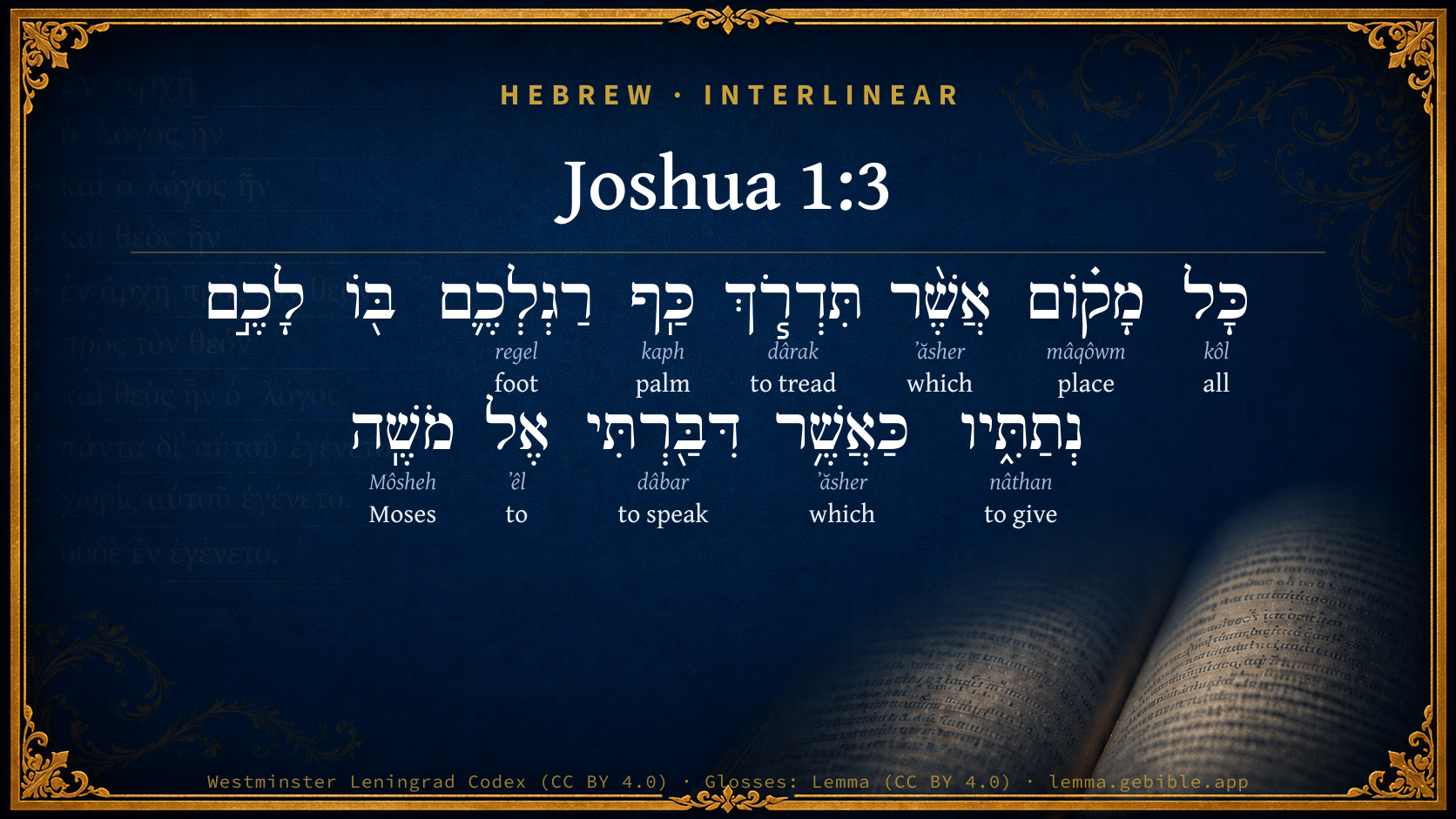
Hebrew (Westminster Leningrad Codex) Joshua 1:3 appears in the Hebrew Old Testament. The text above is from the Westminster Leningrad Codex. Each word links to its Strong’s number, a concise gloss, and parsing drawn from the Open Scriptures Hebrew Bible morphology. Click any word for its full Brown-Driver-Briggs (BDB) entry.
Download image
Cite this verse

Joshua 1:3 (World English Bible). Public Domain. Lemma interlinear Bible study tool, https://lemma.gebible.app/v/joshua/1/3.

Show BibTeX & RIS
BibTeX
RIS
English Translation
Every place that the sole of your foot shall tread on, to you have I given it, as I spoke to Moses.
World English Bible · Public Domain
Download a study sheet

One document with this verse’s original text, its word-by-word gloss line, the meaning frame, cross-references with their text, attributed commentary, and full source and license credits — printable, and it pastes into notes with its structure intact.

This verse Autodidact and up

Study sheet (.html) Plain text (.txt)

A passage Seminary Student

Up to 50 verses in one chapter. A passage sheet keeps up to 6 commentary sources and 12 cross-references per verse, in the order this page ranks them, and says so on the sheet whenever that leaves anything out. Ask for a single verse and you get the Autodidact verse sheet above.

Everything on this page stays free to read, with no account — the sheet is a download of what is already on screen, not access to it.

Want to remove ads? Support Godless Engineer
Compare translations 3

The same verse in 3 English versions, stacked beneath the original-language interlinear above. Click any original word for its lexicon entry.

Each is an independent rendering of the whole verse — the interlinear is not word-aligned to these translations.

Highlighted words mark where these versions differ — a whole-verse word diff, not a word-by-word alignment.

  • World English Bible Public Domain
    Every place that the sole of your foot shall tread on, to you have I given it, as I spoke to Moses.
  • King James Version Public Domain
    Every place that the sole of your foot shall tread upon, that have I given unto you, as I said unto Moses.
  • unfoldingWord Literal Text CC BY-SA 4.0
    Every place that the sole of your foot will tread upon, I have given it to you, just as I spoke to Moses.

unfoldingWord Literal Text — © unfoldingWord, licensed CC BY-SA 4.0. Word-aligned USFM3 via Door43 (git.door43.org/unfoldingWord/en_ult).

Versions to compare (up to 4)

3 of 4 selected

Show all 18 translations

Every available English version of this verse, each an independent rendering of the whole verse.

  • World English Bible Public Domain
    Every place that the sole of your foot shall tread on, to you have I given it, as I spoke to Moses.
  • Berean Standard Bible Public Domain
    I have given you every place where the sole of your foot will tread, just as I promised to Moses.
  • Majority Standard Bible Public Domain
    I have given you every place where the sole of your foot will tread, just as I promised to Moses.
  • King James Version Public Domain
    Every place that the sole of your foot shall tread upon, that have I given unto you, as I said unto Moses.
  • American Standard Version (1901) Public Domain
    Every place that the sole of your foot shall tread upon, to you have I given it, as I spake unto Moses.
  • Revised Version (1885) Public Domain
    Every place that the sole of your foot shall tread upon, to you have I given it, as I spake unto Moses.
  • Geneva Bible (1599) Public Domain
    Euery place that the sole of your foote shall treade vpon, haue I giuen you, as I said vnto Moses.
  • Douay-Rheims (1899) Public Domain
    I will deliver to you every place that the sole of your foot shall tread upon, as I have said to Moses.
  • Young's Literal Translation Public Domain
    `Every place on which the sole of your foot treadeth, to you I have given it, as I have spoken unto Moses.
  • Literal Standard Version CC BY-SA 4.0
    Every place on which the sole of your foot treads, I have given it to you, as I have spoken to Moses.
  • Unlocked Literal Bible CC BY-SA 4.0
    I have given you every place where the sole of your foot will walk. I have given it to you, just as I promised to Moses.
  • unfoldingWord Literal Text CC BY-SA 4.0
    Every place that the sole of your foot will tread upon, I have given it to you, just as I spoke to Moses.
  • Darby Bible Public Domain
    Every place whereon the sole of your foot shall tread have I given to you, as I said unto Moses.
  • World Messianic Bible Public Domain
    I have given you every place that the sole of your foot will tread on, as I told Moses.
  • Webster's Bible Public Domain
    Every place that the sole of your foot shall tread upon, that have I given to you, as I said to Moses.
  • Free Bible Version CC BY-SA 4.0
    As I promised Moses, everywhere you set foot will be land I am giving to you,
  • Bible in Basic English Public Domain
    Every place on which you put your foot I have given to you, as I said to Moses.
  • JPS Tanakh (1917) Public Domain
    Every place that the sole of your foot shall tread upon, to you have I given it, as I spoke unto Moses.

Literal Standard Version (2020), Covenant Press — licensed CC BY-SA 4.0. Text via the HelloAO Bible API (eBible.org). Unlocked Literal Bible (unfoldingWord) — licensed CC BY-SA 4.0. Text via the HelloAO Bible API (eBible.org). unfoldingWord Literal Text — © unfoldingWord, licensed CC BY-SA 4.0. Word-aligned USFM3 via Door43 (git.door43.org/unfoldingWord/en_ult). Free Bible Version, Dr. Jonathan Gallagher — licensed CC BY-SA 4.0. Text via the HelloAO Bible API (eBible.org).

Word by word

More ways to search: Search by grammar → Find every occurrence → Compare this word →

Practice this passage: Drill this verse → Learn its vocabulary →

תִּדְרֹ֧ךְ
dârak
H1869
“to tread”
Verb, Qal, Imperfect, 3rd Person, Feminine, Singular
Part of Speech
Verb
Stem
Qal
Form
Imperfect
Person
3rd Person
Gender
Feminine
Number
Singular
Full BDB Definition

Origin: a primitive root

TWOT: 453

to tread, bend, lead, march - (Qal) - to tread, march, march forth - to tread on, tread upon - to tread (a press) - to tread (bend) a bow - archer, bow-benders (participle) - (Hiphil) - to tread, tread down - to tread (bend with the foot) a bow - to cause to go, lead, march, tread
  1. כָּל kôl H3605 “all of” Noun, Common, Masculine, Singular, Construct
  2. מָק֗וֹם mâqôwm H4725 “place” Noun, Common, Masculine, Singular, Absolute
  3. אֲשֶׁ֨ר ʼăsher H834 “which” Particle, Relative
  4. כַּֽף kaph H3709 “palm of” Noun, Common, Feminine, Singular, Construct
  5. רַגְלְכֶ֛ם regel H7272 “foot · your” Noun, Common, Feminine, Singular, Construct + Suffix, Personal, 2nd Person, Masculine, Plural
  6. נְתַתִּ֑יו nâthan H5414 “to give · him” Verb, Qal, Perfect, 1st Person, Common, Singular + Suffix, Personal, 3rd Person, Masculine, Singular
  7. כַּאֲשֶׁ֥ר ʼăsher H834 “like/as · which” Preposition + Particle, Relative
  8. דִּבַּ֖רְתִּי dâbar H1696 “to speak” Verb, Piel, Perfect, 1st Person, Common, Singular
  9. אֶל ʼêl H413 “to” Preposition
  10. מֹשֶֽׁה Môsheh H4872 “Moses” Noun, Proper

About this verse

These counts appear in no published source. They are computed here, from the morphology-tagged text and Lemma’s own curated glosses. What Lemma adds →

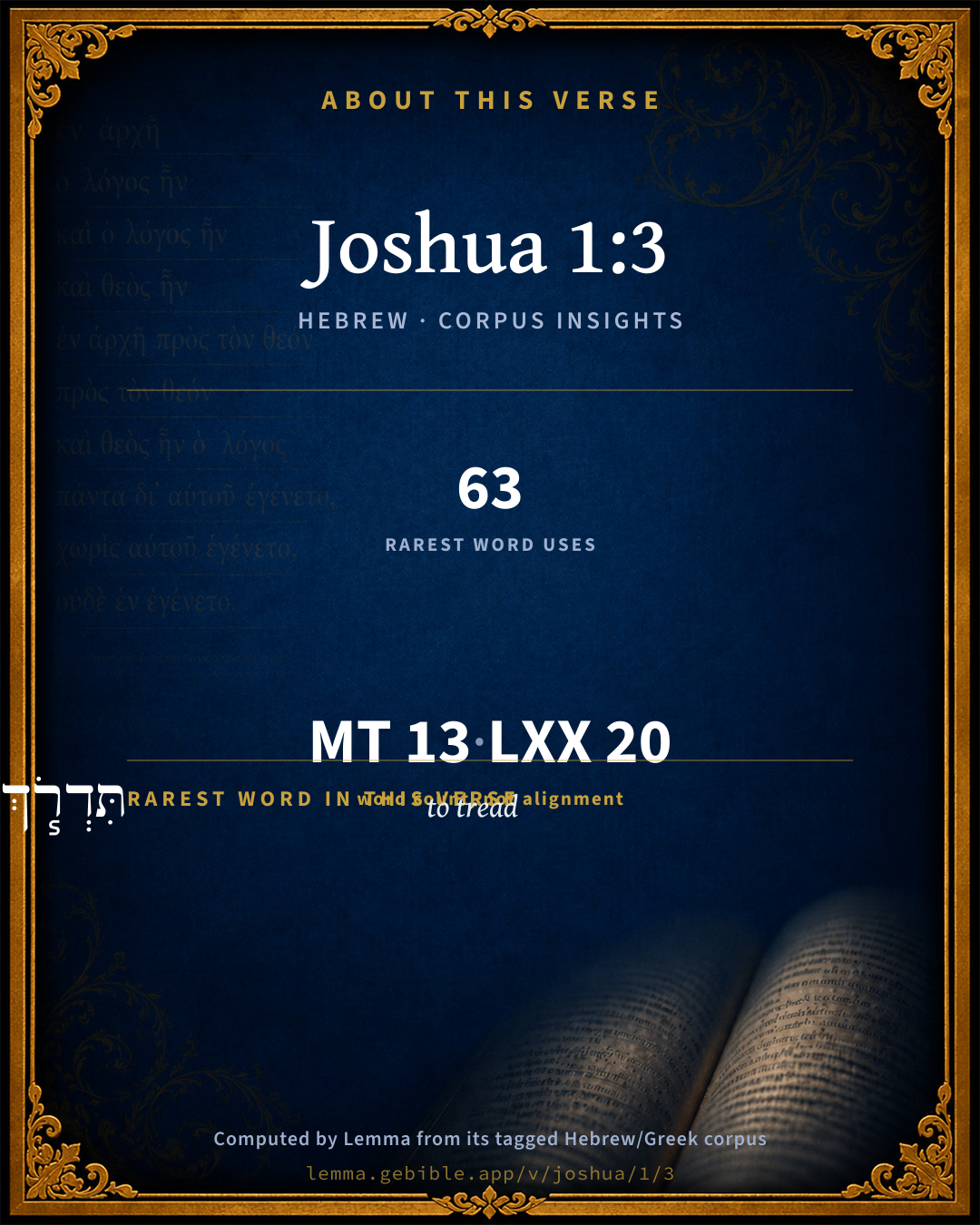
13
words
10
distinct lemmas
Historical
section

Grammatical profile

  • 3 verbs
  • 5 nouns
  • 3 prepositions
  • 2 particles

Verb forms

  • תִּדְרֹ֧ךְ Qal · Imperfect
  • נְתַתִּ֑יו Qal · Perfect
  • דִּבַּ֖רְתִּי Piel · Perfect

Repetition

A word recurs within this verse — often emphatic in Hebrew:

  • אֲשֶׁ֨ר which H834 ×2

Hebrew & Septuagint length

In English translation the verse runs 22 words from the Hebrew and 18 from the Septuagint (LXX English) — closely comparable.

A rough comparison of the two English renderings, which tokenize alike — not a word-level alignment.

Word counts can differ between the Hebrew and the Greek without any difference in meaning — e.g. the Hebrew direct-object marker אֵת has no separate Greek word, and Greek often adds the article ὁ.

In the original languages it is 13 Hebrew tokens and 20 Greek tokens — but the two are counted differently (Hebrew bundles its prefixes and suffixes into one token; the Greek is in lemma form), so that isn’t a like-for-like length.

Cross-references

3

Topical passages linked to Joshua 1:3 in the Treasury of Scripture Knowledge — connected by theme and wording, ordered by reader-vote popularity; previews shown in the World English Bible.

  • Deuteronomy 11:24 Every place whereon the sole of your foot shall tread shall be yours: from the wilderness, and Lebanon, from the river, the river Euphrates, even to the hinder sea shall be your border.
  • Joshua 14:9 Moses swore on that day, saying, Surely the land whereon your foot has trodden shall be an inheritance to you and to your children forever, because you have wholly followed Yahweh my God.
  • Titus 1:2 in hope of eternal life, which God, who can't lie, promised before eternal times;

Cross-references courtesy of OpenBible.info (CC BY 4.0).

Hebrew and Greek witnesses Masoretic Hebrew ↔ Greek Septuagint

The same verse in the two great witnesses to the Old Testament, shown verse-for-verse.

These are two independent witnesses, not word-aligned to each other, and the Septuagint is shown in lemma (dictionary) form.

Hebrew Joshua 1:3 Masoretic · Westminster Leningrad Codex

כָּל מָק֗וֹם אֲשֶׁ֨ר תִּדְרֹ֧ךְ כַּֽף רַגְלְכֶ֛ם בּ֖וֹ לָכֶ֣ם נְתַתִּ֑יו כַּאֲשֶׁ֥ר דִּבַּ֖רְתִּי אֶל מֹשֶֽׁה

Every place that the sole of your foot shall tread on, to you have I given it, as I spoke to Moses.

World English Bible · Public Domain

Greek LXX Joshua 1:3 Septuagint · lemma form

πᾶς ὁ τόπος ἐπί ὅς ἄν ἐπιβαίνω ὁ ἴχνος ὁ πούς σύ σύ δίδωμι αὐτός ὅς τρόπος εἶπον ὁ μωυσῆς

Every spot on which you⌃ shall tread I will give it to you, as I said to Moses.

LXX2012 (modern English Septuagint) · Public Domain

Hebrew: Westminster Leningrad Codex (CC BY 4.0). Greek: Septuagint (public domain); English from LXX2012 (modern English Septuagint) (Public Domain). How the Septuagint differs from the Hebrew →

Targum (Aramaic paraphrase)

1

The Targum is the ancient Jewish Aramaic paraphrase of the Hebrew Scriptures — an interpretive translation, not the Hebrew text itself. Onkelos (literal) and Pseudo-Jonathan (expansive) render the Torah, and Jonathan the Prophets. Coverage is partial: where no permissively-licensed English translation exists for a verse, only the Aramaic is shown. This is verse-level text, not a word-by-word alignment to the Hebrew.

  1. Targum Jonathan Prophets (Joshua–Malachi)
    כָּל אַתְרָא דְתִדְרַךְ פַּרְסַת רַגְלְכוֹן בֵּיהּ לְכוֹן יְהַבִתָהּ כְּמָא דְמַלֵילִית עִם מֹשֶׁה:

    (no public-domain English translation for this verse)

    Targum Jonathan — Aramaic: “Mikraot Gedolot” (public domain). English: “Sefaria Community Translation” (CC0 1.0 (public-domain dedication)); “London "Chaldee Paraphrase," 1871” (public domain). Text via Sefaria.

Commentary

Notes on Joshua 1:3 from classic Christian and Jewish commentators (each source and its license shown beneath its notes). The classic Christian expositions comment on the surrounding passage and are grouped to its opening verse, so a note may address several verses; the Jewish commentaries on the Tanakh (Rashi and others) are per-verse, so they appear only where the commentator wrote on this verse.

Lemma curates 59 commentaries, every one of them public domain or Creative Commons licensed, each selected and text-cleaned for this edition rather than reprinted as found. About our sources →

Trapp's Complete Commentary

John Trapp

Jos 1:3 Every place that the sole of your foot shall tread upon, that have I given unto you, as I said unto Moses.

Ver. 3. Every place that the sale, &c.] I, who am the true proprietary and lord paramount, {Psa 24:1} do give you this land, but yet you must fight for it: and so must the saints for the heavenly Canaan.

“ Nunquam bella bonis, nunquam diserimina desunt. ”

John Trapp, A Commentary or Exposition upon All the Books of the Old and New Testament (1647–1656) — public domain. Text from a community e-Sword module.

Joseph Benson's Commentary

Jos 1:3-4. Every place — That is, within the following bounds. This Lebanon — Emphatically, as being the most eminent mountain in Syria, and the northern border of the land: or this which is within thy view. Hittites — Of the Canaanites, who, elsewhere, are called Amorites, (Gen 15:16,) and here Hittites, the Hittites being the most considerable and formidable of them all. The greater sea — The midland sea, great in itself, and especially compared with those lesser collections of waters, which the Jews called seas. “But the Israelites never possessed all this land.” To which it may be answered, 1st, That was from their own sloth and cowardice, and disobedience to God, and breach of those conditions upon which this promise was suspended: 2d, Though their possessions extended not to Euphrates, yet their dominions did, and all those lands were tributary to them in David’s and Solomon’s time.

Joseph Benson's Commentary on the Old and New Testaments (1811–1818) — public domain. Text from a community e-Sword module.

The Preacher's Complete Homiletical Commentary

Joseph S. Exell (gen. ed.)

CRITICAL NOTES.—

Jos_1:3. Every place that the sole] Every place against which your faith and courage lead you to go up, shall be yours. Your inheritance in the land shall have no limits but those set by your own unbelief and fears. As far as you will tread, you shall possess.

Jos_1:6. Be strong and firm—(Schroeder)] “The words signify not firmness and strength in general, but the strength in the hands and the firmness in the knees, Isa_35:3, cf. Heb_12:12-13” (J. H. Michaelis).

MAIN HOMILETICS OF THE PARAGRAPH.—Jos_1:3-9

“SERVING THE LORD”

In the service of God—

I. There is no honour without work. Joshua is placed at the head of the host, not merely to be a chief, but a leader. “Every place” must be won. Israel must go up against each. The sole of the foot must tread, and that often in the tramp of battle, wherever the people would inherit. And the man who is at their head must lead them to the war. He, too, must divide the inheritance for them. Not least, he must “meditate day and night” in the law; for how shall he secure obedience if he be ignorant of that which is to be obeyed? Leading in such a case means arduous toil, perpetual care, ceaseless interest, and unrest. There can be no honour in the mere position. Idleness there would be simply exalted shame and prominent disgrace. It is always thus. The height of our position is the measure either of our honour or dishonour, according to the work done. High position is vantage ground for work, not rest. It is so socially, ecclesiastically, mentally, and even morally. He who climbs high in order to lie down, only exposes his slothfulness. He may lie more quietly in altitudes which the din of honest labour does not reach; for all that, he is simply a conspicuous sluggard.

II. There is no work without encouragement. The whole passage is emphatic with promise. Wherever God gives arduous duties. He supplies bright hopes. Probably there is no position in which humanity ever stood, saving that of impenitence and persistent sin, which has not its own specific illumination in the Scripture promises. The day has its sun, the night its moon and stars, and even the arctic zone its aurora borealis. God’s love has beams of light strong enough to reach every spot in that part of the sphere of moral being where His name is had in reverence. Scripture has light for the darkness of penitence, of labour, of suffering in all its forms, of bereavement, and of death.

1. Our gloom and darkness are not essentials of life. He who supposes they are must begin by assuming the light of Divine encouragement to be insufficient.

2. Our gloom and darkness are not desirable. They cannot be; God has sought to remove them in every form.

3. Our gloom and darkness are of our own choosing. Our Heavenly Father has provided light for all who seek light, and invites all to walk therein.

4. Our gloom and darkness are harmful and sinful. They prevent our work, discourage others, shew our neglect of the Bible, or they shew that reading and meditating we do not believe.

III. There is no encouragement apart from obedience. (Jos_1:7; Jos_1:9.) In the sphere of moral life wicked men always walk opposite to the Sun of righteousness, and thus are ever in the night. In order to be strong for conflict, Joshua is to be strong in the comfort of hope; in order to be strong in hope, he is to be strong in obedience.

1. He who disobeys the precepts has no right to the promises. It is as though a child should steadfastly ignore his father’s wishes, and then presume upon his unrestrained gifts and his undiminished love.

2. He who disobeys the precepts lacks the spirit which alone can use the promises. Lax obedience shews lax faith, and promise yields its value only to trust. Lax obedience shews lax interest, and no man can really delight where he is careless.

IV. There can be no sufficient obedience without meditation. (Jos_1:8.) We are responsible, not only to do what we know, but to know what there is to be known. The ambassador who refused to open the despatches of his government would plead ignorance in vain. When Nelson shut his eye against his admiral’s signal, he was none the less guilty of disobedience. Men may neglect to read the Scriptures, and then say, “I knew not that I transgressed,” but the very ignorance which they plead is an aggravated form of guilt. God complains of Ephraim, “I have written to him the great things of my law, but they were counted as a strange thing.”

V. There can be no satisfactory meditation which does not centre in God Himself. (Jos_1:9.) “Have not I commanded thee?” We must look through the written word up to God, whom it is meant to reveal. We must look through all revelation on to Him. The Bible is light on God. The miracles of Christ are not recorded to excite wonder, they are to reveal God. It is possible to make Gethsemane, the Lord’s Supper, and even the Cross so many superstitions. The brazen serpent became a relic at which men stopped, rather than a memory through which they went on to God. Hezekiah did holy work, then, to break it in pieces, and to call it “Nehushtan.” If Christ be not risen again, even Calvary is worthless; “Your faith is vain; ye are yet in your sins.” Gethsemane, the Supper, the Cross, are only good as they reveal the finished atonement and love of the living Saviour, and through Him the pardon and love of God. Riddling all superstitions of mere Bible-reading and formal religion through and through, the living Son of God looks down from heaven, and says to Saul of Tarsus, “That they may receive forgiveness of sins and inheritance among them which are sanctified BY FAITH THAT IS IN ME.” (Act_26:18.) Faith is to be in the living Christ, not in cold duties and dead things. Trench has somewhere said, “Our blessedness is that Christ does not declare to us a system, and say, ‘This is the truth;’ so doing He might have established a school: but He points to a person, even to Himself, and says, ‘I am the Truth;’ and thus He founded, not a school, but a Church, a fellowship which stands in its faith upon a person, not in its tenure of a doctrine, or at least upon this only in a sense which is mediate and secondary.”

SUGGESTIVE COMMENTS ON THE VERSES

Jos_1:3-5. GOD’S SUFFICIENT PROMISES.

I. They reveal their value only as far as we use them. Where men tread, there shall they inherit. This can only be known by going on in the strength of them. Each says, like its Divine Author, “Prove me now herewith.”

II. They have respect to all preceding promises. “As I said unto Moses.” “Vested interests.” No one promise ignores the property which men may have in another. Christ destroyed nothing of the O.T. Scriptures; He fulfilled them. Nowhere so much as on and around the cross do we read the words, “That the Scripture might be fulfilled.”

III. They have regard to all that which might weaken and limit them from without. (Jos_1:4.) The boundary had military fitness. Strasbourg and Metz. God loves to give so that we can hold. A Christian with only penitence, only humility, only zeal, must ever be weak,—too weak to stand. He who sets foot on the whole circle of the graces, and inherits them all, has not only a broader and richer possession, but a more secure.

IV. They are not merely general, but personal. “Before thee.” They are each for all the people, all for each of the people, and most for him who most needs them.

V. They are as continuous as human want. “All the days of thy life.” As good on weekdays as on Sundays; and on sad days as on days of song. Good for all kinds of days, to the end of our days.

VI. They are made clear by illustration, and thrice blessed by precedent. “As I was with Moses, so I will be with thee.” So of all in the Scriptures. Somebody has tried and proved each of them. The increasing value of the Scriptures. The interest of man’s experience is ever accumulating on the capital of the written word. The Bible is richer today than it ever was before.

VII. They have their foundation and worth in the Divine character. “I will not fail thee, nor forsake thee.”

Jos_1:5.

I. God’s presence gives perpetual and unvarying victory. Any man may conquer, who fights with the Lord on his side. Victory is then as sure in one place as in another. Pharaoh, Red Sea, Wilderness, or Canaanites,—it matters not which, nor when.

II. God’s presence is given irrespective of everything but sin.

1. Irrespective of ability, disposition, or temperament. Men choose their companions in view of traits of character. God walks with all who fear Him. Variety in O. T. prophets. So the apostles.

2. Irrespective of social condition and particular circumstances. The various instances under which this same promise was given: To Jacob, the outcast (Gen_28:15); to “the church in the wilderness” (Deu_31:6); to Joshua as well as Moses; to Solomon, the king, in his work of building the temple (1Ch_28:20); to “the poor and needy” (Isa_41:17); to the persecuted Hebrew Christians (Heb_13:5).

III. God’s presence once given is intended to be given for ever. The doctrine is full of consolation—should be as fully received as it is absolutely stated—must be carefully guarded from presumption. He who reverently listens to the cry of Saul, “The Lord is departed from me,” or marks with Christian spirit the pitiable weakness of Samson, who “wist not” that he was in like manner left to himself in his deliberate sinfulness, will not rashly blindfold himself with a creed.

“To be forsaken of God implies utter loneliness, utter helplessness, utter friendlessness, utter hopelessness, and unutterable agony.”—Met, Tab. Pulpit, Jos_1:8., pp. 603–605.

“Joshua was sensible how far he came short of Moses in wisdom and grace; but what Moses did was done by virtue of the presence of God with him. Joshua, though he had not always the same presence of mind that Moses had, yet if he had always the same presence of God, would do well enough.” “What Joshua had himself encouraged the people with long ago (Num_14:9), God here encourageth him with.”

The Preacher's Complete Homiletical Commentary (gen. ed. Joseph S. Exell; Funk & Wagnalls, c. 1892) — public domain (pre-1929). A full-Bible homiletical/sermon-outline anthology covering 65 of 66 books (2 John is absent from the source module). Text from a community e-Sword module.

Tyndale Open Study Notes

Tyndale Open Resources

1:3 Moses’ death did not end God’s presence with or guidance of Israel.

Tyndale Open Study Notes — © Tyndale Open Resources, licensed CC BY-SA 4.0. Text via the HelloAO Bible API.

Jamieson, Fausset & Brown

Robert Jamieson, A. R. Fausset & David Brown

Every place that the sole of your foot shall tread upon that have I given you--meaning, of course, not universal dominion, but only the territory comprised within the boundaries here specified (see on Deu 19:8).

Jamieson, Fausset & Brown — Commentary Critical and Explanatory on the Whole Bible (1871) — public domain (CC PDM 1.0). Text via the HelloAO Bible API.

Adam Clarke's Commentary

Verse 3. The sole of your foot shalt tread upon] That is, the whole land occupied by the seven Canaanitish nations, and as far as the Euphrates on the east; for this was certainly the utmost of the grant now made to them; and all that was included in what is termed the promised land, the boundaries of which have already been defined. See De 34:1-4, and see Jos 1:4 below. It has been supposed that the words, Every place that the sole of your foot shall tread upon, were intended to express the ease with which they were to conquer the whole land, an instance of which occurs in the taking of Jericho. It was only their unfaithfulness to God that rendered the conquest in any case difficult.

Adam Clarke's Commentary on the Bible (1810–1826) — public domain. Text from a community e-Sword/MySword module.

Ellicott's Commentary for English Readers

(3) Every place that the sole of your foot shall tread upon, that have I given unto you.—The conquest of Canaan was the special duty assigned to Joshua by the word of Moses. (Hence the order for the extermination of Amalek was written for Joshua [Exo_17:14] as the representative conqueror, though he did not actually carry it out.) But the conquest of Canaan, as effected by Joshua, must be carefully defined. It was a limited conquest. He took a certain number of strongholds throughout the country, and utterly crushed the armies that were opposed to him in the field. He established the people of Israel in the position that he had won. (See Jos_12:9-24 for an outline of the position.) He then divided to the tribes of Israel the whole territory, conquered and unconquered alike (see Jos_13:1-7). The Philistines and Sidonians (or Phoenicians) are examples of two great nations not conquered by Joshua, but assigned to Israel for an inheritance. Thus it appears that what Israel would conquer, the sole of his foot must tread. The conquest which Joshua began for the people, must be carried out in detail by the several tribes themselves. For a further discussion of the relation of Joshua’s conquest to the whole history of Israel, see Note on Jos_13:2.

A Bible Commentary for English Readers, edited by Charles John Ellicott (1878–1897) — public domain. Text from a community e-Sword module.

The Cambridge Bible for Schools and Colleges

gen. ed. J. J. S. Perowne

3. as I said unto Moses] Comp. Deu_11:24; Jos_14:9.

The Cambridge Bible for Schools and Colleges (gen. ed. J. J. S. Perowne; Cambridge University Press, 1878–1918) — public domain. Text from a community e-Sword module.

John Gill's Exposition

Every place that the sole of your feet shall tread upon,.... That is, in the land of Canaan:

that have I given unto you, as I said unto Moses: See Gill on Deu 11:24; though the Jews extend this to all without the land subdued by them, and even to all the countries they now tread on, and are exiles in; but the limits of what the Lord gave them are fixed in Jos 1:4.

John Gill's Exposition of the Whole Bible (1746–1763) — public domain (CC PDM 1.0). Text via the HelloAO Bible API.

Haydock's Catholic Bible Commentary

Moses. Thus the preceding permission, which the Jews extend, as if God had authorized them to conquer the whole world, is limited. (Haydock) See Deuteronomy xi. 24. --- Their right to the land of Chanaan depends on this grant of God, who is the Lord of all things, and who thus took away all the privileges of the former inhabitants. But the warrant of destruction only regarded the people of Chanaan. Those who lived towards the Euphrates, were obliged only to pay tribute by David and Solomon, thought their country formed part of what had been promised to the Israelites. They might have possessed all that region, if they had proved faithful. The limits of the promised land vary, as they are considered under various lights. (Calmet) --- The desert of Arabia Petrea and Antilibanus formed the boundaries on the south and on the north, the Euphrates and Mediterranean were on the east and west, when the territories of the Israelites were considered in their utmost extent. (Haydock)

George Leo Haydock (1774–1849), Haydock's Catholic Family Bible and Commentary, 1859 edition — public domain. Excludes Psalms (Douay-Rheims chapter numbering differs from Protestant) and Deuterocanonical books (Catholic canon only).

Matthew Poole's English Annotations

Every place, to wit, within the following bounds.

Matthew Poole's English Annotations on the Holy Bible (1683–1685) — public domain. Text from a community e-Sword/MySword module.

Whedon's Commentary on the Bible

Daniel D. Whedon

3. Every place that the sole of your foot shall tread upon — Compare the similar language in Deu_11:24. The entire land was before them, and their own faith, and courage were to decide how much of it they would actually possess.

Daniel D. Whedon (gen. ed.), Commentary on the Old and New Testaments (1874–1909) — public domain. Text from a community e-Sword module.

The Pulpit Commentary

Every place that the sole of your foot doth tread upon. These words are a quotation, almost word for word, from Deu_11:24, bat the original promise is to be found in Gen_12:1-7, with which we may compare Gen_13:14-17 Gen_15:18 Gen_17:8. Comp. also Jos_14:9 Exo_23:30, Exo_23:31, etc. It was God"s purpose that the whole land should belong to the children of Israel; a purpose which, as usual in Hebrew prophecy, is signified by the use of the perfect tense here. The conquest was intended to be complete. Not a foot"s breadth was to rest in the hands of its former owners. But here, as elsewhere in Holy Writ, we may mark the way in which man"s sin and want of faith has marred the purposes of God. In the Book of Judges we read that the Canaanites were not only not driven out, but that the children of Israel made marriages with them, worshipped their gods, and practised their abominations. Jerusalem remained in the hands of the Jebusites until the time of David, while the Philistines remained in possession of their portion of Palestine until it was reduced under the power of the king of Babylon. We may observe that, according to all the ordinary laws of criticism, this citation of Deuteronomy is a proof that that Book existed when the Book of Joshua was written. For the cumbrous scheme of Elohists, Jehovists, Deuteronomists, and the like, by which this natural conclusion is overruled, see Introduction. Have I given it. The preterite here denotes God"s purpose. (cf. Gen_1:29)

The Pulpit Commentary (1880–1919), ed. H.D.M. Spence-Jones & Joseph S. Exell — public domain. Text from a community e-Sword module.

John Wesley's Explanatory Notes

Every place - That is, within the following bounds.

John Wesley, Explanatory Notes Upon the Whole Bible (1754–1765) — public domain. Text via the GEBible commentary corpus.

Keil & Delitzsch

C. F. Keil & F. Delitzsch

"Namely, every place that the sole of your foot shall tread upon," i.e., I have given you the whole land, not excepting a single foot's breadth. The perfect, "I have given," refers to the counsel of God as having been formed long before, and being now about to be carried into execution. These words, which are connected with Deu 11:24, so far as the form is concerned, rest upon the promise of God in Exo 23:30-31, to which the words "as I said unto Moses" refer.

Keil & Delitzsch — Biblical Commentary on the Old Testament (1861–1891) — public domain (CC PDM 1.0). Text via the HelloAO Bible API. (Old Testament only.)

Scofield Reference Notes

C. I. Scofield

Every place

The law of appropriation. God gives, but we must take.

The Scofield Reference Bible (1917 edition), notes by C. I. Scofield — public domain. Text from a community e-Sword module.

Rashi

Rabbi Shlomo Yitzchaki (Rashi)

Every place upon which the sole of your feet will tread. This is similar to what was said to Moshe. Regarding this, we learned in the Sifre. ‘If [this verse] is to teach us about the boundaries of Eretz Yisroel, the Torah has already stated: From the wilderness and the Lebanon etc. If so, why is it said here: Every place upon which the sole will tread? This includes the lands outside Eretz Yisroel. After you have conquered the land, everything you conquer outside the land will be sacred and will belong to you.’

Rashi on the Tanakh — English translations: “The Judaica Press complete Tanach with Rashi, translated by A. J. Rosenberg” (CC BY 4.0); “Pentateuch with Rashi's commentary by M. Rosenbaum and A.M. Silbermann, 1929-1934” (public domain); “The Metsudah Tanach series, Lakewood, N.J” (CC BY 4.0); and “The Book of Joshua, Metsudah Publications, 1997” (CC BY 4.0). Text via Sefaria.

Lesson kit

Teaching starters — assembled from the data on this page, not authored interpretation. Every prompt links to the verse data it draws on. Edit before teaching.

Joshua, in the Historical, opens this verse with 13 words (10 distinct Hebrew lemmas). Its most distinctive word is dârak (“to tread”). A historical commentator’s framing appears above. Read the whole chapter for the surrounding context.

Discussion questions

  1. How does “to tread” (dârak) shape what this verse is saying?
  2. Deuteronomy 11:24 shares this passage’s theme. How do the two illuminate each other?
  3. “which” occurs 2× in this one verse. What is the effect of the repetition?
  4. The translations on this page render this verse differently — a whole-verse word diff, not a word-by-word alignment. What might account for the different wordings?
  5. The verb «תִּדְרֹ֧ךְ» is Qal Imperfect. How does its form color the action?
  6. Reading how Trapp's Complete Commentary and Joseph Benson's Commentary read this verse, where do the two commentators agree and where do they part?

Things to notice

Reading settings

Reading text

Shown beneath each verse's original-language words.

Old Testament
Old Testament edition

Read the OT as the Masoretic Hebrew (MT) or the Greek Septuagint (LXX).

English shown for the Greek Septuagint (in the Hebrew ↔ Greek comparison).

Comparing translations? Open the Compare panel on any verse page to stack up to four side by side.