
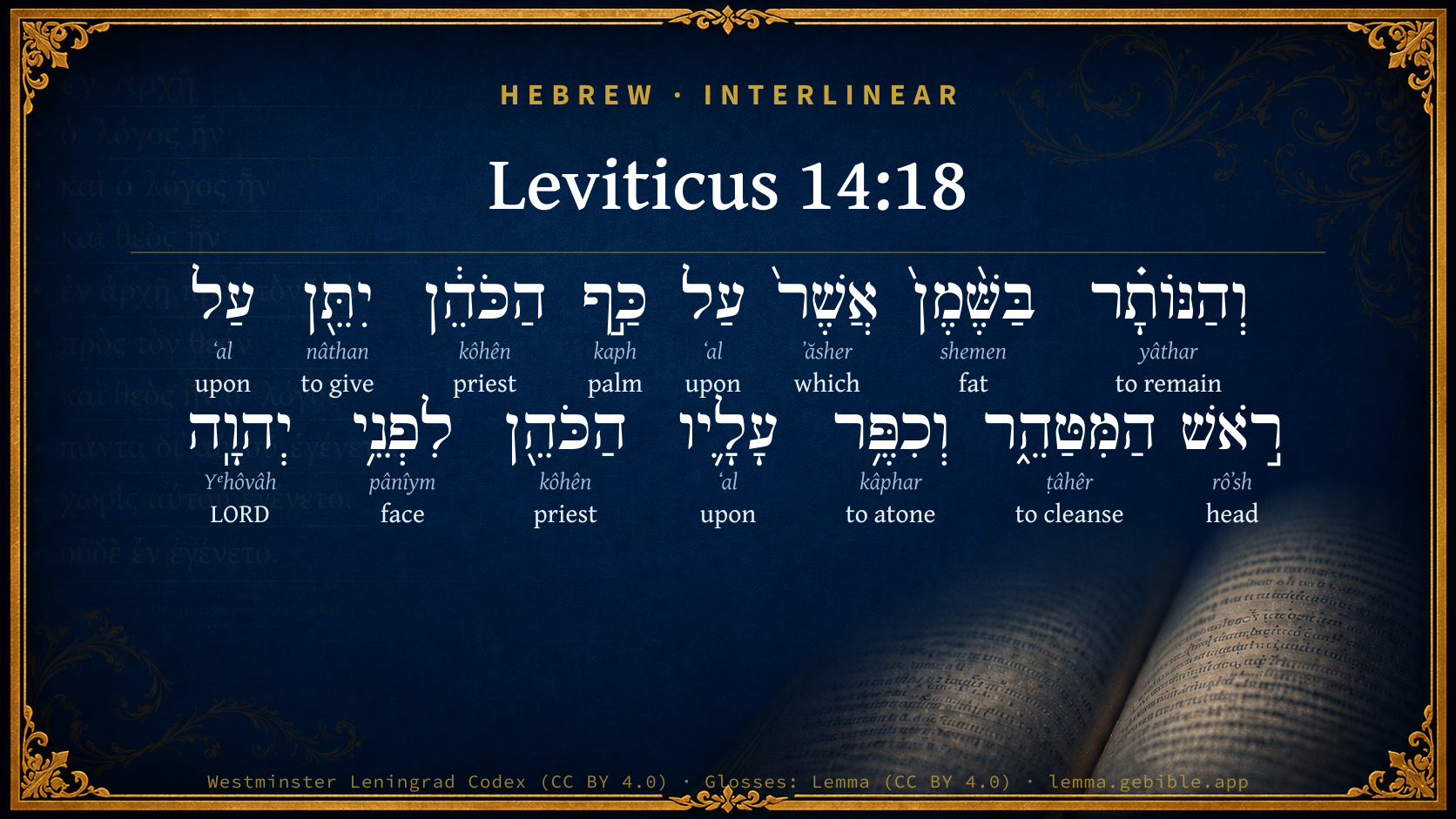
Leviticus 14:18

Hebrew (Westminster Leningrad Codex) Leviticus 14:18 appears in the Hebrew Old Testament. The text above is from the Westminster Leningrad Codex. Each word links to its Strong’s number, a concise gloss, and parsing drawn from the Open Scriptures Hebrew Bible morphology. Click any word for its full Brown-Driver-Briggs (BDB) entry.
Download image
Cite this verse

Leviticus 14:18 (World English Bible). Public Domain. Lemma interlinear Bible study tool, https://lemma.gebible.app/v/leviticus/14/18.

Show BibTeX & RIS
BibTeX
RIS
English Translation
The rest of the oil that is in the priest's hand he shall put on the head of him who is to be cleansed, and the priest shall make atonement for him before Yahweh.
World English Bible · Public Domain
Download a study sheet

One document with this verse’s original text, its word-by-word gloss line, the meaning frame, cross-references with their text, attributed commentary, and full source and license credits — printable, and it pastes into notes with its structure intact.

This verse Autodidact and up

Study sheet (.html) Plain text (.txt)

A passage Seminary Student

Up to 50 verses in one chapter. A passage sheet keeps up to 6 commentary sources and 12 cross-references per verse, in the order this page ranks them, and says so on the sheet whenever that leaves anything out. Ask for a single verse and you get the Autodidact verse sheet above.

Everything on this page stays free to read, with no account — the sheet is a download of what is already on screen, not access to it.

Want to remove ads? Support Godless Engineer
Compare translations 3

The same verse in 3 English versions, stacked beneath the original-language interlinear above. Click any original word for its lexicon entry.

Each is an independent rendering of the whole verse — the interlinear is not word-aligned to these translations.

Highlighted words mark where these versions differ — a whole-verse word diff, not a word-by-word alignment.

  • World English Bible Public Domain
    The rest of the oil that is in the priest's hand he shall put on the head of him who is to be cleansed, and the priest shall make atonement for him before Yahweh.
  • King James Version Public Domain
    And the remnant of the oil that is in the priest's hand he shall pour upon the head of him that is to be cleansed: and the priest shall make an atonement for him before the LORD.
  • unfoldingWord Literal Text CC BY-SA 4.0
    And the remainder of the oil that on the palm of the priest he shall put on the head of the person being cleansed. And the priest shall make atonement for him to the face of Yahweh.

unfoldingWord Literal Text — © unfoldingWord, licensed CC BY-SA 4.0. Word-aligned USFM3 via Door43 (git.door43.org/unfoldingWord/en_ult).

Versions to compare (up to 4)

3 of 4 selected

Show all 18 translations

Every available English version of this verse, each an independent rendering of the whole verse.

  • World English Bible Public Domain
    The rest of the oil that is in the priest's hand he shall put on the head of him who is to be cleansed, and the priest shall make atonement for him before Yahweh.
  • Berean Standard Bible Public Domain
    The rest of the oil in his palm, the priest is to put on the head of the one to be cleansed, to make atonement for him before the LORD.
  • Majority Standard Bible Public Domain
    The rest of the oil in his palm, the priest is to put on the head of the one to be cleansed, to make atonement for him before the LORD.
  • King James Version Public Domain
    And the remnant of the oil that is in the priest's hand he shall pour upon the head of him that is to be cleansed: and the priest shall make an atonement for him before the LORD.
  • American Standard Version (1901) Public Domain
    and the rest of the oil that is in the priest's hand he shall put upon the head of him that is to be cleansed: and the priest shall make atonement for him before Jehovah.
  • Revised Version (1885) Public Domain
    and the rest of the oil that is in the priest’s hand he shall put upon the head of him that is to be cleansed: and the priest shall make atonement for him before the LORD.
  • Geneva Bible (1599) Public Domain
    But the remnant of the oyle that is in the Priests hand, he shall powre vpon the head of him that is to be clensed: so the Priest shall make an atonement for him before the Lord.
  • Douay-Rheims (1899) Public Domain
    And upon his head.
  • Young's Literal Translation Public Domain
    and the remnant of the oil which `is' on the palm of the priest, he putteth on the head of him who is to be cleansed, and the priest hath made atonement for him before Jehovah.
  • Literal Standard Version CC BY-SA 4.0
    and the remnant of the oil which [is] on the palm of the priest, he puts [it] on the head of him who is to be cleansed, and the priest has made atonement for him before YHWH.
  • Unlocked Literal Bible CC BY-SA 4.0
    As for the rest of the oil that is in the priest's hand, he will put it on the head of the person who is to be cleansed, and the priest will make atonement for him before Yahweh.
  • unfoldingWord Literal Text CC BY-SA 4.0
    And the remainder of the oil that on the palm of the priest he shall put on the head of the person being cleansed. And the priest shall make atonement for him to the face of Yahweh.
  • Darby Bible Public Domain
    And the remainder of the oil that is in the priest's hand he shall put upon the head of him that is to be cleansed, and the priest shall make atonement for him before Jehovah.
  • World Messianic Bible Public Domain
    The rest of the oil that is in the priest’s hand he shall put on the head of him who is to be cleansed, and the priest shall make atonement for him before the LORD.
  • Webster's Bible Public Domain
    And the remnant of the oil that is in the priest's hand he shall pour upon the head of him that is to be cleansed: and the priest shall make an atonement for him before the LORD.
  • Free Bible Version CC BY-SA 4.0
    What is left of the olive oil in his palm, the priest will put on the head of the person being made clean and then make them right before the Lord.
  • Bible in Basic English Public Domain
    And the rest of the oil in the priest's hand he will put on the head of him who is to be made clean; and so the priest will make him free from sin before the Lord.
  • JPS Tanakh (1917) Public Domain
    And the rest of the oil that is in the priest's hand he shall put upon the head of him that is to be cleansed; and the priest shall make atonement for him before the LORD.

Literal Standard Version (2020), Covenant Press — licensed CC BY-SA 4.0. Text via the HelloAO Bible API (eBible.org). Unlocked Literal Bible (unfoldingWord) — licensed CC BY-SA 4.0. Text via the HelloAO Bible API (eBible.org). unfoldingWord Literal Text — © unfoldingWord, licensed CC BY-SA 4.0. Word-aligned USFM3 via Door43 (git.door43.org/unfoldingWord/en_ult). Free Bible Version, Dr. Jonathan Gallagher — licensed CC BY-SA 4.0. Text via the HelloAO Bible API (eBible.org).

Word by word

More ways to search: Search by grammar → Find every occurrence → Compare this word →

Practice this passage: Drill this verse → Learn its vocabulary →

הַמִּטַּהֵ֑ר
ṭâhêr
H2891
“the · cleansing”
Particle, Definite Article + Verb, Hithpael, Participle Active, Masculine, Singular, Absolute
Part of Speech
Particle + Verb
Stem
Hithpael
Form
Participle Active
Gender
Masculine
Number
Singular
State
Absolute
Full BDB Definition

Origin: a primitive root

TWOT: 792

to be clean, be pure - (Qal) - to be clean (physically - of disease) - to be clean ceremonially - to purify, be clean morally, made clean - (Piel) - to cleanse, purify - physically - ceremonially - morally - to pronounce clean - to perform the ceremony of cleansing - (Pual) to be cleansed, be pronounced clean - (Hithpael) - to purify oneself - ceremonially - morally - to present oneself for purification
  1. וְהַנּוֹתָ֗ר yâthar H3498 “and · the · remaining” Conjunction + Particle, Definite Article + Verb, Niphal, Participle Active, Masculine, Singular, Absolute
  2. בַּשֶּׁ֨מֶן֙ shemen H8081 “in/at the · fat” Preposition, Determined + Noun, Common, Masculine, Singular, Absolute
  3. אֲשֶׁר֙ ʼăsher H834 “which” Particle, Relative
  4. עַל ʻal H5921 “upon” Preposition
  5. כַּ֣ף kaph H3709 “palm of” Noun, Common, Feminine, Singular, Construct
  6. הַכֹּהֵ֔ן kôhên H3548 “the · priest” Particle, Definite Article + Noun, Common, Masculine, Singular, Absolute
  7. יִתֵּ֖ן nâthan H5414 “to give” Verb, Qal, Imperfect, 3rd Person, Masculine, Singular
  8. עַל ʻal H5921 “upon” Preposition
  9. רֹ֣אשׁ rôʼsh H7218 “head of” Noun, Common, Masculine, Singular, Construct
  10. וְכִפֶּ֥ר kâphar H3722 “and · to atone” Conjunction + Verb, Piel, Sequential Perfect, 3rd Person, Masculine, Singular
  11. עָלָ֛יו ʻal H5921 “upon · him” Preposition + Suffix, Personal, 3rd Person, Masculine, Singular
  12. הַכֹּהֵ֖ן kôhên H3548 “the · priest” Particle, Definite Article + Noun, Common, Masculine, Singular, Absolute
  13. לִפְנֵ֥י pânîym H6440 “to/for · face(s) of” Preposition + Noun, Common, Both, Plural, Construct
  14. יְהוָֽה Yᵉhôvâh H3068 “LORD” Noun, Proper

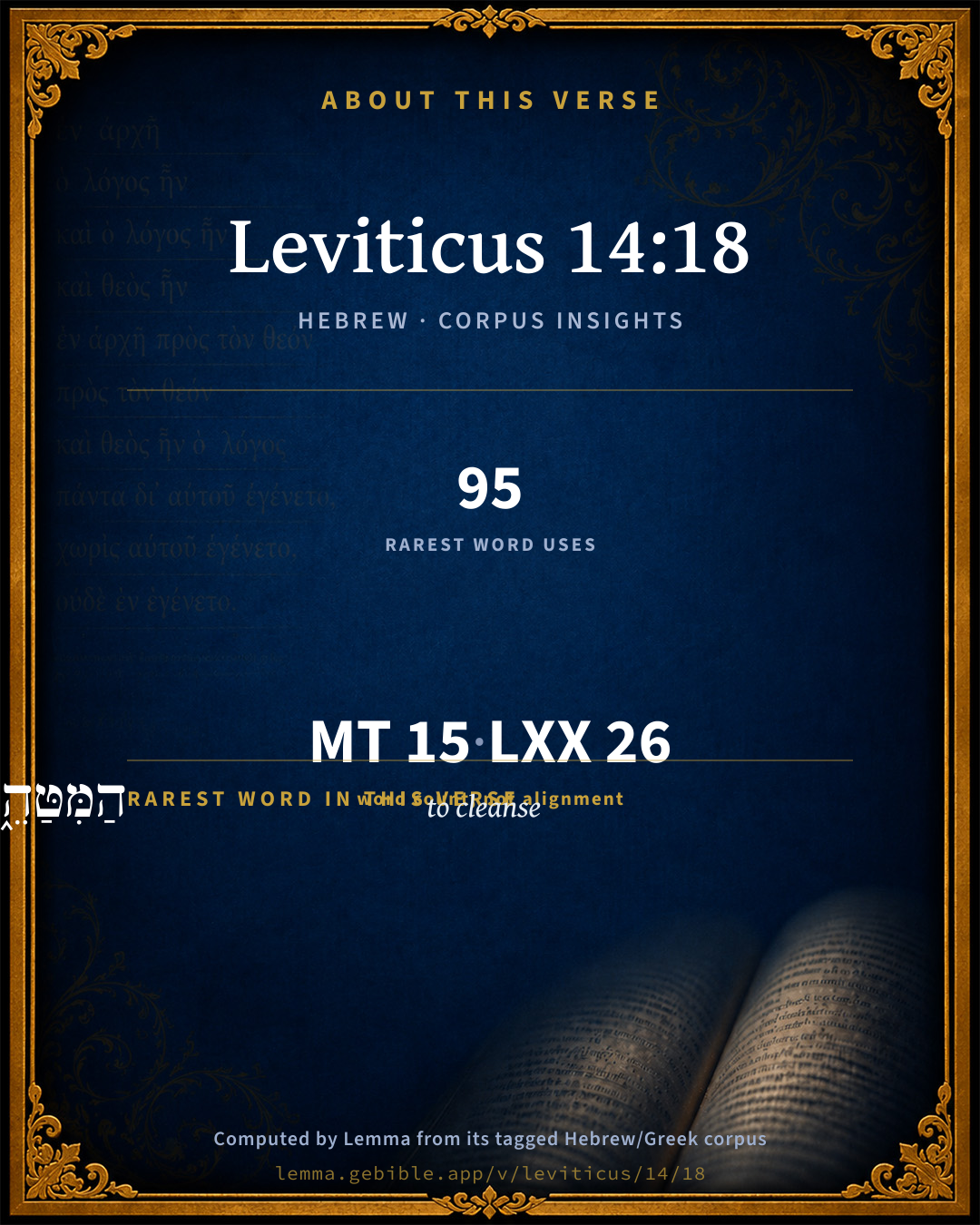
About this verse

These counts appear in no published source. They are computed here, from the morphology-tagged text and Lemma’s own curated glosses. What Lemma adds →

15
words
12
distinct lemmas
Pentateuch
section

Grammatical profile

  • 4 verbs
  • 7 nouns
  • 3 prepositions
  • 1 particle

Verb forms

  • וְהַנּוֹתָ֗ר Niphal · Participle Active
  • יִתֵּ֖ן Qal · Imperfect
  • הַמִּטַּהֵ֑ר Hithpael · Participle Active
  • וְכִפֶּ֥ר Piel · Sequential Perfect

Repetition

Words recur within this verse — often emphatic in Hebrew:

  • עַל upon H5921 ×3
  • הַכֹּהֵ֔ן priest H3548 ×2

Hebrew & Septuagint length

In English translation the verse runs 34 words from the Hebrew and 34 from the Septuagint (LXX English) — the same length.

A rough comparison of the two English renderings, which tokenize alike — not a word-level alignment.

Word counts can differ between the Hebrew and the Greek without any difference in meaning — e.g. the Hebrew direct-object marker אֵת has no separate Greek word, and Greek often adds the article ὁ.

In the original languages it is 15 Hebrew tokens and 26 Greek tokens — but the two are counted differently (Hebrew bundles its prefixes and suffixes into one token; the Greek is in lemma form), so that isn’t a like-for-like length.

Cross-references

7

Topical passages linked to Leviticus 14:18 in the Treasury of Scripture Knowledge — connected by theme and wording, ordered by reader-vote popularity; previews shown in the World English Bible.

  • Leviticus 4:26 All its fat he shall burn on the altar, like the fat of the sacrifice of peace offerings; and the priest shall make atonement for him concerning his sin, and he will be forgiven.
  • 2 Corinthians 1:21–22 Now he who establishes us with you in Christ, and anointed us, is God;
  • Exodus 29:7 Then you shall take the anointing oil, and pour it on his head, and anoint him.
  • Leviticus 4:31 All its fat he shall take away, like the fat is taken away from off of the sacrifice of peace offerings; and the priest shall burn it on the altar for a sweet savor to Yahweh; and the priest shall make atonement for him, and he will be forgiven.
  • Leviticus 5:16 He shall make restitution for that which he has done wrong in the holy thing, and shall add a fifth part to it, and give it to the priest; and the priest shall make atonement for him with the ram of the trespass offering, and he will be forgiven.
  • Leviticus 8:12 He poured some of the anointing oil on Aaron's head, and anointed him, to sanctify him.
  • Ephesians 1:17–18 that the God of our Lord Jesus Christ, the Father of glory, may give to you a spirit of wisdom and revelation in the knowledge of him;

Cross-references courtesy of OpenBible.info (CC BY 4.0).

Hebrew and Greek witnesses Masoretic Hebrew ↔ Greek Septuagint

The same verse in the two great witnesses to the Old Testament, shown verse-for-verse.

These are two independent witnesses, not word-aligned to each other, and the Septuagint is shown in lemma (dictionary) form.

Hebrew Leviticus 14:18 Masoretic · Westminster Leningrad Codex

וְהַנּוֹתָ֗ר בַּשֶּׁ֨מֶן֙ אֲשֶׁר֙ עַל כַּ֣ף הַכֹּהֵ֔ן יִתֵּ֖ן עַל רֹ֣אשׁ הַמִּטַּהֵ֑ר וְכִפֶּ֥ר עָלָ֛יו הַכֹּהֵ֖ן לִפְנֵ֥י יְהוָֽה

The rest of the oil that is in the priest's hand he shall put on the head of him who is to be cleansed, and the priest shall make atonement for him before Yahweh.

World English Bible · Public Domain

Greek LXX Leviticus 14:18 Septuagint · lemma form

ὁ δέ καταλείπω ἔλαιον ὁ ἐπί ὁ χείρ ὁ ἱερεύς ἐπιτίθημι ὁ ἱερεύς ἐπί ὁ κεφαλή ὁ καθαρίζω καί ἐκἱλάσκομαι περί αὐτός ὁ ἱερεύς ἔναντι κύριος

And the remaining oil that is on the hand of the priest, the priest shall put on the head of the cleansed leper, and the priest shall make atonement for him before the Lord.

LXX2012 (modern English Septuagint) · Public Domain

Hebrew: Westminster Leningrad Codex (CC BY 4.0). Greek: Septuagint (public domain); English from LXX2012 (modern English Septuagint) (Public Domain). How the Septuagint differs from the Hebrew →

Targum (Aramaic paraphrase)

2

The Targum is the ancient Jewish Aramaic paraphrase of the Hebrew Scriptures — an interpretive translation, not the Hebrew text itself. Onkelos (literal) and Pseudo-Jonathan (expansive) render the Torah, and Jonathan the Prophets. Coverage is partial: where no permissively-licensed English translation exists for a verse, only the Aramaic is shown. This is verse-level text, not a word-by-word alignment to the Hebrew.

  1. Targum Onkelos Torah (Genesis–Deuteronomy)
    וּדְאִשְׁתָּאַר בְּמִשְׁחָא דִי עַל יְדָא דְכַהֲנָא יִתֵּן עַל רֵישָׁא דְמִדַכֵּי וִיכַפֵּר עֲלוֹהִי כַּהֲנָא קֳדָם יְיָ

    (no public-domain English translation for this verse)

    Targum Onkelos — Aramaic: “Onkelos Genesis” (public domain); “Onkelos Exodus” (public domain); “Onkelos Leviticus” (public domain); “Onkelos Numbers” (public domain); “Onkelos Deuteronomy” (public domain). English: “Sefaria Community Translation” (CC0 1.0 (public-domain dedication)); “J.W. Etheridge. The Targums of Onkelos and Jonathan Ben Uzziel on the Pentateuch. London: Longmans, Green, 1862” (public domain). Text via Sefaria.

  2. Targum Pseudo-Jonathan Torah (Genesis–Deuteronomy)
    וּמַה דְמִשְׁתַּיֵיר מִן מִשְׁחָא דְעַל יְדָא דְכַהֲנָא יִתֵּן עַל רֵישָׁא דְמִידְכֵּי וִיכַפֵּר עֲלוֹי כַּהֲנָא קֳדָם יְיָ

    And that which yet remaineth of the oil that is in the priest's hand he shall put upon the head of him who is to be cleansed, and the priest shall make atonement for him before the Lord.

    Targum Pseudo-Jonathan — Aramaic: “Targum Jonathan on Genesis” (public domain); “Targum Jonathan on Exodus” (public domain); “Targum Jonathan on Leviticus” (public domain); “Targum Jonathan on Numbers” (public domain); “Targum Jonathan on Deuteronomy” (public domain). English: “The Targum of Jonathan ben Uzziel, trans. J. W. Etheridge, London, 1862” (public domain). Text via Sefaria.

Commentary

Notes on Leviticus 14:18 from classic Christian and Jewish commentators (each source and its license shown beneath its notes). The classic Christian expositions comment on the surrounding passage and are grouped to its opening verse, so a note may address several verses; the Jewish commentaries on the Tanakh (Rashi and others) are per-verse, so they appear only where the commentator wrote on this verse.

Lemma curates 59 commentaries, every one of them public domain or Creative Commons licensed, each selected and text-cleaned for this edition rather than reprinted as found. About our sources →

Trapp's Complete Commentary

John Trapp

Lev 14:18 And the remnant of the oil that [is] in the priest’s hand he shall pour upon the head of him that is to be cleansed: and the priest shall make an atonement for him before the LORD.

Ver. 18. Upon the head.] Everlasting joy shall be upon the heads of Christ’s ransomed ones. {Isa 35:10}

John Trapp, A Commentary or Exposition upon All the Books of the Old and New Testament (1647–1656) — public domain. Text from a community e-Sword module.

Ellicott's Commentary for English Readers

(18) He shall pour upon the head.—That which remains of the oil in the hollow of the priest’s hand after some of it had been sprinkled seven times before the Lord, and after some had been put on the several organs of the leper’s body, the priest is to put, not “pour,” upon the convalescent’s head—the quantity left in the hand not being sufficient to pour—whilst the bulk of the log from which the hollow handful has been taken was the perquisite of the officiating priests, and, like the flesh of the sacrifices, had to be consumed within the sacred precincts.

And the priest shall make an atonement.—According to the canons which obtained during the second Temple, it was the act of putting the oil on the several organs, but more especially on the head, which effected the atonement of the restored leper. Failing to do this, even if the prescribed sacrifices had been offered, no expiation was made. The atonement was made for the sins which brought leprosy upon the sinner.

A Bible Commentary for English Readers, edited by Charles John Ellicott (1878–1897) — public domain. Text from a community e-Sword module.

John Gill's Exposition

And the remnant of the oil that is in the priests hand,.... Either in the hand of the priest that makes the leper clean, or in the hand of a fellow priest; what was left of that after some of it had been sprinkled seven times before the Lord, and after other of it had been put upon the several parts of the leper, as directed in Lev 14:17,

he shall pour upon the head of him that is to be cleansed; for the plague of leprosy was sometimes in the head, Lev 13:44; and this may denote either the blessings of grace on the head of the righteous, or that a man's head should be sanctified; he should have pure principles as well as pure practices; and that his head knowledge should be sanctified knowledge; some have only the form of godliness, but deny the power of it:

and the priest shall make an atonement for him before the Lord; by putting the oil on the several parts, particularly on the head, which was done, as is said in the Misnah (a), to make atonement; if he puts it, atonement is made, but if he does not put it, there is no atonement made; but one would think rather the atonement refers to all the priest did, both in offering the trespass offering, and in putting both the blood of that and the oil on the several parts that are mentioned: this atonement was made for the sin or sins which were the cause or the man's leprosy: what was done with the rest of the log of oil is not said; it was the portion of the priests, and was for their use: Maimonides says (b), the rest of the log of oil is not eaten but in the court by the males of the priests, as other the most holy things; and that it is unlawful to eat thereof until the priest had sprinkled of it seven times, and put it on the above parts; and if one eats he is to be beaten.

(a) Ut supra. (Misn. negaim, c. 14. sect. 8.) (b) Ut supra, (Mechosre Capharah, c. 4.) sect. 3.

John Gill's Exposition of the Whole Bible (1746–1763) — public domain (CC PDM 1.0). Text via the HelloAO Bible API.

Whedon's Commentary on the Bible

Daniel D. Whedon

18. Pour upon the head — This symbolized the endowment of the whole man with the gift of the Holy Ghost. The believer is not only to be cleansed from the leprosy of hereditary and inbred depravity, but to be “filled with all the fulness of God.” Eph_3:19.

Daniel D. Whedon (gen. ed.), Commentary on the Old and New Testaments (1874–1909) — public domain. Text from a community e-Sword module.

Ramban (Nachmanides)

Rabbi Moshe ben Nachman (Ramban / Nachmanides)

AND THE REST OF THE OIL THAT IS IN THE PRIEST’S HAND HE SHALL PUT UPON THE HEAD OF HIM TO BE CLEANSED; AND THE PRIEST SHALL MAKE ATONEMENT FOR HIM BEFORE THE ETERNAL. This atonement is accomplished by means of the priest’s acts with the blood of the guilt-offering [as prescribed in Verse 14] and the oil [as set forth in Verses 15-18]. Similarly, the verse stating [in connection with a leper who is poor], to make atonement for him before the Eternal, [carries the same meaning]. And in the Torath Kohanim we find it said: 3:12. “And the rest of the oil that is in the priest’s hand he shall put upon the head of him that is to be cleansed, and the priest shall make atonement. ‘If he put [the rest of the oil upon his head], he effected atonement for him, and if he did not put it thereon, he did not effect atonement.’ These are the words of Rabbi Akiba. Rabbi Yochanan the son of Nuri said: ‘This is the residue of a commandment, [and therefore is not part of the commandment itself, and thus not indispensable]; whether he put it thereon or did not put it thereon, he has effected atonement.’” Now if so, according to the opinion of Rabbi Yochanan the son of Nuri, the expression and the priest shall make atonement for him, refers [only] to the guilt-offering [which is indispensable in the final purification of the leper].Now Scripture states [here] in the case of the guilt-offering, and the priest shall make atonement, and then states again in the case of the sin-offering, and he shall make atonement for him that is to be cleansed because of his uncleanness, and with reference to the burnt-offering and meal-offering it also states, and the priest shall make atonement for him, and he shall be clean. But we do not know the purport of all these expressions of atonement. Perhaps the guilt-offering effects atonement for the trespass that he committed before he was affected by his plague, and the sin-offering effects atonement for his sin which he committed during the time of the plague. For perhaps in his anguish he ascribed aught unseemly to G-d, this being the significance of the expression because of his uncleanness [used in connection with the sin-offering that he must bring]. The burnt-offering and meal-offering constitute a ransom for his soul, that he be worthy to be purified and return to his dwelling. Therefore He said, and the priest shall make atonement for him, ‘and he shall be clean.’ Now in the Torath Kohanim it is stated: 3:13. “And the priest shall offer the sin-offering, and make atonement. Why is this said?, when at the end of the section (in Verse 20) it concludes, and the priest shall make atonement for him, and he shall be clean? (Malbim in his commentary to the Torath Kohanim). Since it is said, And the priest shall offer the burnt-offering and the meal-offering upon the altar, I might think that they are all indispensible for the purification of the leper, therefore Scripture states, and the priest shall offer the sin-offering, and make atonement, thus teaching that the atonement is dependent [only] upon the sin-offering.” It is possible that the expression and the priest shall make atonement for him, and he shall be clean alludes to everything that has been done for him [i.e., for the leper’s purification],for the birds [which he brought at the very beginning of his purification, followed by the three offerings brought on the eighth day, as discussed here] also came for the purpose of atonement and purification, for so He also said in connection with a plague in the house, and he shall make atonement for the house, and it shall be clean. clearly refers to the birds mentioned in that verse. Here too, then, (in Verse 20) the reference is similar.

Ramban (Nachmanides) on the Tanakh — English translation: “Commentary on the Torah by Ramban (Nachmanides). Translated and annotated by Charles B. Chavel. New York, Shilo Pub. House, 1971-1976” (CC BY 4.0). Text via Sefaria.

Lesson kit

Teaching starters — assembled from the data on this page, not authored interpretation. Every prompt links to the verse data it draws on. Edit before teaching.

Leviticus, in the Pentateuch, opens this verse with 15 words (12 distinct Hebrew lemmas). Its most distinctive word is ṭâhêr (“to cleanse”). A historical commentator’s framing appears above. Read the whole chapter for the surrounding context.

Discussion questions

  1. How does “to cleanse” (ṭâhêr) shape what this verse is saying?
  2. Leviticus 4:26 shares this passage’s theme. How do the two illuminate each other?
  3. “upon” occurs 3× in this one verse. What is the effect of the repetition?
  4. These translations render this verse differently; the difference is in the English rendering, not the original. What questions does that raise?
  5. The verb «וְהַנּוֹתָ֗ר» is Niphal Participle Active. How does its form color the action?
  6. Reading how Trapp's Complete Commentary and Ellicott's Commentary for English Readers read this verse, where do the two commentators agree and where do they part?

Things to notice

Reading settings

Reading text

Shown beneath each verse's original-language words.

Old Testament
Old Testament edition

Read the OT as the Masoretic Hebrew (MT) or the Greek Septuagint (LXX).

English shown for the Greek Septuagint (in the Hebrew ↔ Greek comparison).

Comparing translations? Open the Compare panel on any verse page to stack up to four side by side.