
Ezekiel 21:17

Hebrew (Westminster Leningrad Codex) Ezekiel 21:17 appears in the Hebrew Old Testament. The text above is from the Westminster Leningrad Codex. Each word links to its Strong’s number, a concise gloss, and parsing drawn from the Open Scriptures Hebrew Bible morphology. Click any word for its full Brown-Driver-Briggs (BDB) entry.
Download image
Cite this verse

Ezekiel 21:17 (World English Bible). Public Domain. Lemma interlinear Bible study tool, https://lemma.gebible.app/v/ezekiel/21/17.

Show BibTeX & RIS
BibTeX
RIS
English Translation
I will also strike my hands together, and I will cause my wrath to rest: I, Yahweh, have spoken it.
World English Bible · Public Domain
Download a study sheet

One document with this verse’s original text, its word-by-word gloss line, the meaning frame, cross-references with their text, attributed commentary, and full source and license credits — printable, and it pastes into notes with its structure intact.

This verse Autodidact and up

Study sheet (.html) Plain text (.txt)

A passage Seminary Student

Up to 50 verses in one chapter. A passage sheet keeps up to 6 commentary sources and 12 cross-references per verse, in the order this page ranks them, and says so on the sheet whenever that leaves anything out. Ask for a single verse and you get the Autodidact verse sheet above.

Everything on this page stays free to read, with no account — the sheet is a download of what is already on screen, not access to it.

Want to remove ads? Support Godless Engineer
Compare translations 3

The same verse in 3 English versions, stacked beneath the original-language interlinear above. Click any original word for its lexicon entry.

Each is an independent rendering of the whole verse — the interlinear is not word-aligned to these translations.

Highlighted words mark where these versions differ — a whole-verse word diff, not a word-by-word alignment.

  • World English Bible Public Domain
    I will also strike my hands together, and I will cause my wrath to rest: I, Yahweh, have spoken it.
  • King James Version Public Domain
    I will also smite mine hands together, and I will cause my fury to rest: I the LORD have said it.
  • unfoldingWord Literal Text CC BY-SA 4.0
    For I will also hit my two hands together, and then I will bring my fury to rest! I, Yahweh, declare it!”

unfoldingWord Literal Text — © unfoldingWord, licensed CC BY-SA 4.0. Word-aligned USFM3 via Door43 (git.door43.org/unfoldingWord/en_ult).

Versions to compare (up to 4)

3 of 4 selected

Show all 18 translations

Every available English version of this verse, each an independent rendering of the whole verse.

  • World English Bible Public Domain
    I will also strike my hands together, and I will cause my wrath to rest: I, Yahweh, have spoken it.
  • Berean Standard Bible Public Domain
    I too will strike My hands together, and I will satisfy My wrath.’ I, the LORD, have spoken.”
  • Majority Standard Bible Public Domain
    I too will strike My hands together, and I will satisfy My wrath.’ I, the LORD, have spoken.”
  • King James Version Public Domain
    I will also smite mine hands together, and I will cause my fury to rest: I the LORD have said it.
  • American Standard Version (1901) Public Domain
    I will also smite my hands together, and I will cause my wrath to rest: I, Jehovah, have spoken it.
  • Revised Version (1885) Public Domain
    I will also smite mine hands together, and I will satisfy my fury: I the LORD have spoken it.
  • Geneva Bible (1599) Public Domain
    I wil also smite mine hands together, and wil cause my wrath to cease. I the Lord haue said it.
  • Douay-Rheims (1899) Public Domain
    And I will clap my hands together, and will satisfy my indignation: I the Lord have spoken.
  • Young's Literal Translation Public Domain
    And I also, I smite My hand on my hand, And have caused My fury to rest; I, Jehovah, have spoken.'
  • Literal Standard Version CC BY-SA 4.0
    And I also, I strike My hand on My hand, || And have caused My fury to rest; I, YHWH, have spoken.”
  • Unlocked Literal Bible CC BY-SA 4.0
    For I will also hit my two hands together, and then I will bring my fury to rest! I, Yahweh, declare it!”
  • unfoldingWord Literal Text CC BY-SA 4.0
    For I will also hit my two hands together, and then I will bring my fury to rest! I, Yahweh, declare it!”
  • Darby Bible Public Domain
    And I myself will smite my hands together, and I will satisfy my fury: I Jehovah have spoken [it].
  • World Messianic Bible Public Domain
    I will also strike my hands together, and I will cause my wrath to rest. I, the LORD, have spoken it.”
  • Webster's Bible Public Domain
    I will also smite my hands together, and I will cause my fury to rest: I the LORD have said it.
  • Free Bible Version CC BY-SA 4.0
    I will also clap my hands, and then my anger will be over. I, the Lord, have spoken.”
  • Bible in Basic English Public Domain
    And I will put my hands together with a loud sound, and I will let my wrath have rest: I the Lord have said it.
  • JPS Tanakh (1917) Public Domain
    (21-22) I will also smite My hands together, and I will satisfy My fury; I the LORD have spoken it.'

Literal Standard Version (2020), Covenant Press — licensed CC BY-SA 4.0. Text via the HelloAO Bible API (eBible.org). Unlocked Literal Bible (unfoldingWord) — licensed CC BY-SA 4.0. Text via the HelloAO Bible API (eBible.org). unfoldingWord Literal Text — © unfoldingWord, licensed CC BY-SA 4.0. Word-aligned USFM3 via Door43 (git.door43.org/unfoldingWord/en_ult). Free Bible Version, Dr. Jonathan Gallagher — licensed CC BY-SA 4.0. Text via the HelloAO Bible API (eBible.org).

Word by word

More ways to search: Search by grammar → Find every occurrence → Compare this word →

Practice this passage: Drill this verse → Learn its vocabulary →

וַהֲנִחֹתִ֖י
nûwach
H5117
“and · to rest”
Conjunction + Verb, Hiphil, Sequential Perfect, 1st Person, Common, Singular
Part of Speech
Conjunction + Verb
Stem
Hiphil
Form
Sequential Perfect
Person
1st Person
Gender
Common
Number
Singular
Full BDB Definition

Origin: a primitive root

TWOT: 1323

to rest - (Qal) - to rest, settle down and remain - to repose, have rest, be quiet - (Hiphil) - to cause to rest, give rest to, make quiet - to cause to rest, cause to alight, set down - to lay or set down, deposit, let lie, place - to let remain, leave - to leave, depart from - to abandon - to permit - (Hophal) - to obtain rest, be granted rest - to be left, be placed - open space (substantive)
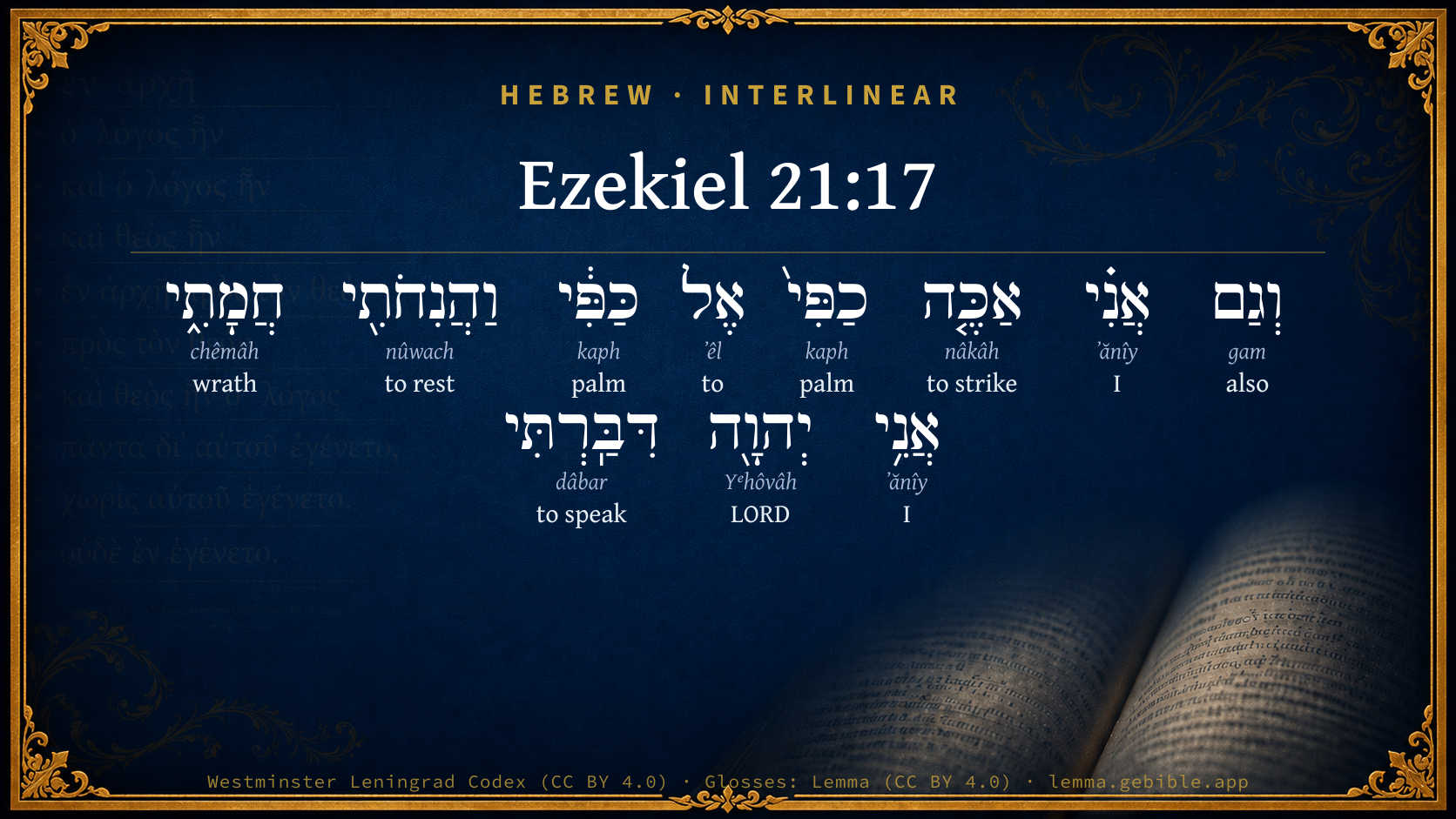
  1. וְגַם gam H1571 “and · also” Conjunction + Particle, Accusative
  2. אֲנִ֗י ʼănîy H589 “I” Pronoun, Personal, 1st Person, Common, Singular
  3. אַכֶּ֤ה nâkâh H5221 “to strike” Verb, Hiphil, Imperfect, 1st Person, Common, Singular
  4. כַפִּי֙ kaph H3709 “palm · my” Noun, Common, Feminine, Singular, Construct + Suffix, Personal, 1st Person, Common, Singular
  5. אֶל ʼêl H413 “to” Preposition
  6. כַּפִּ֔י kaph H3709 “palm · my” Noun, Common, Feminine, Singular, Construct + Suffix, Personal, 1st Person, Common, Singular
  7. חֲמָתִ֑י chêmâh H2534 “wrath · my” Noun, Common, Feminine, Singular, Construct + Suffix, Personal, 1st Person, Common, Singular
  8. אֲנִ֥י ʼănîy H589 “I” Pronoun, Personal, 1st Person, Common, Singular
  9. יְהוָ֖ה Yᵉhôvâh H3068 “LORD” Noun, Proper
  10. דִּבַּֽרְתִּי dâbar H1696 “to speak” Verb, Piel, Perfect, 1st Person, Common, Singular

About this verse

These counts appear in no published source. They are computed here, from the morphology-tagged text and Lemma’s own curated glosses. What Lemma adds →

11
words
9
distinct lemmas
Prophets
section

Grammatical profile

  • 3 verbs
  • 4 nouns
  • 2 pronouns
  • 1 preposition
  • 1 particle

Verb forms

  • אַכֶּ֤ה Hiphil · Imperfect
  • וַהֲנִחֹתִ֖י Hiphil · Sequential Perfect
  • דִּבַּֽרְתִּי Piel · Perfect

Repetition

Words recur within this verse — often emphatic in Hebrew:

  • כַפִּי֙ palm H3709 ×2
  • אֲנִ֗י I H589 ×2

Hebrew & Septuagint length

In English translation the verse runs 20 words from the Hebrew and 18 from the Septuagint (LXX English) — closely comparable.

A rough comparison of the two English renderings, which tokenize alike — not a word-level alignment.

Word counts can differ between the Hebrew and the Greek without any difference in meaning — e.g. the Hebrew direct-object marker אֵת has no separate Greek word, and Greek often adds the article ὁ.

Cross-references

8

Topical passages linked to Ezekiel 21:17 in the Treasury of Scripture Knowledge — connected by theme and wording, ordered by reader-vote popularity; previews shown in the World English Bible.

  • Ezekiel 5:13 Thus shall my anger be accomplished, and I will cause my wrath toward them to rest, and I shall be comforted; and they shall know that I, Yahweh, have spoken in my zeal, when I have accomplished my wrath on them.
  • Ezekiel 21:14 You therefore, son of man, prophesy, and strike your hands together; and let the sword be doubled the third time, the sword of the deadly wounded: it is the sword of the great one who is deadly wounded, which enters into their chambers.
  • Ezekiel 22:13 Behold, therefore, I have struck my hand at your dishonest gain which you have made, and at your blood which has been in the midst of you.
  • Zechariah 6:8 Then he called to me, and spoke to me, saying, "Behold, those who go toward the north country have quieted my spirit in the north country."
  • Numbers 24:10 Balak's anger was kindled against Balaam, and he struck his hands together; and Balak said to Balaam, I called you to curse my enemies, and, behold, you have altogether blessed them these three times.
  • Deuteronomy 28:63 It shall happen that as Yahweh rejoiced over you to do you good, and to multiply you, so Yahweh will rejoice over you to cause you to perish, and to destroy you; and you shall be plucked from off the land where you go in to possess it.
  • Isaiah 1:24 Therefore the Lord, Yahweh of Hosts, The Mighty One of Israel, says: "Ah, I will get relief from my adversaries, And avenge myself of my enemies;
  • Ezekiel 16:42 So will I cause my wrath toward you to rest, and my jealousy shall depart from you, and I will be quiet, and will be no more angry.

Cross-references courtesy of OpenBible.info (CC BY 4.0).

Hebrew and Greek witnesses Masoretic Hebrew ↔ Greek Septuagint

The same verse in the two great witnesses to the Old Testament, shown verse-for-verse.

These are two independent witnesses, not word-aligned to each other, and the Septuagint is shown in lemma (dictionary) form.

Hebrew Ezekiel 21:17 Masoretic · Westminster Leningrad Codex

וְגַם אֲנִ֗י אַכֶּ֤ה כַפִּי֙ אֶל כַּפִּ֔י וַהֲנִחֹתִ֖י חֲמָתִ֑י אֲנִ֥י יְהוָ֖ה דִּבַּֽרְתִּי

I will also strike my hands together, and I will cause my wrath to rest: I, Yahweh, have spoken it.

World English Bible · Public Domain

Greek LXX Ezekiel 21:17 Septuagint · lemma form

ἀνακράζω καί ὀλολύζω υἱός ἄνθρωπος ὅτι αὐτός γίγνομαι ἐν ὁ λαός ἐγώ αὐτός ἐν πᾶς ὁ ἀποἡγέομαι ὁ ἰσραήλ παραοἰκέω ἐπί ῥομφαία γίγνομαι ἐν ὁ λαός ἐγώ διά οὗτος κροτέω ἐπί ὁ χείρ σύ

And I also will clap my hands, and let loose my fury: I the Lord have spoken it.

LXX2012 (modern English Septuagint) · Public Domain

Hebrew: Westminster Leningrad Codex (CC BY 4.0). Greek: Septuagint (public domain); English from LXX2012 (modern English Septuagint) (Public Domain). How the Septuagint differs from the Hebrew →

Targum (Aramaic paraphrase)

1

The Targum is the ancient Jewish Aramaic paraphrase of the Hebrew Scriptures — an interpretive translation, not the Hebrew text itself. Onkelos (literal) and Pseudo-Jonathan (expansive) render the Torah, and Jonathan the Prophets. Coverage is partial: where no permissively-licensed English translation exists for a verse, only the Aramaic is shown. This is verse-level text, not a word-by-word alignment to the Hebrew.

  1. Targum Jonathan Prophets (Joshua–Malachi)
    צְוַח וְאַיְלֵיל בַּר אָדָם אֲרֵי הִיא הֲוַת בְּעַמִי הִיא וְכָל רַבְרְבֵי יִשְׂרָאֵל קְטוֹלֵי חַרְבָּא אִתְכַּנְשׁוּ וְאָתוּ עַל עַמִי מִסְחוֹר סְחוֹר בְּכֵן טְפַח עַל יַרְכָא:

    (no public-domain English translation for this verse)

    Targum Jonathan — Aramaic: “Mikraot Gedolot” (public domain). English: “Sefaria Community Translation” (CC0 1.0 (public-domain dedication)); “London "Chaldee Paraphrase," 1871” (public domain). Text via Sefaria.

Commentary

Notes on Ezekiel 21:17 from classic Christian and Jewish commentators (each source and its license shown beneath its notes). The classic Christian expositions comment on the surrounding passage and are grouped to its opening verse, so a note may address several verses; the Jewish commentaries on the Tanakh (Rashi and others) are per-verse, so they appear only where the commentator wrote on this verse.

Lemma curates 59 commentaries, every one of them public domain or Creative Commons licensed, each selected and text-cleaned for this edition rather than reprinted as found. About our sources →

Trapp's Complete Commentary

John Trapp

Eze 21:17 I will also smite mine hands together, and I will cause my fury to rest: I the LORD have said [it].

Ver. 17. I will also smite mine hands together.] As animating the enemy and rejoicing at thy ruin. {a} Chaldee, I will bring revenge upon revenge;

“ Animumque explesse iuvabit. ”

“And he will help satisfy the spirit.”

{a} Exultat quasi hortator gladii saevientis. He exalts just as I will exhortthe angry sword. - Jerome.

John Trapp, A Commentary or Exposition upon All the Books of the Old and New Testament (1647–1656) — public domain. Text from a community e-Sword module.

Jamieson, Fausset & Brown

Robert Jamieson, A. R. Fausset & David Brown

Jehovah Himself smites His hands together, doing what He had commanded Ezekiel to do (see on Eze 21:14), in token of His smiting Jerusalem; compare the similar symbolical action (Kg2 13:18-19).

cause . . . fury to rest--give it full vent, and so satisfy it (Eze 5:13).

Jamieson, Fausset & Brown — Commentary Critical and Explanatory on the Whole Bible (1871) — public domain (CC PDM 1.0). Text via the HelloAO Bible API.

Ellicott's Commentary for English Readers

(17) My fury to rest.—As in Eze_16:42, because it has accomplished its purpose and has nothing more to do. (Comp. Eze_5:13; Eze_14:13.)

At Eze_21:18 the third and final prophecy of the chapter begins, and, besides being much more explicit than the others, includes also a new subject (Eze_21:28-32), a prophecy against Ammon. Hitherto it has only been foretold that Judah shall be desolated, now it is added that this shall be effected by the king of Babylon, and that he shall also extend his conquests to the Ammonites.

A Bible Commentary for English Readers, edited by Charles John Ellicott (1878–1897) — public domain. Text from a community e-Sword module.

The Cambridge Bible for Schools and Colleges

gen. ed. J. J. S. Perowne

17. smite mine hands] The strong anthropomorphism suggests a tumult of emotion in the Divine mind, and sympathy with the terrible work.

cause my fury to rest] Appease, or, assuage my fury. Cf. ch. Eze_5:13.

The Cambridge Bible for Schools and Colleges (gen. ed. J. J. S. Perowne; Cambridge University Press, 1878–1918) — public domain. Text from a community e-Sword module.

John Gill's Exposition

Also thou, son of man, appoint thee two ways, that the sword of the king of Babylon may come,.... Describe or draw out upon a table or tile, as in Eze 4:1, or on the ground, two roads, such as are described in maps; which it may be supposed the king of Babylon would take, either the one or the other, in order to make war against some king or another:

both twain shall come forth out of one land; both ways must be drawn as coming from one country, even Babylon;

and choose thou a place, choose it at the head of the way to the city; fix upon some spacious place, where Nebuchadnezzar may be supposed to bring his army, as a proper rendezvous for them to muster them in; and let be where two ways meet, that lead to cities, one to one city, and another to another: and it seems that upon the desert of Arabia, through which the king of Babylon came, there was such a place, where two ways met, and one led to Jerusalem, and the other to Rabbath; and this is the place the prophet was to describe, and where in fact Nebuchadnezzar came.

John Gill's Exposition of the Whole Bible (1746–1763) — public domain (CC PDM 1.0). Text via the HelloAO Bible API.

Matthew Poole's English Annotations

Smite mine hands together, in token of my approbation and well-pleasedness in those executions which the Chaldeans shall finish against you; those hands, that were used to restrain and check, shall excite and encourage your enemies.

My fury: see Eze 5:13.

Matthew Poole's English Annotations on the Holy Bible (1683–1685) — public domain. Text from a community e-Sword/MySword module.

The Pulpit Commentary

Vers. 17-19. The new section opens in a different strain. Ezekiel sees, as in vision, Nebuchadnezzar and his army on their march. He is told to appoint (better, make, or mark, as on a brick or tile, as in Eze_4:1) a place where the road bifurcated. Both come from one land, i.e. from Babylon; but from that point onwards one road led to Rabbath, the capital of the Ammonites (Deu_3:11; 2Sa_11:1) the other to Jerusalem. Apparently, the exiles and the people of Judah flattered themselves that the former was the object of the expedition. The answer to that false hope is a vivid picture of what was passing in the council of war which Nebuchadnezzar was holding at that parting of the ways. The prophet sees, as it were, the sign post pointing, as with a hand, to each of the two cities The king consults his soothsayers, and uses divinations. Of these Ezekiel enumerates three:

(1) He shakes the arrows to and fro (Revised Version). This was known among the Greeks as the belomanteia The arrows were put into a quiver, with names (in this case probably Rabbath and Jerusalem) written on them. One was then drawn, or thrown, out as by chance, and decided the direction of the campaign.

(2) He consults the images (Hebrew, teraphim). The modus operandi in this case is not known, but Jud_1:18:18 and Hos_3:4 point to some such use of them.

(3) There remains the sacrifice and the inspection of the liver, familiar alike in Greek, Etrurian, and Roman divination (Cicero, "De Divin.," 6:13).

The satisfaction of God"s fury.

This is a most awful subject. Gladly would we leave it alone. Oh for a fresh sight of God"s eternal love, instead of this horror of great darkness, this vision of wrath and judgment unrestrained and fully satisfied! Yet the fearful words are before us and they invite our earnest regard.

I GOD"S FURY IS FEARFULLY PROVOKED BY SIN. It is only against sinners that these dreadful words are written. The righteous may share the temporal calamities that smite the wicked (ver. 4), but they incur none of the wrath of God that lies behind those calamities. Nevertheless, as we are all sinners, there is little comfort in this thought. Consider how greatly sin provokes wrath.

1. It is committed in full daylight. The Jews possessed the land. We know Christ. We cannot plead ignorance. Even the heathen have accusing consciences.

2. It is committed against love. We sin against our Father, to whom we ewe everything, and who has been infinitely gracious to us.

3. It is committed in spite of warnings. Israel had her grand procession of minatory prophets from Elijah to Ezekiel. We have the warnings of the Bible.

4. It is committed without necessity. There is a better way and a happier. Nothing but the most wilful perversity can make us choose the evil path. A saving hand has been held out to protect us. When we sin we reject that help.

5. It is committed after Gods long suffering has been tried. He has long refrained from punishing. Yet men have made his long suffering an excuse for greater sin. Thus they have "treasured up wrath for the day of wrath.

II GOD"S FURY CANNOT BE RESISTED.

1. It cannot be opposed by mens powers. The sinner has to contend with the Almighty and the All-wise. The stoutest must fall in such a contest, and the most cunning must fail in the foolish attempt to outwit God.

2. It cannot be opposed by any excuses. Unhappily, there is no doubt as to the guilt of the sinner. He had opportunities of return, and he rejected them. Conscience must paralyze resistance.

3. It cannot be opposed by Gods love. There is no schism in the nature of God. Love itself must approve of wrath directed against hardened impenitence.

III GOD"S FURY WILL BE SATISFIED.

1. It will not fail. Nothing that God attempts can fail. This we may infer as a conclusion from the observations under the previous head. It will not endure forever. When it has accomplished its work it will rest. It may be that some of the results of it will endure forever. The slain man will not arise again on earth, but he is not being killed continuously. The ruined city may never be rebuilt, and yet the earthquake that overthrew temples and palaces has long subsided, and all is now still and calm.

2. It will be satisfied when it has accomplished its end. God"s fury is not like his love. It does not spring unprovoked from his own heart. It is roused by sin, and when it has punished sin, it is satisfied. But this is the most awful satisfaction of it. There is another satisfaction, viz.:

3. It will be satisfied when it is propitiated. This is not stated in the verse before us. But it is the burden of the gospel. Christ our Advocate propitiates the wrath of God. (1Jn_2:1, 1Jn_2:2) Then if we have confessed our sin, and sought the saving help of Christ, we need fear the wrath of God no longer. It is satisfied.

The Pulpit Commentary (1880–1919), ed. H.D.M. Spence-Jones & Joseph S. Exell — public domain. Text from a community e-Sword module.

John Wesley's Explanatory Notes

Smite my hands - In token of my approbation.

John Wesley, Explanatory Notes Upon the Whole Bible (1754–1765) — public domain. Text via the GEBible commentary corpus.

Rashi

Rabbi Shlomo Yitzchaki (Rashi)

and wail Heb. וְהֵילֵל, a term for wailing (יְלָלָה).

for it The sword will be upon My people and upon their princes and officers.

those gathered to the sword Heb. מְגוּרֵי, a gathering of nations coming to the sword were around My people. So did Jonathan render מְגוּרֵי, related to the word in (Prov. 10: 5): “An intelligent son gathers (אוֹגֵר) in the summer”; (ibid. 6:8), “She gathers (אָגְרָה) her food in the harvest”; (Joel 1:17), “garners (מַמְּגֻרוֹת) are demolished”; (Haggai 2:19), “The seed is still in the granary (בַּמְגוּרָה).” Menachem, however, connected it to the word for fear, like (Num. 22:3): “And Moab became terrified (וַיָגָר).”

therefore, clap upon your thigh as a wailing and a lament.

Rashi on the Tanakh — English translations: “The Judaica Press complete Tanach with Rashi, translated by A. J. Rosenberg” (CC BY 4.0); “Pentateuch with Rashi's commentary by M. Rosenbaum and A.M. Silbermann, 1929-1934” (public domain); “The Metsudah Tanach series, Lakewood, N.J” (CC BY 4.0); and “The Book of Joshua, Metsudah Publications, 1997” (CC BY 4.0). Text via Sefaria.

Lesson kit

Teaching starters — assembled from the data on this page, not authored interpretation. Every prompt links to the verse data it draws on. Edit before teaching.

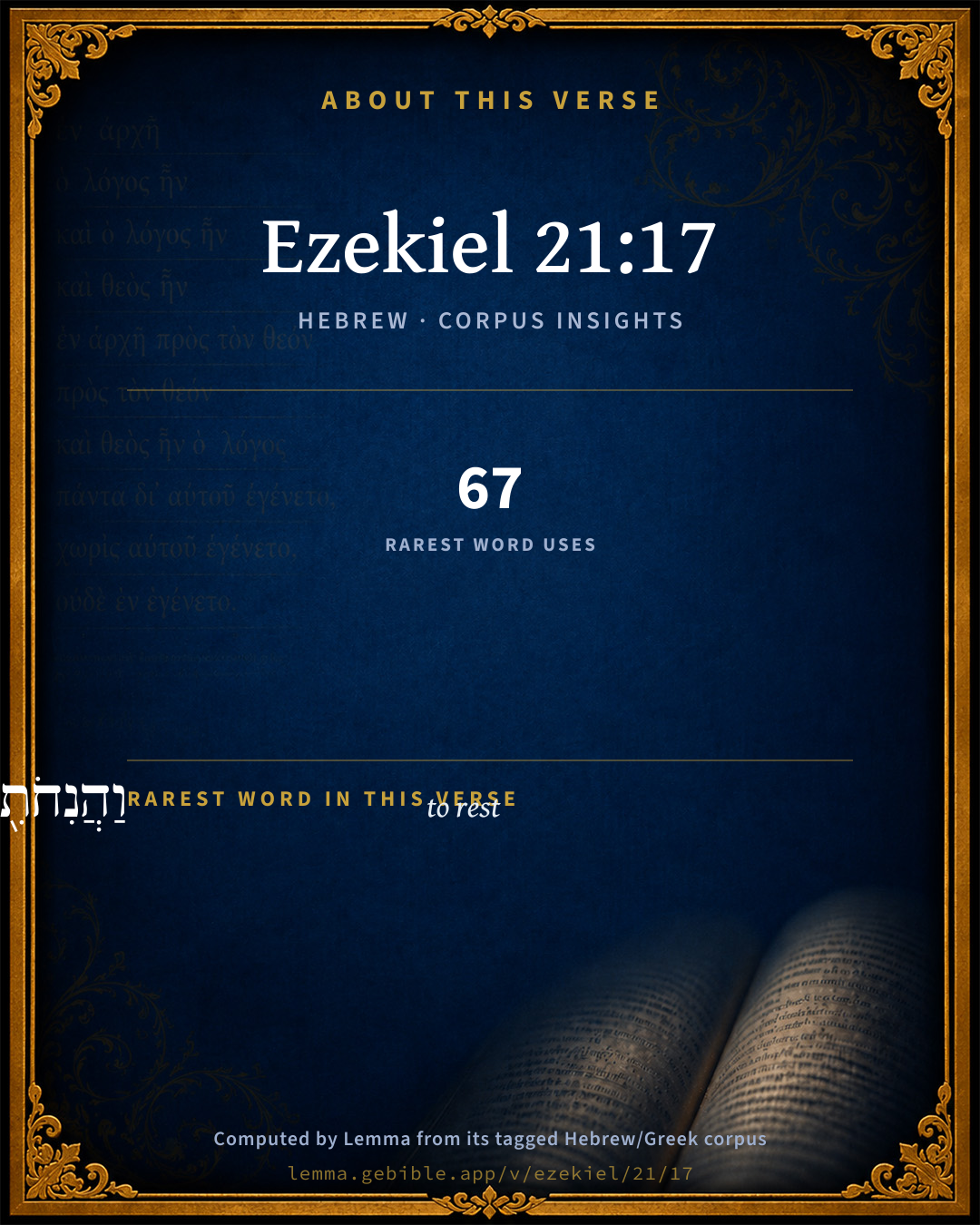
Ezekiel, in the Prophets, opens this verse with 11 words (9 distinct Hebrew lemmas). Its most distinctive word is nûwach (“to rest”). A historical commentator’s framing appears above. Read the whole chapter for the surrounding context.

Discussion questions

  1. What does “to rest” (nûwach) contribute to the verse as a whole?
  2. Ezekiel 5:13 shares this passage’s theme. How do the two illuminate each other?
  3. “palm” occurs 2× in this one verse. What is the effect of the repetition?
  4. These translations render this verse differently. What is at stake in choosing one wording over another?
  5. The verb «אַכֶּ֤ה» is Hiphil Imperfect. How does its form color the action?
  6. Reading how Trapp's Complete Commentary and Jamieson, Fausset & Brown read this verse, where do the two commentators agree and where do they part?

Things to notice

Reading settings

Reading text

Shown beneath each verse's original-language words.

Old Testament
Old Testament edition

Read the OT as the Masoretic Hebrew (MT) or the Greek Septuagint (LXX).

English shown for the Greek Septuagint (in the Hebrew ↔ Greek comparison).

Comparing translations? Open the Compare panel on any verse page to stack up to four side by side.