
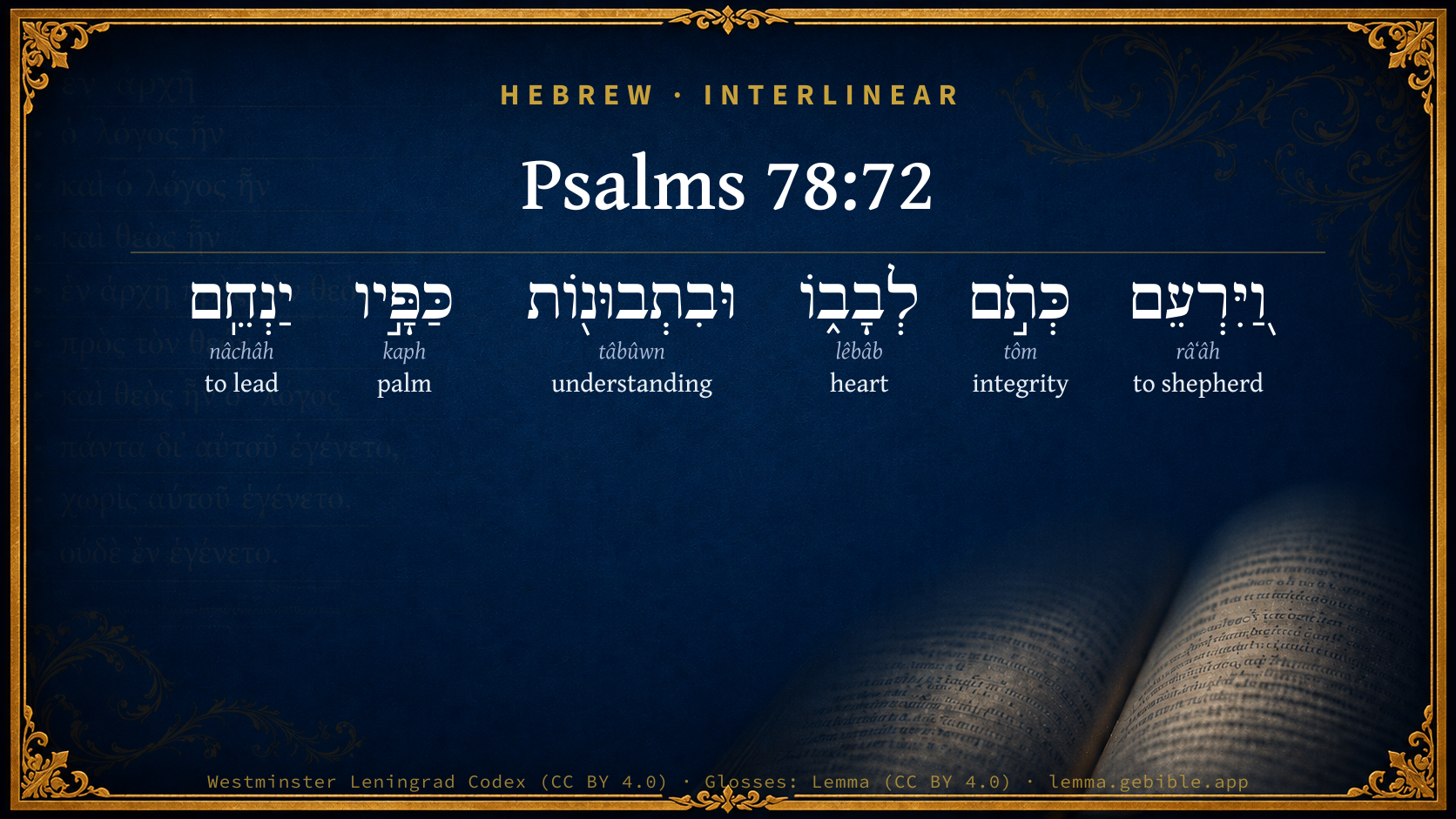
Psalms 78:72

Hebrew (Westminster Leningrad Codex) Psalms 78:72 appears in the Hebrew Old Testament. The text above is from the Westminster Leningrad Codex. Each word links to its Strong’s number, a concise gloss, and parsing drawn from the Open Scriptures Hebrew Bible morphology. Click any word for its full Brown-Driver-Briggs (BDB) entry.
Download image
Cite this verse

Psalms 78:72 (World English Bible). Public Domain. Lemma interlinear Bible study tool, https://lemma.gebible.app/v/psalms/78/72.

Show BibTeX & RIS
BibTeX
RIS
English Translation
So he was their shepherd according to the integrity of his heart, And guided them by the skillfulness of his hands.
World English Bible · Public Domain
Download a study sheet

One document with this verse’s original text, its word-by-word gloss line, the meaning frame, cross-references with their text, attributed commentary, and full source and license credits — printable, and it pastes into notes with its structure intact.

This verse Autodidact and up

Study sheet (.html) Plain text (.txt)

A passage Seminary Student

Up to 50 verses in one chapter. A passage sheet keeps up to 6 commentary sources and 12 cross-references per verse, in the order this page ranks them, and says so on the sheet whenever that leaves anything out. Ask for a single verse and you get the Autodidact verse sheet above.

Everything on this page stays free to read, with no account — the sheet is a download of what is already on screen, not access to it.

Want to remove ads? Support Godless Engineer
Compare translations 3

The same verse in 3 English versions, stacked beneath the original-language interlinear above. Click any original word for its lexicon entry.

Each is an independent rendering of the whole verse — the interlinear is not word-aligned to these translations.

Highlighted words mark where these versions differ — a whole-verse word diff, not a word-by-word alignment.

  • World English Bible Public Domain
    So he was their shepherd according to the integrity of his heart, And guided them by the skillfulness of his hands.
  • King James Version Public Domain
    So he fed them according to the integrity of his heart; and guided them by the skilfulness of his hands.
  • unfoldingWord Literal Text CC BY-SA 4.0
    And he shepherded them according to the integrity of his heart, and with the skillfulness of his hands he guided them.

unfoldingWord Literal Text — © unfoldingWord, licensed CC BY-SA 4.0. Word-aligned USFM3 via Door43 (git.door43.org/unfoldingWord/en_ult).

Versions to compare (up to 4)

3 of 4 selected

Show all 18 translations

Every available English version of this verse, each an independent rendering of the whole verse.

  • World English Bible Public Domain
    So he was their shepherd according to the integrity of his heart, And guided them by the skillfulness of his hands.
  • Berean Standard Bible Public Domain
    So David shepherded them with integrity of heart and guided them with skillful hands.
  • Majority Standard Bible Public Domain
    So David shepherded them with integrity of heart and guided them with skillful hands.
  • King James Version Public Domain
    So he fed them according to the integrity of his heart; and guided them by the skilfulness of his hands.
  • American Standard Version (1901) Public Domain
    So he was their shepherd according to the integrity of his heart, And guided them by the skilfulness of his hands. Psalm 79 A Psalm of Asaph.
  • Revised Version (1885) Public Domain
    So he fed them according to the integrity of his heart; and guided them by the skilfulness of his hands.
  • Geneva Bible (1599) Public Domain
    So he fed them according to the simplicitie of his heart, and guided them by the discretion of his hands.
  • Douay-Rheims (1899) Public Domain
    And he fed them in the innocence of his heart: and conducted them by the skilfulness of his hands.
  • Young's Literal Translation Public Domain
    And he ruleth them according to the integrity of his heart, And by the skilfulness of his hands leadeth them!
  • Literal Standard Version CC BY-SA 4.0
    And he rules them according to the integrity of his heart, || And leads them by the skillfulness of his hands!
  • Unlocked Literal Bible CC BY-SA 4.0
    David shepherded them with the integrity of his heart, and he guided them with the skill of his hands.
  • unfoldingWord Literal Text CC BY-SA 4.0
    And he shepherded them according to the integrity of his heart, and with the skillfulness of his hands he guided them.
  • Darby Bible Public Domain
    And he fed them according to the integrity of his heart, and led them by the skilfulness of his hands.
  • World Messianic Bible Public Domain
    So he was their shepherd according to the integrity of his heart, and guided them by the skillfulness of his hands.
  • Webster's Bible Public Domain
    So he fed them according to the integrity of his heart; and guided them by the skillfulness of his hands.
  • Free Bible Version CC BY-SA 4.0
    Like a shepherd, he took care of them with sincere devotion, leading them with skillful hands.
  • Bible in Basic English Public Domain
    So he gave them food with an upright heart, guiding them by the wisdom of his hands.
  • JPS Tanakh (1917) Public Domain
    So he shepherded them according to the integrity of his heart; and lead them by the skilfulness of his hands.

Literal Standard Version (2020), Covenant Press — licensed CC BY-SA 4.0. Text via the HelloAO Bible API (eBible.org). Unlocked Literal Bible (unfoldingWord) — licensed CC BY-SA 4.0. Text via the HelloAO Bible API (eBible.org). unfoldingWord Literal Text — © unfoldingWord, licensed CC BY-SA 4.0. Word-aligned USFM3 via Door43 (git.door43.org/unfoldingWord/en_ult). Free Bible Version, Dr. Jonathan Gallagher — licensed CC BY-SA 4.0. Text via the HelloAO Bible API (eBible.org).

Word by word

More ways to search: Search by grammar → Find every occurrence → Compare this word →

Practice this passage: Drill this verse → Learn its vocabulary →

כְּתֹ֣ם
tôm
H8537
“like/as · integrity of”
Preposition + Noun, Common, Masculine, Singular, Construct
Part of Speech
Preposition + Noun
Type
Common
Gender
Masculine
Number
Singular
State
Construct
Full BDB Definition

Origin: from H8552

TWOT: 2522a

integrity, completeness - completeness, fulness - innocence, simplicity - integrity
  1. וַ֭יִּרְעֵם râʻâh H7462 “and · to shepherd · them” Conjunction + Verb, Qal, Sequential Imperfect, 3rd Person, Masculine, Singular + Suffix, Personal, 3rd Person, Masculine, Plural
  2. לְבָב֑וֹ lêbâb H3824 “heart · his” Noun, Common, Masculine, Singular, Construct + Suffix, Personal, 3rd Person, Masculine, Singular
  3. וּבִתְבוּנ֖וֹת tâbûwn H8394 “and · in/at · understanding of” Conjunction + Preposition + Noun, Common, Feminine, Plural, Construct
  4. כַּפָּ֣יו kaph H3709 “palms · his” Noun, Common, Feminine, Dual, Construct + Suffix, Personal, 3rd Person, Masculine, Singular
  5. יַנְחֵֽם nâchâh H5148 “to lead · them” Verb, Hiphil, Imperfect, 3rd Person, Masculine, Singular + Suffix, Personal, 3rd Person, Masculine, Plural

About this verse

These counts appear in no published source. They are computed here, from the morphology-tagged text and Lemma’s own curated glosses. What Lemma adds →

6
words
6
distinct lemmas
Wisdom
section

Notable vocabulary

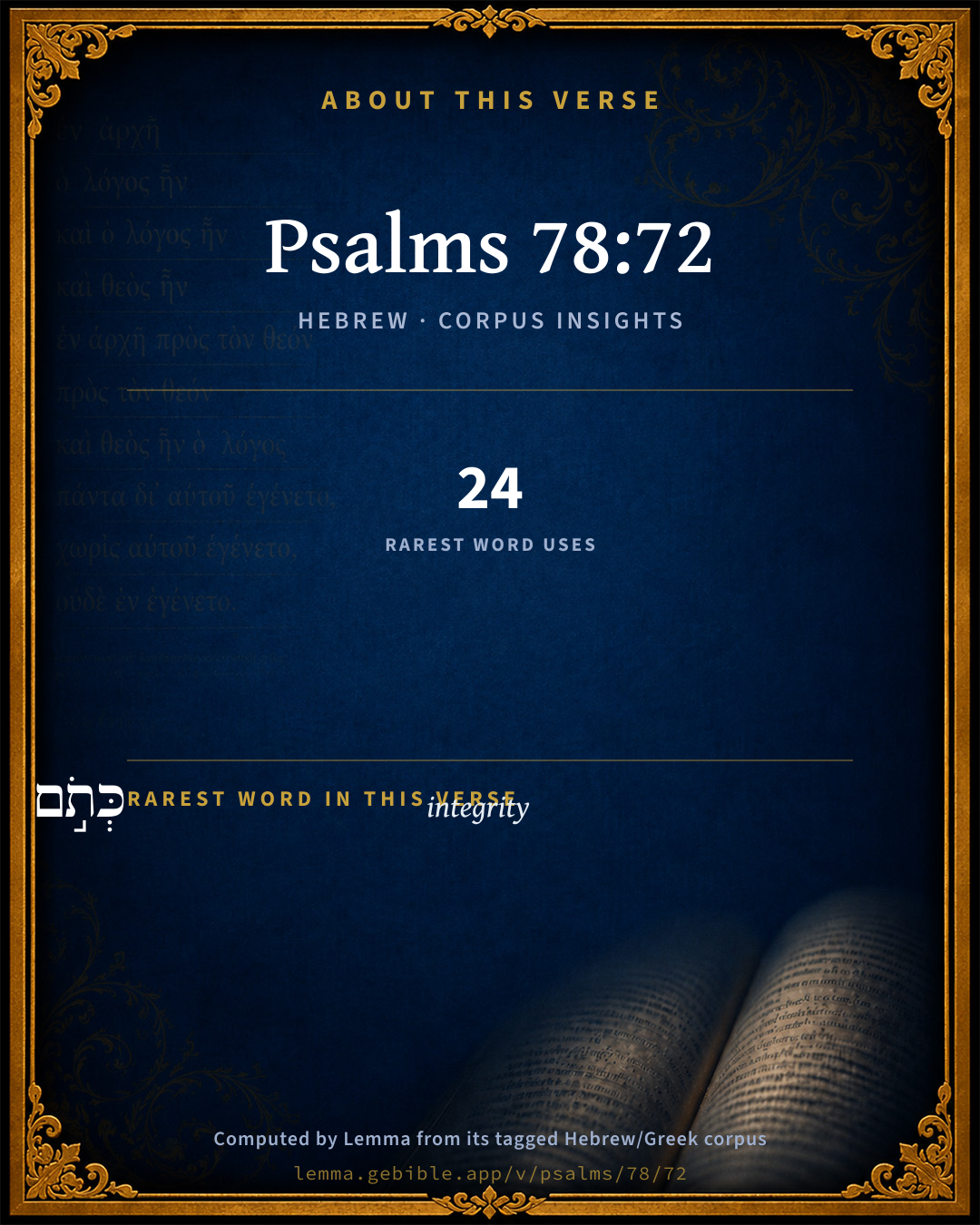
The rarest word here is כְּתֹ֣ם integrity H8537 — appearing just 24 times in the whole Hebrew Bible.

Shared distinctive vocabulary

כְּתֹ֣ם integrity H8537 occurs in 24 verses of the Hebrew Bible. Also found in:

Grammatical profile

  • 2 verbs
  • 4 nouns

Verb forms

  • וַ֭יִּרְעֵם Qal · Sequential Imperfect
  • יַנְחֵֽם Hiphil · Imperfect

Hebrew & Septuagint length

In English translation the verse runs 21 words from the Hebrew and 19 from the Septuagint (LXX English) — closely comparable.

A rough comparison of the two English renderings, which tokenize alike — not a word-level alignment.

Word counts can differ between the Hebrew and the Greek without any difference in meaning — e.g. the Hebrew direct-object marker אֵת has no separate Greek word, and Greek often adds the article ὁ.

Cross-references

14

Topical passages linked to Psalms 78:72 in the Treasury of Scripture Knowledge — connected by theme and wording, ordered by reader-vote popularity; previews shown in the World English Bible.

  • 1 Kings 9:4 As for you, if you will walk before me, as David your father walked, in integrity of heart, and in uprightness, to do according to all that I have commanded you, and will keep my statutes and my ordinances;
  • 2 Timothy 2:15 Give diligence to present yourself approved by God, a workman who doesn't need to be ashamed, properly handling the Word of Truth.
  • Isaiah 11:2–4 The Spirit of Yahweh shall rest on him, the spirit of wisdom and understanding, the spirit of counsel and might, the spirit of knowledge and of the fear of Yahweh.
  • Psalms 101:1–8 I will sing of loving kindness and justice. To you, Yahweh, I will sing praises.
  • Acts 13:22 When he had removed him, he raised up David to be their king, to whom he also testified, 'I have found David the son of Jesse, a man after my heart, who will do all my will.'
  • 2 Samuel 8:15 David reigned over all Israel; and David executed justice and righteousness to all his people.
  • 1 Kings 3:6–9 Solomon said, You have shown to your servant David my father great loving kindness, according as he walked before you in truth, and in righteousness, and in uprightness of heart with you; and you have kept for him this great loving kindness, that you have given him a son to sit on his throne, as it is this day.
  • 1 Kings 3:28 All Israel heard of the judgment which the king had judged; and they feared the king: for they saw that the wisdom of God was in him, to do justice.
  • 1 Kings 15:5 because David did that which was right in the eyes of Yahweh, and didn't turn aside from anything that he commanded him all the days of his life, except only in the matter of Uriah the Hittite.
  • Psalms 75:2 When I choose the appointed time, I will judge blamelessly.
  • Zechariah 11:15–17 Yahweh said to me, "Take for yourself yet again the equipment of a foolish shepherd.
  • Acts 13:36 For David, after he had in his own generation served the counsel of God, fell asleep, and was laid with his fathers, and saw decay.
  • James 1:5 But if any of you lacks wisdom, let him ask of God, who gives to all liberally and without reproach; and it will be given to him.
  • 2 Corinthians 3:5–6 not that we are sufficient of ourselves, to account anything as from ourselves; but our sufficiency is from God;

Cross-references courtesy of OpenBible.info (CC BY 4.0).

Hebrew and Greek witnesses Masoretic Hebrew ↔ Greek Septuagint

The same verse in the two great witnesses to the Old Testament, shown verse-for-verse.

You’re reading Greek Psalm 77 (Hebrew Psalm 78). The Septuagint counts the superscription, so verse numbers can differ from the Hebrew — chapter-level alignment, not verse-by-verse. Numbering follows Rahlfs.

These are two independent witnesses, not word-aligned to each other, and the Septuagint is shown in lemma (dictionary) form.

Hebrew Psalms 78:72 Masoretic · Westminster Leningrad Codex

וַ֭יִּרְעֵם כְּתֹ֣ם לְבָב֑וֹ וּבִתְבוּנ֖וֹת כַּפָּ֣יו יַנְחֵֽם

So he was their shepherd according to the integrity of his heart, And guided them by the skillfulness of his hands.

World English Bible · Public Domain

Greek LXX Greek Psalm 77:72 Septuagint · lemma form

καί ποιμαίνω αὐτός ἐν ὁ ἀκακία ὁ καρδία αὐτός καί ἐν ὁ σύνεσις ὁ χείρ αὐτός ὁδηγέω αὐτός

So he tended them in the innocency of his heart; and guided them by the skillfulness of his hands.

LXX2012 (modern English Septuagint) · Public Domain

Hebrew: Westminster Leningrad Codex (CC BY 4.0). Greek: Septuagint (public domain); English from LXX2012 (modern English Septuagint) (Public Domain). How the Septuagint differs from the Hebrew →

Commentary

Notes on Psalms 78:72 from classic Christian and Jewish commentators (each source and its license shown beneath its notes). The classic Christian expositions comment on the surrounding passage and are grouped to its opening verse, so a note may address several verses; the Jewish commentaries on the Tanakh (Rashi and others) are per-verse, so they appear only where the commentator wrote on this verse.

Lemma curates 59 commentaries, every one of them public domain or Creative Commons licensed, each selected and text-cleaned for this edition rather than reprinted as found. About our sources →

Trapp's Complete Commentary

John Trapp

Psa 78:72 So he fed them according to the integrity of his heart; and guided them by the skilfulness of his hands.

Ver. 72. So he fed them, &c.] See Psa 78:70. He was not malus vir bonus princeps (as is said of our Richard III), but every way accomplished, and active for the good of his subjects.

John Trapp, A Commentary or Exposition upon All the Books of the Old and New Testament (1647–1656) — public domain. Text from a community e-Sword module.

Joseph Benson's Commentary

Psa 78:72. So he fed them — Having so great a trust put into his hands, he obtained mercy of the Lord to be found both skilful and faithful in the discharge of it; he fed them — That is, he ruled and taught them, guided and protected them, 1st, Very honestly; according to the integrity of his heart — Aiming at nothing else but the glory of God, and the good of the people committed to his charge. The principles of religion were the maxims of his government, which he administered, not with carnal policy, but with godly sincerity, by the grace of God. 2d, Very discreetly; he did it by the skilfulness of his hands — He was not only very sincere in what he designed, but very prudent in what he performed, and chose out the most proper means in pursuit of his end; for his God did instruct him to discretion. Happy the people that are under such a government! And with good reason doth the psalmist make this the finishing, crowning instance of God’s favour to Israel; for David was a type of Christ, the great and good Shepherd, who was humbled first and then exalted; and of whom it was foretold, that he should be filled with the spirit of wisdom and understanding, and should judge and reprove with equity, Isa 11:3-4. On the integrity of his heart, and the skilfulness of his hands, all his subjects may entirely rely; and of the increase of his government and peace there shall be no end.

Joseph Benson's Commentary on the Old and New Testaments (1811–1818) — public domain. Text from a community e-Sword module.

J. A. Alexander on Psalms

Joseph Addison Alexander

72. (Psa 78:72) And he has fed them after his integrity of heart, and in the skill (or prudence) of his hands will lead them (still). This is no sudden interruption of the psalm, but the conclusion to which all was tending from the first. At the same time it implies that when the psalm was written, David was still reigning and expected to reign longer. Besides the divine attestation here afforded to his theocratical fidelity, the verse may be regarded as a beautiful tribute to the good and great King from his chief musician and fellow-seer. To lead, in the last clause, is to lead or tend a flock, and, with the parallel term feed, makes up the full description of a shepherd.

Joseph Addison Alexander, The Psalms Translated and Explained (1850) — public domain. Text from a community e-Sword module.

Geneva Bible (1599)

Geneva Bible translators

He showeth wherein a king’s charge standeth: to wit, to provide faithfully for his people, to guide them by counsel, and defend them by power.

Geneva Bible (1599) marginal notes — public domain. Text via Bolls.life.

Adam Clarke's Commentary

Verse 72. So he fed them] Here David is mentioned as having terminated his reign. He had fed the people, according to the integrity of his heart, for that was ever disposed to do the will of God in the administration of the kingdom: and his hand being skilful in war, he always led them out to victory against their enemies.

ANALYSIS OF THE SEVENTY-EIGHTH PSALM

The psalmist, considering that it is God's command that his works be not forgotten, but that the father should deliver his former doings to posterity, that they might be to them both comfort and instruction, deter them from sin, and persuade them to fear God, gives in this Psalm a long catalogue of God's dealings with his people, even from their coming out of Egypt to the conclusion of the reign of David.

There are three principal parts in this Psalm: -

I. A preface, in which the psalmist exhorts men to learn and declare the way of God, Ps 78:1-9.

II. A continued narrative of God's administration among the people, and their stubbornness, disobedience, and contumacy; together with the punishments which God inflicted upon them, Ps 78:9-67.

III. His mercy, manifested in the midst of judgment; that he did not cut them off, but, after the rejection of Ephraim, (Israel,) made choice of Judah, Zion, and David.

I. In the PREFACE or exordium he labours to gain attention: "Give ear, O my people," Ps 78:1.

1. Shows that he is about to deliver doctrines and precepts from heaven. It is God's law, and it should be heard: 1. For its excellence, Ps 78:2. 2. For its certainty, Ps 78:3.

2. He shows the end, which is another argument for attention. 1. It must not be hidden from their children, that God might be praised, Ps 78:4. 2. And his power magnified; and 3. His people edified, Ps 78:5.

Then follow the duties of their children, which are three: 1. That they might know God, his law, his works, Ps 78:6. 2. That they might trust in him, Ps 78:7. 3. That they might be obedient, Ps 78:8.

II. The NARRATION. Their fathers were stubborn and rebellious, of which he gives several examples: -

1. In Ephraim: "They turned back in the day of battle," Ps 78:9.

2. They kept not the covenant of God, Ps 78:10.

3. They forgat his works in Egypt, Ps 78:11.

The psalmist extends this narrative, and shows, 1. God's goodness; 2. Israel's obstinacy; 3. Their punishment.

I. His goodness in bringing them out of Egypt in such a marvellous way, Ps 78:12. 1. He divided the Red Sea, Ps 78:13. 2. He made the waters to stand on a heap, Ps 78:13.

1. His care in guiding them: 1. In the daytime by a cloud, Ps 78:14. 2. In the night by fire, Ps 78:14.

2. His love in providing for them. 1. He clave the rock that they might have water, Ps 78:15. 2. He caused these waters to follow them as rivers, Ps 78:16. 3. And thus they had an abundant supply, Ps 78:16.

II. Israel's obstinacy. 1. They sinned. 2. More and more. 3. Provoked the Holy One of Israel, Ps 78:17-18.

They were incredulous.

1. They tempted God by desiring other supplies than his providence had designed. He gave them manna; they would have flesh.

2. They questioned his power, Ps 78:19.

3. They were foolishly impatient, and must have immediately whatever they thought proper, else they murmured. They said, 1. He smote the rock, and the water gushed out. 2. But can he give bread also? Ps 78:20.

III. Their punishment. 1. The Lord was wroth, Ps 78:21. 2. A fire was kindled. 3. Because they believed him not, nor trusted in his salvation, Ps 78:22.

He provided manna for them; an especial blessing, on various considerations.

1. It came from heaven, Ps 78:23.

2. It came abundantly. He "rained it down," Ps 78:24.

3. It was most excellent: "Man did eat angels' food," Ps 78:25.

Weary of this, they desired flesh. In this also God heard them. 1. He brought quails. 2, In abundance. 3. Brought them to and about the camp, so that they had no labour to find them, Ps 78:25-26; Ps 78:28. 4. They were all gratified with them, Ps 78:29.

See God's justice in their punishment, and the cause of it. 1. They were "not estranged from their lust," Ps 78:30. 2. His wrath came upon them. 3. It came suddenly. 4. It slew them. 5. Even the chief of them, Ps 78:31.

See their sin notwithstanding. 1. For all this, they sinned yet more. 2. They were incredulous, Ps 78:32. 3. He caused them to consume their days in vanity. 4. And their years (forty long years) in trouble, Ps 78:33.

They began apparently to relent. 1. They sought him. 2. They returned. 3. They sought after God. 4. They remembered that he was their Rock. 5. And the Most High their Redeemer, Ps 78:34-35.

But in this, their apparent amendment, they were guilty - 1. Of hypocrisy, Ps 78:36. 2. Of insincerity, Ps 78:37. 3. Of instability: "They were not steadfast in his covenant," Ps 78:37.

On a review of this, the prophet extols the goodness of God that bore with such a people.

1. He opened to them the fountain of mercy: "He being full of compassion."

2. He displayed an act of this mercy: "He forgave their iniquity."

3. Though he punished in a measure, yet he restrained his vindictive justice, and destroyed them not, Ps 78:38.

His motives for this tenderness: 1. He remembered that they were but flesh. 2. That, their probation once ended, their state was fixed for ever, Ps 78:39. See the note. See Clarke on Ps 78:39.

He proceeds with the story of their rebellions. 1. They provoked him often in the wilderness. 2. They grieved him in the desert, Ps 78:40. 3. They returned to sin, tempted him. 4. Insulted him. 5. And forgat all his past mercies, Ps 78:41-43. More particularly, 1. They remembered not his hand, Ps 78:42. 2. Nor his signs in Egypt, Ps 78:44.

The wonders which he wrought in Egypt. Five of the plagues mentioned: -

First plague. He turned their rivers into blood, Ps 78:44.

Fourth plague. He sent divers flies, Ps 78:45.

Second plague. The frogs destroyed them, Ps 78:45.

Eighth plague. The locusts, Ps 78:46.

Seventh plague. Their vines, c. were destroyed, Ps 78:47.

1. He cast upon them the fierceness of his wrath. 2. Sent evil angels among them. 3. And made a path for his anger, Ps 78:49.

The first plague. He gave their life to the pestilence, Ps 78:50.

The last plague. He slew their first-born, Ps 78:51.

He now gives a recital of God's mercy in the following particulars:

1. He brought his people through the Red Sea, Ps 78:52.

2. He guided them as a flock.

3. He kept them in safety, Ps 78:53.

4. He did not suffer them still to wander, but brought them, - 1. To the border of his sanctuary. 2. Even to Mount Zion. 3. Cast out the heathen before them. 4. And divided them an inheritance by lot, Ps 78:54 Ps 78:55.

Yet still, 1. "They tempted and provoked him." 2. "Kept not his testimonies." 3. "Turned aside" from his worship. 4. Were unfaithful. 5. And idolatrous, Ps 78:55-58.

For this, - 1. God's wrath grows more hot against the people. 2. He greatly abhorred Israel. 3. Forsook the tabernacle. 4. Delivered up the ark. 5. Gave the people to the sword. 6. Gave up the priests to death. 7. And brought upon them general desolation, Ps 78:59-64.

Once more, God - 1. Remembers them in mercy. 2. Fixes his tabernacle among them. 3. Chooses David to be their king. 4. During the whole of whose days they had prosperity in all things, Ps 78:65-72.

Behold here the goodness and severity of God. Reader, learn wisdom by what those have suffered.

Adam Clarke's Commentary on the Bible (1810–1826) — public domain. Text from a community e-Sword/MySword module.

The Cambridge Bible for Schools and Colleges

gen. ed. J. J. S. Perowne

72. the integrity of his heart] Cp. 1Ki_9:4; Psa_7:8; Psa_101:2; and the use of the cognate adjective in Psa_15:2; Psa_18:23.

the skilfulness] The regal faculty of discernment which Solomon desired (1Ki_3:9), and with which he was so richly endowed (1Ki_4:29).

The Cambridge Bible for Schools and Colleges (gen. ed. J. J. S. Perowne; Cambridge University Press, 1878–1918) — public domain. Text from a community e-Sword module.

Albert Barnes' Notes on the Bible

So he fed them - He performed toward them the office of a shepherd.

According to the integrity of his heart - literally, “According to the perfection of his heart.” That is, he was upright and pure in the administration of his government.

And guided them by the skillfulness of his hands - literally, “by the understanding of his hands” - as if the hand had been endued with intelligence. Compare Psa 144:1 : “Which teacheth my hands to war, and my fingers to fight.” See also Psa 137:5. The idea is, that he administered the government with integrity and uprightness. This is a beautiful tribute to the integrity and purity of the administration of David. It is not the language of flattery; it is a simple statement, flowing from the heart, in favor of a just and upright administration; and it is a true statement of what the administration of David was. Save in the matter of Uriah - over which he afterward wept so bitterly - his administration was eminently just, pure, impartial, wise, and benignant; probably none among people have been more so. The whole psalm is thus a beautiful argument showing why the government had been transferred from Ephraim to Judah, and why it had been placed in the hands of David.

Albert Barnes' Notes on the Bible (1834–1885) — public domain. Text from a community e-Sword/MySword module.

Matthew Poole's English Annotations

He commends David for the two necessary ingredients of a good prince.

1. Integrity; whereby he sincerely sought the good and welfare of his people, avoiding and abhorring those counsels and courses which were contrary thereunto.

2. Skilfulness; whereby he managed all the public affairs with singular prudence; which is here ascribed to his hands, not because it was seated in them, but because it was acted and discovered by them, and appeared in all his actions or administrations.

Matthew Poole's English Annotations on the Holy Bible (1683–1685) — public domain. Text from a community e-Sword/MySword module.

The Treasury of David

Charles H. Spurgeon

Ver. 72. So he fed them according to the integrity of his heart. David was upright before God, and never swerved in heart from the obedient worship of Jehovah. Whatever faults he had, he was unfeignedly sincere in his allegiance to Israel's superior king; he shepherded for God with honest heart.

And guided them by the skilfulness of his hands. He was a sagacious ruler, and the psalmist magnifies the Lord for having appointed him. Under David, the Jewish kingdom rose to an honourable position among the nations, and exercised an influence over its neighbours. In closing the Psalm which has described the varying conditions of the chosen nation, we are glad to end so peacefully; with all noise of tumult or of sinful rites hushed into silence. After a long voyage over a stormy sea, the ark of the Jewish state rested on its Ararat, beneath a wise and gentle reign, to be wafted no more hither and thither by floods and gales. The psalmist had all along intended to make this his last stanza, and we too may be content to finish all our songs of love with the reign of the Lord's anointed. Only we may eagerly enquire, when will it come? When shall we end these desert roamings, these rebellions, and chastenings, and enter into the rest of a settled kingdom, with the Lord Jesus reigning as "the Prince of the house of David?"

Thus have we ended this lengthy parable, may we in our life parable have less of sin, and as much of grace as are displayed in Israel's history, and may we close it under the safe guidance of "that great Shepherd of the sheep." AMEN.

Ver. 72. In spite of his transgressions, which he always bitterly repented of and which were therefore blotted out of the Book of God, he remains to all princes and rulers of the earth as the noblest pattern. In perfect inward truth he knew and felt himself to be "King by the grace of God." The crown and sceptre he bore merely in trust from the King of all kings; and to his latest breath he endeavoured with all his earnestness to be found as a genuine theocratic king, who in everything must conduct his earthly government according to the ordinances and directions of God. Therefore the Lord made all that he took in hand prosper, and nothing was clearer to the people than that the Lord was truly with the king. Frederick William Krummacher, in "David, the King of Israel." 1867.

Charles H. Spurgeon's The Treasury of David (1869–1885) — public domain. Psalms only. Text from a community e-Sword/MySword module.

The Pulpit Commentary

So he fed them according to the integrity of his heart. On the whole, David performed his task of governing Israel faithfully. He had the direct testimony of God to that effect. (see 1Ki_9:4) And he guided them by the skilfulness of his hands. David was not only an upright and faithful king, but also a "skilful" or prudent one. He built up his kingdom into an empire without suffering any serious disasters. Israel reached its acme of glory and prosperity under him, decline setting in

The Pulpit Commentary (1880–1919), ed. H.D.M. Spence-Jones & Joseph S. Exell — public domain. Text from a community e-Sword module.

Lesson kit

Teaching starters — assembled from the data on this page, not authored interpretation. Every prompt links to the verse data it draws on. Edit before teaching.

Psalms, in the Wisdom, opens this verse with 6 words (6 distinct Hebrew lemmas). Its most distinctive word is tôm (“integrity”). A historical commentator’s framing appears above. Read the whole chapter for the surrounding context.

Discussion questions

  1. What does “integrity” (tôm) contribute to the verse as a whole?
  2. Genesis 20:5 shares the word «integrity» with this verse. How do the two illuminate each other?
  3. These translations render this verse differently; the difference is in the English rendering, not the original. What questions does that raise?
  4. The verb «וַ֭יִּרְעֵם» is Qal Sequential Imperfect. How does its form color the action?
  5. Reading how Trapp's Complete Commentary and Joseph Benson's Commentary read this verse, where do the two commentators agree and where do they part?

Things to notice

Reading settings

Reading text

Shown beneath each verse's original-language words.

Old Testament
Old Testament edition

Read the OT as the Masoretic Hebrew (MT) or the Greek Septuagint (LXX).

English shown for the Greek Septuagint (in the Hebrew ↔ Greek comparison).

Comparing translations? Open the Compare panel on any verse page to stack up to four side by side.