
Ezra 9:5

Hebrew (Westminster Leningrad Codex) Ezra 9:5 appears in the Hebrew Old Testament. The text above is from the Westminster Leningrad Codex. Each word links to its Strong’s number, a concise gloss, and parsing drawn from the Open Scriptures Hebrew Bible morphology. Click any word for its full Brown-Driver-Briggs (BDB) entry.
Download image
Cite this verse

Ezra 9:5 (World English Bible). Public Domain. Lemma interlinear Bible study tool, https://lemma.gebible.app/v/ezra/9/5.

Show BibTeX & RIS
BibTeX
RIS
English Translation
At the evening offering I arose up from my humiliation, even with my garment and my robe torn; and I fell on my knees, and spread out my hands to Yahweh my God;
World English Bible · Public Domain
Highlights
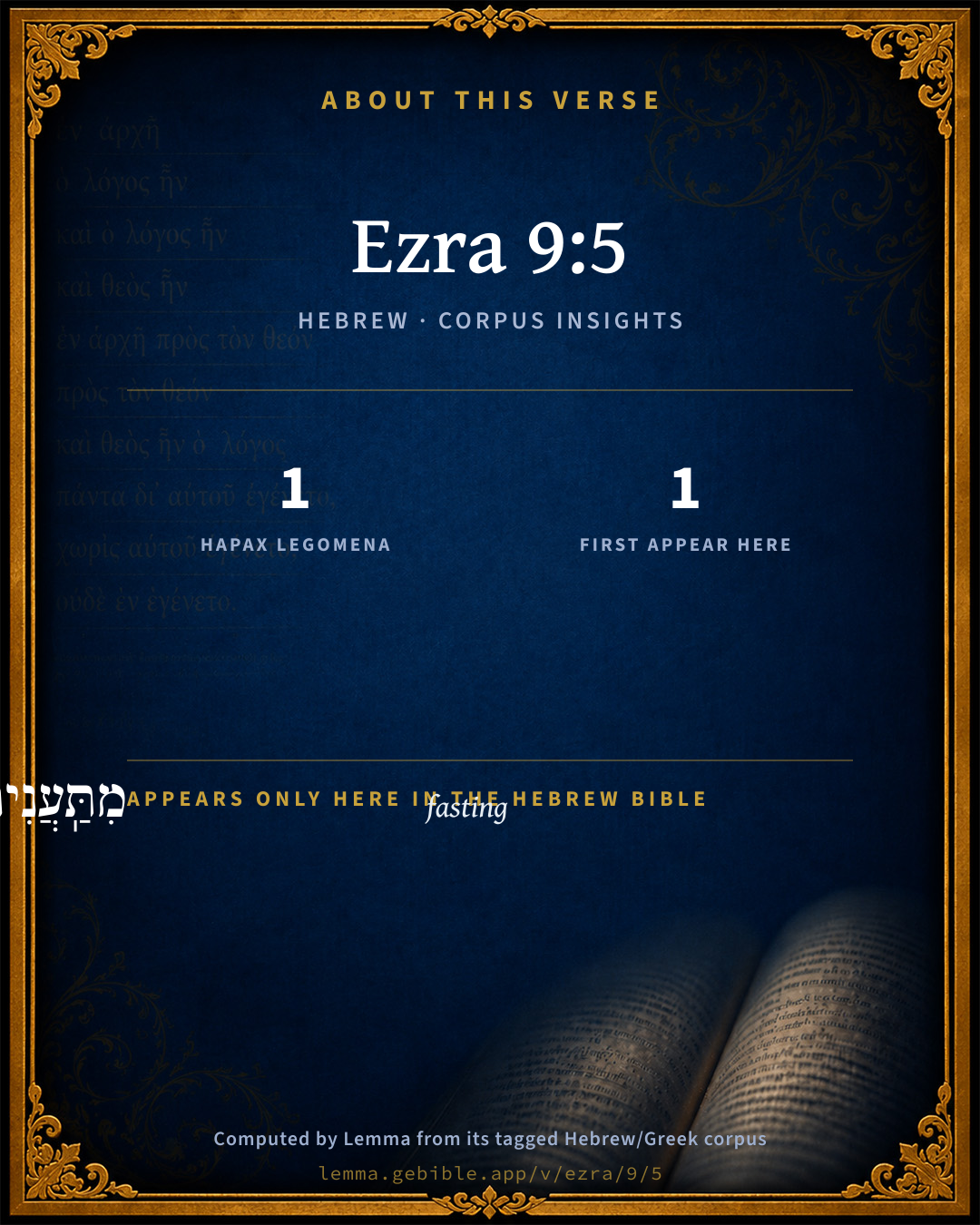
  • 1 hapax legomenon — only here in the Hebrew Bible
  • 1 first appearance in the Hebrew Bible
Full analysis ↓
Download a study sheet

One document with this verse’s original text, its word-by-word gloss line, the meaning frame, cross-references with their text, attributed commentary, and full source and license credits — printable, and it pastes into notes with its structure intact.

This verse Autodidact and up

Study sheet (.html) Plain text (.txt)

A passage Seminary Student

Up to 50 verses in one chapter. A passage sheet keeps up to 6 commentary sources and 12 cross-references per verse, in the order this page ranks them, and says so on the sheet whenever that leaves anything out. Ask for a single verse and you get the Autodidact verse sheet above.

Everything on this page stays free to read, with no account — the sheet is a download of what is already on screen, not access to it.

Want to remove ads? Support Godless Engineer
Compare translations 3

The same verse in 3 English versions, stacked beneath the original-language interlinear above. Click any original word for its lexicon entry.

Each is an independent rendering of the whole verse — the interlinear is not word-aligned to these translations.

Highlighted words mark where these versions differ — a whole-verse word diff, not a word-by-word alignment.

  • World English Bible Public Domain
    At the evening offering I arose up from my humiliation, even with my garment and my robe torn; and I fell on my knees, and spread out my hands to Yahweh my God;
  • King James Version Public Domain
    And at the evening sacrifice I arose up from my heaviness; and having rent my garment and my mantle, I fell upon my knees, and spread out my hands unto the LORD my God,
  • unfoldingWord Literal Text CC BY-SA 4.0
    And at the offering of the evening I arose from my humiliation, and when I tore my garment and my robe. And I knelt down on my knees, and spread out my palms to Yahweh my God.

unfoldingWord Literal Text — © unfoldingWord, licensed CC BY-SA 4.0. Word-aligned USFM3 via Door43 (git.door43.org/unfoldingWord/en_ult).

Versions to compare (up to 4)

3 of 4 selected

Show all 18 translations

Every available English version of this verse, each an independent rendering of the whole verse.

  • World English Bible Public Domain
    At the evening offering I arose up from my humiliation, even with my garment and my robe torn; and I fell on my knees, and spread out my hands to Yahweh my God;
  • Berean Standard Bible Public Domain
    At the evening offering, I got up from my humiliation with my tunic and cloak torn, and I fell on my knees, spread out my hands to the LORD my God,
  • Majority Standard Bible Public Domain
    At the evening offering, I got up from my humiliation with my tunic and cloak torn, and I fell on my knees, spread out my hands to the LORD my God,
  • King James Version Public Domain
    And at the evening sacrifice I arose up from my heaviness; and having rent my garment and my mantle, I fell upon my knees, and spread out my hands unto the LORD my God,
  • American Standard Version (1901) Public Domain
    And at the evening oblation I arose up from my humiliation, even with my garment and my robe rent; and I fell upon my knees, and spread out my hands unto Jehovah my God;
  • Revised Version (1885) Public Domain
    And at the evening oblation I arose up from my humiliation, even with my garment and my mantle rent; and I fell upon my knees, and spread out my hands unto the LORD my God;
  • Geneva Bible (1599) Public Domain
    And at the euening sacrifice I arose vp from mine heauinesse, and when I had rent my clothes and my garment, I fell vpon my knees, and spred out mine hands vnto the Lord my God,
  • Douay-Rheims (1899) Public Domain
    And at the evening sacrifice I rose up from my affliction, and having rent my mantle and my garment, I fell upon my knees, and spread out my hands to the Lord my God,
  • Young's Literal Translation Public Domain
    And at the present of the evening I have risen from mine affliction, and at my rending my garment and my upper robe, then I bow down on my knees, and spread out my hands unto Jehovah my God,
  • Literal Standard Version CC BY-SA 4.0
    And at the present of the evening I have risen from my affliction, and at my tearing my garment and my upper robe, then I bow down on my knees, and spread out my hands to my God YHWH,
  • Unlocked Literal Bible CC BY-SA 4.0
    But at the evening offering I arose from my position of humiliation in my torn clothes and robe, and knelt down and spread my hands to Yahweh my God.
  • unfoldingWord Literal Text CC BY-SA 4.0
    And at the offering of the evening I arose from my humiliation, and when I tore my garment and my robe. And I knelt down on my knees, and spread out my palms to Yahweh my God.
  • Darby Bible Public Domain
    And at the evening oblation I arose up from my humiliation; and with my mantle and my garment rent, I fell on my knees, and spread out my hands to Jehovah my God,
  • World Messianic Bible Public Domain
    At the evening offering I rose up from my humiliation, even with my garment and my robe torn; and I fell on my knees, and spread out my hands to the LORD my God;
  • Webster's Bible Public Domain
    And at the evening sacrifice I arose from my heaviness; and having rent my garment and my mantle, I fell upon my knees, and spread out my hands to the LORD my God,
  • Free Bible Version CC BY-SA 4.0
    At the evening sacrifice, I stood up from where I had been sitting in grief, with my clothes torn, and I kneeled down and held out my hands to the Lord my God.
  • Bible in Basic English Public Domain
    And at the evening offering, having made myself low before God, I got up, and with signs of grief, falling down on my knees, with my hands stretched out to the Lord my God,
  • JPS Tanakh (1917) Public Domain
    And at the evening offering I arose up from my fasting, even with my garment and my mantle rent; and I fell upon my knees, and spread out my hands unto the LORD my God;

Literal Standard Version (2020), Covenant Press — licensed CC BY-SA 4.0. Text via the HelloAO Bible API (eBible.org). Unlocked Literal Bible (unfoldingWord) — licensed CC BY-SA 4.0. Text via the HelloAO Bible API (eBible.org). unfoldingWord Literal Text — © unfoldingWord, licensed CC BY-SA 4.0. Word-aligned USFM3 via Door43 (git.door43.org/unfoldingWord/en_ult). Free Bible Version, Dr. Jonathan Gallagher — licensed CC BY-SA 4.0. Text via the HelloAO Bible API (eBible.org).

Word by word

More ways to search: Search by grammar → Find every occurrence → Compare this word →

Practice this passage: Drill this verse → Learn its vocabulary →

מִתַּֽעֲנִיתִ֔י
taʻănîyth
H8589
“from · fasting · my”
Preposition + Noun, Common, Feminine, Singular, Construct + Suffix, Personal, 1st Person, Common, Singular
Part of Speech
Preposition + Noun
Type
Common
Gender
Feminine
Number
Singular
State
Construct
Full BDB Definition

Origin: from H6031

TWOT: 1652f

humiliation (by fasting), ascetic practice of fasting
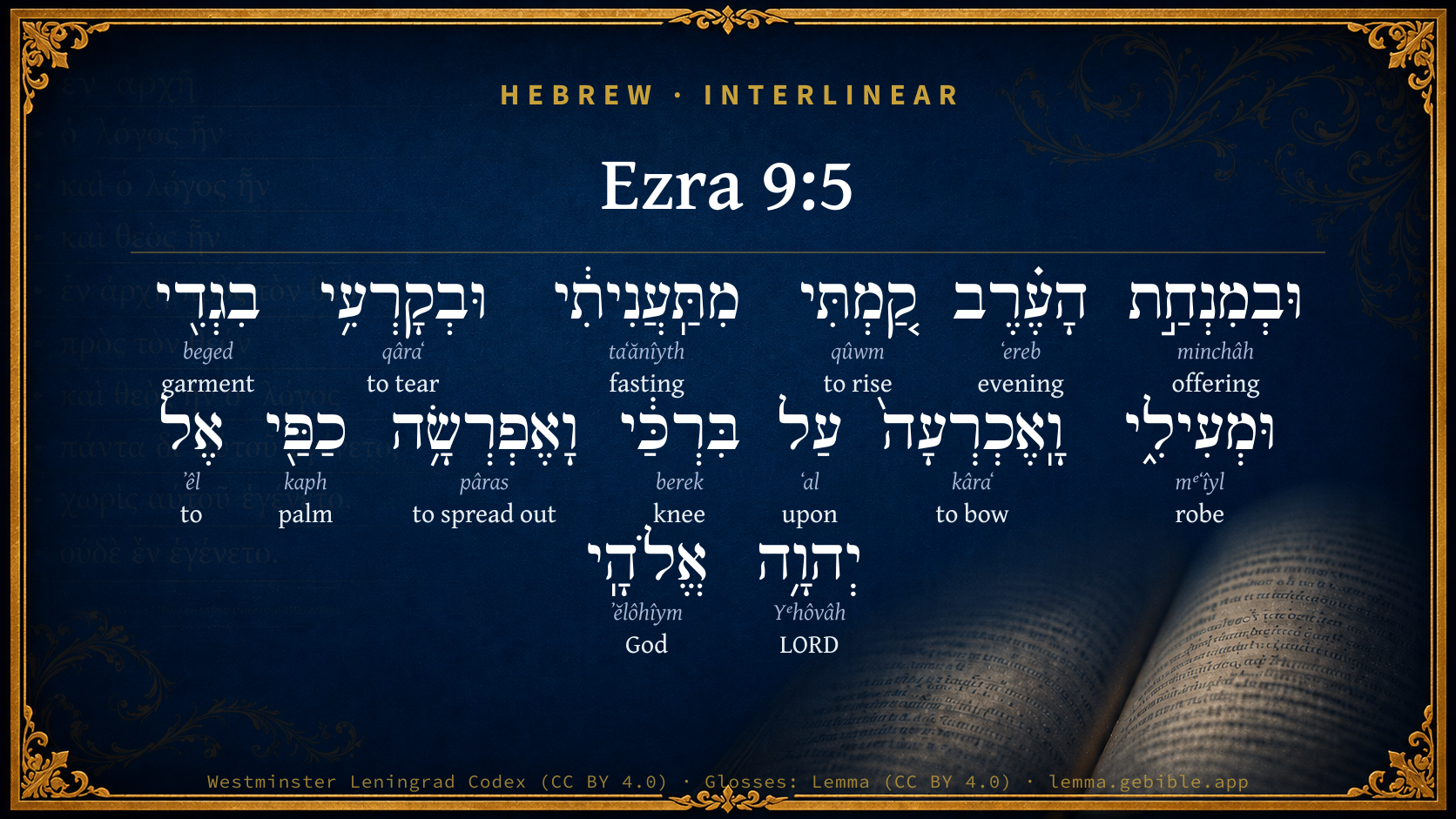
  1. וּבְמִנְחַ֣ת minchâh H4503 “and · in/at · offering of” Conjunction + Preposition + Noun, Common, Feminine, Singular, Construct
  2. הָעֶ֗רֶב ʻereb H6153 “the · evening” Particle, Definite Article + Noun, Common, Masculine, Singular, Absolute
  3. קַ֚מְתִּי qûwm H6965 “to rise” Verb, Qal, Perfect, 1st Person, Common, Singular
  4. וּבְקָרְעִ֥י qâraʻ H7167 “and · in/at · to tear · me” Conjunction + Preposition + Verb, Qal, Infinitive Construct + Suffix, Personal, 1st Person, Common, Singular
  5. בִגְדִ֖י beged H899 “garment · my” Noun, Common, Masculine, Singular, Construct + Suffix, Personal, 1st Person, Common, Singular
  6. וּמְעִילִ֑י mᵉʻîyl H4598 “and · robe · my” Conjunction + Noun, Common, Masculine, Singular, Construct + Suffix, Personal, 1st Person, Common, Singular
  7. וָֽאֶכְרְעָה֙ kâraʻ H3766 “and · to bow” Conjunction + Verb, Qal, Sequential Imperfect, 1st Person, Common, Singular + Suffix, h
  8. עַל ʻal H5921 “upon” Preposition
  9. בִּרְכַּ֔י berek H1290 “knees · my” Noun, Common, Feminine, Dual, Construct + Suffix, Personal, 1st Person, Common, Singular
  10. וָאֶפְרְשָׂ֥ה pâras H6566 “and · to spread out” Conjunction + Verb, Qal, Sequential Imperfect, 1st Person, Common, Singular + Suffix, h
  11. כַפַּ֖י kaph H3709 “palms · my” Noun, Common, Feminine, Dual, Construct + Suffix, Personal, 1st Person, Common, Singular
  12. אֶל ʼêl H413 “to” Preposition
  13. יְהוָ֥ה Yᵉhôvâh H3068 “LORD” Noun, Proper
  14. אֱלֹהָֽי ʼĕlôhîym H430 “God(s) · my” Noun, Common, Masculine, Plural, Construct + Suffix, Personal, 1st Person, Common, Singular

About this verse

These counts appear in no published source. They are computed here, from the morphology-tagged text and Lemma’s own curated glosses. What Lemma adds →

15
words
15
distinct lemmas
Historical
section

Notable vocabulary

1 hapax legomenon — a word that appears only here in the entire Hebrew Bible:

  • מִתַּֽעֲנִיתִ֔י fasting H8589

First appearance in Scripture

This word makes its first canonical appearance in the Hebrew Bible here:

  • מִתַּֽעֲנִיתִ֔י fasting H8589

Shared distinctive vocabulary

בִּרְכַּ֔י knee H1290 occurs in 25 verses of the Hebrew Bible. Also found in:

Grammatical profile

  • 4 verbs
  • 9 nouns
  • 2 prepositions

Verb forms

  • קַ֚מְתִּי Qal · Perfect
  • וּבְקָרְעִ֥י Qal · Infinitive Construct
  • וָֽאֶכְרְעָה֙ Qal · Sequential Imperfect
  • וָאֶפְרְשָׂ֥ה Qal · Sequential Imperfect

Hebrew & Septuagint length

In English translation the verse runs 33 words from the Hebrew and 37 from the Septuagint (LXX English) — closely comparable.

A rough comparison of the two English renderings, which tokenize alike — not a word-level alignment.

Word counts can differ between the Hebrew and the Greek without any difference in meaning — e.g. the Hebrew direct-object marker אֵת has no separate Greek word, and Greek often adds the article ὁ.

Cross-references

13

Topical passages linked to Ezra 9:5 in the Treasury of Scripture Knowledge — connected by theme and wording, ordered by reader-vote popularity; previews shown in the World English Bible.

  • 1 Kings 8:22 Solomon stood before the altar of Yahweh in the presence of all the assembly of Israel, and spread forth his hands toward heaven;
  • 1 Kings 8:38 whatever prayer and supplication be made by any man, [or] by all your people Israel, who shall know every man the plague of his own heart, and spread forth his hands toward this house:
  • 1 Kings 8:54 It was so, that when Solomon had made an end of praying all this prayer and supplication to Yahweh, he arose from before the altar of Yahweh, from kneeling on his knees with his hands spread forth toward heaven.
  • Exodus 9:29 Moses said to him, "As soon as I have gone out of the city, I will spread abroad my hands to Yahweh. The thunders shall cease, neither shall there be any more hail; that you may know that the earth is Yahweh's.
  • Exodus 9:33 Moses went out of the city from Pharaoh, and spread abroad his hands to Yahweh; and the thunders and hail ceased, and the rain was not poured on the earth.
  • 2 Chronicles 6:13 (for Solomon had made a brazen scaffold, five cubits long, and five cubits broad, and three cubits high, and had set it in the midst of the court; and on it he stood, and kneeled down on his knees before all the assembly of Israel, and spread forth his hands toward heaven;)
  • Psalms 95:6 Oh come, let's worship and bow down. Let's kneel before Yahweh, our Maker,
  • Psalms 141:2 Let my prayer be set before you like incense; The lifting up of my hands like the evening sacrifice.
  • Psalms 143:6 I spread forth my hands to you. My soul thirsts for you, like a parched land. Selah.
  • Ephesians 3:14 For this cause, I bow my knees to the Father of our Lord Jesus Christ,
  • Isaiah 1:15 When you spread forth your hands, I will hide my eyes from you; Yes, when you make many prayers, I will not hear. Your hands are full of blood.
  • Luke 22:41 He was withdrawn from them about a stone's throw, and he knelt down and prayed,
  • Acts 21:5 When it happened that we had accomplished the days, we departed and went on our journey. They all, with wives and children, brought us on our way until we were out of the city. Kneeling down on the beach, we prayed.

Cross-references courtesy of OpenBible.info (CC BY 4.0).

Hebrew and Greek witnesses Masoretic Hebrew ↔ Greek Septuagint

The same verse in the two great witnesses to the Old Testament, shown verse-for-verse.

These are two independent witnesses, not word-aligned to each other, and the Septuagint is shown in lemma (dictionary) form.

Hebrew Ezra 9:5 Masoretic · Westminster Leningrad Codex

וּבְמִנְחַ֣ת הָעֶ֗רֶב קַ֚מְתִּי מִתַּֽעֲנִיתִ֔י וּבְקָרְעִ֥י בִגְדִ֖י וּמְעִילִ֑י וָֽאֶכְרְעָה֙ עַל בִּרְכַּ֔י וָאֶפְרְשָׂ֥ה כַפַּ֖י אֶל יְהוָ֥ה אֱלֹהָֽי

At the evening offering I arose up from my humiliation, even with my garment and my robe torn; and I fell on my knees, and spread out my hands to Yahweh my God;

World English Bible · Public Domain

Greek LXX Ezra 9:5 Septuagint · lemma form

καί ἐν θυσία ὁ ἑσπερινός ἀναἵστημι ἀπό ταπείνωσις ἐγώ καί ἐν ὁ διαῥήγνυμι ἐγώ ὁ ἱμάτιον ἐγώ καί πάλλομαι καί κλίνω ἐπί ὁ γόνυ ἐγώ καί ἐκπετάζω ὁ χείρ ἐγώ πρός κύριος ὁ θεός

And at the evening sacrifice I rose up from my humiliation; and when I had torn my garments, then I trembled, and I bow myself on my knees, and spread out my hands to the Lord God,

LXX2012 (modern English Septuagint) · Public Domain

In the Septuagint this is one book — Esdras B (2 Esdras): Ezra is chapters 1–10, Nehemiah 11–23.

On this verse, The Cambridge Bible for Schools and Colleges discusses the Septuagint’s reading. Read the note in Commentary ↓

Hebrew: Westminster Leningrad Codex (CC BY 4.0). Greek: Septuagint (public domain); English from LXX2012 (modern English Septuagint) (Public Domain). How the Septuagint differs from the Hebrew →

Commentary

Notes on Ezra 9:5 from classic Christian and Jewish commentators (each source and its license shown beneath its notes). The classic Christian expositions comment on the surrounding passage and are grouped to its opening verse, so a note may address several verses; the Jewish commentaries on the Tanakh (Rashi and others) are per-verse, so they appear only where the commentator wrote on this verse.

Lemma curates 59 commentaries, every one of them public domain or Creative Commons licensed, each selected and text-cleaned for this edition rather than reprinted as found. About our sources →

Matthew Henry's Commentary

What the meditations of Ezra's heart were, while for some hours he sat down astonished, we may guess by the words of his mouth when at length he spoke with his tongue; and a most pathetic address he here makes to Heaven upon this occasion. Observe,

I. The time when he made this address - at the evening sacrifice, Ezr 9:5. Then (it is likely) devout people used to come into the courts of the temple, to grace the solemnity of the sacrifice and to offer up their own prayers to God in concurrence with it. In their hearing Ezra chose to make this confession, that they might be made duly sensible of the sins of their people, which hitherto they had either not taken notice of or had made light of. Prayer may preach. The sacrifice, and especially the evening sacrifice, was a type of the great propitiation, that blessed Lamb of God which in the evening of the world was to take away sin by the sacrifice of himself, to which we may suppose Ezra had an eye of faith in this penitential address to God; he makes confession with his hand, as it were, upon the head of that great sacrifice, through which we receive the atonement. Certainly Ezra was no stranger to the message which the angel Gabriel had some years ago delivered to Daniel, at the time of the evening sacrifice, and as it were in explication of it, concerning Messiah the Prince (Dan 9:21, Dan 9:24); and perhaps he had regard to that in choosing this time.

II. His preparation for this address. 1. He rose up from his heaviness, and so far shook off the burden of his grief as was necessary to the lifting up of his heart to God. He recovered from his astonishment, got the tumult of his troubled spirits somewhat stilled and his spirit composed for communion with God. 2. He fell upon his knees, put himself into the posture of a penitent humbling himself and a petitioner suing for mercy, in both representing the people for whom he was now an intercessor. 3. He spread out his hands, as one affected with what he was going to say, offering it up unto God, waiting, and reaching out, as it were, with an earnest expectation, to receive a gracious answer. In this he had an eye to God as the Lord, and as his God, a God of power, but a God of grace.

III. The address itself. It is not properly to be called a prayer, for there is not a word of petition in it; but, if we give prayer its full latitude, it is the offering up of pious and devout affections to God, and very devout, very pious, are the affections which Ezra here expresses. His address is a penitent confession of sin, not his own (from a conscience burdened with its own guilt and apprehensive of his own danger), but the sin of his people, from a gracious concern for the honour of God and the welfare of Israel. Here is a lively picture of ingenuous repentance. Observe in this address,

1. The confession he makes of the sin and the aggravations of it, which he insists upon, to affect his own heart and theirs that joined with him with holy sorrow and shame and fear, in the consideration of it, that they might be deeply humbled for it. And it is observable that, though he himself was wholly clear from this guilt, yet he puts himself into the number of the sinners, because he was a member of the same community - our sins and our trespass. Perhaps he now remembered it against himself, as his fault, that he had staid so long after his brethren in Babylon, and had not separated himself so soon as he might have done from the people of those lands. When we are lamenting the wickedness of the wicked, it may be, if we duly reflect upon ourselves and give our own hearts leave to deal faithfully with us, we may find something of the same nature, though in a lower degree, that we also have been guilty of. However, he speaks that which was, or should have been, the general complaint.

(1.) He owns their sins to have been very great: "Our iniquities are increased over our heads (Ezr 9:6); we are ready to perish in them as in keep waters;" so general was the prevalency of them, so violent the power of them, and so threatening were they of the most pernicious consequences. "Iniquity has grown up to such a height among us that it reaches to the heavens, so very impudent that it dares heaven, so very provoking that, like the sin of Sodom, it cries to heaven for vengeance." But let this be the comfort of true penitents that though their sins reach to the heavens God's mercy is in the heavens, Psa 36:5. Where sin abounds grace will much more abound.

(2.) Their sin had been long persisted in (Ezr 9:7): Since the days of our fathers have we been in a great trespass. The example of those that had gone before them he thought so far from excusing their fault that it aggravated it. "We should have taken warning not to stumble at the same stone. The corruption is so much the worse that it has taken deep root and begins to plead prescription, but by this means we have reason to fear that the measure of the iniquity is nearly full."

(3.) The great and sore judgments which God had brought upon them for their sins did very much aggravate them: "For our iniquities we have been delivered to the sword and to captivity (Ezr 9:7), and yet not reformed, yet not reclaimed - brayed in the mortar, and yet the folly not gone (Pro 27:22) - corrected, but not reclaimed."

(4.) The late mercies God had bestowed upon them did likewise very much aggravate their sins. This he insists largely upon, Ezr 9:8, Ezr 9:9. Observe, [1.] The time of mercy: Now for a little space, that is, "It is but a little while since we had our liberty, and it is not likely to continue long." This greatly aggravated their sin, that they were so lately in the furnace and that they knew not how soon they might return to it again; and could they yet be secure? [2.] The fountain of mercy: Grace has been shown us from the Lord. The kings of Persia were the instruments of their enlargement; but he ascribes it to God and to his grace, his free grace, without any merit of theirs. [3.] The streams of mercy, - that they were not forsaken in their bondage, but even in Babylon had the tokens of God's presence, - that they were a remnant of Israelites left, a few out of many, and those narrowly escaped out of the hands of their enemies, by the favour of the kings of Persia, - and especially that they had a nail in his holy place, that is (as it is explained, Ezr 9:9), that they had set up the house of God. They had their religion settled and the service of the temple in a constant method. We are to reckon it a great comfort and advantage to have stated opportunities of worshipping God. Blessed are those that dwell in God's house, like Anna that departed not from the temple. This is my rest for ever, says the gracious soul. [4.] The effects of all this. It enlightened their eyes, and it revived their hearts; that is, it was very comfortable to them, and the more sensibly so because it was in their bondage: it was life from the dead to them. Though but a little reviving, it was a great favour, considering that they deserved none and the day of small things was an earnest of greater. "Now," says Ezra, "how ungrateful are we to offend a God that has been so kind to us! how disingenuous to mingle in sin with those nations from whom we have been, in wonderful mercy, delivered! how unwise to expose ourselves to God's displeasure when we are tried with the returns of his favour and are upon our good behaviour for the continuance of it!"

(5.) It was a great aggravation of the sin that it was against an express command: We have forsaken thy commandments, Ezr 9:10. It seems to have been an ancient law of the house of Jacob not to match with the families of the uncircumcised, Gen 34:14. But, besides that, God had strictly forbidden it. He recites the command, Ezr 9:11, Ezr 9:12. For sin appears sin, appears exceedingly sinful, when we compare it with the law which is broken by it. Nothing could be more express: Give not your daughters to their sons, nor take their daughters to your sons. The reason given is because, if they mingled with those nations, they would pollute themselves. It was an unclean land, and they were a holy people; but if they kept themselves distinct from them it would be their honour and safety, and the perpetuating of their prosperity. Now to violate a command so express, backed with such reasons, and a fundamental law of their constitution, was very provoking to the God of heaven.

(6.) That in the judgments by which they had already smarted for their sins God had punished them less than their iniquities deserved, so that he looked upon them to be still in debt upon the old account. "What! and yet shall we run up a new score? Has God dealt so gently with us in correcting us, and shall we thus abuse his favour and turn his grace into wantonness?" God, in his grace and mercy, had said concerning Sion's captivity, She hath received of the Lord's hand double for all her sins (Isa 40:2); but Ezra, in a penitential sense of the great malignity that was in their sin, acknowledged that, though the punishment was very great, it was less than they deserved.

2. The devout affections that were working in him, in making this confession. Speaking of sin,

(1.) He speaks as one much ashamed. With this he begins (Ezr 9:6), O my God! I am ashamed and blush, O my God! (so the words are placed) to lift up my face unto thee. Note, [1.] Sin is a shameful thing; as soon as ever our first parents had eaten forbidden fruit they were ashamed of themselves. [2.] Holy shame is as necessary an ingredient in true and ingenuous repentance as holy sorrow. [3.] The sins of others should be our shame, and we should blush for those who do not blush for themselves. We may well be ashamed that we are any thing akin to those who are so ungrateful to God and unwise for themselves. This is clearing ourselves, Co2 7:11. [4.] Penitent sinners never see so much reason to blush and be ashamed as when they come to lift up their faces before God. A natural sense of our own honour which we have injured will make us ashamed, when we have done a wrong thing, to look men in the face; but a gracious concern for God's honour will make us much more ashamed to look him in the face. The publican, when he went to the temple to pray, hung down his head more than ever, as one ashamed, Luk 18:13. [5.] An eye to God as our God will be of great use to us in the exercise of repentance. Ezra begins, O my God! and again in the same breath, My God. The consideration of our covenant-relation to God as ours will help to humble us, and break our hearts for sin, that we should violate both his precepts to us and our promises to him; it will also encourage us to hope for pardon upon repentance. "He is my God, notwithstanding this;" and every transgression in the covenant does not throw us out of covenant.

(2.) He speaks as one much amazed (Ezr 9:10) "What shall we say after this? For my part I know not what to say: if God do not help us, we are undone." The discoveries of guilt excite amazement: the more we think of sin the worse it looks. The difficulty of the case excites amazement. How shall we recover ourselves? Which way shall we make our peace with God? [1.] True penitents are at a loss what to say. Shall we say, We have not sinned, or, God will not require it? If we do, we deceive ourselves, and the truth is not in us. Shall we say, Have patience with us and we will pay thee all, with thousands of rams, or our first-born for our transgression? God will not thus be mocked: he knows we are insolvent. Shall we say, There is no hope, and let come on us what will? That is but to make bad worse. [2.] True penitents will consider what to say, and should, as Ezra, beg of God to teach them. What shall we say? Say, "I have sinned; I have done foolishly; God be merciful to me a sinner;" and the like. See Hos 14:2.

(3.) He speaks as one much afraid, Ezr 9:13, Ezr 9:14. "After all the judgments that have come upon us to reclaim us from sin, and all the deliverances that have been wrought for us to engage us to God and duty, if we should again break God's commandments, by joining in affinity with the children of disobedience and learning their ways, what else could we expect but that God should be angry with us till he had consumed us, and there should not be so much as a remnant left, nor any to escape the destruction?" There is not a surer nor sadder presage of ruin to any people than revolting to sin, to the same sins again, after great judgments and great deliverances. Those that will be wrought upon neither by the one nor by the other are fit to be rejected, as reprobate silver, for the founder melteth in vain.

(4.) He speaks as one much assured of the righteousness of God, and resolved to acquiesce in that and to leave the matter with him whose judgment is according to truth (Ezr 9:15): "Thou art righteous, wise, just, and good; thou wilt neither do us wrong nor be hard upon us; and therefore behold we are before thee, we lie at thy feet, waiting our doom; we cannot stand before thee, insisting upon any righteousness of our own, having no plea to support us or bring us off, and therefore we fall down before thee, in our trespass, and cast ourselves on thy mercy. Do unto us whatsoever seemeth good unto thee, Jdg 10:15. We have nothing to say, nothing to do, but to make supplication to our Judge," Job 9:15. Thus does this good man lay his grief before God and then leave it with him.

Matthew Henry's Commentary on the Whole Bible (1708–1710) — public domain (CC PDM 1.0). Text via the HelloAO Bible API.

Jamieson, Fausset & Brown

Robert Jamieson, A. R. Fausset & David Brown

PRAYS TO GOD. (Ezr 9:5-15)

I fell upon my knees, and spread out my hands unto the Lord my God--The burden of his prayer, which was dictated by a deep sense of the emergency, was that he was overwhelmed at the flagrant enormity of this sin, and the bold impiety of continuing in it after having, as a people, so recently experienced the heavy marks of the divine displeasure. God had begun to show returning favor to Israel by the restoration of some. But this only aggravated their sin, that, so soon after their re-establishment in their native land, they openly violated the express and repeated precepts which commanded them to extirpate the Canaanites. Such conduct, he exclaimed, could issue only in drawing down some great punishment from offended Heaven and ensuring the destruction of the small remnant of us that is left, unless, by the help of divine grace, we repent and bring forth the fruits of repentance in an immediate and thorough reformation.

Next: Ezra Chapter 10

Jamieson, Fausset & Brown — Commentary Critical and Explanatory on the Whole Bible (1871) — public domain (CC PDM 1.0). Text via the HelloAO Bible API.

Trapp's Complete Commentary

John Trapp

Ezr 9:5 And at the evening sacrifice I arose up from my heaviness; and having rent my garment and my mantle, I fell upon my knees, and spread out my hands unto the LORD my God,

Ver. 5. I arose up from my heaviness] In affliction, sc. of spirit, wherewith his heart was leavened and soured, as David’s was, Psa 73:21; embittered, as Peter’s, Mat 26:75; poured out upon him, as Job’s, Job 30:16. He did really afflict himself with voluntary sorrows for the transgressions of his people.

And having rent, &c.] See Ezr 9:3.

I fell upon my knees] This gesture did both evidence and increase the ardency of his affection.

And spread out my hands] With the palms open toward heaven, in a having, craving way, as beggars. This was the Jewish manner of praying, and it was very becoming.

John Trapp, A Commentary or Exposition upon All the Books of the Old and New Testament (1647–1656) — public domain. Text from a community e-Sword module.

Joseph Benson's Commentary

Ezr 9:5. I rose up from my heaviness — From that mournful posture, and put myself into the posture of a petitioner. He did this at the time of the evening sacrifice, because then devout people used to come into the courts of the temple, that, hearing his confession, they likewise might be made sensible of the sins of the people. And he had an eye to that great propitiation, of which that sacrifice was a peculiar type.

Joseph Benson's Commentary on the Old and New Testaments (1811–1818) — public domain. Text from a community e-Sword module.

The Pulpit Commentary

EZRA"S CONFESSION AND PRAYER TO GOD. (Ezr_9:5-15) The most remarkable feature of Ezra"s confession is the thoroughness with which he identifies himself with his erring countrymen, blushes for their transgressions, and is ashamed for their misconduct. All their sins he appears to consider as his sins, all their disobedience as his disobedience, all their perils as his perils. Another striking feature is his sense of the exceeding sinfulness of the particular sin of the time (see vers. 6, 7, 10). He views it as a "great trespass one that "is grown up into the heavens which is equivalent to a complete forsaking of God"s commandments, and on account of Which he and his people "cannot stand before" God. This feeling seems based partly on the nature of the sin itself (ver. 14), but also, and in an especial way, on a strong sense of the ingratitude shown by the people in turning from God so soon after he had forgiven their former sins against him, and allowed them to return from the captivity, rebuild the temple, and re-establish themselves as a nation. If after their deliverance they again fell away, the sin could not but be unpardonable; and the punishment to be expected was a final uprooting and destruction from which there could be no recovery (vers. 13, 14).

At the evening sacrifice I arose up from my heaviness. The time of sacrifice was the fittest time for prayer, especially for a prayer in which acknowledgment of sin was to form a large part. Sacrifice symbolized expiation; and Ezra probably felt that his supplication would be helped by the expiatory rite which was being performed at the time. He rent his garment and his mantle a second time, as a renewed indication of sorrow, and with the view of impressing the people who "were assembled unto him" (ver. 4) the more, and stirring them up to penitence. "Segnius irritant animum demissa per aures Quam quae sunt oculis subjecta fidelibus.

Vers. 5-15.

A flood of tears.

As we noticed before, and as is here noticed again, the approach of the evening sacrifice seems to have been the first thing which opened Ezra"s lips. Speaking to him at last as he sat like a rock, (comp. Psa_105:41) it was answered immediately by a mingled outburst of confession and tears. Again by outward gesture expressing his sorrow, but not, as before, his indignation, he added now, by falling on his knees and spreading out his hands, the outward tokens of humiliation and prayer. And all that he says we find to be in exact accordance therewith. Unqualified shame; irresistible proof; inexcusable guilt. In these words we have a sufficient key to the nature and order of his thoughts.

I UNQUALIFIED SHAME. How difficult a thing it is to look on any one to whom we have done wrong. How especially difficult if that other is one to whom we are especially bound to show honour. This was the great trial of the prodigal"s case. He had to say to his father, I have sinned before thee (Isa_1:2; Mal_1:6) The same kind of feeling is traceable here. "O my God, I am ashamed and blush to lift up my face to thee, my God." As one of thy chosen people Israel, how can I look on thee as things are? My own countenance proclaims its shame, its burning shame, if I do. For, indeed, there is cause for shame in this case. There is nothing else, in fact, as things are. Like a man in the waters, when, being above his head, they destroy his life, so are we overwhelmed now with our shame. Like those who have nothing to say to thee because the proof of their guilt is before thee, so are we silenced now by our shame. "Our guiltiness (margin) is grown up into the heavens". (comp. Psa_90:8) Altogether this opening confession is like that of Job. (Job_40:4 Job_42:6) Behold, I am vile, and abhor myself; or, like that of the prodigal, before referred to, "I am not worthy to be called thy son." My very privileges having become my disgrace, what disgrace can be worse?

II IRRESISTIBLE PROOF. There being nothing perhaps less pleasing to God than to accuse ourselves before him without knowing why, such an extreme confession as the above ought not to be made without sufficient proof. This we have in abundance in the words which come next (vers. 7-12). The sin which Ezra had that day heard of, and which had led him t make this confession, was in every way a reproach. It was so because committed

1. In defiance of God"s judgments. For similar sin in previous days on the part of their fathers an almost unexampled visitation of judgment had come on them as a nation. Though a people sacred to Jehovah, he had handed them over in consequence, together with their "kings and priests," the most sacred classes among them, (2Sa_1:14, 2Sa_1:21; Psa_106:16; Lam_4:20) into the hands of their foes. Loss of life, or liberty, or substance in the best case loss of respect had been the result (see end ver. 7). Even to that "day," in fact (ibid. ), this "confusion of face," of which Daniel had spoken so feelingly some eighty years ago, after some seventy years" trial of it, remained as part of their lot. Yet, with all this in their memory and experience, what had been their reply? To repeat again now the very offence for which they had suffered so much!

2. In despite of God"s mercy. Notwithstanding this heavy displeasure, there had been compassion as well. For some little time back (little in the life-history of a nation, that is to say) various signs of "grace" or favour had been vouchsafed to them. The destruction of the people, e.g. , had not been total; a "remnant" had "escaped a great token of good in itself. (Eze_14:22, Eze_14:23) Nor had their dispersion from the home under God"s wing been for ever. On the contrary, a "nail," or fixed habitation, (Isa_22:23 Isa_33:20) had been given them "in his holy place." There was some cheerfulness also, or "lightening of the eyes," with all their "confusion of face," and some "reviving" in their death-like bondage. Truly wonderful mercy, indeed, it was! that restored house after such long desolation; that restored "wall" or fence round such captives; how much it proved; how much it promised; what an undeserved mercy it was. How amazingly wicked, therefore, how ungrateful, to despise it as they had done.

1. In contempt of God"s express will. Most clearly, most strongly, most earnestly, and that from the very first, had God declared his mind on this point. lie had done so by his words, as here quoted. He had done so by his actions, as here referred to. Why had he ever swept away from Canaan its original inhabitants? Why had he introduced the Israelites in their place

2. What had he made their inheritance of it to depend on? The answers to these various questions were clear and emphatic on this subject, and made the conduct which Ezra was bewailing like that of soldiers ordered by their commander to charge the enemy, and drawing their swords instead against himself. These were the three reasons why Ezra spoke as he did of their sin. (2Ch_28:22; Luk_12:47; Rom_2:4; Rev_9:20, Rev_9:21)

III INEXCUSABLE GUILT. In circumstances such as these, what could they say or expect? After such experience, after such deliverance, and in the face of such knowledge, they had begun again the old sin. Must not this bring down again the old anger, and this time without bound (ver. 14)? Even as things were, would not God be "righteous" (ver. 15) if their whole remnant were destroyed? So much so, that it does not seem to occur to Ezra even to speak to God of any other course of proceeding. It is even a marvel to him, in the circumstances, that they continue "escaped." Here we are do as thou willest we cannot stand before thee in our trespasses (Psa_130:3) we can only place ourselves before thee in the dust we have nothing to urge. This total absence of all plea or entreaty almost reminds one of Eli"s silence in 1Sa_3:18 (comp. also 2:25), knowing as he did the inexcusable guilt and impenitence of his sons. Even Daniel, in his deepest humiliation on account of the sins of his people, could take a different line. (Dan_9:19)

CONCLUSION. In this remarkable picture of true penitence we may notice

1. Its singular accuracy of judgment. Sin here, as with David and Joseph and all truly "God-conscious" men and minds, is an offence against God himself. (see Gen_39:9; 1Sa_12:23; Psa_51:4; Rom_4:15; 1Jn_3:4)

2. Its unswerving. loyalty. See the acknowledgments here of God"s mercy and justice in vers. 13, 15; and comp. Psalm 51. end ver. 4, also 1. 4, 6; Luk_7:29; Rom_3:4, Rom_3:19. This sin, at any rate, the sin which renders amendment and forgiveness impossible, the sin of charging God foolishly, the true penitent is free from.

3. Its unsparing sincerity. So far from denying, hiding, or palliating the evil it refers to, it seems anxious rather to bring to light and exhibit its very worst traits. We read of Elias in one place. (Rom_11:2) as making "intercession against Israel." Ezra here, identifying his own case with that of Israel, may be almost said to do it against himself. Could even the great accuser (Rev_12:10) with truth have said very much worse? Contrast Gen_3:12, Gen_3:13; khsiv 1Sa_15:13, 1Sa_15:20, 1Sa_15:21; and comp. perhaps the ejkdi of 2Co_7:11.

HOMILIES BY J.A. MACDONALD Ver. 5.

The dawn of hope.

Here is a graphic scene. Behold Ezra, the chief man of his nation, and a prince of the Persian Empire, with his garment and his mantle rent, his hair and beard torn and disordered, bowed in silent grief, and surrounded by the best men of his people, all trembling at the word of God. But lo! a ray of hope from the fire of the altar kindles in his soul. "And at the evening sacrifice," etc. Here learn

I THAT THE ONE WAY TO GOD IS THROUGH THE BLOOD OF ATONEMENT.

1. Ezra sat astonied until the evening sacrifice.

(1) He saw the sin of his people. Its enormity. Its aggravations.

(2) He saw the gathering storm of Divine anger. The more he reflected, the blacker became the cloud.

(3) He saw no way of escape. His suspense was awful, until the fire of the altar began to light up the darkness of the gathering night.

2. Now he is encouraged to pray.

(1) God has found out a way. Sacrifice would never have occurred to the unaided reason of man; or even had it occurred to him, he could not be sure that God would accept it.

(2) God has made his ways known unto men. It was revealed soon after the. (Gen_3:15, 24 4:4 8:20, 21) More formally established in the Levitical law. This was authenticated by all the miracles of the exodus. Fulfilled in the solemnities of Calvary.

II THAT HE MUST BE APPROACHED IN THE SPIRIT OF HUMILIATION.

1. Ezra rent his garment and his mantle.

(1) His "garment" to express his personal grief at the dishonour done to God. At the wickedness of his people. At their consequent. liability to fearful punishment.

(2) His" mantle," which was such a robe as was worn by persons of birth and station, was rent to express his distress in his magisterial. and representative capacity. Public men should recognise a public responsibility to God.

2. This he now did the second time.

(1) In the first instance he rent his clothes to express to men his grief. It produced the desired effect. All those who "trembled at the word of God" gathered round him. We should witness for God to man against sin. We should do this in the most emphatic manner, so as to produce conviction.

(2) Now by similar acts he expresses his grief to God. This second rending of his garment and mantle was in connection with his rousing himself to pray. God expects from us a formal and full confession of sin. He does not need information, but requires it for our benefit.

3. Ezra also now fell upon his knees.

(1) Hitherto he had been sitting in his grief, bewildered and astonished, not knowing what to do to avert the looming" vengeance. To pray he knew not how until his spirit was stirred within him "at the evening- sacrifice." All true prayer is from God. (Pro_16:1) The fire that stirs a prayerful soul is from the altar of Calvary. (see Isa_6:6, Isa_6:7)

(2) Kneeling is an appropriate attitude for prayer. It expresses submission. (Php_2:10) We should beware of the hypocrisy of bowing the knee when there is no submission in the soul.

(3) Posture, however, is not essential to prayer. Scripture furnishes examples of various postures. The attitude of the heart is of vital importance. This is a comfort to those who are physically incapacitated for kneeling. (1Ti_4:8)

III THAT WE MUST DRAW NEAR TO GOD IN FAITH. Ezra "spread out his hands to the Lord his God.

1. He recognised God as his covenant friend.

(1) Note the possessive case. All that is meant in the title "God" he claims as his. What a proprietary is here!

(2) There is a glorious complement to this. If the Lord be our covenant God, then are we his covenanted people. He too has a property in us. (Son_2:16) We are his "peculiar. treasure.". (Psa_135:4)

(3) The covenant, relationship evermore recognises Christ who is the Covenant of his people, and whose blood is the "blood of the covenant." The recognition of all this is faith, and when this recognition is raised in us by the Spirit of God the faith becomes saving.

2. Therefore he spread out his hands.

(1) The open hand is the symbol of truth. Ezra approached God with the sincerity of a genuine faith. (see Psa_24:4) The open hand of the impenitent hypocrite is bloody in the sight of God. (Isa_1:15)

(2) The hands spread out are in the attitude of craving and receiving. Corresponding to this, the outstretched hands of God denote the offers of his mercy. (Pro_1:24) Let us ask and receive, that our joy may be full. J.A.M.

HOMILIES BY J.S. EXELL Vers. 5-15.

A good man"s sight of sin.

I That the sight of sin AWAKENS WITHIN THE GOOD MAN A SPIRIT OF EARNEST PRAYER. "I fell upon my knees, and spread out my hands unto the Lord my God" (ver. 5).

1. The humility of the prayer. Ezra fell upon his knees in deepest self-abasement; he did not stand erect like the Pharisee in the temple, but smote upon his breast like the publican. (Luk_18:13) Surely the sin of God"s chosen people could not but inspire humility within the patriot.

2. The earnestness of the prayer. Ezra spread out his hands in earnest entreaty before God; the solemnity of the circumstance awakened him to holy fervour. At such a time a lifeless prayer could be of no avail.

3. The direction of the prayer. Ezra directed his prayer to the Lord his God; he felt the vanity of human help, and that God only could avert the consequence of their transgression. A sense of sin should lead to God.

4. The personal claim of the prayer. "My God," "O my God.

II THAT THE SIGHT OF SIN AWAKENS WITHIN THE GOOD MAN A SENSE OF SHAME. "I am ashamed and blush to lift up my face to thee, my God: for our iniquities are increased over our head, and our trespass is grown up unto the heavens (ver. 6). He is ashamed

1. Because he is morally sensitive to sin. Purity is sensitive to evil.

2. Because he understands the true nature of sin. "Our iniquities," "our trespass.

3. Because he realises the magnitude of sin. "Our iniquities are increased over our head, and our trespass is grown up to heaven." Sin brings shame; this the good man feels.

III THAT THE SIGHT OF SIN AWAKENS WITHIN THE GOOD MAN MEMORIES OF SORROW. "And for our iniquities have we, our kings, and our priests, been delivered into the hand of the kings of the lands, to the sword, to captivity, and to a spoil" (ver. 7).

1. A memory of degradation. Sin will send kings and priests into degrading captivity.

2. A memory of cruelty. Sin delivers men as to the sword.

3. A memory of bondage. Sin is slavery.

4. A memory of loss. Sin spoils men of their best treasures. The history of sin is a history of sorrow, and the sight of sin calls up to the mind of the good man sad memories.

IV THAT THE SIGHT OF SIN AWAKENS WITHIN THE GOOD MAN THE THOUGHT OF THE GOVERNMENT OF GOD.

1. Its mercy. "And now for a little space grace hath been showed from the Lord our God" (vers. 8, 9).

2. Its fidelity. "Yet our God hath not forsaken us in our bondage" (ver. 9).

3. Its forbearance. "Seeing that thou our God hast punished us less than our iniquities deserve" (ver. 13). This life is not the scene of complete punishment.

4. Its delay. "For we remain." Sin is not immediately punished in this life.

5. Its rectitude. "O Lord God of Israel, thou art righteous" (ver. 15). "Its retribution. "For we cannot stand before thee because of this" (ver. 15).

Thus Ezra viewed the sin of Israel in its relation to the moral government of God. E.

The Pulpit Commentary (1880–1919), ed. H.D.M. Spence-Jones & Joseph S. Exell — public domain. Text from a community e-Sword module.

Keil & Delitzsch

C. F. Keil & F. Delitzsch

Ezra's prayer and confession for the congregation. - Ezr 9:5 And at the time of the evening sacrifice, I rose up from my mortification (תּענית, humiliation, generally through fasting, here through sitting motionless in deep affliction of soul), and rending my garment and my mantle. These words contribute a second particular to קמתּי, and do not mean that Ezra arose with his garments torn, but state that, on arising, he rent his clothing, and therefore again manifested his sorrow in this manner. He then fell on his knees, and spread out his hands to God (comp. Kg1 8:22), to make a confession of the heavy guilt of the congregation before God, and thus impressively to set their sins before all who heard his prayer.

Ezr 9:6

9:6, etc. The train of thought in this prayer is as follows: I scarcely dare to lift up my fact to God, through shame for the greatness of our misdeeds (Ezr 9:6). From the days of our fathers, God has sorely punished us for our sins by delivering us into the power of our enemies; but has now again turned His pity towards us, and revived us in the place of His sanctuary, through the favour of the king of Persia (Ezr 9:7). But we have again transgressed His commands, with the keeping of which God has connected our possession of the good land given unto us (Ezr 9:10). Should we then, after God has spared us more than we through our trespasses have deserved, bring His wrath upon us, till we are wholly consumed? God is just; He has preserved us; but we stand before Him with heavy guilt upon us, such guilt that we cannot endure God's presence (Ezr 9:13). Ezra does not pray for the pardon of their sin, for he desires only to bring the congregation to the knowledge of the greatness of their transgression, and so to invite them to do all that in them lies to atone for their guilt, and to appease God's wrath.

"I am ashamed, and am covered with shame, to lift up my face to Thee, my God." ונכלמתּי בּשׁתּי united, as in Jer 31:19, comp. Isa 45:16, and other passages. נכלם, to be covered with shame, is stronger than בּושׁ. "For our iniquities are increased over our head," i.e., have grown above our head. ראשׁ למעלה, to or over the head. למעלה serves to enhance the meaning of רבוּ, like Ch1 23:17. "And our guiltiness is great, (reaching) unto the heavens;" comp. Ch2 28:9.

Ezr 9:7

"Since the days of our fathers, have we, our kings, our priests, been delivered into the hands of the kings of the lands, to the sword, to captivity, to plunder, and to shame of face." The words from בּחרב onwards serve to explain what is meant by being delivered into the hand of strange kings. On the expression פּנים בּשׁת, comp. Dan 9:7, etc., Ch2 32:21. הזּה כּהיּום, as it is this day, as is to-day the case; see remarks on Dan 9:7. The thought is: We are still sorely suffering for our sins, by being yet under the yoke of foreign sovereigns.

Ezr 9:8-9

"And now for a little moment there has been mercy from the Lord our God, to leave us a rescued remnant, and to give us a nail in His holy place, that our God may lighten our eyes, and give us a little reviving in our bondage." He calls the short interval between their release from captivity by Cyrus, and the time when he is speaking, רגע כּמעט, a little moment (comp. Isa 26:20), in comparison with the long period of suffering from the times of the Assyrians (comp. Neh 9:32) till the reign of Cyrus. פּליטה, a rescued remnant, is the new community delivered from Babylon, and returned to the land of their fathers. In proportion to the numerous population of former days, it was but a remnant that escaped destruction; but a remnant which, according to the predictions of the prophets, was again to grow into a large nation. A foundation for this hope was given by the fact that God had given them "a nail in the place of His sanctuary." The expression is figurative. יתד is a nail or peg struck into the wall, to hang any kind of domestic utensils upon; comp. Isa 22:23, etc. Such a nail was the place of God's sanctuary, the temple, to the rescued community. This was to them a firm nail, by which they were borne and upheld; and this nail God had given them as a support to which they might cling, and gain new life and vigour. The infinitive clauses following, להאיר and לתתּנוּ, are dependent upon the preceding infinitives להשׁאיר and ולתת, and state the purpose for which God has given a nail in His house to this remnant. That our God may enlighten our eyes, i.e., may bestow upon us new vitality; comp. Psa 13:4. Suffering and misfortune make the eyes dim, and their light is quenched in death: the enlightened or beaming eye is an image of vital power; comp. Sa1 14:27, Sa1 14:29. מחיה לתתּנוּ is not to be translated, ut daret nobis vivificationem, the suffix to לתתּנוּ being not dative, but accusative. The literal rendering is: that He may make us a slight reviving. מחיה, the means of supporting life, restoration to life; see on Ch2 14:13. Ezra adds מעט; for the life to which the community had attained was but feeble, in comparison with a vigorous social life. Their deliverance from Babylon and return to the land of their fathers was, so to speak, a revival from death; compare the embodiment of this figure in Ezekiel's vision, Eze 37:1-14 : they were, however, still in a state of vassalage, and had not yet regained their independence. This thought is further carried out in Ezr 9:9 : "For we are bondmen, yet our God hath not forsaken us in our bondage, but hath extended mercy to us before the kings of Persia; so that they have given us a reviving to build up the house of our God, and to repair its ruins, and have given us a wall about us in Judah and Jerusalem." They who have returned to Jerusalem and Judah are still bondmen, for they are yet under the Persian yoke; but God has disposed the kings of Persia so to favour them as to give them a reviving, to enable them to rebuild the house of God. Cyrus and Darius had not merely permitted and commanded the building of the temple, but had also furnished them with considerable assistance towards the carrying out of this work; comp. Ezr 1:3, etc. Ezr 6:7-9. The suffix in חרבתיו alludes to אלהים בּית. The words of the last sentence are figurative. גּדר means the wall of a vineyard, the wall or fence built for its protection (Isa 5:2, Isa 5:5). Hence the wall, or enclosure, is an image of protection from the incursions and attacks of enemies. Such a wall has been given them in Judah and Jerusalem by the kings of Persia. "The meaning is not that they possess a place defended by walls (perhaps, therefore, the temple) in Jerusalem and Judah, but that the Persian kings have given to the new community a safe dwelling-place (or the means of existence), because the power of the Persian empire secures to the returned Israelites continued and undisturbed possession of the city and the land." (Bertheau.)

After this statement concerning the divine favour, Ezra next sets himself to describe the conduct of his countrymen with respect to the mercy extended to them.

Ezr 9:10

"And now, O our God, what can we say after this? That we have forsaken Thy commandments," זאת, i.e., such proofs of the divine compassion as have just been mentioned. The answer which follows commences with כּי, before which נאמר is mentally repeated: "we can only say that we have forsaken Thy commandments, requited Thy kindness with sins."

Ezr 9:11-12

Namely, the commandments "which Thou hast commanded by Thy servants the prophets, saying, The land unto which ye go to possess it is an unclean land through the uncleanness of the people of the lands, through their abominations, wherewith they have filled it from one end to another through their impurity. And now give not your daughters unto their sons, neither take their daughters unto your sons (for wives), nor seek their peace nor their wealth for ever; that ye may be strong, and eat the good of the land, and leave it for an inheritance to your children for ever." The words of the prophets introduced by לאמר are found in these terms neither in the prophetical books nor the Pentateuch. They are not, therefore, to be regarded as a verbal quotation, but only as a declaration that the prohibition of intermarriage with the heathen had been inculcated by the prophets. The introduction of this prohibition by the words: the land unto which ye go to possess it, refers to the Mosaic age, and in using it Ezra had chiefly in view Deu 7:1-3. He interweaves, however, with this passage other sayings from the Pentateuch, e.g., Deu 23:7, and from the prophetic writings, without designing to make a verbal quotation. He says quite generally, by His servants the prophets, as the author of the books of Kings does in similar cases, e.g., Kg2 17:23; Kg2 21:10; Kg2 24:2, where the leading idea is, not to give the saying of some one prophet, but to represent the truth in question as one frequently reiterated. The sayings of Moses in Deuteronomy also bear a prophetical character; for in this book he, after the manner of the prophets, seeks to make the people lay to heart the duty of obeying the law. It is true that we do not meet in the other books of Scripture a special prohibition of marriages with Canaanites, though in the prophetical remarks, Jdg 3:6, such marriages are reproved as occasions of seducing the Israelites to idolatry, and in the prophetic descriptions of the whoredoms of Israel with Baalim, and the general animadversions upon apostasy from the Lord, the transgression of this prohibition is implicitly included; thus justifying the general expression, that God had forbidden the Israelites to contract such marriages, by His servants the prophets. Besides, we must here take into consideration the threatening of the prophets, that the Lord would thrust Israel out of the land for their sins, among which intermarriage with the Canaanites was by no means the least. Ezra, moreover, makes use of the general expression, "by the prophets," because he desired to say that God had not merely forbidden these marriages one or twice in the law, but had also repeatedly inculcated this prohibition by the prophets. The law was preached by the prophets when they reiterated what was the will of God as revealed in the law of Moses. In this respect Ezra might well designate the prohibition of the law as the saying of the prophets, and cite it as pronounced according to the circumstances of the Mosaic period.

(Note: It is hence evident that these words of Ezra afford no evidence against the single authorship of the Pentateuch. The inference that a saying of the law, uttered during the wanderings in the wilderness, is here cited as a saying of the prophets the servants of Jahve, is, according to the just remark of Bertheau, entirely refuted even by the fact that the words cited are nowhere found in the Pentateuch in this exact form, and that hence Ezra did not intend to make a verbal quotation.)

The words: the land into which ye go, etc., recall the introduction of the law in Deu 7:1, etc.; but the description of the land as a land of uncleanness through the uncleanness of the people, etc., does not read thus either in the Pentateuch or in the prophets. נדּה, the uncleanness of women, is first applied to moral impurity by the prophets: comp. Lam 1:17; Eze 7:20; Eze 36:17, comp. Isa 64:5. The expression מפּה אל־פּה, from edge to edge, i.e., from one end to the other, like לפה פּה, Kg2 10:21; Kg2 21:16, is taken from vessels filled to their upper rim. ועתּה introduces the consequence: and now, this being the case. The prohibition וגו תּתּנוּ אל is worded after Deu 7:3. The addition: nor seek their peace, etc., is taken almost verbally from Deu 23:7, where this is said in respect of the Ammonites and Moabites. תּחזקוּ למאן recalls Deu 11:8, and the promise: that ye may eat the good of the land for ever, Isa 1:19. לבניכם והורשׁתּם, and leave it for an inheritance to your children, does not occur in this form in the Pentateuch, but only the promise: that they and their children should possess the land for ever. On הורישׁ in this sense comp. Jdg 11:24; Ch2 20:11.

Ezr 9:13-14

And after all, continues Ezra, taking up again the אחרי־זאת of Ezr 9:10, - "after all that is come upon us for our evil deeds, and for our great trespass - yea, Thou our God has spared us more than our iniquity deserved, and hast given us this escaped remnant - can we again break Thy commandments, and join in affinity with the people of these abominations? Wilt Thou not be angry with us even to extirpation, so that no residue and no escaped remnant should be left?" The premiss in Ezr 9:13 is followed in Ezr 9:14 by the conclusion in the form of a question, while the second clause of Ezr 9:13 is an explanatory parenthesis. Bertheau construes the passage otherwise. He finds the continuation of the sentence: and after all this ... in the words וגו אתּה כּי, which, calmly spoken, would read: Thou, O God, hast not wholly destroyed us, but hast preserved to us an escaped remnant; while instead of such a continuation we have an exclamation of grateful wonder, emphatically introduced by כּי in the sense of כּי אמנם. With this construction of the clauses, however, no advance is made, and Ezra, in this prayer, does but repeat what he had already said, Ezr 9:8 and Ezr 9:9; although the introductory אהרי leads us to expect a new thought to close the confession. Then, too, the logical connection between the question Ezr 9:14 and what precedes it would be wanting, i.e., a foundation of fact for the question Ezr 9:14. Bertheau remarks on Ezr 9:14, that the question: should we return to break (i.e., break again) the commands of God? is an antithesis to the exclamation. But neither does this question, to judge by its matter, stand in contrast to the exclamation, nor is any such contrast indicated by its form. The discourse advances in regular progression only when Ezr 9:14 forms the conclusion arrived at from Ezr 9:13, and the thought in the premiss (13a) is limited by the thoughts introduced with כּי. What had come upon Israel for their sins was, according to Ezr 9:7, deliverance into the hand of heathen kings, to the sword, to captivity, etc. God had not, however, merely chastened and punished His people for their sins, He had also extended mercy to them, Ezr 9:8, etc. This, therefore, is also mentioned by Ezra in Ezr 9:13, to justify, or rather to limit, the כּל in כּל־הבּא. The כּי is properly confirmatory: for Thou, our God, hast indeed punished us, but not in such measure as our sins had deserved; and receives through the tenor of the clause the adversative meaning of imo, yea (comp. Ewald, 330, b). למטּה מ חשׂכתּ, Thou hast checked, hast stopped, beneath our iniquities. חשׂך is not used intransitively, but actively; the missing object must be supplied from the context: Thou hast withheld that, all of which should have come upon us, i.e., the punishment we deserved, or, as older expositors completed the sense, iram tuam. מעוננוּ למטּה, infra delicta nostra, i.e., Thou hast punished us less than our iniquities deserved. For their iniquities they had merited extirpation; but God had given them a rescued remnant. כּזאת, as this, viz., this which exists in the community now returned from Babylon to Judaea. This is the circumstance which justifies the question: should we, or can we, again (נשׁוּב is used adverbially) break Thy commandments, and become related by marriage? (חתחתּן like Deu 7:3.) התּעבות עמּי, people who live in abominations. The answer to this question is found in the subsequent question: will He not - if, after the sparing mercy we have experienced, we again transgress the commands of God - by angry with us till He have consumed us? כּלּה עד (comp. Kg2 13:17, Kg2 13:19) is strengthened by the addition: so that there will be no remnant and no escaping. The question introduced by הלוא is an expression of certain assurance: He will most certainly consume us.

Ezr 9:15

"Jahve, God of Israel, Thou art righteous; for we remain an escaped remnant, as (it is) this day. Behold, we are before Thee in our trespass; for no one can stand before Thy face, because of this." Ezra appeals to the righteousness of God, not to supplicate pardon, as Neh 9:33, for the righteousness of God would impel Him to extirpate the sinful nation, but to rouse the conscience of the community, to point out to them what, after this relapse into their old abominations, they had to expect from the justice of God. נשׁארנוּ כּי is confirmatory. God has shown Himself to be just by so sorely punishing this once numerous nation, that only a small remnant which has escaped destruction now exists. And this remnant has again most grievously offended: we lie before Thee in our trespass; what can we expect from Thy justice? Nothing but destruction; for there is no standing before Thee, i.e., no one can stand before Thee, על־זאת, because of this (comp. Ezr 8:23; Ezr 10:2), i.e., because of the fresh guilt which we have incurred.

Keil & Delitzsch — Biblical Commentary on the Old Testament (1861–1891) — public domain (CC PDM 1.0). Text via the HelloAO Bible API. (Old Testament only.)

Tyndale Open Study Notes

Tyndale Open Resources

9:5 Ezra’s inner humility before God was consistent with his falling on his knees. His outstretched hands demonstrated his pleading with God to intervene.

Tyndale Open Study Notes — © Tyndale Open Resources, licensed CC BY-SA 4.0. Text via the HelloAO Bible API.

Adam Clarke's Commentary

Verse 5. Fell upon my knees] In token of the deepest humility. Spread out my hands, as if to lay hold on the mercy of God. We have already had occasion to explain these significant acts.

Adam Clarke's Commentary on the Bible (1810–1826) — public domain. Text from a community e-Sword/MySword module.

Ellicott's Commentary for English Readers

(5-15) Ezra’s prayer of confession and deprecation.

(5) And at the evening sacrifice I arose up.—Until the afternoon Ezra had sat silent and in grief before the Temple, and in presence of the people. Then, amidst the solemnities of the sacrifice, he uttered the prayer which he had been meditating.

(6) And said, O my God.—The confession begins with “O my God;” but Ezra is the representative of the people, and it proceeds “O our God” (Ezr_9:10), without once returning to the first person.

(7) Since the days of our fathers have we been in a great trespass.—In these Common Prayers of Ezra, Nehemiah, and Daniel, the race of Israel is regarded as one, and national sins as one “great trespass.” The repetition of “this day” at the beginning and at the end of the verse is to be observed: in the former place in reference to the sin; in the latter in reference to the punishment.

(8) A little space.—The “little” here and at the close of the sentence are emphatic. All the present tokens of mercy are said at the conclusion of the prayer (Ezr_9:14) to be conditional in their continuance. The little space from the time of Cyrus was nearly two generations; but it was a moment only in relation to the past and the possible future. The idea is inverted in Isa_54:7 : “For a small moment have I forsaken thee.”

Nail in his holy place.—The Temple was itself the sure nail on which all their hopes hung.

A little reviving.—Literally, make us a little life. The present revival was but the beginning, and still by manifold tokens precarious.

(9) We were bondmen.—Better, we are bondmen. In this lies the emphasis of the appeal.

A wall.—Like “the nail,” a figurative expression for security. The literal wall was not yet rebuilt. This completes the description of Divine mercy: first, the people were a delivered remnant; the Temple was a sure nail for the future of religion; and their civil estate was made secure.

(10) After this.—But all was a mercy for which there had been no adequate return.

(11) Saying.—In the later Old Testament Scriptures the quotation of the earlier is often of this character, giving the substance of many passages. The same style is observable in the New Testament.

(12) Give not your daughters.—See Deu_7:3, the only place where the interdict includes both daughters and sons. It is observable that the giving of daughters in marriage to heathens is not mentioned either in Ezra or in Nehemiah.

Nor seek their peace.—An evident echo of that most stern injunction in Deu_23:6.

(15) O Lord God of Israel, thou art righteous.—The solemn invocation shows that this is a summary of the whole prayer: God’s righteousness is magnified, as accompanied by the grace which had preserved them, although as only a remnant; and as such covered with their trespasses; and especially with “this” the present trespass, the guilt of which underlies all.

A Bible Commentary for English Readers, edited by Charles John Ellicott (1878–1897) — public domain. Text from a community e-Sword module.

The Cambridge Bible for Schools and Colleges

gen. ed. J. J. S. Perowne

5–15. Ezra’s Confession

5. And at the evening sacrifice] R.V. And at the evening oblation, i.e. at the time of its being offered.

I arose up from my heaviness] R.V. I arose up from my humiliation. Marg. fasting. The Hebrew word ‘Taanith’ occurs only here in the O.T.: in later Hebrew it became the accepted for religious fasting. This passage favours the original application to general humiliation rather than to abstinence from food. So the LXX. ταπείωσις.

and having rent my garment and my mantle] R.V. even with my garment and my mantle rent; and. There is no need to render as the A.V. and most commentators, as if Ezra for a second time rent his clothes. He calls attention to the fact that in the presence of the assembled people he stood before them with these evident signs of his grief and dismay, and thus by a mute appeal united them with him in his act of prayer.

fell upon my knees, and spread out my hands] We find in Scripture both kneeling and standing as the postures of prayer. For kneeling compare 1Ki_8:54, Solomon … kneeling on his knees with his hands spread forth toward heaven. Dan_6:10 ‘And he kneeled upon his knees three times a day.’ Psa_95:6 ‘Let us kneel before the Lord our Maker’. Cf. Luk_22:41; Act_7:60; Act_9:40; Act_20:36; Act_21:5. For standing cf. 1Sa_1:26; 1Ki_8:22; 1Ch_23:30; Mat_6:5; Luk_18:11.

The attitude of spreading out the hands expressed the desire to receive and to embrace the Divine gift, the hands open and the palms turned upwards as if to accept. Cf. Exo_9:29; 1Ki_8:22, Isa_1:15 ‘And when ye spread forth your hands’. 2Ma_3:20 ‘All holding their hands toward heaven made supplication’.

the Lord my God] Cf. Ezr_7:6; Ezr_7:9; Ezr_7:14; Ezr_7:19-20; Ezr_7:25-26 and especially 28.

The Cambridge Bible for Schools and Colleges (gen. ed. J. J. S. Perowne; Cambridge University Press, 1878–1918) — public domain. Text from a community e-Sword module.

John Gill's Exposition

And at the evening sacrifice I rose up from my heaviness,.... The signs and tokens of it, particularly sitting on the ground; or "from my fasting" (n), having eaten nothing that day, it being early in the morning when he was told the above case:

and having rent my garment and my mantle; which he had done before, and still kept them on him in the same case:

fell upon my knees, and spread out my hands unto the Lord my God; in the posture and with the gesture of an humble supplicant.

(n) "jejunio meo", Michaelis; so Jarchi.

John Gill's Exposition of the Whole Bible (1746–1763) — public domain (CC PDM 1.0). Text via the HelloAO Bible API.

Matthew Poole's English Annotations

From my heaviness, i.e. from that mournful posture, Ezr 8:4, and put myself into the posture of a petitioner. Or,

by reason of my heaviness, or affliction. Having mourned for the sin, I considered that was not sufficient, and that God expected the confession and amendment of it, and therefore I fell to prayer.

Matthew Poole's English Annotations on the Holy Bible (1683–1685) — public domain. Text from a community e-Sword/MySword module.

Whedon's Commentary on the Bible

Daniel D. Whedon

5. Fell upon my knees — The appropriate attitude of an agonizing supplicant.

Spread out my hands — Thus further indicating his own helplessness, and his imploring condition of soul.

Daniel D. Whedon (gen. ed.), Commentary on the Old and New Testaments (1874–1909) — public domain. Text from a community e-Sword module.

John Wesley's Explanatory Notes

Heaviness - From that mournful posture, and put myself into the posture of a petitioner. He did this at the time of the evening sacrifice, because then devout people used to come into the courts of the temple, that hearing his confession, they likewise might be made sensible of the sins of the people. And he had an eye to that great propitiation, of which that sacrifice was a peculiar type.

John Wesley, Explanatory Notes Upon the Whole Bible (1754–1765) — public domain. Text via the GEBible commentary corpus.

Kretzmann's Popular Commentary

Paul E. Kretzmann

Ezra’s Confession of the People’s Sin

v. 5. And at the evening sacrifice, about the middle of the afternoon, I arose up from my heaviness, from the stupor which had benumbed him; and having rent my garment and my mantle, once more indicating his anger, sorrow, and grief, I fell upon my knees and spread out my hands unto the Lord, my God, in a gesture of humble supplication,

v. 6. and said, O my God, I am ashamed and blush, a very emphatic expression of his repentant sorrow for his people, to lift up my face to Thee, my God; for our iniquities are increased over our head, and our trespass is grown up unto the heavens, their great abundance being like a flood which threatened to engulf the Jews forever.

v. 7. Since the days of our fathers have we been in a great trespass unto this day, as the history of both Israel and Judah under the kingdom had shown; and for our iniquities have we, our kings, and our priests been delivered into the hand of the kings of the lands, to the sword, to be killed outright, to captivity, to languish in exile, and to a spoil, their land having been plundered time and again by the enemies, and to confusion of face, to the deepest shame and humiliation, as it is this day.

v. 8. And now for a little space, for almost sixty years, grace hath been showed from the Lord, our God, to leave us a remnant to escape, and to give us a nail in His Holy Place, the figure being that of a peg on which domestic utensils were hung and the meaning that God had again given them a part and a right in His house, in His Temple, that our God may lighten our eyes, by removing the night of trouble and weakness resting upon them, and give us a little reviving in our bondage, by bestowing salvation, strength, and encouragement.

v. 9. For we were bondmen, held captive by the enemies; yet our God hath not forsaken us in our bondage, but hath extended mercy unto us in the sight of the kings of Persia, to give us a reviving, restoring them once more as a nation and as a congregation of Jehovah, to set up the house of our God, and to repair the desolations thereof, and to give us a wall in Judah and in Jerusalem, by protecting them against all their oppressors. The mercies of God having been mentioned, the sin of the people stands out all the more strongly by comparison.

v. 10. And now, O our God, what shall we say after this? For we have forsaken Thy commandments

v. 11. which Thou hast commanded by Thy servants, the prophets, for their mixed marriages involved idolatry, saying, The land unto which ye go to possess it is an unclean land with the filthiness of the people of the lands, with their abominations, which have filled it from one end to another with their uncleanness.

v. 12. Now, therefore, give not your daughters unto their Sons, neither take their daughters unto your sons, Ezra here quotes from Moses, Exo 23:32; Exo 34:16; Deu 7:3, nor seek their peace or their wealth forever, that ye may be strong and eat the good of the land, enjoy all its richest blessings, and leave it for an inheritance to your children forever, as a permanent possession of the children of Israel.

v. 13. And after all that is come upon us for our evil deeds and for our great trespass, the punishment of their exile, seeing that Thou, our God, hast punished us less than our iniquities deserve, literally, "hast restrained a part of our sins from below," namely, in this, that His punishment was below the measure of their misdeeds, and hast given us such deliverance as this,

v. 14. should we again break Thy commandments and Join in affinity with the people of these abominations, by entering into mixed marriages with them? The thought is that the remembrance of the leniency of the Lord in dealing with the people ought certainly to restrain them from transgressing His precept. Wouldest not Thou be angry with us till Thou hadst consumed us, so that there should be no remnant nor escaping? This fate the general blameworthiness of the people in the new transgression would certainly have deserved.

v. 15. O Lord God of Israel, Thou art righteous, a Judge whose holiness would constrain Him to bring punishment upon the congregation if its members would continue in the present transgression; for we remain yet escaped, as it is this day. Behold, we are before Thee in our trespasses, for we cannot stand before Thee because of this. The implication was that, unless, by the help of divine grace, they would repent and bring forth fruit meet for repentance in a prompt change of tactics, the wrath of the righteous God would be sure to strike them. A confession of this kind also includes the prayer for forgiveness and will therefore surely be heard.

Paul E. Kretzmann, Popular Commentary of the Bible (1921–1924) — public domain. Text from a community e-Sword module.

unfoldingWord translationNotes

Door43 World Missions Community

my position of humiliation

another way of saying he was "sitting ashamed" ( Esra 9:4). "where I was sitting on the ground to show how ashamed I was"

knelt down and spread my hands

"got on my knees and stretched out my arms with my hands open toward the sky"

our iniquities increase over our head, and our guilt grows to the heavens

These words are two ways of speaking of iniquity and guilt as if they were physical objects that could grow to be larger than people. The abstract nouns "iniquity" and "guilt" can be expressed as a noun and an adjective, respectively. AT: "we have committed wicked deeds and we are very guilty" (See: Parallelism and Abstract Nouns)

translationWords

humiliate

Yahweh

iniquity

guilt

heaven

unfoldingWord translationNotes — © Distant Shores Media and the Door43 World Missions Community, licensed CC BY-SA 4.0. Source: git.door43.org/Door43/en_tn.

Rashi

Rabbi Shlomo Yitzchaki (Rashi)

from my fast for I had not eaten on that day.

Rashi on the Tanakh — English translations: “The Judaica Press complete Tanach with Rashi, translated by A. J. Rosenberg” (CC BY 4.0); “Pentateuch with Rashi's commentary by M. Rosenbaum and A.M. Silbermann, 1929-1934” (public domain); “The Metsudah Tanach series, Lakewood, N.J” (CC BY 4.0); and “The Book of Joshua, Metsudah Publications, 1997” (CC BY 4.0). Text via Sefaria.

Lesson kit

Teaching starters — assembled from the data on this page, not authored interpretation. Every prompt links to the verse data it draws on. Edit before teaching.

Ezra, in the Historical, opens this verse with 15 words (15 distinct Hebrew lemmas). Its most distinctive word is taʻănîyth (“fasting”). A historical commentator’s framing appears above. Read the whole chapter for the surrounding context.

Discussion questions

  1. What does “fasting” (taʻănîyth) contribute to the verse as a whole?
  2. This verse holds 1 word here found nowhere else in the Hebrew Bible. What might the rare word draw attention to?
  3. The word “fasting” first appears here in Scripture. What is being introduced at this debut?
  4. Genesis 30:3 shares the word «knee» with this verse. How do the two illuminate each other?
  5. The translations on this page render this verse differently — a whole-verse word diff, not a word-by-word alignment. What might account for the different wordings?
  6. The verb «קַ֚מְתִּי» is Qal Perfect. How does its form color the action?
  7. Reading how Matthew Henry's Commentary and Jamieson, Fausset & Brown read this verse, where do the two commentators agree and where do they part?

Things to notice

  • 1 word in this verse appears nowhere else in the Hebrew Bible.
  • 1 word makes its first canonical appearance in Scripture here.
  • These translations choose different wording for 21 words in this verse.
  • 15 distinct Hebrew lemmas span 15 words in this verse.

Reading settings

Reading text

Shown beneath each verse's original-language words.

Old Testament
Old Testament edition

Read the OT as the Masoretic Hebrew (MT) or the Greek Septuagint (LXX).

English shown for the Greek Septuagint (in the Hebrew ↔ Greek comparison).

Comparing translations? Open the Compare panel on any verse page to stack up to four side by side.