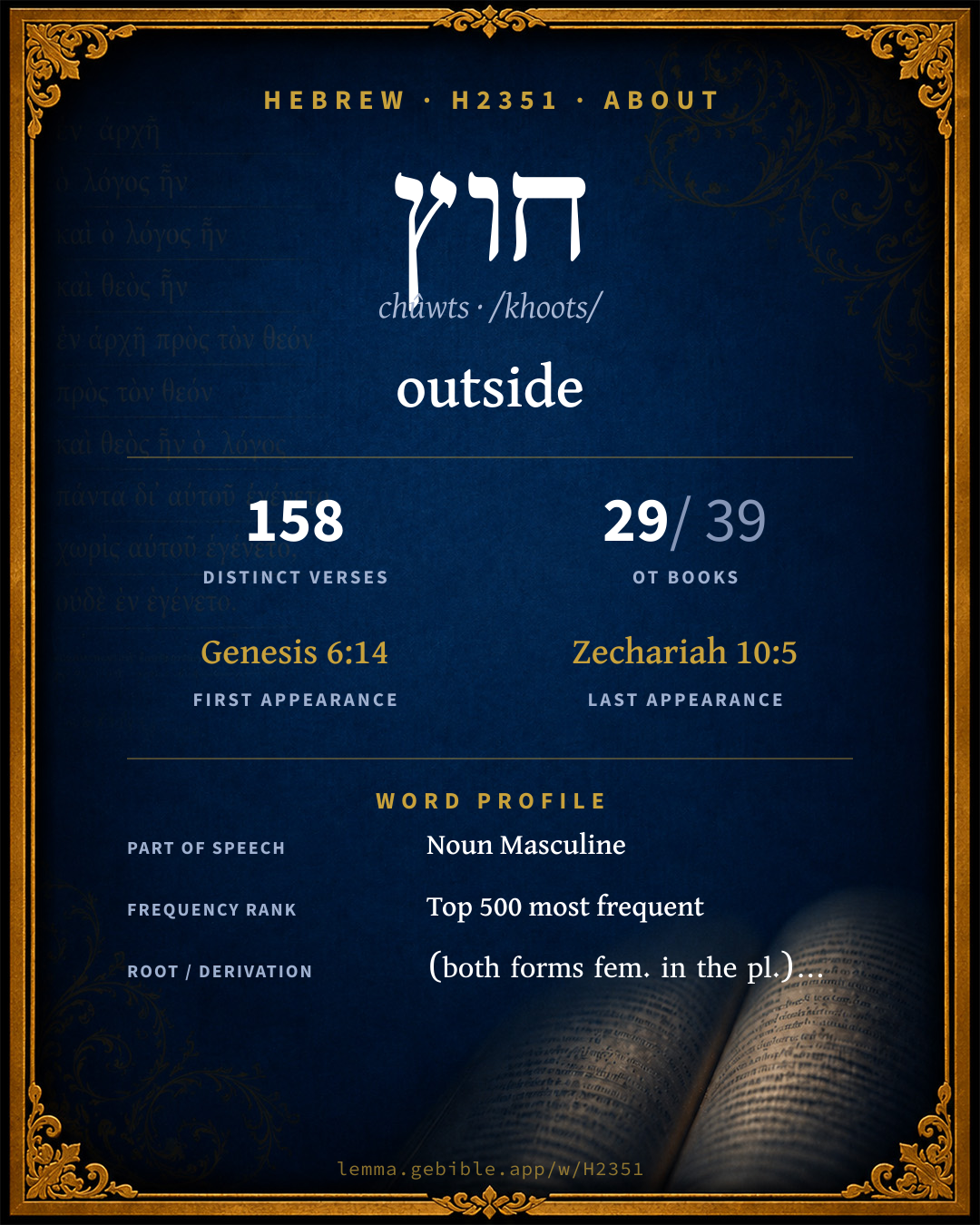
חוּץ
outside
Full lexicon entry — Brown-Driver-Briggs (BDB)
From Brown-Driver-Briggs (BDB)
Where this word appears
See every Absolute-state word in the Hebrew Bible →
Grammar key — what these labels mean
Part of speech
- Noun
- A naming word — a person, place, thing, or idea.
Noun type
- Common
- A common noun — a general class of person, place, or thing (“king,” “city,” “water”), not a specific name.
State
- Absolute
- The independent form of a noun, not bound to a following word.
- Construct
- A noun bound to a following noun in a possessive / “of” relationship (the construct chain).
Gender
- Masculine
- Grammatically masculine.
Number
- Singular
- One.
- Plural
- More than one (in Hebrew, generally three or more).
Grammatical forms
- Noun, Common, Masculine, Singular, Absolute 122 times (74%)
- Noun, Common, Masculine, Plural, Absolute 22 times (13%)
- Noun, Common, Masculine, Plural, Construct 19 times (12%)
- Noun, Common, Masculine, Singular, Construct 1 time (1%)
Parsed forms decoded from the imported morphology (morphhb / Westminster Leningrad Codex — WLC text public domain, morphhb tagging CC BY 4.0), counted across 164 parsed occurrences — not distinct verses.
Every verse where H2351 appears — 158 distinct verses across 29 books. Click any verse to open its interlinear word-by-word view. Verse text shown in the World English Bible for context — . Each verse’s Hebrew form is shown with its reference; the English is not keyword-highlighted, since the data carries no word-level English alignment. Use “Compare translations” on any verse to read it across multiple English versions. This concordance covers the Hebrew Bible; Septuagint (Greek Old Testament) occurrences are not indexed here.
Genesis 12 verses
- Genesis 6:14 וּ/מִ/ח֖וּץ conj + prep + n c ms Make an ark of gopher wood. You shall make rooms in the ark, and shall seal it inside and outside with pitch.
- Genesis 9:22 בַּ/חֽוּץ prep det + n c ms Ham, the father of Canaan, saw the nakedness of his father, and told his two brothers outside.
- Genesis 15:5 הַ/ח֗וּצָ/ה ptcl def.art + n c ms + sfx dem Yahweh brought him outside, and said, "Look now toward the sky, and count the stars, if you are able to count them." He said to Abram, "So shall your seed be."
- Genesis 19:16 מִ/ח֥וּץ prep + n c ms But he lingered; and the men laid hold on his hand, and on the hand of his wife, and on the hand of his two daughters, Yahweh being merciful to him; and they took him out, and set him outside of the city.
- Genesis 19:17 הַ/ח֗וּצָ/ה ptcl def.art + n c ms + sfx dem It came to pass, when they had taken them out, that he said, "Escape for your life! Don't look behind you, neither stay anywhere in the plain. Escape to the mountain, lest you be consumed!"
- Genesis 24:11 מִ/ח֥וּץ prep + n c ms He made the camels kneel down outside the city by the well of water at the time of evening, the time that women go out to draw water.
- Genesis 24:29 הַ/ח֖וּצָ/ה ptcl def.art + n c ms + sfx dem Rebekah had a brother, and his name was Laban. Laban ran out to the man, to the spring.
- Genesis 24:31 בַּ/ח֔וּץ prep det + n c ms He said, "Come in, you blessed of Yahweh. Why do you stand outside? For I have prepared the house, and room for the camels."
- Genesis 39:12 הַ/חֽוּצָ/ה ptcl def.art + n c ms + sfx dem She caught him by his garment, saying, "Lie with me!" He left his garment in her hand, and ran outside.
- Genesis 39:13 הַ/חֽוּצָ/ה ptcl def.art + n c ms + sfx dem It happened, when she saw that he had left his garment in her hand, and had run outside,
- Genesis 39:15 הַ/חֽוּצָ/ה ptcl def.art + n c ms + sfx dem It happened, when he heard that I lifted up my voice and cried, that he left his garment by me, and ran outside."
- Genesis 39:18 הַ/חֽוּצָ/ה ptcl def.art + n c ms + sfx dem and it happened, as I lifted up my voice and cried, that he left his garment by me, and ran outside."
Exodus 9 verses
- Exodus 12:46 ח֑וּצָ/ה n c ms + sfx dem In one house shall it be eaten; you shall not carry forth anything of the flesh abroad out of the house; neither shall you break a bone of it.
- Exodus 21:19 בַּ/ח֛וּץ prep det + n c ms if he rises again and walks around with his staff, then he who struck him shall be cleared: only he shall pay for the loss of his time, and shall provide for his healing until he is thoroughly healed.
- Exodus 25:11 וּ/מִ/ח֖וּץ conj + prep + n c ms You shall overlay it with pure gold. Inside and outside shall you overlay it, and shall make a gold molding around it.
- Exodus 26:35 מִ/ח֣וּץ prep + n c ms You shall set the table outside the veil, and the lampstand over against the table on the side of the tent toward the south: and you shall put the table on the north side.
- Exodus 27:21 מִ/ח֨וּץ prep + n c ms In the tent of meeting, outside the veil which is before the testimony, Aaron and his sons shall keep it in order from evening to morning before Yahweh: it shall be a statute forever throughout their generations on the behalf of the children of Israel.
- Exodus 29:14 מִ/ח֖וּץ prep + n c ms But the flesh of the bull, and its skin, and its dung, you shall burn with fire outside of the camp: it is a sin-offering.
- Exodus 33:7 מִ/ח֣וּץ מִ/ח֥וּץ prep + n c ms prep + n c ms Now Moses used to take the tent and to pitch it outside the camp, far away from the camp, and he called it "The tent of meeting." It happened that everyone who sought Yahweh went out to the tent of meeting, which was outside the camp.
- Exodus 37:2 וּ/מִ/ח֑וּץ conj + prep + n c ms He overlaid it with pure gold inside and outside, and made a molding of gold for it round about.
- Exodus 40:22 מִ/ח֖וּץ prep + n c ms He put the table in the tent of meeting, on the side of the tent northward, outside of the veil.
Leviticus 20 verses
- Leviticus 4:12 מִ/ח֨וּץ prep + n c ms even the whole bull shall he carry forth outside the camp to a clean place, where the ashes are poured out, and burn it on wood with fire. Where the ashes are poured out it shall be burned.
- Leviticus 4:21 מִ/חוּץ֙ prep + n c ms He shall carry forth the bull outside the camp, and burn it as he burned the first bull. It is the sin offering for the assembly.
- Leviticus 6:11 מִ/ח֣וּץ prep + n c ms He shall take off his garments, and put on other garments, and carry the ashes outside the camp to a clean place.
- Leviticus 8:17 מִ/ח֖וּץ prep + n c ms But the bull, and its skin, and its flesh, and its dung, he burned with fire outside the camp; as Yahweh commanded Moses.
- Leviticus 9:11 מִ/ח֖וּץ prep + n c ms The flesh and the skin he burned with fire outside the camp.
- Leviticus 10:4 מִ/ח֖וּץ prep + n c ms Moses called Mishael and Elzaphan, the sons of Uzziel the uncle of Aaron, and said to them, "Draw near, carry your brothers from before the sanctuary out of the camp."
- Leviticus 10:5 מִ/ח֖וּץ prep + n c ms So they drew near, and carried them in their coats out of the camp, as Moses had said.
- Leviticus 13:46 מִ/ח֥וּץ prep + n c ms All the days in which the plague is in him he shall be unclean. He is unclean. He shall dwell alone. Outside of the camp shall be his dwelling.
- Leviticus 14:3 מִ/ח֖וּץ prep + n c ms and the priest shall go forth out of the camp. The priest shall examine him, and, behold, if the plague of leprosy is healed in the leper,
- Leviticus 14:8 מִ/ח֥וּץ prep + n c ms "He who is to be cleansed shall wash his clothes, and shave off all his hair, and bathe himself in water; and he shall be clean. After that he shall come into the camp, but shall dwell outside his tent seven days.
- Leviticus 14:40 מִ/ח֣וּץ prep + n c ms then the priest shall command that they take out the stones in which is the plague, and cast them into an unclean place outside of the city:
- Leviticus 14:41 מִ/ח֣וּץ prep + n c ms and he shall cause the inside of the house to be scraped round about, and they shall pour out the mortar, that they scraped off, outside of the city into an unclean place.
- Leviticus 14:45 מִ/ח֣וּץ prep + n c ms He shall break down the house, its stones, and its timber, and all the house's mortar. He shall carry them out of the city into an unclean place.
- Leviticus 14:53 מִ/ח֥וּץ prep + n c ms but he shall let the living bird go out of the city into the open field. So shall he make atonement for the house; and it shall be clean."
- Leviticus 16:27 מִ/ח֣וּץ prep + n c ms The bull for the sin offering, and the goat for the sin offering, whose blood was brought in to make atonement in the Holy Place, shall be carried forth outside the camp; and they shall burn their skins, their flesh, and their dung with fire.
- Leviticus 17:3 מִ/ח֖וּץ prep + n c ms Whatever man there is of the house of Israel, who kills an ox, or lamb, or goat, in the camp, or who kills it outside the camp,
- Leviticus 18:9 ח֑וּץ n c ms "'You shall not uncover the nakedness of your sister, the daughter of your father, or the daughter of your mother, whether born at home, or born abroad.
- Leviticus 24:3 מִ/חוּץ֩ prep + n c ms Outside of the veil of the Testimony, in the Tent of Meeting, shall Aaron keep it in order from evening to morning before Yahweh continually: it shall be a statute forever throughout your generations.
- Leviticus 24:14 מִ/חוּץ֙ prep + n c ms "Bring out of the camp him who cursed; and let all who heard him lay their hands on his head, and let all the congregation stone him.
- Leviticus 24:23 מִ/חוּץ֙ prep + n c ms Moses spoke to the children of Israel; and they brought forth him who had cursed out of the camp, and stoned him with stones. The children of Israel did as Yahweh commanded Moses.
Numbers 13 verses
- Numbers 5:3 מִ/ח֥וּץ prep + n c ms Both male and female shall you put out, outside of the camp shall you put them; that they not defile their camp, in the midst of which I dwell."
- Numbers 5:4 מִ/ח֖וּץ prep + n c ms The children of Israel did so, and put them out outside of the camp; as Yahweh spoke to Moses, so did the children of Israel.
- Numbers 12:14 מִ/ח֣וּץ prep + n c ms Yahweh said to Moses, If her father had but spit in her face, shouldn't she be ashamed seven days? let her be shut up outside of the camp seven days, and after that she shall be brought in again.
- Numbers 12:15 מִ/ח֥וּץ prep + n c ms Miriam was shut up outside of the camp seven days: and the people didn't travel until Miriam was brought in again.
- Numbers 15:35 מִ/ח֖וּץ prep + n c ms Yahweh said to Moses, The man shall surely be put to death: all the congregation shall stone him with stones outside of the camp.
- Numbers 15:36 מִ/חוּץ֙ prep + n c ms All the congregation brought him outside of the camp, and stoned him to death with stones; as Yahweh commanded Moses.
- Numbers 19:3 מִ/ח֣וּץ prep + n c ms You shall give her to Eleazar the priest, and he shall bring her forth outside of the camp, and one shall kill her before his face:
- Numbers 19:9 מִ/ח֥וּץ prep + n c ms A man who is clean shall gather up the ashes of the heifer, and lay them up outside of the camp in a clean place; and it shall be kept for the congregation of the children of Israel for a water for impurity: it is a sin-offering.
- Numbers 31:13 מִ/ח֖וּץ prep + n c ms Moses, and Eleazar the priest, and all the princes of the congregation, went forth to meet them outside of the camp.
- Numbers 31:19 מִ/ח֥וּץ prep + n c ms Encamp you outside of the camp seven days: whoever has killed any person, and whoever has touched any slain, purify yourselves on the third day and on the seventh day, you and your captives.
- Numbers 35:4 וָ/ח֔וּצָ/ה conj + n c ms + sfx dem The suburbs of the cities, which you shall give to the Levites, shall be from the wall of the city and outward one thousand cubits round about.
- Numbers 35:5 מִ/ח֣וּץ prep + n c ms You shall measure outside of the city for the east side two thousand cubits, and for the south side two thousand cubits, and for the west side two thousand cubits, and for the north side two thousand cubits, the city being in the midst. This shall be to them the suburbs of the cities.
- Numbers 35:27 מִ/ח֕וּץ prep + n c ms and the avenger of blood find him outside of the border of his city of refuge, and the avenger of blood kill the manslayer; he shall not be guilty of blood,
Deuteronomy 6 verses
- Deuteronomy 23:10 מִ/ח֣וּץ prep + n c ms If there be among you any man, who is not clean by reason of that which happens him by night, then shall he go abroad out of the camp, he shall not come within the camp:
- Deuteronomy 23:12 מִ/ח֖וּץ חֽוּץ prep + n c ms n c ms You shall have a place also outside of the camp, where you shall go forth abroad:
- Deuteronomy 23:13 ח֔וּץ n c ms and you shall have a paddle among your weapons; and it shall be, when you sit down abroad, you shall dig therewith, and shall turn back and cover that which comes from you:
- Deuteronomy 24:11 בַּ/ח֖וּץ הַ/חֽוּצָ/ה prep det + n c ms ptcl def.art + n c ms + sfx dem You shall stand outside, and the man to whom you do lend shall bring forth the pledge outside to you.
- Deuteronomy 25:5 הַ/ח֖וּצָ/ה ptcl def.art + n c ms + sfx dem If brothers dwell together, and one of them die, and have no son, the wife of the dead shall not be married outside to a stranger: her husband's brother shall go in to her, and take her to him as wife, and perform the duty of a husband's brother to her.
- Deuteronomy 32:25 מִ/חוּץ֙ prep + n c ms Outside shall the sword bereave, In the chambers terror; [It shall destroy] both young man and virgin, The suckling with the man of gray hairs.
Joshua 2 verses
- Joshua 2:19 הַ/ח֛וּצָ/ה ptcl def.art + n c ms + sfx dem It shall be, that whoever shall go out of the doors of your house into the street, his blood shall be on his head, and we shall be guiltless: and whoever shall be with you in the house, his blood shall be on our head, if any hand be on him.
- Joshua 6:23 מִ/ח֖וּץ prep + n c ms The young men the spies went in, and brought out Rahab, and her father, and her mother, and her brothers, and all that she had; all her relatives also they brought out; and they set them outside of the camp of Israel.
Judges 2 verses
- Judges 12:9 הַ/ח֔וּצָ/ה הַ/ח֑וּץ ptcl def.art + n c ms + sfx dem ptcl def.art + n c ms He had thirty sons; and thirty daughters he sent abroad, and thirty daughters he brought in from abroad for his sons. He judged Israel seven years.
- Judges 19:25 הַ/ח֑וּץ ptcl def.art + n c ms But the men wouldn't listen to him: so the man laid hold on his concubine, and brought her forth to them; and they knew her, and abused her all the night until the morning: and when the day began to spring, they let her go.
1 Samuel 1 verse
2 Samuel 4 verses
- 2 Samuel 1:20 בְּ/חוּצֹ֣ת prep + n c mp cs Don't tell it in Gath, Don't publish it in the streets of Ashkelon; Lest the daughters of the Philistines rejoice, Lest the daughters of the uncircumcised triumph.
- 2 Samuel 13:17 הַ/ח֑וּצָ/ה ptcl def.art + n c ms + sfx dem Then he called his servant who ministered to him, and said, Put now this woman out from me, and bolt the door after her.
- 2 Samuel 13:18 הַ/ח֔וּץ ptcl def.art + n c ms She had a garment of various colors on her; for with such robes were the king's daughters who were virgins dressed. Then his servant brought her out, and bolted the door after her.
- 2 Samuel 22:43 חוּצ֥וֹת n c mp Then did I beat them small as the dust of the earth, I did crush them as the mire of the streets, and did spread them abroad.
1 Kings 5 verses
- 1 Kings 6:6 ח֔וּצָ/ה n c ms + sfx dem The nethermost story was five cubits broad, and the middle was six cubits broad, and the third was seven cubits broad; for on the outside he made offsets [in the wall] of the house round about, that [the beams] should not have hold in the walls of the house.
- 1 Kings 7:9 וּ/מִ/ח֑וּץ וּ/מִ/ח֖וּץ conj + prep + n c ms conj + prep + n c ms All these were of costly stones, even of hewn stone, according to measure, sawed with saws, inside and outside, even from the foundation to the coping, and so on the outside to the great court.
- 1 Kings 8:8 הַ/ח֑וּצָ/ה ptcl def.art + n c ms + sfx dem The poles were so long that the ends of the poles were seen from the holy place before the oracle; but they were not seen outside: and there they are to this day.
- 1 Kings 20:34 וְ֠/חוּצוֹת conj + n c mp [Ben Hadad] said to him, The cities which my father took from your father I will restore; and you shall make streets for you in Damascus, as my father made in Samaria. I, [said Ahab], will let you go with this covenant. So he made a covenant with him, and let him go.
- 1 Kings 21:13 מִ/ח֣וּץ prep + n c ms The two men, the base fellows, came in and sat before him: and the base fellows bore witness against him, even against Naboth, in the presence of the people, saying, Naboth did curse God and the king. Then they carried him forth out of the city, and stoned him to death with stones.
2 Kings 4 verses
- 2 Kings 4:3 הַ/ח֔וּץ ptcl def.art + n c ms Then he said, Go, borrow you vessels abroad of all your neighbors, even empty vessels; borrow not a few.
- 2 Kings 10:24 בַ/חוּץ֙ prep det + n c ms They went in to offer sacrifices and burnt offerings. Now Jehu had appointed him eighty men outside, and said, If any of the men whom I bring into your hands escape, [he who lets him go], his life shall be for the life of him.
- 2 Kings 23:4 מִ/ח֤וּץ prep + n c ms The king commanded Hilkiah the high priest, and the priests of the second order, and the keepers of the threshold, to bring forth out of the temple of Yahweh all the vessels that were made for Baal, and for the Asherah, and for all the host of the sky, and he burned them outside of Jerusalem in the fields of the Kidron, and carried the ashes of them to Bethel.
- 2 Kings 23:6 מִ/ח֤וּץ prep + n c ms He brought out the Asherah from the house of Yahweh, outside of Jerusalem, to the brook Kidron, and burned it at the brook Kidron, and beat it to dust, and cast the dust of it on the graves of the common people.
2 Chronicles 6 verses
- 2 Chronicles 5:9 הַ/ח֑וּצָ/ה ptcl def.art + n c ms + sfx dem The poles were so long that the ends of the poles were seen from the ark before the oracle; but they were not seen outside: and there it is to this day.
- 2 Chronicles 24:8 חֽוּצָ/ה n c ms + sfx dem So the king commanded, and they made a chest, and set it outside at the gate of the house of Yahweh.
- 2 Chronicles 29:16 חֽוּצָ/ה n c ms + sfx dem The priests went in to the inner part of the house of Yahweh, to cleanse it, and brought out all the uncleanness that they found in the temple of Yahweh into the court of the house of Yahweh. The Levites took it, to carry it out abroad to the brook Kidron.
- 2 Chronicles 32:3 מִ/ח֣וּץ prep + n c ms he took counsel with his princes and his mighty men to stop the waters of the springs which were outside of the city; and they helped him.
- 2 Chronicles 32:5 וְ/לַ/ח֨וּצָ/ה֙ conj + prep det + n c ms + sfx dem He took courage, and built up all the wall that was broken down, and raised [it] up to the towers, and the other wall outside, and strengthened Millo [in] the city of David, and made weapons and shields in abundance.
- 2 Chronicles 33:15 ח֥וּצָ/ה n c ms + sfx dem He took away the foreign gods, and the idol out of the house of Yahweh, and all the altars that he had built in the mountain of the house of Yahweh, and in Jerusalem, and cast them out of the city.
Ezra 1 verse
Nehemiah 2 verses
Job 3 verses
- Job 5:10 חוּצֽוֹת n c mp Who gives rain on the earth, And sends waters on the fields;
- Job 18:17 חֽוּץ n c ms His memory shall perish from the earth. He shall have no name in the street.
- Job 31:32 בַּ֭/חוּץ prep det + n c ms (The foreigner has not lodged in the street; But I have opened my doors to the traveler);
Psalms 4 verses
- Psalms 18:42 חוּצ֣וֹת n c mp Then I beat them small as the dust before the wind. I cast them out as the mire of the streets.
- Psalms 31:11 בַּ/ח֑וּץ prep det + n c ms Because of all my adversaries I have become utterly contemptible to my neighbors, A fear to my acquaintances. Those who saw me on the street fled from me.
- Psalms 41:6 לַ/ח֣וּץ prep det + n c ms If he comes to see me, he speaks falsehood. His heart gathers iniquity to itself. When he goes abroad, he tells it.
- Psalms 144:13 בְּ/חוּצוֹתֵֽי/נוּ prep + n c mp cs + sfx pers 1cp Our barns are full, filled with all kinds of provision. Our sheep bring forth thousands and ten thousands in our fields.
Proverbs 6 verses
- Proverbs 1:20 בַּ/ח֣וּץ prep det + n c ms Wisdom calls aloud in the street. She utters her voice in the public squares.
- Proverbs 5:16 ח֑וּצָ/ה n c ms + sfx dem Should your springs overflow in the streets, Streams of water in the public squares?
- Proverbs 7:12 בַּ/ח֗וּץ prep det + n c ms Now she is in the streets, now in the squares, And lurking at every corner.
- Proverbs 8:26 וְ/חוּצ֑וֹת conj + n c mp While as yet he had not made the earth, nor the fields, Nor the beginning of the dust of the world.
- Proverbs 22:13 בַ/ח֑וּץ prep det + n c ms The sluggard says, "There is a lion outside! I will be killed in the streets!"
- Proverbs 24:27 בַּ/ח֨וּץ prep det + n c ms Prepare your work outside, And get your fields ready. Afterwards, build your house.
Ecclesiastes 1 verse
Song of Solomon 1 verse
Isaiah 8 verses
- Isaiah 5:25 חוּצ֑וֹת n c mp Therefore Yahweh's anger burns against his people, And he has stretched out his hand against them, and has struck them. The mountains tremble, And their dead bodies are as refuse in the midst of the streets. For all this, his anger is not turned away, But his hand is still stretched out.
- Isaiah 10:6 חוּצֽוֹת n c mp I will send him against a profane nation, and against the people of my wrath will I give him a charge, to take the spoil, and to take the prey, and to tread them down like the mire of the streets.
- Isaiah 15:3 בְּ/חוּצֹתָ֖י/ו prep + n c mp cs + sfx pers 3ms In their streets they gird themselves with sackcloth; on their housetops, and in their broad places, everyone wails, weeping abundantly.
- Isaiah 24:11 בַּֽ/חוּצ֑וֹת prep det + n c mp There is a crying in the streets because of the wine; all joy is darkened, the mirth of the land is gone.
- Isaiah 33:7 חֻ֑צָ/ה n c ms + sfx dem Behold, their valiant ones cry outside; the ambassadors of peace weep bitterly.
- Isaiah 42:2 בַּ/ח֖וּץ prep det + n c ms He will not cry, nor lift up his voice, nor cause it to be heard in the street.
- Isaiah 51:20 חוּצ֖וֹת n c mp Your sons have fainted, they lie at the head of all the streets, as an antelope in a net; they are full of the wrath of Yahweh, the rebuke of your God.
- Isaiah 51:23 וְ/כַ/ח֖וּץ conj + prep det + n c ms and I will put it into the hand of those who afflict you, who have said to your soul, Bow down, that we may go over; and you have laid your back as the ground, and as the street, to those who go over.
Jeremiah 16 verses
- Jeremiah 5:1 בְּ/חוּצ֣וֹת prep + n c mp cs Run you back and forth through the streets of Jerusalem, and see now, and know, and seek in the broad places of it, if you can find a man, if there are any who does justly, who seeks truth; and I will pardon her.
- Jeremiah 6:11 בַּ/ח֔וּץ prep det + n c ms Therefore I am full of the wrath of Yahweh; I am weary with holding in: pour it out on the children in the street, and on the assembly of young men together; for even the husband with the wife shall be taken, the aged with him who is full of days.
- Jeremiah 7:17 וּ/בְ/חֻצ֖וֹת conj + prep + n c mp cs Don't you see what they do in the cities of Judah and in the streets of Jerusalem?
- Jeremiah 7:34 וּ/מֵֽ/חֻצוֹת֙ conj + prep + n c mp cs Then will I cause to cease from the cities of Judah, and from the streets of Jerusalem, the voice of mirth and the voice of gladness, the voice of the bridegroom and the voice of the bride; for the land shall become a waste.
- Jeremiah 9:21 מִ/ח֔וּץ prep + n c ms For death is come up into our windows, it is entered into our palaces; to cut off the children from outside, [and] the young men from the streets.
- Jeremiah 11:6 וּ/בְ/חֻצ֥וֹת conj + prep + n c mp cs Yahweh said to me, Proclaim all these words in the cities of Judah, and in the streets of Jerusalem, saying, Hear you the words of this covenant, and do them.
- Jeremiah 11:13 חֻצ֣וֹת n c mp cs For according to the number of your cities are your gods, Judah; and according to the number of the streets of Jerusalem have you set up altars to the shameful thing, even altars to burn incense to Baal.
- Jeremiah 14:16 בְּ/חֻצ֨וֹת prep + n c mp cs The people to whom they prophesy shall be cast out in the streets of Jerusalem because of the famine and the sword; and they shall have none to bury them-them, their wives, nor their sons, nor their daughters: for I will pour their wickedness on them.
- Jeremiah 21:4 מִ/ח֖וּץ prep + n c ms Thus says Yahweh, the God of Israel, Behold, I will turn back the weapons of war that are in your hands, with which you fight against the king of Babylon, and against the Chaldeans who besiege you, without the walls; and I will gather them into the midst of this city.
- Jeremiah 33:10 וּ/בְ/חֻצ֣וֹת conj + prep + n c mp cs Thus says Yahweh: Yet again there shall be heard in this place, about which you say, It is waste, without man and without animal, even in the cities of Judah, and in the streets of Jerusalem, that are desolate, without man and without inhabitant and without animal,
- Jeremiah 37:21 מִ/ח֣וּץ prep + n c ms cs Then Zedekiah the king commanded, and they committed Jeremiah into the court of the guard; and they gave him daily a loaf of bread out of the bakers' street, until all the bread in the city was spent. Thus Jeremiah remained in the court of the guard.
- Jeremiah 44:6 וּ/בְ/חֻצ֖וֹת conj + prep + n c mp cs Therefore my wrath and my anger was poured forth, and was kindled in the cities of Judah and in the streets of Jerusalem; and they are wasted and desolate, as it is this day.
- Jeremiah 44:9 וּ/בְ/חֻצ֖וֹת conj + prep + n c mp cs Have you forgotten the wickedness of your fathers, and the wickedness of the kings of Judah, and the wickedness of their wives, and your own wickedness, and the wickedness of your wives which they committed in the land of Judah, and in the streets of Jerusalem?
- Jeremiah 44:17 וּ/בְ/חֻצ֖וֹת conj + prep + n c mp cs But we will certainly perform every word that is gone forth out of our mouth, to burn incense to the queen of the sky, and to pour out drink-offerings to her, as we have done, we and our fathers, our kings and our princes, in the cities of Judah, and in the streets of Jerusalem; for then had we plenty of food, and were well, and saw no evil.
- Jeremiah 44:21 וּ/בְ/חֻצ֣וֹת conj + prep + n c mp cs The incense that you burned in the cities of Judah, and in the streets of Jerusalem, you and your fathers, your kings and your princes, and the people of the land, didn't Yahweh remember them, and didn't it come into his mind?
- Jeremiah 51:4 בְּ/חוּצוֹתֶֽי/הָ prep + n c mp cs + sfx pers 3fs They shall fall down slain in the land of the Chaldeans, and thrust through in her streets.
Lamentations 7 verses
- Lamentations 1:20 מִ/ח֥וּץ prep + n c ms See, Yahweh; for I am in distress; my heart is troubled; My heart is turned within me; for I have grievously rebelled: Abroad the sword bereaves, at home there is as death.
- Lamentations 2:19 חוּצֽוֹת n c mp Arise, cry out in the night, at the beginning of the watches; Pour out your heart like water before the face of the Lord: Lift up your hands toward him for the life of your young children, that faint for hunger at the head of every street.
- Lamentations 2:21 חוּצוֹת֙ n c mp The youth and the old man lie on the ground in the streets; My virgins and my young men are fallen by the sword: You have killed them in the day of your anger; you have slaughtered, [and] not pitied.
- Lamentations 4:1 חוּצֽוֹת n c mp How is the gold become dim! [how] is the most pure gold changed! The stones of the sanctuary are poured out at the head of every street.
- Lamentations 4:5 בַּ/חוּצ֑וֹת prep det + n c mp Those who did feed delicately are desolate in the streets: Those who were brought up in scarlet embrace dunghills.
- Lamentations 4:8 בַּ/חוּצ֑וֹת prep det + n c mp Their visage is blacker than a coal; they are not known in the streets: Their skin cleaves to their bones; it is withered, it is become like a stick.
- Lamentations 4:14 בַּֽ/חוּצ֔וֹת prep det + n c mp They wander as blind men in the streets, they are polluted with blood, So that men can't touch their garments.
Ezekiel 17 verses
- Ezekiel 7:15 בַּ/ח֔וּץ prep det + n c ms The sword is outside, and the pestilence and the famine within: he who is in the field shall die with the sword: and he who is in the city, famine and pestilence shall devour him.
- Ezekiel 7:19 בַּ/חוּצ֣וֹת prep det + n c mp They shall cast their silver in the streets, and their gold shall be as an unclean thing; their silver and their gold shall not be able to deliver them in the day of the wrath of Yahweh: they shall not satisfy their souls, neither fill their bowels; because it has been the stumbling block of their iniquity.
- Ezekiel 11:6 חוּצֹתֶ֖י/הָ n c mp cs + sfx pers 3fs You have multiplied your slain in this city, and you have filled the streets of it with the slain.
- Ezekiel 26:11 חֽוּצוֹתָ֑יִ/ךְ n c mp cs + sfx pers 2fs With the hoofs of his horses shall he tread down all your streets; he shall kill your people with the sword; and the pillars of your strength shall go down to the ground.
- Ezekiel 28:23 בְּ/ח֣וּצוֹתֶ֔י/הָ prep + n c mp cs + sfx pers 3fs For I will send pestilence into her, and blood into her streets; and the wounded shall fall in the midst of her, with the sword on her on every side; and they shall know that I am Yahweh.
- Ezekiel 34:21 הַ/חֽוּצָ/ה ptcl def.art + n c ms + sfx dem Because you thrust with side and with shoulder, and push all the diseased with your horns, until you have scattered them abroad;
- Ezekiel 40:5 מִ/ח֥וּץ prep + n c ms Behold, a wall on the outside of the house round about, and in the man's hand a measuring reed six cubits long, of a cubit and a handbreadth each: so he measured the thickness of the building, one reed; and the height, one reed.
- Ezekiel 40:19 מִ/ח֖וּץ prep + n c ms Then he measured the breadth from the forefront of the lower gate to the forefront of the inner court outside, one hundred cubits, [both] on the east and on the north.
- Ezekiel 40:40 מִ/ח֗וּצָ/ה prep + n c ms + sfx dem On the [one] side outside, as one goes up to the entry of the gate toward the north, were two tables; and on the other side, which belonged to the porch of the gate, were two tables.
- Ezekiel 40:44 וּ/מִ/חוּצָ/ה֩ conj + prep + n c ms + sfx dem Outside of the inner gate were chambers for the singers in the inner court, which was at the side of the north gate; and their prospect was toward the south; one at the side of the east gate having the prospect toward the north.
- Ezekiel 41:9 הַ/ח֖וּץ ptcl def.art + n c ms The thickness of the wall, which was for the side-chambers, on the outside, was five cubits: and that which was left was the place of the side-chambers that belonged to the house.
- Ezekiel 41:17 וְ/לַ/ח֜וּץ conj + prep det + n c ms to [the space] above the door, even to the inner house, and outside, and by all the wall round about inside and outside, by measure.
- Ezekiel 41:25 מֵ/הַ/חֽוּץ prep + ptcl def.art + n c ms There were made on them, on the doors of the temple, cherubim and palm trees, like as were made on the walls; and there was a threshold of wood on the face of the porch outside.
- Ezekiel 42:7 לַ/חוּץ֙ prep det + n c ms The wall that was outside by the side of the chambers, toward the outer court before the chambers, the length of it was fifty cubits.
- Ezekiel 43:21 מִ/ח֖וּץ prep + n c ms You shall also take the bull of the sin-offering, and it shall be burnt in the appointed place of the house, outside of the sanctuary.
- Ezekiel 46:2 מִ/ח֗וּץ prep + n c ms The prince shall enter by the way of the porch of the gate outside, and shall stand by the post of the gate; and the priests shall prepare his burnt-offering and his peace-offerings, and he shall worship at the threshold of the gate: then he shall go forth; but the gate shall not be shut until the evening.
- Ezekiel 47:2 ח֔וּץ הַ/ח֔וּץ n c ms ptcl def.art + n c ms Then he brought me out by the way of the gate northward, and led me round by the way outside to the outer gate, by the way of [the gate] that looks toward the east; and, behold, there ran out waters on the right side.
Hosea 1 verse
Amos 1 verse
Micah 1 verse
Nahum 2 verses
- Nahum 2:4 בַּֽ/חוּצוֹת֙ prep det + n c mp The chariots rage in the streets. They rush back and forth in the broad ways. Their appearance is like torches. They run like the lightnings.
- Nahum 3:10 חוּצ֑וֹת n c mp Yet was she carried away. She went into captivity. Her young children also were dashed in pieces at the head of all the streets, and they cast lots for her honorable men, and all her great men were bound in chains.
Zephaniah 1 verse
Zechariah 2 verses
- Zechariah 9:3 חוּצֽוֹת n c mp Tyre built herself a stronghold, And heaped up silver like the dust, And fine gold like the mire of the streets.
- Zechariah 10:5 חוּצוֹת֙ n c mp They shall be as mighty men, Treading down muddy streets in the battle; And they shall fight, because Yahweh is with them; And the riders on horses will be confounded.
About this entry
At a glance — auto-summarized from this page’s data, not written by a person. Every figure links to its source below. This summary describes the numbers; it doesn’t interpret them.
חוץ — transliterated chûwts — is a Hebrew noun carrying the sense “outside.” Where the King James Version says “without,” newer translations reach for “outside” (Berean Standard Bible); the renderings breakdown has the detail. The Hebrew Bible uses it across 158 verses — common. Debuting at Genesis 6:14, it then recurs through the corpus. It shares a root with חיץ. Each statement above links to its evidence; the full detail follows below.
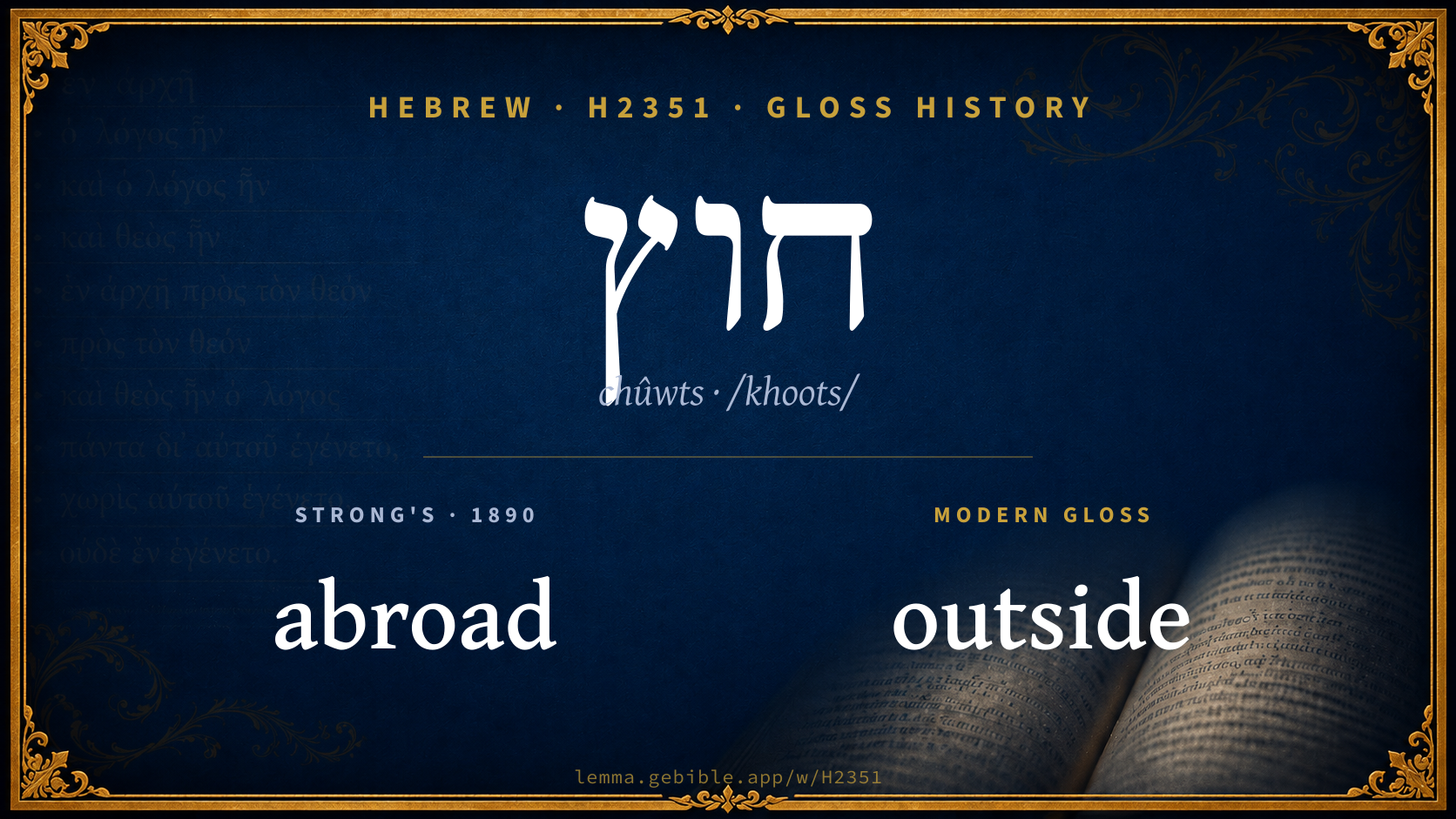
Gloss history
Strong's 1890 vs modern scholarship
About this word
Strong's H2351 catalogs a Hebrew word from the Hebrew Old Testament.
These counts are not copied from any lexicon or concordance. They are computed here, from the morphology-tagged Hebrew Old Testament. What Lemma adds →
- 158
- distinct verses
- The word appears in 158 distinct verses.
- 29 / 39
- OT books
- The word appears in 29 of 39 Old Testament books.
- #279
- by frequency
- Top 500 most frequent Hebrew words (rank 279 of 8,640 Hebrew words by occurrence).
View all 158 occurrences in the concordance →
By section of the Old Testament
By traditional corpus
Conventional, traditional groupings — biblical authorship is debated, so this is a traditional corpus grouping, not an authorship claim. Each share is this word’s portion of its verses in that division of the Hebrew canon. Each figure is a share of the word’s 158 distinct verses.
- Prophets (Nevi'im) 67 verses · 42%
- Torah (Pentateuch) 60 verses · 38%
- Writings (Ketuvim) 31 verses · 20%
How translations render this word
Counts come from each version’s own published word-to-Strong’s tagging or interlinear alignment — an approximate guide to how each version renders this word, not a word-level alignment the data otherwise carries. Because each total is that version’s own tagged count, the per-version totals vary from one another and need not match the appearance or distinct-verse counts above. These counts may also differ from a printed concordance because Lemma counts each distinctly tagged rendering and does not collapse phrase taggings into a single head-word total. This is a fixed set of word-tagged versions (KJV, ASV, BSB, ULT) and does not change with the reading translation you choose elsewhere. Each version’s license is shown beside its name below (and on Sources).
- King James Version: Without 59×, Streets 29×, Abroad 20×
- American Standard Version: Without 56×, Streets 28×, Abroad 12×
- Berean Standard Bible: Outside 68×, Streets 36×, Out 15×
- unfoldingWord Literal Text: Outside 78×, Streets 19×, Outside of 8×
King James Version Public Domain
Renders H2351 across 163 tagged occurrences — most commonly:
Plus 21 renderings that appear only once — usually multi-word phrases or single function words the recovered tagging swept in, not distinct renderings. Not rendered by a distinct English word in 1 further occurrence.
American Standard Version Public Domain
Renders H2351 across 160 tagged occurrences — most commonly:
Plus 31 renderings that appear only once — usually multi-word phrases or single function words the recovered tagging swept in, not distinct renderings.
Berean Standard Bible Public Domain
Renders H2351 across 156 tagged occurrences — most commonly:
Plus 18 renderings that appear only once — usually multi-word phrases or single function words the recovered tagging swept in, not distinct renderings. Not rendered by a distinct English word in 6 further occurrences.
unfoldingWord Literal Text CC BY-SA 4.0
Renders H2351 across 159 tagged occurrences — most commonly:
Plus 23 renderings that appear only once — usually multi-word phrases or single function words the recovered tagging swept in, not distinct renderings.
Senses in the full BDB
What do BDB’s symbols mean?
BDB uses these scholarly abbreviations:
| Symbol | Meaning |
|---|---|
| 𝔊 | the Septuagint (the ancient Greek translation, LXX) |
| 𝔙 | the Vulgate (the Latin translation) |
| 𝔖 | the Syriac version (the Peshitta) |
| 𝔗 | the Targum (the Aramaic translation) |
| ψ | the Psalms |
| √ | root (the underlying root or stem) |
| ‖ | parallel passage (a synonymous or contrasted parallel) |
| † | the dagger: every passage where the word occurs is cited |
The 6 senses and sub-senses the full Brown-Driver-Briggs lexicon distinguishes for this word, in lexicon order (not ranked by frequency), with BDB’s own verbatim wording and sub-sense lettering. Shown in Hebrew script with BDB’s own scholarly abbreviations. The condensed entry is in the Lexicon Entry tab. See also the Forms in the corpus table below.
- 1. the outside, of a house, tent, city, camp, etc., often used, especially with preps., to express the adv. idea of outside, abroad (Aramaic syn., except in sense 2 a, is בַּר, ܒܰܪ):
- a. as accus. after vb. of motion Dt 23:13 יָצָא חוּץ to go forth outside (sc. a camp), v 14 (as adv. accus.) בְּשִׁבְתְּךָ חוּץ outside, הוֹצִיא הַחוּץ to bring forth outside (a house or chamber) Ju 19:25 2 S 13:18 cf. Ne 13:8, Ju 12:9b בָּנוֹת הֵבִיא לְבָנָיו מִן־הַחוּץ from outside, from abroad, 2 K 4:3 שַׁאֲלִי־לָךְ כֵּלִים מִן־הַחוּץ from outside (opp. בַּבַּיִת v 2); as genit. Lv 18:9 מוֹלֶדֶת חוּץ one born abroad (i.e. by another father or mother, of a half-sister: opp. מוֹלֶדֶת בַּיִת) Ez 47:2(×2). With ָה loc. חוּצָה, after a vb. of motion Ex 12:46 מִן־הַבַּיִת … חוּצָה, Pr 5:16 2 Ch 29:16, 33:15 חוּצָה לָעִיר outside of the city, Nu 35:4 מִקִּיר הָעִיר וָחוּצָה from the wall of the city and outwards; = on the outside, without 1 K 6:6 Is 33:7 צָֽעֲקוּ חוּצָה cry without, 2 Ch 24:8: so הַחוּצָה Gn 15:5 וַיּוֹצֵא אֹתוֹ הח׳ and brought him outside, 19:17; 24:29 Jos 2:19 +, 1 K 8:8 לֹא יֵרָאוּ הַחוּצָה were not seen towards the outside, Dt 25:5 לֹא תִהְיֶה אֵשֶׁת הַמֵּת הַחוּצָה לְאִישׁ זָר i.e. shall not be married into another family, cf. Ju 12:9a. e.g. Deuteronomy 23:13
- b. with preps.: a. †אל־החוץ towards the outside Ez 41:9, †34:21 pleon. אל־החוצה. b. בחוץ Gn 9:22 outside (opp. בְּתוֹךְ אָהֳלֹה v 21), 24:31 לָמָּה תַעֲמֹד בַּחוּץ, Dt 24:11 Ex 21:19 אם יקום והתהלך בחוץ (after leaving a sick couch), 2 K 10:24 ψ 31:12 Ez 7:15 (opp. מִבַּיִת), Ho 7:1 +. c. †לחוץ ψ 41:7 יצא לחוץ; = on the outside Ez 41:17; 42:7, †לַחוּצָה 2 Ch 32:5 towards the outside. d. מִחוּץ on (מִן 1 c) the outside Ez 40:19; 46:2, מִבַּיִת וּמִחוּץ within and without (of an ark, building, etc.) Gn 6:14 Ex 25:11 = 37:2 1 K 7:9, Dt 32:25 מחוץ תְּשַׁכֶּל־חֶרֶב (opp. וּמֵחֲדָרִים אֵימָה), La 1:20 (cf. Ez 7:15 supr. b); so מֵהַחוּץ †Ez 41:25. מִחוּץ לְ on the outside of, Gn 19:16 וַיַּנִּיחֵהוּ מִחוּץ לָעִיר, 24:11 Ex 26:35; 37:7(×2) Lv 8:17; 14:8 Nu 35:5 Jos 6:23 Je 21:4 +, even after a vb. of motion 1 K 21:13 וַיּוֹצִיאוּהוּ מִחוּץ לָעִיר, 2 K 23:6, though in this case אל מחוץ ל is more common, Lv 4:12, 21 אל מחוץ למחנה, 6:4; 10:4; 14:40, 41 + often P, Dt 23:11. e. †מִחוּצָה Ez 40:40 on the outside, מִחוּצָה לְ v 44. f. (late) †חוּץ מִן outside of, Ec 2:25 who can eat, and who enjoy, חוּץ מִמֶּנִּי outside of me, i.e. except me? (but read rather, with 𝔊 𝔖 De Now al., חוּץ מִמֶּנּוּ apart from, without him, i.e. God). (So NH חוּץ מִן except, without, v. De Ec 2:25. Cf. the Aramaic syn. בַּר מִן except Ex 20:3 𝔗, apart from, without Is 36:10 𝔗; Syriac ܠܒܰܪ ܡܶܢ id.) e.g. Ezekiel 41:9
- 2. Of a definite locality, viz.
- a. that which is outside the houses of a town, i.e. a street Is 51:23 כַּחוּץ לַעֹבְרִים, Je 37:21 חוּץ הָאֹפִים the Bakers’ street, Pr 1:20 בַּחוּץ (‖ בָּֽרְחֹבוֹת: so 7:12; 22:13 Je 9:20); often in pl., as חוּצֹת אַשְׁקְלוֹן the streets of Ashkelon 2 S 1:20, ח׳ ירושׁלם Je 5:1; 7:17, 34 + often Jer., 1 K 20:34 וְחֻצוֹת תָּשִׂים־לְךָ בְּדַמֶּשֶׂק and streets (i.e. bazaars) shalt thou make thee in D., as my father made in Samaria (a concession involving the right of trading), Am 5:16 Is 15:3; 24:11 (as scene of mourning), Is 5:25 Je 51:4 Ez 11:6; 28:23 (as filled with corpses of slain), בְּרֹאשׁ כָּל־חוּצוֹת i.e. in conspicuous places, Na 3:10 La 2:19; 4:1 Is 51:20, טִיט חוּצוֹת mire of streets Zc 10:5 (trampled on by warriors), in simile, of foes trodden under foot, ψ 18:43 Mi 7:10 (so כְּחֹמֶר ח׳ Is 10:6), metaph. of cheapness and abundance Zc 9:3. e.g. Isaiah 51:23
- b. more gen., that which is outside enclosed cities, the open country, Jb 18:17 וְלֹא שֵׁם לוֹ עַל־פְּנֵי־חוּץ (v. De), cr. Pr 24:27; in the pl. Jb 5:10 וְשֹׁלֵחַ מַיִם עַל פְּנֵי חוּצוֹת, Pr 8:26 ψ 144:13 (as place where flocks abound). e.g. Job 18:17
Senses from the full Brown-Driver-Briggs lexicon (Brown, Driver, Briggs; Oxford 1906 — public domain), digitized via Sefaria, supplemented by the OpenScriptures HebrewLexicon (CC BY 4.0). Full attribution on Sources.
Word origin
n.[m.] the outside, sometimes, especially in pl., spec. a street, never with sf. in sg., with ָה loc. ח֫וּצָה, חֻ֫צָה, pl. חוּצוֹת, חֻצוֹת, with sf. חוּצֹתָיו etc., Is 15:3 etc.;—
— Brown-Driver-Briggs (Oxford 1906, public domain), digitized via Sefaria, supplemented by the OpenScriptures HebrewLexicon (CC BY 4.0). See Sources.
Origin: (both forms fem. in the pl.) from an unused root meaning to sever
Jastrow Dictionary
A second Hebrew/Aramaic lexicon for comparison, covering Aramaic and post-biblical (Talmudic, Targumic, Midrashic) usage that the biblical-Hebrew BDB does not. Matched by lemma rather than by Strong’s number, so a lemma may carry more than one Jastrow headword (shown separately below), and the entries cover usage well beyond the Bible.
חוּץ I
- (cmp. אוּץ), perf. a. part. חָץ [to squeeze in; to be wedged in,]
- 1. to be tight, immovable. Makhsh. III, 8 בשביל שיָחוּצוּ that they may become tight (by swelling). Mikv. X, 3 בזמן שהיא חוֹצָה (cmp. part. fem. חוֹלָה, fr. חוּל) if it is tight (immovable).
- 2. to tighten, tie closely. Y. Ḥag. III, 79ᵃ top (חָצִין) חָצִים אותה they tie it watertight.
- 3. חוּץ or הָצַץ to wedge in, form a partition; to intervene, esp. (at bathing) to prevent the water from touching the body. Erub. III, 1 (27ᵃ) יכול לָחוּץ (לָחוֹץ) ולאכול Ms. M. (Bab. ed. לח׳ ולילך וכ׳, Mish. לילך לח׳ ולאכ׳, Y. ed. לח׳ ולוכל, v. Rabb. D. S. a. l. note) he may form a partition (between himself and the uncleanness, by sitting in a vehicle &c.) and eat. Zeb. 19ᵃ מהו שיָחוּץ (שתָּהוּץ) does it form a partition between the body and the water (so as to make the immersion ineffective)?—Y. Sabb. VII, beg. 7ᵈ שהן חָצִין וכ׳ for they form an interposition at bathing after menstruation. V. חָצַץ.
חוּץ
- 1. same. Part. חָיֵיץ, f. חָיְיצָא same. Zeb. 19ᵃ, v. preced. Ib. חָיְיצֵי (Rashi: חָיְיצָן)
- 2. (v. חַיִיץ) to form a partition, to build a wall by piling up material without cementing; (of persons) to form a lane. Y. Shebi. III, end, 34ᵈ חָיֵיץ ליה, v. חַיִיץ.—Keth. 17ᵃ; Meg. 29ᵃ דחָיְיצֵי וכ׳, v. אִבּוּלָא.
חוּץ II
- preced.)
- 1. that which is divided off, outside, street. Kel. XXVIII, 9 חלוק של יוצאת הח׳ the shirt of the runabout (prostitute; v. Sm. Ant. s. v. Coa Vestis a. Diaphane Heimata; Tosef. Kel. B. Bath. V, 14 יוצאות החוט going out of the line of custom). Zeb. 57ᵇ; Yoma 57ᵃ ח׳ ופנים Ar. (v. Rabb. D. S. a. l note 2, a. Tosaf. to Zeb. l. c.) what is done outside the Temple and what inside. Ḥull. VI, 2 השוחט … בח׳ he who slaughters unconsecrated animals within the Temple court, or consecrated animals without. Ib. 85ᵃ שחוטי ח׳ consecrated animals slaughtered outside the Temple court. Ib. 68ᵃ וצתה ח׳ למחיצתו was carried outside of its legal limits; a. fr.—בַּח׳, מִבַּח׳ outside, from outside, לַח׳ out (through the window &c.). Sabb. I, 1. Ab. Zar. 11ᵃ; a. v. fr.
- 2. (followed by מ־) except, without. Ḥull. I, 1 ח׳ מחרש וכ׳ except a deaf and dumb &c. Gen. R. s. 49 ח׳ מדעתו without consulting him; a. v. fr.
A Dictionary of the Targumim, the Talmud Babli and Yerushalmi, and the Midrashic Literature (Marcus Jastrow; London, Luzac, 1903) — Public Domain. Digitized via Sefaria. Digitized via Sefaria. Full attribution on Sources.
Forms in the corpus
The 78 distinct written forms H2351 takes in the Hebrew Bible, most frequent first — each parse links to that state’s occurrences in the concordance. Hebrew forms include their vowel points and cantillation, so a single lemma takes many written forms.
The 60 most common forms are shown; 18 rarer forms follow in the full concordance.
Same root — word family
Other BDB entries built from the same root as H2351, grouped by Strong’s listed origin. These share a root / origin per the lexicon — not necessarily a shared meaning. Each links to that word’s own entry.
Derived from this word
Compare all same-root words → They share a root, not necessarily a meaning.
Septuagint verse parallels
This word appears in 154 verses that also exist in the Greek Old Testament (Septuagint), out of the 158 Hebrew verses it occurs in. You can read those verses in Greek by switching the Old Testament edition to the Septuagint.
Read these verses in the Septuagint
- Genesis 6:14
- Exodus 12:46
- Leviticus 4:12
- Numbers 5:3
- Deuteronomy 23:10
- Joshua 2:19
- Judges 12:9
- 1 Samuel 9:26
- 2 Samuel 1:20
- 1 Kings 6:6
- 2 Kings 4:3
- 2 Chronicles 5:9
This is a verse-level parallel only — the same verses exist in both the Hebrew and Greek Old Testaments. No word-level Hebrew↔Greek correspondence is claimed: the data carries no such alignment, so no Greek word is shown as this Hebrew word’s translation. Coverage is not total — the Septuagint omits the deuterocanon and renumbers the Psalms, so some Hebrew verses have no direct Greek parallel.