
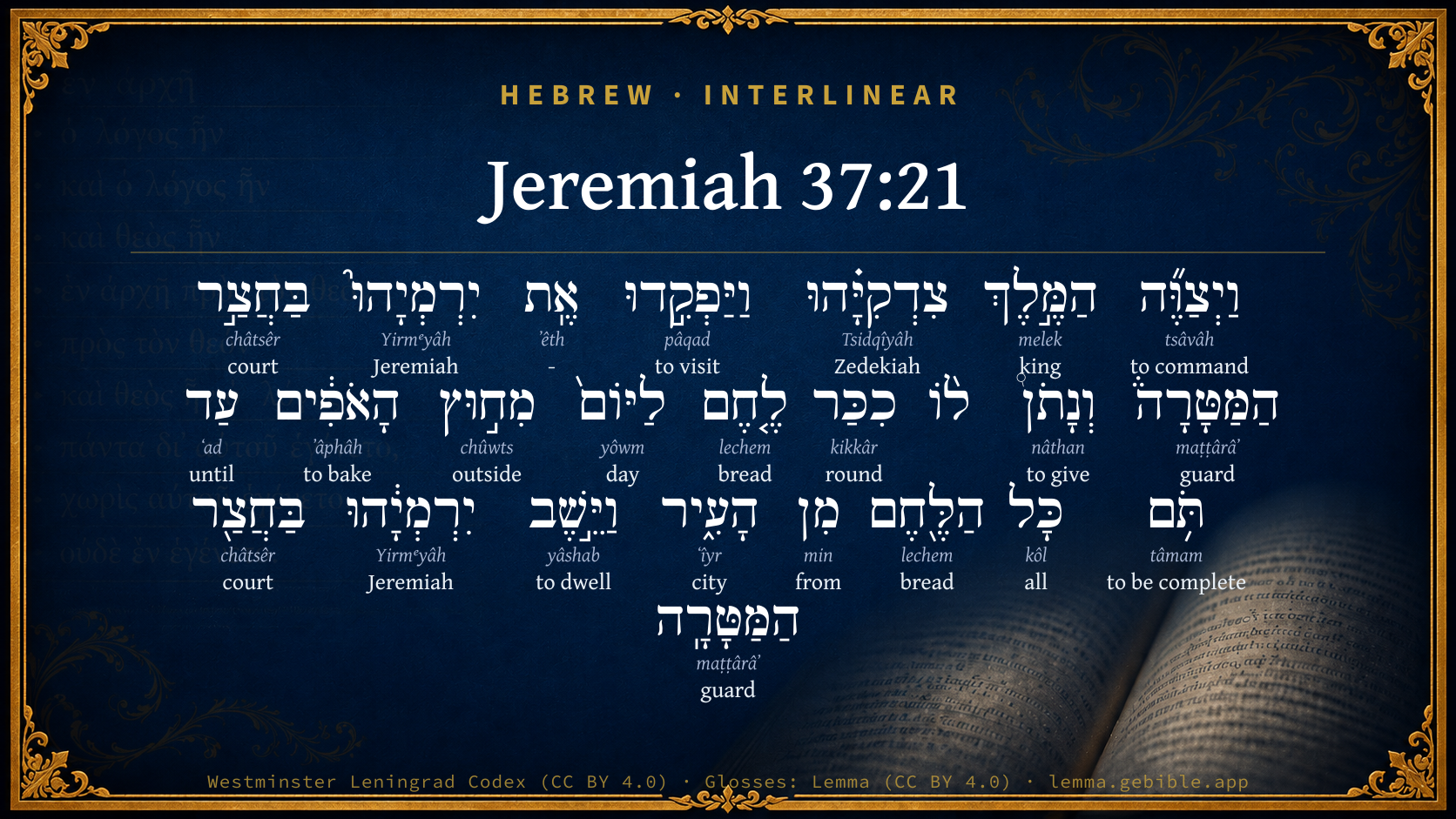
Jeremiah 37:21

Hebrew (Westminster Leningrad Codex) Jeremiah 37:21 appears in the Hebrew Old Testament. The text above is from the Westminster Leningrad Codex. Each word links to its Strong’s number, a concise gloss, and parsing drawn from the Open Scriptures Hebrew Bible morphology. Click any word for its full Brown-Driver-Briggs (BDB) entry.
Download image
Cite this verse

Jeremiah 37:21 (World English Bible). Public Domain. Lemma interlinear Bible study tool, https://lemma.gebible.app/v/jeremiah/37/21.

Show BibTeX & RIS
BibTeX
RIS
English Translation
Then Zedekiah the king commanded, and they committed Jeremiah into the court of the guard; and they gave him daily a loaf of bread out of the bakers' street, until all the bread in the city was spent. Thus Jeremiah remained in the court of the guard.
World English Bible · Public Domain
Download a study sheet

One document with this verse’s original text, its word-by-word gloss line, the meaning frame, cross-references with their text, attributed commentary, and full source and license credits — printable, and it pastes into notes with its structure intact.

This verse Autodidact and up

Study sheet (.html) Plain text (.txt)

A passage Seminary Student

Up to 50 verses in one chapter. A passage sheet keeps up to 6 commentary sources and 12 cross-references per verse, in the order this page ranks them, and says so on the sheet whenever that leaves anything out. Ask for a single verse and you get the Autodidact verse sheet above.

Everything on this page stays free to read, with no account — the sheet is a download of what is already on screen, not access to it.

Want to remove ads? Support Godless Engineer
Compare translations 3

The same verse in 3 English versions, stacked beneath the original-language interlinear above. Click any original word for its lexicon entry.

Each is an independent rendering of the whole verse — the interlinear is not word-aligned to these translations.

Highlighted words mark where these versions differ — a whole-verse word diff, not a word-by-word alignment.

  • World English Bible Public Domain
    Then Zedekiah the king commanded, and they committed Jeremiah into the court of the guard; and they gave him daily a loaf of bread out of the bakers' street, until all the bread in the city was spent. Thus Jeremiah remained in the court of the guard.
  • King James Version Public Domain
    Then Zedekiah the king commanded that they should commit Jeremiah into the court of the prison, and that they should give him daily a piece of bread out of the bakers' street, until all the bread in the city were spent. Thus Jeremiah remained in the court of the prison.
  • unfoldingWord Literal Text CC BY-SA 4.0
    So King Zedekiah gave an order. His servants confined Jeremiah in the courtyard of the guard. A loaf of bread was given him every day from the street of the bakers, until all the bread in the city was gone. So Jeremiah stayed in the courtyard of the guard.

unfoldingWord Literal Text — © unfoldingWord, licensed CC BY-SA 4.0. Word-aligned USFM3 via Door43 (git.door43.org/unfoldingWord/en_ult).

Versions to compare (up to 4)

3 of 4 selected

Show all 17 translations

Every available English version of this verse, each an independent rendering of the whole verse.

  • World English Bible Public Domain
    Then Zedekiah the king commanded, and they committed Jeremiah into the court of the guard; and they gave him daily a loaf of bread out of the bakers' street, until all the bread in the city was spent. Thus Jeremiah remained in the court of the guard.
  • Berean Standard Bible Public Domain
    So King Zedekiah gave orders for Jeremiah to be placed in the courtyard of the guard and given a loaf of bread daily from the street of the bakers, until all the bread in the city was gone. So Jeremiah remained in the courtyard of the guard.
  • Majority Standard Bible Public Domain
    So King Zedekiah gave orders for Jeremiah to be placed in the courtyard of the guard and given a loaf of bread daily from the street of the bakers, until all the bread in the city was gone. So Jeremiah remained in the courtyard of the guard.
  • King James Version Public Domain
    Then Zedekiah the king commanded that they should commit Jeremiah into the court of the prison, and that they should give him daily a piece of bread out of the bakers' street, until all the bread in the city were spent. Thus Jeremiah remained in the court of the prison.
  • American Standard Version (1901) Public Domain
    Then Zedekiah the king commanded, and they committed Jeremiah into the court of the guard; and they gave him daily a loaf of bread out of the bakers' street, until all the bread in the city was spent. Thus Jeremiah remained in the court of the guard.
  • Revised Version (1885) Public Domain
    Then Zedekiah the king commanded, and they committed Jeremiah into the court of the guard, and they gave him daily a loaf of bread out of the bakers’ street, until all the bread in the city was spent. Thus Jeremiah remained in the court of the guard.
  • Geneva Bible (1599) Public Domain
    Then Zedekiah the King commanded, that they should put Ieremiah in the court of the prison, and that they should giue him dayly a piece of bread out of the bakers streete vntill all the bread in the citie were eaten vp. Thus Ieremiah remained in the court of the prison.
  • Young's Literal Translation Public Domain
    And the king Zedekiah commandeth, and they commit Jeremiah into the court of the prison, also to give to him a cake of bread daily from the bakers' street, till the consumption of all the bread of the city, and Jeremiah dwelleth in the court of the prison.
  • Literal Standard Version CC BY-SA 4.0
    And King Zedekiah commands, and they commit Jeremiah into the court of the prison, also to give a cake of bread to him daily from the bakers’ street, until the consumption of all the bread of the city, and Jeremiah dwells in the court of the prison.
  • Unlocked Literal Bible CC BY-SA 4.0
    So King Zedekiah gave an order. His servants confined Jeremiah in the courtyard of the guard. A loaf of bread was given him every day from the street of the bakers, until all the bread in the city was gone. So Jeremiah stayed in the courtyard of the guard.
  • unfoldingWord Literal Text CC BY-SA 4.0
    So King Zedekiah gave an order. His servants confined Jeremiah in the courtyard of the guard. A loaf of bread was given him every day from the street of the bakers, until all the bread in the city was gone. So Jeremiah stayed in the courtyard of the guard.
  • Darby Bible Public Domain
    Then Zedekiah the king commanded, and they committed Jeremiah into the court of the guard, and they gave him daily a loaf of bread out of the bakers' street, until all the bread in the city was spent. And Jeremiah abode in the court of the guard.
  • World Messianic Bible Public Domain
    Then Zedekiah the king commanded, and they committed Jeremiah into the court of the guard. They gave him daily a loaf of bread out of the bakers’ street, until all the bread in the city was gone. Thus Jeremiah remained in the court of the guard.
  • Webster's Bible Public Domain
    Then Zedekiah the king commanded that they should commit Jeremiah into the court of the prison, and that they should give him daily a piece of bread out of the baker's street, until all the bread in the city should be consumed. Thus Jeremiah remained in the court of the prison.
  • Free Bible Version CC BY-SA 4.0
    King Zedekiah gave the order for Jeremiah to be held in the guard's courtyard and be provided with a loaf of bread every day from a bakery until there was no bread left in the city. So Jeremiah stayed in the guard's courtyard.
  • Bible in Basic English Public Domain
    Then by the order of Zedekiah the king, Jeremiah was put into the place of the armed watchmen, and they gave him every day a cake of bread from the street of the bread-makers, till all the bread in the town was used up. So Jeremiah was kept in the place of the armed watchmen.
  • JPS Tanakh (1917) Public Domain
    Then Zedekiah the king commanded, and they committed Jeremiah into the court of the guard, and they gave him daily a loaf of bread out of the bakers' street, until all the bread in the city was spent. Thus Jeremiah remained in the court of the guard.

Literal Standard Version (2020), Covenant Press — licensed CC BY-SA 4.0. Text via the HelloAO Bible API (eBible.org). Unlocked Literal Bible (unfoldingWord) — licensed CC BY-SA 4.0. Text via the HelloAO Bible API (eBible.org). unfoldingWord Literal Text — © unfoldingWord, licensed CC BY-SA 4.0. Word-aligned USFM3 via Door43 (git.door43.org/unfoldingWord/en_ult). Free Bible Version, Dr. Jonathan Gallagher — licensed CC BY-SA 4.0. Text via the HelloAO Bible API (eBible.org).

Word by word

More ways to search: Search by grammar → Find every occurrence → Compare this word →

Practice this passage: Drill this verse → Learn its vocabulary →

הַמַּטָּרָה֒
maṭṭârâʼ
H4307
“the · guard”
Particle, Definite Article + Noun, Common, Feminine, Singular, Absolute
Part of Speech
Particle + Noun
Type
Common
Gender
Feminine
Number
Singular
State
Absolute
Full BDB Definition

Origin: from H5201

TWOT: 1356a

guard, ward, prison, mark, target - guard, ward, prison - target, mark (figuratively of chastisement)
  1. וַיְצַוֶּ֞ה tsâvâh H6680 “and · to command” Conjunction + Verb, Piel, Sequential Imperfect, 3rd Person, Masculine, Singular
  2. הַמֶּ֣לֶךְ melek H4428 “the · king” Particle, Definite Article + Noun, Common, Masculine, Singular, Absolute
  3. צִדְקִיָּ֗הוּ Tsidqîyâh H6667 “Zedekiah” Noun, Proper
  4. וַיַּפְקִ֣דוּ pâqad H6485 “and · to visit” Conjunction + Verb, Hiphil, Sequential Imperfect, 3rd Person, Masculine, Plural
  5. אֶֽת ʼêth H853 “-” Particle, Direct Object
  6. יִרְמְיָהוּ֮ Yirmᵉyâh H3414 “Jeremiah” Noun, Proper
  7. בַּחֲצַ֣ר châtsêr H2691 “in/at · court of” Preposition + Noun, Common, Both, Singular, Construct
  8. וְנָתֹן֩ nâthan H5414 “and · to give” Conjunction + Verb, Qal, Infinitive Absolute
  9. כִכַּר kikkâr H3603 “round of” Noun, Common, Both, Singular, Construct
  10. לֶ֤חֶם lechem H3899 “bread” Noun, Common, Both, Singular, Absolute
  11. לַיּוֹם֙ yôwm H3117 “to/for the · day” Preposition, Determined + Noun, Common, Masculine, Singular, Absolute
  12. מִח֣וּץ chûwts H2351 “from · outside of” Preposition + Noun, Common, Masculine, Singular, Construct
  13. הָאֹפִ֔ים ʼâphâh H644 “the · baking” Particle, Definite Article + Verb, Qal, Participle Active, Masculine, Plural, Absolute
  14. עַד ʻad H5704 “until” Preposition
  15. תֹּ֥ם tâmam H8552 “to be complete” Verb, Qal, Infinitive Construct
  16. כָּל kôl H3605 “all of” Noun, Common, Masculine, Singular, Construct
  17. הַלֶּ֖חֶם lechem H3899 “the · bread” Particle, Definite Article + Noun, Common, Both, Singular, Absolute
  18. מִן min H4480 “from” Preposition
  19. הָעִ֑יר ʻîyr H5892 “the · city” Particle, Definite Article + Noun, Common, Feminine, Singular, Absolute
  20. וַיֵּ֣שֶׁב yâshab H3427 “and · to dwell” Conjunction + Verb, Qal, Sequential Imperfect, 3rd Person, Masculine, Singular
  21. יִרְמְיָ֔הוּ Yirmᵉyâh H3414 “Jeremiah” Noun, Proper
  22. בַּחֲצַ֖ר châtsêr H2691 “in/at · court of” Preposition + Noun, Common, Both, Singular, Construct
  23. הַמַּטָּרָֽה maṭṭârâʼ H4307 “the · guard” Particle, Definite Article + Noun, Common, Feminine, Singular, Absolute

About this verse

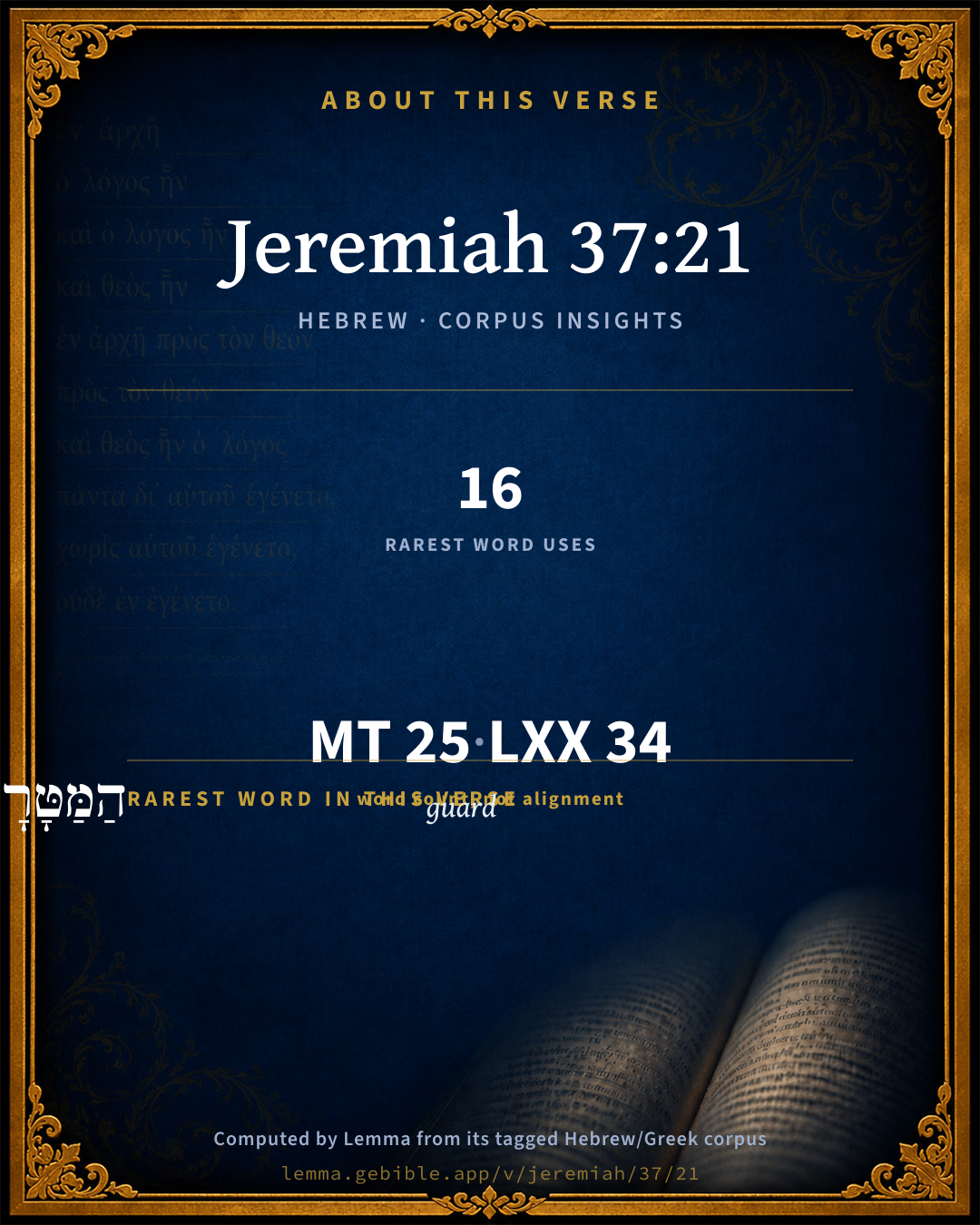
These counts appear in no published source. They are computed here, from the morphology-tagged text and Lemma’s own curated glosses. What Lemma adds →

25
words
20
distinct lemmas
Prophets
section

Notable vocabulary

The rarest word here is הַמַּטָּרָה֒ guard H4307 — appearing just 16 times in the whole Hebrew Bible.

Shared distinctive vocabulary

הַמַּטָּרָה֒ guard H4307 occurs in 15 verses of the Hebrew Bible. Also found in:

Grammatical profile

  • 6 verbs
  • 15 nouns
  • 3 prepositions
  • 1 particle

Verb forms

  • וַיְצַוֶּ֞ה Piel · Sequential Imperfect
  • וַיַּפְקִ֣דוּ Hiphil · Sequential Imperfect
  • וְנָתֹן֩ Qal · Infinitive Absolute
  • הָאֹפִ֔ים Qal · Participle Active
  • תֹּ֥ם Qal · Infinitive Construct
  • וַיֵּ֣שֶׁב Qal · Sequential Imperfect

Repetition

Words recur within this verse — often emphatic in Hebrew:

  • יִרְמְיָהוּ֮ Jeremiah H3414 ×2
  • בַּחֲצַ֣ר court H2691 ×2
  • הַמַּטָּרָה֒ guard H4307 ×2
  • לֶ֤חֶם bread H3899 ×2

Hebrew & Septuagint length

In the original languages it is 25 Hebrew tokens and 34 Greek tokens — but the two are counted differently (Hebrew bundles its prefixes and suffixes into one token; the Greek is in lemma form), so that isn’t a like-for-like length.

Cross-references

32

Topical passages linked to Jeremiah 37:21 in the Treasury of Scripture Knowledge — connected by theme and wording, ordered by reader-vote popularity; previews shown in the World English Bible.

  • Jeremiah 38:13 So they drew up Jeremiah with the cords, and took him up out of the dungeon: and Jeremiah remained in the court of the guard.
  • Jeremiah 38:28 So Jeremiah abode in the court of the guard until the day that Jerusalem was taken.
  • Jeremiah 32:2 Now at that time the king of Babylon's army was besieging Jerusalem; and Jeremiah the prophet was shut up in the court of the guard, which was in the king of Judah's house.
  • Jeremiah 38:9 My lord the king, these men have done evil in all that they have done to Jeremiah the prophet, whom they have cast into the dungeon; and he is likely to die in the place where he is, because of the famine; for there is no more bread in the city.
  • Jeremiah 52:6 In the fourth month, in the ninth day of the month, the famine was sore in the city, so that there was no bread for the people of the land.
  • 2 Kings 25:3 On the ninth day of the [fourth] month the famine was sore in the city, so that there was no bread for the people of the land.
  • Isaiah 33:16 He shall dwell on high; his place of defense shall be the munitions of rocks; his bread shall be given [him]; his waters shall be sure.
  • Job 5:20 In famine he will redeem you from death; In war, from the power of the sword.
  • Psalms 33:18–19 Behold, Yahweh's eye is on those who fear him, On those who hope in his loving kindness;
  • Deuteronomy 28:52–57 They shall besiege you in all your gates, until your high and fortified walls come down, in which you trusted, throughout all your land; and they shall besiege you in all your gates throughout all your land, which Yahweh your God has given you.
  • 1 Kings 17:4–6 It shall be, that you shall drink of the brook; and I have commanded the ravens to feed you there.
  • Psalms 34:9–10 Oh fear Yahweh, you his saints, For there is no lack with those who fear him.
  • Psalms 37:3 Trust in Yahweh, and do good. Dwell in the land, and enjoy safe pasture.
  • Psalms 37:19 They shall not be disappointed in the time of evil. In the days of famine they shall be satisfied.
  • Proverbs 16:7 When a man's ways please Yahweh, He makes even his enemies to be at peace with him.
  • Proverbs 21:1 The king's heart is in Yahweh's hand like the watercourses. He turns it wherever he desires.
  • Jeremiah 32:8 So Hanamel my uncle's son came to me in the court of the guard according to the word of Yahweh, and said to me, Please buy my field that is in Anathoth, which is in the land of Benjamin; for the right of inheritance is yours, and the redemption is yours; buy it for yourself. Then I knew that this was the word of Yahweh.
  • Jeremiah 39:14–15 they sent, and took Jeremiah out of the court of the guard, and committed him to Gedaliah the son of Ahikam, the son of Shaphan, that he should carry him home: so he lived among the people.
  • Lamentations 2:11–12 My eyes do fail with tears, my heart is troubled; My liver is poured on the earth, because of the destruction of the daughter of my people, Because the young children and the infants swoon in the streets of the city.
  • Lamentations 2:19–20 Arise, cry out in the night, at the beginning of the watches; Pour out your heart like water before the face of the Lord: Lift up your hands toward him for the life of your young children, that faint for hunger at the head of every street.
  • Lamentations 4:4–5 The tongue of the sucking child cleaves to the roof of his mouth for thirst: The young children ask bread, and no man breaks it to them.
  • Lamentations 4:9–10 Those who are killed with the sword are better than those who are killed with hunger; For these pine away, stricken through, for want of the fruits of the field.
  • Lamentations 5:10 Our skin is black like an oven, Because of the burning heat of famine.
  • Matthew 6:33 But seek first God's Kingdom, and his righteousness; and all these things will be given to you as well.
  • Acts 12:5 Peter therefore was kept in the prison, but constant prayer was made by the assembly to God for him.
  • Acts 24:27 But when two years were fulfilled, Felix was succeeded by Porcius Festus, and desiring to gain favor with the Jews, Felix left Paul in bonds.
  • Acts 28:16 When we entered into Rome, the centurion delivered the prisoners to the captain of the guard, but Paul was allowed to stay by himself with the soldier who guarded him.
  • Acts 28:30 Paul stayed two whole years in his own rented house, and received all who were coming to him,
  • Ephesians 4:1 I therefore, the prisoner in the Lord, beg you to walk worthily of the calling with which you were called,
  • Ephesians 6:20 for which I am an ambassador in chains; that in it I may speak boldly, as I ought to speak.
  • 2 Timothy 1:8 Therefore don't be ashamed of the testimony of our Lord, nor of me his prisoner; but endure hardship for the Gospel according to the power of God,
  • 2 Timothy 2:9 in which I suffer hardship to the point of chains as a criminal. But God's word isn't chained.

Cross-references courtesy of OpenBible.info (CC BY 4.0).

Hebrew and Greek witnesses Masoretic Hebrew ↔ Greek Septuagint

The same verse in the two great witnesses to the Old Testament, shown verse-for-verse.

These are two independent witnesses, not word-aligned to each other, and the Septuagint is shown in lemma (dictionary) form.

Hebrew Jeremiah 37:21 Masoretic · Westminster Leningrad Codex

וַיְצַוֶּ֞ה הַמֶּ֣לֶךְ צִדְקִיָּ֗הוּ וַיַּפְקִ֣דוּ אֶֽת יִרְמְיָהוּ֮ בַּחֲצַ֣ר הַמַּטָּרָה֒ וְנָתֹן֩ ל֨וֹ כִכַּר לֶ֤חֶם לַיּוֹם֙ מִח֣וּץ הָאֹפִ֔ים עַד תֹּ֥ם כָּל הַלֶּ֖חֶם מִן הָעִ֑יר וַיֵּ֣שֶׁב יִרְמְיָ֔הוּ בַּחֲצַ֖ר הַמַּטָּרָֽה

Then Zedekiah the king commanded, and they committed Jeremiah into the court of the guard; and they gave him daily a loaf of bread out of the bakers' street, until all the bread in the city was spent. Thus Jeremiah remained in the court of the guard.

World English Bible · Public Domain

Greek LXX Structure differs

In the Septuagint, Jeremiah is about an eighth shorter than the Hebrew and arranges its material differently — the Oracles Against the Nations (Hebrew chapters 46–51) appear in the middle of the Greek book, after 25:13. Because the chapter and verse boundaries do not line up, a verse-for-verse comparison with the Hebrew is not shown.

A verse-for-verse comparison isn’t shown here because the chapters and verses don’t line up. Switch to the LXX edition with the MT / LXX toggle above to read the Greek directly.

Hebrew: Westminster Leningrad Codex (CC BY 4.0). Greek: Septuagint (public domain); English from a public-domain English Septuagint. How the Septuagint differs from the Hebrew →

Targum (Aramaic paraphrase)

1

The Targum is the ancient Jewish Aramaic paraphrase of the Hebrew Scriptures — an interpretive translation, not the Hebrew text itself. Onkelos (literal) and Pseudo-Jonathan (expansive) render the Torah, and Jonathan the Prophets. Coverage is partial: where no permissively-licensed English translation exists for a verse, only the Aramaic is shown. This is verse-level text, not a word-by-word alignment to the Hebrew.

  1. Targum Jonathan Prophets (Joshua–Malachi)
    וּפַקֵיד מַלְכָּא צִדְקִיָה וּפַקִידוּ יַת יִרְמְיָה בְּדָרַת בֵּית אֲסִירַיָא וִיהָבוּן לֵיהּ פִּתָּא דְלַחְמָא לְיוֹמָא מִשׁוּק נַחְתּוֹמַיָא עַד דִשְׁלִים כָּל לַחְמָא מִן קַרְתָּא וִיתֵיב יִרְמְיָה בְּדָרַת בֵּית אֲסִירַיָא:

    (no public-domain English translation for this verse)

    Targum Jonathan — Aramaic: “Mikraot Gedolot” (public domain). English: “Sefaria Community Translation” (CC0 1.0 (public-domain dedication)); “London "Chaldee Paraphrase," 1871” (public domain). Text via Sefaria.

Commentary

Notes on Jeremiah 37:21 from classic Christian and Jewish commentators (each source and its license shown beneath its notes). The classic Christian expositions comment on the surrounding passage and are grouped to its opening verse, so a note may address several verses; the Jewish commentaries on the Tanakh (Rashi and others) are per-verse, so they appear only where the commentator wrote on this verse.

Lemma curates 59 commentaries, every one of them public domain or Creative Commons licensed, each selected and text-cleaned for this edition rather than reprinted as found. About our sources →

Trapp's Complete Commentary

John Trapp

Jer 37:21 Then Zedekiah the king commanded that they should commit Jeremiah into the court of the prison, and that they should give him daily a piece of bread out of the bakers’ street, until all the bread in the city were spent. Thus Jeremiah remained in the court of the prison.

Ver. 21. Then Zedekiah the king commanded.] For this courtesy of his to the prophet, God granted him a natural death, and an honourable burial in Babylon.

That they should commit Jeremiah into the court of the prison.] Where he might have more liberty and better accommodations, and where his friends, eum adire et audire possent, might come and hear him. See Jer 22:2.

And that they should give him daily a piece of bread.] And a piece of a cake, we say, is better than no bread. I read of a gracious woman who said that she had made many a meal’s meat upon the promises when she wanted bread. But Jeremiah, besides the promises, {Jer 1:8 and elsewhere} was here, by a sweet providence, sustained in the prison during that extreme famine in the city, whereof we read in the Lamentations, when it was no small mercy to have a morsel of bread to keep him alive. Sic amara interdum dulcescunt. Who would not trust so good a God?

John Trapp, A Commentary or Exposition upon All the Books of the Old and New Testament (1647–1656) — public domain. Text from a community e-Sword module.

Tyndale Open Study Notes

Tyndale Open Resources

37:21 The king defied his officials and ordered the guards to keep Jeremiah in the courtyard of the guard in the royal palace under protective custody. Considering the scarcity of food during the long siege, a loaf of fresh bread every day was a generous ration.

Tyndale Open Study Notes — © Tyndale Open Resources, licensed CC BY-SA 4.0. Text via the HelloAO Bible API.

Geneva Bible (1599)

Geneva Bible translators

That is, so long as there was any bread in the city: thus God provideth for his, that he will cause their enemies to preserve them to that end whereunto he hath appointed them.

Geneva Bible (1599) marginal notes — public domain. Text via Bolls.life.

Jamieson, Fausset & Brown

Robert Jamieson, A. R. Fausset & David Brown

court of the prison-- (Jer 32:2; Jer 38:13, Jer 38:28).

bakers' street--Persons in the same business in cities in the East commonly reside in the same street.

all the bread . . . spent--Jeremiah had bread supplied to him until he was thrown into the dungeon of Malchiah, at which time the bread in the city was spent. Compare this verse with Jer 38:9; that time must have been very shortly before the capture of the city (Jer 52:6). God saith of His children, "In the days of famine they shall be satisfied" (Psa 37:19; Isa 33:16). Honest reproof (Jer 37:17), in the end often gains more favor than flattery (Pro 28:23).

All this was subsequent to his imprisonment in Jonathan's house, and his release on his interview with Zedekiah. The latter occurred before the return of the Chaldeans to the siege; the similar events in this chapter occurred after it.

Next: Jeremiah Chapter 38

Jamieson, Fausset & Brown — Commentary Critical and Explanatory on the Whole Bible (1871) — public domain (CC PDM 1.0). Text via the HelloAO Bible API.

Adam Clarke's Commentary

Verse 21. Then Zedekiah - the court of the prison] Was contiguous to the king's house, where the prisoners could readily see their friends.

Give him daily a piece of bread out of the bakers' street] From the public stores; which he received till all the provisions were spent.

Adam Clarke's Commentary on the Bible (1810–1826) — public domain. Text from a community e-Sword/MySword module.

John Calvin's Commentaries

The Prophet tells us, that God regarded the miseries to which he had been unjustly exposed: and the king no doubt became humane towards Jeremiah, because God turned his heart towards what was just and right. We said, indeed, yesterday, that the king was not in disposition cruel or sanguinary; yet he would not have been so easily eritreated by the Prophet, had he not been influenced by the hidden working of God’s Spirit. We hence see how God favors his servants and has regard for their infirmity when necessary. We yet see also that the Prophet was not so kindly dealt with as to be allowed to return free to his own house, but that he was removed to another prison, where his condition was more tolerable. He was then in the court of the prison

He says, that a crust of bread was given to him daily, or every day. The word ככר, kekar, is by some rendered “mass,” or lump, and means sometimes a large loaf; but it is probable, that during so much scarcity the Prophet had but a scanty living. He had then a crust or piece of bread every day We see how mean was his food; but God often tries his servants in this way, withholding from them all the delicacies of this world. It is added, from the street of the bakers; by these words is meant, I think, that it was coarse bread, not made of fine flour, such as rich men did eat, for their mouths could not endure what was rough and course. Then God’s holy Prophet was content with the common bread. The king and his counsellors had their own bakers; but it is said that bread was brought to the Prophet from a common place, the street of the bakers And the bread then sold during such a scarcity was no doubt black bread. We hence see what kind of bread it was, because it was sold for the common use of the people.

Thus the Prophet shews, that though some relaxation was allowed him, he was still confined in prison, and also that no meat nor any delicacies were given him, but a crust of bread only. He however commemorates the favor of God, inasmuch as in so great a scarcity he was not without bread. He had, then, his daily bread until all provisions failed.

And hence we learn, that God often so provides for his servants, that he appears to have forsaken them; and yet he then especially takes care of them and supplies them with what is needful for their support. Had Jeremiah been at home, he might have been at any time stoned by the people; for there were not wanting those disposed to stir up famished men against him. He might then have been every moment in danger of his life at home. But now in prison, he was safe, and no one could do him any harm. Besides, had he been at home, many might have robbed him, so as to leave him nothing to preserve life; but in prison he had his daily allowance. Thus, then, God often conducts his servants in a manner that is wonderful and beyond what we can conceive, and in the meantime acts as the head of a family, in supplying their wants. In short, the Prophet here intimates that he was cared for by God, so that during the famine and scarcity among the whole people, his bread was yet given to him, when he could not have begged it. When he could not have procured bread for himself either by labor, or by industry, or by begging, or by money, he shews that God took care of him so as to feed him during that distress.

He however adds, that he was in the court of the prison, in order to shew that God tried his patience, for a prison was a place of degradation. The Prophet was exposed to the reproaches of all; and then the princes might have often threatened him with danger, and might have also transferred him to another place, as we shall hereafter see. Therefore, in a measure only did God bring aid to his Prophet, for it was not his pleasure wholly to deliver him, and yet he suffered him not to be reduced to extremities. Now follows —

John Calvin's Commentaries (1540-1563) — public domain. Text from the Calvin Translation Society English edition (1840s-50s) via the Christian Classics Ethereal Library (ccel.org). Calvin's coverage is partial (roughly two-thirds of the Bible); uncommented books and verses are honest gaps, never fabricated. The 19th-century editor's footnotes and remarks are omitted so the notes are faithfully Calvin's own voice.

Ellicott's Commentary for English Readers

(21) Into the court of the prison . . .—This was obviously a concession to Jeremiah’s request, and here he remained (see Jer_32:2; Jer_33:1), with one brief exception (Jer_38:6), till the capture of the city. It was “in the king’s house,” above ground, with free access for light and air, and it was therefore in his power to see that the prophet was treated with respect, and not left to starve.

A piece of bread out of the bakers’ street.—The locality is not mentioned elsewhere, but Jerusalem, like other Eastern cities, seems to have had distinct localities assigned as bazaars to special trades. Thus, one of the broad streets running through the city was known, in New Testament times, as the valley of Tyropceon (= cheesemakers). Merchants and goldsmiths appear in Neh_3:32 as having their separate quarters, and apothecaries in Neh_3:8. The “street of the bakers” was probably connected with “the tower of the furnaces” in Neh_3:11. The order given by the king indicates that the city was already blockaded, and that the supply of provisions was falling short.

A Bible Commentary for English Readers, edited by Charles John Ellicott (1878–1897) — public domain. Text from a community e-Sword module.

The Cambridge Bible for Schools and Colleges

gen. ed. J. J. S. Perowne

21. court of the guard] See on Jer_32:2.

a loaf of bread] a flat round cake, not unlike a flat stone in shape and appearance (Mat_7:9, cp. Jer_4:3), about nine inches in diameter and an inch thick. One of these cakes was considered a charity dole (1Sa_2:36, R.V. “loaf”).

the bakers’ street] Hos_7:4; Hos_7:6 shews that baking was a trade. We here see that, like other trades in the East, the bakers occupied a definite place in the bazaar.

until all the bread in the city was spent] Cp. ch. Jer_52:6.

The Cambridge Bible for Schools and Colleges (gen. ed. J. J. S. Perowne; Cambridge University Press, 1878–1918) — public domain. Text from a community e-Sword module.

John Gill's Exposition

Then Zedekiah the king commanded that they should commit Jeremiah into the court of the prison,.... He did not think fit to discharge him entirely, lest it should give offence to the princes, who had committed him; but he ordered him to be put in a court belonging to the prison, where he might breathe in a freer air, and have liberty of walking to and fro, where his friends might be admitted to come and see him:

and that they should give him daily a piece of bread out of the bakers' street; it seems there was a street in Jerusalem so called, where the bakers lived; and perhaps the king's bakers; who had orders to deliver to the prophet every day a piece or loaf of bread, as much as was sufficient for a man; or, however, as much as the scarcity of provisions in a siege would allow. Kimchi makes mention of a Midrash, which interprets this of bread made of bran, which was sold without the palace; as if it was coarser bread than what was eaten at court:

until all the bread in the city was spent; that is, as long as there was any. These were the king's orders:

thus Jeremiah remained in the court of the prison: until the city was taken; unless a small time that he was in the dungeon of Malchiah, out of which he was taken again, and restored to the court of the prison, and there continued; see Jer 38:6.

Next: Jeremiah Chapter 38

John Gill's Exposition of the Whole Bible (1746–1763) — public domain (CC PDM 1.0). Text via the HelloAO Bible API.

Albert Barnes' Notes on the Bible

The prison - the watch (marginal reference).

Piece - literally, a circle, i. e., a round cake.

The bakers’ street - It is usual in oriental towns for each trade to have a special place set apart for it. Compare Act 10:6.

Albert Barnes' Notes on the Bible (1834–1885) — public domain. Text from a community e-Sword/MySword module.

Matthew Poole's English Annotations

Commanded that they should commit Jeremiah into the court of the prison; so as he was a prisoner still, but in a freer air, where he did not suffer those inconveniences which he endured in the hole or dungeon. It is of no great moment to know whether the portion of bread allowed the prophet by the king were a loaf, (as some think,) or a piece of a loaf; it was such a proportion as could be allowed according to the proportion which others had, and the straits which the city was in, and so much as served to keep him alive. Jeremiah remained here till, upon the suggestion of the princes, he was removed to a worse place, as we shall read in the sixth verse of the next chapter; where he staid not long, but was again removed to the court of the prison, as we shall read there, Jer 38:13, where (as it followeth there, Jer 38:28) he continued until the city was taken.

Matthew Poole's English Annotations on the Holy Bible (1683–1685) — public domain. Text from a community e-Sword/MySword module.

The Pulpit Commentary

Court of the prison; rather, court of the watch. (as Jer_32:2) A piece of bread; literally, a circle (i.e. round cake) of bread. This is mentioned elsewhere in descriptions of poverty; (1Sa_2:36 Pro_6:26) but as the ancient Oriental bread was not our delicate white bread, it was a real "staff of life." The Syrian peasants still eat cakes of coarse meal, of about the thickness of parchment, and equal in size to a large plate (Orelli"s "Travels"). The bakers" street. Probably the several trades were confined to special quarters and streets. In Cairo each trade has still its own bazaar (saddlers, carpets, hardware, goldsmiths, sweetmeats, etc.).

The rough wind stayed in the day of the east wind.

Very terrible to the prophet were the sufferings he had to bear. Hence he seeks for relief by petitioning the king for help, which the king is led to bestow (ver. 21). It is an illustration of how God stays his rough wind, etc. Note

I GOD OFTEN LETS SORE TROUBLE COME TO HIS SERVANTS.

II BUT HE APPOINTS IT ACCORDING TO THEIR POWER OF ENDURANCE. He is not a hard master, gathering where he has not strawed, nor reaping where he has not sown. He fits the back for the burden it has to bear. If staying in the dread dungeon was too great a trial for his prophet, he will have him taken out. The wave that would have sunk the boat in which our Lord was with his disciples was never permitted to beat into it. A great many others came, but not that one. And so it ever is. "As thy day, so thy strength." God will be our "arm every morning.

III THEREFORE "TAKE NO THOUGHT FOR THE MORROW," etc. C.

The Pulpit Commentary (1880–1919), ed. H.D.M. Spence-Jones & Joseph S. Exell — public domain. Text from a community e-Sword module.

unfoldingWord translationNotes

Door43 World Missions Community

the courtyard of the guard

This was an open area attached to the king's palace that was surrounded by buildings and in which they kept prisoners. See how you translated this in Jeremiah 32:2.

A loaf of bread was given him

This can be translated in active form. AT: "His servants also gave Jeremiah a loaf of bread" (See: Active or Passive)

from the street of the bakers

"from the street where the bakers worked"

translationWords

king

Zedekiah

servant

Jeremiah

court

bread

unfoldingWord translationNotes — © Distant Shores Media and the Door43 World Missions Community, licensed CC BY-SA 4.0. Source: git.door43.org/Door43/en_tn.

Rashi

Rabbi Shlomo Yitzchaki (Rashi)

from the street of the bakers Heb. מחוץ, from the street of the bakers. Cf: “And you shall make streets (וחצות) for yourself in Damascus” (I Kings 20:34).

Rashi on the Tanakh — English translations: “The Judaica Press complete Tanach with Rashi, translated by A. J. Rosenberg” (CC BY 4.0); “Pentateuch with Rashi's commentary by M. Rosenbaum and A.M. Silbermann, 1929-1934” (public domain); “The Metsudah Tanach series, Lakewood, N.J” (CC BY 4.0); and “The Book of Joshua, Metsudah Publications, 1997” (CC BY 4.0). Text via Sefaria.

Lesson kit

Teaching starters — assembled from the data on this page, not authored interpretation. Every prompt links to the verse data it draws on. Edit before teaching.

Jeremiah, in the Prophets, opens this verse with 25 words (20 distinct Hebrew lemmas). Its most distinctive word is maṭṭârâʼ (“guard”). A historical commentator’s framing appears above. Read the whole chapter for the surrounding context.

Discussion questions

  1. How does “guard” (maṭṭârâʼ) shape what this verse is saying?
  2. 1 Samuel 20:20 shares the word «guard» with this verse. How do the two illuminate each other?
  3. “Jeremiah” occurs 2× in this one verse. What is the effect of the repetition?
  4. These translations render this verse differently; the difference is in the English rendering, not the original. What questions does that raise?
  5. The verb «וַיְצַוֶּ֞ה» is Piel Sequential Imperfect. How does its form color the action?
  6. Reading how Trapp's Complete Commentary and Tyndale Open Study Notes read this verse, where do the two commentators agree and where do they part?

Things to notice

Reading settings

Reading text

Shown beneath each verse's original-language words.

Old Testament
Old Testament edition

Read the OT as the Masoretic Hebrew (MT) or the Greek Septuagint (LXX).

English shown for the Greek Septuagint (in the Hebrew ↔ Greek comparison).

Comparing translations? Open the Compare panel on any verse page to stack up to four side by side.