2 Chronicles 32:3

Hebrew (Westminster Leningrad Codex) 2 Chronicles 32:3 appears in the Hebrew Old Testament. The text above is from the Westminster Leningrad Codex. Each word links to its Strong’s number, a concise gloss, and parsing drawn from the Open Scriptures Hebrew Bible morphology. Click any word for its full Brown-Driver-Briggs (BDB) entry.
Download image
Cite this verse

2 Chronicles 32:3 (World English Bible). Public Domain. Lemma interlinear Bible study tool, https://lemma.gebible.app/v/2-chronicles/32/3.

Show BibTeX & RIS
BibTeX
RIS
English Translation
he took counsel with his princes and his mighty men to stop the waters of the springs which were outside of the city; and they helped him.
World English Bible · Public Domain
Download a study sheet

One document with this verse’s original text, its word-by-word gloss line, the meaning frame, cross-references with their text, attributed commentary, and full source and license credits — printable, and it pastes into notes with its structure intact.

This verse Autodidact and up

Study sheet (.html) Plain text (.txt)

A passage Seminary Student

Up to 50 verses in one chapter. A passage sheet keeps up to 6 commentary sources and 12 cross-references per verse, in the order this page ranks them, and says so on the sheet whenever that leaves anything out. Ask for a single verse and you get the Autodidact verse sheet above.

Everything on this page stays free to read, with no account — the sheet is a download of what is already on screen, not access to it.

Want to remove ads? Support Godless Engineer
Compare translations 3

The same verse in 3 English versions, stacked beneath the original-language interlinear above. Click any original word for its lexicon entry.

Each is an independent rendering of the whole verse — the interlinear is not word-aligned to these translations.

Highlighted words mark where these versions differ — a whole-verse word diff, not a word-by-word alignment.

  • World English Bible Public Domain
    he took counsel with his princes and his mighty men to stop the waters of the springs which were outside of the city; and they helped him.
  • King James Version Public Domain
    He took counsel with his princes and his mighty men to stop the waters of the fountains which were without the city: and they did help him.
  • unfoldingWord Literal Text CC BY-SA 4.0
    And he consulted with his chiefs and his mighty ones to stop up the waters of the springs that were outside the city; and they helped him.

unfoldingWord Literal Text — © unfoldingWord, licensed CC BY-SA 4.0. Word-aligned USFM3 via Door43 (git.door43.org/unfoldingWord/en_ult).

Versions to compare (up to 4)

3 of 4 selected

Show all 18 translations

Every available English version of this verse, each an independent rendering of the whole verse.

  • World English Bible Public Domain
    he took counsel with his princes and his mighty men to stop the waters of the springs which were outside of the city; and they helped him.
  • Berean Standard Bible Public Domain
    he consulted with his leaders and commanders about stopping up the waters of the springs outside the city, and they helped him carry it out.
  • Majority Standard Bible Public Domain
    he consulted with his leaders and mighty men about stopping up the waters of the springs outside the city, and they helped him carry it out.
  • King James Version Public Domain
    He took counsel with his princes and his mighty men to stop the waters of the fountains which were without the city: and they did help him.
  • American Standard Version (1901) Public Domain
    he took counsel with his princes and his mighty men to stop the waters of the fountains which were without the city; and they helped him.
  • Revised Version (1885) Public Domain
    he took counsel with his princes and his mighty men to stop the waters of the fountains which were without the city; and they helped him.
  • Geneva Bible (1599) Public Domain
    Then he tooke counsell with his princes and his nobles, to stoppe the water of the fountaines without the citie: and they did helpe him.
  • Douay-Rheims (1899) Public Domain
    He took counsel with the princes, and the most valiant men, to stop up the heads of the springs, that were without the city: and as they were all of this mind,
  • Young's Literal Translation Public Domain
    and he taketh counsel with his heads and his mighty ones, to stop the waters of the fountains that `are' at the outside of the city -- and they help him,
  • Literal Standard Version CC BY-SA 4.0
    and he takes counsel with his heads and his mighty ones, to stop the waters of the fountains that [are] at the outside of the city—and they help him,
  • Unlocked Literal Bible CC BY-SA 4.0
    he consulted with his leaders and his powerful men to stop up the waters of the springs that were outside the city; they helped him do so.
  • unfoldingWord Literal Text CC BY-SA 4.0
    And he consulted with his chiefs and his mighty ones to stop up the waters of the springs that were outside the city; and they helped him.
  • Darby Bible Public Domain
    he took counsel with his princes and his mighty men to stop the fountains of waters that were outside the city; and they helped him.
  • World Messianic Bible Public Domain
    he took counsel with his princes and his mighty men to stop the waters of the springs which were outside of the city, and they helped him.
  • Webster's Bible Public Domain
    He took counsel with his princes and his mighty men to stop the waters of the fountains which were without the city: and they helped him.
  • Free Bible Version CC BY-SA 4.0
    he talked with his army commanders about blocking up the water sources that lay outside the city. This is what they did.
  • Bible in Basic English Public Domain
    He took up with his rulers and men of war the question of stopping up the water-springs outside the town; and they gave him their support.
  • JPS Tanakh (1917) Public Domain
    he took counsel with his princes and his mighty men to stop the waters of the fountains which were without the city; and they helped him.

Literal Standard Version (2020), Covenant Press — licensed CC BY-SA 4.0. Text via the HelloAO Bible API (eBible.org). Unlocked Literal Bible (unfoldingWord) — licensed CC BY-SA 4.0. Text via the HelloAO Bible API (eBible.org). unfoldingWord Literal Text — © unfoldingWord, licensed CC BY-SA 4.0. Word-aligned USFM3 via Door43 (git.door43.org/unfoldingWord/en_ult). Free Bible Version, Dr. Jonathan Gallagher — licensed CC BY-SA 4.0. Text via the HelloAO Bible API (eBible.org).

Word by word

More ways to search: Search by grammar → Find every occurrence → Compare this word →

Practice this passage: Drill this verse → Learn its vocabulary →

לִסְתּוֹם֙
çâtham
H5640
“to stop up”
Preposition + Verb, Qal, Infinitive Construct
Part of Speech
Preposition + Verb
Stem
Qal
Form
Infinitive Construct
Full BDB Definition

Origin: a primitive root

TWOT: 1550

to stop up, shut up, keep close - (Qal) - to stop up - to shut up, keep close - secret (participle) - (Niphal) to be stopped up - (Piel) to stop up
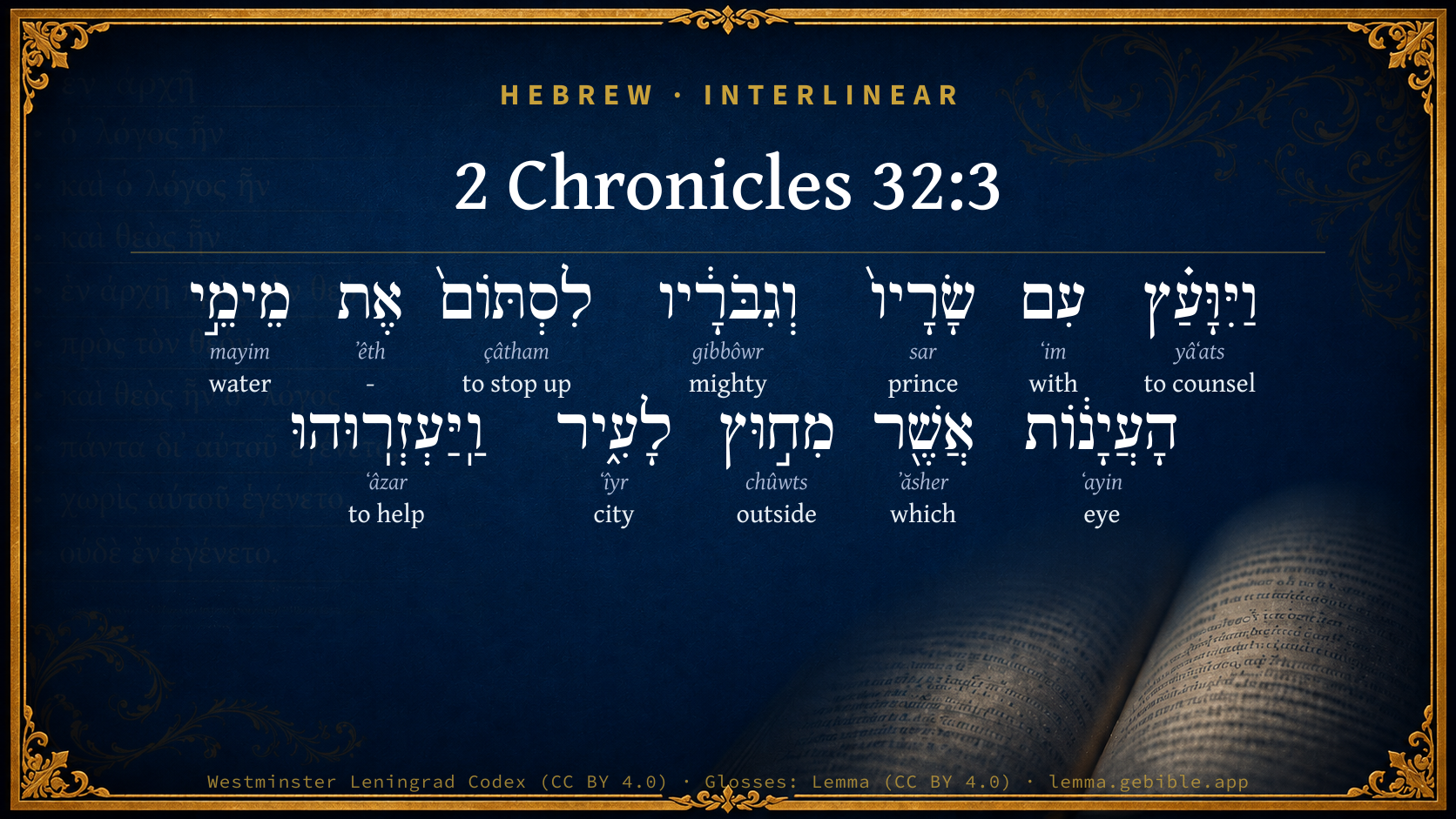
  1. וַיִּוָּעַ֗ץ yâʻats H3289 “and · to counsel” Conjunction + Verb, Niphal, Sequential Imperfect, 3rd Person, Masculine, Singular
  2. עִם ʻim H5973 “with” Preposition
  3. שָׂרָיו֙ sar H8269 “princes · his” Noun, Common, Masculine, Plural, Construct + Suffix, Personal, 3rd Person, Masculine, Singular
  4. וְגִבֹּרָ֔יו gibbôwr H1368 “and · mighty · his” Conjunction + Adjective, Adjective, Masculine, Plural, Construct + Suffix, Personal, 3rd Person, Masculine, Singular
  5. אֶת ʼêth H853 “-” Particle, Direct Object
  6. מֵימֵ֣י mayim H4325 “water(s) of” Noun, Common, Masculine, Plural, Construct
  7. הָעֲיָנ֔וֹת ʻayin H5869 “the · eyes” Particle, Definite Article + Noun, Common, Both, Plural, Absolute
  8. אֲשֶׁ֖ר ʼăsher H834 “which” Particle, Relative
  9. מִח֣וּץ chûwts H2351 “from · outside” Preposition + Noun, Common, Masculine, Singular, Absolute
  10. לָעִ֑יר ʻîyr H5892 “to/for the · city” Preposition, Determined + Noun, Common, Feminine, Singular, Absolute
  11. וַֽיַּעְזְרֽוּהוּ ʻâzar H5826 “and · to help · him” Conjunction + Verb, Qal, Sequential Imperfect, 3rd Person, Masculine, Plural + Suffix, Personal, 3rd Person, Masculine, Singular

About this verse

These counts appear in no published source. They are computed here, from the morphology-tagged text and Lemma’s own curated glosses. What Lemma adds →

12
words
12
distinct lemmas
Historical
section

Notable vocabulary

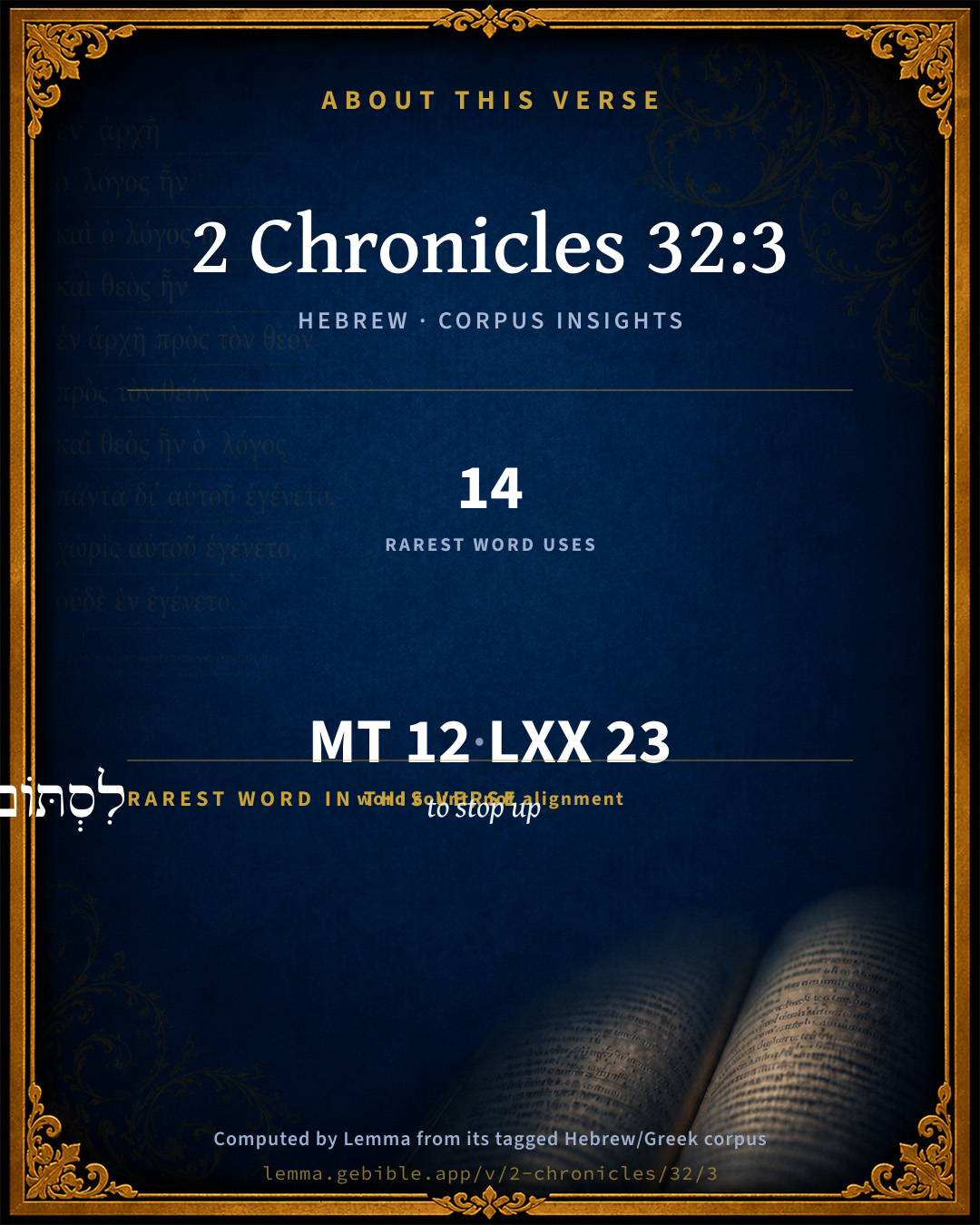
The rarest word here is לִסְתּוֹם֙ to stop up H5640 — appearing just 14 times in the whole Hebrew Bible.

Shared distinctive vocabulary

לִסְתּוֹם֙ to stop up H5640 occurs in 14 verses of the Hebrew Bible. Also found in:

Grammatical profile

  • 3 verbs
  • 5 nouns
  • 1 adjective
  • 1 preposition
  • 2 particles

Verb forms

  • וַיִּוָּעַ֗ץ Niphal · Sequential Imperfect
  • לִסְתּוֹם֙ Qal · Infinitive Construct
  • וַֽיַּעְזְרֽוּהוּ Qal · Sequential Imperfect

Hebrew & Septuagint length

In English translation the verse runs 27 words from the Hebrew and 26 from the Septuagint (LXX English) — closely comparable.

A rough comparison of the two English renderings, which tokenize alike — not a word-level alignment.

Word counts can differ between the Hebrew and the Greek without any difference in meaning — e.g. the Hebrew direct-object marker אֵת has no separate Greek word, and Greek often adds the article ὁ.

In the original languages it is 12 Hebrew tokens and 23 Greek tokens — but the two are counted differently (Hebrew bundles its prefixes and suffixes into one token; the Greek is in lemma form), so that isn’t a like-for-like length.

Cross-references

9

Topical passages linked to 2 Chronicles 32:3 in the Treasury of Scripture Knowledge — connected by theme and wording, ordered by reader-vote popularity; previews shown in the World English Bible.

  • Proverbs 15:22 Where there is no counsel, plans fail; But in a multitude of counselors they are established.
  • Proverbs 20:18 Plans are established by advice; By wise guidance you wage war!
  • Proverbs 24:6 For by wise guidance you wage your war; And victory is in many advisors.
  • 2 Kings 18:20 You say (but they are but vain words), [There is] counsel and strength for the war. Now on whom do you trust, that you have rebelled against me?
  • 2 Kings 20:20 Now the rest of the acts of Hezekiah, and all his might, and how he made the pool, and the conduit, and brought water into the city, aren't they written in the book of the chronicles of the kings of Judah?
  • 2 Chronicles 30:2 For the king had taken counsel, and his princes, and all the assembly in Jerusalem, to keep the Passover in the second month.
  • Isaiah 22:8–11 He took away the covering of Judah; and you did look in that day to the armor in the house of the forest.
  • Isaiah 40:13 Who has directed the Spirit of Yahweh, or being his counselor has taught him?
  • Romans 11:34 "For who has known the mind of the Lord? Or who has been his counselor?"

Cross-references courtesy of OpenBible.info (CC BY 4.0).

Hebrew and Greek witnesses Masoretic Hebrew ↔ Greek Septuagint

The same verse in the two great witnesses to the Old Testament, shown verse-for-verse.

These are two independent witnesses, not word-aligned to each other, and the Septuagint is shown in lemma (dictionary) form.

Hebrew 2 Chronicles 32:3 Masoretic · Westminster Leningrad Codex

וַיִּוָּעַ֗ץ עִם שָׂרָיו֙ וְגִבֹּרָ֔יו לִסְתּוֹם֙ אֶת מֵימֵ֣י הָעֲיָנ֔וֹת אֲשֶׁ֖ר מִח֣וּץ לָעִ֑יר וַֽיַּעְזְרֽוּהוּ

he took counsel with his princes and his mighty men to stop the waters of the springs which were outside of the city; and they helped him.

World English Bible · Public Domain

Greek LXX 2 Chronicles 32:3 Septuagint · lemma form

καί βουλεύω μετά ὁ πρεσβύτερος αὐτός καί ὁ δυνατός ἐνφράσσω ὁ ὕδωρ ὁ πηγή ὅς εἰμί ἔξω ὁ πόλις καί συν ἐπιἰσχύω αὐτός

And he took counsel with his elders and his mighty men to stop the wells of water which were without the city: and they helped him.

LXX2012 (modern English Septuagint) · Public Domain

Hebrew: Westminster Leningrad Codex (CC BY 4.0). Greek: Septuagint (public domain); English from LXX2012 (modern English Septuagint) (Public Domain). How the Septuagint differs from the Hebrew →

Commentary

Notes on 2 Chronicles 32:3 from classic Christian and Jewish commentators (each source and its license shown beneath its notes). The classic Christian expositions comment on the surrounding passage and are grouped to its opening verse, so a note may address several verses; the Jewish commentaries on the Tanakh (Rashi and others) are per-verse, so they appear only where the commentator wrote on this verse.

Lemma curates 59 commentaries, every one of them public domain or Creative Commons licensed, each selected and text-cleaned for this edition rather than reprinted as found. About our sources →

Trapp's Complete Commentary

John Trapp

2Ch 32:3 He took counsel with his princes and his mighty men to stop the waters of the fountains which [were] without the city: and they did help him.

Ver. 3. To stop the waters of the fountains.] He trusted in God: but yet used the best means. God is to be trusted, but not tempted. See Isa 22:9; Isa 22:11.

John Trapp, A Commentary or Exposition upon All the Books of the Old and New Testament (1647–1656) — public domain. Text from a community e-Sword module.

Joseph Benson's Commentary

2Ch 32:3-4. To stop the waters of the fountains — To fill them up with earth and other things cast into them, that it might not be known there was any water there, and withal to draw the waters by secret passages and pipes to Jerusalem. And the brook that ran through the midst of the land — The brook Kidron, which being but small, except when much rain fell, they easily filled up the spring of it. Saying, Why should the kings of Assyria find much water — Which was scarce in that country, and the want of it might greatly distress the Assyrian army.

Joseph Benson's Commentary on the Old and New Testaments (1811–1818) — public domain. Text from a community e-Sword module.

Tyndale Open Study Notes

Tyndale Open Resources

32:3-5 Sennacherib’s attack did not come as a surprise; Hezekiah provoked it by breaking a treaty (2 Kgs 18:7, 20). Because water was critical to both attacker and defender in siege warfare, Hezekiah made sure that Sennacherib’s army would not have access to the city’s water supply. In one of the most famous engineering feats of ancient times, Hezekiah’s tunnel connected the fresh waters of the Gihon Spring to the pool of Siloam, making water accessible from within the city walls. This famous tunnel is almost one-third of a mile long (approximately 580 yards [530 meters]) and about six feet [2 meters] high. The famous Hezekiah inscription, discovered in the tunnel in 1880, describes how the excavators met to join the two ends. Although much of the tunnel consisted of natural underground aqueducts, it was a tremendous strategy for protecting the citizens of the city.

Tyndale Open Study Notes — © Tyndale Open Resources, licensed CC BY-SA 4.0. Text via the HelloAO Bible API.

The Cambridge Bible for Schools and Colleges

gen. ed. J. J. S. Perowne

3. to stop the waters] Cp. 2Ki_20:20 (“[Hezekiah] made the pool and the conduit and brought water into the city”) and Isa_22:9; Isa_22:11.

At the present day there is an underground tunnel cut through the rock leading from St Mary’s Well down to the Lower Pool of Siloam. It is rudely constructed and owing to its windings is 586 yards long, though the distance in a straight line is only 368 yards. As therefore the Lower Pool was probably within the ancient walls, while St Mary’s Well was outside, this tunnel may be Hezekiah’s conduit. If the well were stopped, the besiegers would lose the water, which would collect in the Pool for the use of the besieged. An inscription in ancient Hebrew characters (“The Siloam Inscription”) discovered in situ describes briefly the digging of the tunnel, but does not enable us to fix the date of it for certain. See for the original text Lidzbarski, Nordsemitische Epigraphik, Tafel xxi. 1, and for an English translation, Sayce, Fresh Light from the Ancient Monuments, p. 87.

The Cambridge Bible for Schools and Colleges (gen. ed. J. J. S. Perowne; Cambridge University Press, 1878–1918) — public domain. Text from a community e-Sword module.

John Gill's Exposition

So there was gathered much people together,.... At the instance of Hezekiah, his nobles and officers:

who stopped all the fountains; perhaps by laying planks over them, and earth upon them, so that it could not be discerned there were any fountains there:

and the brook that ran through the midst of the land; which, according to Kimchi, was Gihon, Ch2 32:30, which was near Jerusalem; the stream of this very probably they turned into channels under ground, whereby it was brought into the city into reservoirs there provided, that that might have a supply during the siege, while the enemy was distressed for want of it:

saying, why should the kings of Assyria come and find much water? by which means they would be able to carry on the siege to a great length, when otherwise they would be obliged to raise it quickly: mention is made of kings of Assyria, though there was but one, with whom there might be petty kings, or tributary ones; and, besides, as he boasted, his princes were altogether kings, Isa 10:8.

John Gill's Exposition of the Whole Bible (1746–1763) — public domain (CC PDM 1.0). Text via the HelloAO Bible API.

Albert Barnes' Notes on the Bible

To stop the waters ... - Compare 2Ch 32:30. Hezekiah’s object was probably twofold - to hide the springs outside the city in order to distress the Assyrians, and to convey their water underground into the city, in order to increase his own supply during the siege.

Albert Barnes' Notes on the Bible (1834–1885) — public domain. Text from a community e-Sword/MySword module.

Haydock's Catholic Bible Commentary

City. The torrent Cedron afforded the only good supply of water. It was often dry, and was only three steps across, when full of melted snow or rain. The waters of Siloe and Gihon were collected in it. Yet it was no difficult enterprise for the king to turn the stream, and introduce the waters through the rock into a large reservoir, in the city, by the canal, which is mentioned 2 Esdras ii. 14., and Ecclesiasticus xlviii. 19. The besieged were more frequently deprived of water, Judith vii. 6. Babylon was taken by Semiramis, Cyrus, and Alexander, after they turned aside the waters of the Euphrates; and Cæsar obliged the town of Cahors to surrender, by intercepting the springs. Frontin. iii. 7. C.

George Leo Haydock (1774–1849), Haydock's Catholic Family Bible and Commentary, 1859 edition — public domain. Excludes Psalms (Douay-Rheims chapter numbering differs from Protestant) and Deuterocanonical books (Catholic canon only).

Matthew Poole's English Annotations

To stop the waters of the fountains, with earth or other things cast into them; and withal to derive the waters by secret paths and pipes under ground to Jerusalem.

Matthew Poole's English Annotations on the Holy Bible (1683–1685) — public domain. Text from a community e-Sword/MySword module.

Whedon's Commentary on the Bible

Daniel D. Whedon

3. To stop the waters of the fountains which were without the city — The object was thereby to distress the enemy, by preventing him from obtaining water near the city. He probably not only hid the springs from view, but drew off the water by secret aqueducts into the city.

Daniel D. Whedon (gen. ed.), Commentary on the Old and New Testaments (1874–1909) — public domain. Text from a community e-Sword module.

The Pulpit Commentary

To stop the waters of the fountains without the city. These fountains or springs were probably those represented by En Rogel, on the Ophel spur or very large mound, or fortified hill (mistranslated possibly from that circumstance "tower," in 2Ki_5:24; Isa_32:14 on the southeast of the temple. The object of Hezekiah is obvious enough. The word ( for "stopping" occurs in all thirteen times twice in piel in Genesis, once in niph. in Nehemiah, and ten times in kal in Kings, Chronicles, Daniel, Ezekiel, and Psalms. It is for all material purposes very uniformly rendered in all these places by the word "stop" eight times, and otherwise "shut" or "closed," or to carry a derived meaning, "hidden" or "secret." If the word "shut" or "shut off" were employed, it would fit every occasion. So we are not told here how he stopped the fountain or fountains, but that he shut the waters off from one direction and guided them into another, vie. by a conduit running westward from the springs and the Gihon (i.e. the brook) flowing naturally down the Tyropoean valley to a pool prepared for it in the city (see our ver. 30; and 2Ki_18:17 2Ki_20:20; Ecclus, 48:17; and Conder"s "Handbook to the Bible," p. 339). This pool was very probably none other than the pool of Siloam.

The Pulpit Commentary (1880–1919), ed. H.D.M. Spence-Jones & Joseph S. Exell — public domain. Text from a community e-Sword module.

John Wesley's Explanatory Notes

To stop - And withal to draw the waters by secret pipes underground to Jerusalem.

John Wesley, Explanatory Notes Upon the Whole Bible (1754–1765) — public domain. Text via the GEBible commentary corpus.

Lesson kit

Teaching starters — assembled from the data on this page, not authored interpretation. Every prompt links to the verse data it draws on. Edit before teaching.

2 Chronicles, in the Historical, opens this verse with 12 words (12 distinct Hebrew lemmas). Its most distinctive word is çâtham (“to stop up”). A historical commentator’s framing appears above. Read the whole chapter for the surrounding context.

Discussion questions

  1. How does “to stop up” (çâtham) shape what this verse is saying?
  2. Genesis 26:15 shares the word «to stop up» with this verse. How do the two illuminate each other?
  3. These translations render this verse differently. What is at stake in choosing one wording over another?
  4. The verb «וַיִּוָּעַ֗ץ» is Niphal Sequential Imperfect. How does its form color the action?
  5. Reading how Trapp's Complete Commentary and Joseph Benson's Commentary read this verse, where do the two commentators agree and where do they part?

Things to notice

Reading settings

Reading text

Shown beneath each verse's original-language words.

Old Testament
Old Testament edition

Read the OT as the Masoretic Hebrew (MT) or the Greek Septuagint (LXX).

English shown for the Greek Septuagint (in the Hebrew ↔ Greek comparison).

Comparing translations? Open the Compare panel on any verse page to stack up to four side by side.