
Jeremiah 11:13

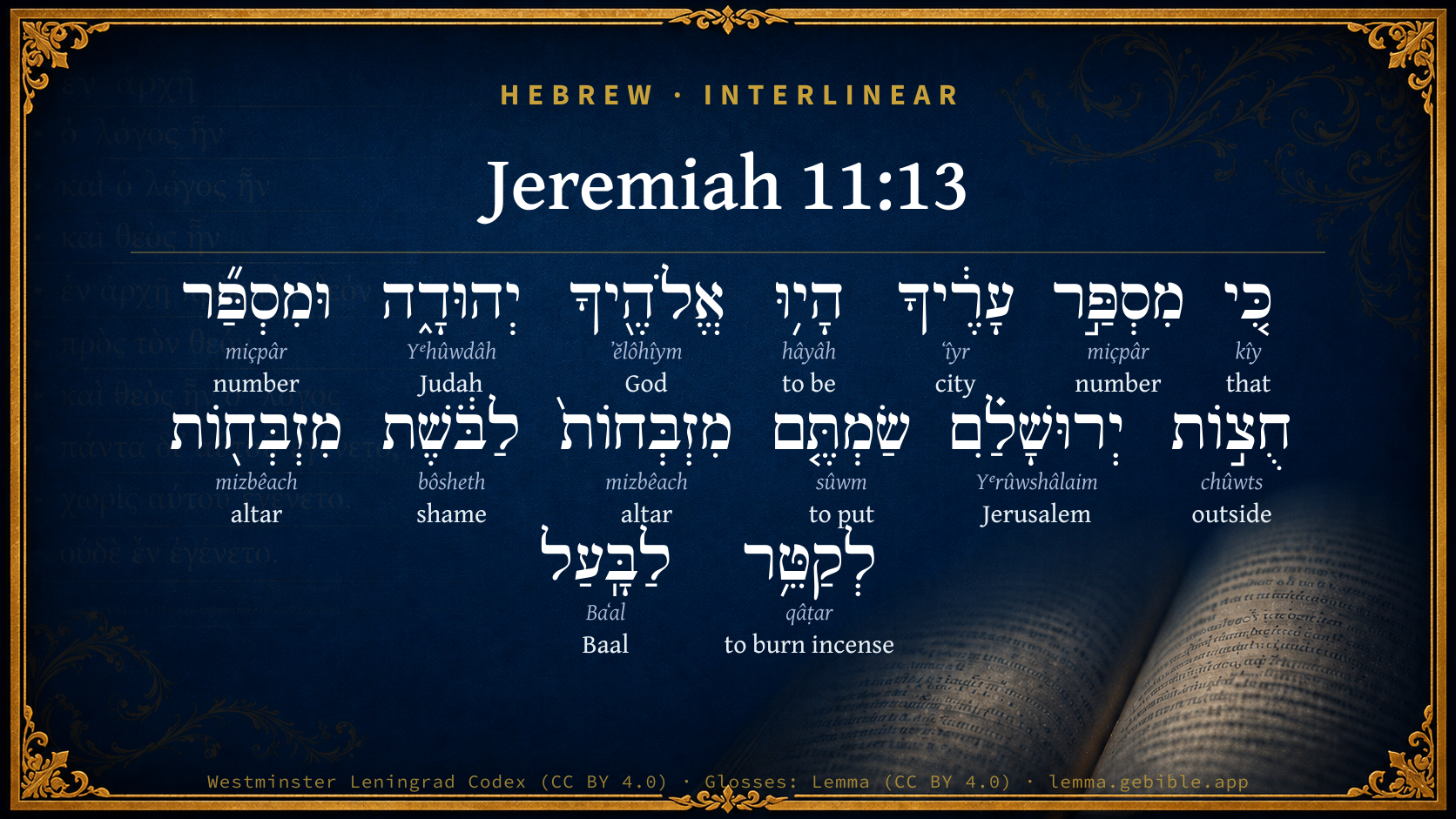
Hebrew (Westminster Leningrad Codex) Jeremiah 11:13 appears in the Hebrew Old Testament. The text above is from the Westminster Leningrad Codex. Each word links to its Strong’s number, a concise gloss, and parsing drawn from the Open Scriptures Hebrew Bible morphology. Click any word for its full Brown-Driver-Briggs (BDB) entry.
Download image
Cite this verse

Jeremiah 11:13 (World English Bible). Public Domain. Lemma interlinear Bible study tool, https://lemma.gebible.app/v/jeremiah/11/13.

Show BibTeX & RIS
BibTeX
RIS
English Translation
For according to the number of your cities are your gods, Judah; and according to the number of the streets of Jerusalem have you set up altars to the shameful thing, even altars to burn incense to Baal.
World English Bible · Public Domain
Download a study sheet

One document with this verse’s original text, its word-by-word gloss line, the meaning frame, cross-references with their text, attributed commentary, and full source and license credits — printable, and it pastes into notes with its structure intact.

This verse Autodidact and up

Study sheet (.html) Plain text (.txt)

A passage Seminary Student

Up to 50 verses in one chapter. A passage sheet keeps up to 6 commentary sources and 12 cross-references per verse, in the order this page ranks them, and says so on the sheet whenever that leaves anything out. Ask for a single verse and you get the Autodidact verse sheet above.

Everything on this page stays free to read, with no account — the sheet is a download of what is already on screen, not access to it.

Want to remove ads? Support Godless Engineer
Compare translations 3

The same verse in 3 English versions, stacked beneath the original-language interlinear above. Click any original word for its lexicon entry.

Each is an independent rendering of the whole verse — the interlinear is not word-aligned to these translations.

Highlighted words mark where these versions differ — a whole-verse word diff, not a word-by-word alignment.

  • World English Bible Public Domain
    For according to the number of your cities are your gods, Judah; and according to the number of the streets of Jerusalem have you set up altars to the shameful thing, even altars to burn incense to Baal.
  • King James Version Public Domain
    For according to the number of thy cities were thy gods, O Judah; and according to the number of the streets of Jerusalem have ye set up altars to that shameful thing, even altars to burn incense unto Baal.
  • unfoldingWord Literal Text CC BY-SA 4.0
    For the number of your cities are your gods, Judah, and the number of the streets of Jerusalem, you have set up altars to shameful thing, altars to offer to Baal.

unfoldingWord Literal Text — © unfoldingWord, licensed CC BY-SA 4.0. Word-aligned USFM3 via Door43 (git.door43.org/unfoldingWord/en_ult).

Versions to compare (up to 4)

3 of 4 selected

Show all 18 translations

Every available English version of this verse, each an independent rendering of the whole verse.

  • World English Bible Public Domain
    For according to the number of your cities are your gods, Judah; and according to the number of the streets of Jerusalem have you set up altars to the shameful thing, even altars to burn incense to Baal.
  • Berean Standard Bible Public Domain
    Your gods are indeed as numerous as your cities, O Judah; the altars of shame you have set up—the altars to burn incense to Baal—are as many as the streets of Jerusalem.’
  • Majority Standard Bible Public Domain
    Your gods are indeed as numerous as your cities, O Judah; the altars of shame you have set up—the altars to burn incense to Baal—are as many as the streets of Jerusalem.’
  • King James Version Public Domain
    For according to the number of thy cities were thy gods, O Judah; and according to the number of the streets of Jerusalem have ye set up altars to that shameful thing, even altars to burn incense unto Baal.
  • American Standard Version (1901) Public Domain
    For according to the number of thy cities are thy gods, O Judah; and according to the number of the streets of Jerusalem have ye set up altars to the shameful thing, even altars to burn incense unto Baal.
  • Revised Version (1885) Public Domain
    For according to the number of thy cities are thy gods, O Judah; and according to the number of the streets of Jerusalem have ye set up altars to the shameful thing, even altars to burn incense unto Baal.
  • Geneva Bible (1599) Public Domain
    For according to the number of thy cities were thy gods, O Iudah, and according to the number of the streetes of Ierusalem haue yee set vp altars of confusion, euen altars to burne incense vnto Baal.
  • Douay-Rheims (1899) Public Domain
    For according to the number of thy cities were thy gods, O Juda: and according to the number of the streets of Jerusalem thou hast set up altars of confusion, altars to offer sacrifice to Baalim.
  • Young's Literal Translation Public Domain
    For -- the number of thy cities have been thy gods, O Judah, And -- the number of the streets of Jerusalem Ye have placed altars to a shameful thing, Altars to make perfume to Baal.
  • Literal Standard Version CC BY-SA 4.0
    For the number of your cities have been your gods, O Judah, || And [for] the number of the streets of Jerusalem You have placed altars to a shameful thing, || Altars to make incense to Ba‘al.
  • Unlocked Literal Bible CC BY-SA 4.0
    For you Judah, the number of your gods has increased to equal the number of your cities. You have made the number of shameful altars in Jerusalem, incense altars for Baal, equal to the number of her streets.
  • unfoldingWord Literal Text CC BY-SA 4.0
    For the number of your cities are your gods, Judah, and the number of the streets of Jerusalem, you have set up altars to shameful thing, altars to offer to Baal.
  • Darby Bible Public Domain
    For [as] the number of thy cities, are thy gods, O Judah; and [as] the number of the streets of Jerusalem, have ye set up altars to the Shame, altars to burn incense unto Baal.
  • World Messianic Bible Public Domain
    For according to the number of your cities are your gods, Judah; and according to the number of the streets of Jerusalem you have set up altars to the shameful thing, even altars to burn incense to Baal.’
  • Webster's Bible Public Domain
    For according to the number of thy cities were thy gods, O Judah; and according to the number of the streets of Jerusalem have ye set up altars to that shameful thing, even altars to burn incense to Baal.
  • Free Bible Version CC BY-SA 4.0
    You certainly have as many gods as you have towns, Judah! You have built shameful altars, altars to burn incense to Baal. You have as many altars as the streets of Jerusalem.
  • Bible in Basic English Public Domain
    For the number of your gods is as the number of your towns, O Judah; and for every street in Jerusalem you have put up altars to the Baal for burning perfumes to the Baal.
  • JPS Tanakh (1917) Public Domain
    For according to the number of thy cities are thy gods, O Judah; and according to the number of the streets of Jerusalem have ye set up altars to the shameful thing, even altars to offer unto Baal.

Literal Standard Version (2020), Covenant Press — licensed CC BY-SA 4.0. Text via the HelloAO Bible API (eBible.org). Unlocked Literal Bible (unfoldingWord) — licensed CC BY-SA 4.0. Text via the HelloAO Bible API (eBible.org). unfoldingWord Literal Text — © unfoldingWord, licensed CC BY-SA 4.0. Word-aligned USFM3 via Door43 (git.door43.org/unfoldingWord/en_ult). Free Bible Version, Dr. Jonathan Gallagher — licensed CC BY-SA 4.0. Text via the HelloAO Bible API (eBible.org).

Word by word

More ways to search: Search by grammar → Find every occurrence → Compare this word →

Practice this passage: Drill this verse → Learn its vocabulary →

לַבֹּ֔שֶׁת
bôsheth
H1322
“to/for the · shame”
Preposition, Determined + Noun, Common, Feminine, Singular, Absolute
Part of Speech
Preposition + Noun
Type
Common
Gender
Feminine
Number
Singular
State
Absolute
Full BDB Definition

Origin: from H954

TWOT: 222b

shame - shame - shameful thing
  1. כִּ֚י kîy H3588 “that” Conjunction
  2. מִסְפַּ֣ר miçpâr H4557 “number of” Noun, Common, Masculine, Singular, Construct
  3. עָרֶ֔יךָ ʻîyr H5892 “cities · your” Noun, Common, Feminine, Plural, Construct + Suffix, Personal, 2nd Person, Masculine, Singular
  4. הָי֥וּ hâyâh H1961 “to be” Verb, Qal, Perfect, 3rd Person, Common, Plural
  5. אֱלֹהֶ֖יךָ ʼĕlôhîym H430 “God(s) · your” Noun, Common, Masculine, Plural, Construct + Suffix, Personal, 2nd Person, Masculine, Singular
  6. יְהוּדָ֑ה Yᵉhûwdâh H3063 “Judah” Noun, Proper
  7. וּמִסְפַּ֞ר miçpâr H4557 “and · number of” Conjunction + Noun, Common, Masculine, Singular, Construct
  8. חֻצ֣וֹת chûwts H2351 “streets of” Noun, Common, Masculine, Plural, Construct
  9. יְרוּשָׁלִַ֗ם Yᵉrûwshâlaim H3389 “Jerusalem” Noun, Proper
  10. שַׂמְתֶּ֤ם sûwm H7760 “to put” Verb, Qal, Perfect, 2nd Person, Masculine, Plural
  11. מִזְבְּחוֹת֙ mizbêach H4196 “altars” Noun, Common, Masculine, Plural, Absolute
  12. מִזְבְּח֖וֹת mizbêach H4196 “altars” Noun, Common, Masculine, Plural, Absolute
  13. לְקַטֵּ֥ר qâṭar H6999 “to burn incense” Preposition + Verb, Piel, Infinitive Construct
  14. לַבָּֽעַל Baʻal H1168 “to/for the · Baal” Preposition, Determined + Noun, Proper

About this verse

These counts appear in no published source. They are computed here, from the morphology-tagged text and Lemma’s own curated glosses. What Lemma adds →

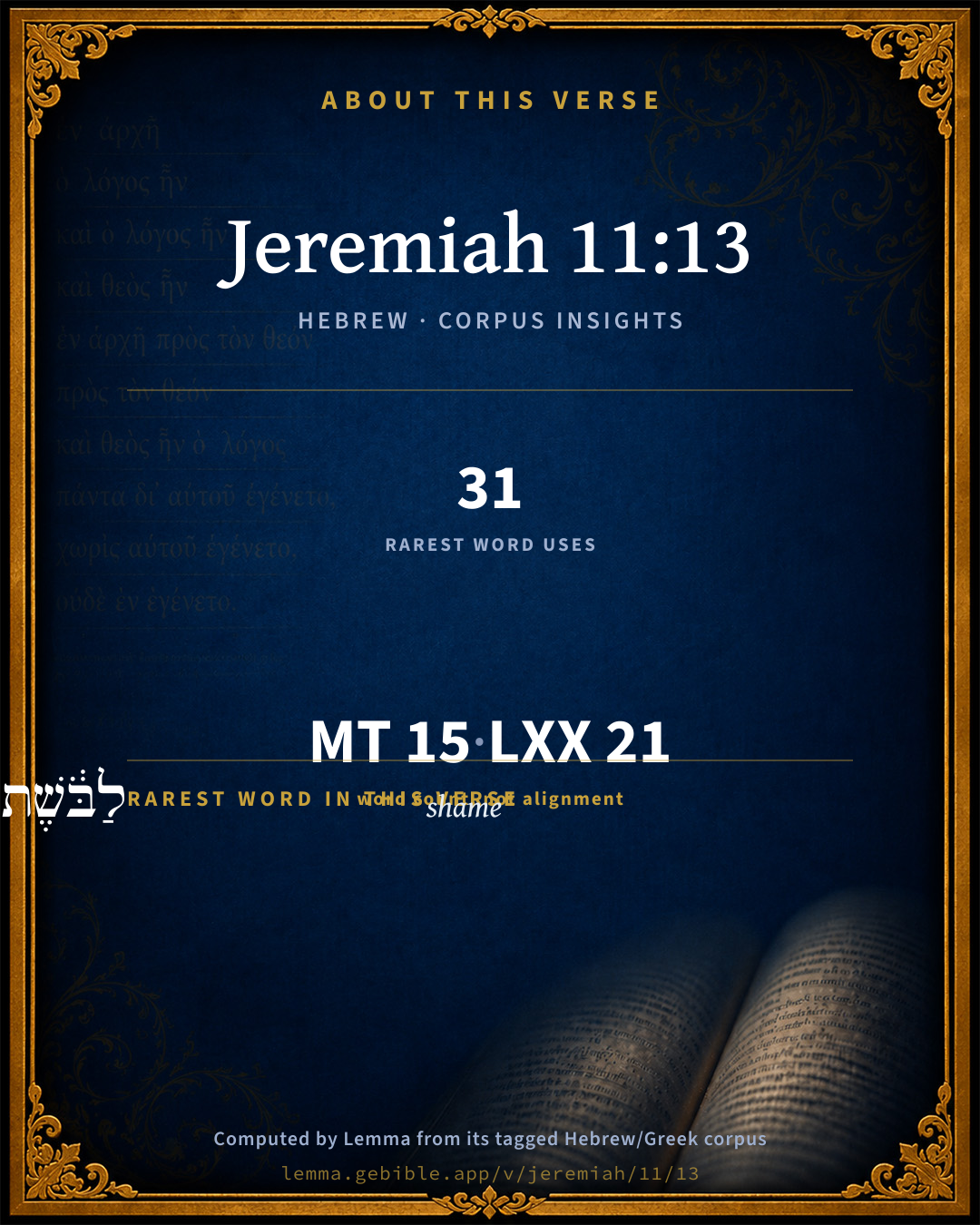
15
words
13
distinct lemmas
Prophets
section

Shared distinctive vocabulary

לַבֹּ֔שֶׁת shame H1322 occurs in 30 verses of the Hebrew Bible. Also found in:

Grammatical profile

  • 3 verbs
  • 11 nouns
  • 1 conjunction

Verb forms

  • הָי֥וּ Qal · Perfect
  • שַׂמְתֶּ֤ם Qal · Perfect
  • לְקַטֵּ֥ר Piel · Infinitive Construct

Repetition

Words recur within this verse — often emphatic in Hebrew:

  • מִסְפַּ֣ר number H4557 ×2
  • מִזְבְּחוֹת֙ altar H4196 ×2

Hebrew & Septuagint length

In the original languages it is 15 Hebrew tokens and 21 Greek tokens — but the two are counted differently (Hebrew bundles its prefixes and suffixes into one token; the Greek is in lemma form), so that isn’t a like-for-like length.

Cross-references

12

Topical passages linked to Jeremiah 11:13 in the Treasury of Scripture Knowledge — connected by theme and wording, ordered by reader-vote popularity; previews shown in the World English Bible.

  • Jeremiah 2:28 But where are your gods that you have made you? let them arise, if they can save you in the time of your trouble: for according to the number of your cities are your gods, Judah.
  • 2 Kings 23:13 The high places that were before Jerusalem, which were on the right hand of the mountain of corruption, which Solomon the king of Israel had built for Ashtoreth the abomination of the Sidonians, and for Chemosh the abomination of Moab, and for Milcom the abomination of the children of Ammon, did the king defile.
  • Deuteronomy 32:16–17 They moved him to jealousy with strange [gods]; With abominations provoked they him to anger.
  • 2 Kings 21:4–5 He built altars in the house of Yahweh, of which Yahweh said, In Jerusalem will I put my name.
  • 2 Kings 23:4–5 The king commanded Hilkiah the high priest, and the priests of the second order, and the keepers of the threshold, to bring forth out of the temple of Yahweh all the vessels that were made for Baal, and for the Asherah, and for all the host of the sky, and he burned them outside of Jerusalem in the fields of the Kidron, and carried the ashes of them to Bethel.
  • Isaiah 2:8 Their land also is full of idols. They worship the work of their own hands, That which their own fingers have made.
  • Jeremiah 3:1–2 They say, If a man put away his wife, and she go from him, and become another man's, will he return to her again? Won't that land be greatly polluted? But you have played the prostitute with many lovers; yet return again to me, says Yahweh.
  • Jeremiah 3:24 But the shameful thing has devoured the labor of our fathers from our youth, their flocks and their herds, their sons and their daughters.
  • Jeremiah 7:9 Will you steal, murder, and commit adultery, and swear falsely, and burn incense to Baal, and walk after other gods that you have not known,
  • Jeremiah 19:5 and have built the high places of Baal, to burn their sons in the fire for burnt offerings to Baal; which I didn't command, nor spoke it, neither came it into my mind:
  • Jeremiah 32:35 They built the high places of Baal, which are in the valley of the son of Hinnom, to cause their sons and their daughters to pass through [the fire] to Molech; which I didn't command them, neither did it come into my mind, that they should do this abomination, to cause Judah to sin.
  • Hosea 12:11 If Gilead is wicked, Surely they are worthless. In Gilgal they sacrifice bulls. Indeed, their altars are like heaps in the furrows of the field.

Cross-references courtesy of OpenBible.info (CC BY 4.0).

Hebrew and Greek witnesses Masoretic Hebrew ↔ Greek Septuagint

The same verse in the two great witnesses to the Old Testament, shown verse-for-verse.

These are two independent witnesses, not word-aligned to each other, and the Septuagint is shown in lemma (dictionary) form.

Hebrew Jeremiah 11:13 Masoretic · Westminster Leningrad Codex

כִּ֚י מִסְפַּ֣ר עָרֶ֔יךָ הָי֥וּ אֱלֹהֶ֖יךָ יְהוּדָ֑ה וּמִסְפַּ֞ר חֻצ֣וֹת יְרוּשָׁלִַ֗ם שַׂמְתֶּ֤ם מִזְבְּחוֹת֙ לַבֹּ֔שֶׁת מִזְבְּח֖וֹת לְקַטֵּ֥ר לַבָּֽעַל

For according to the number of your cities are your gods, Judah; and according to the number of the streets of Jerusalem have you set up altars to the shameful thing, even altars to burn incense to Baal.

World English Bible · Public Domain

Greek LXX Structure differs

In the Septuagint, Jeremiah is about an eighth shorter than the Hebrew and arranges its material differently — the Oracles Against the Nations (Hebrew chapters 46–51) appear in the middle of the Greek book, after 25:13. Because the chapter and verse boundaries do not line up, a verse-for-verse comparison with the Hebrew is not shown.

A verse-for-verse comparison isn’t shown here because the chapters and verses don’t line up. Switch to the LXX edition with the MT / LXX toggle above to read the Greek directly.

Hebrew: Westminster Leningrad Codex (CC BY 4.0). Greek: Septuagint (public domain); English from a public-domain English Septuagint. How the Septuagint differs from the Hebrew →

Targum (Aramaic paraphrase)

1

The Targum is the ancient Jewish Aramaic paraphrase of the Hebrew Scriptures — an interpretive translation, not the Hebrew text itself. Onkelos (literal) and Pseudo-Jonathan (expansive) render the Torah, and Jonathan the Prophets. Coverage is partial: where no permissively-licensed English translation exists for a verse, only the Aramaic is shown. This is verse-level text, not a word-by-word alignment to the Hebrew.

  1. Targum Jonathan Prophets (Joshua–Malachi)
    אֲרֵי מִנְיַן קִרְוֵיכוֹן הֲוָאָה דְחַלְתְּכוֹן דְבֵית יְהוּדָה וּמִנְיַן שׁוֹקֵי יְרוּשְׁלֵם שַׁוִיתוּן אֱגוֹרִין לְבָהֲתָא וֶאֱגוֹרִין לְאַסָקָא בּוּסְמִין לְבַעֲלָא:

    (no public-domain English translation for this verse)

    Targum Jonathan — Aramaic: “Mikraot Gedolot” (public domain). English: “Sefaria Community Translation” (CC0 1.0 (public-domain dedication)); “London "Chaldee Paraphrase," 1871” (public domain). Text via Sefaria.

Commentary

Notes on Jeremiah 11:13 from classic Christian and Jewish commentators (each source and its license shown beneath its notes). The classic Christian expositions comment on the surrounding passage and are grouped to its opening verse, so a note may address several verses; the Jewish commentaries on the Tanakh (Rashi and others) are per-verse, so they appear only where the commentator wrote on this verse.

Lemma curates 59 commentaries, every one of them public domain or Creative Commons licensed, each selected and text-cleaned for this edition rather than reprinted as found. About our sources →

Trapp's Complete Commentary

John Trapp

Jer 11:13 For [according to] the number of thy cities were thy gods, O Judah; and [according to] the number of the streets of Jerusalem have ye set up altars to [that] shameful thing, [even] altars to burn incense unto Baal.

Ver. 13. For according to the number of thy cities.] See Jer 2:28.

And according to the number of thy streets.] See Eze 16:31.

John Trapp, A Commentary or Exposition upon All the Books of the Old and New Testament (1647–1656) — public domain. Text from a community e-Sword module.

Tyndale Open Study Notes

Tyndale Open Resources

11:13 Idolatry was so rampant in Judah that not a town or street could be found without an idol present.

Tyndale Open Study Notes — © Tyndale Open Resources, licensed CC BY-SA 4.0. Text via the HelloAO Bible API.

Geneva Bible (1599)

Geneva Bible translators

Read Jer. 2:28.

Geneva Bible (1599) marginal notes — public domain. Text via Bolls.life.

Jamieson, Fausset & Brown

Robert Jamieson, A. R. Fausset & David Brown

shameful thing--Hebrew, "shame," namely, the idol, not merely shameful, but the essence of all that is shameful (Jer 3:24; Hos 9:10), which will bring shame and confusion on yourselves [CALVIN].

Jamieson, Fausset & Brown — Commentary Critical and Explanatory on the Whole Bible (1871) — public domain (CC PDM 1.0). Text via the HelloAO Bible API.

John Calvin's Commentaries

The Prophet shews here that the dews were not only polluted with one kind of superstition, but that they sought for themselves fictitious gods from all quarters, so that the land was fined and, as it were, deluged with innumerable superstitions. He says, that in proportion to the number of cities were the gods in the kingdom of Judah, and that in every city, in proportion to the number of streets, altars were built, that they might burn incense to Baal

There seems, however, to be some inconsistency in the words; for if they all worshipped Baal, where could be found the multitude of gods which the Prophet condemns? It then follows, that there was everywhere the same form of superstition, or that they did not in every place burn incense to Baal. But from this place and from others we may gather that this is a common name; for though all idols had their distinctive names, yet this name was applied indiscriminately, and all idols had it in common. For what does Baal mean but a patron, or an inferior god, who procured the favor of the supreme God? The prophets often use the word in the plural number, and call the lesser or inferior gods Baalim, who were regarded as mediators or angels; and farther, they often mean all kinds of idols by Baal. There is to be understood here a figure, by which a part is taken for the whole; for the Prophet intended by the word to include all those gods which the Jews had devised for themselves, though their names were different.

But what the Prophet condemned in the people was, as we see, daily practiced. For there is no end, when men once depart ever so little from the pure worship of the only true God: for when anything is blended with it, one error immediately produces another; so various errors will cumulate, tin men fall into a labyrinth from which there is no exit. This is clearly seen under the Papacy. At first Satan, by spurious pretences, led men away from the simple worship of God and his pure doctrine; and as there is in all an inbred curiosity, every one had a desire to add something of his own. Hence then it happened that so great a mass of errors and superstitions has prevailed. It is nothing strange, then, that the Prophet condemned the Jews, not only for having departed from the true and lawful worship of God, but also for having as many idols as cities, and for having so many forms of worship as there were streets in their cities. And we hence also learn that all the superstitions among the whole people had the same root; for though they differed in particulars, they all yet proceeded from the same principle; for every one wished to have his own God. It hence happened, that every city had its patron, and every family also devised a god for itself; for no one was satisfied with the common worship. It is then wholly necessary that we should faithfully worship the one true God; otherwise the Devil will immediately bring in strange gods and a mixed multitude of gods: so that it hence evidently appears, that we thus justly suffer for our impious levity in forsaking the fountain of living waters.

He says that altars were built for reproach. This may be referred to God, because they offered to God a heinous effrontery in setting up their profane altars in opposition to that one true altar which God had commanded to be built for him in the temple. But this is a strained interpretation. It is more suitable to refer this to the people, because they erected altars for themselves to their own shame, as though he had said that the Jews were themselves the authors of all their evils, so that they ought to consider them as due to their impiety, being the punishments inflicted by the Lord. It is the same as though he had said, “God will indeed chastise you, as ye are worthy of being so treated, but ascribe the whole fault to yourselves; for the altars, raised by your own hands, will be to you for reproach and shame.”

He at length adds, To offer incense to Baal They sought doubtless the favor of the supreme God; but as they devised for themselves patrons, as mediators between them and God, according to the Platonic figment, which has prevailed in all ages, the Prophet here declares that their gods were as many as their cities, and even as many as their streets; for God does not admit those sophistical subtleties by which hypocrites seek to escape; for whenever his glory is transferred to others, he complains that new gods are introduced. It follows —

John Calvin's Commentaries (1540-1563) — public domain. Text from the Calvin Translation Society English edition (1840s-50s) via the Christian Classics Ethereal Library (ccel.org). Calvin's coverage is partial (roughly two-thirds of the Bible); uncommented books and verses are honest gaps, never fabricated. The 19th-century editor's footnotes and remarks are omitted so the notes are faithfully Calvin's own voice.

Ellicott's Commentary for English Readers

(13) According to the number of thy cities . . .—This and Jer_11:12 reproduce what we have heard already in Jer_2:27-28; Jer_7:17. The “shameful thing” is, as in Jer_3:24, the image of Baal, which would seem to have been set up openly in some prominent place in every city of Judan, every street of Jerusalem. The reference is probably made, as before, to the formal recognition of Baal-worship in the days of Manasseh (2Ki_21:3; 2Ch_33:3), but the sin may have been repeated as soon as the restraint of Josiah’s reign had been removed.

A Bible Commentary for English Readers, edited by Charles John Ellicott (1878–1897) — public domain. Text from a community e-Sword module.

John Gill's Exposition

Therefore pray not thou for this people,.... If for a remnant among them, yet not for the body of the people; and if for their spiritual and eternal good, yet not for their temporal salvation; their temporal ruin was certain; the decree was gone forth, and there was no revoking it; and this is said, not so much by way of prohibition of the prophet, as by way of threatening to the people, to show that as their own prayers should not profit them, so they should not have the benefit of the prayers of good men, their sin was a sin unto death, at least temporal death, and must not be prayed for, Jo1 5:16,

neither lift up a cry or prayer for them; more words are used, to show the divine resolution, how inexorable he was, and how desperate was their condition, and their ruin sure; these words are repeated from Jer 7:16,

for I will not hear them in the time that they cry unto me for their trouble; for, as he would not hear their prayers when they should cry to him to be delivered from their trouble, it cannot be thought that he should hear the prayers of others for them, The Targum understands this of the prayers of the prophet for them, paraphrasing the words thus,

"for there is no acceptance before me (or it is not pleasing to me) when thou shall pray for them before me, in the time of their evil;''

neither their prayers, nor the prophet's for them, would be acceptable to God, or of any avail, he being determined to bring evil upon them.

John Gill's Exposition of the Whole Bible (1746–1763) — public domain (CC PDM 1.0). Text via the HelloAO Bible API.

Albert Barnes' Notes on the Bible

That shameful thing - i. e., Baal; public establishment of idolatry, such as actually took place in the reign of Manasseh (2Ch 33:3. Contrast 2Ki 18:4).

Albert Barnes' Notes on the Bible (1834–1885) — public domain. Text from a community e-Sword/MySword module.

Haydock's Catholic Bible Commentary

Confusion. Thus he contemptuously denotes Baalim, chap. iii. 24. (Calmet) --- Various idols were objects of adoration, (Haydock) so that no city or street, perhaps not any house, was pure, chap. vii. 18., and xliv. 17., Isaias lxv. 11., and Ezechiel xvi. 25.

George Leo Haydock (1774–1849), Haydock's Catholic Family Bible and Commentary, 1859 edition — public domain. Excludes Psalms (Douay-Rheims chapter numbering differs from Protestant) and Deuterocanonical books (Catholic canon only).

Matthew Poole's English Annotations

Not that they had just so many idols as were cities in Judah, or altars as were streets in Jerusalem; the meaning is, they had very many, and that the people who lived in every city and street were guilty. What he calls their shame, or the shameful thing, is afterwards expounded Baal, called a shameful thing, because it was what they had reason to be ashamed of, and what would certainly bring them to shame and confusion.

Baal signifieth lord, and was a common name given to more idols than one; the Phoenicians used the name Baal, the Chaldeans Bell. God, Hos 2:16, forbade his people to call him by this name, because so abused to idolatry. Many think that the sun was what the Phoenicians worshipped under this name; some say Saturn was he. Manasseh, who preceded Josiah, reared up altars for Baalim, and made groves, and worshipped all the host of heaven, and served them, 2Ch 33:3. Learned men say that the Asians called the same idol Baal, whom those of Europe called Jupiter. It is not improbable which learned men judge, that the heathens acknowledging one Supreme Being, worshipped him in several creatures; some mistaking the sun, moon, and stars to be he, others other things; these they called Baalim, lords, as they called the principal god Baal. The heathens’ idolatry seems to be their worshipping God in creatures, and paying a divine homage to creatures, the sun, moon, and stars, and other far inferior to them, not believing that those creatures were the Divine Being, but that the Divine Being was in them, and from them would hear their supplicants, and do them good; which, though the heathens might a little be excused in, having no Scriptures showing them the nature of the true God, and how he would be worshipped; yet in the Jews was inexcusable, they having the oracles of God committed to them, which both showed them the true nature of God, and let them know that no creature could be any similitude or representation of him; and that his will was, that they should pay their homage to him without any similitudes or representations exciting them to that homage, fit for nothing but to beget in the minds of people false conceptions and apprehensions of the Divine Being, which is merely spiritual; notwithstanding which direction from the Divine law, the Jews, after the manner of the heathens, would pay their homage to God before the sun, moon, and stars, and before images made with hands, and make altars to such creatures and images, which was the idolatry God complains of, and of which he declares a greater abhorrence than almost of any other sin. It is likely that Baal here mentioned was the sun, because it was near Manasseh’s times, who thus highly offended God; and it is probable that though Josiah had begun a famous reformation. yet a great deal of this leaven was left in the common people; besides that the sins of Manasseh, 2Ki 23:26, are reckoned up as the special proximate cause of this wrath of God against Judah.

Matthew Poole's English Annotations on the Holy Bible (1683–1685) — public domain. Text from a community e-Sword/MySword module.

Whedon's Commentary on the Bible

Daniel D. Whedon

13. Shameful thing — See Jer_3:24.

Daniel D. Whedon (gen. ed.), Commentary on the Old and New Testaments (1874–1909) — public domain. Text from a community e-Sword module.

The Pulpit Commentary

That shameful thing; rather, the shame. The name Baal is changed, to mark the abhorrence of the speaker, into Bosheth. (see Jer_3:24) Manasseh, we are told, "raised up altars for Daal". (2Ki_21:3)

The Pulpit Commentary (1880–1919), ed. H.D.M. Spence-Jones & Joseph S. Exell — public domain. Text from a community e-Sword module.

John Wesley's Explanatory Notes

That shameful thing - Baal, called a shameful thing, because it was what they had reason to be ashamed of, and what would certainly bring them to shame and confusion. Baal - Signifies Lord, and was a common name given to more idols than one; the Phoenicians used the name Baal, the Chaldeans, Bell. Learned men say, that the Asians called the same idol Baal, whom those of Europe called Jupiter. It is not improbable, that the Heathens acknowledging one supreme being, worshipped him in several creatures; some mistaking the Sun, Moon, and Stars to be he, others, other things; these they called Baalim, Lords, as they called the principal God, Baal.

John Wesley, Explanatory Notes Upon the Whole Bible (1754–1765) — public domain. Text via the GEBible commentary corpus.

Lesson kit

Teaching starters — assembled from the data on this page, not authored interpretation. Every prompt links to the verse data it draws on. Edit before teaching.

Jeremiah, in the Prophets, opens this verse with 15 words (13 distinct Hebrew lemmas). Its most distinctive word is bôsheth (“shame”). A historical commentator’s framing appears above. Read the whole chapter for the surrounding context.

Discussion questions

  1. What does “shame” (bôsheth) contribute to the verse as a whole?
  2. How does 1 Samuel 20:30, which shares the word «shame», read alongside this verse?
  3. What does the repetition of “number” (2× in this one verse) do in this verse?
  4. These translations render this verse differently. What is at stake in choosing one wording over another?
  5. «הָי֥וּ» is a Qal Perfect verb. How does that grammatical form shape the action described?
  6. Compare how Trapp's Complete Commentary and Tyndale Open Study Notes read this verse. Where do they agree or differ?

Things to notice

Reading settings

Reading text

Shown beneath each verse's original-language words.

Old Testament
Old Testament edition

Read the OT as the Masoretic Hebrew (MT) or the Greek Septuagint (LXX).

English shown for the Greek Septuagint (in the Hebrew ↔ Greek comparison).

Comparing translations? Open the Compare panel on any verse page to stack up to four side by side.