
2 Samuel 13:18

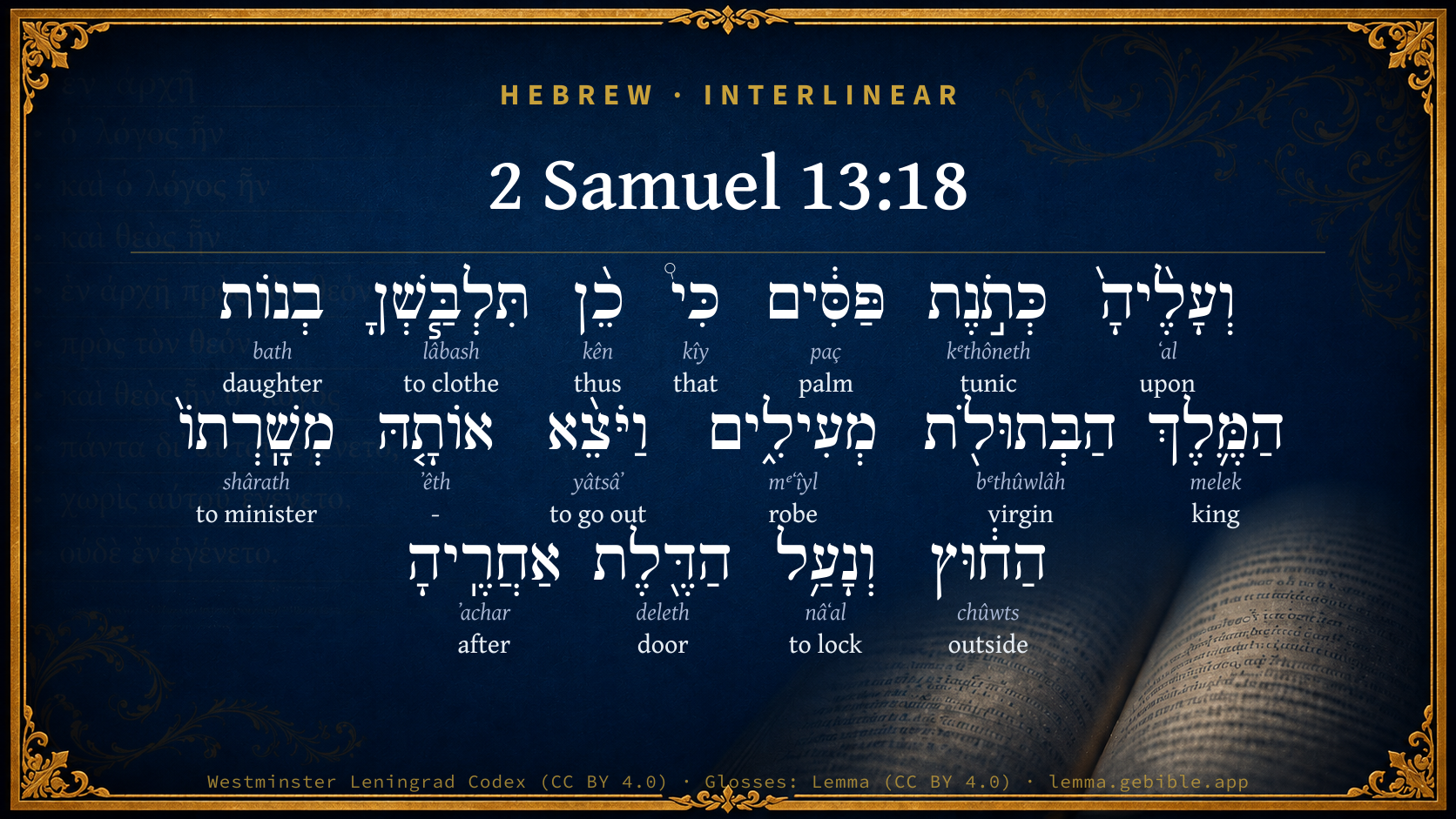
Hebrew (Westminster Leningrad Codex) 2 Samuel 13:18 appears in the Hebrew Old Testament. The text above is from the Westminster Leningrad Codex. Each word links to its Strong’s number, a concise gloss, and parsing drawn from the Open Scriptures Hebrew Bible morphology. Click any word for its full Brown-Driver-Briggs (BDB) entry.
Download image
Cite this verse

2 Samuel 13:18 (World English Bible). Public Domain. Lemma interlinear Bible study tool, https://lemma.gebible.app/v/2-samuel/13/18.

Show BibTeX & RIS
BibTeX
RIS
English Translation
She had a garment of various colors on her; for with such robes were the king's daughters who were virgins dressed. Then his servant brought her out, and bolted the door after her.
World English Bible · Public Domain
Download a study sheet

One document with this verse’s original text, its word-by-word gloss line, the meaning frame, cross-references with their text, attributed commentary, and full source and license credits — printable, and it pastes into notes with its structure intact.

This verse Autodidact and up

Study sheet (.html) Plain text (.txt)

A passage Seminary Student

Up to 50 verses in one chapter. A passage sheet keeps up to 6 commentary sources and 12 cross-references per verse, in the order this page ranks them, and says so on the sheet whenever that leaves anything out. Ask for a single verse and you get the Autodidact verse sheet above.

Everything on this page stays free to read, with no account — the sheet is a download of what is already on screen, not access to it.

Want to remove ads? Support Godless Engineer
Compare translations 3

The same verse in 3 English versions, stacked beneath the original-language interlinear above. Click any original word for its lexicon entry.

Each is an independent rendering of the whole verse — the interlinear is not word-aligned to these translations.

Highlighted words mark where these versions differ — a whole-verse word diff, not a word-by-word alignment.

  • World English Bible Public Domain
    She had a garment of various colors on her; for with such robes were the king's daughters who were virgins dressed. Then his servant brought her out, and bolted the door after her.
  • King James Version Public Domain
    And she had a garment of divers colors upon her: for with such robes were the king's daughters that were virgins apparelled. Then his servant brought her out, and bolted the door after her.
  • unfoldingWord Literal Text CC BY-SA 4.0
    Now a long robe on her, for thus the virgin daughters of the king dressed garments. And the one attending him brought her outside, and he locked the door behind her.

unfoldingWord Literal Text — © unfoldingWord, licensed CC BY-SA 4.0. Word-aligned USFM3 via Door43 (git.door43.org/unfoldingWord/en_ult).

Versions to compare (up to 4)

3 of 4 selected

Show all 18 translations

Every available English version of this verse, each an independent rendering of the whole verse.

  • World English Bible Public Domain
    She had a garment of various colors on her; for with such robes were the king's daughters who were virgins dressed. Then his servant brought her out, and bolted the door after her.
  • Berean Standard Bible Public Domain
    So Amnon’s attendant threw her out and bolted the door behind her. Now Tamar was wearing a robe of many colors, because this is what the king’s virgin daughters wore.
  • Majority Standard Bible Public Domain
    So Amnon’s attendant threw her out and bolted the door behind her. Now Tamar was wearing a robe of many colors, because this is what the king’s virgin daughters wore.
  • King James Version Public Domain
    And she had a garment of divers colors upon her: for with such robes were the king's daughters that were virgins apparelled. Then his servant brought her out, and bolted the door after her.
  • American Standard Version (1901) Public Domain
    And she had a garment of divers colors upon her; for with such robes were the king's daughters that were virgins apparelled. Then his servant brought her out, and bolted the door after her.
  • Revised Version (1885) Public Domain
    And she had a garment of divers colours upon her: for with such robes were the king’s daughters that were virgins apparelled. Then his servant brought her out, and bolted the door after her.
  • Geneva Bible (1599) Public Domain
    (And she had a garment of diuers coulours vpon her: for with such garments were the Kings daughters that were virgins, apparelled) Then his seruant brought her out, and locked the doore after her.
  • Douay-Rheims (1899) Public Domain
    And she was clothed with along robe: for the king's daughters that were virgins, used such kind of garments. Then his servant thrust her out: and shut the door after her.
  • Young's Literal Translation Public Domain
    -- and upon her `is' a long coat, for such upper robes do daughters of the king who `are' virgins put on, -- and his servant taketh her out without, and hath bolted the door after her.
  • Literal Standard Version CC BY-SA 4.0
    And a long coat [is] on her, for such upper robes daughters of the king who [are] virgins put on—and his servant takes her outside, and has bolted the door after her.
  • Unlocked Literal Bible CC BY-SA 4.0
    Then his servant brought her out and bolted the door after her. Tamar was wearing a very decorated robe because the king's daughters who were virgins dressed that way.
  • unfoldingWord Literal Text CC BY-SA 4.0
    Now a long robe on her, for thus the virgin daughters of the king dressed garments. And the one attending him brought her outside, and he locked the door behind her.
  • Darby Bible Public Domain
    Now she had a vest of many colours upon her; for so were the king's daughters that were virgins apparelled. And his attendant brought her out, and bolted the door after her.
  • World Messianic Bible Public Domain
    She had a garment of various colors on her, for the king’s daughters who were virgins dressed in such robes. Then his servant brought her out and bolted the door after her.
  • Webster's Bible Public Domain
    And she had a garment of divers colors upon her: for with such robes were the king's daughters that were virgins appareled. Then his servant brought her out, and bolted the door after her.
  • Free Bible Version CC BY-SA 4.0
    So his servant threw her out and locked the door behind her. Tamar was wearing the long robe of a princess, which is what the king's virgin daughters wore.
  • Bible in Basic English Public Domain
    Now she had on a long robe, such as in past times the king's virgin daughters were dressed in. Then the servant put her out, locking the door after her.
  • JPS Tanakh (1917) Public Domain
    Now she had a garment of many colours upon her; for with such robes were the king's daughters that were virgins apparelled. — And his servant brought her out, and bolted the door after her.

Literal Standard Version (2020), Covenant Press — licensed CC BY-SA 4.0. Text via the HelloAO Bible API (eBible.org). Unlocked Literal Bible (unfoldingWord) — licensed CC BY-SA 4.0. Text via the HelloAO Bible API (eBible.org). unfoldingWord Literal Text — © unfoldingWord, licensed CC BY-SA 4.0. Word-aligned USFM3 via Door43 (git.door43.org/unfoldingWord/en_ult). Free Bible Version, Dr. Jonathan Gallagher — licensed CC BY-SA 4.0. Text via the HelloAO Bible API (eBible.org).

Word by word

More ways to search: Search by grammar → Find every occurrence → Compare this word →

Practice this passage: Drill this verse → Learn its vocabulary →

פַּסִּ֔ים
paç
H6446
“palms”
Noun, Common, Masculine, Plural, Absolute
Part of Speech
Noun
Type
Common
Gender
Masculine
Number
Plural
State
Absolute
Full BDB Definition

Origin: from H6461

TWOT: 1789a

flat (of the hand or foot), palm, sole - of the tunic reaching to palms and soles (figuratively)
  1. וְעָלֶ֨יהָ֙ ʻal H5921 “and · upon · her” Conjunction + Preposition + Suffix, Personal, 3rd Person, Feminine, Singular
  2. כְּתֹ֣נֶת kᵉthôneth H3801 “tunic of” Noun, Common, Feminine, Singular, Construct
  3. כִּי֩ kîy H3588 “that” Conjunction
  4. כֵ֨ן kên H3651 “thus” Adverb
  5. תִּלְבַּ֧שְׁןָ lâbash H3847 “to clothe” Verb, Qal, Imperfect, 3rd Person, Feminine, Plural
  6. בְנוֹת bath H1323 “daughters of” Noun, Common, Feminine, Plural, Construct
  7. הַמֶּ֛לֶךְ melek H4428 “the · king” Particle, Definite Article + Noun, Common, Masculine, Singular, Absolute
  8. הַבְּתוּלֹ֖ת bᵉthûwlâh H1330 “the · virgins” Particle, Definite Article + Noun, Common, Feminine, Plural, Absolute
  9. מְעִילִ֑ים mᵉʻîyl H4598 “robes” Noun, Common, Masculine, Plural, Absolute
  10. וַיֹּצֵ֨א yâtsâʼ H3318 “and · to go out” Conjunction + Verb, Hiphil, Sequential Imperfect, 3rd Person, Masculine, Singular
  11. אוֹתָ֤הּ ʼêth H853 “- · her” Particle, Direct Object + Suffix, Personal, 3rd Person, Feminine, Singular
  12. מְשָֽׁרְתוֹ֙ shârath H8334 “ministering · him” Verb, Piel, Participle Active, Masculine, Singular, Construct + Suffix, Personal, 3rd Person, Masculine, Singular
  13. הַח֔וּץ chûwts H2351 “the · outside” Particle, Definite Article + Noun, Common, Masculine, Singular, Absolute
  14. וְנָעַ֥ל nâʻal H5274 “and · to lock” Conjunction + Verb, Qal, Perfect, 3rd Person, Masculine, Singular
  15. הַדֶּ֖לֶת deleth H1817 “the · door” Particle, Definite Article + Noun, Common, Feminine, Singular, Absolute
  16. אַחֲרֶֽיהָ ʼachar H310 “after · her” Preposition + Suffix, Personal, 3rd Person, Feminine, Singular

About this verse

These counts appear in no published source. They are computed here, from the morphology-tagged text and Lemma’s own curated glosses. What Lemma adds →

17
words
17
distinct lemmas
Historical
section

Notable vocabulary

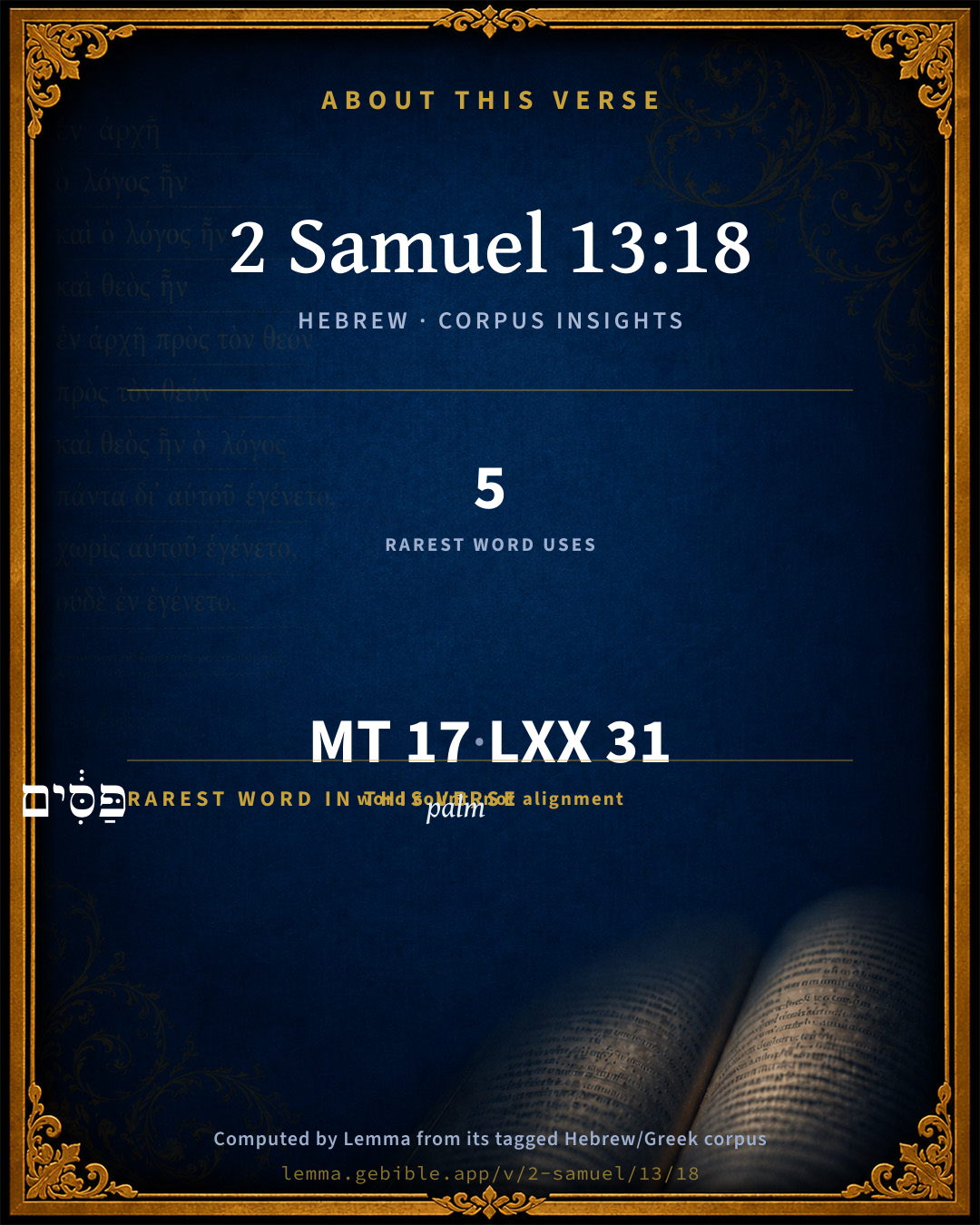
The rarest word here is פַּסִּ֔ים palm H6446 — appearing just 5 times in the whole Hebrew Bible.

Shared distinctive vocabulary

פַּסִּ֔ים palm H6446 occurs in 5 verses of the Hebrew Bible. Also found in:

Grammatical profile

  • 4 verbs
  • 8 nouns
  • 2 prepositions
  • 1 conjunction
  • 1 adverb
  • 1 particle

Verb forms

  • תִּלְבַּ֧שְׁןָ Qal · Imperfect
  • וַיֹּצֵ֨א Hiphil · Sequential Imperfect
  • מְשָֽׁרְתוֹ֙ Piel · Participle Active
  • וְנָעַ֥ל Qal · Perfect

Hebrew & Septuagint length

In English translation the verse runs 33 words from the Hebrew and 33 from the Septuagint (LXX English) — the same length.

A rough comparison of the two English renderings, which tokenize alike — not a word-level alignment.

Word counts can differ between the Hebrew and the Greek without any difference in meaning — e.g. the Hebrew direct-object marker אֵת has no separate Greek word, and Greek often adds the article ὁ.

In the original languages it is 17 Hebrew tokens and 31 Greek tokens — but the two are counted differently (Hebrew bundles its prefixes and suffixes into one token; the Greek is in lemma form), so that isn’t a like-for-like length.

Cross-references

5

Topical passages linked to 2 Samuel 13:18 in the Treasury of Scripture Knowledge — connected by theme and wording, ordered by reader-vote popularity; previews shown in the World English Bible.

  • Genesis 37:3 Now Israel loved Joseph more than all his children, because he was the son of his old age, and he made him a coat of many colors.
  • Judges 5:30 Have they not found, have they not divided the spoil? A lady, two ladies to every man; To Sisera a spoil of dyed garments, A spoil of dyed garments embroidered, Of dyed garments embroidered on both sides, on the necks of the spoil?
  • Genesis 37:23 It happened, when Joseph came to his brothers, that they stripped Joseph of his coat, the coat of many colors that was on him;
  • Genesis 37:32 They took the coat of many colors, and they brought it to their father, and said, "We have found this. Examine it, now, whether it is your son's coat or not."
  • Psalms 45:13–14 The princess inside is all glorious. Her clothing is interwoven with gold.

Cross-references courtesy of OpenBible.info (CC BY 4.0).

Hebrew and Greek witnesses Masoretic Hebrew ↔ Greek Septuagint

The same verse in the two great witnesses to the Old Testament, shown verse-for-verse.

These are two independent witnesses, not word-aligned to each other, and the Septuagint is shown in lemma (dictionary) form.

Hebrew 2 Samuel 13:18 Masoretic · Westminster Leningrad Codex

וְעָלֶ֨יהָ֙ כְּתֹ֣נֶת פַּסִּ֔ים כִּי֩ כֵ֨ן תִּלְבַּ֧שְׁןָ בְנוֹת הַמֶּ֛לֶךְ הַבְּתוּלֹ֖ת מְעִילִ֑ים וַיֹּצֵ֨א אוֹתָ֤הּ מְשָֽׁרְתוֹ֙ הַח֔וּץ וְנָעַ֥ל הַדֶּ֖לֶת אַחֲרֶֽיהָ

She had a garment of various colors on her; for with such robes were the king's daughters who were virgins dressed. Then his servant brought her out, and bolted the door after her.

World English Bible · Public Domain

Greek LXX 2 Samuel 13:18 Septuagint · lemma form

καί ἐπί αὐτός εἰμί χιτών κάρπωμα ὅτι οὕτως δύω ὁ θυγάτηρ ὁ βασιλεύς ὁ παρθένος ὁ ἐπενδύτης αὐτός καί ἐκἄγω αὐτός ὁ λειτουργός αὐτός ἔξω καί ἀποκλείω ὁ θύρα ὀπίσω αὐτός

And she had on her a variegated robe, for so were the king's daughters that were virgins attired in their apparel: and his servant led her forth, and shut the door after her.

LXX2012 (modern English Septuagint) · Public Domain

On this verse, Haydock's Catholic Bible Commentary discusses the Septuagint’s reading. Read the note in Commentary ↓

Hebrew: Westminster Leningrad Codex (CC BY 4.0). Greek: Septuagint (public domain); English from LXX2012 (modern English Septuagint) (Public Domain). How the Septuagint differs from the Hebrew →

Targum (Aramaic paraphrase)

1

The Targum is the ancient Jewish Aramaic paraphrase of the Hebrew Scriptures — an interpretive translation, not the Hebrew text itself. Onkelos (literal) and Pseudo-Jonathan (expansive) render the Torah, and Jonathan the Prophets. Coverage is partial: where no permissively-licensed English translation exists for a verse, only the Aramaic is shown. This is verse-level text, not a word-by-word alignment to the Hebrew.

  1. Targum Jonathan Prophets (Joshua–Malachi)
    וַעֲלָהּ כִּתּוּנָא דְפַסֵי אֲרֵי כֵן לָבְשָׁן בְּנַת מַלְכָּא בְּתוּלָתָא כַּרְדוּטִין וְאַפֵּיק יָתָה מְשׁוּמְשָׁנֵיהּ לְבָרָא וְאַגִיף דָשָׁא בַּתְרָהָא:

    (no public-domain English translation for this verse)

    Targum Jonathan — Aramaic: “Mikraot Gedolot” (public domain). English: “Sefaria Community Translation” (CC0 1.0 (public-domain dedication)); “London "Chaldee Paraphrase," 1871” (public domain). Text via Sefaria.

Commentary

Notes on 2 Samuel 13:18 from classic Christian and Jewish commentators (each source and its license shown beneath its notes). The classic Christian expositions comment on the surrounding passage and are grouped to its opening verse, so a note may address several verses; the Jewish commentaries on the Tanakh (Rashi and others) are per-verse, so they appear only where the commentator wrote on this verse.

Lemma curates 59 commentaries, every one of them public domain or Creative Commons licensed, each selected and text-cleaned for this edition rather than reprinted as found. About our sources →

Trapp's Complete Commentary

John Trapp

2Sa 13:18 And [she had] a garment of divers colours upon her: for with such robes were the king’s daughters [that were] virgins apparelled. Then his servant brought her out, and bolted the door after her.

Ver. 18. A garment of divers colours.] Wrought or embroidered.

For with such robes were the king’s daughters, &c.] So are all God’s children apparelled with the vestis variegata of saving graces {Col 3:12 1Pe 5:5} which maketh them amiable and admirable in the sight of God and all good people.

Then his servant brought her out, &c.] Evil masters are not without evil servants, ready to humour them in anything they command.

John Trapp, A Commentary or Exposition upon All the Books of the Old and New Testament (1647–1656) — public domain. Text from a community e-Sword module.

Joseph Benson's Commentary

2Sa 13:18. She had a garment of divers colours — Of embroidered work. His servant brought her out, &c. — A high contempt of a king’s daughter. But the servant’s dependance on his master overruled all respect due to her. “Tamar thus treated,” says Delaney, “not parted with as an innocent woman, cruelly injured, but thrust out as a prostitute that had seduced to sin, is the strongest image of innocence, barbarously abused, and insufferably insulted, that history affords us; the greatest injury loaded with the greatest indignities! contumely added to cruelty!”

Joseph Benson's Commentary on the Old and New Testaments (1811–1818) — public domain. Text from a community e-Sword module.

Tyndale Open Study Notes

Tyndale Open Resources

13:18 a long, beautiful robe: The same phrase is used to describe Joseph’s robe in Gen 37:3.

Tyndale Open Study Notes — © Tyndale Open Resources, licensed CC BY-SA 4.0. Text via the HelloAO Bible API.

Geneva Bible (1599)

Geneva Bible translators

For that which was of divers colors or pieces, in those days was had in great estimation, Gen. 37:3; Judg. 5:30.

Geneva Bible (1599) marginal notes — public domain. Text via Bolls.life.

Jamieson, Fausset & Brown

Robert Jamieson, A. R. Fausset & David Brown

garment of divers colours--As embroidery in ancient times was the occupation or pastime of ladies of the highest rank, the possession of these parti-colored garments was a mark of distinction; they were worn exclusively by young women of royal condition. Since the art of manufacturing cloth stuffs has made so great progress, dresses of this variegated description are now more common in the East.

Jamieson, Fausset & Brown — Commentary Critical and Explanatory on the Whole Bible (1871) — public domain (CC PDM 1.0). Text via the HelloAO Bible API.

Adam Clarke's Commentary

Verse 18. A garment of divers colours] See Clarke on Ge 37:3, where the same words occur.

Adam Clarke's Commentary on the Bible (1810–1826) — public domain. Text from a community e-Sword/MySword module.

Ellicott's Commentary for English Readers

(18) A garment of divers colours.—The word is used only here and in connection with Joseph (Gen_37:3; Gen_37:23; Gen_37:32), and is supposed to mean a tunic with long sleeves, in distinction from those with short sleeves commonly worn. The fact is mentioned to show that Tamar must have been recognised as a royal virgin by Amnon’s servant, as well as by everyone else.

A Bible Commentary for English Readers, edited by Charles John Ellicott (1878–1897) — public domain. Text from a community e-Sword module.

The Cambridge Bible for Schools and Colleges

gen. ed. J. J. S. Perowne

18. a garment of divers colours] The expression is used elsewhere only of Joseph’s “coat of many colours” (Gen_37:3; Gen_37:23), and probably means a long tunic with sleeves, worn, it would seem, as an outer garment in place of the usual mantle. The fact of her wearing this distinctive dress is mentioned, to shew that the servant and the people who met her in the street would at once recognise who she was.

The Cambridge Bible for Schools and Colleges (gen. ed. J. J. S. Perowne; Cambridge University Press, 1878–1918) — public domain. Text from a community e-Sword module.

John Gill's Exposition

And she had a garment of divers colours upon her,.... Of embroidered work, which made her the more observable, and her shame the more manifest. Whether this was interwoven with threads of various colours, or embroidered with figures of flowers, animals, &c. and wrought with the needle, or was painted with different colours, or made up of pieces of various colours, is not certain. See Gill on Gen 37:3; but according to Braunius (c) it was neither, and so the coat of Joseph, but was a garment with sleeves, reaching down to the ankles, and pieced at the borders with fringe; and, indeed, garments of flowers and various colours were such as in other nations, as in Athens, harlots wore (d) and not virgins, as follows:

for with such robes were the king's daughters that were virgins apparelled; which they wore to distinguish them both from common people, and from married persons of the same quality:

then the servants brought her out, and bolted the door after her; laid hold on her, and brought her out by main force; thrust her out of doors, and turned the key upon her.

(c) De Vest. Sacerdot. Heb. l. 1. c. 17. sect. 21. (d) Suidas in voce

John Gill's Exposition of the Whole Bible (1746–1763) — public domain (CC PDM 1.0). Text via the HelloAO Bible API.

Albert Barnes' Notes on the Bible

A garment of divers colors - See Gen 37:3. Some prefer here (and there) “a tunic with sleeves,” a tunic reaching to the extremities, i. e. the hands and feet, and worn over the common tunic, in room of a robe.

Albert Barnes' Notes on the Bible (1834–1885) — public domain. Text from a community e-Sword/MySword module.

Haydock's Catholic Bible Commentary

Robe. Hebrew passim; long and variegated, like Joseph’s, Genesis xxxvii. 3. The Septuagint call it, Greek: karpotos, to insinuate that it was "adorned with fruits," &c. (Haydock)

George Leo Haydock (1774–1849), Haydock's Catholic Family Bible and Commentary, 1859 edition — public domain. Excludes Psalms (Douay-Rheims chapter numbering differs from Protestant) and Deuterocanonical books (Catholic canon only).

Matthew Poole's English Annotations

Of divers colours; of embroidered work. Compare Gen 37:3.

Matthew Poole's English Annotations on the Holy Bible (1683–1685) — public domain. Text from a community e-Sword/MySword module.

Whedon's Commentary on the Bible

Daniel D. Whedon

18. A garment of divers colours — A loose outer garment reaching down to the ankles and covering the arms, for such the original word, פסים, seems to indicate; and Josephus says, “The virgins of old time wore such loose coats tied at the hands, and let down to the ankles, that the inner coats might not be seen.” But even this robe of royalty protected her not from shameful abuse.

Daniel D. Whedon (gen. ed.), Commentary on the Old and New Testaments (1874–1909) — public domain. Text from a community e-Sword module.

The Pulpit Commentary

A garment of divers colours. This was probably a long tunic with sleeves, so woven as for the colours to form patterns like those of the Scottish tartans. (see on Gen_37:3) The next sentence is probably a note, which has crept from the margin into the text, and which literally is, "For so king"s daughters, while unmarried, wore over mantles". (me"ils; see note on 1Sa_2:19) Both the Authorized Version and the Revised Version so render as if the coloured chetoneth and the me"il were the same; but the meaning of the note rather is to guard against the supposition that the princess, while wearing the close-fitting long tunic with sleeves, had dispensed with the comely mantle. It is, indeed, possible that, while busy in cooking, she had laid the me"il by, and now rushed away without it. But it was the tunic with its bright colours which made both Amnon"s servitor and also the people aware that she was one of the king"s daughters.

The Pulpit Commentary (1880–1919), ed. H.D.M. Spence-Jones & Joseph S. Exell — public domain. Text from a community e-Sword module.

John Wesley's Explanatory Notes

Garment - Of embroidered work.

John Wesley, Explanatory Notes Upon the Whole Bible (1754–1765) — public domain. Text via the GEBible commentary corpus.

unfoldingWord translationNotes

Door43 World Missions Community

bolted the door after her

This means to lock the door so that she will not be able to come back in again. AT: "locked the door so that she could not go back in" (See: Assumed Knowledge and Implicit Information)

put ashes on her head and tore her robe. She put her hands on her head

These are acts of mourning and grief in the Israelite culture. AT: "put ashes on her head and tore her robe to show that she was very sad. Then to show her grief, she put her hands on her head" (See: Symbolic Action)

translationWords

robe

unfoldingWord translationNotes — © Distant Shores Media and the Door43 World Missions Community, licensed CC BY-SA 4.0. Source: git.door43.org/Door43/en_tn.

Lesson kit

Teaching starters — assembled from the data on this page, not authored interpretation. Every prompt links to the verse data it draws on. Edit before teaching.

2 Samuel, in the Historical, opens this verse with 17 words (17 distinct Hebrew lemmas). Its most distinctive word is paç (“palm”). A historical commentator’s framing appears above. Read the whole chapter for the surrounding context.

Discussion questions

  1. What does “palm” (paç) contribute to the verse as a whole?
  2. Genesis 37:3 shares the word «palm» with this verse. How do the two illuminate each other?
  3. The translations on this page render this verse differently — a whole-verse word diff, not a word-by-word alignment. What might account for the different wordings?
  4. The verb «תִּלְבַּ֧שְׁןָ» is Qal Imperfect. How does its form color the action?
  5. Reading how Trapp's Complete Commentary and Joseph Benson's Commentary read this verse, where do the two commentators agree and where do they part?

Things to notice

Reading settings

Reading text

Shown beneath each verse's original-language words.

Old Testament
Old Testament edition

Read the OT as the Masoretic Hebrew (MT) or the Greek Septuagint (LXX).

English shown for the Greek Septuagint (in the Hebrew ↔ Greek comparison).

Comparing translations? Open the Compare panel on any verse page to stack up to four side by side.