Leviticus 4:21

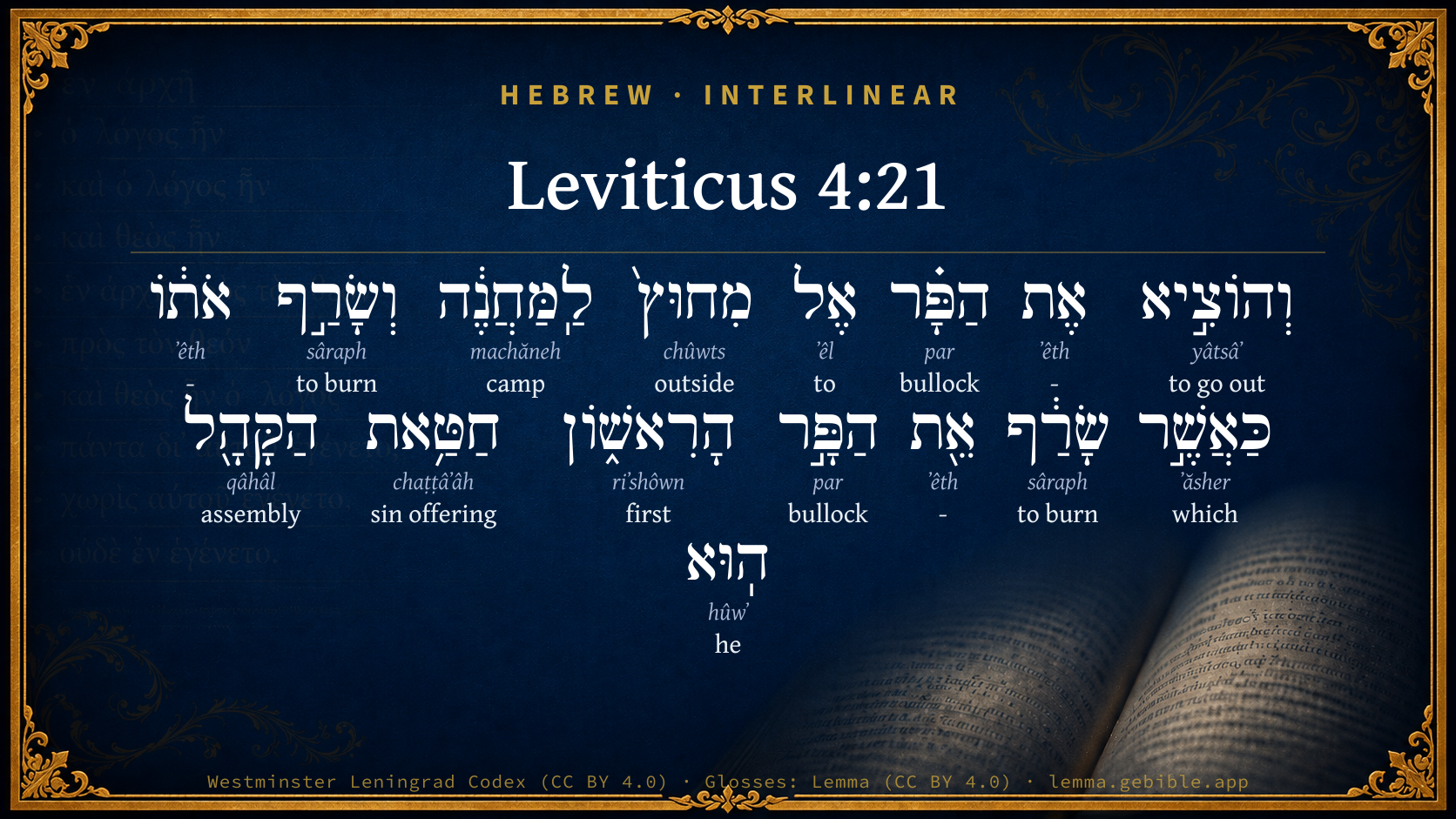
Hebrew (Westminster Leningrad Codex) Leviticus 4:21 appears in the Hebrew Old Testament. The text above is from the Westminster Leningrad Codex. Each word links to its Strong’s number, a concise gloss, and parsing drawn from the Open Scriptures Hebrew Bible morphology. Click any word for its full Brown-Driver-Briggs (BDB) entry.
Download image
Cite this verse

Leviticus 4:21 (World English Bible). Public Domain. Lemma interlinear Bible study tool, https://lemma.gebible.app/v/leviticus/4/21.

Show BibTeX & RIS
BibTeX
RIS
English Translation
He shall carry forth the bull outside the camp, and burn it as he burned the first bull. It is the sin offering for the assembly.
World English Bible · Public Domain
Download a study sheet

One document with this verse’s original text, its word-by-word gloss line, the meaning frame, cross-references with their text, attributed commentary, and full source and license credits — printable, and it pastes into notes with its structure intact.

This verse Autodidact and up

Study sheet (.html) Plain text (.txt)

A passage Seminary Student

Up to 50 verses in one chapter. A passage sheet keeps up to 6 commentary sources and 12 cross-references per verse, in the order this page ranks them, and says so on the sheet whenever that leaves anything out. Ask for a single verse and you get the Autodidact verse sheet above.

Everything on this page stays free to read, with no account — the sheet is a download of what is already on screen, not access to it.

Want to remove ads? Support Godless Engineer
Compare translations 3

The same verse in 3 English versions, stacked beneath the original-language interlinear above. Click any original word for its lexicon entry.

Each is an independent rendering of the whole verse — the interlinear is not word-aligned to these translations.

Highlighted words mark where these versions differ — a whole-verse word diff, not a word-by-word alignment.

  • World English Bible Public Domain
    He shall carry forth the bull outside the camp, and burn it as he burned the first bull. It is the sin offering for the assembly.
  • King James Version Public Domain
    And he shall carry forth the bullock without the camp, and burn him as he burned the first bullock: it is a sin offering for the congregation.
  • unfoldingWord Literal Text CC BY-SA 4.0
    And he shall bring out the bull to on the outside of the camp and he shall burn it just as he burned the first bull. It the sin offering of the assembly.

unfoldingWord Literal Text — © unfoldingWord, licensed CC BY-SA 4.0. Word-aligned USFM3 via Door43 (git.door43.org/unfoldingWord/en_ult).

Versions to compare (up to 4)

3 of 4 selected

Show all 18 translations

Every available English version of this verse, each an independent rendering of the whole verse.

  • World English Bible Public Domain
    He shall carry forth the bull outside the camp, and burn it as he burned the first bull. It is the sin offering for the assembly.
  • Berean Standard Bible Public Domain
    Then he is to take the bull outside the camp and burn it, just as he burned the first bull. It is the sin offering for the assembly.
  • Majority Standard Bible Public Domain
    Then he is to take the bull outside the camp and burn it, just as he burned the first bull. It is the sin offering for the assembly.
  • King James Version Public Domain
    And he shall carry forth the bullock without the camp, and burn him as he burned the first bullock: it is a sin offering for the congregation.
  • American Standard Version (1901) Public Domain
    And he shall carry forth the bullock without the camp, and burn it as he burned the first bullock: it is the sin-offering for the assembly.
  • Revised Version (1885) Public Domain
    And he shall carry forth the bullock without the camp, and burn it as he burned the first bullock: it is the sin offering for the assembly.
  • Geneva Bible (1599) Public Domain
    For he shall carie the bullocke without the hoste, and burne him as he burned the first bullock: for it is an offring for the sinne of the Congregation.
  • Douay-Rheims (1899) Public Domain
    But the calf itself he shall carry forth without the camp, and shall burn it as he did the former calf: because it is for the sin of the multitude.
  • Young's Literal Translation Public Domain
    and he hath brought out the bullock unto the outside of the camp, and hath burned it as he hath burned the first bullock; it `is' a sin-offering of the assembly.
  • Literal Standard Version CC BY-SA 4.0
    and he has brought out the bullock to the outside of the camp, and has burned it as he has burned the first bullock; it [is] a sin-offering of the assembly.
  • Unlocked Literal Bible CC BY-SA 4.0
    He will carry the bull outside the camp and burn it as he burned the first bull. This is the sin offering for the assembly.
  • unfoldingWord Literal Text CC BY-SA 4.0
    And he shall bring out the bull to on the outside of the camp and he shall burn it just as he burned the first bull. It the sin offering of the assembly.
  • Darby Bible Public Domain
    And he shall carry forth the bullock outside the camp, and burn it as he burned the first bullock: it is a sin-offering of the congregation.
  • World Messianic Bible Public Domain
    He shall carry the bull outside the camp, and burn it as he burned the first bull. It is the sin offering for the assembly.
  • Webster's Bible Public Domain
    And he shall carry forth the bullock without the camp, and burn him as he burned the first bullock: it is a sin-offering for the congregation.
  • Free Bible Version CC BY-SA 4.0
    Then he shall take the bull outside the camp and burn it, just as he burned the bull previously mentioned. It is the sin offering for the whole community.
  • Bible in Basic English Public Domain
    Then let the ox be taken away outside the tent-circle, that it may be burned as the other ox was burned; it is the sin-offering for all the people.
  • JPS Tanakh (1917) Public Domain
    And he shall carry forth the bullock without the camp, and burn it as he burned the first bullock; it is the sin-offering for the assembly.

Literal Standard Version (2020), Covenant Press — licensed CC BY-SA 4.0. Text via the HelloAO Bible API (eBible.org). Unlocked Literal Bible (unfoldingWord) — licensed CC BY-SA 4.0. Text via the HelloAO Bible API (eBible.org). unfoldingWord Literal Text — © unfoldingWord, licensed CC BY-SA 4.0. Word-aligned USFM3 via Door43 (git.door43.org/unfoldingWord/en_ult). Free Bible Version, Dr. Jonathan Gallagher — licensed CC BY-SA 4.0. Text via the HelloAO Bible API (eBible.org).

Word by word

More ways to search: Search by grammar → Find every occurrence → Compare this word →

Practice this passage: Drill this verse → Learn its vocabulary →

וְשָׂרַ֣ף
sâraph
H8313
“and · to burn”
Conjunction + Verb, Qal, Sequential Perfect, 3rd Person, Masculine, Singular
Part of Speech
Conjunction + Verb
Stem
Qal
Form
Sequential Perfect
Person
3rd Person
Gender
Masculine
Number
Singular
Full BDB Definition

Origin: a primitive root

TWOT: 2292

to burn - (Qal) to burn - (Niphal) to be burned - (Piel) burner, burning (participle) - (Pual) to be burnt up, be burned
  1. וְהוֹצִ֣יא yâtsâʼ H3318 “and · to go out” Conjunction + Verb, Hiphil, Sequential Perfect, 3rd Person, Masculine, Singular
  2. אֶת ʼêth H853 “-” Particle, Direct Object
  3. הַפָּ֗ר par H6499 “the · bullock” Particle, Definite Article + Noun, Common, Masculine, Singular, Absolute
  4. אֶל ʼêl H413 “to” Preposition
  5. מִחוּץ֙ chûwts H2351 “from · outside” Preposition + Noun, Common, Masculine, Singular, Absolute
  6. לַֽמַּחֲנֶ֔ה machăneh H4264 “to/for the · camp” Preposition, Determined + Noun, Common, Both, Singular, Absolute
  7. אֹת֔וֹ ʼêth H853 “- · him” Particle, Direct Object + Suffix, Personal, 3rd Person, Masculine, Singular
  8. כַּאֲשֶׁ֣ר ʼăsher H834 “like/as · which” Preposition + Particle, Relative
  9. שָׂרַ֔ף sâraph H8313 “to burn” Verb, Qal, Perfect, 3rd Person, Masculine, Singular
  10. אֵ֖ת ʼêth H853 “-” Particle, Direct Object
  11. הַפָּ֣ר par H6499 “the · bullock” Particle, Definite Article + Noun, Common, Masculine, Singular, Absolute
  12. הָרִאשׁ֑וֹן riʼshôwn H7223 “the · first” Particle, Definite Article + Adjective, Adjective, Masculine, Singular, Absolute
  13. חַטַּ֥את chaṭṭâʼâh H2403 “sin offering of” Noun, Common, Feminine, Singular, Construct
  14. הַקָּהָ֖ל qâhâl H6951 “the · assembly” Particle, Definite Article + Noun, Common, Masculine, Singular, Absolute
  15. הֽוּא hûwʼ H1931 “he” Pronoun, Personal, 3rd Person, Masculine, Singular

About this verse

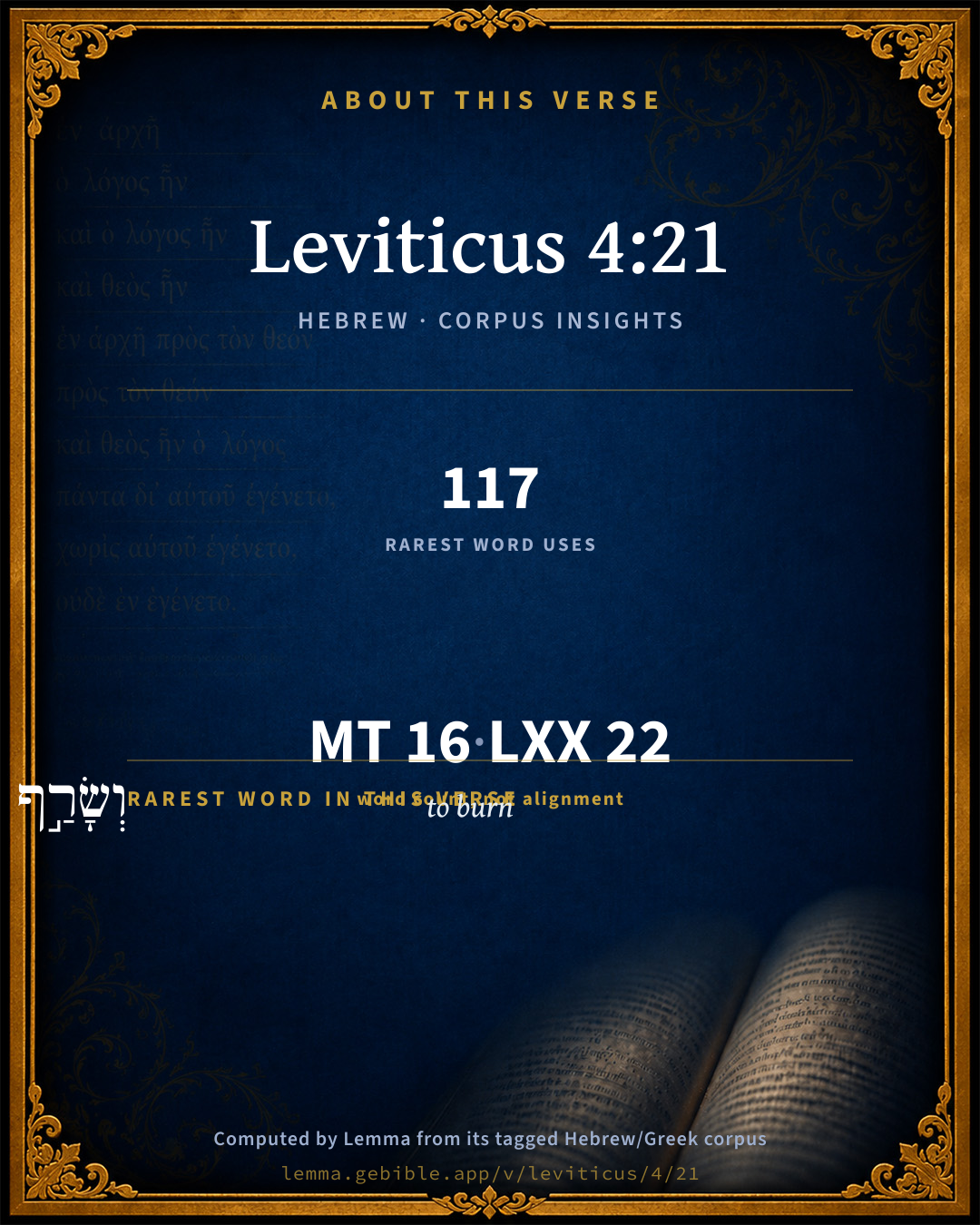
These counts appear in no published source. They are computed here, from the morphology-tagged text and Lemma’s own curated glosses. What Lemma adds →

16
words
12
distinct lemmas
Pentateuch
section

Grammatical profile

  • 3 verbs
  • 6 nouns
  • 1 adjective
  • 1 pronoun
  • 1 preposition
  • 4 particles

Verb forms

  • וְהוֹצִ֣יא Hiphil · Sequential Perfect
  • וְשָׂרַ֣ף Qal · Sequential Perfect
  • שָׂרַ֔ף Qal · Perfect

Repetition

Words recur within this verse — often emphatic in Hebrew:

  • הַפָּ֗ר bullock H6499 ×2
  • וְשָׂרַ֣ף to burn H8313 ×2

Hebrew & Septuagint length

In English translation the verse runs 26 words from the Hebrew and 30 from the Septuagint (LXX English) — closely comparable.

A rough comparison of the two English renderings, which tokenize alike — not a word-level alignment.

Word counts can differ between the Hebrew and the Greek without any difference in meaning — e.g. the Hebrew direct-object marker אֵת has no separate Greek word, and Greek often adds the article ὁ.

In the original languages it is 16 Hebrew tokens and 22 Greek tokens — but the two are counted differently (Hebrew bundles its prefixes and suffixes into one token; the Greek is in lemma form), so that isn’t a like-for-like length.

Cross-references

8

Topical passages linked to Leviticus 4:21 in the Treasury of Scripture Knowledge — connected by theme and wording, ordered by reader-vote popularity; previews shown in the World English Bible.

  • Leviticus 16:15 "Then he shall kill the goat of the sin offering, that is for the people, and bring his blood within the veil, and do with his blood as he did with the blood of the bull, and sprinkle it on the mercy seat, and before the mercy seat:
  • Leviticus 4:11–12 The bull's skin, all its flesh, with its head, and with its legs, its innards, and its dung,
  • Leviticus 16:21 Aaron shall lay both his hands on the head of the live goat, and confess over him all the iniquities of the children of Israel, and all their transgressions, even all their sins; and he shall put them on the head of the goat, and shall send him away into the wilderness by the hand of a man who is in readiness.
  • 2 Chronicles 29:21–24 They brought seven bulls, and seven rams, and seven lambs, and seven male goats, for a sin-offering for the kingdom and for the sanctuary and for Judah. He commanded the priests the sons of Aaron to offer them on the altar of Yahweh.
  • Ezra 8:35 The children of the captivity, who had come out of exile, offered burnt offerings to the God of Israel, twelve bulls for all Israel, ninety-six rams, seventy-seven lambs, and twelve male goats for a sin-offering: all this was a burnt offering to Yahweh.
  • Matthew 20:28 even as the Son of Man came not to be served, but to serve, and to give his life as a ransom for many."
  • 2 Corinthians 5:21 For him who knew no sin he made to be sin on our behalf; so that in him we might become the righteousness of God.
  • 1 Timothy 2:5–6 For there is one God, and one mediator between God and men, the man Christ Jesus,

Cross-references courtesy of OpenBible.info (CC BY 4.0).

Hebrew and Greek witnesses Masoretic Hebrew ↔ Greek Septuagint

The same verse in the two great witnesses to the Old Testament, shown verse-for-verse.

These are two independent witnesses, not word-aligned to each other, and the Septuagint is shown in lemma (dictionary) form.

Hebrew Leviticus 4:21 Masoretic · Westminster Leningrad Codex

וְהוֹצִ֣יא אֶת הַפָּ֗ר אֶל מִחוּץ֙ לַֽמַּחֲנֶ֔ה וְשָׂרַ֣ף אֹת֔וֹ כַּאֲשֶׁ֣ר שָׂרַ֔ף אֵ֖ת הַפָּ֣ר הָרִאשׁ֑וֹן חַטַּ֥את הַקָּהָ֖ל הֽוּא

He shall carry forth the bull outside the camp, and burn it as he burned the first bull. It is the sin offering for the assembly.

World English Bible · Public Domain

Greek LXX Leviticus 4:21 Septuagint · lemma form

καί ἐκφέρω ὁ μόσχος ὅλος ἔξω ὁ παρεμβολή καί κατακαίω ὁ μόσχος ὅς τρόπος κατακαίω ὁ μόσχος ὁ πρότερος ἁμαρτία συναγωγή εἰμί

And they shall carry forth the calf whole without the camp, and they shall burn the calf as they burnt the former calf: it is the sin-offering of the congregation.

LXX2012 (modern English Septuagint) · Public Domain

Hebrew: Westminster Leningrad Codex (CC BY 4.0). Greek: Septuagint (public domain); English from LXX2012 (modern English Septuagint) (Public Domain). How the Septuagint differs from the Hebrew →

Targum (Aramaic paraphrase)

2

The Targum is the ancient Jewish Aramaic paraphrase of the Hebrew Scriptures — an interpretive translation, not the Hebrew text itself. Onkelos (literal) and Pseudo-Jonathan (expansive) render the Torah, and Jonathan the Prophets. Coverage is partial: where no permissively-licensed English translation exists for a verse, only the Aramaic is shown. This is verse-level text, not a word-by-word alignment to the Hebrew.

  1. Targum Onkelos Torah (Genesis–Deuteronomy)
    וְיַפֵּק יָת תּוֹרָא לְמִבָּרָא לְמַשְׁרִיתָא וְאוֹקִיד יָתֵהּ כְּמָא דִי אוֹקִיד יָת תּוֹרָא קַדְמָאָה חַטַאת קְהָלָא הוּא

    (no public-domain English translation for this verse)

    Targum Onkelos — Aramaic: “Onkelos Genesis” (public domain); “Onkelos Exodus” (public domain); “Onkelos Leviticus” (public domain); “Onkelos Numbers” (public domain); “Onkelos Deuteronomy” (public domain). English: “Sefaria Community Translation” (CC0 1.0 (public-domain dedication)); “J.W. Etheridge. The Targums of Onkelos and Jonathan Ben Uzziel on the Pentateuch. London: Longmans, Green, 1862” (public domain). Text via Sefaria.

  2. Targum Pseudo-Jonathan Torah (Genesis–Deuteronomy)
    וְיִפּוֹק יַת תּוֹרָא לְמִבָּרָא לְמַשְׁרִיתָא וְיוֹקֵד יָתֵיהּ הֵיכְמָא דְאוֹקֵד יַת תּוֹרָא קַדְמָאָה דְכַהֲנָא רַבָּא מִטוּל דְיִשְׁתְּבוֹק חוֹבִין דְיִשְרָאֵל בֵּיהּ וּבְרַם חַטָאת קְהָלָא הוּא

    And the bullock shall be carried forth without the camp and be burned, as the former bullock of the high priest was burned, that through it the sin of Israel may be forgiven. It is a sin offering for the congregation.

    Targum Pseudo-Jonathan — Aramaic: “Targum Jonathan on Genesis” (public domain); “Targum Jonathan on Exodus” (public domain); “Targum Jonathan on Leviticus” (public domain); “Targum Jonathan on Numbers” (public domain); “Targum Jonathan on Deuteronomy” (public domain). English: “The Targum of Jonathan ben Uzziel, trans. J. W. Etheridge, London, 1862” (public domain). Text via Sefaria.

Commentary

Notes on Leviticus 4:21 from classic Christian and Jewish commentators (each source and its license shown beneath its notes). The classic Christian expositions comment on the surrounding passage and are grouped to its opening verse, so a note may address several verses; the Jewish commentaries on the Tanakh (Rashi and others) are per-verse, so they appear only where the commentator wrote on this verse.

Lemma curates 59 commentaries, every one of them public domain or Creative Commons licensed, each selected and text-cleaned for this edition rather than reprinted as found. About our sources →

Trapp's Complete Commentary

John Trapp

Lev 4:21 And he shall carry forth the bullock without the camp, and burn him as he burned the first bullock: it [is] a sin offering for the congregation.

Ver. 21. Without the camp.] Pointing to Christ, who carried our sins out of God’s sight. See Heb 13:12. {See Trapp on "Heb 13:12"}

John Trapp, A Commentary or Exposition upon All the Books of the Old and New Testament (1647–1656) — public domain. Text from a community e-Sword module.

Lesson kit

Teaching starters — assembled from the data on this page, not authored interpretation. Every prompt links to the verse data it draws on. Edit before teaching.

Leviticus, in the Pentateuch, opens this verse with 16 words (12 distinct Hebrew lemmas). Its most distinctive word is sâraph (“to burn”). Read the whole chapter for the surrounding context.

Discussion questions

  1. The word sâraph carries the sense “to burn.” How does it shape the verse?
  2. How does Leviticus 16:15, which shares this passage’s theme, read alongside this verse?
  3. What does the repetition of “bullock” (2× in this one verse) do in this verse?
  4. These translations render this verse differently; the difference is in the English rendering, not the original. What questions does that raise?
  5. «וְהוֹצִ֣יא» is a Hiphil Sequential Perfect verb. How does that grammatical form shape the action described?

Things to notice

Reading settings

Reading text

Shown beneath each verse's original-language words.

Old Testament
Old Testament edition

Read the OT as the Masoretic Hebrew (MT) or the Greek Septuagint (LXX).

English shown for the Greek Septuagint (in the Hebrew ↔ Greek comparison).

Comparing translations? Open the Compare panel on any verse page to stack up to four side by side.