Lamentations 4:5

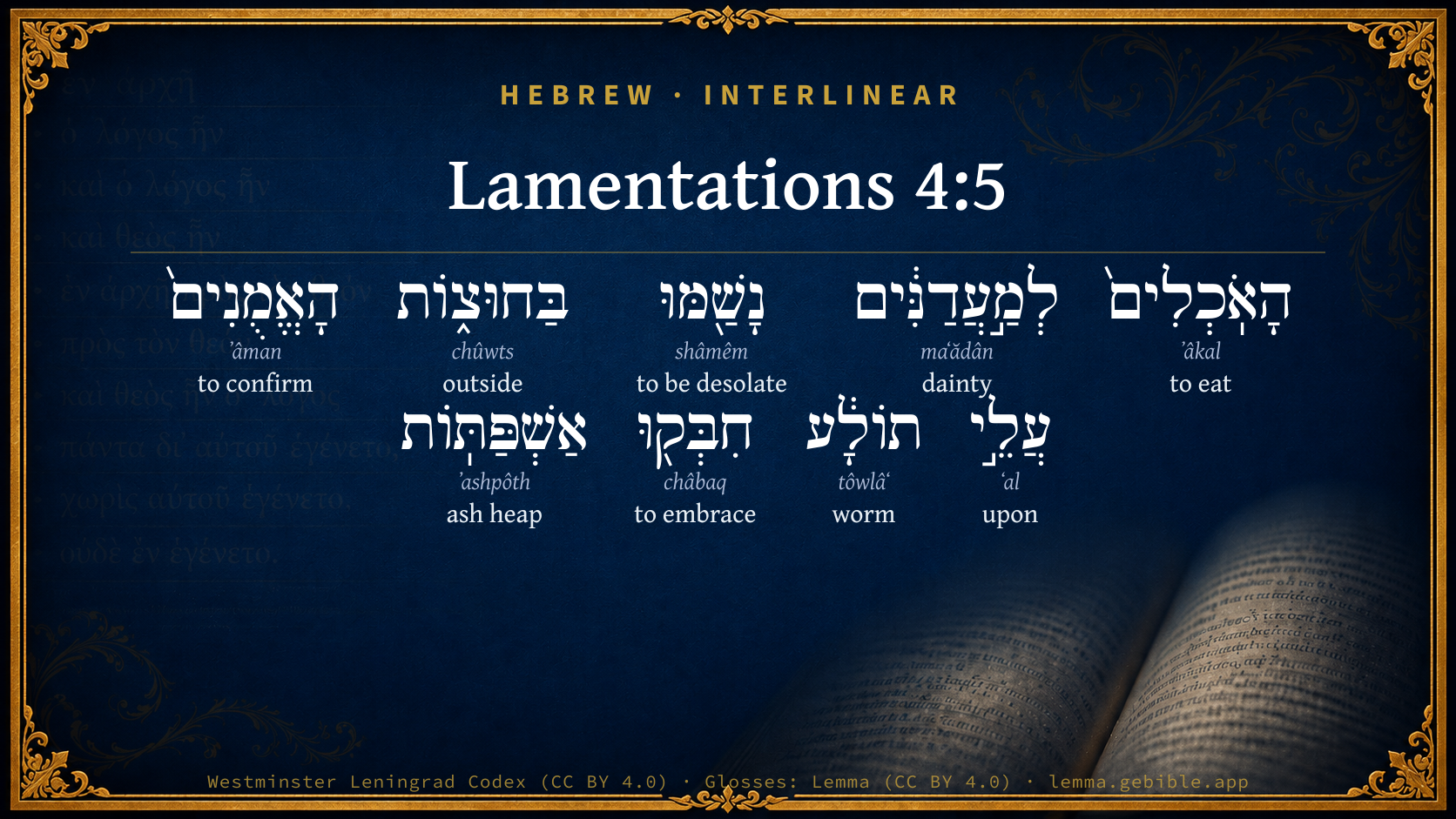
Hebrew (Westminster Leningrad Codex) Lamentations 4:5 appears in the Hebrew Old Testament. The text above is from the Westminster Leningrad Codex. Each word links to its Strong’s number, a concise gloss, and parsing drawn from the Open Scriptures Hebrew Bible morphology. Click any word for its full Brown-Driver-Briggs (BDB) entry.
Download image
Cite this verse

Lamentations 4:5 (World English Bible). Public Domain. Lemma interlinear Bible study tool, https://lemma.gebible.app/v/lamentations/4/5.

Show BibTeX & RIS
BibTeX
RIS
English Translation
Those who did feed delicately are desolate in the streets: Those who were brought up in scarlet embrace dunghills.
World English Bible · Public Domain
Download a study sheet

One document with this verse’s original text, its word-by-word gloss line, the meaning frame, cross-references with their text, attributed commentary, and full source and license credits — printable, and it pastes into notes with its structure intact.

This verse Autodidact and up

Study sheet (.html) Plain text (.txt)

A passage Seminary Student

Up to 50 verses in one chapter. A passage sheet keeps up to 6 commentary sources and 12 cross-references per verse, in the order this page ranks them, and says so on the sheet whenever that leaves anything out. Ask for a single verse and you get the Autodidact verse sheet above.

Everything on this page stays free to read, with no account — the sheet is a download of what is already on screen, not access to it.

Want to remove ads? Support Godless Engineer
Compare translations 3

The same verse in 3 English versions, stacked beneath the original-language interlinear above. Click any original word for its lexicon entry.

Each is an independent rendering of the whole verse — the interlinear is not word-aligned to these translations.

Highlighted words mark where these versions differ — a whole-verse word diff, not a word-by-word alignment.

  • World English Bible Public Domain
    Those who did feed delicately are desolate in the streets: Those who were brought up in scarlet embrace dunghills.
  • King James Version Public Domain
    They that did feed delicately are desolate in the streets: they that were brought up in scarlet embrace dunghills.
  • unfoldingWord Literal Text CC BY-SA 4.0
    The ones eating delicacies are desolate in the streets. The ones reared on scarlet embrace garbage heaps. WAW

unfoldingWord Literal Text — © unfoldingWord, licensed CC BY-SA 4.0. Word-aligned USFM3 via Door43 (git.door43.org/unfoldingWord/en_ult).

Versions to compare (up to 4)

3 of 4 selected

Show all 18 translations

Every available English version of this verse, each an independent rendering of the whole verse.

  • World English Bible Public Domain
    Those who did feed delicately are desolate in the streets: Those who were brought up in scarlet embrace dunghills.
  • Berean Standard Bible Public Domain
    Those who once ate delicacies are destitute in the streets; those brought up in crimson huddle in ash heaps.
  • Majority Standard Bible Public Domain
    Those who once ate delicacies are destitute in the streets; those brought up in crimson huddle in ash heaps.
  • King James Version Public Domain
    They that did feed delicately are desolate in the streets: they that were brought up in scarlet embrace dunghills.
  • American Standard Version (1901) Public Domain
    They that did feed delicately are desolate in the streets: They that were brought up in scarlet embrace dunghills.
  • Revised Version (1885) Public Domain
    They that did feed delicately are desolate in the streets: they that were brought up in scarlet embrace dung-hills.
  • Geneva Bible (1599) Public Domain
    They that did feede delicately, perish in the streetes: they that were brought vp in skarlet, embrace the dongue.
  • Douay-Rheims (1899) Public Domain
    He. They that were fed delicately have died in the streets; they that were brought up in scarlet have embraced the dung.
  • Young's Literal Translation Public Domain
    Those eating of dainties have been desolate in out-places, Those supported on scarlet have embraced dunghills.
  • Literal Standard Version CC BY-SA 4.0
    Those eating of delicacies have been desolate in out-places, || Those supported on scarlet have embraced dunghills.
  • Unlocked Literal Bible CC BY-SA 4.0
    Those who used to feast on the finest food now starve in the streets. Those who were brought up wearing scarlet clothing now lie on piles of ashes.
  • unfoldingWord Literal Text CC BY-SA 4.0
    The ones eating delicacies are desolate in the streets. The ones reared on scarlet embrace garbage heaps. WAW
  • Darby Bible Public Domain
    They that fed delicately are desolate in the streets; they that were brought up in scarlet embrace dung-hills.
  • World Messianic Bible Public Domain
    Those who ate delicacies are desolate in the streets. Those who were brought up in purple embrace dunghills.
  • Webster's Bible Public Domain
    They that fed delicately are desolate in the streets: they that were brought up in scarlet embrace dunghills.
  • Free Bible Version CC BY-SA 4.0
    Those who used to eat gourmet food now die starving in the streets. Those who dressed in fine clothes from their childhood now live in heaps of rubbish.
  • Bible in Basic English Public Domain
    Those who were used to feasting on delicate food are wasted in the streets: those who as children were dressed in purple are stretched out on the dust.
  • JPS Tanakh (1917) Public Domain
    They that did feed on dainties are desolate in the streets; they that were brought up in scarlet embrace dunghills.

Literal Standard Version (2020), Covenant Press — licensed CC BY-SA 4.0. Text via the HelloAO Bible API (eBible.org). Unlocked Literal Bible (unfoldingWord) — licensed CC BY-SA 4.0. Text via the HelloAO Bible API (eBible.org). unfoldingWord Literal Text — © unfoldingWord, licensed CC BY-SA 4.0. Word-aligned USFM3 via Door43 (git.door43.org/unfoldingWord/en_ult). Free Bible Version, Dr. Jonathan Gallagher — licensed CC BY-SA 4.0. Text via the HelloAO Bible API (eBible.org).

Word by word

More ways to search: Search by grammar → Find every occurrence → Compare this word →

Practice this passage: Drill this verse → Learn its vocabulary →

לְמַ֣עֲדַנִּ֔ים
maʻădân
H4574
“to/for · dainties”
Preposition + Noun, Common, Both, Plural, Absolute
Part of Speech
Preposition + Noun
Type
Common
Gender
Both
Number
Plural
State
Absolute
Full BDB Definition

Origin: from H5727

TWOT: 1567d

dainty (food), delight
  1. הָאֹֽכְלִים֙ ʼâkal H398 “the · eating” Particle, Definite Article + Verb, Qal, Participle Active, Masculine, Plural, Absolute
  2. נָשַׁ֖מּוּ shâmêm H8074 “to be desolate” Verb, Niphal, Perfect, 3rd Person, Common, Plural
  3. בַּחוּצ֑וֹת chûwts H2351 “in/at the · streets” Preposition, Determined + Noun, Common, Masculine, Plural, Absolute
  4. הָאֱמֻנִים֙ ʼâman H539 “the · confirmed” Particle, Definite Article + Verb, Qal, Participle Passive, Masculine, Plural, Absolute
  5. עֲלֵ֣י ʻal H5921 “upon” Preposition
  6. תוֹלָ֔ע tôwlâʻ H8438 “worm” Noun, Common, Both, Singular, Absolute
  7. חִבְּק֖וּ châbaq H2263 “to embrace” Verb, Piel, Perfect, 3rd Person, Common, Plural
  8. אַשְׁפַּתּֽוֹת ʼashpôth H830 “ash heaps” Noun, Common, Masculine, Plural, Absolute

About this verse

These counts appear in no published source. They are computed here, from the morphology-tagged text and Lemma’s own curated glosses. What Lemma adds →

9
words
9
distinct lemmas
Prophets
section

Notable vocabulary

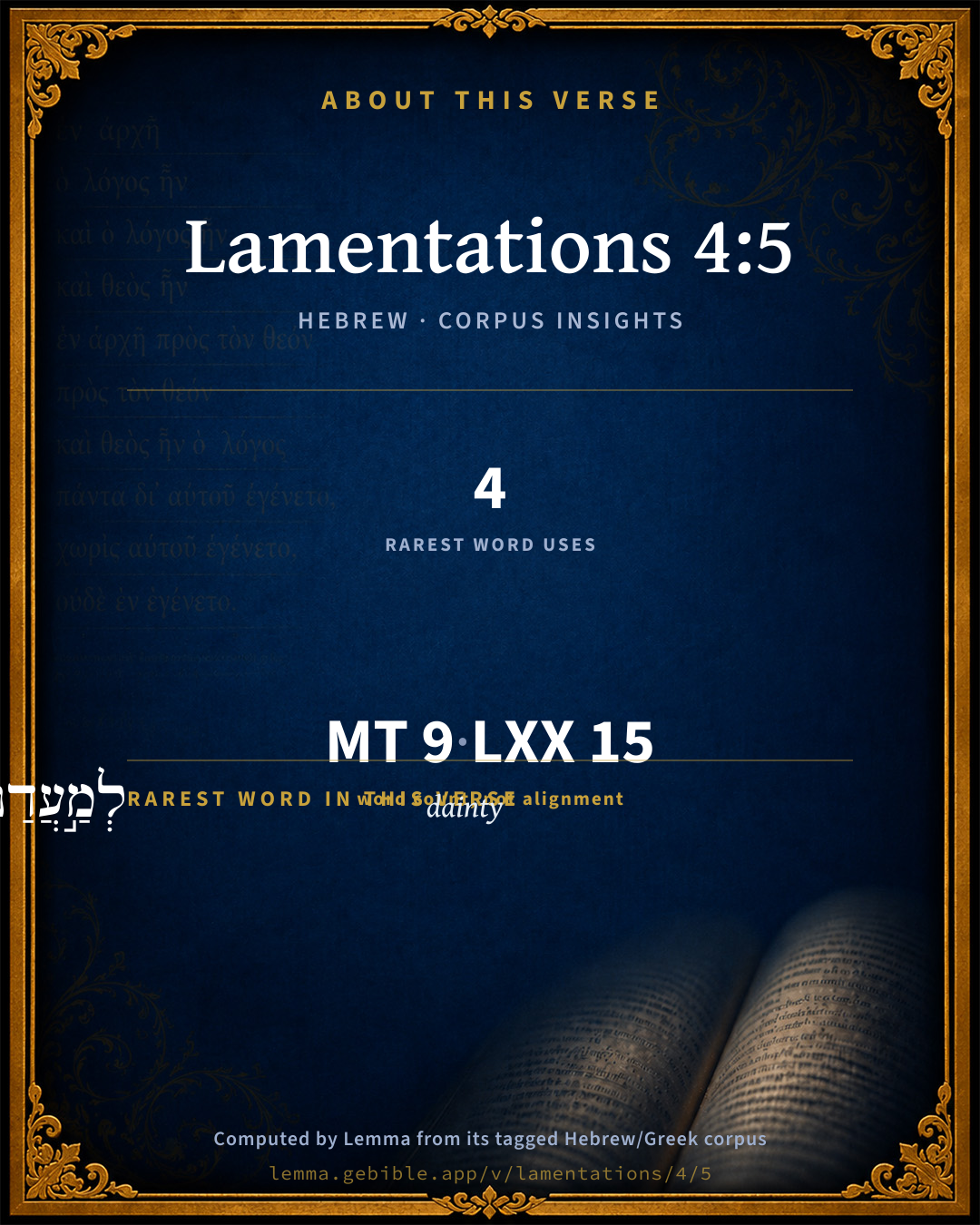
The rarest word here is לְמַ֣עֲדַנִּ֔ים dainty H4574 — appearing just 4 times in the whole Hebrew Bible.

Shared distinctive vocabulary

לְמַ֣עֲדַנִּ֔ים dainty H4574 occurs in 4 verses of the Hebrew Bible. Also found in:

Grammatical profile

  • 4 verbs
  • 4 nouns
  • 1 preposition

Verb forms

  • הָאֹֽכְלִים֙ Qal · Participle Active
  • נָשַׁ֖מּוּ Niphal · Perfect
  • הָאֱמֻנִים֙ Qal · Participle Passive
  • חִבְּק֖וּ Piel · Perfect

Hebrew & Septuagint length

In English translation the verse runs 19 words from the Hebrew and 24 from the Septuagint (LXX English) — closely comparable.

A rough comparison of the two English renderings, which tokenize alike — not a word-level alignment.

Word counts can differ between the Hebrew and the Greek without any difference in meaning — e.g. the Hebrew direct-object marker אֵת has no separate Greek word, and Greek often adds the article ὁ.

In the original languages it is 9 Hebrew tokens and 15 Greek tokens — but the two are counted differently (Hebrew bundles its prefixes and suffixes into one token; the Greek is in lemma form), so that isn’t a like-for-like length.

Cross-references

15

Topical passages linked to Lamentations 4:5 in the Treasury of Scripture Knowledge — connected by theme and wording, ordered by reader-vote popularity; previews shown in the World English Bible.

  • Luke 16:19 "Now there was a certain rich man, and he was clothed in purple and fine linen, living in luxury every day.
  • Proverbs 31:21 She is not afraid of the snow for her household; For all her household are clothed with scarlet.
  • Amos 6:3–7 Those who put far away the evil day, And cause the seat of violence to come near;
  • Luke 15:16 He wanted to fill his belly with the husks that the pigs ate, but no one gave him any.
  • Deuteronomy 28:54–56 The man who is tender among you, and very delicate, his eye shall be evil toward his brother, and toward the wife of his bosom, and toward the remnant of his children whom he has remaining;
  • 2 Samuel 1:24 You daughters of Israel, weep over Saul, Who clothed you in scarlet delicately, Who put ornaments of gold on your clothing.
  • Isaiah 24:6–12 Therefore has the curse devoured the earth, and those who dwell therein are found guilty: therefore the inhabitants of the earth are burned, and few men left.
  • Luke 7:25 But what did you go out to see? A man clothed in soft clothing? Behold, those who are gorgeously dressed, and live delicately, are in kings' courts.
  • 1 Timothy 5:6 But she who gives herself to pleasure is dead while she lives.
  • Revelation 18:7–9 However much she glorified herself, and grew wanton, so much give her of torment and mourning. For she says in her heart, 'I sit a queen, and am no widow, and will in no way see mourning.'
  • Isaiah 3:16–26 Moreover Yahweh said, "Because the daughters of Zion are haughty, And walk with outstretched necks and flirting eyes, Walking to trip as they go, Jingling ornaments on their feet;
  • Isaiah 32:9–14 Rise up, you women who are at ease, [and] hear my voice; you careless daughters, give ear to my speech.
  • Jeremiah 6:2–3 The comely and delicate one, the daughter of Zion, will I cut off.
  • Jeremiah 9:21–22 For death is come up into our windows, it is entered into our palaces; to cut off the children from outside, [and] the young men from the streets.
  • Job 24:8 They are wet with the showers of the mountains, And embrace the rock for lack of a shelter.

Cross-references courtesy of OpenBible.info (CC BY 4.0).

Hebrew and Greek witnesses Masoretic Hebrew ↔ Greek Septuagint

The same verse in the two great witnesses to the Old Testament, shown verse-for-verse.

These are two independent witnesses, not word-aligned to each other, and the Septuagint is shown in lemma (dictionary) form.

Hebrew Lamentations 4:5 Masoretic · Westminster Leningrad Codex

הָאֹֽכְלִים֙ לְמַ֣עֲדַנִּ֔ים נָשַׁ֖מּוּ בַּחוּצ֑וֹת הָאֱמֻנִים֙ עֲלֵ֣י תוֹלָ֔ע חִבְּק֖וּ אַשְׁפַּתּֽוֹת

Those who did feed delicately are desolate in the streets: Those who were brought up in scarlet embrace dunghills.

World English Bible · Public Domain

Greek LXX Lamentations 4:5 Septuagint · lemma form

ὁ ἐσθίω ὁ τρυφή ἀπο ἀναἵζω ἐν ὁ ἔξοδος ὁ τιθηνέω ἐπί κόκκος περιβάλλω κοπρία

HE. They that feed on dainties are desolate in the streets: they that used to be nursed in scarlet have clothed themselves with dung.

LXX2012 (modern English Septuagint) · Public Domain

Hebrew: Westminster Leningrad Codex (CC BY 4.0). Greek: Septuagint (public domain); English from LXX2012 (modern English Septuagint) (Public Domain). How the Septuagint differs from the Hebrew →

Commentary

Notes on Lamentations 4:5 from classic Christian and Jewish commentators (each source and its license shown beneath its notes). The classic Christian expositions comment on the surrounding passage and are grouped to its opening verse, so a note may address several verses; the Jewish commentaries on the Tanakh (Rashi and others) are per-verse, so they appear only where the commentator wrote on this verse.

Lemma curates 59 commentaries, every one of them public domain or Creative Commons licensed, each selected and text-cleaned for this edition rather than reprinted as found. About our sources →

Trapp's Complete Commentary

John Trapp

Lam 4:5 They that did feed delicately are desolate in the streets: they that were brought up in scarlet embrace dunghills.

Ver. 5. They that did feed delicately.] Such uncertainty there is of outward affluence. Our Richard II was famished to death. {a} Henry Holland, Duke of Exeter, grandchild to John of Gaunt, was seen to run on foot bare legged after the Duke of Burgundy’s train, begging his bread for God’s sake. This I saw, saith Philip de Comines. This Henry was brother-in-law to King Edward IV, from whom he fled.

They that were brought up in scarlet.] Qui nutriebantur in croceis seu cocceis, that were gorgeously arrayed, or, that rolling on their rich beds, wrapped themselves in costly quilts.

Embrace dunghills.] {b} There take up their lodgings, and there also are glad to find anything to feed on, though never so coarse and homely. The lapwing is made a hieroglyphic of infelicity, because he hath as a coronet upon the head, and yet feedeth upon the worst of excrements. It is pity that any child of God, washed in Christ’s blood, should bedabble his scarlet robe in the stinking guzzle of the world’s dunghill; that anyone who hath heretofore soared as an eagle should now creep on the ground as a beetle, or wallow as a swine in the mire of sensuality.

{a} Speed, lib. iii. cap. 4.

{b} In fimetis victum quaeritant prae inopia. - Jun.

John Trapp, A Commentary or Exposition upon All the Books of the Old and New Testament (1647–1656) — public domain. Text from a community e-Sword module.

Jamieson, Fausset & Brown

Robert Jamieson, A. R. Fausset & David Brown

delicately--on dainties.

are desolate--or, "perish."

in scarlet embrace dunghills--Instead of the scarlet couches on which the grandees were nursed, they must lie on dunghills.

embrace--They who once shrank sensitively from any soil, gladly cling close to heaps of filth as their only resting-place. Compare "embrace the rock" (Job 24:8).

Jamieson, Fausset & Brown — Commentary Critical and Explanatory on the Whole Bible (1871) — public domain (CC PDM 1.0). Text via the HelloAO Bible API.

Adam Clarke's Commentary

Verse 5. Embrace dunghills.] Lie on straw or rubbish, instead of the costly carpets and sofas on which they formerly stretched themselves.

Adam Clarke's Commentary on the Bible (1810–1826) — public domain. Text from a community e-Sword/MySword module.

John Calvin's Commentaries

Here he goes on farther, and says, that they had perished with famine who had been accustomed to the most delicate food. He had said generally that infants found nothing in their mothers’ breasts, but pined away with thirst, and also that children died through want of bread. But he now amplifies this calamity by saying, that this not only happened to the children of the common people, but also to those who had been brought up delicately, and had been clothed in scarlet and purple.

Then he says that they perished in the streets, and also that they embraced the dunghills, because they had no place to lie down, or because they sought food, as famished men do, on dunghills. It seems to be a hyperbolical expression; but if we consider what the Prophet has already narrated and will again repeat, it ought not to appear incredible, that those who had been accustomed to delicacies embraced dunghills; for mothers cooked their own children and devoured them as beef or mutton. There is no doubt but that the siege, of which we have before read, drove the people to acts too degrading to be spoken of, especially when they had become blinded through so great a pertinacity, and had altogether hardened themselves in their madness against God. It follows, —

John Calvin's Commentaries (1540-1563) — public domain. Text from the Calvin Translation Society English edition (1840s-50s) via the Christian Classics Ethereal Library (ccel.org). Calvin's coverage is partial (roughly two-thirds of the Bible); uncommented books and verses are honest gaps, never fabricated. The 19th-century editor's footnotes and remarks are omitted so the notes are faithfully Calvin's own voice.

Ellicott's Commentary for English Readers

(5) They that were brought up . . .—Literally, that were carried (as children are carried). “Scarlet” as in 2Sa_1:24, stands for the shawls or garments of the rich, dyed, as they were, in the Tyrian purple or crimson. Those that had been once wrapped in such shawls now threw themselves, “embracing” them as their only refuge, on dunghills.

A Bible Commentary for English Readers, edited by Charles John Ellicott (1878–1897) — public domain. Text from a community e-Sword module.

The Cambridge Bible for Schools and Colleges

gen. ed. J. J. S. Perowne

5. delicately] luxuriously. Children are still the subject, and not, as has been suggested, rich persons. In the latter case we should have to render carried on scarlet (i.e. litters or couches furnished with costly stuffs of that colour), unduly forcing the sense of the Heb. verb.

desolate] See on ch. Lam_3:11.

embrace dunghills] for want of a better couch.

The Cambridge Bible for Schools and Colleges (gen. ed. J. J. S. Perowne; Cambridge University Press, 1878–1918) — public domain. Text from a community e-Sword module.

John Gill's Exposition

They that did feed delicately are desolate in the streets,.... That were brought up in the king's palace, or in the houses of noblemen; or, however, born of parents rich and wealthy, and had been used to good living, and had fared sumptuously and deliciously every day, were now wandering about in the streets in the most forlorn and distressed condition, seeking for food of any sort, but could find none to satisfy their hunger; and so, as the Vulgate Latin version renders it, perished in the ways or streets:

they that were brought up in scarlet: in dyed garments, as Jarchi; clothed with scarlet coloured ones, as was the manner of the richer and better sort of people, Pro 31:21; or, "brought up upon scarlet" (o); upon scarlet carpets, on which they used to sit and eat their food, as is the custom of the eastern people to this day: these

embrace dunghills, are glad of them, and with the greatest eagerness rake into them, in order to find something to feed upon, though ever so base and vile; or to sit and lie down upon. Aben Ezra interprets it of their being cast here when dead, and there was none to bury them.

(o) "super coccinum", Pagninus, Montanus; "super coccino", Piscator, Michaelis.

John Gill's Exposition of the Whole Bible (1746–1763) — public domain (CC PDM 1.0). Text via the HelloAO Bible API.

Albert Barnes' Notes on the Bible

They that were brought up in scarlet - literally, “those that were carried upon scarlet;” young children in arms and of the highest birth now lie on the dirt-heaps of the city.

Albert Barnes' Notes on the Bible (1834–1885) — public domain. Text from a community e-Sword/MySword module.

Haydock's Catholic Bible Commentary

Scarlet. Literally, "yellow;" croceis. (Haydock) --- Hebrew means purple. Those who have been educated in the most delicate manner, are forced to feed on the most disgusting things, 4 Kings vi. 25., and xviii. 27., and Deuteronomy xxviii. 54.

George Leo Haydock (1774–1849), Haydock's Catholic Family Bible and Commentary, 1859 edition — public domain. Excludes Psalms (Douay-Rheims chapter numbering differs from Protestant) and Deuterocanonical books (Catholic canon only).

Matthew Poole's English Annotations

This judgment reached not only to the common people, but to persons of the highest rank and order, whose misery was now so much the greater, because so contrary to their former splendid state and way of living. They were wont to fare deliciously; now they wanted bread to eat, and were desolate in the streets. They were wont to eat upon scarlet carpets, or to lodge upon scarlet beds and conches; now they searched for their meat upon, or were glad to lie upon, dunghills.

Matthew Poole's English Annotations on the Holy Bible (1683–1685) — public domain. Text from a community e-Sword/MySword module.

Whedon's Commentary on the Bible

Daniel D. Whedon

5. They that did feed delicately — Lived in daintiness and luxury.

Are desolate — Perish of starvation, in the streets.

Brought up in scarlet — Literally, were carried on purple, or scarlet, (that is, as children,) have now no resting place but dung hills. One of the most vivid of all the passages reflecting the national distress.

Daniel D. Whedon (gen. ed.), Commentary on the Old and New Testaments (1874–1909) — public domain. Text from a community e-Sword module.

The Pulpit Commentary

They that did feed delicately, etc. i.e. luxuriously. The rendering has been disputed, but without sufficient ground. "They that did eat at dainties," i.e. pink at their dainty food, is forced. The Aramaic mark of the accusative need not surprise us in Lamentations. (comp. Jer_40:2) Brought up in scarlet; rather, borne upon scarlet; i.e. resting upon scarlet-covered couches. The poet speaks of adults, not of children.

Reverses of fortune.

I REVERSES OF FORTUNE ARE NOT UNCOMMON. It is not only in the rare case of a protracted siege, when at last rich and poor both suffer from the severities of famine, that we may see some who once fed delicately wandering desolate in the street. All who have gone down into the haunts of the very poor and have investigated the severest cases of wretchedness know how many of the most abject paupers have enjoyed wealth and luxury in former years. Even in an orderly society such as our own the number of these violent reverses of fortune is appalling. Let no one boast of his assured comfort.

II REVERSES OF FORTUNE ARE MOST PAINFUL. We rarely miss what we have never known. There is, therefore, much mitigation to the hardness of the lot of those who are born in the most miserable circumstances, arising from the fact that they have never experienced anything better. But the greatest distress is in coming down from affluence, comfort, and honour to poverty, distress, and shame.

III REVERSES OF FORTUNE ARE FREQUENTLY MERITED. We must beware of the error of Job"s friends. The innocent may and often do suffer from a most grievous succession of calamities. Still, those three men had much to say for their view. Their mistake was in making it universal in its application. It is rarely that the seed of the righteous man has to beg for bread. Good men may have a humble lot and sometimes may have to suffer considerable loss. But usually the greatest degradation and misery follows the folly or sin of the sufferer. Probably the one vice of intemperance is the cause of more than half the cases of the very worst reverses of fortune.

IV REVERSES OF FORTUNE SHOULD EXCITE PECULIAR COMMISERATION. The happy and prosperous should look out for such cases. The most sad among them are often the hardest to find. They hide in shame and misery. Especially when the degradation is moral it becomes a Christian work to seek to restore the fallen. The Son of man came, not so much to preserve the prosperous nor to raise those who had never known better things, as to seek and to save the lost sheep of the house of Israel, i.e. those who had once been privileged and had fallen from their first estate.

V REVERSES OF FORTUNE DO NOT JUSTIFY LOSS OF FAITH IN GOD. They tempt men that way. "Curse God, and die," a voice whispers into the ear of the despairing man. But it is the voice of folly as well as of sin. For:

1. We must expect to be governed in many mysteries by the great and all-wise God. It may be rational to disbelieve in the existence of God; but it cannot be rational to believe that he is, and yet to doubt his wisdom or goodness.

2. The reverse is often due to the fault of the sufferer.

3. It may be overruled for his good.

VI REVERSES OF FORTUNE MAY BE REVERSED. So was it in Job"s case; the end of the patriarch"s life was even brighter than the beginning of it.

1. This may happen on earth. In suffering we are too ready to lose heart. We paint the future in dark shades manufactured solely from present experiences. But there are more resources in the world than we dream of.

2. It will surely come in the next world to all who trust in God. Then the second reverse will be as joyous as the first was miserable. For the same principle will apply in both cases, and the great change will heighten the sense of the new condition. Happy are they who, in Christ, though suffering and despised, are looking forward to this glorious reverse of their present dark fortunes.

Social revolution.

I AN ILLUSTRATION OF THE INSTABILITY OF HUMAN SOCIETY. We may consider it either as the instability of wealth or the instability of rank. It shows how no class of the community is able to say that, whatever happens in the way of stress or destitution, it will keep right. Men build up societies in which rank comes from the accumulation of wealth or the exercise of power that is in a man by nature. But these human societies thus built up cannot reckon on permanence. Greed is excited on the part of others, and the higher a man has risen the lower he may fall.

II THE ILLUSTRATION HERE SHOULD MAKE US CONSIDERATE OF THOSE IN HIGH POSITION. The high are of necessity the few. Their position is seen from the outside and from a distance. What we do see is very likely to mislead us, for our eye lights on outward splendour and the appearance of much leisure and the ability to do very much what one likes. But the many journals and memoirs that have been published revealing the inner life of courts and titled circles show that human beings may be none the less miserable because the misery is gilded over. Our pity may be needed at any moment for the man of rank and privilege. Whatever the outward differences may be, the inward heart is the same, and that must have its sorrows, its disappointments, and its perils.

III WE ARE TAUGHT THE NEED OF CAUTION IN GLORIFYING HUMAN CIVILIZATION. What many people reckon to be the highest civilization needs material wealth in great profusion to keep it up. There must be classes to paint pictures, carve statuary, and give long periods of time to the elaboration of artistic conceptions, whatever they may be. And what a satire on all this it is to recollect how fragile and fading some of these art treasures have proved! The ignorant and narrow minded undervalue these things, but then it is also possible to over value them, to get so occupied with them as to forget the deepest things of humanity, the things that endure. The civilized, refined, natural man may be good, but how much better is the spiritual man, even though he be rude in speech and full of error in his tastes! Truly we may say, he that is least among spiritual men is greater than the highest of attainments among natural men. Y.

The Pulpit Commentary (1880–1919), ed. H.D.M. Spence-Jones & Joseph S. Exell — public domain. Text from a community e-Sword module.

Rashi

Rabbi Shlomo Yitzchaki (Rashi)

they that were reared on crimson on colored garments.

they that were reared Heb. הָאֱמֻנִים. An expression similar to (Esther 2:7): “And he brought up (אֹמֵן) Hadassah.”

clasp the dunghills heaps of dung; they lie on the dunghills in the street.

Rashi on the Tanakh — English translations: “The Judaica Press complete Tanach with Rashi, translated by A. J. Rosenberg” (CC BY 4.0); “Pentateuch with Rashi's commentary by M. Rosenbaum and A.M. Silbermann, 1929-1934” (public domain); “The Metsudah Tanach series, Lakewood, N.J” (CC BY 4.0); and “The Book of Joshua, Metsudah Publications, 1997” (CC BY 4.0). Text via Sefaria.

Lesson kit

Teaching starters — assembled from the data on this page, not authored interpretation. Every prompt links to the verse data it draws on. Edit before teaching.

Lamentations, in the Prophets, opens this verse with 9 words (9 distinct Hebrew lemmas). Its most distinctive word is maʻădân (“dainty”). A historical commentator’s framing appears above. Read the whole chapter for the surrounding context.

Discussion questions

  1. How does “dainty” (maʻădân) shape what this verse is saying?
  2. Genesis 49:20 shares the word «dainty» with this verse. How do the two illuminate each other?
  3. These translations render this verse differently. What is at stake in choosing one wording over another?
  4. The verb «הָאֹֽכְלִים֙» is Qal Participle Active. How does its form color the action?
  5. Reading how Trapp's Complete Commentary and Jamieson, Fausset & Brown read this verse, where do the two commentators agree and where do they part?

Things to notice

Reading settings

Reading text

Shown beneath each verse's original-language words.

Old Testament
Old Testament edition

Read the OT as the Masoretic Hebrew (MT) or the Greek Septuagint (LXX).

English shown for the Greek Septuagint (in the Hebrew ↔ Greek comparison).

Comparing translations? Open the Compare panel on any verse page to stack up to four side by side.